Top ten resources for teachers (part 2!)

“The internet is a great place for English language teachers, if you know to where to look!” …thus began part 1  – a post that was written to bring a group of internet-based gems together, to make it easier for all English language teachers to find and benefit from them. It has turned out to be a popular idea, even gaining a nomination for the  Teaching English British Council blog of the month award, BUT it also ruffled a few feathers: In making the list, I left off some brilliant resources!
So here is part 2 – another top ten resources for teachers to try out… This time, including the websites/resources that YOU wanted to see included! (Plus some more of my own…)

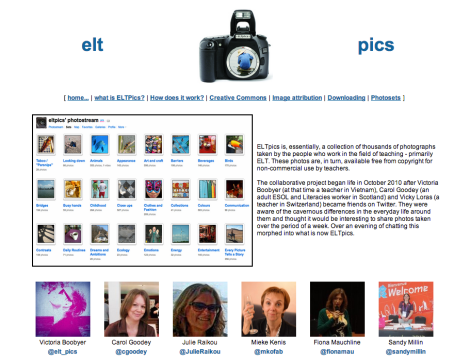
1. ELTpics


Screenshot of ELTpics home page

Screenshot of ELTpics home page


This collaborative project has made it possible for teachers to easily source creative commons – licensed photos for use in their classrooms. The above website has links to explanations about creative commons licensing, as well as how to download and accredit images. The images themselves are stored on flickr:

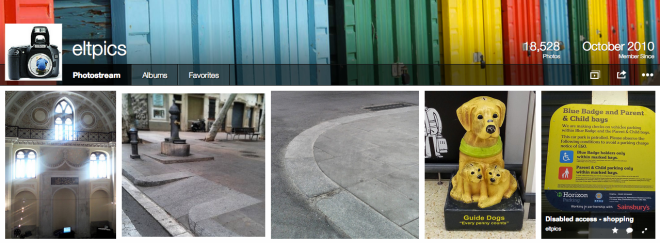
Screenshot of ELTpics Flickr site

Screenshot of the ELTpics photo-stream home

If you click on “albums”, then you can see, at a glance, all the different categories that are in use on ELTpics e.g. predictions, phrasal verbs, adjectives…  The project leaders set a new category on a regular basis, inviting everybody to send them pictures to upload into that category. You can also submit photos to be included in older categories. It is important that the photos you upload are your own and that if there are people in the photos (e.g. a picture of students doing an activity), that you have their permission to share those photos too.

2. Take a photo and…

Screenshot of Take a photo and...

Screenshot of Take a photo and…

Linked with the ELTpics initiative above, this blog contains ideas for how you can use photos – taken from the ELTpics stream or otherwise – in your classroom to great effect. Worth a look if you are after some inspiration!

3. (a) Teachit ELT

Screenshot of Teachit ELT

Screenshot of Teachit ELT

This is a website I hadn’t come across before – to the surprise of one of the readers of the original post. Free members have access to the above-pictured resources (nicely indexed in various ways – by level, skill, specialism etc) but can only download  .pdf files. If you want access, for example, to an audio track, you’d have to upgrade your membership. It looks as though you can get plenty of mileage out of .pdf access only, though, so worth a look.

Because you have to pay to enjoy the full benefits of this site, I will offer an alternative no. 3:

3. (b) Breaking News English

Screenshot of Breaking News English

Screenshot of Breaking News English

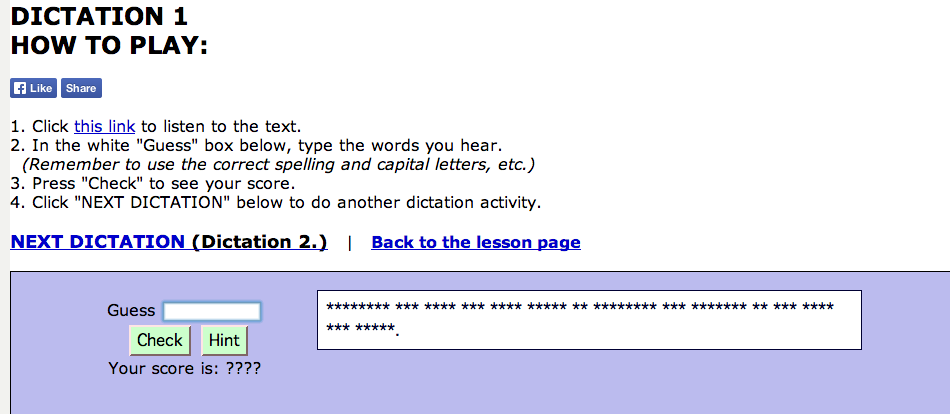
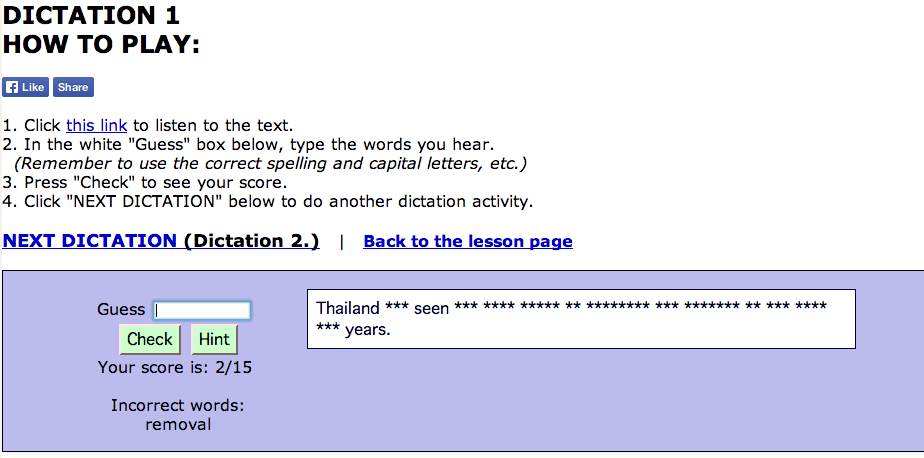
A 2014 ELTon nominee, this site offers freely available lesson plans and activities based on simplified news articles written by the site owner. Resources are divided up by level and as well as providing written text, there are also recordings of the articles being read aloud. These can be accessed at different speeds. There is also a dictation facility, which you can use with learners, allowing them to listen and type what they hear into a box (containing clues in the form of the dictation text written in asterisks, one for each letter of a word with space between words), and find out if thy are right or wrong.

4. Wordandphrase.info

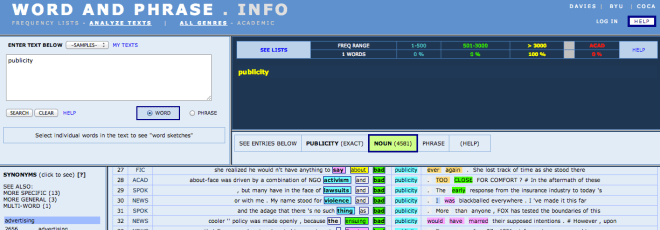
A screenshot of wordandphrase.info

A screenshot of wordandphrase.info

Time for one of my own favourites! This wonderful site allows you to find out about words and chunks of language, through corpus data analysis. You can input a chunk of text and see which words fall into the top 500, the top 3000 and which words are outside of the top 3000, according to frequency of use. You get definitions, synonyms, common collocates divided up by word type. You can also see which register(s) words/chunks are used in and see examples of use, either filtered by register or all registers mixed together. As teachers, we are often faced by student questions regarding usage or student work containing language that doesn’t seem quite right to us, though there is no grammatical reason why it couldn’t be. Wordandphrase.info is great for answering all these queries. Going a step further, it’s a great resource to get students using themselves, as a tool to help them answer their own language-related queries. If you want to know more, or want help using the site, I’ve written a series of posts about the site, including self-access materials to guide students (or teachers!) through use of it.

5. Science Direct

Screenshot of Science Direct

Screenshot of Science Direct

This is another one of my favourites. I hear you wondering, though, if I’ve got the name wrong – what’s science got to do with ELT? Well in fact, this is a site that allows you to search for articles from (as you can see) a range of disciplines. There are no small number related to different facets of ELT too. E.g. this search I did relates to learner autonomy and metacognition. You can search by journal title, author name etc. or browse by broader categories. One good thing about this site is that if you access a particular article, it will then offer you links to another set of articles based on the subject matter of the initial one you looked at. Of course there are the usual quantity of articles that are not freely available BUT, equally, there are plenty that are, and you can download these as .pdf files. So this is a handy way to access ELT-related literature.

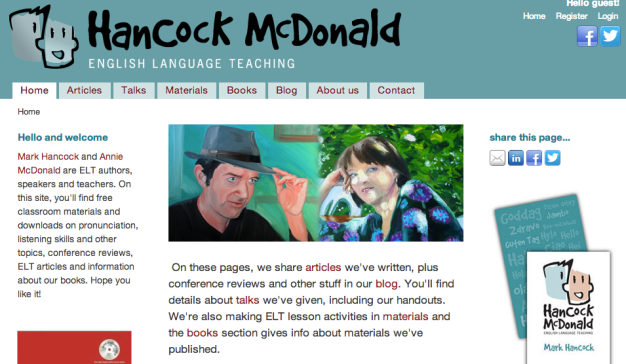
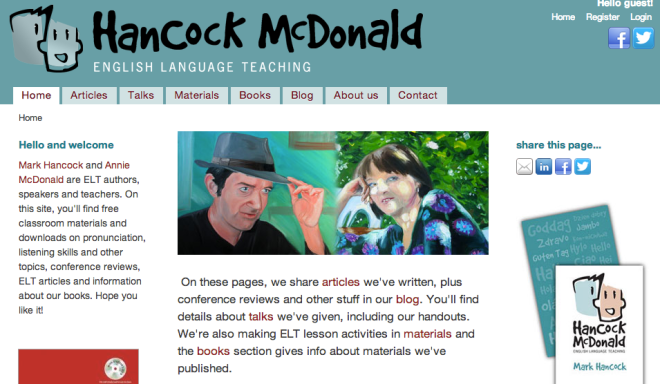
6. Hancock McDonald English Language Teaching

Screenshot of Hancock McDonald English Language Teaching

Screenshot of Hancock McDonald English Language Teaching

This great site contains a mixture of classroom materials and other resources e.g. articles and reviews related to pronunciation and listening skills. The site owners, Mark Hancock and Annie McDonald, are successful published authors and materials writers, so the materials are of high quality and the blog content worth reading. Pronunciation and listening are often referred to as the Cinderella skills, those that get neglected, and that are difficult to teach. Well, this site provides the inspiration necessary to get to Cinderella to that ball!

7. Recipes for the EFL classroom

Screenshot of EFLrecipes.wordpress.com

Screenshot of Recipes for the EFL classroom

This handy little blog fills a niche: It doesn’t offer lesson plans or glossy materials, but what it does do (and well, if the stats I’ve heard about are anything to go by!) is offer a mixture of activities, techniques and ideas that you can very easily use in the classroom. Taking the metaphor of a lesson as a meal, this blog divides aspects of teaching up by course and provides “recipes” for doing things differently and perhaps that little bit better. As an added bonus, you get some actual food and drink-related recipes too! Well worth a visit and bookmark.

9. TEFL.net

Screenshot of TEFL.net

Screenshot of TEFL.net

This site has been around for donkeys years. As well as lesson plans and resources, it hosts some discussion forums, a plethora of articles on ELT-related topics, a site of the month award offered on a – you guessed it! – monthly basis to recognise quality ELT websites, and more. You can also sign up for a weekly email that will bring teaching tips right to your doorstep – or inbox – regularly.

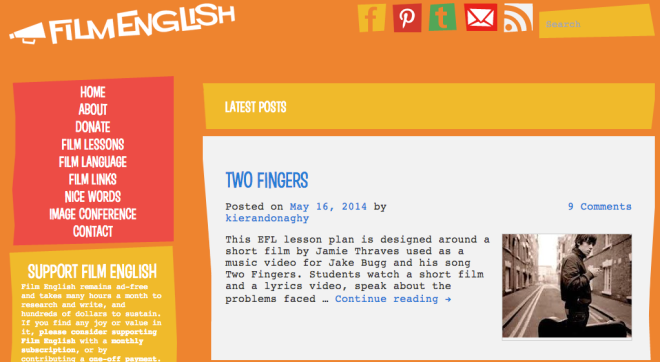
10. Film English

Screenshot of Film English

Screenshot of Film English

This website is an ELTon award winner for Innovation in Teacher Resources, and rightfully so: It contains a wealth of lesson plans based on short films. As well as using these to teach language, the lesson plans deal with “cine literacy” and encourage critical thinking skills development, important in this day and age. All resources are freely available, with the option of offering a donation to support the site and maintain its current “ad-free” format.

Afterword

That brings me to the end of another Top 10! I hope you enjoyed it and will find it useful. To the person who recommended EFL Smart Blog , it seemed a good site (if an interesting colour scheme) but more directed at students than teachers. For my top ten resources for teachers list, there has to be a significant element of the site that is geared towards helping teachers in some way. As you can see by the range of sites listed, there is no fixed format for this help to take, the only stipulation is that utility for teachers, not only students. 

Keep the recommendations coming – there’s always the chance of a part 3!

Learning contracts and language learning

The concept

Have you or your students ever made a learning contract before? Up to now, I’ve mostly encountered the concept in association with teaching young learners/teenagers and it generally includes rules for behaviour, which the student and teachers should follow. The idea is that by involving the learners in decisions regarding what should and shouldn’t be done in class, they will be more invested in adhering to these rules and take more responsibility for their own and each others’ actions. If we extend the scope of these contracts to include language learning behaviours then I think (hope!) they could become a very useful motivational tool. As my students have identified, through the projects I’ve done with them, “making goals and communicating them to others is a good way to gain motivation” (Student Feedback).

There would be echoes of:

  • goal setting theory (Locke and Latham, 1990, in Dornyei and Ushioda 2012:loc 569, in terms of goal difficulty, goal specificity, goal importance and commitment)
  • motivation theory (e.g. Egbert, 2003, in Dornyei and Ushioda 2012:loc 2039, and Motivational Flow, which requires a balance of challenge and skills, opportunities for focus, clear goals, intrinsic interest and authenticity of task and sense of control over the task process)
  • learner autonomy theory (in terms of taking responsibility for own learning, making decisions regarding one’s learning etc. e.g. Benson, 2011).

So, I think (hope!) learning contracts, if the scope were extended to include language learning behaviours rather than just classroom behaviours, could be a very useful motivational tool.

How useful? Well, I hope to find out this summer…

The experiment

I’ve just come back to England for approximately three months. During this time, unlike the past 8 months, I won’t be regularly exposed to Italian by default, which means it would be very easy to just ‘not get round to’ working on my language skills and systems. This would be rather a shame as I would inevitably regress fairly significantly in the process. In a vain attempt to maintain my Italian, I am going to make myself a learning contract.

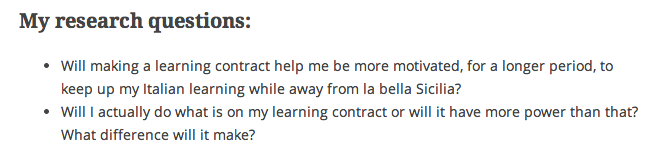
My research questions: 

  • Will making a learning contract help me be more motivated, for a longer period, to keep up my Italian learning while away from la bella Sicilia?
  • Will I actually do what is on my learning contract or will it have more power than that? What difference will it make?

My methodology:

  • Make the learning contract on this blog (therefore communicating it to a LOT of people!); copy it to Evernote as a checklist and check things off as I do them. Then uncheck them for take 2, recheck for take 3 etc. In order to keep track of what I’m doing.
  • Attempt to do what I said I’d do. (!)
  • Be aware of and make a note of when the learning contract influences my language learning behaviour.
  • Reflect on my progress with the language and with regards to the contract at regular intervals. (So the contract doesn’t get forgotten!)
  • See how rusty/otherwise my Italian is by the time I go back to Palermo!

My learning contract:

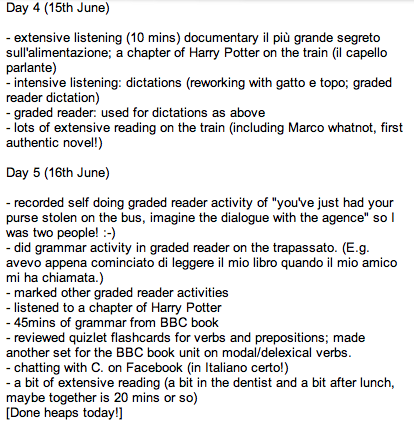
  1. Read extensively in Italian for at least 20 minutes every day. (I did this in Sicily, so it’s not a huge ask!)
  2. Listen extensively to Italian for at least 20 minutes every day. (This can include radio, podcasts, tv series, films etc.)
  3. Use my Italian graded reader regularly: To include reading it, listening to the audio, completing all the activities, reflecting on the process of using a graded reader for language learning. (I’m very curious to find out what it will be like! Will be a first for me!)
  4. Write on my Italian blog at least once a week. (If I do it more often, great, but a minimum of once a week.) I wrote on the plane yesterday, still need to upload it, so I have done so this week = a good start!
  5. Study grammar at least once a week. (Again, if more, so much the better but at least once is better than nothing!)
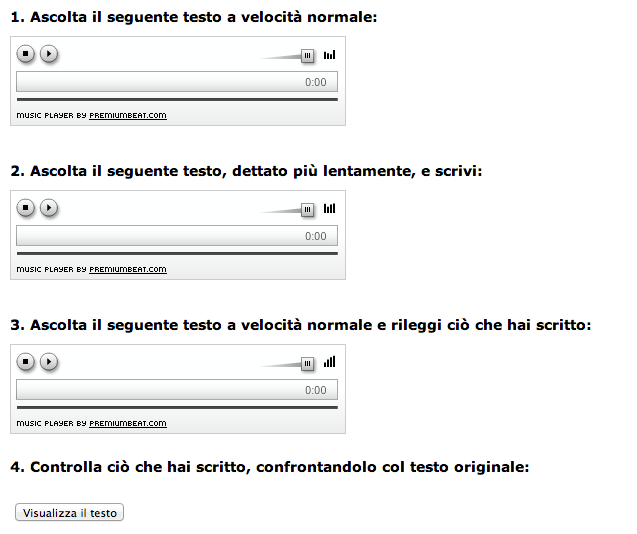
  6. Do intensive listening practice at least once a week. E.g. use this site . (Re frequency, as above!)
  7. Record myself (following muttering along to recordings or speaking freely, depending on my focus) at least once a week. (Re frequency, as above!)
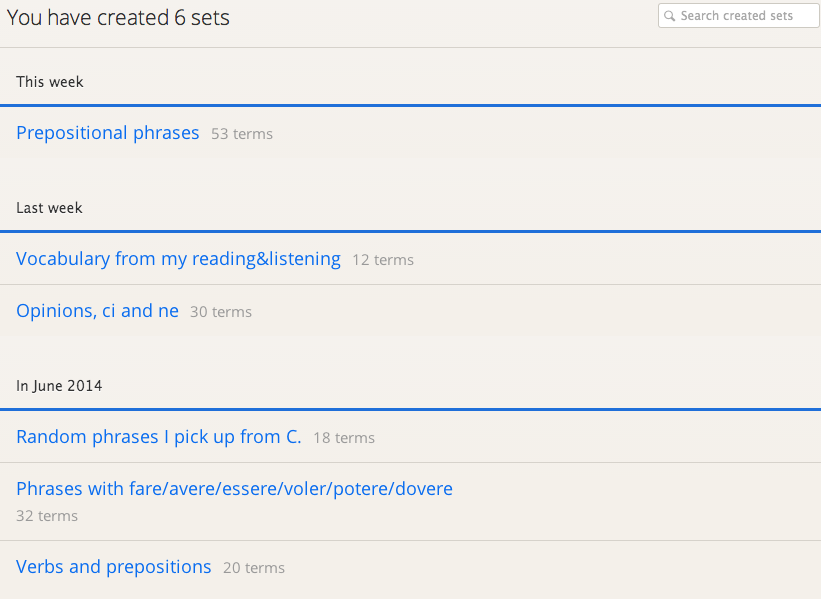
  8. Use Quizlet to learn vocabulary at least once a week. Alternate between adding words and playing with words each week. (Re frequency, as above!)
  9. Read something from my Italian magazine at least once a week. (It’s a big magazine, full of lots of articles of varying sizes. It’s sort of science-y, technology-y, news-y in content. I’ve only read about two things so far!)
  10. Send a message to one or more Italian friends on Facebook once a week. (Dual benefit of keeping in touch with people and using Italian!)

Signed: Lizzie Pinard   Date: 4/6/14

Next update on my progress due: 4th July or as near thereafter as work permits!

Wish me luck! Let’s see what happens to my Italian in the next few months…

Depending how things go, I may attempt to transfer what I have learnt through this experiment to my teaching in the autumn! I.e. try learning contracts with some of my learners.

References:

Dornyei, Z. and Ushioda, E. (2012) Teaching and Researching Motivation. Pearson Education Limited.

Benson, P. (2011) Teaching and Researching: Autonomy in Language Learning. Pearson Education Limited.

British Council Blog of the Month award nomination!

A big thank you to Teaching English British Council for nominating me for their blog of the month award for this month! The nomination is for my Top ten resources for teachers  post, which some of you may have already seen. Thank you also to the 438 people who have voted for me by “liking” the post since TEBC posted their nomination on the Facebook page sometime yesterday! A pleasant sight to discover upon returning from my holiday (3 whole days off ELT! It’s a record!!)…

Thank you to TEBC and all the people who have voted by "liking" my nomination!

Thank you to TEBC and all the people who have voted by “liking” my nomination!

There are already some great other nominees/blog posts up for the award, so I don’t imagine I shall win, but it’s lovely to have been thought of, and lovely to have got a few “likes” too. 🙂

The post came about because there are so many great resources on the internet if you know where to look but not all teachers may be lucky enough to know all of them. So, I made an annotated list of ten (with some cheating, I mean grouping!) of the best, as a useful starting point – and with 9,262 views since I posted it on the 12th May this year, it is my most-viewed post of all time! I’m now planning a “part 2” – to add some of the fantastic resources omitted, such as ELTpics!!  I’m glad (going by the “likes” and views) that people seem to think it’s a good idea to bring these resources together and I hope it has been useful to you all.

Why not have a look at the TEBC Facebook page and see what posts the other nominees have been nominated for, and if you feel so inclined, have your say by “liking” the post you think deserves to win? And while you’re at it, have a look at the wealth of interesting stuff that the TEBC group share via this page on a regular basis! Well worth a peruse.

At the British Council ELTons, 2014!

At the risk of sounding unbearably smug and like I’m blowing my own trumpet at full volume etc. (which, let’s face it, would be most un-British!), I’m going to allow myself one more post about the ELTons 2014 and my very unexpected win. Why? After all, yesterdays news, today’s fish and chip papers and all that…

Well, I’ve been given permission to upload my “winner’s interview” (recorded after the awards ceremony, when I was still completely stunned!) onto my blog – and being as realistically I’m never going to win an ELTon again, and, even if blue moons were to happen, will definitely never win the Macmillan New Talent in Writing award again (for obvious reasons…) So I’ve decided to go ahead and have my interview on my blog – it’s the first time I’ve ever been interviewed, and probably the last, so why not!

Here it is:

As I said in the interview, you can’t get hold of the materials yet – they are still just my dissertation project, so there is only one printed copy (first edition!) gathering dust in my tutor’s basement somewhere and a .pdf or two on my hard drive – but here is some information about them if you are interested!

And here are a smattering of the wonderful tweets I received following my win:

Screen Shot 2014-05-30 at 14.40.38Screen Shot 2014-05-30 at 14.50.16Screen Shot 2014-05-30 at 14.50.21Screen Shot 2014-05-30 at 14.50.29Screen Shot 2014-05-30 at 14.50.37Screen Shot 2014-05-30 at 14.50.52

And, yes, yes I did “favourite” them all! 🙂 I also attempted to respond:

Screen Shot 2014-05-30 at 14.59.41

Thank you, again, to all who sent me such lovely messages. I couldn’t put them all on here, or this post would be endless! But it was very enjoyable to receive them all, they were much appreciated. 🙂

I will be very interested to see how it all unfolds – when I will hear from Macmillan, what they will say… I haven’t heard anything from them yet, however, which I’m actually quite surprised about: I suppose I had expected some kind of acknowledgement from them, that I have won their award this year! But then, these are not circles in which I’m accustomed to moving, so I can’t say I have anything solid on which to base my expectations! The good news is that the B.C. ELTons team are taking care of the prize money aspect and arrangements regarding this are under way. Yay!

Interesting times, especially having read this post by Nicola Prentis. All I can say is, watch this space! Meanwhile, there is no shortage of “things to do” on my never-ending list! 🙂

41st ELT Blog Carnival on Learner Autonomy – coming soon!

I’m delighted to be hosting the 41st ELT Blog Carnival in June this year and looking forward, very much, to seeing lots of posts written by lots of people, all about learner autonomy – the 41st Blog Carnival topic of choice.

To find out about how to get involved, how to submit posts, how to avoiding missing out on ELT Blog carnivals to come and where to go to catch up with ELT Blog carnivals past, click on the image below:

Screen Shot 2014-05-20 at 16.58.38

Get your thinking caps on, everybody!

Let the carnival begin!

Let the carnival begin! Image taken from en.wikipedia.org via Google search for images licensed for commercial reuse with modification

Let the carnival begin! Image taken from en.wikipedia.org via Google search for images licensed for commercial reuse with modification


One little thing… (A guest post by Ceri Jones!)

A little over a month ago, I issued a challenge to all who read this blog. The challenge was to reflect on and write about a little thing that has made a big difference to your teaching during the last year. All was quiet and then sometime later, there was a flurry of discussion on Twitter 

Little things...

Little things…

little things...

Little things…

as a result of Sandy sharing my link on Twitter and Facebook. (Thank you, Sandy!) And this is where Ceri Jones comes in. Not only is this the first blog post written in response to my challenge, but Ceri also has the dubious honour of being the first person to write a guest post on my blog! I’m delighted to host her post here and hope she will be the first of many guests. Ceri is a teacher, materials writer (you may have seen her name on one of your course books! – Inside Out, Straight Forward, The Big Picture…) and also has a great blog , well worth a visit.

Here it is then, Ceri’s response to my challenge… 

I was sitting on a train using Facebook as a pacifier, when I came across this great blog post by Lizzie. It got me thinking. Then it got me writing. First to Lizzie in the comments and then in my little purple note book.

ceri pic 1

my little purple notebook – © Ceri Jones

One little thing …

Post-its used to be an essential part of my day-to-day teaching kit. I was teased about it, in fact, leaving little coloured squares in my wake wherever I went. But that was a long time ago. And I moved on and discovered other tools that obsessed me instead (scraps of paper, IWB slides, shared photos on my phone, voice recordings on our class blog.)

Then, a few months ago, I attended a workshop at a conference by a teacher taking the reverse journey, from technology to paper. And more specifically exploring the potential of post-its. It wasn’t her ideas as such (though she had some great ones to share) but the objects themselves that inspired me. And on Monday morning I bought a stack of post-its and took them into my beginners class. And alongside the whiteboard, the miniboard, the projector, and the blog, they became a new focus for collecting and organizing and revisting and recycling emergent language in our barefoot classroom.

My purple notebook started to bulge with them. The walls of the classroom were decorated with them. The photos from our classes were dotted with them. I don’t think it’s changed the way I taught as such, but it did refresh it and made playing with language (literally) more hands on.

Here are a few examples:

Post-its in action

Post-its in action – © Ceri Jones

In this class, the post-its helped us look back at what we’d studied last term, and look forward to what we wanted to do next. I’ve kept them in my notebook as a reminder.

ceri pic3-2

post-its and question words – © Ceri Jones

In this photo, taken in yesterday’s class, we’re revisiting question words. The students matched the words with their meanings. Then we took away the words and they remembered them from their meaning. Then we took away the meanings and remembered them from the words. Then we moved them around and regrouped them, comparing e.g. who, which and what, or how, how much, how many, how often. The little pink stack will come back to the table at the beginning of the next lesson again to be fingered and matched and moved around.

Ceri pic 4

question words in context – © Ceri Jones

Here the words have gone back into the context of the questions the students had asked in the lesson before. And later, after we’d followed the various tangents thrown up by the questions, they stayed on the board without their questions as memory hooks.

The colour and the movement and the manipulation makes the language, and the lesson, just that little bit more memorable. A little thing … but thanks for giving me the time to think about it Lizzie!

Thank you, Ceri!

I hope everybody enjoys Ceri’s post as much as I have.

If you would like to write a guest post in response to this challenge, or on a different topic (e.g. metacognition , language learning , your Delta/M.A. experiences , learner autonomy, a classroom activity you’ve used successfully… etc!) please do get in touch by commenting on this post or emailing lizzie.pinard@gmail.com.

What’s in a name?

What *is* in a name?

This blog post was inspired by a recent email exchange with somebody who wrote to me asking for information about the Leeds Met M.A. ELT/Delta. However, the “biggest concern” that this person had, and the main question they wanted me to answer, was with regards to the university’s reputation and the impact of this on post-qualification job-hunting.

It’s a fair question.

In fact, before I went to Leeds Met, I also had the same question. Although, my concern was more immediate – about the quality of the course rather than what would happen beyond it.  I suppose big names are reassuring: If you go to a school with a big name, you embark on your mission with confidence in what will happen – it will be as high a quality as befits such a name. Small names are perhaps more of a gamble. I had never heard of Leeds Met until I found the course leaflet in my conference pack when I went to Glasgow in 2012.

Why did I make that gamble?

I investigated the course website very thoroughly, looking at the staff profiles relevant to my course, and was reassured by the extensive experience the tutors could lay claim to, teaching (both in years and variety) and academic (presentations. publications etc). Additionally, of course, not any centre can run a Delta course – they have to meet all sorts of criteria and be externally assessed periodically to ensure that they are meeting those criteria. The tutors have to be suitably qualified and experienced as well – naturally.  I was planning to take the Delta/M.A. route, where the Delta is integrated into an M.A. in ELT. So in the end, I thought that at the very least I would (hopefully!) come out of the course with my Delta, which is universally recognised, and if the M.A. wasn’t much good, so be it – I’d make of it what I could.

Outcome

In the end the gamble I made paid off in spades: I learnt a huge amount and have been trying to put it all to use, and build on it, ever since; in various ways. The course was practical as well as rooted in theory, my tutors were so supportive of all my efforts and I’ve also had a wealth of opportunities since, that have emerged as a result of doing the course and putting that learning to use. Most recently, of course, I’ve won an ELTon for the materials I produced as my dissertation project.

Question

To those in the position of hiring people in the ELT profession, do you look at C.V.s and make a decision to short-list or not short-list a person for an interview based on the name(s) attached to their qualification(s)? How much does it influence you and why?

To all those who have done M.A.s in an ELT-related field, or any other ELT-related qualifications, what influenced your choice of institution?


Question time! (image taken from pixabay.org via google search for images licensed for commercial use with modification)

Question time! (image taken from pixabay.org via google search for images licensed for commercial use with modification)


My latest British Council Associate blog post: RESET – five tips for staying motivated!

My British Council Associate blog post for May was on the topic of teacher motivation. I came up with a cheesy acronym for my tips – RESET! (or: Read, Experiment, Step back, Evaluate, Take a break)

Click on the Wordle below (based on the content of the post!) to be taken to the British Council Teaching English site page where my post can be found.

RESET: 5 Tips for staying motivated

RESET: 5 Tips for staying motivated

I think motivation is a fascinating area of study and that it’s important for both teachers and learners to be able to manage their motivation effectively. It’s a theme I shall definitely be returning to in later blog posts.

Thank you, British Council Teaching English team, for the continued opportunity of writing as a Teaching English associate blogger, it’s a stimulating project that I am very much enjoying! 🙂

To read posts by all the other wonderful associate bloggers that I am honoured to share my title with, please click this link. And do have a look at Rachael Roberts’s insightful blog post that is also on the topic of teacher motivation and avoiding burn-out: in it, there some very valuable tips for all.

British Council ELTons 2014: the speech I *didn’t* make

As everybody who follows this blog (and one or two others who don’t) know, I was nominated/shortlisted for an ELTon this year. I was delighted when I made the long-list back in November – would have been quite satisfied just to have got that far – then thoroughly wowed when I made the short-list in March.

Tonight, thanks to my lovely Dos and my school director, I was able to attend the awards ceremony, along with my M.A. ELT tutor/”product team”, Heather. Prior to the ceremony, all nominees had been emailed to request that we prepare a speech for just in case we should win the award. Well, suffice to say speech-writing didn’t happen, end-of-term report writing (and a million other things) did – but that’s ok, it wasn’t like I was going to actually win or anything… Except, I did. Miraculously enough, I am now an ELTon winner in the category of Macmillan award for new talent in writing. (Thank you, Macmillan and thank you British Council!)

Apparently I won!

Apparently I won!

I was so stunned when they announced me as the winner, that I had to be shown the way to get onto the stage. And then, of course, I was presented with the award (which I can vouch is very solid glass, going by the weight – wouldn’t like to drop it on my toes by mistake…) and asked to say a few words. Rabbit in the headlights comes to mind, but nevertheless I duly made a speech of sorts. Which could be summed up in the following sentence: “I was super lucky because I went to IATEFL a couple of years ago, found a flyer in my conference pack and as a result wound up at Leeds Met, where my materials were born” I clean forgot that one is supposed to thank every man and his dog on such occasions – and it’s not like I’m without people to thank. Fortunately, I have a blog, so now I’m going to write the speech I should have said! (Though I think what I said was a good start…)

“I’m standing here (now a figurative here!) tonight because of a flyer. Two years ago, I went to the IATEFL conference in Glasgow and I found a flyer in my bag. It was the flyer for Leeds Metropolitan Uni, where I would go on to do my M.A. in ELT. It wasn’t a decision taken lightly – it was a risk. But sometimes, taking risks pays huge dividends. I didn’t know Leeds Met. I didn’t know that I would find the best tutors (thank you all!) and course-mates (thank you too!) I could ever have hoped to have there. I stepped into the unknown – and got super-lucky. I’m mostly here tonight because I’m lucky…

My biggest thanks has to go to Heather Buchanan, course leader of the M.A. ELT/Delta at Leeds Met, from whom I learnt so much during the materials development module, and who gave me so many hours of her time and so much support throughout the course and especially while I was creating these dissertation materials (and trying to decide how to answer the awkward questions she asked me about them on a regular basis!). Also, for not letting me bin them halfway through the summer when I had decided they were rubbish and I’d be better off starting again! Thank you for everything, Heather. 🙂

Secondly, I must thank Sandy Millin, who I met thanks to Twitter and #ELTchat and who has been a massive source of inspiration to me ever since. If it weren’t for her, my materials would be twice as long as they currently are, as the instructions would all be epically long, rambling nightmares. One weekend, Sandy eventually managed to just about beat the habit of using ten words where three would do out of me, as well showing me a wonderful world of computer shortcuts that made my life (well, using Indesign and MS Word) a lot easier, during a rather trying several months! Thank you so much, Sandy! 🙂

Thirdly, a big thank you is also due to Jane Templeton, one of my course mates at Leeds Met. She had the unenviable task of putting up with my regular whinging about the D-beast. (On the plus side, she got to moan about her assignments to me too, though!) Seriously, though, things are made so much easier by the support of others who know what you’re going through, so you can cuss together over a glass of wine! Thank you, Jane! 🙂

Finally, though they only came into my life after the big project was complete, I want to thank my current employers and colleagues. I work in a fantastic school, with really supportive people around me and that is invaluable. Currently, it is the busiest time of the year at IH Palermo, but my DoS let me attend the ceremony tonight nevertheless and has been so very supportive of me in every way, while my colleagues have, between them, covered the classes I will be missing as a result. Thank you Jonny, Pat and Silvio, and everybody else at IH Palermo. I’m very glad to be going back for another contract after the summer!

I’m also here because my Grandad left me some money when he died, and it was that money that I used to pay for my course at Leeds Met. He was an amazing man, who lived an amazing life and I wish he were able to see what a difference he’s made to my life. My M.A. ELT/Delta year was life-changing in so many ways. And this ELTon award is one of the wonderful outcomes of it.

I’m delighted to accept the award (yep, still delighted!) and (still pretty much as) stunned (as I was when I stumbled onto the stage this evening). Thank you everybody.”  Fortunately I hadn’t prepared a speech so the audience didn’t have to sit through this when I was unleashed on the microphone. 😉

It’s been a crazy journey getting to this point, and I look forward with interest to the next stage. Meanwhile, it was a brilliant experience being at the ELTons ceremony tonight, albeit rather surreal for a little nobody like me! 🙂 My warmest congratulations to all the other winners in all the other categories!

And now, 20hrs after I woke up in Palermo this morning, goodnight world! 🙂

Autonomous listening skill development: activity 1

How do I help learner get beyond “just” listening?

Listen! (Image taken from www.pixabay.org via Google search for images licensed for commercial reuse with modification)

Listen! (Image taken from http://www.pixabay.org via Google search for images licensed for commercial reuse with modification)

I encourage learners to listen extensively outside class, and extensive listening is recognised as beneficial to language learning. But what about actually developing listening skills? As in, listening with a view to improving both decoding (“translating the speech signal into speech sounds, words and clauses, and finally into a literal meaning” (Field, 2008:kindle loc. 2386)) and meaning-building (“adding to the bare meaning provided by decoding and relating it to what has been said before” (ibid)) skills.

How can I help learners to actively work on their listening outside class as well as during listening lessons? Part of learning autonomously is awareness of a range of task types and their potential learning benefits, and the corresponding ability to pick tasks according to learning goals. Helping learners become able to do this with their listening is something I have begun to work on within my learner autonomy projects.

What activities can learners do to help themselves develop their listening skills rather than just listening?

In this series, I will describe some listening activities I’ve done with learners to help them become more autonomous listeners by giving them something tangible to do with their out of class “listening practice”.

This first activity works well as a follow-up to a lesson with focus on weak forms , in which you have raised learners’ awareness of weak forms in connected speech.

Aims:

  • increase perception of weak forms in connected speech
  • develop sense of rhythm and the role of weak forms and word/sentence stress within this
  • develop learners’ ability to chunk written language correctly when they read it

Materials:

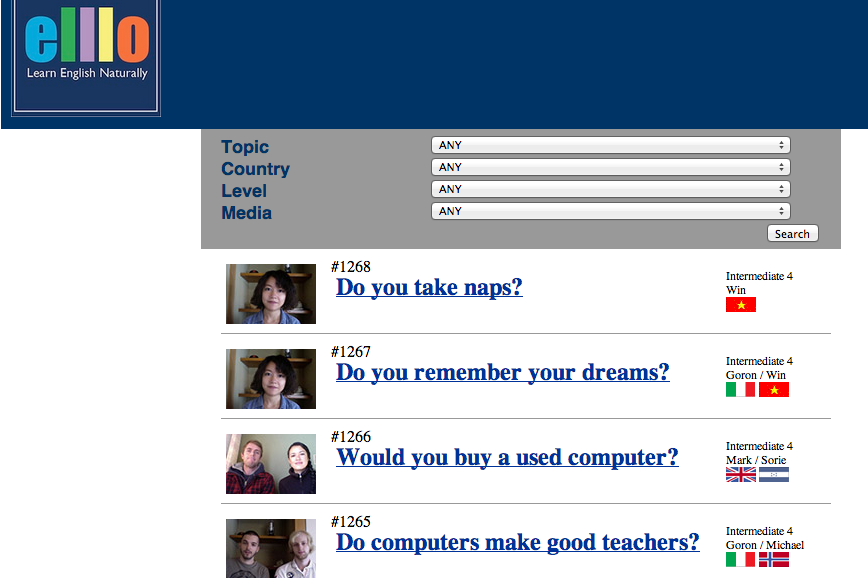
  • Learners will need a recording that has an accompanying transcript. (For learners at intermediate and below, www.elllo.org could be a useful resource for this; for higher level learners, a possible resource is the BBC “Voices” project )

Procedure:

  • Learners should, of course, first listen to their recording for meaning (identify main ideas, key information etc.)
  • Once learners have listened for meaning, they can compare what they heard with the transcript and check.
  • This done, learners play the recording again and mutter along with the recording, aloud. (For this, it could be worth selecting a portion of the recording rather than trying to do the whole thing.)
  • Ensure that learners are aware that initially this will be very difficult. The speakers will speak “too fast” for learners to keep up. However, if they replay and mutter along with a portion of the recording several times, then they will be able roughly match it.
  • How do they match it? In order to keep up with the recording and not get out of synch, they will be forced to use the same rhythm and stress as the speaker. This means they will need to stress certain words and shrink others – i.e. the weak forms. NB: The goal of this isn’t to try and get learners to speak in this way: it’s to develop their perception of the stress and rhythm of English, which they can then use to help themselves listen more effectively. However, I think the productive element is important as it helps to increase their perception by making it physical. 
  • Follow up: Once learners have muttered along enough times to be able to do so relatively comfortably, they could then record themselves reading the transcript aloud, trying to maintain the rhythm they developed during the muttering activity. They could post their recording and a link to the original recording on a collaborative platform e.g. Edmodo and compare each others’ efforts.
  • Breaking the activity down: With my learners, I did this as a series of homework activities:The first was to find a recording, listen for meaning, check with the transcript, then do some muttering.The second was to do some more muttering and then record themselves.The third was to listen again to the original recording, with the transcript, and mark all the pauses they heard, and use those pauses to help themselves manage their breathing while muttering and while recording themselves. Then they compared the first lot of recordings with the second lot.Of course this third step could be done earlier: Done in the order I did it, learners benefit from the comparisons they can make, but done earlier, they may benefit from that scaffolding sooner.

Benefits:

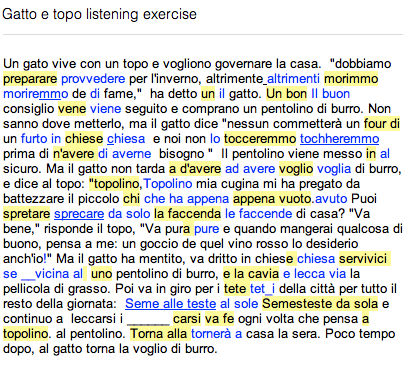
  • Because learners have to use correct word and sentence stress in order to keep up with the recording, it draws their attention to these. (I found when I tried the activity with an Italian recording, I’d get out of synch and lose the rhythm when I put the stress in the wrong place in a word. E.g. “gentile” springs to mind, and “sapere”, “utile” and “omeopata” – you realise that you keep getting out of synch at particular points, listen again and pay special attention to those points, then try again with the correct pronunciation, and then, with persistence, it works better.)
  • Recording yourself and listening to the recording, as well as comparing to the original, can help you pick out weaknesses in your pronunciation, and in doing so become more aware of what you are hearing.
  • Listening to, looking at and producing the weak forms helps learners become better able to recognise them through familiarity: it draws very focused attention to how the words look vs how they sound when condensed in connected speech, which is highlighted by the physicality of having to produce it.

Important to remember:

  • Bring it back into the classroom: give learners time to discuss at the beginning of the lessons following those when you set this activity as homework.
  • Ensure learners know they aren’t expected to speak in this way: Otherwise put, ensure the goals of the activity are clear to learners. When you set the activity, having done your focus on weak forms lesson, encourage learners to make the link between that lesson and this homework activity.
  • Scaffold it: You might have noticed that my lesson on weak forms involves some muttering along with the transcript. This means that before I got my learners doing the activities described in this post, for homework, they weren’t starting from a blank page – either from the pronunciation awareness perspective or from the task knowledge perspective (accustomed to using transcripts for listening activities, done similar activities in class, know how to approach them vs. “the transcript is that strange bunch of text that lurks in the back of the course book”!). Hopefully this will have made it less daunting and less confusing; well, certainly my learners all managed to do the task successfully and were enthusiastic about it.

Conclusion

Helping learners develop their listening autonomously is something I will be doing more work on in the future: exploration only began post-IATEFL (using Sandy’s ideas as a way in) and has been sporadic since then (I’m human! There are only 24hrs in a day and some of those are needed for sleeping/eating etc.!) with a burst of ideas emerging very recently through experimentation with my learners and in my own language learning. I’m planning to build on it, and work it into my learner autonomy projects more systematically as next steps, especially during the next set of courses that I teach.

References:

Field, J. (2009) Listening in the Language Classroom. Cambridge University Press.