Write-up of Andrew Walkley’s BELTA webinar: Language-focused teacher development

This afternoon, I have had the pleasure of attending a fantastic webinar presented by Andrew Walkley, one half of the popular Dellar-Walkley duo whose project Lexical Lab you might be aware of. 

Andrew delivering an awesome webinar!

Andrew delivering an awesome webinar!

The focus of the webinar was Language-focused teacher development, looking at the way we deal with vocabulary in class and what we need to be doing outside class in order for this to become more effective. I took notes as we went along, so here they are, slightly edited to make them more comprehensible…

  • First we were asked to put groups of four words into order of their frequency.
  • Then we were asked to make examples for a set of seven words and a structure (the past continuous).

Andrew went on to explain that within the CLT era, we have seen some particular types of approaches emerge, that are language rich and responsive – TBL, Lexical Approach, Dogme, Demand High…

  • In TBL, if there is breakdown in communication, this is where learning is supposed to happen, the teacher facilitating this learning.
  • In Dogme, maybe some further practice together will be done too.
  • With Demand High teaching (which concept he said sparked this talk), there was a complaint that a lot of teaching taking place where you move from task to task but without much actual teaching happening. The teacher needed to be stronger in saying ‘no, this is wrong’ or pushing individual students and teaching them in the moments where they are struggling. A lot of Scrivener’s solutions were technical, technique-type things, e.g. the teacher pretends not to understand what the student is saying, thereby forcing them to explain why what they were were saying was right.

That’s ok to a point, but Andrew felt that it wasn’t the real reason why the teaching wasn’t happening.  He has been interested in the Lexical Approach since its publication 20 years ago now, he has also been aware of the expectations of thinking about language and dealing with language that are advocated in LA are high. He recognises that it is difficult.

Andrew then introduced us to a book, Thinking Fast and Slow by Daniel Kahneman. It deals with the difficulty for experts in employing their expertise. This is because of the need for fast, in the moment, spontaneous thinking, where rather than think clearly about certain aspects of thinking, we replace a kind of logical thought with heuristics i.e. a generalised idea of something.

This brought us back to the task we did at the start.

Andrew showed us the answers to the frequency question:

Screenshot of the answers to the frequency quiz

Screenshot of the answers to the frequency quiz

Then he asked whether the corpus frequency answer (biased towards written) is reflective of the bias in native speaker natural use? His feeling is that often we overestimate certain frequencies of words and underestimate others. In the spoken corpus, arise and beard come at a similar level. Many students are interested in academic and professional lives in English, where they may not be using the language all the time in the workplace or study in Britain etc, but the resources they use may be in English, so a word like ‘arise’ would have a higher frequency and value.

As for the activity of making examples: our tendency is to produce examples like the ones we produced, but sometimes these aren’t actually the most common uses or even the way we use the language. Of this type of example, they may be one in a thousand in the corpus. E.g. She is a Christian. So… how is Christian really used? Andrew confessed that he might struggle with some of these words, in terms of making examples. E.g. whereby, arise, in terms of. Some of these are more difficult to think of examples from. They don’t fit into that simple x is y pattern. They require more complex sentences:

Screenshot from the webinar

Screenshot of Andrew’s examples from the webinar

It’s difficult to think of these kind of examples on the spot, Andrew explained, the Daniel Kahneman book offering some very clear reasons as to why. This is to do with biases that overtake logical thought. Our tendency would be to put words like blonde, banana etc. higher up because we know we can think of examples for these more easily than arise or whereby. If we think about the number of different contexts that we use banana or arise, then it becomes clear that arise would occur in academic texts, meetings, and several more possible contexts than the word banana or beard. Similarly serious vs. fun, there are a wider number of things that can be serious than there are fun things. As I understood it, this is availability bias, one of three factors that affect our choice:

  • availability bias
  • representational bias
  • priming

Apparently words also have a representational bias, e.g. x is y, x does y, doctor has a white coat etc. So the examples and explanations that come to mind are often of that nature.

Finally, priming: In English language teaching, this is quite strong. E.g. I was having a bath when the phone rang.

  • Because of what we’ve learnt before and what we’ve seen in coursebooks before, we think of certain examples and contexts, and we don’t see the wider context we could use.
  • Sometimes when we are trying to hear what students are saying, and trying to correct them, often what we are primed to notice is basic grammar, typical grammar that we have taught before. So, we will commonly notice the present perfect used incorrectly or missed third person ‘s’ and these we look to correct.

Andrew explained that this is problematic in terms of these responsive methodologies. There is too big a cognitive load for any teacher trying to use these methods.

When you are in class, e.g. with TBL you are catering for individuals and have to do many things, which he went on to describe:

  • You have to hear the student first, which is already difficult possibility due to layout and noise levels.
  • You have to understand what they want to say/write, recognise the error/gap in their language, and give the ‘correct’ example (” because sometimes what we want to be doing is extend ss knowledge, e.g. where they use a particular word where another less frequent use works better)
  • You then have to explain or check why one is correct and the other isn’t, if we are talking in terms of TBL and Dogme, then extra examples of new language are necessary, and for Dogme also further ‘spontaneous’ practice.
  • Finally you need to remember it in order to revise and recycle it at a later date.

That’s a lot to expect. And multiplied by all individual students with individual needs. So, instead, Andrew said, we fall back on examples given before, or focus on relatively infrequent words and give simplified examples which don’t necessarily reflect enough of how those words are used. Yet if you are a believer in a more lexical approach to teaching, one of the most important things is giving good examples of how language is used.

So, this is the big issue with these methodologies. Ironically, often, somebody who doesn’t like coursebooks will give examples that have been seen in one before! Coursebook writers are similarly primed. You come up with examples which afterwards you think ‘what was I thinking? Nobody would ever say that!‘. If you believe that exemplifying natural use is important than you need to also think outside the class. Inside the class it is too difficult due to cognitive load. It may also be that to become a better non-course book user, we need to become better coursebook users and writers!

The more we focus on different words and how we might exemplify them and ask questions about them, and think about spontaneous practices for them, the more we will get better at doing it spontaneously. Kahen (of the above-mentioned book) suggests the example of chess players who basically learn lots and lots and lots of moves. It takes all those hours of practice in order to become spontaneous in the context of a chess match. We may not have so much time to prepare in our lives but it’s an ongoing process so if we work at it incrementally, we’ll get better at it.

In terms of training and development, however, most focus is grammatical, rather than lexis. Grammar rules into which we slot the words. Andrew doesn’t particularly agree with this. At this stage in the talk, he outlined some potential issues for teacher development:

  • In terms of the planning, on training courses and post-qualification, planning focuses on activities: thinking of activities to help practice bits of grammar or vocabulary in the course book. Whereas we should think a lot more about the lexis and the questions we are going to ask about it etc. in the planning.
  • Judgement of lessons in observations shouldn’t based on fulfilling aims as it goes agains the idea of being responsive to students. So we need to think about how we think about language AND expectations of what a good lesson is.
  • Teacher development tends to focus on learning new techniques. E.g. Demand High. Frustrating because it is more techniques, other ways of doing somehting. Wehreas I feel we need to focus more on actual language.

Andrew put forward some alternatives:

Frequency training

  • Macmillan dictionary: game to decide if it is three star, two star or one star words. (Different frequencies) Once you realise that something is frequent, thinking about why it’s frequent and as a consequence thinking about the kind of examples you might give to reflect that frequency.
  • The compleat lexical tutor: I missed this explanation!
  • Phrasal English.org: Uses the BNC. Put in a word or two, request exact word or same lemma. E.g. inc plural, past participle form included. Gives a rough count and a concordance. (Like wordandphrase.info, I think?)  May be skewed by names. E.g. Christian. But still gives an idea. You might just take this as a staffroom thing, e.g. reading something or taking a collocation. Have competitions who thinks something is more common than something else. E.g. ambitious plan vs ambitious scheme. Then find out. To help us think about frequencies.

Exploiting vocabulary exercises

Essentially a lot of vocabulary activities focus on single words. Increasingly, now, you also get collocation exercises, matching two words to make a collocation. You might even have whole sentence exercises e.g. gap fills, little dialogues matching question and response. We need to think about slightly different ways of using these.

  • In a single word exercise, we should think about what collocations to elicit from students about these words and questions to ask about the vocabulary. Not just meaning focused but usage focused.
  • With collocation exercises, now we need to think beyond the collocation and think about the collocates of the collocations e.g. example sentences and dialogues, or a story to tell?
  • And then if you think about the whole sentence exercises, ask questions to get students reuse grammar and chunks, and other vocabulary that isn’t the focus but can be exploited.

Take for e.g. a ‘Which is the odd one out?’ exercise

The temptation is to say the non-odd words out are the same. But are they? And what do the students get apart from adding re-? Instead think about how we can use these words more. What collocations can go with these words?

  • Is what we reconstruct the same as what we rebuild?
  • Is what we reconsider the same as what we reexamine?
  • E.g. we can rebuild a relationship but we don’t reconstruct or remake it. We reexamine the evidence but we don’t rethink the evidence. We might rewrite an essay but not reword it. We might reword something shorter like an answer. We remake a film but we don’t rebuild it.

These are the kinds of things we want to be able to tell our students. We need precise examples. Going back to supermarkets, we might overestimate its frequency, quite often we don’t say I’m going to the supermarket, we say I’m going to Tescos or Carrefour. Perhaps these are better examples for our students in some ways.

Take for e.g. a collocations exercise

We need to think about:

  • What works with these collocations e.g. swimming pool and swimming trunks. Fishing rod and fishing gear. After you have matched them up, possibly with a picture thrown in, what next? Need to know how to use them!
  • A second question you might ask is who would you say it to, when would you say it, why would you say it? Think of how they might work in a dialogue. Sometimes the compound gets split up. E.g. see you on the track in half an hour. (Running track) Or swimming pool. Let’s go swimming. Ok see you at the pool in 15 mins.

Andrew suggests that we need to spend more time thinking about this aspect of language rather than on activities, in our planning.

  • Think about the kind of questions we ask about vocabulary. Can we generate language around target words? E.g. What might you ask if someone is carrying a lot of gear? Can I help you? Oooh where are you off to?
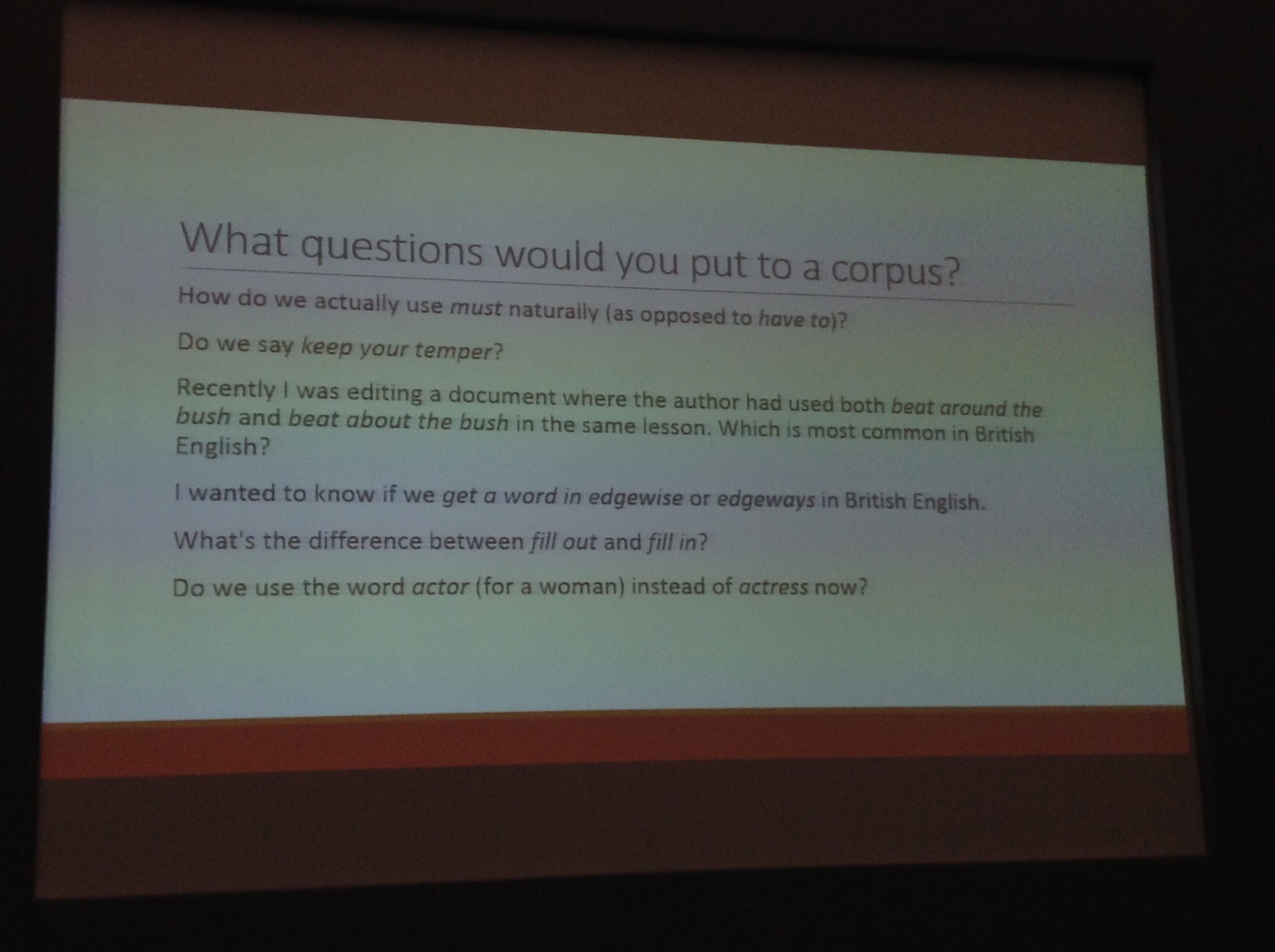
The questions we could ask

Screenshot of the questions Andrew says we could ask

  • Thinking about these kind of questions on the spot is quite difficult, you need to think about them beforehand to be able to ask them on the spot.

More complex sentence examples show more of how language works, so students see more examples of grammar in use.

  • Rather than x is y. (She is a Christian vs As a Christian, I think we should look for non-violent solutions = As a x, I think we should y.
  • Who was the guy with the beard? I haven’t seen him before = who was the guy with…the blonde hair, sitting next to you… etc. I haven’t seen him before.
  • Through vocabulary, we can ask simple quick questions to review grammar. E.g. When the paramedics arrived, his heart had stopped beating but they got it going again and then rushed to the hospital. –> Draw attention to the past perfect, when you get something going again, why/where else do we rush to?
Things to think about

Screenshot of the questions that Andrew suggests we ask

There are lots of these kinds of patterns we could draw attention to, that are useful and interesting little patterns that students could use but don’t make it into coursebooks. You have to have thought about the example before, but once you have thought about it in planning before, in the context of a text or language focus etc. it makes it available to use spontaneously in response to students in the future.

Andrew then told us about one aspect of his and Hugh Dellar’s Lexical lab:  you can send in a completed exercise and Andrew/Hugh will suggest questions/chunks relating to it and invite suggestions from others too.

Other tips from Andrew:

  • Think about what the students might want to say in the speaking exercises you plan to set up. It may mean either doing the task yourself, or with a teacher partner, and seeing what comes up.
  • Get teachers to record their answers. Notice the language that is repeated or could be useful for the students to do the task. Often there is a disconnect between grammar practice and single word practice and the task we set which requires a more complex use of language and may include a variety of things we haven’t thought about.

Ongoing questions to ask to promote teacher development:

Questions to help us develop!

Questions that Andrew recommends asking to promote development!

The first two questions require genuine interaction in the classroom, where rich language can be found. The third is important as what is new? A new combination? New phrases around known words? Because often the grammar or word is known, but the language around it isn’t. The fourth encourages you to reflect on the questions you ask and improve them for next time. The last question is based on the idea that we do get better at dealing with language if we write material. Ideally do it with someone else, get someone else to look at it. This encourages you to be critical and think about language in use and how students might want to use it.

Being able to answer language questions and being able to ask questions about language in this way is not a natural thing but a little bit like relearning the language and a process that needs to be ongoing along with your students. You need to practice it.

Language-focused TD is like language learning: it never stops! 

Thinking about the wider context of language use. We need to think beyond the obvious. Maybe students won’t use the banana example because they go to the shops themselves and don’t have anyone to ask to buy bananas for them! Whereas the words we thought less common might have more possible contexts of use and so be more common than we thought.

In response to concerns that this approach may become too teacher-centred, Andrew responded: talking about language and giving examples is student centred, as it is what the students want to say and need to hear in order to be able to say them better. Teacher talk: needs to be for the students’ benefit. It is also important to use generative, slightly open questions. Students might make jokes in response to them. E.g. Why would you want to reconstruct someone’s face? Because they are plug-ugly vs. after an accident.

I found this webinar absolutely fascinating. It reminds me of my last observation where I think basically my DoS was recommending that I do this. I.e. that I plan my vocabulary focus more, because of it being difficult to respond effectively on the hoof, and I think the intention was in this vein. Having watched this webinar, I now have a much clearer idea of how to go about that than I did previously. Am looking forward to implementing this and gradually developing in this area. 

It was my first time to see Andrew speak and I have to admit to now very much looking forward to hopefully attending his talk at IATEFL! 

Thank you very much, Andrew, for a really valuable hour and a bit! And thank you, BELTA, for hosting him!

‘Richmond Skills Boost’: my materials!

Richmond Skills Boost‘ is a series of multi-level stand-alone reading and listening materials, which enable learners to work on their receptive skills independently of any course book they may be using. Teachers and students can both access this series of worksheets, via the Richmond ELT Site (requires institutional registration). Once you have registered, in the teacher’s area you will see ‘Skills Boost’, and this is where you will find all the worksheets.

Rather than having one person write all the worksheets, Richmond ELT used a range of different people, so you will see a lot of different ‘writer’s voices’ coming through. Reading worksheets 7, 8 and 9, aimed at A1 level, were written by yours truly! I’m very pleased with how the worksheets turned out, the designers have made them look really lovely. I found it very challenging writing materials for such a low level, but thanks to support from the Richmond team, I got there in the end:

Mine!

Mine!

These are my first published, paid materials and the whole process was a very interesting experience. Not least because the revisions coincided with my first pre-sessional at Sheffield University, a summer in which I also presented at the TOBELTA online conference and wrote a book chapter for an edited book due out this year, as well as teaching myself Italian: if you want something doing, ask a busy person!

I’d definitely like to do more materials writing in the future, so if you are interested in working with me on a project, please let me know! (Also happy to do proof-reading and piloting, if wanted…)

Thank you, Richmond ELT, for having me as part of this project! 🙂

Learning students’ names: how do *you* do it?

Getting to know students’ names is something every teacher has to do. It goes with the territory. Working in a language school, you teach multiple groups of students at various levels, of various ages, which adds up to a lot of names. My latest timetable currently has 7 different classes with another 1 due to start in a few weeks. Fortunately, 2 of the classes are YL classes, kept on from last term, and one of the classes is an on-going IELTS class. The other 4 are new adult groups each with around 11 or 12 students in, and the one due to start soon is another IELTS class. Like I said, that’s a lot of names!

This blog post has come about because after my first class with one of my new groups of learners on Wednesday 4th February, I came back down to the staffroom and one of my colleagues was wondering if I had inherited his students. So I proceeded to reel off all their names for him to check against. The response was ‘Bloody hell! How do you know all their names already?!’ The simple answer is, I need to. In order for me to be able to teach a group, they need to be individuals, as soon as possible, so that I can work with them and not experience group-fear (fear of being in front of a big group of people I don’t know!) :-p

Of course, remembering these names and people just after the end of the lesson you have just spent with them is one thing. The difficulty comes when two days later, having met umpteen other new students and taught umpteen other classes, you pick up your register to meet your new class for the second time. Who are they again, these names? I had that moment today, but luckily because of what I did in the first lesson, before I walked in I was quickly able to remind myself who they all are.

Here’s how:

  • In the first lesson, you always do some kind of getting to know you activity, right? Obviously. For example, at the most simple level, find out three new, interesting things about your partner. (Always concept check ‘interesting’ here… 😉 )
  • What I find works best is if after the activity you do some kind of plenary, where the students report things about each other to the group as a whole.
  • While they speak together and while they report, I scribble bits of information down.

Here is an example page from the above-mentioned class:

names5

(You may well wonder why the book says September when we are in January. This book was a freebee from the school, which my desk ate between October and January, and recently regurgitated! 😉 ) It’s no work of art, very basic scribbles. Of course, names and ages blanked out for obvious reasons. (And I’m not entirely sure why I wrote ‘Sicilian’ down, not really a distinguishing feature here! I think though that it had been to do with cooking but I didn’t have time to finish writing!) So, some of the information relates to physical features, some is from the initial ‘3 interesting things‘ activity or equivalent, some is from the subsequent FSW activity, and some is meta-information gleaned from the activities e.g. the eye symbol, to remind me that the student in question looks like one to keep an eye on. The important thing is, moments before the second lesson with this class, I opened my notebook, looked at these notes, these bits and bobs of information I had scribbled down, and it was enough to trigger memories of who they all were, meaning I could walk into the classroom and confidently use their names straight away, which of course they appreciate and which helps with rapport.

This time round, I did the usual ‘Find someone who…‘ type-activity but I did it with a ‘learner autonomy twist’, which, as well as acting as an icebreaker and getting everybody talking to everybody else, immediately gave me an insight into/snapshot of where they are all at with regards their independent learning habits. It also encourages the students to think about what they do already, vocalise it to their classmates, and compare it with what their classmates do. Hopefully this is sowing the seeds and setting the scene for further work on helping them – and helping them to help each other – become more autonomous in their learning.

For homework at the end of the first lesson, I set them the task of writing a letter to me, with the goal of telling me about them. I told them the objective of the homework was for me to get to know them better and to see what their writing is like. Two days later, 11 pieces of writing duly plopped into my lap from my eager beavers! So, killing two birds with one stone, I’m getting extra needs analysis data both from the point of view of getting to know them better (including about their learning habits, as I encouraged them to use the ‘Find Someone Who‘ activity statements for inspiration as to what to write about) and seeing where they are at with their written production.

Obviously my initial observations in terms of speaking and listening ability or level of autonomy may not necessarily be accurate, and they are not set in stone judgements, they are just first impressions which will keep evolving every lesson, as I learn more about the students and as the students evolve. ‘Eyes’ may be added or removed and so on. Simply, this is a starting point. The main thing is, as a whole, the notes fixed the students’ faces and names in my memory from the get-go, which makes life much easier for me.

This works for me. But I’m sure other people have much more efficient ways of going about it! How do you get to know your students names? 🙂

Kaboom! The Explosive Team Review Game (With an added twist…)

I am sure most of you are already familiar with the review game of Kaboom (also known variously as Tornado, Earthquake, and any other non-context-sensitive natural disaster). In this post, I am going to share the adaptations, or tweaks, that I’ve made to it in order to:

  • cut down on preparation time
  • make it more student-centred
  • make it more challenging

The Regular Version

In the regular version, prior to heading to class, the teacher pre-prepares a grid (size decided at discretion – depends how long you want the game to take!). The grid is made of squares, to each of which is allocated one of the following:

  • A question mark – signifies, funnily enough, a question.
  • A flashing B – signifies a bonus (which means 50 free points to the recipient team)
  • The arrows of change – two arrows one above the other, each pointing in opposite directions, signifies the team changes points, either with the other team, or if more than two teams, the chosen team (which is going to be the team with the most points!)
  • A bomb – signifies an explosion of points, leaving the recipient team with zero.

The teacher also prepares a set of questions to ask.

Once in the classroom, the teacher draws a blank version of the grid on the board, with letter and number coordinates. Teams take turns to pick a square and answer a question/receive a bonus/change scores/lose all their points, depending on the square. The game continues till all squares have been revealed. The winners are the team with the highest score.

My Version

Well, it’s the same as the above version, except:

  • The teacher doesn’t prepare a grid before going to class: the teacher draws the empty grid on the board (sized at discretion) and makes up the square contents as he/she goes along. And when the kids accuse you of making it up as you go along, wow them with your amazing memory skills… 😉

This way, you save on preparation time (big deal, it’s pretty minimal, but why not!) AND you get to ham up the drama, orchestrating the changes and explosions etc. to keep it as exciting as possible.

  • The teacher doesn’t prepare a set of questions before going to class: instead, when a question square is selected, the opposing team must come up with the question. How? By working together, looking through their coursebooks/notes and coming up with one.

This way, you save on preparation time AND you wind up with a bunch of teenagers avidly looking through their books/notes either in order to make up a question or preparing themselves to be asked. Encourage them to be crafty: the harder the questions, the less likely the other team is to get points. They try really hard to come up with tricky questions and do a lot of reviewing in the process, with lots of whispered discussions regarding vocabulary definitions and grammar points, and how to make them as difficult as possible. The game becomes less teacher-centred too.

  • The teacher breaks down the question squares in to ? (free question), ?G (grammar-related question) and ?V (vocabulary-related question)

This is so that the students don’t get stuck in a question-type rut. It also serves, in this way, to up the challenge level. If your class were still not coming up with enough variety of questions, then you could throw in a few ?T (teacher-generated questions) as well! This would also enable you to draw attention to a particular language point/piece of vocabulary that you wanted to review, without having to prepare all the questions/make the game entirely teacher-centred.

Here is an example of a game in progress: 

Kaboom!

Kaboom!

This was with my upper intermediate teenagers class. They are a small class (currently) and so only two teams were necessary. Being quite high-level, they were doing well with regards to question variety so I hadn’t inflicted any ?T squares at this point. Here, you can see the different types of question squares, the bonus squares, the arrows of change and the bomb squares.

All in all, Kaboom! is a great review game. It’s easy to tweak the amount of challenge according to the level of your learners, and children, teenagers and adults all get caught up in the excitement. Finally, I may be biased, but I think it’s even better with my tweaks! 😉

Enjoy! 

An added twist! Image taken from en.wikipedia.org, licensed for commercial reuse with modification.

An added twist! Image taken from en.wikipedia.org, licensed for commercial reuse with modification.

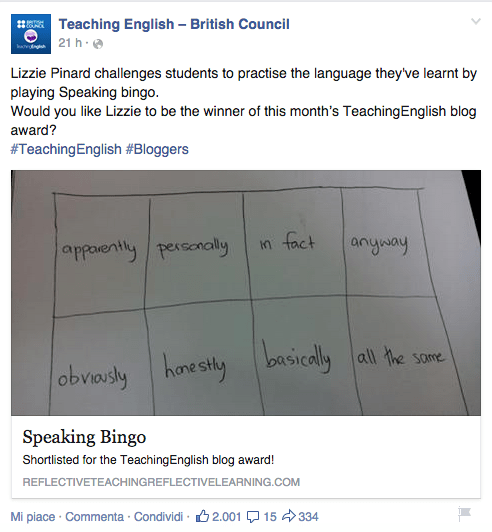
TeachingEnglish British Council Blog of the Month Shortlisted!

Yep, that’s right! My blog has just been shortlisted for a Teaching English British Council blog of the month award! The shortlisted post is Top 10 resources for teaching IELTS which I wrote because it’s what i would have wanted to be able to find when I started teaching IELTS. 🙂

If you would like to vote, click on the picture below and it will take you to the Teaching English British Council page. There, you can cast your vote for me by clicking on ‘like’ on the post that looks like this picture, or, for any of the other shortlisted posts this month, should you prefer…keep checking the TEBC page, as new ones will be added over the course of this week!

Shortlisted! Thank you TEBC!

Shortlisted! Thank you TEBC!

Summary of the 26.02.2014 #ELTChinwag on Metacognitive Skills

For those not in the know, ELTChinwag discussions, organised by ELT Ireland, take place on Twitter twice a month on Mondays at 20.30pm GMT, under the hashtag #ELTChinwag.  The focus is decided in advance and publicised on the hashtag, where you can also make topic suggestions. The topic on the 26th February was Metacognitive Skills. I suggested the topic and had intended to participate, but by the time I got home soon after 9 (Italian time, so in time!) I had clean forgotten about it! On the plus side, I’m participating now by writing up the discussion. Here, then, is a summary of it (NB: I have expanded contracted Tweet-speak into full sentences, to make it easier to read!):

The obvious starting point, of course, was to thrash out a definition… 

What do we understand by ‘Metacognitive Skills’?

  • For me, metacognitive skills is the ability to think about how we think about, find out about and remember things (@LahiffP)
  • Knowing what you don’t know and how to go about knowing it? (@EAPStephen)

  • .. and how you might go about being more effective in getting to know it? (@LahiffP)

This raised another question.

Are our students of how they remember and understand, or get to know things?

Response to this question, as you would expect, was mixed…

  • Adults tend to be more so than young learners. Teenagers – well it depends on them. Although some adults are totally not either. (@KateLloyd05)
  • i think most students are aware of lack of memory but not techniques nor learning style. (@Noreen_Lam)

  • “I know it doesn’t work but not what I might do about it.” Can they develop techniques to help though? (@LahiffP)

  • Yes they need suggestions because they may not be aware of methods. Some just think they’re not trying hard enough! (@Noreen_Lam)

  • Mine are mainly teens and I often ask what they find better when learning and what they don’t. Some have insight. (@LahiffP)

  • Mine are adults 22-50,  only some of them actually want to learn what they could do to learn better, faster. (@MihaelaOlarlu)
  • Adults, mostly European, and they were reluctant to do weekly reflection but they’re getting more into it now. (@Jane_Seely)

Further questions and issues were raised and suggestions made…

  • But do they have the self-awareness that would allow them to regulate that? (@LahiffP)

  • “I know it doesn’t work but not what I might do about it.” Can they develop techniques to help though? (@LahiffP)
  • Sometimes they are quite pessimistic see English as mainly as content rather than a  set of skills. Very few of them are willing to reflect on their learning and observe what they’re missing out on. (@Noreen_Lam)

  • Some educational contexts mean they are not encouraged to reflect (@KateLloyd05)

  • I think everyone has capacity to reflect. Some do it naturally with learning. Others do it in other areas of their life. E.g. most people would reflect if they erred in social situation. Perhaps a case of helping students transfer existing skills. (@EAPStephen)

  • “Helpful to try to find other aspects more relevant to them in which they reflect and then extrapolate.” (@EAPStephen)

  • Yes, they need suggestions because they may not be aware of methods. Some just think they’re not trying hard enough!

This allusion to the necessity of scaffolding led on very conveniently to the next question…

What can we do to help our students develop their metacognitive skills?

  • I’ve noticed that with reflection you have to give them some freedom as to the form and type of feedback. (@LahiffP)
  • I designed a questionnaire to appeal to different student learning types, in week 5 now so need to tweak a bit (@Jane_Seely)

  • In teacher training raising awareness of trainees own learning process is a big part of it. (@LahiffP) (So important! If teachers themselves aren’t aware of their own learning process or haven’t developed the skill of reflecting on it, how can they help their learners to develop this?)

  • Often interesting to get them to reflect on others in class – e.g. find someone who exercise. Who is good at remembering vocab. Then find them and ask them how they do it. (@EAPStephen)  (I love this idea!! Can’t wait to try it out! Watch this space!)

  • A reflection questionnaire? (@LahiffP)

  • I like an activity where they give each other study advice, “If I were you I would …” and do a class study guide (@LahiffP) (Another on the list of new things to try asap!)

  • Expectation management too, given high level topics, students worry about understanding, less about how it’s done. (@MihaelaOlarlu)

  • Sometimes it is better not to call it a reflection I find, Learner diary is not a great term either. (@LahiffP) (I wonder what labels do work?)

  • Recorded presentations, self scoring for writing,  reflection on missed items listening skills.They find it beneficial and encouraging, they can cope with mistakes as long as there are reasons. (@MihaelaOlarlu)

  • Possibly a Pandoras box. Get them to reflect on the lessons. What activities they enjoyed, found helpful. (@EAPStephen)

  • I did project about learner diaries few years back and v. interesting results with kids and adults. (@Noreen_Lam) (I would love to know more about this!)

The last question, food for thought to finish on:

Is it worth pushing our students to take part in regulating their own learning? 

Of course, anyone who reads my blog will know what my views on this are! 😉

  • Absolutely! If you do it consistently over time it rubs off on them. (LahiffP)

  • it depends on the type and reason for learning. EAP is easier to push them, GE in home country, less so. Just for fun. (@KateLloyd05)

  • Definitely, done properly they know it’s worth it. (@MihaelaOrlarlu)

  • Pushing but for their benefit! Giving them tools to learn better and tailored ideas. Makes it easier and less boring. (@Noreen_Lam)

  • Maybe it’s fundamental!! (@ESLBrain)

To finish off with, here are the links that were thrown up during the discussion:

How wonderful to see a bunch of teachers being enthusiastic about metacognition and metacognitive skill development. I would love to sit down with them all in a pub and chat about it! In my experience, metacognitive skill development is beneficial and the students do appreciate it. Of course it’s not an overnight thing, persistence is key, as is motivation management.  

If you are interested in learning more about metacognition and metacognitive skill development, then I highly recommend Vandergrift, L. and Goh, C. Teaching and learning second language Listening: metacognition in action published by Routledge. It is an accessible introduction to the theory behind metacognition and contains lots of practical suggestions for putting it into practice. The focus is on listening skill development, as the name would suggest, but the principles can be applied in other areas. 

Finally, a small plug: In early April I will be doing an International House World Organisation live online workshop on the topic of metacognition. Only IH teachers can participate live but the recording will eventually become available to all, if I’m not mistaken. More information nearer the time… 🙂

Shhh...I'm thinking! Picture from commons.wikipedia.org licensed for commercial reuse with modification.

Shhh…I’m thinking about my thinking! Picture from commons.wikipedia.org licensed for commercial reuse with modification.

Finding the game-like challenge!*

*With minimal preparation involved… Following a recent Friday workshop on teaching teenagers, in which, amongst other things, we discussed the difference between playing games for the sake of playing games and adding a game-like challenge into the activities we do in class, I have been thinking about different ways we can do this, without spending heaps of extra time on preparation. Here are some of the ideas I’ve come up with:

1. Board it and collaborate

Instead of (or as well as/before) having learners complete a table in their books, individually, why not put them in teams, put the table on the board and get them to race to complete the table accurately:

Linking words with teenagers

Linking words with teenagers

Here is an example from a teenager class of mine, looking at linking words in a writing lesson. The words were highlighted in a model text and the activity in the book was to divide them between a: words for contrasting two pieces of information, b: words to give reasons for something and c:words used to list arguments. Doing the activity this way got them out of their seats, changed the pace of the lesson and generated some useful energy. Of course, they also got to benefit from working together to solve the task. And all I had to do was draw a table on the board while they were reading the text.

2. Bingo it!

The age-old game of bingo can be used to liven up writing activities, as Sandy explains here or speaking activities, as I describe here. Bringing bingo into a speaking or a writing activity in this way gives students something extra to aim for, rather than just completion of a writing or speaking activity. It doesn’t hurt that the something extra is a) fun and b) encourages extra production and/or better use of the target language! Here is an example bingo board I used to model the activity for my Level 9 Upper Intermediate adult students:

Bingo with L9

Bingo with L9

All students need is a page in their notebooks on which to draw their table. No preparation is required beforehand, unless you want to make a model, in which case I think that one took me about 60 seconds to mock up! You could also play Reading Bingo, where students make a bingo grid of ideas or vocabulary that they expect to find in a given text, having looked at associated pictures or headings, and then read the text quickly to see if what they predicted is present, ticking off anything that is. First student to tick everything off in their grid wins! This is a good way to challenge students to read faster and resist reading every word.

3. Speed it up!

Adding a time constraint to an activity can up the level of challenge and bring in some competition. This is enhanced if the activity can be done in pairs or groups. Whether you set a time limit or do the old ‘whoever finishes first gets a point’ thing, heart rates will probably speed up. Beware though: a) make sure stronger and weaker students are mixed up. b) enforce an accuracy rule (i.e. being really fast but really inaccurate doesn’t win any points!)

60 seconds...starting now! Image taken from en.wikipedia.org, licensed for commercial re-use with modification

60 seconds…starting now! Image taken from en.wikipedia.org, licensed for commercial re-use with modification

4. Make it kinaesthetic!

If you can get students moving (for good reason rather than at random!), chances are you can make the language more memorable. For example, going back to the language my teenagers were looking at in 1, to test their recall of which words do what, you could ask them to put their hands up when you say a word used for giving reasons, stand up for any words used to list arguments and stamp their feet for any words used to make a contrast. Other variations on this include ‘river crossing’ or ‘traffic lights’ where students move to different parts of the room or move from side to side, according to where a given piece of language is allocated. This is a good way to change the pace of a lesson and generate some energy when teenagers – or adults! – are getting tired. Or, with younger kids, perhaps you’ll use it to get rid of some excess energy!

Kinaesthetic to the max! Image taken from de.wikipedia.org, licensed for commercial reuse with modification

Kinaesthetic to the max! Image taken from de.wikipedia.org, licensed for commercial reuse with modification

5. Bring out the banana boards (a.k.a mini-whiteboards!)

Mini-whiteboards are a fantastic way to spice up a lesson and add some game-like challenge. From something as simple as the teacher saying a verb and the students writing the past participle on their mini-whiteboard and then holding it up, and awarding points to the fastest and to those who got it correct but more slowly (so that everybody has a chance to win some points and nobody gets too far ahead or behind) to as complex as working on introductions in an IELTS class, mini-whiteboards come up trumps for their flexibility and students always love them!  Common uses include banana dictating sentences (i.e. dictating a sentence with a gap for students to complete) or sentence transformations. For lots of great ideas, here is a brilliant post from Chia Suan Chong, describing how she uses mini-whiteboards in her lessons. I particularly like the idea of having students summarise a portion of a text using pictures and then using the pictures to jog their memory when they tell a partner about their portion of text. A jigsaw reading with a difference! “But my school doesn’t have any mini-whiteboards!” I hear you say. Not to worry, all you need is a piece of card and a plastic folder like this (our YLC taught me this one!):

Home-made mini-whiteboard!

Home-made mini-whiteboard!

6. Drill it differently

Instead of just doing the same tired old choral drill, add some challenge to your drilling and make it more appealing to learners. Here is a post from Chris Ożóg over at ELT Reflections, which highlights the benefits of drilling together with lots of good ideas for how to spice it up. Another way to bring drilling to life, and make it more game-like, in the YL classroom, is to use a pronunciation wheel:

Pron wheel made by our YLC

Example pron wheel (made by our YLC)

Students take it in turns to spin the wheel and say whatever sounds, words or chunks it is that you are drilling in the way that the wheel stipulates. You can do this as a whole class, and then you can put learners in pairs or groups and they can continue the activity and drill themselves while you go round monitoring and working with individuals/groups to upgrade their production.

7. Make it a memory game

If learners have just done a crossword or a vocabulary activity in their course books, rather than check/feedback and move on, why not re-use the activity to challenge their memory? Get them to cover up the crossword clues and try to remember what the clue for each word in the grid was. Or get them to cover up the grid and test each other using the clues. Get them to close their course books and see how much language they can remember from the page (in pairs or groups, make it a competition) or call out prompts, so that you encourage active recall. Give students a time-limit in which to read a text, then have them close their books and see how much of it they can recount in pairs.

Testing your memory? (Image taken from Google image search licensed for commercial reuse with modification.)

Can you remember? (Image taken from Google image search licensed for commercial reuse with modification.)

8. Hand it over!

Sometimes the game-like challenge may also be a case of making a game more challenging, so that students are pushed more. A good way of doing this is finding ways to make games as student-centred as possible. For example, getting students to make up some quiz questions rather than only answering teacher-prepared questions. Here is a post describing how I upped the challenge in the review team game, Kaboom!

Kaboom!

Kaboom!

This picture is taken during a recent Kaboom! review with my teenaged upper intermediate students.

What do you like doing to bring a game-like challenge into your lessons? 

Speaking Bingo

This idea came up in our two-weekly Friday seminar, nearly two weeks ago now (how time flies…). The seminar was about teaching teenagers, and at this point were were discussing the difference between games and adding game-like challenge, and sharing ideas for how to add game-like challenge. Our YL coordinator suggested Speaking Bingo.

Aim:

Encourage learners to incorporate target language into their speaking. Give learners additional motivation to speak.

Procedure:

  • Prior to a speaking activity, have students make up a bingo card for themselves. In each square they choose a piece of vocabulary studied in that lesson (or from a set studied previously that you wanted to review).
  • During the speaking activity, students tick off each bit of vocabulary as they use it.
  • First student to tick off all the bits of vocabulary gets to call Bingo!

Variation:

Instead of ticking off the words they use themselves, you could get them to start a timer and tick off any target language their partner uses. Their partner should be trying to use as much target language as possible, and the winner would be the one who managed to use all the language on their partner’s card (which they wouldn’t have previously seen) in the fastest time.

Bingo with L9

An example I made for my Level 9s (Upper Intermediate)

It worked really well with my adult Level 9’s, gave them that added push to use the target language and they enjoyed it!

60 seconds: a simple vocabulary review game

So, at our school, it’s that ‘nearly time for the final test’ kind of time, but as any self-respecting teacher will tell you, review (especially of the spaced variety) is an important part of language learning. So hopefully this activity will be useful to you, at whatever point in your courses you may be! The amount of preparation required for this game ranges from minimal to none…

Goal: 

Encourage active recall of previously studied vocabulary; push learners to think about the co-text of vocabulary not just the basic meaning.

Level: 

Pre-intermediate upwards. For lower levels, give them more time to come up with examples, and perhaps provide a sample example on the card to get them going. It kind of grades itself by the vocabulary used. Each level will be capable of putting different words into example sentences, each level’s sentences will vary in complexity.

Materials: 

Small pieces of paper, each with a piece of target vocabulary on one side. (You can prepare these yourself [minimal] or get your learners to do it in groups, which case you only need to provide paper! [none] )

Procedure:

  • Put learners into groups of four. Within the four, each learner has a partner and two opponents.
  • Give each group a set of cards (or if your students made the cards, get each group to swap their pack of cards with another group)
  • Each student takes it in turn to pick a card and think of example sentences into which that word could fit. They tell their group as many sentences as they can in sixty seconds, substituting ‘banana’ or similar for the target word.
  • If their partner guesses the word first, they as a pair get a point. If one of the other pair guess the word first, they as a pair get the point.
  • The game continues until you want to stop it or until all cards are finished.
  • If you use a vocabulary box/bag, you could get them to put the words that weren’t guessed into it, for future review. You could also play this game using vocabulary from the box/bag.

Benefits:

Learners, whether providing examples or guessing the target word, have to think about various aspects of the word in question, not only the meaning. I.e. They need to think about the word grammar, about collocates, about register etc. I think this makes it more useful than simply describing/defining the word.

Variations:

If the focus is something like word pairs (which I have needed to review with my Level 9/Upper Intermediate learners), you could provide only half of the word pair on the pieces of paper, so that the learner who is providing the example sentences has to recall what the full word pair is, as well as how to use it.

Enjoy!

60 seconds...starting now! Image taken from en.wikipedia.org, licensed for commercial re-use with modification

60 seconds…starting now!              Image taken from en.wikipedia.org, licensed for commercial re-use with modification

Things I have learnt about Quizlet from Leo Sellivan’s Webinar!

IATEFL run regular webinars for English Language Teachers to participate in, fortunately for us, and this afternoon I was lucky enough to be able to spend an hour listening to Leo Selivan share his knowledge of the power of Quizlet. For those who don’t know, Quizlet is a website that enables you to create sets of flashcards, using words and/or images. I am a big fan of Quizlet, having used it for my own language learning, and have tried to help learners use it too, by creating self-access materials for them to use. Coincidentally, as the webinar started, I received notifications saying a learner of mine was adding a set to one of my Quizlet classes!

Here is what I have taken away today:

To help you navigate this blogpost, the structure of webinar went thus:

  • Key principles for learning vocabulary
  • Quizlet functions
  • Writing definitions
  • Tweaks and tips

Key points I took away:

  • Memorable and manageable is what vocabulary recording should be!
  • Disadvantages of lexical notebooks:

– Students’ reluctance to go back and add in new items to existing topics. (If organised by topic or key words)

– Students view it as time consuming, possibly waste of time and prefer to record vocabulary in a linear fashion rather than elaborating on existent entries.

– Students’ notes and your notes not in synch.

– The notebooks do not provide active recall practice (ARP is necessary to commit new vocab to long term memory): Students can see the words in front of them, so they don’t need to try and retrieve them. Whereas ARP aids memorisation process.

  • Research shows that incidental learning of vocabulary is not enough.

Learners need practice activities. (This is the principle I applied to my Italian learning by transferring language from sources e.g. books, audio books etc to Quizlet!)

Decontextualised vocabulary practice is perfectly justifiable and learners, especially adults, can learn vocabulary out of context. (Like I did with Quizlet and my Italian!)

– We need a combination of both contextualised and decontextualised practice and use.

– The Communicative Approach sees language as a tool but vocabulary experts today say that it is justified to treat vocabulary as an object of study, not just a tool for communication.

NB: Leo cited Laufer B (2005) – I think the title was Focus on form in second language vocabulary learning but check his reference slide to be sure – as the source for this information

To learn vocabulary we need frequent encounters with new items. 5-15.However vocabulary learning isn’t only increasing the size but also how well you can use the words that you know. E.g. depth as well as breadth. Depth is all about the how of the word rather than just the what.

Meaning is important but form is too. Students may think they know a word because it looks like they a word they know. E.g. adopt – adapt. This leads to over-estimation of vocabulary knowledge.

We should exploit L1. Especially in a monolingual setting.

– We should provide focused engagement with new language. Opportunities to manipulate, use it in different contexts etc.

Enter Quizlet!!! <drum roll!!!>

Functions: 

When you access the website, you are presented with the functions of: Flashcards, Learn, Speller, Scatter, Space Race and Test. 

However, Flashcards, Scatter, Speller, Learn, Space race, Test  is Leo’s suggestion of the order in which students should use the functions, as this represents easy to difficult, or receptive to productive with increasing challenge. (This I found particularly interesting, as I had never thought about it before, though in my own use of Quizlet have tended to go for the Learn function as it gave me the right level of challenge (also because I got used to using it on my iPad, in preference to the easier alternative of the matching mode), but once I was used to the language would use the test function and the space race function too, on my computer. I had never analysed my usage in this way before and now it makes more sense!)

  • You can create classes. Yup. But as a free user, can only have 8. If you want more, you can create folders.
  • It has as a mobile app, so you can practice on the go.

Writing Definitions:

  • Gapped definitions can be more useful for co-text, also more personalised as it is your example sentence.
  • Dictionary.com not useful for learners, as definition uses more complex language than the word being defined. Use good online dictionaries e.g. Cambridge, Macmillan, Longman dictionaries. Leo’s blog has a section called essential lexical tools, well worth checking out.

Don’t:

– define a word with its synonym: This gives the false impression that the words are interchangeable, whereas they collocate differently etc. E.g. What’s happened to you? Ok. What’s occurred to you? Not the same.

– rely on user generated content: you can add your own definitions, you can select from list of readymade definitions from other users, learners may not know the synonyms and they don’t work in the same way. Be careful, or becomes ‘usergenerated nonsense’

Bear in mind:

– 9 different aspects of knowing a word: spoken and written form, meaning, spelling, collocation, grammatical patterns, constraints e.g. appropriate in informal or formal context, connotation etc. Textbooks tend to only pay attention to form-meaning links, neglecting other aspects. In classroom interactions, teachers also tend to focus on teaching means rather than the other aspects of word knowledge: “The tip of the lexical iceberg” as Leo put it!

The collocation of a word may result in different translations in another language: E.g. heart conditions vs terms and conditions.

– Co-text is important for learning a word. NB: Context is the story or situation happening around a word whereas co-text is the words immediately surrounding the word e.g. have an accident or by accident. “The linguistic environment”.

Alternatives to definitions

(You can find Leo’s example flashcards to see that he practices what he preaches and have a play!)

  • Example sentence with a blank plus definition in brackets at the bottom. And word on other side.
  • Give example collocations
  • Multiple Prompts
  • Collocation chains e.g. lots of adjectives which collocate with the same word, being the target word. (works really well on Scatter)
  • Phrase and translation: perfectly acceptable and you can also negotiate the translation in class.
  • Phrase in a conversation: Provide phrases within a conversation, e.g. the phrase is taken out of a dialogue. But in learn mode, all that conversation is what you have type in in learn mode, so it is difficult. Less text is easier for the learn mode.
  • Word and collocate in co-text sentences with first letter clues. You can increase or decrease challenge in this way, e.g. by adding the last letter too, or not.

Useful to know:

  • “…” multiple dots indicate whether it is the first part or the latter part of the collocation, which is useful information when trying to access the correct answer in your brain! e.g. fallen into… …disrepair

In learn mode, do you have type in all those multiple dots. If learners type the answer correctly without multiple dots does that means Quizlet would reject the answer? Fortunately not!

  • What happens if you have a few instances of the same word, e.g. prepositions, when using scatter mode? You can use any instance of a word with any correct match. As long as it fits the sentence correctly it will be considered correct by clever Quizlet. (Good to know!)
  • You can bold certain items! When you enter the definition, you put stars on both sides of the word or group of words that you would like to bold. So, you can highlight dependent prepositions, for example. Or bold the gapped sentence and leave the definition normal.

Another tip Leo offered was to encourage students to take screen captures of their scores and times from their out of class study and compare in class!

Finally, I discovered that he introduces learners to Quizlet in a similar way to me, but including his special order of use of the functions (see above) that I will be bearing in mind from now on!

This was a fantastic webinar, which this post only gives the merest overview of, and I fully recommend accessing the recording on the IATEFL website if you can, or if/when Leo publishes his slides or any blog posts about it, visit his blog. Leo blogs at Leoxicon, which is well worth a visit, with plenty of quality content.

Thank you, Leo!