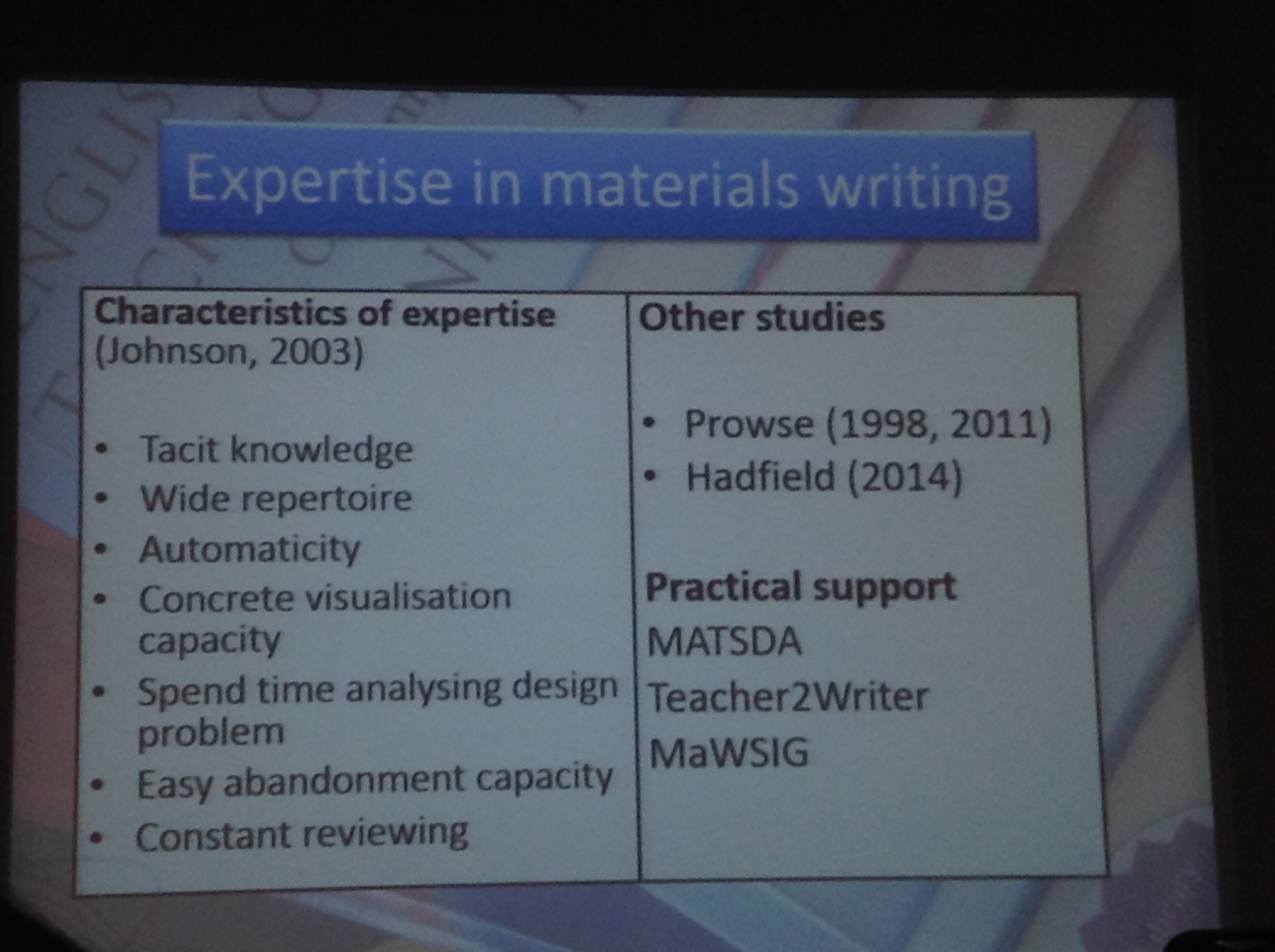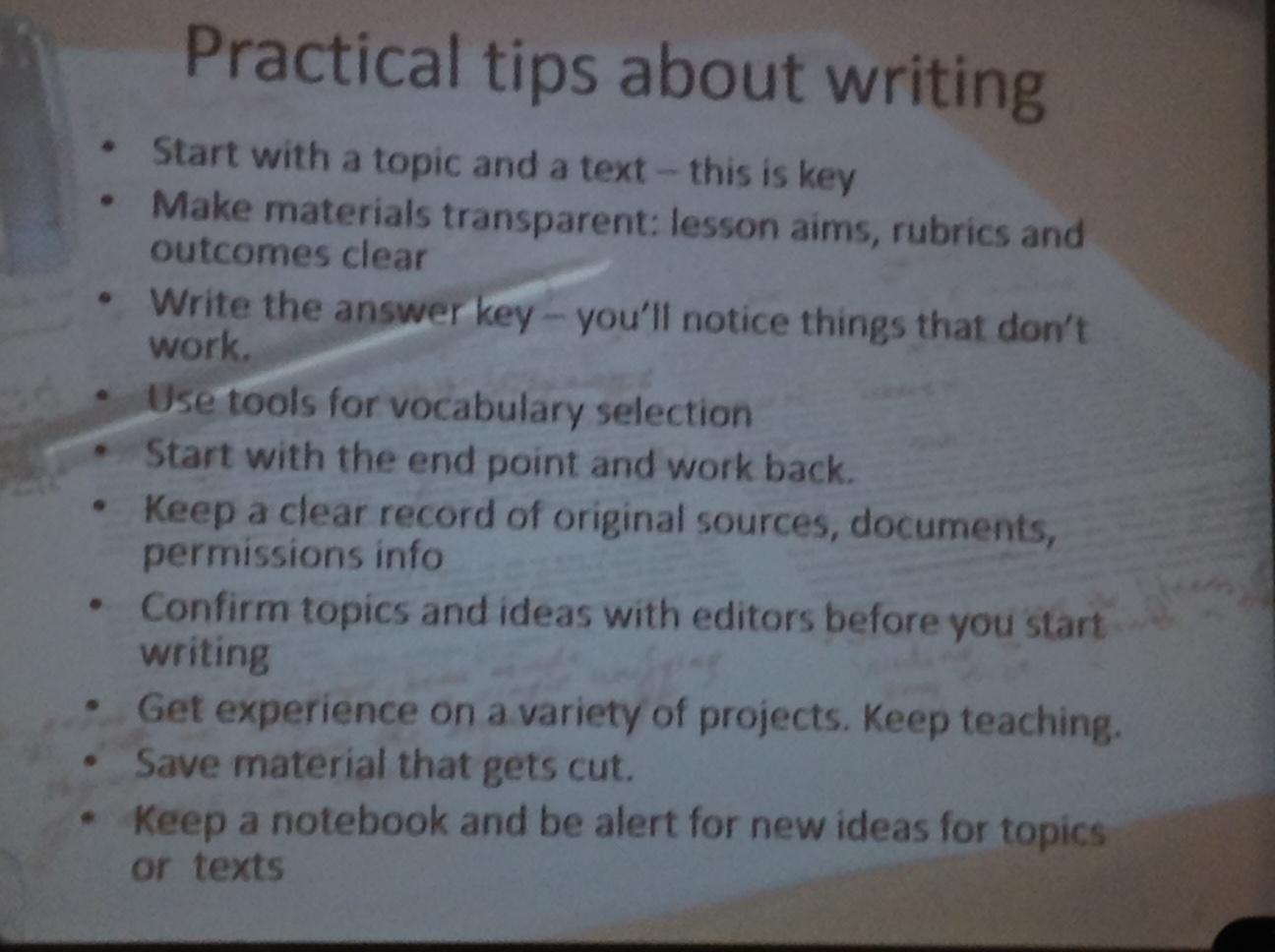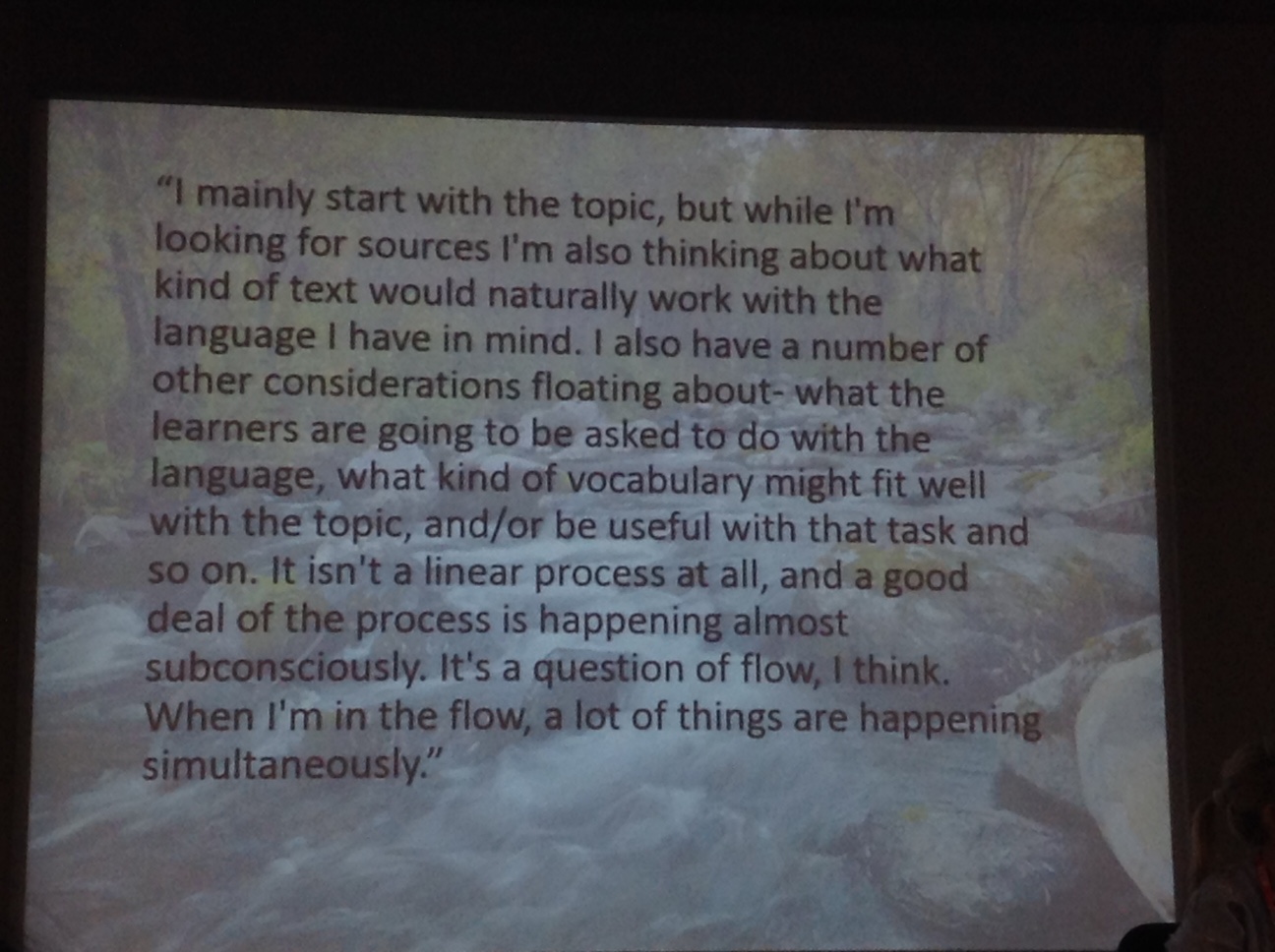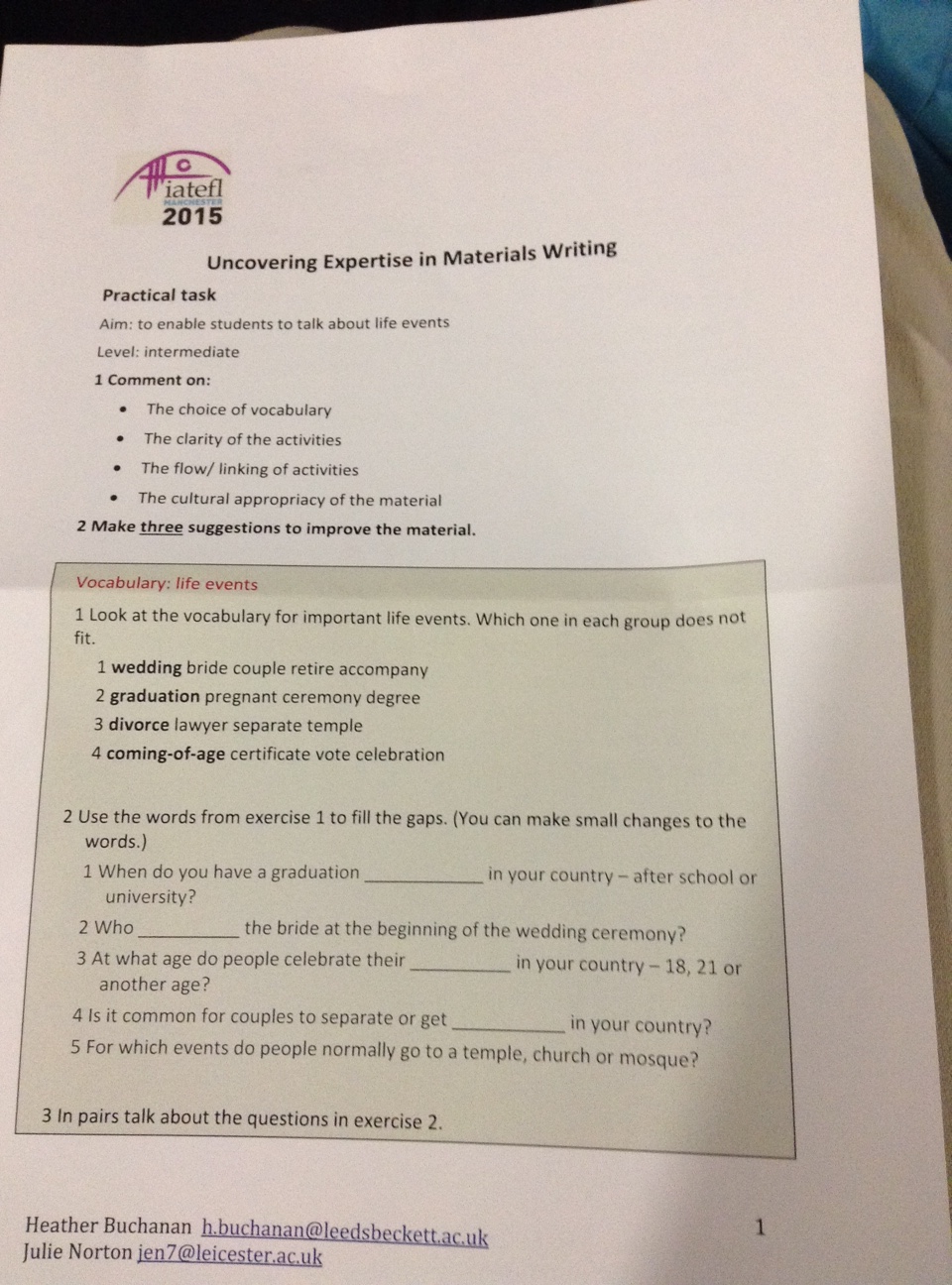
IATEFL 2015: Pre-conference Event Day – MaW SIG – Part 3

Duly refreshed, it’s time for the afternoon sessions…

How to write ELT activities for authentic film and video – Kieran and Anna

Kieran and Anna also produced: “How to write film and video activities” – from the Teacher2writer training modules. (Yep, another module! Seems to be a trend today, for presenters to plug their Teacher2Writer module! 😀 )

 In today’s talk, they intend to consider:

  1. Role of video and film (more and more important)
  2. Sourcing video and film
  3. Exploiting video and film

Changing from video as an add-on (think glorified listening activities) to something more integral. Capturing and editing moving images has become much more accessible. This can be exploited in language learning. Kieran thinks there will be an increasing demands for writers of this type of activity.

 You need to think about:

  • Syllabus fit – a strict publisher’s brief fit or just integrating it into what you are teaching?
  • Music/soundtrack needs not to be overwhelming, so that voices can be heard. Language level is affected by this and other things such as accents, number of speakers etc. Keep a checklist of these handy.
  • Length – 2-5minute clips are optimal for attention/engagement. The shorter the clip, the more repeat viewings you can have, with different activities. This helps with comprehension too.
  • Relevance – of topic and content vs students’ context, background etc.
  • Task potential – visual is important. Less effective if activities are relying too heavily on the non-visual i.e. the audio.

 Established approach to writing for video

  • Pre-viewing tasks
  • While-viewing tasks
  • Post-viewing tasks

Publishers will break it down like this and include things like vocabulary lists for you to use too.

 Pre-viewing activities:

For language-based goals – matching, summary completion (pre-teaching vocabulary), stills from the video and a summary (for more challenging material)

For communicative goals – prediction, discussion. Take a still from the film or video, accompany it with some questions. Connecting this task with the viewing is of course to check their predictions.

 While viewing activities:

  •  Don’t overload: Activities and instructions should be concise.
  • We can use reading/listening type questions but shouldn’t rely too heavily on these.
  • Need to be activities that don’t demand too much attention so that ss can still focus on the film.

For more information: www.visualmanifesto.com

 My thoughts: 

Maybe lunch affected my brain adversely – clearly my notes from this talk don’t do it justice! The presenters ran out of time for getting beyond ‘While viewing’ but the slides are going to be available later, so keep an eye on MaW SIG channels for further information on this!

Does a corpus have the answer? Corpus tools for ELT writers by Julie Moore

I was looking forward to this talk! I really enjoyed Julie’s talk at last year’s IATEFL and I love corpora! 

 Focus:

  • What is a corpus, what are corpus tools?
  • How to use them to help you write materials – with examples
  • What a corpus isn-t very good for
  • Ways of accessing corpora
  • A few other nifty vocab tools

Corpus, corpora – a collection of texts, used to investigate language and how it works. We use corpus tools do this, software which allows this investigation.

When you look at a corpus, you get something called a concordance. That is, examples of language taken from the stored texts, with the searched word appearing down the middle, aka a key word in context (KWIC) search. You can then click on a sentence to get a little more context.

We can ask a corpus many things…

Questions!

Questions!

With a corpus we can:

  • search for authentic examples.

This can lead you to identify a nice context for a given language point. E.g. a film competition guideline set for “must”.

It is quite rare to find something ready for use straight away: you are more likely to adapt and abridge entries so that all language is level-appropriate.

You can also use it as a template to create your own example. It helps you to create something more natural-sounding.

  • do collocation searches

E.g. keep your temper, do frequency searches. Look at the example lines. Then you see it does exist but not on it’s own but rather for e.g. keep your temper under control/in check etc.

  • search for phrases and chunks

Sketch Engine: search “bush” to find more possibilities than “beat around the bush” So start with a wide search. Then search for the frequency of the collocate e.g. around/about. Then you can search for English type. Smaller difference between around and about for British English.

 What isn’t a corpus good at?

Corpus are good at vocabulary –oriented queries. If you don’t have a specific lexical item to search for, it is more difficult and requires a lot more time. E.g. present continuous for future plans. Even if you come up with a search of present continuous examples, you would have to manually identify the future plans ones.

They are also not so good for longer examples or complete texts: this is because of copyright and permissions rules. You can’t borrow enough sentences to illustrate ‘on the other hand’ for example.

 Important points to consider:

  • spoken vs written
  • genre mix
  • AmE vs BrE
  • Expert vs student

Otherwise put, it is important to know your corpus and what it contains.

For example, the British Academic Written Corpus (student writing, native and non native) so you aren’t going to search it to find out about general spoken English…

Don’t follow blindly:

You need to question the results if they are surprising e.g. with keep and temper.

You only get what you search for. Just because you find something doesn-t mean you have answered your question. Sometimes answers aren-t clear cut. Remember your audience and aims.

 How to access a corpus

  • Major publishers have their own corpus. E.g. Oxford. Ask if you can use it.
  • Free corpora: COCA SkELL (great data, limited search tools), BAWE/BASE
  • Subscription corpora: Sketch Engine, Collins Corpus (coming soon…)

A few other nifty tools      

  •  Textcheckers – input a text and compare it to a particular wordlist e.g. AWL, English Vocab Profile, Oxford 3000

E.g. VocabKitchen

Depends how good you think the lists are as to how much you rely on the tool.

  •  Usage trends

E.g. Cobuild online, Ngram – show a line graph of usage trends.

  •  Dictionaries

 Thesaurus facility, advanced searches – Macmillan Online is good for this.

More useful stuff!

More useful stuff!

Don’t worry – Julie is planning to write a blog post explaining a bit about these tools and what they do. Watch out for it on her blog.

My thoughts:

Another great session with lots to take away! And my note-taking brain appears to have woken up again too… 🙂 Corpora are great, as long as you are using them for what they are great at and not falling into the traps highlighted by Julie. 

IATEFL 2015: Pre-conference Event Day – MaW SIG – Part 2

Following the first break, we were treated to two more fantastic talks:

A technological toolkit for Writers – Nick 

Nick starts with a whistle-stop tour of technological history, also sharing the story of a very large internet-related phone bill with us. Apparently his parents weren’t so impressed…

The three key areas of focus are:

  • Useful hardware
  • Timesaving software
  • Avoiding internet-related distraction

 Useful hardware 

Computer – PC or Mac or… what suits you

Operating system – OSX, Windows, Linux or… what suits you

Word-processing software – Word, Open Office.. what suits you

Browser – Don’t use IE…try something else…please…

Screen-size – as big as you can; multiple monitors (less switching between applications e.g. What you’re writing and your source….avoid work and email or what you’re not writing and your distractor!) And use desktop arrangement/Fences – you  can draw a box on your desktop, give it a label and put your files in it.

 Keyboard and mouse – touching them all the time, make sure they are comfortable. Mechanical keyboard – clickety clackety; these days mainly used for gamers.

Timesaving software

60 seconds...starting now! Image taken from en.wikipedia.org, licensed for commercial re-use with modification

Time, precious time! Image taken from en.wikipedia.org, licensed for commercial re-use with modification

 Basic criteria:

  •  Must solve a problem: if I’m only doing it once a month, probably don’t need a fix…
  • Simplicity!
  • Integration – should talk to all devices, if relevant
  • Cost – should be reasonable

Nick’s ELT courses include:

  • Vocabulary presentations
  • Texts
  • Practice exercises

(grossly oversimplified)

 So how can technology help?

1. Images – these sometimes generate a long url (that you need to paste into the document). Fix: Use browser extensions (these extend functionality of your browser): URL shortener. One touch to shrink the URL. As a rule of thumb: If you do anything with your browser that requires 2 or more clicks, someone has designed something that will enable you to do it in one…

  • Taking a partial screenshot (easy on a mac! yay!)
  • Online dictionaries: CALD space word – searches Cambridge dictionaries online. Go to search field in the dictionary, go to add as search engine, change the keyword to something quick to remember, and bingo!  (I really have to set these up!)

2. Texts – Archiving for future reference. We have moved on from filing cabinets and from endless folders of unsearchable pdfs to…

 Evernote!! 

http://www.evernote.com – it’s brilliant. (At some point I should write a guide to using it…)

Screenshot of Evernote-s homepage: They clearly got this dude off Shutterstock or similar! ;-)

Screenshot of Evernote-s homepage: They clearly got this dude off Shutterstock or similar! 😉

 3. Practice exercises (grammar or vocab)

Use macros: automate a set of actions that you can repeat ad infinitum.

  • Teacher’s Pet: a massive collection of macros that you install and it creates a custom tool bar, which does all the boring jobs for you. Fabulous!

Distractions – Tough love techniques

  • Stayfocused: A toolbar extension limits time per day on certain sites – you define which sites distract you and how much time you can spend on them today. When you look at the website, it starts counting down.
  • Strict Workflow: – Page blocked until a break timer starts. Back to work!
  • Rescue time: A weekly report on how you use your time…

Your mileage may vary… you may get more out of this than others do.

 Tiny.cc/mawsig_techtools – link to a google doc for adding info to

Nick’s email: mail@nicholastims.info

 My thoughts:

What an incredibly useful half an hour! It flew by, was full of humour and we got to learn lots of great techie shortcuts to doing stuff that materials writers do. What more could you want?

 Session 4: Writing ELT audio and video scripts. From basic principles to creating drama

 With the improvement in technology, going out into the street and recording is becoming more possible. You discover all sorts of interesting bits of language that you don’t discover if you script it all yourself cold.

 Need to consider:

  • Is there too much target language shoe-horned in?
  • Is the context clear? (Stated in rubric? A picture? Sound effects?)
  • Is there enough turn-taking? Breaking it down makes it easier for students to handle the language load, particularly at lower levels.
  • Is there a suitable number of speakers? More than 3 or 4 is too many. E.g. 4 people in a meeting is quite hard for the student to know who is speaking each time. Variety of names, genders and accents can help with this. (Must be stated in the script for the actors to be aware of…)
  • What about the lack of authenticity? How can we introduce more feelings of authentic speech into the writing and make it less stilted?

We had a go at considering:

image1

Our turn!


Features of authentic speech:

  • (Diverse) Pronunciation and accent
  • False starts and repetition
  • Error
  • Fillers and filled pauses
  • Contract and full forms
  • Idiom, slang, jargon, idiolect

Which of these should we be putting into our scripts? Depends on who is using the materials. Maybe not errors! The grammar of spoken English… Are they errors? Or are they just spoken English? And what will the editor remove? Ums and errs and I think are more likely to be kept? False starts often removed. It is important to start thinking about how to add some of these things in…

 Adding drama

You need a central character who wants something. Then you add some kind of conflict situation that makes things more difficult for them! “Try it 3 times” – the main character tries and fails twice and then third time lucky, within the script. 5 or 6 times, becomes more like Fawlty Towers…

Video producers say that ELT writers coming from an audio background tend to state the bloody obvious. Show don-t tell. Slightly in conflict with language teaching but… we need to come up with ways to make it more visual yet control the language.

John’s website, where these slides will appear…

My thoughts:

Well, by the end of talk no. 4, it’s easy to see why people say MaW SIG’s PCE is the one to come to! So far, the diversity in the topics has made me think just how diverse Materials Writing is, there are so many different elements that meet in this discipline. It’s really rather fascinating! Also, I’m really enjoying the opportunity of doing all the little tasks that the various presenters have conjured up, working alongside people who know their stuff – a great learning experience! 

Phew! After an action-packed morning, it’s time for lunch! 

IATEFL 2015: Pre-conference Event Day – MaW SIG – Part 1

The Materials Writer’s Essential Toolkit

Here I am at the IATEFL 2015 PCE Day, and I have to admit, MaW SIG has its work cut out for it today, as there is a portion of me that is rather sorry to be giving up my precious Easter holiday to be attending a conference! Fortunately, as the venue came in to sight, my enthusiasm and excitement finally made themselves known. Having registered and collected the usual conference bumpf, I have even read the programme now and everything! Bring on the Materials Writer’s Essential Toolkit! As it’s a long day of many talks, I am breaking it into several blog posts to make it more digestible… 

 Sessions 1 and 2 – 10.10 – 11.30

 Writing Multiple Choice Activities – what Sue Kay has learnt…

Who knew that there could be so much to say about Multiple Choice Activities? Perhaps it-s because…“there’s an awful lot that can go wrong!”

Sue kicked off by talking about advantages and disadvantages of this question type:

 Advantages

  • Can be marked by a computer;
  • Can deal with large volumes of students being tested (hence chosen format for TOEFL and TOEIC).
  • From a teaching point of view, can offer some support to lower level students who can recognise but not produce much

Disadvantages

  • Assess recognition not use of language;
  • Depending on no. of options, 33 or 25 % chance of guessing;
  • Easy to cheat…
  • Writing good ones is HARD!

Challenges

Are the items difficult enough? Are they plausible? The art of adding distraction to text or script (aka how to confuse the students and tempt them away from the right answer!)

At this point, we looked at the anatomy of multiple choice.

Firstly, they are not MCQs (Multiple Choice Questions) but MCIs (Multiple Choice Items) as not all are “questions”. E.g. a stem can be an unfinished sentence to complete.

Distractors – wrong answers that tempt ss away

Stem – the question or sentence beginning

Key – the correct answer

 Important to remember:

Options should be plausible, not too obviously right or wrong, consistent in style and length, not repeat or contradict each other, be clear and easy to process…

Task 1 

We looked at these multiple choice items:


Multiple Choice Quiz

Multiple Choice Quiz

And had to identify a) which one was a good example? b) what was wrong with all the rest of them!

  1. C stands out as correct as much longer than A or B (should be short/roughly equally in length; avoid using linkers)
  2. Option C is obviously a distractor, very silly (all options must be plausible or you give ‘one for free’ : suppress the urge to inject humour into MCIs!)
  3. End the stem at a logical point e.g. after the verb AND preposition. E.g. concerned about plus the options rather multiple structures
  4. Correct! (Options same length, consistent style, no linkers or complex structures, all plausible)
  5. Option D stands out as the only one not starting with ‘Michael’ (consistency)
  6. The information on the page is enough to guess the correct answer, without reference to the text. B is obviously the right one. (Too obvious right answers, too obviously wrong distractors, shouldn’t be answerable through common sense)
  7. Options A and D have the same meaning = a double key (mustn’t cancel one another out by saying the opposite either…)
  8. Too easy to answer without listening to the interview. (A and B easy to reject, D too obviously wrong. World knowledge shouldn’t come into play…)

The process as a whole

 You need to write the text and the activity at the same time. Sue used to write the text first but this isn-t a good idea… you end up shoe-horning distractors in. The text becomes unnatural and lacking in coherence.

  • Plan the ideas you want to include in the text
  • Before you write it, draft some stems and keys
  • Brain storm different attitudes feelings emotions angles to include in the script so that you can test not only specific info but opinion and intention too.
  • Paraphrase the language in the text in your key – if you use the same language it’s too obviously the right answer
  • But you can use the same language in the distractors to tempt them away from the right answer. But generally speaking better to paraphrase across the board. Sometimes can be a good temptation though.
  • Use students’ common mistakes when adding distraction. Things that students always confuse.

Adding distraction

  • Time phrases can be used to set up distraction. E.g. saying what happened in the past and then testing what is happening now.

We used to….then… so now…

Distractor: (We used to) live on the edge of a city (outskirts) as something that is happening ‘now’

 At first I thought… but then I saw through…

If testing what is happening now, content following at first I thought acts as a distractor.

We were thinking of….but…

He wanted to….but…

So, what did the couple do at the weekend? (Task 2)

Wanted to, hoped to, intended to, planned on, thought about, was/were going to, tried to, would to have, was/were supposed to etc. are useful to seed into the text.

  • Unreal past

Past tenses in conditionals or after wish.

“I’d probably stay if the boss said he’d pay me more”

Distractor: Her manager has offered her a salary increase


If you’d done what it says on the label, it wouldn’t have shrunk”

Distractor: He followed the washing instructions


I wish we’d brought the compass with us

Distractor: They were well equipped for the walk.


  • Negatives

It-s not as if we’re desperate for a new car park

Distractor: She thinks the town needs better parking facilities

 Here are the guidelines on which the talk draws:

Remember!!

Remember!!

Useful resources:

How to write Reading and Listening Activities  by Caroline Krantz

How to write Exam practice materials  by Roy Norris

Teacher2Writer  website


Reflecting on what we looked at today, Sue says “These are techniques for adding challenge…”

Comments arising from the post-talk Q and A

  •  Making the options challenging but the language as easy to process as possible, so that the students are processing the text rather than the options.
  •  Try your questions out on colleagues first…
  •  With listening texts, more important to spread the items out vs. reading texts where students have control over processing time.
  • Digital – templates may have character limits; can be set up for exam type (i.e. can listen only twice) or to learn (can listen as many times as they want, with more challenging questions? Or if supporting lower level students then they have more time to get it right; higher levels may choose not to slow it down, listen again etc.)

End of session 1 – happy to report that enthusiasm/excitement/motivation are fully present and accounted for again! 🙂

 Session 2: Maximising the image in materials design – Ben Goldstein and Ceri Jones

The role of images in ELT

How has it changed over the last 15-20 years?

When they started, it was purely decorative or a visual aid. This has changed a lot in the last 5 -10 years. Opening pages of units in CBs, there is often a big image, more central to the writing and learning process. Careful: These big images still involve rather conservative use of image. More prominent but yet still traditional exploitation. E.g. decorative.

How can we subvert?

In our roles as writers, how can we make sure that the images are working for us, inc. the decorative ones? Focus on print. Digital is slightly different.

Ben and Ceri showed us a sample search. We had to guess the search term…

Image search results

Image search results

What was the search term? “Beach”

Image banks: some publishers have them (affiliations) and prefer only to use those banks. Some give you more freedom to search outside them. Some receptive, some less so. There are also budgets to be aware of. Certain images need to be cheap. You may be able to squeeze in the odd expensive one.

Types: 

  • Stock images (clip art etc.)
  • Creative commons
  • Photo journalism
  • Design/boutique

Flip flops – stock image (thinkstock; used by BA in an advert. Used often for corporate materials)

Palm trees – design/boutique (lens modern) (aesthetically pleasing, airbrushed, but not full of ideas, so very decorative quality)

People on beach – photo journalism (Panos – image and text; often very generative. Can be too strong/controversial)

People on the beach – creative commons (unsplash – the social media front for a design company; like a teaser)

Sand shark – creative commons (ELT pics – by teachers for teachers, creative commons on Flickr; Blog – Take a photo and…)

image4-1

Sources for different image types

 These are different kinds of image banks. How do we search for images?

The bigger the bank, the more difficult it is to find what you are looking for i.e. using suitable search terms. Specificity of search is important…

 Some more good sources:

  • The whole picture – Guardian;
  • The wider image – Reuters
  • Getty works with Flickr.

Using Alamy

 Search term “beach”

Parameters – “square” [influenced by instagram, may be more creative]; (vs portrait or square-) “Creative” rather than “relevant” filter.

When writing artwork briefs, specify what parameters you don’t want as well e.g. “not Landscape”

Using Panos – the image can give an idea for a whole activity/topic. Another role of the image in the writing process – inspiration even if it doesn’t make it on to the page…

Image types revisited… this time with focus on fashion!

Are they new? trending? on the way out?

Here are some of the ones we considered:

  • Selfie
  • Selfie on stick
  • Mosaic
  • Drony (Dronie?) (Yes, really. Selfies with drones)
  • Infographic
  • Word cloud
  • Fish eye
  • Panodash (iphone trick, same person appearing in photograph multiple times);
  • Draw my life
  • Angry cat.
Keeping up to date is important - here's how...

Keeping up to date is important – here’s how…

 More useful sources and ideas:

  •  The Map of the Urban Linguistic Landscape Facebook Group
  •  Use your own images also!
  • You can use image banks to inform your artwork briefs.

Writing an artwork brief

 Be very specific. Explain how the image is supposed to work not just what it looks like. Be clear about what you don’t want. (E.g. NOT a lifestyle magazine type of shot)

An artwork brief

An artwork brief

Image roles

  • Scene-setting (for a topic or context)
  • Illustrative
  • Decorative
  • Driving force (opening spread, man and nature – positive, negative, conjures up different feelings)

Coming back to the process again, a good idea is to go to images first, see what is out there, let the images inspire. Start with a topic and brainstorm images, see what hits you. It can kick-start the creative process. It can rejuvenate you when you are on Unit 10 of level 4 of a course!

For more information see Ben’s website and Ceri’s website

My thoughts:

Much like with MCI’s, my general thought is, “who knew there was so much to know!” With both talks, within half an hour I went from knowing very little to at least knowing how little I know! Lots of useful content. From the practical aspects such as how to find the images, sources etc. to the process, where I am particularly struck by the idea of doing an image search around a topic and letting inspiration flow that way. It’s a new way of brainstorming that hadn’t occurred to me before. Not having written an artwork brief before, it was also interesting seeing some examples and then actually doing a task in which we worked in small groups to create a brief for a given image.

Has to be said, a great start to a great day. 🙂 Worth giving up being on holiday for… 😉


One step forward, two steps back! (Or, the joys of language learning…)

One step forward…

My computer has been playing up since Christmas, so finally I decided it was time to take it to the Apple store for some TLC. More specifically, the Palermo Apple store. I don’t have much, if any, computer-related vocabulary in Italian… I can also be rather lazy. This means I didn’t get round to looking up useful verbs (e.g. shutdown, reboot etc.) before going to the store. During the 25 minute walk to get to the store, I did however at least think about how to paraphrase the afore-mentioned verbs and about quite what I was going to say. I will admit, part of me thought that I might find someone with a bit of English working there (as I had been lucky enough to do at the TIM phone shop soon after arriving here the first time around with only about one ciao and one grazie to rub together!) but that wasn’t to be…

Turns out the Apple store here works differently from the ones I’ve been to in England too – there was nobody waiting to greet me, ask what I wanted and direct me to the relevant place, so I had to find someone, explain why I was there, ask what I should do, get sent to the relevant place and find crowds of people all waiting for various things. Cue explaining, again, what I wanted and getting more specific re-direction. Then I finally spoke to one of the “Geniuses”, only happily enough they don’t go by that rather cringeworthy name here! What followed was a textbook example of negotiation of meaning. I tried to explain what was wrong with my laptop and he translated it into Italian computer language. This required gestures, paraphrases and a slightly pleading expression in my eyes. What was good was when he dutifully provided a verb and I could then use that verb for the next part of the explanation! I was lucky that he was patient and didn’t seem unduly perturbed by my ignorance! 🙂 I felt quite satisfied when I left the store, armed with what I went in for – instructions for how to fix my laptop.

Two steps back…

Contrast the above rather satisfactory exchange with me on Friday afternoon, talking (or attempting to talk might be a better description) with an Italian colleague, and conjugating the verb I wanted to use in the first person instead of in the second person – i.e. the equivalent of Ok, so I’ll give it to me later instead of Ok, so you’ll give it to me later. I heard the mistake as soon as I said it, and self-corrected, but oh my lordy lordy could I make a more basic mistake?! I know how to conjugate dare in second person simple future, I know what I had wanted to say, but it just came out wrong… Was I tired? Was it just a clumsy moment? Does there have to be a reason? Who can say…

Conclusion

C’est la vie! Che ci vuoi fare. Unfortunately my self-study has dwindled to almost nothing and my Italian course that I did is receding into history. (Though I do still make an effort to monitor my use of pronouns, using what I learnt that week to use them correctly!) I’d love to be amazing at Italian, but it’s not going to happen – so I might as well just enjoy the fact that I *can* get by independently here and not worry too much about all the mistakes I make along the way. 🙂 Also, being able to paraphrase/circumlocute is a very handy strategy!

Diary of an intermediate language learner (Part 3)

Diary of an intermediate language learner comes to an end with… 

PART 3

(You can also read Part 1 here and Part 2 here.)

Day 4 – Thursday 26th February 2015

I turned up bright and early (despite no sleep to speak of the night before, worse luck), with all my homework done (yay!), and a plate of brownies to share with my classmates. They were a little goodbye from me, this being my last day, and on a more personal note a celebration of the summer job offer I had from Sheffield University yesterday! It was brought to my attention that I had perhaps been too dominant in the first three days of the course, so I took it very quietly today.

Today, there was no recounting what we did yesterday. I have, however, had an idea of how we could have done it: I was thinking it would have been nice to return to the chunks for recounting that we met on Day 1. The task could have been to use these to recount what we did yesterday, however mundane. The challenge would be to recount these potentially mundane things using the chunks to pretend like it was exciting, and as listener to respond as though it were super exciting. E.g. (Loosely converting the Italian chunks we used into English…) “You’ll never guess what happened [yesterday]! “Do tell..” “Well, first of all, I actually woke up!!” “Really?! Wow!” “Yes, and then, get this, I had breakfast!” “No!!!” etc. I think it could be fun! As well as some nice language-recycling. 🙂

Storyonics!

Storyonics! To be combined with lovely Italian chunks…? 🙂

In the event, we started instead by checking our gap-fill homework in pairs, while C wrote the solutions up on the board and then we checked against those and had the opportunity to ask any questions. This was quite a time-efficient way of dealing with the homework check, though inevitably a fair bit of discussion arose. Of course, as with previous days, it was useful. Next up was yesterday’s recipe which we had rewritten for homework, and we went through this open class with C nominating us in turn to read sections of it.

We continued with the theme of recipes: the first task of the day was to work in groups and create a recipe. However, this time the recipe wasn’t for food but for love. Nevertheless, though, imperatives and pronouns were of course required! One group had to write a recipe for winning a girl over, the other (my group) had to write a recipe for achieving the opposite effect. So here was the opinion gap opportunity I was wishing for yesterday! I mostly listened rather than spoke, and it was clear that everyone found it a fun, engaging activity. C did lots of monitoring and helping us fill in gaps in our language and pronoun usage, which was useful. Once we had finished, we paired up with someone from the opposite group and shared our recipes. Finally, C boarded each recipe in turn, using the opportunity to do some pronunciation drilling.

IMG_20150226_114925

Our recipes!

After break and brownies, the theme continued but the focus shifted to a song by Marco Ferrandini : Teorema. The gist question was to listen for whether Marco’s theory was for winning a girl or getting rid of her. It seemed to be the former, but there turned out to be a twist, which we discovered on listening to the second part. Conveniently enough, the song was full of imperatives and pronouns, which C exploited by getting us to try and complete the gapped text with these; first from memory and then listening to check. This was followed by a similar activity based on the second part of the song, but this time focusing on prepositions.

So this was a task-based lesson, with the main task being production of a recipe and the work with the song being post-task focus on form activities. The non-linguistic outcome was, of course, the recipe. The language focus was imperatives and pronouns, which C encouraged us to use in our recipe production, so it was an overt language focus. I suppose, therefore, purists might argue that because we were guided towards use of a particular form (i.e. imperatives and pronouns), which we had been studying, that it was more a language practice activity than a task. However, there was definitely a non-linguistic outcome, with an opinion gap which required collaboration and negotiation in order to complete the task. Or, perhaps it might be that the recipe activity wasn’t the main task; it was a pre-task activity, with the main task being the work with the song. In which case you could perhaps argue that the completed song was the non-linguistic outcome?

I was thinking an alternative approach could be:

  • to start with a brief discussion about what makes relationships successful or unsuccessful
  • use that as a springboard to elicit/brainstorm/board relevant vocabulary, useful verbs and nouns (pre-task activity)
  • then do the recipe activity as the main task, but with no overt form-focus (interestingly, to me anyway, in this case, as we had done the recipe activity the previous day, that would have acted as a facilitating activity [I remember Willis and Willis in Doing Task-based teaching saying that pre-task preparation can carry over from a previous lesson], which would hopefully mean that what we produced in the main task would be less ‘impoverished’ [common criticism of TBL output] than it might have been otherwise!)
  • and then input the song, keeping the gist stage that we had, whereby we discovered the twist in it, then treat the first verse as a dictogloss, so that we would try to reconstruct it from key words noted down
  • and then compare our reconstruction with the transcript, with relevant focus on form emerging at this stage
  • and finally go back to our main-task recipes and upgrade them based on what we had gleaned from the song (enter, at this point, hopefully, all the wonderful form focus work that emerged from this activity when we did it with C!)

I love that there are so many different ways of using a given set of materials (in this case, a song text) and I think the way C used it was very creative. I especially liked how the recipe theme carried over from the previous lesson, giving the lessons a non-grammatical link/flow. And thinking that brings to mind another can of worms: planning over a series of lessons, as well as within individual lessons! There is so much to think about as a teacher…

Teacher Take-away

Here is the customary subjective summary of what I learnt…

  • Tasks with a non-linguistic outcome are a Good Thing. From a student point of view it doesn’t matter whether or not they strictly speaking fit the criteria of a task according to purists.
  • Focusing on language that emerges from a task is a Good Thing. (E.g. in this case the imperatives and pronouns emerging from the recipe-writing) …Especially with a teacher who does it well. 🙂
  • Continuity of theme/topic, not only of grammar structure, is a Good Thing.
  • It’s fun doing songs in class! (This is something I should do more of…a challenge?!)
  • There are countless ways of using the same materials. As a T, this week has made me think more about alternative ways. Good to get out of a rut?
  • Prepositions are a bitch! 😉 (But it is motivating when you are the only one to figure out what the correct preposition is before listening! Of course I have now forgotten both the verb and preposition in question…)
  • Sometimes things happen outside a lesson that affect how you participate in that lesson. That’s life. Learner life doesn’t cease to exist when inside the classroom.
  • I’m now a fan of TBL from student point of view as well as from teacher point of view!

Final reflections

Some might think I’ve been overly critical of C’s teaching in this reflective journal and that therefore I didn’t find the course good, but it’s not true:

Firstly, I feel a lot more secure in my understanding and use of pronouns. Not just in terms of form, but also pronunciation. (I won’t forget ‘glielo’ and yellow!)  I’ve also picked up a fair bit of new vocabulary, both words and chunks. (I want to try out the story recounting chunks, I might try it with my storyonics cards! And maybe also if/when I start private lessons again, [still to be confirmed…]). So as a linguistic exercise, it has been recognisably very valuable. Am very jealous of the students who get to spend a month in this class! 😉

Secondly, I’ve experienced a wide range of activity types and teaching techniques from a learner’s point of view, which for me has been very interesting. Of course my reaction to any given activity or technique is very subjective. But experiencing my reactions to activities and techniques, to things that arise in the classroom, to lessons as a whole, will hopefully make me that bit more empathic and responsive to the reactions that I notice in my learners when I teach.

Finally, not only is C clearly a born teacher, but she has a lot more teaching experience than I have, and so from this point of view I’ve found participating in the lessons a very valuable learning experience – lots of activities to ‘steal’ and techniques to try out, but also, in attempting to evaluate my experience of the lessons, trying to think critically about my experience, I’ve enabled myself to ‘steal’ not only things that actually happened but also additional possibilities. For me, teaching is about endless possibilities, puzzle pieces that can be put together in different ways and bring out different pictures, depending on who is in the classroom at the time. I now look forward to experimenting (further!) with my own puzzle pieces, based on all the new possibilities that have opened up in my mind as a consequence of joining this Italian class for a week. Lucky me! 🙂

Thank you, C, for letting me into your class for a week: it was great!! And thank you IHPA giving me the opportunity to flog myself with being a full-time language learner AND teacher all at the same time. Utterly exhausting but oh so worth it and something I would highly recommend to any teacher who has the opportunity to do so. Spending some time in a classroom as a learner, you learn ever such a lot about teaching, as well as of the target language itself, in the process: it really is time well-spent.

All of us ss and t together: Happy language learners, lucky to have such a good teacher! :)

All of us ss and t together: Happy language learners, lucky to have such a good teacher! 🙂

Diary of an intermediate language learner (Part 2)

Diary of an intermediate language learner continues with…

PART 2

(You can also read Part 1 here )

Day 2 – Tuesday 24th February 2015

Today we started by recounting in pairs what we had done since yesterday’s lesson. This time, we had to do it by drawing and guessing. It was great fun, but took ages and I felt I wanted to TALK rather than draw and guess. However, for those who have been in the class for a while and have already had plenty of speaking opportunities, this is a great way of adding some variety. I wonder how we’ll do it tomorrow? I must say, I felt rather envious of my partner who had spent his afternoon visiting a monument, buying theatre tickets for tomorrow, going dancing, and other students who had gone home, changed into gym clothes and been to the gym, then done their homework. I, meanwhile, had left Italian class, swallowed lunch, taught 2 classes, did All  The Things, including homework, in my ‘break’, then taught two more classes before dragging myself home to a cup of tea and bed! I think the perfect combination would be a language learning and horse-riding holiday. Learn in the morning, ride in the afternoon, or vice versa, and some days with just horse-riding too. Bliss! 😉

Next up was homework checking. This took a long time, but was very useful. I suppose in a 3hr class you have much more time to play with than a 1hr20 minute class (the usual length of the classes I currently teach). Checking the homework involved teamwork/points for correct answers, which was fun except for the point where I had been nominated by my group to read out our answer, but it was the last one in the section and for the final gap I had apparently misheard the final decision, in the scramble to wrap up, so I made a mistake and lost the point for our team le stelline. I crettini got it instead, and one member of my group had a right go at me! That was rather upsetting and threw me temporarily but then I got over it.

Once we had finished checking homework (I was chuffed that I had done it all!), we returned to the stories we had written yesterday. C had looked at them all and marked up the errors using a correction code. They were stuck up around the classroom and we had to go round and try to correct the errors she had highlighted. This was a really lovely activity (another one I plan to steal! There’s an IELTS group-essay writing activity that I think this would make the perfect follow-up to…) but I found that I was very focused on the errors and didn’t really pay much attention to the story itself. So much had happened since we wrote them (work, life, homework, a lot of homework correcting!) that I could barely remember the premise. So, I think it might have been nice to have had a quick look at the stories right after we had written them yesterday, in order to enjoy the nonsensicality and humour, and do all the meaning processing, to then return today for the error correction activity.

The remainder of the lesson, following the break, was focusing on pronouns. We had a list of 14 sentences with errors in, which we had to correct in teams. This I found a bit frustrating because in my group of 4, two students hadn’t studied pronouns at all before, one a little bit and me not masses but definitely more. I wanted to be in the other group. :-p Frustrating, though, not because I was impatient with my classmates but because I found it difficult to explain in Italian what I understood. (Lack of language classroom experience – not used to discussing language in the TL – as anticipated on Day 0!) And so my poor group mates were doubly challenged, by their lack of prior knowledge and my rubbish Italian! For example, how the formal ‘Lei’ works. Fortunately, for this one, C stepped in and explained nicely and clearly! She also gave the two who had no prior some scaffolding (a table of subjects and pronouns – direct and indirect). So I experienced as a student the value of good monitoring and responding to situations that arise (obviously this kind of situation is not unusual in mixed-level classes). Whole class feedback took the form of a point scoring game. It was funny because there was this two-tier point-scoring system and everything carefully written up on the board but then at the end, after all that, we didn’t add up the points! Not that it mattered.

(Interestingly for me, from a classroom management perspective, in terms of group work, I sometimes found groups of 4 unwieldily big for discussing, but also discovered what a difference moving furniture makes. Obviously I “knew” before, and one always does encourage learners to move into a tighter grouping prior to discussion, but I didn’t appreciate what a difference it makes until experiencing as a learner first-hand,  the contrast between starting spread out and then continuing after C had duly pushed us into a tighter grouping.)

Teamwork! (The ticks refer to which ones have been done - the game meant we went through them in random order - rather than what we got right or what was right to start with...)

Teamwork! (The ticks refer to which ones have been done – the game meant we went through them in random order – rather than what we got right or what was right to start with…)

Finally, homework was of course set. So much to do, so little time. Thank goodness a) the writing homework (writing a correct version of one of the marked up stories we’d looked at earlier) is not due for tomorrow and b) I hopefully will finish at 7.20 tomorrow, meaning I’ll have time to do written homework. Meanwhile, All The Things (preparation, marking, tussling with cantankerous photocopiers, eating, gap-fill homework due tomorrow) must be done between 4.30 and 6. Am utterly exhausted. But can’t believe 50% of the course is already gone. Must. Make. Most. Of. Rest.

Overall, today’s lesson was fun but seemed very grammar-heavy. The individual activities were all engaging and useful, but felt a bit disconnected one from the next. Unlike yesterday, there was no context, no text, no situation. And all the speaking we did was about language. I think maybe having spent as long as we did on homework correction, I perhaps wouldn’t have then gone into the story correction activity at that point (though such a nice activity) because it constituted more correcting, albeit of  a different sort. Whereas possibly a complete change of focus, keeping the story correction for a later stage, might have been good. So, for example maybe instead of the correction activity, working with a text, or having a discussion, and introducing some kind of context for the pronouns work.

Am slightly sad that this week’s focus is pronouns, as it would have been interesting to study something I haven’t studied before, to feel what it’s like to learn something from scratch in a group. However, I’m crap at pronouns so it’s no bad thing linguistically! 🙂  I hope tomorrow there will be more speaking, listening or reading and fewer grammar activities.

On reflection, I think that C tends to favour a test-teach-test lesson frame (which is cool – start from what we learners know and build on it) and perhaps where we finished with the pronoun game, that was a ‘test’ element, with feedback providing some ‘teach’ but perhaps running out of time was the reason for the lack of text or context introduced in this lesson – it might have been next on the list? Nevertheless, I think it would be nice if the ‘teach’ bit wasn’t necessarily board-based explanation. C’s explanations are very clear, supported by equally clear board work, which is very helpful (I really wish my explanations and board work were as good!), but, pain in the butt that I am, both linguistically and pedagogically I’m also interested in experiencing a guided discovery activity as a learner, whereby the group-work would encourage us to investigate and work linguistic things out, with some kind of scaffolding questions, rather than just test us (as, for example, the pronouns game did). This way, sometimes the board-based explanation could fill in the gaps that remain rather than be the dominant mode, adding extra variety and catering for different learning preferences. The structure of the course (long [3hr] daily lessons) might also lend itself to a task-based learning lesson frame and/or some kind of project work. Which I’d also like to experience! Not that I am at all demanding… 😉

Meanwhile, today has set me thinking about the importance of lesson shape, flow and providing opportunities for speaking not only about language: a trigger for closer scrutiny of my own teaching… I have also realised that I have been applying some of what I learnt on the tutor training course: particularly that relating to lesson observation. While, of course, I am a participant rather than an observer, so in some ways it is flawed as an observation, in others it makes the process even more powerful as an experience, because you actually feel the effect of what is being done rather than just observing it. So that’s another layer of learning for me: language learner, teacher AND tutor-in-training!

Day 3 – Wednesday 25th February 2015

Today, again, I was in bright and early, ready to start. This time, however, I plucked up the courage to chat with partner in Italian while waiting for others to arrive! 🙂

This time, we didn’t discuss yesterday’s events straight away. Instead, we all had to write our favourite word (learnt so far on this course) on a piece of paper. I chose ‘ingannare‘ – make someone believe something that isn’t true. Then C gave us all someone else’s piece of paper, and we had to tell our partner what we had done yesterday since the lesson, with the challenge of slipping in the word/chunk on our new piece of paper. Partner, of course, to guess what the word/chunk is. (Another activity I fully plan to steal! Edit: Tried it with my Level 3’s, another win! Note to self: Adapt it for use with my EAP students over the summer…) I had “fa venire i brividi” and spoke about my photocopiers woes – it was the passage of time (wasted) vs the need to do All The Things (of which there were many), and the rising of panic in direct proportion to said waste time, that mi faceva venire i brividi. Within the process of playing this game, a nice expression emerged related to the word I had written down initially: “ingannare il tempo” – in English, ‘kill time‘; as C said, Italians are less brutal and just dupe it/beguile it instead. 🙂

Then, it was homework checking time. This time, no games. For me, a relief after yesterday’s episode! (Though the girl in question was absent today anyway!) It didn’t take quite as long as yesterday. Again, though, it was useful. Inevitably, from time to time, in the process of these discussions, we lapsed from Italian into English. I like how C deals with this: She would say something along the lines of “That doesn’t sound like Italian to me…maybe it’s some kind of strange Sardinian dialect. I don’t speak Sardinian so I don’t know.” – essentially, drawing attention to the issue (being that we needed to be speaking in Italian not English) but in a humorous way, thereby achieving the goal (we’d switch back to Italian) without it becoming a “thou shalt…” mandate and keeping a pleasant, fun atmosphere in the classroom. This is another technique I want to adopt. On a side note, it’s been interesting to experience the question of rapport from the learner seat, and how nice it is when the atmosphere is comfortable, when there is a lot of humour and banter both between students and between the teacher and students. It definitely does oil the wheels of the learning process!

Review emerging from homework

Review emerging from homework

Next, joy, we got a context! Enter Walter and Natalia. Fortunately, one of my classmates requested for the clearer black pen to be used at this point. Which reminds me, I really need to get some more pens from the office – my only remaining pens are red and green, which isn’t great if any of my students are red-green colour-blind. Plus, green isn’t much better than fading blue, visibility-wise, as a main colour! Better for marking up/highlighting things. (Edit: Now fully armed with new pens and am paying much more attention to my board-work! And generally writing more things on my board, having found it very helpful when C wrote emergent vocabulary up on the board, which she always made a point of doing.)

Meet Walter and Natalia!

Meet Walter and Natalia!

C elicited adjectives to describe this married couple who have a little girl, by telling us how they behave. Next we did a vocabulary matching activity, during the feedback of which lots of extra language emerged and was dealt with. C is very good at responding to emergent language and random questions in a way which I find is really, really motivating from a learner’s perspective. I wonder how I compare in that way. Another thing to put under scrutiny in my next classes! I also noticed that she does concept checking/display questions really well. (Jealous!) She puts on a sort of ingenuous air that makes it all rather humorous. As a learner, I find the question process reassuring – that I have understood correctly. So I think I’d also like to adopt/steal this approach to concept questions, as I might then feel less awkward than I have been known to feel when doing this type of checking and therefore ask more of these questions! [Edit: I duly tried it in my first class after this lesson and it worked a treat! Something else to play with more…]

Next, we got a jumbled up conversation. Clear instructions and instruction checking questions ensured that we didn’t write anything in the gaps, we didn’t reorder the conversation, we just picked out which lines were Natalia’s and which were Walter’s. Once that was done, we were able to reorder the conversation and then practice it together, putting appropriate pronouns in the gaps. This was followed by whole class feedback, in which we were nominated in turn to read out the line, inserting the relevant pronoun. That brought us to break-time.

After break, we got a handout with the gapped dialogue in order, and went through it AGAIN line by line, nominated, inserting the correct pronoun. I found this a little tedious and would have preferred to have had the handout when we went through it the first time round. However, more questions did come out the second time round, so therefore for those with less experience of pronouns, this was valuable. E.g. who is the subject, what is the object, what is the pronoun substituting, how does word order affect meaning etc. (I wonder if all my reading has helped me get over these word order issues?  Or possibly because French also has special word order with pronouns so as a concept it is familiar to me…Still, whatever the case, it’s still way more interesting than the alphabet was! 😉 ) I think after this extensive language focus, it would also have been nice to try and ‘perform’ the dialogue without looking at it. This would have required some improvisation but should have been doable as by this point we were very familiar with Walter and Natalia and the meaning-content of the dialogue. We could have then been given some delayed feedback on our use of pronouns in the process of our improvisations.

In the event, we abandoned Walter and Natalia rather abruptly, and appeared to abandon pronouns, to move on to a guessing game where C gave out clues on cut up pieces of paper, one at a time, to different individuals to read out to the rest of the class, the aim of which was to have us guess what traditional dish she had written a recipe for. It was fun and a lovely way to bring some culture into the lesson. But I was also quite tired by this point and confused about what this had to do with all else in the lesson up to this point, which had revolved around Walter and Natalia, as well as pronouns. They – and their child – had now disappeared from the scene! Eventually, after we had guessed what the recipe was, and done a vocabulary matching activity (during which again lots of interesting language emerged and many random questions were dealt with! 🙂 ), we were given the recipe, which, it transpired, had been written without pronouns! Aha! All became clear: the missing link. And so it was that our homework task was to rewrite the recipe WITH pronouns. C gave us a bit of input on imperatives (which she elicited as commonly used in recipes) and pronouns first, to set us up for this. (Note to self: steal this recipe-guessing activity to adapt for Level 2 to review quantifiers…and then see which other levels I can shoe-horn it into as well!)

And that brought us to the end of the lesson and the end of day three. The recipe was a lovely personal touch, but I wonder if there would be a way to make it flow more smoothly from what had come before. I haven’t yet had time to think enough about this to come up with a ‘solution’ (‘..’ because it’s not a ‘problem’ as such, just a point of interest to me! And, again, is just making me ponder lesson shapes, flow, staging, explicitness of connections between activities and so on. All of which is useful to think about!)

All in all, I enjoyed today’s lesson and was relieved when use of context came into play. I think chopping up the dialogue was a great way to introduce it and get us to process it for meaning before working on the pronouns. And the clear instructions were important to make sure we didn’t screw up the staging by focusing on the gaps too early. Must remember this! One thing that I do notice is that it is the end of Day 3 and I still know very little about my classmates. I would really like there to be some kind of opinion exchange speaking activity, where I could find out what they think about stuff and have a go at expressing my own opinions on stuff. I think I mean speaking activities that allow some personalised use of all language resources, not just target structures or discussion thereof. This has made me pay particular attention in my lessons today subsequent to this class, to what opportunities I provide for interaction of this nature. In the form of lead-ins, response to texts and so on. I also wonder if we will do some reading tomorrow, as we haven’t yet.

I think so far my favourite day has been day one, with today in second and yesterday in third place. But don’t get me wrong: I have thoroughly enjoyed being in the classroom every day, particularly the way that it has, without fail, enabled to me to shut the outside world out temporarily, it’s really nice to engage that intensively with something.

 Teacher Take-away

Here is my subjective summary of what Days 2 and 3 taught me:

  • it is difficult to focus on errors and meaning at the same time (cf. the story-writing correction activity).
  • activities can be really good individually but lack flow as a series.
  • sometimes the link between activities can be immediately obvious to teacher but not to the learners.
  • context is very important for flow/lesson shape and having a context makes everything a lot more fun and meaningful.
  • talking only about language isn’t enough.
  • related to above point, if talking opportunities are mostly language-related, you don’t get to know your classmates.
  • discussing language in the target language is actually quite difficult if you aren’t used to it! If one person in a group isn’t used to it, it can make things more difficult for the other group members too.
  • effective monitoring and classroom management is so helpful. 🙂
  • it’s really nice when the teacher personalises the materials.
  • concept checking can be reassuring as a learner, and there are ways of making it fun as a teacher.
  • responding well to emergent language is very motivating for learners.
  • non-gap fill homework makes a nice change! But is much more time-consuming, which is difficult when you have a heavy schedule. Conclusion: when giving more time-consuming homework, give a longer deadline (as C did).
  • Decent board pens make a big difference to clarity of board work!
  • Clear board work is lovely to be on the receiving end of!

End of Part 2

Diary of an intermediate language learner (Part 1)

I wrote this post between the 22nd and 26th February just gone, now finally getting it up!  

After just over 5 years of negotiating the role of ‘language teacher‘ in the ‘communicative language classroom‘, and 4 days after doing the Italian entry test at work, the week commencing 23rd February 2015 sees me stepping into the role of ‘language learner‘ for one week. This will be my first experience of the communicative language classroom from a learner viewpoint. The keener followers amongst you will remember I did have a few survival classes soon after arriving in Sicily the first time around, but there were only 3 teachers including me in those lessons so they don’t really count!

Yes, only one week, BUT in that week I am following three hours of Italian class every morning between 10a.m. and 1p.m. 12hrs of learning time should yield plenty of interest, both linguistic and pedagogic.

This post, broken into 3 parts is a journal of my experiences as a learner, my reflections on these experiences and the resultant take-away as a teacher. I’m not sure how much interest it will be to others, but if nothing else, hopefully I can at least capture the value for teachers of putting themselves in the learning seat from time to time…

PART 1

Day 0 – Sunday 22 February 2015

I’m very excited about starting my Italian classes tomorrow. This is strange, as I didn’t much enjoy the above-mentioned survival classes. I was a very frustrated beginner and ended up quitting the classes (going off instead to immerse myself in the language via extensive reading and listening, a bit of self-study, and then during the summer of 2014, doing a vast quantity of self-study). This time, however, I am optimistic. This time, I have words. If the teacher tries to elicit something, it might actually work rather than just drive me nuts! 😉

I’m also a bit nervous though. So I have been contemplating possible problems I might encounter (aka my fears) BUT, more importantly, what strategies I can use to overcome them.

Here is my list of potential problems:

  1. Understanding instructions.
  2. Doing listening tasks that involve answering comprehension questions.
  3. Giving up control of my learning.
  4. Being shy/nervous initially (the class started two weeks ago so we won’t all be new – not sure if I will be the only new person or if any others will be starting tomorrow too)
  5. Being a disadvantage due to starting late: resultant confusion with things that are familiar to the others.

Here are my reflections and solutions:

  1. My listening isn’t too bad. Plus, being a teacher, I know what most language learning activities involve (this was useful when I forgot to read the instructions during my entrance test!) so I can probably work it out between what I understand and what I can see. If all else fails, I also know how to ask my teacher to repeat something and how to say I don’t understand. Always useful!
  2. As above, my listening isn’t too bad. I’m not so worried about understanding if we listen to recordings, but more the process of listening-and-answering-comprehension-questions-simultaneously: it’s not something I do a lot of! Solution? Boh. Hopefully we’ll do the check-in-pairs thing so it won’t matter too much if I have missed stuff! 😉 Which reminds me, it will be interesting attempting to discuss activities in the target language (especially if I’m working with another teacher, with whom I usually speak in English…) Well, my students manage it, so it will be good for me to try, so I know how they feel!
  3. This will be a bit weird for me. Having done so much self-study, I’m not used to someone else being in charge. Even with my handful of 1-1 lessons, they were tailored to me and based on what I wanted, so I was still in charge, in a way. I remember getting frustrated with the survival classes because I didn’t know what the plan was, which made it less easy for me to tolerate activities I didn’t like (e.g. learning the alphabet :-p ). Solution: make a conscious effort to relax and trust the teacher. At least we won’t be learning the alphabet!
  4. I think this is any language learner’s worry, the first time they walk into a classroom! I shall just have to make a big effort to be brave, act confident and hope that the teacher does some kind of ice-breaker to kick off with.
  5. Well, it’s bound to happen. Hopefully not too much though! My solution has been to speak to another student (a colleague) who is following the course and has done since the beginning, and find out what they have been up to, especially most recently. Turns out it’s imperfetto vs passato prossimo. So I’ve had a play on a website I use, with grammar activities. Other than that, the teacher will be aware that I’ve missed stuff and will be able to help if necessary, as will others in the class. A potential bonus of this situation is that I am unlikely to get bored and frustrated at things being too easy! (cf. alphabet, above :-p )

Mostly, I can’t wait! It’s going to be really interesting, both from the point of view of learning a bunch of Italian, including having plenty of speaking opportunities, and from the point of view of language teaching pedagogy. Knowing first-hand what it’s like to be an intermediate learner in a communicative language classroom is bound to affect how I teach in some way! It’s funny though, I have two intermediate classes at the moment, one (Level 5) is the first half of intermediate, the other (Level 6) is the second half. According to the entrance testing, I suppose I am somewhere around where the first half lot are at (i.e. beginning of intermediate). But I feel more in common with my Level 3’s (beginning of pre-intermediate)! I hope I can keep up… time will tell!

Couldn't pass up the opportunity to get myself a shiny new notebook for the course! All ready to go!

Couldn’t pass up the opportunity to get myself a shiny new notebook for the course! All ready to go!

Day 1 – Monday 23rd February 2015

I was really nervous to start with. (Just as I had predicted!) There are 8 students and we each had to introduce ourselves to the rest of the group. My heart was pounding while I waited for my turn, which is silly, as saying your name and what you do is not exactly rocket science! It makes me think, though, on reflection, that talking briefly in pairs (with a little task such as ‘find out three interesting things about your partner‘ or ‘find three things that you have in common‘) and then reporting to the class as a pair might be less intimidating, possibly, than jumping straight in to whole class introductions. However, the teacher (henceforth ‘C’)’s approach was certainly time efficient.

Next up was a warmer, which was to work in pairs and tell our partner about our weekend, BUT only using gestures. Partner had to interpret the recount. This was good fun. I was slightly at a disadvantage due to having missed the class on gestures done the previous week, but my partner showed me the handout and in any case miming worked just fine. This is one of the many activities I plan to steal. (Edit: Tried it with my level 2’s in my last class this week, perfect little past simple reviewing warmer!)

We continued with some listening. C started by eliciting the theme, ‘disavventura’ and thankfully (considering fear no.2 above) for the first listen, we just had to listen, so I practised note-taking (thinking about my last summer EAP students, who I spent weeks teaching how to listen, albeit to lectures, and note-take) – it IS hard to do in an additional language, but practice helps (e.g. the conference I attended last term, on the topic of veganism. But that’s another story for another day!). After we had listened, we compared what we had understood (in pairs). My partner had understood a bit more than me, but she was Spanish so maybe that was an advantage?! I’m not sure if C had set a gist question or not – if she did, I mustn’t have been paying enough attention at the time (there’s a lot to think about and concentrate on as a learner, I have discovered!). I think a gist question (or, as the case may be, paying attention to the gist question! 😉 ) would have been useful. After comparing in pairs, we looked at a sheet of multiple choice questions related to the listening, which we completed from memory. That was pretty easy, but there was some disagreement on one of the questions, so we listened again to to check, but we had the additional task of noticing storytelling and commenting language. C set this up by drawing a table on the board and giving an example. I really liked this task and managed to pick out quite a few of the target chunks, which were then elicited and boarded in a whole class FB, following comparison in pairs of what we’d heard.

Lots of useful language!

Lots of useful language! But what is the one right at the bottom on the right? Damn my incompetent photography!

Having mined these chunks from the listening, we moved on to using them. C gave each pair of students either a set of chunks for recounting or a set for commenting, and the former also received a situation, something that had happened yesterday, to tell partner about. Partner was, of course, to use the commenting language. Mine were ‘A stranger on a bus asked you to marry him‘ and ‘You saved Silvio Berlusconi’s life‘ – good humour value! This activity reminded me of my Delta speaking skills LSA, for which I focused on telling anecdotes. It’s great because if the activities make sure you have understood how to use it correctly, you (the learner) wind up with a bank of instantly useful language. (Once you internalise it, anyway!) I think it might have been useful to have a copy of the transcript at some point though, to keep as a record/aide-memoire of  the language in use.

Following our telling and commenting activity, we had some delayed error correction. C wrote up the sentences on the board and we had to identify the errors. Once we had had a go, C then put a red rectangle around each of the incorrect elements and we had another chance to discuss/check. (This I really liked – I usually write up the sentences, students discuss, then we go through and correct; I haven’t put an interim stage in before but as a learner I found it really useful. One to try out next time I do delayed error correction! Edit: Duly tried, learners responded well = win! Something to keep using!)

Finally, we did a group-writing activity. This involved C dictating an opening line of a paragraph, for us to write down, and then us completing the paragraph with our own ideas. This done, we folded over our paragraph and handed the paper over to the person on our right. On the new paper, we wrote down the next paragraph opener to be dictated and completed that. And so on. Once we had finished writing the stories in this way, C collected them and set homework (many gaps to fill!), bringing us to the end of the lesson.

Overall, for me, the lesson was very engaging and flowed nicely, with all the language work coming out of the listening text. For example, as well as the storytelling chunks, we also did some work on comparatives, which spring-boarded from a simile used in the recording – ‘bianco come un lenzuolo’ and encompassed different types of comparative and use of a selection of other idiomatic comparisons [which C elicited – good fun! Eliciting is definitely better when you actually have words, just like I thought!] too.

I won't forget the pulcino!!

I won’t forget what ‘pulcino’ means!! 🙂

As it happened, the activity for using the comparatives threw some people. We used the handout in whole class mode directly, with C nominating us to answer. Some of us could do it, others struggled. Maybe a quick pair stage would have helped?

Nevertheless, for the first 1.5hrs of the 3hr class, I managed to forget that there was a world outside the classroom door. For the second 1.5, I almost managed to as well, which, in the circumstances, was testimony to a very good lesson.

 Teacher Take-away:

All very subjective, perhaps, but this is a summary of my take-away so far:

  • Speaking whole-class straight away is intimidating!
  • Identifying issues you might have with something in advance of when they could arise means that when they do arise, you are more prepared for them and less floored by them.
  • Little warmers involving drawing and miming are a good way to add variety to review
  • Gist questions are useful (and as a learner, it is easy to miss something if it happens to be said when your focus is elsewhere and it is isn’t repeated!)
  • Related to this, learners have a lot to think about – check they are paying attention to you at key points!
  • The text doesn’t lose its interest value when you repeatedly exploit it with further activities, as long as these are varied and flow nicely.
  • Noticing (looking out for a particular structure, functional set or lexical set) and text-mining (focusing on extracting language you already know) activities are great! With listening, if you do it at a stage where the meaning content of the text is already familiar, then it is motivating to pick out a set of language that you know and be able to pick out quite a lot of it.
  • If you don’t have a transcript at some point, you want one. (Of course it shouldn’t come too early in the proceedings!) Transcripts can be useful in different ways. (E.g. in this case, I wanted it as a record of the target language in use, rather than to aid understanding)
  • Role play (e.g. when we were given the situations to play out) is useful, as you can focus on processing the language without having to use up processing room for idea creation too.
  • Delayed error correction is more difficult than I realised! Having an interim stage of ringed errors helps in the identification and correction process.
  • Eliciting is fun when you have words. (VS when I was a complete beginner, when it really wasn’t!)
  • If you produce something, it is a bit of an anti-climax not to see it in the end (i.e. the group writing activity)
  • Activities may be more difficult than you realise, a pair stage can help flag this up without putting anyone on the spot.
  • Having a teacher with a sense of humour makes things a lot of fun! 🙂

End of Part 1

Nominated for the Teaching English British Council Blog of the Month Award!

I am proud to announce that I have once again been nominated for the Teaching English British Council blog of the month award! 🙂 This time, the nomination is for my Speaking Bingo post, which describes a simple game for encouraging learners to use target words and expressions in speaking activities.

The TEBC blog award is decided by the number of ‘likes’, or votes, each nominee gains: the highest number wins. If you would like to vote for me, please click on the picture below:

My nomination! :) Thank you, TEBC.

My nomination! 🙂 Thank you, TEBC.

While you are at it, why not have a look at the other nominees’ blog posts – you might find you’d rather vote for them! 🙂 – and all the other great links that TEBC shares regularly.

Thank you to all who have already voted for me and to all who read this blog: you make it what it is!

Entrance testing and my Italian: then and now

Yesterday afternoon, I did the Italian entrance test at IHPA. It consists of a computer-based grammar/vocabulary test and a speaking test. I also did the test about ten months ago. Since then I have put a considerable amount of time and effort into learning Italian… 

Computer-based component: Then

Ten months ago, I successfully completed the first activity, a gap fill, and passed on to the second, completing a conversation. After submitting it, I was booted out. My level was high elementary. I don’t remember much about it other than being frustrated in the conversation activity because I knew that my bodge along language wasn’t what was required! (Duly confirmed by the test ending at that point…)

Computer-based component: Now

Kids were running riot round the computers, waiting to go into class but I started nevertheless. I figured a bit of noise more or less wasn’t going to make much difference. Again, I successfully completed the first activity. I couldn’t remember it from before or anything, but it made more sense to me this time. I actually knew more what I was putting and why, rather than just guessing. I passed onto the conversation and again, for most of it, I was quite sure of my answers this time. Though some I didn’t have a clue. So far, so good. This time, I successfully passed this activity too. Enter activity three. The little timer was counting down, so I had “hurry hurry” in my head. Clickety click. Ah. I forgot to read the instructions on the instruction screen before passing to the associated activity. Fortunately, being a language teacher, I could work out more-or-less what was required without any instructions. It seemed to be transformations. There were more answers that I wasn’t sure of this time. At the end of that activity the test ended for me. I came out as intermediate, though. 🙂 (Funnily enough, when I spoke about it to one of my colleagues who also did the test recently, it turned out that he also managed to forget to read the instructions for that third activity! Being teachers, who always till we are blue in the face tell our students to read instructions carefully in tests – how many times has this come up in my IELTS classes for example!! – how ironic that we don’t do it ourselves…)

Speaking component: Then

Ten months ago I didn’t have many words. Italian words, I mean. So it wasn’t a very extensive speaking test. I remember having to describe Rome (a city in Italy I had been to) and being largely unable to do so. I did have some random horse-related vocabulary, though, from my extensive reading and from going to the stables regularly! I think I only managed to speak in the present and very a little bit of past. I came out, again, somewhere mid-Elementary.

Speaking component: Now

I really enjoyed the speaking test yesterday! I have a lot more words now. And my tester pushed me to use different things, like imperfect, conditionals, hypotheses and so on. Apparently I kept avoiding using the future though. Which is strange because I do know how to form it! Subsequently, when pondering it, I wondered if it wasn’t a non-linguistic issue. I.e. I feel like if I speak about the future using the future tense, e.g. I’m going to have a nice house, I’m going to go horse-riding and running all the time, I’m going to do this, that and the other, I’d be tempting fate! So I err towards conditionals. E.g. I would like to have a nice house, I would like to work in x place, etc. Even talking about next weekend for me would require conditionals (largely weather-related!) not just pure future.

Anyway, it turns out that I’m intermediate in speaking too! Which, given this time last year it was all I could do to repeat phrases after people and get out a few halting sentences of my own, is progress! Also turns out that I have problems with word stress and putting it in the wrong place. Not surprising given I am largely self-taught. It also occurred to me after the test that I accidentally lied during it. I said I hadn’t done any courses since the couple of lessons of survival Italian that I did with the school right when I arrived. Whereas, of course I have had a handful of private lessons recently. But a combination of new timetable and ill teacher has meant that for nearly a month now I haven’t had any. So it was easy to forget in the heat of the moment! Besides, when asked about “courses” I only thought as in classes at the school. Which I really haven’t had any more of.

What next?

Well, it looks like I’m on the good old intermediate plateau now. And the vast quantities of self-study I did during last summer have dwindled right down to a spot of reading each night before bed! I might join an intensive course that is running at the moment, but still not sure yet. Either which way, hopefully I will be continuing with the private lessons, as there is still one viable day a week for it. It’ll just be paid lessons rather than an exchange (as it was before) since there just aren’t two possible days a week for it to happen anymore. The joys of timetabling!

In any case, I’ve found doing the test quite motivating. (I think I actually really rather like tests, disturbingly enough!) It’s shown me that I’ve made reasonable progress. But will that be enough to galvanise me into action (lessons etc.) and further self study? Time will tell… 😉

Screenshot 1: One World Italiano

Been a while since I visited this site!!

Valentine’s Day Lesson Idea/plan + materials

For once in my life, I decided to break with tradition and actually do a Valentine’s Day lesson. Turned out to be quite good fun with my Upper Intermediate teens during their last lesson before Valentine’s Day…

Image from wikicommons.org licensed for commercial reuse with modification

Image from wikicommons.org licensed for commercial reuse with modification

This lesson includes a prediction quiz, a video clip, a short philosophical reading, a discussion and some project work. Materials used are all linked to at the end of this post.

  • Brief lead-in: Show slide with a Valentine’s Day picture and a picture of marmite. Ask students what these have in common. (Love it or hate it…) Which camp are they in? Why? (NB: you may want to show a quick clip of a marmite advertisement – I would if I did this lesson again! Unless students are familiar with marmite…)
  • Prediction quiz: In pairs/small groups, students complete the quiz about Valentine’s Day with their predictions.
  • Video clip: Students watch/listen and check their predictions, noting correct answers where necessary.
Click on this picture to be taken to the video clip!

Click on this picture to be taken to the video clip!

  • Check: Students check what they understood in pairs/small groups.
  • Discuss: Students discuss if they are surprised by any of the statistics and why/why not.
  • Discuss: In new groupings, students discuss the two philosophical questions that lead in to the reading.
  • Read: Students read the short text and compare the writer’s views with their ideas from the discussion.
  • Discuss: Students discuss the gist and opinion questions at the end of the text.
  • Produce: Having learnt all about Valentine’s Day, the students, as campaigners, now create their own holiday. (Who is it in honour of? Why? How is it celebrated? Encourage them to make it as zany as possible. Encourage them to incorporate the statistical language from the video clip [in the case of my teens, this recycles the statistical language they met last term]). Students should present their holiday in a poster (for my students I prompted them to use the persuasive language we’d looked at in a previous lesson, so some more review), to convince the government to give everybody a national holiday for it. I also warned them that I (the government) would be asking a few questions following the presentation, which they duly prepared for.

My teens got really in to the final production stage, getting into role as petitioners for their holiday, and they even took a photo of their finished poster afterwards! 🙂

Here are the materials I used:

And here is the holiday that won!

The 'Government' says, "Yes, please!" ;-)

The ‘Government’ says, “Yes, please!” 😉

If you use this lesson with your classes, I hope  you enjoy it! Let me know how it goes by posting in the comments… 🙂