Useful IELTS Websites

Here is an annotated list of all the useful links I’ve found for helping students prepare for IELTS. I thought it would be a useful resource for anybody teaching IELTS (as this is what I would really have liked to find when I started!) and I will soon be adapting it and posting it as a resource specifically aimed at students on the Independent English blog (I promised my current class!). There were/are too many for all to be included in a ‘Top 10’ list but they are worth a look nevertheless; whether by you or your students! Let me know if you think there are any links that I should add or if any of the links are broken. I intend to keep adding links to this list, as I come across them.

IELTS! image taken from en.wikipedia.org via google search for images licensed for commercial reuse with modification

                                                            IELTS!                                                                           image taken from en.wikipedia.org via google search for images licensed for commercial reuse with modification

General

This website is very useful, containing sections on writing, reading, speaking, listening, grammar, vocabulary, with advice and opportunities for practice, as well as a section that brings together all the material available for download e.g. sample tests, sample answers for the writing etc. It also boasts a useful collection of student writing, for Writing Part 1 and Part 2, together with feedback on this.

The British Council Learn English IELTS page bills itself thus:

‘In our IELTS section you can find practice materials and advice to help you prepare for the listening, speaking, reading and writing modules of the IELTS test.

You can watch learners from different parts of the world give views and opinions about IELTS. There is a series of videos focusing on the speaking module of the test, as well as online practice activities and mock test papers for the other three modules.’

A good starting point for students, the official IELTS website contains all the information students/test takers need to know about how to register, how to find a test centre etc. It also contains a test sample for each of the 4 components and a complex set of FAQ’s.

Regularly updated with quiz questions relating to the various components of the IELTS exam, typical grammar and vocabulary, this Facebook page is linked with IELTS.org.

A collection of freely accessible practice materials for all four test components, put together by IELTS Exam-Net.

Lots of material for IELTS preparation here, focusing on each of the components as well as on relevant grammar and vocabulary for both General and Academic IELTS (the latter based on the Academic Word list) and providing lots of opportunities for learning how to approach the exam, practising and, in terms of the writing, seeing what other people have produced.

This website contains daily IELTS lessons from ‘Simon’, an ex-IELTS examiner. For example, the latest lesson is ‘IELTS Writing Task 1: using words from the chart’. There are categories for each of the components, and with the writing divided up into Academic Part 1, Academic Part 2 and General. There is also a section for general advice and for relevant grammar and vocabulary.

Reading

From IELTS Buddy, another clear overview of this component of the exam, detailing the different question types and requirements, with some useful tips.

From British Council Learn English IELTS page, this is a reading text and some questions, together with an answer key for checking afterwards.

This is a comprehensive page from DC IELTS which includes links to tutorials focusing on each of the reading question types, tutorials focusing on increasing your reading speed, tutorials focusing on the necessary reading sub-skills, a band calculator and some exam tips.

Listening

IELTS Buddy gives a clear overview of the listening component of the IELTS exam, as well as a selection of practice tests.

Students can do listening test practice on this part of the British Council Learn English IELTS page.

From the DC IELTS website, this page gives a clear overview of the listening component of the IELTS exam, together with links to 10 lessons that focus on various sub-skills that students need to be confident with in order to do well in this component. It also boasts a Band Calculator that students can use to translate their listening scores into IELTS bands.

Independent English is a site that was set up by DoS and teacher trainer Sandy Millin, with whom I have just entered into collaboration regarding this site. Its goal is to help learners learn independently by publishing posts that both offer a range of ideas and guide students through carrying them out. I haven’t posted any content yet (watch this space!) but Sandy has published this post on IELTS friendly podcasts, which brings together links to a range of podcasts on IELTS style topics e.g. science and global problems, and offers suggestions for using these effectively.

Speaking

Students can look at the assessment criteria for the speaking component of the exam here.

A series of videos put together by the British Council,  giving advice on how to approach the speaking component of the IELTS exam.

A comprehensive overview of the speaking component, this DC IELTS page contains a map of the speaking exam, tips for success, training videos, practice questions, focus on the exam format, on how to use preparation time, speaking component tutorials e.g. on pausing language, and ideas for practice, amongst others.

Writing

This post from the IH London Blog helps students prepare for the IELTS writing component, by focusing on how to structure a Part 1 and a Part 2 piece of writing.

Writing Part 1

‘IELTS Buddy’ provides sample Writing Part 1’s for all the possible task types and analyses the process of producing an answer to a Writing Part 1 task.

Again from ‘IELTS Buddy’, students can look at other students’ work together with feedback on it.

This is a link to the criteria used for marking Part 1 of the writing component of the IELTS exam.

A blog post from TEFL Reflections, of a podcast focusing on the Task Achievement category of the assessment criteria for Part 1. NB: This blog has other useful posts relating to the IELTS exam including focus on writing and on speaking.

This article on Exam English explains how to approach an IELTS part 1 with two sources of data within a single task, e.g. a graph and a table.

Writing Part 2

This blog post on the IH London blog focuses on how to improve your writing score by planning more effectively. NB: This blog contains other useful IELTS-related articles in its exams category.

In this section of IELTS Buddy, students can look at example part 2 essays written by other students, together with feedback.

And here is the criteria used for marking Part 2 of the writing component of the IELTS exam.

From Exam English, this is a detailed explanation of what examiners are looking for in the introduction and conclusion of a Writing Part 2 essay.

Another article from Exam English, this time explaining how Part 2 questions work and how to make sure you have answered them fully.

From DC IELTS, this page contains a wealth of material to help students with IELTS essay writing.  It looks at the different types of essay, structuring an essay, the process of writing an essay, some sample essays, vocabulary for essay writing, a focus on each portion of the essay (introduction etc.), and guidance on how to review your essay effectively once you’ve written it.

Vocabulary and Grammar

This is a link to all the lessons on the IELTS Simon site that focus on IELTS grammar and vocabulary-related topics, for example ‘IELTS Grammar: natural answers‘ and ‘IELTS Vocabulary: Band 7-9 words‘.

Quizlet

Quizlet is a useful website that allows you to review and memorise vocabulary, while having fun at the same time. Registration is free and can be done by setting up a new account or by using a Facebook or Google account. Students can access sets of flashcards that other test takers have made, or create their own. Quizlet can be used on both smartphone and tablet devices (Apple and Android) as well as your computer.

Here are some sets relating to IELTS that students can use:

Quizlet sets relating to IELTS speaking component.

Quizlet sets relating to IELTS writing component.

Quizlet sets relating to IELTS reading component.

Quizlet sets relating to IELTS listening component.

Here are some materials I wrote, which take you through the process of using Quizlet.

Memrise

Memrise is another site dedicated to learning while having fun. Registration is free and can be done by setting up a new account or using a Facebook account. Memrise can be used on both smartphone and tablet devices (Apple and Android) as well as your computer.

Here is a selection of the courses that have people have made to prepare for IELTS:

A selection of courses relating to IELTS. Memrise courses relating to IELTS

Other vocabulary resources

Exam English have made a timed quiz relating to words from the academic word list.

Also from Exam English, here students can find the academic wordlist and related tests.

From the DC IELTS website, this is a comprehensive set of activities linked with the Academic Word List, including activities that allow students to see the words used in the context of IELTS writing answers. Includes daily activities and review activities as well.

Wordandphrase.info is a tool for corpus analysis and the academic version enables one to search an academic corpus for words or phrases and generate concordances of examples showing how they are used, as well as definitions, synonyms, collocates and frequency information. Here are some materials I made, which guide you through the process of using www.wordandphrase.info. These materials focus on the general part of the site (www.wordandphrase.info) rather than the academic but the principal is the same. (Creating materials specifically focusing on the academic portion is on my list of things to do!)

Grammar-related links

Exam English have put together a twenty question grammar quiz for IELTS test takers.

This link, from the IELTS-exam.net website, offers offers “concise yet comprehensive coverage of the grammar necessary in order to be successful in the IELTS test.”

Exam strategies, techniques and tips

Put together by the British Council, students from all over the world give their opinions and tips for the IELTS test.

From IELTS Buddy, this is a collection of lessons relating to each of the four components of the exam, containing lots of tips for how to approach these most effectively.

This is a set of exam tips from the Exam English website.

The top five fears of IELTS test takers and how to overcome them.

Knowing the exam well is a key strategy, and this is a quiz from the DC IELTS page for students to find out where they are with this.

10 Tips to help students succeed in the speaking component, from DC IELTS.

Apps

If you are inclined towards the world of tablet and smartphone, as many are these days, here are a couple of apps that might be worth looking at:

This app was developed by Sam McCarter, writer of the Macmillan Ready for IELTS coursebook. It works on iPhone, iPad and Android devices. For free, you get access to a wide range of interactive activities to practice essential IELTS exam skills, and for £3.99 or five dollars, you get that plus ‘take the test with an interactive video examiner’, detailed hints and tips on all the different parts of the exam and an interactive ‘can do’ statement section with which you can score yourself. If the course book is anything to go by, then I would imagine that this app will be worth the small outlay. But even what’s available for free is already a jolly good start and surely worth downloading!

This is a free app developed by the British Council, which enables students to work on building up their IELTS-relevant vocabulary, through doing lots of quizzes and fun activities. There are different topics, typical to IELTS, such as ‘The Environment‘ and ‘Work and Business‘.

In the Classroom

Lesson plans and materials for helping students to prepare for each of the components, including some plans that require minimal materials/preparation.

More material ready to deploy in the classroom, together with advice on how to use it effectively.

For more resources that are useful for teachers (but also including books that are suitable for self-study), you might like to look at my recentTop 10 Resources’ list !

Again, If you know any other useful sites, please comment on this post so I can add the links to this collection! 

My Top 10 Resources for Teaching IELTS

Following my recently begun and ongoing foray into teaching IELTS, I thought I would revisit my Top 10’s in ELT series and offer up a list of the resources that I have found most helpful in my IELTS journey so far. The focus of this Top 10* post will be Academic IELTS, as I haven’t taught General IELTS thus far. Of course, the listening and speaking components are the same, so some aspects will be transferable.  Click on any picture to be taken to a description of the source (books) or the source itself (websites).

*The more astute amongst you will notice that this Top 10 list is only 9 – strong… it’s deliberate! No. 10 is up for discussion: please do comment on this post and tell me the resource you think should fill this space… (And for further IELTS-related links, see my Useful IELTS Websites post!)

Books

1. Vocabulary for IELTS Advanced

Screen Shot 2015-01-19 at 14.07.46

Screenshot from Amazon UK website

Written by Pauline Cullen and published by Cambridge University Press, this is a book I initially came across while working on the pre-sessional at Sheffield University last summer. I have since used it with my IELTS students here in Palermo, and found it to be a great resource. It cleverly combines a focus on and practice of each of the four IELTS components with useful, relevant vocabulary input and practice. It is also packed with ‘Test Tips’ which are act as a useful reminder of what to emphasise to students.

2. Complete IELTS (Bands 5 – 6.5)

Screen Shot 2015-01-19 at 14.15.00

Screenshot from Amazon UK website

Also published by Cambridge University Press (unfortunately I am not on commission…), Complete IELTS was written by Guy Brook-Hart and Vanessa Jakeman. There are similar books available for other bands, but this is the one I have been using. What do I like about this student book? It’s user-friendly, it integrates the grammar and vocabulary with focus on the different elements of the exam. It also has a really useful Writing Reference at the back of the book, which breaks down all the different task types that students might meet in Writing Part 1, with clear information, tips and models to help them face these different task types, and highlights the different question types that students might meet in Part 2, again with information, tips and sample answers to guide them.

3. Ready for IELTS

Screenshot from Amazon UK website

Screenshot from Amazon UK website

Ready for IELTS is published by Macmillan and written by Sam McCarter. This has been another valuable resource for me, for the following reasons: It contains four ‘Ready for…’ sections, one for each exam component, which offer a guided discovery approach to IELTS reading, writing, speaking and listening, and is also full of useful tips (‘What to expect in the exam‘, ‘How to go about it‘ ‘Don’t forget‘ boxes can be found throughout). It contains plenty of test practice opportunities but rather than being empty practice, the book makes a real effort to help students improve, rather than hoping sheer repetition will get them there. Finally, and perhaps a little shallow, I also like how colourful and visually appealing it is!

4. IELTS Resource Pack 

Screenshot from Amazon

Screenshot from Amazon UK website

This fantastic pack of activities and games, written by Jan Marks, is very useful for livening up IELTS prep classes while at the same time ensuring that important information is thoroughly hammered home. Like the earlier-mentioned Vocabulary for IELTS Advanced, I first met this book during the summer, as it was one of our resource books for the entrance exam preparation component of the pre-sessional, and found it very useful. Depending on the length of your sessions, these activities can be used independently or to supplement a given lesson that you are doing.

Websites:

5. TEFL Reflections

Screenshot of TEFL Reflections

Screenshot of TEFL Reflections

For useful, practical information that will help you to help yourself ( 🙂 ) your students get to grips with IELTS writing, part 1 AND part 2, the best thing you can do is look at these posts written by Marek Kiczkowiak and Robert Wiilliam:

IELTS Writing Part 1

IELTS Writing Part 2

They have also taken on the IELTS Speaking exam, for example:

IELTS Speaking

Marek and Robert are both IELTS examiners and have taken the time to share some of their IELTS expertise with the rest of us. I, for one, am grateful! 🙂

6. British Council Learn English IELTS

Screenshot of the British Council Learn IELTS page

Screenshot of the British Council Learn IELTS page

Like the rest of the British Council Learn English site, this is an invaluable source of material for students and teachers alike. Practice materials and advice that you can point your students towards or have a perusal of, yourself!

7. British Council Take IELTS Teacher Resources

Screen Shot 2015-01-19 at 19.15.51

Screenshot of the British Council IELTS teaching resources page

More quality materials from the British Council, this time aimed at teachers of IELTS, very helpful for guidance in making IELTS come alive in the classroom.

8. One stop English IELTS page

Screen Shot 2015-01-20 at 13.33.19

Screenshot taken from One Stop English IELTS page

This page is part of the collection of resources for teachers gathered under the name ‘One stop English’. Amongst all the resources for different types of English (e.g. Business English, English for Children etc.) there is a section dedicated to exam preparation within which can be found the IELTS page. The material is divided up into categories, one for each exam component, one for strategies, one for exam orientation and a nifty little selection of activities requiring ‘Minimal Resources’.

 9. IELTS.org and The Official IELTS Facebook Page

Screen Shot 2015-01-21 at 09.27.57

Screen shot from IELTS.org

Screen Shot 2015-01-21 at 09.27.26

Screenshot from the IELTS Official Facebook Page

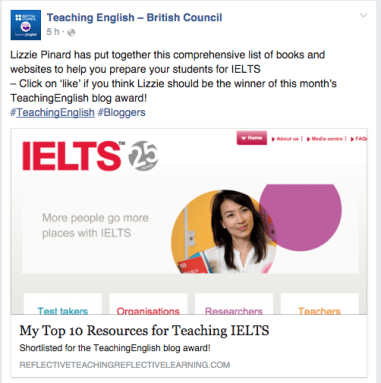
A list of IELTS resources wouldn’t be complete without a tipping of the hat to IELTS.org, home of IELTS on the web, and the Facebook page associated with it. IELTS.org has sections dedicated to test-takers, organisations, researchers and teachers. The Official IELTS Facebook Page publishes regular quiz questions relating to the exam and language typically used in the exam, with the answers following 24hrs later. If your students use Facebook, it’s worth pointing them at the Facebook page, and certainly they can benefit from looking at the test-takers section of IELTS.org.

I hope you find this list useful. And now, I look forward to hearing your suggestions for no. 10! 

Edits:

IELTS! image taken from en.wikipedia.org via google search for images licensed for commercial reuse with modification

IELTS! image taken from en.wikipedia.org via google search for images licensed for commercial reuse with modification

Leeds Metropolitan University has become Leeds Beckett University!

For reasons unbeknownst to us mere mortals, Leeds Metropolitan University changed its name to Leeds Beckett University, with effect from September 2014. I spent a happy year at Leeds Met doing my M.A. in ELT and Delta, between 2012 and 2013, and for me it will always be Leeds Met.

However, nostalgia aside, usefully enough, I have now finally updated all the links in my blog that used to lead to Leeds Metropolitan’s M.A ELT/Delta page so that they now point in the brand new direction of Leeds Beckett University’s M.A. ELT/Delta page. I can assure you, it was a very dull labour of love. Worth it though, as the good news is, the only thing that’s changed is the name: the M.A. ELT department is still kept going by the same lovely team of tutors who were at the helm while I was there.

I’m not, though, going to change all mentions of Leeds Met, in various blog posts and pages, to Leeds Beckett, as it was Leeds Met when I was there, but at least now, should you be so inclined, you can follow links to more information about the course I did without reaching a dead end!

Enjoy! 🙂

Goodbye 2014, Hello 2015!

And so this is Christmas, and what have we done? Another year over, a new one just begun…
Already? I think 2014 may have been the fastest year yet?!

The WordPress Monkeys recently sent me a round-up of my blogging year, and as usual it prompted reflection on the year as a whole, as well as what lies ahead.

In 2014 I:

delivered my first webinar (for the British Council)
– delivered my first online conference presentations (for IH and for BELTA)
spoke at IATEFL for the first time and also got proposal no. 2 accepted for Manchester this year
spoke at MATSDA for the second time
– wrote a book chapter (for an edited book hopefully being published by IATEFL Learning Technologies SIG this year)
taught EAP for the first time at Sheffield Uni
– completed the IH Certificate for Teaching YL and Teens
– finished year 1 and started year 2 in Palermo
– got some self study materials published by Richmond ELT (3 worksheets, CEFR A1 level, reading)
won an ELTON (yes I remembered it at this stage of the list-making activity!
– won a British Council blog award for the posts I wrote at IATEFL  in Harrogate.
– graduated with a distinction from my MA in ELT
– started the IH certificate for training to be a tutor/trainer
had my column appear in the 2014 IH journals
– became vegan (not work-related but perhaps my most significant non-work related step) and developed a passion for cooking in the process!
– learnt a heck of a lot of Italian (and a lot about language learning in the process!)

… And thought around November-time that I was slacking and not really achieving enough in 2014. Hmm! Actually it was quite a year, so if academic year 2014-2015 started quietly enough (‘only’ doing the tutoring course and learning how to teach IELTS in addition to the usual work stuff and Italian study) maybe that’s ok, actually! 😉

Here is an excerpt from the WordPress Monkeys’ round up of my blogging year:

Screen Shot 2015-01-01 at 23.34.03

Thank you to all who visited me here…

Screen Shot 2015-01-01 at 23.34.36

…whichever corner of the globe you hail from!

It is always interesting (for me) to see which are the top-viewed posts of the year. For 2014, I suppose they are fairly representative of what I got up to: I did indeed produce a well-received series of ‘Top 10 resources for…’ posts which have hopefully been helpful to some people, I enjoyed getting my teeth into discussing issues relating to language learning, I have been very busy working on my learner autonomy projects and I did lots of stuff in the classroom too!

Screen Shot 2015-01-01 at 23.34.19

Looking ahead

2015 should be certainly an interesting year, with a few things pencilled in already. E.g. IATEFL, another webinar, a journal article due in May, reapplying to Sheffield Uni for the summer. It’s also a year of uncertainty, in that for the second year running I need to decide whether to do another year at IHPA or not. I think I really got lucky in getting my job there from Oct 2013, it’s been a great place to work with a lot of opportunity for development and I was delighted to return in October. However, I don’t know that a third year is for me. I think I want to return to the UK and settle down. Why? Quite simply because I’m not old but I’m not getting any younger and I find it quite an upheaval living between two places – just as you get used to being in one, then it’s time for a stint in the other. It’s the best of both worlds and yet the whole of neither of them. Not conducive to relationships or family building, either, in my opinion. (Teaching is awesome but I want a life outside of it too!) However, because of how it all works, the application timings involved, I would have to relinquish one job with no guarantee of another, which is scary! Fortunately I have supportive family and friends, and an ok CV so even if plan A didn’t work out, I will find a plan B or C (G? K? We’ll see!) somehow or another… Necessity is the mother of and all that. Meanwhile, I have another couple of months to think about it before crunch time!

One thing I do know is that I will continue to seize opportunities as they arise and see where that takes me – it seems to be working ok so far! This year I also want to extend the seizing to opportunities for having fun, and opportunities within my personal/social life, rather than only in the sphere of work: life is short (as my mum’s untimely death in 2009 taught me) and there *is* more to it than ELT (even though ELT is a fantastic part of it!). So, the blog may have been a bit quiet lately but rest assured the time has not been wasted. I’d like to blog more this year, as I do enjoy it and find it a great developmental tool, but I also have to balance all my other commitments AND have a life, so everything in moderation, I suppose… (Otherwise put, it may or may not be a little quiet until after I’ve finished the IH tutor training course!)

Finally, happy new year to you all and thank you for being part of this blog: sharing my posts with you is a real privilege. 🙂

2015_new_year

Happy 2015!! Image taken from a Google search, licensed for commercial reuse with modification.

Christmas Fun!

Well, it’s that time of year again! Here are a few things I’ve done with my classes in the last week before the Christmas holidays… 

1. Christmas Play!

How the Elves saved Christmas

My 10-12 year old ‘M2’s’  persuaded me to enter into the ‘Christmas Spirit’ this year, by requesting a Christmas play – some of them had done a play with their teacher last year and, apparently, had much enjoyed it! I duly complied and set about writing a play. The play tells the story of Father and Mary Christmas, amidst their Christmas preparations, losing their list of naughty/nice boys and girls, and sending the Elves off to compile a new one. The Elves finish their journey in M2’s classroom and use our star chart to decide if the M2 children should get any presents this year. Needless to say, the answer was yes! So, in the end, they return to Lapland with the list and Christmas is saved!

In terms of language, I also managed to work in all of the structures we’d looked at over the course of this term – present simple, past simple and continuous, present perfect, comparatives, possessives and present continuous for future plans – as well as a song and a chant (the chant being based on the wake up shake up chant we do at the start of each class).  In terms of preparation, as well as rehearsal time (half an hour per lesson for three lessons), some time had to be spent making elf hats and shoes out of coloured card.

Here is the hat I made as a model for them! The design inspired by a Google image, but I can’t claim credit for it – my lovely YLC (Young Learner Coordinator) figured it out!

Elf hat

Here are my happy elves, Father Christmas and Mary Christmas (who, bless her, stepped into the role at the last minute due to an absentee, hence double hat and script in hand!):

m2

And here is a copy of the play. It is for a cast of 8 students and one teacher, but easily adaptable, as the number of elves is very flexible!

2. A letter of complaint to Santa

I also had some Christmas-related fun with my L4b’s (Upper Intermediate teenagers): In a bid to try and balance the time:exam date:quantity of course book remaining ratio, rather than doing an un-related Christmas lesson, I converted a page of their course book into one. The course book page from Pearson Choices Upper Intermediate was a writing workshop, focusing on formal letters of complaint, within a unit on advertising.

So a quick Google found me this letter of complaint to Santa. A speedy bit of editing enabled me to splice in some of the language that the Choices workshop centred around, that is to say language for formal letter writing, including the structure ‘Not only <inversion>….but …. too’ e.g. Not only were the presents not what I had ordered, but they arrived late too’. To lead in, I threw together a quick powerpoint with images of an advertisement for Santa’s Grotto, claiming to make all your dreams come true, a Christmas tree with presents beneath it and a screaming child, from which I was able, via some pair work, to elicit the story behind the letter of complaint. This was followed by some role-playing in pairs, student A was the 9 year child, with a rather impressive vocabulary, who wrote the letter and student B was the grumpy elf who answered the phone when said child called to complain (mentioned in the letter) and then the language focus, using a mixture of the Choices skill builder for identifying the target language and my own Christmas complaint letter-related examples for the ‘Not only…’ bit. Finally, I asked them to imagine it was Christmas day and they had just opened a…<show the picture on the course book  page> …I think it was a fancy alarm clock and had them imagine the problems they might have with it, which they then compared with those mentioned in the model letter on the course book page, from which the homework of writing their own letter was set up.

So, nothing extraordinary, but my teens enjoyed the amusing twist on an otherwise fairly bland sequence. 🙂

3. Christmas Debate

Less amazing still, but good value: turns out you can get a really good debate out of the topic ‘This house believes that Christmas should be abolished‘ with chatty Italian upper intermediate adult students! It also provided a nice opportunity for reviewing language for expressing opinions, agreeing and disagreeing, which we had looked at earlier in the course.

🙂

So all in all, it’s been a fun run up to Christmas and, even better, now the holidays have actually arrived!

Teaching teenagers “have to” and “can’t” for complaining – resurrected in TEA issue 71!

A while back, I blogged about an activity I had done with my teenagers, to help them get to grips with ‘have to’ and ‘can’t’ for complaining. Some time down the line, Philip Kerr from TEA (Teachers of English, Austria) approached me to request permission to publish the activity in the TEA online magazine winter 2014 issue, which I, of course, duly granted.

Here is a link to the magazine, where, as well as my little activity, you can find pieces by Ceri Jones, Lindsay Clandfield and others, on a range of focuses.

Enjoy!

(PS: there will be more blog posts soon… when the time – things to do ratio is just slightly less punishing!! 🙂 )

Keeping teachers motivated

A few weeks ago, at IH Palermo, we had a workshop on Demand High Teaching. We looked at various techniques for ‘getting closer to the learning’ in the classroom and were then sent off to experiment in our classes, with the promise that there would be a subsequent ‘reporting back’ session. This happened today, as part of a rather informal workshop in which we discussed what we had learnt/taken away from/experimented with from recent ‘buzz observations’ (short i.e. 10-15 minute pop-in peer observations) and reflected on our experimentation with Demand High. The final part of the workshop was dedicated to a ‘swap shop’ where many of us shared activities we have done in the classroom recently.

To me, this is rather an effective way of motivating teachers. By telling us that there would be a future session in which we’d talk about what we had done with the techniques learnt about in the Demand High session and what we’d taken away from the buzz observations, there was immediately more chance that we would make more of an effort to do something in the meantime! This mirrors what I strongly advocate doing with learners, in terms of fostering learner autonomy: bringing it back to into the classroom. I think it’s equally important and effective where teachers are concerned, because like our students we are busy people. And sometimes, CPD might get put on the back-burner as a result. Yet, effective CPD is done little and often, is an on-going process of growth.

The workshop was interesting: as well as sharing ideas and experiences, we discussed the pros and cons of buzz observations and full lesson observations, from the peer observation perspective. I found this particularly interesting as I am doing the IH Tutor Training certificate course at the moment, and one of the recent modules looked at organising observations. Turns out there are more types of observation than I was aware of! Anyway, I hadn’t come across buzz observations before we did them here this term, but we all agreed that they are a Good Thing. Why? You get to see ‘snapshots’ of other teachers’ lessons and gather ideas for use in your own. It may not necessarily be things that are new to you, but it may remind you of things that you haven’t done for a while. (Over time all build up a range of techniques and activities that we use, but the more time you teach for, the more you build up, the more you can forget! And, of course, we generally tend to stay in our comfort zones!) You also get to see a range of teaching styles and a range of levels in a short space of time, so it is very time effective. Of course, full length observations have different benefits: you get to see the shape of the lesson, where an activity fits into the great scheme of things, how learning is built on in the course of the lesson etc.

From the point of view of being observed, we agreed that it is less stressful not to have the same person sitting in for the whole lesson, but yet, having people pop in and out does make you ‘up your game’ – naturally! I have to admit, I found it particularly gratifying today when one of the teachers who observed me mentioned how clear my instructions were! Instructions (which in my recent YL observation we renamed ‘demonstrations’ to help me…) have always been my nemesis. I suppose this teacher caught me on a good day! (Or, a good activity, rather! Inconsistency is where I’m hovering with instructions currently…) Perhaps this ‘gratification’ is another positive aspect of this type of workshop where we feedback on what we have learnt from one another: it reinforces that we all have something to offer and that we can all (and should!) learn plenty from one another. And it helps us all feel valued, which is important, even if it may seem like a small thing.

In conclusion, workshops don’t have to be complicated and full of bells and whistles in order to be very effective. (I must remember this, as I am on the module for planning input sessions now…!) It is also A Very Good Thing when a couple of kettles, some mugs and a good supply of teabags are involved! 🙂

I leave you with a link to my most recent British Council post, which discusses CPD at IH Palermo and how it works here, as well as the effect of this on teacher motivation. Enjoy! And if your school isn’t doing any of the things I’ve discussed in this post and my BC post, why not suggest that they do? Evolution is healthy! I also leave you with a request: let me know (comment on this post!) what kind of CPD you’ve been up to recently – through your place of work or independently – I would love to hear.

OLYMPUS DIGITAL CAMERA

CPD and cups of tea/coffee combine very well! Image taken from google image search for images licensed for commercial reuse with modification.


British Council Videos: ‘Teacher Talk’

One of the perks of being a British Council Associate is that as well as having had the opportunity to deliver a webinar (with another on the cards for next year!) I have also been able to participate in a project called ‘Teacher Talk‘. This is a series of videos edited by the British Council, which feature some of the BCAs talking about various ELT-related issues.

So far, you can watch short video clips about:

(Click on the title to be taken to the relevant video – I think there may be more forthcoming, but I can’t actually remember at this stage how many topics there were in all!)

I think part of the beauty of these clips is that they are so short – within a few minutes you can either pick up a few new ideas or remind yourself of things you knew but hadn’t been uppermost in your mind recently, becoming buried amongst the myriad other things that we, as teachers, have to juggle.

The other thing I like about them is that you hear a range of voices on a single subject, particularly as the British Council has edited the videos very cleverly, so that although they cut from one person to another, the flow of ideas is seamless and easy to follow.

From my own selfish developmental point of view, making the videos, which I sent to the British Council to be included in the editing process, encouraged me to reflect on and synthesise (very succinctly by my standards – the videos had to be fairly brief!)  my views on these various important elements of ELT. Watching the videos now, months down the line, it encourages me to question whether I practice what I (and the others in the video clips) ‘preach’ and how I could try and do so more effectively.

All in all, a very rewarding project to have been part of. Thank you, British Council, for this fantastic opportunity! 🙂

2 simple ideas for adapting your course book

After a very prolonged silence (life gets  in the way dontcha know!), here I am again! Greetings, all. For my first post back, I thought I’d share two very simple ways that I adapted two standard course book activities from New Headway Upper Intermediate unit 1 (so this was a while back, as we are now on Unit 3, but it’s taken me that long to get round to writing this post!), which worked very well with my Level 7’s. Both adaptations could easily be applied to other activities of this type, at any level from pre-intermediate upwards.

At upper intermediate level, in my context, we have the luxury of TIME: instead of 6 units to be covered over the duration of the course, the magic number is 4. So, as I wasn’t in a hurry, and I wanted the learners to mine the maximum possible out of the activities in question, which are both linked with tense review, I did some adapting…

1)

Course book activity:

A grammar-focused warmer activity consisting of a list of sentences, a box of time expressions. Students to insert the time expressions into the sentences. The time expressions can be used more than once and some will fit in more than one place in a given sentence.

My adaptation:

  • Write each sentence on a separate piece of paper
  • Stick the sentences up around the room
  • Give each pair or small group (3) – depending on numbers – of learners the box of time expressions.
  • Pairs to go round the classroom, stopping at each sentence to decide which time expressions could be used with it and where they should fit.
  • Once all have finished, whole class feedback: the teacher reads out each sentence with the time expressions where students have put them. The class as a whole decides if the sentence is correct or not.

Benefits:

  • A lot of discussion, both at the pair/small group stage and at the whole class feedback stage: learners really engage with the language.
  • Pairs/small groups can see what other pairs/small groups have done, and decide whether they agree or disagree.
  • Provides a nice energetic start to the lesson, as learners are moving around rather than sat still.

2. 

Course book activity:

A set of sentence starters which between them will generate a range of tenses. Students to complete the sentences with their own ideas, then read their sentences to a partner and respond to their partner’s sentence.

My adaptation:

  • In advance of the lesson, teacher completes the sentences with own ideas
  • In the lesson, teacher focuses learners on the sentence starters and tells them that she has completed those sentences making them true for her.
  • Learners to try and guess what the teacher has written. E.g. for the sentence starter “At weekends I often…” Students might say, “At weekends, you often go out for a drink with your friends!” or “Do you often go out for a drink with your friends at weekends?“. Of course, the teacher can feed in clues to help the learners guess. This stages provides the model for the next stage.
  • Learners then complete the sentences to make these true for them.
  • Then learners repeat the guessing process in small groups.

Benefits:

  • The teacher can provide linguistic feedback at the modelling stage, if learners make mistakes when guessing. Learners will then hopefully produce sentences that are more correct than they would have been, in the subsequent stage. (Of course teacher monitors to check for any errors)
  • The activity is more interactive and engaging. Rather than a learner reading out their sentences and another learner half-listening, there is some genuine communication going on, which requires use of the various tenses under review.
  • The nature of guessing means that learners produce multiple sentences using the sentence frames and target structures.

Nothing very earth-shattering or “new”, no great deal of preparation required, but sometimes the simplest things can be pretty effective. This was the case with the two activities described above.

Hopefully, at the very least, I have reminded you of these two different ways of going about approaching the activity types in question: lately I have been reminding myself of various classroom management techniques via Jim Scrivener’s book of that name, so I am a fan of reminders!

Enjoy 🙂 (And I hope it won’t be so long till the next time I post something!)

Motivation

Motivation is a slippery beast.

Amongst those who research it, there are many differing views (Dornyei and Ushioda 2012) but there is agreement with regards to its effect on human behaviour:

“Motivation is responsible for

  • why people decide to do something
  • how long they are willing to sustain the activity
  • how hard they are going to pursue it” (ibid: kindle loc 259, emphasis as per original)

A lot of investigation into motivation has taken place over the years, with various theories abounding to account for the origins of motivation, the effects of motivation, the effects of the absence of motivation and other such elements.

Motivation is fascinating.

It is something that everybody both enjoys and struggles with at various intervals. It can fluctuate hugely in a very short space of time. When you’re feeling motivated, you can’t imagine not being motivated by whatever it is that is motivating you at that time, but then something happens and your motivation nose-dives, at which point you find it difficult to imagine feeling motivated again. Motivation can be influenced by so many things, both external and internal. Of these influences, some will kindle motivation and some will dampen it, changes which may occur simultaneously, resulting in a sort of battle of influences, with victory being a very temporary state. Of course, with so many influences at play, it is difficult to identify which one is responsible for any change that occurs (Dornyei and Ushioda, 2012).

Motivation is closely entwined with learner autonomy.

My other passion, learner autonomy, is closely entwined with motivation. Nobody is going to dedicate any length of time or great effort to doing something that they are not motivated (whether that motivation be positive or negative) to do. Autonomous language learning, by nature, requires, amongst other things, motivation. The motivation to begin, and, as importantly, the motivation to keep going. Enthusiastic language study/use for two days followed by several weeks of doing nothing will have little effect on one’s competence. Indeed, Williams and Burden, 1997 (in Dornyei and Ushioda, 2012) highlight the need for language teachers to consider not only the arousal of interest but also the longer term process of helping learners sustain it. I would argue that this applies not only to motivation within the classroom across the duration of a course, but also to the motivation for learning outside the classroom.

Developing one’s language skills autonomously is hard work. It is hard enough work, when, as a teacher, you are very aware of how learning a language works: we know that it is slow, that progress may seem invisible, but we also know that every little helps and that perseverance is key. We know how important exposure to the target language, in all its forms, is; we know that a vast amount of this type of exposure is necessary for the effects to become apparent. We have awareness of different approaches to learning, different activities and the benefits of these, enabling us to combine them as we see best suits our needs. Of course, even with our knowledge of all these things, we are not immune to dips in motivation. There are far too many different elements that influence motivation for anybody to be immune to dips in it.

Motivation is long-term.

Perhaps, then, in terms of sustaining motivation, we ought to ask not only “how do I stay motivated?/how do I help my learners stay motivated?” but also “how do I rekindle my motivation when it dips?/how do I help my learners rekindle their motivation when it dips?” Take, for example, my Italian learning. Over the summer, while I was in the UK, I was, by and large, hugely motivated to improve my Italian. I worked so hard on it that my housemate dubbed my attic bedroom “Little Italy”. My key motivation was being able to converse in Italian when I got back to Palermo. Fast forward back to mid-October, and here I am. Have I spoken loads of Italian? No. Outside of work, there has been the odd bit of transactional communication, at work, the opportunities to actually converse, getting beyond pleasantries (hi, how are you, how was your weekend etc.) are few and far between. (I think I need PSP Speaking [on offer at IHPA – multilevel English conversation hour that students can freely sign up for, in addition to their courses] in Italian!)  Since returning to Palermo, my motivation has fluctuated a lot more than it did in the UK. I find this interesting because being in the target language environment is supposed to be motivational. It’s supposed to be harder to stay motivated when you are outside it. Perhaps this would be the case if you had no concrete plans to travel to the target language environment in the foreseeable future.

Motivation is problematic.

My first problem after getting back to Palermo was that I lost my overall driving goal – that of ‘being able to converse in Italian when I get back to Palermo‘. Initially I was very happy – I managed to do things like sort out my phone and internet in the phone shop unaided, a far cry from the same time last year, when I had no language and could do nothing independently. And then something happened. A week where, for the first time in ages, I didn’t meet my (updated) learning contract – by a long shot. I just hadn’t really bothered. Instead, I merely read my current book(s). After that week elapsed and I had even “forgotten” to do my weekly reflection (in Italian), I had a little emergency meeting with myself, to try and figure out what was going on. What was going on was that I didn’t feel motivated anymore. My outdated goal needed updating. It has now, as of a couple of days ago, become ‘I need to keep studying so that when opportunities to speak properly in Italian do occasionally arise, I haven’t lost all the language I was building up over the summer with afore-mentioned opportunities in mind’. The reflection and the goal-updating have helped my motivation somewhat. Of course one of my other motivations, that I love the Italian language, has remained a motivation – but that only motivates me to keep reading and to a lesser extent watching/listening in Italian. All well and good, but the speaking only gets rustier! What all of this highlights for me is some issues around goal-setting: goals need to be updated if circumstances change (but a change in circumstances may, of course, not be as big as a move between countries as in my example); lack of, or outdated, goals can result in lack of motivation; goals that are too general don’t have such a strong effect on motivation (“I want to be better at Italian” could be said to be a goal of mine, of course, but it is not specific enough to motivate me on its own.) Plenty of food for thought.

Motivation is inspirational. 

This whole process, spanning the months from June when I started learning Italian in earnest through until now, has on various occasions given me food for thought, leading me to wonder how to apply what I learn from my own experience to what I do with students in the classroom. The latest developments have lead me to delve into further experimentation with helping learners manage their motivation. I say “further” because my learner autonomy projects last year had a strong thread of this running through them. So perhaps this post is a very long-winded way of saying “stay tuned for more posts relating to motivation and language learning” !

References:

Dornyei, Z. and Ushioda, E. (2012) Teaching and Researching Motivation (Applied Linguistics in Action) Routledge. Oxon.