Have you heard of TEFLEquity Advocates?

The main purpose of this post is to share some information about a grass roots organisation that I have only recently become fully aware of: TEFLEquity Advocates. The second part of the post highlights a few other related links you might also like to look at.

TEFLEquity Advocates

Hands up if you know about it? Hands up if you knew about it before Silvana Richardson took IATEFL by storm with her fantastic day 2 plenary session? Hands up if you were like me – only vaguely aware of it before IATEFL?

TEFLEquity Advocates is 2 years old. It was set up in April 2014 with the purpose of fighting the discrimination that persists in ELT hiring practices. The about page of their website stresses that it is not only for “non-native speakers” and encourages “native speakers” to get involved as well. Silly labels that we are currently stuck with aside (for an explanation of why they are ridiculous, have a look at this post of mine!), basically what’s important is that it is for EVERYBODY who works in ELT. And if you are reading my blog, that probably means YOU too.

Even though, as I mentioned, I was vaguely aware of TEFLEquity Advocates before IATEFL, I hadn’t realised quite how extensive their website is. (It’s fantastic!) I figure that if I wasn’t aware, then there are probably others out there who now know about TEFL Equity, due to the prominence at IATEFL enjoyed by the issues that it treats, but don’t know about it and all the wonderful resources you can find on the website. Hence this post.

Resources

TEFLEquity Advocates has a whole section dedicated to useful resources:  You can find such gems as a reading list of academic papers relating to “NEST and NNEST” issues, complete with hyperlinks to help you access these; a list of blogs that also focus on these issues, again complete with hyperlinks; a list of anti-discrimination statements made by various organisations and finally a list of Facebook groups that you could join, in which these issues are discussed.

Get Involved

It also has a section dedicated to suggestions for ways for YOU to get involved, including joining a list of current supporters (on my list right now!), links to a couple of surveys that you could complete which would contribute to the website founders’ research on the issues it treats, and a badge that you can add to your blog or website. It looks like this:

badge

Put this on your blog or website and link it back to the TEFLEquity Advocates website, please!

Can you see mine, to the top right-hand side of my website?

The Blog

In the Blog section you can read a number of inspiring stories written by teachers (both “NNEST” and “NEST”) who have succeeded against the odds, blog posts written by the website curators (most recently, a post that questions what comes next after Silvana Richardson’s IATEFL 2016 plenary ) and, finally, a “Talk to the Experts” section, which contains a list of links to a wide range of interviews conducted by TEFL Equity Advocates. The list is broken down by background and contains categories such as Academic Directors/Recruiters, ELT Professionals, Teacher Trainers, Linguists/Scholars and more.

The Hall of Fame

This section contains an A-Z of schools, recruitment agencies and listing websites that DON’T discriminate. Hopefully this will be an ever-growing list, so if you think any school/recruitment agency or listing website is missing from it, there is a contact form you can use to get in touch.

Webinars

TEFLEquity Advocates regularly host webinars on a wide range of “NNEST”/”NEST”- related topics and issues. In this section of the website, you can find a list of links to past webinars together with information for how to join forthcoming webinars. (I have been invited to give a webinar later this year, which invitation I was delighted to accept, so watch this space!)

Activities and Lesson Plans

In the final section of the TEFL Equity Advocates website, you can find lesson resources, whose aim is (and I quote) “to raise awareness of ELF and World Englishes, NNEST discrimination, qualities of good English teachers in general and egalitarian hiring policies.” These are divided into plans intended for use in ESL and EFL classrooms and for use in teacher training.  If you have any lesson materials that would fit in either category, the website welcomes you to get in touch by using the contact form.

Hands up if you were aware that the TEFLEquity website contained such a lot of useful, interesting material? I wasn’t, until I got home from IATEFL and went to have a look at it! I encourage you to do the same. Read a few articles, watch a webinar, and, of course, get involved in any way that you can. The more of us who do, the better! The website already contains loads of great content, but, across the board, TEFLEquity Advocates welcome your contribution, be it by doing a webinar, writing a blog post, sharing a lesson plan or any number of other options. There is no shortage of opportunity to get involved.

Other things to have a look at

(I wouldn’t usually plug my own posts like this, but this is an important topic and these talks and discussions were so worthwhile, that I feel justified in doing so!)

Ignorance and silence are our biggest enemies, so let’s raise awareness and NOT stop talking about the issues until they become historical rather than current.

Lizzie’s Language Learning Contract (v2.April 2016)

Capitalising on post-IATEFL momentum and motivation, I’ve decided it’s time to renew my language learning goals – and practice what I preach! I’m always telling learners, ‘it doesn’t matter if you’re busy, even ten minutes a day is better than nothing’ and encouraging them to maintain motivation. Meanwhile, what about me? Well, it could be worse, I suppose…

  • I DO write my diary in Italian (nearly) every day (I missed a couple of days while at IATEFL, for example!). My reading is slightly more sporadic – at the moment I’m listening and reading along with Per dieci minuti written and read aloud by Chiara Gamberale. It generally happens while I am having a bath in the evening but sometimes I am just too tired! (I’m also in the middle of a translation of the third book in Philip Pullman’s Dark Materials trilogy. But I haven’t dipped into that since I got back home from my most recent trip to Sicily, at Easter!)
  • I also have a stack of magazines that I don’t dip into as often as I should (read: erm, when was the last time I did so?!)
  • I’m reading in German a few times a week at the moment too, am quite enjoying the book I am in the middle of. It’s about horses and aimed at young teenagers (!) – good fun. 😉
  • I’m also in the middle of a book in French (Au Bonheur des Dames by Emile Zola) but it’s been a while since I dipped into that properly – though I did read about one page recently!

It’s Polish that’s the real problem. I decided I was going to learn Polish in late May last year. Suffice to say, it wound up on the back burner. However, last night, for the first time in ages, riding the wave of post-IATEFL motivation, I dug out my ‘Harry Potter 1 in Polish’ audiobook and listened a bit, just enjoying the sounds and rhythm. (I had want to listen and read along but I’ve got to work out where my e-book of it is stored, was unable to find it quickly enough…) I still want to learn Polish. However, it doesn’t end there. I’ve also got a little bee in my bonnet telling me to try another project: Project “see how much Spanish I can pick up purely through using graded readers”. Unlike Polish, Spanish graded readers are fairly easy to come by – including those with audio discs, which are the sort I would go for. I think it would be an interesting experiment!

Screen Shot 2016-04-19 at 08.57.31

Using the theory I’ve used on my learners, I am going to communicate my learning goals to you lot who read this blog in the hopes that it motivates me to achieve more than I would have otherwise. Even if I don’t always manage to meet my self-inflicted contractual obligations, it will hopefully still be more than I would have achieved if I hadn’t made them in the first place.

Lizzie’s Learning Contract

I solemnly do declare that I will (attempt to) do the following this week:

  • read and/or listen to something in Italian
  • read and/or listen to something in French
  • read and/or listen to something in German
  • use my 1000 first words in Polish
  • “read”/”listen to” Harry Potter in Polish
  • use Memrise and/or Quizlet for Polish
  • use my Polish for Dummies book
  • use graded readers in Spanish

Signed: Lizzie Pinard

That’s all! It’s not a huge ask. The first three are very vague, but that’s fine – it means they encompass any kind of input I wish to use (books, audiobooks, magazines, radio, tv etc) As as sub-goal, I will aim to vary it if I can…

Let’s see how it goes. There will be updates at various possibly semi-regular intervals!

Is anybody else trying to learn a new language at the moment? How are you going about it? Is it working?! 🙂


My IATEFL Summary of Posts

I thought I would collate all my IATEFL blog posts into a single post, as I usually do, but with a twist: This year, I am going to weave them into a narrative of my IATEFL 2016.

Tuesday

I arrived at the ICC  from New Street station after my “I’m going to walk” initial attitude had been wiped out by immediately getting lost and doing a big circle at the end of which I was back at the station again. “Where are the taxis?” was a much more successful approach. Thankfully, Sandy was there when I arrived (somewhat flustered!) and pointed me in all the appropriate directions, which meant I was well in time for the start of the event.

This was the day I attended the Materials Writing SIG Pre-Conference Event – Print VS Digital: Is it really a competition? I watched Ceri Jones’s talk about the similarities between print and digital, through looking at a specific learning task in various print and technological manifestations. This was followed by Genevieve White telling us about the skills needed to adapt a print course to digital. After the break was the young learners and teenagers section – Katherine Bilsborough gave us lots of great tips for primary materials design and Fiona Mauchline took us into the minds of teens. From this, we moved on to a focus of self-publishing with Damian Williams and editor etiquette with Sue Kay. I was very surprised to discover that leaving 2 spaces after a full-stop isn’t something that everybody else does. I learnt it when I learnt how to use computers and have done it ever since…or have I? Looking at my blog posts, it seems that I actually don’t leave two spaces after all. Yet I could have sworn I did… Just as well it’s no longer a thing then! The SIG day was rounded off with a panel discussion.

On Tuesday evening, along with Sandy, I discovered that Jamie’s Italian does some very good vegan options – yum! Of course, the time spent catching up with people who you haven’t seen, well, since the last IATEFL conference, is all part and parcel of the experience.

Wednesday

It started, of course, with the opening plenary delivered by the wonderful David Crystal, which did not in any way disappoint. A fascinating hour and twenty minutes. My next session was a sit-out, as I wanted a bit of head-clearing time before I did my talk in the 12.00 slot (How amazing to have such an early in the day AND early in the conference slot! (I’m used to the penultimate day graveyard slot…). It was part of a listening forum, which meant that I spoke alongside Craig Wealand and Ellen Servenis. Craig talked about using podcasts with students, in terms of encouraging them to listen outside the classroom, while Ellen talked about using listening journals with, like me, the goal of encouraging students to use metacognitive strategies to help improve their listening skills. Both talks were very interesting and I enjoyed being part of a forum, though our time allocation seemed incredibly brief!

That done, I could get down to the serious business of making the most of my IATEFL. After lunch, I attended an EAP-focused talk, by Angela Smith which was about sharing ideas for supporting postgraduate students, a materials development focused workshop, by Kath Bilsborough and Sue Lyon-Jones, which had loads of ideas for using what’s already out there in your materials and how to do that, and a talk about introducing flipped learning into a university EAP setting, done by Robyn Brinks in collaboration with Pearson, so a nice variety, all in all.

From 6.30 to 8.00 in the evening, following a rushed bite to eat at The Handmade Burger Co. near to the ICC, it was the Cambridge “invitation-only” event time. I have no idea why I was invited, but on the plus side for me, there were two-minute talks as well as the usual hobnobbing that I am so inept at! Through these I had a taste of Silvana’s fantastic presentation style, which made me look forward to the next day’s plenary.

Thursday

Well, between having seen Silvana speak briefly on Wednesday evening at the Cambridge thing and having read the abstract for her plenary – The Native Factor: the haves and have nots – I had high expectations. What I didn’t expect was to reach the end of it feeling like I wanted to cry and having to fight really hard to get all my emotions back under control. Because seriously, who cries in a plenary, how embarrassing! Turns out I wasn’t the only one. Such an important topic, so immaculately delivered, I highly recommend that you watch the British Council recording.

The plenary finished a bit late (I assume – I went directly to the next session I had earmarked and it had already started!). It was a session about using TextInspector. I didn’t write a blog post because not only did I arrive late but I couldn’t get on the wifi either, so made a few notes in Word. These are they:

Text Inspector

Late entry – worth it! (plenary)

 www.textinspector.com

  •  Profiles a text according to CUP – CEFR band scales. You can try a version for free on the Vocabulary Profile website.
  •  If you go to Text Inspector: paste text into text box, click analyse and you get the output from text inspector. Different metrics down lefthand side. If you think it has miscounted e.g. number of sentences, you can edit it and update the scores.
  • You can also jump straight to the scorecard and get an overall analysis of your text, all the statistically significant data. Number of metrics used are e.g. average syllables per sentence etc. They have a statistically significant influence in terms of Band.

Not really worth a blog post, I think you’ll agree! It looks an interesting tool though, worth a closer look. I did manage to get on the WiFi for the next talk, which was by Michelle Tamala who was looking at how to help EAP students become more autonomous and use metacognitive strategies. Finally before lunch, I also attended Alan Maley’s talk, Ten great educators and their legacy.

After lunch, I had planned to attend the ELTJ debate on teacher training but I had been offered an interview slot which clashed with the start of that session. Nevertheless, it was exciting being interviewed! (I was going to say it was my first live interview, but I guess that award goes to my ELTon award one! Pity I didn’t remember that at the time, then maybe I would have been less nervous…!)

Thursday had an EAP theme running through it – the next talk I attended was ‘You tell me! Practical ideas for student led tasks in ESAP’ by Anne Heaton of Coventry University who she talked about making general English for Academic Purposes classes more subject specific by using students’ own knowledge within tasks, and I went from that to “How to optimise tutorial time: the 20 minute fix” by David Jay of Anglia Ruskin University.

Finally, I attended the Panel on Native Speakerism – it seemed the obvious thing to do after the morning’s plenary! It was interesting to hear about the issue from a range of perspectives. I was very shocked to learn that Christopher Graham had received hate mail (of the “You are betraying your tribe” variety) for supporting the TEFLEquity movement. I suppose I always like to think that people might have got over being so ridiculous by 2016. The truth is, in our profession, the battle is yet young.

I didn’t attend any evening events on Thursday evening, was exhausted funnily enough! And my apartment had a bathtub…

Friday

Friday was another lovely day, full of the spontaneity that makes IATEFL, well, IATEFL! I started with Tyson Seburn’s talk on learner-sourced visuals for higher level texts and then took a break from the EAP theme with Dita Phillips’s talk, “I’m a non-native speaker teacher, hear me roar!”  I nearly didn’t get in – first I sat on the floor and then the ushers tried to chase me and some lovely person gave up their seat for me and exited! Thank you, whoever you are!

After that, I really wanted to go to Sarah Milligan and Patrick Curry’s talk but finally opted for the MaW SIG Open Forum, after all I am a member! It was great to hear the summing up of the year, as well as about their future plans. Their scholarship (in collaboration with OUP) winner also said a few words, which was nice. Finally, I won one of the raffle prizes. 🙂  The SIG are recruiting new committee members and I am tempted to put in for the deputy publications role, running out of time though!

After lunch, I returned to the theme of EAP with Michelle Hunter who spoke on the topic of “Demanding High in ELT – silently” and followed it with the follow-up workshop to Silvana’s plenary  – couldn’t miss it! As you would expect, the turn-out filled a good-size hall! The time went very quickly, too quickly really, but the discussion was fruitful. I think/hope lots of people have gone away from IATEFL thinking about how they can make a difference. I know I have!

Then it was break-time and I met up with my tutors from Leeds Beckett and a handful of Leeds Beckett students past and present. It was lovely. The final talk I attended on Friday was that of my M.A. tutor Heather Buchanan and her long-time friend Julie Norton, a tutor at the University of Leicester. It was “What makes an outstanding coursebook? The publisher’s perspective”there was a lot of interesting information but not enough time. Hopefully they can say a little more about it in a future webinar…

That was all the conference sessions for the day, so off I went to Wagamama’s to grab a bite before the Pecha Kucha. Two other delegates had the same idea, one of whom I “know from online” and so we wound up having a lovely dinner together quite unexpectedly. This is one of the things I love about IATEFL! I thoroughly enjoyed both the dinner and the Pecha Kucha. It must be a real thrill to do one!

Other highlights of the day included picking up my annual Black Cat publisher bag! 😉 And also discussing ideas for future IATEFL talks with Sandy and getting an idea for a project that may well keep me going for years!

Saturday

Saturday began with snow, which was rather a shock! Fortunately by the time we made our way over to the ICC, it had stopped.

Scott Thornbury did the final morning plenary – 1966 and all that: a critical history of ELT. I missed the session straight after the plenary because I was saying goodbye to some people but then I went to “What is this thing called Academic English Language Proficiency?” which was really interesting! All about conceptual frameworks for competency and Dr Pamela Humphrey’s idea for one that combines all the ones she has read about. The last talk I went to was Damian Williams’ talk on language development for teachers, which was about integrating language development into teacher development.

Emerging from the bubble, walking in the sunlight after getting back to Sheffield and the real world (feeling somewhat bizarre after 4.5 days of intensive conferencing) followed. And that was the end.

Except…yesterday evening, I finally got round to putting the registered blogger badge on my blog! (Along with the TEFLEquity supporter one that I now proudly sport!) You can add one to your website or blog too, see this page to find out how. For other ideas of how to get involved have a look at this page.

My final IATEFL-related acts for the weekend were sorting this blog post out and writing a post that was my way of continuing the Native Speakerism issue. (It’s ok, I haven’t spent all day on the computer, I also went for a lovely little 12k run in the sunshine!) Now it’s back to the real world, but carrying all the motivation and buzz that IATEFL never fails to supply.

Thank you, IATEFL, for a fabulous few days and see you again next year, I hope!! (Meanwhile, I need to put my project into action! And hopefully also catch up with a few of the sessions that were recorded that I missed but wanted to attend…)

The Native Factor: the discussion continues

Hands up, dear readers, those who of you who think I am a ‘native speaker’ of British English.

Flag_-_Union_Flag

Hands up if you think I am from England.

“Where are you from?”

It’s one of the earliest questions we teach learners how to ask. And yet it can be one of the most difficult and complicated to answer.

I was born in Chichester, a little town in the south of England.

Screen Shot 2016-04-17 at 14.38.14

I’ve never lived there. I spent the first two years of my life in a little village near Bognor Regis (Felpham, for any Sussex dwellers!). My earliest memories of this part of England, though, come from visits to relatives subsequent to moving to the other end of the world.

From the age of 2 to the age of 17, I lived in Botswana, though I went to a boarding school in South Africa (Mafeking) for secondary school. 2000px-Flag_of_Botswana.svgsf-lgflag

My mum is English but if you follow her side of the family tree up a very little way, you will find one Mr Galindo from Spain.

1280px-Flag_of_Spain.svg

Also, once she finished university, she moved away from England permanently (apart from short periods of time when she had my sister and me). She lived in Barbados, Indonesia, Libya and Botswana and, of all those place including England, spent most of her life in Botswana.

My dad is Dominican.

2000px-Flag_of_Dominica.svg

His father’s branch of his side of the family, though is originally from France (his mother was indigenous Dominican).

french flag

He has lived in Dominica, Barbados, Grenada, UK, Belize, Indonesia, Libya and Botswana, and, again, of all those, Botswana is the place where he has spent the most time. He jokes that if he were asked to pick up arms in a world war, he wouldn’t know which way to point them.

I feel the same. Of my nearly 33 years, I have spent a grand total of about 10 or 11 (not continuously) in various parts of the UK. Two initial years, two years of A-Levels, 3 years at the University of Warwick (each year in different accommodation), a year up in Durham, 2.5 years in Sheffield, my M.A. year in Leeds. So, for 2/3 of my life, a big majority, I’ve been exposed to non-British English. In Botswana, South Africa, France, Indonesia and Italy. Add to that, of course, Dominican English via my dad!

What am I a “native speaker” of? Errrm a variety of English that doesn’t have an actual name? A cross between Botswana English, South African English, British English and Dominican English. I know the Botswana National Anthem (in Setswana) and the South African National Anthem (contains multiple languages) by heart, while the British National Anthem I know about one verse, possibly. Playground chants/skipping games were in Setswana. The mediums of instruction at school were various varieties of English (I had teachers from all over!). I studied French and Setswana at primary school, French, German and Afrikaans (but just as an afternoon activity) at secondary school, French at University and recently learnt a fair bit of Italian through living in Italy and self-study. I learnt a few words of Indonesian while I was in Indonesia too.

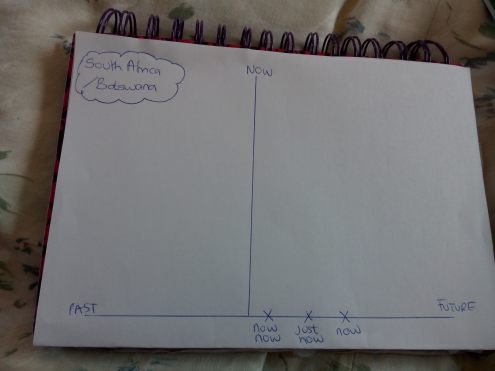
When I came back to the UK to do my A-levels, I had to make some adjustments to how I spoke (grammar and vocabulary) and my accent drew a lot of comment. For example, I had to learn that Botswana/South Africa and the U.K. refer to time differently. Look at these two timelines to see what I mean:

IMG_20160417_151653

IMG_20160417_151708

You can imagine, when I told matron at the boarding school in UK, “Ok, I’ll do it just now”, there could be some confusion. Another example: in South African English, we say “is it?” (izzit?) in the same way as someone from the UK might say “really?” or “is that so?” (Funnily enough, my dad would always correct us when we used that particular structure.) So, I had to learn British English when I started to live (on and off!) in the UK. (That said, I have a fairly limited command of it – put me in a conversation with someone speaking broad Liverpudlian, for example, and I struggle – as I did at IATEFL 2013 when trying to get instructions on where my friend should park her car!) I also had to deal with the absence of a whole swathe of cultural references – we didn’t have British TV in Botswana (and this was long pre-internet as we know it nowadays). Come to that we didn’t have TV, other than the one local channel that operated for a few hours a day, until I was about 12 or 13. (Which was when satellite TV arrived – prior to that we could only have had South African television and my parents didn’t want it because there was apartheid going on in SA and they didn’t agree it with it!)

So, where am I from? At the moment I say Sheffield. It’s where I consider home in the UK. But that’s a relatively recent phenomenon (I would say I have considered it home and where I come home to between contracts etc since 2007) . If we are talking birth, then Chichester, which otherwise means very little to me. I’m also and always will be from Botswana. And half Dominican. The strange thing is, I got a job in Indonesia on the basis of being a native speaker of British English, with my British passport. This clearly exemplifies how meaningless certain bits of paper and labels can be, not to mention job selection criteria of this nature! (My mum nearly had me prematurely in Libya so even my passport is a bit of an accident!)

Humans, however, love labels. Putting things into categories is something we are good at. We name things and group things. This is something we use to our advantage in language teaching, to help our students learn vocabulary. I actually rather dislike labels by and large. Particularly the sort that require you to tick boxes on forms – there is never a box that I actually fit all the way in! (On equal ops forms I either tick ‘other’ or, for the origins questions, ‘mixed white and black Caribbean’ – and you can bet that whoever reads that box tick wouldn’t be expecting me to show up, but there we are!) We like to tick box people by race, gender and sexuality, all of which are very fluid. It’s all well and good, the trouble comes when labels start to be abused, to be used as a basis for discrimination, hate crimes and so on.

Another thing to consider is that, issues with labels aside, the way we call things changes over time. David Crystal’s opening plenary gave many good examples of items of language coming into and going out of use. This year’s IATEFL would suggest that the labels “native speaker” and “non-native speaker” are finally ready to become obsolete, thank goodness. The world has changed since the terms were coined and it seems absolutely ludicrous that these outdated labels are still being used to discriminate against people. “Nativeness” in terms of language is really a very dated concept, due to the increased mobility of the global population. This was alluded to by David Crystal in his talk at IATEFL 2015, in which he answered a series of questions:

11. With the rise of EFL, what are your thoughts on dropping native speaker and referring simply to variants of English?

David only uses it in a biological context not a linguistic context. There has always been variety – accents, dialects. This has increased enormously, because of the enormous immigration into Britain,producing lots of diversity, and globally. Recognising this has an impact on everything we do. The fact that there is now so much “non-native” variation is simply a natural development similar to the diversity amongst people in the biological native context. People are all just speakers or writers on youtube, for example. There is a blurring of distinctions. Think of the couple who speak English as their mutual language, EFL, have a child, and speak to that child in English, then that child is a native speaker of EFL. At the end of the day, teaching knowledge is the important thing, in a teaching context. Pillow talk and nursery rhymes are the most difficult things for “non-native speakers”, according to a Swedish friend of David’s. No corpus of it – an IATEFL potential project? Watch out for microphones appearing between you in bed…😉

Yes, this year at IATEFL, the discussion has indeed continued. Indeed, with Silvana Richardson’s immaculately delivered plenary, The Native Factor: Haves and havenots, a panel discussion chaired by TEFLEquity’s Marek Kiczkowiak, and talks such as Dita Phillips’s I am a Non-Native Speaker – hear me roar! and Damian William’s talk on Language development for teachers, not only has it continued, but it has grown in volume and impact. In the panel discussion and the post-plenary workshop, the issue of labels was discussed, as the issue of what terms to use instead was considered.

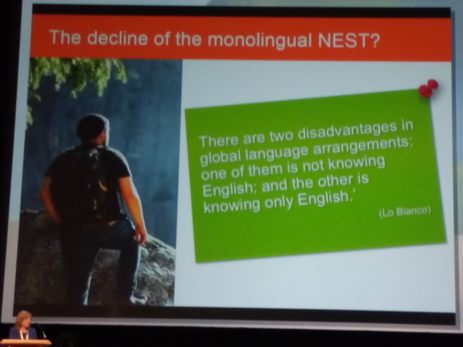
I’ve been thinking about this too. In Silvana’s plenary, she pointed out that

IMG_20160414_101007

In this day and age, that is absolutely true. The monolingual speaker of English, unless they teach English and are aware of the need for accommodation and communication strategies in spoken encounters with multilingual users of English, is the real spanner in the works and the reason why communication fails. (When we teach our learners repair strategies, I think we ought to explain that it’s because they may find themselves faced with someone who doesn’t know how to communicate properly and may need this kind of prompting – being asked to slow down, repeat, paraphrase etc!)  This being the case, surely the “ideal model” should be a multilingual user of English? I find it very strange that we have language schools inviting students to attend classes because learning a language is a fine thing to do and will give you such great advantages on one hand, and on the other hand, the same language schools only willing to hire what they call “native speakers” or teachers with “native level” English (which only counts if that English is British/American/Canadian etc and I didn’t see a category for my mongrel variety, I have to say!) Talk about thinking that is not at all joined up and extraordinarily mixed messages!

It’s time for SLA to catch up. It’s time for employers of teachers the world over to catch up. I’m glad that this year’s IATEFL has highlighted this. Let’s keep the discussion going. And let’s back it up with action. So far, I’ve blogged write-ups of key talks from IATEFL, written this blogpost and (very proudly) put the TEFLEquity supporter badge on my blog. It looks like this:

badge

Click on the image to be taken to the website

I strongly encourage everybody else in our profession, who blogs or has a website relevant to the profession, to do the same. Let’s be the majority, not the minority. We shake our heads at the unpleasant (often an understatement!) things our ancestors have done in the name of labels and arbitrary categories, but let’s remember that we also need to shake our heads and stand up against what’s happening now. This is the only way to rid our profession of discrimination and ensure that we have qualified teachers teaching English rather than people who have been hired because their first language is a particular variety of English and (in some cases) because they have white skin.

Thank you IATEFL for providing a platform for all those who spoke up in talks and panel discussions and workshops to speak. Silence and inaction are perhaps our biggest enemies, so these last few days must be a score in our favour against them! And finally, again, I welcome anyone who wishes to share their views on this, but doesn’t have a blog of their own, to write a guest blog post that I will happily share on my blog.

(PS: I understand that Christopher Graham, who was on the panel in the discussion on native speakerism that took place at IATEFL, received hate mail for supporting the TEFLEquity movement, along the lines of “You are betraying your tribe”, so I am prepared for similar. The truth is, I would be more worried if such people were agreeing with my opinions [unless they had suddenly decided to become open-minded, rational beings!] So, bring it on!)

Best wishes to all,

Lizzie. Multilingual user of (some varieties of) English.

IATEFL 2016 Plenary Day 4 1966 and all that: a critical history of ELT (Scott Thornbury)

The last day has come all too soon…

Scott starts with a warm up. He gives us some significant dates in his life: 1950, 1975, 1992, 2000. 1950, he was born. 1975, significant career landmark: started teaching! Will revisit that moment shortly. 1992, first IATEFL conference (in Lille, France). 2000, at an IATEFL conference in Dublin he coined the term grammar McNuggets – little bitesized chunks of language that we love teaching, that form the nutrition of our syllabuses, on the assumption that if we deliver enough of them, the students will magically absorb them and language learning will take place. Also likens it to feeding seals – here is the past continuous, catch that! A metaphor he saw in a talk recently.

On the theme of chronology, given it’s the 50th anniversary of IATEFL, it seems appropriate to map the lifeline our profession. The reference in the title:

IMG_20160416_091138

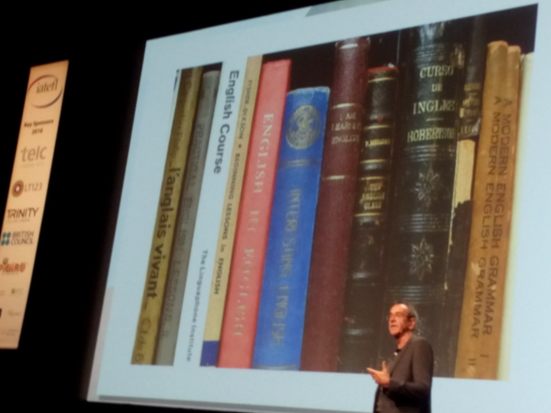
In the introduction to this book, history is not what you think, it’s what you can remember. Today will be the history that Scott can remember. He collects old course books, old grammars, old dictionaries etc.
IMG_20160416_091318

The titles wouldn’t resonate now – “Interesting English”? come on, it would have to be “Awesome English” and what would the follow up to “I’m learning English” be? “I’m still learning English”?!

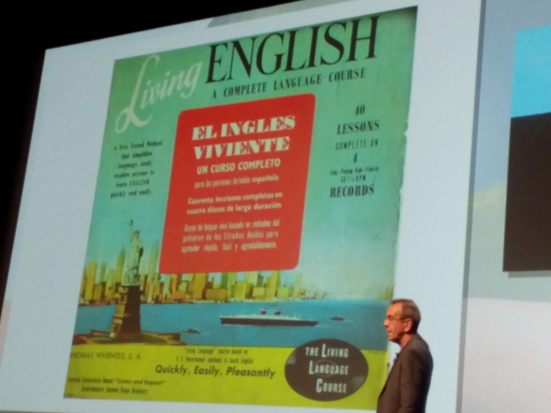
He shows us a cover:
IMG_20160416_091357

It’s interesting to look at the transcript inside…
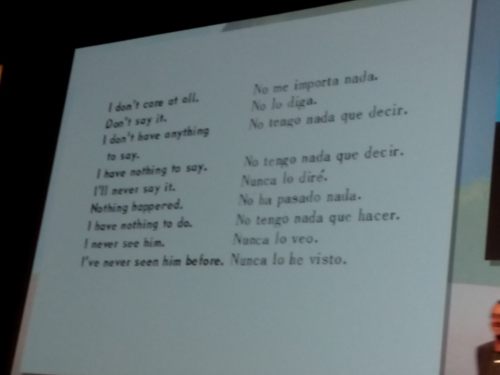
IMG_20160416_091427

English for interrogation purposes? In 1965, this was the height of the cold war. Looking at the credits for this book, one of the names, Weiman, is from the department of war…

However, 1966 (50 years ago):

TESOL was founded. And Chomsky said he was skeptical about the significants for the teaching of languages such insights and understandings as have been attained in linguistics and psychology.” Another voice that gave a counter-discourse in linguistics, Dell Hymes. He gave a talk about communicative competence though it wasn’t published till a few years later. But the idea is born that linguistic competence isn’t the be all and end all: communicative competence also includes sociolinguistic and strategic competence. It was an interesting, fresh look at what language competence is. Had a knock-on effect for course design and methodology.

Newmark, L. wrote How not ot interfere with language learning. Incredibly presciently, he said, if we just teach the little bits of language, there are so many of them, by the time we’ve taight them and practiced them, a child will be an adult and an adult will be dead. It’s not the case that language is additive and linear, or no one would ever learn it. “An important test of our success as language teachers…is the ability of our students to choose to say what they want.” The alternative put forward was doing tasks, that language was learning a whole act at a time rather than individual items.

Pit Corder, an applied linguist at the university of Edinburgh, said that language is not knowledge but a set of skills. The teaching of it therefore must be different from the teaching of a content subject like science. In the same year, James Asher was propagating the view of total physical response. Niche methods were trying to fill the void left by the demise of the direct method.

1967

Saw the foundation of IATEFL (the I being added). The first conference was in London. Scott alludes to Richard Smith’s blog tracing the history of IATEFL. The then president said that the much publicised revolution is not a leap forward but a regression into routine and dullness. There were collections of papers that are fascinating from then, there is quite a lot of controversy.

Louis Alexander’s First Things First was published, and it was based on a very structural view of the language. Error was very much frowned upon…
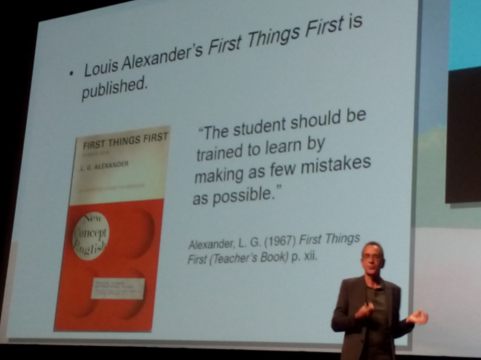
IMG_20160416_092337

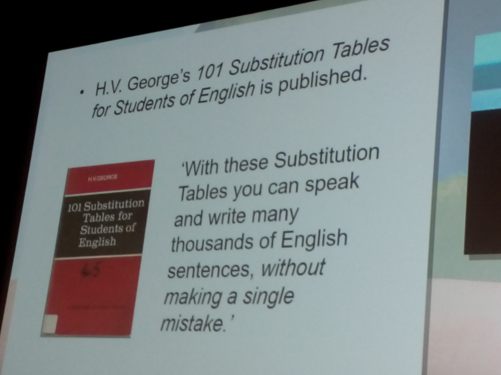
H.V. George was also error phobic:

IMG_20160416_092447

In a paper called the significance of learner errors, Pit Corder talks about the ‘built in syllabus’, saying we need to learn more about the way the learner learns and their ‘built in syllabus’.

So on the one hand, no errors, errors are bad, on the other errors are inevitable, deal with it, and they don’t necessarily come from L1 interference.

Then we look at some children’s English books. The language used isn’t very frequent…
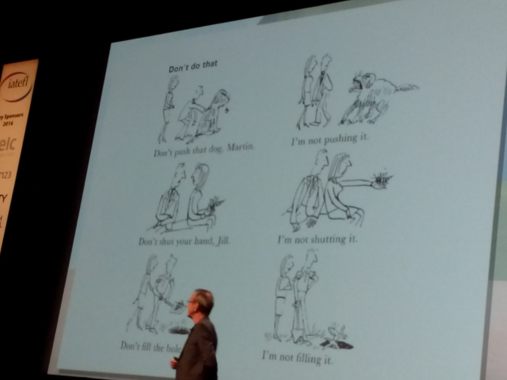
IMG_20160416_092711

1969

L.G. Kelly’s (New Zealand scholar and applied linguist)’s 25 Centuries of Language Teaching, he wasn’t looking at methods but methodologies and the ideologies that underpin them. “Methods are of little interest”. One generation’s heresy becomes the orthodoxy of the next. Out with the old, in with the new. This seemed to be about to happen in the late sixties. There was also a major cultural revolution going on in reaction to the cold war and the Vietnam war and that’s captured a progressive moevement in education generally:
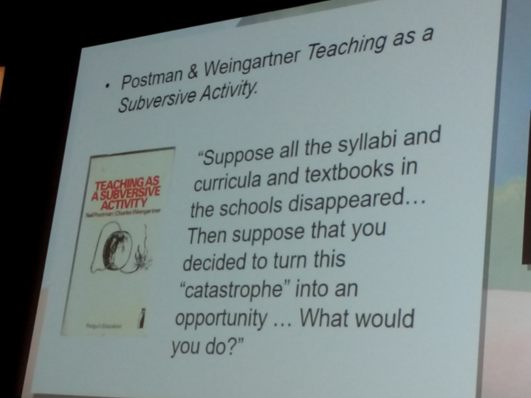
IMG_20160416_093033

Times were changing, it was the Zeitgeist of the late 60s.

1971

At a conference in Switzerland, a group of people got together to plan an approach to the teaching of languages in Europe. The Council of Europe in Switzerland aimed to reform and standardise the teaching of languages and devise a framework for adult language learning based on the needs of the learner and things required of them to function in a target language community.

Chris Candlin presented a paper called “Sociolinguistics and communicative language teaching” at IATEFL. The very word communication hadn’t really penetrated into our field until then but suddenly started to take off.
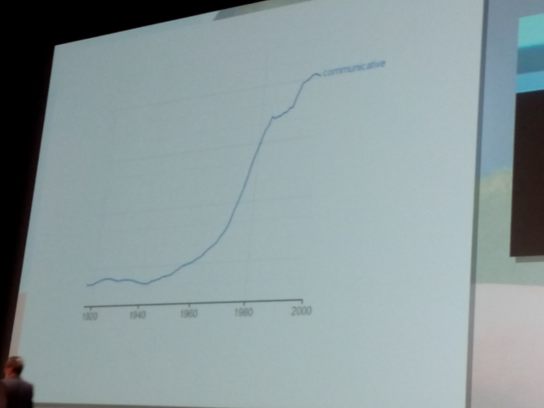
IMG_20160416_093324

1972

At last the first woman in a sequence of white males produced a paper based on her own classroom research “Communicative competence: an experiment in foreign language teaching’. Widdowson’s article on the teaching of English for communication also appeared in ELTJ. There was also the first conference focusing on communicative language teaching and the first ‘morpheme studies’ and diagrams started to appear which attempted to describe the order in which morphemes and inflections are acquired in first and second language, irrespective of the first language.

1975

International House Shaftsbury Avenue is where Scott got his certificate which alludes to “surprising lapses in grammar analysis”. Scott arrived as the major change away from the audio-lingual method was happening. The Threshold syllabus appeared and Strategies. So the syllabus was organised by notions and functions rather than grammar. Language described in terms of the purpose for which it was designed, rather than a series of structures to practice.

IMG_20160416_093737

What’s important is what people want to DO with language. This is where this undercurrent came to the surface in pedagogic materials.

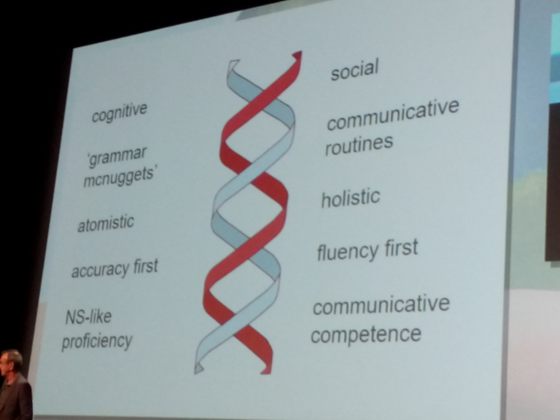
So there were two intertwining but not interconnected discourses.
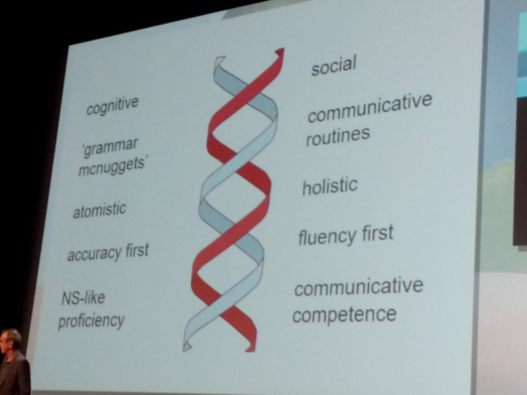
IMG_20160416_095654

On the one hand, there is the view of learning as being primarily cognitive and the nature of language/units of acquisition as structural and atomistic, the accumulation of entities of language, of accuracy being primary and the goal being NS-like proficiency. The new discourse came from social linguistics. It saw the units of language acquisition as communicative routines, larger acts or tasks, the acquisition of which was holistic not one at a time, and fluency was primary, with communicative competence being the aim. It seemed in 1975 that these two discourses that had been unravelling over the decades had finally been resolved in favour of the communicative approach.

BUT, had they? Of course, they were never resolved. The tension goes on. There was a reaction to it…the grammar syllabus was likened to bamboo, whatever you do to it, it keeps springing back up! Then we look at the introduction in a 1968 course book and a 2016 course book. Grammar is central. In some ways, not a lot has changed:
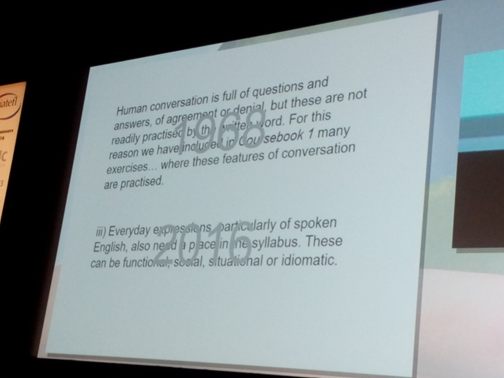
IMG_20160416_094340

What happened? Well, it’s easier to test grammar McNuggets…
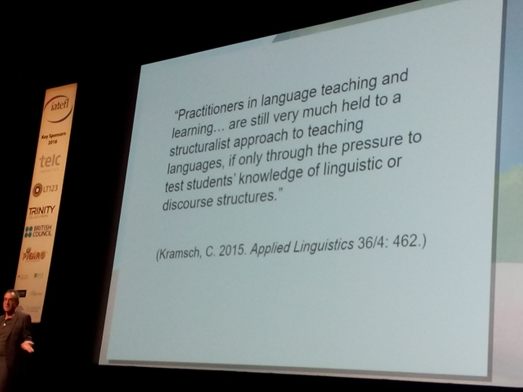
IMG_20160416_094436

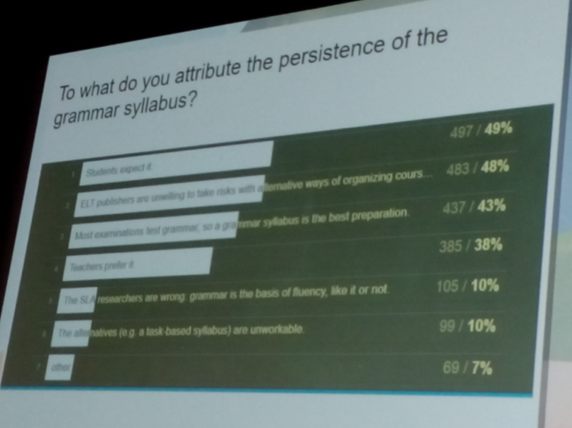
With a view to finding out what people think, Scott sent out a survey to try and unravel the mystery of why we can’t shake off the grammatical syllabus.
IMG_20160416_094626

He thought number 5 was interesting: that SLA researchers are wrong. These are probably climate change deniers as well… The earth is flat…

Many of the respondents had been teaching for more than ten years and had taught in a variety of different contexts. A fairly representative sample. In terms of student expectation, are they ever asked? Canagarajah found that since teachers thought that students thought that grammar was important, this is what they gave them.

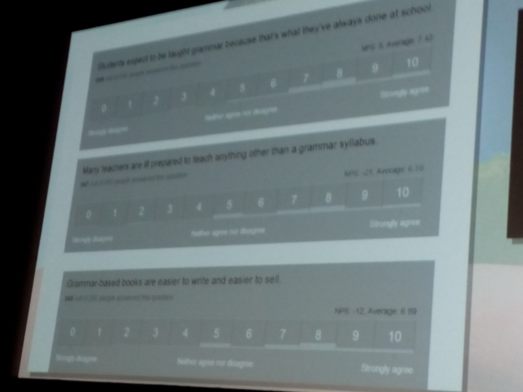
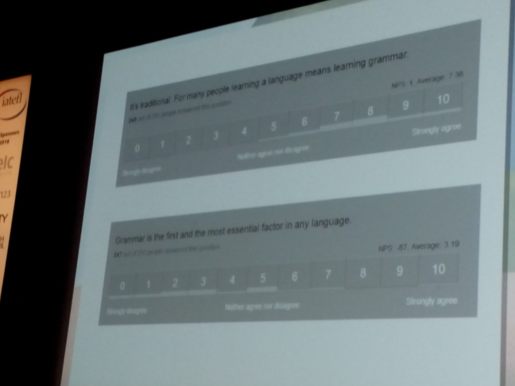
Scott took some of the statements from the first survey and asked people to rather in terms of whether they agree or not. There is a mismatch between what we teach and what we believe. That for many people learning a language means learning the grammar, but not that grammar is the first and most essential factor in any language.
IMG_20160416_094927

IMG_20160416_094952

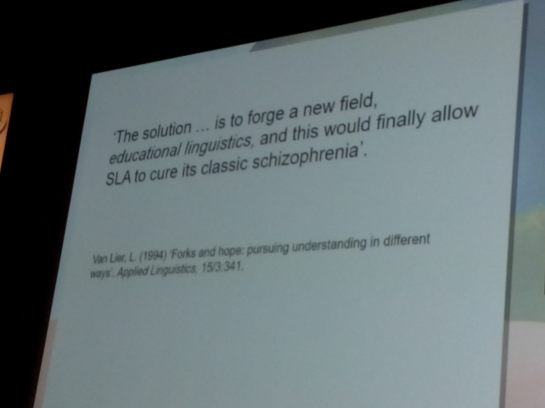
We need to free ourselves from being teachers of grammar and remember that we are part of the field of education and rebrand what we do as educational. SLA needs to be anchored in education.
IMG_20160416_095154

This is how he was going to end the talk but then when you stick your head over the parapet and look, you see that all is not well in the field of education either.
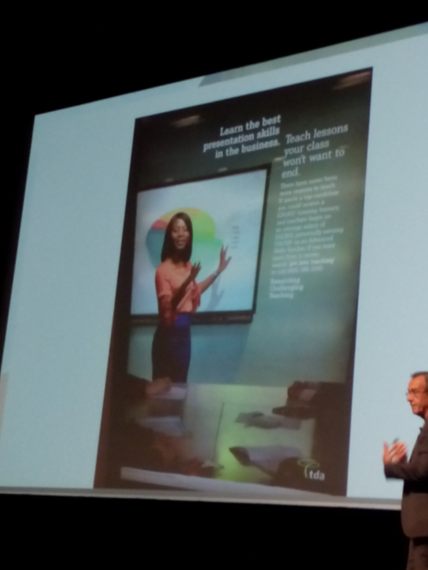
IMG_20160416_095244

The iconography in an advert for teaching is very business technology and ppt-heavy. This has penetrated into schools, turning them into service providers. The rhetoric/discourse of neoliberalism penetrates into the discourse of education.
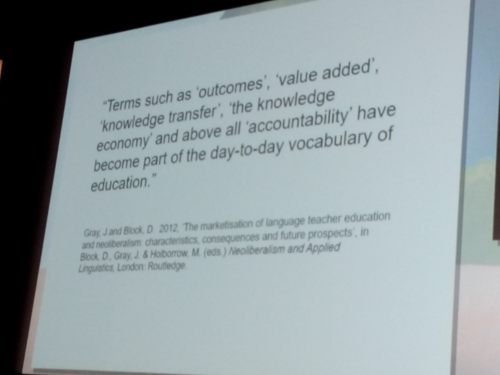
IMG_20160416_095349

What’s associated with this is the proliferation of testing, standardised testing, which seems to have taken over (think of the number of suicidal children in Britain due to pressure of testing). There is something unhealthy about this. The atomisation of knowledge. You can deliver them and test them.

Granular is the new buzzword.

IMG_20160416_095534

It’s a good word for marketing a breakfast cereal but not for language. Even vocabulary is not granular, every word in the lexicon is connected to other words which are connected to other words in both the TL and other languages.

We’ve gone back to the lefthand side of this image:
IMG_20160416_095654

How can we find a way out of this dilemma?

There are three possible routes.

  1. The pragmatic route
  2. The dogmatic route
  3. The dialectic route

There is a view, another view that negates that ideology and then there is a synthesis of the two, which is more than the sum of its parts.

First one: it’s just a subject, it has coursebooks and a syllabus, you have to break it down and test it. Accept it, don’t get het up about it.

In 1930 the Coleman report was published, and they decided to forget fluency and focus on reading, the objective was the ability to read a foreign language. This was a pragmatic approach, not expecting fluency.

Second one: The dogmatic (dogmetic?) route – if we want to get rid of the grammar syllabus, get rid of the coursebook and go back to using the language as it was meant to be used, for whole acts, communicatively and work on emergent language etc. You can go even further and say let’s get rid of the teacher (flavour of Sugata Mitra’s plenary) as well, according to Scott.

Maria Montessori: The greatest sign of success for a teacher…is to be able to say,”The children are now working as if I did not exist.”

Third one: Is there a way we can combine the traditional on the one hand and the view that language is learnt through use, is holistic etc on the other?

  • http://languagelearninginthewild/com – a wonderful idea, for the learning of Scandinavian/nordic languages, by adults who to go the country, are enrolled in classes but are sent out into the streets and have to do things like buy a croissant. The people who work in the shops have been coached/prepared in how to deal with silly foreigners who can’t speak the language. They take photos, record on their mobile phones, they take it back to the classroom and compare notes. The perfect fusion of experience and classrooms. They can also phone up a volunteer to help them if they get stuck. Uber teachers?!
  •  http://handsupproject.org – for children who cannot get out of the classroom, children from Gaza performed some songs and chants they had learned via Skype, here at IATEFL. We are shown a reverse picture dictation, where they draw something and then try and get Nick Bilborough to draw it, through a question and answer sequence. A fusion of traditional language classroom and real language use.

Ok, where are we going? 2066…

What can we predict? Probably the intertwining discourses will still be with us. The process of learning is not straight-forward. Even when it seems so, some teachers still go against the flow. Scott salutes these teachers.

IATEFL 2016 What is this thing called Academic English Language Proficiency? (Dr Pamela Humphreys)

Pamela works in Australia at a University in Queensland, in the area of in-sessional support. She also has many years of pre-sessional experience.

The number of students studying in English language contexts has increased massively since 1975 (0.8m) – in 2012 it was 4.5m and rising. “All the known world has a second language for advanced education” (Brumfit). English language proficiency is a critical factor for academic performance according to Cho and Bridgeman.

Let’s start with communicative competence, term coined by Hymes in the 60s but it was the work of Canale and Swain in the 80s that gave us this framework. Conceptual frameworks in academic education draw on this framework. In Canale and Swain, grammatical competence is joined by discourse competence, sociolinguistic competence and strategic competence. Since then, the framework has undergone several iterations. Bachman takes strategic competence out, subdivides the competencies into organisational (grammatical and textual) and pragmatic competence (illocutionary and sociolinguistic).

What’s quite interesting is that despite the fact we have 30-40 years of knowledge of these competencies, we don’t know how they interact or the relative weightings, of importance. Pamela also wanted to find out how they interact with academic english proficiency.

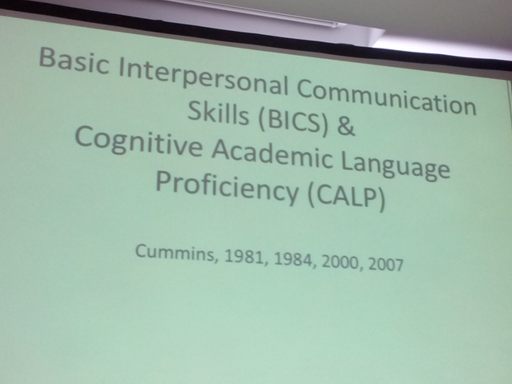
Cummins came up with Basic Interpersonal Communication Skills (BICS)  and Cognitive Academic Language Proficiency (CALP).

IMG_20160416_111702

He shows that the latter takes longer to develop and that there is little transference between the two. This was talking about children. Pamela wanted something similar for adults in higher education. A conceptual or theoretical model for Academic English Language Proficiency. She couldn’t find anything. Though there is a lot of information relating to academic discourse. We know a lot about it. EAP/ESP/ESAP, genre analysis, discourse analysis, corpus linguistics and academic literacies.

“Academic writing is not a single undifferentiated mass but a variety of subject-specific literacies” (Hyland, 2002:352)

She found four models.

IMG_20160416_112009

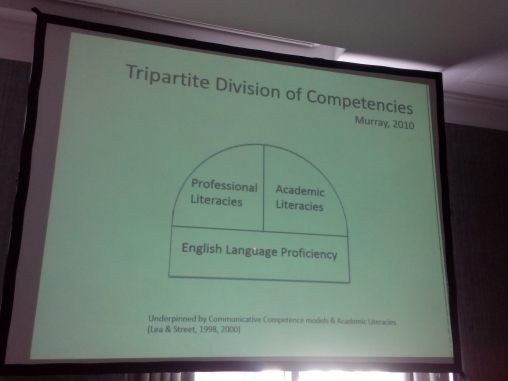
Murray has a tripartite system. Academic literacy is not just study skills or socialisation but a plural literacies about social practice and making meaning, about identity and power. Professional literacies are what they need once the move into their working environment post-study. English language proficiency is something that can be cashed in to develop these other skills. Is there a threshold that students must surpass before they can develop these other literacies?

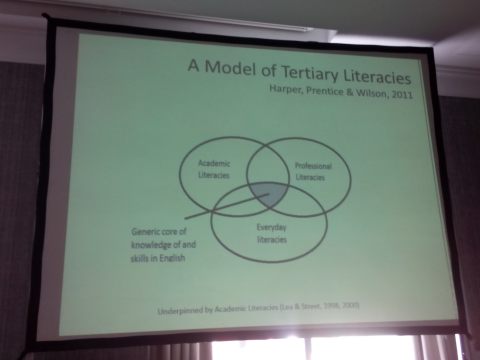
This vertical conception of academic literacy was criticised, of course. Harper, Prentice and Wilson include the same notions but with no threshold, they can be developed concurrently, not necessarily equally, but concurrently. They believe there is a core that can be used in all three contexts, everyday, professional and academic.

IMG_20160416_112206

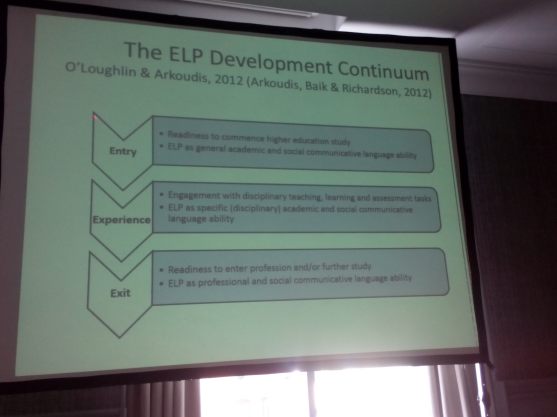
O’Loughlin and Arkoudis (2012) take a different approach, dividing it into entry into higher education, time spent in education and the exit. The student lifecycle option. At entry they need a general academic communicative ability but as they go through their degree they need to develop more specific communicative language ability, specific to the discipline and by the time they graduate they need to have developed the language and skills necessary for their future trajectory.

IMG_20160416_112300

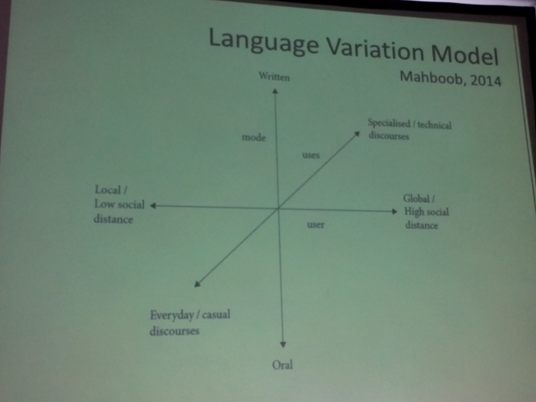
Mahboob in his Language Variation Model is talking about how language varies in different contexts with different uses.

IMG_20160416_112436

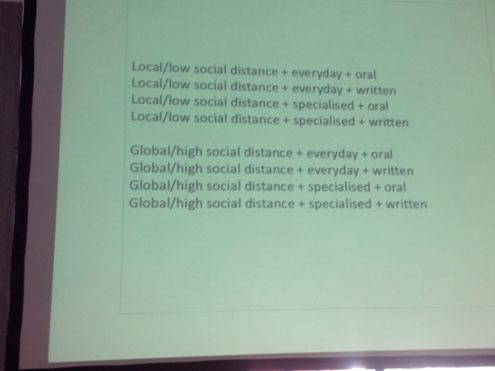
So he talks about the uses, the user and the mode. Uses can vary from the everyday to the specialised (including academic). Mode can vary from written to oral. Another dimension not shown is time. This gives rises to 8 different domains. Probably all of the last four apply to academic contexts.

IMG_20160416_112550

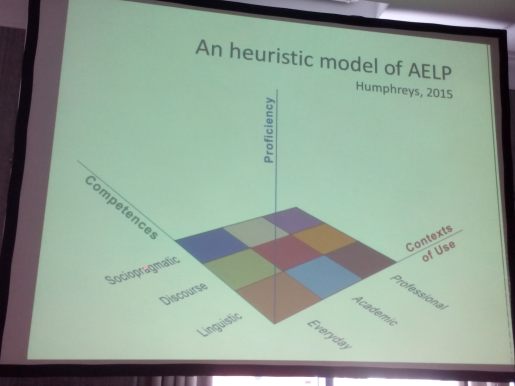
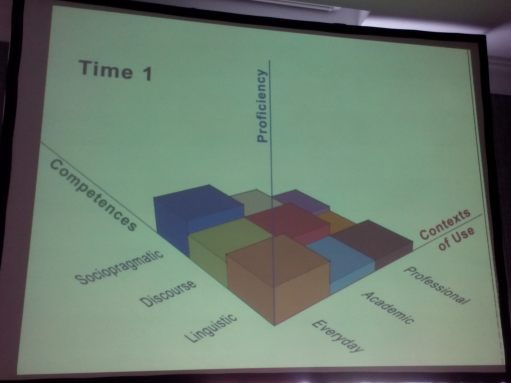
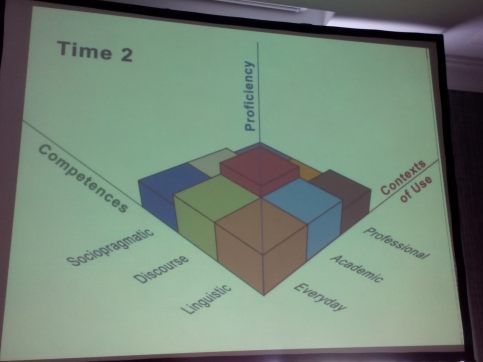
In terms of a summary, if we draw on all these frameworks, we know that language requires multiple competences, that there are varying contexts of use and proficiency should/can change over time. Pamela wanted to bring it all together to make one conceptual framework. (The frameworks we have looked at are conceptual not validated.)

She comes up with:

IMG_20160416_112824

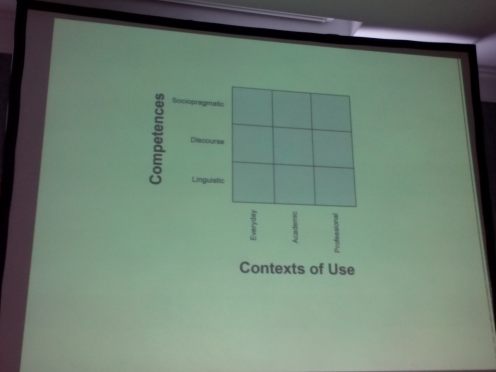
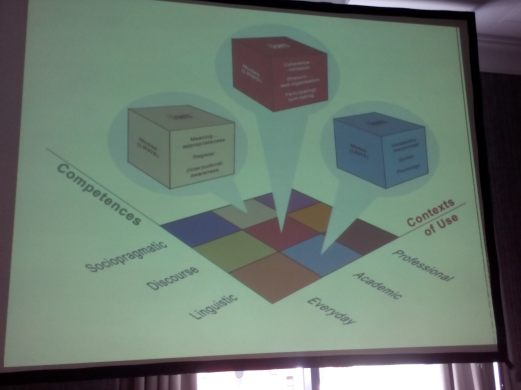
She has three competences, three contexts of use (seen quite a lot in the academic frameworks) and they all intersect. She doesn’t think the lines are solid. The third aspect is proficiency, as we hope it will improve in the course of doing a degree.

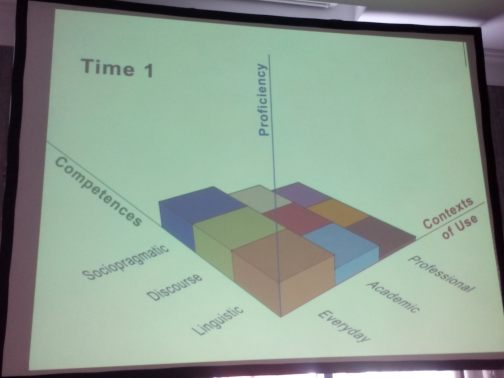
It can show different levels of development:

IMG_20160416_113000

IMG_20160416_113012

It can show change over time:

IMG_20160416_113036

So that is her conceptual framework. How can we use it? It can be used for key stakeholders in the industry who are not experts, people who don’t understand what language is about but need to. Could also be used with teachers and students. It could be used to help in curriculum development, to track what has been included. What you tick or want to tick will depend on your context e.g. pre-sessional may not include the professional tick. At least it would be a principled decision. With students, you could use it as means of finding out what students feel confident and less confident about.

IMG_20160416_113134

Of course language is very complex, so underlying this 3×3 is the complexity of what we have already see, so we can unpack this. So we as linguistics can unpack the different aspects involved in each square.

IMG_20160416_113303

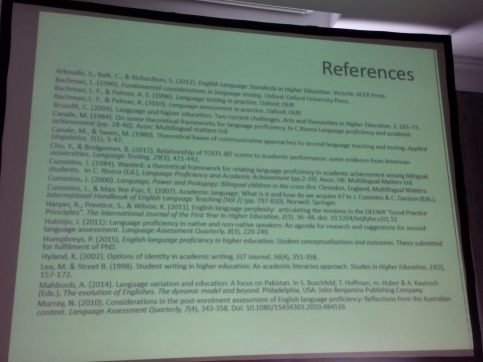
Here are Pamela’s references:

IMG_20160416_113647

p.humphreys@griffith.edu.au

IATEFL 2016: The LDT Toolkit (Damian Williams)

Damian starts by asking us what LDT stands for. It’s Language Development for Teachers. There are different ways for describing it. He chose this because it’s the same as the name of the specialism for Delta module 3. It also emphasises the developmental aspect.

Teacher development is often split into teacher education for teaching teachers about teaching and teacher training. Teacher training is more about developing skills e.g. CELTA, Delta, Trinity, with a very practical element. Continuing professional development is everything else e.g. webinars, conferences etc. He feels that LDT overlaps between them, as it is learning knowledge but also developing skills.

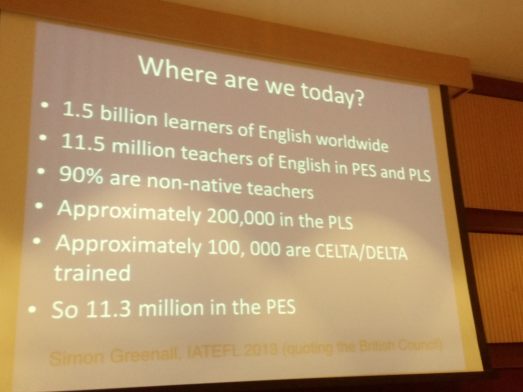
He wanted to find some figures of what the numbers of NESTs and NNESTs around the world are.

IMG_20160416_122042

Bigger numbers now, of course.

A lot of conference talks are based around the private language sector when in actual fact it’s a very small proportion of the language teaching that goes on in the world today. Damian lived in Brazil for 10 years and one of the things he was doing there was running workshops for teachers, on behalf of publishers. It was a thing they did for their best customers. Most of the teachers came from state schools with very large classes. A lot of the feedback was “this is great, sounds brilliant, but my reality of 30-40 kids, this wouldn’t work”.

There are some key issues involved here.

IMG_20160416_122547

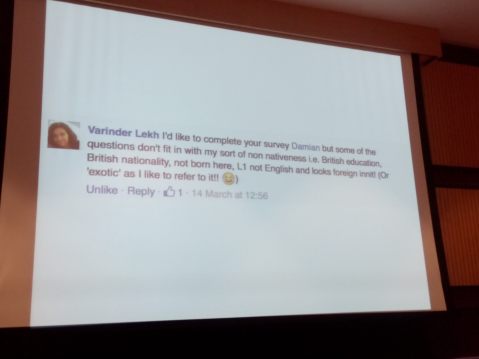
First of all, definitions. We should all just be called teachers regardless of where we are from (rather than NEST and NNEST etc.) Damian asked people to answer some questions via FB groups but it’s complex!

IMG_20160416_122413

Most English spoken in the world today is as a second or foreign language. TEFLEquity are trying to raise awareness of discriminatory practices in recruitment etc.

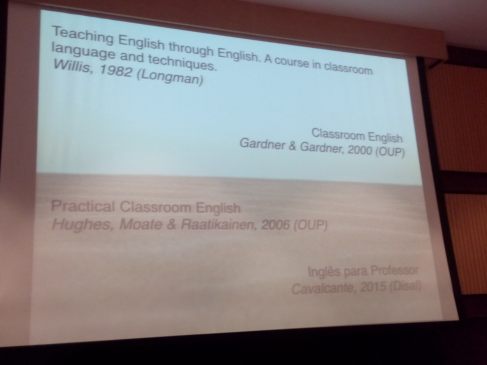
Language proficiency is the focus of this talk. Why? Firstly, there isn’t much about in terms of published materials that does it already. Here are a few examples that do:

IMG_20160416_122638

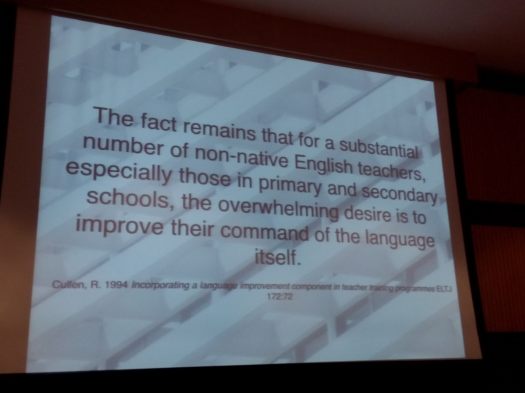
Most TT courses focus on methodology and skills, where there is a language component it tends to be language awareness and looking at language as a system as opposed to practical uses. There is a lack of time on these courses, as there is a lot to do and get through. Building a language component into that would take too much time. Cullen (1994) quotes Berrry (1990) quotes lots of Polish teachers saying that their main use of English was in their classroom with their students, so they don’t get to practice English much outside the classroom. The demands of CLT adds even more pressure. Most teachers that Cullen spoke to wanted it. He says this in his article:

IMG_20160416_123207

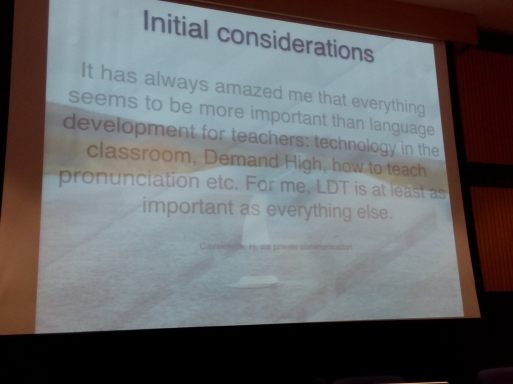
Initial considerations

IMG_20160416_123233

  • Is this a GE course for general improvement or an ESP course specifically related to teaching? Damian opted for the latter.
  • What proportion of a course should it be? Damian wants to build it into the other components of the course.
  • How to incorporate experience? Damian heard a lot of “this is great but it wouldn’t work in my situation”  – how to deal with that?

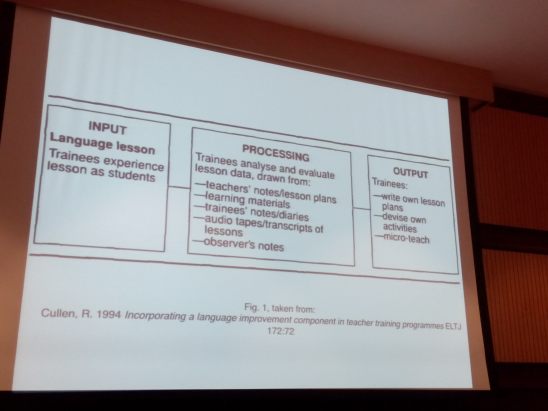
Cullen sets out four approaches to LDT.

  1. ‘ignore’ it – do all the other development through the medium of English
  2. include an LDT component (does take a lot of time)
  3. link methodology and language work – using English as a medium of instruction but an add-on where you start to analyse the language used as well.
  4. make LDT central – give language lessons as you would normal but also demonstrate practice.

IMG_20160416_123621

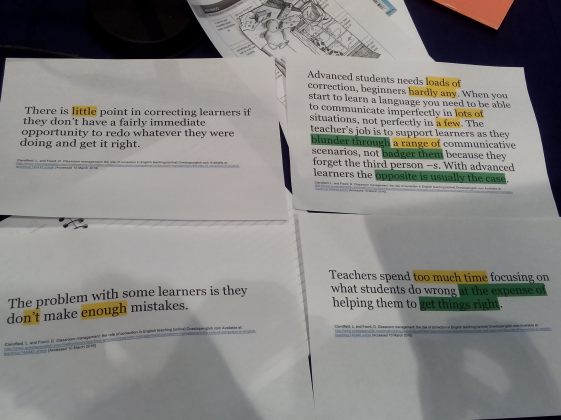
Next, we try some activities within this approach. E.g. look at statements about error correction and agree/disagree with them. Some of the language is highlighted:

IMG_20160416_123909

Focus on the highlighted expressions.

  • Look at the expressions highlighted in yellow. Which have a positive or negative meaning? Which mean a large/small quantity?
  • Look at the expressions highlighted in green. For each one decide Does it have a positive/negative meaning? What other part of the text does it refer to? What do you think it means?

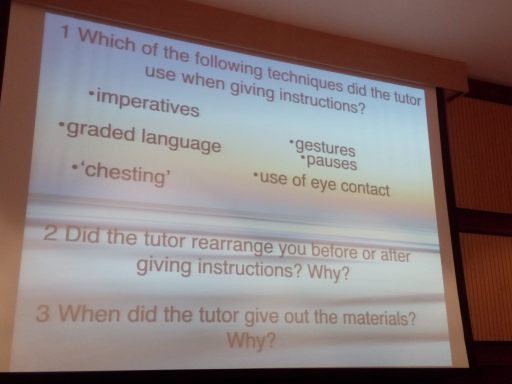
Next, Damian ‘sets up an activity’. Work in pairs. Each pair has a set of pictures that are the same but different. Pairs should describe their pictures to each other and find ten differences. Don’t show your partner your picture. Damian gives the instructions. Then we should answer questions about the demonstration.

IMG_20160416_125017

IMG_20160416_125049

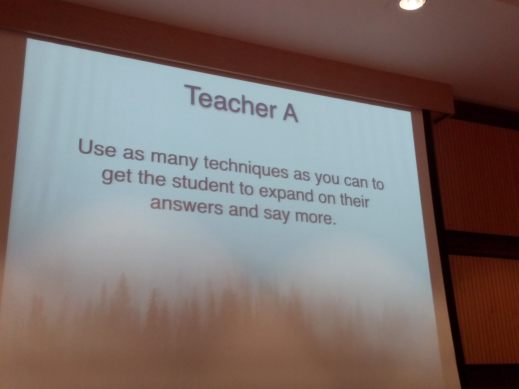
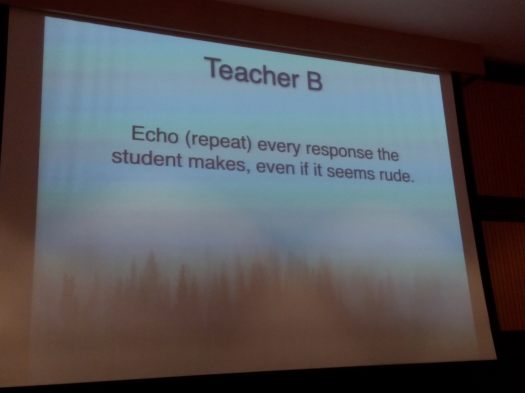
The next activity is mini-bingo. Students write down one-word answers for themselves in the boxes and, comparing their answers in pairs, get a bingo each time theirs is the same as their partners. We are asked to practice eliciting feedback from a student who has done this activity. The first time A is going to be the teacher finding out the answers from B the student. A’s are given an extra instruction with B’s looking away!

IMG_20160416_125122

IMG_20160416_125337

Next, roles are changed and B’s get a different instruction.

IMG_20160416_125431

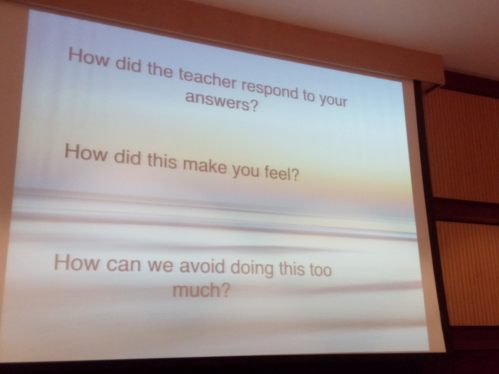
If we’re doing this in an LDT classroom, there are then some reflective questions.

IMG_20160416_125554

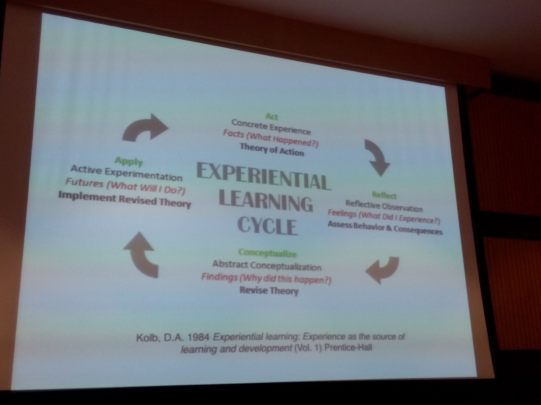
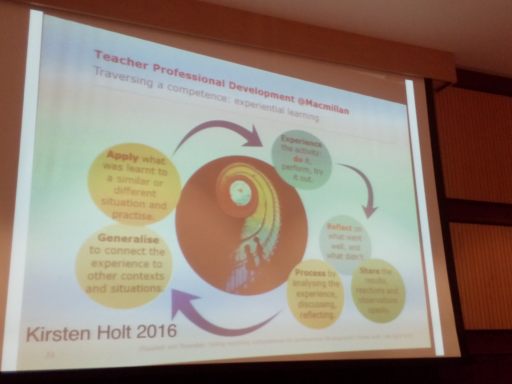
So this is partly an experiential approach, using Kolb’s cycle. We learn by doing and reflecting on what we have done. The CELTA is like a driving test, but says you are safe to be let loose on the classroom, it’s then through the years spent in the classroom that you really learn. Many teachers have many years of classroom experience, what we are doing is feeding into that experience within the circle. Teachers try things out, take them into the classroom and use them, then reflect on them.

IMG_20160416_125640

As Kirsten Holt said in her session yesterday:

IMG_20160416_125802

Other ideas for activities:

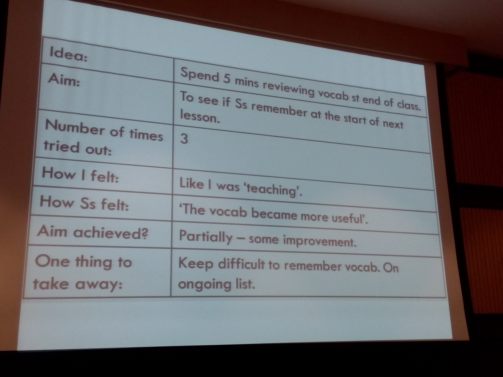
  • keeping logs/reflective journals e.g:

IMG_20160416_125852

  • Try out keywords/key phrases in class e.g. I need you to do x rather than Do x
  • Categorising phrases for different aspects of the lesson
  • Technique ‘bingo’ during observations
  • Encourage forums/online discussions helps with the idea of building confidence through sharing experiences
  • Matching phrases used in class to a list of techniques

This is all very kind of initial, Damian’s initial thoughts, but thinks there is a lot of scope for it.


IATEFL 2016 Demanding higher in EAP – silently (Michelle Hunter)

Michelle Hunter’s talk is about demanding higher in ELT – silently! She asks us how we have been getting on so far with the conference. This is a talk, she feels like it is more a case of talking between us all rather than death by powerpoint. The belief system she is growing within herself is that we are all equals despite being diverse and so it’s let’s share ideas!

She is a firm believer in silence although she is not always very good at it. She has experienced the power of being silent in the classroom and hopes higher level thinking goes on in that quiet space. She will explain what she means by silence – does not mean The Silent Way, but a silence that is full of attention and generative listening. Silence with a purpose. She got her ideas from a person called Nancy Klein who demonstrates her belief system in the way she communicates. NK has been around for 25-30 years now.

She used silence to demand higher of her students, by not jumping in and offering an answer but giving students more time to think for themselves. She is going to tell us how she learnt to do that. She is also going to share some examples from her teaching context (in Germany at one of the universities).

IMG_20160415_141626

This applies even more so to doing things in another language. Michelle noticed in the world of academic English that it is less about perfecting your English and more about learning how to think academically. (This was on a 6 week pre-sessional) Students need to be able to be critical, evaluate, think at the higher order levels of Bloom’s taxonomy, have rigorous and coherent arguments and come up with really good, strong ideas. How do you come up with an idea if you can’t sit and think about it quietly? Or with a teacher to sit and listen to those ideas and help you further them? So Michelle has a group of people who need to think rigorously in a second language and she wants them to do that by pushing them further.

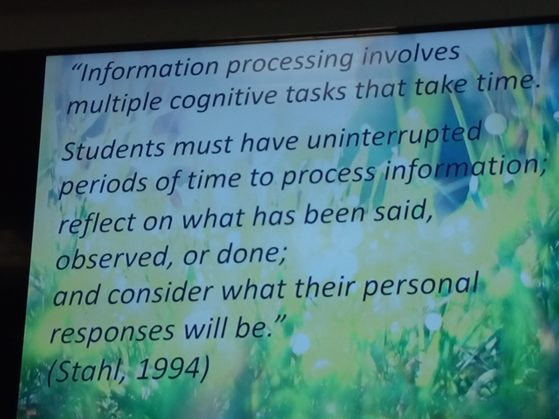
Michelle discovered that lots of people have looked into giving people more time to think, it has been around for quite a while as a concept, and wondered why we don’t do it more often. In a lesson observation, Michelle held silence for 20 seconds possibly longer. She did some further research into the topic and discovered that Stahl changed the word from wait time to thinking time. Then in Scott Thornbury’s A-Z blog, there is a post on silence which deals with 7 different writers, one of whom looked at the pros and cons of silence. Silence can be activating is one that caught her eye.

Michelle shows us Nancy Kline and asks us to substitute ‘teaching’ for ‘coaching’. She says ‘Equate coaching (teaching) with generative attention not just input’. ‘For coaches (teachers) to create the conditions for independent thinking….they first of all have to be interested…in where the client will go next in their thinking.’ Michelle has shared her video on the website that we can access on http://www.demandhighsilently.com

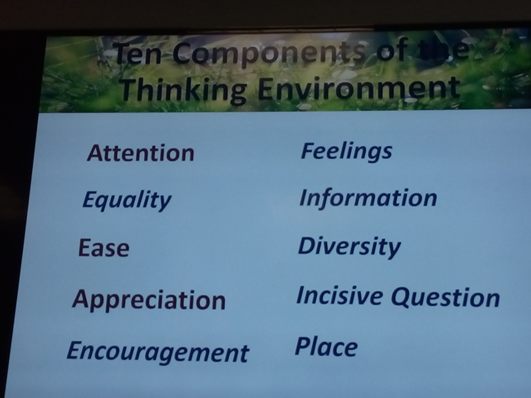
The basis of Michelle’s silence in the EAP classroom, and her ability to do think time rather than jump in, breaks into ten components.

IMG_20160415_142720

Attention is probably the most valuable thing we can give to another human being. Totally focused, uninterrupted, non-judgemental with generative listening. Through that attention, a brain can work and function, knowing it’s not going to be interrupted and come up with great ideas. Somehow your brain knows that I am curious, interested etc. If you wait, you can see the cogs turning and the thinking happening, so that someone can come up with their own answer to a question.

Ease is an important element in the classroom. If you create ease, then there is a safe place to work in and the brain doesn’t get frozen by emotion.

Appreciation (example of a teacher who was reported as spending ten minutes telling each child how special they are, in a special needs classroom). 3-1 is great. 5-1 is better. 13-1 is overkill. In terms of positive to negative feedback. So give positive feedback more often than negative feedback. Neuro pathways open up when you feel appreciated. So your brain works better. Not empty praise, but appreciation. E.g. thank you for coming.

Michelle wanted to test out something more concrete in her classroom. She tried out Thinking Rounds in Class. You use it in the opening and closing of a class. Sit in a circle and the stipulation is, everybody has a chance to speak, about a question asked at the beginning. E.g. Share something about something positive that  happened to you last week. This sets up an atmosphere of positivity in the room, which opens up the brain and that creates a more constructive working environment. The feedback from this process was very positive – that everyone got a chance to speak and knows they wouldn’t be interrupted and could finish their thought to the end. A form of equality. The closing round was one round to say what went well and then the appreciation round (Saying what you appreciate about the person next to them in the round). One group did it really well, one group was a bit giggly. To round off the whole process was a writing exercise – how you see a thinking environment and what do you think it could bring you. (The lesson on the thinking environment will be on the website)

Michelle was aiming to adapt what she learnt about coaching to use in her teaching. She hopes we can find something useful in what she has shared, some elements to take away. She finished by introducing herself!! She lives and works in Germany, has done some pre-sessionals at Bristol University.

IATEFL 2016 Learner Sourced Visuals: A higher level text’s best friend (Tyson Seburn)

Tyson is from the University of Toronto where he teaches on an EAP programme where students take a bunch of courses leading into their undergrad courses. This is the context for this talk but the things discussed in the talk can be adapted depending on your learners.

Images can be impactful for learners to help them understand what’s happening in the text. Tyson is going to demonstrate this to us.

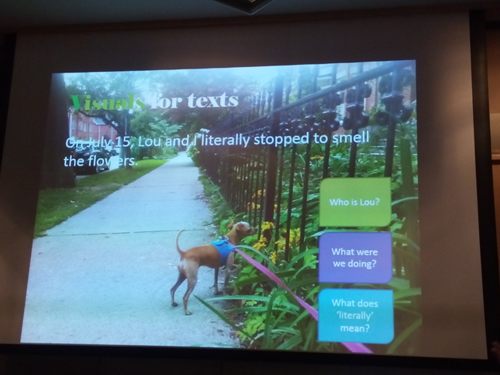
We look at a common phrase: stop to smell the flowers.

IMG_20160415_103017

What does literally mean? We actually stopped to smell the flowers as vs. slowing down life. This illustrates the meaning of the word literally. So if you have already taught the meaning behind the phrase “stop to smell the flowers”, then you can use that to get at the meaning of another word in the text, in this case “literally” through using a visual.

Higher level texts contain challenging concepts for students that they can’t fully grasp. What tends to happen is that students have a very surface level understanding of the vocabulary in a text. When they put the words together to understand the concepts behind the words, they flounder a little bit. In EAP programmes, students tend to be faced with text only, often several pages that are quite dense, and they have to remember things from earlier in a text as they proceed. It can be a bit overwhelming. Main and supporting points may get lost as they read the text as they can’t visualise what was happening. So if you ask them about these, they won’t be able to explain. There are also cultural references embedded in the text that students may miss. A visual can helpfully demonstrate these to the student.

We all use visuals to a certain degree but even in EAP classes we want students to recognise different parts of the text in a different way. We want students to be able to look for a visual that represents a concept in the text so that they better understand the concept and can explain it to others, as this backs up their own understanding and comprehension.

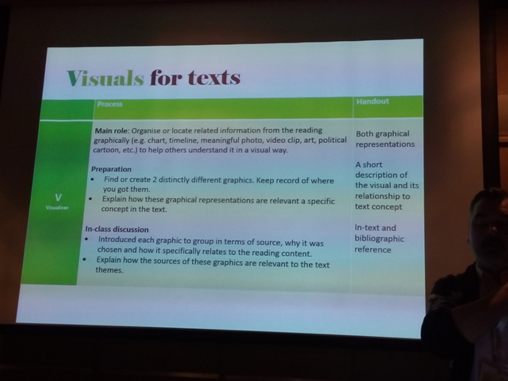
The visualiser role:

IMG_20160415_103510

Students might find a chart, make a timeline, find a photo, a political cartoon, something that represents something in the text. Something that helps their understanding and would be easy to explain to another person. So they need to find or create two distinctly different graphics. This is to avoid the default to Google images. Could be two visuals for the same concept or for different concepts. Because it’s an EAP programme, for digital literacy skills they should keep a record of where the graphic came from. They also need to be able to explain how it relates to the concept in the text. In a subsequent group discussion about the text, the student will introduce a graphic, where they found it and how it relates to the concept. They also have to produce a handout/google doc with the images, a short description of why it’s useful and some references.

Task 1

IMG_20160415_103807

What might learners find confusing? Phrasal verb “to be off”, “den door”, “smugly”… If we look at a vocabulary level rather than an argument which doesn’t exist here, you are probably starting to visualise what is happening in the text but if a student lacks the vocabulary, that becomes difficult, they lose the meaning of the text. A picture can help.

IMG_20160415_103951

Lou being super-smug! 🙂

This picture illustrates what is going on in the text, illuminating the meaning of the text:

IMG_20160415_104041

So what we’ve got here is a simplistic text but the same concepts will apply to more complex texts as we will see.

IMG_20160415_104145

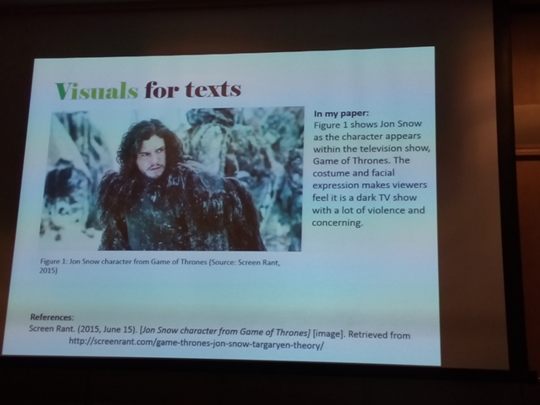
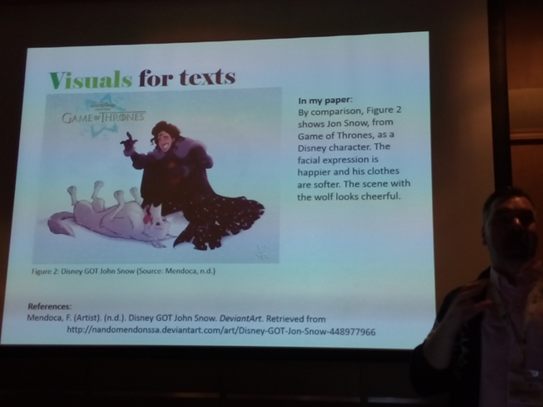
Looking at the above statements, “Disneyfication” won’t be in a dictionary, it’s a made up word. What characteristics do you think of for Disney? Goofy, princesses, light-hearted, cheery. What visuals might be useful to get the students to realise?

IMG_20160415_104255

You can see, the above is not disneyfied, but this is:

IMG_20160415_104323

Taking a character that is rough around the edges and disneyfies it!

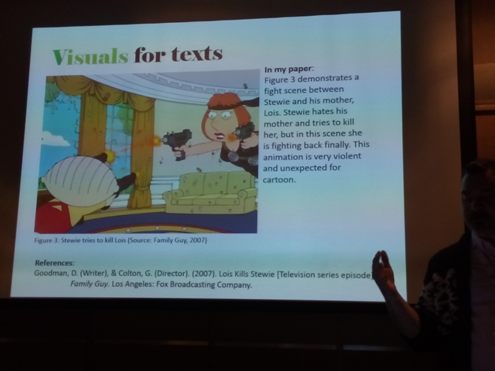
Again, if we watched a video of Family Guy, we can see its violent/rough.

IMG_20160415_104358

But in one episode, they turn into disney characters and they sing about how lovely it is to eat pie. So in a disneyfication process, you go from something realistic and gritty to something tht is whitewashed a little bit, happier, more cheerful, not the real thing. Whatever the real thing was becomes more cheerful than it actually is.

IMG_20160415_104427

Considerations for students:

  • Does the visual represent what is in the text, the aspect or feeling in it? Not just “apple”.
  • What concept in the text does the visual help explain? Does it help explain or is it just lip service?
  • Does it elaborate beyond vocabulary? (In a lower level text you might just do vocabulary but you might look for concepts rather than just words)
  • Where does the visual come from? Important skill for students when sourcing images is to know the source and reference it correctly.

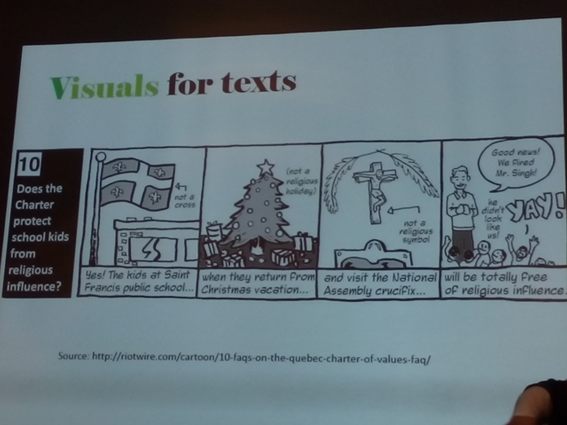
IMG_20160415_104831

With the above example, Tyson wanted the students to find things that represent this. But learners are not automatically good at this (e.g. they might just find two flags one of which is for Quebec and one for Canada), the more feedback given, the better visuals they can find:

IMG_20160415_104927

Here is another example text:

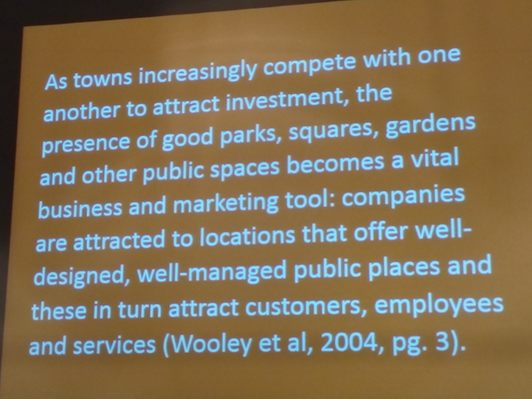
IMG_20160415_104958

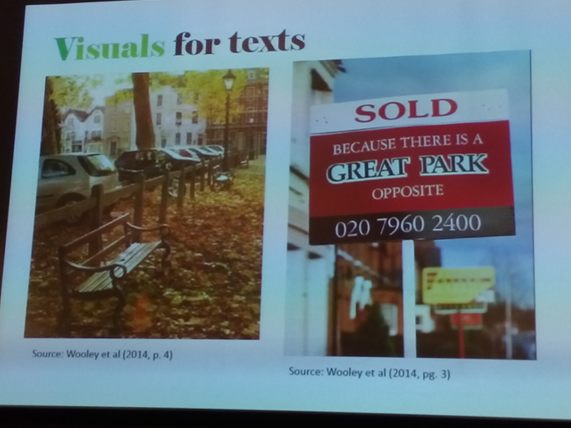
This demonstrates the value of public spaces in a city and why they might be useful. We want to illuminate why they might be useful.

IMG_20160415_105037

The righthand pic shows this better than the left-hand pic. It shows that businesses near public spaces will benefit from them.

We look at a further example:

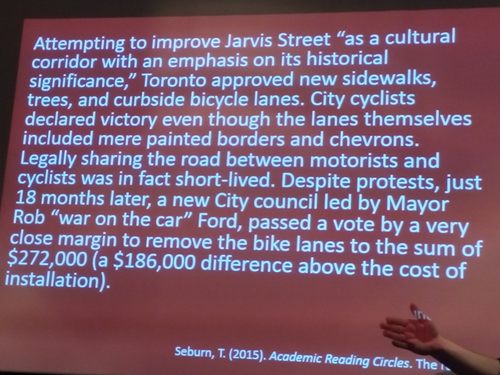
IMG_20160415_105146

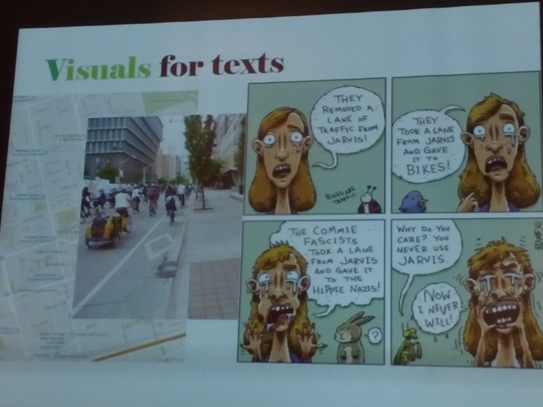
What types of visuals would work for this? A google map might help to show what is situated on that street and where it is. An image of cyclists protesting against the bike lane reversal, shows opposition. A political cartoon can illustrate the emotional side of Toronto in relation to this issue. VS a street sign or just a bike lane in a random city doesn’t work. You can’t just pick random visuals, you have to dig a little deeper.

IMG_20160415_105310

Important considerations:

IMG_20160415_105413

Each of these things are separate lessons but when we pull them all together this role becomes more key for students when they are reading a particular text.

Tyson then went on to show us more examples of visuals that students had found to illuminate elements of different texts, before bringing this very interesting talk to a close.

IMG_20160415_105716

IATEFL 2016 What makes an outstanding ELT coursebook? The publisher’s perspective (Heather Buchanan and Julie Norton)

The final talk I’m attending today is by Heather Buchanan and Julie Norton, who teach at Leeds Beckett University and University of Leicester respectively. They have been involved in materials development for about 20 years, from a theoretical academic perspective for a long time, and more recently worked on the Navigate series, which was a wonderful opportunity to see things from another more practical perspective. They did a talk last year about expertise in writing, where they asked writers and editors what constitutes expertise in course book writing but predominantly responses from writers. At the end, an editor said it was a shame that the sample was so skewed. This talk is to put that right!

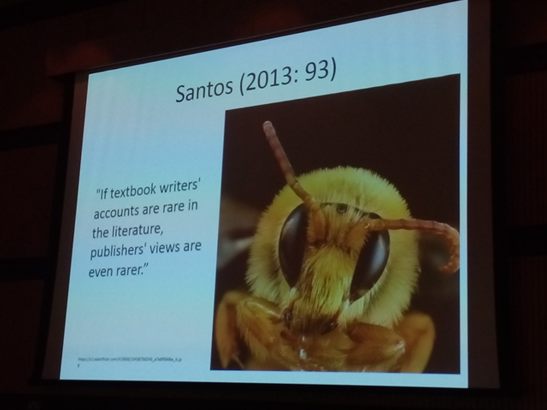
Apparently the voices of editors are very rare in the literature.

IMG_20160415_174214

Heather and Julie are interested in redressing that so that expertise can be shared. Another reason to do this is because practitioners, teachers and researchers understand a bit more about how course books are produced. Understanding this helps to understand why materials are the way they are and understand the pressures that are faced in producing a multiple level series of course books in a short space of time. They’ve noticed in recent years at IATEFL that that seems to be a goal, for example with SIGs like MaW SIG and groups like ELT Teacher2Writer. They are all trying to help people understand how to write materials and get foot in the door. Heather and Julie hope to contribute to this process.

They have been collecting data since January this year, some of which before the MAWSIG day and have continued since and have x hours of interview data, which is a lot. They have learnt a lot from the process of interviewing people. They’ve interviewed 21 editors and publishers this year, some in focus groups and some in individual interviews. This happened over Skype. They’ve spoken to a variety of different kinds of publishers and editors both in-house and freelance, with various experience, and designers as well. So lots of different perspectives. It’s been interesting to understand more about the process of how course books are developed in this way. They have a lot of rich data even though it’s a small-scale study really. They thank all the respondents as it has been both useful and very enjoyable.

They are going to highlight some of the main themes and give their interpretations and comments on this. Then we are going to be asked for our opinions. As it is a workshop, there will be a few discussions as well. We are will look at the four research questions one by one, discuss them and hear about what Heather and and Julie found out.

Research Questions

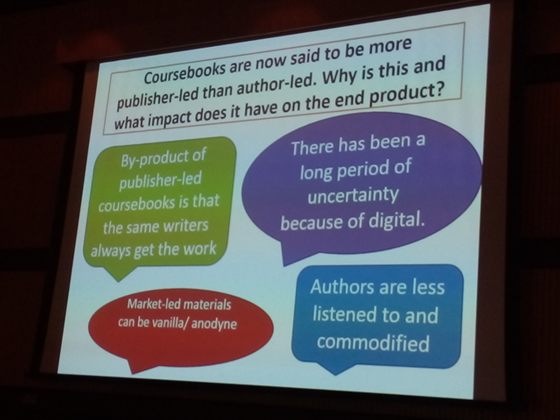
  1. Coursebooks are now said to be more publisher-led than author-led. Why is this and what impact does it have on the end product?

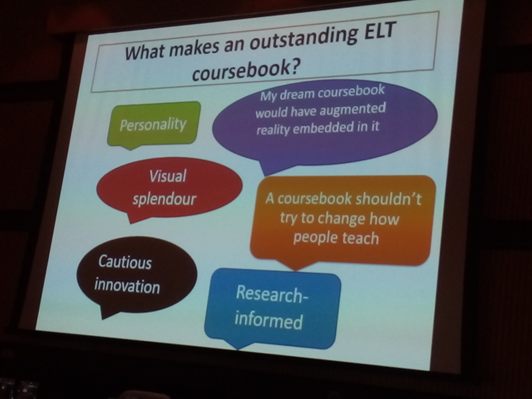
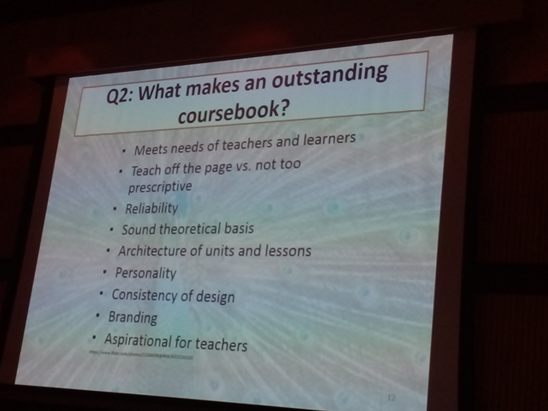
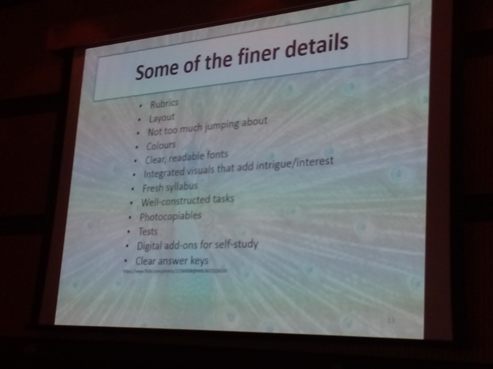
  2. What makes an outstanding coursebook? Please give examples.

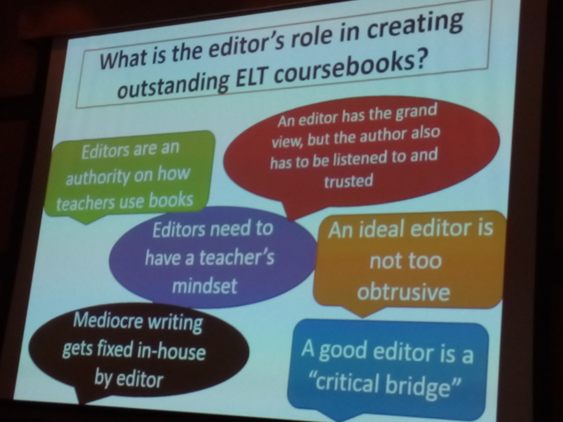
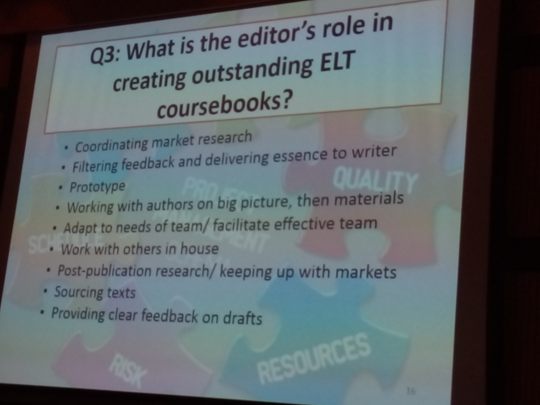
  3. What is the editor’s role in creating outstanding ELT coursebooks?

  4. If you planned to launch a new global coursebook series, what would you look for in an inital sample from a prospective writer? What skills do writers need to produce outstanding materials and how can these skills be developed?

Deliberately broad, in order to get people talking about it. The main question very broad – what makes an outstanding course book. They also tried to get at this idea of the course book being more publisher-led, in the development and instigation of ideas. They wanted to know why this was and how it affects the product at the end of the day. They were also interested in the editors role and in what publishers are looking for when writers send in a sample, what makes them take on a writer and what makes the reject? And finally what skills are needed, how can the skills be developed?

IMG_20160415_174951

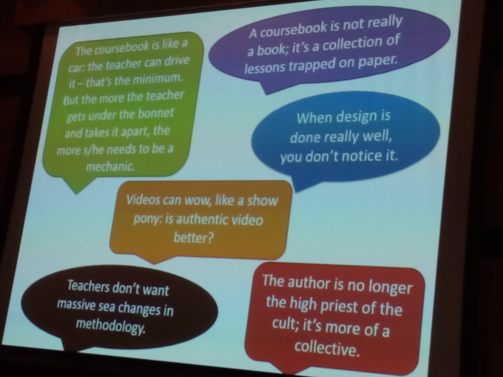
These are some snippets from the data as an overview. We need to discuss them. Some are direct quotes and some are paraphrasing.

Following the discussion, we are asked for any comments we have on the quotes. The broadness of the questions allowed Heather and Julie to explore and then drill down into areas of interest.

Next we moved onto individual points.

Here are some of the things that people said in response to question 1:

IMG_20160415_175843

An audience member felt there was an element of truth in the digital uncertainty comment – there has been. For example the one laptop per child policy that got dropped.

Julie says a lot of people talked about the impact of technology but also about that course books are more market led than publisher led. A long time ago, teh author was more instrumental in the conceptualisation of the series than now and there are various reasons for that. Firstly, digital makes the projects huge, for example 450 people. Trying to manage that, including getting information about what is wanted by the market, what has to happen in house (Design, production, a range of editors, techie people, marketers etc). There is also huge time pressure to get all the levels out at the same time if possible, so if you have a six-level course that is a huge undertaking, maybe you have to split into two years. You also need to meet consumers’ needs in order for the book to sell. Some publishers draw on massive corpora that they have collected and use them to inform the materials. So it has to be publisher led as the publisher has the information. The impact should be positive in terms of people feeling their needs have been met. A problem might be that it lacks freshness as people asked what they want are unlikely to ask for too much change, they might want something very similar, leading to that “vanilla anodyne effect”. With some courses it might be possible to have the necessary local expertise in terms of authors, producing something for a clear target audience, which might be very positive. It might feel like the author’s role is downgraded as the publisher is trying to take on so many other views.

There is a tension or balancing act to try to innovate within particular constraints.


IMG_20160415_180527

An audience member suggested it should be user-friendly, easy to use. Another suggested it should be open to adaptation. Two closely related points, as Heather says. The person who said the quote in the orange speech bubble was talking about imposing methodologies on people in different cultures, whereas some people discuss it as including teacher training within the materials. It depends how its done, how its introduced, is it imposed or not. It’s a very complex issue.

IMG_20160415_181318

Heather said the first point was no surprise. It’s important to meet all kinds of different needs e.g. SEN. Will the students be able to relate to the materials? Then, the second point, the teacher needs to be able to pick a course book up, walk into class and teach from it, knowing it would be reliable and they wouldn’t have to spend a long time planning. However, teachers may also want to do more with the materials, adapt them, use some bits but not others. The tricky thing is catering for both types of teachers. Of course we also need to know that the course book is accurate, answers all correct. Then there needs to be a sound theoretical basis, which can be a range of things from being based on corpora, to the methodology used etc. The architecture is about the flow and shape of lessons and units, how they are built. People talked about the personality of the course book, based on the type of methodology, the look and design, the author voice, the kind of texts you are using. Some people also talked about it being aspirational for teachers, they may feel they are becoming a more communicative teacher by following those materials, for example.
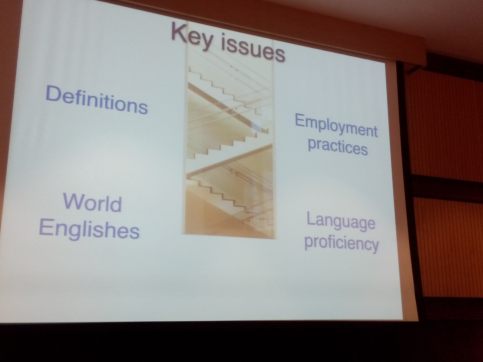
Some finer points:

IMG_20160415_181633

Moving on to the editor’s role:

IMG_20160415_181640

Heather and Julie were interested in what the editors bring to the course books and found that some of the points were contradictory as the editor plays a tricky role and has to handle complex situations. They thought it was a nice way to look at it, to think of the editor as a bridge between the people involved in the process.
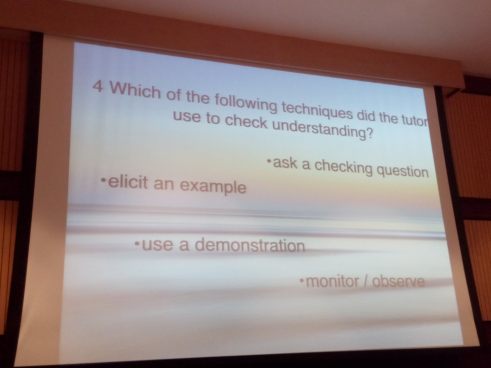
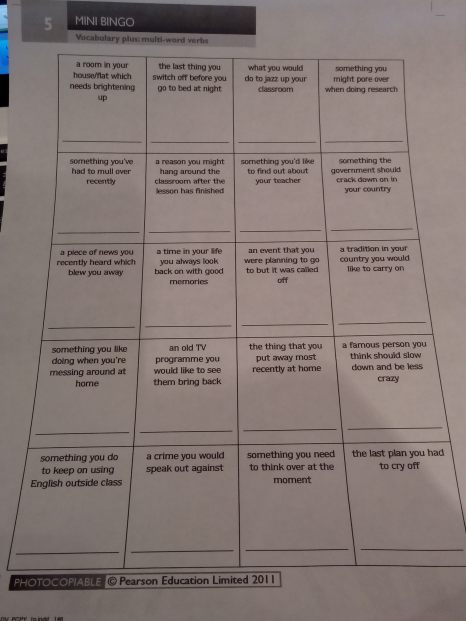
We are reminded that there are different types of editor, e.g publishing and commissioning, development/content, copy editors for the nitty gritty and there is also the free-lance/in-house editor split.

IMG_20160415_181832

As well as coordinating, feeding back information. Also sticking up for the author to the publisher and vice versa, so the critical bridge role. They might do some research post publication and realise that certain things have been omitted and produce pdfs to go online to address that issue. A crucial role is giving feedback on drafts, which involves being quite diplomatic, it is a complex relationship between author and editor. The editor has to represent different teachers to the author as the author can’t have experience of teaching in evert different contexts but the editor can do research into different contexts and feed that back. Often they have been teachers themselves too. They have to be devil’s advocate/critical friend, which is quite a challenging/daunting role (imagine doing it for Michael Swan’s grammar!). Authors are going through all kinds of things in real life – so, knowing when to send a bunch of flowers is important too.

We ran out of time for the remaining question/rest of the slides but are invited to email Heather and Julie to get them.

However, the conclusion is:

IMG_20160415_182207

The editor is instrumental in controlling quality in course books and sometimes we forget what a useful process it is. We often talk about how difficult it is to receive feedback but the end product is going to be better for that. Heather and Julie are calling for more transparency and communication about the process.

They agree with Tomlinson on the following and would love to be involved in the process! This sort of research could be really important to feedback into future products.


IMG_20160415_182325

It was a really interesting talk and it’s a shame we didn’t get on to the final question!