Delta Notes 3: Module 2 – My LSA1 Reading and Feedback

Title/Focus

There are 4 systems (Grammar, Pronunciation, Discourse, Lexis) and 4 skills (Reading, Listening, Speaking Writing), of which you must choose two systems and two skills to focus on over the course of your 4 LSAs (Language Systems/Skills Assignments).

My LSA 1 focused on raising awareness of medium-strength verb-noun and adjective-noun collocations for lower level learners. This falls squarely into systems: lexis.

Reference list

Here is the reference list from my final submission. As you can see, at this point I hadn’t learnt how to correctly format a reference list, something that was picked up on in the feedback…

Screen Shot 2016-05-08 at 14.19.25

Screen Shot 2016-05-08 at 14.19.37

Feedback 

Essay

I got a pass for this essay. (Yay!)

Strengths

  • using sub-headings and sign-posts to make the structure clear
  • narrowing the scope (by collocation type, strength and student level)
  • consulted key texts for my focus and used them well
  • my analysis, issues and solutions followed on well from each other.
  • including both learning and teaching problems and referring to a range of learners was another plus, as was using terminology accurately and defining key terminology. My teaching suggestions included activities for raising awareness and activation, and were based on a range of resources, so there was good variety.

Weaknesses:

  • as already mentioned, my reference list formatting was a little odd and also missing places of publication.
  • in my writing, I used too many quotations, where paraphrasing would have been better. Paraphrase/summary is a much more efficient use of words than direct quotation, generally, something which is key when word limits are tight, and also allows much more ‘writer voice’/criticality to come through.

(This was an issue in my Module 3 essay too, initially, as it happens. It’s something I carried over from my B.A. days of yore so had to modify/work on it to succeed in the written components of the Delta. Having done so was a great help when it came to doing the M.A. modules the following semester.)

  • Not enough reference to my own experience and interest in the area, make my analysis more in-depth by including examples, and try to target one issue per solution rather than having solutions that target various issues, as it became a bit too generic.
  • Lack of my own voice/criticality (linking of course to the over-reliance on quotations and not drawing enough on my own experience…)

(It’s funny, these issues – voice, criticality, in-text citation/quotation/paraphrasing and referencing etc – that I had to work on are things that I am now helping my own students to develop and work on in their pre-M.A. studies! I must remember to mention to them that it was something that I initially struggled with too, as I am sure they think I was born knowing how to do it all!)

Lesson Plan/Lesson/Reflection

I got a pass for this lesson – just!

Strengths:

  • The pronunciation analysis and use of phonemes in the language analysis section of the plan  (though conversely my attention to meaning and form were identified as being in need of more work in terms of clarity!)
  • I gave detailed information about the learners in my group (but it would have been better if I had included more information about their ability in the target language point)
  • Good level of detail about how my lesson integrated with other lessons (timetable fit)
  • Comprehensive and varied assumptions
  • A nice clear main aim, which I managed to meet! (Having clear, appropriate aims and meeting them is a Good Thing.)
  • My classroom management was generally effective and I listened/responded well to the students.
  • I gave students some opportunity to correct themselves when they made errors, through use of techniques like gesture use (and was encouraged to do more of this!)
  • My reflection generally identified strengths and weaknesses well

Weaknesses:

  • My subsidiary aim was too vague, with the evidence I gave for meeting it being rather sketchy, and my stage aims also needed more work.
  • The lesson suffered from there being a long teacher-fronted presentation stage, which ended up taking up the first half of the lesson, so the students didn’t have any opportunity for pair-work or group-work until then.
  • I underestimated how long the presentation stage would take (links to above point but is a planning issue, while the above is a lack of student interaction issue that arose as a result of the underestimation)
  • Explaining rather than using students as a resource to check form/meaning/pronunciation.
  • Using unnatural intonation when speaking to the learners – apparently at times it seemed as though I was addressing a group of children. Oops.
  • I also missed opportunities to use questions to check students’ understanding of language items.
  • In my reflection, I underestimated one of the weaknesses I identified – the interaction issue that arose as a result of the overlong presentation stage
  • my suggestions for how I would build on this lesson in future classes were a bit lacking in substance.

I suppose the question is, for a pass, are you doing enough right to balance out all the issues?! I wonder if anyone ever gets a distinction in LSA1 (if you did, hats off to you!!)? I suspect it is almost impossible… Happy to be proved wrong though!

At LSA1 stage, I think the key thing is to really get to grips with all the feedback you are given in all its forms. At Leeds (was Met) Beckett, we had draft feedback on LSA essay and lesson plans, and then we received the Delta 5a report after the LSA observation within an individual tutorial which gave us the opportunity to discuss the lesson and the feedback with the tutor who had observed us. That’s a lot of feedback/opportunities for learning. What all this feedback presents you with the main thing that sticks in my mind when I think of LSA 1: an almost vertical learning curve. It’s where you are tasked with getting your head around understanding exactly what an LSA is, involves and requires from start to finish. The challenge is then to take everything you learn from LSA1 and feed it directly into making the LSA2 process more successful and hopefully less painful. In other words, to develop the various skills  – researching (including reading very selectively and efficiently, which is probably a skill in itself!), planning, teaching, reflecting – being checked on each time you do an LSA. So, rather than spending time thinking that the feedback isn’t fair, or that you should have got a pass/merit/distinction (delete as appropriate), focus on using it to be better next time. It’s hard having your teaching process pulled to pieces and dissected, but you can learn a lot from it too.

I hope this post is helpful to my readers who are doing their Delta Module 2 now or anybody who is planning to do Module 2 at some point.

Onestopenglish.com “Author of the Month”

Well, I hadn’t really thought of myself as an “ELT Author” until my editors at Onestopenglish asked me to complete a questionnaire. I feel like it’s still something I’m aspiring towards! Still, working with Onestopenglish has been a lucky start for me.

Rather than any kind of competition, the idea of the Author of the month page is to enable the users of the website to learn a bit more about the authors who write for it:

Screen Shot 2016-05-07 at 19.15.56

I also hadn’t thought of myself as one of an “amazing team of expert authors” (I mean, while I can believe the others are experts, I wouldn’t put myself in the ‘expert’ bracket!), but there we are! I’m honoured to be included on the list as a result of the on-going (but nearly complete) work that I’m doing on Compass with my editors at Onestopenglish as a result of that Macmillan-sponsored ELTon I won a couple of years ago.

I had to answer the following questions:

  • Tell us a little about yourself
  • How would you describe yourself in five words?
  • How did you start your writing career?
  • Where’s the most interesting place you’ve taught?
  • What’s your proudest teaching moment?
  • What’s your most embarrassing teaching moment?
  • What’s your favourite joke?
  • What are your tips for becoming an ELT author?

Screen Shot 2016-05-07 at 19.10.43

To find out my answers to the rest of the questions, you’ll have to visit the page (which you can access by clicking on the photo of it above)!

Thank you, Macmillan/Onestopenglish folk! 🙂

Cambridge Delta: all that Module 2/3 feedback, all that reading…

In February this year, I revisited Leeds (was Metropolitan now) Beckett University (where I did my Delta and M.A. in the one crazy yet incredibly awesome year that was academic year 2012-2013) to deliver a workshop on Blogging to teach and to learn for the Multimedia and Independent Learning component of the M.A. in ELT. (This post is not about that but if you want to know more, you can read about it here.) This visit and workshop gave me the opportunity to meet this year’s cohort. During the practical element, when I was moving around the room helping students to set up their blogs, one of them asked me why I didn’t upload samples of my work e.g. LSA essays, lesson plans, module 3 sections and the like, as everyone is always desperate to see “a model” to make it clearer what they are aiming towards. The truth is, as I explained to that student, for better or worse, the Cambridge view is that this creates the potential for plagiarism issues to arise and so is best avoided.

In accordance with the Cambridge stance, Sandy Millin has offered a very useful alternative: on her ever-popular Delta page she shares a summary of the feedback she received for each essay and lesson plan of her 4 LSAs, together with the grades she got. I recommend having a look. Upon hearing my explanation of the Cambridge stance, the student I talked to at Leeds Beckett suggested that in that case it could still be very useful for Delta people if I shared my reference lists for each LSA and my Module 3 essay. I can’t see a problem with doing that as the same sources can be used to build up support for any number of arguments – and truth be told, it won’t narrow things down *that* much as I had access to a fabulous university library so was able to get my hands on a lot of resources!

Since that visit to Leeds Beckett, the conversation with that student has been in the back of my mind and finally I am going to do something about it – bit by bit!  I thought perhaps a good plan would be to use both the above alternatives combined into one: share my reference list and a summary of feedback I received for each of my assignments. This will hopefully complement Sandy’s post as I got a smattering of passes, merits and distinctions across 4 LSAs, coming out with a distinction overall. I was thinking of doing one post per LSA to make for four less cumbersome/lengthy posts rather than one ridiculously long one, and link to them from my M.A. ELT/Delta page, for ease of access. I might try to do one for the Module 2 PDA/Experimental Practice and Module 3 post as well, if it turns out to be useful. All in good time.

I hope this will be helpful to people, though I would still emphasise the importance of making full use of whatever drafting/feedback process you have in your institute (for example, I found it useful to go through the Delta 5a form and highlight all the suggestions made for the essay/plan/teaching components so that I could refer back to them as I worked on my next LSA., as well as using the in-text comments in my draft essays and lesson plans, and asking a million questions during tutorials) – this is where the real learning takes place and everybody’s trajectory is different.

The benefit for me, meanwhile, the way I see it, is that in doing these posts a few years down the line (time flies!!!), I get to re-visit all that learning (yay!), which is never a bad thing. (What a deeply influential learning journey it was, especially in combination with the M.A…) – Of course, I *am* working full-time so it won’t all happen at once… Watch this space!

Screen Shot 2014-02-28 at 21.20.55


Teacher Education Circle 4

For the more astute amongst you, you will notice that I have gone straight from TE Circle 1 and TE Circle 2 to TE Circle 4. This was deliberate rather than a slip – I sadly missed TE Circle 3 because I (not so sadly!) had already gone off on Easter holiday when it happened (it had been supposed to happen a couple of weeks earlier than it did but was delayed due to illness). This post is, as ever, slightly delayed – TE Circle 4 actually took place on Thursday 21st April 2016. Somehow it now seems to be already May. Not sure how that happened…!

I arrived a little late because I was teaching a class when it started – fortunately that class took place in the same general location as the meeting so I was able to get to it swiftly after. Normally I am a good twenty minutes away (door to door, using the bike) over on a different site. Nevertheless, it was a interesting meeting so I’m glad I was able to make some of it!

Work has continued apace on the “Teaching Advisory Service (TAS)” – an idea thought of and developed during and in between TE Circles. It is now ready to be trialled, which is rather exciting! Teachers will have the possibility to do various developmental activities, facilitated by a mentor. So, for example, a teacher could simply observe a colleague for 10-30 minutes and the mentor would facilitate by covering their class for the duration of this. Other options include:

  • team-teaching with a mentor
  • finding materials with a mentor
  • bouncing ideas for lesson plans/observations off a mentor
  • being observed by a mentor, with positive feedback/skill development in mind
  • discussion of classroom issues, teaching methods or personal goals with a mentor

Everything done within this service would be confidential rather than part of a management-led formal process. The trialling process will take place during the rest of this term and then it will be evaluated and tweaked, based on feedback from participants in the trial (mentors and teachers alike) to then be rolled out fully next academic year – if it is successful. It will be interesting to see what happens. I quite fancy the team-teaching option, personally. Team teaching is not something I’ve done a lot of. In fact, I don’t think I’ve done any since my first job in Lampung, where it was part of the induction process.

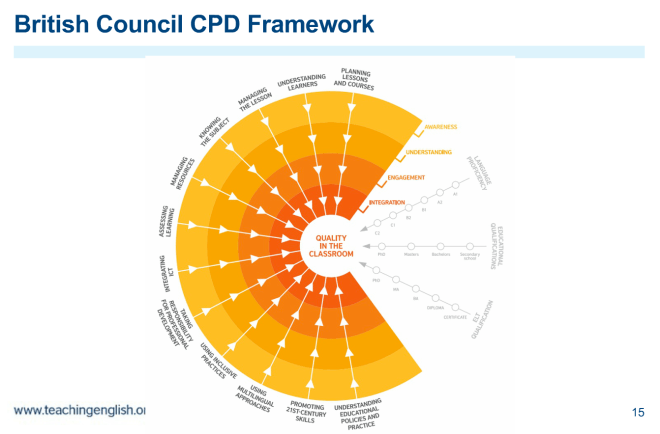
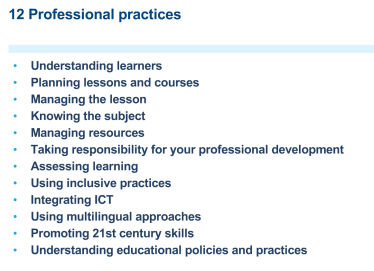
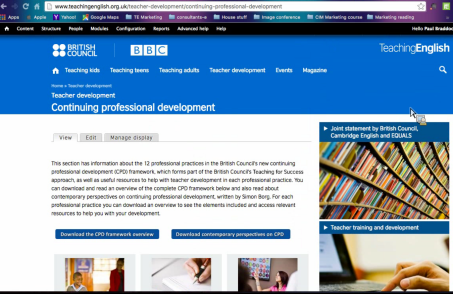
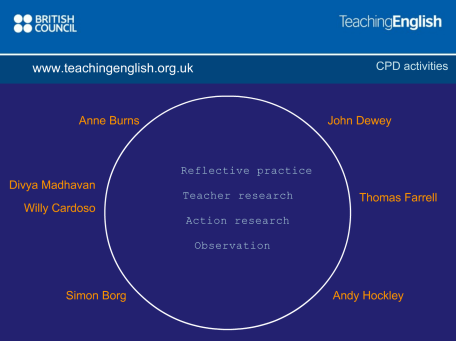
In TE Circle 4, we also discussed a framework and some slides that had been brought back from IATEFL talks relating to them. One of these was a British Council framework for CPD:

IMG_1579

IMG_1580

One of the talks was the Cambridge English Signature Event (Observations and Reflections – Tensions between best practice and reality), available to watch on the IATEFL 2016 online page and on my list (that I am steadily working my way through) of post-IATEFL catching up to be done!

We discussed other frameworks we were aware of, for example the BALEAP one which is specifically aimed at teachers of EAP (see here). This brought up the issue of how the frameworks are used and how teacher educators can help teachers use them. There is the question of whether teachers are institutionally obliged to use them, whether there is assessment of that. So, for example, in the research part of the university there is a framework that researchers get judged against and in order to get funding they  have to demonstrate that they are worth that funding according to that framework. A sort of quality assurance. We are accredited to BALEAP and British Council so we are inspected by them, according to their frameworks. Then, apparently there is a framework that will be brought into use by universities for teaching staff but what is yet unknown is how they will be used. It could turn into an OFSTED for universities potentially. Perhaps helping teachers to use the frameworks (rather than have the frameworks used on them so to speak) is something the Teaching Advisory Service could also do.

The question of reflection also came up, in relation to the above talk. It was suggested that if reflection is required then it needs to be taught/trained as it doesn’t come naturally to everybody. Indeed, some people are actively opposed to doing it.

In my opinion one of the issue that arises with requiring it is that it is difficult to do at the drop of a hat and some things take longer to reflect on effectively than others. I think requiring it to be done within a certain time frame and with a particular outcome, e.g. as part of a training course between teaching a lesson and getting feedback on it, makes it another box to tick/hoop to jump through, and so there is a shift from genuine reflection/evaluation to something more contrived to produce the desired outcome. Yet, is this a problem? You learn how to reflect and evaluate by doing it, then perhaps once you have finished with the hoops, it can shift back towards being something more genuine and developmental. Then, every so often (e.g. with formal observations), you (may) have to prove that you can still do it! So maybe, then, in training courses, rather than getting rid of the reflective element, there needs to be more focus on how to reflect effectively, and on helping people learn how that is for them (as everyone’s process is a bit different) rather than treating it as a box ticking exercise where if you don’t do x, y or z in your post-lesson reflection you will fail that teaching practice. Otherwise you might end up trying to get square pegs into round holes.

During the TE circle I was asked who I think of as my audience when I write reflectively on this blog. Magnificent as ever when put on the spot I responded with the greatly insightful…”errrm my readers?”  Thinking about it, I don’t write with a particular audience in mind, other than “people who are interested in ELT, from whatever perspective” – teachers, teacher trainers, DoS’s, publishers, whoever you are you, whatever you do, you are welcome to read what I write of course! I figure that just as I enjoy other peoples’ blog posts, there are people out there who get something out of reading mine!

My blog is busier some days than others. During IATEFL it is particularly busy, of course – in April I had 6,293 visitors and 12, 940 views. This is where they were from:

Screen Shot 2016-05-04 at 13.00.08

These were the top ten countries:

Screen Shot 2016-05-04 at 13.00.24

Less anonymously, I know Sandy Millin reads my blog posts (she comments on them and shares them) as do Rachel Daw and Naomi Epstein. (Hi guys! 🙂 ) To give a collective term to these three and others, my PLN (personal learning network) aka the people I interact with online via Twitter, my blog and their blogs. Some people read some posts, some people read other posts. 884 poor sods get an email every time I publish something! Audience aside, I think the act of communicating something to someone else, in speaking or in writing, but particularly in writing, requires a deeper processing of that something than keeping it to yourself/just thinking about it. It forces you to make those thoughts more coherent. I’m really glad that the folk on Twitter/#ELTChat encouraged me to start blogging moreorless 5 years ago now, happy to have been part of an online teaching community for that long and long may it continue.

Back to TE Circle, our attention was drawn to a free sample chapter from Jack Richards’ book Key issues in Language Teaching, published by Cambridge. It was the chapter on professional development. On my to-do list still is a review of this book and the Cambridge Bookshelf app as they let me have a free copy in exchange for doing that. Fortunately they have been patient and their patience is soon to be rewarded! Watch this space…

The circle came to an end, and as usual I felt privileged to be able to take part in the discussion and learnt a lot from it, but also felt rather out of my depth as everyone else there was about a gazillion times more experience than me(!). I hope I can attend the next one and look forward to seeing what happens with the advisory service. You can be sure that if I do manage to try out the team teaching thing, there will be a blog post in it!


IATEFL 2016 – Q and A follow-up to David Crystal’s plenary

Thank you British Council/IATEFL Online for enabling me to catch up with the follow up Q and A session for David Crystal’s fantastic opening plenary. Seeing David talk is always a treat.

I am not going to write up the whole session – I recommend that you instead spend half an hour watching it here. You might want to watch the recording of his plenary here first, though, to contextualise the Q and A!

Instead, I am just going to pick out a few things and comment on them:

  • Language play is taking place in all languages not just English – students are aware of that, whatever their age. They know that people play with language. The teacher’s job is to somehow grade their encounters with variety in both spoken and written environments. This enhances the standard learning experience: standard is standard because it is not non-standard and vice versa. The two things are always playfully interacting with each other. A teacher doesn’t teach standard English alone, or non-standard English as a separate subject, but somehow the interplay between the two so that one learns when one is learning a standard feature of the language that there are also non-standard variants.

I love this idea of teaching the interplay between the two! I think it’s important too – teaching standard English alone wouldn’t prepare students for the reality of English as it is used in the world today. 

  • The most popular component of the A-Level English Language course is language change. Both dimensions: language development (in the sense of a child learning to speak) and the deterioration at the other end of the spectrum, but also the change in trends of usage through the centuries and through living memory. The students love it because it gives them a sense of ownership of the language. They can discover for themselves the changes that are taking place. Last week’s cool words are not this week’s cool words. E.g. text messaging, of the “C U L8R” variety. Used to be popular, in 2003/4/5, messages were full of abbreviations. It was fashionable. (David always gets the teacher to get the students to collect text message data in advance of his visits). Last year, there wasn’t a single abbreviation to be seen. Not even an “lol” to be seen. They are not cool anymore. Why? Because adults started doing it! “I stopped doing it when my dad started” David predicts the same thing will happen to emojis. He gives them five years. Language change is happening now, as well as being something that has happened.

I feel old… Also, for anyone who, I was, is unsure about the difference between emoticons and emojis, here is a Guardian article that explains it! I wonder what will come after emojis? Am I old if I still use emoticons rather than emojis unless they auto-convert? For example, in WhatsApp you can select from a menu of emojis but if you put : – ) (without the spaces) then it stays that way rather than auto-converting into the relevant emoji. The only reason I really use emojis is because they have appeared as conversions of my emoticons. I don’t tend to bother selecting them from emoji menus. I must definitely be old!

Anyway, I love the idea of students collecting and analysing their message data!

  • Language doesn’t have an independent existence from society. It is explained by what is going on elsewhere. E.g. in the UK, breaking down of social class system, increase in cultural diversity, things to do with gender, race and stereotyping. We have become a more egalitarian society. You would expect language to reflect those trends. So, once upon a time certain accents were considered subservient because RP developed at the end of the 18th century into upper class English. Then came the middle class, the nouveau riche, build the railways, made textile machines, built roads etc. One day, the Duke invites the industrialist to dinner and suddenly the industrialist realises he does not know how to behave. So books on etiquette and elocution appear, with the elocution movement. Elocutionists became millionaires in those days. The people writing the manuals on pronunciation use words like “horrible” and “vile” to describe other accents. RP developed as a contrast with the regional accents of the time. As soon as the class distinction starts to break down, so attitudes change, the accent changes and people would modify their RP accent to sound ‘less posh’. However, not all regional accents have gone up-market equally. Some accents are considered positively but some inner city accents have got a long way to go before they achieve a complete range of positive responses. But give it time.

Isn’t the history of language/society fascinating?! And accent/attitudes to accent as well. I love non-‘BANA’ country English accents. And regional accents. With regards to my own accent, whenever people delve into the “where are you from?” question with me, they always go something like “aha! I thought you didn’t sound English” (as in England English)! When my sister and I were young and we (as in the family rather than us two personally!) got our first telephone with an inbuilt answering machine (very exciting! It was able to send and receive faxes too!!!), my sister had a great time recording variations of the message that people would get if they rang and we didn’t pick up. Amongst others, she took off to perfection a posh English accent, saying we were back home in the UK and had gone to London Zoo! Which was all the funnier because neither of us thought of the UK as home, of course. For me, Botswana English accents as well as some other African country English accents sound warm and homely, because they remind me of my childhood I suppose. 

  • You can never predict the future when it comes to language. Who, 1000 years ago, would have predicted that no one would know Latin? What will we be speaking in 1000 years? Could be Martian, if they have landed. One of the penalties of success – i.e. if a language becomes a global language – is that the language becomes owned by everybody. Then you get two forces – the need for intelligibility and the need for identity. In many parts of the world, you have standard English taught in schools and a non-standard English spoken on the streets. Language is messy, though, and things start to overlap. Things start to creep from one to the other and vice versa. The important thing is: when you encounter this problem, don’t think of it as a language learning problem, it’s just an issue inherent in a global language. You go backwards and forwards between standard and non-standard English.

I wonder if Martians would use emojis too… Anyway, I love the image of the back-and-forth-ing between standard English and peoples’ own varieties of English the world over, as intelligibility breaks down and is restored and stabilised then breaks down again. But rather than “breaks down” which has negative connotations, I want a more neutral word for it. I think there’s a lot of fun to be had in trying to build meaning with different people from different places, as long as everyone is aware that it may occasionally go astray! 

Anyway, as I said at the beginning, I highly recommend that you watch the full recording of both the plenary and this little Q and A session!

A few useful things I have learnt about using Microsoft Word for materials writing and academic writing

You know when you learn something and you wish you had known it sooner? Microsoft Word has made me feel that way on more than one occasion. Here are a couple of things I wish I had known well before I actually wound up learning them:

1. ‘Split screen’ function

In first place by a long way, I give you the ‘Split screen‘ function. ‘Split screen‘ really is nothing short of magical. I (like to) forget how much time I have spent scrolling up and down between various parts of a document to add things in, to make changes to things before I discovered it was possible with the mere click or two of a button to split the document and half so that I could keep one bit still and move the other bit!

How?

In Word for Apple, you click on “Window” in the tool bar and select “Split” – simple as that! In the version for Windows, you will find “Split” nestled in the “View” tab.

Screen Shot 2016-04-29 at 12.54.14

Mac

When you click it, the magic happens:


Screen Shot 2016-04-29 at 12.54.52

You can drag the bar up and down to make one or the other portions bigger, as you need to.

splitscreen

Windows sufferers

When?

I’ve found it useful (read: a Godsend!) in the following situations:

  • Materials writing: when editing a document containing both teachers notes and a student hand-out. It is much easier to make sure that teachers’ notes and student hand-outs correspond correctly if you can see both at once. You also save a lot of time by not scrolling up and down the document between the two!
  • Materials writing: when editing a document containing both student activities/tasks and answer keys. You can add the answers as you go, again with no scrolling required, and actually SEE the tasks as you write the answers rather than try to memorise/go back and check/repeat.
  • Academic writing: adding references as you go is much easier if you can have the reference section right there to add to as you use new references in the main body of the document. Again, no tedious scrolling required! (This becomes increasingly beneficial, the longer your document grows!)

Right-click shortcuts

How

When you right-click anywhere on your document, a list of options appear:

Screen Shot 2016-04-29 at 13.08.32

Hopefully you won’t need the Cut/Copy/Paste options as you will be using ctrl/cmd + X/C/V respectively, but if you prefer using the mouse, then there they are to use – just do your right-click over the portion of text you have just highlighted to move around (rather than moving your mouse All The Way to Edit!)

The Font/Paragraph/Bullets and Numbering options I think are a bit redundant given they are right there in the Home tab above the document (in both Apple and Windows versions).

The hyperlink option, however, is quite useful for inserting links quickly. (Alternatively you have to go to Insert and then scroll down to the bottom of a long list to “hyperlink”)

I like the synonyms option – if you highlight a word in your text, and right-click then select synonyms, Word will, funnily enough, show you some synonyms of that word. Could be useful for those times when you are lacking in inspiration…

There is also a dictionary option and a translator option that you can use if you can’t be bothered to open a web browser and go to a web-based tool!

When

When you want to do things more quickly!

Keyboard shortcuts 

How

So, remember I explained at great length how to find the “Split” option? Well, rather than go clicking around to do it, you could also use a keyboard shortcut. The default one on the Mac version is cmd+alt+s

How do you know what all the keyboard shortcuts are? (Other than cut/copy/paste which everyone knows!) Well, in the Apple version, quite a few of them are helpfully listed alongside their function within the menu bar drop-down menus:

Screen Shot 2016-04-29 at 13.29.33

If you take against one of the shortcuts assigned, or you want to add a shortcut for something else, you can change it by going to Tools -> Customise Keyboard:

Screen Shot 2016-04-29 at 13.36.01

All the potential commands are listed by category, and where there is a shortcut you will be told what it is in the Current keys. In the above example, for Insert Symbol there isn’t a shortcut so I am assigning one by making the shortcut while the cursor is in the Press new keyboard shortcut box. Once I click Assign, it will move into the Current keys box. Now when I press Command+Option+Shift+S, I will be able to insert a symbol! Don’t worry, if the shortcut you choose is already assigned to something else, you will be told next to where it says “Currently assigned to”. As you can see, my new shortcut is as yet unused. (I had to try a couple of options before I found this one!)

Shortcut keys are your friend – learn the shortcuts for the things you do most often, and if there isn’t a shortcut key, add one! (This link tells you how to do it for Windows versions)

When

The sooner the better! Make Word work for you, rather than the other way round.

What’s your favourite Word time-saving trick?

IATEFL 2016 Online: Self-marketing for English teachers – use your strengths for competitive advantage

Now that IATEFL 2016 is over, I am prolonging the enjoyment and learning by catching up with all the recordings of sessions I missed. I plan to work through the list of recordings in the order they appear, picking out and watching any titles that grab my attention (or that had grabbed my attention while I was at IATEFL!). 

This first one – Self-marketing for English teachers: use your strengths for competitive advantage, by Jenny Giambalvo Rode, intrigued me for several reasons. Firstly, at IATEFL this year, Sandy Millin was giving me tips on “branding” myself better (and given everyone knows who she is, it seemed worth listening to those!), such as slightly altering the name of my blog (did you notice the change?), so this idea of ‘self-marketing’ has been on my radar. Secondly, I recently watched Kirsten Holt (of Macmillan)’s webinar on networking, which I had been meaning to do since she did at the end of March. I’m pretty sure that, prior to this year, I’ve never noticed there being a webinar devoted to networking and similarly a conference session devoted to ELT teacher self-marketing. (I could be wrong though! Anyone care to correct me?!) Of course in itself it’s not a new concept – freelancers have long had to think about how best to, well, get work(!). My perception, though, is that this ‘marketing oneself’ aspect of being an English Language Teacher is becoming more mainstream. Look at this description of Kirsten’s recent webinar:

“This webinar is aimed at ELT teachers and professionals working in all sectors and settings.”

Screen Shot 2016-04-27 at 16.21.42

You will notice, too, that the title for Jenny’s talk is “Self-marketing for English teachers” not “freelance teachers” or “freelance online teachers” but ‘English teachers’ – in general. As the job market becomes more competitive, and work is harder to come by, perhaps it IS something that all teachers need to think more about? What do you think? 

Self-marketing for English teachers – use your strengths for competitive advantage

Jenny, the head of department at an adult education centre and a bilingual German and Italian speaker, says as teachers we are a one-person company and our students are consumers. She wants to help us work on our self-marketing strategies.

Of your soft skills and professional skills, what one would you choose as being the one that would make the difference between getting a job or not? Examples are flexibility, networking, connections, empathy, people knowledge, creativity… She asks the audience to keep this in mind as we proceed. Next we have to look at the market – the schools, universities, businesses around you, in your area. Are you living in a small village? A big town? And where would you like to work? Is the institution you want to work at in your location?

This is all part of a SWOT analysis. These are used to make the current situation clear, in terms of you and your market. We’ve looked at strengths but think about what could be the weakness of what you consider to be your strength. E.g. friendly – you can make a connection with the kids, but too friendly and maybe they will just do what they want. With opportunities, you need to think about what you can do. How can you increase your skills? When you think about weaknesses, strengths and opportunities, you have to think about time. Distinguish between short, middle and long-term action. A short-term action for getting a job might be going down to the job market and submitting your CV. A middle-term action would be like Jenny making a year long plan to speak at IATEFL this year, including improving English and submitting a proposal. A long-term action would be thinking about where you want to be in 5 years and then thinking about a plan of how to get there, using your strengths and building on them. You need something to make you stand out from your colleagues in a positive way. Think about yourself as a one person business, with a business profile in your head.

Now think about your target group, i.e. the type of students you would like to teach. Business people? Children? What is your target group? Your business profile should fit with your target group. One of the most important things in marketing is finding your niche. It’s a simple marketing strategy. The smaller the niche is, the greater your opportunity and your advantage because there is less competition. Identify your opportunities, based on your location and your goals. For example, you could become an examiner.

Once you have your profile and your strategies, you need to get them out there. You need to be visible online, for your audience/future bosses etc. For example, you could join the TELC community. In Europe, Twitter and Facebook are good for networking, worldwide there are other platforms and social media that are more important. (I suppose LinkedIn fits in here too!) You make your own business profile and you need to decide if you will have two separate accounts for private and business or only one for both) and use it to connect with different people and places. Networking is what marketing needs and does. Use conferences not only to improve skills but also to network. You never know what it might lead to.

Give yourself deadlines. When you set goals, give yourself a completion date. Jenny concludes by inviting us to a webinar about SWOT analysis that she is planning to deliver in May.

My first reaction is that it all sounds so business-y what with all the SWOT analysis and every teacher is a one-person company and students as consumers etc! (I recommend you watch the session though, and form your own opinions…)

I suppose, though, jargon aside, that it’s always useful to be reminded to think about short, medium and long term career goals. That said, I am in less of a hurry than I used to be career-wise. I think this is possibly because I have already done a lot in a short time: I feel I’m now in a position to build on that more steadily rather than continue to be in the haring hurry that I was in previously. (Hopefully this means I will grow steadily and avoid burn-out!) So, I absolutely still have goals (for example I really want to do a PhD or Ed Doc at some point and I would also like to become a teacher trainer) but they don’t have time-limits attached currently. (Hence, “at some point”) That said, there are plenty of projects in the pipeline now/in the near future (some research I want to do, a book I’m supposed to be co-writing etc) and of course there are the most pressing short-term goals of all which are doing the best job I can in my current job (including learning how to teach EAP better!) and securing work somewhere come September when my current contract finishes!

Would be interested to hear your thoughts on this session! Have you done a swot analysis recently? Do you consider yourself a one-person company? (If yes, are you freelance or do you work for someone else?) What do you do to “market” yourself?

Happy Birthday, Blog…??

So, today this popped up in my comment notifications:

Screen Shot 2016-04-28 at 19.21.21

Whoop whoop! Except…erm…

Seems like last year they sent me this message on the 1st May?! So, really, who knows. I published my first ever blog post on the 8th May 2011, so maybe I should make that my blog’s birthday? Either which way, I can’t believe how old my blog is getting. It’s seen a whole five IATEFL’s, for goodness sake! (Seems strange to think that I have too, come to it. It feels like no time since I won a scholarship to my first one in 2012. And yet…lifetimes too!)

Another year gone (più o meno anyway!) and like all its predecessors, it’s been fairly jam-packed! Being a teacher may be many things – dull is certainly not one of them.

Anyway, Happy (un?)Birthday, Blog! Here’s to another exciting year! 🙂


ELTC: Vocabulary review workshop

This is a very delayed write-up of a Vocabulary Review workshop that I did at the ELTC last term. It’s taken me this long because I have been reflecting on and off since, and now finally feel ready to publish it! It’s a reflective post divided into ‘before’ and ‘after’ with the former focusing on my preparations and the latter focusing on what actually happened!

Before

Tomorrow I am going to be running a workshop for my colleagues at the ELTC. The focus is vocabulary review activities. This year, so far, I have already done two other workshops for them: one on helping learners become more autonomous (part of the training day at the start of term) and one whose aim was to encourage reflection on career turning points and glean ideas for further developmental possibilities. I’ve also done a practical workshop on blogging (both with learners and as a means of professional development), at Leeds Beckett University, on the Multimedia and Independent Learning module, as well as an online session also about career turning points for the recent TD SIG web carnival. Coming up, as well as tomorrow’s session on Vocabulary Review, I have another session with Leeds Beckett University, this time online, about developing learner autonomy, a British Council webinar also about learner autonomy tools/tips and my IATEFL presentation in April, which will form part of a forum on listening and focuses on helping learners become more autonomous listeners in an EAP pre-sessional context.

The reason I mention all these commitments is that (not so coincidentally!) I have recently(ish) been reflecting on my short, mid-term and longer term goals, now that I have achieved the long-term goal that I set out with after I finished my CELTA, which was to gain some experience and then in due course work at Sheffield University. Of course I also squeezed in my M.A. in ELT and my Delta in the interim, which was handy and part of the plan for getting university work. Teacher training is one of my areas of interest, so it follows logically that, if one of my goals is to become a teacher trainer, doing as many workshops as I can, in various contexts, would be a useful way of gaining experience and working on my techniques for working with teachers rather than students. Initially, I started doing workshops as a means of developing myself as a teacher, and I will admit the main personal goal early on was survival. Happily, as you can tell since I am sitting here writing this, I achieved that! Since then, goals have included sharing what I’ve learnt through my experimentation, becoming more confident in my delivering, including more interaction in my sessions and so on.

This vocabulary workshop, however, is the first one I will do since reading “A Practical Introduction to Teacher Training in ELT” written John Hughes and published by Pavillion, borrowed from the ELTC’s library.

Screen Shot 2016-03-01 at 16.54.16

It is also the first workshop I have volunteered to do in response to topics requested by teachers via survey and shared with everybody by our professional development team. I did a workshop on Error Correction at IH Palermo, with the topic suggested by the DoS, as planning a workshop was one of the tasks for the Tutor in training certificate I did while at IH. It seemed logical that if I had to plan a workshop, I might as well deliver it! For that workshop, I had help from my DoS and from my ex-Delta module 1+2 tutor who shared some materials with me via email. I also had the memory of an error correction workshop I had done during Delta (hence contacting aforementioned tutor!), on which I based the workshop. Of course, this time, for the vocabulary workshop, I’ve done all the preparation unsupported, starting from scratch. I think I should do more sessions like these. I’ve already signed up to do one on pronunciation so hopefully I can use what I learn from doing this session in planning that one. I shall be team-teaching it with one of my colleagues, which also be interesting! 🙂

Hughes suggests thinking of a training session as a triangle shape, divided into three. The smallest part at the top of the triangle is “What?”, the next segment, which goes until half-way down the triangle is “Why?” and the rest of the triangle is “How?” So this is the structure I have applied to my vocabulary workshop. The “what” and “why” section will be taken care of via discussion of some quiz questions relating to the topic of vocabulary review (and by extension learning). The bulk of the session, the “how”, is going to be a game of bingo! I will ask groups to brainstorm a grid of 9 vocabulary review activities that they have used before and then I will share 9 activities of my own with them. I plan to do this by having them participate (briefly!) in each activity using Delta module 1-style terminology (particularly relating to Lexis) as the target vocabulary. If the activity corresponds with any on their grid (regardless of the name, as these activities tend to go by several names), then they get to tick it off and we’ll see if anyone gets Bingo! The remaining time will be used to allow groups to share any leftover activities on their grids. I have also prepared a handout summarising the activity procedures so that the teachers don’t need to make notes as well as participate.

I anticipate that timing is going to be tight, as I will only have an hour to play with. However, I recognise that we do not need to complete each activity, teachers just need to have a taster of it in order to make sense of how it works. As per the triangle, the “what” and “why” quiz should not take up too much time. If time does run out, then I’ll make a google doc and invite teachers to write a brief summary of the outstanding activities on their list. One of my goals is to maintain a good pace and really keep track of the timing. I suppose, in the circumstances, it is also going to be a good test of classroom management and instruction-giving! (The better these are, the better the timing will be!)

After

Well, the good news is that my colleagues responded positively to this workshop. I had 6 attendees and they all had plenty to contribute to the discussion element (!) as well as being willing to get involved in the game-playing element.

As I predicted, time WAS an issue. Or, was it less the timing that was an issue and more my confidence in managing the discussion element, which I allowed to take up too much time?They had a lot to say and I didn’t want to cut it too short! (Perhaps I should have had fewer discussion questions, though I think they were all useful…) Actually I just wish I had had a longer session to play with – in the event we started slightly late and some attendees had to leave early due to other commitments, and even that aside it wasn’t the longest time slot! That’s not an excuse though – I did know roughly how long I would have. Perhaps I should have included fewer activities to try out?

However, on the plus side, this time issue was mitigated by my carefully prepared hand-out which meant that although we couldn’t have a stab at playing all of the games, teachers did take away instructions for all of them so that content wasn’t lost. Perhaps it didn’t matter that there were left over activities. It just gave the teachers a greater take-away for future experimentation. Perhaps, then, what I needed to do was stop trying the activities at a given point when there was still enough time for a constructive closing. I think that is what really got lost, as we had to come to a halt rather abruptly as teachers had to leave to get to other things.

For me, another positive was that within the game playing, we were able to refer back to the discussion element and build on it. The games illustrated the points made through the discussion questions, making them that much clearer. I think this was important because it made the workshop more cohesive and less of a ‘discussion with a few activities tacked on’ which perhaps it was in danger of becoming, given its nature. It was intended to be a practical session, with lots of ideas for teachers to try out, rather than a theoretical session, but the discussion element allowed for the practical ideas to be rooted in theory. So even though my first thought at the end of the workshop was that I had let it go on for too long, I now feel that that wasn’t the issue, rather it was how I managed the remaining time.

I would say the main drawback was that although I identified time as a potential issue in my planning, and recognised that not every activity needed to be completed, I didn’t recognise that the teachers didn’t actually even need to do every activity, thanks to the hand-out I had prepared, and therefore wasn’t prepared in the session to stop going through my set of activities in time for a strong closing. This is something that will definitely be a consideration in future workshops.

At the end of the session, I felt disappointed that it hadn’t gone quite as I might have liked it to, but on reflection I think it had a lot of positives and, importantly, I learnt some useful things from how it did go:

  • hand-outs are really useful!
  • make a decision with regards to how long an activity should run for and be firmer in bringing it to a close, if needs be. (Alternatively, if it needs to go on longer than planned, revise plans for the timings for the rest of the session!)
  • recognise when all the material is not going to be got through and ensure that there is nevertheless time for a suitable closing element to wrap everything up
  • in planning, if there is clearly too much material, either cut it down or ensure that nothing will be lost from the session if all the material isn’t covered. (In other words plan so that no core material will be lost)

I think that’s a useful set of points for me to consider next time I plan and deliver a workshop! So, all in all, it was a successful learning and developmental experience for me in my quest to become a teacher trainer at some point! I look forward to building on it. 🙂

If you are interested, here is the powerpoint I used and here is my handout.

IATEFL 2016: “A hundred thousand things to see!”

The title of this post is a somewhat obscure reference to a ten-minute talk I did last year at IHTOC (IH Teachers Online Conference) in which I used the lyrics of Aladdin to try and persuade my audience of the benefits of attending a conference! It also reflects the reason for this post. The truth is, even though I did manage to see over 20 talks  for every one I saw, there was at least another I also wanted to see and missed! Too many things to see… 🙂

Fortunately, the British Council IATEFL Online 2016 site means I (and many others) can play catch-up! The conference lives on a little while longer. 🙂 Thank you, British Council folk and IATEFL folk involved, for making this possible!

Here are a few of the talks I plan to have a look at:

  • Self-marketing for English Teachers – use your strengths for competitive advantage
  • Q and A session relating to David Crystal’s plenary session
  • Enhancing speaking and writing outcomes using Google Apps
  • Forum on special educational needs – creating positive inclusive learning opportunities
  • The ELTJ debate – “This house believes that teacher training is a waste of time”
  • Forum on encouraging teacher reflection
  • National Geographic Learning Signature Event – What does it mean to be a Global Citizen?
  • Chatting in the academy – exploring spoken English for academic purposes
  • Reviewing qualifications and CPD: helping meet teachers’ training needs
  • ELT Conversation
  •  Visual literacy in creating classroom materials
  • Catering for trainee diversity on CELTA courses

All of these recordings can be found on the Sessions page of the British Council IATEFL Online website. What a valuable resource!

I also want to have a look at some of the interviews that were conducted during the conference, all of which can be found on the Interviews page of the British Council IATEFL Online website. For example:

Screen Shot 2016-04-27 at 19.40.45 Screen Shot 2016-04-27 at 19.41.14 Screen Shot 2016-04-27 at 19.41.31 Screen Shot 2016-04-27 at 19.43.46

In addition to the sessions collected on the British Council IATEFL Online website, you can also watch sessions done and recorded by Macmillan, which will be available on their page here. The two I most want to catch up with are:

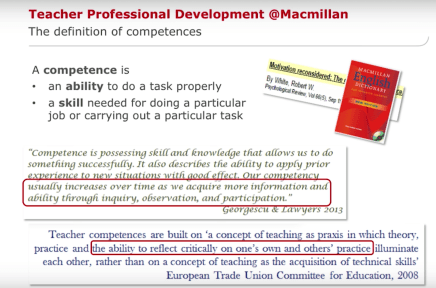
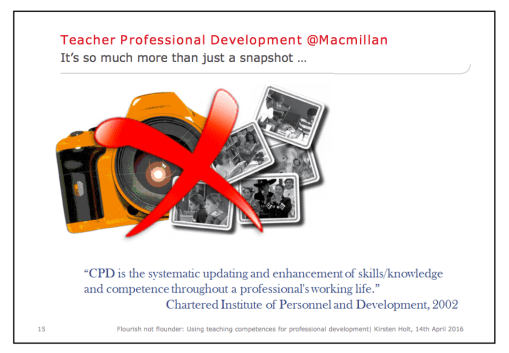
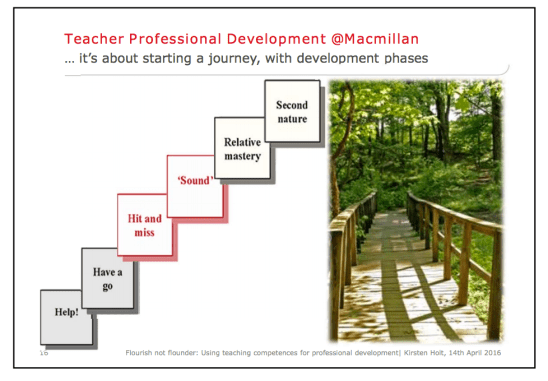
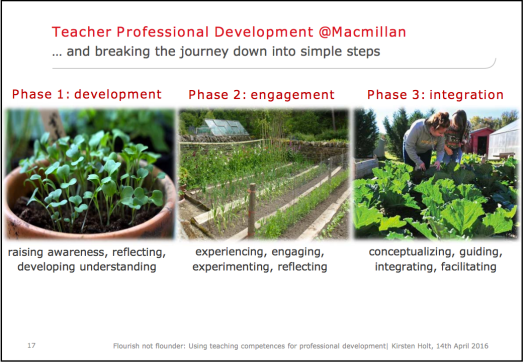
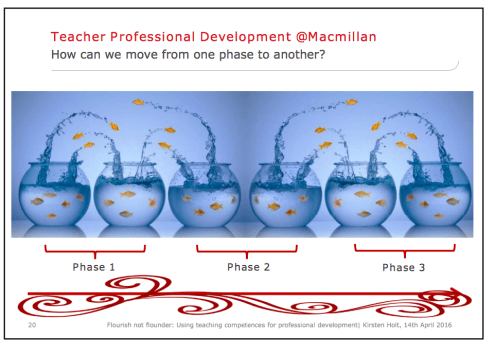
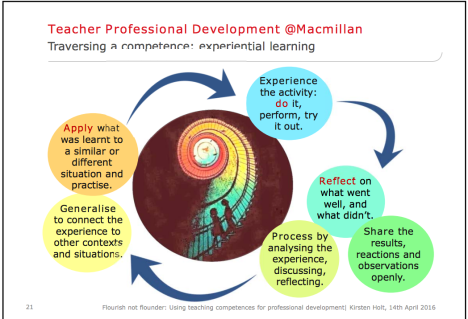
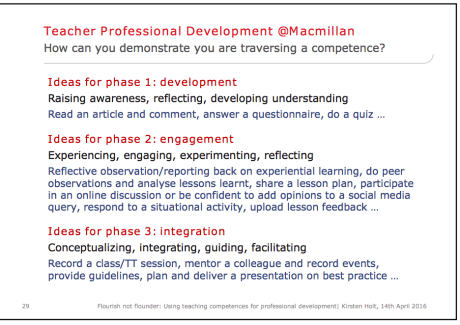
  • Flourish not flounder: using teaching competences for professional development
  • The teacher of tomorrow: professional development through informal learning

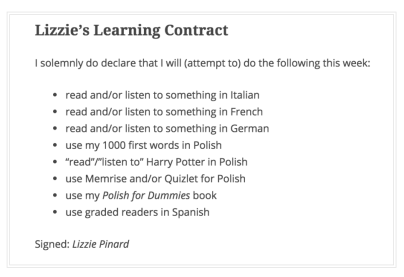
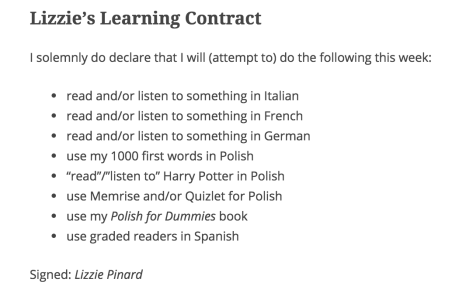
Plenty to wade through, then, but that’s ok – I’ve got nearly a whole year to finish before IATEFL rolls round again and this particular list gets topped up again! Similar to my newly made language learning contract, this is a mini CPD contract – the difference is, though, that the language learning one accounts for the sum total of my language learning while this one doesn’t account for the sum total of my CPD!

How about you, which IATEFL online talks and interviews do you want to catch up with?!