Christmas Fun!

Well, it’s that time of year again! Here are a few things I’ve done with my classes in the last week before the Christmas holidays… 

1. Christmas Play!

How the Elves saved Christmas

My 10-12 year old ‘M2’s’  persuaded me to enter into the ‘Christmas Spirit’ this year, by requesting a Christmas play – some of them had done a play with their teacher last year and, apparently, had much enjoyed it! I duly complied and set about writing a play. The play tells the story of Father and Mary Christmas, amidst their Christmas preparations, losing their list of naughty/nice boys and girls, and sending the Elves off to compile a new one. The Elves finish their journey in M2’s classroom and use our star chart to decide if the M2 children should get any presents this year. Needless to say, the answer was yes! So, in the end, they return to Lapland with the list and Christmas is saved!

In terms of language, I also managed to work in all of the structures we’d looked at over the course of this term – present simple, past simple and continuous, present perfect, comparatives, possessives and present continuous for future plans – as well as a song and a chant (the chant being based on the wake up shake up chant we do at the start of each class).  In terms of preparation, as well as rehearsal time (half an hour per lesson for three lessons), some time had to be spent making elf hats and shoes out of coloured card.

Here is the hat I made as a model for them! The design inspired by a Google image, but I can’t claim credit for it – my lovely YLC (Young Learner Coordinator) figured it out!

Elf hat

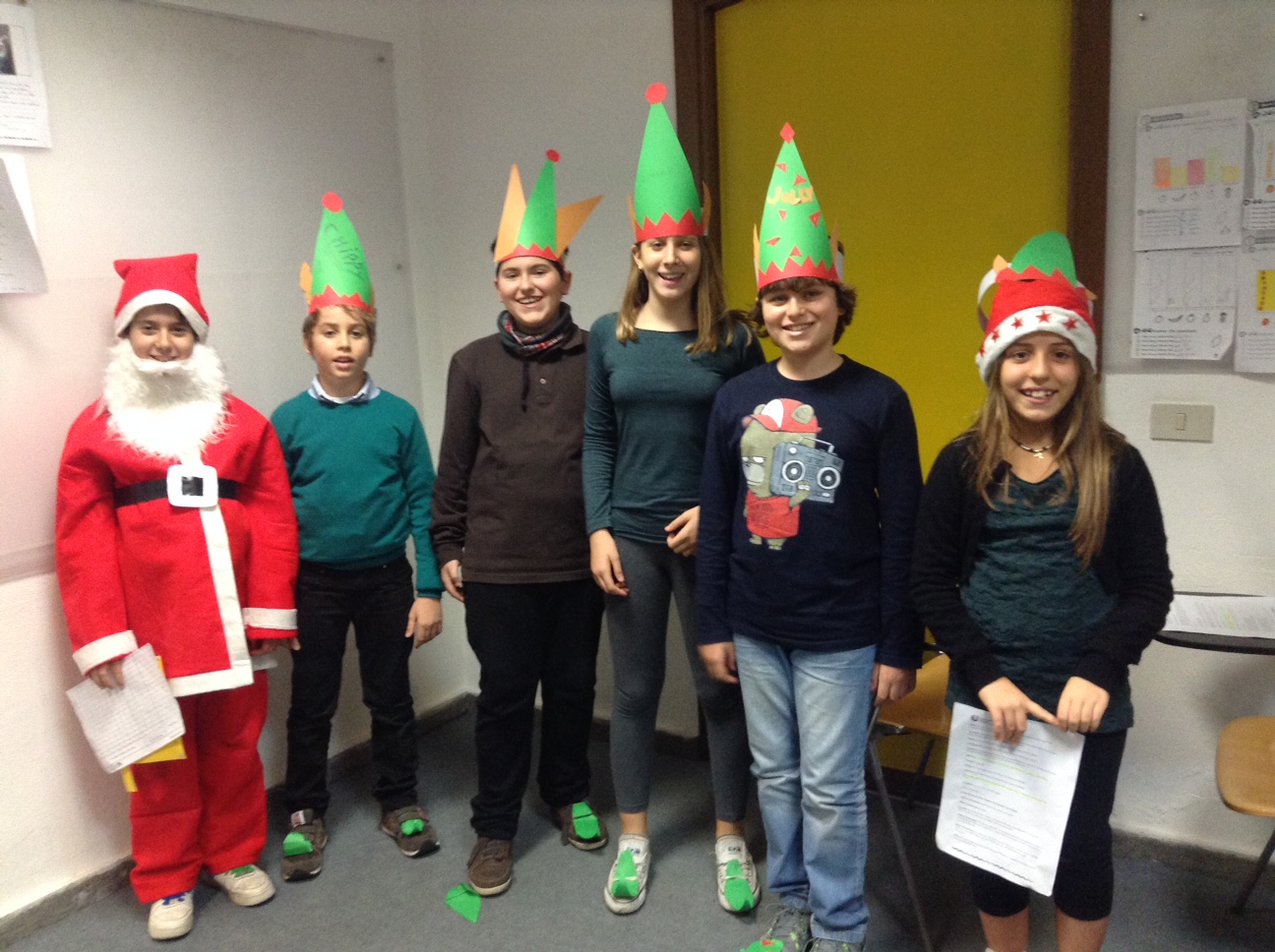
Here are my happy elves, Father Christmas and Mary Christmas (who, bless her, stepped into the role at the last minute due to an absentee, hence double hat and script in hand!):

m2

And here is a copy of the play. It is for a cast of 8 students and one teacher, but easily adaptable, as the number of elves is very flexible!

2. A letter of complaint to Santa

I also had some Christmas-related fun with my L4b’s (Upper Intermediate teenagers): In a bid to try and balance the time:exam date:quantity of course book remaining ratio, rather than doing an un-related Christmas lesson, I converted a page of their course book into one. The course book page from Pearson Choices Upper Intermediate was a writing workshop, focusing on formal letters of complaint, within a unit on advertising.

So a quick Google found me this letter of complaint to Santa. A speedy bit of editing enabled me to splice in some of the language that the Choices workshop centred around, that is to say language for formal letter writing, including the structure ‘Not only <inversion>….but …. too’ e.g. Not only were the presents not what I had ordered, but they arrived late too’. To lead in, I threw together a quick powerpoint with images of an advertisement for Santa’s Grotto, claiming to make all your dreams come true, a Christmas tree with presents beneath it and a screaming child, from which I was able, via some pair work, to elicit the story behind the letter of complaint. This was followed by some role-playing in pairs, student A was the 9 year child, with a rather impressive vocabulary, who wrote the letter and student B was the grumpy elf who answered the phone when said child called to complain (mentioned in the letter) and then the language focus, using a mixture of the Choices skill builder for identifying the target language and my own Christmas complaint letter-related examples for the ‘Not only…’ bit. Finally, I asked them to imagine it was Christmas day and they had just opened a…<show the picture on the course book  page> …I think it was a fancy alarm clock and had them imagine the problems they might have with it, which they then compared with those mentioned in the model letter on the course book page, from which the homework of writing their own letter was set up.

So, nothing extraordinary, but my teens enjoyed the amusing twist on an otherwise fairly bland sequence. 🙂

3. Christmas Debate

Less amazing still, but good value: turns out you can get a really good debate out of the topic ‘This house believes that Christmas should be abolished‘ with chatty Italian upper intermediate adult students! It also provided a nice opportunity for reviewing language for expressing opinions, agreeing and disagreeing, which we had looked at earlier in the course.

🙂

So all in all, it’s been a fun run up to Christmas and, even better, now the holidays have actually arrived!

Teaching teenagers “have to” and “can’t” for complaining – resurrected in TEA issue 71!

A while back, I blogged about an activity I had done with my teenagers, to help them get to grips with ‘have to’ and ‘can’t’ for complaining. Some time down the line, Philip Kerr from TEA (Teachers of English, Austria) approached me to request permission to publish the activity in the TEA online magazine winter 2014 issue, which I, of course, duly granted.

Here is a link to the magazine, where, as well as my little activity, you can find pieces by Ceri Jones, Lindsay Clandfield and others, on a range of focuses.

Enjoy!

(PS: there will be more blog posts soon… when the time – things to do ratio is just slightly less punishing!! 🙂 )

Keeping teachers motivated

A few weeks ago, at IH Palermo, we had a workshop on Demand High Teaching. We looked at various techniques for ‘getting closer to the learning’ in the classroom and were then sent off to experiment in our classes, with the promise that there would be a subsequent ‘reporting back’ session. This happened today, as part of a rather informal workshop in which we discussed what we had learnt/taken away from/experimented with from recent ‘buzz observations’ (short i.e. 10-15 minute pop-in peer observations) and reflected on our experimentation with Demand High. The final part of the workshop was dedicated to a ‘swap shop’ where many of us shared activities we have done in the classroom recently.

To me, this is rather an effective way of motivating teachers. By telling us that there would be a future session in which we’d talk about what we had done with the techniques learnt about in the Demand High session and what we’d taken away from the buzz observations, there was immediately more chance that we would make more of an effort to do something in the meantime! This mirrors what I strongly advocate doing with learners, in terms of fostering learner autonomy: bringing it back to into the classroom. I think it’s equally important and effective where teachers are concerned, because like our students we are busy people. And sometimes, CPD might get put on the back-burner as a result. Yet, effective CPD is done little and often, is an on-going process of growth.

The workshop was interesting: as well as sharing ideas and experiences, we discussed the pros and cons of buzz observations and full lesson observations, from the peer observation perspective. I found this particularly interesting as I am doing the IH Tutor Training certificate course at the moment, and one of the recent modules looked at organising observations. Turns out there are more types of observation than I was aware of! Anyway, I hadn’t come across buzz observations before we did them here this term, but we all agreed that they are a Good Thing. Why? You get to see ‘snapshots’ of other teachers’ lessons and gather ideas for use in your own. It may not necessarily be things that are new to you, but it may remind you of things that you haven’t done for a while. (Over time all build up a range of techniques and activities that we use, but the more time you teach for, the more you build up, the more you can forget! And, of course, we generally tend to stay in our comfort zones!) You also get to see a range of teaching styles and a range of levels in a short space of time, so it is very time effective. Of course, full length observations have different benefits: you get to see the shape of the lesson, where an activity fits into the great scheme of things, how learning is built on in the course of the lesson etc.

From the point of view of being observed, we agreed that it is less stressful not to have the same person sitting in for the whole lesson, but yet, having people pop in and out does make you ‘up your game’ – naturally! I have to admit, I found it particularly gratifying today when one of the teachers who observed me mentioned how clear my instructions were! Instructions (which in my recent YL observation we renamed ‘demonstrations’ to help me…) have always been my nemesis. I suppose this teacher caught me on a good day! (Or, a good activity, rather! Inconsistency is where I’m hovering with instructions currently…) Perhaps this ‘gratification’ is another positive aspect of this type of workshop where we feedback on what we have learnt from one another: it reinforces that we all have something to offer and that we can all (and should!) learn plenty from one another. And it helps us all feel valued, which is important, even if it may seem like a small thing.

In conclusion, workshops don’t have to be complicated and full of bells and whistles in order to be very effective. (I must remember this, as I am on the module for planning input sessions now…!) It is also A Very Good Thing when a couple of kettles, some mugs and a good supply of teabags are involved! 🙂

I leave you with a link to my most recent British Council post, which discusses CPD at IH Palermo and how it works here, as well as the effect of this on teacher motivation. Enjoy! And if your school isn’t doing any of the things I’ve discussed in this post and my BC post, why not suggest that they do? Evolution is healthy! I also leave you with a request: let me know (comment on this post!) what kind of CPD you’ve been up to recently – through your place of work or independently – I would love to hear.

OLYMPUS DIGITAL CAMERA

CPD and cups of tea/coffee combine very well! Image taken from google image search for images licensed for commercial reuse with modification.


British Council Videos: ‘Teacher Talk’

One of the perks of being a British Council Associate is that as well as having had the opportunity to deliver a webinar (with another on the cards for next year!) I have also been able to participate in a project called ‘Teacher Talk‘. This is a series of videos edited by the British Council, which feature some of the BCAs talking about various ELT-related issues.

So far, you can watch short video clips about:

(Click on the title to be taken to the relevant video – I think there may be more forthcoming, but I can’t actually remember at this stage how many topics there were in all!)

I think part of the beauty of these clips is that they are so short – within a few minutes you can either pick up a few new ideas or remind yourself of things you knew but hadn’t been uppermost in your mind recently, becoming buried amongst the myriad other things that we, as teachers, have to juggle.

The other thing I like about them is that you hear a range of voices on a single subject, particularly as the British Council has edited the videos very cleverly, so that although they cut from one person to another, the flow of ideas is seamless and easy to follow.

From my own selfish developmental point of view, making the videos, which I sent to the British Council to be included in the editing process, encouraged me to reflect on and synthesise (very succinctly by my standards – the videos had to be fairly brief!)  my views on these various important elements of ELT. Watching the videos now, months down the line, it encourages me to question whether I practice what I (and the others in the video clips) ‘preach’ and how I could try and do so more effectively.

All in all, a very rewarding project to have been part of. Thank you, British Council, for this fantastic opportunity! 🙂

2 simple ideas for adapting your course book

After a very prolonged silence (life gets  in the way dontcha know!), here I am again! Greetings, all. For my first post back, I thought I’d share two very simple ways that I adapted two standard course book activities from New Headway Upper Intermediate unit 1 (so this was a while back, as we are now on Unit 3, but it’s taken me that long to get round to writing this post!), which worked very well with my Level 7’s. Both adaptations could easily be applied to other activities of this type, at any level from pre-intermediate upwards.

At upper intermediate level, in my context, we have the luxury of TIME: instead of 6 units to be covered over the duration of the course, the magic number is 4. So, as I wasn’t in a hurry, and I wanted the learners to mine the maximum possible out of the activities in question, which are both linked with tense review, I did some adapting…

1)

Course book activity:

A grammar-focused warmer activity consisting of a list of sentences, a box of time expressions. Students to insert the time expressions into the sentences. The time expressions can be used more than once and some will fit in more than one place in a given sentence.

My adaptation:

  • Write each sentence on a separate piece of paper
  • Stick the sentences up around the room
  • Give each pair or small group (3) – depending on numbers – of learners the box of time expressions.
  • Pairs to go round the classroom, stopping at each sentence to decide which time expressions could be used with it and where they should fit.
  • Once all have finished, whole class feedback: the teacher reads out each sentence with the time expressions where students have put them. The class as a whole decides if the sentence is correct or not.

Benefits:

  • A lot of discussion, both at the pair/small group stage and at the whole class feedback stage: learners really engage with the language.
  • Pairs/small groups can see what other pairs/small groups have done, and decide whether they agree or disagree.
  • Provides a nice energetic start to the lesson, as learners are moving around rather than sat still.

2. 

Course book activity:

A set of sentence starters which between them will generate a range of tenses. Students to complete the sentences with their own ideas, then read their sentences to a partner and respond to their partner’s sentence.

My adaptation:

  • In advance of the lesson, teacher completes the sentences with own ideas
  • In the lesson, teacher focuses learners on the sentence starters and tells them that she has completed those sentences making them true for her.
  • Learners to try and guess what the teacher has written. E.g. for the sentence starter “At weekends I often…” Students might say, “At weekends, you often go out for a drink with your friends!” or “Do you often go out for a drink with your friends at weekends?“. Of course, the teacher can feed in clues to help the learners guess. This stages provides the model for the next stage.
  • Learners then complete the sentences to make these true for them.
  • Then learners repeat the guessing process in small groups.

Benefits:

  • The teacher can provide linguistic feedback at the modelling stage, if learners make mistakes when guessing. Learners will then hopefully produce sentences that are more correct than they would have been, in the subsequent stage. (Of course teacher monitors to check for any errors)
  • The activity is more interactive and engaging. Rather than a learner reading out their sentences and another learner half-listening, there is some genuine communication going on, which requires use of the various tenses under review.
  • The nature of guessing means that learners produce multiple sentences using the sentence frames and target structures.

Nothing very earth-shattering or “new”, no great deal of preparation required, but sometimes the simplest things can be pretty effective. This was the case with the two activities described above.

Hopefully, at the very least, I have reminded you of these two different ways of going about approaching the activity types in question: lately I have been reminding myself of various classroom management techniques via Jim Scrivener’s book of that name, so I am a fan of reminders!

Enjoy 🙂 (And I hope it won’t be so long till the next time I post something!)

Motivation

Motivation is a slippery beast.

Amongst those who research it, there are many differing views (Dornyei and Ushioda 2012) but there is agreement with regards to its effect on human behaviour:

“Motivation is responsible for

  • why people decide to do something
  • how long they are willing to sustain the activity
  • how hard they are going to pursue it” (ibid: kindle loc 259, emphasis as per original)

A lot of investigation into motivation has taken place over the years, with various theories abounding to account for the origins of motivation, the effects of motivation, the effects of the absence of motivation and other such elements.

Motivation is fascinating.

It is something that everybody both enjoys and struggles with at various intervals. It can fluctuate hugely in a very short space of time. When you’re feeling motivated, you can’t imagine not being motivated by whatever it is that is motivating you at that time, but then something happens and your motivation nose-dives, at which point you find it difficult to imagine feeling motivated again. Motivation can be influenced by so many things, both external and internal. Of these influences, some will kindle motivation and some will dampen it, changes which may occur simultaneously, resulting in a sort of battle of influences, with victory being a very temporary state. Of course, with so many influences at play, it is difficult to identify which one is responsible for any change that occurs (Dornyei and Ushioda, 2012).

Motivation is closely entwined with learner autonomy.

My other passion, learner autonomy, is closely entwined with motivation. Nobody is going to dedicate any length of time or great effort to doing something that they are not motivated (whether that motivation be positive or negative) to do. Autonomous language learning, by nature, requires, amongst other things, motivation. The motivation to begin, and, as importantly, the motivation to keep going. Enthusiastic language study/use for two days followed by several weeks of doing nothing will have little effect on one’s competence. Indeed, Williams and Burden, 1997 (in Dornyei and Ushioda, 2012) highlight the need for language teachers to consider not only the arousal of interest but also the longer term process of helping learners sustain it. I would argue that this applies not only to motivation within the classroom across the duration of a course, but also to the motivation for learning outside the classroom.

Developing one’s language skills autonomously is hard work. It is hard enough work, when, as a teacher, you are very aware of how learning a language works: we know that it is slow, that progress may seem invisible, but we also know that every little helps and that perseverance is key. We know how important exposure to the target language, in all its forms, is; we know that a vast amount of this type of exposure is necessary for the effects to become apparent. We have awareness of different approaches to learning, different activities and the benefits of these, enabling us to combine them as we see best suits our needs. Of course, even with our knowledge of all these things, we are not immune to dips in motivation. There are far too many different elements that influence motivation for anybody to be immune to dips in it.

Motivation is long-term.

Perhaps, then, in terms of sustaining motivation, we ought to ask not only “how do I stay motivated?/how do I help my learners stay motivated?” but also “how do I rekindle my motivation when it dips?/how do I help my learners rekindle their motivation when it dips?” Take, for example, my Italian learning. Over the summer, while I was in the UK, I was, by and large, hugely motivated to improve my Italian. I worked so hard on it that my housemate dubbed my attic bedroom “Little Italy”. My key motivation was being able to converse in Italian when I got back to Palermo. Fast forward back to mid-October, and here I am. Have I spoken loads of Italian? No. Outside of work, there has been the odd bit of transactional communication, at work, the opportunities to actually converse, getting beyond pleasantries (hi, how are you, how was your weekend etc.) are few and far between. (I think I need PSP Speaking [on offer at IHPA – multilevel English conversation hour that students can freely sign up for, in addition to their courses] in Italian!)  Since returning to Palermo, my motivation has fluctuated a lot more than it did in the UK. I find this interesting because being in the target language environment is supposed to be motivational. It’s supposed to be harder to stay motivated when you are outside it. Perhaps this would be the case if you had no concrete plans to travel to the target language environment in the foreseeable future.

Motivation is problematic.

My first problem after getting back to Palermo was that I lost my overall driving goal – that of ‘being able to converse in Italian when I get back to Palermo‘. Initially I was very happy – I managed to do things like sort out my phone and internet in the phone shop unaided, a far cry from the same time last year, when I had no language and could do nothing independently. And then something happened. A week where, for the first time in ages, I didn’t meet my (updated) learning contract – by a long shot. I just hadn’t really bothered. Instead, I merely read my current book(s). After that week elapsed and I had even “forgotten” to do my weekly reflection (in Italian), I had a little emergency meeting with myself, to try and figure out what was going on. What was going on was that I didn’t feel motivated anymore. My outdated goal needed updating. It has now, as of a couple of days ago, become ‘I need to keep studying so that when opportunities to speak properly in Italian do occasionally arise, I haven’t lost all the language I was building up over the summer with afore-mentioned opportunities in mind’. The reflection and the goal-updating have helped my motivation somewhat. Of course one of my other motivations, that I love the Italian language, has remained a motivation – but that only motivates me to keep reading and to a lesser extent watching/listening in Italian. All well and good, but the speaking only gets rustier! What all of this highlights for me is some issues around goal-setting: goals need to be updated if circumstances change (but a change in circumstances may, of course, not be as big as a move between countries as in my example); lack of, or outdated, goals can result in lack of motivation; goals that are too general don’t have such a strong effect on motivation (“I want to be better at Italian” could be said to be a goal of mine, of course, but it is not specific enough to motivate me on its own.) Plenty of food for thought.

Motivation is inspirational. 

This whole process, spanning the months from June when I started learning Italian in earnest through until now, has on various occasions given me food for thought, leading me to wonder how to apply what I learn from my own experience to what I do with students in the classroom. The latest developments have lead me to delve into further experimentation with helping learners manage their motivation. I say “further” because my learner autonomy projects last year had a strong thread of this running through them. So perhaps this post is a very long-winded way of saying “stay tuned for more posts relating to motivation and language learning” !

References:

Dornyei, Z. and Ushioda, E. (2012) Teaching and Researching Motivation (Applied Linguistics in Action) Routledge. Oxon.

Teaching IELTS

This could be a wonderful post, full of words of wisdom on the subject of teaching IELTS

IELTS! image taken from en.wikipedia.org via google search for images licensed for commercial reuse with modification

IELTS! image taken from en.wikipedia.org via google search for images licensed for commercial reuse with modification

However, for this to be the case, I need YOUR help! I’ve recently started teaching a class of highly motivated IELTS students (the majority of whom are after the Academic version rather than the General version), who are a pleasure to teach, but IELTS isn’t (yet?!) a specialist area of mine. I know there are lots of you out there with a wealth of IELTS-teaching experience, so I’m hoping I can persuade you to help me! It would be very much appreciated (by myself and my students alike!) if you could comment on this post with any IELTS-related tips you might have, for a teacher teaching IELTS or for students studying IELTS, and/or links to your go-to sites, whether for you as a teacher, or that you direct students to.

Thank you in advance to anybody kind enough to comment! 🙂

(PS There will be more posts on this blog soon… I just need to get my juggling skills up to scratch again first!!)

Teaching Academic Listening (and transferral to the General English classroom!)

This summer, I worked on a pre-sessional course for the very first time…

At Sheffield University, as well as teaching your tutor group writing skills and guiding them through the process of producing an extended written project, each teacher is responsible for teaching one of the other skills (reading, speaking or listening) to their own and a further two groups. For me, that skill was listening, 8 weeks of academic listening. And it was really interesting!

In this post, I’m going to share some of what I’ve done with my students and some of what I’ve learnt in the process. I also want to reflect on what might be transferable back to the general English classroom at International House, Palermo – rather imminently! (This post has been a few weeks in the pipelines!)

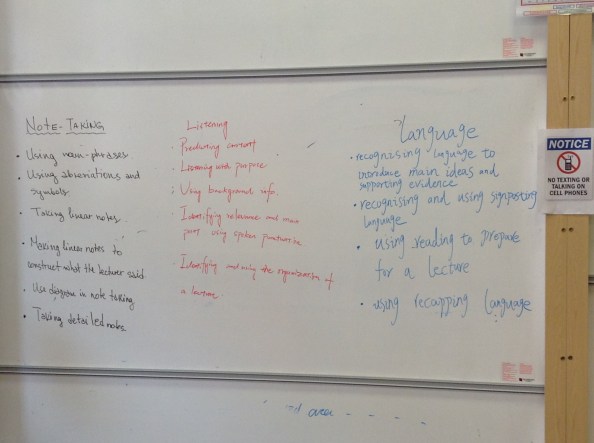
The 8 week listening thread of the pre-sessional course at Sheffield University was based on OUP EAP upper intermediate/B2 (de Chazal & McCarter, 2012) The listening skills development in this course book, to me, seems very strongly rooted in strategy development: students are equipped with strategies to use in order to help themselves listen more effectively to academic texts e.g lectures. Generic elements and functional language are teased out and students’ awareness raised, combined with scaffolded practice opportunities. This scaffolding is evident within units and across the book as a whole, where a gradual decrease can be identified, as students are expected to listen increasingly more independently.

This in mind, was all I had to do turn up and open to page x? Possibly not! In any case, having read a lot about teaching listening (e.g.Teaching and Learning Second Language Listening: Metacognition in Action  Vandergrift and Goh 2012), much of which seemed applicable to academic listening, and adding to this what I had gleaned from the induction week as well as the relevant chapter in EAP Essentials (Alexander, Argent and Spencer, 2008), I had a clear idea of what I wanted to do with the listening skills thread:

  1. Include (systematically, with gradually decreasing scaffolding) review activities at the start of the class and reflective activities at the end. (3hr lessons lend themselves to this approach beautifully!)
  2. Avoid the scenario of students meeting a new strategy and then consigning it to the dusty depths of a folder, never to be used again.
  3. Enable students to track their progress/development and recognise an accumulation of strategies being at their disposal. Not only this but also encourage *regular use* of them.
  4. Linked to all of the above, help the students become more independent listeners.

How did I do this?

  • Long-term planning

I made a hand-out to accompany each class, based on the activities in the course-book. Each handout guided the learners through the lesson from reflection to main content to review, also highlighting any new strategies introduced, and I made several weeks’ worth in advance. The main reason for this was time-management, trying to free up time for intensive marking periods and planned absences (graduation, wedding). However, I noticed that it really helped the coherence, especially as I had Vandergrift and Goh (2012) in mind, in terms of systematically reducing scaffolding and guiding learners towards independence in planning, monitoring and evaluating their strategy use. There was clear progression, explicit progression, from one class to the next.

Result: 

Increased coherence, making the content more useful for students.

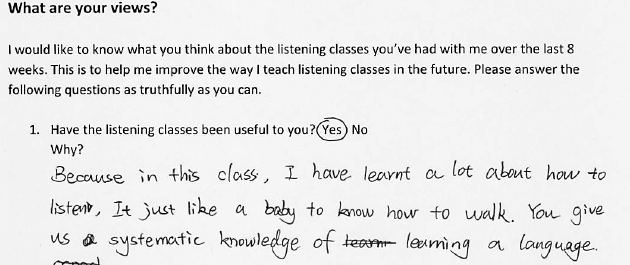
I had the ss fill in a feedback form at the end of the class - 4 questions, no numbers, to encourage reflection  (for them) and to gain an insight into their thoughts (for me).

I had the ss fill in a feedback form at the end of the class – 4 questions, no numbers, to encourage reflection (for them) and to gain an insight into their thoughts (for me).

Out of 36 responses, one was withholding judgement until he/she knew whether he/she had passed the USEPT exam (the university entrance proficiency test), one thought it was partly useful but felt we talked too much, and the rest were “yes”‘s.

Transferability: 

It’s different in a General English environment, as courses tend to be organised around grammar structures. However, what I want to try and do this year at IH Palermo is help students see how they are building on what they have learnt and be more systematic in how I approach my lessons in terms of review and reflection. Of course, being 1hr20 minute lessons rather than 3hr lessons limits the amount of time available for this. Nevertheless, working with the time available, a similar ratio could usefully be applied.

  • Strategy tables

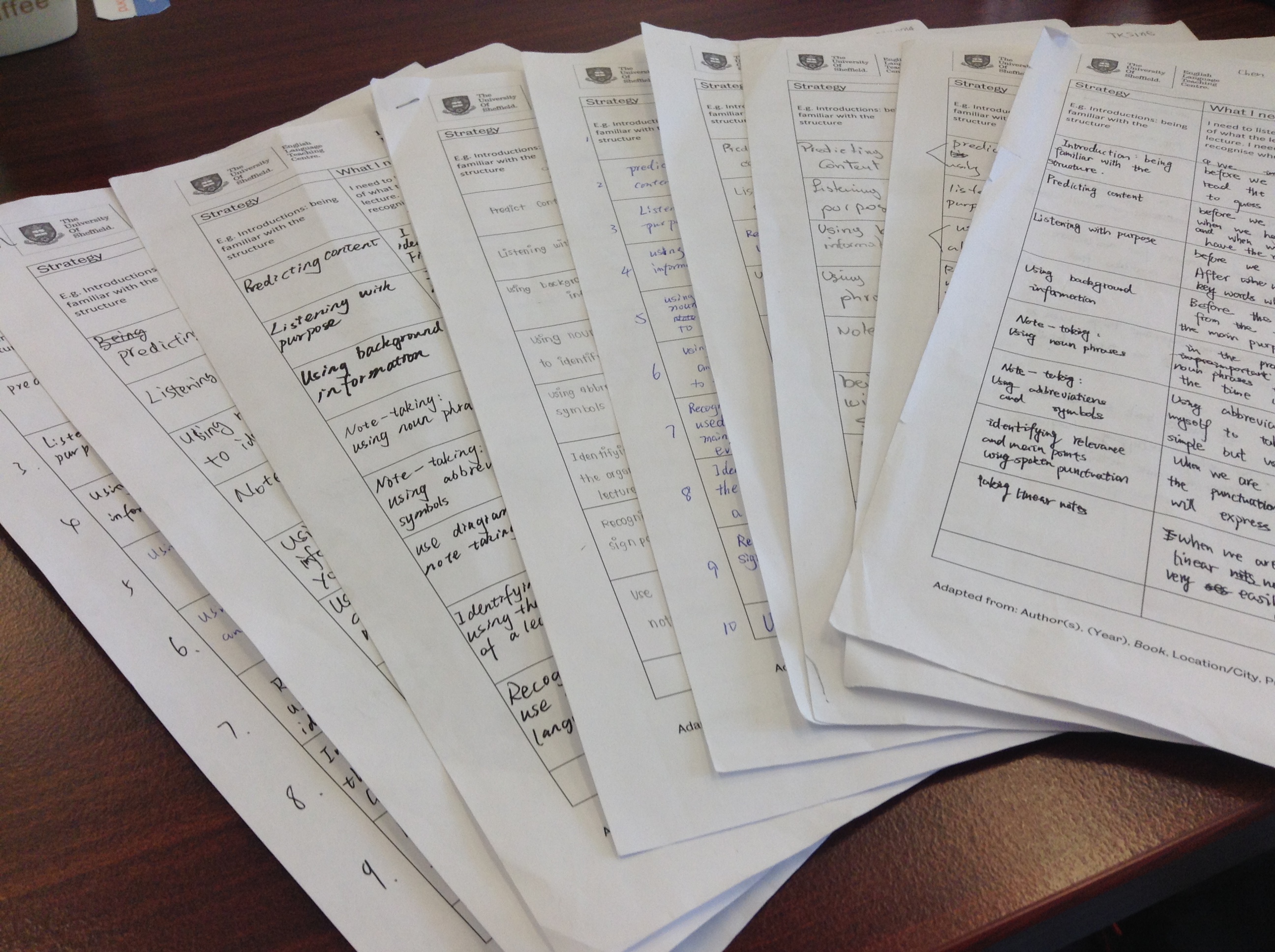
Strategy tables kept and updated by the students over the duration of the course.

Strategy tables kept and updated by the students over the duration of the course.

I made these between week 2 and week three of the course, following the blank stares that emerged in the initial review section of week 2. The idea was to help students build up a reference/resource, where at a glance they can see what strategies they have learnt and how to use them. This means they should be more likely to use them independently, rather than systematically forget about them, as new strategies are encountered. I completed the first strategy as an example, gave the students a little bit of time at the end of the class in week three to start updating them (so as to ensure they knew what they were doing) and then sent them off under instructions to bring their tables up to date. An important thing that emerged from this was the fact that it was not an instant success. The following week, not all students had updated their tables. However, by bringing it back into the classroom each week at the beginning of the lesson (students would compare their tables), an expectation of autonomy was created. In due course, all the students did live up to that expectation. This coincides with the recognition of the value of what they are doing and the behaviour becomes truly independent rather than purely response to expectation.

Result: 

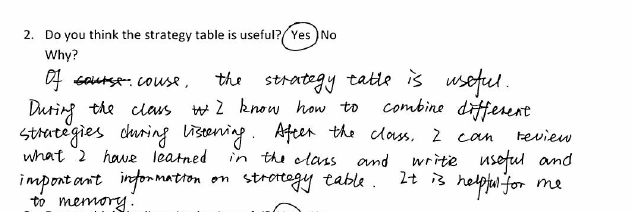
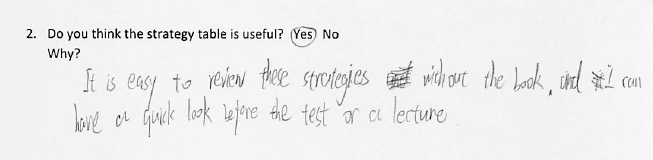
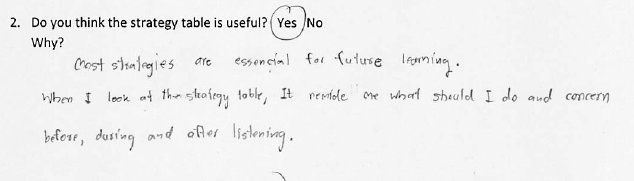
Students finished the course with a record of what they had learnt, a resource to take away, and a more independent approach to their listening skills development. Out of 36 responses, 35 were “yes” and one was “no”, who thought that there were too many strategies to juggle. This student hadn’t yet reached the point of being able to select strategies independently. With 8 weeks of teaching, expecting all students to reach that point may be a little over-ambitious. Many students commented that the strategy tables were useful for reviewing what had been learnt in previous lessons and made remembering the strategies and how to use them easier. I was particularly pleased with comments that cropped up regarding the utility of the strategy table beyond the end of the course. If learners can see how something is going to be useful to them long-term, they are likely to invest more in using it, and be more independent in their use of it.

Comments on the strategy table.

Comments on the strategy table.

Comments on the strategy table (2)
Comments on the strategy table (2)


Comments on the strategy table (3)

Comments on the strategy table (3)


 Transferability:

I think use of a strategy table would transfer nicely to exam preparation classes, where exam strategies are key to success. It could also potentially be useful in terms of accumulating a record of learning strategies met and experimented with, or resources. In the past, I have given learners a handout with different resources for them to try. I wonder if getting them to create this handout themselves, collaboratively perhaps, might be even more effective…
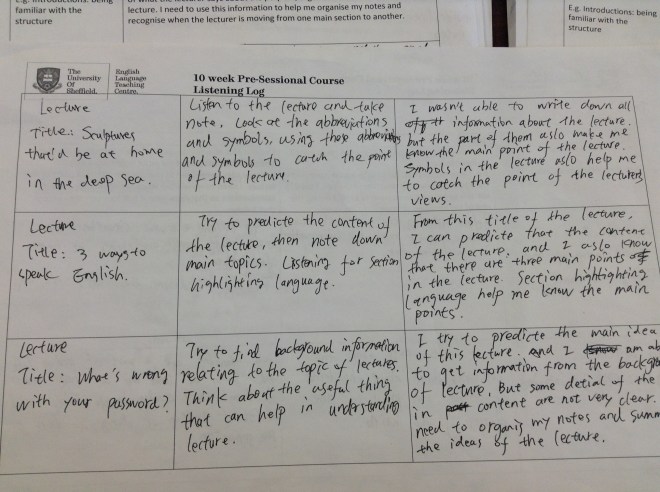
  • Listening logs

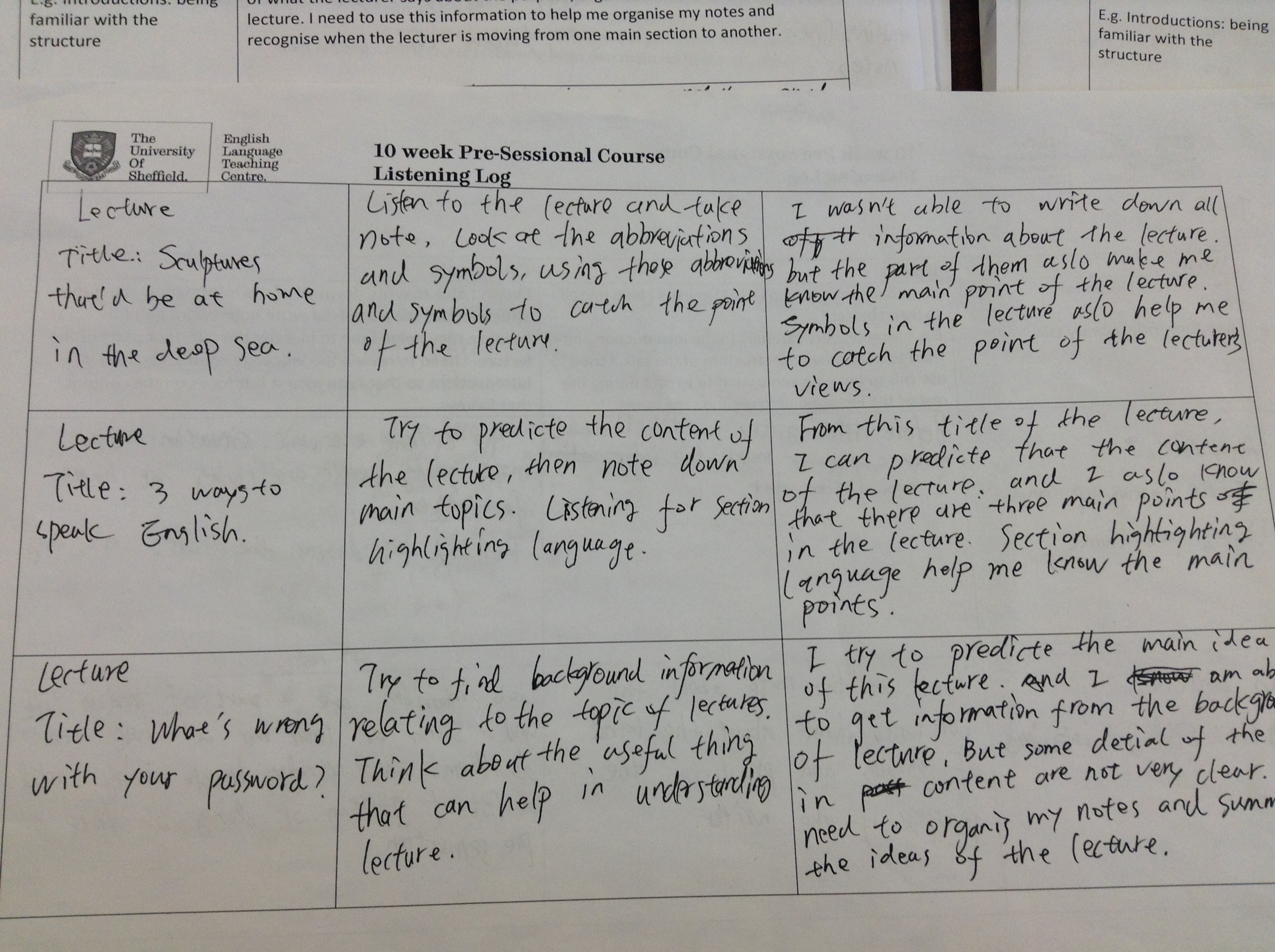
Listening log in action!

Listening log in action!

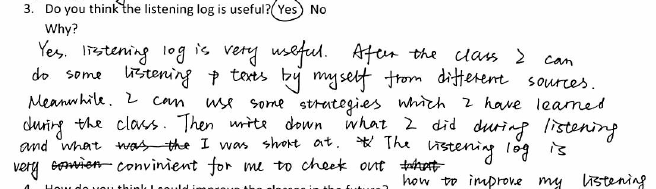
These were made and introduced alongside the strategy tables. The idea was not by own but based on what I’ve learnt by reading about teaching listening. I adapted it to this context. As with the strategy tables, I started the learners off with an example. The goals were to encourage independent listening, to help learners develop metacognitive awareness and to avoid the scenario (much bemoaned by listening teachers) of the question “What have you listened to since the last lesson? Which strategies have you practiced?” being met with blank stares. Again, as with the strategy tables, learners compared their logs at the beginning of each lesson.

Result:

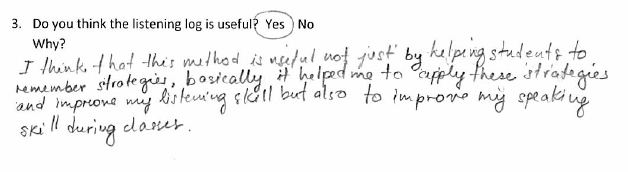
Some students thought the log could be improved by including space for their actual note-taking. Others thought it wasn’t for them. Those that used it, however, did find it useful, as a means of structuring and tracking their out-of-class listening and tracking their progress.

Listening log comments (1)
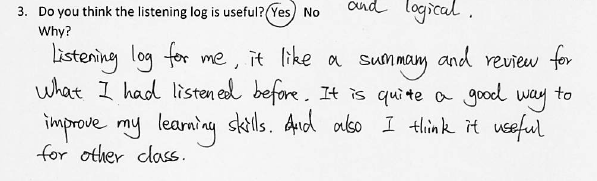
Listening log comments (1)

Listening log comments (2)

Listening log comments (2)

Listening log comments (3)
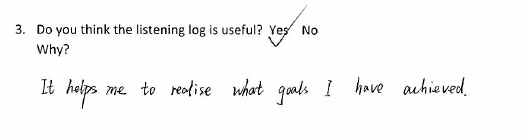
Listening log comments (3)

Listening log comments (4)
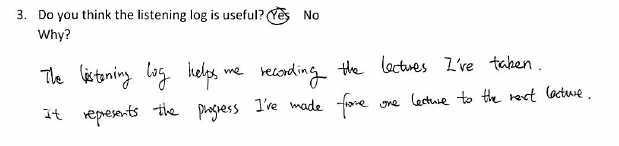
Listening log comments (4)

Screen Shot 2014-09-27 at 20.39.30

Listening log comments (5)

Transferability: 

As I have learnt through my own language learning this summer, as well as through these students’ experiences, logging is an incredibly useful thing to do. I think it is very transferable to the General English classroom. Students can log their out-of-class study and in the process create a record of their efforts, achievements and progress. Personally speaking, I’ve found it a useful way of maintaining motivation. I think learning logs could be also usefully used in conjunction with something like a learning contract. I think it needs careful thought though, as to how valuable it’s going to be. For example with these students, it wasn’t just what they did that they recorded, but how they went about it (in terms of strategy choice) and reflections on that experience.

  • Reprocessing information/strategies

As well as using listening logs and strategy tables with the students, I also used classroom activities to encourage them to reprocess what they were learning and really internalise it. For example, mingles in which the students played strategy guessing games or simply recalled as many strategies (and what they involve) as they could in a given time frame, swapping partners frequently and repeating (generally also collecting and taking with them information/ideas from their various partners – enabling them to benefit from a collective understanding of what they were learning).

Another effective activity was getting students, in groups to create mind-maps of the strategies, which they then presented to their classmates:
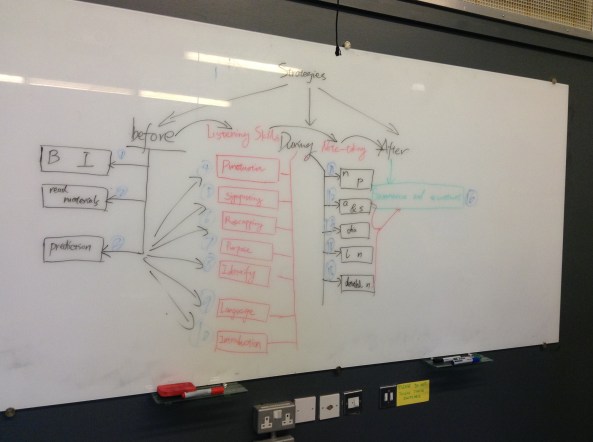
Mind-maps (1)
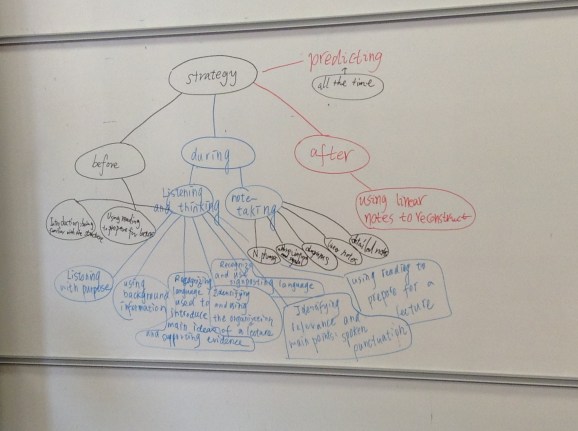
Mind-maps (1)

IMG_0674

Mind-maps (2)

IMG_0673

Mind-maps (3)

Result:

This encouraged deeper processing both of what the strategies involved and how they relate to each other as well as to the task at hand. We did the activity in a lesson subsequent to one in which the focus of the lecture extract was on categorisation (e.g. Aristotle’s classification of the world) and using diagrams in note-taking, so this task also developed that theme by requiring students to categorise the strategies and present their ideas visually.

Transferability: 

Activities like this obviously have great transferability potential, and,  as well as encouraging deeper processing of lesson content, give students opportunity to use language meaningfully and benefit from each others’ knowledge and understanding.

  • Systematic introduction of out-of-class listening resources 

At the end of each class, I gave students a new resource to try (e.g. Oxford University podcasts, UCL lunchtime lectures etc.) and at the beginning of the next class, they had to report back to their classmates regarding what they had done with the resource and an evaluation of it. This was done in conjunction with using the listening logs described above. Again, uptake wasn’t instantaneous, but perseverance meant students did use the resources in due course – and develop their listening.

This was a more directed version of my Experimentation with English project. It seemed logical as EAP is more directed too: goals are very specific, and specific needs relating to these require specific resources. I think there is something to be said for for introducing resources piece-meal, in terms of not overwhelming students. Having said that, my students at IH loved the handout with all the different resources.

Transferability:

I wonder about using this approach in conjunction with my EE project. So, as well as giving learners the resource, going through a more directed process so that all the learners end up trying at least some of the resources. Then, those who are more independent will inevitably try more besides, but perhaps the gap between the more and less independent might be lessened by the extra direction.  I think this could also be transferable to exam preparation classes, in terms of encouraging students to use different exam preparation resources to prepare, and sharing what they learn with each other.

Conclusions:

It was a very interesting summer, and, I am happy to say, my three groups performed very strongly overall in the listening component of the listening proficiency/entrance exam. Importantly, they also felt they had made progress, thanks to the concrete means of measuring it (e.g. strategy tables and listening logs), which helped maintain motivation and encourage a feeling of all the hard work they were putting in being worthwhile. Equally importantly, they were equipped to continue to develop their skills independently and apply what they had learnt in the new context. (Encouraged by frequent pushing from me to reflect on the relevance of what we were doing to what they would be doing in the future – i.e. their university courses!).

I now look forward to trying to transfer what I have learnt to my current context and help my new students to be develop as effectively as possible over the short duration that they are studying with me.




Learning contracts and language learning (Part 3): the end of the summer and beyond

It’s been quite a while since my last update on my learning contract shenanigans. It was due on the 4th September, but…life has been rather attention-seeking since then! As you may remember, on the 4th June this year, I decided to make and attempt to stick to a learning contract. Month one saw me off to a positive start albeit taking a while to get my resources organised, month 2 was up and down motivation-wise, but the contract kept me on track when I started veering towards complacency on occasion. And now here we are at the end of month 3.5, meaning I’m heading back to Palermo! In fact, I am writing this on the flight in a final desperate bid to round up my summer of learning before I’m thrown headlong into the next phase.

This is my learning contract, dutifully copied and pasted into Evernote.

A reminder of my learning contract, which lives in Evernote, in my Italian notebook!

Did I stick to my contract in month three? Yes. Despite mega-commitments to fulfil concurrently! Since then? No. There are only 24 hrs in a day and seven days in a week. Between visiting people to say cheerio and packing my life up, not much time remained. However, I’ve done my best and, I would say, done more than I would have done if I hadn’t had my contract pestering me! So, failure or success? Depends on which view you take. I’m leaning towards success, as I used what time I did have rather than focusing on what I couldn’t do. Also, just because I couldn’t do as much as I would have liked, I didn’t stop altogether in response to that, which would have been the easy way out.

Anyway, what about my progress?

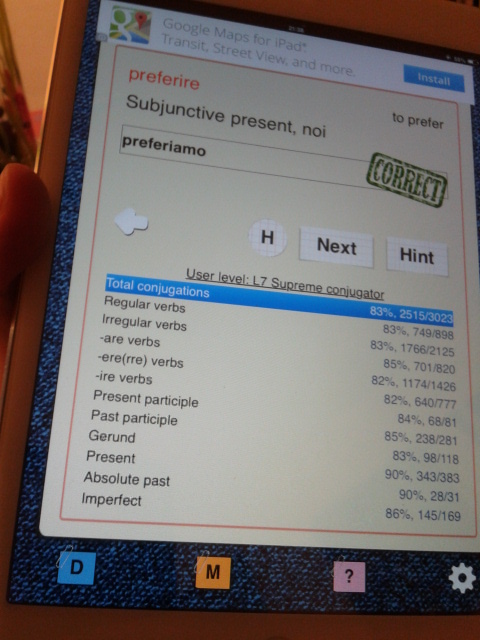
  • Well, last month I vowed to get my percentage on the conjugation app up from low sixties to 80. Took a couple weeks but I got to 83% with no individual tense scores below 80.
83%!

83%!

Been slack on it lately though – once I met that goal, my interest dipped hugely! What I should have done at that point is make a new goal…so there we go, a demonstration of the importance of goal management in terms of motivation!

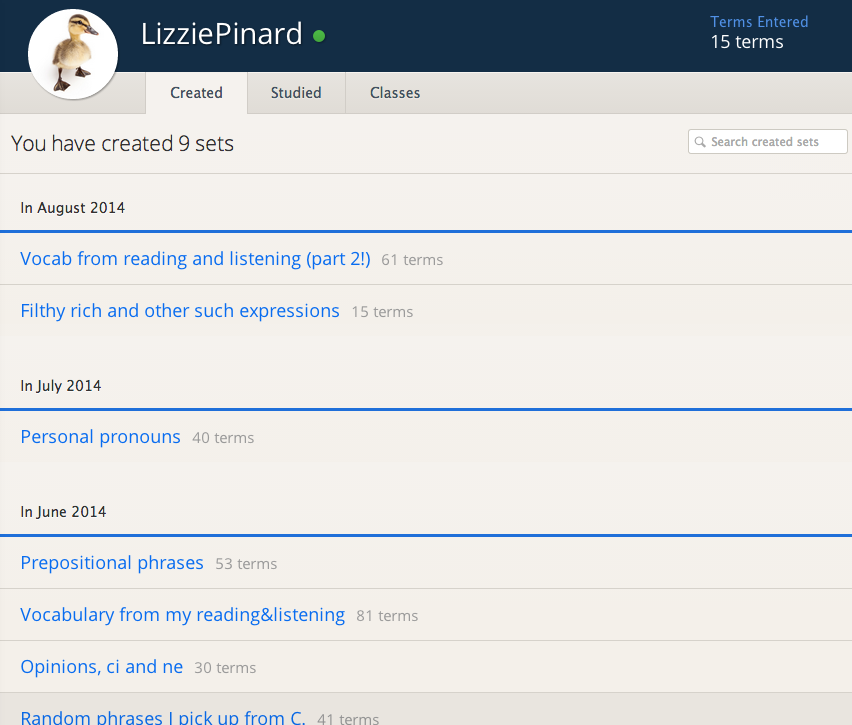
  • I’ve persevered with Quizlet, and text-mining. I now have two sets of text-mined language,with 80 and 61 terms respectively. Two, because 80 terms was unwieldy enough! I’ve become better at text-mining while listening now, and also at hearing and clocking variations on them. I’ve noticed the importance of context: the phrases I’ve mined from texts or conversations are much more ‘mine’ than those I’ve picked out from language learning resources. Additionally, I try to use my new language productively, when writing or chatting, either on FB messenger or with myself! With the latter, I silently articulate whatever phrases match the situation I’m in and the emotions that go with it.
All my sets for the summer! (Except the two you can't see at the bottom, called 'phrases with fare/avere/essere/voler/potere/dovere ' and 'verbs and prepositions'

All my sets for the summer! (Except the two you can’t see at the bottom, called ‘phrases with fare/avere/essere/voler/potere/dovere ‘ and ‘verbs and prepositions’

This combination of techniques has been central to my learning this summer, and definitely something I want to pass on to my students.

  • Another effective approach has been my focus on two areas of grammar – prepositions and pronouns – and combining learning about these, learning examples of (using Quizlet) them, and actively looking to notice their use in texts. It was, however, also very helpful to have a friend simply explain how they work, which I then reinforced with use of learning resources (grammar book, websites…). This applies equally to things I have noticed but couldn’t explain/understand e.g. Pronouns and past participle agreement. It was useful to be able to say ‘I’ve noticed x – what gives?’

This reminds me of this blog post published a little while back, which dichotomised “the deliberate teacher way” and the “power learner way”, i.e. bite-sized chunks vs. all at once. In response, I will be controversial and say I want and like both! Again and again, for me, variety is the spice of life and the interaction between approaches and techniques is as important as the approaches/techniques themselves. It could be argued that it’s in this interaction that the language catching web I mentioned in this post about text mining is built and works most effectively, in my own admittedly limited experience.

  • I’ve been grappling with my audiobook of Cime Tempestose, finding it useful to go back and listen again periodically. Partly because of dipping in and out meaning that it’s easy to forget what’s going on, partly to deal with the speed (it’s faster than The Secret Garden!) and partly because I haven’t read or listened to it in English previously, so that ups the challenge. I’m on disc 2 and understand the majority of what is going on now. I stil go back and listen again periodically as that also enables extra text-mining and noticing.

What next?

Well, very soon I shall get to test my italian by speaking it! Actual speaking rather than typing! I’m super curious to see what will happen. I know I have a much wider vocabulary and a better command of basic grammar than I did at the start of summer, and my listening is much improved, but will being faced with actual Italians reduce me back to the stuttering wreck I was at the beginning of June? Time will tell.

I need to get into a study routine here too. Maybe I need to make a new contract, which bears in mind the resources available in the TL environment. There’s also my course book that remains unfinished…

One thing is for sure, I plan to use the language as much as possible and enjoy it! (I must remind myself of this in gibbering wreck moments!)

Conclusions

Learning contracts are a useful motivational tool, which can encourage use of a range of activities. Of course, like anything else in language learning, there are pitfalls to be aware of and try to avoid. They are certainly no panacea (of course), and how effective they are will vary from learner to learner. It is important to manage motivation and sub-goals carefully, to avoid complacency or loss of interest! However, the existence of the contract does help in this department. I plan to try and keep using one myself, and will try to use what I’ve learned through this experiment to help my learners develop their autonomous learning skills.

Post-Script

In order to get in to my temporary apartment (where I can finally upload this post!), I had to deal with the Italian owners. Once they sussed I could speak Italian, that’s what we did. And…I understood everything (give or take an occasion of asking for a repetition) plus was able to communicate reasonably competently, able to say what I wanted to say. A far cry from when I arrived this time last year and failed to get myself any food to eat (in a bar), soon after I arrived! I think that now I have enough language for there to be more language than gaps in familiar situations, meaning that I can make myself understood and, I hope, when I’m stuck for a specific word/chunk, paraphrase around it and elicit it from my interlocutor so that I can learn it! That is the approach I want to use…time will tell how it works out for me! 

Stay tuned… 😉

Update!

It has been a little quiet here of late, I’ll admit. Conversely, life has been anything but! In the last 11 weeks and 4 days, as well as steadily trying to learn some Italian (most apt phrase I’ve learnt vis-a-vis this summer is “il da fare non manca mai” – there’s never any shortage of things to do!) and experiment with my own learner autonomy, I have:

  • been inducted into and worked on a 10-week pre-sessional programme at Sheffield University
  • presented at an online conference (The BELTA-TESL Toronto joint effort, themed Teaching Reading and Writing)
  • graduated
  • attended a wedding (not my own, I hasten to add!)
  • written a 4500 word first draft book chapter
  • given detailed feedback and then subsequently graded 26,000 words of student projects (so 52,000 words of marking altogether, there!)
  • done USEPT (proficiency test for university entrance) examining (speaking) and marking (writing, reading)

and, as of Friday 5th September at 12.45, finally had a break from the world of ELT!!!! It was mainly the project marking and book chapter that put a halt to any blog updating I might have had in mind (there are only 24hrs in a day, and I do need to sleep [and study Italian!] for some of them!)… As they mainly account for the 3 weekends prior to this one just gone, other than the one during which I attended the wedding!

Lack of inspiration to blog, however, is not a problem. So, there will be plenty more posts appearing when I feel ready to return to the world of ELT; amongst others, a post about teaching academic listening and the 4/9/14 update on my Italian learning, as well as an update of my Delta page, to incorporate information about the new module 1 exam format. Of course once I return to IH Palermo, there will be plenty to say on that front too!

So stay tuned and see you soon!  (Just give me a few more days holiday first, please… 🙂 )