I received an email from WordPress this morning: Your 2013 year in blogging. I also recently read 12 from ’12: The best of your posts from this year (blog challenge) by Adam Simpson. I had planned to round off 2013 by writing something along similar lines to identify my blogging highlights for this year. This post will be a mixture of that and response to WordPress‘s report on my blog activity this year…
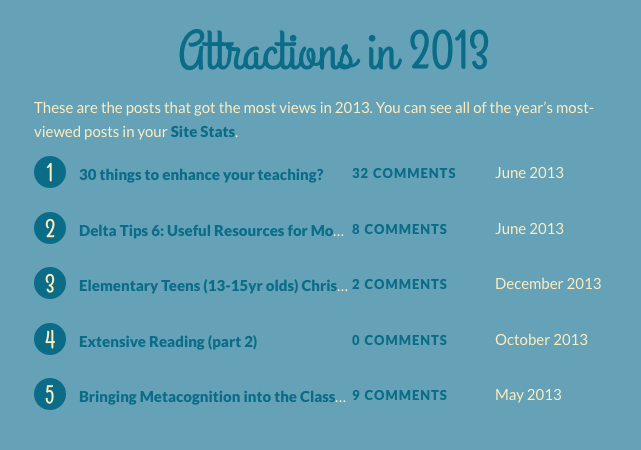
According to WordPress, here are my top 5 posts for this year.
This is based on the number of views received. So, according to their quantitative analysis:
The best according to WordPress!
Though I hadn’t started writing the intended Top 13 from ’13 blogpost before receiving WordPress‘s email (unless you count setting up a draft post with a title as starting :-p ), I had started thinking about what blogposts I would choose:
WordPress and I agree with regards to number 1. 30 things to enhance your teaching? would definitely have headed my list of my favourite posts of mine from 2013. Why? Because it got me loads of views? No. Because not only did it win me the British Council blog of the month award for June 2013 (which, to be fair, accounts for it topping the “number of views analysis”), but, as importantly, it is also a reminder of the fantastic flavour of learning that I tasted while doing my course at Leeds Met Uni during the academic year 2012/13. I had the time of my life, learnt loads and look back on the experience with great fondness and appreciation.
Of the rest of that list, 4 and 5 would also definitely have made the 13 for ’13 cut. Extensive Reading part 2 is important to me because it came about as as result of my (on-going) learner autonomy development projects and as a result of my own recent experiences of using extensive reading for my own language learning. Bringing Metacognition into the Classroom would have made the cut because I still find the whole area of metacognition and metacognitive awareness development and its role in language learning fascinating. My interest was sparked by Teaching and Learning Second Language Listening by Vandergrift and Goh, which I read in preparation for designing the materials I created for my Materials Development module assessment, having stumbled across it by chance in Leeds University Library (making use of my SCONUL card!). A chance discovery that had a deep impact both on my assignment and my conceptualisation of language teaching and learning.
Delta Tips 6: Resources for Module 1 exam revision would probably not have made the cut, but I would certainly have chosen a post from my Delta Tips series, as representative of the series, which I enjoyed writing because it gave me the opportunity to reprocess all my learning and create a record of it to look back on (we always extol the virtues of peer-teaching in the language classroom and I think as teachers we can benefit as much as our learners by sharing and reflecting on what we learn), and because judging by the number of views the various posts in the series have had, they’ve been at least moderately useful to other Delta trainees.
The final post listed in the WordPress top 5, at number 3, (Elementary Teens (13-15 year olds) Christmas Lesson) wouldn’t have made the cut for my 13 for ’13 list either. I think I would have gone for my Elementary Teens Global Issues SIG challenge materials/lesson plan instead. Why? Because it was a rewarding process making materials to meet the challenge both of Global SIG’s food awareness month and of engaging my teenagers early on in their course.
Other posts that didn’t make the quantitative top 5 but would make my qualitative top 5 (or 13 from ’13) would be:
- my posts, Part 1 and Part 2, about my Delta and M.A. respectively, because they act as a reminder of the professional and personal growth I’ve enjoyed since September 2012 and a motivator to continue pushing myself to use what I’ve learnt and add to it.
- a post as representative of my Dissertation Diary series, e.g. this one, which helped me achieve a solid mark for my dissertation materials/rationale and which provides me with a window to look back on that process and remind myself of what I learnt as well as how.
- In response to Observations of an Elementary Language User as representative of all my posts relating to my experience of being back in the Elementary language learning seat, which has also influenced my teaching and my learner autonomy projects in various ways.
Posting a-go-go!
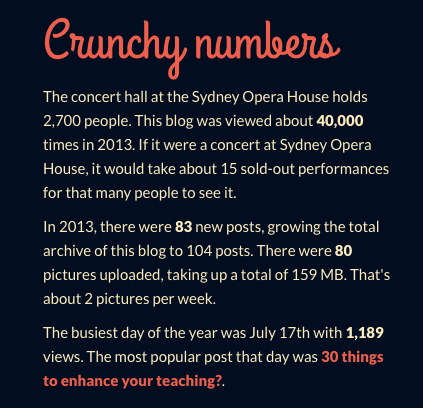
2013 has definitely been a year of blossoming for my blog: The 83 posts mentioned above were all written from May onwards this year, so in the space of about 8 months. Meanwhile, the three previous years of blogging yielded the other 21 – quite a stark contrast! What have I gained from blogging so extensively? Well, my British council blog award and resultant webinar (forthcoming!) on learner autonomy, for starters. But also, a space to reflect and re-process my learning, as well as a record of my professional development over the course of time. It gives me a lot of pleasure to look back over posts I’ve written and recapture the excitement, motivation, inspiration etc that the posts were borne of, while reminding myself what I’ve learnt.
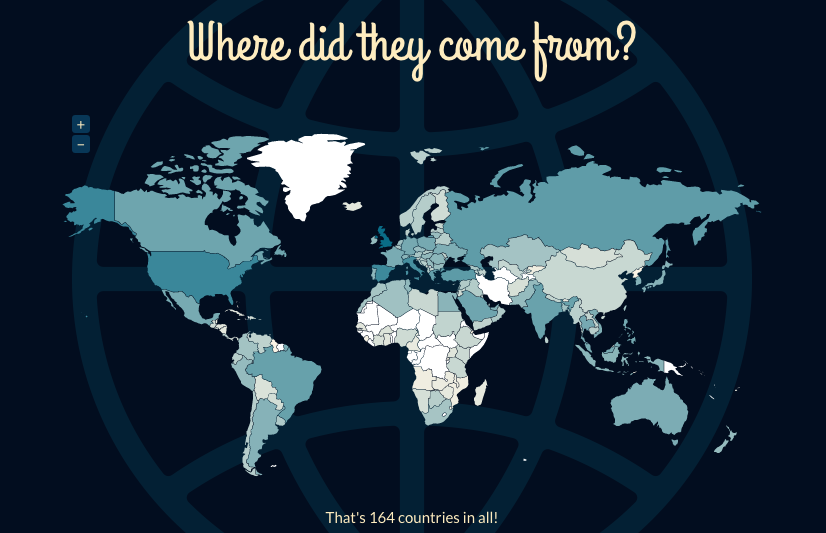
Countries, countries, everywhere!
That my posts have been read by people from 164 countries makes me feel a sense of connectedness to teachers and the industry worldwide – I feel a part of something. The teachers I communicate with via Twitter, via this blog, via their blogs (I’m planning a post where I list the blogposts by others which have most inspired me in 2013 – stay tuned! Update: That post is now written and can be found here) and other means of online CPD (e.g. participating in webinars) are all part of the big online staffroom that I am lucky enough to be able to pop into on a regular basis and from which I gain and share ideas, creativity, motivation and inspiration.

Blossoming blog (“Frangipani_flowers” taken from Google images search, licensed for commercial reuse with modification)
And finally, to end my last post for this year, a big thank you to everybody who has been part of my 2013 and all my very best wishes for a happy and fulfilling 2014. Carpe diem! 🙂