IATEFL 2016 Plenary Day 2 (Silvana Richardson)

The “passionate and inspiring Silvana” (as she was introduced and I agree with based on the few minutes I saw her speak for at the Cambridge networking thing last night!) will speak to us about the ‘native factor’ – the haves and the have nots. (Twitter name, in case you are interested: @laIoli)

Silvana starts by telling us a few things about herself: she is not tall, she is not male, not single, not atheist, not sport, not fantasy buff, not a native speaker. She uses this ‘ridiculous way of introducing herself’ i.e. litotes (negation of one quality to emphasise another) to pose a question: what quality is she emphasising by saying that she is a non-native English speaker? Why do we still refer to an aspect of the professional identity of over 80% of the teachers of English as a ‘non’?

How is it still a legitimate term?!

It’s not just a word.
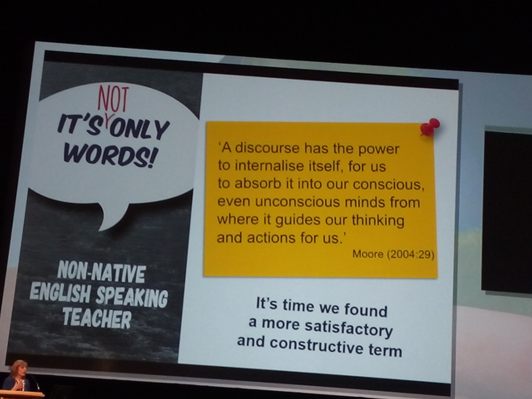
IMG_20160414_091359

It’s time to find something better!

Next Silvana gave us –

The one minute history of Native Speakerism starring the Monolingual Bias.

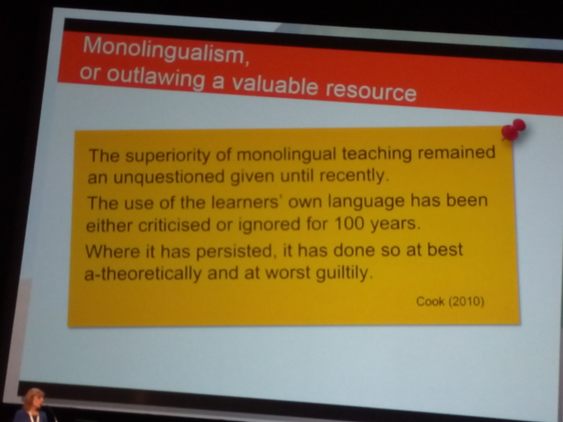
She takes us  back 100 years to The Direct Method: thou shalt not use your own language in class. This and subsequent methods created a monolingual bias which gave a biased view of the native speaker. The common goal was to achieve native-like competence. Meaning 3 things: That NS is the best model, that the way that the NS acquires L1 is the best way to acquire a foreign language and that the NS makes the best teacher. This creates a deficit view of the learner’s own language – it becomes a source of interference and an obstacle, and a deficit view of the NNS as defective, a failed monolingual of English. The ideal native speaker according to Kramsch is monolingual, monocultural, speaks only a standard variety of English, and is equally competent in oracy and literacy skills. This concept has been critiqued as a figment of linguists’ imagination (Palkeday 1985). It is, however, a very resilient myth. Take for example the European Profiling Grid which is used in recruitment of teachers. The ultimate goal is “Has native speaker like competence in the target language”.

How does this notion impact on identity, as an NS or an NNS?

If you have the native factor, you can safely assume that: The native speaker is the best model, the ideal teacher. I am an NS. Therefore I am the ideal model and ideal teacher.

If you are a non-native speaker, it is the reverse. I am not the ideal model. I am not the ideal teacher.

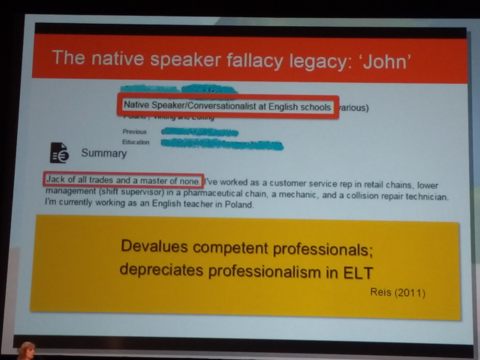
Very problematic and toxic logic. Kamhi-Stein (2005) criticises this ‘native speaker fallacy’. It makes assumptions that NS have particular features but actually they can all be acquired through training. Silvana then shows us a linkedin profile and what it does! It devalues all of us and professionalism.
IMG_20160414_092313

The logic also creates a competence dichotomy. A very unhelpful separation into camps. An us versus them. It’s very damaging to all of us.

The Plight of the Have Nots

We will look at this from four perspectives.

1.

The Market forces’ discourse: customers prefer native speakers

“It is a truth universally acknowledged that a student in need of English language lessons must be in want of a native speaker”

DO customers prefer native speakers? How true is this claim? Is it based on reliable records or on impressions? Out of 1000 students how many is it? 500? 5? The two who shout loudest? What does research say about what students prefer? This is a relatively new area of study. She is gong to look at a few studies and we have to decide what the findings support.

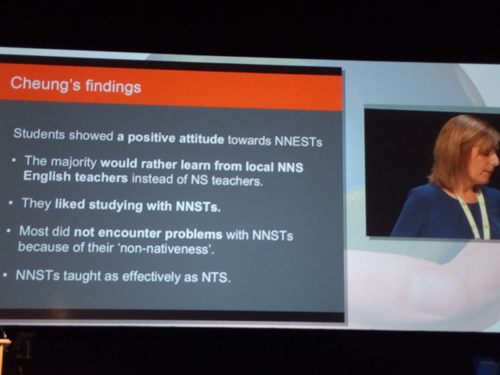
Cheung 2002 – attitudes to NS and NNS and the strengths/weaknesses of both. Questionnaires, interviews, observations, 420 ss at 7 universities in Hong Kong. Findings:
IMG_20160414_092806

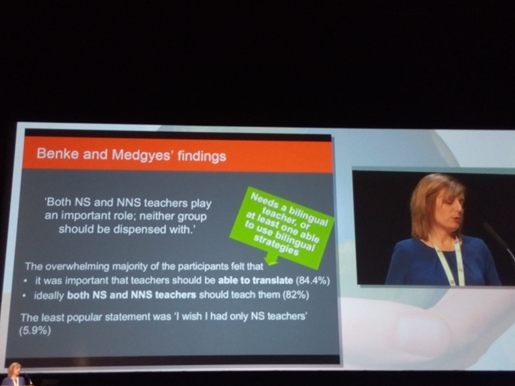
Benke and Medgyes (2005) – SS perceptions of NS and NNS teachers, questionnaire, Hungary.
IMG_20160414_092932

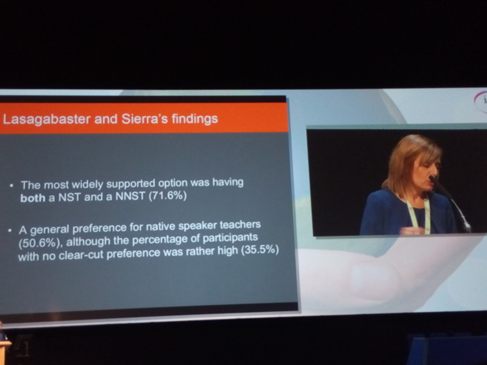
Lasagagabaster and Sierra (2005) – Students perceptions of NS NNS;  Closed and open questions; Basque area of Spain
IMG_20160414_093015

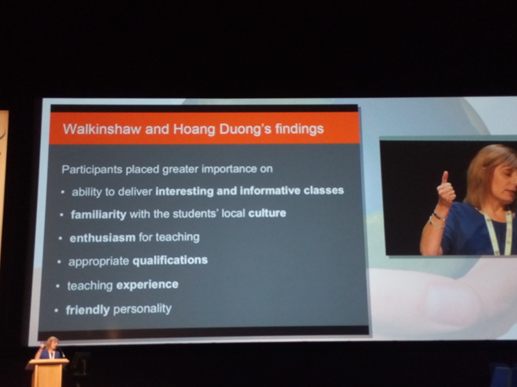
Walkinshaw and Hoang Duong (2012) – how learners rate ‘native-speakerness’ compared with 7 qualities valued in EL teachers: rating survey and questionnaire, Vietnam.
IMG_20160414_093123

Silvana then presented a summary of the perceived advantages of NNESTs:

  • Declarative knowledge: knowledge about English (They had to learn it!)
  • Ability to identify areas of potential difficulty: when you know the L1, you know what will be easy or difficult, from your own experience.
  • share and use the students own language
  • able to make cross-linguistic and cross cultural comparisons
  • teach grammar more effectively
  • empathise with the learner (been there…)
  • provide appropriate strategies
  • willing to work hard

Followed by those of NS:

  • procedural knowledge (how to use English, tacit and unconscious)
  • teaching of lexis (idiom, colloquialism, slang)
  • fluency in English with ‘original English accent’
  • no apparent language difficulties
  • linguistic authenticity
  • teach speaking and listening more effectively
  • cultural understanding (of own culture)
  • more relaxed attitude to error correction

These perceptions were taken from various studies.

Silvana summarises by saying that students generally value professional and personal qualities over nativeness. Both NEST and NNEST are perceived to be competence each with unique strengths. Preference is inconclusive. Some indicate both, some one, some the other.

There is the discourse of Employers having no choice. This is discrimination. These are discriminatory practices disguised as common sense. Actually, employers always have choices. Collusion with inequality and prejudice is a choice. Discrimination is a choice. Also, “just because the market is demanding certain things, it does not mean that the market cannot be made to see things differently” (reference missed, sorry!).

Is the customer always right? Silvana did an experiment a few months ago. She had a two-hour conversation with a student who adamantly wanted a native speaker. He was shocked that it only took a month to become a teacher. He changed his mind. The real question is, are customers expectations realistic? How do we behave when they aren’t? What if their preferences are racist or discriminatory? “I didn’t come to the UK to be taught by a trainer who is a native speaker of my own language” – has been said. First they ask those who said it if there is anything in the promotional literature about this? No. This is because we are equal opportunities employers and we are proud. Proud to employ the best trainers and nativeness doesn’t come into it. They are told to give the trainer a chance and come back in a few days if still unhappy. They don’t come back.

Why are NNS rejecting themselves? (As per above example)

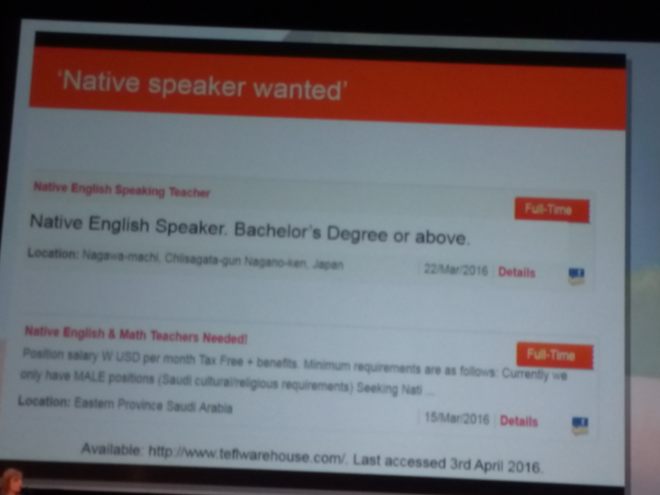
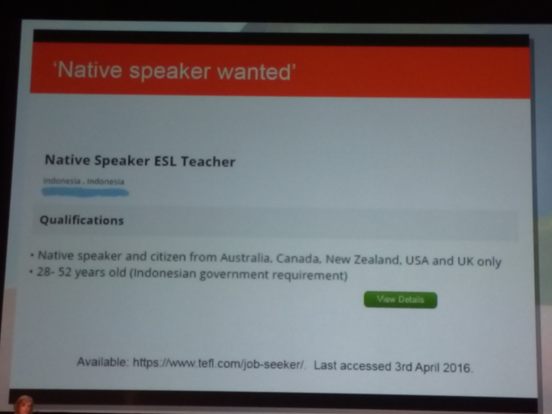
2. Discrimination and recruitment.
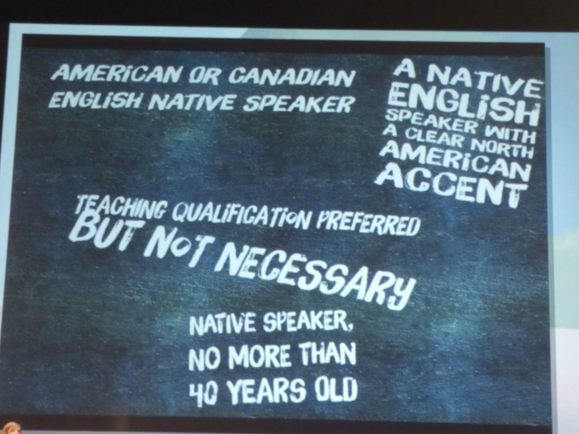
IMG_20160414_094428

No EFL qualifications required in either!
 

IMG_20160414_094516

Even narrower!

This is the reality:

This is the lay of the land.

The lay of recruitment land.

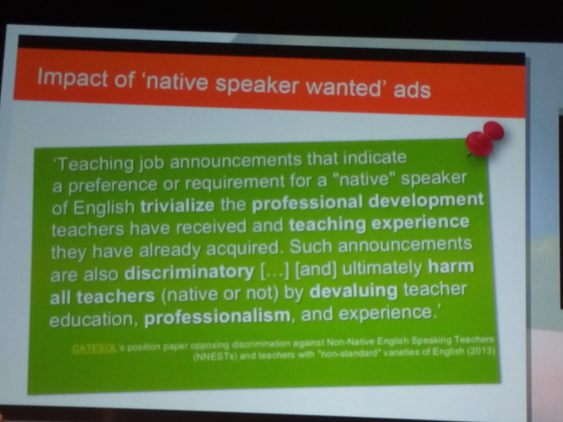
And these announcements are damaging:
IMG_20160414_094646

Clark and Paran (2007)

Looked at the recruitment of NNESTs in the UK. 72.3% of participant institutions judged nativeness to be very important.

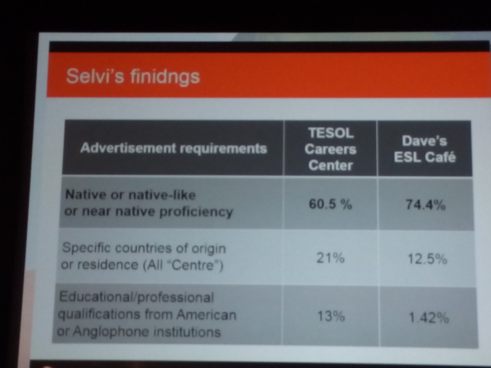
Selvi (2010) 

A vast majority of the advertisements favoured NESTs and rejected NNESTs. He describes discrimination as a multi-faceted phenomenon. There is also the issue of variety of English, where qualifications are obtained (golden standard: Anglophone institutions) and location of citizenship.
IMG_20160414_094900

Mahboob and Golden

Focused on East Asia. Nativeness was the single most frequent criterion mentioned in the ads. 49% of the ads listed specific countries from which the applicants must come.  US being at the top. Some ads also specify colour. Nativeness is linked to inner circle countries only. Students are being taught by ‘teachers’ who are not qualified to do so.

3. The mono-training orthodoxy

If you look at SLA in the 20th century, if you look at the theories, you find yourselves in a very confined cognitive space. Very little reference and interaction with the world around you. The result of this is narrow approaches to teaching, learning and teacher education. Native speakerist, monolingual and monocultural.

If we look at the areas in which native speakerism has dominated, no stone left unturned -theory, research, publishing, teaching and learning materials etc. Cook puts it very eloquently:
IMG_20160414_095516

There is no research evidence on whether students learn better in an ‘impossible to code-switch’ classroom environment.

Ernesto Macaro’s study on code-switching: little known but important!

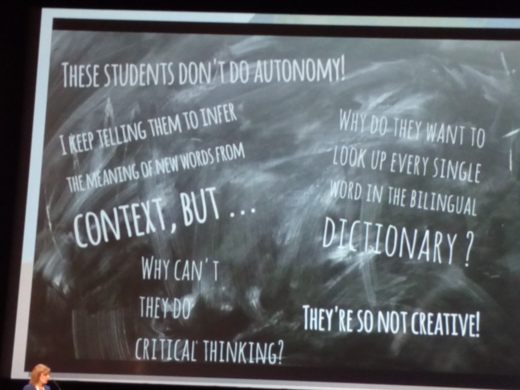
Monolingual approaches abound. There is a cultural appropriacy issue with this. An approach designed to work in a BANA country will not necessarily work elsewhere. Silvana gives another snapshot of realities around the world:
IMG_20160414_095811

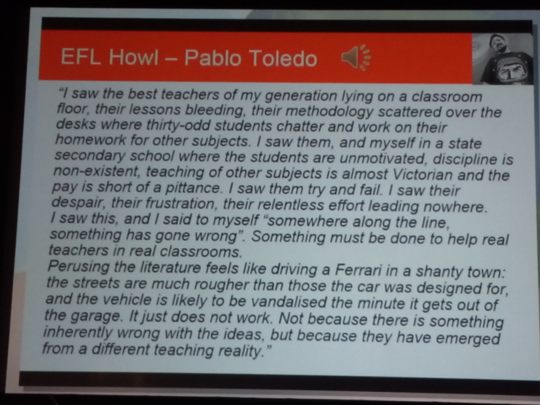
She then plays us a clip from Pablo Toledo – EFL Howl on teaching in difficult circumstances:
IMG_20160414_095919

4. Issues of confidence and self-esteem

What has all this done to the T whose first language is something other than English?
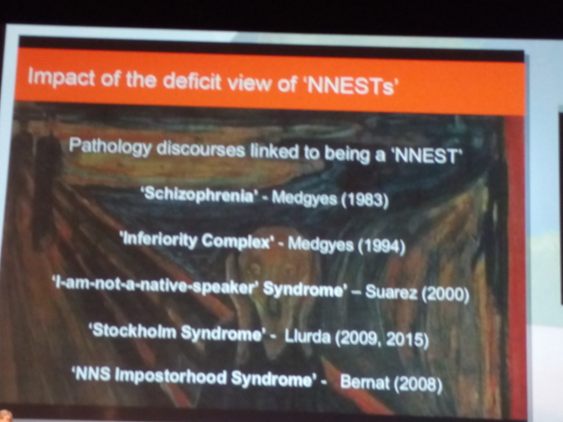
IMG_20160414_100103

Inferiority complex: belief that own knowledge is inadequate to the linguistic standards (think back to the teacher standards we looked at earlier – ‘native speaker’)

Stockholm syndrome: secretly admiring the NS and denying self the right to be a recognised language user.

Impostor syndrome: feelings of inauthenticity and inadequateness.

Faking it: If you can’t be a native, at least try and pass for one. Hope that students won’t notice but concerned about being ‘caught out’. There is still institutional pressure – schools asking Ts to pretend to be a different nationality. What does this do to identity?

Silvana thinks NNS develop coping strategies. 

  1. Shying away: in EFL contexts, shying away from modelling language and instead ‘play the tape’ so that the script models the language; and away from using English in the classroom as the language of instruction and communication.
  2. Hiding own identity in terms of L1 status: In English as home language context never telling the students that you aren’t a native speaker; hiding it initially and then gradual or final revelation, like an embarrassing confession. “I only tell them once they trust me and like me”.

The future?

  • The wider context
  • Overcoming the dichotomy
  • What can we do?

The Wider Context: Multilingualism

A paradigm shift is unfolding out there as we sit here in this auditorium. It is now the turn of the multilingual. Multilingualism is the new norm in a Globalised world. Recent publications reflect this. It is a trend to watch and find out more about. We are moving from a deficit view of the learner’s own language to an asset view. We are moving away from an NS view of acquisition to a bilingual view. Second language acquisition is moving towards plurilingual development. The perception  of learner’s own language is moving from obstacle to resource. The goal of learning is moving from near NS competence to multilingual competence.
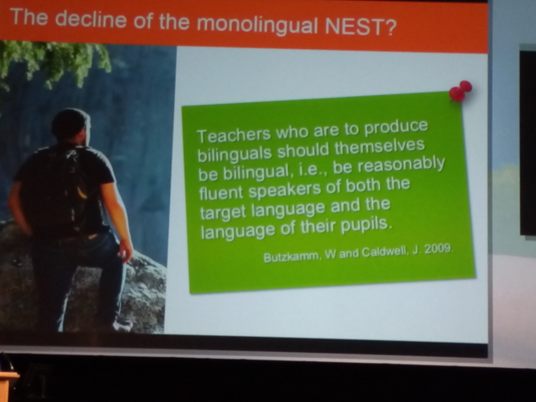
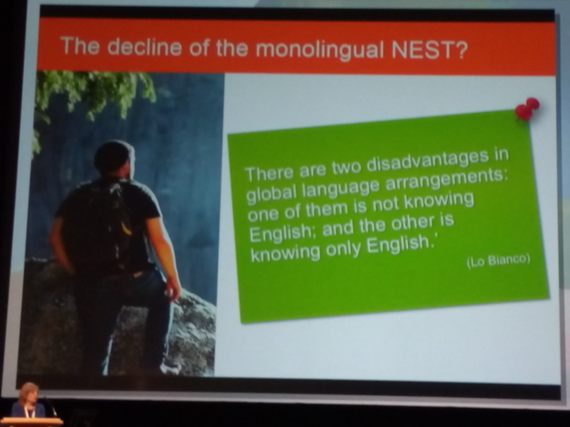
IMG_20160414_100950

IMG_20160414_101007

Monolinguals, take note…

Overcoming the dichotomy 

How can we overcome the dichotomy? We, as in those of us who were born and raised using a language other than English can’t do this alone and neither should we. This is a major battle about ethical and principled professionalism against prejudice. We need to stop thinking about them and us and start looking at professionalism as a continuum. On the continuum we can look at professionals as being more or less prepared, knowledgable, competent, proficient USERS of English.

What can we do?

(NB: deliberately larger font!!!) 

What can we do? We need to find out more about this issue, become more aware. Write about equality for NESTS and NNEST.

Teachers: Join an advocacy campaign and show support. There is a forum this afternoon about it! Write a statement supporting this campaign. Promote advocacy initiatives on social media. Start a discussion in your workplace to raise awareness. Do research, more is needed.

Teacher educators: review programmes in terms of the scope. What is the ultimate goal of these programmes? To develop well-rounded critical professionals or churning out skilled technicists who can produce monolingualism for export? Consider the content and methodology – is there critical exploration? Are they sufficiently inclusive? Sensitive to glocalisation? Using the students’ own language? What about bilingual identities? The elephant in the room is teacher’s own language proficiency – how can we help teachers develop this?

Workplace: Do you have an Equal Ops policy? Do you implement it? Are you proud of it? Do you challenge students’ expectations? Do you recruit based on merit?
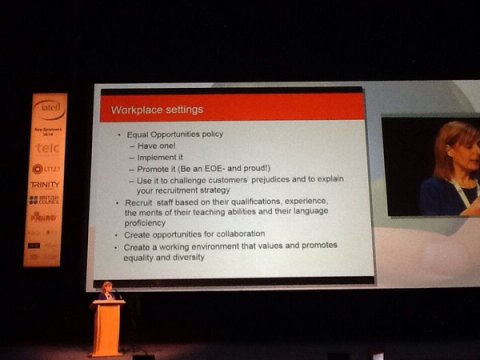
Equal ops in work place

Teachers associations: Issue a statement against the discrimination of NNESTs. TESOl France writes to employers who write native speakerist ads to discourage them from that. Create alignment maps of professional qualifications of teachers of EFL at regional, national and international levels. Encourage members not to apply for positions where advertisement is discriminatory.

There is a lot of work to be done to make our professional equitable.

And the only way is to work together. Silvana’s dream is that teachers be judged on their merits as a teacher not on an accident of birth. Silvana’s real name is Silvana Ioli. She was born and raised and educated in Argentina. And she is really proud of it. She is a professional and plurlingual teacher of language.

And oh my goodness what a plenary! Standing ovations, some tears (not only mine!! I fought mine back, then was quite relieved to see someone who hadn’t, meaning I was not the only one to get all emotional!)

In my current context, I finally work in a place that DOES has equal ops (as far as I can tell!), where I DO have colleagues from all over, working there on the basis of their many merits rather than their skin colour or passport type. This should be the rule rather than the exception. Previously, I have worked in schools where: teachers were hired based on skin colour and passport, ‘non-native speaker’ teachers were viewed (including by themselves) as second-class citizens of the teaching world, where all teachers were British, where being male and North American was the basis the recruitment decision was made upon… I’m not going to say which indictments go with which schools. It doesn’t matter. What matters is that we all do as Silvana said and recognise what has gone on, what is going on and where the future is/should lie, and do our bit to push it in that direction, regardless of our role in the teaching world. We are all professionals in the ELT world together, we all need to fight together to make it what we want to be. Jim Scrivener tweeted that this was ELT’s “I have a dream” plenary. It may be cheesy but let’s make it all of our dreams. In the hopes that at some point history will look back on this period as one where finally the paradigm shifted away from the ridiculous. 

Ok, rant over. I have only one thing left to say: this post deserves to be the most read on my blog. Silvana’s words were inspiring. So spread them. Share this post. And, if anyone wants to use my blog as a platform to share their ideas in relation to this topic, please do get in touch. You are welcome, I would be happy to host guest blog posts. 

Oh, one LAST thing: don’t forget to have a look at the TEFLEquity website too! 

 

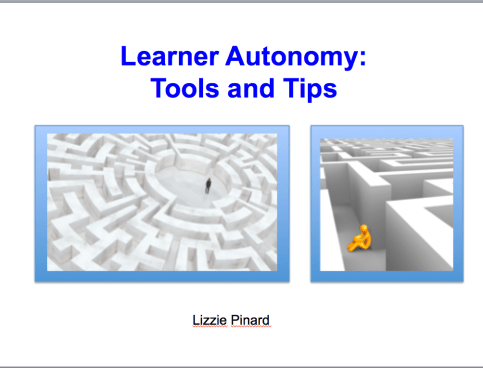
British Council Webinar: Learner Autonomy – Tools and Tips

Today I had the pleasure of doing a webinar for the British Council TeachingEnglish folk, the topic and title of which was: Learner Autonomy – Tools and Tips. A whopping 97 people participated! (I mention this because it properly surprised me…!) What lovely attendees they were, though, which made for lots of great discussion.

This is my write-up of the session but if you want to watch the recording of the webinar, you can find that here.

Screen Shot 2016-03-15 at 16.18.21

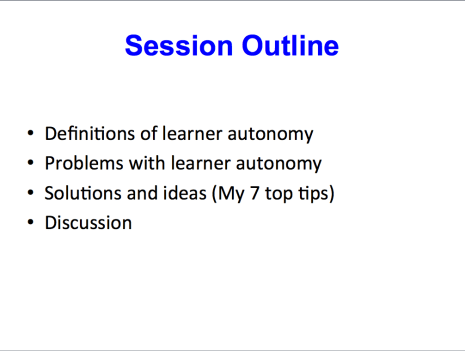
The outline of my session was as follows:

Screen Shot 2016-03-15 at 16.18.41

In the event, due to my internet briefly conking out about 3/4s of the way through, the end discussion became questions to take away and think about, BUT there was a lot of discussion and interaction throughout, fortunately, so there was no missing out in that respect.

We started with this key question:

Screen Shot 2016-03-15 at 16.18.47

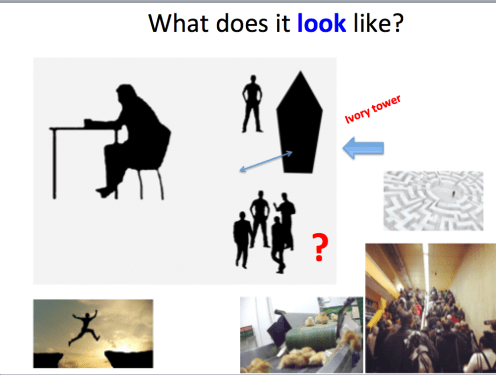
The participants came up with some great definitions. Then I changed the focus slightly to:

Screen Shot 2016-03-15 at 16.18.53

Getting the participants to speak about what learner autonomy looks like to them immediately brought us onto something more tangible. Again, they had plenty to say, lots of which I was able to refer back to in the course of the webinar.

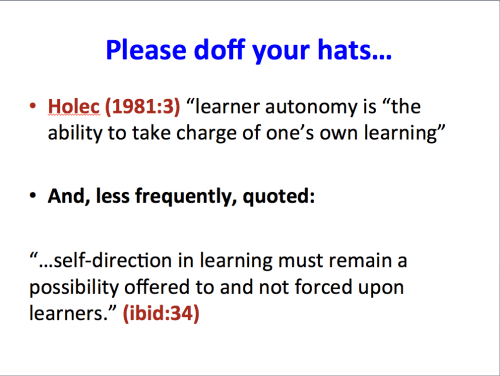
Next we looked at a seminal definition from the literature:

Screen Shot 2016-03-15 at 16.19.00

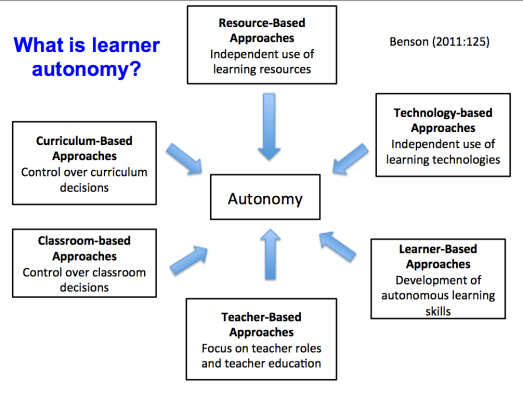
Having doffed our hats to Holec, we looked at different approaches to learner autonomy, as illustrated by Benson (2011):

Screen Shot 2016-03-15 at 16.19.08

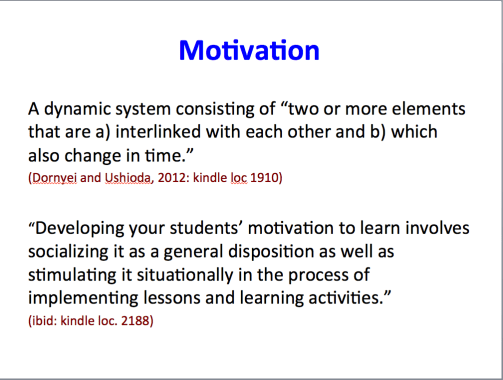
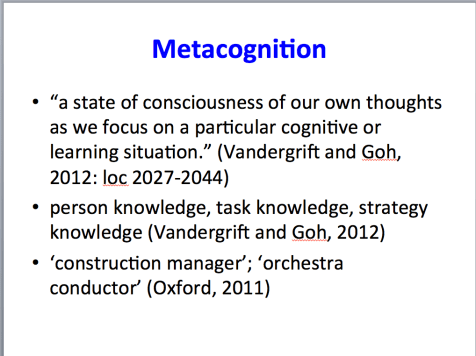
When we talk about learner autonomy, it is my opinion that interwoven through the discussion should be the following two concepts:

Screen Shot 2016-03-15 at 16.19.15

Screen Shot 2016-03-15 at 16.19.21

I think it’s safe to say you can’t get very far in autonomous learning without them!

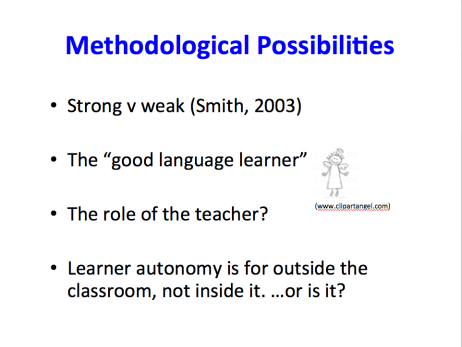
Having looked at the key concepts under consideration, we moved onto the question of methodology:

Screen Shot 2016-03-15 at 16.19.28

Smith (2003) identifies a strong and a weak methodology for learner autonomy. The former starts from what the learners bring to the table – their existent capabilities – and aims to build on and develop these, while the weak methodology is a deficit model where the teacher aims to transfer a set of skills that she or he associates with the “good language learner” (you know, that ideal person who studies for hours and hours every day outside class and has no other commitments to worry about, the perfect person…yeah, the one that mostly doesn’t exist). So, the strong methodology places the teacher more in the role of facilitator or enabler rather than transferrer of knowledge.

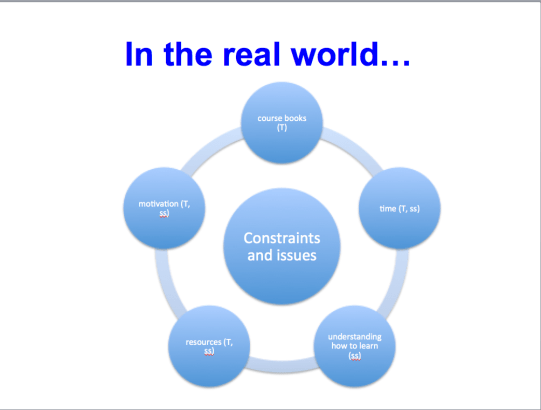
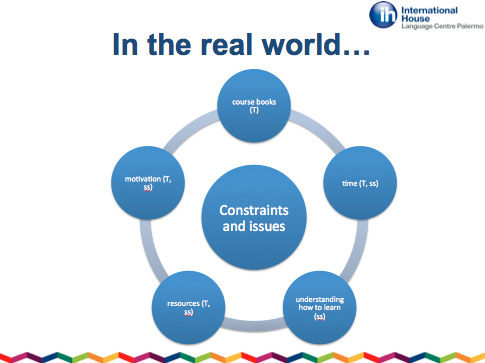
Moving away from the image of the “ideal language learner”, we were able to consider the constraints that teachers and learners face in the real world:

Screen Shot 2016-03-15 at 16.19.35

The real world is often far from ideal. However, in being aware of the potential issues, we are better equipped to negotiate them.

Of course at this point it was time to talk about the practical side, in this case how I have negotiated the issues, which is encapsulated in my top 7 tips. We did this as a guessing game, where I displayed the pictures and had the participants guess what they thought the tip would be, based on the image. They did not disappoint – lots of great ideas consistently throughout the game!

My top 7 tips

1.

Screen Shot 2016-03-15 at 16.19.47

Tip 1

What I mean by this is, find out as much as you can, as soon as you can, about what your students do and don’t do already. Encourage them to find out as much as they can about what their peers are doing. This is your starting point. How: For example, at the beginning of the course, you could use a Find Someone Who activity (they find out about each other, you listen in and find out about them), followed by writing you a letter (you find out some more). They aren’t empty vessels.

Here is an example FSW I made and used with some of my classes.

2.

Screen Shot 2016-03-15 at 16.19.53

Tip 2

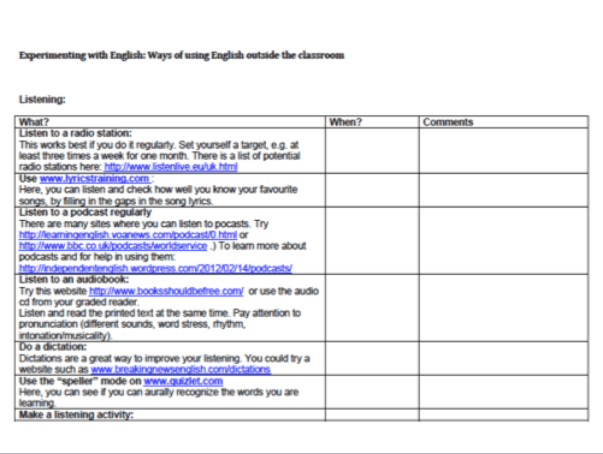
In a nutshell, provide ideas. E.g. my experimentation with English handout.

Screen Shot 2016-03-15 at 16.20.00

With higher levels, encourage them to add and share ideas of their own. There is no such thing as an exhaustive list. (For more information about this, look at my previous related posts! )

3.

Screen Shot 2016-03-15 at 16.20.14

Tip 3

Nothing happens overnight…

In fact, the question of time works on many levels. Firstly, give them time to talk about their outside class activities in class. Doesn’t have to be heaps of time. Little and often is good. This provides opportunities to bolster each others’ motivation, spark interest in untried ideas, share victories or issues, celebrate, troubleshoot and so on. It also motivates them to keep going. Secondly, in terms of take up: Don’t worry if they aren’t all enamoured with the project from the get-go. Give them time to get used to it, and to start to recognise the benefits. Encourage discussion of the benefits. Thirdly, emphasise to the learners that whatever little they are able to do is better than nothing. Learners often have the impression that if they don’t have a good hour to dedicate to studying then it’s not worthwhile even starting. Whereas ten minutes here or there is not only more likely to be the case, given peoples’ busy lives, but done regularly is really beneficial! Learners need to know that.

4.

Screen Shot 2016-03-15 at 16.20.20

Tip 4

This links to my previous tip, in terms of discussion of benefits. Helping students develop meta-awareness of the learning process is important, as understanding the why behind activities will help them be better able to select suitable activities themselves, independently. This makes them less teacher-reliant in the long run. This contrasts with just blindly doing what teacher tells them. I showed an example of a handout I used with my learners to facilitate discussion with regards to reading outside class:

Screen Shot 2016-03-15 at 16.20.32

The handout encourages learners to discuss their experience thus far, and to question it (so not only ‘what do you do/have you done?’ but ‘why?’). In raising their awareness of different resources, approaches and the benefits and drawbacks of each, we equip learners to make more successful decisions with regards to what they will do next.

For ideas of how to engage student metacognition, I suggest reading/using:

Vandergrift and Goh (2012)

Vandergrift and Goh (2012)

Note the free samples also!
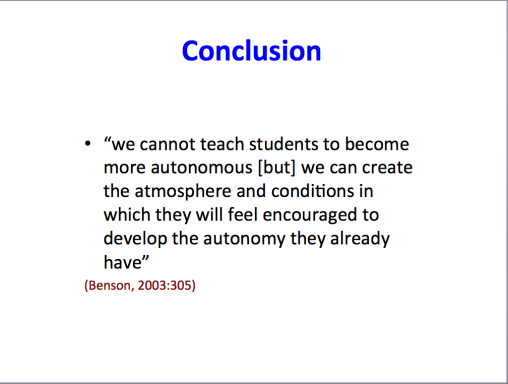
Note the free samples also!


5.

Screen Shot 2016-03-15 at 16.20.37

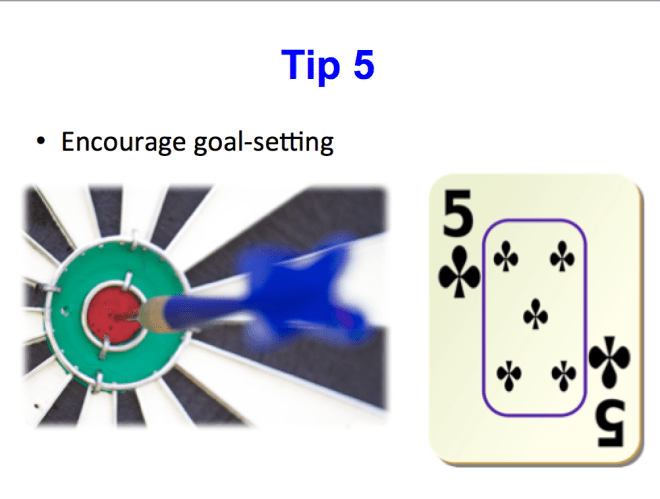
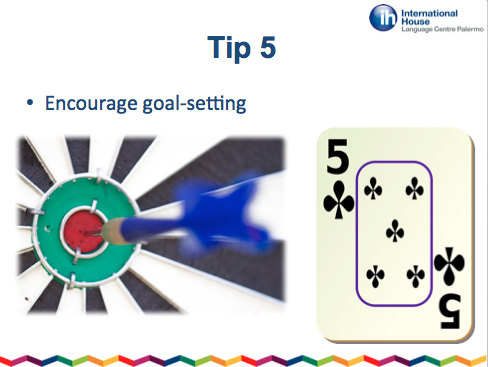
Tip 5

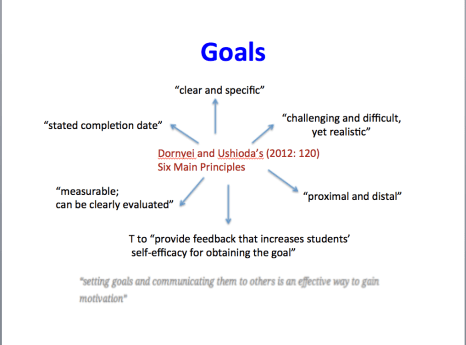
Having realistic goals to aim towards helps to break down the mammoth task of learning a language into achievable steps in the right direction. This helps students not to lose motivation and to be more aware of their own progress. Making effective goals is not simple, and it is worth bearing the following principles in mind:

Screen Shot 2016-03-15 at 16.20.45

6.

Screen Shot 2016-03-15 at 16.20.51

Tip 6 – Forget-me-not!

It’s important not to set everything up and then forget about it. Keep being interested in what the learners are doing. Give them that bit of time regularly, as mentioned before. If you forget about it, chances are they will too. Let them show off! Keep bringing it back into the classroom.

7.

Screen Shot 2016-03-15 at 16.20.56

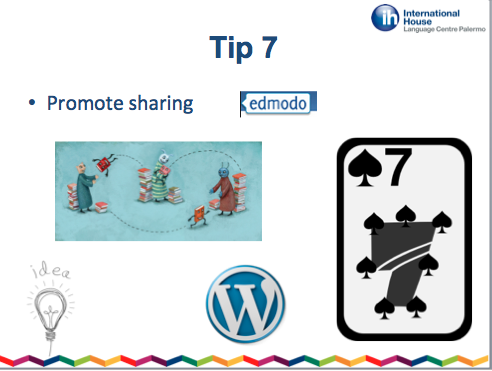
Tip 7

Using some kind of platform that allows them to share and communicate outside class, e.g.Edmodo or a class blog or wiki, immediately increases the scope and variety of what learners can do outside class. More activities become possible. (For ideas of how to useEdmodo or class blogs/wikis in this way, see the posts I have written in relation to this!)

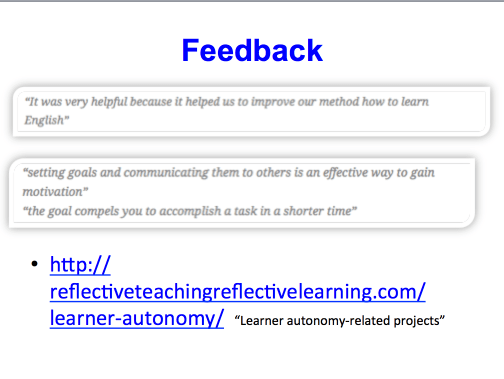
Feedback

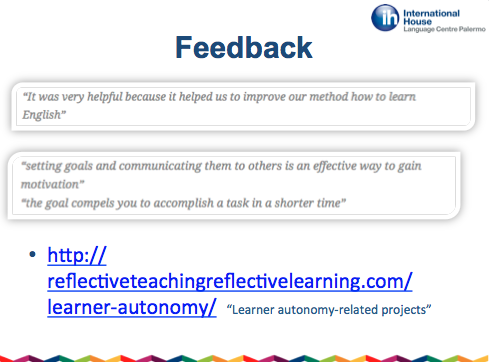
Having shared my 7 tips and so brought the guessing game to its end, I shared a bit of feedback from students:

Screen Shot 2016-03-15 at 16.21.02

To conclude the webinar, I shared a final quote with the participants:

Screen Shot 2016-03-15 at 16.21.09

I also reminded them that learner autonomy is…

Screen Shot 2016-03-15 at 16.21.14

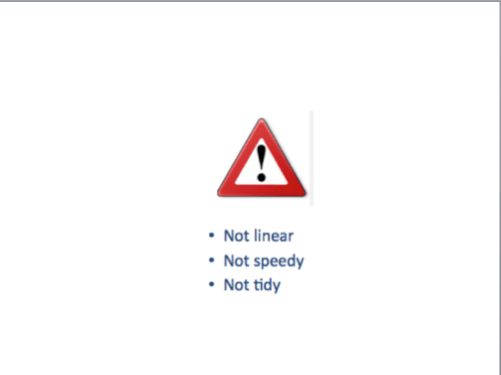
It’s not all going to go perfectly straight away, but we should persevere and remember that it is an organic process.

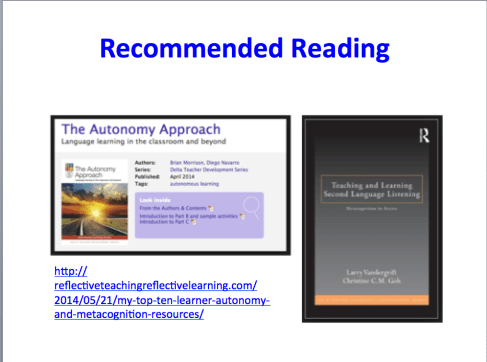
To reiterate the books whose virtues I extolled earlier:

Screen Shot 2016-03-15 at 16.21.20

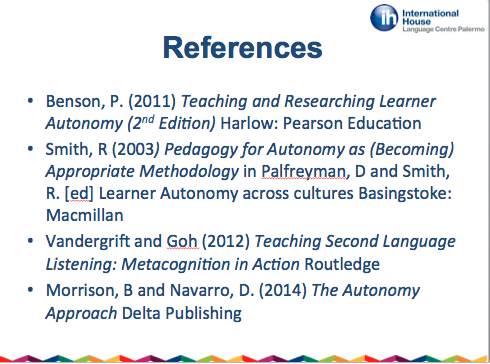
Here are the references from my webinar:

Benson, P. (2003)  Learner autonomy in the classroom in in Nunan, D. [ed] Practical English language teaching. PRC: Higher education press/McGraw Hill.

Benson, P. (2011) Teaching and Researching Autonomy (2nd Edition) Harlow: Pearson Education.

Dornyei and Ushioda (2012) Teaching and Researching Motivation (Kindle Edition)Harlow: Pearson Education.

Holec, H. (1981) Autonomy and foreign language learning. Oxford: Pergamon. (First published 1979, Strasbourg: Council of Europe.)

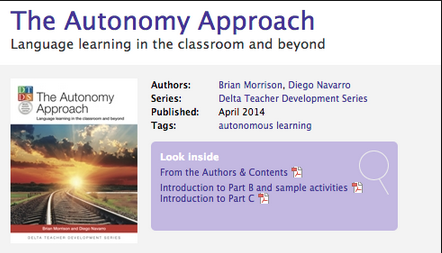
Morrison, B. and Navarro, D. (2014) The Autonomy Approach: Language learning in the classroom and beyond. Delta Publishing.

Oxford, R. (2003) Towards a more Systematic Model of L2 Learner Autonomy in Palfreyman, D and Smith, R. [Ed] Learner Autonomy Across Cultures. Basingstoke: Palsgrave Macmillan.

Smith, R. (2003) Pedgagogy for Autonomy as (Becoming) Appropriate Methodology in Palfreyman, D and Smith, R. [Ed] Learner Autonomy Across Cultures. Basingstoke: Palsgrave Macmillan.

Vandergrift, L. and Goh, C. (2012) Teaching and Learning Second Language Listening: Metacognition in Action. Oxon: Routledge.

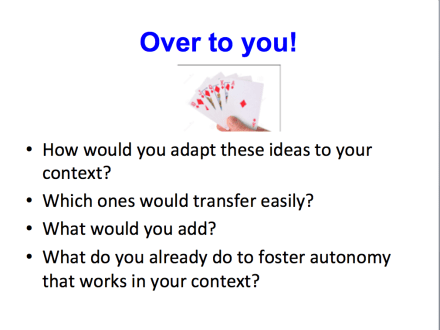
And here are the discussion questions that became questions to take away and reflect on:

Screen Shot 2016-03-15 at 17.03.31

Thanks again to the British Council for this opportunity, I very much enjoyed it and the participants seemed to as well! 🙂

Phonemic chart review game: Connect 3 (or 4)

As part of the Sheffield University 10 week pre-sessional programme, I have been teaching a Social English class 3 afternoons a week at 1h30 a pop. Last week on Thursday, I introduced them to the phonemic chart, using Adrian Underhill’s method. Today (Monday) I wanted a fun way to review the sounds with my learners, and so Connect 3 (or 4), using the phonemic chart, came about…

Preparation:

None! (Excellent…)

Materials:

  • A phonemic chart projected onto a whiteboard (failing that, an A3 print-out would work equally well)
  • a board pen (more than one would be even better – see my comments at the end of the post)

Procedure:

  • Put learners into 2 teams (or 3 if you have a big class) of 4-6 players.
  • Each team has a symbol. With my learners today, Bing were suns and Bong were stars. (They are always Bing and Bong: borrowed from an ex-colleague of mine at IHPA, these names refer to the buzzer sounds that you get on TV game shows and that the team in question must make before answering in any games where speed to answer is of the essence…)
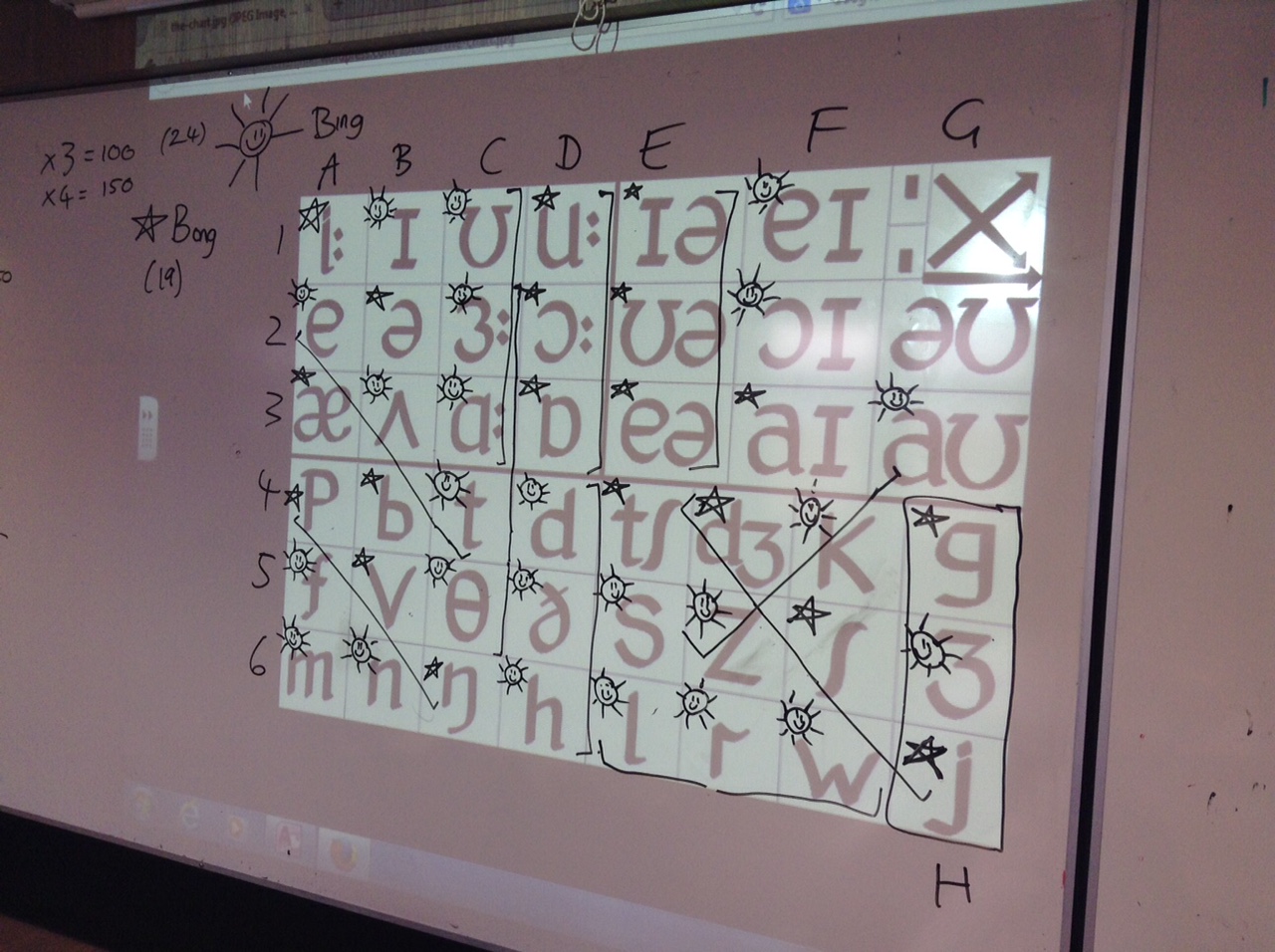
  • Explain the aim and rules to the learners. The aim of the game is to get 3 squares in a row to score £100 or 4 squares in a row to score £150. (Could also be points, but as we had just done a vocabulary auction, we stuck with the money theme!). In order to win a square, learners must make the sound that corresponds with that square correctly and give an example word with that sound in it. (Number and letter off the squares so that learners can choose a square by calling out e.g. E5. As there are more columns in the bottom half of the chart than the top, there is a special extra column H here. See picture below.)
  • If learners make the correct sound AND give a correct example word, they get to have their symbol drawn in the square and the square becomes theirs. The turn passes to the next team. If learners make a correct sound but incorrect word, the turn passes to the next team, ditto if they make the sound incorrectly. In this case, the square is still open to be won either by the next team, or, when the turn returns to the team who were incorrect, they can try again (or choose a different square if they prefer!).
  • Each time a team of learners get 3 or 4 in a row, write £100 or £150 in their score board column.
  • Towards the end, you will probably end up with a handful of squares that will not help learners gain a 3 or a 4. Sell these off at £50 a pop, with teams taking it in turns to make the sound and give an example word in order to win this money. The same rules re correctness mentioned previously still apply.
  • When everything is finished, add up the money and see who is the winner! You could also add up the number of suns and stars (or whatever other symbols) to see who totalled the greatest number of squares.
The phonemic chart at the end of the game!

The phonemic chart at the end of the game!

Showing also our scoreboard (one set of numbers goes back to the vocabulary auction...)

Showing also our scoreboard (one set of numbers goes back to the vocabulary auction…)

My comments:

  • My learners enjoyed this and it was good to see how much they remembered from last Thursday. Making pronunciation physical does make it much more memorable. (They remembered things like ‘the idiot sound’, ‘like having an orange in your mouth’, for example, trying the sounds out in their groups before giving their final answer.) Understanding way the chart is organised helps too – it helped them remember some of the sounds between the ones they were more sure of.
  • If I did it again, I’d remember all my board markers so that I wasn’t stuck with only black pen. Each team could have a different colour, and any squares that were done incorrectly could be marked in a different colour to flag them up more clearly for some further post-game review.
  • To up the challenge for academic English classes, stipulate that the example word given should be an academic word (and bonus if one of the ones you have studied recently!). To up the challenge in a General English setting, stipulate that it be a word related to a particular set of topics or course book units, depending how your programme works.

Enjoy! 🙂

My first veganniversary!

I know, I know…this blog has been quiet recently. Don’t worry, I do have a post or two up my sleeve – for example, I plan to write about the pronunciation auction I did with my Social English group, who I teach in the afternoons on the Sheffield University 10 week pre-sessional programme – but for now, I’m going to depart briefly from the teaching English theme of this blog (other than the rather tenuous link that you might notice early on in the post!) and share something about the writer behind the blog i.e. me! You see, I’m vegan and have been for exactly one year…

My 1st veganniversary breakfast! (And another new recipe for me!)

My 1st veganniversary breakfast! (And another new recipe for me!)

Just over a year ago, I started thinking about becoming vegan. I wanted to do something to mark the 5 year anniversary of Mum’s death from breast cancer. Those in the know will note that this is July and the anniversary is in August. The truth is, once I had the idea, I started to look into it and then I didn’t want to wait any longer. Luckily for me, I have a very patient vegan friend who answered all my questions, including the stupid ones, shared lots of resources with me (in Italian, so I was also learning Italian through learning about veganism – perfect example of CLIL, or Content and Language Integrated Learning! Yup, that was the earlier mentioned tenuous link 😉 ) and, memorably, didn’t push me, even once. (Thank you, Chiara!) So, it was easy to learn what I needed to learn and the decision soon followed. The 19th of July 2014.

Screen Shot 2015-07-19 at 16.15.50

This is one of the first websites Chiara sent me to: http://www.vegfacile.info. It has had a makeover since then, though! Lots of reading in Italian…

I was vegetarian for many years before becoming vegan. So long that it had become more of a habit than anything else. A habit that I would happily bend occasionally to be more convenient for others (chicken once or twice a year at my aunt’s for example) or even myself (tuna from a can as a quick meal). This isn’t something I am proud, is just how it was. In all my time as a vegetarian, though, which is all my independent adult life, I never prepared any meat or fish (non-can) myself. In fact, I used to worry that if I had children, I wouldn’t know how to cook meat for them. Now I know that children can thrive on a vegan diet, and even know one such child personally, who couldn’t be happier or healthier, that’s one less thing to worry about!

So, “lazy” vegetarian to lazy vegan? Seems logical, but no. Since the 19th July 2014, I haven’t deliberately eaten any animal derived products and have not purchased any leather or wool etc either. You might notice I specify ‘deliberately’… Well, last summer, newly vegan, I ate a Waitrose pasta sauce that I was convinced I had checked the labels of and was suitable for vegans, but then on an occasion as I was stirring it through my veg, I idly looked what I thought was again at the label and there was anchovies, plain as day. I ate the food nevertheless and chalked it up to experience, vowing to be even more careful in label-checking in future – so far, so good. I wasn’t going to waste it (same as I won’t throw away things I bought in my pre-vegan life: I have sold some things, proceeds to an animal charity, and charity shopped others. The rest, I will just replace them with animal-friendly alternatives when the time comes).  Deliberately, however, I have explored a whole new world of cooking and have a repertoire much, much greater than I did this time last year, of dishes I can make. This, I have thoroughly enjoyed. I didn’t use to have any interest in recipes, now I am a recipe geek with an Evernote notebook full of recipes I have saved. Many I have tried, many that are on the “to try” list still. (Have tried two new ones today so far in celebration! 🙂 )

My recipe notebook on Evernote. :-)

My recipe notebook on Evernote. 🙂

Why not “lazy vegan”? Why no “I slipped up because I couldn’t resist x on day y”? Because I can’t un-know what I know. As a vegetarian, I believed that dairy and eggs didn’t do any harm. Now I know better. And having learnt, and made the decision that I am not ok with what happens, in my head if I were now to eat a piece of cheese or something with egg in deliberately, that would be tantamount to saying “I am ok with how this is produced“. And I’m not. It was, and remains, that simple. For me. The beautiful-looking icecream in the gelateria is calves in veal crates having been ripped from their mothers soon after birth. And so on. If my “why” ever becomes hazy, then I will force myself to watch Earthlings again. It took me three sittings (at least) to get through it. I cried buckets, I felt physically ill, but I got to the end, and I only had to watch it, not live it. So instead I live by my choice to use alternatives to animal products. These days, there is an abundance of them, and fruit, veg and grains never go out of fashion. Do I feel deprived? No. Privileged? Yes.

Of course, nothing is completely straight-forward: as you may have noticed, I am a vegan who rides horses. I don’t think I exploit them, for me they are four-legged people who I like to spend time with – both on the ground and in the saddle.  Alba, pictured below, belongs to me and has done for all of a month. I live in the UK, she lives in Sicily (where she has space, freedom, sunshine, horsey amici, and is happy). The main thing is, she won’t be ending up on someone’s plate after all.

11713262_10207305182607387_130819224_o

My beautiful Alba.

There are enough vegans, however, who would despise me for not giving up my riding. C’est la vie. That said, I don’t plan to ride here in the UK. Having Alba (far away as she is), knowing she is safe from harm, and happy, is enough.

Then, of course, there is my profession. What has that got to do with anything? Well, let’s say, firstly about as soon as I got the hang of veganism in the UK, especially Sheffield, it was time to start my second stint in Palermo. Cue being back to the beginning of working everything out for a second time round. Fortunately, though, again I had Chiara to help me. To recommend shops and restaurants, for example, including giving me a link to a locally produced map of all things vegan-friendly in Palermo. To answer the old “can you get x here? Where?” question over and over…and over again! To tell me what animal-friendly remedies I could use, when I was ill. She also introduced me to the concept of vegan groups on Facebook, of which there are some Sicily and, indeed, Palermo-based ones. As a result of these, I attended a talk about vegan nutrition for children and a free vegan food-tasting event, both of which I much enjoyed. I have also since found UK and Sheffield-based pages and groups, which is nice. Have been out for lunch with one lot and meeting another lot on Wednesday for dinner. Secondly, my work timetable in Palermo precluded mid-week cooking. Cue batch-cooking becoming a way of life! I will admit to getting a bit bored of it in the end – the cooking more than the eating, lentils are always good! – and I had to be disciplined and do that weekend cooking whatever else I had on and however little I felt like it. Audiobooks (in various languages!) helped a lot, though, easing the tedium of vegetable chopping. Finally, ah the teeny tiny kitchen in my flat… I rose to that challenge though! Back in England, the big kitchen and better working hours are a bonus: only one packed meal a day! And surfaces, sweety darling, surfaces… (think Ab Fab!)

My journey has been positive so far: I am lucky to have family and friends who have been supportive of me and my decision. My sister has been most vociferous about it but she has also made sure, whenever we have been together since, that we eat where I can eat, that I have what I need, and she also shopped for and carried a list of things to me when she visited in October, true big sister style, in addition to more recently ensuring I was fully catered for over the weekend of my cousin’s wedding, which also coincided with my return to the UK. (Thank you, Rosa!)  I hope never to alienate any of them. I am also lucky to have had a lot of help, as described throughout this post. I also hope that if anyone I know or come to know starts thinking about making this transition, I can be as helpful (and un-pushy) as Chiara has been with me.

To end with some humour, here is some of what I have learnt this past year:

You know you’re vegan if…

  • nearly the whole hand-luggage you take on any trip is food
  • pre-journey food prep takes longer than packing does
  • you are queen of tupperware
  • ‘But where do you get your protein/calcium/B12?’ is an endless refrain! (answer: everywhere…)
  • you take a packed meal to a wedding
  • people proudly tell you that what they are eating is vegan
  • a functioning food processor/blender is no less than a God-send
  • cashew nuts are not just cashew nuts!
  • trying a new type of grain or tofu is exciting
  • recipes are the most exciting thing ever
  • pigs in blankets is this:
Esther the wonder pig. Everybody needs to know Esther! :)

Esther the wonder pig. Everybody needs to know Esther! 🙂 (Click on the pic to find out more…)

So, that’s it really! And here’s to my second year. 🙂

Are any of you teachers who read my blog also vegan? Say ‘hi’ if you like (if you aren’t too disgusted with the whole horse-related paragraph of this post)! 🙂

MaW SIG May: Cleve Miller – ‘New Publishing’ : a summary/write-up

Cleve compares the old internet to a pipe. We would passively consume content that was very much top-down, expert-created, static. It was a continuation of how publishing had worked for the last 500 years. Since 2002 we got what we call the new web, though it’s not new anymore. This is an open platform where we contribute, collaborate and create content. This is where need to locate ourselves as content creators, as materials designers.

Screen shot of slide

Screen shot of slide

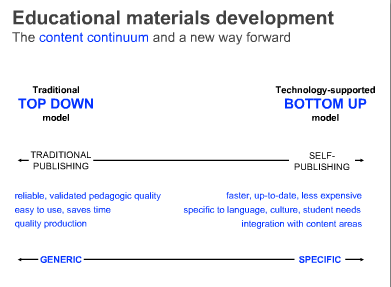
The content continuum – the fundamental driving force behind the way materials design is going. On the one extreme, we have traditional publishing (the old web, the “pipe”) and on the other extreme we have a bottom-up self-publishing model. To allow this bottom-up stuff is the advent of web and web-technology. With a blog, we can publish to thousands of people, for free, in a very short space of time.

There are advantages and disadvantages to both. The top-down model is expert-created and high quality, but it is also a generic, one size fits all. 5 year publishing plans are normal. And it runs into a barrier. The bottom-up model is faster, up-to-date and isn’t restricted to a 5 year plan. It can be specific to language culture and student need. It is the difference between generic content and specific content, along a continuum. There are times when the top-down model is appropriate, and the one-size fits all is fine, this isn’t to knock publisher content. But there are also opportunities on the other end of the continuum, which Clive wants to look at with us.

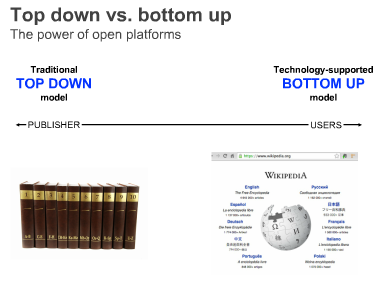
The power of open platforms. 

E.g. Encylopaedias: on the top-down side, we have Encyclopaedia Britannica, on the other end we have Wikipedia. Wikipedia contains multilingual, user-generated information, meaning that for example things that don’t have much coverage in the traditional encylopaedia can in Wikipedia. It is much more localised.

screen shot of slide

screen shot of slide

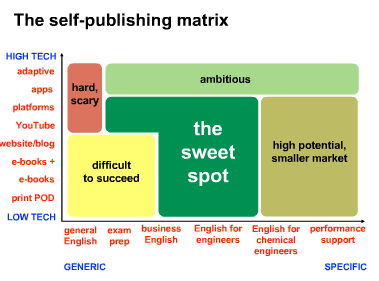
ELT also has a general to specific continuum. From General English to English for Chemical Engineers or any other ESP or more specific e.g. English only for Brazilian students. Most specific would be materials designed for an individual student to meet their needs.

Screenshot of slide - Clive's ELT self-publishing matrix

Screenshot of slide – Clive’s ELT self-publishing matrix

From a self-publishing perspective, let’s imagine you are going to design, on your own, some materials. How do you focus what you are looking at? If you are looking at low tech, general English, that is the difficult to succeed area because that is what publishers know how to do really well and they have lots of money to put into it. If you try and make an app for General English, then it’s still difficult because you are competing against the publishers, with all their money. There are platforms you can use, but it is tough and expensive. If you move towards the more specific end of the spectrum, then making an app is still ambitious but you at least will not be competing with the publishers when you are aiming towards something more esoteric, so it is ambitious in  terms of technology rather than competition. In the middle of both spectrums is the sweet spot (not too hot, not too cold), if you get more specific, then the market is much smaller e.g. English for chemical engineers, but it is needed.

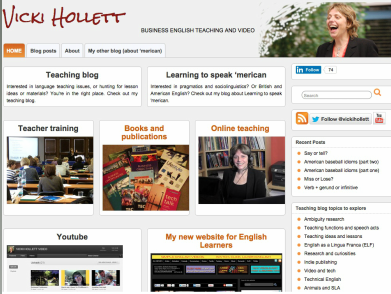
There are of course exceptions to all the above. E.g. the case study that we will look at. Which is by Vicki Hollett. She started with the difficult to succeed, scary area. She already has content published in traditional models but she is doing this anyway. And her content is multi-modal. Online teaching, you tube channel, website. Her revenue model for You Tube is the advertising.

screenshot of slide

screenshot of slide

What are the success principles for Vicki Hollett?

screenshot of slide

screenshot of slide

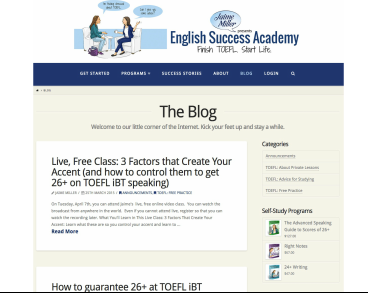
The next case study is English Success Academy by Jaime Miller. It’s one exam. Nothing but TOEFL prep. She is engaging, has lots of videos, a well-designed website, she does one-one teaching her content is multi-modal. Her revenue model is premium price e-books.

screenshot of slide

screenshot of slide

What are her success principles?

screenshot of slide

screenshot of slide

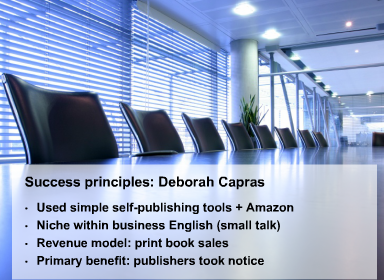
The third case study is Deborah Capras. She wrote a book and is delivering it on Amazon. Very specific topic. Business, politics, small talk. Her revenue model is print book sales. And the mainstream publishers then took notice of her.

screenshot of slide

screenshot of slide

What are her success principles?

screenshot of slide

screenshot of slide

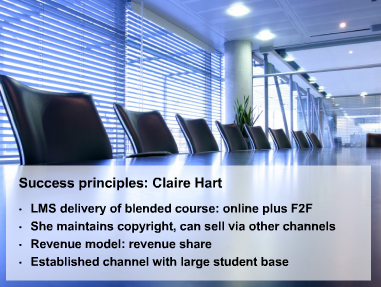
The final is Claire Hart. Blended English for Engineering. She used English 360 platform. There is an online component but then there are also face-face lesson plans and all the handouts you need, for the university department customers. Importantly, she copyrighted it. She can sell it by way of other channels. Claire can take the content and repurpose it into a print book on Amazon, or put it through YouTube as videos, she can use it in any way.

screenshot of slide

screenshot of slide

Her revenue model is revenue share between Claire and the platform who takes 40%. If you use a platform with a good user base, the marketing is there for you.

What are her success principles?

screenshot of slide

screenshot of slide

“Self-publishing”

  • Rather than thinking of self-publishing, you are thinking of developing a new product. So you are an entrepreneur. You need to think like a business person. You need to think about “sales-y things”. The hardest part is the marketing. How many videos are there on youtube? How many books are there on Amazon?
  • You need to get an editor. Very important, indispensable, in order to maintain a good level of quality. Clive thinks that peer editing could be an interesting possibility. So that there is a network of self-publishers that support each other.
  • You need a niche. Be the very best at one specific thing. That is the most powerful way to move forward. E.g. Ros with regards to English for Medicine. There’s a lot of ways to get specific. Combine your teaching with it. Niches are much easier to market to. Go to professional associations, look on LinkedIn. If you market to a niche, it’s not expensive, if you narrow your focus it’s not and you can do it.
  • Pull everything together on a website or blog.
  • Think outside the box for customers. For example, can you add value to a Business?

To summarise, the future of materials design is bottom up. That doesn’t mean top-down will disappear, but bottom up is the way forward because it can be more specific than any top-down model can be. Britannica doesn’t have the resources to produce 17 pages on Salina, Wikipedia enables that.

In the Q and A time, Sue Lyon-Jones reminds us:

“Keeping your copyright doesn’t always mean you can publish your work elsewhere. Some contracts may grant publishers exclusive rights to publish in specific formats or for a set period of time, for example. Make sure you read and understand the small print, folks!”

When you use a platform (e.g. Instagram, YouTube), lots of times you give up control. So be aware.

To contact Cleve for more information about any of this: cleve@english360.com


IATEFL 2015 Fostering autonomy: harnessing the outside world from within the classroom – Lizzie Pinard

Well, I thought I had better attend my own talk…

My abstract for this year’s talk is as follows:

It is widely acknowledged that language learning requires use of the target language outside the classroom as well as inside it. However, learner autonomy is often expected rather than fostered. This talk looks at what can be done in the classroom to help learners harness the rich resources of language accessible outside, with greater confidence and effectiveness.

The outcome

My talk outline was a simple one:

  • Definitions of learner autonomy
  • Problems with learner autonomy
  • Solutions and ideas (My 7 top tips)
  • Discussion

Being the good old graveyard slot, getting towards the end of the day, I decided to turn my talk into a game: good old-fashioned bingo!

So having looked at what learner autonomy is and involves:

Learner autonomy

Learner autonomy

…and the issues we face in trying to foster it:

Problems problems!

Problems problems!

I asked the audience to pair up and brainstorm their top 7 tips. This became their ‘bingo card’, to compare with my own 7.

My top 7 tips

1.

Tip 1

Tip 1

What I mean by this is, find out as much as you can, as soon as you can, about what your students do and don’t do already. Encourage them to find out as much as they can about what their peers are doing. This is your starting point. How: For example, at the beginning of the course, you could use a Find Someone Who activity (they find out about each other, you listen in and find out about them), followed by writing you a letter (you find out some more). They aren’t empty vessels.

Here is an example FSW I made and used with some of my classes.

2.

Tip 2

Tip 2

In a nutshell, provide ideas. E.g. my experimentation with English handout. With higher levels, encourage them to add and share ideas of their own. There is no such thing as an exhaustive list. (For more information about this, look at my previous related posts! )

3.

Tip 3

Tip 3

Nothing happens overnight…

In fact, the question of time works on many levels. Firstly, give them time to talk about their outside class activities in class. Doesn’t have to be heaps of time. Little and often is good. This provides opportunities to bolster each others’ motivation, spark interest in untried ideas, share victories or issues, celebrate, troubleshoot and so on. It also motivates them to keep going. Secondly, in terms of take up: Don’t worry if they aren’t all enamoured with the project from the get-go. Give them time to get used to it, and to start to recognise the benefits. Encourage discussion of the benefits.

4.

Tip 4

Tip 4

This links to my previous tip, in terms of discussion of benefits. Helping students develop meta-awareness of the learning process is important, as understanding the why behind activities will help them be better able to select suitable activities themselves, independently. This makes them less teacher-reliant in the long run. This contrasts with just blindly doing what teacher tells them. For ideas of how to engage student metacognition, I suggest reading/using:

Vandergrift and Goh (2012)

Vandergrift and Goh (2012)

Note the free samples also!

Note the free samples also!


5.

Tip 5

Tip 5

Having realistic goals to aim towards helps to break down the mammoth task of learning a language into achievable steps in the right direction. This helps students not to lose motivation and to be more aware of their own progress.

6.

Tip 6

Tip 6 – Forget-me-not!

It’s important not to set everything up and then forget about it. Keep being interested in what the learners are doing. Give them that bit of time regularly, as mentioned before. If you forget about it, chances are they will too. Let them show off! Keep bringing it back into the classroom.

7.

Tip 7

Tip 7

Use some kind of platform that allows them to share and communicate outside class e.g. Edmodo or a class blog or wiki. This immediately increases the scope and variety of what learners can do outside class. More activities become possible. (For ideas of how to use Edmodo or class blogs/wikis in this way, see the posts I have written in relation to this!)

Feedback

Having shared my 7 tips and so brought the game of Bingo to its end, I shared a bit of feedback from students:

Screen Shot 2015-04-12 at 07.08.15

Feedback


Then I asked the audience to discuss how they might apply these tips to their own context:

Screen Shot 2015-04-12 at 07.11.10

Discussion questions


And finally offered a list of references/recommended reading:

References

References

Thank you to all who attended my talk, it was a pleasure to speak at IATEFL for my second time and I look forward to the next time! 🙂


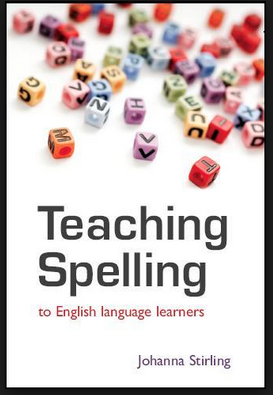
IATEFL 2015: The Why and How of Self-Publishing – Johanna Stirling

And time for another talk on the topic of materials development!

Johanna is going to talk about the nuts and bolts of self-publishing. It’s really the why, what and how, but it just didn’t fit! We are looking specifically at print books.

We’re going to look at why you might want to self-publish to start with and Johanna starts by telling us about the experience of holding her published book for the first time!

Johanna's baby! ;-)

Johanna’s baby! 😉

She used print-on-demand, which means she did almost everything herself except for the cover (an ex-student graphic designer did that!).

Why did she self-publish?

  • She had complete autonomy – no compromises had to be made. She was able to avoid publisher requirements (e.g. for a series – she had 70 activities, they wanted it if she could produce 300!)
  • Also for a bigger share of the profit. 70-75% of royalties is what you can get.
  • The biggest thing was SATISFACTION!

Why did other people self-publish?

Nicky Hockly

  • traditional publisher wouldn’t take it because the audience would be too small
  • wanted the speed of getting the book out which isn’t possible with a publisher
  • she feels much more sense of ownership with this one than ones she has traditionally published.

Jamie Keddie

  • no need to fit into a series (which methodology books usually need to do)
  • no need to wait to be commissioned (which usually is the case)
  • can make reference to “taboo” topics (not possible with publishers!)

Rod Bolitho

  • a deal with a publisher fell through and they couldn’t find another
  • wanted editorial control
  • wanted to retain the integrity of the book

But it’s not for everybody…not for you if…

  • you don’t know what to do. (If you just want to get into writing, better to start with a publisher…)
  • if you need deadlines (or you need to be incredibly disciplined!)
  • think you want to write another Grammar in Use book. (you need a niche!)
  • want to write a coursebook
  • haven’t been published before (previous experience with publishers is invaluable)
  • are technophobic (or you’re going to have real problems because you have to rely on technology for a lot of things and use a lot of different tools)
  • need money NOW from it!

If it is for you, then how?

You need The Big Idea. The ones that work best:

  • fill a niche: where there isn’t much else; focusing on a small area, really specific e.g. Nicky Hockly’s webinar book.
  • meet a need: something that teachers need.
  • are new or different in some way
  • are something that you know a lot about and are passionate about!

What about writing?

The most important thing is the content, everything else is peripheral. (Plug: From September, NILE will be doing a materials development course)

Something that Johanna found quite hard was finding her writer’s voice for this. How formal should it be? How academic should it be? Even down to things like to contract or not contract. She wanted to be consistent. It took a long time.

Organisation (of chapters, units, parts) also took a long time.

Saving and storing what you write is very important. But you can get confused about which version is which. So every day, Johanna saved her book as a new day, with the date in the title. After three days, old versions were deleted unless there was a particular reason to keep it. This made it easier to be able to find the latest version more quickly!

Johanna wrote in Word, no fancy packages. She sat down one weekend and went through all the menus and learnt what it did. E.g. it will do your indexing for you. (Link to Sandy’s friend’s Word tutorials)

For the cover design, if you are not a designer it is hard to get it right – worth paying for. As is a proof reader. When it came to the layout, Johanna looked at other books and looked for a layout that she liked. She liked the Dummies (yellow and black) book layout, so she copied that but for e.g. logos in the margins, Word couldn’t do. For layout, she recommends  The Non-Designer’s Design Book by Robin Williams.

In terms of editing, her one real regret is not using an editor. She could have saved a lot of money by spending it. She took three years rewriting it, but if she had someone look at it and make suggestions, she could have taken on other work at that time, paid work! Information on prices can be found on a website called Joanna Penn, The Creative Penn e.g. novel £7.50/1000 words. For Johanna’s book that would be £500. (Plug: Karen White, White Ink Limited, get  in touch in order to find out about costs, which are often by the hour for this kind of project)

Regards printing and production, there are 3 main companies that print on demand: Lulu.com, createspace by Amazon and IngramSpark (a relatively new kid on the block). With Lulu, Johanna wrote her book in word, converted it to a PDF and then uploaded it to Lulu.com and the cover as well, as a pdf. As simple as that. As it is print on demand, you can order one book and they will print one book. You pay what one book costs. You don’t have to buy a fixed number of books, just the number you want. You can get your one copy to be photographed with it. Then you find all the mistakes, you can correct it, re-upload it and there you are! You can keep doing it till you are happy. It’s the writing that is difficult…

If you want to sell it in bookshops or on Amazon, you need an ISBN. You can either buy your own or get a free one. There are various advantages and disadvantages to both – look into it when you get this far! For pricing, look at similar books and set your price somewhere in the middle of them. Distribution can be online, or bricks and mortar (even if they just order it in on demand)

The work does not stop here. Marketing is important. E.g. blogging (Johanna has the Spelling Blog), social media – the more connections you have the better, word of mouth, flyers (sent out to people – electronic and paper – to libraries), award nominations (e.g. ELTons), talks e.g. at conferences (Johanna has done talks on spelling), articles for teachers associations newsletters or journals. The more work you do on this, the more you sell and vice versa…

Good luck! says Johanna. 🙂  It’s not just an alternative to traditional publishers. There are many other reasons to do it!

Johanna’s blog (handout available) here.

IATEFL 2015 – Opening Plenary – Donald Freeman

Frozen in thought? How we think about what we do in ELT

How we use ideas to explain and justify, make sense out of what we do as teachers.

Reasoning has two sides to it. We can reason about something – reason as a verb – and we can give reasons for something – reason as a noun. To reason about something focuses internally, you making sense of something, whereas giving reasons addresses other people. So reasoning has both internal and external dimensions.

Reasons can be seen as ‘myths’ –  they connect us and help us justify what we do. The ‘myths’ we use are anchored in experience. They aren’t right or wrong. They have a grain of truth in them, there are elements of usefulness but also those that are misleading.

In this talk, Donald will look at a set of myths that organise our work.

  • The myth of direct causality
  • The myth of sole responsibility
  • The myth of proficiency as the goal

There is the one dimension of myths which is the shared-ness of the meaning, but they also create communities of people who accept them and consider them reasonable. In this way, they may also freeze our thinking.

The myth of direct causality

This is the myth that teaching causes learning. It’s like a pool shot, one ball propels the other towards the pocket. Not that straightforward. But there is a problem with this problem: we organise schools and teaching as if this myth is true. Teachers are evaluated based on how their students perform. Yearly progress is measured and teachers are evaluated accordingly. Then we aggregate this information to create league tables. The element that is true in this myth is that the opposite also is not true. Teaching and learning are connected but it is not a direct causal relationship. Teaching influences learning, a relational connection. A teacher’s move connects to a student’s move, which connects to a teacher’s move etc. So teaching does connect to learning, but the question is how we understand that connection – as influence rather than cause and effect.

The myth of sole responsibility

The myth that as a teacher I am solely responsible for making learning happen in the classroom. We do act often as if we are responsible for what is going on in our lessons, making critical decisions about what is to be taught, planning, materials preparation. So we view teaching as our responsibility. But the moves that we make open up moves that students make, and these moves re-shape the possibilities of the next moves we can make. And the game of the lesson progresses. Responsibility is distributed. It’s organised in a way that one move/decision/action shapes the possibility of what comes next. This interplay between moves we can think of as opportunities – to teach on the teacher’s side and learn on the students’ side. These opportunities when they line up seem almost seamless. When they don’t line up, things go wrong, the idea of sole responsibility resurfaces.

These two myths could be summarised in a single statement: “As a teacher, you have to manage what you can’t control.”  The question is, how can we thaw our way of thinking about these myths?

The myth of proficiency as a goal

The myth that the goal of classroom teaching is student proficiency. Donald would argue that this is the myth that fundamentally has us in its grasp. What’s right about this? Clearly what we do as teachers in the classroom creates opportunities for students – to learn language. What’s frozen is not that but the relationship between what we do in the classroom and the way we think about how it travels outside. Proficiency has us in its clutches as language teachers. The idea of proficiency is grounded in an assumption of nativeness. That the world of language users divides itself between those who are native users and those who are non-native users. Proficiency is something that those who are born with and use the language a lot have, and those who meet the language through school are striving for.

The problem is that both ideas – proficiency and nativeness – are misleading. Nativeness is geopolitical not linguistic. Similarly, proficiency – an intuitive and appealing idea – is conceptually problematic. A usefully wrong idea. “Usefully wrong” – a practical heuristic from Lee Scholman. Teachers use a particular form of knowledge when they teach – usefully wrong ideas. 25-30 years ago David Nunan pointed out that proficiency is like the ghost in the machine. “assumed to exist because the concept is intuitively appealing” –  Nunan, 1987. How do you actually define that stuff that people get good at in language, when language is so flexible, permeable, like water not like ice? And when getting good at is a function of place and circumstance, not something general and universal? Proficiency is a function of time, place and experience.

Proficiency freezes our thinking because we use the concept of general language proficiency which does not admit to a clear set of boundaries but instead covers a lot of territory. If students can do something in the classroom, in an exam, we assume they can do it on their own in a place of their own choosing. What happens in the classroom is not a reflection of the larger whole. It is part of it, but not a reflection. Horizonal knowledge: What you have to know in the moment and how you project it out into the future. In the language classroom, it is the suitcase problem. In order to capture language and bound it, we have to give it attributes that it doesn’t have and didn’t ask for. Grammar. Four skills. etc. They allow us to chart the relationship between what is inside and what we hope will happen outside. “The strange this funny things happen to language when it comes to school.” Language gets attributes because of the fact that we need to teach it, not because of what it actually is.

In place of this myth of general proficiency a a goal, what we need is proficiencies as a plural. All of us are multi-literate, we use different ways of accessing meaning in text. We are more literate in some ways than other ways. As plural, they are always situated in particular contexts. This would apply to proficiency. Then we need to think about how these contexts are bounded, to understand what it is we are proficient in. When we think about proficiency from this point of view, we can recognise that it is an interesting, intricate dance.

How do we create a version of English that teachers can use as they teach so that the boundaries are clear? Donald created a list of ‘teacher tasks’ – e.g. taking attendance, collecting student work, make announcements, discipline. A panel looked at the tasks and looked at how each task could be grouped into functional areas, how they are enacted in routines and what language accompanies them. So this defines classroom language proficiency from the point of view of the teacher. From task to language. If we wanted to help teachers become proficient in this context, general proficiency wouldn’t suffice. This is a very specific proficiency. By bounding it, setting parameters, identifying what it is, we can clearly identify that it isn’t about general proficiency.

Bringing it together

If these are some of our myths, how can we think about them differently? Think about skateboarding. If you watch people skateboarding, you will see there is a relentlessness about it. They practice again and again and again, on and on. So there is direct causality in what they do. They have sole responsibility (for the practice and outcome). It is clearly bounded, you become proficient in specific areas. This gives us a sense of learning but what about teaching? We need to think differently about what teaching is and might be. Learning driven by the learner. Teaching is part of it but the question is how? We know teaching is central but that doesn’t mean we have to think about it in the same way. If we reframe our myths in this way, then we can look at learning from a slightly different point of view.

Caleb Gattegno – “You can be lived by your preconceptions, which will make you a bad teacher”

Eleanor Duckworth – “It occurred to me, then, that of all the virtues related to intellectual functioning, the most passive is the virtue of knowing the right answer”

Think of the myths as our “right answers” – they impinge on our ability to think actively.

“What you do about what you don’t know is, in the final analysis, what determines what you will ultimately know” – Eleanor Duckworth.

Phew! A lot to digest and think about! What an interesting opening plenary. 🙂

Nominated for the Teaching English British Council Blog of the Month Award!

I am proud to announce that I have once again been nominated for the Teaching English British Council blog of the month award! 🙂 This time, the nomination is for my Speaking Bingo post, which describes a simple game for encouraging learners to use target words and expressions in speaking activities.

The TEBC blog award is decided by the number of ‘likes’, or votes, each nominee gains: the highest number wins. If you would like to vote for me, please click on the picture below:

My nomination! :) Thank you, TEBC.

My nomination! 🙂 Thank you, TEBC.

While you are at it, why not have a look at the other nominees’ blog posts – you might find you’d rather vote for them! 🙂 – and all the other great links that TEBC shares regularly.

Thank you to all who have already voted for me and to all who read this blog: you make it what it is!

Speaking Bingo

This idea came up in our two-weekly Friday seminar, nearly two weeks ago now (how time flies…). The seminar was about teaching teenagers, and at this point were were discussing the difference between games and adding game-like challenge, and sharing ideas for how to add game-like challenge. Our YL coordinator suggested Speaking Bingo.

Aim:

Encourage learners to incorporate target language into their speaking. Give learners additional motivation to speak.

Procedure:

  • Prior to a speaking activity, have students make up a bingo card for themselves. In each square they choose a piece of vocabulary studied in that lesson (or from a set studied previously that you wanted to review).
  • During the speaking activity, students tick off each bit of vocabulary as they use it.
  • First student to tick off all the bits of vocabulary gets to call Bingo!

Variation:

Instead of ticking off the words they use themselves, you could get them to start a timer and tick off any target language their partner uses. Their partner should be trying to use as much target language as possible, and the winner would be the one who managed to use all the language on their partner’s card (which they wouldn’t have previously seen) in the fastest time.

Bingo with L9

An example I made for my Level 9s (Upper Intermediate)

It worked really well with my adult Level 9’s, gave them that added push to use the target language and they enjoyed it!