The “passionate and inspiring Silvana” (as she was introduced and I agree with based on the few minutes I saw her speak for at the Cambridge networking thing last night!) will speak to us about the ‘native factor’ – the haves and the have nots. (Twitter name, in case you are interested: @laIoli)
Silvana starts by telling us a few things about herself: she is not tall, she is not male, not single, not atheist, not sport, not fantasy buff, not a native speaker. She uses this ‘ridiculous way of introducing herself’ i.e. litotes (negation of one quality to emphasise another) to pose a question: what quality is she emphasising by saying that she is a non-native English speaker? Why do we still refer to an aspect of the professional identity of over 80% of the teachers of English as a ‘non’?
How is it still a legitimate term?!
It’s not just a word.

It’s time to find something better!
Next Silvana gave us –
The one minute history of Native Speakerism starring the Monolingual Bias.
She takes us back 100 years to The Direct Method: thou shalt not use your own language in class. This and subsequent methods created a monolingual bias which gave a biased view of the native speaker. The common goal was to achieve native-like competence. Meaning 3 things: That NS is the best model, that the way that the NS acquires L1 is the best way to acquire a foreign language and that the NS makes the best teacher. This creates a deficit view of the learner’s own language – it becomes a source of interference and an obstacle, and a deficit view of the NNS as defective, a failed monolingual of English. The ideal native speaker according to Kramsch is monolingual, monocultural, speaks only a standard variety of English, and is equally competent in oracy and literacy skills. This concept has been critiqued as a figment of linguists’ imagination (Palkeday 1985). It is, however, a very resilient myth. Take for example the European Profiling Grid which is used in recruitment of teachers. The ultimate goal is “Has native speaker like competence in the target language”.
How does this notion impact on identity, as an NS or an NNS?
If you have the native factor, you can safely assume that: The native speaker is the best model, the ideal teacher. I am an NS. Therefore I am the ideal model and ideal teacher.
If you are a non-native speaker, it is the reverse. I am not the ideal model. I am not the ideal teacher.
Very problematic and toxic logic. Kamhi-Stein (2005) criticises this ‘native speaker fallacy’. It makes assumptions that NS have particular features but actually they can all be acquired through training. Silvana then shows us a linkedin profile and what it does! It devalues all of us and professionalism.
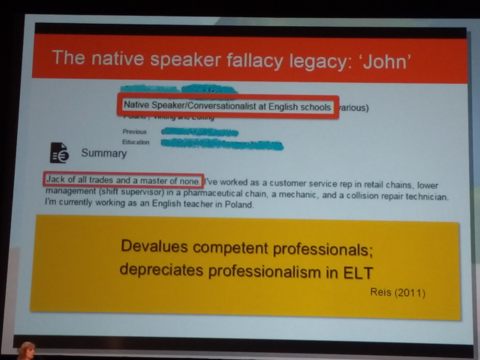
The logic also creates a competence dichotomy. A very unhelpful separation into camps. An us versus them. It’s very damaging to all of us.
The Plight of the Have Nots
We will look at this from four perspectives.
1.
The Market forces’ discourse: customers prefer native speakers
“It is a truth universally acknowledged that a student in need of English language lessons must be in want of a native speaker”
DO customers prefer native speakers? How true is this claim? Is it based on reliable records or on impressions? Out of 1000 students how many is it? 500? 5? The two who shout loudest? What does research say about what students prefer? This is a relatively new area of study. She is gong to look at a few studies and we have to decide what the findings support.
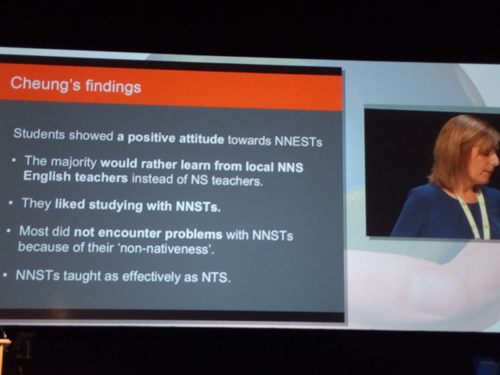
Cheung 2002 – attitudes to NS and NNS and the strengths/weaknesses of both. Questionnaires, interviews, observations, 420 ss at 7 universities in Hong Kong. Findings:
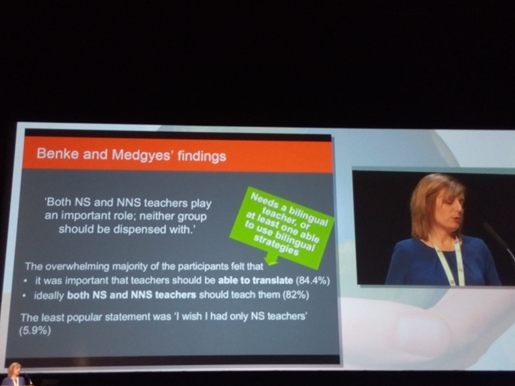
Benke and Medgyes (2005) – SS perceptions of NS and NNS teachers, questionnaire, Hungary.
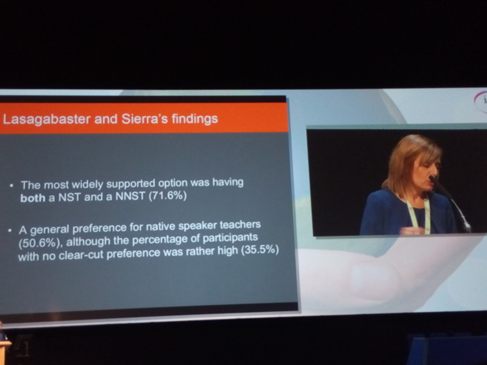
Lasagagabaster and Sierra (2005) – Students perceptions of NS NNS; Closed and open questions; Basque area of Spain
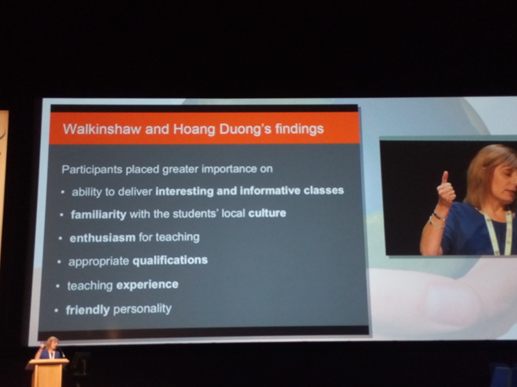
Walkinshaw and Hoang Duong (2012) – how learners rate ‘native-speakerness’ compared with 7 qualities valued in EL teachers: rating survey and questionnaire, Vietnam.
Silvana then presented a summary of the perceived advantages of NNESTs:
- Declarative knowledge: knowledge about English (They had to learn it!)
- Ability to identify areas of potential difficulty: when you know the L1, you know what will be easy or difficult, from your own experience.
- share and use the students own language
- able to make cross-linguistic and cross cultural comparisons
- teach grammar more effectively
- empathise with the learner (been there…)
- provide appropriate strategies
- willing to work hard
Followed by those of NS:
- procedural knowledge (how to use English, tacit and unconscious)
- teaching of lexis (idiom, colloquialism, slang)
- fluency in English with ‘original English accent’
- no apparent language difficulties
- linguistic authenticity
- teach speaking and listening more effectively
- cultural understanding (of own culture)
- more relaxed attitude to error correction
These perceptions were taken from various studies.
Silvana summarises by saying that students generally value professional and personal qualities over nativeness. Both NEST and NNEST are perceived to be competence each with unique strengths. Preference is inconclusive. Some indicate both, some one, some the other.
There is the discourse of Employers having no choice. This is discrimination. These are discriminatory practices disguised as common sense. Actually, employers always have choices. Collusion with inequality and prejudice is a choice. Discrimination is a choice. Also, “just because the market is demanding certain things, it does not mean that the market cannot be made to see things differently” (reference missed, sorry!).
Is the customer always right? Silvana did an experiment a few months ago. She had a two-hour conversation with a student who adamantly wanted a native speaker. He was shocked that it only took a month to become a teacher. He changed his mind. The real question is, are customers expectations realistic? How do we behave when they aren’t? What if their preferences are racist or discriminatory? “I didn’t come to the UK to be taught by a trainer who is a native speaker of my own language” – has been said. First they ask those who said it if there is anything in the promotional literature about this? No. This is because we are equal opportunities employers and we are proud. Proud to employ the best trainers and nativeness doesn’t come into it. They are told to give the trainer a chance and come back in a few days if still unhappy. They don’t come back.
Why are NNS rejecting themselves? (As per above example)
2. Discrimination and recruitment.
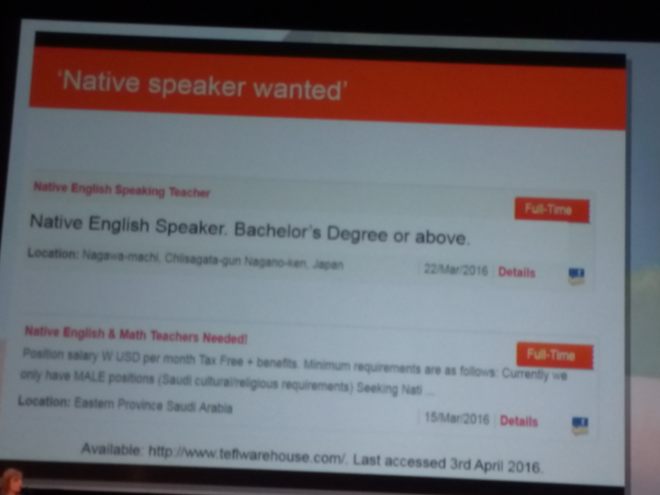
No EFL qualifications required in either!
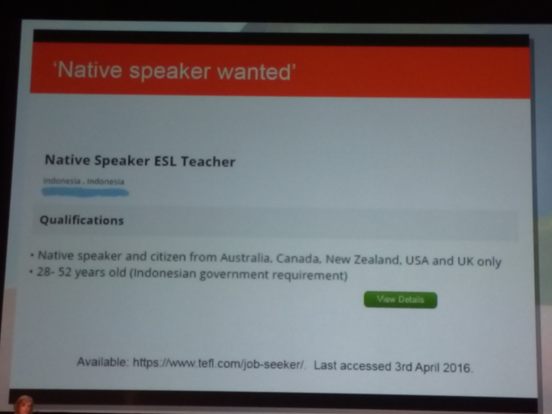
Even narrower!
This is the reality:
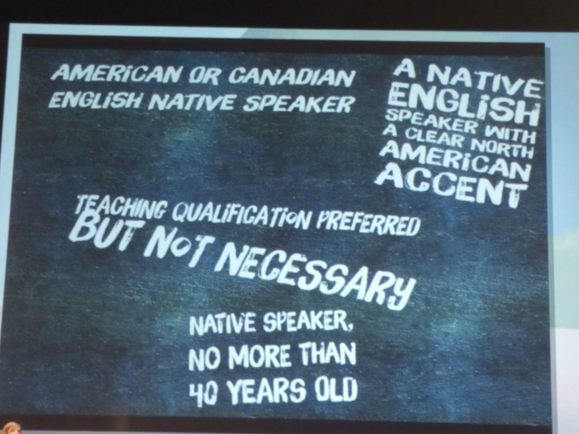
The lay of recruitment land.
And these announcements are damaging:
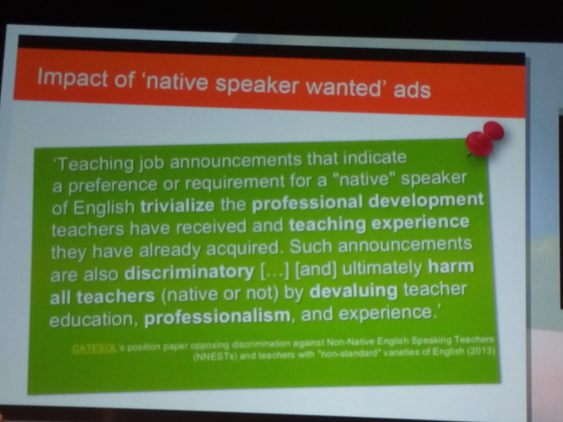
Clark and Paran (2007)
Looked at the recruitment of NNESTs in the UK. 72.3% of participant institutions judged nativeness to be very important.
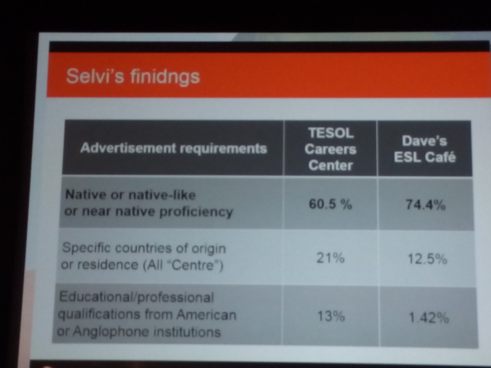
Selvi (2010)
A vast majority of the advertisements favoured NESTs and rejected NNESTs. He describes discrimination as a multi-faceted phenomenon. There is also the issue of variety of English, where qualifications are obtained (golden standard: Anglophone institutions) and location of citizenship.
Mahboob and Golden
Focused on East Asia. Nativeness was the single most frequent criterion mentioned in the ads. 49% of the ads listed specific countries from which the applicants must come. US being at the top. Some ads also specify colour. Nativeness is linked to inner circle countries only. Students are being taught by ‘teachers’ who are not qualified to do so.
3. The mono-training orthodoxy
If you look at SLA in the 20th century, if you look at the theories, you find yourselves in a very confined cognitive space. Very little reference and interaction with the world around you. The result of this is narrow approaches to teaching, learning and teacher education. Native speakerist, monolingual and monocultural.
If we look at the areas in which native speakerism has dominated, no stone left unturned -theory, research, publishing, teaching and learning materials etc. Cook puts it very eloquently:
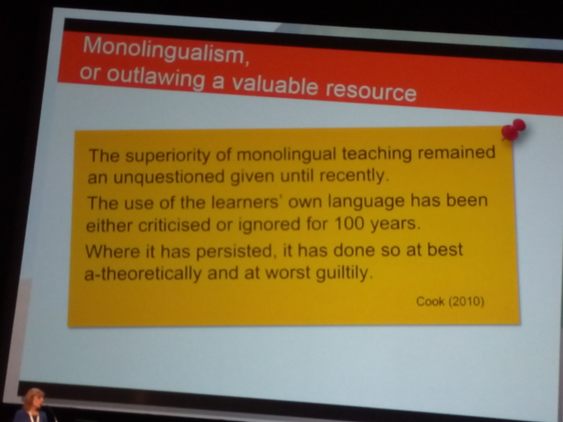
There is no research evidence on whether students learn better in an ‘impossible to code-switch’ classroom environment.
Ernesto Macaro’s study on code-switching: little known but important!
Monolingual approaches abound. There is a cultural appropriacy issue with this. An approach designed to work in a BANA country will not necessarily work elsewhere. Silvana gives another snapshot of realities around the world:
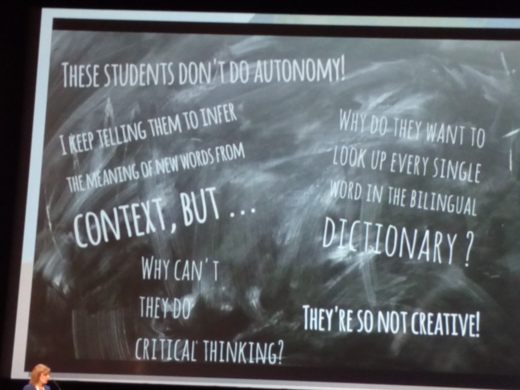
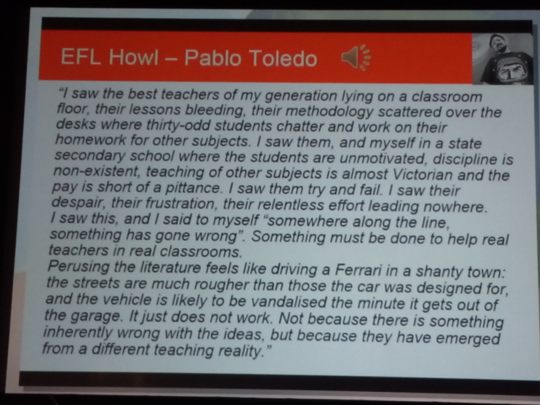
She then plays us a clip from Pablo Toledo – EFL Howl on teaching in difficult circumstances:
4. Issues of confidence and self-esteem
What has all this done to the T whose first language is something other than English?
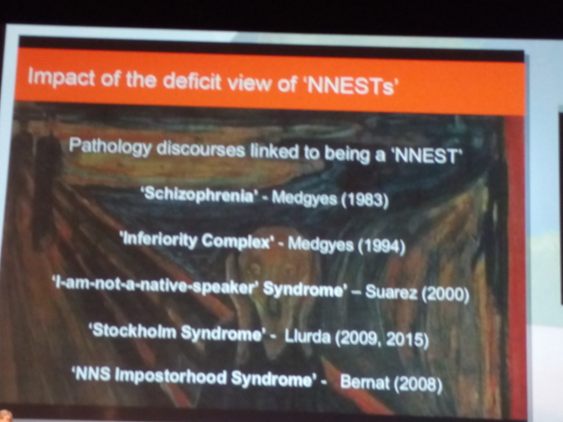
Inferiority complex: belief that own knowledge is inadequate to the linguistic standards (think back to the teacher standards we looked at earlier – ‘native speaker’)
Stockholm syndrome: secretly admiring the NS and denying self the right to be a recognised language user.
Impostor syndrome: feelings of inauthenticity and inadequateness.
Faking it: If you can’t be a native, at least try and pass for one. Hope that students won’t notice but concerned about being ‘caught out’. There is still institutional pressure – schools asking Ts to pretend to be a different nationality. What does this do to identity?
Silvana thinks NNS develop coping strategies.
- Shying away: in EFL contexts, shying away from modelling language and instead ‘play the tape’ so that the script models the language; and away from using English in the classroom as the language of instruction and communication.
- Hiding own identity in terms of L1 status: In English as home language context never telling the students that you aren’t a native speaker; hiding it initially and then gradual or final revelation, like an embarrassing confession. “I only tell them once they trust me and like me”.
The future?
- The wider context
- Overcoming the dichotomy
- What can we do?
The Wider Context: Multilingualism
A paradigm shift is unfolding out there as we sit here in this auditorium. It is now the turn of the multilingual. Multilingualism is the new norm in a Globalised world. Recent publications reflect this. It is a trend to watch and find out more about. We are moving from a deficit view of the learner’s own language to an asset view. We are moving away from an NS view of acquisition to a bilingual view. Second language acquisition is moving towards plurilingual development. The perception of learner’s own language is moving from obstacle to resource. The goal of learning is moving from near NS competence to multilingual competence.

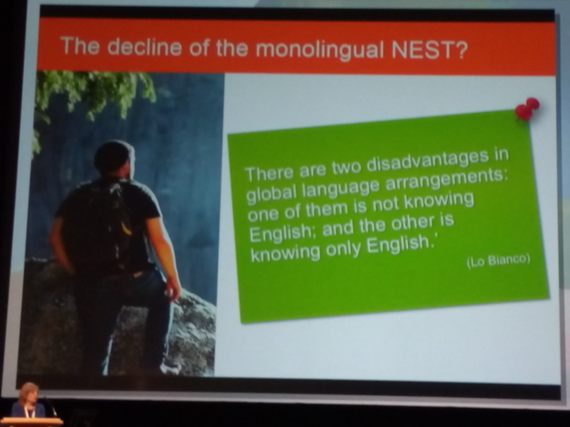
Monolinguals, take note…
Overcoming the dichotomy
How can we overcome the dichotomy? We, as in those of us who were born and raised using a language other than English can’t do this alone and neither should we. This is a major battle about ethical and principled professionalism against prejudice. We need to stop thinking about them and us and start looking at professionalism as a continuum. On the continuum we can look at professionals as being more or less prepared, knowledgable, competent, proficient USERS of English.
What can we do?
(NB: deliberately larger font!!!)
What can we do? We need to find out more about this issue, become more aware. Write about equality for NESTS and NNEST.
Teachers: Join an advocacy campaign and show support. There is a forum this afternoon about it! Write a statement supporting this campaign. Promote advocacy initiatives on social media. Start a discussion in your workplace to raise awareness. Do research, more is needed.
Teacher educators: review programmes in terms of the scope. What is the ultimate goal of these programmes? To develop well-rounded critical professionals or churning out skilled technicists who can produce monolingualism for export? Consider the content and methodology – is there critical exploration? Are they sufficiently inclusive? Sensitive to glocalisation? Using the students’ own language? What about bilingual identities? The elephant in the room is teacher’s own language proficiency – how can we help teachers develop this?
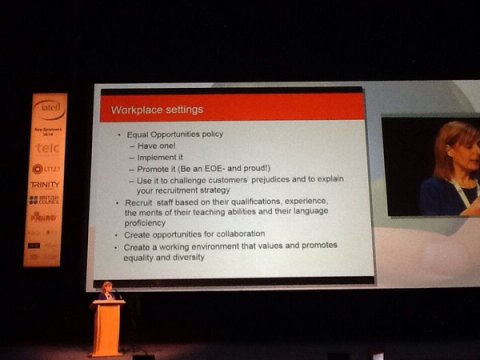
Workplace: Do you have an Equal Ops policy? Do you implement it? Are you proud of it? Do you challenge students’ expectations? Do you recruit based on merit?
Teachers associations: Issue a statement against the discrimination of NNESTs. TESOl France writes to employers who write native speakerist ads to discourage them from that. Create alignment maps of professional qualifications of teachers of EFL at regional, national and international levels. Encourage members not to apply for positions where advertisement is discriminatory.
There is a lot of work to be done to make our professional equitable.
And the only way is to work together. Silvana’s dream is that teachers be judged on their merits as a teacher not on an accident of birth. Silvana’s real name is Silvana Ioli. She was born and raised and educated in Argentina. And she is really proud of it. She is a professional and plurlingual teacher of language.
And oh my goodness what a plenary! Standing ovations, some tears (not only mine!! I fought mine back, then was quite relieved to see someone who hadn’t, meaning I was not the only one to get all emotional!)
In my current context, I finally work in a place that DOES has equal ops (as far as I can tell!), where I DO have colleagues from all over, working there on the basis of their many merits rather than their skin colour or passport type. This should be the rule rather than the exception. Previously, I have worked in schools where: teachers were hired based on skin colour and passport, ‘non-native speaker’ teachers were viewed (including by themselves) as second-class citizens of the teaching world, where all teachers were British, where being male and North American was the basis the recruitment decision was made upon… I’m not going to say which indictments go with which schools. It doesn’t matter. What matters is that we all do as Silvana said and recognise what has gone on, what is going on and where the future is/should lie, and do our bit to push it in that direction, regardless of our role in the teaching world. We are all professionals in the ELT world together, we all need to fight together to make it what we want to be. Jim Scrivener tweeted that this was ELT’s “I have a dream” plenary. It may be cheesy but let’s make it all of our dreams. In the hopes that at some point history will look back on this period as one where finally the paradigm shifted away from the ridiculous.
Ok, rant over. I have only one thing left to say: this post deserves to be the most read on my blog. Silvana’s words were inspiring. So spread them. Share this post. And, if anyone wants to use my blog as a platform to share their ideas in relation to this topic, please do get in touch. You are welcome, I would be happy to host guest blog posts.
Oh, one LAST thing: don’t forget to have a look at the TEFLEquity website too!