
My second webinar for the day! (Now yesterday!)
Speakers: Paul Ellis and Kate Trafford from Cambridge International dn Cambridge English respectively.
Hoping to: understand principles of inclusive pedagogy and build a tool box of inclusive classroom ideas to support all learners.
Terminology:
Neurodiversity: different ways that we all think, move, hear, see, understand, process, information and communicate with each other. We are all neurodiverse. This describes variation in peoples’ minds.
Neurotypical: the group whose thinking, moving etc reflect social or cultural norms, the typical way.
Neurodivergent: the group who have a type of brain often considered different from the socially constructed norm.
This reminds us that there is no single way that we learn. Our language needs to be up to date and inclusive. Inclusive terminology is important.
We started with a poll. How much do you agree?
- Differentiation like giving dyslexic learners separate worksheets is the best way to creat an inclusive classroom.
- Inclusive teaching practices are beneficial for all students, not just those with learning differences.
- I feel confident teaching neurodivergent learners and have many strategies in my teacher toolbox ready to use.
Paul and Kate’s principles: a holistic view
Equitable outcomes for all students – with or without a formal diagnosis. In some countries you can get a diagnosis for e.g. autism, dyslexia. Today we won’t be talking about specific conditions but rather inclusive education for all. The focus is on removing the barriers and not changing the learners themselves, just enabling them to show what they know and can do. Neuroinclusive approaches support all learners.
Performance = potential minus interference. (Timothy Gallwey, 1972) We all face barriers to performance that could be anything taht gets in the way of your potential to perform to your best. This can vary depending on the day, and what other influences there are going on. The good news is, you can use first class teaching strategies e.g. active learning, assessment for learning, self-management, UOL principles then you are already looking after a lot of learners in your class. Then only a small number of students will need also differentiated activities and testing, and additional support. An even smaller number will need personalised interventions.
Neuroinclusivity in education means a classroom culture that anticipates every kind of brain and removes barriers so that every learner can engage meaningfully.
Small consistent changes can have a big impact. Universal design for learning: divides into representation of content (multimodal, videos, quizzes, textbooks), action and expression (oral presentations, written text, digital portfolios, group work) and engagement and motivation (give choice and link units to relevant content and long-term goals).
Some common classroom behaviours and their possible causes:
- difficulty getting started: can be due to not knowing where to start and having cognitive overload. Once working memory is too full, information cannot be processed so they may have difficulty progressing.
- losing focus or “over-focusing”: can be due to lack of clear time or progress markers, not enough sensory or cognitive variation
- emotional responses that seem disproportionate: learners may have a low sense of safety and predictability, or cognitive fatigue.
- longer than average time to process spoken instructions: too much demand on working memory demands and auditory processing load.
- sensory discomfort (light, noise, seating, temperature): learner is experience sensory overload from their environment which creates a barrier to learning and ability to complete tasks.
Environmental barriers are not learner deficits. The barriers are task design, instructions, pace, sensory overload and relational climate. Inclusion shouldn’t result in extra work, it is small, consistent adjustments that remove barriers for learners.
Neuroinclusive practice: removing the barriers
Part 1: Quick wins
- Immersive reader: It is on Microsoft word but Apple has an equivalent. What you see is you get tabs that enable you to change page colour, text spacing, a read-aloud function, live focus which enables you to focus on one line at a time. Which of these things help depends on the individual. (Google docs enables you to change the page colour in page set up! I use that!)
- Bionic reading: some parts of each word are in bold. Again, whether it is helpful depends on the individual. You need to involve the students not decide for them.
- Different colour backgrounds: on paper or plastic coloured overlays.
- Fonts: use sans serif fonts e.g Arial, Tahoma (we like Open Sans at work!)
- Use a visible clock: to help students manage time especially during tests, exams and timed activities.
- After asking a question, count to three before calling on anyone. Pause and then give them a chance to respond. (Usually teachers give 0.7 seconds for learners to respond. Waiting time is so important! Don’t be scared of silence!)
- Vary the way you call on learners (e.g. written responses on a mini-whiteboard) (Wooclap is a digital example we use)
Part 2: long term strategies
These might take a bit more planning but will be very worthwhile. These are built on 6 core elements, 3 of which (the 3 in bold) we will focus on today:
- creating a clear lesson structure
- incorporating appropriate technology (if found beneficial)
- adapting the learning materials (e.g. level or physical nature)
- explicit classroom delivery and instructions
- integrating learning and asssessment
- setting the right environment
Creating a clear lesson structure
Have a visual lesson checklist. Use the pages of the coursework/resource as a springboard for your lesson.
- Share learning objectives at the beginning of class so students know the starting point and the goal for the timeframe of the lesson.
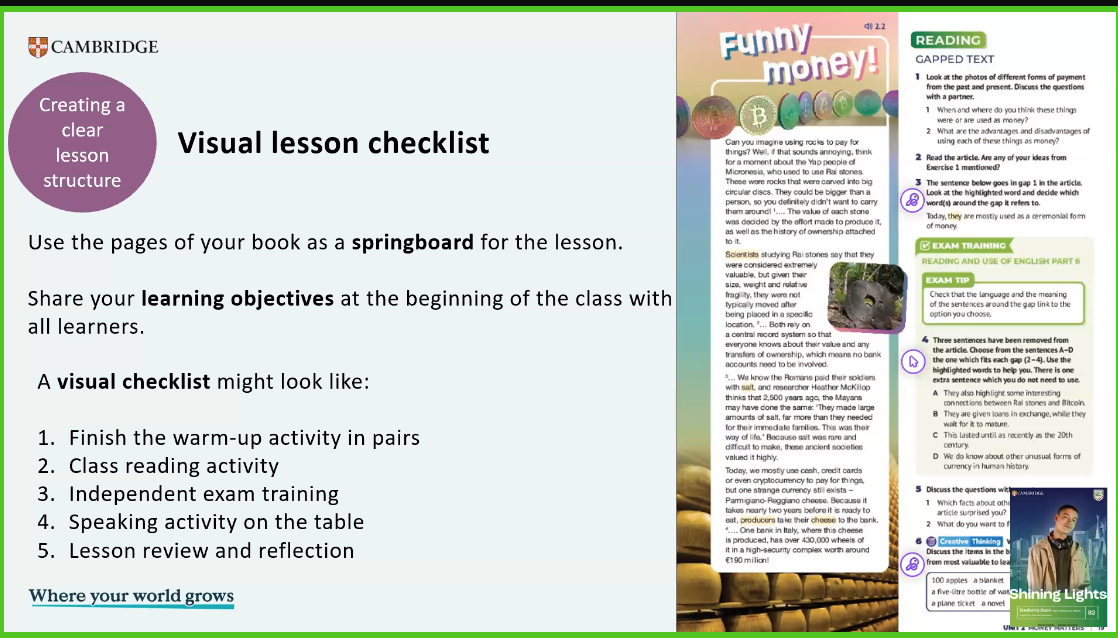
If that checklist is only given verbally, it will be forgotten. If written down as a checklist, it will help keep learners on track, and help them maintain focus.
3 different ways to present a visual checklist:
- AI generated: number, icon, description
- whiteboard clipboard with numbered descriptions
- pinboard note with numbered summarised descriptions
Try different ones, see what learners prefer.
Establish a clear and consistent routine. This allows a positive start to the lesson and review prior learning. It creates predictability so students know what they are coming into and what will be expected of them. This creates a psychologically safe environment. It also allows you to address any issues that arise and take the register quickly and quietly. 5-10 minutes is it all it takes. This can be any kind of do-now activity that students do as soon as they come in. If you have multiple lessons per week, you could have a particular routine for Lesson 1 of the week, Lesson 2 of the week etc that is the same each week.
Explicit classroom delivery and instructions
I do – we do – you do: teacher models, students do all together, student does individual attempt. This can help avoid cognitive overload and achieve a sense of teamwork as you are doing it together. Teacher writes a sentence, students complete it on mini whiteboards, students do an individual activity.
Use a variety of instruction techniques to ensure learners are following the class rhythm. Bring L1 into the classroom: get learners to explain the instruction/activity/concept to a grumpy grandad who doesn’t speak English (maybe be a bit less specific incase someone’s relative just died…)
Another example is: Say it, show it, write it, repeat it.
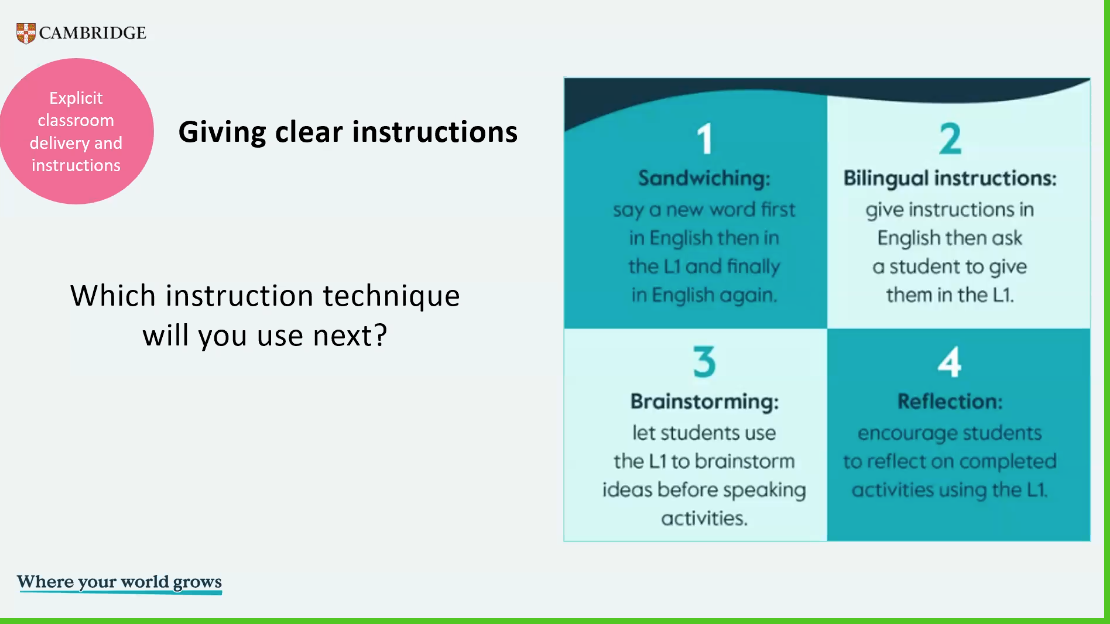
These ideas allow L1 into the classroom in a small, controlled way to check understanding.
Setting the right environment:
Sensory objects: when learners can channel their energy, they have improved concentration. Learners can have a specific sensory object of their choosing which they keep with them. Can take it out when needed. You could have a selection box for learners to choose from when they need a moment of self-regulation. This helps to create a safe environment. Being able to choose their own one encourages agency.
Individual headphones can be useful: excess background noise can be very distracting. Headphones can also be used for listening to audiobook or listening and reading a text at the same time.
Digital exams: What could be the benefits for learners sitting a digital exam ? More focus, fewer distractions, more control, more empowering.
(I would add:
- use natural lighting rather than overhead lighting where possible.
- if you are using a computer connected projection screen, enable “Night light” (in display settings on Windows) to minimise glare.
- have quiet activities in between the group activities to allow overstimulated students to have a breather )
We only looked at three pillars today. We will be able to look at others ‘for homework’ via some wider reading we will be given.
Keep in mind:
- neuroinclusive approaches support all learners
- these approaches are good for adults as well!
- focus on removing the barriers and not changing the learners
- good teaching practises are inclusive teaching practices
- small actions applied consistently lead to great impact
Next steps:
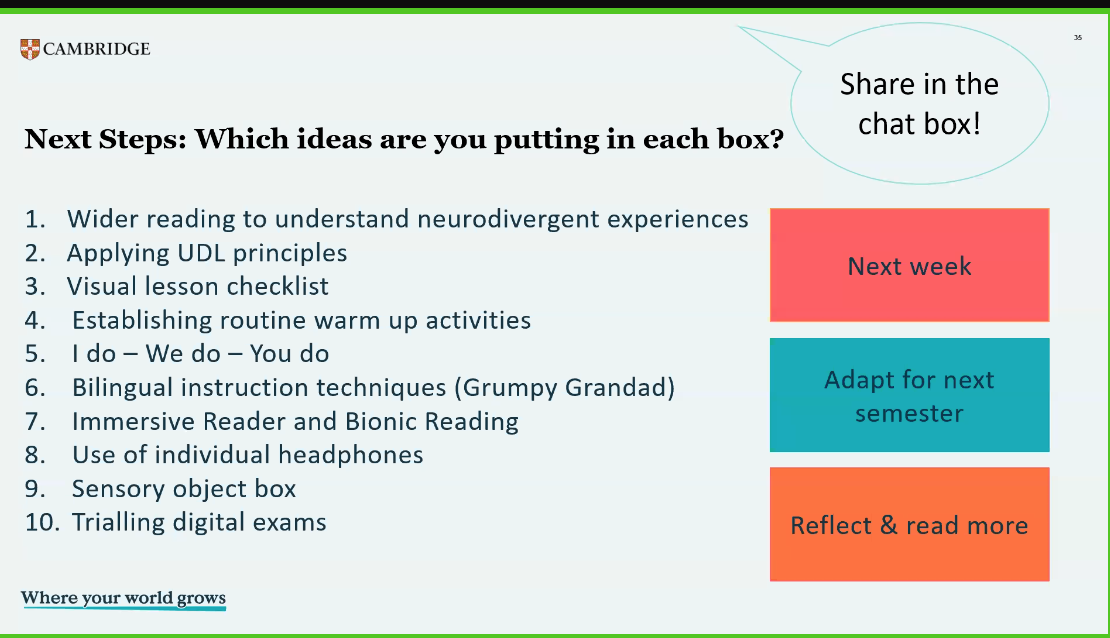
All of the ideas shared today are tried and tested!
We repeated the poll from the start of the webinar. There have been some changes since the start, more people feel confident: 4 and 5 have increased while 3 has decreased.
Resources:
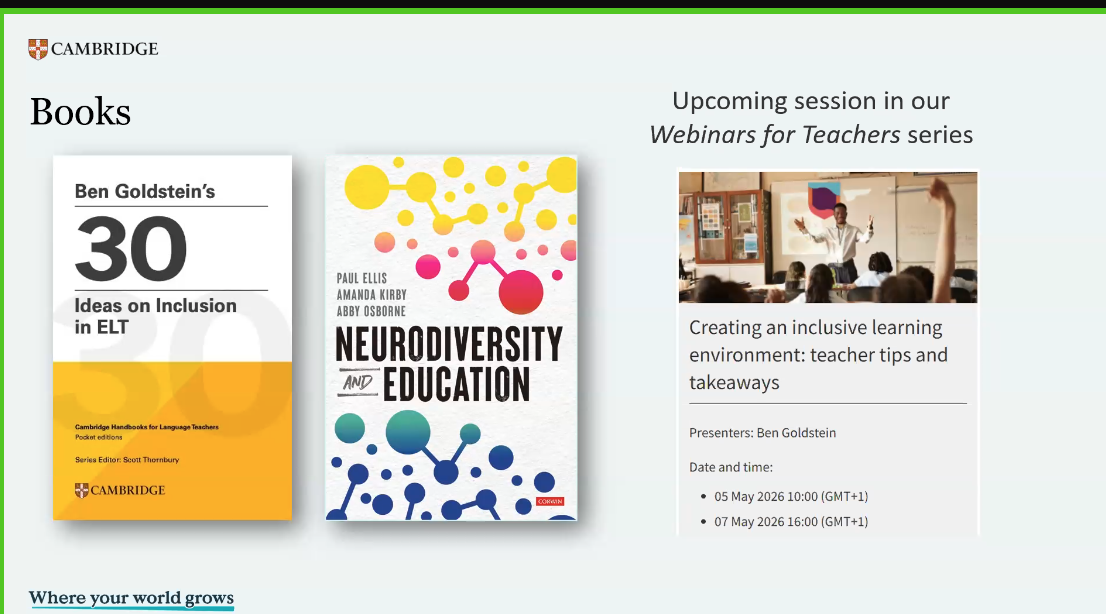
The middle one, Neurodiversity and Education, I didn’t know about – looks interesting! (On a non-Cambridge note, Pavillion ELT recently brought out English Language Teaching in a Neurodiverse World.)
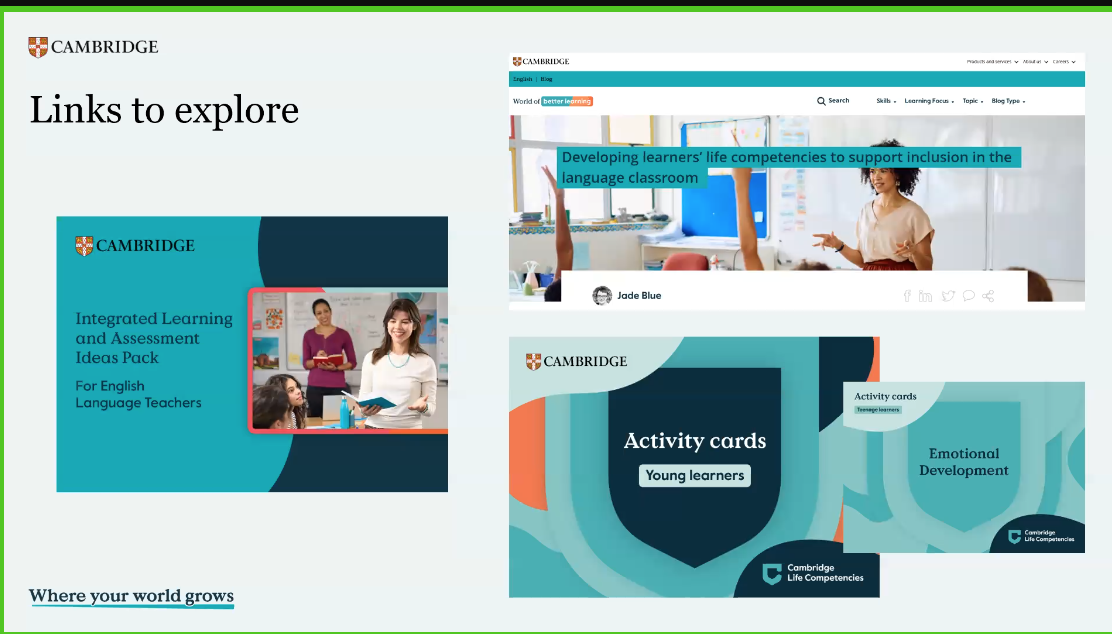
And some more cambridge stuff!
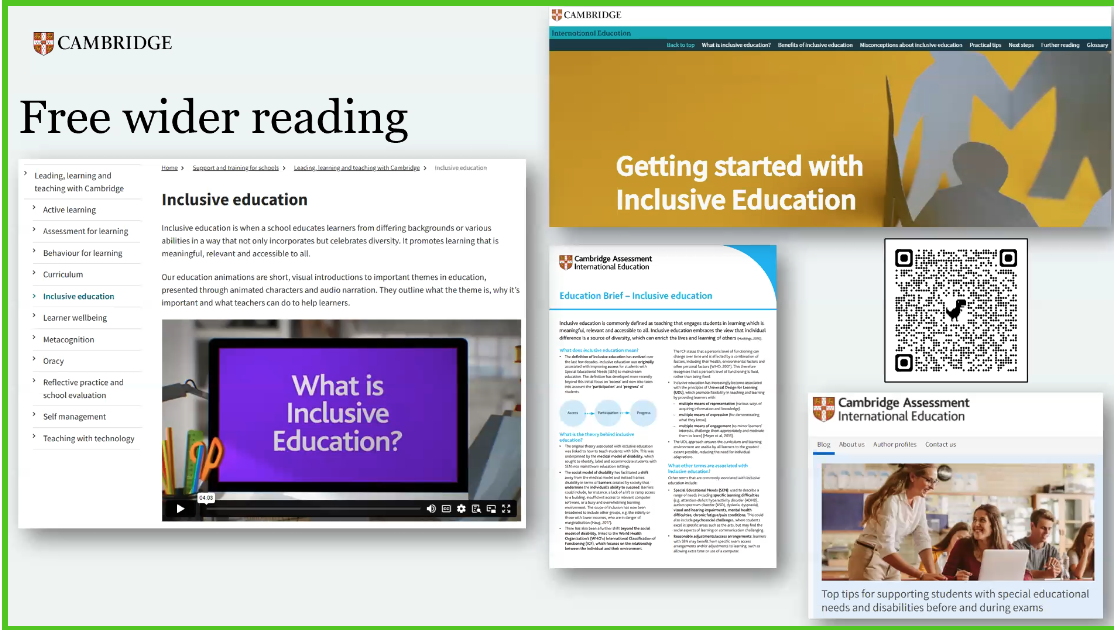
…And some more!
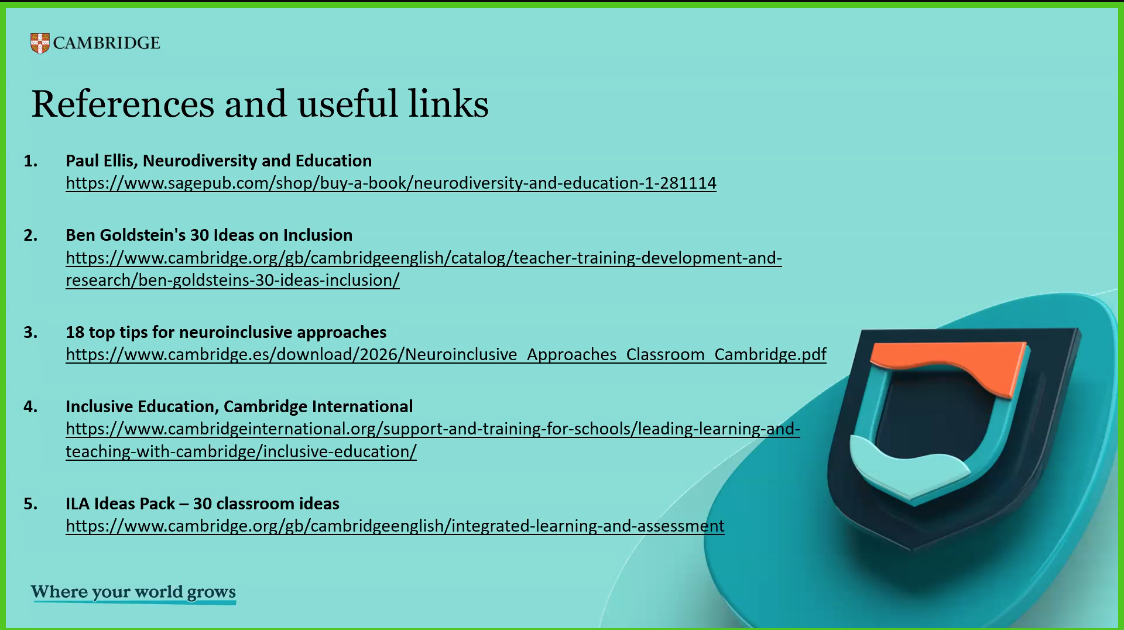
…and in list/link form.
Two webinars in one day was a lot! Anyway, it’s so nice to see neurodivergence being acknowledged and talked about in ELT in recent time. Hopefully, while it seems to be a current theme, it will not just be a passing craze! I have so much buzzing around in my head relating to inclusion and relating to group dynamics, and all the sessions I’ve attended this year so far, and all of it in relation to classroom practice. What I don’t have is time to really think deeply about it all and bring it all together (so much time pressure around other things right now)! Though on the plus side my end of semester feedback from my class in terms of learning envrionment was really positive this year for both semesters, so what I have been doing in relation to these things has nevertheless been well-received by students.

