Neurodiversity: inclusive pedagogy, fostering effective learning for all (Cambridge webinar)

My second webinar for the day! (Now yesterday!)

Speakers: Paul Ellis and Kate Trafford from Cambridge International dn Cambridge English respectively.

Hoping to: understand principles of inclusive pedagogy and build a tool box of inclusive classroom ideas to support all learners.

Terminology:

Neurodiversity: different ways that we all think, move, hear, see, understand, process, information and communicate with each other. We are all neurodiverse. This describes variation in peoples’ minds.

Neurotypical: the group whose thinking, moving etc reflect social or cultural norms, the typical way.

Neurodivergent: the group who have a type of brain often considered different from the socially constructed norm.

This reminds us that there is no single way that we learn. Our language needs to be up to date and inclusive. Inclusive terminology is important.

We started with a poll. How much do you agree?

  • Differentiation like giving dyslexic learners separate worksheets is the best way to creat an inclusive classroom.
  • Inclusive teaching practices are beneficial for all students, not just those with learning differences.
  • I feel confident teaching neurodivergent learners and have many strategies in my teacher toolbox ready to use.

Paul and Kate’s principles: a holistic view

Equitable outcomes for all students – with or without a formal diagnosis. In some countries you can get a diagnosis for e.g. autism, dyslexia. Today we won’t be talking about specific conditions but rather inclusive education for all. The focus is on removing the barriers and not changing the learners themselves, just enabling them to show what they know and can do. Neuroinclusive approaches support all learners.

Performance = potential minus interference. (Timothy Gallwey, 1972) We all face barriers to performance that could be anything taht gets in the way of your potential to perform to your best. This can vary depending on the day, and what other influences there are going on. The good news is, you can use first class teaching strategies e.g. active learning, assessment for learning, self-management, UOL principles then you are already looking after a lot of learners in your class. Then only a small number of students will need also differentiated activities and testing, and additional support. An even smaller number will need personalised interventions.

Neuroinclusivity in education means a classroom culture that anticipates every kind of brain and removes barriers so that every learner can engage meaningfully.

Small consistent changes can have a big impact. Universal design for learning: divides into representation of content (multimodal, videos, quizzes, textbooks), action and expression (oral presentations, written text, digital portfolios, group work) and engagement and motivation (give choice and link units to relevant content and long-term goals).

Some common classroom behaviours and their possible causes:

  • difficulty getting started: can be due to not knowing where to start and having cognitive overload. Once working memory is too full, information cannot be processed so they may have difficulty progressing.
  • losing focus or “over-focusing”: can be due to lack of clear time or progress markers, not enough sensory or cognitive variation
  • emotional responses that seem disproportionate: learners may have a low sense of safety and predictability, or cognitive fatigue.
  • longer than average time to process spoken instructions: too much demand on working memory demands and auditory processing load.
  • sensory discomfort (light, noise, seating, temperature): learner is experience sensory overload from their environment which creates a barrier to learning and ability to complete tasks.

Environmental barriers are not learner deficits. The barriers are task design, instructions, pace, sensory overload and relational climate. Inclusion shouldn’t result in extra work, it is small, consistent adjustments that remove barriers for learners.

Neuroinclusive practice: removing the barriers

Part 1: Quick wins

  • Immersive reader: It is on Microsoft word but Apple has an equivalent. What you see is you get tabs that enable you to change page colour, text spacing, a read-aloud function, live focus which enables you to focus on one line at a time. Which of these things help depends on the individual. (Google docs enables you to change the page colour in page set up! I use that!)
  • Bionic reading: some parts of each word are in bold. Again, whether it is helpful depends on the individual. You need to involve the students not decide for them.
  • Different colour backgrounds: on paper or plastic coloured overlays.
  • Fonts: use sans serif fonts e.g Arial, Tahoma (we like Open Sans at work!)
  • Use a visible clock: to help students manage time especially during tests, exams and timed activities.
  • After asking a question, count to three before calling on anyone. Pause and then give them a chance to respond. (Usually teachers give 0.7 seconds for learners to respond. Waiting time is so important! Don’t be scared of silence!)
  • Vary the way you call on learners (e.g. written responses on a mini-whiteboard) (Wooclap is a digital example we use)

Part 2: long term strategies

These might take a bit more planning but will be very worthwhile. These are built on 6 core elements, 3 of which (the 3 in bold) we will focus on today:

  1. creating a clear lesson structure
  2. incorporating appropriate technology (if found beneficial)
  3. adapting the learning materials (e.g. level or physical nature)
  4. explicit classroom delivery and instructions
  5. integrating learning and asssessment
  6. setting the right environment

Creating a clear lesson structure

Have a visual lesson checklist. Use the pages of the coursework/resource as a springboard for your lesson.

  • Share learning objectives at the beginning of class so students know the starting point and the goal for the timeframe of the lesson.
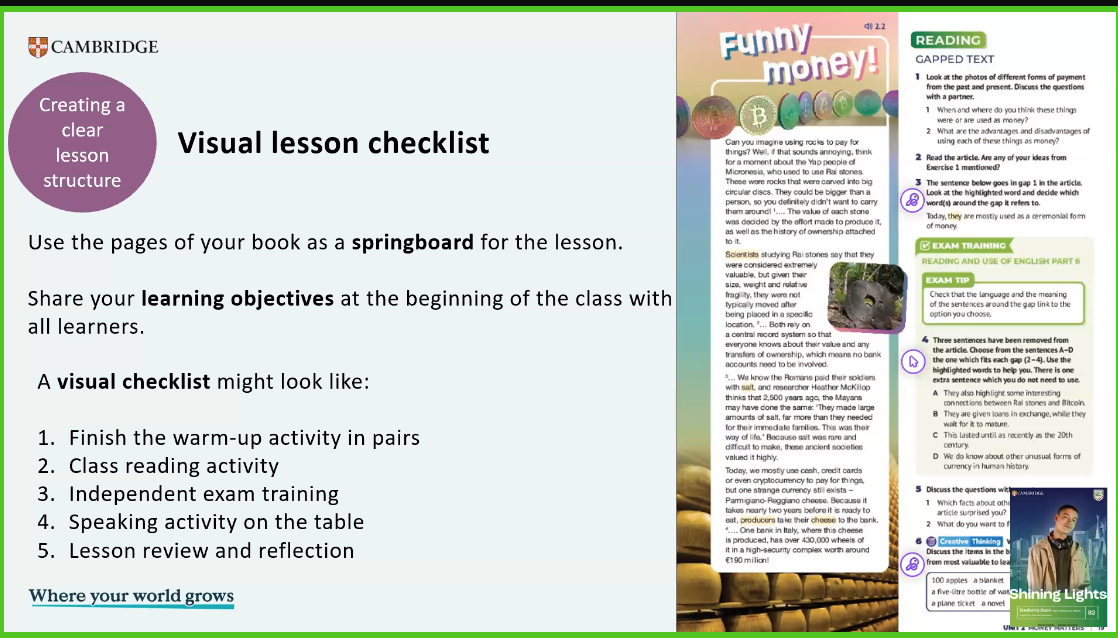
If that checklist is only given verbally, it will be forgotten. If written down as a checklist, it will help keep learners on track, and help them maintain focus.

3 different ways to present a visual checklist:

  • AI generated: number, icon, description
  • whiteboard clipboard with numbered descriptions
  • pinboard note with numbered summarised descriptions

Try different ones, see what learners prefer.

Establish a clear and consistent routine. This allows a positive start to the lesson and review prior learning. It creates predictability so students know what they are coming into and what will be expected of them. This creates a psychologically safe environment. It also allows you to address any issues that arise and take the register quickly and quietly. 5-10 minutes is it all it takes. This can be any kind of do-now activity that students do as soon as they come in. If you have multiple lessons per week, you could have a particular routine for Lesson 1 of the week, Lesson 2 of the week etc that is the same each week.

Explicit classroom delivery and instructions

I do – we do – you do: teacher models, students do all together, student does individual attempt. This can help avoid cognitive overload and achieve a sense of teamwork as you are doing it together. Teacher writes a sentence, students complete it on mini whiteboards, students do an individual activity.

Use a variety of instruction techniques to ensure learners are following the class rhythm. Bring L1 into the classroom: get learners to explain the instruction/activity/concept to a grumpy grandad who doesn’t speak English (maybe be a bit less specific incase someone’s relative just died…)

Another example is: Say it, show it, write it, repeat it.
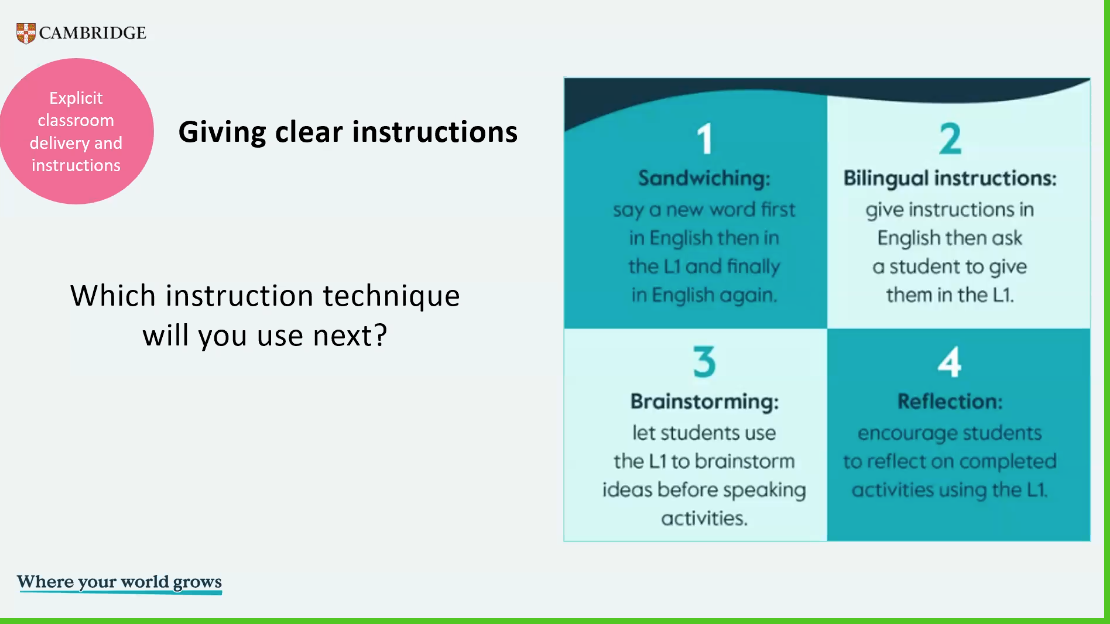
These ideas allow L1 into the classroom in a small, controlled way to check understanding.

Setting the right environment:

Sensory objects: when learners can channel their energy, they have improved concentration. Learners can have a specific sensory object of their choosing which they keep with them. Can take it out when needed. You could have a selection box for learners to choose from when they need a moment of self-regulation. This helps to create a safe environment. Being able to choose their own one encourages agency.

Individual headphones can be useful: excess background noise can be very distracting. Headphones can also be used for listening to audiobook or listening and reading a text at the same time.

Digital exams: What could be the benefits for learners sitting a digital exam ? More focus, fewer distractions, more control, more empowering.

(I would add:

  • use natural lighting rather than overhead lighting where possible.
  • if you are using a computer connected projection screen, enable “Night light” (in display settings on Windows) to minimise glare.
  • have quiet activities in between the group activities to allow overstimulated students to have a breather )

We only looked at three pillars today. We will be able to look at others ‘for homework’ via some wider reading we will be given.

Keep in mind:

  • neuroinclusive approaches support all learners
  • these approaches are good for adults as well!
  • focus on removing the barriers and not changing the learners
  • good teaching practises are inclusive teaching practices
  • small actions applied consistently lead to great impact

Next steps:
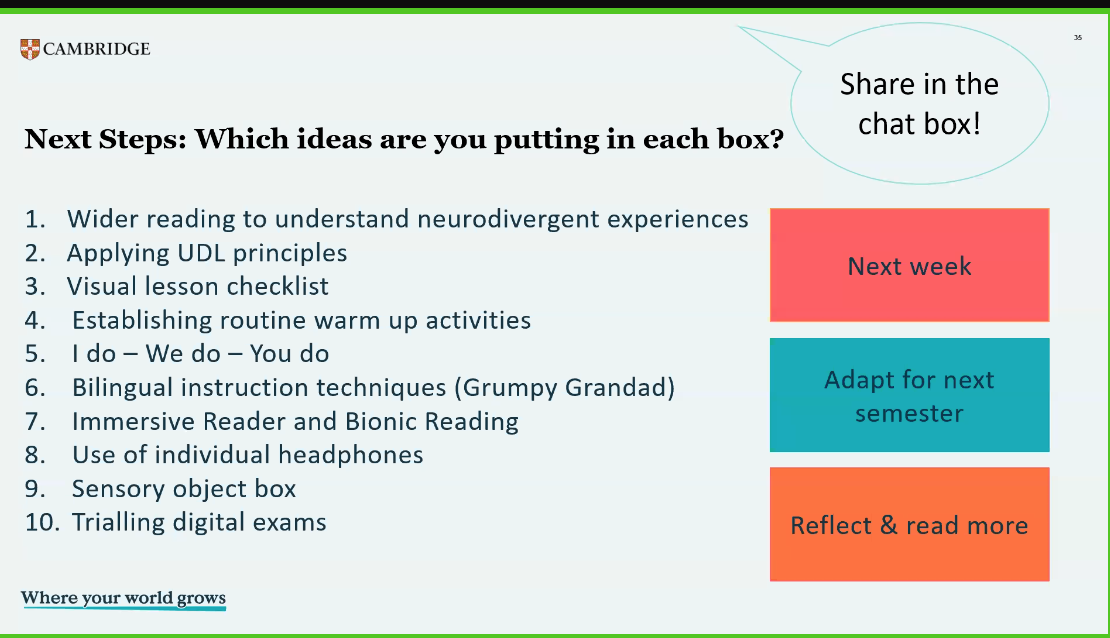
All of the ideas shared today are tried and tested!

We repeated the poll from the start of the webinar. There have been some changes since the start, more people feel confident: 4 and 5 have increased while 3 has decreased.

Resources:
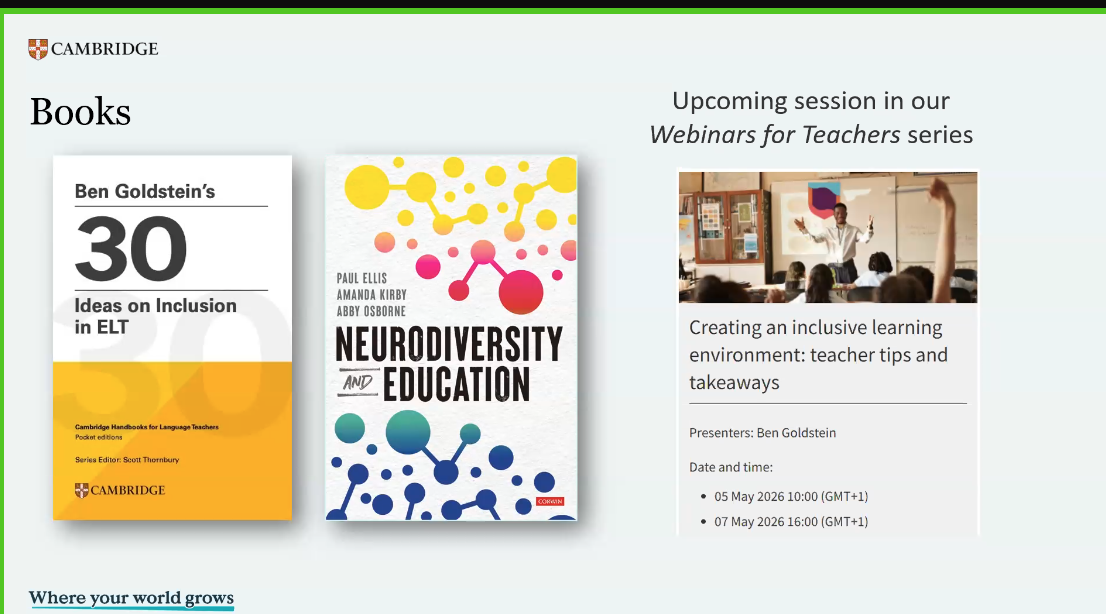
The middle one, Neurodiversity and Education, I didn’t know about – looks interesting! (On a non-Cambridge note, Pavillion ELT recently brought out English Language Teaching in a Neurodiverse World.)
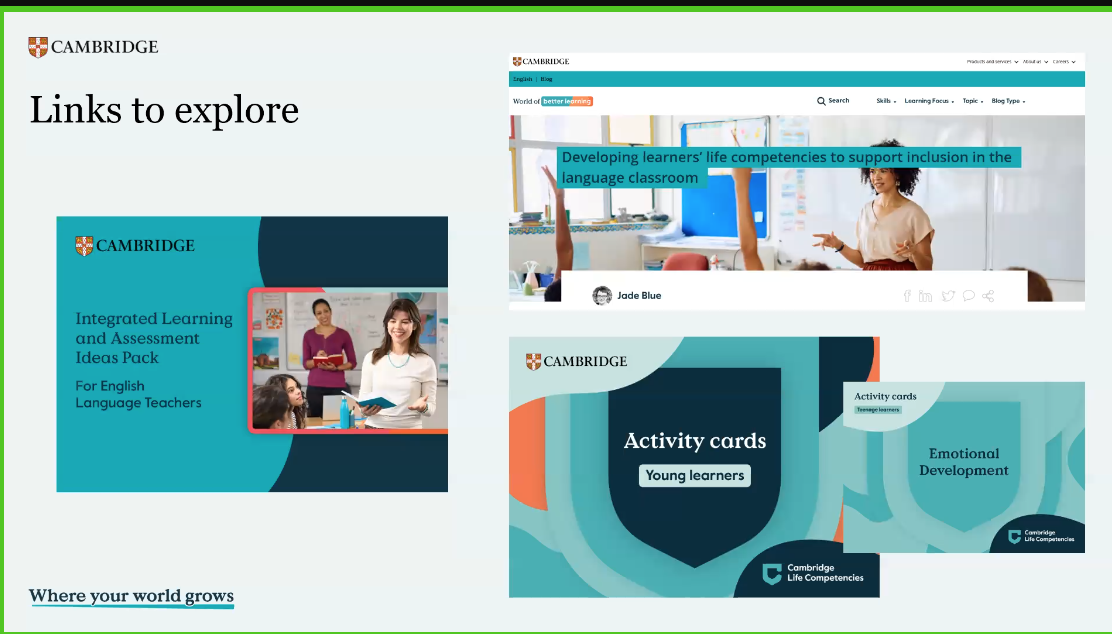
And some more cambridge stuff!
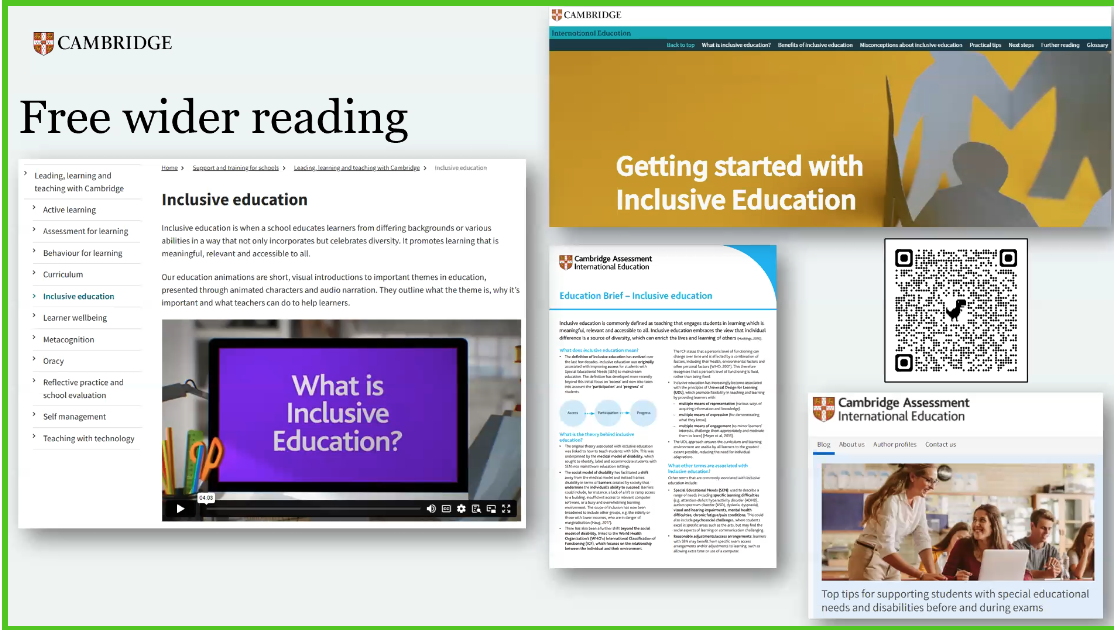
…And some more!
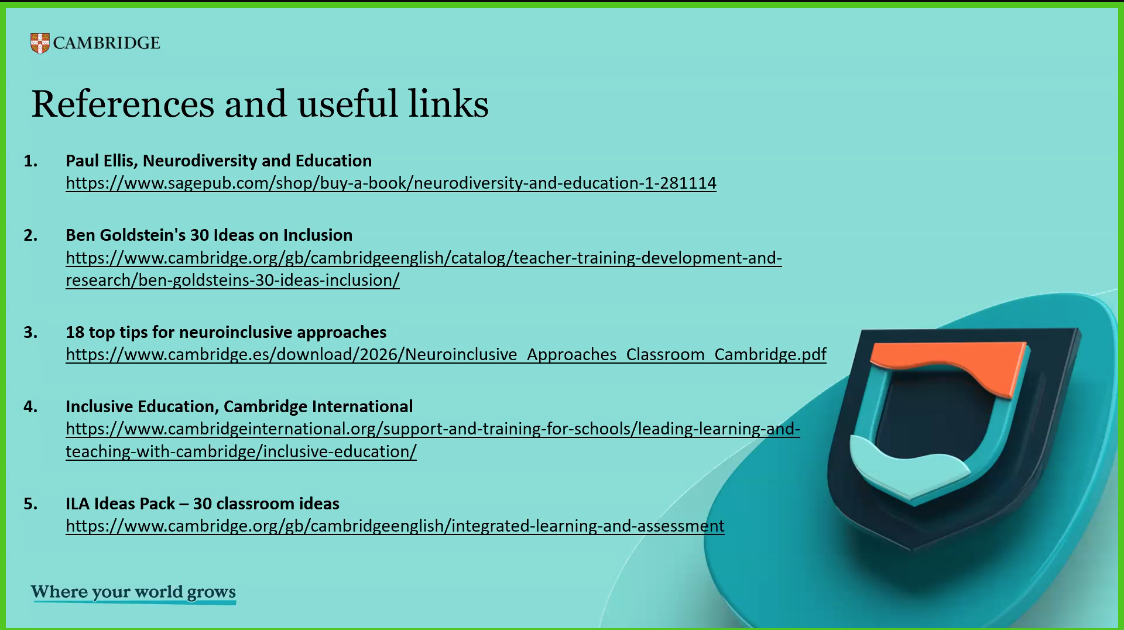
…and in list/link form.

Two webinars in one day was a lot! Anyway, it’s so nice to see neurodivergence being acknowledged and talked about in ELT in recent time. Hopefully, while it seems to be a current theme, it will not just be a passing craze! I have so much buzzing around in my head relating to inclusion and relating to group dynamics, and all the sessions I’ve attended this year so far, and all of it in relation to classroom practice. What I don’t have is time to really think deeply about it all and bring it all together (so much time pressure around other things right now)! Though on the plus side my end of semester feedback from my class in terms of learning envrionment was really positive this year for both semesters, so what I have been doing in relation to these things has nevertheless been well-received by students.
Cambridge Online Day session – Creating an inclusive learning environment: Teacher tips and takeaways (Ben Goldstein)

This session is part of a Cambridge day of webinars. I saw it advertised and had to break my not working at the weekend rule because it sounded too good to miss!

Ben will be talking about inclusion today. There will be a little bit of theory and some practical tips. Sounds awesome! (If anyone attended, or if Ben reads this – unlikely – and thinks I got anything down wrong, please do comment and I’ll be happy to correct it!)

Ben starts by asking: What do we mean by inclusion?

We had to write down in the chat what we think inclusion means. He said use nouns: I came up with welcoming, belonging – others said equity, fairness, embracing differences, differentiation, special educational needs, acceptance, empathy…

It’s a big topic, involving a lot of areas.

The next question was “Why is it important?” My answer: Because everyone has something to bring to the table so we need to make space for them. Everyone deserves a chance to be there. Others said it’s about not being an outcast (and other things I didn’t catch quickly enough to write down).

Inclusion may mean different things to you depending on who you are, your context, etc.

Ben’s view: Inclusion is about recognising, respecting and learning from the “other”. It is important because everybody should have the same rights and opportunities. This strengthens social cohesion.

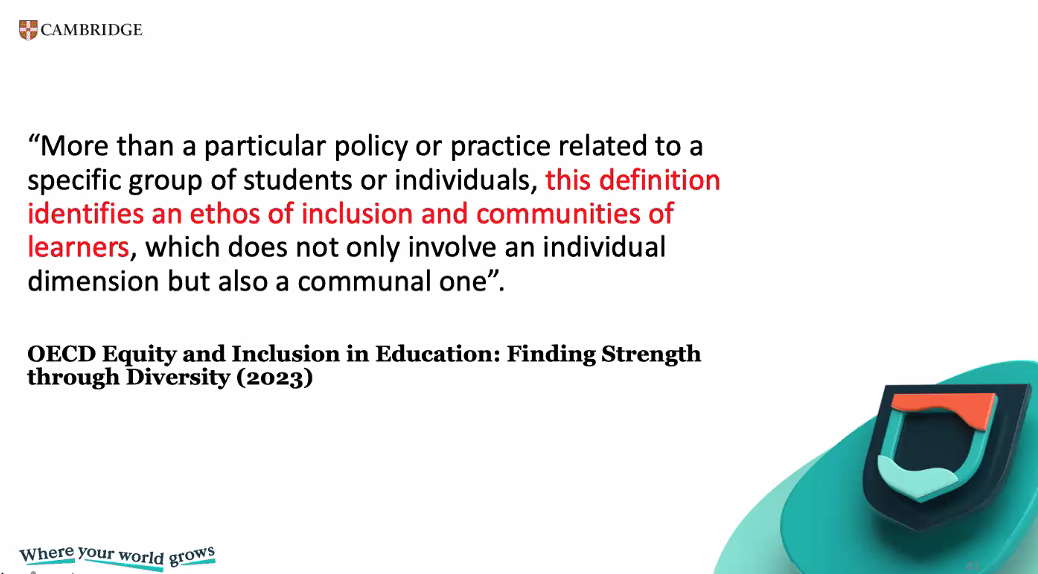
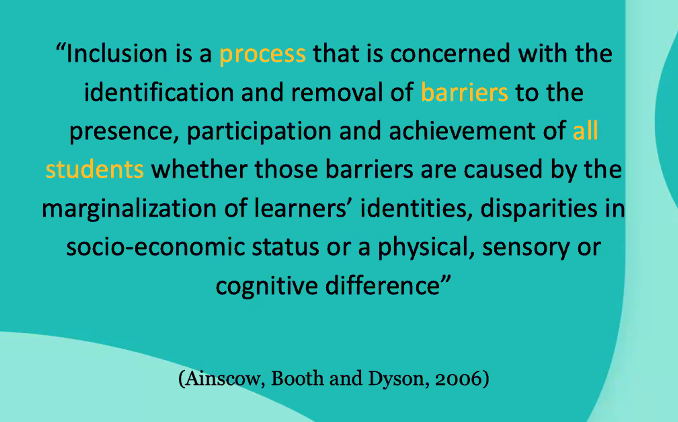
He then shared a view from the literature:

He said keywords were “process” and “removing barriers” and “all students” – not only valid for special educational needs but for everybody.

Equality/Equity, Inclusion, Diversity were the next terms that Ben wanted to unpack. What is the difference between equality and equity?

If you look up EDI/DEI online, sometimes E stands for equity and sometimes equality. But they don’t mean the same thing.

  • Equality is giving everyone the same thing
  • Equity is giving everyone what they need. Giving everyone the same doesn’t help because everyone doesn’t begin from the same place. Giving everyone what they need is what we should aim for. Focus is on fairness and opportunity.
  • Diversity focuses on acknowledging, respecting and celebrating differences. It focuses on representation.
  • Inclusion is the specific ways in which Equity and Diversity are realised. So the focus is on participation.

How can inclusion be understood in a language learning/teaching context?

Ben recently ran a course on inclusive practice and got students to say what it means to them in their context.

Ana from Quito, Equador: For her inclusion means removing barriers, not lowering expectations. Students face barriers related to different types of things – language, cultural, background – not only physical or cognitive challenges. It’s about trying to anticipate these barriers and try to allow students to understand what you are teaching them. It’s about flexibility as a teacher. It’s important to have different strategies and materials and supports that can help any students that don’t follow a certain way. It also means creating a classroom culture where everyone feels valued and safe. That’s the first step and the most important one. If they feel safe they will be able to take risks and participate and feel like they are being supported and heard. Once you make a safe space for them for the students to feel part of, then anything else can move on. Something we should talk about constantly among colleagues and promote constantly.

After playing the video, Ben underlined the “it’s about creating a classroom culture where everyone feels valued and safe” and that it is a continuous process. He chose Ana’s video to show us because she emphasises this.

It’s the space that you create with your learners that allows them the opportunity to participate. The most important ingredient. (Yesss! I agree so hard!!!)

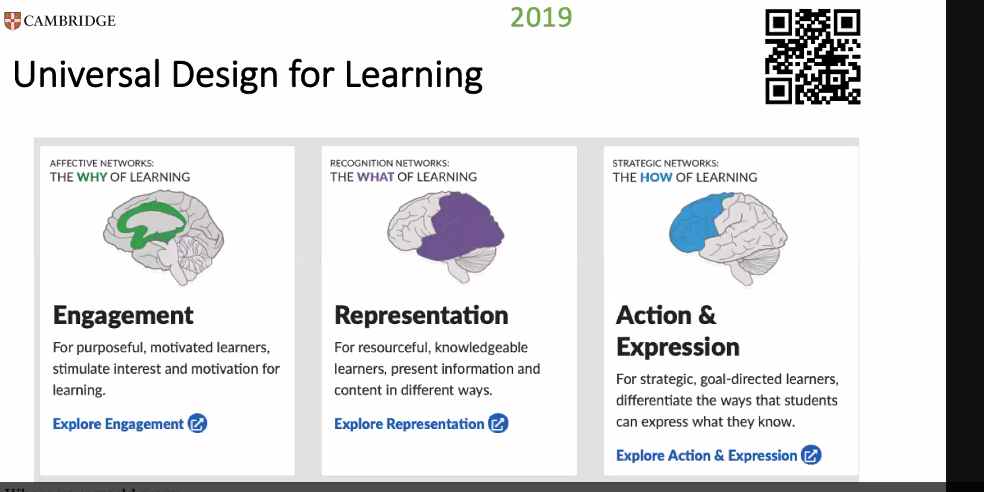
Universal Design for Learning:

It’s a practical framework for inclusive practice in education in general, also appropriate for language teaching. 3 central ideas.

  • The idea of engagement: how do you get your learners motivated? How do you stimulate their interest?
  • Representation: how do you present th information to them so that they find it accessible?
  • Action and expression: how do they express themselves/show what they know?

These 3 ideas are a very good way to think of practical applications for inclusive practice.

UDI allows us to be people led rather than label led, allows for intersectionality. Ben’s approach is a holistic/whole person approach. Learner variability is the norm in class. You know they will be very different from each other as well as sharing things. We need to account for this from the outset in our methodology and materials. You get to know your students on a human level as people not jus as students and this can allow you to adapt your material to them. An inclusive approach must be seen as beneficial to all. Our goal is for everyone to feel connected and belong.

Tips and takeaways for the classroom

Best practice: include frequent breaks, allow more time/use silence, make it visual (use colour), chunk it (break down instructions, write them up on the board), review language/concept check more, vary activities, allow freedom to move.

Doing these things is already being inclusive. It’s not rocket science. But we may not understand it as being inclusive, the difference is in the way we frame it.

  1. Offering choice
  2. Building a community
  3. Using and respecting learners’ own language
  4. Developing empathy

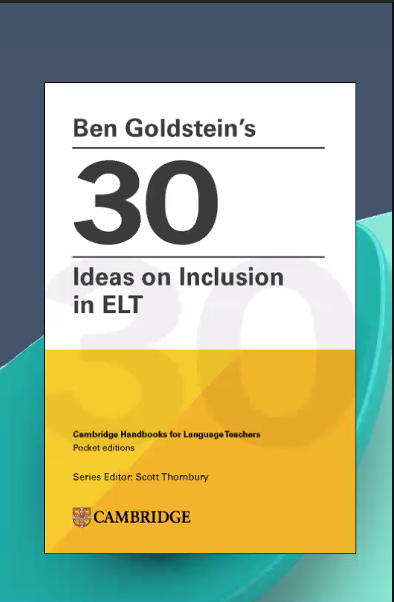
The above 4 takeaways come from Ben’s book 30 ideas on inclusion in ELT. Some of the ideas talked about now come from the book.

Offering choice is fundamental. How can we offer students choice? Choice of discussion, choice of who to work with, choice of task/topics. This is about being flexible with students. Ben offers:

  • seating arrangements
  • project/presentations (poster, essay, video) – related to action/expression in UDL.
  • Roles (research, organiser, spokesperson). Responses to text (describe a personal connection, answer comp questions, summarise…).
  • Goals (identify personal goals and established ones) – this becomes apparent when you get to know students on a personal level.
  • Review and reflection (logs/journals) – we all do this in different ways (e.g. today some people will be making notes, typing, or just listening and processing). Give learners choice on how they reflect.
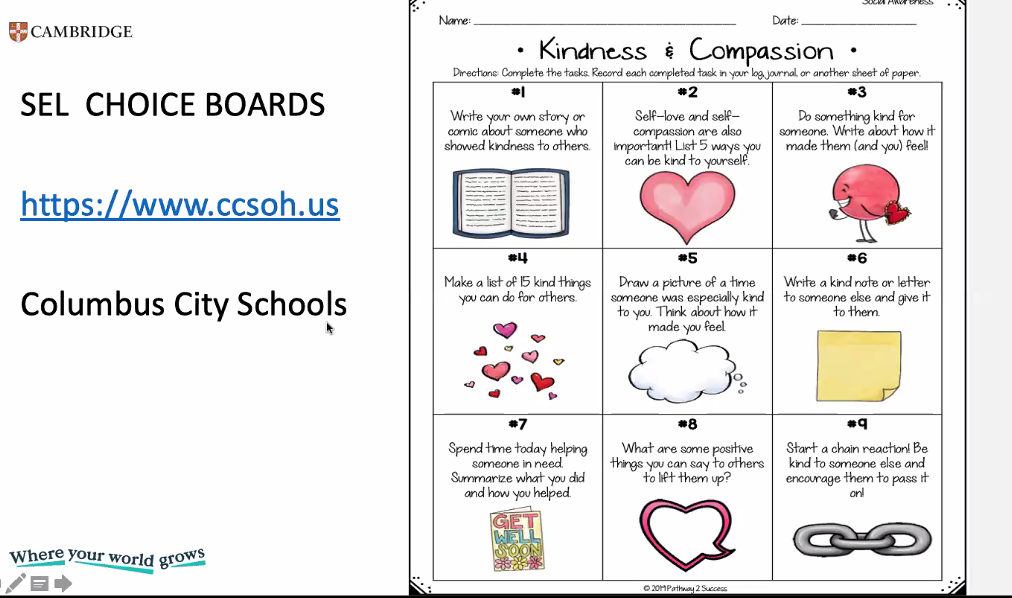
  • Choice board – students can choose which activity to do. Google choiceboards to find more examples.

Building a community: classroom contracts. Many are familiar with this. Inclusive pracice is not rocket science, but with familiar things we can give an inclusive twist. E.g. for adult learners, add things like listen carefully to other people’s opinions and do not interrupt. Do not jump to conclusions or make assumptions, be curious and ask questions. Respect the student if you disagree. When showing disagreement, criticise the idea not the person. Keep an open mind with the expectation of learning something new.

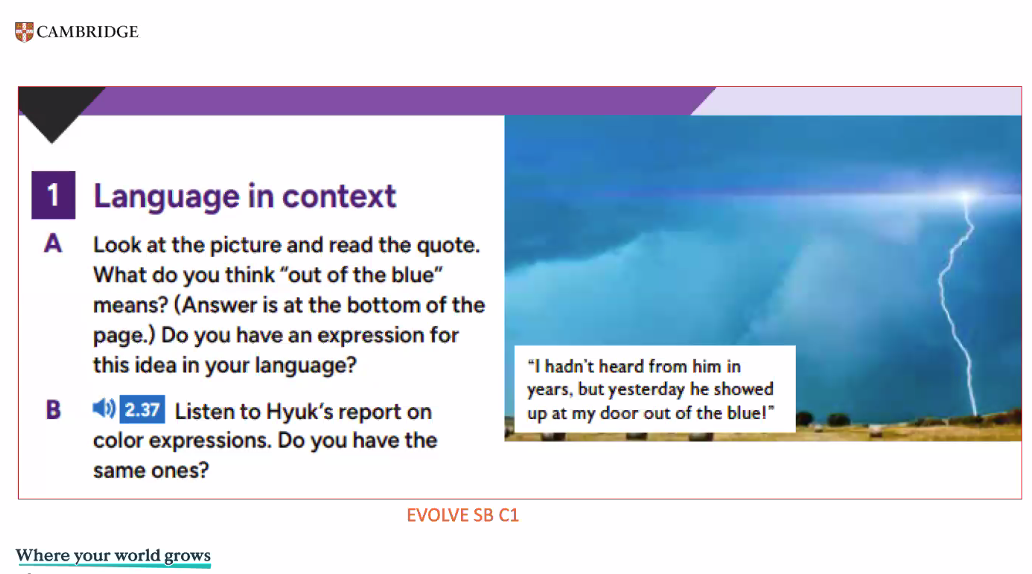
Using and respecting learners own language: It is important to acknowledge and respect learners’ language. A plurilingual approach is encouraged by the European Framework. How can we use it?

  • Activating schemata/brainstorming ideas can be in L1, then summarise those ideas/reformulate in English. This can save time. This may enable more sophisticated ideas.
  • Provide input in L1 and then learners respond in English.
  • Own-language moments (e.g. self evaluation, contrastive analysis).
  • Sandwiching – e.g. give the instruction in English, translate into L1, then give the instruction again in English. This way students get an ear for the important instructions.
  • Conduct an own-language survey: at the start of tern, ask learners to share languages they speak/understand, how the learned them, how they use them.

A way to get them to reflect on their own language/culture in contrast with others:

Developing empathy: One way to develop empathy is to tell stories. Ben tells us a story about Hong Kong island, working with teenagers from quite wealthy backgrounds who weren’t particularly motivated, there because their parents wanted them to be. They all had English names. A lot of them liked having English names, made them feel part of the English class. One day he had to do a substitution class in Kowloon, was reading out the register, one of them didn’t have an English name, he didn’t want one. The others started laughing at him for that. Ben stopped the class and said listen if he doesn’t want an English name, that is ok, we need to respect that choice. The next day in that class again, and this time the other students were all ok with it. He realised something imorant: when we talk about empathy, we don’t just mean between teacher and students, but also among students. He realised he had to make sure they valued him and his choice. That was 25 years ago.

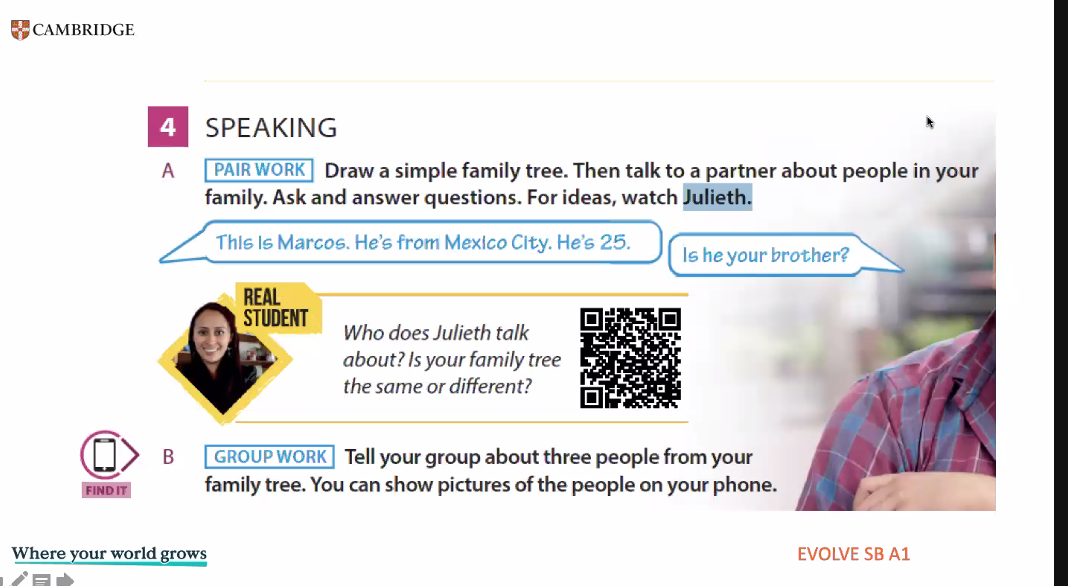
This is focusing on a humanist idea of education in terms of the role of teacher and learner. In Evolve (coursebook), they have students from different countries who are the same level as the coursebook user. When the student does an activity, they watch a video of someone like them doing it. See example below:

Closing thoughts

(There was no time for inclusive materials part of the session, but there will be another webinar about that he will be doing soon!)

  • A holistic approach to learning: Put the learner first not the label.
  • EDIB (what does the B stand for? Belonging. Why is it important? Because it should be the end goal. The need for social connection and identification within physical environments. Not a declared end state but an ongoing practice. It is not bestowed. No one is in a dominant position. Belonging emerges from meaningful contribution to group. There is a focus on community. Move away from just thinking about differentiation and teh individual and focus more on the classroom as a community.
  • Inclusion must be seen as an asset for all. No tokenism.
  • Be flexible, curious and kind.
  • Many changes can be made for free. Big changes can be made with small gestures. Not change your methodology overnight. Just one little change can make a huge difference in the environment of the class. Gestures made by teachers, school ethos, and in what we as a society decide we want for our future.

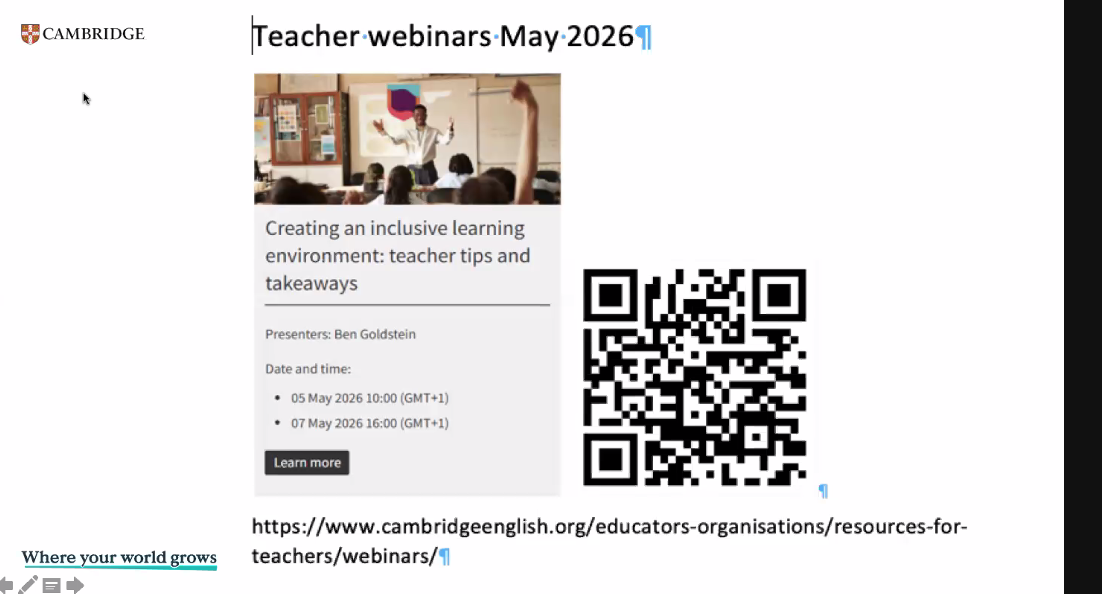
Ben’s webinar about inclusion in materials (yes please!):

Audience Question: Do you have any tips for inclusiveness for students who are troublemakers?

  • classroom contract
  • A chapter in his book – calling out and calling in – what to do in these situations. He will also focus more on this in May. You need to call out a student and having a contract helps with this. The contract is made with the students so that if the student is not following it and is causing trouble, then you can remind them that they participated in making the contract. Students can call out each other in this way too. Quite a complicated area, maybe requires a webinar on its own.

I have a lot of thoughts about all of this, and they tie in with a lot of my thoughts around everything I’ve read about group dynamics in the last year. But reflecting on and processing all that is far too much to tack onto the end of this already lengthy blog post summary so I shall keep that for another time! Watch this space… 🙂

University of Sheffield Workshop – Inclusivity: The Fundamentals (24/10/19)

Today (24th October – starting to write up on same day as attendance, remains to be seen if I will finish same day as well!), I was able to attend a workshop run by the university which focused on inclusivity. (Previously I have also attended workshops about mental health and supporting Chinese Students – there’s lots of good stuff available, it’s a question of whether or not it clashes with your timetabled classes! Today I was lucky again!)

Inclusivity: The Fundamentals

The Elevate team started by saying that inclusivity is a broad topic and that today’s session would provide an overview of current inclusivity best practice and tips on how to develop an inclusive curriculum/learning environment.

Inclusivity is an umbrella term and definitions with regards to what is included within it have changed and developed over the years. 10 years ago it was limited to specific support for students with specific disabilities: it was limited and focused. Now, it includes all of the following:

  • support for specific disabilities e.g. dyslexia
  • support for international students
  • accessible measures that benefit all students
  • sense of belonging
  • retention/success
  • decolonising the curriculum

One aspect of the university’s current teaching and learning strategy is as follows:

“Developing inclusive curricula, to close attainment gaps for students from under-represented groups and to foster a sense of belonging for all students, with equal opportunities for all to succeed.”

Good inclusive practice and good teaching/learning practice have a lot of overlap. Our first task was to think about and discuss what we already do that is inclusive. People from various different university faculties/departments were in attendance, including two others and myself attached to the ELTC (one from the main ELTC, one who mainly does DLP, while I of course hail from the USIC arm), so it was interesting to hear from a range of subject areas.

My brainstorming points were:

  • scaffolding in terms of assessment (KIP 4)
  • formative assessment that teaches students how to approach summative assessments (KIP 4)
  • clear instructions (KIP 1)
  • variety of task types (KIP 2)
  • using models (KIP 4)

(Interestingly, a colleague from the journalism department, upon hearing that I work at USIC, told me that the students they get from us are often reticent to speak up, and one way of overcoming that which she has used is to incorporate mobile phones into activities, for example by using Padlet for brainstorming.)

What is a KIP, I hear you asking?

KIP = my shorthand for Key Areas of Inclusive Practice, of which there are 6:

  1. Academic Community
  2. Classroom and Accessibility
  3. Technology
  4. Assessment
  5. Feedback
  6. Evaluation and Review

We looked at each area in turn.

1. Academic Community

Why is this important? The more somebody feels part of and represented in a community, the more they will achieve. They need to feel they have a place. As teachers, we need to bolster that feeling. We need to remember that this is an unfamiliar, intimidating environment for students who come to us and to help them feel at ease. We need to respect their identity e.g. call them by the name they wished to be called by (I always ask students what they want me to call them!) and use the pronouns they want us to use for them. In this way, they will feel more accepted.

Language use also comes within this area. Basically, use plain English! Of course, this is an issue more for university departments, as ELTC folk are used to grading language for obvious reasons! It’s nice to see that the importance of not being jargontastic and of explaining specific terminology clearly is being highlighted at university level.

It’s also important to involve students by letting them have opportunities to feed back (in a variety of ways) so that their experience of your classes is communicated clearly to you and can help inform what you do.

2. Classroom/Accessibility

Accessibility is not only about the physical space (e.g. the classroom), but also about how materials are presented and how lessons are delivered. For example, classroom materials should be representative of the students you are teaching. It is also important to get to know your students and what they are bringing to the room, as their prior learning experiences may be very different from what you are expecting of them in your classes. Using a variety of activities means that you don’t repeatedly advantage or disadvantage particular groups of students. Neurodivergent students may be excellent lateral thinkers, in activities which require this their peers can learn a lot from them.

The university has a lot of support available. It would be helpful to signpost different aspects of it to students at point of need e.g. highlighting the existence of WAS to students about to embark on their first essay assignment. Try to look for opportunities in the curriculum where different things could be highlighted/referred to.

3. Technology

There are lots of different ways that students can use technology to access learning in a more suitable way for them, for example screen readers for partially sighted or blind students. Keeping this in mind, it is important that we optimise our materials for use by these students. One way of making sure that course materials are accessible is to use Blackboard Ally, which is a tool that measures the accessibility of materials for staff and allows students to download materials in whichever format is best for them (including audio). An example of making materials more accessible is including image tags so that screen readers can interpret the image for the students using them. Also, using the headings function in word to format headings means that the screen reader can differentiate between headings and normal text and incorporate that information into how the information is transferred to the student. When you put your materials through Blackboard Ally, it will give you a score (Red, Yellow or Green) depending on how accessible they are.

Another way we can help students is to use consistent online methods for assessment and try to work towards having VLE navigation consistent across modules so that students don’t have to learn how to access the VLE for their various modules in completely different ways from module to module. To make this easier, there are templates in Blackboard that can be used.

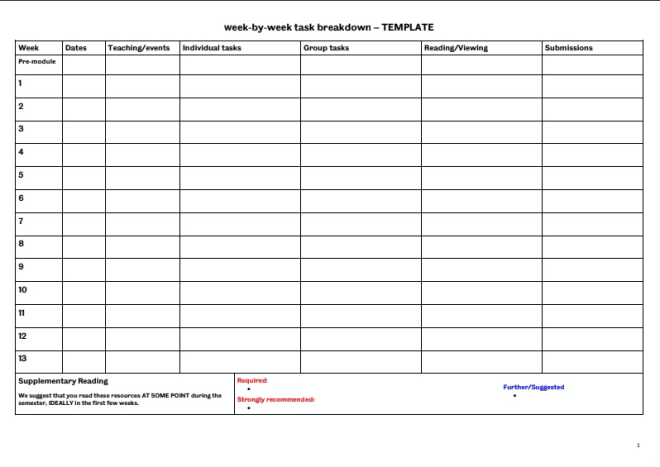
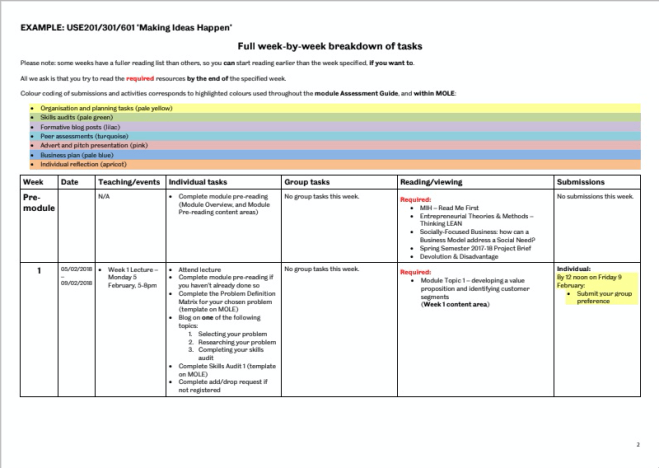
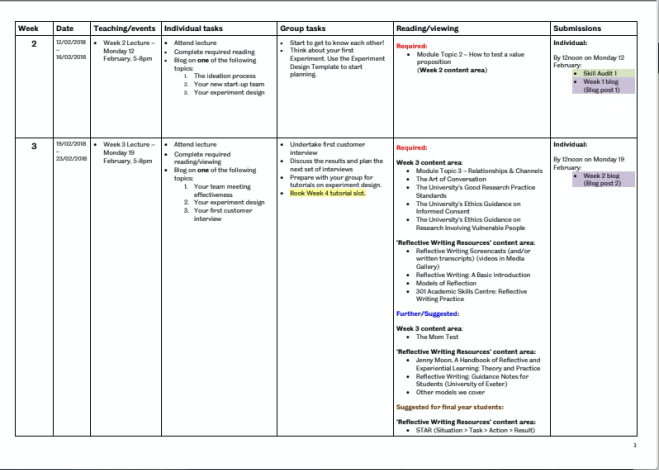
Here is a week by week task breakdown template and an example of how a completed one might look:

Using colour coding is helpful for students who are aided by the visual. There is recent legislation in the UK regarding accessibility online in the public domain, and university VLEs come under this. However, it is also just good practice. In terms of font, it is best to use a sans serif font such as calibri or arial as these are easiest to read.

Technology can also enable us to get feedback from our students in a range of ways. Even with very large groups, using feedback opportunities can help you get a better feel for your students’ needs/worries etc. For example, you could use Google forms or a similar tool such as SurveyMonkey, you could use Smartboard “Shoutitout” or any other brainstorming tool such as Bitpaper too.

4. Assessment

Assessment is very important in terms of inclusivity, as it is how we recognise and reward progress, and how we build up students’ skills. It is important not to assume that everyone will know/have experience of the assessment task type you are asking them to do. In order to help students understand what they are doing and how it fits into the bigger picture, refer to learning outcomes and go through assessment criteria with them. This way, they will understand what they need to do in order to be successful.

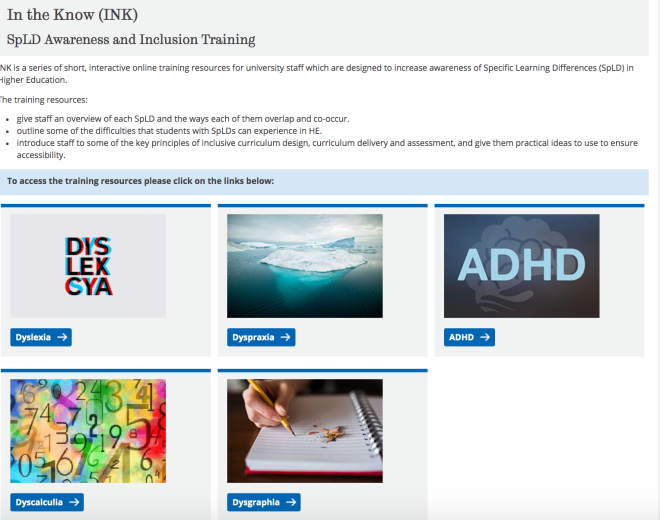
As teachers, it is also important for us to become more familiar with the effects that certain disabilities have. In the Know is a set of brief introductions to a range of disabilities that you can use as a starting point to broaden your knowledge. Below you can see which ones they have so far:

Where possible, use a range of assessment types so that students have opportunities to play to their strengths. For example, if a course is 100% assessed by exams, or 100% assessed by coursework, certain students will be disadvantaged in either case and therefore a mixture is preferred. Ideally, give students a choice of assessment types to meet their learning outcomes.

5. Feedback

There are a variety of ways to do feedback and it is important that we make use of this to avoid doing feedback in the same way every time. As with materials, tasks and assessment, doing things in the same way every time disadvantages and advantages the same students every time. It is important to ensure that students understand the role and function of feedback, and that you teach them how to use it most effectively to improve their performance.

6. Evaluation and Review

  • It is important that you make your expectations clear to students from the outset.
  • Collaboration with students will support more effective evaluation and review.

(I will come clean – this is the only thing I have written down in my notes here. Towards the end of the session so areas 5 and 6, the session deliverers noticed time was getting away and accelerated accordingly!)

The final task we did in this workshop was reflect on and discuss what three things we would like to take away and build on in our own departments. Here are the notes I made:

  • Week by week task breakdown template: we have a weekly syllabus at the front of our workbooks – could it be more effective? Could there be another document with more information/colour available on Blackboard?
  • Signposting support: could it be better integrated? e.g. signposting mental health services in conjunction with topic on social media and mental health? Need more familiarity with various services available in order to signpost them where relevant.
  • Student feedback opportunities: how shall I get feedback from my students for mid-term? (Midterm is upon us already!) – Discussion on Google+ community page? Use a Google Form? (Having talked to a colleague of mine, and got some inspiration, I have now decided to go with a Google Form!)
  • Consistency across modules: Do all the modules the students do within a given pathway at the college + AES use Blackboard in the same way with regards to navigation? Do we use those templates? (I have no idea, this was one to bend the ear of our tech folk about!)

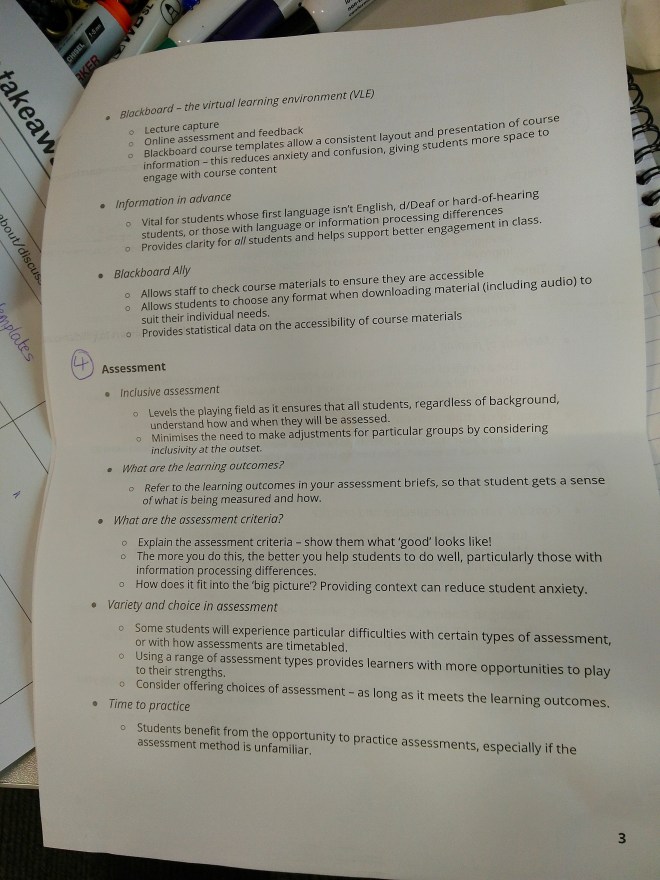
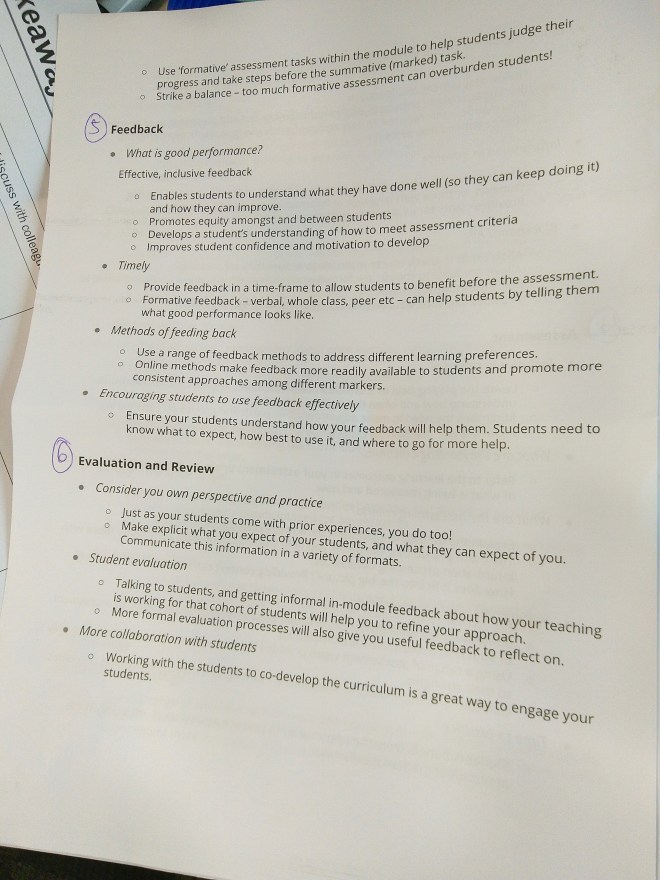
All in all it was an interesting workshop. Here is the handout we were given, which has a lot of information in it:

Hope this session write-up is of interest/use to some of you out there! 🙂