IATEFL 2016: Teaching Academic Listening: helping learners take control

My talk at IATEFL this year forms part of a forum on Listening. This means that a number of speakers, in this case 3, take 20 minute turns to speak about their topic. An additional 20 minutes are allocated to questions for all speakers. My co-speakers were Craig Wealand whose talk was entitled The power of podcasts for adult self-study and Ellen Servinis who spoke about Listening journals for enhancing skills and strategies. My own contribution, based on my experiences at Sheffield International Summer School pre-sessional programmes in 2014 and 2015, is called Teaching Academic Listening: helping learners take control. 

In the ten-week pre-sessional programme, which I taught on for both summers, as well as teaching your tutor group writing skills and guiding them through the process of producing an extended written project, each teacher is responsible for teaching one of the other skills (reading, speaking or listening) to their own and a further two groups. For me, that skill was listening.

Being a 20 minute talk, the structure was fairly brief and straightforward:

Screen Shot 2016-04-05 at 15.32.05

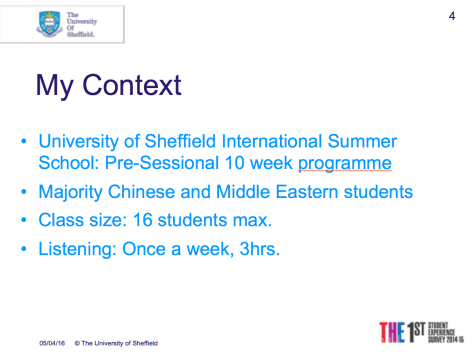
I started my talk by introducing myself and my context:

Screen Shot 2016-04-05 at 15.32.12


Screen Shot 2016-04-05 at 15.32.20

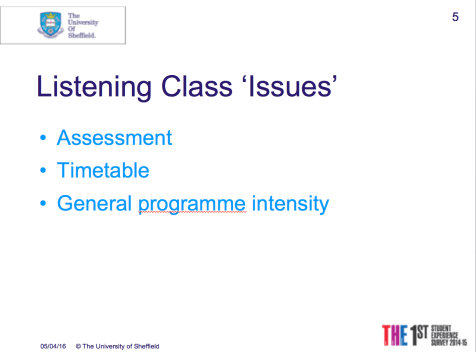
Next I highlighted certain ‘issues’ that I met in this context specifically in relation to my listening skills classes. I use ‘…’ because they are more just contextual constraints, the way things are. Nevertheless, here they are:

Screen Shot 2016-04-05 at 15.32.27

Assessment: Listening isn’t assessed directly at the summer school, whereas all three other skills are. Students are assessed via their projects and presentations, which directly tests reading, writing and speaking. Students who haven’t got unconditional offers do a proficiency listening test at the end of the course, alongside all three other skills proficiency tests, but they have specific classes preparing them for these tests.

Timetable: Students have one lesson of three hours per week, which is a lovely chunk of time. Of course, in between times a heck of a lot of stuff happens to them, in the form of classes for all three other skills plus a project class plus compulsory attendance at one lecture per week. Remembering what was done the previous week and carrying it forward to the current week isn’t necessarily straightforward! Yet, the skills development thread is constantly building on what has gone before, as learners are expected to use already learnt strategies and add new ones as time goes by.

General intensity of the programme: Students have a lot to do and as listening isn’t assessed directly (see above)it tends to be the one that they might let slip in terms of extra work.

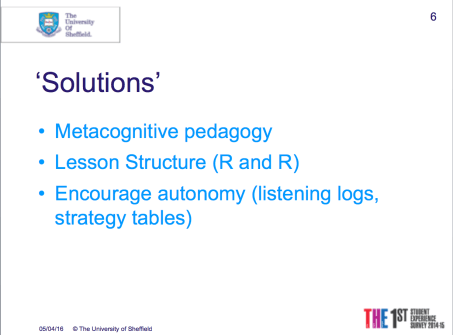
Having discussed these ‘issues’, I put forward the ‘solutions’ (no plasters, just little attempts I made to make things work in my context!) I came up with:

Screen Shot 2016-04-05 at 15.32.36

Which I then went on to expand upon.

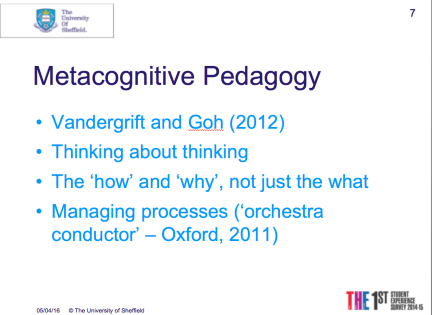
Metacognitive Pedagogy

Screen Shot 2016-04-05 at 15.32.43

Vandergrift and Goh (2012:kindle loc. 1995) define metacognition as “a state of consciousness of our own thoughts as we focus on a particular cognitive or learning situation”. Their proposed pedagogy for teaching listening focuses on helping learners become more aware in three main ways: of themselves as a person, of the tasks that they are doing and of the strategies that they can use to complete these tasks. Oxford (2011) gives us the image of an orchestra conductor (the learner) using their gestures (their strategies) to control the instruments of the orchestra (the cognitive activities) in order to produce a beautiful piece of music (an effectively completed task). Being such a brief talk, I could not go into a lot of detail regarding this pedagogical approach, but I recommend both books if this is a subject that interests you.

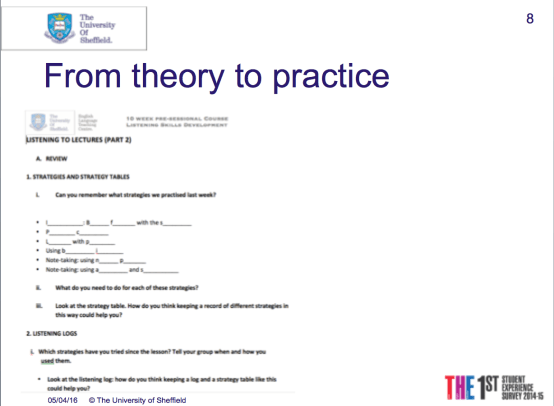
Next I went on to demonstrate how I put the theory into practice:

Screen Shot 2016-04-05 at 15.32.50

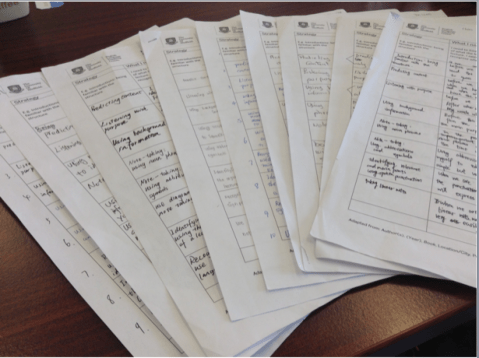
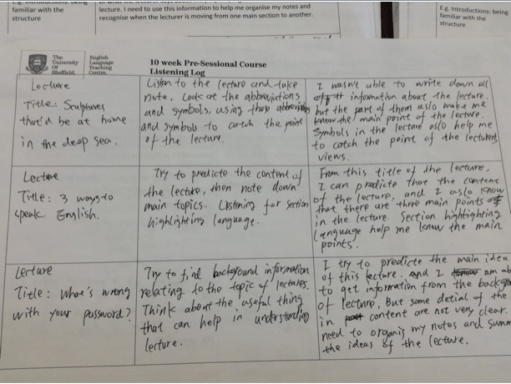
Here, you can see the materials I made for the second week of lessons. A week after the first lesson, I knew that students would struggle to remember what we had done previously so the first activity checks what they do remember. Both summers, students were unable to complete most of the gaps. Having guided them to the correct answers (encouraging use of last week’s notes etc.), I handed out the strategy tables for them to look at. This sequence guides them to an awareness of the utility of the strategy table, the “why” of it. Introducing the listening logs followed a similar sequence. I showed examples of each, both empty and completed:

Screen Shot 2016-04-05 at 15.32.59

Screen Shot 2016-04-05 at 15.33.16

Screen Shot 2016-04-05 at 15.33.07

Screen Shot 2016-04-05 at 15.33.23

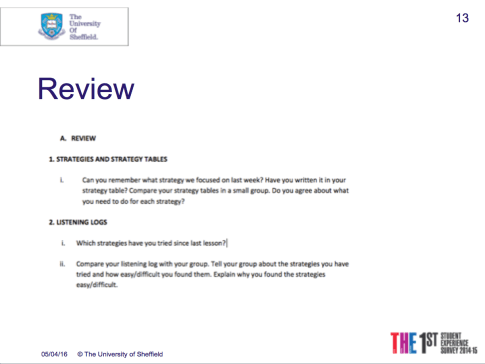
Reviewing strategies learnt in the previous lesson and listening done between classes acted as a means of ensuring that students brought their knowledge and experience forward to the current class:

Screen Shot 2016-04-05 at 15.33.31

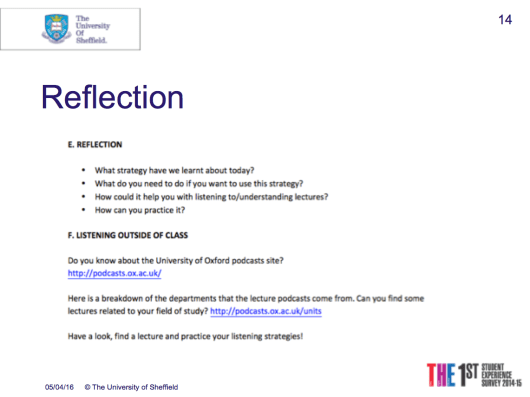
At the end of each lesson, I built in time for guided reflection via small-group discussion:

Screen Shot 2016-04-05 at 15.33.38

As the course progressed, evaluation was also introduced:

Screen Shot 2016-04-05 at 15.33.44

As you can see, all of the questions guide learners to think more deeply rather than just do things.

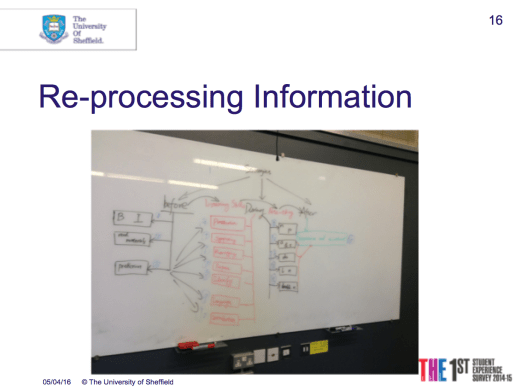
Another activity I built in was a reprocessing information activity. This was to help the learning become more deeply ingrained. The course material required students to present something using specific language, so I made the activity about their own learning on the course i.e. the strategies we had studied and how they fit together. Making these diagrams pushed learners to think about how the strategies connect rather than being a disparate list:

Screen Shot 2016-04-05 at 15.33.50

That was more than enough to get through in the time allowed, so the only thing left to do was give them my references and point them towards this summary post!

Screen Shot 2016-04-05 at 15.34.11

Making general EAP more specific – academic writing

The 10-week pre-sessional programme at Sheffield University is an English for General Academic Purposes course rather than an English for Specific Academic Purposes course. This means that students learn general academic skills and vocabulary rather than subject specific. However, even working with a general EAP course book, like Oxford EAP, it is possible to tweak a lesson so that it links in with students’ academic fields, and, in my experience, this has a very beneficial effect on students’ engagement with the (often rather dry) lesson content, as the relevance and usefulness is clearer to them and the content more meaningful. I managed just such a lesson tweak in my most recent academic writing lesson (yesterday). Though far from being rocket science or anything particularly special, a few simple tweaks made a big difference, so I thought I’d share what I did here…

The aim of the lesson was for learners to be better able to write comparison essays, in terms of structure and complex comparison sentences using subordinators. The Oxford EAP spread was logical:

  • dividing a list of ideas corresponding to a given essay title by perspective (e.g. financial, social…)
  • focusing on the overall structure by getting students to match block and point-by-point outlines (with no content) to descriptions
  • matching outlines with content relating to the beginning essay title and evaluating the clarity of each
  • producing an outline for another essay title (using notes given to help)
  • identifying the chosen outline in a paragraph of text responding to another essay title and using this as a springboard for focusing on subordinators (highlighting, analysing, controlled practice)
  • writing a comparison essay (in response to another title)

My students are approximately 50% medicine, 50% dentistry in terms of field, so for this lesson I got them to sit grouped accordingly. Before starting on the above sequence, I encouraged them, in their groups, to brainstorm a list of comparisons they might make in their field. For example, in dentistry, they might compare systemic fluoridation with topical fluoridation (as I have discovered in the course of the project thread of this programme!). Once they had generated their lists, I asked them to look at each item and think of at least two perspectives from which they could compare their items. So, for the above example, it could be from a financial perspective or a health perspective. These are M.A. students to be, so they are interested in what they are going to study. Thus, starting the lesson in this way immediately grabbed their attention because it was fully relevant to them.

Having done that, with relevance of comparison essays established, we moved onto the OUP EAP sequence and worked through it up till the end of the controlled practice activity for subordinators. Then we returned to the information generated in the above-described opening sequence, from which they selected a comparison and produced an outline (choosing a block or point-by-point structure) based on that, thus linking the learning back to their field. They also wrote some complex sentences, using subordinators, comparing their chosen items from their chosen perspectives. This was far more engaging than writing sentences in response to a random essay title that they didn’t really care about. Obviously in an EGAP course these are inevitable, but even on such courses it definitely pays to be on the look out for ways of linking the general content back to the specific disciplines. (Without needing to be an expert in those fields, of course!)

Next week we are looking at problem-and-solution essays: hopefully I can make these as engaging as comparison essays turned out to be!

Yay, writing! ;-)

Yay, writing! 😉 (Image licensed for commercial reuse with modification)

Taking auctions beyond grammar

I’ve never been a massive fan of grammar auctions – mostly because I was never quite sure how they were supposed to work. Generally they involve a list of sentences, most of which have mistakes in them, which the learners are supposed to correct and then bid on. It was always the money aspect that confused me! This summer, however, I have decided how they work (for me) and then applied them successfully to pronunciation and vocabulary…

Pronunciation Auction

Aim:

to focus on the pronunciation (especially word stress) of a set of target vocabulary with whose meaning learners are already familiar.

Materials: 

Each team of learners need a list of the words to be used for the game.

Preparation:

None – learners should have the words already, as they are previously studied words. Or if you really want, make another special list of them to hand out!

Procedure:

  • Put learners into teams of 4-6 players and make sure each team has a list of the target words for the game. (Our list happened to have 24 words on it, academic vocabulary which we had looked at previously in the context of a reading text, which worked fine.) NB: The list should be numbered for easy identification purposes. (Actually ours wasn’t but before we started I told them how it would be numbered – there were 4 columns each with six words, so it was 1-6 down column one, 7-12 down column two etc.)
  • Tell learners they have £1000 to spend on the words. How much they spend on each word depends on how sure they are of the pronunciation. (We focused on word stress as we hadn’t introduced the phonemic chart yet – but I can already imagine some variations involving it! Watch this space!)
  • Give learners 5-10 minutes (depending how many target words you have) to decide what the correct pronunciation of each word is and how sure they are of it, and to allocate their £1000.
  • When everybody is ready, call out the number of a word. E.g. number 10. Each team reveals how much they bid on word 10. The highest bid gets to pronounce the word. If correct, they gain the amount  of money they allocated. So if they bid £200, they get £200 in their score board. They can earn bonus cash by then providing the other words in a word family, also pronounced correctly. E.g. if the target word is ‘advertise’, they can gain bonus cash for ‘advertisement’ and ‘advertising’. (This encourages them to think about how, in many cases, when you change word type, the stress changes too.) We decided that providing correct pronunciation for all members of the word family merited doubling one’s money.
  • If the highest bidder gets the pronunciation wrong, the word passes to the next highest bidder. If the next highest bidder gets it correct, they win the highest bidder’s bid total. So if, in the above example, the team who bid £200 got it wrong, and the next highest bid was £150, if that second team got it correct, they would win £200.
  • Once all the words have been pronounced (if any haven’t been bid on by any of the groups, sell them off at £50 a pop to get learners to have a go even if they aren’t sure!), the winner is the group with the highest total of money.

Vocabulary Auction

Aim: 

To review the meanings of previously studied target lexis.

Materials: 

None.

Preparation: 

None.

Procedure:

  • Give learners, in teams, a set length of time to write a list of a given set of target words that they have been studying (in our case it was a set of phrasal verbs). At the end of the set time, do a quick whole class check to make sure all teams have all the target words. (If one team has them all, and the others don’t, you could award some bonus points!) OR provide/point them at a list of the words.
  • Give teams time to discuss the meanings of the target words, decide how sure they are of the meaning and allocate their £1000 (as with the pronunciation auction)
  • The procedure follows as per the pronunciation auction except that learners provide meanings rather than pronunciation. Learners can earn bonus cash by putting the target word in a sentence correctly. (You could up the challenge by requiring the meaning and a suitable collocation, with bonus cash for extra collocations…)

Enjoy!

Sold! (Image taken from www.pixabay.org)

Sold! (Image taken from http://www.pixabay.org)

Phonemic chart review game: Connect 3 (or 4)

As part of the Sheffield University 10 week pre-sessional programme, I have been teaching a Social English class 3 afternoons a week at 1h30 a pop. Last week on Thursday, I introduced them to the phonemic chart, using Adrian Underhill’s method. Today (Monday) I wanted a fun way to review the sounds with my learners, and so Connect 3 (or 4), using the phonemic chart, came about…

Preparation:

None! (Excellent…)

Materials:

  • A phonemic chart projected onto a whiteboard (failing that, an A3 print-out would work equally well)
  • a board pen (more than one would be even better – see my comments at the end of the post)

Procedure:

  • Put learners into 2 teams (or 3 if you have a big class) of 4-6 players.
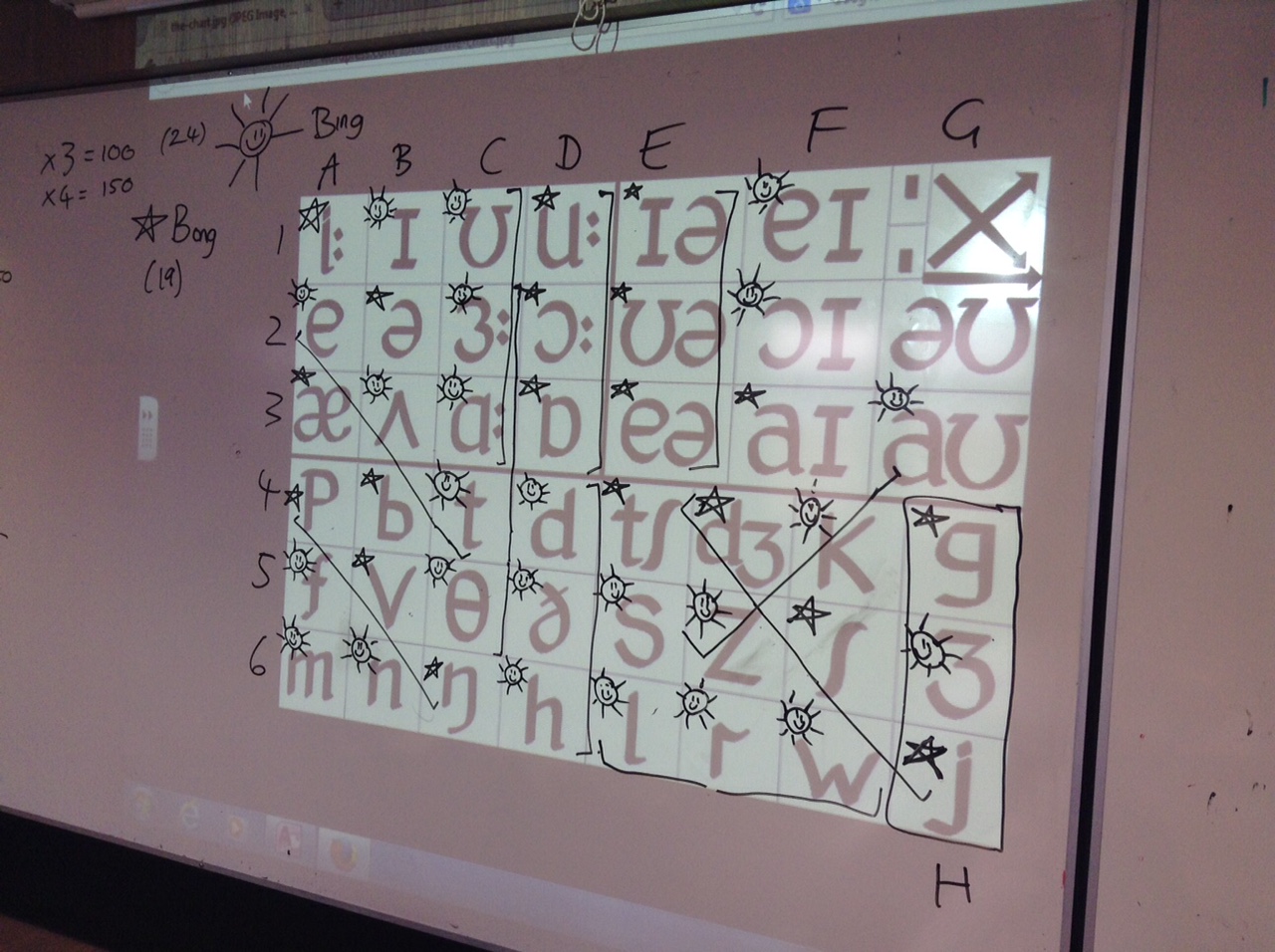
  • Each team has a symbol. With my learners today, Bing were suns and Bong were stars. (They are always Bing and Bong: borrowed from an ex-colleague of mine at IHPA, these names refer to the buzzer sounds that you get on TV game shows and that the team in question must make before answering in any games where speed to answer is of the essence…)
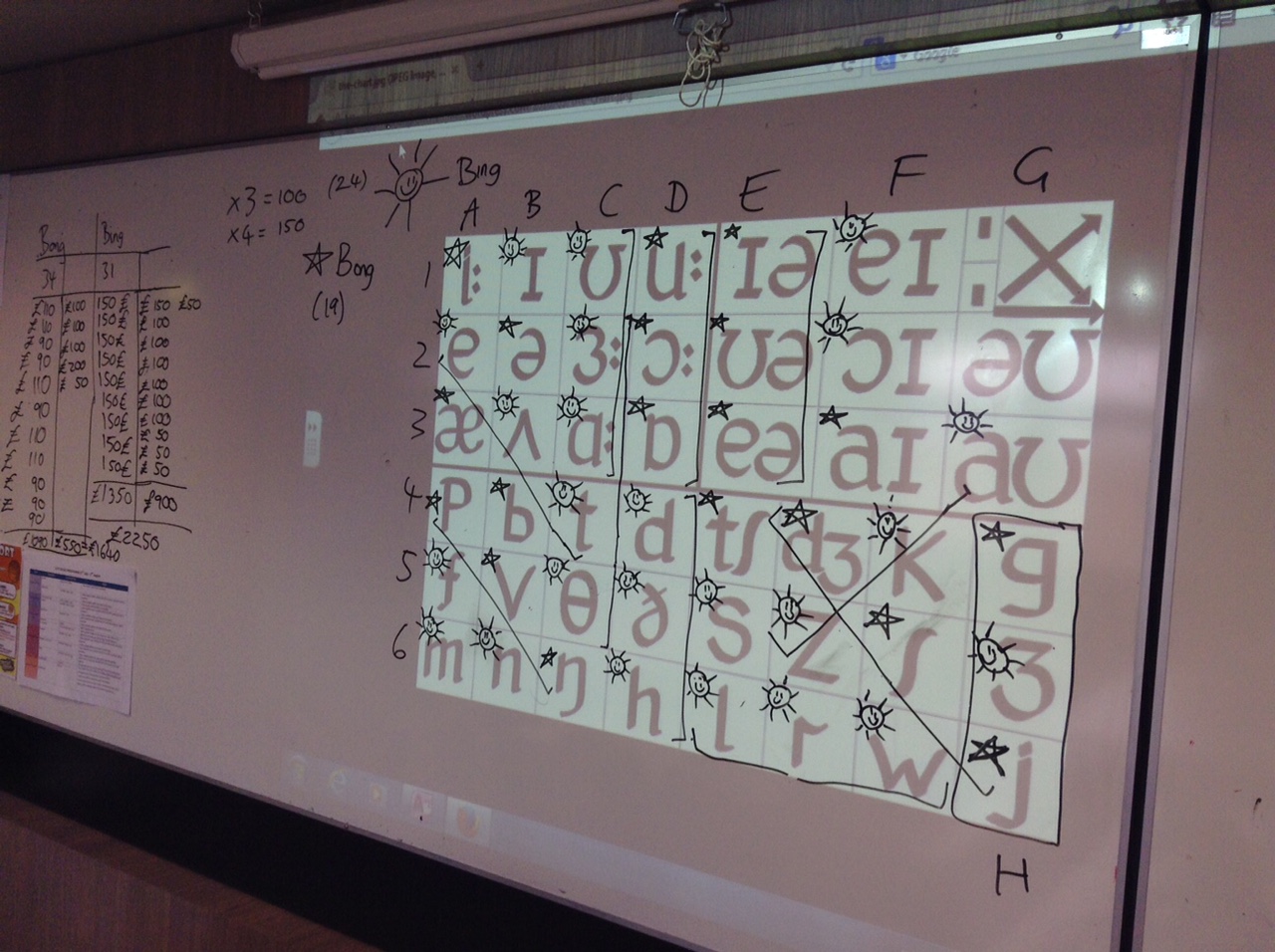
  • Explain the aim and rules to the learners. The aim of the game is to get 3 squares in a row to score £100 or 4 squares in a row to score £150. (Could also be points, but as we had just done a vocabulary auction, we stuck with the money theme!). In order to win a square, learners must make the sound that corresponds with that square correctly and give an example word with that sound in it. (Number and letter off the squares so that learners can choose a square by calling out e.g. E5. As there are more columns in the bottom half of the chart than the top, there is a special extra column H here. See picture below.)
  • If learners make the correct sound AND give a correct example word, they get to have their symbol drawn in the square and the square becomes theirs. The turn passes to the next team. If learners make a correct sound but incorrect word, the turn passes to the next team, ditto if they make the sound incorrectly. In this case, the square is still open to be won either by the next team, or, when the turn returns to the team who were incorrect, they can try again (or choose a different square if they prefer!).
  • Each time a team of learners get 3 or 4 in a row, write £100 or £150 in their score board column.
  • Towards the end, you will probably end up with a handful of squares that will not help learners gain a 3 or a 4. Sell these off at £50 a pop, with teams taking it in turns to make the sound and give an example word in order to win this money. The same rules re correctness mentioned previously still apply.
  • When everything is finished, add up the money and see who is the winner! You could also add up the number of suns and stars (or whatever other symbols) to see who totalled the greatest number of squares.
The phonemic chart at the end of the game!

The phonemic chart at the end of the game!

Showing also our scoreboard (one set of numbers goes back to the vocabulary auction...)

Showing also our scoreboard (one set of numbers goes back to the vocabulary auction…)

My comments:

  • My learners enjoyed this and it was good to see how much they remembered from last Thursday. Making pronunciation physical does make it much more memorable. (They remembered things like ‘the idiot sound’, ‘like having an orange in your mouth’, for example, trying the sounds out in their groups before giving their final answer.) Understanding way the chart is organised helps too – it helped them remember some of the sounds between the ones they were more sure of.
  • If I did it again, I’d remember all my board markers so that I wasn’t stuck with only black pen. Each team could have a different colour, and any squares that were done incorrectly could be marked in a different colour to flag them up more clearly for some further post-game review.
  • To up the challenge for academic English classes, stipulate that the example word given should be an academic word (and bonus if one of the ones you have studied recently!). To up the challenge in a General English setting, stipulate that it be a word related to a particular set of topics or course book units, depending how your programme works.

Enjoy! 🙂

Snapshots of PS-10 Summer 2015 – the first 50%!

“PS-10” is the short code name used for the ten week pre-sessional programme at the University of Sheffield. This is the second summer I have spent working on the programme, and already the taught component is 50% complete! Time flies when you are having fun… In fact, time flies so briskly that this poor little blog has been quite ignored of late – other than my recent post of a more personal nature,  My first veganniversary.  Previously promised posts -e.g. the one about the pronunciation auction activity I did recently – are STILL in the pipelines and will make it out in due course. Honest. Meanwhile, here is are a few snapshots of life as a pre-sessional teacher at Sheffield Uni (from most recent to earliest), as half-way through a course is as good a time as any for reflection…

Screen Shot 2015-04-11 at 21.59.37

Yay for the ELTC! 🙂

Friday 24th July

1245-1300 Impromptu 1-1 tutorial 

One of my students has had health issues but is back on the course now, managing to attend most lessons. This student already has an unconditional offer, so exam grades are not an issue. If he wanted to, he could stay off classes with doctor’s permission, but he wants the full benefit of the learning opportunity so he is persevering. I love the motivation! Of course I wasn’t going to refuse him a tutorial at the end of the lesson today, even though I had to delay my weekend ever so slightly ( 😉 ). The main focus of the tutorial was his project, and I was able to give the necessary guidance – there was even a bit of a light bulb moment when we talked about using reporting verbs to show stance and structure arguments. Being able to help and the amount of appreciation shown at the end of it was incredibly rewarding. I have to admit, I love my job!

Thursday 23rd July

09.15-10.45; 11.15-12.45 – Listening Skills for my third group.

Listen! (Image taken from www.pixabay.org via Google search for images licensed for commercial reuse with modification)

Listen! (Image taken from http://www.pixabay.org via Google search for images licensed for commercial reuse with modification)

I am teaching listening as my second skill again this year – so in addition to teaching my tutor group writing and project work, I teach them and another two groups listening, once a week each, for 3hrs with a half an hour break mid-way.

This morning, the content topic was Leadership and the strategy focuses were using spoken punctuation to identify important information, note-taking using linear notes and using linear notes to reconstruct what the lecturer has said. For the skills work, the key text is Oxford EAP Upper Intermediate. I accompany this with my own materials, which  top and tail my classes with review and reflection, as well as encouraging them to think metacognitively (i.e. about the why of what they are doing) at various points throughout the lesson. It’s week 4 and out of 13 students, only a handful have got updated strategy tables with them. I gave them these strategy tables in Week 1, to help them keep track of the strategies we are learning about each week. This is to avoid out of sight, out of mind syndrome – it would be far too easy for students to forget about previous learning amidst all the new information that is thrown at them from every angle on a regular basis, but the strategies accumulated need to be remembered and used alongside new additions rather than forgotten. Nevertheless, I get them discussing and remembering what we did in the previous lesson, while making a mental note to use some class time towards the end of the lesson for table completion.

The lesson takes learners through recognition and use of spoken punctuation (the latter useful for their presentations) and use of linear notes. I use the final extract as a challenge/progress test. (Not a stressful kind of test, just an opportunity for them to measure their own progress). I also use it to take them through the planning-monitoring-evaluation process championed by Vandergrift and Goh in their fantastic book Teaching and learning second language listening: Metacognition in action. The idea is that before students listen, they decide which strategies they are going to use; during listening, they monitor their use of the strategies and after listening they evaluate their strategy use and take forward what they learnt. In the end, this is something they should be doing independently, but at this point in the course, I encourage discussion and collaboration, to scaffold it. Following the listening, I ask them to discuss again and evaluate their strategy use. Once they have done this, I explain the rationale behind the process. Both this group and my Tuesday group seemed to recognise the value of it and despite the uphill struggle of the strategy tables, I feel – in both lessons – that their response to being taken through the process and discussing the rationale behind it is a little ‘lightbulb moment’. One that has been built towards over the last 4 weeks. I would love to work with students over a longer period – 8 taught weeks is a very short space of time for listening skill development – but nevertheless hope that although students can only improve so much in the short space of time that is PS-10, I can give them the tools to help themselves improve more in the long term.

(I also did this lesson with my tutor group today (Friday) and in the last part of the lesson, following the final listening extract challenge. I again encouraged reflection and evaluation, and once they had discussed amongst themselves, invited them to share their reflections with me. There was a lot of subsequent discussion and comment sharing, and of course I was able to empathise with their experiences because of having attended a presentation in Italian during the academic year, while I was in Palermo. So I know how testing it is trying to take notes in a second language (especially as my level of Italian is definitely lower than theirs of English!). So I reminded them that note-taking is a skill even in your first language, and in a second language there is an added level of difficulty, and shared my own experience of doing it in Italian. They seemed to really appreciate that, and the whole discussion process was a very positive end to the lesson.)

I really must revisit the planning, monitoring, evaluating process with all three groups next week and in the following remaining three weeks of the course too.

13.45-15.15 – Social English

Social English is a class for students who have met their department demands with regards to test scores and so have unconditional offers. Thus, instead of doing USEPT (proficiency exam) preparation classes, they join a Social English class. The lovely thing about these classes is that they are very flexible, so the ‘syllabus’ is negotiated between the teacher and the students. Today, in response to a request last lesson, we did a pronunciation lesson. I introduced the chart to them Adrian Underhill style. (Something I learnt/taught myself how to do during my Delta!) There were some lovely lightbulb moments e.g. when they recognised what their mouths were doing and how it changed between sounds (lips spread to narrow and flat to sticking out, mouth open to closed etc.), as well as how this is reflected in the chart, and when I got them to glide between the monophthongs to find the diphthongs and then showed them the symbol on the diphthong side of the chart. They also really enjoyed taking turns in using the chart to sound out their names (and I got to learn how to pronounce them properly!).
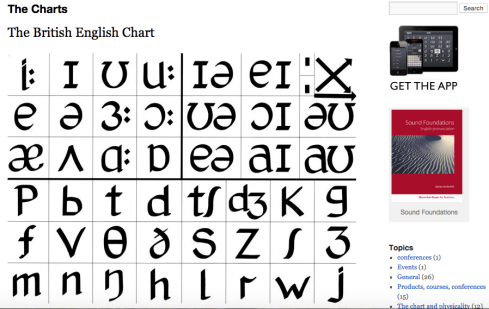
Adrian Underhill's phonemic chart. Click on the pic to go to his blogpost talking about introducing the chart to students.

Adrian Underhill’s phonemic chart. Click on the pic to go to his blogpost talking about introducing the chart to students.

As far as their onward study is concerned, this will help them when they come to look up words in the dictionary, as they will be able to use the phonemic script to understand the pronunciation. We have done a lot of vocabulary work recently, academic vocabulary, so in future lessons I want to forge links back to that.

As usual, they thanked me at the end of the lesson, and told me how useful it was. They tell me how much they like these Social English lessons and how useful they are fairly regularly, which is nice! I suppose that is part of the joy of a student negotiated ‘syllabus’ that doesn’t need to cover all four skills etc because they get that in their morning classes.

Sunday 19th July

Home!

Yes, it’s the weekend. A lovely relaxing one too. Over the course of it I come across my Cusenaire rods which had been in storage and start wondering about how I could use them in EAP. My ideas so far include using them as part of a pronunciation review game, for the learners in my Social English class to quiz each other on the word stress of the academic vocabulary we have been studying and also as a means of illustrating the given-to-new structure that much writing takes and that I touched on with my tutor group last Monday in Writing class. Watch this space…!

figures

Cusenaire rods! 🙂

Wednesday 15th July

09.15-10.45; 11.15-13.15 Project Class

1280px-Stipula_fountain_pen

Well actually we use computers, but… 😉

I have my tutor group once a week for Project class, every Wednesday for three hours (with a half-hour break mid-way as usual). Over the course of 8 weeks, this course strand guides students through researching and writing a 2000 word project. This year, we gave them titles while last year they had to write their own, saving a good chunk of time that could usefully be used on other things! On the 15th July, in the first half of the lesson, I started by plugging my laptop into the project in order to briefly show them how Evernote works as a note-taking/organisation tool (and offered help between now and the end of PS-10 for if they ran into difficulty using it). Then, I had them sharing the sources they had had to find, read and highlight useful elements of for homework. They had to justify their highlighting, explaining why the article and in particular the highlighted parts were useful for their project. The idea is that this process of explaining what they have read, in their own words, requires deeper reflection and understanding to take place first, in the reading process. They knew that they would be doing this, of course, to encourage that focused reading to take place.

reading glasses pixabay

It also paved the way for what we focused on after the break, during which class I would be observed. While they shared and discussed sources, I went round and spoke to them individually, in order to see the project outlines that they had also produced for homework and talk through these with them. This enabled me to make sure they were on the right track and set up for the next stage of homework – producing detailed outlines where their arguments were matched to the supporting evidence/sources they had found to back them up.

After the break, we did a lesson on in-text citation. This started with the students creating mind maps of what they already knew and then looking at some definitions and filling in the missing terms – i.e. review. (Being continuing students – i.e. students who have already done some studying at the ELTC and so they have had some exposure to much of what we look at -the ideal scenario is to build on existent knowledge as much as possible.) The terms were things like paraphrasing, quoting, reference list, bibliography, plagiarism. Then, we looked at some example use of a source and they identified if it was appropriate use or not and why, and if not, how to make it appropriate. Having done all this, we were ready to turn back to their sources, which I used as a means of looking at use of reporting verbs and how they can show writer stance. (E.g. if I use the verb ‘claim’ to introduce something a source says, chances are that not long afterwards, I plan to refute it with another piece of evidence, one which supports my stance.) This involved a process of identification/underlining and discussion (is this fact or not, what does the author think about it? etc), with me going round and working with pairs, ensuring they understood what they had found. Once we had done this, I got them to summarise a chunk of text that they had highlighted as useful for their project in one sentence in their own words – paraphrasing to capture the meaning rather than paraphrasing word for word – and then choose a reporting verb that reflected what the evidence was and how they felt about it.

At the end of the lesson, I asked them how they felt about their projects and they said they felt a lot happier at this end of the lesson than they had done at the beginning of the morning. So, for me, although not a perfect lesson by a long way, it was a successful one. This was reflected in the observation feedback pertaining to the second half of the lesson, where in the overall comments, the suggestions for improvement were prefaced with “A few minor points in an otherwise excellent lesson: …” . It is nice to be appreciated, by my students and the people I work with alike.

Wednesday 8th July

13.45-15.15 Project Standardisation

Normally we don’t have anything scheduled on Wednesday afternoons – we finish after the morning class. This is time we can use to catch up on marking and planning, but also the time in which developmental workshops and standardisations are organised. The students, meanwhile, attend a lecture (which forms part of the discussion at the beginning of my listening classes, as part of homework is to take notes during the lecture and practice using the strategies…).

In this standardisation session, we are taken through the new criteria for grading projects and then look an example with grades given, followed by discussing in groups and giving grades ourselves. This is vital, of course, as then we are all on the same page when 26,000 – odd words of projects rain onto us in week 6 (first draft) and week 8 (final submission) of the course.

We will have further standardisations for presentation assessment and USEPT assessment in forthcoming weeks on Wednesdays.

29th June 

09.15-10.45; 11.15-12.45 Writing Class (and first meeting with new tutor group)

The first meeting with a group of new students can be slightly nerve-wracking on both sides. This year, I have returners so I start teaching directly on Monday. (New students do registration on the Monday and only start classes on the Tuesday) They turn out to be a lovely bunch of people. Mostly Arabic speaking, from various Middle Eastern and North African countries, as well as one Chinese and one Japanese student. (Interestingly, this is a completely demographic to last summer, where I had all new students and all but about 2 were Chinese!) Once the ice has been broken through some getting to know you activities, there’s no looking back and we get stuck in to analysing essay titles. Having taught the material in last year’s pre-sessional course, I already feel a lot more comfortable using it (as a springboard). The lesson goes well and seems to augur well for what lies ahead.  🙂

22nd June – 26th June

09.15 – 16.15 (with half an hour morning break, one hour lunch break and 15 mins afternoon break, daily Monday – Friday) Induction
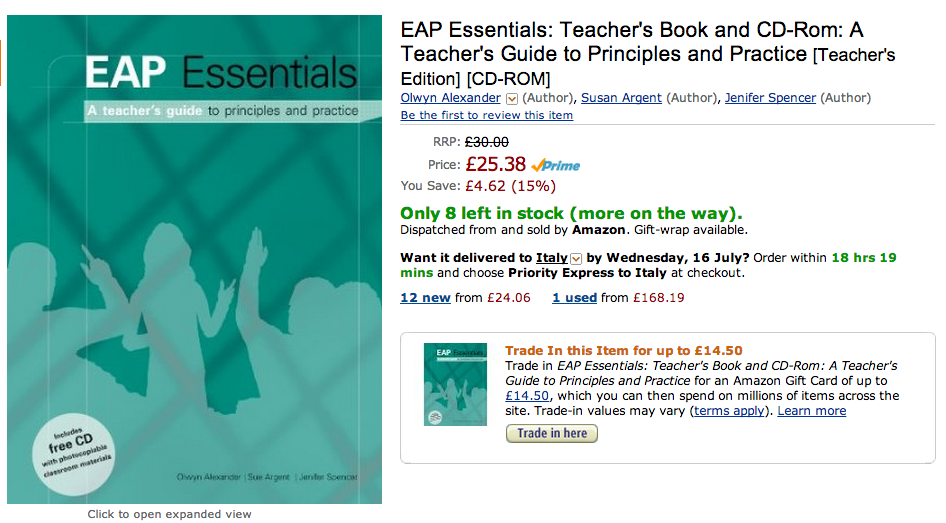
EAP Essentials - essential in name, essential in nature...

EAP Essentials – essential in name, essential in nature…

We get a whole week of induction before starting work on PS-10, so it is pretty thorough! One of the authors of EAP Essentials, Jenifer Spencer, does input sessions on teaching EAP, then of course there is all the nuts and bolts organisational stuff (syllabus, timetables, overview of course components and assessment) as well as a fair smattering of tech sessions, where we set up our accounts and learn how to use things like MOLE (Sheffield Uni’s branded Blackboard) and Google Drive. As a returner, there are some sessions where I have the opportunity to join a break-off group, where we discuss the same topics as in the main room, but with more emphasis on reflection and discussion than input. These are really motivational and useful, and help me get back into the EAP zone after an academic year of general English. I think maybe the best thing about being a returner is that instead of EVERYTHING being new, there is so much more familiarity. It makes life SO much easier.

On the final day, the Friday, we see where we will be teaching and our temporary staffroom. This year, I have actual classrooms rather than lecture theatres – yippee! We aren’t required to stay on site till a given time, so we can go home to use the remaining time for long-term lesson preparation. (The added bonus of this is that home has windows! 😉 ) It’s nice being treated like a professional adult in this sense, being trusted to do what needs to be done.

Closing comments

(What a relief! I hear you say… 😉 )

I am really enjoying this summer and, being a returner myself (just like my students – except it’s the PS-10 I’ve done before rather than other courses during the year!) I feel a lot more confident with what I’m doing. This, in turn, gives me the confidence to be a lot more hands on with the students and more responsive to their needs. My students are appreciative and think I’m doing a good job, the people above me are supportive and think I am doing a good job, and my colleagues are lovely and friendly too. Week 6 and 8, when we have all the projects to feedback on (6) and grade (8) will be a bit stressful, but that’s ok – it’s temporary rather than the norm so it’s manageable. One thing I am also enjoying is being able to have a genuine work-life balance. I’m able to get out on walks, do yoga, play my clarinet, see friends, relax and read, as well as work. I don’t finish the week feeling utterly destroyed physically and mentally. I can cook at home during the week. I actually feel rested by the end of the weekend and ready for the week again. Really lovely. I will make the most of it while this summer lasts! 🙂

IATEFL 2015 – Academic Writing Forum

I’m only staying for the first half of this, as I want to head to the MaW SIG open forum, but hopefully the first half will be the best half! 😉 I think I actually wanted to be in the Forum on Different Perspectives on Feedback, but at 2 minutes before start time, I am actually too exhausted to try and start finding the appropriate room in this absolutely vast building. So EAP writing it is! 

15 minutes per talk then questions, so I should catch just under 2 talks.

Integrating simulations in a seminar based approach to EAP writing

Learning the context and conventions of writing in another language is a great challenge for students (Hyland, 2003)

The advantage of a content-based approach is providing a more focused background and vocabulary for students’ writing. However, non-native speakers may be reticent in seminar situations. A simulation enables students to participate in a real-life like situation by assuming real roles. It is a reality of function, as participants have to act according to a role. The environment is simulated, life-like but not real. It is structured.

4 stages to a simulation:

  1. Briefing (readings and discussion; at the end of the stage, instructions, handing out roles)
  2. Preparation/group work, depending on the type of simulation. Debates work well, so students are on one side or the other.
  3. The simulation stage is where the debate takes place, so students give persuasive speeches and discuss.
  4. There is finally a debriefing for some cooling off.

Advantages:

  • Learners are motivated and gain opportunities for meaningful practice.
  • Creativity is encouraged.
  • Realism and relevance are injected into the classroom.

How about in EAP writing? 

Readings and discussions can give students background/information about essay topics.

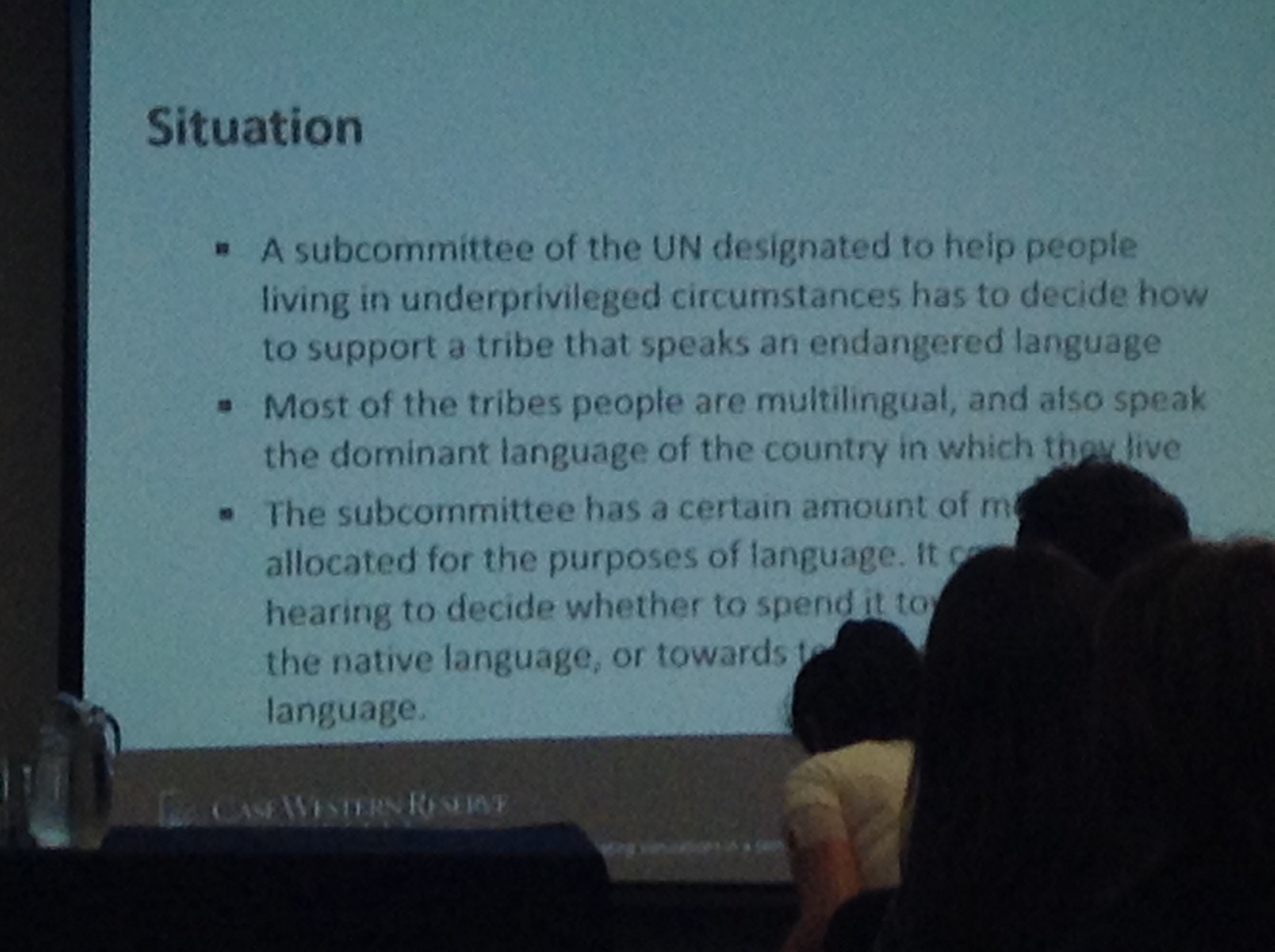
Sample simulation 1: Endangered languages

image6-1

  • Students are given the above situation. They receive roles for the hearing. Readings are assigned too. Journal articles and newspaper articles. Videos are watched.
  • Students spend a class period and time outside class preparing. Then in a subsequent class, the hearing takes place.
  • Several writing assignments can be integrated into this: summary responses to the readings, journal entries describing the simulation role, argumentative essay, different topics possible.

Why do students like this?

By the time they write about the topic, they are primed by all the background information. They gain an opportunity to be creative in developing their roles. Most students enjoy debating.

Some students felt shy in role, some felt the roles were too restrictive, some thought too much research was involved. Some students were too dominant.

Conclusions:

Simulations provide an effective framework for thinking about the topic of the essay and lots of background information. More in-depth reading and discussion is promoted. 4 skills are integrated.

Jennifer Macdonald: Beyond the 5 paragraph essay

This refers to the formulaic “McEssay”/IELTS essay – intro, three body paragraphs, conclusion; based on personal opinion/experience. Not based on external sources/research.

It shouldn’t be the sole genre of writing classes, as  it only really exists in writing courses. Corpus data suggests that other genres of writing are more common for undergrads and postgrads at university. So to prepare them for what awaits them, they need something else. They need to be able to refer to source texts, for example. Many students’ English training focuses on preparation for a standardised test e.g. IELTS so they think 5 paragraph essay is all there is.

How can we break this mould?

  • Teach concept of genre. Get students to think about it before and during writing.
  • Unpack the genre. What is the purpose, what is wanted?
  • Provide resources on genre that students can access independently
  • Assign (For reading and writing) a variety of texts (explanation, definition, methodology, recount, case study etc.)

Genres are like footwear, need to use the right one in the right context. Not the end of the world if you don’t but it’s “kind of weird” if you don’t e.g. snowboots on the beach. Inappropriate.

Most likely you teach mixed disciplines/backgrounds so you probably can’t teach a genre with full authenticity but in the assignments you give, aim for as many aspects as possible. You also need to find work-arounds for research as much isn’t practical.

Look at the British Council LearnEnglish Writing with a purpose website.

Explanation: descriptive account, written to demonstrate understanding of the object of study and the ability to describe and explain systematically how it functions.

-> Can be a paragraph (topic sentences, paragraph-level skills can be introduced)

What to describe? Anything! Draw on web etc.

(Within academia this would be part of another genre.)

Definition: structures used in this genre are of particular interest.

Methodology recount: description of procedures undertaken by a writer – methods, results, discussion.

At this point it was nearly time for me to leave and I also ran out of steam! Though corrected now, I kept making typos because my fingers (and brain?) were so, so tired!! Anyway, it’s ok because Jennifer’s slides are available here. And the upshot of it all was that there is life beyond the 5 paragraph essay and lots of it! I will definitely be having a look at her slides when my brain is functioning better… 

IATEFL 2015: Academic Reading Circles – Tyson Seburn

Time for another EAP-related talk…

This is something that heretofore has existed only on Tyson’s blog, but a book is coming out on the Round – watch this space…

The main roles of Academic Reading Circles:

image1-2

This project was developed and implemented at the University of Toronto by Tyson on a reading and writing course. The goal wasn’t to improve the reading speed but rather the deeper level comprehension, so that they are able to talk about it intellectually and use it in their writing. His students are undergraduates, and there are 16 per class, predominantly Chinese with a few Russian and Ecuadorians. Tyson has them for 24 weeks over the academic year.

Problems that Tyson noticed with his students:

They need to engage deeply with course texts in order to demonstrate understanding in their written work. The problem was, they were not. They were only doing superficial reading, which became evident when they were asked questions about the text or asked to discuss it, they stayed at a lexical level. Applied understanding was rare. They needed to synthesise content from a variety of texts, which requires deep understanding.

Tyson decided to try the idea of literature circles, which has been adapted to ELT. However, traditional style didn’t work. Literature circles are more about fun and don’t have a connection with writing, while academic context requires something more serious and robust. So not new, but adapted for a new context.

Start with a common text, usually teacher chosen, these materials are going to be used for writing. Students are given different roles (as pic above and detailed descriptions below) and work specifically within that role on the text outside of class. In class they work in a group and co-construct knowledge/understanding of the text.

1. Leader:

situate text and gauge group. Finding out things like the purpose for reading (not the teacher said so!), the text source, the target audience, bibliographical information (also see the first couple of steps of the 12 steps approach discussed by Barbara yesterday). Create basic comprehension questions to use in their group to check their understanding. To do this, they need to identify the statements that represent key points. So, for our example:

Which statements represent key points:

1. Cyclists once influenced Jarvis Street’s lanes.

etc – 5 ish statements, some of which do and some of which don’t represent key points.

2. Contextualiser:

Pick out the people, places, events, pieces of research in texts and identify them as research opportunities. They go to the internet and find out more about these contextual references. To be able to tell the group why the research may have referenced these. E.g. “as a cultural corridor with an emphasis on its historical significance” (useful)  or “city cyclists declared victory (not so useful). They could look up “the mayor” and “Ford”.

3. Visualiser

Find things in the text that could be graphically represented e.g. as videos, images, timelines, infographics etc. E.g. in this text, a google map showing where Jarvis street is situated, as we don’t know Toronto; a photo of Jarvis street showing the bike lanes; political/satirical cartoons with relevance. By bringing this in, a new element for understanding the text is added.

4. Connector

Causes transferability (of skills)  between courses. When you force them to make connections in a text, it builds up this ability. Make connections to other studies, other events, other experiences. A couple of questions that might come up as the connector for this text:

  • “Have there been other asinine government decisions?”
  • “Does this situation remind you of anything from your other classes?”
  • “Does the configuration of Jarvis street remind you of a street you know?” (This can help to visualise/understand the argument

Give prompts e.g. make a connection to another event; make a connection to other classes; make a connection to somewhere you know

5. Highlighter

Focuses on lexical items to facilitate meaning. But not only unknown vocabulary (NB not only words but phrases). There are 3 types: 1. unknown, yes, of course e.g. corridor; short-lived; had their day. How frequent is this vocabulary?  2. topical vocabulary – used within a particular discipline. E.g. in this case related to transportation. When we force them to notice this topical vocabulary, the process – exploring it etc. – makes them better able to use it in their own writing. 3. tonal language – that shows author feelings and attitudes towards what they are talking about. e.g. “quite costly”   “just 18 months later” (not a significant amount of time) “included mere painted borders” (mere – shows it is not sufficient)

Specs

  • One common text (it is a required text)
  • There is indivudal work that you give to the students, they need to go away and do that work in order to do the subsequent group work in class. Follow up/talk about what is happening in the text as a whole class.
  • Rotate roles, so students are taking a different role each week. So 5 weeks to get through all the roles. The first time they do the roles, they are not that good at them.
  • Leads to deeper comprehension and better use of texts in writing.

Another reference to De Chazal…really need to read that book… 😉 Really interesting talk, great to meet Tyson finally, and I also bumped into a Sheffield Uni colleague from last year, who is keen on these reading circles so will be picking her brains over the summer for a context (very) specific perspective and useful hints/tips. This kind of thing is what I love about IATEFL and ELT! 


IATEFL 2015: Structured Reading Tasks for Using Authentic Materials to Teach Academic Skills – Dr Barbara Howarth

Another academic session! 

Barbara Howarth is from Glasgow International College in Scotland. The approach she is talking about originates from Edward de Chazal. She works in a pathway college – students there are aiming to get into university, they aren’t there yet. This could be pre-masters programmes, science and engineering students. They teach a range of academic skills.

In the “research project” module (a min. of 5.5 IELTS score in reading  and IELTS 5.5), students get 20 weeks and they are aiming towards writing a research project based on secondary research. 10-15 students per group. Materials are provided. Within these are a number of authentic texts. The overall approach is a task-based approach and reading is integrated into this. The form of assessment is an 8000 word written report and a poster presentation. The students choose their own topic.

(So this is similar to what the Uni Sheffield students I teach have to do, except my students get about 8 teaching weeks to produce a 2000 word written project based on secondary research. They also give an oral presentation on the same project.)

A 12-step approach 

<For a list of all the steps see handout page 1>

The rationale is to grade the tasks and present them in a logical order, so that students are taken naturally through the reading process. Work with these tasks repeatedly so that a level of automaticity is developed.

Step 1:  Bibliographical details identification

It’s very important that students have bibliographical details for any text they are working with. So getting them to highlight the relevant information is a straight-forward task to start with. However, issues can emerge, such as lack of issue number on the front page, but if you look in a database, you can find the issue number. To deal with this, use follow up homework tasks to get the students into the library and databases to find such information.

Steps 2 and 3 (see the handout)

Step 4: Labelling abstracts.

Starting to think about information and what type of information is in this text. One element is the abstract/summary, another element is the analysis. This might involve the results but for these to make sense, you need to understand the aims. They need to be interpreted, so you need to draw conclusions i.e. evaluate the findings. So the task at this stage is for students to label an abstract. Show them a model first. Things that aren’t straightforward for students: The aim sits within the method. Sometimes its difficult for the students to label up the aims.

Up to this stage, we have mainly been previewing the text – bibliographical details, what kind of information is in there, how it is structured. Basic things but things that are necessary in order for the students to approach meaning.

Step 5 (see handout)

Step 6 Meaning

The aim of the task is to write a summary. The abstract is a summary, yes, but what is the point of the whole paper? The main point will correspond to the aims of the paper. The main points are determined by these. In the example paper, there are two aims – to analyse the carbon sequestration and to simulate the potential carbon sinks. Important for students to identify these and break them down. Getting them to copy bits of information encourages them away from the laptop. In this case, the aims. Anything they copy should be denoted by quotation marks and include a citation. So this gives them the main information with other distractions removed. The example summary is a two-sentence summary reflecting the two main aims. Insisting on reduction of number of words encourages paraphrasing.

Step 7 and 8 (See handout)

Step 9 Language

Language is a means of expressing meaning. So the language that you choose to look at arises from the steps that have preceded. E.g. in this case, the language of analysis, relating to the informational elements in question. This task is a categorisation task – identifying topic-related vocabulary (e.g. carbon sequestration, forestation) and vocabulary related to analysis (e.g. rate, applied to, empirical growth curves) Then divide the vocabulary up into word type. Follow up work could involve the Oxford Dictionary of Academic English. All the words identified are present. Underlined words are head words. Red words are on the AWL (Coxhead 2000)

Step 10: Critical thinking and evaluation

After dealing with meaning and language, students are in a position to start engaging with slightly more higher order cognitive tasks. E.g. discussion questions. Students need to learn that they need to justify their opinions. Another task is to look at conclusions and relate them to the results, and realise that they contain an element of evaluative judgement.

What Barbara has seen

Students go from the state of being buried in their laptops and make a transition into being really thoughtful readers. That change may be brought about by giving the students a structured step by step that they can use, working from simple to more complex tasks necessary in academia. The magic moment for Barbara is when she hands out a reading text and students automatically start to apply the process – e.g. highlighting the bibliographical information.

There will be a link to the handout here (once I have photographed and uploaded it!)

An interesting session! And a reminder that I STILL need to get round to reading de Chazal’s book that has been sitting on my kindle since last year… 

reading glasses pixabay

Let’s read! Image taken from Pixabay.


IATEFL 2015 “EAP writing: teaching strategies for effective paraphrasing” – Tina Kuzic

My first non-plenary talk for the main IATEFL conference (plenty of PCE talks yesterday!) and it’s about EAP. Hopefully it will help me to help my students this summer…

Why paraphrasing?

Because it is such an important part of academic writing. Writing in general is the most challenging thing to teach nowadays, especially with learners who are part of the digital generation, and especially in terms of motivation. For academic integrity, paraphrasing is key.

Tina’s courses

EGAP and ESAP (for psychology) both are in-sessional and obligatory. The average level is B2 when it comes to speaking. However, for writing, the level is a bit lower; especially for formal writing. At secondary school, students only write essays so they don’t get any training in formal writing. The focus of Tina’s courses is study skills, strategies for reading, writing for academic purposes.

Plagiarism, and preventing it, is very important and one of the tasks that we as EAP teachers have to address. Students are often not aware that they have plagiarised, they lack training in this context.

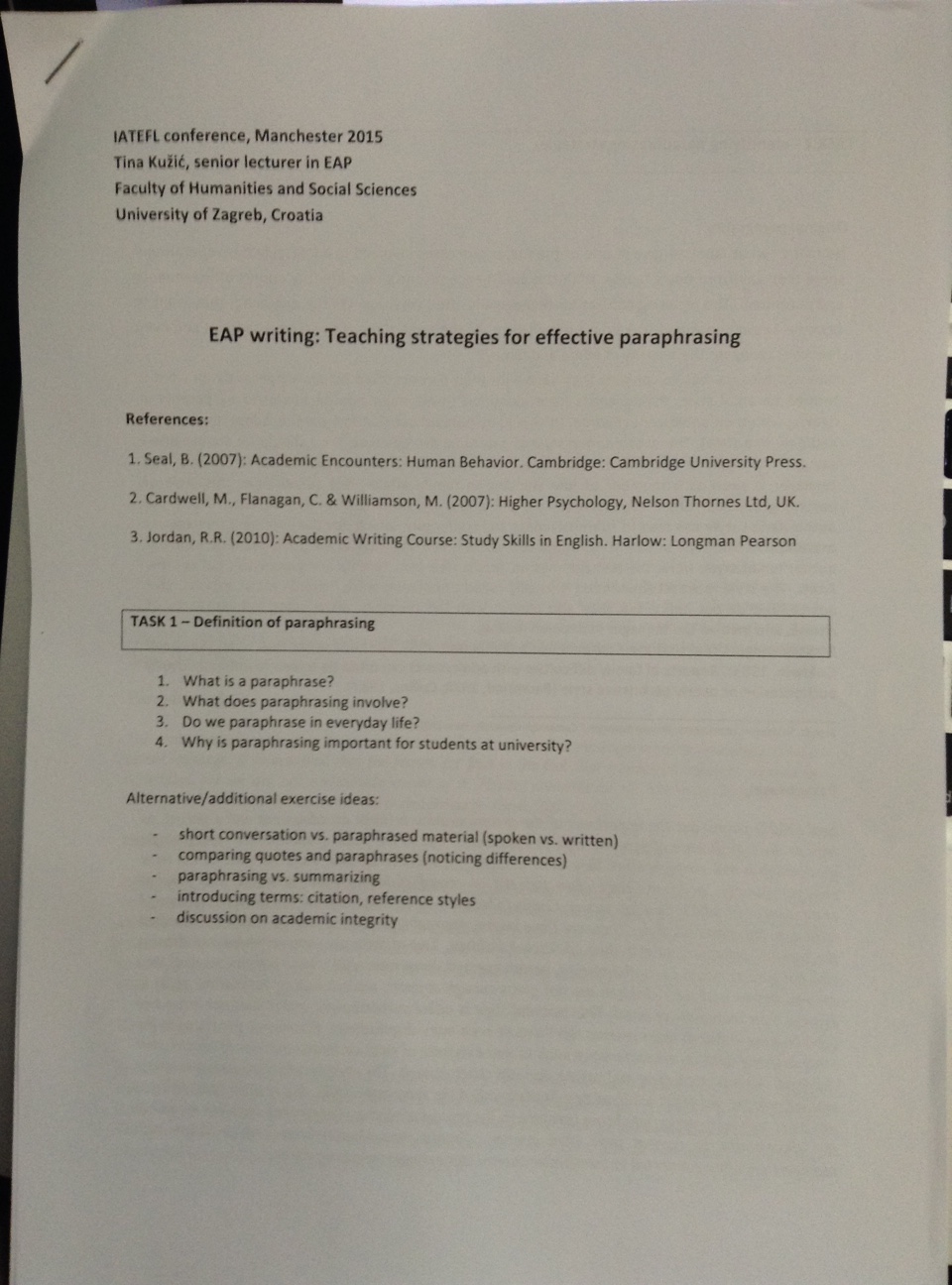
Task 1

For the introductory class, Tina refers to students’ previous knowledge – what they think or know about a given thing. Start with a set of questions.

So, for paraphrasing:

  • what is a paraphrase?
  • what does paraphrasing involve?
  • do we paraphrase in every day life?
  • why is paraphrasing important for students at university?

Extension: defining terms such as quoting, citing, summarising, referencing

Students may not be familiar with all the terminology.

You could also start with a conversation, a paraphrased conversation, a written summary paragraph of it and get them to notice the differences. Or, give them a quote and a paraphrase, get them to identify the differences.

image2

Task 2: Identifying paraphrasing strategies

An original and a paraphrased sentence is given to the students and they are given time to read each. Students asked to find examples of the rewriting and asked what happens in terms of grammar and vocabulary. Once more familiar, they could look at paragraphs, as per the task we were given.

  • The first sentence is a summary of the main idea of the text, used as a topic sentence.
  • Move from paraphrasing details to summarising main ideas.
  • Use different parts of speech
  • Use different structures e.g. active vs passive
  • Synonyms
  • changing the subject
  • moving parts of sentences
  • combining short sentences
  • dividing long sentences
  • synthesising sources

Paraphrasing uses a mixture of these.

Provide students with a list of these strategies, then go back to the sentence/paragraph and look for the strategies not previously identified.

Task 3:

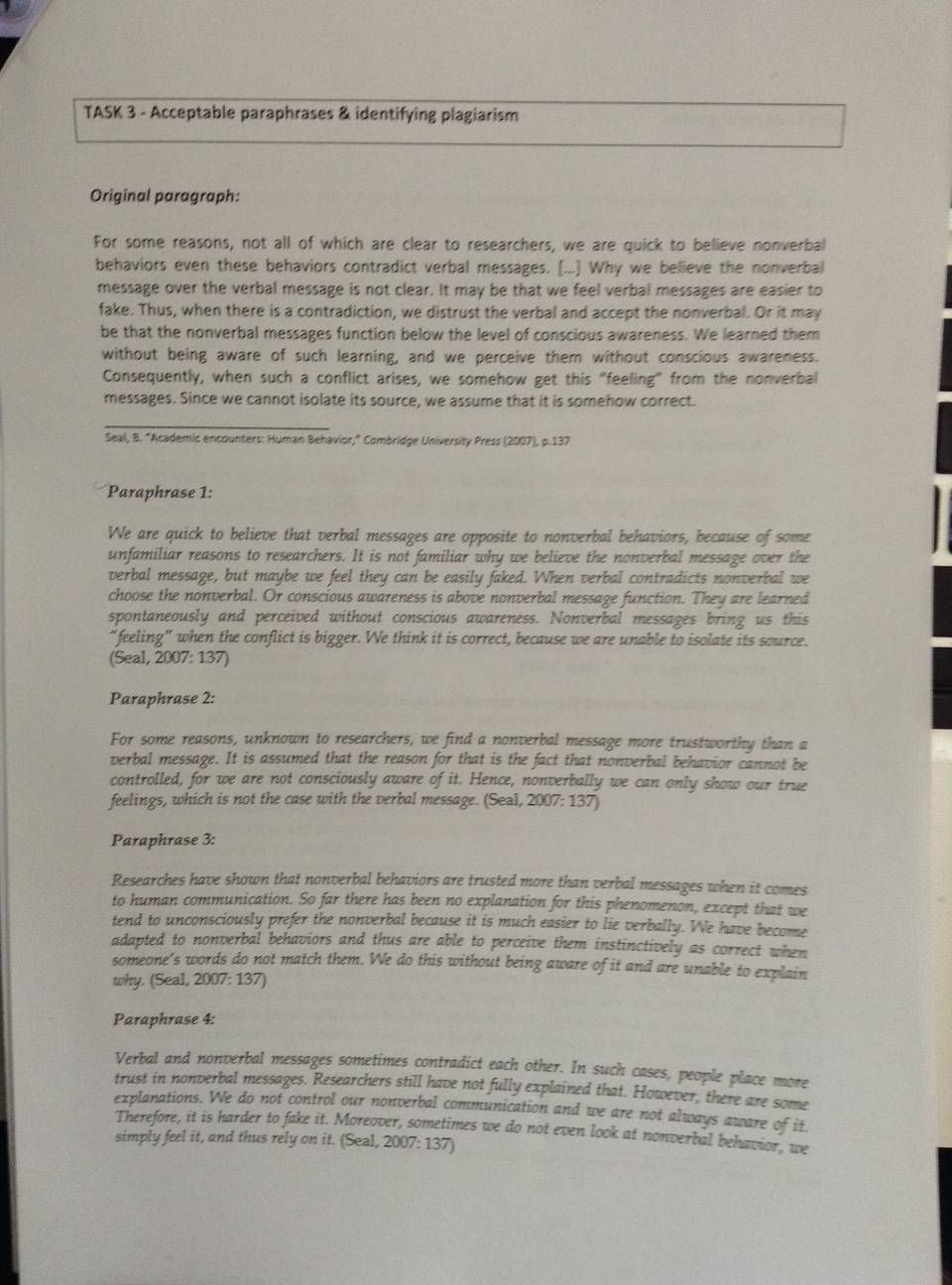
Give them one original paragraph and a few sample paraphrases of the paragraph. Read them and identify whether they are acceptable or not. Why/why not? (Using sample students’ writing – from beginning to end of a semester)

Paraphrases!

Paraphrases!

Paraphrase 1

  • Following the same pattern as the paragraph e.g. take the first sentence and change it slightly, then the second etc. is not acceptable
  • The main idea has been lost.
  • Too many identical chunks of language copied from the paragraph. Too much is directly lifted.

Paraphrase 2

  • A key term is ‘psychology’ for example – you can’t paraphrase it. But if it isn’t the keyword, you have to change it somehow. Or e.g. non-verbal behaviour, in this case.
  • Not plagiarised but not accurate either. Original: it may be that… Paraphrase: “it is assumed that…” not the same meaning. Need to keep the original message.
  • This person also follows the same pattern of the paragraph.
  • Parts of this have been paraphrased successfully but not acceptable over all.

Paraphrase 3

  • Acceptable

Paraphrase 4

  • The sentence lengths are too short.
  • Coherence and cohesion are also part of paraphrasing.
  • The language is not hedged enough.
  • Informality can be a problem.

Something to consider: What about where the source is acknowledged? At the end. But where does it start? We need to introduce also reporting verbs.

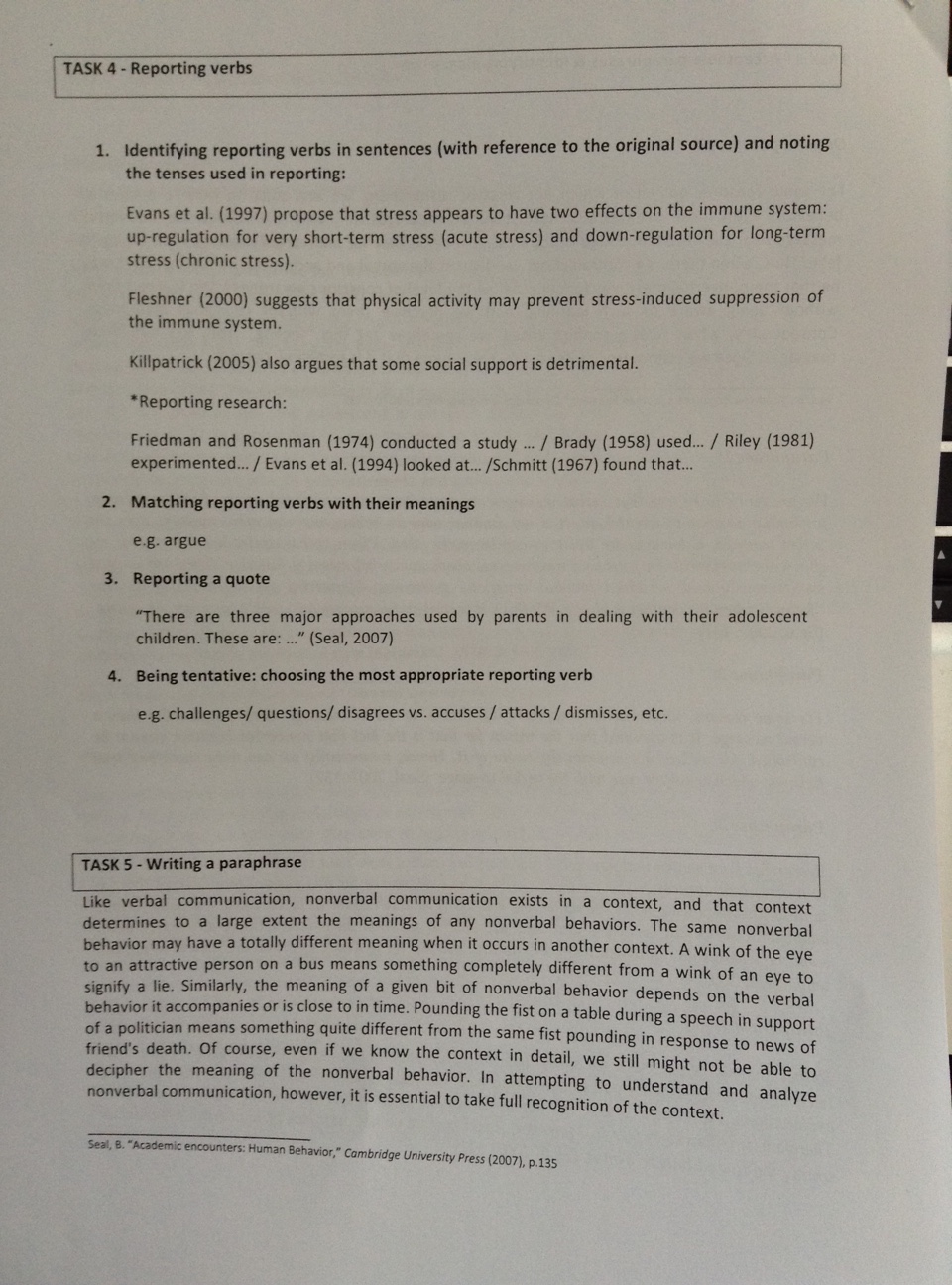
Task 4

  • Introducing paraphrases and quotes
  • The importance of reporting verbs
  • Tentativeness
  • Tenses

Start with a few sentences always with “write” e.g. the author wrote etc, ask ss to read the sentences, identify the verbs and think of other verbs that could be used instead of “wrote”/”has written”. There are many verbs we can use, some stronger, some more tentative.

Give ss sentences with such verbs used and get them to identify these and the tense. I.e. present simple. -> Present simple for current relevance. -> Referring to specific research may be past simple tense.

Get ss to match reporting verbs with their meaning. E.g. argue isn’t about fighting but about putting forward reasoning for your ideas.

Give ss sentences and get them to identify which reporting verbs could be used with each one. (E.g. no. 3 – Seal presents, Seal describes etc.)

Encourage students to use more tentative verbs e.g. challenges/questions/disagrees vs accuses/attacks/dismisses

image3

Task 5

Get students to write an acceptable paraphrase!

Encourage students to use mind-maps to organise the information visually. For identifying the key terms. From this they think about the who, what, why, make notes. They then use this when they write their paraphrase. So that they are not looking at the original and thus are not tempted to lift too much/pattern it the same way etc.

Great workshop – really useful for ideas for how to work with my ss on their paraphrasing over the summer. A most excellent start to the main conference, for me. 🙂
 

Teaching Academic Listening (and transferral to the General English classroom!)

This summer, I worked on a pre-sessional course for the very first time…

At Sheffield University, as well as teaching your tutor group writing skills and guiding them through the process of producing an extended written project, each teacher is responsible for teaching one of the other skills (reading, speaking or listening) to their own and a further two groups. For me, that skill was listening, 8 weeks of academic listening. And it was really interesting!

In this post, I’m going to share some of what I’ve done with my students and some of what I’ve learnt in the process. I also want to reflect on what might be transferable back to the general English classroom at International House, Palermo – rather imminently! (This post has been a few weeks in the pipelines!)

The 8 week listening thread of the pre-sessional course at Sheffield University was based on OUP EAP upper intermediate/B2 (de Chazal & McCarter, 2012) The listening skills development in this course book, to me, seems very strongly rooted in strategy development: students are equipped with strategies to use in order to help themselves listen more effectively to academic texts e.g lectures. Generic elements and functional language are teased out and students’ awareness raised, combined with scaffolded practice opportunities. This scaffolding is evident within units and across the book as a whole, where a gradual decrease can be identified, as students are expected to listen increasingly more independently.

This in mind, was all I had to do turn up and open to page x? Possibly not! In any case, having read a lot about teaching listening (e.g.Teaching and Learning Second Language Listening: Metacognition in Action  Vandergrift and Goh 2012), much of which seemed applicable to academic listening, and adding to this what I had gleaned from the induction week as well as the relevant chapter in EAP Essentials (Alexander, Argent and Spencer, 2008), I had a clear idea of what I wanted to do with the listening skills thread:

  1. Include (systematically, with gradually decreasing scaffolding) review activities at the start of the class and reflective activities at the end. (3hr lessons lend themselves to this approach beautifully!)
  2. Avoid the scenario of students meeting a new strategy and then consigning it to the dusty depths of a folder, never to be used again.
  3. Enable students to track their progress/development and recognise an accumulation of strategies being at their disposal. Not only this but also encourage *regular use* of them.
  4. Linked to all of the above, help the students become more independent listeners.

How did I do this?

  • Long-term planning

I made a hand-out to accompany each class, based on the activities in the course-book. Each handout guided the learners through the lesson from reflection to main content to review, also highlighting any new strategies introduced, and I made several weeks’ worth in advance. The main reason for this was time-management, trying to free up time for intensive marking periods and planned absences (graduation, wedding). However, I noticed that it really helped the coherence, especially as I had Vandergrift and Goh (2012) in mind, in terms of systematically reducing scaffolding and guiding learners towards independence in planning, monitoring and evaluating their strategy use. There was clear progression, explicit progression, from one class to the next.

Result: 

Increased coherence, making the content more useful for students.

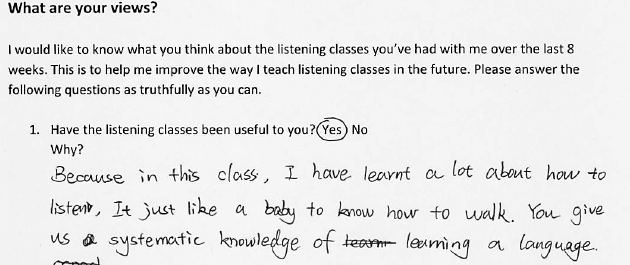
I had the ss fill in a feedback form at the end of the class - 4 questions, no numbers, to encourage reflection  (for them) and to gain an insight into their thoughts (for me).

I had the ss fill in a feedback form at the end of the class – 4 questions, no numbers, to encourage reflection (for them) and to gain an insight into their thoughts (for me).

Out of 36 responses, one was withholding judgement until he/she knew whether he/she had passed the USEPT exam (the university entrance proficiency test), one thought it was partly useful but felt we talked too much, and the rest were “yes”‘s.

Transferability: 

It’s different in a General English environment, as courses tend to be organised around grammar structures. However, what I want to try and do this year at IH Palermo is help students see how they are building on what they have learnt and be more systematic in how I approach my lessons in terms of review and reflection. Of course, being 1hr20 minute lessons rather than 3hr lessons limits the amount of time available for this. Nevertheless, working with the time available, a similar ratio could usefully be applied.

  • Strategy tables

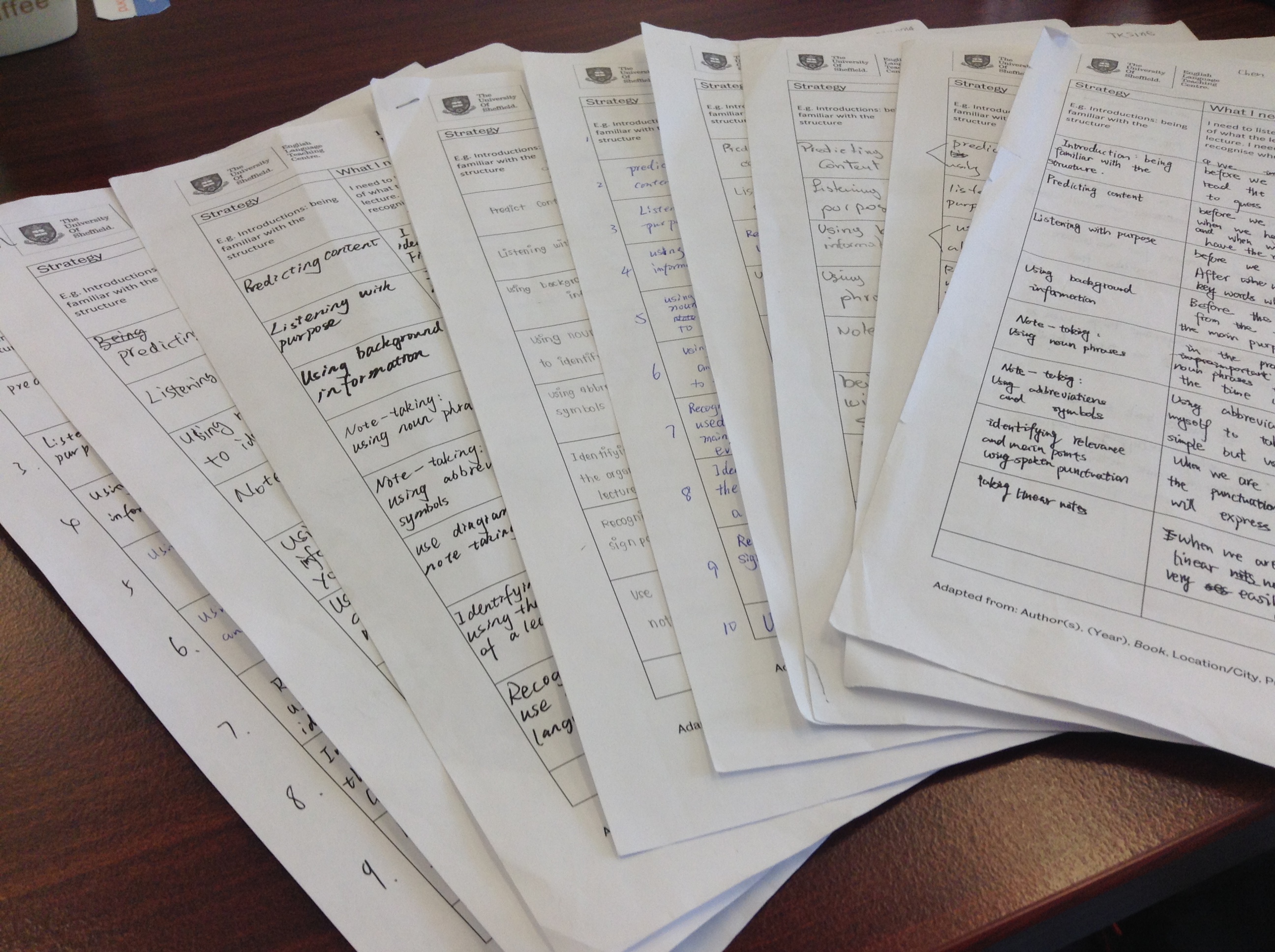
Strategy tables kept and updated by the students over the duration of the course.

Strategy tables kept and updated by the students over the duration of the course.

I made these between week 2 and week three of the course, following the blank stares that emerged in the initial review section of week 2. The idea was to help students build up a reference/resource, where at a glance they can see what strategies they have learnt and how to use them. This means they should be more likely to use them independently, rather than systematically forget about them, as new strategies are encountered. I completed the first strategy as an example, gave the students a little bit of time at the end of the class in week three to start updating them (so as to ensure they knew what they were doing) and then sent them off under instructions to bring their tables up to date. An important thing that emerged from this was the fact that it was not an instant success. The following week, not all students had updated their tables. However, by bringing it back into the classroom each week at the beginning of the lesson (students would compare their tables), an expectation of autonomy was created. In due course, all the students did live up to that expectation. This coincides with the recognition of the value of what they are doing and the behaviour becomes truly independent rather than purely response to expectation.

Result: 

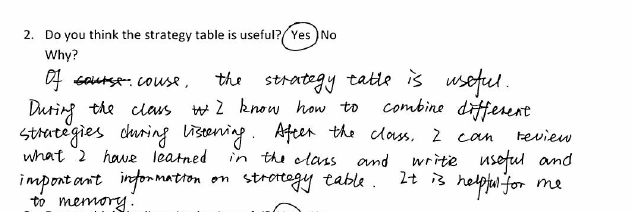
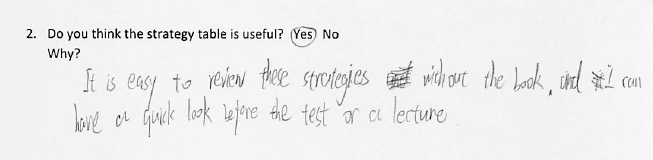
Students finished the course with a record of what they had learnt, a resource to take away, and a more independent approach to their listening skills development. Out of 36 responses, 35 were “yes” and one was “no”, who thought that there were too many strategies to juggle. This student hadn’t yet reached the point of being able to select strategies independently. With 8 weeks of teaching, expecting all students to reach that point may be a little over-ambitious. Many students commented that the strategy tables were useful for reviewing what had been learnt in previous lessons and made remembering the strategies and how to use them easier. I was particularly pleased with comments that cropped up regarding the utility of the strategy table beyond the end of the course. If learners can see how something is going to be useful to them long-term, they are likely to invest more in using it, and be more independent in their use of it.

Comments on the strategy table.

Comments on the strategy table.

Comments on the strategy table (2)

Comments on the strategy table (2)


Comments on the strategy table (3)

Comments on the strategy table (3)


 Transferability:

I think use of a strategy table would transfer nicely to exam preparation classes, where exam strategies are key to success. It could also potentially be useful in terms of accumulating a record of learning strategies met and experimented with, or resources. In the past, I have given learners a handout with different resources for them to try. I wonder if getting them to create this handout themselves, collaboratively perhaps, might be even more effective…

  • Listening logs

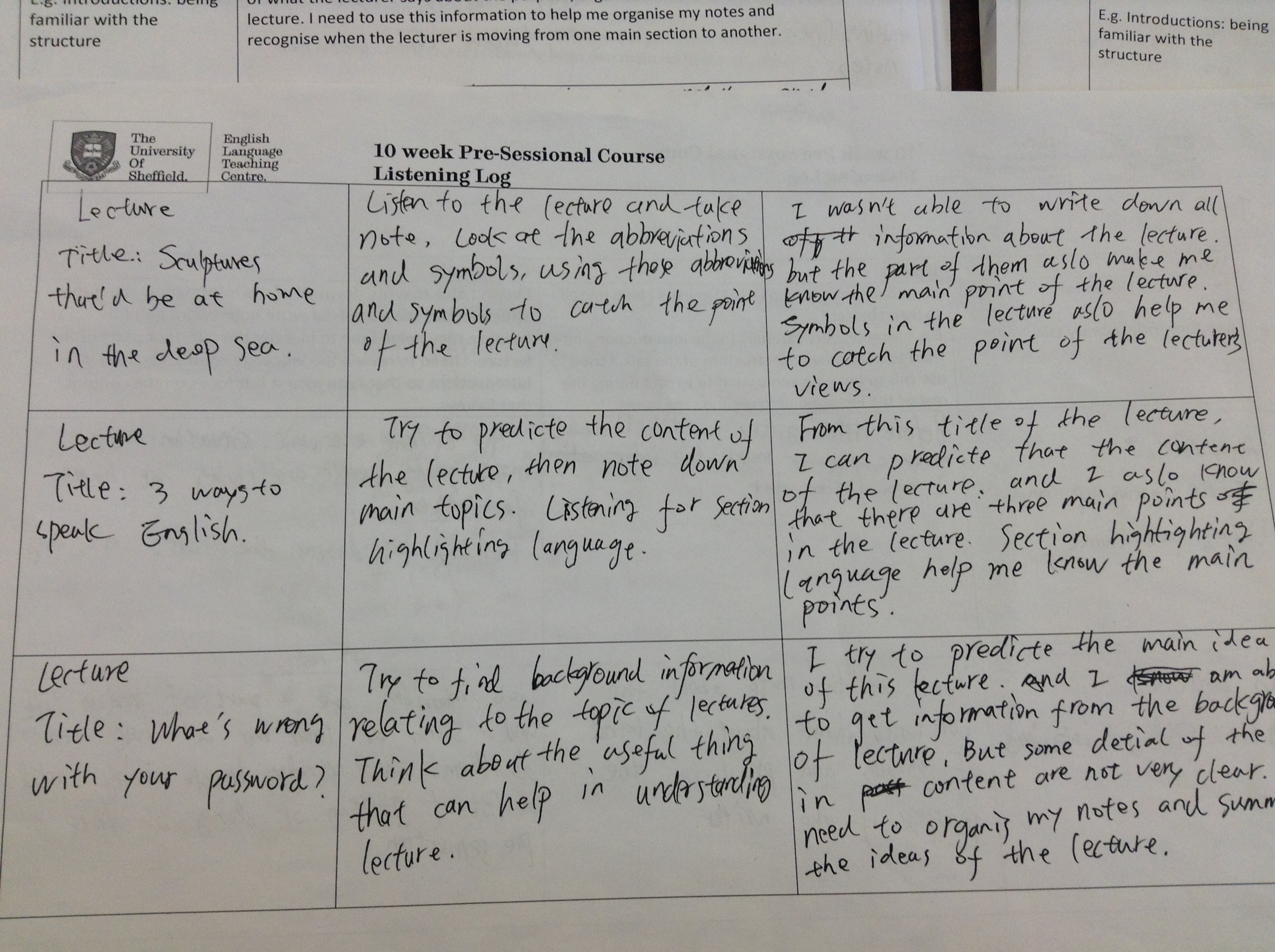
Listening log in action!

Listening log in action!

These were made and introduced alongside the strategy tables. The idea was not by own but based on what I’ve learnt by reading about teaching listening. I adapted it to this context. As with the strategy tables, I started the learners off with an example. The goals were to encourage independent listening, to help learners develop metacognitive awareness and to avoid the scenario (much bemoaned by listening teachers) of the question “What have you listened to since the last lesson? Which strategies have you practiced?” being met with blank stares. Again, as with the strategy tables, learners compared their logs at the beginning of each lesson.

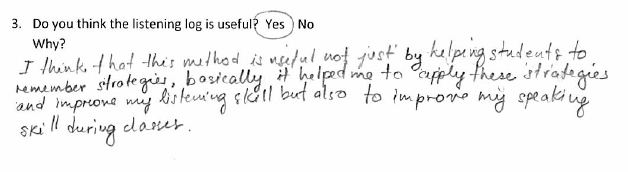
Result:

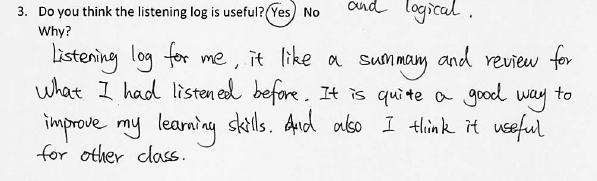
Some students thought the log could be improved by including space for their actual note-taking. Others thought it wasn’t for them. Those that used it, however, did find it useful, as a means of structuring and tracking their out-of-class listening and tracking their progress.

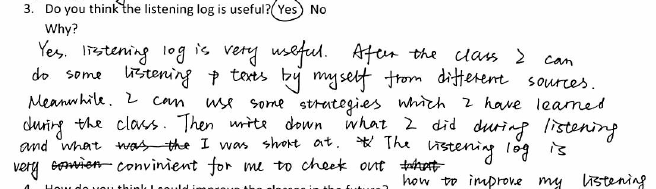
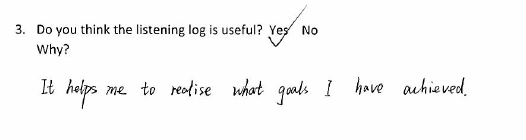
Listening log comments (1)

Listening log comments (1)

Listening log comments (2)

Listening log comments (2)

Listening log comments (3)

Listening log comments (3)

Listening log comments (4)

Listening log comments (4)

Screen Shot 2014-09-27 at 20.39.30

Listening log comments (5)

Transferability: 

As I have learnt through my own language learning this summer, as well as through these students’ experiences, logging is an incredibly useful thing to do. I think it is very transferable to the General English classroom. Students can log their out-of-class study and in the process create a record of their efforts, achievements and progress. Personally speaking, I’ve found it a useful way of maintaining motivation. I think learning logs could be also usefully used in conjunction with something like a learning contract. I think it needs careful thought though, as to how valuable it’s going to be. For example with these students, it wasn’t just what they did that they recorded, but how they went about it (in terms of strategy choice) and reflections on that experience.

  • Reprocessing information/strategies

As well as using listening logs and strategy tables with the students, I also used classroom activities to encourage them to reprocess what they were learning and really internalise it. For example, mingles in which the students played strategy guessing games or simply recalled as many strategies (and what they involve) as they could in a given time frame, swapping partners frequently and repeating (generally also collecting and taking with them information/ideas from their various partners – enabling them to benefit from a collective understanding of what they were learning).

Another effective activity was getting students, in groups to create mind-maps of the strategies, which they then presented to their classmates:

Mind-maps (1)

Mind-maps (1)

IMG_0674

Mind-maps (2)

IMG_0673

Mind-maps (3)

Result:

This encouraged deeper processing both of what the strategies involved and how they relate to each other as well as to the task at hand. We did the activity in a lesson subsequent to one in which the focus of the lecture extract was on categorisation (e.g. Aristotle’s classification of the world) and using diagrams in note-taking, so this task also developed that theme by requiring students to categorise the strategies and present their ideas visually.

Transferability: 

Activities like this obviously have great transferability potential, and,  as well as encouraging deeper processing of lesson content, give students opportunity to use language meaningfully and benefit from each others’ knowledge and understanding.

  • Systematic introduction of out-of-class listening resources 

At the end of each class, I gave students a new resource to try (e.g. Oxford University podcasts, UCL lunchtime lectures etc.) and at the beginning of the next class, they had to report back to their classmates regarding what they had done with the resource and an evaluation of it. This was done in conjunction with using the listening logs described above. Again, uptake wasn’t instantaneous, but perseverance meant students did use the resources in due course – and develop their listening.

This was a more directed version of my Experimentation with English project. It seemed logical as EAP is more directed too: goals are very specific, and specific needs relating to these require specific resources. I think there is something to be said for for introducing resources piece-meal, in terms of not overwhelming students. Having said that, my students at IH loved the handout with all the different resources.

Transferability:

I wonder about using this approach in conjunction with my EE project. So, as well as giving learners the resource, going through a more directed process so that all the learners end up trying at least some of the resources. Then, those who are more independent will inevitably try more besides, but perhaps the gap between the more and less independent might be lessened by the extra direction.  I think this could also be transferable to exam preparation classes, in terms of encouraging students to use different exam preparation resources to prepare, and sharing what they learn with each other.

Conclusions:

It was a very interesting summer, and, I am happy to say, my three groups performed very strongly overall in the listening component of the listening proficiency/entrance exam. Importantly, they also felt they had made progress, thanks to the concrete means of measuring it (e.g. strategy tables and listening logs), which helped maintain motivation and encourage a feeling of all the hard work they were putting in being worthwhile. Equally importantly, they were equipped to continue to develop their skills independently and apply what they had learnt in the new context. (Encouraged by frequent pushing from me to reflect on the relevance of what we were doing to what they would be doing in the future – i.e. their university courses!).

I now look forward to trying to transfer what I have learnt to my current context and help my new students to be develop as effectively as possible over the short duration that they are studying with me.