IATEFL 2015: Uncovering Expertise in Coursebook Writing – Heather Buchanan and Julie Norton

Well, I wasn’t going to miss this one – interesting topic and one of the speakers (Heather)  was, of course, my tutor at Leeds Met (now Beckett) Uni. 

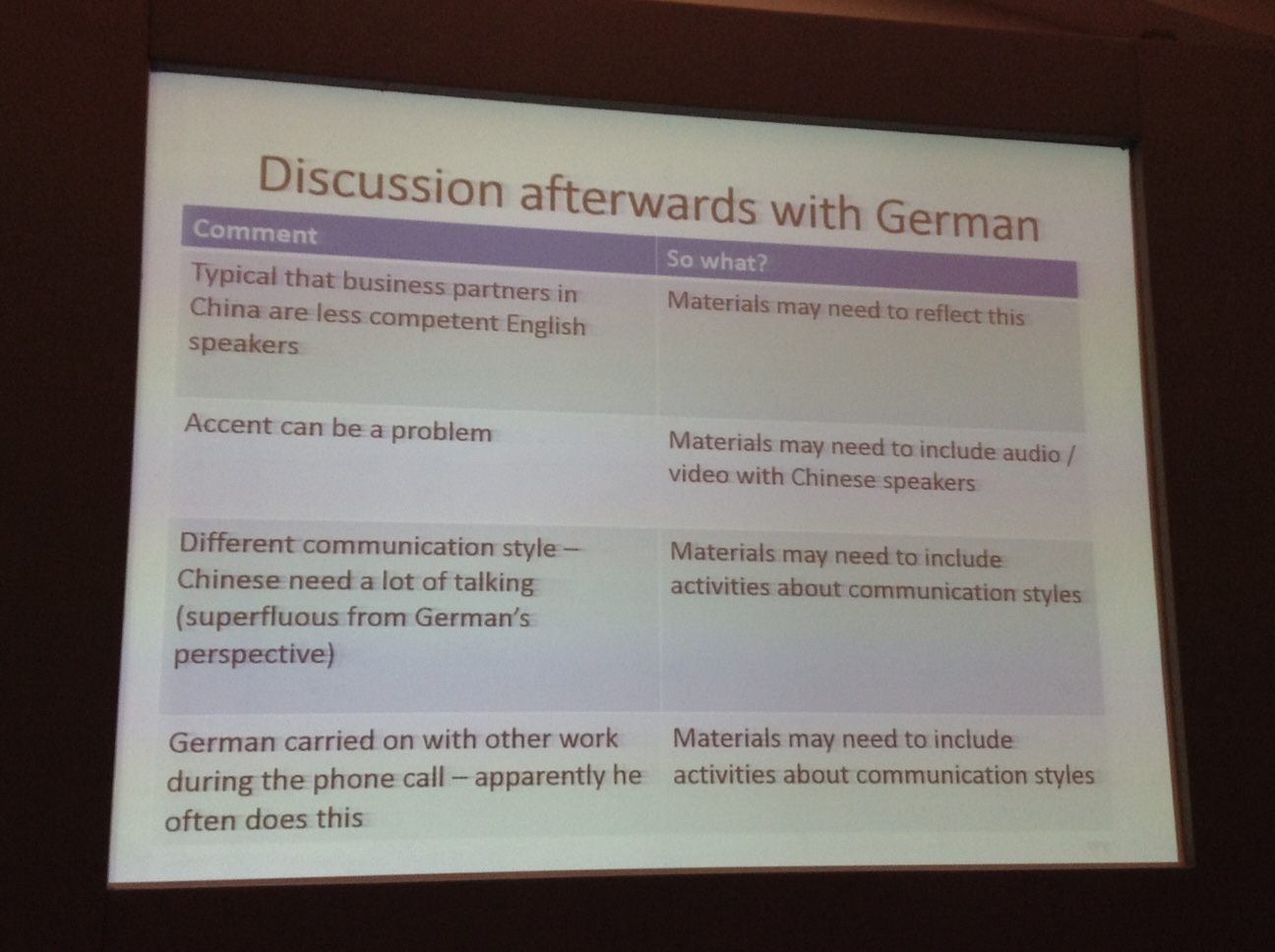
Julie and Heather want to build on the work done by the likes of MaW SIG and ELT Teacher2Writer in terms of demystifying the field of Materials Development.

They started by showing us a quote that sums up the field. Materials writing – it’s “like expecting the first violinist to compose the orchestra’s repertoire in his or her spare time”  – this was Michael Swan on expecting materials development from untrained teachers.

Expertise in materials writing

We looked at the characteristics of expertise:
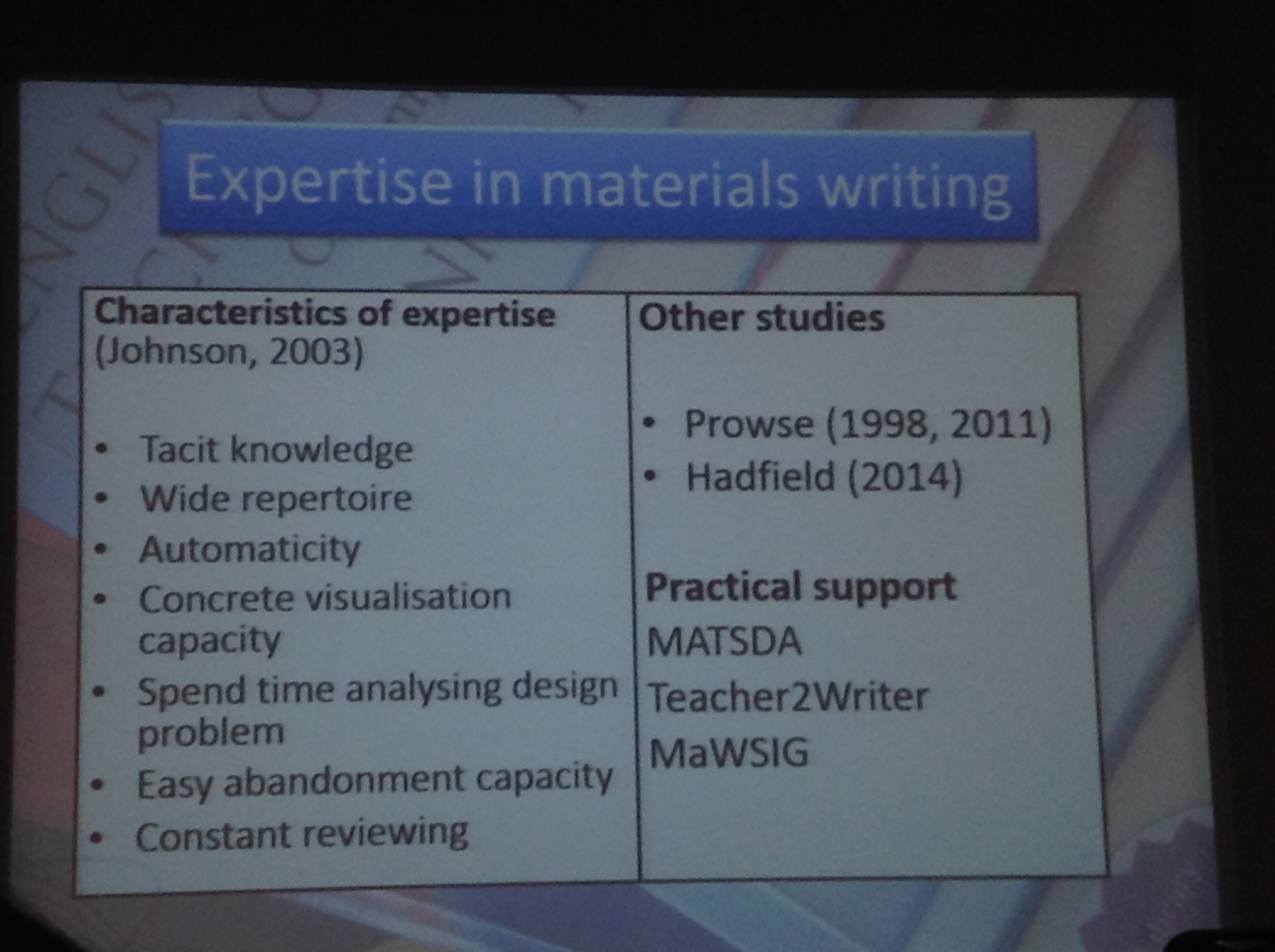
image1-1

Then we moved on to hearing about Heather and Julie’s research project. They had used simple questionnaires, which they had distributed writers and editors. They shared the data collected with us, looking at different questions (and the responses they had collected) in turn…

What are the 3 biggest challenges that you face when writing a unit of a coursebook?

  • Practical constraints: space, fitting it all on to the page; being able to develop interesting texts with a limited number of terms; meeting deadlines/timing
  • Creativity: thinking of ideas, fresh angles on topics, a wide repertoire of tasks, creative language practice for different language points. Editors say that constraints can generate creativity i.e. within the brief.
  • Following the brief: being really aware of your students and teachers, background, interests etc so that you can write the right kind of lessons for them; coping with changing briefs (as projects move forward this happens)
  • Technical aspects: the biggest category, coming back to it later!
  • Managing the process: relationship with the editor

What three pieces of advice about the craft of writing would you give a new course book writer?

  • Working with others: useful to have a writing partner, complement each others strengths/weaknesses, bouncing ideas off each other; being able to take feedback. Editors represent teachers that aren’t like you.
  • Going back: looking at what you have created and being self-critical; redrafting things and being meticulous
  • Visualisation and imagination: you have to be able to imagine what it’s going to look like on the page when it’s finished. How will things flow from one thing to another. Trying to visualise the position of the teacher who will use the material. Understanding what works and being able to conceptualise how the material will work in class. If you don’t have this, you are an editor’s nightmare!
  • Managing time: managing time within a day, being self-disciplined, managing deadlines etc.
  • Beliefs: being aware of your own beliefs and principles regarding teaching, being aware of the principles of the project in comparison with your own and thinking twice about taking on a project if the two aren’t compatible.

Coming back to Technical aspects:

A big category so broken into 2:

Theoretical Expertise

You need a sound knowledge of methodology and linguistics.

Writers need to make the findings of research more palatable for the classroom. They also need appropriate terminology to teach items that arise out of theory e.g. corpus research. E.g. what do you call connected speech on the student book’s page?

Practical Expertise

  • The more support a writer puts on the page, the more tied the students and teacher are to the page. There is a balance between support and flexibility that needs to be considered.
  • Thinking about the final task in a unit and how you prepare students through the unit to meet it. There was a lot of talk about tapestries and weaving, ending with a seamless garment. This applies within a unit but across a whole book as well, so as to ensure continuity and good recycling of language, also consistency. Ensuring the theme is maintained but interestingly developed.
  • What do you do if the editor doesn’t like the topic? Knowing when to let go of a topic is important, whether it is because the editor doesn’t like it or if it just isn’t working.
  • How do you make your text sound natural? Will the editor cut those ums and ahs from your audio in the end?
  • Knowing how much material is needed for a lesson so that you don’t end up with too much.
  • You need to make sure communicative activities are genuine.

What advice would you give?
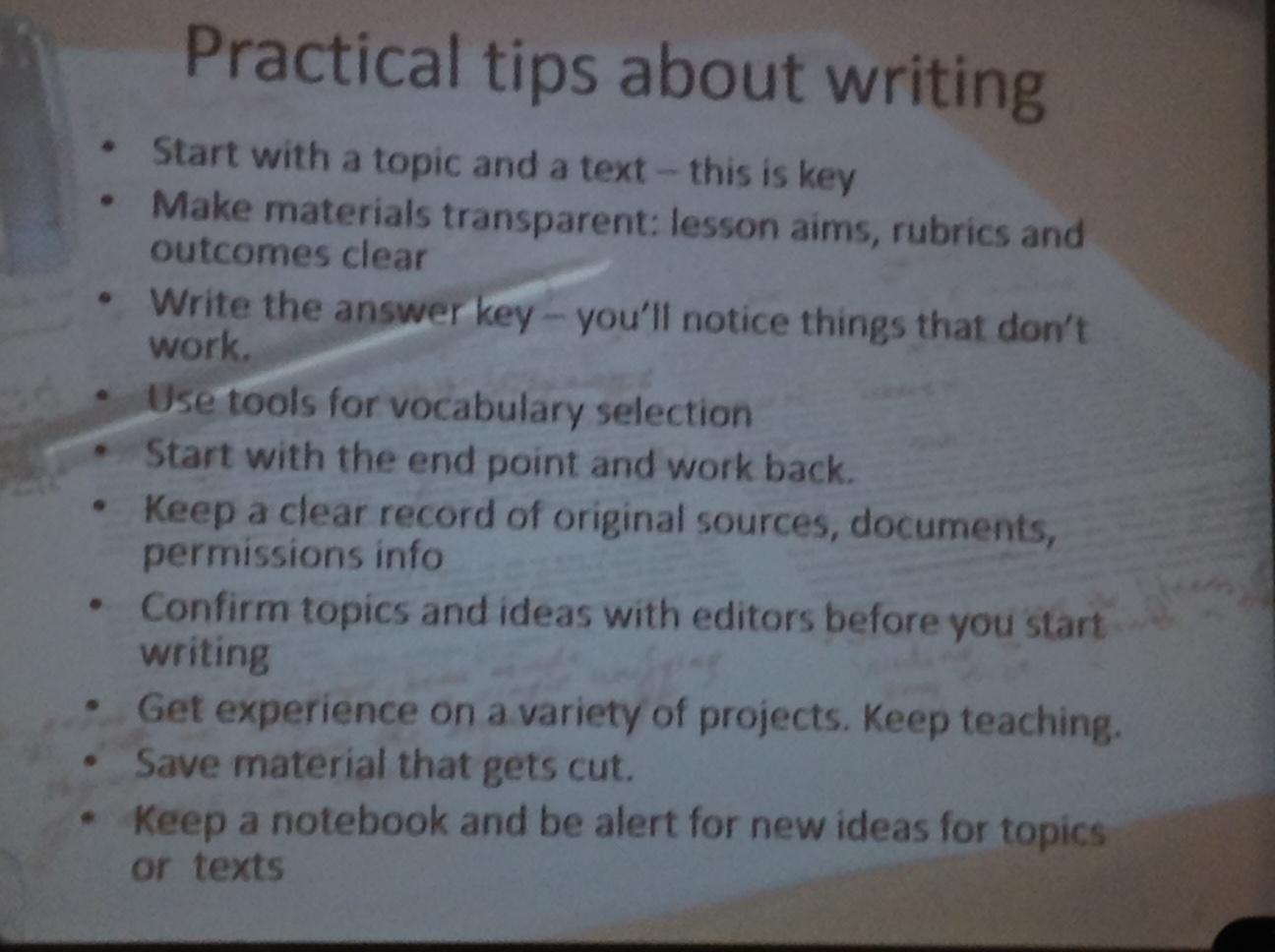
image3-1

(In terms of use tools, this refers to things like the Oxford 3000 or the Vocab profile)

Has the way you approach writing changed since you first started writing coursebooks? If so how and why?

Internal:

  • Developing greater automaticity
  • Gaining more confidence
  • Gaining more knowledge of the language
  • Gaining more knowledge of the craft – how much can fit on one page, what works etc.
  • Awareness of pitfalls
  • Professional maturity – understanding how it works, relationship with the editor, greater awareness
  • Focus on students

External:

  • What’s valued in materials
  • what has changed in the world of publishing
  • the impact of the internet.

Conclusions:

It’s highly complex but it can be demystified. Is there any shortcut for experience? What is the best method for developing expertise? “Writing is just like a muscle: you just have to keep at it” (a writer) “I have rarely seen improved ‘creativity’ in writers, as this tends to be inherent and is difficult to train” (an editor)
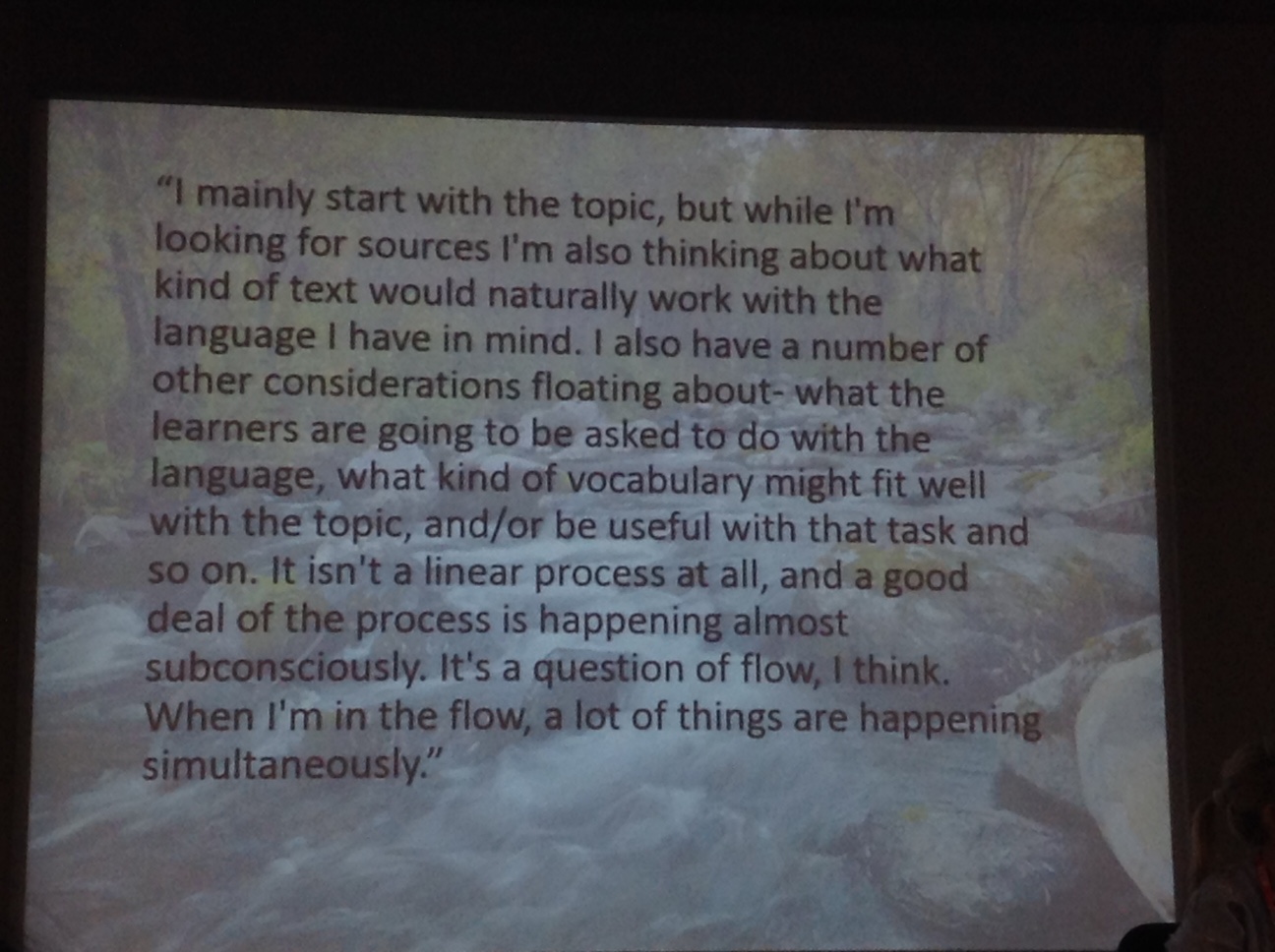
image4-1

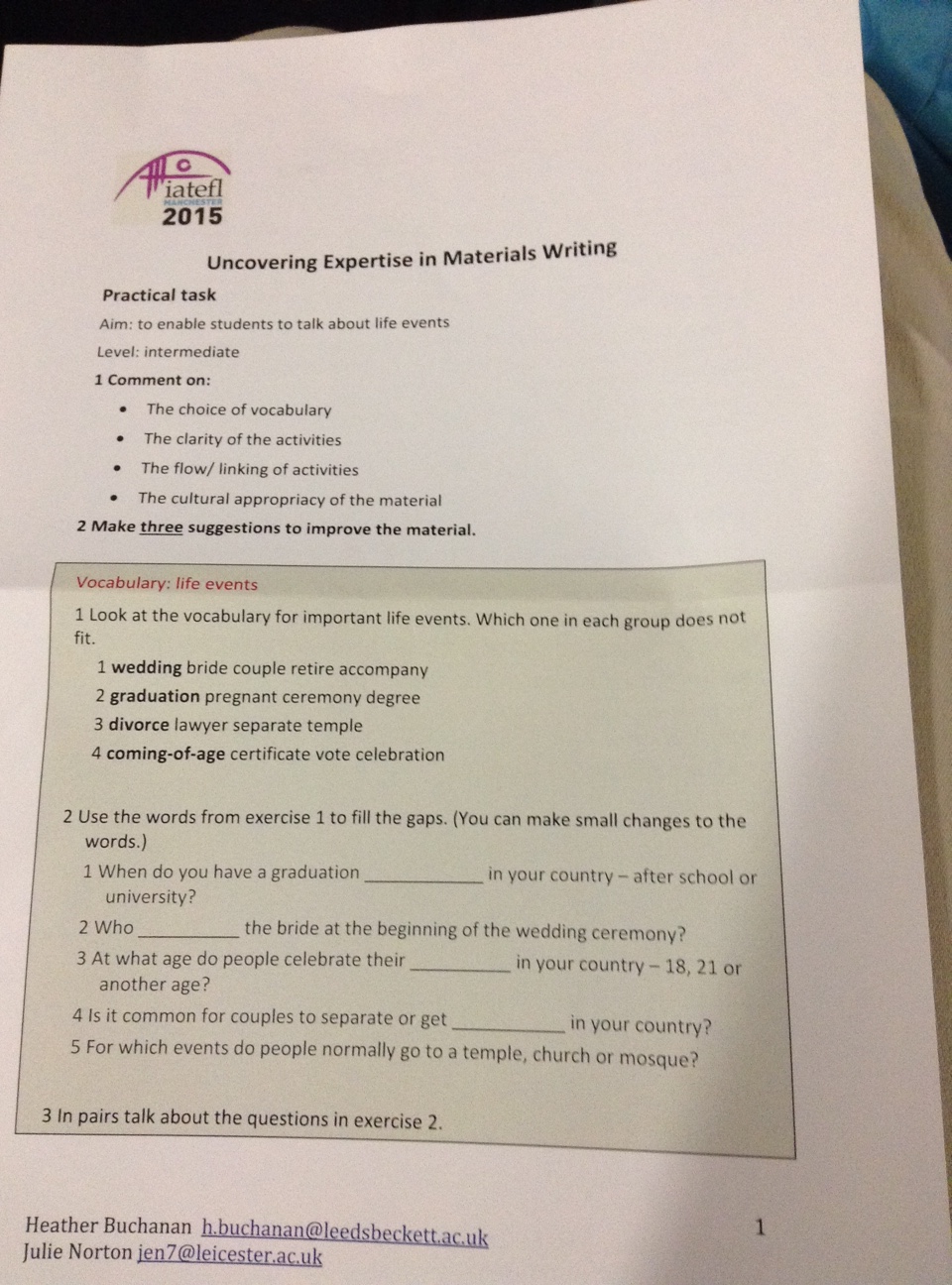
Task:

image5

Responses that came out in the post-task discussion:

  • A very abrupt beginning
  • Lots of vocabulary not practised/activated
  • Formatting unclear, no explanation for the words in bold.
  • An example would help to clarify the rubric
  • Is there a correct answer? If there isn’t, is that ok or not?
  • The discussion questions are not generative in discussion terms, could be rephrased to push students to produce more than one word answers.
  • Cultural inappropriacy – potentially inappropriate in some places, taboo issues e.g. divorce in some places.
  • My group and I also thought that the mixture of word types in the first question could be misleading. And one group of words had more words than the other groups.

And that was all we had time for! It was a very speedy half an hour on a very interesting topic. 

IATEFL 2015: Swimming and Pronunciation – Wayne Rimmer

Floor space only for this talk! A very small room and lots of eager participants…

Wayne starts by connecting swimming and pronunciation:

Why the connection with swimming? 

  • They rely on basic principles – once someone has them, they can swim/pronounce better.
  • The physical nature also brings these two disciplines together.

With swimming, you need to expend a lot of energy but you also need good technique. You can’t get anywhere without good technique in swimming. Wayne thinks it’s the same with pronunciation. Pronunciation is about what you do with your body, how you experience things.

When we give students information, does it help them to produce the language? Maybe not. It’s about what the body esp. oral cavity is doing.

  • They are both individual efforts. You swim by yourself, you pronounce by yourself.
  • Both are difficult to observe – e.g. front crawl, all you see is the arm coming out of the water, the actual work is happening under the water. All the skill is happening under the water – you have to get it behind you. You can’t learn about swimming by watching people swim – there is nothing to see. Pronunciation is similar – some more visual than others but how they are pronounced is very subtle.
  • Both are teachable and learnable (some may disagree!) Wayne has personally got results with both, however.
  • There is variation in performance.

With swimming, if you go to a pool or a lake, and watch people swimming, you will see lots of different styles, lots of variations in technique. There isn’t just one way to swim, we all have different bodies so the same way won’t suit everybody. With pronunciation, we all have different bodies and speak in different ways – if someone phones you, know who it is because their register, how they pronounce is very specific. There is also variation in accents. E.g. Manchester, northern vowel sounds. Both within anglophone countries and across countries.

Less than 5% of the population produce RP. It doesn’t represent the global reality. And it’s not possible for everyone to reach “native speaker standard” (loaded term). There is a ceiling effect. To get beyond your ceiling, you are going to have to allocate so much time to it that what happens to everything else? Teaching is all about priorities and time.

  • Non-imitative: even if you could mimic it in the classroom, will you be able to produce it naturally outside? (This morning’s plenary comes back to mind…) Just like with swimming, you can’t become a good swimmer by watching others swimming.
  • Both are, or should be, fun! Perhaps not with listen and repeat minimal pairs.
Feel the water! Image taken from Google Images search, licensed for commercial use with modification

Feel the water! Image taken from Google Images search, licensed for commercial use with modification

Feel the water

Personal anecdote from Wayne: He was always quite a good runner at school, went to university, wanted to go to the next level so did as much running as possible, but realised it wasn’t possible without injury. So he needed another aerobic activity. Eventually settled on swimming. He went three times a week and got nowhere, had no technique, got dispirited. He tried copying everyone else, but it didn’t work. He got quite stressed about the whole thing, about getting nowhere. He even spoke to a few people to get advice, but it didn’t work. One day when he was getting out of the pool, an old guy asked him if he was ok, he said he was but couldn’t swim, and the old guy said “Just feel the water”. So next time, he went and decided to concentrate on what he was doing, not worry about what everybody else was doing, not worry about speed, and try out a few things by himself. Over a period, all these things fed into each other and he started to swim more efficiently and faster.

The principles are very basic, you just have to put them into operation and it clicks into place. BUT not overnight. Not in a single lesson. As a coach, it takes a lot of time to get people to that click into place point. But you need the principles. The better your technique, the easier it will feel. It also becomes automated. Like walking. But that takes a long time. To start with, you have to think about every moment, takes cognitive energy.

The principles of pronunciation are also relatively straight-forward but you need to have them before you can move with it:

  • Egressive airflow: air comes out of your mouth (very few are ingressive, air coming in)
  • Modulation of airflow: if you just blow out, nothing happens. It comes out through your lungs, through your voice box, the glottis. The folds can be open or closed, vibrating or not. That shapes the texture of what comes next. Then the oral cavity, you have a powerful muscle i.e. the tongue. (If your arms were as powerful as your tongue, you’d move through the water twice as fast!) It can change shape, direction, block airflow etc.
  • Automation of process: we don’t have to think about where our tongue is in order to articulate, but learners initially do. Until it becomes automatic.

Once you get a feel for what is happening there, then anything is possible. You have to experience pronunciation. With your body.

<Now we have to do things with our tongues, following instructions. Then produce sound. Then glides (diphthongs).>

So the idea is to get students to experience what they are doing with their tongue and where the sound is going.

For pronunciation, we need coaching not teaching:

  • Not a one style for everyone approach. We need to accommodate different styles.
  • We need to set realistic goals. And set different goals for different people. So that we don’t burn anybody out/disappoint them. In swimming and pronunciation, it is physical, will-power is not enough.
  • You have to feel it to do it. Most students aren’t interested in high linguistics, they just want to use the language.
  • You cannot swim/pronounce for someone. It’s up to them. A lot of what happens is irrespective of us. In teaching there is very little evidence of particular methods of teaching having particular results. E.g. which method is more effective? Hard to find such studies. We like to overestimate our role but… (again echoes of this morning’s plenary!)

Key resource for learning about pronunciation in this sense:

Catford, J (2001) A practical introduction to phonetics. Oxford: Oxford University Press

It was a very interesting talk. I would have liked more on the practical activities to do with learners front, but then it was a talk rather than a workshop. I’d really quite like to attend the workshop version…! 


IATEFL 2015 “EAP writing: teaching strategies for effective paraphrasing” – Tina Kuzic

My first non-plenary talk for the main IATEFL conference (plenty of PCE talks yesterday!) and it’s about EAP. Hopefully it will help me to help my students this summer…

Why paraphrasing?

Because it is such an important part of academic writing. Writing in general is the most challenging thing to teach nowadays, especially with learners who are part of the digital generation, and especially in terms of motivation. For academic integrity, paraphrasing is key.

Tina’s courses

EGAP and ESAP (for psychology) both are in-sessional and obligatory. The average level is B2 when it comes to speaking. However, for writing, the level is a bit lower; especially for formal writing. At secondary school, students only write essays so they don’t get any training in formal writing. The focus of Tina’s courses is study skills, strategies for reading, writing for academic purposes.

Plagiarism, and preventing it, is very important and one of the tasks that we as EAP teachers have to address. Students are often not aware that they have plagiarised, they lack training in this context.

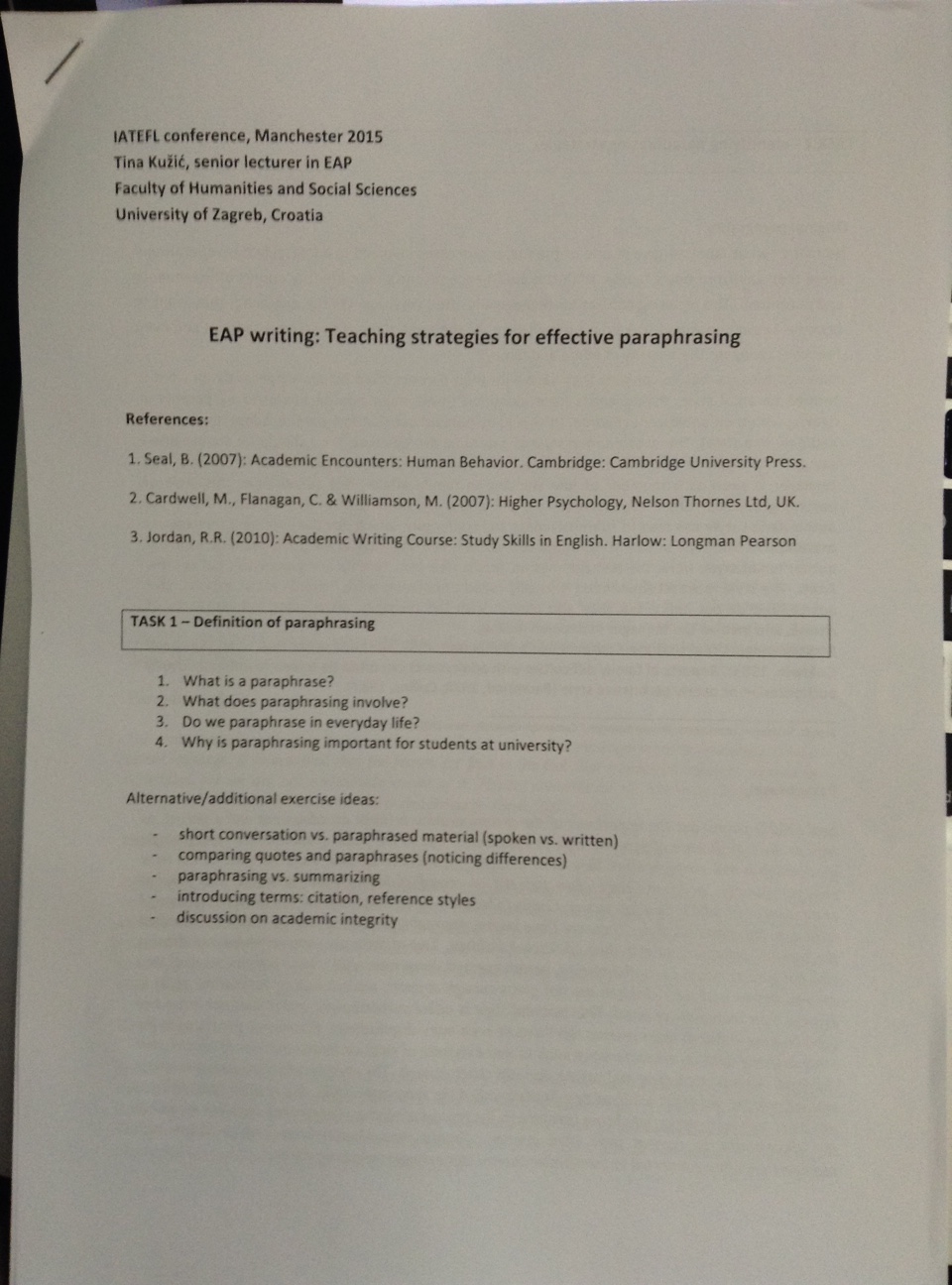
Task 1

For the introductory class, Tina refers to students’ previous knowledge – what they think or know about a given thing. Start with a set of questions.

So, for paraphrasing:

  • what is a paraphrase?
  • what does paraphrasing involve?
  • do we paraphrase in every day life?
  • why is paraphrasing important for students at university?

Extension: defining terms such as quoting, citing, summarising, referencing

Students may not be familiar with all the terminology.

You could also start with a conversation, a paraphrased conversation, a written summary paragraph of it and get them to notice the differences. Or, give them a quote and a paraphrase, get them to identify the differences.

image2

Task 2: Identifying paraphrasing strategies

An original and a paraphrased sentence is given to the students and they are given time to read each. Students asked to find examples of the rewriting and asked what happens in terms of grammar and vocabulary. Once more familiar, they could look at paragraphs, as per the task we were given.

  • The first sentence is a summary of the main idea of the text, used as a topic sentence.
  • Move from paraphrasing details to summarising main ideas.
  • Use different parts of speech
  • Use different structures e.g. active vs passive
  • Synonyms
  • changing the subject
  • moving parts of sentences
  • combining short sentences
  • dividing long sentences
  • synthesising sources

Paraphrasing uses a mixture of these.

Provide students with a list of these strategies, then go back to the sentence/paragraph and look for the strategies not previously identified.

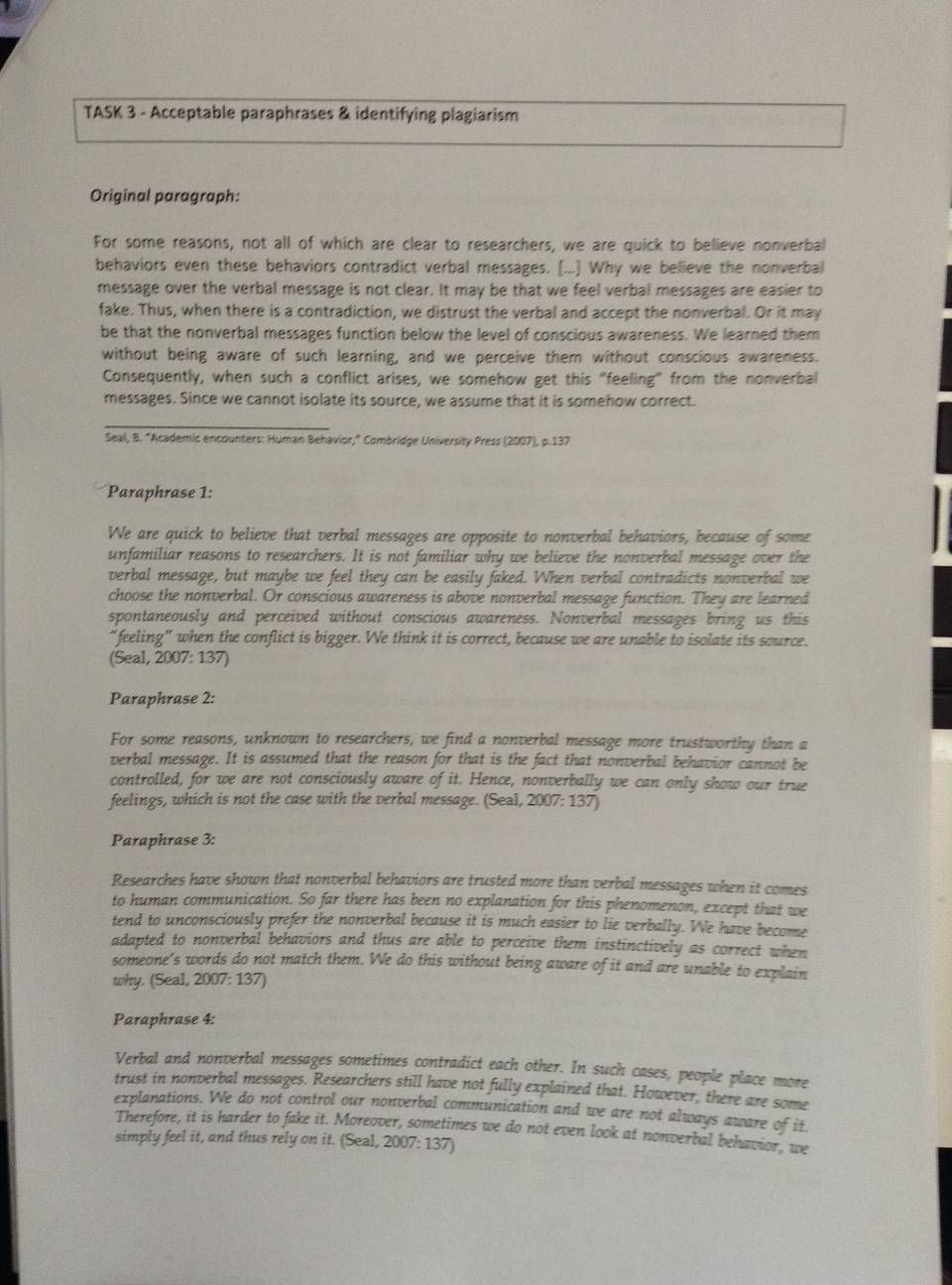
Task 3:

Give them one original paragraph and a few sample paraphrases of the paragraph. Read them and identify whether they are acceptable or not. Why/why not? (Using sample students’ writing – from beginning to end of a semester)

Paraphrases!

Paraphrases!

Paraphrase 1

  • Following the same pattern as the paragraph e.g. take the first sentence and change it slightly, then the second etc. is not acceptable
  • The main idea has been lost.
  • Too many identical chunks of language copied from the paragraph. Too much is directly lifted.

Paraphrase 2

  • A key term is ‘psychology’ for example – you can’t paraphrase it. But if it isn’t the keyword, you have to change it somehow. Or e.g. non-verbal behaviour, in this case.
  • Not plagiarised but not accurate either. Original: it may be that… Paraphrase: “it is assumed that…” not the same meaning. Need to keep the original message.
  • This person also follows the same pattern of the paragraph.
  • Parts of this have been paraphrased successfully but not acceptable over all.

Paraphrase 3

  • Acceptable

Paraphrase 4

  • The sentence lengths are too short.
  • Coherence and cohesion are also part of paraphrasing.
  • The language is not hedged enough.
  • Informality can be a problem.

Something to consider: What about where the source is acknowledged? At the end. But where does it start? We need to introduce also reporting verbs.

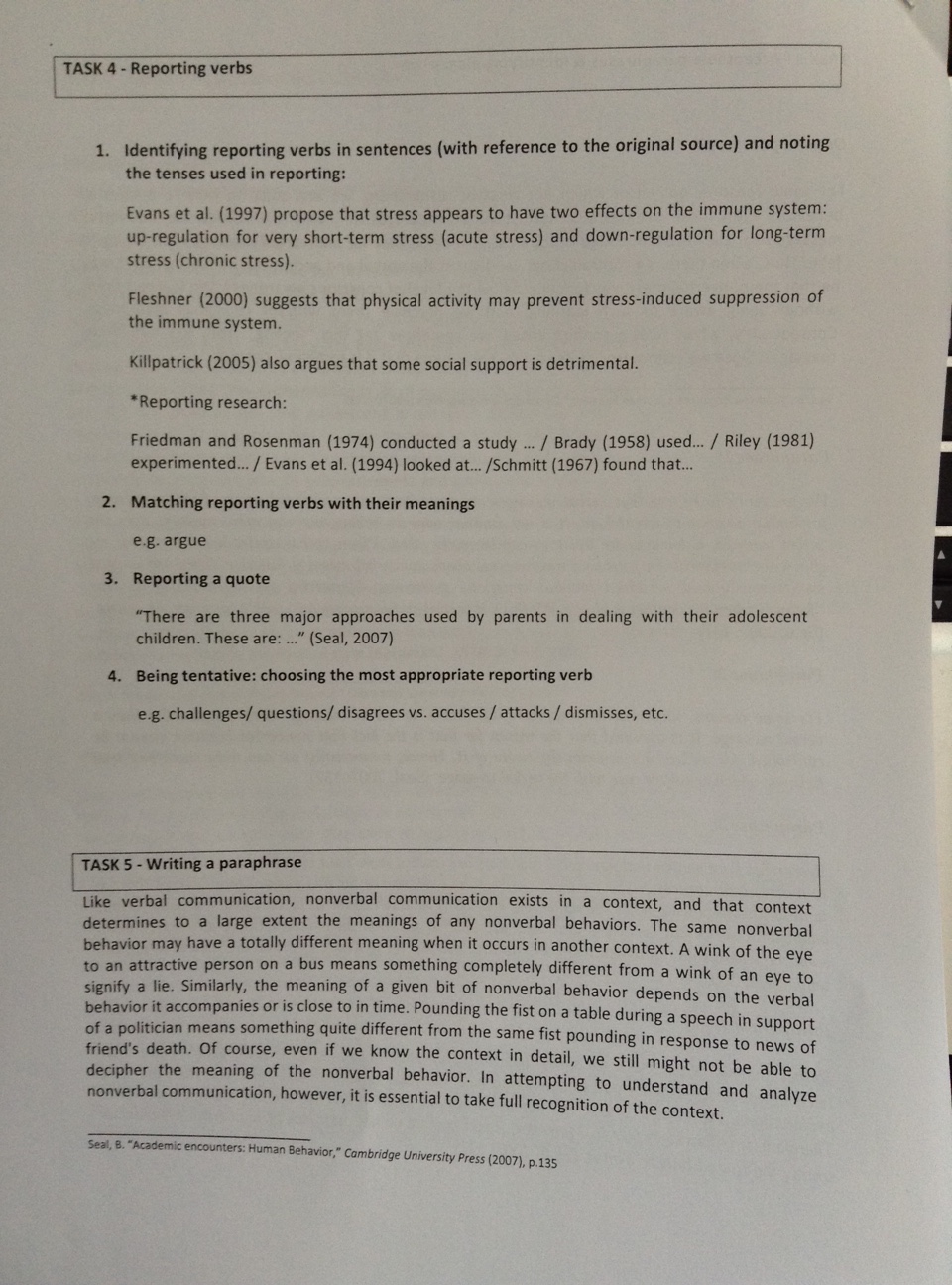
Task 4

  • Introducing paraphrases and quotes
  • The importance of reporting verbs
  • Tentativeness
  • Tenses

Start with a few sentences always with “write” e.g. the author wrote etc, ask ss to read the sentences, identify the verbs and think of other verbs that could be used instead of “wrote”/”has written”. There are many verbs we can use, some stronger, some more tentative.

Give ss sentences with such verbs used and get them to identify these and the tense. I.e. present simple. -> Present simple for current relevance. -> Referring to specific research may be past simple tense.

Get ss to match reporting verbs with their meaning. E.g. argue isn’t about fighting but about putting forward reasoning for your ideas.

Give ss sentences and get them to identify which reporting verbs could be used with each one. (E.g. no. 3 – Seal presents, Seal describes etc.)

Encourage students to use more tentative verbs e.g. challenges/questions/disagrees vs accuses/attacks/dismisses

image3

Task 5

Get students to write an acceptable paraphrase!

Encourage students to use mind-maps to organise the information visually. For identifying the key terms. From this they think about the who, what, why, make notes. They then use this when they write their paraphrase. So that they are not looking at the original and thus are not tempted to lift too much/pattern it the same way etc.

Great workshop – really useful for ideas for how to work with my ss on their paraphrasing over the summer. A most excellent start to the main conference, for me. 🙂


IATEFL 2015: Pre-conference Event Day – MaW SIG – Part 4

By now it’s been a long day and, truth be told, I’m getting tired! I did however manage to jot down a few things for each of the remaining talks, so for what they are worth (my notes, that is, clearly the talks are worth plenty!) here they are:

Tailor-making materials from an ESP author perspective – Evan Frendo

How are tailor-made materials in a corporate context different?

  • Very specific. PARSNIPS aren’t an issue e.g. PIG in industry usage.
  • Corporate culture – e.g. a training culture
  • Needs – corporation needs as well as the individual.
  • Learning centred not learner centred.
  • Training rather than education.

It’s all about finding the gap – the training gap – between where they are now and where they need to be. Very specific, focused on aspects of the job that needs to be done. You can use corpora to do this (very specific texts and wordsmith tools).

 However:

  • Vocabulary profilers don’t apply e.g. hose package is an “A1 word” if you work in the relevant trade.
  • Record a phonecall, discuss with participant. What does it tell me? Need to analyse…
Analysis

Analysis

  •  Company insider definition of good presentation may differ from ours but is according to their context and needs. We need to learn what those are.
  •  Materials need to be based on evidence not intuition.
  • Not “English for Engineers” – Engineers speak to other people too! Priorities and issues may not be obvious to whoever wrote English for Engineers.
  • Check your insights with other stakeholders.
  • Use experts to tell you what counts as “successful” communication. It can be wrong in one context but right in another i.e. if they get the contract, get the product delivered etc.
ELF

ELF


(Mis) Adventures in Self-Publishing – Christien Lee

 What should I self-publish?

An important question. Big sales, not much competition, in your comfort zone.

 Why should I self-publish? 

Traditional publishers give more cachet and better production values, no upfront costs, you get a commission or an advance.

But…no guarantee that a traditional ELT publisher will accept it, especially for niche market books; takes a long time before publication. (Self-publishing is quicker.) Less money and delayed payment from publishers.

 Benefits of self-publishing:

  • Guaranteed publication
  • short time to publication
  • potential return of up to 70%.
  • Regular and timely income

But:

  •  No guarantee of making money
  • Potential to lose time and money. Costs – e.g. paying freelance audio creators; setting up website; more work before publication (Editing, layout, formatting etc)
  • More work after publication – marketing, social media etc.

How should I handle editing, book layout, audio and so on?

  • DIY
  • Use crowdsourcing/freelancers
  • Friendsourcing

For audio there is for example Voice Bunny – post a project and people audition for it…

 Where should I publish it?

  •  Print on demand with CreateSpace (Amazon)
  • Book distribution service e.g. Draft2Digital or Smashwords
  • Wayzgoose Press – a cross between self-publishing and ELT publishers; 40% on print and 50% on e-books.
  • The Round – teacher development books

Ensuring quality content

 For test preparation materials, match for length, genre, register, difficulty, complexity, topic/subject, testing point, distractor patterns

 Tools to ensure material is at the right level:

  • Cambridge Vocabulary Profile (Profile a text and then use that as a template)
  • Academic Word List Highlighter
  • Lexile Analyzer – gives you a lexile score which is a number e.g. 1200 for a reading text. Put in the text and it’s 1300, then you need to simplify it to make it closer.

 Developing the online content 

  • Use a platform like WordPress with premium plugins e.g. shopping cart
  • Paying for a custom-designed site
  • DIY

Interactive service – Articulate Storyline, like powerpoint on steroids, can be used online and include quizzes etc.

Crclee+iatefl@gmail.com

My thoughts:

What a day! So much quality content, so much take away. And only my poor little brain to process it all, oh dear…! Thank you MaW SIG for a brilliant day. And to all presenters for their fantastic talks and best efforts to keep to time so that we actually stayed exactly on schedule all day – must be a first for any SIG?! 😉

IATEFL 2015: Pre-conference Event Day – MaW SIG – Part 3

Duly refreshed, it’s time for the afternoon sessions…

How to write ELT activities for authentic film and video – Kieran and Anna

Kieran and Anna also produced: “How to write film and video activities” – from the Teacher2writer training modules. (Yep, another module! Seems to be a trend today, for presenters to plug their Teacher2Writer module! 😀 )

 In today’s talk, they intend to consider:

  1. Role of video and film (more and more important)
  2. Sourcing video and film
  3. Exploiting video and film

Changing from video as an add-on (think glorified listening activities) to something more integral. Capturing and editing moving images has become much more accessible. This can be exploited in language learning. Kieran thinks there will be an increasing demands for writers of this type of activity.

 You need to think about:

  • Syllabus fit – a strict publisher’s brief fit or just integrating it into what you are teaching?
  • Music/soundtrack needs not to be overwhelming, so that voices can be heard. Language level is affected by this and other things such as accents, number of speakers etc. Keep a checklist of these handy.
  • Length – 2-5minute clips are optimal for attention/engagement. The shorter the clip, the more repeat viewings you can have, with different activities. This helps with comprehension too.
  • Relevance – of topic and content vs students’ context, background etc.
  • Task potential – visual is important. Less effective if activities are relying too heavily on the non-visual i.e. the audio.

 Established approach to writing for video

  • Pre-viewing tasks
  • While-viewing tasks
  • Post-viewing tasks

Publishers will break it down like this and include things like vocabulary lists for you to use too.

 Pre-viewing activities:

For language-based goals – matching, summary completion (pre-teaching vocabulary), stills from the video and a summary (for more challenging material)

For communicative goals – prediction, discussion. Take a still from the film or video, accompany it with some questions. Connecting this task with the viewing is of course to check their predictions.

 While viewing activities:

  •  Don’t overload: Activities and instructions should be concise.
  • We can use reading/listening type questions but shouldn’t rely too heavily on these.
  • Need to be activities that don’t demand too much attention so that ss can still focus on the film.

For more information: www.visualmanifesto.com

 My thoughts: 

Maybe lunch affected my brain adversely – clearly my notes from this talk don’t do it justice! The presenters ran out of time for getting beyond ‘While viewing’ but the slides are going to be available later, so keep an eye on MaW SIG channels for further information on this!

Does a corpus have the answer? Corpus tools for ELT writers by Julie Moore

I was looking forward to this talk! I really enjoyed Julie’s talk at last year’s IATEFL and I love corpora! 

 Focus:

  • What is a corpus, what are corpus tools?
  • How to use them to help you write materials – with examples
  • What a corpus isn-t very good for
  • Ways of accessing corpora
  • A few other nifty vocab tools

Corpus, corpora – a collection of texts, used to investigate language and how it works. We use corpus tools do this, software which allows this investigation.

When you look at a corpus, you get something called a concordance. That is, examples of language taken from the stored texts, with the searched word appearing down the middle, aka a key word in context (KWIC) search. You can then click on a sentence to get a little more context.

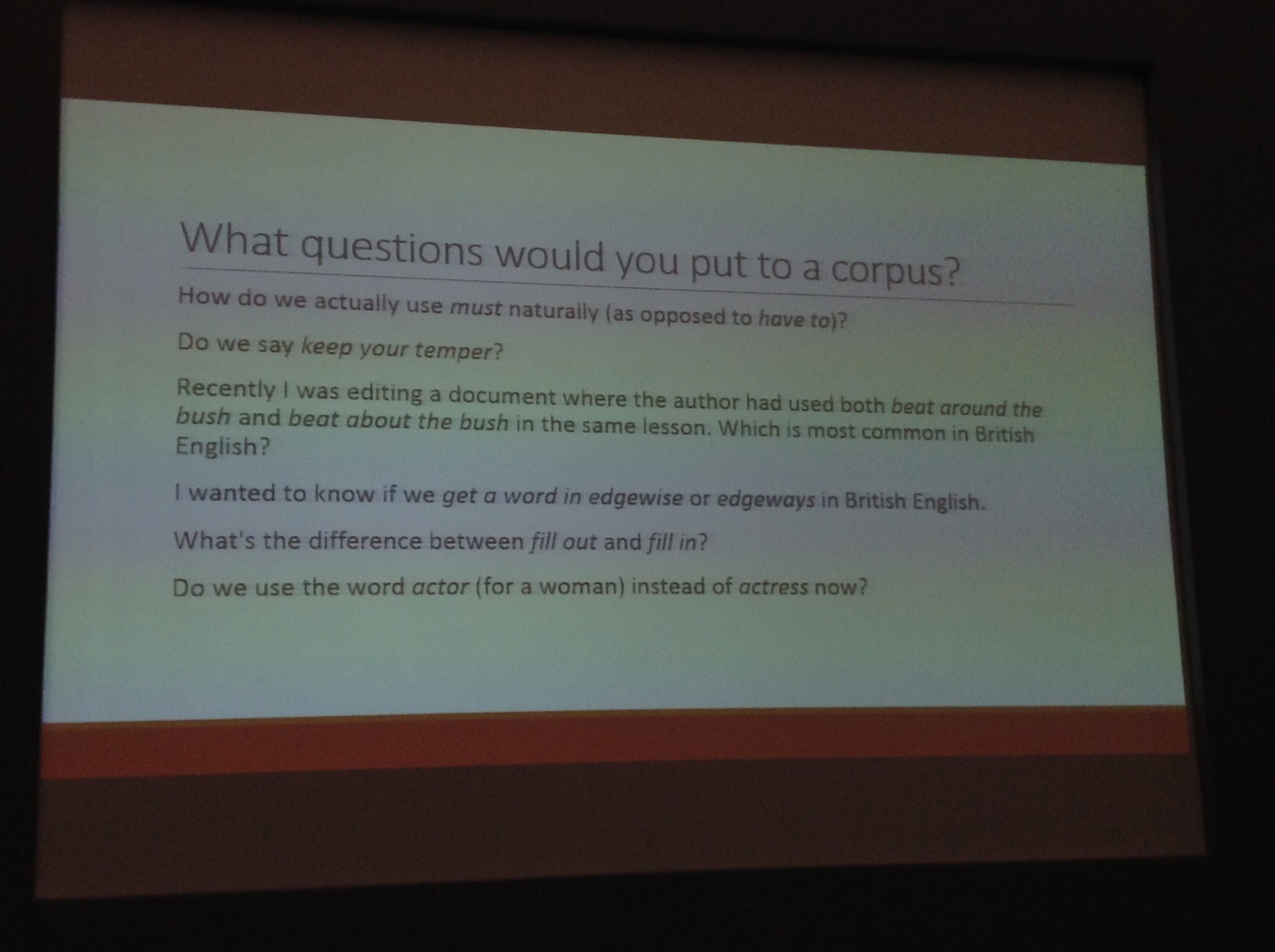
We can ask a corpus many things…

Questions!

Questions!

With a corpus we can:

  • search for authentic examples.

This can lead you to identify a nice context for a given language point. E.g. a film competition guideline set for “must”.

It is quite rare to find something ready for use straight away: you are more likely to adapt and abridge entries so that all language is level-appropriate.

You can also use it as a template to create your own example. It helps you to create something more natural-sounding.

  • do collocation searches

E.g. keep your temper, do frequency searches. Look at the example lines. Then you see it does exist but not on it’s own but rather for e.g. keep your temper under control/in check etc.

  • search for phrases and chunks

Sketch Engine: search “bush” to find more possibilities than “beat around the bush” So start with a wide search. Then search for the frequency of the collocate e.g. around/about. Then you can search for English type. Smaller difference between around and about for British English.

 What isn’t a corpus good at?

Corpus are good at vocabulary –oriented queries. If you don’t have a specific lexical item to search for, it is more difficult and requires a lot more time. E.g. present continuous for future plans. Even if you come up with a search of present continuous examples, you would have to manually identify the future plans ones.

They are also not so good for longer examples or complete texts: this is because of copyright and permissions rules. You can’t borrow enough sentences to illustrate ‘on the other hand’ for example.

 Important points to consider:

  • spoken vs written
  • genre mix
  • AmE vs BrE
  • Expert vs student

Otherwise put, it is important to know your corpus and what it contains.

For example, the British Academic Written Corpus (student writing, native and non native) so you aren’t going to search it to find out about general spoken English…

Don’t follow blindly:

You need to question the results if they are surprising e.g. with keep and temper.

You only get what you search for. Just because you find something doesn-t mean you have answered your question. Sometimes answers aren-t clear cut. Remember your audience and aims.

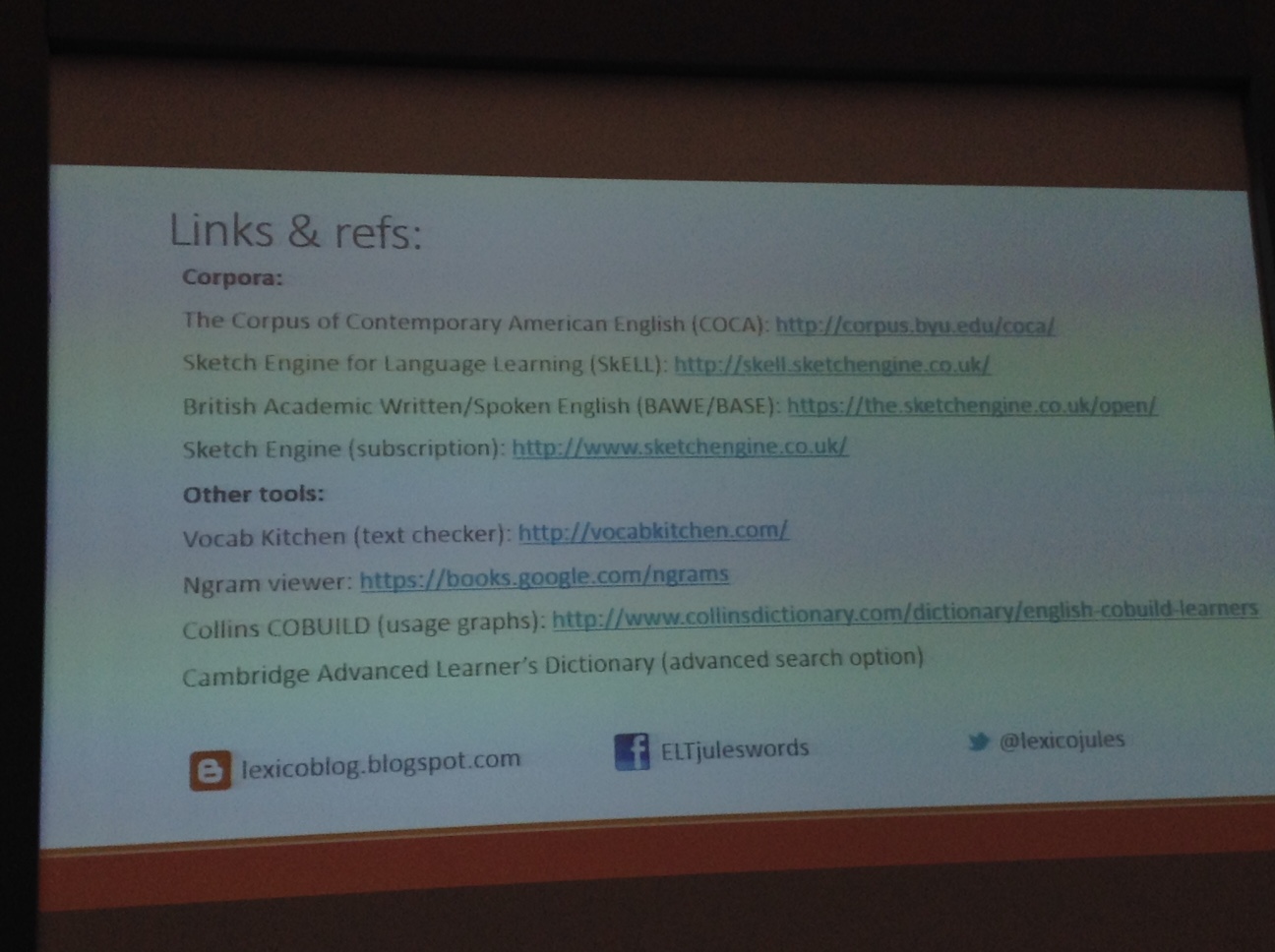
 How to access a corpus

  • Major publishers have their own corpus. E.g. Oxford. Ask if you can use it.
  • Free corpora: COCA SkELL (great data, limited search tools), BAWE/BASE
  • Subscription corpora: Sketch Engine, Collins Corpus (coming soon…)

A few other nifty tools      

  •  Textcheckers – input a text and compare it to a particular wordlist e.g. AWL, English Vocab Profile, Oxford 3000

E.g. VocabKitchen

Depends how good you think the lists are as to how much you rely on the tool.

  •  Usage trends

E.g. Cobuild online, Ngram – show a line graph of usage trends.

  •  Dictionaries

 Thesaurus facility, advanced searches – Macmillan Online is good for this.

More useful stuff!

More useful stuff!

Don’t worry – Julie is planning to write a blog post explaining a bit about these tools and what they do. Watch out for it on her blog.

My thoughts:

Another great session with lots to take away! And my note-taking brain appears to have woken up again too… 🙂 Corpora are great, as long as you are using them for what they are great at and not falling into the traps highlighted by Julie. 

IATEFL 2015: Pre-conference Event Day – MaW SIG – Part 2

Following the first break, we were treated to two more fantastic talks:

A technological toolkit for Writers – Nick 

Nick starts with a whistle-stop tour of technological history, also sharing the story of a very large internet-related phone bill with us. Apparently his parents weren’t so impressed…

The three key areas of focus are:

  • Useful hardware
  • Timesaving software
  • Avoiding internet-related distraction

 Useful hardware 

Computer – PC or Mac or… what suits you

Operating system – OSX, Windows, Linux or… what suits you

Word-processing software – Word, Open Office.. what suits you

Browser – Don’t use IE…try something else…please…

Screen-size – as big as you can; multiple monitors (less switching between applications e.g. What you’re writing and your source….avoid work and email or what you’re not writing and your distractor!) And use desktop arrangement/Fences – you  can draw a box on your desktop, give it a label and put your files in it.

 Keyboard and mouse – touching them all the time, make sure they are comfortable. Mechanical keyboard – clickety clackety; these days mainly used for gamers.

Timesaving software

60 seconds...starting now! Image taken from en.wikipedia.org, licensed for commercial re-use with modification

Time, precious time! Image taken from en.wikipedia.org, licensed for commercial re-use with modification

 Basic criteria:

  •  Must solve a problem: if I’m only doing it once a month, probably don’t need a fix…
  • Simplicity!
  • Integration – should talk to all devices, if relevant
  • Cost – should be reasonable

Nick’s ELT courses include:

  • Vocabulary presentations
  • Texts
  • Practice exercises

(grossly oversimplified)

 So how can technology help?

1. Images – these sometimes generate a long url (that you need to paste into the document). Fix: Use browser extensions (these extend functionality of your browser): URL shortener. One touch to shrink the URL. As a rule of thumb: If you do anything with your browser that requires 2 or more clicks, someone has designed something that will enable you to do it in one…

  • Taking a partial screenshot (easy on a mac! yay!)
  • Online dictionaries: CALD space word – searches Cambridge dictionaries online. Go to search field in the dictionary, go to add as search engine, change the keyword to something quick to remember, and bingo!  (I really have to set these up!)

2. Texts – Archiving for future reference. We have moved on from filing cabinets and from endless folders of unsearchable pdfs to…

 Evernote!! 

http://www.evernote.com – it’s brilliant. (At some point I should write a guide to using it…)

Screenshot of Evernote-s homepage: They clearly got this dude off Shutterstock or similar! ;-)

Screenshot of Evernote-s homepage: They clearly got this dude off Shutterstock or similar! 😉

 3. Practice exercises (grammar or vocab)

Use macros: automate a set of actions that you can repeat ad infinitum.

  • Teacher’s Pet: a massive collection of macros that you install and it creates a custom tool bar, which does all the boring jobs for you. Fabulous!

Distractions – Tough love techniques

  • Stayfocused: A toolbar extension limits time per day on certain sites – you define which sites distract you and how much time you can spend on them today. When you look at the website, it starts counting down.
  • Strict Workflow: – Page blocked until a break timer starts. Back to work!
  • Rescue time: A weekly report on how you use your time…

Your mileage may vary… you may get more out of this than others do.

 Tiny.cc/mawsig_techtools – link to a google doc for adding info to

Nick’s email: mail@nicholastims.info

 My thoughts:

What an incredibly useful half an hour! It flew by, was full of humour and we got to learn lots of great techie shortcuts to doing stuff that materials writers do. What more could you want?

 Session 4: Writing ELT audio and video scripts. From basic principles to creating drama

 With the improvement in technology, going out into the street and recording is becoming more possible. You discover all sorts of interesting bits of language that you don’t discover if you script it all yourself cold.

 Need to consider:

  • Is there too much target language shoe-horned in?
  • Is the context clear? (Stated in rubric? A picture? Sound effects?)
  • Is there enough turn-taking? Breaking it down makes it easier for students to handle the language load, particularly at lower levels.
  • Is there a suitable number of speakers? More than 3 or 4 is too many. E.g. 4 people in a meeting is quite hard for the student to know who is speaking each time. Variety of names, genders and accents can help with this. (Must be stated in the script for the actors to be aware of…)
  • What about the lack of authenticity? How can we introduce more feelings of authentic speech into the writing and make it less stilted?

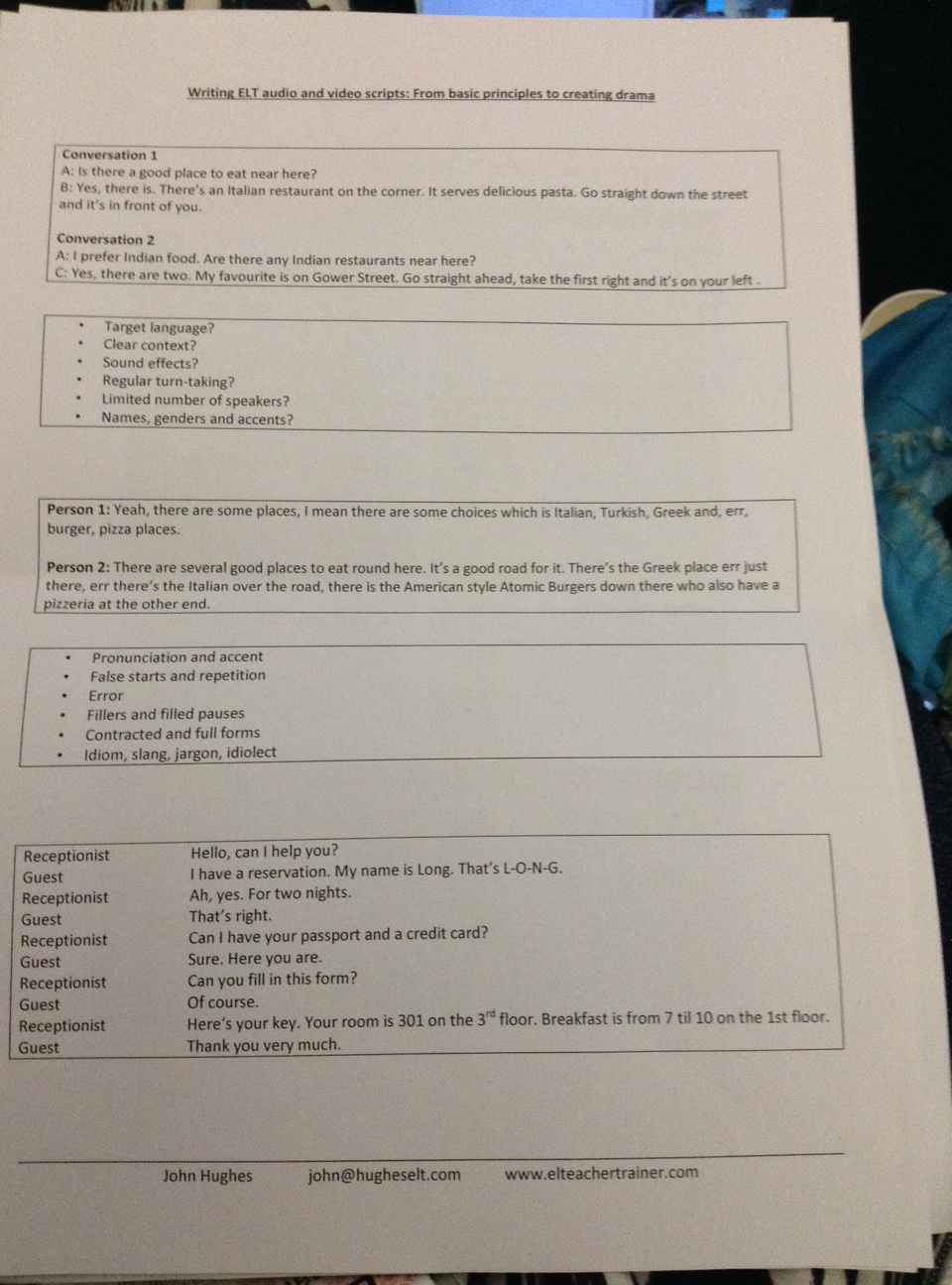
We had a go at considering:

image1

Our turn!


Features of authentic speech:

  • (Diverse) Pronunciation and accent
  • False starts and repetition
  • Error
  • Fillers and filled pauses
  • Contract and full forms
  • Idiom, slang, jargon, idiolect

Which of these should we be putting into our scripts? Depends on who is using the materials. Maybe not errors! The grammar of spoken English… Are they errors? Or are they just spoken English? And what will the editor remove? Ums and errs and I think are more likely to be kept? False starts often removed. It is important to start thinking about how to add some of these things in…

 Adding drama

You need a central character who wants something. Then you add some kind of conflict situation that makes things more difficult for them! “Try it 3 times” – the main character tries and fails twice and then third time lucky, within the script. 5 or 6 times, becomes more like Fawlty Towers…

Video producers say that ELT writers coming from an audio background tend to state the bloody obvious. Show don-t tell. Slightly in conflict with language teaching but… we need to come up with ways to make it more visual yet control the language.

John’s website, where these slides will appear…

My thoughts:

Well, by the end of talk no. 4, it’s easy to see why people say MaW SIG’s PCE is the one to come to! So far, the diversity in the topics has made me think just how diverse Materials Writing is, there are so many different elements that meet in this discipline. It’s really rather fascinating! Also, I’m really enjoying the opportunity of doing all the little tasks that the various presenters have conjured up, working alongside people who know their stuff – a great learning experience! 

Phew! After an action-packed morning, it’s time for lunch! 

IATEFL 2015: Pre-conference Event Day – MaW SIG – Part 1

The Materials Writer’s Essential Toolkit

Here I am at the IATEFL 2015 PCE Day, and I have to admit, MaW SIG has its work cut out for it today, as there is a portion of me that is rather sorry to be giving up my precious Easter holiday to be attending a conference! Fortunately, as the venue came in to sight, my enthusiasm and excitement finally made themselves known. Having registered and collected the usual conference bumpf, I have even read the programme now and everything! Bring on the Materials Writer’s Essential Toolkit! As it’s a long day of many talks, I am breaking it into several blog posts to make it more digestible… 

 Sessions 1 and 2 – 10.10 – 11.30

 Writing Multiple Choice Activities – what Sue Kay has learnt…

Who knew that there could be so much to say about Multiple Choice Activities? Perhaps it-s because…“there’s an awful lot that can go wrong!”

Sue kicked off by talking about advantages and disadvantages of this question type:

 Advantages

  • Can be marked by a computer;
  • Can deal with large volumes of students being tested (hence chosen format for TOEFL and TOEIC).
  • From a teaching point of view, can offer some support to lower level students who can recognise but not produce much

Disadvantages

  • Assess recognition not use of language;
  • Depending on no. of options, 33 or 25 % chance of guessing;
  • Easy to cheat…
  • Writing good ones is HARD!

Challenges

Are the items difficult enough? Are they plausible? The art of adding distraction to text or script (aka how to confuse the students and tempt them away from the right answer!)

At this point, we looked at the anatomy of multiple choice.

Firstly, they are not MCQs (Multiple Choice Questions) but MCIs (Multiple Choice Items) as not all are “questions”. E.g. a stem can be an unfinished sentence to complete.

Distractors – wrong answers that tempt ss away

Stem – the question or sentence beginning

Key – the correct answer

 Important to remember:

Options should be plausible, not too obviously right or wrong, consistent in style and length, not repeat or contradict each other, be clear and easy to process…

Task 1 

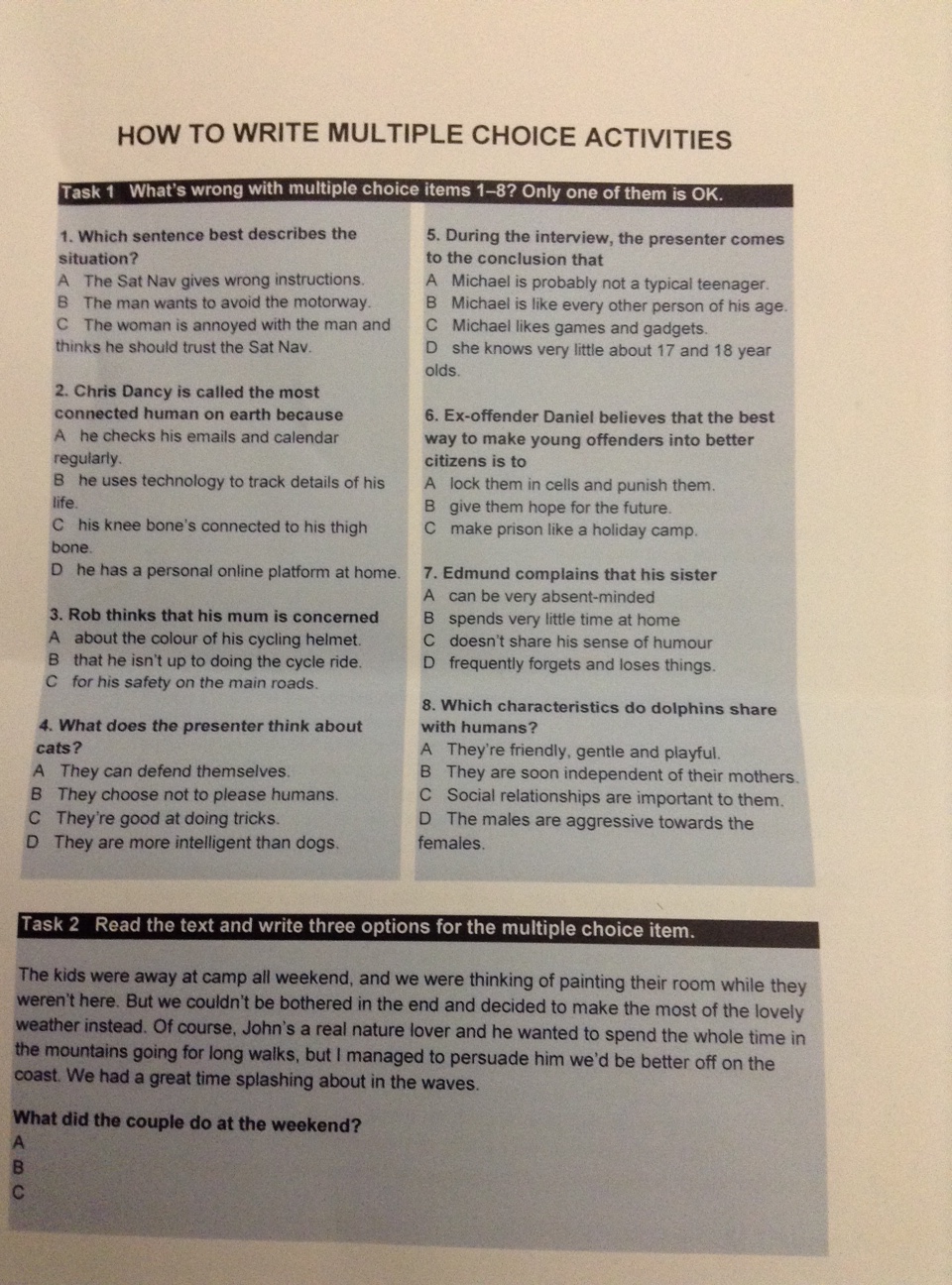
We looked at these multiple choice items:


Multiple Choice Quiz

Multiple Choice Quiz

And had to identify a) which one was a good example? b) what was wrong with all the rest of them!

  1. C stands out as correct as much longer than A or B (should be short/roughly equally in length; avoid using linkers)
  2. Option C is obviously a distractor, very silly (all options must be plausible or you give ‘one for free’ : suppress the urge to inject humour into MCIs!)
  3. End the stem at a logical point e.g. after the verb AND preposition. E.g. concerned about plus the options rather multiple structures
  4. Correct! (Options same length, consistent style, no linkers or complex structures, all plausible)
  5. Option D stands out as the only one not starting with ‘Michael’ (consistency)
  6. The information on the page is enough to guess the correct answer, without reference to the text. B is obviously the right one. (Too obvious right answers, too obviously wrong distractors, shouldn’t be answerable through common sense)
  7. Options A and D have the same meaning = a double key (mustn’t cancel one another out by saying the opposite either…)
  8. Too easy to answer without listening to the interview. (A and B easy to reject, D too obviously wrong. World knowledge shouldn’t come into play…)

The process as a whole

 You need to write the text and the activity at the same time. Sue used to write the text first but this isn-t a good idea… you end up shoe-horning distractors in. The text becomes unnatural and lacking in coherence.

  • Plan the ideas you want to include in the text
  • Before you write it, draft some stems and keys
  • Brain storm different attitudes feelings emotions angles to include in the script so that you can test not only specific info but opinion and intention too.
  • Paraphrase the language in the text in your key – if you use the same language it’s too obviously the right answer
  • But you can use the same language in the distractors to tempt them away from the right answer. But generally speaking better to paraphrase across the board. Sometimes can be a good temptation though.
  • Use students’ common mistakes when adding distraction. Things that students always confuse.

Adding distraction

  • Time phrases can be used to set up distraction. E.g. saying what happened in the past and then testing what is happening now.

We used to….then… so now…

Distractor: (We used to) live on the edge of a city (outskirts) as something that is happening ‘now’

 At first I thought… but then I saw through…

If testing what is happening now, content following at first I thought acts as a distractor.

We were thinking of….but…

He wanted to….but…

So, what did the couple do at the weekend? (Task 2)

Wanted to, hoped to, intended to, planned on, thought about, was/were going to, tried to, would to have, was/were supposed to etc. are useful to seed into the text.

  • Unreal past

Past tenses in conditionals or after wish.

“I’d probably stay if the boss said he’d pay me more”

Distractor: Her manager has offered her a salary increase


If you’d done what it says on the label, it wouldn’t have shrunk”

Distractor: He followed the washing instructions


I wish we’d brought the compass with us

Distractor: They were well equipped for the walk.


  • Negatives

It-s not as if we’re desperate for a new car park

Distractor: She thinks the town needs better parking facilities

 Here are the guidelines on which the talk draws:

Remember!!

Remember!!

Useful resources:

How to write Reading and Listening Activities  by Caroline Krantz

How to write Exam practice materials  by Roy Norris

Teacher2Writer  website


Reflecting on what we looked at today, Sue says “These are techniques for adding challenge…”

Comments arising from the post-talk Q and A

  •  Making the options challenging but the language as easy to process as possible, so that the students are processing the text rather than the options.
  •  Try your questions out on colleagues first…
  •  With listening texts, more important to spread the items out vs. reading texts where students have control over processing time.
  • Digital – templates may have character limits; can be set up for exam type (i.e. can listen only twice) or to learn (can listen as many times as they want, with more challenging questions? Or if supporting lower level students then they have more time to get it right; higher levels may choose not to slow it down, listen again etc.)

End of session 1 – happy to report that enthusiasm/excitement/motivation are fully present and accounted for again! 🙂

 Session 2: Maximising the image in materials design – Ben Goldstein and Ceri Jones

The role of images in ELT

How has it changed over the last 15-20 years?

When they started, it was purely decorative or a visual aid. This has changed a lot in the last 5 -10 years. Opening pages of units in CBs, there is often a big image, more central to the writing and learning process. Careful: These big images still involve rather conservative use of image. More prominent but yet still traditional exploitation. E.g. decorative.

How can we subvert?

In our roles as writers, how can we make sure that the images are working for us, inc. the decorative ones? Focus on print. Digital is slightly different.

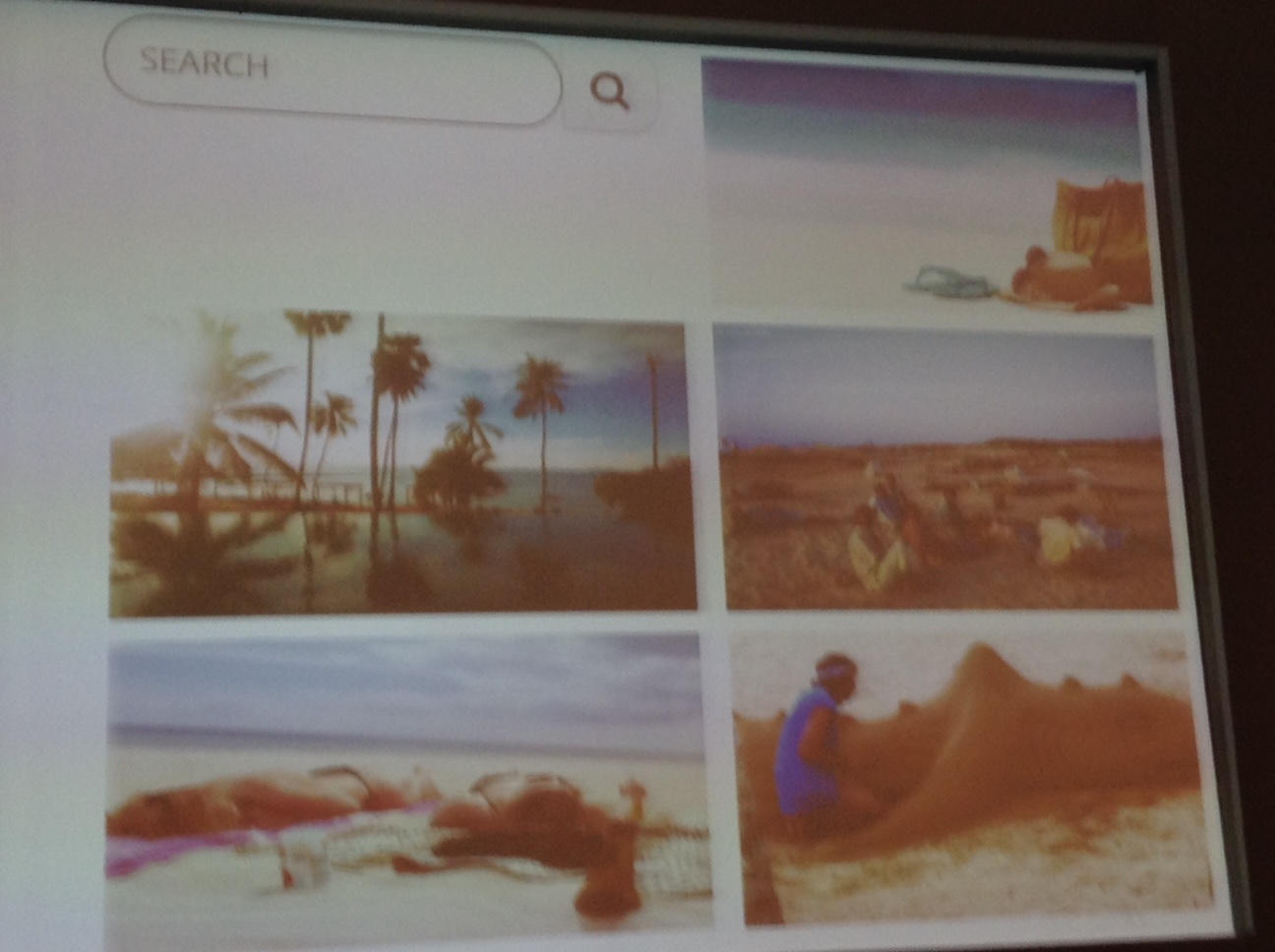
Ben and Ceri showed us a sample search. We had to guess the search term…

Image search results

Image search results

What was the search term? “Beach”

Image banks: some publishers have them (affiliations) and prefer only to use those banks. Some give you more freedom to search outside them. Some receptive, some less so. There are also budgets to be aware of. Certain images need to be cheap. You may be able to squeeze in the odd expensive one.

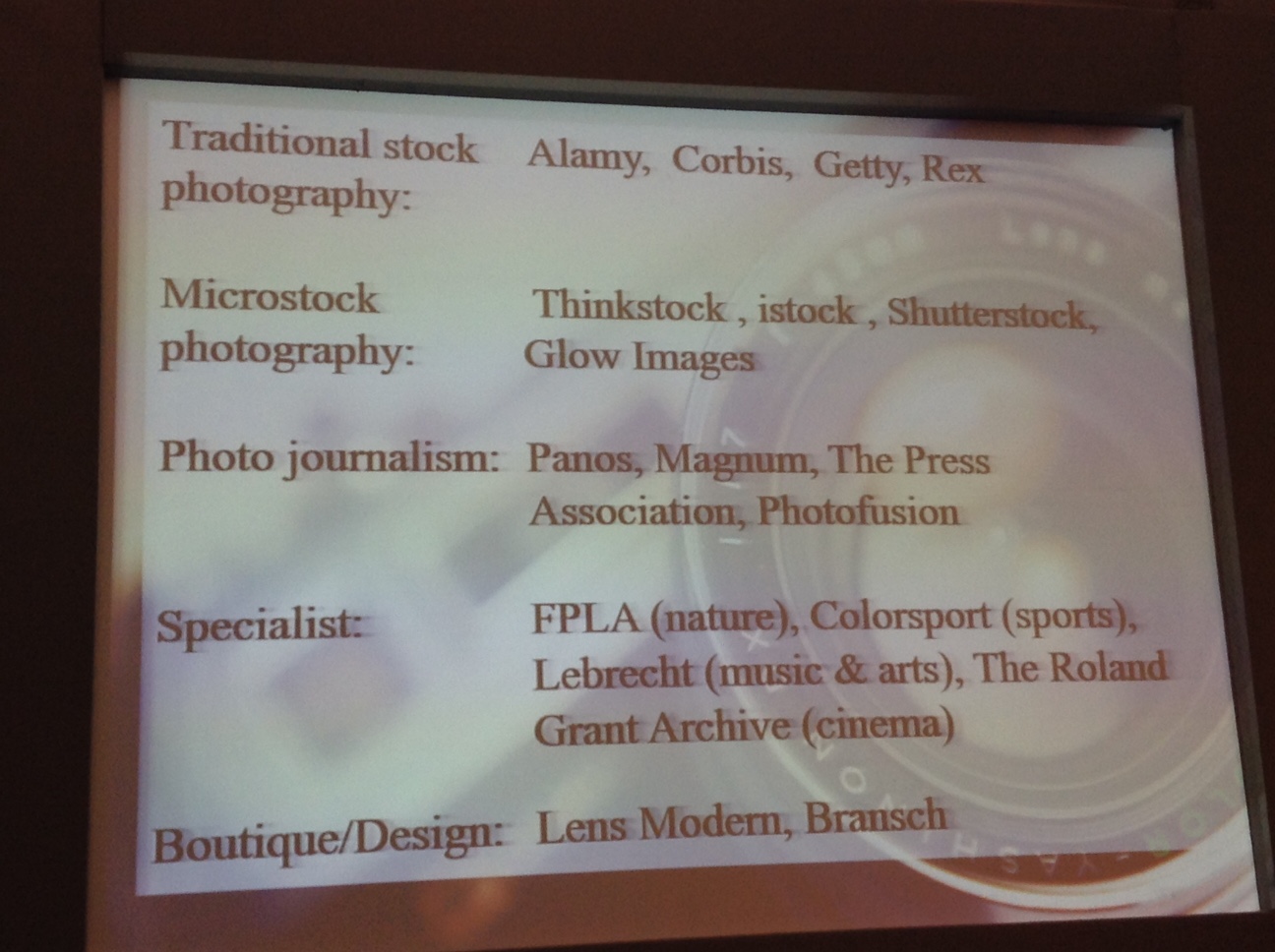
Types: 

  • Stock images (clip art etc.)
  • Creative commons
  • Photo journalism
  • Design/boutique

Flip flops – stock image (thinkstock; used by BA in an advert. Used often for corporate materials)

Palm trees – design/boutique (lens modern) (aesthetically pleasing, airbrushed, but not full of ideas, so very decorative quality)

People on beach – photo journalism (Panos – image and text; often very generative. Can be too strong/controversial)

People on the beach – creative commons (unsplash – the social media front for a design company; like a teaser)

Sand shark – creative commons (ELT pics – by teachers for teachers, creative commons on Flickr; Blog – Take a photo and…)

image4-1

Sources for different image types

 These are different kinds of image banks. How do we search for images?

The bigger the bank, the more difficult it is to find what you are looking for i.e. using suitable search terms. Specificity of search is important…

 Some more good sources:

  • The whole picture – Guardian;
  • The wider image – Reuters
  • Getty works with Flickr.

Using Alamy

 Search term “beach”

Parameters – “square” [influenced by instagram, may be more creative]; (vs portrait or square-) “Creative” rather than “relevant” filter.

When writing artwork briefs, specify what parameters you don’t want as well e.g. “not Landscape”

Using Panos – the image can give an idea for a whole activity/topic. Another role of the image in the writing process – inspiration even if it doesn’t make it on to the page…

Image types revisited… this time with focus on fashion!

Are they new? trending? on the way out?

Here are some of the ones we considered:

  • Selfie
  • Selfie on stick
  • Mosaic
  • Drony (Dronie?) (Yes, really. Selfies with drones)
  • Infographic
  • Word cloud
  • Fish eye
  • Panodash (iphone trick, same person appearing in photograph multiple times);
  • Draw my life
  • Angry cat.
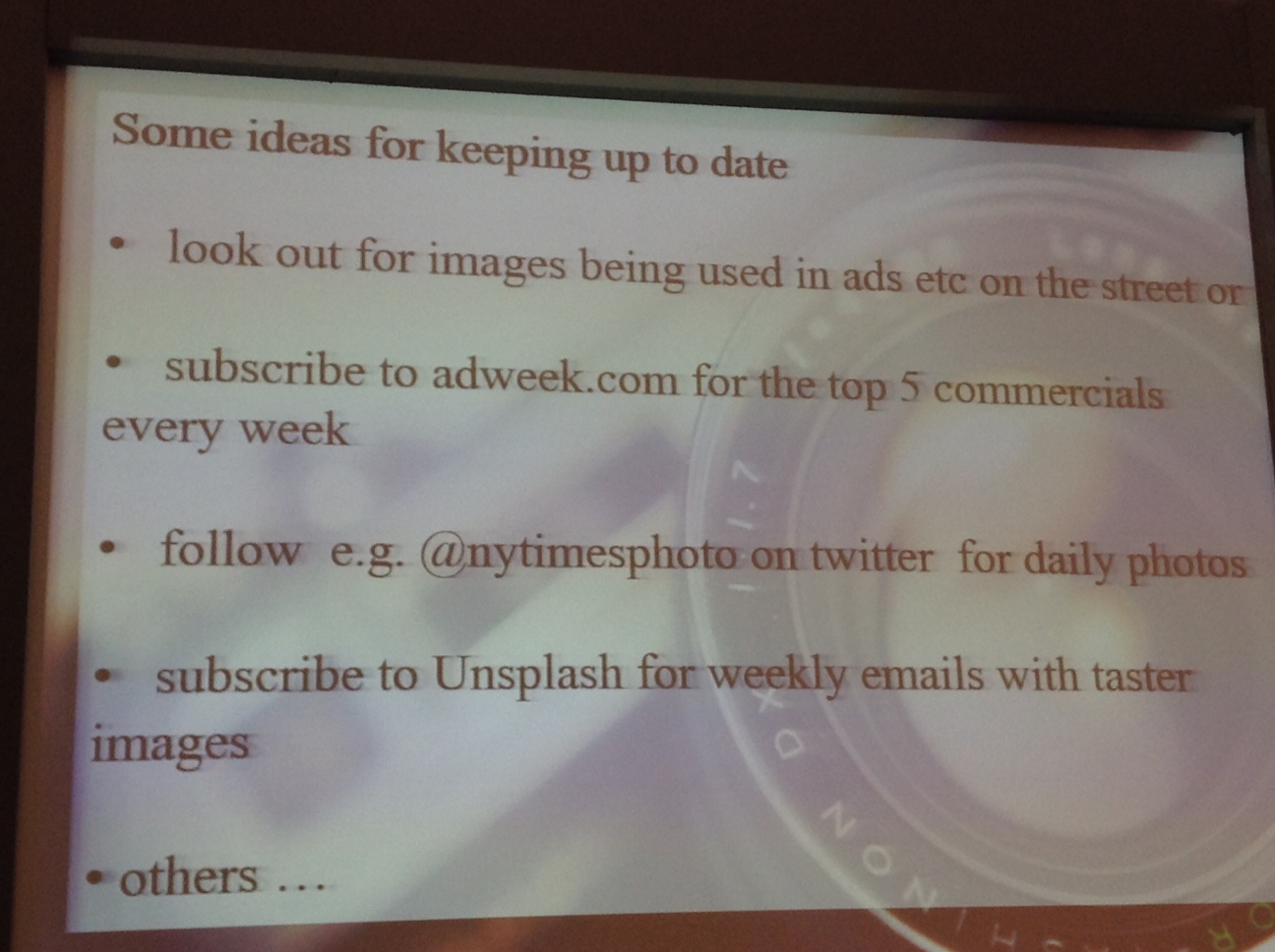
Keeping up to date is important - here's how...

Keeping up to date is important – here’s how…

 More useful sources and ideas:

  •  The Map of the Urban Linguistic Landscape Facebook Group
  •  Use your own images also!
  • You can use image banks to inform your artwork briefs.

Writing an artwork brief

 Be very specific. Explain how the image is supposed to work not just what it looks like. Be clear about what you don’t want. (E.g. NOT a lifestyle magazine type of shot)

An artwork brief

An artwork brief

Image roles

  • Scene-setting (for a topic or context)
  • Illustrative
  • Decorative
  • Driving force (opening spread, man and nature – positive, negative, conjures up different feelings)

Coming back to the process again, a good idea is to go to images first, see what is out there, let the images inspire. Start with a topic and brainstorm images, see what hits you. It can kick-start the creative process. It can rejuvenate you when you are on Unit 10 of level 4 of a course!

For more information see Ben’s website and Ceri’s website

My thoughts:

Much like with MCI’s, my general thought is, “who knew there was so much to know!” With both talks, within half an hour I went from knowing very little to at least knowing how little I know! Lots of useful content. From the practical aspects such as how to find the images, sources etc. to the process, where I am particularly struck by the idea of doing an image search around a topic and letting inspiration flow that way. It’s a new way of brainstorming that hadn’t occurred to me before. Not having written an artwork brief before, it was also interesting seeing some examples and then actually doing a task in which we worked in small groups to create a brief for a given image.

Has to be said, a great start to a great day. 🙂 Worth giving up being on holiday for… 😉


BELTA & TESL Toronto Online Conference: 8/9 August 2014

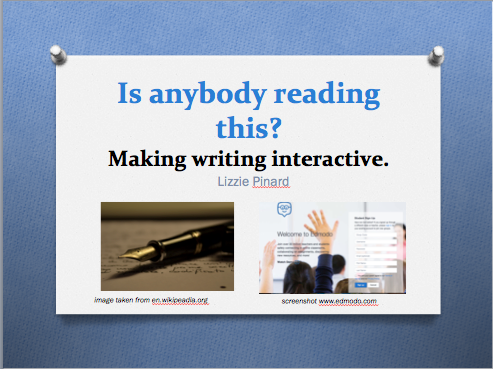
Today, the 9th of August 2014, I was lucky enough to deliver a presentation as part of the BELTA and TESL Toronto Online Conference. The topic of my talk was Is anybody reading this? Making writing more interactive using Edmodo and Blogs. 

Saturday 9th August @ 16.30

Saturday 9th August @ 16.30

I started off by looking at what exactly writing is and how/why we do it with our learners. From this, I moved on to consider some of the issues that may arise in the teaching of writing, which provided a useful springboard for me to introduce the 4 C’s:

C-ommunication

C-ollaboration

C-reativity

C-omparison

My presentation went on to explore each of these, in terms of what we do in the classroom, what we ask learners to do at home and how Edmodo/Blogs could enhance this for our learners. For those who are unfamiliar with Edmodo, I provided a link to a workshop on using Edmodo that I gave at IH Palermo last academic year.

I also discussed a variety of activities, which you can find out more about at the following links:

Finally, I offered some student feedback gathered during the last academic year…

  • “Edmodo is a good way for know the classmate.in the same time is a good idea to improve our knowledge and confront opinion and so on! besides is a good tool to read and think in the english mode.”
  • “Edmodo is a good idea because we can write, read and talk in english with our classmate. We can improve our english with text, podcast that one user post and we can link an immage and describe it and we can talk about it togethere.”
  • “Edmodo is a funny way to keep in touch! You can also discuss (in English) about everything you want and share links, photo, files…”
  • “Edmodo simply is an informatics tool for the class students more usefull than a personal mail because It gives the possibilities to close the comunications only between them!”
  • “Edmodo is like a forum. Of course if you write about everythingh in English, you’ll improve your writing. It’s funnier than doing homework on your notebook. You can write wherever you are (at the moment I’m writing while people are talking about neuroprotection!)”
  • Edmodo is a usuful way to continue your english studies outside the school. Thanks to this group you can compare your homeworks,share your favourite links and discuss about everything you want to discuss! At first,I thought the typical workbook was better than this innovative way ,instead the prons are lots. Everywhere you are,you can look up something you learnt but that you forgot asking something writing on ed-modo, ’cause thanks to the app available for smartphones,you can connect in a real time and you’ll find the other one who will answer to your posts. Even your teacher will be on ed-modo who will correct your homeworks and will answer to your doubts accelerating your studies without waiting for the next lessons beginning.

…before handing over to participants for some question and answer/discussion time. Thank you to BELTA and TESL Toronto for giving me this opportunity to share my ideas and experiences with fellow teachers world-wide.

The link to the recording is available here. Additionally, here is a link to my powerpoint slides.

Fire away!

Fire away!

Feel free to comment on this post if you have any questions or want to discuss anything further! I will be happy to hear from you.

MATSDA 2014 – What about the other 165 hours a week?

Today I was lucky enough to do a 45 minute presentation at the MATSDA conference in Liverpool. This was held at Liverpool University and the usual lovely crowd of people attended. Thank you to all who attended my talk – one of four that took place at 12.0o.

My presentation focused on ways of helping learners increase their exposure to English, and their use of it, outside of class time. I feel this is essential for learning and acquisition to take place, as the limited quantity of time available in class is insufficient, and beset with course-book related issues.

I discussed obstacles to acquisition and then looked at the various projects I’ve been working on with learners,  for the last 8 or 9 months: my reading project, my experimentation with English project, my use of collaborative tools project (which is linked with the aforementioned experimentation project), my efforts to help my learners become language researchers. I also briefly discussed the materials I made for my dissertation project, whose goal was also to help learners make use of the language in the out-of-class environment.

For further information about these projects and to access all the references made during the talk and that I’ve used during the course of all the projects, please visit my learner autonomy page and look in the section entitled Learner autonomy-related projects. For information about my dissertation materials, scroll down further on the same page and see the third link in the Presentations section.

Finally, here are the slides I used during the presentation.

Thank you to MATSDA, and especially Brian and Hitome, for allowing me to speak and making me feel very welcome.

How do we help out learners to bridge that gap... Copyright: Lizzie Pinard 2014 (between Palermo and Cefalu, Sicily)

How do we help out learners to bridge that gap… Copyright: Lizzie Pinard 2014 (between Palermo and Cefalu, Sicily)

IHTOC (International House Teachers Online Conference) May 2014

At 14.20 CET (12.20 GMT, 13.20 BST) I took part in the International House Teachers Online Conference (a.k.a IHTOC). Each talk in this conference is ten minutes in length, with talks being divided up in to 50 minute sessions. In my session, I had the honour of talking in the same session as David Petrie of IH Coimbra (with whom I’ve been discussing the future of language teaching, on our respective blogs) whose topic was “What I did on my holidays – six things from IATEFL 2014“; Emma Cresswell from IH Santander who gave a talk called “From conference to classroom“; Anya Shaw who hails from IH Buenos Aires Belgrano and spoke on the topic of “Homework: rethinking our routines” and last but assuredly not least, Sandy Millin, the DoS at IH Sevastopol who shared “Five ways to raise your professional profile“.

My own talk title was “From teacher to enabler: stimulating acquisition outside the classroom“. Those of you who have read my blog before will know that I am very interested in the prickly issue of Learner Autonomy and exploring ways of enabling language acquisition during the many hours learners spend outside class. Little wonder, then, when I was invited to submit a speaker proposal, this interest came to the fore.

In my ten minutes, I discussed why the step from teacher to enabler is important to make and suggested 3 simple ways to do this.

  • Encourage experimentation
  • Get learners goal-setting
  • Keep talking!

The rationale behind the first point is that learners, myself included when it comes to Italian, tend to stick with one or two “safe” activities, if they do any work at all outside class time. In order to broaden their range of activities and help them remain motivated to try new things, scaffolded experimentation can be very effective. However, giving learners a bunch of ideas and then leaving them to it is not helpful in terms of maintaining motivation. Chances are they will file away the handout and quickly forget about it, reverting back to their mainstay activities.

This is where points two and three come in.

Setting challenging yet achievable intermediate, mid-term goals can help learners maintain their motivation by breaking down the monolithic task of learning a language into more manageable chunks and increasing the chances of success: t

The experience of success, especially that which is hard-won, is one of the motivational factors that Dornyei (2013) includes the third channel of his L2 Motivational Self-System – the language learning experience.

Regular discussion, in which learners communicate their goals and discuss their learning experiences gives rise to the benefits of heightened commitment to the goals, greater satisfaction in attaining goals as they share their achievements, and less isolation when they are in a learning slump – indeed, during these times they can ‘feed off’ the motivation of others and regain the desire to have another go; and then be the ones that give faltering classmates that extra push.

I suggested that this recipe was not limited to the handout I shared, but could also be applied to extensive reading or anything we want learners to do outside the classroom.

My ideas drew on goal setting theory (Lock and Latham, 1990), motivation theory (Dornyei, 2014) as well as the idea of motivational flow (Egbert, 2003) and, of course, learner autonomy theory (e.g. Benson, 2011, Oxford 2003, Smith, 2003)

10 minutes is not a long time, so I had to wrap it up pretty quickly, having elaborated on my three-step plan and hand on to the next speaker!

Here is a copy of my slides and here  is a link to the recording.

References:

Benson (2011) Teaching and Researching Learner Autonomy Pearson Education. Harlow

Egbert (2003) in Dornyei and Ushioda (2012) Teaching and researching motivation Pearson Education. Harlow

Dornyei, Z. (2014) Plenary talk, Motivation and the vision of knowing another language in the Warwick Postgraduate Conference, June 26th 2013.

Lock and Latham (1990) in Dornyei and Ushioda (2012) Teaching and Researching Motivation. Pearson Education. Harlow.

Oxford, R. (2003) Towards a more Systematic Model of L2 Learner Autonomy in Palfreyman, D and Smith, R. [Ed] Learner Autonomy Across Cultures. Palgrave Macmillan. Basingstoke.

Smith, R. (2003) Pedgagogy for Autonomy as (Becoming) Appropriate Methodology in Palfreyman, D and Smith, R. [Ed] Learner Autonomy Across Cultures. Palgrave Macmillan. Basingstoke.