Reading in L2, Running (and Yoga…)

When I went home for Christmas, I set myself the target of reading in Italian at least a little bit every day. I succeeded, but it was quite a struggle: obviously there were plenty of distractions – people to see, things to do, places to go… Some days I read only for a few minutes, one or two pages. On the days where I had some relaxation time built in, I managed a bit more, though other books (about learner autonomy and about motivation) also clamoured for attention, as did actual relaxation ( :-p ). I also set myself the target of getting out running as often as possible, to try and get back in the habit of it so that on returning to Palermo, I could kick-start some healthier habits than I had got into by the end of last term. Due to afore-mentioned lack of healthy habits last term, this was difficult. I knew it would be hard work, so I had to really push myself to get out (and stay out!). As the holiday progressed, and the little running outings added up, it became easier and I began to look forward to it again. I’ve only been back in Palermo just under a week but I’ve been running 3 times and have another running outing planned for tomorrow. As for the reading, I’m back to my usual 20 minutes in the evening, plus ten minutes or so during my lunch break, each day.

So what has the one got to do with the other? And where does Yoga fit in?

It’s all about there being no substitution for actually doing it.

  • If you don’t read in L2, run, or do yoga regularly, they all get harder. And it gets harder to motivate yourself to do them because you know it will be harder due to how long you’ve spent not doing them. You also get slower (reading, running) and stiffer (yoga), which again makes it less enjoyable, which negatively affects your motivation to do it next time.
  • Conversely, if you get in the habit of doing them regularly, they are enjoyable, you are able to do enough (succeed sufficiently) that you feel motivated, and they do you good (in terms of language learning or health). That they are now enjoyable also means you feel motivated to do them more often.
  • Setting targets can be helpful in terms of actually making you do any of these activities and it can add to motivation each time you meet such a target. (This week, my running target is 27k – I’ve to do 10k tomorrow in order to meet that target, so I shall see if I can still run that distance! For my learners, setting reading targets has been useful.)

Following my own reflections, I put the question to my Upper Intermediate class, as a warmer:

I divided my learners into in groups and asked them to brainstorm similarities between running and reading, giving each group an opportunity to summarise their ideas for the rest of the class. They came up with some interesting ideas:

  • If you get bored of running the same route, you can change your route, while if get bored of reading, you can change your approach to reading. (We’ve previously discussed different ways of reading and pros/cons of each, validating learners’ approaches and encouraging experimentation with different approaches, so I was pleased to see this aspect brought up spontaneously by them in this discussion, with no prompting from me!)
  • In running, there are many different types of shoes you have to choose the right pair of shoes for yourself in order to enjoy running and get what you want out of it. In reading, there are many different kinds of books and other things to read that you have to choose from and in order to enjoy it, you need to find the kind of material that is right for you. (This made me happy because at the beginning of the term, there was a lot more insecurity re what “should” we read, what is “correct” etc. and we discussed pros and cons of different types of reading material and I emphasised the importance of what they read being what they WANT to read, and now they are much more confident in choosing material that they actually enjoy for their extensive reading)
  • The more you run, the faster you can get and the further you can run. The more you read, the more you will be able to read in a given time (i.e. your reading speed/fluency will increase as well as your stamina).
  • Some people prefer running alone, some prefer running in groups. With reading, some people prefer doing it independently while others prefer the social aspect of being part of a book club and sharing the reading experience that way. Some people like to discuss what they are reading, others aren’t bothered about doing that.

What would I do differently next time? I’m planning to do this little discussion activity with another group of mine, with whom I have also been doing my reading project, but I think this time, after letting them brainstorm (so that I don’t influence their ideas initially, as I am very interested in what they come up with by themselves), I will feed in a few prompt words e.g. goals/targets, motivation etc, and see if they can also identify some of the ideas that I had. I will also elicit the metacognitive purpose of the activity – reflecting on different qualities of reading in order to compare it with running and raising awareness of the importance of frequency/regularity in order to benefit. I attempted to do this with my upper intermediates, but when they didn’t generate the ideas I was after, I explained it rather than guiding them to it. As ever, room for improvement…

Why am I using valuable class time for this kind of discussion? To encourage valuable collaborative reflection on learning – in this case, reflection on the reading process – which feeds into development of awareness and autonomy (in terms of the choices they make, and how this changes over time, with regards to their reading, which also continues to be collectively reflected on). I would say it was successful to an extent – it certainly brought out some interesting points (including things that I hadn’t thought of, when I had thought about it myself in relation to my own L2 reading), which showed that my learners have gained from everything we’ve been doing in addition to learning all the required content. It’s also interesting, as I have been pondering the issue of collecting useful feedback with regards to my various projects, as the courses are all nearing their end, and this has unexpectedly given me some extra food for thought. However, as mentioned above, I will be making changes to how I do it next time I do it! 🙂

And now a question for you: Would you use this discussion activity with your learners? How would you change/adapt it? …Or do you think I’m just bonkers? 🙂

no running in the library

Nooo…. 😉 (Image taken from Google image search, licensed for commercial use with modification)

Have you seen these? My top 5 2013 blogposts from other blogs

As promised in  my self-indulgent review of my own posts from 2013, I will now look at some of the posts I’ve read that were produced by other people…

In 2013, I read dozens of interesting, well-written blog posts that inspired me to try out new things in the classroom and to respond with reflections of my own. For my first post of 2014, I’m going to attempt to pick out my top 5. (Choosing 5 out of so many was a difficult enough task, so I’m not going to attempt to rank them! 😉 )

  • Ways of exploiting lexical self-study material in the classroom part two: some things we can get students to do.  This is the second post in a series written by Hugh Dellar, on his well-known blog. I first became aware of this series of three posts when a member of my PLN tweeted part 2 of the series (as linked). Of course I then also read part 1 (and part 3 when it later came out!) Bursting with helpful ideas, these posts really got me thinking and indeed experimenting in the classroom. I drew on part 2 when I did my first observation in my current job and opened up a key area to develop within my practice, which was (and is) very exciting. I really recommend reading these posts if they’ve slipped beneath your radar thus far…
  • The case for: 6 reasons why our language learners should get homework. This post by Adam Simpson was brought to my attention by another member of my PLN, this time by way of Facebook. It particularly resonated with me because I’m working in a context where giving homework is compulsory, and I’ve tried really hard to make the homework as meaningful and relevant to the learners as possible, as well as trying to use it as a tool to help them become more autonomous. What I particularly like about this post is the inclusion of questions for us teachers to ask ourselves when we are thinking about setting homework. These are questions I want to return to regularly this year, as I continue in my mission to make homework really worthwhile for my learners.
  • Teacher Dereliction Anxiety Disorder  Yet again, I became aware of this post by Kevin Stein as a result of a member of my PLN sharing it via social media. (Are we sensing a pattern here?? 😉 ) It is the second in a series of posts about extensive reading, on a blog called The other things matter – which I think is a fantastic name and concept, by the way! Don’t you agree? The “other” things really do matter, in teaching. The post contains a lot of useful ideas for getting learners reading extensively whilst combatting teacher anxiety at using class time for “such things”. Although in my current context, contact time is too brief for a lot of what is suggested, the concept of using time for things other than teaching <insert language point here> is far from lost on me: my current learner autonomy development and extensive reading projects require brief but regular use of class time to maintain – time that I would argue is well spent.
  • Writing journals with students  by Sandy Millin is one of the many posts that I read on her blog last year. In this post, she tells us about how she used journals with various of her classes in Newcastle, and the benefits this had for both her and the learners. The activity may need a little adjustment/adaptation to work in contexts with less contact time available but nevertheless it’s another shining example of the wonderful “other” things teachers do with their learners, so if you haven’t read it yet (unlikely – everybody has read Sandy’s posts, I think! 😉 ) then get on over to her blog and have a squiz.
  • Can teachers do research? is by Marisa Constantinides. She talks about a research project she carried out and then goes on to discuss the question in the title, providing suggestions to help teachers get started with action research. I like this post because I strongly believe that doing classroom-based research is a great way to develop and can also be very motivational for teachers: instead of getting bogged down in a rut and doing the same thing, in the same way, time after time, it allows you to explore and evaluate different ways and new ideas for doing things. I’m currently in the middle of some small-scale learner autonomy-related research projects with my learners, as a result of which I’ve done fair bit of reading of relevant literature and reflecting over this break and am keen to continue working with my learners, and see where the project takes us next. (Just as well, as the holiday is all but over!) Maybe 2014 could be the year for you to start researching in your classroom too? Have a look at Marisa’s post for tips on how to go about it…

So, that’s my top five. I could have kept listing posts ad infinitum, but, instead, over to you: It would be fantastic if you could comment on this post with a link to any one (or two or three..) blog post that caught your eye and inspired you in 2013. 🙂 I look forward to seeing your comments and visiting the posts you recommend…

Blogging highlights of 2013: me versus WordPress Monkeys!

I received an email from WordPress this morning: Your 2013 year in blogging. I also recently read 12 from ’12: The best of your posts from this year (blog challenge) by Adam Simpson. I had planned to round off 2013 by writing something along similar lines to identify my blogging highlights for this year. This post will be a mixture of that and response to WordPress‘s report on my blog activity this year…

According to WordPress, here are my top 5 posts for this year.

This is based on the number of views received. So, according to their quantitative analysis:

Screen Shot 2013-12-31 at 10.05.32

The best according to WordPress!

Though I hadn’t started writing the intended Top 13 from ’13 blogpost before receiving WordPress‘s email (unless you count setting up a draft post with a title as starting :-p ), I had started thinking about what blogposts I would choose:

WordPress and I agree with regards to number 1. 30 things to enhance your teaching? would definitely have headed my list of my favourite posts of mine from 2013. Why?  Because it got me loads of views? No. Because not only did it win me the British Council blog of the month award for June 2013 (which, to be fair, accounts for it topping the “number of views analysis”), but, as importantly, it is also a reminder of the fantastic flavour of learning that I tasted while doing my course at Leeds Met Uni during the academic year 2012/13. I had the time of my life, learnt loads and look back on the experience with great fondness and appreciation.

Of the rest of that list, 4 and 5 would also definitely have made the 13 for ’13 cut. Extensive Reading part 2 is important to me because it came about as as result of my (on-going) learner autonomy development projects and as a result of my own recent experiences of using extensive reading for my own language learning. Bringing Metacognition into the Classroom would have made the cut because I still find the whole area of metacognition and metacognitive awareness development and its role in language learning fascinating. My interest was sparked by Teaching and Learning Second Language Listening by Vandergrift and Goh, which I read in preparation for designing the materials I created for my Materials Development module assessment, having stumbled across it by chance in Leeds University Library (making use of my SCONUL card!). A chance discovery that had a deep impact both on my assignment and my conceptualisation of language teaching and learning.

Delta Tips 6: Resources for Module 1 exam revision would probably not have made the cut, but I would certainly have chosen a post from my Delta Tips series, as representative of the series, which I enjoyed writing because it gave me the opportunity to reprocess all my learning and create a record of it to look back on (we always extol the virtues of peer-teaching in the language classroom and I think as teachers we can benefit as much as our learners by sharing and reflecting on what we learn), and because judging by the number of views the various posts in the series have had, they’ve been at least moderately useful to other Delta trainees.

The final post listed in the WordPress top 5, at number 3, (Elementary Teens (13-15 year olds) Christmas Lesson) wouldn’t have made the cut for my 13 for ’13 list either. I think I would have gone for my Elementary Teens Global Issues SIG challenge materials/lesson plan instead. Why? Because it was a rewarding process making materials to meet the challenge both of Global SIG’s food awareness month and of engaging my teenagers early on in their course.

Other posts that didn’t make the quantitative top 5 but would make my qualitative top 5 (or 13 from ’13) would be:

  • my posts, Part 1 and Part 2, about my Delta and M.A. respectively, because they act as a reminder of the professional and personal growth I’ve enjoyed since September 2012 and a motivator to continue pushing myself to use what I’ve learnt and add to it.
  • a post as representative of my Dissertation Diary series, e.g. this one, which helped me achieve a solid mark for my dissertation materials/rationale and which provides me with a window to look back on that process and remind myself of what I learnt as well as how.
  • In response to Observations of an Elementary Language User as representative of all my posts relating to my experience of being back in the Elementary language learning seat, which has also influenced my teaching and my learner autonomy projects in various ways.
Screen Shot 2013-12-31 at 17.24.01

Posting a-go-go!

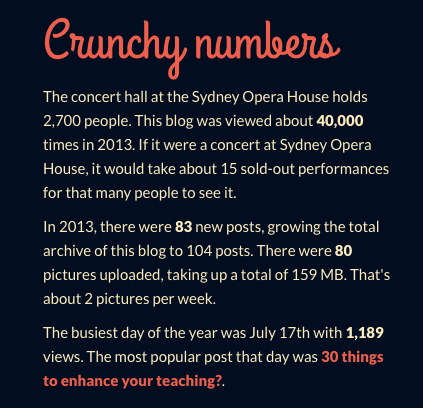
2013 has definitely been a year of blossoming for my blog: The 83 posts mentioned above were all written from May onwards this year, so in the space of about 8 months. Meanwhile, the three previous years of blogging yielded the other 21 – quite a stark contrast! What have I gained from blogging so extensively? Well, my British council blog award and resultant webinar (forthcoming!) on learner autonomy, for starters. But also, a space to reflect and re-process my learning, as well as a record of my professional development over the course of time. It gives me a lot of pleasure to look back over posts I’ve written and recapture the excitement, motivation, inspiration etc that the posts were borne of, while reminding myself what I’ve learnt.

Screen Shot 2013-12-31 at 17.24.41

Countries, countries, everywhere!

That my posts have been read by people from 164 countries makes me feel a sense of connectedness to teachers and the industry worldwide – I feel a part of something. The teachers I communicate with via Twitter, via this blog, via their blogs (I’m planning a post where I list the blogposts by others which have most inspired me in 2013 – stay tuned! Update: That post is now written and can be found here) and other means of online CPD (e.g. participating in webinars) are all part of the big online staffroom that I am lucky enough to be able to pop into on a regular basis and from which I gain and share ideas, creativity, motivation and inspiration.

Blossoming blog (“Frangipani_flowers” taken from Google images search, licensed for commercial reuse with modification)

And finally, to end my last post for this year, a big thank you to everybody who has been part of my 2013 and all my very best wishes for a happy and fulfilling 2014. Carpe diem! 🙂

In response to “Observations of an elementary language user”

As many of you know, I’ve been back in the “Elementary Language Learner” shoes since late September, which was when I moved to Palermo. Since then, Chia Suan  (who blogs for ET Professional) has written a couple of posts which deconstruct the teaching and learning mantras that many subscribe to, which I have read with great interest. You can find part one here and part two here. (Both well worth a read!)

I’ve also blogged about my experiences of language learning, including the difficulties I had with the language lessons I was lucky enough to attend for free, but subsequently gave up due to excess time commitments, and thoughts in relation to reading extensively. I found that being a language learner again has made me see what I do (teaching) in a whole new light. In view of this, Chia’s posts have made very timely reading matter! Having read the second one this morning and it being the end of the year (hurrah for holidays!), it seemed like a good time for some reflection on learning and teaching, in response to Chia’s posts.

Firstly, I would like to say thank you to Chia for deconstructing “eliciting is good”! I can remember all too clearly sitting in the class and wondering when the teacher would stop trying to extract language that we just didn’t have or wishing we knew what it was that was wanted. Getting blood out of a stone would surely have been easier. And it got worse when we’d be asked to repeat something that the teacher had elicited, so we thought ok, it must be correct, cool. *Then*, having repeated it, we’d finally learn that it was in fact wrong and be back to elicitation square one again. Reading Chia’s post made me breathe a sigh of relief – it’s not just me!

The other point in Chia’s post that jumped out at me is the final mantra she deconstructed: “Learners should commit themselves wholeheartedly to their language learning process and take responsibility for their learning. They should come to class everyday on time, do their homework, and seek out opportunities to actively use the language everyday.”  As Chia says, just because we teach language for a living, doesn’t mean our learners learn language for a living. Something I feel to be very important is to avoid trying to force anything on learners. Not only because learners are not just learners but people with lots of things vying for attention in their every day lives, but also because language learning is SO personal: one man’s meat really is another man’s poison. Rather than forcing anything on learners, we should be helping them discover what works for them. And sometimes that may be putting language learning on the back-burner for a spell as other things in life take over.

My school is closed for two weeks over Christmas now. I haven’t given my (adult) learners any homework, but in the last lesson I gave them some time to discuss with each other what they could do over Christmas to try and keep using English. They have some sheets with various activity ideas (that I gave them about a month ago, part of an on-going project) and these were used within the discussion. But even this was optional: the activity wasn’t framed as “You must choose x number of things to do and do them” but, having discussed why it might be a good idea to try and use English during the holiday (end-of-course test is not long after we start back again), “what do you think you’d like to try and do?” They all chose some things. They will all do varying amounts of whatever it is they have chosen to do. Some may not be able to do much of anything at all. And that’s fine. But what about those who don’t do anything? I hear you say. Well, they aren’t stupid. They understand how and why it would be helpful to use English during the break, just as outside of class during term-time. If they’re not able to use English over the Christmas break (family commitments, going away etc.) then that’s how it is – in Chia’s words, “that’s ok”. I think the majority of them will do something, some will do more than others, and every little will help. And for those that don’t, I don’t think forcing something on them would be helpful anyway.

Meanwhile, this elementary learner is in England for two weeks and needs (wants) to keep up her Italian. I haven’t got a course book with me. I’ve finished the first course book I was using, and plan to start another one in the new year, but for now I’m on holiday. So my Italian maintenance will mostly take the shape of reading extensively in Italian, blogging in Italian (I have a little private blog that so far has a grand total of 3 entries – only started it recently) occasionally, speaking a bit of Italian with my sister (she speaks a bit) and probably that will be about it. My main goal for these next two weeks is to relax. It’s my first holiday since August 2012! If were still attending classes and my teacher had loaded me with holiday homework and said I had to do it, I think I’d ignore it until the day before the lesson and then spend a few minutes rattling out as much as I could half-heartedly. I don’t think it would help much!

Long live being critical of teaching mantras, I say! I don’t know if there will be a part 3 to Chia’s ‘observations of an elementary language user‘ series of posts but I hope so! It’s so important for teachers to be able to empathise with what their learners are going through and put ourselves in learners’ shoes but so easy to forget and ask learners to do things or do things with learners that we, ourselves, would hate if we were them! E.g. bad elicitation. Or forcing them to learn in ways that just don’t work for them. Or teaching them useless vocabulary. As teachers, we (hopefully) know something about different ways of teaching and learning that may (or may not) work, but we shouldn’t assume we know best or that learners who don’t learn the way we think they should are deficient. I think there’s no such thing as an ideal language learner. It might be easy to say “the ideal language learner does x, y and z” but x, y and z may be hopeless for some learners, who may be much better off doing a, b and c. In which case, forcing x, y and z would be rather like square pegs and round holes… Rather than ideal, or less ideal, there are just differences. Many differences. Unsurprisingly, perhaps, as the human race is not a bunch of clones!

Vive la difference! 🙂

square peg

Square pegs and round holes? (Taken from google search “licensed for commercial reuse with modification”)

Elementary Teens (13-15yr olds) Christmas Lesson Idea

I had a lot of fun with my elementary teens today, for our last lesson before the holidays and thought I would share the lesson idea here, for anyone else to use…

Materials:

  • Recording of “Merry Christmas (War is Over)” by John Lennon
  • Gapped listening text
  • Whiteboard, board pens
  • Christmas Spirit!

Plan:

  • Put the learners in small groups (3 ss per group). Ask them how THEY celebrate Christmas (activities, food etc) and get them to take turns to tell their group. However, the task is to draw up a list of similarities and differences in their Christmas celebrations. When they have finished, give each group a chance to report their similarities and differences to the whole class.
  • Ask them if they know how people celebrate Christmas in other countries in the world. Let them share any knowledge/ideas/opinions related to this.
  • Put the learners into two teams. Give each team ownership of one of the whiteboards (if you are lucky enough to have 2 whiteboards in the classroom, as I am in this particular classroom!) or split one board between the two groups. Divide the boards into pros and cons (of Christmas). (With + and – signs and happy and sad faces, to clarify!) Let the learners brainstorm in their groups and fill the board. (My learners had lots of ideas!) This should raise the point that Christmas is not rosy for everybody (e.g. poor people, lonely people, old and infirm lonely people etc.) Give learners the opportunity to look at and comment on the other group’s whiteboard/ideas. (I found it particularly amusing when they were discussing how the magic of Christmas is for when you are young, not for them – I guess that makes me a proper grandmother then! 😉 I was impressed by all the ideas that they came up with, especially for the negative column.)
  • Write the song title and John Lennon on the board. Ask the learners if they know this song. (Most of these learners had!) Tell learners they are going to listen to the song and write down any key words they hear/understand (NB: check they are clear that words like “and” “but” etc don’t count!) (My learners were able to note down quite a few key words, some more than others – depending on level within the level and familiarity with the song). Let learners compare and pool their key words in their teams.
  • Hand out the gapped listening text and get learners to tick the words on their list that they can see in the text. Ask learners to listen again and complete the gaps. Get them to compare in their groups after listening and then play the recording again for them to check the answers they have decided on through the discussion/comparison. Project the complete song lyrics for them to see/check their answers against. Get them to check their list of key words again. Work together as a class to identify what caused the misunderstanding of any words written down (in gaps or as key words) that are not in the song. (E.g. it sounded like a different word, they heard half of the word and interpreted it as a different word etc. Think of sound interference at word boundaries and problems that may arise from chunking the stream of sound incorrectly…)
  • Get the learners to use their completed texts to sing along to the recording. See if they will try and sing the song without the recording – mine did! They thoroughly enjoyed it.
  • Ask learners why John Lennon wrote this song. Elicit their ideas. (E.g. Protest against war/injustice/inequality etc. To bring people together. To get people to think about less fortunate people at Christmas…)  Ask them what kind of song it is. (A protest song). Ask them if they know any other protest songs. (Mine did! Came up with lots of good examples between them). Ask them if they know any protest songs in their language. (Again, mine did! Though they specified that they were more like solidarity songs) Ask them if they think these protest songs do any good. (My optimistic, positive crowd thought they did and had plenty of ideas why this was the case) 
  • Round off the lesson with some “Stop the Sleigh!” (which you may know under the more common name of Stop the Bus… 😉 )  This works very nicely with Elementary teens in teams of 3: especially as adjectives, nationalities and food have all been covered during the past term – it was a game but also a bit of review.

The lesson worked well, the teens were very keen to express themselves (!) and I was able to feed in a lot of language that they wanted there and then. The song gave them listening practice and acted as a stimulus for discussions about Christmas that enabled us to extend discussions of Christmas well beyond the initial, familiar Christmas food and activities talk that we started with. We also had a lot of fun! Win all round… 🙂

christmas_by_bioclay88-d5p4k6o

“Christmas” by bioclay88 – taken from google images search licensed for commercial use with modification.

The twelve weeks of class (to the tune of the 12 days of Christmas)

A bit of Christmassy fun, loosely based on some of the things my level 3’s have done thus far during their course… Set to the tune of the 12 Days of Christmas.

My challenge to you: choose another Christmas carol or song and do something similar: have fun changing the lyrics to make it about teaching. If you do, comment on this post with a link to it so I can have a look! 🙂

The 12 weeks of class

In the first week of classes, my teacher gave me to me

the goal of reading extensively.

In the second week of classes, my teacher gave to me

two Edmodo tasks and the goal of reading extensively.

In the third week of classes, my teacher gave to me

three present simples, two Edmodo tasks and the goal of reading extensively.

In the fourth week of classes my teacher gave to me

Four phrasal verbs, three present simples, two Edmodo tasks and the goal of reading extensively.

In the sixth week of classes my teacher gave to me

Five verbs plus -ing! Four phrasal verbs, three present simples, two Edmodo tasks and the goal of reading extensively.

In the sixth week of classes my teacher gave to me

six jumbled questions, five verbs plus-ing! Four phrasal verbs, three present simples, two Edmodo tasks and the goal of reading extensively.

In the seventh week of classes my teacher gave to me

Seven prepositions, six jumbled questions, five verbs plus-ing! Four phrasal verbs, three present simples, two Edmodo tasks and the goal of reading extensively.

In the eighth week of classes my teacher gave to me

Eight comparative adjectives, seven prepositions, six jumbled questions, five verbs plus -ing! Four phrasal verbs, three present simples, two Edmodo tasks and the goal of reading extensively.

In the ninth week of classes my teacher gave to me

Nine collocations, eight comparative adjectives, seven prepositions, six jumbled questions, five verbs plus -ing! Four phrasal verbs, three present simples, two Edmodo tasks and the goal of reading extensively.

In the tenth week of classes my teacher gave to me

Ten minutes spent reviewing, nine collocations, eight comparative adjectives, seven prepositions, six jumbled questions, five verbs plus -ing! Four phrasal verbs, three present simples, two Edmodo tasks and the goal of reading extensively.

In the eleventh week of classes my teacher gave to me

eleven quantifiers, ten minutes spent reviewing, nine collocations, eight comparative adjectives, seven prepositions, six jumbled questions, five verbs plus – ing! Four phrasal verbs, three present simples, two Edmodo tasks and the goal of reading extensively.

In the twelfth week of classes my teacher gave to me

twelve fun ways to use English , eleven quantifiers, ten minutes spent reviewing, nine collocations, eight topics for discussion, seven prepositions, six jumbled questions, five verbs plus – ing! Four phrasal verbs, three present simples, two Edmodo tasks and the goal of reading extensively.

(I’m now wondering about doing something along these lines with my advanced class as part of their last lesson this term: combining reflection on what they’ve learnt/done this term with a bit of fun and collaboration…If I do and it goes well, I’ll share the lesson plan here!)

Post-observed lesson reflection: When it all goes wrong!

I was observed teaching today – TP 2/4 of my International House Young Learner course. I spent hours and hours preparing it (several on Saturday, several yesterday, several more today) – writing out the plan, tweaking the plan, thinking it through etc. I thought it was a good plan. Oh my goodness could a lesson have ever gone more wrong? Could I have ever been more wrong? I don’t think so…

Well, I have to do a reflection for it to submit to my observer, of course, so I thought I’d reflect on it here first. 

On the plus side, I can see where I went wrong:

In the planning stage:

  • One of my assumptions was that they would have met the present perfect at school. I didn’t expect them to be able to use it but I thought they would have come across it and be familiar with the form. A few had. Most hadn’t. 
  • The template I made for them, based on the poem that the book used to contextualise the language, was too long. I made it the same length as the poem in the book. I should have made it shorter. In the event, they didn’t get on to the freer practice activity where they were going to ask each other their questions, in a speaking ladder. And some of them had trouble coming up with enough ideas despite the brainstorming we did before they started writing. 

In the classroom:

  • I was tense, due to being observed, so instead of the usual relaxed, happy atmosphere, everything felt very awkward and stilted. 
  • The lesson plan was so detailed, pretty well scripted, but I couldn’t remember what was on it and that stressed me out even more. I don’t think detailed lesson plans and I go together. Not that amount of detail. I should have made a normal ‘me’ lesson plan as well, so that I could refer to that not the formal one. Something I could glance at and remind myself where I was and what was next. As it was, I forgot the order, forgot to talk about the meaning before moving to the form – the kids got me back on the right track by questioning the meaning, at least! A very stupid mistake. But I was flustered and it happened. On the plus side, they did eventually understand, after I used my timeline to explain it.
  • I couldn’t turn off the projector because the remote control had got lost under all my stuff. So it was noisy and there was the blue screen of death, and I knew that all too well, but I couldn’t do anything about it! Ridiculous.
  • My activity for eliciting the form (a projection of a summary of the form with parts blanked out for them to stick coloured words onto) was too complicated. It needed more scaffolding. This perhaps comes down to my incorrect assumption. I thought if I gave them more help, i.e. less gaps on the projection, it would be too easy. But also, it should have been a table, to make it clearer. 
  • I was supposed to ask the learners to memorise some past participles, it should have been half of those in the back of their book. I got that all muddled up and asked them to learn a ridiculously long list of verbs on a bookmark with the verbs on that I had given them as an aide. Poor little sods. They must have thought I was off my head. 
  • Then there was the pronunciation activity. By this point, I was really floundering and flustered and couldn’t remember what on earth I was supposed to do. So it all went a bit wrong. I was all the time trying to remember, “what did I say was going to say/do now? Arrgh!” Oh and also, the poem projected onto the whiteboard was too small – that created extra problems with managing the pron. activity which required them to look at it and produce the questions related to the statements. So I had to have them open their books, more faffery. And standing them up to generate more energy failed because of the book thing – they stood up without their books, sensibly enough, but needed them. Teacher management fail! 
  • Then came the writing, with the too-long template (see planning, above!). By this time, timing had gone thoroughly out of the window. And the too-long template took too long for the learners to complete in time to do the freer practice activity. Finally, I had to ask them to finish it for homework (those who hadn’t). 

But there was a positive side too (amazingly enough):

  • The beginning of the lesson (other than letting the routine get too faffy), was good – the learners matched words and pictures and put the cut-up lines of the context poem into the correct order and they were engaged by that. 
  • …erm. I’m struggling to think of any more! Maybe a very small positive side then… (I’m sure there were more…maybe…if so, I will add them later when I’ve had more time to think!)

I came out of the classroom envisaging a career change to data entry. For me, one of the worst things is, because I got a distinction for Delta module 2, I feel like my observers (for both this lesson and the last TP), who both know I did obviously, must watch me teach and wonder how on earth I managed to do that. *I* wonder how on earth I managed to do that. On the other hand, that was for adults. YL’s are a rather different kettle of fish. 

I do wonder if doing this course so soon after finishing my last courses was a good idea. But on the other hand, I clearly need a LOT of help with the whole young learner teaching malarkey! Even if I don’t manage to pass the course in the end, I will still have learnt a lot. I already have. Maybe that is the main thing.

So, next step: Write the reflection and then prepare for the next observation. What have I learnt from today’s experience: A lot. So hopefully my children will forgive me for today and I can use what I have learnt to make their next lessons better… 

My simple question to you today: What do you do when it all goes wrong? 

Feedback forms and follow up

This post is inspired by the coincidence of happening across this post by Anthony  and it having recently been that time of term where I work – only, instead of it being end-of-course questionnaire evaluation forms, we’ve just done mid-course questionnaire evaluation forms. These were anonymous to the extent that the teacher is required to leave the room while the students complete these forms, so that they are able to discuss their responses together freely.

Anthony makes a good point about the issue of lack of context with such anonymous data: I suppose regardless of the number of learners in the class, with anonymity the data becomes quantitative rather than qualitative – i.e. x students think the course is satisfactory, while y students think it better than satisfactory and z think it is below standard. X students think there is too much grammar, y students think there is too little grammar and z students think the amount of grammar is just right. And so on. If, in the first instance, x represents the majority, and in the second instance, z represents the majority, then one is relieved.

figures

Which colour stands for satisfied? (Cuisenaire Rods – taken from wiki commons, labeled for commercial reuse with modification)

Would it be better to have feedback with names attached? Anthony describes the potential benefits of this. As I see it, the main one would be the potential for tailoring your response(s) to it and gaining more understanding of what’s behind it. As he mentioned, the cons are generally thought to be the issue of reliability – will a student give genuine feedback if they have to put their name to it? Thinking back to my time as student representative, while I was doing my courses at Leeds Met, there was definitely a strong preference for anonymous feedback as far as the students were concerned – I ended up with a system whereby another student collected and collated feedback and gave it to me to pass on to the tutors at the evaluation meeting –  but the tutors welcomed informal feedback at any time too, which was really nice. Why the preference for anonymity amongst students? As far as I can tell, the thinking goes something along the lines of, “If I complain, they will hate me, which will make things difficult henceforth and may mean I get a lower grade in the next assignment”. There may be a cultural aspect at play too. In some cultures, complaining just isn’t done. Britain would be one of those – everyone has seen that info-graphic regarding “what we say” and “what we really mean”! Stiff upper lip and all that, what! 😉 Perhaps anonymity makes the complaining less direct and therefore more acceptable/comfortable for people to undertake.

Perhaps the length of the course also influences things: If you have a group of students for a whole year, then possibly there is more potential for building a rapport with them and creating a situation whereby channels of communication are open and students are comfortable in using these and telling you when something isn’t working or, on the other hand, if something is particularly helpful. They may then feel more comfortable to put their names to a feedback form too, if you wanted that. Whereas, if you have a class for a couple of hours a week for 12 weeks, depending on the students and teacher involved, you may not reach that point, where they would want to put their name to a form, though you have a perfectly good rapport with them. (And of course, you can’t make it optional, though within any class you probably have some learners who would be happy to put their name on their form, because the “anonymous” ones would no longer be anonymous: we’d be back to pseudo-anonymity.)

So what of the anonymous feedback forms in all this? They are an evaluation tool. From the institutional point of view, you can get some statistics out of them. From the teacher’s point of view, you can identify trends – i.e. if within one class, the majority of students are ticking the “too little” box for writing, then you can address that. Then, of course, if the class is very small, probably you know who filled out each form anyway! So it becomes pseudo-anonymity. Either which way, as long as they aren’t the only tool used to evaluate, they serve a purpose. (Even if, as Anthony pointed out, the information is all somewhat decontextualised.) However, from the student’s point of view, having gone to the effort of filling out the form, they probably want some kind of response to it, some kind of acknowledgement…

My question is, how is the best way to do that effectively when the forms are anonymous or “anonymous”? Here, I’m wondering about the feedback directed at the teacher, rather than the institution (I don’t have a magic wand for making classes smaller or at a different time of the day etc!) What can we do other than, say, doing more writing, if that was the general consensus (as per one of the examples given above), to respond effectively? If you try and talk to the learners as a group about any issues within the feedback forms, then it threatens the anonymity, in that to get anything meaningful out of it, the students who had raised the issues would have to speak, thereby putting their name to it. Which they also may not want to do in front of the class. Getting them to come and speak to you, or to write to you, of their own volition, defies the point of anonymity too (or does it?)  Another issue, of course, is time – whatever method you do use to deal with this can’t be too time-consuming in terms of lesson time, because that is at a premium already, or in terms of out-of-class teacher preparation time, because there are only so many hours in a day and a teacher can only physically do so much.

Answers on a postcard! (Or comment below…) 🙂 (And apologies for the somewhat rambling nature of this post…you may complain using the comments box below – anonymously or not as you please 😉 )

CPD: What does it mean to you?

CPD (Continuing Professional Development) is a well-used phrase. But what does it really mean? What does it involve? To me, it covers a whole multitude of things:

Courses

This is arguably the most obvious element. You identify a gap in your skill set or a need for general upgrade of your skills/knowledge and search for a course to suit your needs. Courses come in all shapes and sizes, varying in length, focus, outcome, commitment requirements, cost and so on.

The DELTA (Diploma for English Language Teaching to Adults) or its Trinity counter part, the Trinity Dip. TESOL, is a popular choice for qualified ESL teachers wanting to take the next step. These are internationally recognised professional qualifications with a practical focus. The DELTA is a modular qualification and modules can be taken separately or concurrently, distance or face-to-face, part-time or full-time, intensively or non-intensively. The trick is to make the right decision regarding which of these options will work for you. Being a level 7 qualification, the DELTA gives you a number of credits towards a Masters qualification, depending on the university and the course chosen.

M.A.’s (Master of Arts) or M.Sc.’s (Master of Sciences) are generally considered to be more theoretically focused. Popular choices for teachers include Masters in English Language Teaching, Applied Linguistics and TESOL and pure Applied Linguistics. Some M.A.s manage to combine the more theoretical focus of an M.A. with practical application. One such is the Leeds Met M.A. in ELT, which focuses on what you can do with the theory rather than on just learning and writing about it: in the second semester, for example, you design materials, undertake research, develop multimedia tools and write a journal article. First semester content depends on whether or not you choose to do the integrated DELTA option.

Shorter courses

I think these tend to have a narrower focus and there are lots of options out there. International House, for example, has a range of courses, of various lengths, some blended and some purely online. (I shall be doing the Young Learner training, starting tomorrow!) I won’t go into depth on all the courses available out there, or it will treble the length of this post! 😉

Work-based CPD

This, most obviously, would include workshops (both attending and delivering), formal observation, peer observation and the opportunity to participate in short training courses. And, I have discovered, if you work somewhere that truly values CPD (actively, not just paying lip service), then these things become amazing opportunities.

I had my first formal observation earlier this week. Scary scary. BUT the DoS had emphasised that this was developmental rather than a test and an opportunity to experiment. So I experimented for the first time with some techniques I’d read about shortly prior to the observed lesson. It was so valuable to then be able to discuss the techniques, difficulties in applying them and ideas for continuing to apply them, during the feedback with my DoS. I now have a lot of detailed feedback notes to read and reflect on before I next teach. However, I have also already had two classes, directly following the feedback, and tried to put into practice the ideas discussed during the feedback, with some good results. So exciting!

There have been two workshops since I started here, too, both very thought-provoking and useful. It’s always good to be back in the learning seat. In due course, I hope also to deliver one, as I think this would be a very valuable experience. In addition to this, last weekend I did some Cambridge speaker examiner training for KET and PET exams, which was an interesting process.

Personal CPD

This is everything you do to learn that doesn’t come under a formal label! In this diverse category comes things like:

  • attending (and/or presenting at) conferences (face-to-face or online)
  • attending (or giving!) seminars (or webinars)
  • reading journals/professional magazines
  • reading relevant books
  • reading relevant blogs
  • using Twitter (e.g. participating in #Eltchat discussions, following up links)/Facebook (e.g. the British Council TeachingEnglish Facebook page.)
  • writing blog posts
  • writing journal/professional magazine articles/contributions
  • making learning materials
  • carrying out classroom-based research projects
  • reflecting on your teaching/development and making plans for what to try out next.
  • being a language learner again (!) (Being a learner in a language classroom again has shone a whole new light on learning, to consider as a teacher!)

For Me:

I found my Delta and M.A. immensely challenging and rewarding. But I think what comes next is equally important. The CPD doesn’t stop when you finish the course and get your certificate. The course provides you with new knowledge, techniques, methodologies etc. but true CPD is what you do with all of that afterwards. Do you put your certificate in a file and then continue as before? Or do you experiment with everything you’ve learnt and look for new things to try out and connect to your previous learning?

At the moment, I have a couple of projects on the go that are very much the result of having done the Multimedia and Independent Learning module of my M.A., that will culminate with my first webinar (in February next year) and recently I’ve also been exercising my materials development learning in making materials for the Global Issues month as well just for my own use with learners. And I’m finding all of this really satisfying, interesting and exciting. I think, too, that having a supportive DoS is key to effective CPD – there’s nothing like being actively encouraged to develop and helped to do so.

To me, CPD is the spaces between the words. It’s what and how you learn but also, all-importantly, what you do with what you learn, it’s being aware of opportunities and taking them when they arise. It’s what herbs and spices are to cooking – not strictly speaking necessary but it turns a bland dish (one day of experience repeated for twenty years) into something delicious and taste-bud tantalising!

I’m sure I’ve missed plenty of CPD options out of this post, so please comment with any additional CPD ideas you have! Inspire me!! 🙂 What does CPD mean to you?

Extensive Reading (part 2)

In this post, I wrote about my own experience of extensive reading and reflected on the idea of getting students a) reading extensively and b) benefitting as much they can from it. Following on from this, I have attempted to start the ball rolling and get the pages turning (at the hands of my learners, of course!).

page turning

Let the pages turn! (Taken from advanced google image search filtered for “labelled for commercial use with modification”)

My experimentation thus far is informed by:

  • what I have learnt about learner autonomy (as well as the role multimedia can play in facilitating this).
  • what I have learnt about motivation.
  • what I have learnt about the relationship between these.
  • what I have learnt about theories of learning (particularly drawing on social constructivist ideas).
  • my own experience of extensive reading (as language learner and teacher) as well as others’ (e.g. the experiences related during a talk at a MATSDA conference this year).
  • reflection on the relationship between the implications all of these and the learners in my classes.

My goal is:

To get my learners reading regularly, over a substantial period of time (not a one-week wonder) and reaping the benefits of this. However, it is important that it comes from them, that they are doing it of their own volition not because it’s forced on them, not because Lizzie said so. Ideally, it should also be something they can enjoy. Of course, pleasure is multi-faceted…

For example, this could be pleasure that results from:

  • relaxation.
  • discovery/satisfying curiosity.
  • achievement/success.
  • overcoming a tough challenge.
  • finding something really difficult but persevering nevertheless.
  • feeling a sense of progress – linearly through the book and/or in terms of language learnt from it.

And the type of pleasure experienced, if any at all, is likely to shift regularly.

Why is pleasure important? I think because it is then more likely to be something they do long term rather than just this semester. (I read in French for pleasure still. And it keeps my language ticking over.)

My classes:

For now, I am focussing on adult classes. (Perhaps when I have done my IH Young Learner training certificate, which I am starting soon, I will think about how to set about this project with my low-level teenaged learners…!) I teach a mixture of levels (currently pre-intermediate, upper intermediate and advanced) and I am using a similar approach with all of these levels. I’m keeping track of what I’m doing with the learners and how they are responding over time by recording anything of interest/relevance in a 50-cent notebook. (The same notebook that I’m using to keep track of my experimentation with various multimedia tools for developing learner autonomy, as I think extensive reading can be an important tool for autonomous learning and autonomy is important in extensive reading.)  It’s early days but it’s already really interesting! (I think so, anyway :-p)

My approach (the beginning):

I started the whole process by putting the learners in small groups for a brief discussion about extensive reading (scaffolded by some simple prompt questions).

This enabled me to gauge:

  • their attitude to reading
  • what they already know about the benefits of reading for language learning
  • what approaches they have used and how well (or not) these have worked for them.

At both lower and higher levels, the learners had experience and ideas to share. Unsurprisingly, a mixture of approaches were discussed. Of course, they then looked to me to tell them “the magic way” but that was not to be…

I responded that:

  • all the approaches they had discussed were equally valid
  • all the approaches had different benefits/drawbacks.
  • varying the approach used could be the best way to gain the most benefits in the long term.

I think this was important to discuss, because there is a danger that learners may think there is only one “right way” of doing things (“I must read x type of book in y time using z approach, if I don’t I won’t learn anything”), and if the perceived “right way” doesn’t work for them, they may give up altogether, feeling that their way is wrong and therefore not worth doing. Whereas, there are, of course, any number of ways to skin a cat/read a book/learn a language.

They also wanted me to tell them what to read, so we discussed the benefits/drawbacks of:

  • reading a book that you have already read in L1 vs. a book you’ve never read before.
  • graded readers vs. authentic texts.
  • books vs magazines/newspapers.

I then gave them the task of finding something they wanted to read in English. The only stipulation was it had to be something they could read over time. So, a book, a book of short stories, a newspaper/magazine that they would read regularly (as vs. a single article). I encouraged them to find something that they want to read.

This, of course, is very subjective:

  • Some learners welcome the challenge of an authentic text (like me and Harry Potter in Italian – it may seem a ridiculous prospect, an elementary learner trying to read Harry Potter written for Italians, but it’s working! And, as it happens, one of my level 3’s has picked Harry Potter in English – which he says is difficult but he is enjoying it and wants to persevere – so far! 🙂 )
  • Some prefer the security of a reader graded to their level and will benefit more from this.
  • In terms of subject matter, one man’s meat is another man’s poison.

I think that whatever learners choose to read, if the desire is there, they can gain something from it. Why? Because it will add to the all-important motivation to persevere. And perseverance = exposure to language in use.

The learners themselves had ideas of where to get hold of English reading material:

  • local bookshops
  • the library
  • online sources, for those with kindles
  • I also posted a link to the Gutenberg project on Edmodo for added inspiration.

My approach (further information):

Compulsory?

I did not make this project compulsory, but explained that once a week we would use ten or so minutes of a lesson to discuss progress/difficulties/approaches used etc. As we had already discussed the benefits, they understood why I was introducing this into their course and were receptive to the idea. I’m not forcing this on them, I’m offering it to them as a potential learning tool and scaffolding their independence in using it. A couple of students in one of my classes don’t want to read. So they are going to listen extensively instead. They are going to watch series/films in English with English subtitles on (so, a bit of reading too!). That’s fine. We’ll see – perhaps as the course progresses and the other learners who are reading share their experience of it and how it’s helping them, these learners may be tempted to experiment outside of their comfort zone. Meanwhile, any exposure to English is better than none!

Level?

With the lower levels, this discussion came the lesson after we had done a lesson of which part had focused on learning new vocabulary and the kinds of things you need to know about a word in order to learn it. This tied in quite nicely: Their homework was to find three words/phrases that were new to them, find out the type of information that we had looked at in class (collocations, prepositions, examples of different meanings of a single word where relevant etc. etc.) and post this on Edmodo, to share with the other learners. I put a link for the Oxford Learners Dictionary onto Edmodo for them to help them with this.

With higher levels, I have some other tools up my sleeve to try out with them, but meanwhile the project levels itself by choice of reading matter.

Autonomy potential?

Subsequently, I have told learners that I won’t set this vocabulary work as homework anymore but it is still something they can continue to do. It can also count towards their 10hrs guided study (learners at IH Palermo need to complete 10hrs of independent learning – any time they use English outside of class of their own volition i.e. not homework). Soon, I want to introduce Quizlet as a way of reviewing the vocabulary they accumulate. Over time, I hope to help them build up a range of ways to use reading material and any vocabulary they choose to extract from it. (I’m not dictating when or how often they should look up words, but between them there is a range of approaches in use, which I am encouraging and will continue to encourage experimentation with.)

I have also asked two levels (so far) – pre-intermediate and advanced – to set themselves mini-goals for their reading over the next week. It was their choice what their goal was, the only stipulation was that it should be small enough to be a realistic aim for one week of reading. Next week’s ten-minute discussion will enable them to share what progress they have made with their goals and consider how realistic they were in light of this. Hopefully, success with the goals will be motivating, in terms of the reading, and if any learners don’t achieve their goals (there are bound to be some), collaboratively (and with my help if necessary) they can work out why and adjust their goal-setting for the next week to make their goals more achievable while still challenging. This will hopefully avoid demotivation by guiding learners towards a way of enjoying a series of meaningful mini-successes rather than becoming dispirited because the end goal (the usual, vague “improve my English for xyz reason”) doesn’t seem to be getting any nearer. I’m doing this because I think motivation management is important for the development of learner autonomy and perseverance.

Conclusion

So, it’s early days but I would say a positive start: the learners are on board. For me, the next step is to help them sustain this motivation rather than get bored/lose interest/give up. Additionally, of course, I want to help them become more autonomous learners. This extensive reading project is one strand of that. I have a handful of ideas up my sleeve (in relation to this project and the larger learner autonomy project) and time this weekend (a three-day weekend, hurrah!) to reflect and formulate the next phase of my plan of action.

What’s next?

Well, if you want to know the results of these experiments (what worked, what didn’t, evaluation at the end of these learners’ current course/level, what else I did to try and make these projects successful i.e. the afore-mentioned ideas lurking up my sleeves), I think you’ll have to wait till my British Council webinar on learner autonomy which will take place in February next year, as conveniently enough my current adult classes mostly finish towards the end of January next year (except for one that finishes in December) – just about in time to round up what I learn, and package it suitably for sharing with others… 😉

Your thoughts?

Meanwhile, as usual I would be very interested to hear from anybody with any thoughts on all this. As I mentioned in my previous post, I would love to hear anybody’s experiences of trying to get learners reading extensively and independently, as well as of being a language learner and using extensive reading as a learning tool.