Adapting to online teaching 2 (EAP)

After my first two weeks of whole group online teaching this term, I published this post about my experience of adapting to this way of teaching (behind the curve because we didn’t do any whole group teaching on our course last term, only short small group tutorials, which I mentioned briefly in my post about our experience of throwing an EAP course online at short notice). Another two weeks have passed so here is the next instalment! (It’s ok, we only have 6 teaching weeks this term before the final 3 weeks become all about assessment, so there will only be 3 of these posts in total!)

Week 3

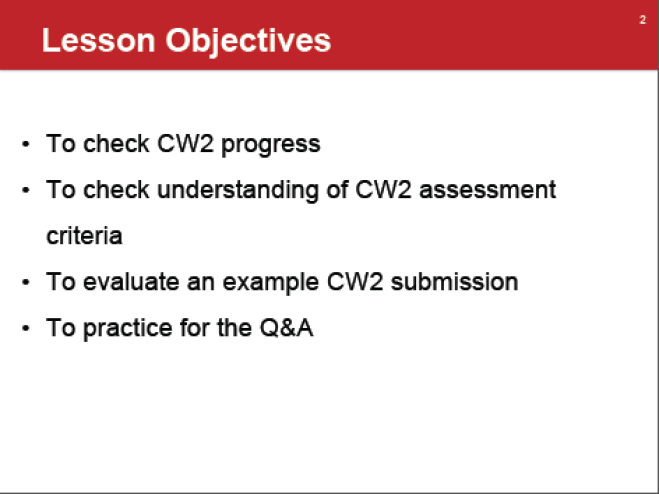
The theme for this week was “Overpopulation – myth or problem?”. Having established in Week 2 that I can do break-out rooms (woo!), I decided to try a speaking-focused lesson with a focus on paraphrasing and summarising sources when speaking (which they will need to do for their Coursework 2 presentations). In preparation for the lesson, students had to find a source to support the position they had been assigned (half the class were assigned ‘myth’, half were assigned ‘problem’). In total, there were 4 break-out room groups, of which the final one was the main discussion task. The first 3 tasks involved random groupings, while the main task I did customised groupings because groups had to have a balance of “myth” and “problem” viewpoints and had to take into account attendance patterns thus far (i.e. I wanted to make sure that as well as being balanced viewpoint wise, no group had more than one student with patchy attendance!)

This was the first task (yes, somehow I forgot about “A”…! Students didn’t say anything about it, if they noticed. Of course they may have thought the chat box warmer task was “A”!)

This task reviews the skills learners developed and were tested on in Coursework 1 Source Report. In all the breakout room tasks for this lesson, I included times on the slides to give students an indication of how long they would have in their breakout room to complete the task.

Positive of this task: clear and achievable for students; provided opportunity for speaking/warming up their working in a breakout room mode!

Problem with this task: no tangible output = room for students to slack off. In future I would do something like get groups to report back in the main room, answering questions such as “In your group, whose source was the most current? What different search methods did your group discuss?”

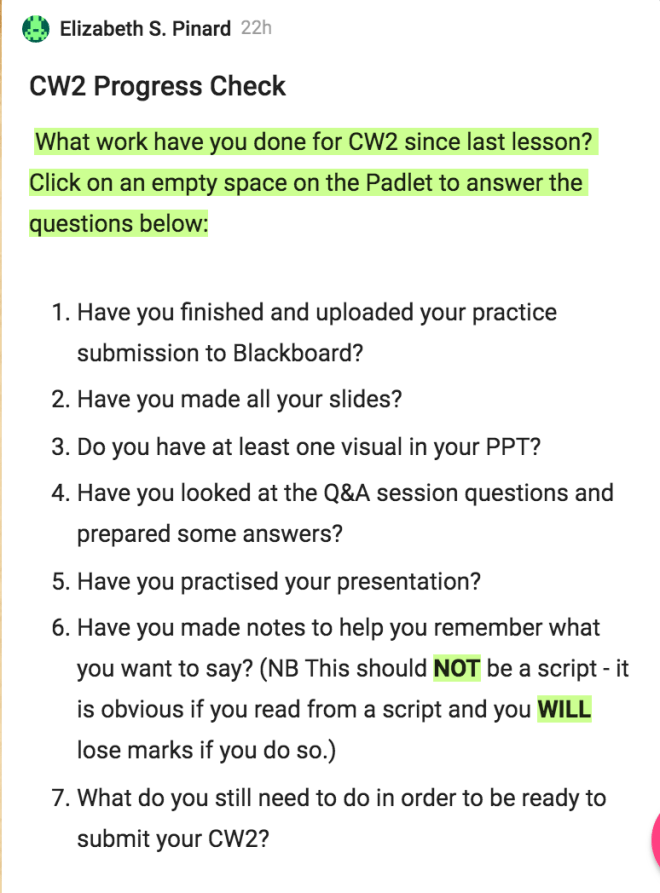
This was primarily a preparatory task for the main discussion but also paraphrasing skill practice. As well as review and practise of written paraphrasing, it encouraged students to pick out key arguments that they could use in the main discussion task. By now, students are used to using Padlet in our whole group sessions both with and without the breakout room/group component.

Positives of this task: useful skill practice, a preparation step for the main discussion, has a tangible/monitorable output (student posts on the padlet)

Problems with this task: my instructions weren’t clear enough – in hindsight I should have included an example post on the padlet!; it took even longer than I had anticipated, which probably also relates to the instructions not being clear enough (fortunately, as has been mentioned previously, timing is very flexible in these sessions this term!); I used the comment function on Padlet to give live feedback/guide students but not all groups noticed the comments as they are not as immediately visually evident as the equivalent on a Google doc would be (I dealt with this by going into breakout rooms and drawing students’ attention to the comments!); my post-task feedback again needed more thought (work in progress!).

This was the final preparation task before the main discussion task. The goal was to give students time to consider the arguments linked to the alternative viewpoint and possible responses to these, so that the main task discussion could be of a higher quality.

Positives of this task: It used the output of the previous task (the arguments on the padlet) with a focus to how they would be used in the subsequent task, which adds coherence to the lesson arc and hopefully means students can see why they are doing what they are doing – there is a clear direction to the tasks;

Problems with this task: students could think “I’ll manage with the discussion, I don’t need to do this task”; any given student’s experience of this task would vary depending on how forthcoming or not their group-mates were. Group dynamics in the online setting is something I need to think about more – how to help students to work well together in groups, in breakout rooms. Maybe add more structure to breakout room tasks e.g. start them with some kind of mini-activity where students have to write something in the chat box, before moving onto using the audio and doing the actual task at hand.

(No, I don’t know what happened to my grasp of the alphabet in these lesson materials! I think I was so focused on the task content that I forgot to pay attention to numbering/lettering!)

So, the main task! Group discussion requiring use of the sources found for homework (research skills), the key arguments identified, paraphrased and considered in the course of this lesson and language for referring to sources verbally.

Positives of this task: Brings together everything the students have done from homework through to final discussion preparation

Problems with this task: As far as I was able to tell, only one out 4 groups did the task properly! I think again what was missing was a clear feedback stage which students would be made aware of in advance of starting the task and which required them to DO the task fully in order to complete; students who want to do the task properly but are in a group with students who are more interested in slacking off lose out (had one student who when I was in the breakout room monitoring/checking on them, tried to give her opinion and elicit others’ opinions but radio silence followed!).

This evaluative element of the lesson comes from Sandy’s recent blog post about conversation shapes. (Although it might be hard to see in this screenshot of the slide, depending on the resolution of your screen, when displayed as a pdf of a ppt in Blackboard collaborate, the credits were clearly visible!) Unsurprisingly, for the group who did have their discussion, it looked most like conversation 2. As a class, we identified that conversation 3 would be most effective – contributions of varying length, responding to the other speakers’ contributions, building on other speakers’ contributions. Obviously in groups, there would be more than 2 speakers but the students didn’t seem to have any problems applying the visuals to a group discussion.

Positives about this task: It was great to have a visual way to think about the discussions the students had had (those who had had them!! But I figure for those who bothered less, this was still useful and could be considered in terms of previous discussions). Having identified that 3 would be the most effective, this can be revisited in future speaking lessons as a prompt in advance of discussion tasks. Could also consider what language and cues would help to build a discussion like this e.g. agreeing and disagreeing language that allows connection to what has been said (that’s a good point, but…/yes, I completely agree, also…), back-channeling etc.

Problems with this task: I probably didn’t go far enough with it. Although, possibly this is not a problem but rather a slow-burn thing that bears plenty of revisiting and therefore doesn’t require lengthy input around it straight away. I think in future I will introduce this after the first suitable seminar discussion practice that students do in the course and revisit it and build on it regularly e.g. have example discussions to match to each shape, the language input as mentioned above etc. (Thank you, Sandy!)

The final task of the lesson was a reflective task, with the output going onto a padlet. Reflection is a key component of learning, of course, and actually these students by and large did a good job of this. This is something I need to capitalise on more in future lessons.

Positives of this task: made students think about what they’d done and evaluate it; those who didn’t speak recognised it in their answers (it’s something!);

Problems with this task: Too many closed questions – need to push them further than that, closed questions are fine but then a follow-up question could be good.

This task reflected weekly lesson content for week 3. In practice, the students had very little in-class time to start it, because all the teacher-led tasks (as above) took a fair amount of time to do, but students are accustomed to fairly substantial homework tasks and as this was part of Lesson 3CD also factors into their asynchronous learning time.

Overall, Week 3 was a useful learning curve for me. There were plenty of positives, there are plenty of things to work on. I find it really useful to consider each lesson in these terms, think about what went well, what didn’t work and how you’d do it differently next time to make it work better, and think about how to reflect what you’ve learned more immediately in subsequent lessons – I guess that is what reflective teaching and learning is all about!

Week 4

Well…you know those lessons where you think you’ve made a really quite good lesson plan and have high hopes for how the lesson will go, but the reality turns out… rather differently? That was week 4’s lesson for me. The theme for Week 4 was Scientific Controversy. The asynch materials included a listening practice based on a panel discussion about genetic modification, which I asked the students in advance of the class as preparation. Though it was homework, it wasn’t extra in the sense that it was part of the core asynch materials for the week.

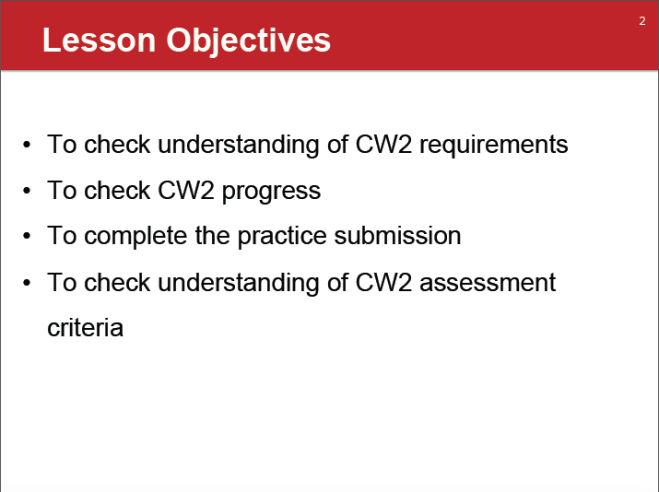
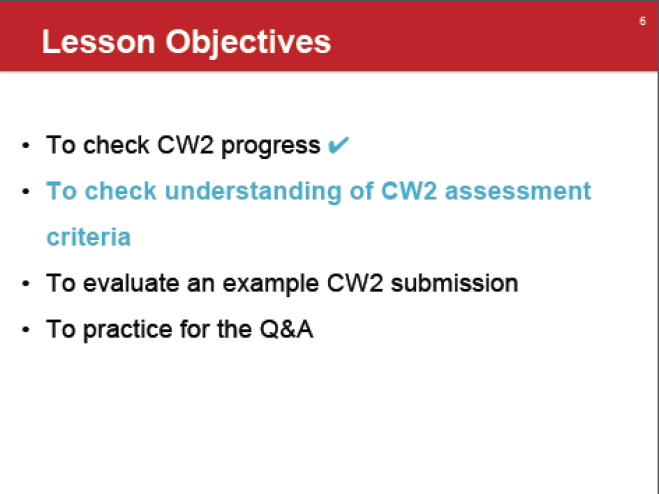
I began the lesson in the usual way – with a chat box warmer. Today I asked them to pick one adjective that most describes them right now and write it in the chat box. 9/14 responded – tired, exhausted, sleepy, blue, sleepy, energetic, sleepy too, calm, hungry. I acknowledged and responded to all their responses. Then we looked at the lesson objectives. In this lesson, I put extra effort into making sure the lesson objectives were clear and carried through the lesson, so that students could see where they were in relation to the objectives, see progress being made and see how tasks relate to the lesson objectives (I’d read, or watched, I forget which, about the importance of doing this). I did this by repeating the objectives slide at appropriate intervals, highlighting each objective as it was focused on and putting a tick by each objective as it was met. Here is an example:

The first stage of the lesson was a language review stage. 

This stage included a definition check for controversy and scientific controversy and a series of pictures of example scientific controversies for which students had to guess what scientific controversy was being illustrated. Here is an example:

The students responded, and a good pace was maintained. I could perhaps have done more with the second question, tried to get students to share more ideas, but knowing I had some meatier tasks later in the lesson, I didn’t want to spend too long on this one. The final task of the first stage was a quick Quizlet review of some vocabulary from the homework asynch materials. 11/14 did it, which was an improvement on Week 2! I haven’t tried the team/breakout room version yet – that may be for next week!

Positives for this stage: Pacing, student response, topic and activities connected to asynch materials so provide review opportunities, use of pictures.

Problems with this stage: The second question on the picture slides got neglected. I think when it unfolding, I worried that if I pushed the second question, the amount of time they spent typing would negatively affect the pace/mean too long was spent on the activity.

The next stage of the lesson was reviewing the listening homework.

I started with these questions:

As you can see, I messed up the formatting for this slide so the Write yes or no looks like it only relates to question 3. I corrected it verbally but only got ‘no’s’, for those who responded. Hoping this was for the third question, I reminded them about the online mock exams available, the importance of practice and that that there would be opportunity for practice during this lesson too.

This next task was supposed to be a fairly quick and easy way of getting them to show their understanding of the opinions voiced in the panel discussion:

Nobody did it. Nobody responded when I asked why nobody had started doing anything a few minutes later. Eventually I said ok give me a smile emoji if you did the listening homework and a sad face emoji if you didn’t. I only got sad faces. So this task flopped completely. The next one was also not going to be possible as it reviewed the target language from the aforementioned homework:

So I skipped to the point where I displayed the target language and we related it to the conversation shapes we’d look at in Week 3 and then moved on to the final review task:

(The opinions referred to are those of the panel speakers again.) Obviously this needed a workaround due to the lack of homework issue, so I had them open up the relevant powerpoint which had notes relating to each panellist’s views and got them to tell me via the chatbox when they had done so.

Positives about this stage: It had a mixture of chatbox and breakout room activities, and focused on the content and the language of the listening homework. I had some workarounds for lack of homework.

Problems with this stage: It relied on students having done the homework! The padlet task had no work around (I was working on the basis that at least SOME of them would have done it and be able to post on the padlet and the rest could interact with that using the comments) for the zero homework completion.

The next and final stage of the lesson was the speaking/live listening stage:

I made this slide a) to give students an overview of this stage of the lesson and b) to insert at the relevant intervals to show which phase of the task we were moving on to. More detailed instructions for each step came at the start of each step. I had hoped this overview would motivate the students to carry out each step as they would know the following steps relied on it and have a clear picture of what they were working towards.

In practice, I put the students into breakout rooms, having set up the task, and went in to each room to check on the students. Group A gave me radio silence. No response. No audio, nothing in the chatbox, whatever I said. So I reiterated what they needed to do and said I would be back in 10 minutes to check on them (the preparation stage was 20 minutes). Group B had some students who did engage and some who did radio silence. Thank God for the ones who did! They asked questions about their topic, I checked their understanding of the task and then I left them to it for a bit (again promising to return in 10 minutes to check on them). At the relevant point I went back to Group A, knowing full well that the chances of them having done anything since I left (no activated mics had appeared at any point) were slim (they could have used the chatbox…they hadn’t!). I tried again, more radio silence. Group B, again, had made progress when I went in to check on them. Then I brought everyone back to the main room. Except…most of Group A didn’t appear/reconnect. (So, presumably, they had done the log on and bugger off thing!) Obviously the plan in the slide above was a write-off (the members of Group A that did show up were still radio silence when addressed/instructed!). In the event, Group B did their discussion and I gave them some feedback, again referring to conversation shapes.

Positives of this stage: It was clearly staged. The group that did the parts that they were able to do made a good effort. (I feel for them, being so outnumbered by ones who won’t participate…)

Problems with this stage: It relied on student participation! Step 3 relied on Step 2 being carried out to some degree of success. Too ambitious? But these ARE pre-masters students, it shouldn’t be! There again, they are all knackered (see chatbox warmer – though Mr Energetic? Group A. Just saying.) If the stage had worked as planned, students may have struggled to summarise the other group’s discussion because poor audio quality makes it harder to follow what is being said.

What am I taking away from these 2 weeks? That I want an article/book/video about classroom management with online platforms! Though quite what can be done if students are completely unresponsive, I’m not sure. I have worked really hard on making everything as clear and as meaningful as possible, in terms of tasks and objectives, which I am pleased with. I continue to try different task types and see what does and doesn’t work (with this group). Possibly I approached it wrongly overall – I tried to connect to the asynchronous material and give students engaging tasks that would help them develop their academic skills and prepare for exams, but maybe I should have focused more on their coursework. The next and final big thing students have to do in terms of course work is prepare and submit a presentation recording, so my final 2 lessons will focus on that! I can but do my best. Importantly, I seem much better able to accept things going wrong, take what I can from it and not beat myself up over it than I have been in the past. I think this links with having had a really supportive line manager/programme leader for a year now – work-related anxiety levels are a lot lower than they used to be – and also, of course, that it has been 1.5yrs now of using Mindfulness to cope better with life, including work.

Watch this space to find out what happens in the last instalment of my teaching reflections for this term. The main purpose of these posts is to be my memory, outsourced, when I come to planning lessons next term with a new group of students! Space and time will make it easier to incorporate what I have been learning these last 4 weeks (lots of learning, hard to keep up but I am doing my best!). The course will look a bit different, and is still under construction, but since it will be what it is from the start, rather than a change being thrust on students part way through, there will be a lot more scope for setting clear expectations and instilling good habits etc from the beginning AND the university will have made it so that students can access Google suite from China yayyy (I forget the technical details but it is some kind of VPN they are purchasing that enables it) – so, exciting times ahead!


Adapting to online teaching (EAP)

Things got a little busy around the middle of March, what with the small issue of a lockdown and a complete shift to remote teaching and learning to deal with. We are now starting our second term of this scenario and where last term was a frantic race to lay down enough track for us all to get from start to end of term somewhat intact, this term (for me) there is more brain space available to shift the focus from how to survive to how to thrive and actually blog about it too! (Why isn’t the noun for thrive thrival? From survival to thrival would make a great blog post title, not that I am there yet!)

This term, we have introduced more synchronous contact time per week. Last term, in addition to all the asynchronous content, we had 2hrs per class per week, which was broken into 4 half-hour slots across which the class was divided, with each small group attending one slot for a short tutorial. By the end of the term, mine looked something like this:

00-05 General chat

Making sure everyone is there, some kind of simple chatbox warmer while students are getting logged in, linked to topic of the week.

05-10 Review of week

Ask students to review how the week has gone, what work they have done, have they understood everything etc. (I found the most time efficient way of doing this was having the review questions on a slide and asking each student to answer all the questions on the slide (up to 3) in one go. Rather than by one question at a time or by using the chatbox. To save the faff of mics going on and off and typing speed, which I also trialled and errored, so to speak!)

10-25 Tasks

A combination of short discussions/debates/vocabulary review tasks. Try to flip as much as possible to have more time

25-30 H/W

Make sure students understand any homework they have to do that week and are clear what the requirements for the next week are in terms of asynchronous materials.

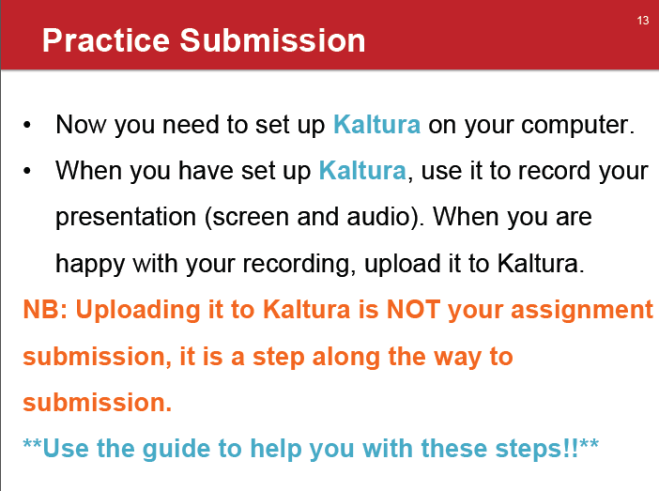
This term, as well as these small group tutorials, we have introduced a 2hr whole class session. To start with, these were to be 1hr teacher-led and 1hr guided study, where the students are set a task and the teacher is on hand to help. Two weeks in and we have decided to leave the structuring of the 2hr slot up to teachers to use how best suits what they are doing with the students. Due to remission hours, I am sharing a group with my co-ADoS and I am doing the 2hr whole group slot while she does the small group tutorials. I’m as happy as the proverbial pig in you-know-what: I have these 2hr slots, with weekly learning materials and assessment requirements to draw on for content and all the freedom in the world to experiment with this new teaching medium. It’s really funny being back in that position of things feeling so new.

I have done two sessions so far.

Session 1

The weekly materials on the VLE for Week 1 focused on Term 3 requirements and reading/writing exam practice. Back in the old days, the fifth hour each week used to be a workshop hour, guiding students on aspects of their writing and speaking coursework. This was my first session with this group of students as last term I taught a different group. These students are the group my co-ADoS has taught for the last two terms. Thus, the first thing I needed to do was some kind of getting to know you activity.

I experimented with using Padlet:

After going through some important course-related information with the students, I also used Padlet to get information from students about their coursework which they started work on last term but we only focus on this term (this is a Pre-Masters group and this is the final year that we are running a synoptic writing coursework, in which we look at the language skills aspect of the coursework while their Research Project module tutor [humanities] or Literature Review module tutor [science and engineering] focus on the content):

I also experimented with Quizlet Live’s individual mode, which like the team mode allows Quizlet use in class, but doesn’t require use of breakout rooms etc to do so is more straightforward.

It worked! It’s a way to review vocabulary in an online setting with a competitive element. My next job is to come up with a few alternative ways so it doesn’t get tired (I used it in week 2 as well!). I might even give the breakout room-team version a go at some point if I am feeling brave.

I followed up with this, having them use the chatbox:

Those three tasks +feedback (e.g. in the GTKY task I had to answer all those questions, most of which were course related and how to learn English online effectively-related) plus going through the important course information took up the whole first hour. The second hour, they had a choice of two tasks – one, work on their coursework, two, do a practice writing exam (they have the real thing in Week 7 this term). The latter required them to have already looked at some of the asynchronous materials, so if they hadn’t yet (it was only Tuesday!), they could start by doing that.

I asked them, where possible (most of them are in China) to share their work with me on a Google doc so I could see what they were doing. None of them did. Some of them have since submitted the writing practice for feedback (it was optional – we will give them feedback if they give us their work to give feedback on, but they could also have opted to use the model and analysis provided in the materials). Their coursework in its entirety will be submitted at the end of Week 4 for first draft feedback so whether or not they used that hour for it, it will have to  be done at some point!

Things I took away from session 1:

  • Allow extra time for tasks; padlet is useful for giving tasks tangible outcomes that you can monitor and give feedback on;
  • yay I still have Quizlet live in my arsenal; the second hour definitely needs tangible and meaningful outcomes;
  • it’s really clear when you do tasks who is participating and who has logged on and then buggered off to do something else in the assumption (perhaps based on other subjects’ whole-class sessions) that the teacher will talk for the whole time and won’t notice if someone isn’t actually there!;
  • the chatbox is versatile but I need to get students speaking as well (time to get to grips with break-out rooms! Only doing small-group tutorials meant I hadn’t up til that point, but I used them for the first time in week 2).

Session 2

This time, I wanted to use breakout rooms and get the students speaking. I also wanted to connect to the topic of the asynchronous materials (Surveillance) and aim to make the session complement the asynchronous component of the course. In terms of skills, the asynchronous weekly lesson material focused on listening/note-taking and paraphrasing/synthesising different view points in a presentation.

I decided to start with a two-part dictogloss. To make it more topical, rather than using the one provided in the lesson materials, I found a couple of Guardian articles about surveillance in the context of Covid19 and the contract tracing scheme, in particular the still-absent app. For the first two sentences, having ensured they had pen and paper to hand via getting them to tell me when they had via the chatbox, I read them out a few times for the students to note down key ideas (I added an extra time and went slightly more slowly than I would have done in a face to face classroom, to mitigate potential audio quality issues). That done, I put them into breakout rooms in small groups with the task of reconstructing the text and choosing one of their group members to write their reconstruction on the padlet I had prepared for the task. (I have two padlets for use during lessons which I wipe between uses, it can be a whiteboard for ss to use, a substitute google doc or a combination of the two.) Once they were in their rooms, I went from room to room and made sure they were on task. Each group managed to duly put their reconstruction on the padlet and were able to compare theirs with other groups and the original. For the second two sentences, back in the main room, the students had to make notes and then use their notes to complete a gapped summary that I displayed for them. They gave their answers in the chat box.

In hindsight, I would a) have spent more time on the feedback element for the first two sentences and b) used the breakout rooms for students to discuss and decide their answers for the gapped summary rather than going directly for the chatbox. Following the two dictoglosses, I displayed 3 reflective questions for students to think about and answer in the chatbox. Again, breakout rooms could have been used here.

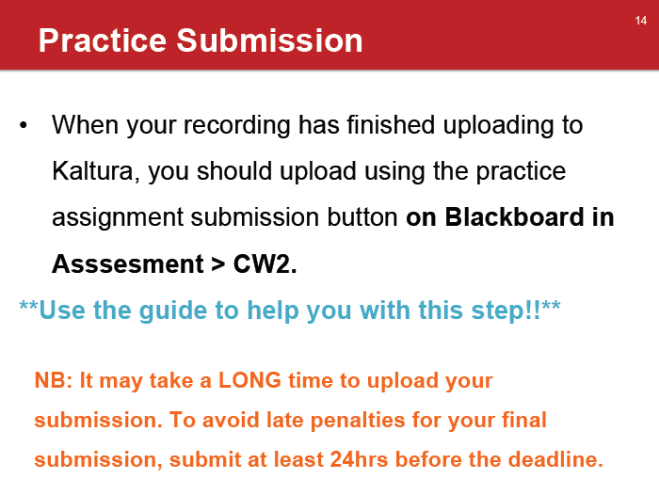
We then moved on to another round of Quizlet live with vocabulary relating to surveillance, which, again, would either be review or preparation depending on how far through the asynchronous materials students were. This was the final teacher-led task. Timing-wise, I ran slightly over for that initial hour, but that wasn’t a problem (even moreso in the light of the requirement of that structure being abandoned, which came out of a meeting the following day!). The guided study task for week 2 was based on something we are trying with our asynchronous padlet – the weekly speaking challenge. The purpose of this weekly challenge is to increase the amount of speaking practice students do per week and to get them used to recording themselves speaking as this is what they will have to do for their coursework presentations later this term. As with introducing anything new (e.g. these students did a weekly paraphrase challenge in the last two terms and uptake was slow there too but it happened with perseverance!), they need a lot of encouraging. So, given that most of them hadn’t done the one from Week 1 and that the Week 2 one was an extension of my lesson, this was the task:


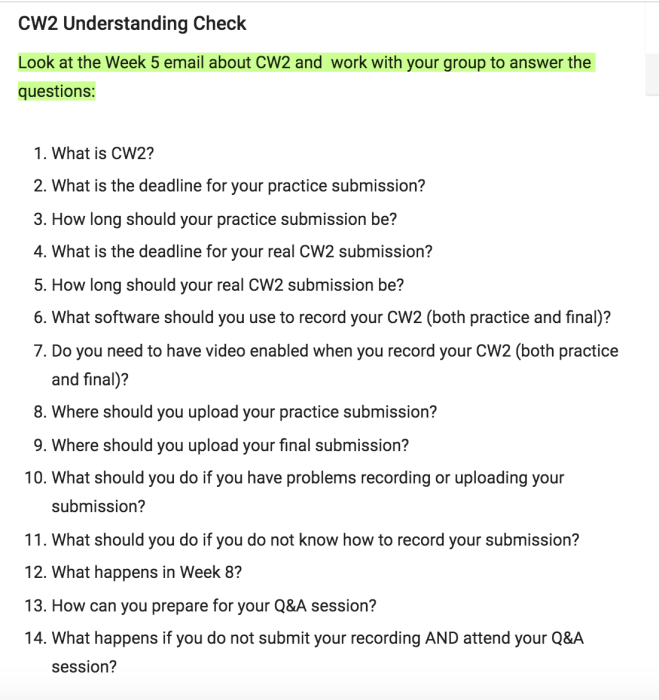
These were the questions:

(The PEE structure is Point, Evidence, Evaluation and it is the structure we teach them to present, support and evaluate their ideas in both writing and speaking.) This task requires them to practice the “paraphrasing/synthesising different view points in a presentation” element of the weekly asynchronous materials in a way that will enable me to check and give feedback on their output.

Things I took away from  session 2:

  • A little really does goes a long way so less = more, especially if I want to start building in more effective scaffolding and feedback elements;
  • I can do breakout rooms, yay! Now I need to think about how best to use them in a way that maximises potential benefits;
  • activities from face to face classrooms can be done online with some adaptation, I need to think carefully about how best to adapt them – what needs adding, what needs removing etc.;
  • teaching online is different but…that’s ok!
  • the more confident I get with it all, the more I can adapt what I do to be as inclusive as possible (obviously that is always an aim, but it helps to have some experience with the medium of teaching and how everything works or doesn’t work in the bag when working towards it).

Session 3 is tomorrow, so I am looking forward to using what I have learnt from session 1 and 2 to inform what I do. Watch this space!

I hope this has been of interest to some of you out there, though I suspect I am rather behind the curve because of how things have worked with our course! Hope you are enjoying the remote way of doing things, wherever you are at with it! I would love to hear about tasks you have adapted and tried in your online classrooms and how it went – if you have blogged about it please drop a link in the comments for me! Otherwise, please do use the comments to share. 🙂


Taking an EAP course online – what we’ve done so far!

Like most of the rest of the educational world, I have been thrust headlong into the world of online teaching and learning. Both from the teaching perspective and the coordinating one. It’s now week 7 of our first term in this brave new world and I have come up for air very briefly before assessments rain down on us between now and the end of the term. I thought I would share a bit of my experience of this term so far and how things are working because I’ve found it useful looking at others’ experiences!

Though we are in week 7, I have so far taught only 4 synchronous sessions as, being an ADoS, I “only” have one group,  we didn’t have any synchronous learning in Week 1 (it got up and running from week 2) and Week 3 got wiped out by a University closure day tacked onto the Easter weekend. My Week 7 session is tomorrow!

I use the term ‘taught’ fairly loosely as our approach is not the traditional whole class online lesson one. Instead, we have a two hour slot and the class of (on average) 20 is divided into 4 half hour slots within that (we change these groupings each week). It’s been interesting coming to terms with the new set-up and figuring out what works (and, indeed, what doesn’t!). We are using Blackboard collaborate and like most of these kind of platforms, it has some useful features like allowing students to raise hands, chat in a chat box, be put into breakout rooms and so forth. Of course with half an hour and a small handful of students, as a whole, we haven’t been using the breakout rooms much. That will change next term though! My half hours tend to take the structure of check on previous week’s learning, task, discussion. It seems to work best when:

  • you nominate students clearly so that they know when to speak (sounds so obvious but in slot one on day one I had to learn that the hard way!).
  • you get used to speaking into the ether and include prompts to get students writing in the chat box or raising their hands within what you say.
  • you use visual instructions to back up the oral ones and there is no ambiguity in what you want students to when and in what order and for how long, and how they are going to return/signal their return to the next whole group learning phase.
  • you get students to prepare thoroughly for the discussion in advance of the session.

As well as our online slots, we (continue to) use Blackboard for asynchronous content. Given we had 2 weeks to get our course up and running, we were fortunate in that we already had all lesson materials on Blackboard in the form of powerpoints and worksheets, previously with the function of enabling students to review content. The challenge, then, has been to make it more suitable to online learning. We have done this in the following ways:

  • Recording start of week and end of week videos. The former review the previous week of learning and talk the students through the lesson content for the current week, while the latter review the week’s content. This has been a laying the track as we go kind of a team effort, with everyone contributing – teachers and ADoSes writing scripts and finding additional materials to support the week’s topic and skills, ADoSes checking and editing scripts as well as adding the additional resources to the relevant lesson padlet on Blackboard, the odd teacher but mainly the TEL (Technology-Enhanced Learning) team recording the videos using Kaltura. Being as there were three cohorts and sets of teachers to manage, this required a complex Project Management Googlesheet to keep track of who was doing what by when. By hook or by crook, though, we have managed to do it! Script checking is complete, script recording ongoing. Materials are released on a weekly basis.
  • Using individual class padlets. Teachers have set up a padlet for each of their groups and this provides a means of generating student interaction (with each other, with tasks, with the teacher) outside of the synchronous learning slots. My students have engaged most with the paraphrase challenge – this is the brainchild of one of my colleagues not me so I don’t take credit! It involves putting a sentence or a short paragraph together with source information on the padlet for students to paraphrase either the entirety in the case of the sentence level ones or select an idea to paraphrase from the paragraph level ones. Of course they need to include correctly formatted citations. It’s a good way to provide regular paraphrasing practice – a skill that students tend to need a lot of practice of in order to master, regardless of L1 background!
  • As alluded to in point one, supplementing what already existed with extra content for the students to use for skills practice – videos, website links, extra practice activities etc.
  • In week 5 and ongoing, end of week quizzes were introduced, using Blackboard’s quizzing tool. These contain questions based on the week’s content to check students’ learning but also as a means for the institution to monitor participation. Script writers have written the questions at the end of the end of week video script, and the TEL team have created the quizzes in Blackboard. I don’t know what we would do without the TEL team!!

Student feedback has been positive but the main thing they want more of is teacher contact points within a week. Thus, next term we will be keeping the short tutorials slot and adding another two hour slot where an hour is more traditional teacher led input and the second hour can be used for tasks with the teacher on hand to provide support. We are also looking add more interactive content to the lesson padlets on Blackboard for next term and for the new academic year (although we have just learnt that there will also be more content being prescribed from higher up than our centre so how that all pans out remains to be seen!)

In terms of asynchronous learning, my students were struggling to keep on top of remembering what they had and hadn’t done tasks-wise and therefore forgetting to do some things. Being younger foundation students, unlike the pre-masters students they haven’t yet learned how to study effectively independently and are used to a lot more structure and hand-holding. So, I made them a record of work to alleviate this issue! Some are even using it 😉

I hope this is of interest to some of you out there and would be interested to hear via comments what you are doing with your students and how that is working out!

Right, see you at the other end of this term (maybe!) <fills lungs and prepares for the next wave to break>

Sophia Mavridi – Interactive virtual learning for the synchronous and asynchronous EAP classroom

The speaker is Sophia Mavridi, who did this talk for BALEAP TELSIG – Interactive virtual learning for the synchronous and asynchronous EAP classroom

As Sophie begins by saying, this is an important topic in E-learning. It is also very topical in the Covid19 era. This was the session plan:

She started by asking us “What is interaction?” some ideas that came out from participants were it’s a 2 way process, students sharing ideas, showing that you are engaged, being engaged. Then she gave us two definitions:

How does this relate to online learning?

She says we often talk about how pedagogy informs decisions, and so before the practical element she wants talk about some pedagogical theory, specifically theories of constructivist learning environments, the flow model and social presence. Looking at these will help to answer the question why interaction is so important when it comest o online learning.

According to cognitive constructivism, knowledge is constructed and this requires meaningful and interactive materials. They need to make meaningful connections between prior knowledge and new knowledge. Social constructivism meanwhile focuses on the idea that learning is a social process requiring scaffolding, which is interaction with the teacher or peers, but it also includes interaction with materials when it comes to online courses.

The FLOW model is the point of maximum concentration and involvement with an activity. The “flow zone” is where we are at this point. For students to reach the flow zone, the activity cannot be too challenging or too easy, as this leads to loss of concentration/focus.

Social presence is the extent to which someone perceives a person as ‘real’ in computer mediated communication. It influences students’ sense of belonging and engagement with collaborative activity. There is a strong correlation between social presence and successful online learning.

So how can we use these fundamental principles in synchronous and asynchronous classrooms?

In the synchronous classroom, physical distance is an obstacle. But it is usually pedagogical distance rather than physical distance that is an obstacle to learning. Sophie shares 6 techniques for embedding and integrating into online teaching/learning:

  1. Turn on your camera. Challenging for the teacher to speak to avatars/names but not all students have good computers or connections and may not be able to use cameras, some students may be sharing their room with a sibling or may not be comfortable sharing their house. We need to be sensitive towards student’s privacy. But WE can turn on our cameras. It is important to do so.
  2. Try to be animated and use eye contact/gestures. Don’t be a talking avatar.
  3. To maintain attention, ask questions every 3-5 minutes. E.g. start with an icebreaking activity e.g. share in the chat a word that describes your day and explain in a sentence why. For content questions, short questions, not too difficult or easy, will help keep them in the flow zone. Get them to use the chat as the mic activation process (“can you hear me?” etc) will be too time-consuming for these frequent little questions.
  4. Ask them to do things hands on. When you give feedback, share the pdf or slides with them and get ss to annotate the slides themselves or add the answers. This gives them something to do.
  5. Use polls and interactive tools – e.g. Padlet, wooclap (interactive platform for collecting immediate answers to questions of different types) – this allows you to get feedback and share resources. You can upload recordings, youtube videos (and ask questions) etc.
  6. Use breakout rooms or 1-1 chat for class collaboration. They are good for discussion and collaborative projects, can also be used to break up the lecturing time and avoid the lesson being too teacher-centred, which synchronous sessions tend to be. For a short question, you wouldn’t use them. Instead, ask them to message the next person on the participant list and discuss the question in chat. That is a quick way to do interaction and pair work.

Interaction in the asynchronous class

Live classes are fantastic for social presence but even the best live class is predominantly teacher-led and that’s why we need to the asynchronous bit. This can be more student centred and it is where students become more autonomous.

LMS = Learning Management System e.g. Google classroom, Moodle, Blackboard, Canvas, Edmodo, Schoology. If you don’t have one, get one and make use of it! Sophia gave us some ideas to do this:

Think about how you did skills and what tools you could use now. E.g. Google Docs, OneNote Reading annotation apps e.g. GoodReader, use Youtube/Ted Talks/Flipgrid/podcasting. You can still do Group work. As well as in live sessions using break out rooms, you can run asynchronous group projects. They are more effort to set up but it is very worth it. Tell students to find a way to communicate (Zoom, whatsapp, we chat) – their responsibility.

Sophie says forums are important and they need to be kept alive by a moderator which is usually the teacher who may ask interesting questions, keep students on their toes and on topic. We need to teach students to add quality comments. If they just say “that’s a great idea, I agree”, that’s a positive comment but not necessarily a quality one. We need to teach them how to participate in a forum. This is an important skill as applicable to participation in a community of practice at university.

In terms of materials, there should be an element of interactivity in any materials. E.g. short and interactive video recordings, self-correct quizzes, questions, reflections. If we just share pdfs, there is no interaction. Even a simple pdf can be made more interactive, it can be broken down by adding in questions. Recordings of longer than 10 minutes mean students are more likely to disengage. Short chunks and frequent questions are better. The ideal length of video for asynch learning is 6 minutes – anything more than that, students tend to switch off. If you really need to record something of 15 minutes, periodically ask them to stop the video and reflect on a question. You can’t expect them to stay focused for 15 minutes watching the video, there are too many distractions to impede that.

Sophie goes on to talk about VoiceThread. It is a collaborative multimedia tool, where you can add images, documents, slides and videos. Users can navigate slides and can leave comments through text, video or voice. It makes materials more interactive and is easy to use as an educational technology. She says ease of use is very important in tech tools, which is why she likes this one. It shouldn’t take a long time to create.

She shows us an example she made. It is a powerpoint with an embedded video of her speaking. You can add multiple recordings to one slide via voice messages. which means if you forget to say something you can add it rather than re-recording. Students can click and select text, audio or video comments. You should specify which according to what skills you want to focus on. E.g. audio and video for practising speaking. Some students aren’t comfortable being on camera, so may be better not to exist on that.

Then she tells us it took 5 minutes to create, record and share (not the slide itself but putting it in VoiceThread and recording the video. It is interactive as students can respond to the questions in the video by typing or speaking. Students add their comments, then as a follow up should listen to/watch classmates comments and complete a task.

Next, participants are asked to go to a link of one she made and leave a video/audio comment, text comments acceptable if you are that shy. To leave a comment, you will be prompted to sign in for an account which just takes a few minutes to set up. The comments appear down the side of the slide off to the left. Sophie plays a few comments to show us.

What can we do with VoiceThread?

It seems like a pretty versatile tool based on all these ideas from Sophie! Recordings can come from Youtube and be embedded. Before you share something with students, you need to change the share settings to allow anyone to view/comment.

It is free for 3/4 voice threads but after that you would need to delete previously made ones or upgrade.

Finally she suggests watching this video with ideas for using VoiceThread in higher education.

You can find Sophia on Twitter with @SophiaMav and her website is sophiamavridi.com


Mindfulness for teachers and learners – musings a year on

It’s been just under (edit: just **over** a year! Life got in the way of this blog post – book chapter resubmission deadline and last few weeks of term, I’m looking at you!!)  a year since the universe conspired to guide me towards taking up mindfulness. The 2nd of March, apparently, so 10 days hence (edit: 8 days ago!) will be the anniversary of when I picked up my first book about Mindfulness – “Mindfulness for worriers” by Padraig O’Morain. At about the same time, Rachael Roberts promoted her 30 ways to Mindfulness book which you can obtain from her very thought-provoking website, and the then TD coordinators promoted a certain Futurelearn course (see below!) Since then, I’ve learnt a lot about Mindfulness and developed my own practice of it, doing multiple courses, reading around it and integrating it into my daily personal and professional life and into my teaching. This blog post is a reflection on what has changed for me in the last nearly a year.

The first aspect of the journey has been learning about mindfulness and trying to apply it. There are two Futurelearn courses about it – Mindfulness for wellbeing and peak performance (this is the one the TD coordinators promoted and it is running again starting on Monday!) and Maintaining a mindful life (this is aimed at people who have already done the wellbeing and peak performance one) – delivered by Monash university and I have done each of them a couple of times, getting more out of them each time as my practice has developed. My choice of tense is deliberate – I am still learning about it and will probably repeat those courses again this year. As with many things in life, the scope for learning with mindfulness is infinite, because as you evolve so what you take from courses or reading etc evolves too. Here are some things I have learnt:

  • I have learnt how to be more aware of where my mind is and bring it back to the present moment when it wanders. (Some mind-wandering is harmless but general lack of awareness of where the mind is can lend itself to worrying/rumination/awfulising/catastrophising.) I have spent a year gently training my ability to bring my mind back to the present moment whenever I notice it wandering, so that I am better able to that when it goes in a direction I don’t want to go in. Which leads me to…
  • I have learnt that I am not at the mercy of my thoughts, I don’t have to follow them all or get bogged down by then. They are there and there will always be new thoughts popping into my mind, but just like buses coming past a bus stop, I can choose whether or not to board them.
  • I have learnt a lot about how the mind works. This includes the different parts of the mind and the different systems at play in the mind, as well as how they influence my behaviour. As a consequence I am better able to recognise what is going on in my mind at various times/in various situations and use that knowledge to influence the direction things take. This is partly as a result of the Futurelearn courses, partly as a result of extra reading and partly as a result of Rachael Roberts’s Facebook group, Life-Resource Lightbulb Moments, which is connected with her blog too. One of the many things that has happened in this group is a virtual book group – we all read (well I am still reading!) The Chimp Paradox. This has involved reading a portion of it and then discussing it on a thread within the group. I wouldn’t have read the book (or as much as I have so far, ongoing!) without the recommendation and the motivation of the reading group, much less had the opportunity to discuss it. So, if you are interested in mindfulness and how the mind works, join the group!
  • I have learnt how to meditate and how much I need it in my life! I now meditate for approx 40 minutes in the evening before bed and sometimes I manage to do a bit before work too. Minor meditative moments can also occur throughout the day. Fridays include extra meditation but more about this later! Meditation has a positive effect on the brain. For me, my evening meditation routine has really helped my sleep – I fall asleep much easier after it. Occasions where I can’t get to sleep because I am too wound up about something are much fewer and further between.
  • I have learnt to use red traffic lights as a mindfulness bell. So, rather than getting annoyed by a minor delay, I use them as a reminder to be fully present. They are little islands of calm in the commute now instead of irritation points. In connection, I have learnt to accept that Sheffield drivers are frequently rather inconsiderate and unpleasant, and not use up precious energy in getting worked up about it. Getting worked up doesn’t change their behaviour, it just affects me negatively.
  • I have learnt  how to deal with stress more effectively. Case in point the last couple of weeks. A colleague I work closely off has been on sick leave, resulting in a big increase in my workload. Where in the past I would have used a LOT of energy and time worrying about not being able to do everything, this time I communicated calmly with the leader relating to one of the hats I wear and explained what was happening to the other hat, then made myself an extensive list of things to do for said other hat and how to do them. Then it was just a case of focusing my energy on ticking them off, one at a time. Crucially, when the weekend arrived and I went home (and indeed each evening when I went home during the week), I deliberately focused my mind away from work and onto home stuff, allowing my mind and body a rest from the stress. (This is where the mindfulness concentration training comes in – being aware of when it started to wander towards work meant I could bring it back, repeatedly, away from work rather than being in a constant state of high alert due to stress.) Last year when a workload-time-related stressful situation arose, I handled it a lot less well – communicated unmindfully and spent far too much time panicking. The issue was resolved fairly quickly but it could have been resolved a lot more effectively. Live and learn! And Iearning I am!
  • I am much more aware of when my mind is slipping into states that are not useful to me. I’m human, so it is prone to do so! Thus, if something happens which goes against what I would like to happen (holiday to Sicily that was meant to happen on Monday next week but is now cancelled, I’m looking at you!), yes I am angry and disappointed, but I also choose to limit the amount of time and energy I allow myself to spend on that. Better to accept that it is what it is, find things to be grateful about (e.g. it would be a lot more stressful for me if I were already there and the lock-down kicked off!) and refocus on now and things I CAN influence (e.g. this will be a useful opportunity to knock my garden/greenhouse into shape ready for growing everything that is currently germinating in my propagators! I will also have more time to complete this fundraising challenge that I am currently undertaking!) By being better able to notice when my mind is slipping into those states that are not useful, through mindfulness meditation training, I can redirect it sooner and more effectively. Multiple times.

As well as learning more about Mindfulness and using it myself, I have in the past year also used it with students in the form of a short (+-2 minute) meditation at the start of each lesson. Feedback from various groups of different levels has been primarily positive. Out of 65 responses gathered thus far, 57 have given positive feedback (relating to concentration, calmness, relaxing stress etc.), 5 have said they aren’t sure or not helpful but not unhelpful, 1 said it wasn’t helpful due to being too short and 2 said it made them feel sleepy! For some of those who respond positively, it seems to make a huge difference. Here are some of the comments that came with the feedback:

This was indirect feedback i.e. the students mentioned the meditation in a question not relating to the meditation!

These below are all in response to more direct questioning:

All in all, I feel this has been a very positive outcome. Mindfulness and education is becoming a more popular topic of discussion, even in ELT, with Pearson recently hosting a series of three webinars about it, and it is definitely something I want to pursue further. At the moment, the start-of-lesson meditation is the main extent of what I do, with a little bit of focus on concentration, particularly in relation to listening to a 10 minute lecture twice, having already listened to fifteen minutes worth of twice-repeated conversations, as my students have to do in their listening exam. In the future, I want to look more into how I can help them train their concentration and do this more systematically.

All that really remains to  be said now, then, is thank you universe for starting me on my mindfulness journey just over a year ago! 🙂

Do you practice mindfulness? When did you start? What changes have you noticed since then?

One reason why blogs are useful!

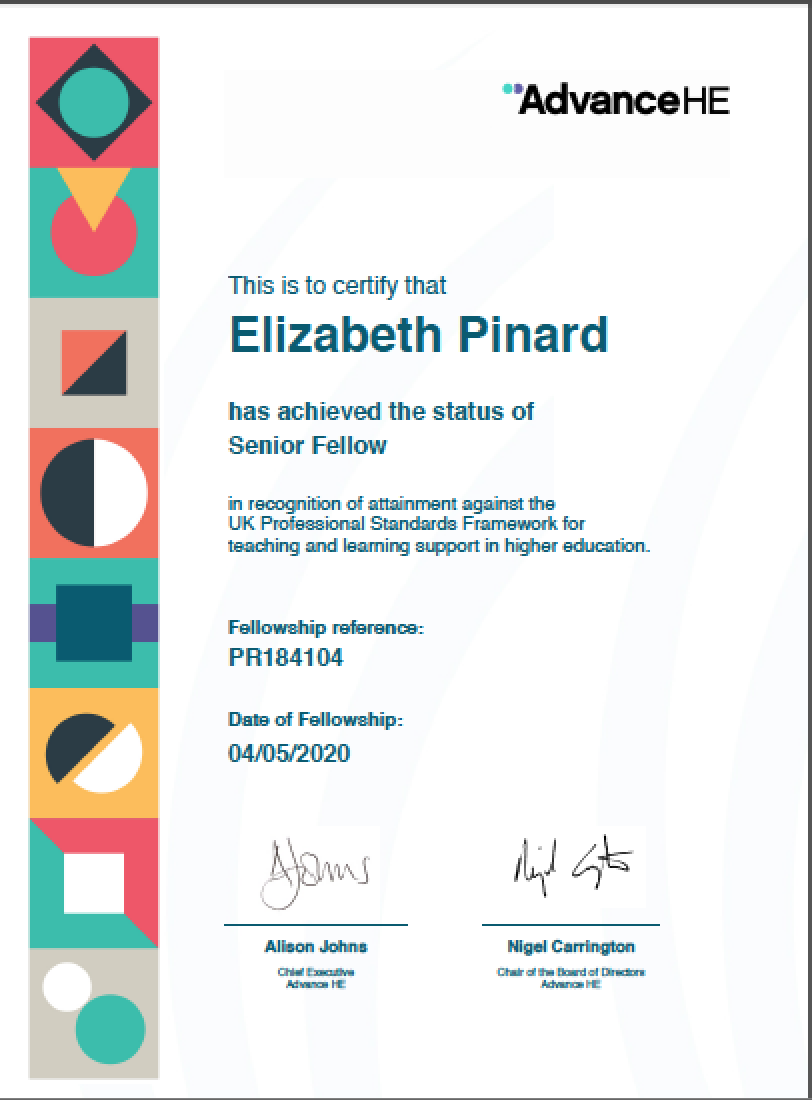
Today I did something very radical. After I finished planning my lessons, I took off all my hats (or put them all on at once?) and decided to update my scholarship log. To explain, here at USIC/ELTC@The University of Sheffield, our schedules include 3hrs per week scholarship time, with the freedom to use it as we please as long as it is CPD-related. The TD team (including me) provide support/ideas for this through the bulletin (my current baby), and a varied programme of workshops. In order to monitor this/hold teachers accountable for it, we have to log what we do on a template provided centrally which we all make a copy of and share with our line managers. So back to today, which indeed is in February so actually (terrifyingly enough) not hugely far off half way through the academic year, I finally got round to sorting mine out for this year (new version each year required so that the document doesn’t get too unwieldy!). Which translates as being faced with trying to log, including dates and time spent, everything I did CPD-wise last term. Can I remember off the top of my head? Hell no. If I asked, I would have said well I did my SFHEA, suppose I haven’t done heaps else otherwise. However, fortunately, most if not all of the CPD I do includes an element of reflection carried out via my old friend, this blog.

In fact, it turns out that last term and into the beginning of this one I have:

…which is actually a fair chunk! Thank you blog for being my memory and reflective aide!!

Having done all the scholarship log updating and looking through my blog in order to do so, I am filled with fresh enthusiasm to add more, albeit time is not often on my side! 🙂

So that is just one reason why blogs are useful! Of course there are many more…

How does your blog help you (unexpectedly)? 🙂

10-year Challenge

Sandy’s 10-year Challenge has inspired me to do one of my own (something which the original 10-year challenge she mentioned did not manage – she is clearly more inspiration than it was :-p ). A whole decade is coming to an end (something which escaped my attention until I read Sandy’s post – I blame the cough and snot-fest I’ve been partaking of since Christmas Eve…) so I concur it’s a good time for a reflective activity.

Here is a photo of me from April 2010 (the first photo of me from 2010 I could find on Facebook where my face is vaguely visible and I’m not with other people who may not want their faces in this blog post!):

It’s at a crag called Bamford Edge in the Peak District. Up until June 2010 was the last time I climbed at this level or frequency so this photo is definitely fittingly symbolic of the decade preceding this one. What happened to make me stop? Don’t worry, no horrific accident or anything. What happened was I completed my CELTA in March 2010 and then went abroad, to Indonesia, to teach: the beginning of my ELT career. I didn’t manage to keep up the climbing and got woefully out of practice. Since moving back to the UK in 2015, to date I’ve not been able to bring the single-minded energy and focus back to it that it would need for me to get properly into it again. The point of this ramble is that priorities change and that’s ok. A lot of outdoor climbing may not have happened this decade but a lot of other cool stuff has!

Here is a photo of me taken in Holyrood Park, Edinburgh, on Christmas Eve (the third of the only three healthy days this holiday!):

Lizzie dec 2019

Photo c. Rosa Pinard

Just like Sandy did, I will list 20 things that have happened in the 2010-2019 decade:

    1. Got my CELTA (Pass B, which I sulked about for ages because it wasn’t an A :-p, March 2010), did my Delta (Triple Distinction, which I worked very hard for so once in a decade I will exercise my bragging rights, August 2013), did my M.A. ELT (with distinction, see above, alongside the Delta, September 2013).
    2. Did various other training courses e.g. the IH Certificate in Teaching Young Learners and Teenagers course and the IH teacher trainer certificate course. (While at IHPA, 2013-2015)
    3. Won an ELTon (“New talent in writing”, May 2014).
    4. Published one or two posts on this blog (!), (which I started writing in May 2011 if I remember correctly, though not in earnest til 2012/2013 when I embarked on the Delta/M.A. thing). Got published in a peer reviewed journal and an edited book:
    5. Worked as a teacher in two different parts of Indonesia (Lampung and Jakarta, 2010-2012), Sicily (Palermo 2013-2015) and three different towns/cities in the U.K. (Newbury 2011, Sheffield summer 2014, 2015-now, and Leeds summer 2013).
    6. Presented at various conferences including IATEFL several times.
    7. Became an Assistant Director of Studies (ADoS) where I work now (April 2018-ongoing) and a Teacher Development Coordinator where I work now (September 2019-ongoing). (With the recent promotion of one of my co-ADoSes to interim Academic Director, I will now be the most experienced member of the current ADoS team by length of time in service in the role, which is weird!)
    8. Finally got an open-ended contract (May 2019), thus fulfilling a goal/dream set at the start of the decade (being able to live where I want to – here in Sheffield – and work in a job I want to work in – at the uni).
    9. Ran 30 miles in one go (an ultramarathon event, Dig Deep, August 2016). Ok so I walked on some of the uphill bits. It was in the Peak District for goodness sake! Also done a 78 mile bike ride (and lots of other cycling – this year alone a few thousand miles worth!), lots of indoor bouldering and even climbed outdoors a couple of times post-June 2010.

      Photo c. Nick Smith

    10. Did an Olympic distance triathlon (by myself rather than an event, summer 2019). So much fun that one of my goals for 2020 (and/or beyond) is a half ironman!
    11. Rescued/adopted the best horse in the world (Alba, June 2015), been surprised by a horse pregnancy, watched a baby horse grow in his mum’s belly and then outside it as well, Nursed the best horse in the world through colic and lost her (September 2018). Baby horse (Star) now 2.75yrs old!
    12. Adopted and cared for five hamsters, two of whom are still with me, all with unique personalities. Being a hamster mama is important to me. 🙂
    13. Understood and become comfortable with my sexuality (gay, demisexual*) and been on some nice dates. (I believe losing my mum at age 25 delayed things somewhat as grief took centre stage for a long time.) *Google it if it is a new term to you! 🙂 . Lucky to work somewhere where colleagues of any sexuality can and frequently do choose to wear a rainbow lanyard to show their support of LGBTQIA+ colleagues. I love my lanyard and I love seeing so many of them around.
    14. Became vegan (July 2014) and learnt how to cook lots of lovely things (ever since). Living in line with my values with regards to compassion for all living beings and respect for the environment in this way has made a positive difference to my mental wellbeing as well as my physical health.
    15. Learnt Italian (Summer 2014, intensive self-study) as well as bits and bobs of a host of languages that Memrise supports. I love Italian and continue to enjoy reading/watching/listening and when in Sicily speaking it. Memrise is one of the many things I don’t do enough of because I have so many places to put every minute.
    16. Started practising mindfulness/kindfulness and meditating regularly (since February 2019) which has improved my mental health/wellbeing dramatically. Done the Monash Futurelearn courses Mindfulness for Wellbeing and Peak Performance and Maintaining a Mindful life.
    17. Spent my longest time living full-time in one house (and therefore also one place) since when I turned 11 and went to boarding school (the house I am currently in, in Sheffield, since June 2015! Very nearly long enough to be able to fill in my CRB check application form – no longer called that but you know that thing – were I to need to, without reference to the several pages long list of addresses I previously had to type up and save for such occasions!).
    18. Got a piano again! (May 2017) I don’t play it as often as I “should” (so many things competing for my time!) but I do love it.
    19. Met and got to know loads of amazing people in all the different aspects of my life, who have inspired me and helped me become who I am today. Thank you all!
    20. Learning how to live without my mum who I lost in August 2009 (so it was a decade since she died this August just gone) and have space for happy too. This has been the first decade without her, so I am even prouder and more grateful of 1-19 in that context.

Been quite the decade! What’s next? Well, this time 10 years ago I would have been hard-pushed to predict any of the above! In fact if you had put this list in front of me this time 10 years ago, I would have probably sniggered and gone “sure, yeah, as if…” or similar. So, who knows where the next 10 years will take me? All I can hope is that I can continue to be positive and live life to the full, whatever it brings, and learn to befriend all moments and events, so to place myself firmly in the life I am living. There is only one and this is it. Today. Now.

Happy 2020 and beyond, everybody!

Image from Pixabay, licensed for reuse

IATEFL Webinar: What makes a good language teacher? (Carol Griffiths)

It is Saturday 2nd November 2019 and Carol will be talking to us about what makes a good language teacher. Slightly more than a decade ago she did a book about the good language learner and now is doing one from the teacher’s point of view. The ideas she presents today come from this book that will soon be available.

She starts by saying teaching is a very demanding profession. The hours spent in the classroom are only the tip of the iceberg. What are the characteristics of a good language teacher? Do we define in terms of qualifications, student success rates, popularity ratings, experience? All these have their limitations. The good teacher is a hopelessly elusive notion – and what is good anyway? However, she will attempt to throw some light on the factors that contribute.

Carol suggests that in order to be good a teacher needs to be autonomous, reflective, culturally aware, sensitive, knowledgeable of things like ELF, methodologies, feedback techniques, assessment procedures, and be able to manage all sorts of things from relationships, to grammar, to vocabulary, to skills. She wants to take a human perspective, recognising that teachers are not machines but real human beings with feelings, needs identities and lives of their own – which she believes is an underrated aspect of teaching and learning.

Identity

Learner identity has been around for a long time, recognised as a powerful force but what about teacher? (e.g. Barkhuizen 2017) but what about teachers? Only recently being recognised as much as it should be. What a teacher does in the classroom and the effect this has on the classroom is connected with it.

Cognition

Teacher cognition = knowledge, thoughts, understanding, attitudes and beliefs – influence what teachers actually do and the way they do it. Although their cognition is recognised, also by themselves, good teachers are able to adapt as the need arises, flexibility is important.

Intercultural awareness

An extremely important goal in education. One goal is to heighten learners’ sensitivity to different ways of seeing others. Can be profoundly motivating for learners. Arouses interest in them and therefore the teacher doesn’t have to struggle to raise it.

Reflection

We have to think about what we are doing, an important aspect of CPD and teacher reflection whether on or in or for action, it is important for the enhancement of situated cognition, teaching process and sound decision-making

Autonomy

An indispensable characteristic. Need to be able to create links between theory and practice. Need to overcome contextual constraints. Autonomous teachers are reflective and self-directed. Tends to promote learner autonomy as well.

ELF

This has aroused a great deal of controversy. Hotly debated. The relative importance of accuracy over intelligibility. This can be problematic. Which is more important. Given that students have to pass exams, and are expected to pass exams, this is an important factor which good teacher, all teachers, have to consider. You can’t just do as you like. In the face of these conflicting questions, we need ELF aware teachers who can exercise judgement within context. Needs to be developed at the teacher training stage. By the time the teacher is in the classroom, survival is the priority. If they are already ELF-aware, then hopefully this will come through in what they do in their classrooms.

In addition to these macro-perspectives, there are other things that teachers need to be aware of. In terms of method, good teachers are aware of different methods and ways of doing things and will choose what best suits their learners. Adapting what they do to meet the needs of their students. Technology is another important factor, it is everywhere these days and it is important to get up to speed with it in the classroom.

Classes are full of individuals and we have to manage to accommodate these individuals. One class is never the same as another. The individuals in a class dictate what is useful, good, interesting etc. Differences may include cognitive, affective, societal. Good teachers factor individual differences into their classroom practice.

Assessment – we are expected to assess our students regularly. We have to equip ourselves with strategies for doing this. How they are assessed can have far reaching effects on their motivation and trajectory. Very serious. Good teachers need to be assessment literate, well-versed in the use of assessment tools.

Classroom management is essential – without it a classroom is chaotic. We have to develop ways of managing a class effectively which can at times be challenging. Good management will promote learning. Good language teachers are able to adapt their own personal style to adapt what is required to suit a particular class.

Corrective feedback – lots of ways to provide this which we come across in training and through experience. Another area which can be challenging. Students tend to expect it. If you don’t correct them, they think you aren’t doing your job. It’s something that we do have to consider very seriously. Overcorrecting or correcting the wrong kind of way can be demotivating. Knowing how to correct well and effectively is an important skill to develop as a teacher. Need to provide appropriate feedback according to context and learning targets.

Relationships – often underestimated but gaining in recognition for its importance. The teacher is an important person. Learner-centred-ness goes back to last century and is important but the greatest single influence on what a student learns is the teacher and relationship with the teacher, the quality of it. It is a great responsibility. Our relationship with students also contributes to our own motivation and job satisfaction in a demanding job.

Strategies. What do we actually do in the classroom? What are we required to present in the classroom? Language learning strategies have been studied extensively from various viewpoints. Controversial but that is not for this talk. In Carol’s research, the best students use a wide variety of language learning strategies and they use them frequently. These students outperform those who use strategies less. Not always that simple but overall. It is also important to develop teachers’ awareness of strategies and their perceptions and beliefs about these strategies. Need to be aware of the need to promote strategies, provide modelling, whatever it takes to encourage students to use their own strategies. This relates to autonomy, helps learners to be autonomous. They need to learn to do it for themselves, the most useful thing we can teach them.

Pragmatics. Long considered the Cinderella of the language learning scene. Probably still underdone in relation to other areas but has received increasing attention. Important that students know when is appropriate to use particular vocabulary when they learn it. While a student may know both vocabulary and grammar, they may not always know how to use it in a real life situation. Good teachers are aware of the need to develop their pragmatic cognition and assess their learners’ pragmatic competence.

Vocabulary is important. You can’t say anything without it. In recent years study of vocabulary has been revolutionised by the use of corpora. Dunn and Webb (2020) say that teachers have four roles with regards to teaching vocabulary – planning, training, testing and teaching. Need to set goals, select activities, evaluate progress and train learners.

Grammar. There is consensus that it needs to be taught but not about how. How it should be introduced, practiced or corrected. However, it is agreed that learners need the opportunity to practice and automatise their use of it meaningfully.

Pronunciation. A slightly thorny one. Teachers often dodge around pronunciation. Carol says it is because grammar is reasonably easy – you can refer to a book to know what is correct. With pronunciation, it is pronounced in so many different ways. It goes far beyond the British-American dichotomy. Even in Britain it varies enormously from place to place. What do we teach? What do students want to learn? Some kind of model needs to be decided on and students themselves need the freedom to choose how they want to pronounce the language. The idea of whether pronunciation is right or wrong has become unfashionable, the question of intelligibility is more important. Somehow the importance of speaking the language has to be dealt with and the teacher has to deal with these issues.

Listening. Not developed merely through exposure or repeated tests. Need to seek to develop orchestration of skills and strategies, which can be facilitated by metacognitive awareness.

Speaking. Another very important skill. Good speaking allows students to participate in social and academic interactions in an environment when the language is spoken. There is often a lack of explicit instruction of skills and strategies needed. Exam washback is an issue. In the end, what passes the exam doesn’t necessarily mean that the learner can perform in the target language environment. Good language teachers help learners to develop spoken accuracy and fluency and heighten their metacognition to regulate their own performance, and also realises that speaking in an unfamiliar language can feel threatening. If a student makes mistakes, it’s important that the teacher supports and encourages them to continue and keep trying.

Reading – the mainstay of previous language learning programmes. Although it’s long been regarded of a cognitive process irrespective of context, there is an ecological perspective which is getting quite popular – the context of the learner environment is important. As with other things we have talked about. Every environment has a mixture of affordances and constraints. Good teaching arises through interactions between people in a particular context. Reading is still very important and should not be underestimated. A book is much more patient than a human listener. You can learn a lot from reading and go back and read again, check the dictionary. We should not underestimate the importance of reading.

Writing is the last skill to develop after listening, reading and speaking. Not everyone is good at writing even in their own first language. Even more difficult in a foreign language. If we’re teaching students who are going on to university, it is an extremely important skill. For us as teachers if we want to going to publishing and for students. It is a process. It doesn’t just happen. You don’t just write something and its perfect even in your own language so can’t expect it from students. Can’t pick up a manual and read the rules, you need to practice. Teachers need to not only have an interest in classroom practice but also writing and learning about writing. Those teachers who do writing themselves may be better able to communicate enthusiasm to students. Good teachers need to adapt to different genres and requirements. We need to lead students through the process.

Burnout. Teachers are very prone to burnout. The time we spend in the classroom, as said before, is only the tip of the iceberg. Teaching is a performance and stressful, so it takes its toll. Attrition is high among teachers. Good language teachers have ways of coping with that stress. It is a real issue and needs to be talked about more. Carol says of teachers she has trained, few stay in for very long as it is too hard. Some don’t even go on to teach after the training course. Good teachers need to find ways of dealing with it in order to stay in the profession, as the job is extremely challenging and demanding. This issue needs more attention and discussion.

Conclusion: good language teaching is multidimensional. Not just one thing. can’t say you have qualification x therefore you are a good teacher or you have experience therefore you are a good teacher. It is more complex than that. They know about all of the things mentioned in this talk.

The book is/will be called Lessons from Good Language Teachers.

Interesting webinar. Feeling reflective as I come away from it!


TD Workshop – Mindfulness in Teaching

Yesterday (30th October 2019), I delivered a workshop at the ELTC called Mindfulness in Teaching.

I started by asking participants to articulate how they were feeling, what emotions they could notice and what sensations they could feel in their bodies. Then we did a quick meditation (the one that I normally use at the start of my classes with students at USIC). Then I asked them again how they felt, to notice the difference.

The outline of my session was as follows:

What is Mindfulness?

I asked everyone (I say everyone, there were three attendees plus the other TD coordinator!) in pairs to discuss what they understood from the term mindfulness and then shared a definition taken from Emma Reynolds’s recent webinar on Mindfulness for Macmillan Education:

“Mindfulness is being aware of what you are doing, whilst you are doing it, without judgement.”

(The ‘without judgement’ bit is important, as you can be very aware of what you are doing when you are resenting every moment, which is not mindfulness!)

Why use it ourselves?

I gave this equation as the basis for my explanation:

“Stress management + greater enjoyment = better wellbeing”

Talking about stress first, I borrowed from Emma Reynolds again, asking participants if they ever felt stressed (and of course the answer was yes – everyone feels stress!) and then using that as the basis to talk about what stress is i.e. the result of a chain of processes that starts with a trigger. The trigger is anything, whether internal or external, that the amygdala perceives as a threat. When a threat is perceived, the amygdala pushes the thinking part of the brain out of the way and swiftly prepares the body for fight or flight (or possibly freeze!). A useful survival mechanism when tigers and the like were a regular issue, not so useful at work. Mindfulness enables us to interrupt the mechanism and engage the thinking part of the brain, meaning we can manage whatever is troubling us better.

In terms of greater enjoyment, I explained that this is because mindfulness means being more present (without judgement) and spending less time ruminating about past events or worrying about future ones (or indeed resenting current ones). As well as being a relief (as we do not have to be a slave to our thoughts and wandering mind), this means that when we are doing something enjoyable, we are able to enjoy it more.

How?

Here I talked about formal practice (meditation – no need for bells or being crosslegged!) and informal practice (bringing awareness to everyday activities, savouring things and bringing gratitude to experiences). I signposted 30 ways to Mindfulness which is a pdf that is available to download for free from the Life-Resourceful website to give participants of specific ideas for how to do this.

Using it with students

Having discussed the benefits of using it ourselves, I moved on to talk about possibilities for using it with students. This part of the talk then drew on the session I did with teachers here at USIC at the beginning of term but with an additional aspect of informal integration of mindfulness into lessons. First I myth-busted using meditation with students (it’s not just for monks, they won’t think you are crazy, you don’t need to be a mindfulness expert to do it, it’s not a waste of time or weird) and one of the participants added the question of religion and whether it might be seen as dogmatic. I explained that mindfulness meditation is not religious, as there is no deity involved, and is simply paying attention to the present moment through the senses.

How?

After myth-busting, I talked about how I set up using mindfulness meditation with students: handing out a printout of the meditation, getting them to discuss what it was, the purpose of it and potential benefits of using it regularly and at the start of classes. The idea is to get some buy-in from the students. Feedback from my students (you can see it in this post), which I displayed and let speak for itself, was resoundingly positive. Since collecting this feedback, some of my colleagues have also started using mindfulness meditation with their students and I have started doing it with my new groups this academic year. Here is the feedback from the three students from my group this term so far who have completed my mid-term course questionnaire, in which I asked a question about the meditation:

(I will update this when they’ve all done that bit of homework!!)

As well as doing a meditation (concentration training, basically!) at the start of class, I have started to try and integrate the concepts into lessons by trying to raise students’ awareness of how the brain works. That is to say, the mind wanders. It is normal for the mind to wander, that’s what it does! The trick is to notice when it wanders and bring it back to the present moment. Notice again, bring it back again. And again. And again. Many times over. This is crucial for example when students are listening to a lecture recording in a listening class or exam. If they lose concentration, they miss vital information. And they WILL lose concentration (see above!). Therefore it is of value for them to be aware of this and to train themselves to notice when their mind wanders and bring it back. The sooner they notice, the less information they will miss. I used this image to introduce this idea to my students:

Another aspect of Mindfulness that can be helpful for students is in the context of nerves for example before an exam or presentation. Nervous stress/anxiety is the result of future worries (what if I don’t understand the recording? what if I forget what I am supposed to say? what if I fail? My parents will kill me etc). It happens to us all but it is something that mindfulness can help with. By noticing the stress response and re-engaging the thinking part of the brain (by reconnecting with the body, through the senses), we can calm down and deal with the situation more effectively. (Let’s face it, if the thinking part of the brain is re-engaged, the exam or presentation is much more likely to go well than if the lizard brain is in charge sending us into panic mode!)

This brought me to the end of the session, and I finished with my top tip for when your mind is racing (e.g. when you are trying to sleep), which I actually got from Padraig O’Morain: Focus on your feet. Your feet are the part of your body furthest away from your mind. If you keep bringing your attention to your feet (and your mind will keep trying to take it away again of course but just bring it back to your feet and repeat and repeat), eventually your mind will realise you aren’t listening and calm down. I use this tip often and it is very useful in the context of falling asleep! 🙂

These are the extra resources I shared at the end:

Do you use mindfulness? Yourself? With students? Would love to hear what your favourite mindfulness techniques are, if so, so please do comment! 🙂


Macmillan World Teachers Day Online Conference – Emma Reynolds: Mind full or Mindful?

On the 2nd October 2019, Macmillan Education hosted an online conference in honour of World Teachers Day. I managed to tune in for Emma Reynolds who presented second, though I had to leave before it finished as the day was running late and I had a meeting to attend. I have finally caught up with what I missed via the Youtube recording of the event. (Check it out if you also missed out!)

Emma is an MBSR-accredited teacher who lives just outside Barcelona. This is her website and here is the Macmillan recording (again) but cued to her session (which I really recommend watching – she delivers it in a very engaging way and you get to experience mindfulness rather than just read about it in my blog post!)

Her session was called…

Mind full? Or Mindful?

She started by inviting us all to close our eyes and just notice sound. That could be sounds in the room, sounds outside, even the sound of our own breathing. Then we were asked to notice our breathing and the movement of breath in and out of the body. In other words, a very brief awareness of sounds and breathing meditation. A quick, easy way to get back in touch with the senses, which is one of the key elements of mindfulness.

Then she told us that she usually starts sessions like this by asking participants to put their hands up if they have ever experienced stress. Of course, everyone puts their hands up. Life is stressful. Being human is stressful. Being a teacher is stressful, it is a stressful profession. Emma proposed to offer us some practical tools for teachers to bring to classroom experience, to calm nerves, to deal with emotions, to avoid the spiralling mind, so that we can be present with our students. As one of the webinar participants said, though, these aren’t just strategies for the classroom/workplace, they are strategies for life.

We moved on to the following questions:

  • what is stress?
  • how does it feel?
  • how does it affect us?

Emma invited us to think of something that had happened in the last week or two (not a really big, traumatic life experience, just a run of the mill stressful situation), to close our eyes and put ourselves there for a moment, to picture where we were, what we said out loud and what was said inside ourselves. Then we had to feel it – how does it feel in the body? Where in the body? Is it a tightness in the chest/belly? Tension in the neck muscles? Faster breathing? Pounding in head? There is an actual physical experience.

When something stressful happens, we start with a thought process, which then fuels emotions which then show up in body sensations. That is the fight or flight system in our brain kicking in. That system is a survival mechanism which all humans and animals have. It responds to threats by preparing us to fight, freeze or run away. All the physical ‘symptoms’ of stress are connected to it. It is the body being told by the system “We need to do something and do it NOW!” Which was useful when we were faced by sabre-tooth tigers back in the day but how useful is it when it’s triggered by an email arriving in your inbox? Or a chance comment from someone? Probably not very.

The fight-flight system, Emma explained, is a very finely tuned mechanism, like a hair trigger. And if you are tired or overwhelmed, then even more so – one small thing can make you explode. She talked about the amygdala area of the brain, which is the primitive alarm centre that acts on instinct and the pre-frontal cortex which is rational, thinking part of the brain. She asked us to imagine walking down the street, not concentrating, when a bus starts coming, we step off the pavement, the bus might be about to hit us but then…we’d be propelled back onto the pavement. Without thinking about it, it would just happen instinctively, spontaneously. The image of the bus would hit the retina of our eye, trigger the alarm system and flight would get us back onto the pavement. The prefrontal cortex gets flipped out of the way by the amygdala and it happens in milliseconds – “before we know it”. It is very reactive, which is useful for running away from tigers but not at work. At work it looks more like receive a rude email, reply, send, and then “oh…er…oops…”. Stress, frustration and anger have the same effect as the tiger. So we may be reactive to situations, shouting at a class, being rude to someone, feeling cut off from everyone.

What can we do about this? How can mindfulness help? Everyone has that reactivity, the amygdala brain area, but we can learn to notice and bring back control to the thinking part of the brain. The mind is often full of thoughts:

It wanders off into the past, rehashing situations that have already happened, or the future, planning all sort of things e.g. what if this, what will I do when; projecting usually stressful, worrisome thoughts about the future or “if only” about the past. The brain has a negativity bias, or a tendency to look for problems/scan for threats. It likes to worry about how to fix things that may or may not happen in the future. I.e. imagined problems, so trying to fix things that aren’t actually there. This means that you are here but your mind is not. You are not present. And that means you are missing the positive present moment experiences. Emma suggested next time we are in the shower, to try to be present – be aware of the smells, the sounds, the sensations. That is an example of getting into the senses and out of the mind.

Children are all about the senses but as we become older and socialised, we lose contact with the body and get stuck in the mind. Lots of stressful ruminating results. Emma told us about a Harvard study which found that we are lost in thought 47% of the time. In other words, stuck on autopilot. There was an app that pinged participants every so often and asked them What are you doing? What are you thinking? And it would be something like having dinner, thinking about tomorrow’s presentation. What are we missing? The shower, the food, the lovely sensations, the appreciation, the excitement, in other words enjoyment of now. We are always somewhere else.

Automatic pilot is not bad. It can be useful. For example, riding a bike we can just get on and ride without thinking about it. We need a certain amount to function in life. However, it is not useful to be stuck/lost in thought all the time, or stuck in the present moment being judgemental of it. (“I don’t want to be here. I don’t want this. This is bad” – resentment, stress.) Mindfulness can help us here. Emma’s definition of Mindfulness is knowing what you are doing whilst you are doing it without judgement. And the without judgement part is important – we may often notice what we are doing but in a resentful/judgemental way, ruminating. Mindfulness allows us to notice what is happening and step away in a non-judgemental, kind way. It is a way to step of the the cycle and start to do something proactive to calm down and get the thinking lid (prefrontal cortex) back down, so that you can deal with the situation creatively and with wisdom.

Emma then talked to us about formal and informal practice. She said the formal practice, meditation, is a loaded word but it’s really just sitting down, being quiet and tuning into sound, breathing and the body. Informal practice is noticing the senses, or information from the senses, in the present moment, for example in the shower or brushing teeth or eating. When your mind is full of to do list or worrying, tune back into the senses and what is happening now. Notice the sensation of feet on the floor. She explained that we can send our concentration/awareness/mind to different places, e.g. the feet. The untrained mind flies about all over the place, training awareness can bring it back., place concentration where you want it to be. When you notice it wandering, you can bring it back. The more you practice, the less and less it will wander. She likens the mind to a puppy. When you are training it to sit and stay, it will keep wandering off every two minutes but practising over and over and over, giving praise, reward, treats, bit by bit the puppy will stay. The same goes with mindfulness. We need to practice over and over but in a kind, non-judgemental way. Notice the mind has wandered, not get frustrated, just gently bring it back.

All of this is also relevant for students. When they get angry or upset, it means they are flipping their lid, and as teachers we can recognise they are stressed and feeling threatened, and help them bring their thinking lid back online again.

Bring awareness to thoughts (gentle curiosity). What is the narrative? What emotions are in there? How does it show up in the body? Curiosity is key.

Emma told us about the “3 step breathing space” activity:

  1.  How are my thoughts? Allow thoughts be, just noticing but not getting caught up in a narrative. What emotions are here? How am I feeling? Where is it in my body?
  2. Centre attention on the breath.
  3. Become aware of sounds or the body.

This can be done very quickly to bring yourself back to the present moment with kindness, care, compassion.

Emma said that the language we use is very important here. “There is anger here” not “I am angry” – the former gives us some distance, allowing it just to be, noticing how it feels in the body, recognising that it is just that system response. Then we give the mind something to do e.g. focus on the breath. You can do it whenever and wherever you notice yourself getting stressed/frustrated, to break the cycle through the moment of awareness.

Then she gave us some other activities we could try:

  • “Look up and smile”

If you are feeling a bit stressed, e.g. before you go into the classroom, look up and smile. It releases good, positive chemicals in your brain, even if you don’t feel like smiling. Then you can enter the classroom with better energy.

  • Frame things differently

The thought “I’ve got so much to do” usually hunches you over and makes you feel very heavy very quickly. Instead, straighten up and shout it out loud (as if you are excited about it!) How we frame things can make us feel better. Sensations of stress also accompany excitement. It’s the same sensations but a different narrative/framing.

  • Labelling

Stop the alarm bell by labelling what is going on. “There is anger/frustration/tiredness here”

  • Take in the good

Consider what is good right now in this moment. This counters the negativity bias.

  • Create calm moments

There is so much bombarding us these days, that our minds can’t tell the difference between real threats and perceived threats. The stress response happens just the same – we get adrenaline and cortisol flowing. But what we need is the calm, soothing rest and digest system, to give the fight/flight system a break. One way to do this is slow down. E.g. walking, try walking a bit slower, noticing how it feels, what you can see, hear and smell, to take you out of the mind and into the body.

  • Traffic light bell

(She suggested this during the Q&A but it fits in with this section of practical suggestions.) Use red traffic lights as a mindfulness bell: instead of getting irate because it is delaying you, think “ah, red light.” And do the 3-step breathing space activity while you wait. Then you are back with a choice, you can choose not switch on the negative complaining narrative about the red light.

Emma gave us the secret that repeated behaviour, whether good or bad, gets wired into the brain and becomes more likely to be triggered in the future. Mindfulness gives us a choice to respond differently. Ultimately, if what you are doing doesn’t serve you, do something differently. Mindless chatter generally isn’t serving.

She recommend using apps such as Calm, Headspace and Insight timer, and doing an MBSR course. Once you do such a course, you could then train to become a mindfulness teacher and bring it into your school.

She finished with this lovely quote: Happy teachers will change the world. 🙂

A really fantastic session, great to see it as part of the Macmillan World Teachers Day conference line-up!