MATSDA 2013 (through my eyes)

This is a whistle-stop tour of talks I attended at MATSDA (Materials Development Association)’s 2-day annual conference, all of which I thoroughly enjoyed. (For those who have never been to a MATSDA conference, I highly recommend it: The atmosphere is lovely – everyone is really friendly, enthusiastic and there to share ideas. Talks are generally quite informal and interactive – the audience is encouraged to participate and everyone gets involved. It’s a good recipe and yesterday the proof of the pudding was definitely in the eating: a good time was had by all.)
Screen Shot 2013-07-14 at 20.33.54

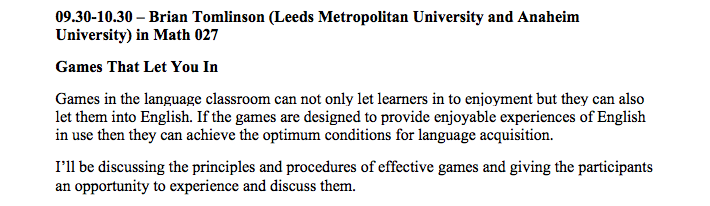
Brian started us off, of course, talking about games – except there was a lot more doing than talking! Brian argued for a game driven approach, but not as the only approach: as an important component of (to the *complete* astonishment of the audience, of course! 😉 ) a text-driven approach. He also took the stance that enjoyment is necessary for language acquisition, but insufficient in itself: Just because learners enjoy something, doesn’t guarantee acquisition. There are other criteria to fulfil.

He then had us try out a few games:

  1. 3-word stories:  In pairs, we each wrote down 3 (consecutive) words to start a story. A said their three words to B, starting the story. B had to respond immediately by continuing A’s story with another 3 words. If either person was unable to continue without pausing, it ended. B then started the next story with their 3 words. (Brian explained that this could be followed by a written phase and a performance phase, using interest as the main criteria)
  2. The second game he had us doing was a game with stones and a wooden board (which exists in many different versions in many different countries) – he had us doing it with circles drawn on paper and tiny balls of screwed up paper. It was complicated but requesting clarification of the rules was all part of it.
  3. Mrs King strikes back: Brian described setting it up by telling the learners they are going to watch a dvd called Mrs King strikes back and eliciting predictions of what it is about. He then proceeds to happen to have forgotten to bring it in. Thus we had to act scene 1 of the film while he narrated it (people are not forced to join in at this stage, watching is fine), playing every role. We then read a text, the ‘true story on which the dvd was based’, and were put into teams, with two minutes to read the text and identify differences between the version just narrated/mimed and the text. An elicitation game followed.
  4. Newspaper hockey: We were put into teams and each team had to produce two hockey sticks and two balls made out of newspaper (except this bit had bee done for us!). In our demo, we had 4 per team. We were numbered off 1-4. We lined up facing each other and at either end was a chair/goal. Your team’s hockey stick is on the opposite chair/goal from the one you are aiming at. Firstly, simply numbers were shouted out. If it was your number, you had to try and score a goal. Then came the more complicated version, in order to know which number is being called, we had to work out the answer to a mathematical problem e.g. the number of people in two tennis doubles matches minus the number of people in a bridge game. (4) Everyone got thoroughly into the spirit of the game and we were all well warmed up for the talks to follow.

Screen Shot 2013-07-14 at 20.34.12

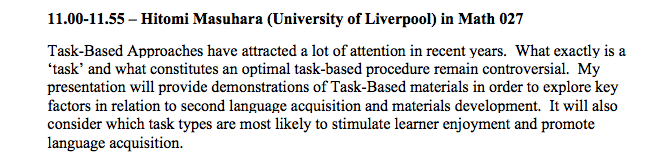
Next up was Hitomi. This was another engaging session, in which, amongst other things, she talked us through a task-based sequence for teenagers based around the topic of magic tricks: Hitomi actually demonstrated a magic trick and then elicited ideas of how it could have happened (she tore a tissue up and then made it whole again – was very cool!). We concluded that angels had kissed it. 😉  She explained that learners could then be taken through a process of searching for similar magic tricks/explanations on youtube, learning how to perform and presenting a performance of whichever trick they have chosen and described optional but recommend follow ups, such as recording performances and/or creating a booklet. The importance of initial focus on content during peer review was emphasised.

(I found it particularly interesting when she contrasted her sequence with Rod Ellis’s (2010) shopping task, pointing out that tasks are used for both research and pedagogical purposes but that tasks with a pedagogical focus emphasise broader educational development, while research tasks are geared towards study of language input, intake and acquisition. So a perfectly good research task may not be the most engaging or effective task pedagogically. However, don’t discount such tasks: do think about how to make them more interesting/engaging/relevant etc.)

Screen Shot 2013-07-14 at 20.37.00

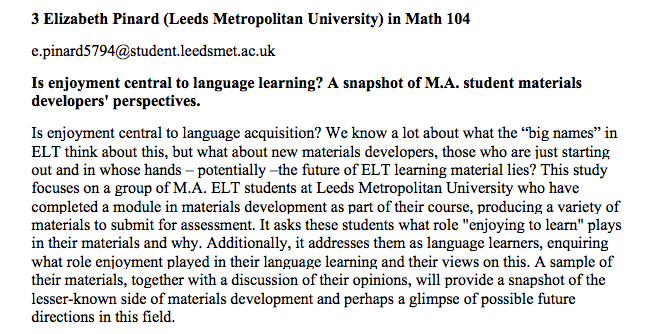
Fortunately, I then went to this talk! 😉 I had a great audience, so the discussion generated was very interesting – everyone had their own views and ideas to contribute, which was great. More information to be found here. (Unfortunately as the recording is only of a rehearsal, you don’t get the interactive flavour of proceedings – which is arguably the best part! – only the general content…)

Screen Shot 2013-07-15 at 06.53.13

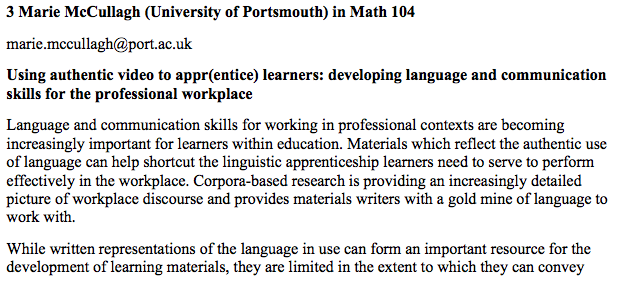
Screen Shot 2013-07-14 at 20.35.05This was a fascinating talk. Marie talked to us about combining Tomlinson’s text-based approach with a discourse analysis approach, using corpora based research to inform language focus. She made the very good point that in course books, transactional and interactional talk are most often separated, whereas in real life, transactional talk includes, and needs, interactional talk. She showed us types of language associated with interactional talk – such as language for expressing stance, hedging and politeness, referring to shared knowledge and showing solidarity. Marie also demonstrated her ideas by showing us materials she’d made for her learners using a video clip from The Apprentice.

Screen Shot 2013-07-14 at 20.35.39

This talk was brilliant – full of simple, useful ideas of how to turn dull as ditchwater IELTS tasks into something interesting and engaging. For example, for the boring, pointless writing about a process task,  Lewis played us a recorded spoof example of the process of making tea from planting it to pouring out the tea, as though it were something two friends would discuss. It was hilarious! It also contained all the necessary language, which learners could extract. He also showed us a spoof model answer to a writing task, in completely the wrong register/genre and suggested getting learners to identify all the inappropriate elements. The true model answer could then be used for cognitively engaging noticing activities.

This was the kind of talk that you left absolutely raring to try out all the ideas! 🙂 The perfect end to day 1.

Screen Shot 2013-07-14 at 20.36.48Day 2 started later than planned (long story!), nevertheless the talks I was able to attend were great. This was the first and it was a lot of fun. The main focus was on improvisation. Volunteers from the audience were required to demo all the activities, of course.

  • There was the bus queue one – we had to stand in a line, one end was the front of the queue, the other was the back. Then there was a really interesting one for exploring the role of status in communication. The demo group consisted of six people and they had to role play different statuses, depending on the playing card they were given. Aces were high. The audience had to guess what their status was by the way they behaved. Obviously in reality, it is less clear cut; indeed, when putting the group in order of status, the audience had different opinions – and this is where the potential for lots of interesting discussion comes in, with potential of course for intercultural comparisons to be made.
  • In the second version, group members each had a playing card again, but this time they couldn’t see it. They could only see the cards of the rest of the group (everyone stuck their cards to their forehead). So here, they had to guess what status they had by how they were treated by the rest of the group.
  • The final one was about blocking and accepting: Blocking – when you stop communication by using disagreement (verbal or nonverbal) or non-sequiturs, for example, to shut it down. Accepting – basically the opposite: you agree (positive verbal or nonverbal language), use back-channels, question tags etc. Two audience members had to role play a shop assistant and customer in a shoe-shop. The first time, they had to accept everything, but not buy/sell any shoes. The second time, one had to accept everything and one blocked everything. For the last one, they both had to block everything.

(I think it might be interesting to combine some of these activities with elements of the corpora talk earlier and ideas from the “Is affective always effective?” talk that followed – so, get some friends to role play these tasks and record  it. This could then be used after the activities as a point of comparison and for some awareness-raising/noticing activities for whatever elements of language use stand out when the transcript is analysed. Not in a “this is the right way to do it” way but in an exploring the differences and possibly making intercultural comparisons kind of way. Obviously not authentic language per se, but whoever is role playing and recording themselves would, I imagine, be using the types of language and structures that they would use in these situations.)

Screen Shot 2013-07-14 at 20.34.33

Jane argued that engagement, affect and motivation are crucial and interlinked. Enjoyment is hard to separate out but not the central aim. She showed us some interesting materials, in which a recording became a point of comparison between spoken and written anecdote telling. Jane had us discussing the materials and thinking about how we’d work with them and lots of great ideas emerged.

Screen Shot 2013-07-15 at 15.11.14

Claudia kept us on the edge our seats by walking us through a sequence which involved used of a video. After doing some readiness activities with us, she played us a dramatic excerpt of a boy cycling very quickly away from something and falling off his bicycle in the process, all to very horror film music. We then had to predict what had happened to lead up to that event. She demonstrated the power of narrative when events are not told in simple linear order. She also showed us excerpts of course material dealing with narrative, published ten years apart, so that we could see how little has changed in that time. Even the cathedral bells, which went through a phase of ringing and ringing incessantly for a spell, couldn’t distract us from this session!

Screen Shot 2013-07-14 at 20.37.54

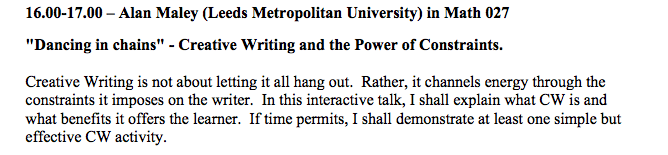
Alan Maley brought proceedings to an end, with an all too short creative writing workshop, taking us through a range of activities which could be used with learners, encouraging creativity and language play. There was theory too, to back it up, discussed briefly but not dwelt upon as we were running late but had to vacate the building at a particular time nevertheless. One of the activities we did was producing a 50 word saga based on the fable of the Fox and the Crow. Here is what I produced:

The fox, he was hungry; the crow, she had food.

This put the fox into a very bad mood.

But he was cunning, he flattered the dame,

And when she responded, down the treat came.

Ladies, be careful for foxes may lurk

Don’t be fooled by a two-faced jerk.

There were some shorter activities too, for example the two line poem:

Hello ________.

Goodbye ________.

I came up with

Hello dissertation, goodbye sanity. 😉

It was brilliant hearing other peoples’ creations and the session was a lovely way to finish a really great conference. There will be several MATSDA conferences next year, in Dublin, Brazil, Germany and I forget the other two places. Anyway, keep an eye out and if one comes to a place near you, then I would definitely suggest going.

Thank you to all the organisers for a wonderful weekend.

MATSDA Conference 2013 Presentation: Is enjoyment central to language learning? A snapshot of student materials developers’ perspectives.

Conference: The MATSDA/University of Liverpool 2 day conference, themed “Enjoying to learn: the best way to acquire a language?” 13th and 14th July 2013, University of Liverpool

Topic: Is enjoyment central to language learning? A snapshot of M.A. student materials developers’ perspectives

Abstract: 

Is enjoyment central to language acquisition? We know a lot about what the “big names” in
ELT think about this, but what about new materials developers, those who are just starting
out and in whose hands – potentially –the future of ELT learning material lies? This study
focuses on a group of M.A. ELT students at Leeds Metropolitan University who have
completed a module in materials development as part of their course, producing a variety of
materials to submit for assessment. It asks these students what role “enjoying to learn” plays
in their materials and why. Additionally, it addresses them as language learners, enquiring
what role enjoyment played in their language learning and their views on this. A sample of
their materials, together with a discussion of their opinions, will provide a snapshot of the
lesser-known side of materials development and perhaps a glimpse of possible future
directions in this field.

Recording: Here. (Not of the actual presentation – due to technical fail – but of a rehearsal)

Write up: Here.

References used in presentation: 

Bolitho et al. (2003) Ten questions about Language Awareness in ELTJ vol. 57/3 Oxford University Press. Oxford.

Dörnyei, Z. (2005). The psychology of the language learner: Individual differences in second language acquisition. Mahwah, NJ: Lawrence Erlbaum.

Dornyei (2013) Plenary at Warwick International PG Conference of Applied Linguistics

Dellar, H. (2013) Twenty things in twenty years, part 7: Input is more important than output. Blog post, address: http://hughdellar.wordpress.com/2013/06/09/twenty-things-in-twenty-years-part-seven-input-is-more-important-than-output/

Gadd, N. (1998) Towards less humanistic English teaching. in ELTJ vol 52/3 Oxford University Press. Oxford.

Gilmore, A. (2007) Authentic materials and authenticity in foreign language learning. In Language Teaching vol. 40. Cambridge University Press. Cambridge.

Lightbown P and Spada N  (2006) How languages are learned Oxford University Press. Oxford.

Richards, J. (2006) Materials development and research – making the connection in RELC vol. 37/1 SAGE publications

Schmidt, R. (1990) The role of consciousness in language learning in Applied Linguistics vol. 11/2 Oxford University Press. Oxford.

Scrivener, J.; Underhill, A.  The issues Blog post, link: http://demandhighelt.wordpress.com/2012/03/02/the-issues/

Swan, M. Language Teaching is Teaching Language. Hornby Lecture given at IATEFL Conference 1996.

Tomlinson (2010) Principles of effective materials development in Harwood N. (ed.) English Language Teaching Materials: Theory and Practice. Cambridge University Press.

Tomlinson (2012): Materials Development for Language Learning and Teaching in Language Teaching vol. 45/2 Cambridge University Press. Cambridge.

The British Council TeachingEnglish blog of the month!

It’s official:

Screen Shot 2013-07-14 at 06.15.39

So it is that finally getting round to synthesising some of what I’ve learnt in the past year led to winning an award. I rather feel I ought to pass it on to my department, though, since I learnt it all thanks to them! 🙂  Thank you, Leeds Met M.A. ELT/Delta tutors! It’s been an incredible year.

Here is a link to the guest post I was asked to do for the British Council blog (the title of which was coined by the editor – as far as I was concerned, I was writing about reflective practice! Had the brief included that title, I would probably have run a mile… :-p ) following notification of my victory. Thank you to the British Council for giving me that opportunity to write a post for them, and indeed for the award itself – both of which are a great honour.

Finally, thank you to everybody who has visited my blog and all who has commented on my posts: without you lot, this blog would be of little value and certainly wouldn’t have won an award. So, thank you for making it what it is. 🙂

Icebreaker Idea

Sandy Millin’s recent (ish!) post, “A map of me”offers a simple yet effective means of breaking the ice in a novel way – important when breaking the ice is a regular requirement, as is the case in language schools with a continuous enrolment system. I am also currently working in a school that uses such a system, and Sandy’s post has inspired me to get creative and expand my repertoire of such activities. So, here is one that I have come up with:

  1. Give each student a piece of paper and ask them to write down a list of information about themselves on it. Specify the number of statements and stipulate that some of the information should relate to things they’ve done in the past, some should be true of now and some should relate to future plans. (The number of statements and the number of stipulations will be level-dependent). NB Students must NOT write their names on their papers.
  2. Take in their sheets of paper and redistribute these so that each student has a piece of paper belonging to another student, identity unknown.
  3. Students should now mingle and ask questions in order to find out who their sheet of paper belongs to. The catch is, they cannot ask yes/no questions. E.g. If a student has written “I have two dogs and a cat”, the questioner cannot ask “Do you have two dogs and a cat?” – they should ask something like. “Have you got any pets?” and proceed from there.
  4. Students continue mingling and questioning until everybody has discovered whose piece of paper they are they are holding. Challenge early finishers to find out as much as possible about everybody in the room by the time the rest of the students finish.

Stipulating a range of time frames for the information encourages learners to use different tenses, so you can get a feel for which they are less comfortable with and for varying levels within the class. Meanwhile, the students get to know one other a bit better, and you can also get to know them a bit better through monitoring and/or through making copies of their information sheets.

This activity is as yet unnamed – if you have any suggestions, answers on a postcard! (Aka in the comment box below :-p)

And if you use it, or come up with any variations on it, let me know how it goes, or what your variations are so I can try them out too! 🙂

Shortlisted for British Council TeachingEnglish blog of the month award!

I’m very excited to have been shortlisted for this award (again!), this time for my post entitled “30 things to enhance your teaching?” 

If you enjoyed this post and want to vote for me, please follow this link (it will open in a new window) and click “like”!

Meanwhile, and either which way, thank to everybody who has visited and followed my blog to date. 🙂

16th Warwick International Post-Graduate Conference in Applied Linguistics: Summary – Session 1, PCE 25th June: The cognitive interview and critical incidents (Dr. Keith Richards)

Dr. Richards has very kindly given me permission to post this summary, produced from the notes I took during the presentation he gave on the 25th June at the University of Warwick:

Pre-Conference Event Session 1

Title: The cognitive interview and critical incidents

Speaker: Dr. Keith Richards, Centre for Applied Linguistics, University of Warwick

KR said he was going to start with a problem. Then talk through looking at and responding to this particular challenge, using the cognitive interview.

The aim of the talk is exploring what it can do, seeing what happens when it is tried out and discovering some interesting things. Perhaps the cognitive interview could provide a useful response to what is a challenging problem.

(Looking at an extract from an interview, on a handout)

Problem: the idea of what a story is (as in definition) – doesn’t fit with Labov’s narrative structure. What we see here is a reflection on a story: it has already been resolved. So there is no climax, it is quite vague. The picture you get is a selection of observations about things, not a story.

However, critical incidents are really important. A bad experience can change the whole perspective on a situation. The challenge is: how best to deal with critical incidents? Cognitive interviews are one response.

KR explained that we would look at the following:

  • The nature of narrative
  • Interview options
  • Cognitive interview techniques
  • Memory and emotion
  • An illustration
  • Further reading
  • The nature of narrative

One of the aims of delving in to critical incidents is to elicit a narrative/story

Stories are powerful; they help us make sense of our lives and experiences. This means we tend to create stories that fit into our life stories. Stories are framed, they have themes, and they fit into a bigger picture. However to get into the experience of a moment, a story may not be the best way to get at it. Why? Because you only get a reflection fitted into a bigger picture. People have two stories: the sacred story (e.g. how I became a doctor) and underneath the mundane, every day stories that have to be elicited in different ways because they are not normally told. (MacLure, M. (1993). Arguing for Your Self: identity as an organising principle in teachers’ jobs and lives. British Educational Research Journal, 19(4): 311–322.)

Interview options

When the police want a statement of what someone saw, they have a special process for eliciting that. They use the cognitive interview: original one used for memory and witnesses.

Definition of cognitive interview: method of eliciting experiential accounts that is rooted in cognitive psychology. Aims to use a variety of techniques to stimulate detailed recall of the event and its temporal, material and affective dimensions.

This does not apply to police interrogations! That’s different. Why? Because, a police interrogation and a witness interview serve different purposes and require different styles of interview.

There are different options for eliciting witness statements:

  • Standard (anything but standard…)
  • guided memory (step by step and probe for descriptions of context and emotions)
  • structured (build rapport; allow narrative to develop; interrupt as little as possible)
  • hypnosis (has proved unreliable)
  • cognitive interview

Principles of cognitive interviews:

  • We have limited cognitive processing resources – therefore, don’t invite the respondent to say a lot at one, focus on single tasks.
  • Witness compatible questioning – you need to adapt your style and questions to the respondent (so, an interviewer may say virtually nothing, only back-channeling, or there may be bursts of the interviewer speaking a lot)
  • Context reinstatement: stimulate physical, cognitive and emotional aspects – one might trigger another aspect of memory.
  • Multisensory coding – going for sounds, smells etc.

The social dynamics are the same as for other interviews. In terms of communication, you need to elicit extensive answers, where the respondent reports everything, leaving nothing out. You can do this by using code compatible output i.e. stimulate memories using associated sounds/smells/tactile stuff.

Cognitive Interview Techniques

Technique, example, psychological basis and evaluation

1. Ask the respondent to reconstruct physical and personal contexts, image of setting, emotional responses and sounds/smells.

The effectiveness of the cue will depend on the extent to which it was encoded with the information to be remembered (like the Madelines in Proust…)

There is some evidence of effectiveness, but results are mixed (as ever…)

2. Ask the respondent to report everything: this can provide valuable information

3. Invite recall from a variety of perspectives: ask interviewee to see x incident from perspective of someone else who was involved.

There are, however, concerns that if asked to do this, people speculate and start to fabricate.

4. Stimulate retrieval from different starting points: E.g. start backwards from the event, to work backwards through what led up to it. This draws on multiple retrieval pathways.

Some evidence of effectiveness, but inconclusive

So, CI enables a variety of approaches. You need to choose your technique according to what is emerging and what might open it up further.

There are two types of events:

Field events – This is the same field of vision as original events

Observer events – This is seen from the observer viewpoint of respondent as an actor in the scene.

To get someone warmed up for this, take a house/flat they know and get them to mentally “look out” of different windows and describe what they see – with eyes closed, to avoid distraction unless not comfortable with that.

An example

 Narrative will yield some things but CI will yield more.

Invite the narrative: (“Can you talk me through…”/”Can you tell me about…” – then sit back and say as little as possible, let it flow, unless you need to clarify)

Elicits abstract and orientation (Labov)

Respondent needs to show they are following. But if they say too much, it can change the flow, so you need to be careful. Nodding is good.

Having got the narrative, in order to move onto the cognitive part, you identify the focus: “What I’m going to do is focus if it’s ok on that exchange, the key – I want to just check that this is the key moment that – <description of moment> I’d like to just focus on that moment a little bit more if that’s ok…”

If it works, the person giving the interview will get into the moment. You can use sensory triggers, work from a sensory thing (e.g. smell of paint) and move out from this into what happens in an incident. Elicit emotions in present tense. From here, you can explore them.

Memory and emotion

Emotions: if you don’t probe in this way, people will generalize things, to avoid reenacting something unpleasant. Crucial if trying to get at a critical incident, when you don’t want vague generalizations.

Memory is unreliable: False memories are contagious. Someone else’s response may become ours. CI can probe beneath that and get at the reality.

Awareness of memory process: People can be aware of how memory works, conscious of it, much more so in CI than in narrative interviews.

Illustration

 Laura example (on handout): The cognitive interview reveals the sense of betrayal experienced in talking to the daughter about the issues.

The dog doesn’t feature in the narrative but in the cognitive interview becomes the core of what is important. The real moment of change is linked to the dog and the sense of betrayal, which aren’t in the narrative. => This is the critical incident.

At the end, somebody asked a question, from which the following discussion emerged:

Is it just a question of paradigm? Cognitive interviews are seeking “the truth” (because that is the purpose of police witness interviews) whereas narrative is constructed. But, we can use techniques of the cognitive interview without committing to the assumption that we are eliciting “the truth”(definitely don’t assume that!), to get certain things to emerge and focus in on moments more effectively.

We can use it to enhance interviewing skills in some situations, especially those involving critical incidents. It is useful if we want to probe something that emerges, if that moment seems to be very important i.e. a critical incident.

All in all, this was a very interesting presentation, with a lot to think about and take away from it. 

Delta Tips 7: PDA Part A

This is the seventh in a series of blog posts I’m doing in response to the number of Delta-related searches that bring visitors to my blog. Each post in this Delta Tips series will deal with a different element of the Delta, based on my experience of doing it (and surviving to tell the tale! )

Module 2 is divided into two parts: Firstly, the set of 4 LSAs (consisting of Background Essay, Lesson Plan/Observed Lesson and Post-Lesson Reflection/Self-evaluation) that you do during the course of your training and secondly, the PDA. The PDA is also divided into two parts: Part A is a reflection and action cycle and Part B is your Experimental Practice. Both parts aim to help you develop into a reflective, self-aware practitioner. Done effectively, there is a lot to be learnt from both parts, that you can use beyond the end of the course to keep furthering your development as a teacher. This post will focus on Part A. (Part B can be found here)

Part A is a 4-step process that you complete alongside your other Delta module course work:

Stage 1: Your diagnostic lesson plan and lesson. Following this, your tutor should give you some feedback. From the feedback, you will be able to extrapolate some goals to work on.

Stage 2: Following your diagnostic, you get 800-1000 words in which to reflect on your beliefs and practices as a teacher, your strengths and weaknesses, the reasons behind these, the positive and negative effects of these on your learners, and finally create an action plan to work on these as well.

Stage 3: This is essentially an update on what you set out to achieve in Stage 2. Following LSA 2, you are required to evaluate your progress, including identification of current weaknesses, and the effectiveness of the approaches/methods/techniques/materials you selected, as well as to produce an action plan, including methods etc that you will use to collect evidence of your development, for the next phase of the course.

Stage 4: Following LSA3, you discuss any changes to your beliefs and practices (as laid out in Stage 2), you evaluate the reflection and observation procedures that you have used and you outline a plan for your future professional development.

The PDA is “only” a pass/fail document. However, it is essential not to back-burn it or ignore it on account of this: the more you put into your PDA, the more you are likely to get out of module 2, the more you are likely to progress between LSAs. Also, in terms of professional development, the PDA helps you to learn how to be a reflective practitioner, which is key in long term development. Pages 54, 55 and 56 of the handbook contain some helpful advice on carrying it out, it is worth reading these at the beginning of module 2 and again before you produce any of the written work for the PDA.

Tips for getting the most out of the PDA:

  1. Listen carefully to what your tutor says after the diagnostic lesson. Make notes. Reflect on them. Compare them with feedback you’ve received from your previous work place/colleagues/learners etc.
  2. When you make your first action plan, don’t put everything you ever want to work on for the rest of your life in it. You only have till after LSA2 to action it, so be realistic and selective.
  3. Choose things to work on that will have the most beneficial effect on you and your learners when improved on. (There are a wide range of possibilities: see p54 of the handbook for ideas)
  4. Work on your PDA consistently, don’t leave it to one side until a few days before the next part is due. It will only benefit you if you give it regular attention.
  5. Be clear about how you are going to collect evidence of your progress/development: This could include filming your lessons and analysing them, getting feedback from your learners, getting colleagues to observe you for specific things you are working on and observing colleagues to see how they do the things you are working on. This evidence will be useful in evaluating your progress in stages 3 and 4.
  6. Be very specific in your initial action plan – how are you going to work on each thing you have identified (reading up on it, trying it, collecting evidence on your efforts) and when are you going to do it by? This specificity will help you keep on track, know what you need to do, and not leave everything til the last minute, thus ensuring you have time to do things effectively.
  7. You don’t need to wait until the next stage of the PDA is due to reflect on your progress: Keep your evidence (observation forms etc) in a folder together and look over it periodically. See if you can identify any patterns.
  8. Write outside of the written work requirements. By this I mean write down your thoughts after a lesson regarding how it went, regarding what you were working on, any changes you notice in your practice. You could use self-evaluation forms (I found one in EtP which was very useful) to stimulate and direct your thoughts.
  9. For stage 3, use your feedback from LSA1 and 2 – what weaknesses were identified by your tutor? Working on these through your PDA will hopefully yield signs of improvement in LSA3 and 4.
  10. Remember, this is a process you can continue using beyond the end of the Delta, which will help you continue to grow as a teacher, so make the most of the opportunity of learning how to do it effectively.

I really enjoyed this element of the Delta and got a lot out of it. I hope you do too! Good luck. 🙂

If you can think of any suggestions/hints/tips that are missing, please do let me know by commenting on this post and I will add them to the list! 

Dissertation Diary 8

I’ve decided to use my blog as a reflective tool while doing my dissertation project – the final component of my M.A. in ELT –  hypothesising that this will make it an even more effective learning experience for me, by mapping it, enabling me to look back on my thought processes and decisions and see what effect these have on the project development. (Other posts in this series can be found here) Once I get to the end (13th September is D-Day!), as well as looking back over the experience of doing the project, I plan to try and evaluate the effect of these reflective blog posts on it.

Yesterday (how can it be nearly the end of June already?!), it was time for another tutorial (no. 3) with H. The focus for this one was my rationale and my materials framework. Once again, a gap in my reading was identified: The works of TBLT opponents. I need to read up on those, weave them in to my rationale and take a stance – argue against what one of them said, or take some of it on board. So, next on my reading list is:

Swan, M. Legislation by Hypothesis: The Case of Task-Based Instruction

and:

Bruton, A. From Tasking Purposes to Purposing Tasks; A Non-Marginal Role for Tasks; When and How the Language Development in TBI?  (from the ELTJ)

Further problems with my rationale include:

  • Overly long introduction/description of context (words can be saved for the other parts)
  • Lack of bridge between context and why TBLT is going to do it better than anything else. I need to address the question of why TBLT is going to be suitable for exactly what it is that I am trying to do. (i.e. making the most of the English-speaking environment. Why is TBLT any better an approach for this than anything else? What are the learners going to get out of TBLT that they wouldn’t get out of any other approach? The answers to these questions need to come across strongly. So that it doesn’t seem to have just been plucked out of a set of possibilities, it needs to be argued why it’s the right approach.)
  • Need to say more about fluency/accuracy/complexity as competing goals – I mention it but I don’t make it clear how TBLT affects it and how a balance can be managed. It needs to be clear. One of the biggest criticisms of TBLT is that learners develop fluency at the expense of accuracy. I’ve got an accuracy/complexity focus in there, with the CR/LA, which compensates for the possibility that learners might not notice new language, just need to make it explicit.
  • Need to make sure when I refer to task organisation within the rationale, that either it is clear without a diagram to explain it or I put in a diagram to make it clearer what I mean, or  refer to an already existent diagram and adjust that diagram to clarify what I mean.

Then we moved on to the Task framework/map of my materials.

Issues that emerged:

  • What content in the first task is going to grab the learners’ attention and engage them, get them excited about the module? Need something more interesting and inspiring.
  • Lack of a ‘getting to know you’ type element for the beginning of the course as well.
  • Making sure the questionnaire-making is suitably scaffolded
  • Making sure the question-focus brings out issues of register/context so that learners can make suitable choices depending on who they are speaking to.
  • Lack of coherence in the task where they analyse an interview transcript?
  • Scaffolding for looking back on the pilots and deciding which questions did and didn’t work etc?
  • When they brainstorm possible problems, reasons and solutions, how will they be equipped with communication strategies, dealing with misunderstandings, language for asking for clarification etc so that they are armed with language and things to help them deal with problems that arise?
  • How to make sure the data collected doesn’t end up being incredibly superficial? How to encourage learners to dig a bit deeper? (Maybe model the questions in the first place to help the students get behind the attitudes, or get the students to research more after collecting the data to follow up on it?)
  • What if students are stuck for ideas? Need to preempt it a bit – make it a bit less open, so that there is less potential for it to end up being superficial – shepherd them towards deeper, more interesting directions. Give them topic suggestions/a model to help them dig a bit deeper etc (maybe a set of models, to illustrate different issues)
  • How to make it challenging for the students? To sustain the interest, it needs to be something worthwhile that’s coming back, not something really obvious that comes out of something really obvious that you asked, making no point in doing it in the first place.
  • How to push the students to set it up so that it’s interesting, that they are culturally engaging with other students and the outside world, how will it be set up? If it’s very loose and open, there may be issues with students lacking imagination. Need a model or a prompt or parameters, something to push them a bit more. So that what’s coming back is worthwhile. It needs to be an engaging process to go through, that they really learn something from.
  • When they take the least successful exchange, analyse it and write an idealised version, what happens if the lack of success isn’t their fault? You can focus them on the communication strategies used and so on, but it might not lend itself to idealised versions being produced.
  • If they have a choice of formats to use to present the information they’ve collected, how will that work? (Possibly go to the self-access centre and find an example of the format they want to use, which they analyse by guided discovery and use to help them produce their own.)
  • How will it be possible draw conclusions from the data collected? Maybe the key is to use it to illustrate the problem of making massive assumptions/jumping to conclusions. So that they can find things out without doing that and be aware of the need to keep finding things out rather than assume.
  • It’s very student-centred but relies a lot on students’ motivation and interest in the whole process. It goes on for 8 days. Quite a long time, not long for what they are doing, but will the students’ interest and motivation be able to be sustained for that long? Can more input be worked into it? Need to cater for the students who are not fully on board on it, maybe they don’t do the homework – what then happens? In the non-ideal situation. What if they don’t like analysing things? It’s a long, focused project to sustain, so it needs careful thought. Can some strands of something different be woven in? To minimise the risk of disengagement, which is higher when it’s so dependent on their own motivation. Need a contingency for when students are stuck for ideas, to make sure it doesn’t end up being mundane. Need to anticipate problems and make sure there are solutions on hand.
  • Can more use of the self-access centre be woven into the materials too? To justify spending the first task on getting to know the way around it. Related to language points? Exploit it by weaving in more things for them to work on. Otherwise what is the point of the self-access centre lesson?
  • How am I going to sell a research project to General English learners? What are they going to get out of it in terms of interest and enjoyment that’s going to keep them motivated?

(There were some positive comments too… ;-))

I need to step back and have a little think about how it’s all going to work with a group of students. Think through all the what-if’s and what the safety nets/support will be.  When I’ve decided what I’m going to do, then it will be time for the next tutorial to discuss it further!

…A little think? Ok, maybe more than a “little” one…! Anyway, seems my weekend has been taken care of! 🙂

Comments/questions/suggestions etc all welcome! 

Phonological Representation in Course Materials: Whose English?

This post contains information related to the presentation I gave during the 16th Warwick International Post Graduate Conference in Applied Linguistics on 26th June 2013:

Presentation Abstract:

The role of English in the world today, as a Global and International language, has been the subject of much debate in the last decade, with the role of Standard British English (SBE) being called into question. Content analysis of language materials can offer an insight into how far the applied linguistic research and trends are reflected in what is being taught and learned in the classroom. The current study focuses on phonological representation, investigating the sociocultural spread of accents found in New Cutting Edge Intermediate, a popular global coursebook which claims to bring “the real world into the classroom”, comparing it with Gray’s (2010) findings on the similarly successful New Headway Intermediate, using the phonological component of Gray’s (2010) content analysis framework and finding that RP/modified RP still predominates. The study finishes by exploring possible reasons for this and recommending potential directions for further research.

Recording of my presentation: Please click here and it will open in a new tab. 

Sources referred to in my presentation:

Grey, J. (2010) The Construction of English: Culture, Consumerism and Promotion in the ELT Global Coursebook. Palgrave Macmillan. Basingstoke.

Jenkins, J. (2000) Accent across boundaries: the Lingua Franca Core. Paper read at the 33rd Annual Meeting of BAAL, 7-9 September 2000, Cambridge.

Jenkins, J. (2006) The times they are (very slowly) a-changing. In ELTJ vol. 60/1. Oxford University Press. Oxford.

Timmis, I. (2002) Native Speaker Norms and International English: A Classroom View. In ELTJ vol. 56/3. Oxford University Press. Oxford. 

Sources referred to in my research write up (data and write up are available on request):

Carter, R. and M. McCarthy. 1997. Exploring Spoken English. Cambridge University Press. Cambridge.

 Cunningham S and Moore P. (2005:a) New Cutting Edge Intermediate. Student Book. Pearson.

 Cunningham, S. and Moore, P. (2005:b) New Cutting Edge Intermediate. Teachers’ book. Pearson

 Gray, J. (2010) The Construction of English: Culture, Consumerism and Promotion in the ELT Global Coursebook. Palgrave Macmillan.

 Hadfield, J. (2012) Becoming Kiwi: A diary of accent change in ELT Journal Volume 66/3. Oxford University Press. Oxford.

 Holliday, A. (2005) The Struggle to Teach English as an International Language. Oxford University Press.  Oxford.

 Jenkins, J.  (2002) The Phonology of English as an International Language. Oxford University Press. Oxford.

McKay, S (2002) Teaching English as an International Language. Oxford University Press. Oxford.

Wei, L. (Ed) The Routledge Applied Linguistics Reader Routledge. Oxon.

Sharifian ed. Perspectives on English as an International Language.

Sobkowiak, W. (2008) Why not LFC? in Dziubalska-Kolaczyk, K. and Przedlacka, J. (Ed.) English Pronunciation Models: A Changing Scene. Peter Lang International Academic Publishers. Bern.

Soars and Soars (2003). New Headway Intermediate: Second Edition. Oxford University Press. Oxford.

Timmis, I (2002) Native Speaker Norms and International English: a classroom view. In ELT Journal. Vol. 56/3. Oxford University Press. Oxford.

Timmis, I. (2003) Corpora, classroom and context: the place of spoken grammar in English language teaching. PhD thesis, University of Nottingham.

Yuen, K.M. (2011) The representation of foreign cultures in English textbooks in ELT Journal vol. 65/4. Oxford University Press. Oxford. 

30 things to enhance your teaching?

In honour of my recent 30th birthday (18th June this year!), I thought I’d attempt to identify 30 things that I’ve incorporated into my professional practice in the past year. 30 is quite a large number, but having spent the last year at Leeds Met, learning vast amounts through tackling my Delta and my M.A. in ELT, I thought I should be able to pinpoint any number of things and that doing so would reinforce them in my mind as well as create a record for me to look back on. This is not an exhaustive list by any means, this is just the 30 things that I’ve been most taken by – including ideas, approaches, tools and techniques. Where possible, I’ve included simple, practical ideas for incorporation of what’s on the list, to make experimentation easier for anyone who should wish to do so. (And the question mark in the post title is deliberate! 🙂 )

I thought it would also be fun for people (i.e. you!) to comment and: 

a) say how many of these already figure in your own professional practice

b) say which of these you particularly like/dislike and why

c) recommend one vital thing for me (and others?) to incorporate that you think is awesome and feel is missing from this list!

So, here goes (in no particular order):

1. Reflective Practice.  This is when, instead of teaching a lesson, then forgetting about it and moving on to teach another lesson, you reflect on the lesson: You think about what went well, what went less well, and why; you think about what you could do differently next time and the effect this might have. You look for the holes in your lesson plan, but you also make a note of any particularly fine moments that you hadn’t anticipated and think about how they came about. You do this systematically, and over time you identify recurring patterns, both good and bad, and make action plans to minimise the latter.

Practical idea for trying this out: You could do what I plan to do this summer, an idea that I had as a result of participating in the #Eltchat discussion on “Learning from your Failures” – at the end of each lesson that you teach, make a note of what you think the 3 best things and 3 worst things about it were. Once a week or fortnight, depending on what suits you the best, get out your notes and reflect on them. Look for patterns, identify weaknesses to address, anything that could be done more effectively, and decide how you are going to address them. This might be a case of making tiny adjustments, doesn’t have to mean massive changes. In subsequent reflections, try to identify if these changes have made any noticeable impact on the best and worst things that you note down.

swirl

2. Audacity. This amazing tool can be used to make listening recordings to use in class. You can record your own voice or you can import sound files – perhaps recordings you’ve made on a dictaphone or similar, or a podcast. You can adjust the speed of the recording if you feel it’s too fast, or insert pauses in it. You can choose from a selection of sound effects to add in. For detailed instructions that tell you how to do all these things, visit http://www.teachertrainingvideos.com/audacity1/index.html 

Practical idea for trying Audacity out: Use Audacity to make a recording that consists entirely of sound effects and use this in class by getting your learners to create a story that incorporates all of these sound effects. You could build this into a lesson on developing speaking sub-skills. (For more on skills development, see no. 28 below.)

swirl

3. Concordances and concordancing: Building and analysing a concordance places learners in the role of researcher.  It is often associated with use of corpora, or collections of spoken or written texts, and computers. The ability to notice patterns in language, that analysing a concordance requires, is useful for a language learner to possess, particularly a higher level learner with access to a lot of target language input outside the classroom,  but does not come automatically by dint of studying a language.

Practical ideas for use in the classroom: You can help learners to develop this skill by providing scaffolding to guide them through the process. Early on, it is useful to guide learners to make very small concordances, using written texts or transcripts of spoken texts, and prompt them to notice features of it. As time passes, learners can be encouraged to make larger concordances from multiple texts and scaffolding can be gradually removed. Later on, learners could be introduced to larger corpora, such as the British National Corpus, and guided to make use of this – first with scaffolding, then increasingly unsupported. Ultimately, the goal is for the learner to be able to slip into the role of researcher, and use this process of creation and analysis of concordances, independently.

(Adapted from the teachers guide to the set of materials I produced for my Materials Development module)

swirl

4. Awareness of ELF/EIL: English as a Lingua Franca and English as an International language have both been the subject of much debate over the last decade. (However, before I did my M.A. I was completely unaware of this!) Jenkins (2000) advocates for a shift away from imitation of native speakers in pronunciation teaching and towards a focus on intelligibility, identifying a lingua franca core of features which are of importance for this. If you are interested in this, I recommend reading Jenkins (1998), an ELTJ article in which she makes the case for questioning the appropriacy of Native Speaker models in a world where English is widely used as a means of communication between non-native speakers of English. However, ELF is no longer only discussed in academic circles, as illustrated by the recent #Eltchat discussion about it (summary here), which also makes good reading for anyone interested in this subject. For a summary of features of ELF pronunciation, you may also like to read Walker (2001) 

Practical ideas for use in the classroom: I would highly recommend sourcing Walker (2010), as this contains a wealth of ideas for adopting an ELF approach to pronunciation in the classroom, as well as an audio CD with samples of speech by ELF speakers. You will then have no shortage of practical ideas for use in the classroom! 🙂

swirl

5. Metacognition: I discovered the idea of metacognition through reading Vandergrift and Goh (2012). The idea behind developing this in learners is that the more aware learners are of the cognitive processes they use in language learning, the more able they will be to deploy these effectively. Thus, instead of learners blindly following what the teacher tells them to do, learners are encouraged to think about and discuss *why* they are doing things and what benefits may be had in doing them. Over time, learners can be encouraged to reflect on their progress and identify areas to work on. Developing metacognitive awareness in learners goes hand in hand with developing their ability to learn independently.

Practical ideas for use in the classroom: After learners complete an activity from their course book, or of your own making, ask learners to think about and discuss what they gained from doing it, what they think the purpose behind it was and whether they can think of any ways in which it could be done more effectively in future lessons. (For a fuller treatment of Metacognition and ideas of how to bring it into your classroom, please visit my post entitled Bringing Metacognition into the Classroom – or if you are especially keen on this idea, you may like to read Vandergrift and Goh, 2012 – a wealth of practical ideas can be found therein!)

swirl

6. Language Awareness approach This approach to language learning is based on the following 5 principles described by Borg, as quoted in Svalberg (1997:290-291):

  1. It involves an ONGOING INVESTIGATION of language as a dynamic phenomenon rather than awareness of a fixed body of established facts.
  2. It involves learners in TALKING ANALYTICALLY about language, often to each other.
  3. It considers essential the INVOLVEMENT of learners in exploration and discovery.
  4. It aims to develop not only the learners’ knowledge about and understanding of language but also their LEARNING SKILLS, thus promoting learner independence.
  5. The aim is to involve learners on both a COGNITIVE and AFFECTIVE level.

This encapsulates a holistic, discovery approach to language learning, which can easily be used alongside other methodological approaches such as CLT or TBLT. Rather than presenting linguistic features, create tasks that enable learners to discover these. (For a more detailed exploration of the Language Awareness Approach, take a look at this post of mine)

Practical idea for incorporating a Language Awareness approach: Draw learners’ attention to a feature of language within a text that they have already engaged with at meaning level. Get learners to think about how else the idea encapsulated in that form could be expressed. What effect would the different ways of expressing it have on the text? Why has the writer chosen this form? What might be the intended effect on the audience? What effect does it have on them as an audience?

swirl

7. Consciousness-Raising approach: Ellis (2003: 163) describes the Consciousness-Raising Approach as ““a kind of puzzle which when solved enables learners to discover for themselves how a linguistic feature works”. Like the LA approach, discovery of and discussion about language are important, as is cognitive engagement. Within Task-Based Learning, a CR task could be used as the main task, as learners talk about a linguistic feature but are not compelled to use it. The non-linguistic outcome would be the observations generated. (For a more detailed exploration of the Consciousness-Raising Approach, take a look at this post of mine)

Practical idea for using Consciousness-Raising in the classroom: Identify a structure that you want learners to focus on. Create a set of sentences using the structure – this will be the data that learners use to extrapolate information about the feature in question. Prompt learners to notice how the structure is used and to formulate a rule for expressing this.

swirl

8. Collocations: If words commonly occur together, it stands to reason that it would be helpful for learners to learn them together. Collocations can be divided into lexical collocations (e.g. noun-noun, verb-noun, adjective-noun) and grammatical collocations (e.g. verb and particle collocation). Some collocations are very strong: If I say what goes with “rancid”, you are likely to say “butter” but many are medium-strength and according to Hill (2000:64), “The main learning load for all language users is not at the strong or weak ends of the collocational spectrum, but in the middle – those many thousands of collocations which make up a large part of what we say and write.” The more aware learners become of the company words keep, the better able they will be to produce natural-sounding spoken and written language.

Practical idea for using collocations in the classroom: When you introduce new vocabulary, think about the company it keeps. If forms part of any common collocations, introduce these as well. Encourage learners to record common collocations rather than individual words. You could also create groups of sentences with a word common to all of them blanked out. See if the learners can identify what the word is through looking at the words around the gap.

swirl

9. Phonology esp. the effect of connected speech on listening: “I can’t understand, they are speaking too fast” is a common complaint amongst learners in listening lessons the world over. In fact, often it is not the speed that is the issue but the effect that connected speech has on individual sounds in individual words. Whether it’s weak forms of functional words or elisions and assimilations of sounds at word boundaries, or simply the lack of the clear delineation of one word from another that is typical of written language, there is often a big gap between what is taught (dictionary pronunciation of isolated words) and what is heard in the speech stream (connected speech). Raising learners’ awareness of features of connected speech can help them understand what it is they are finding difficult about understanding the stream of speech, rather than feeling a general sense of failure. (I did my Delta LSA3 on Phonology, specifically helping learners with connected speech and found it a fascinating area of study.)

Practical idea for raising learners’ awareness of connected speech: When learners have already engaged with a text at meaning level, pick out phrases which showcase elision or assimilation or any given feature that you want to focus on, and use them as the basis for a task that helps learners discover how sounds change in connected speech.

swirl

10. Spoken grammar: This was a particularly interesting discovery for me. There is a lot of difference between the way we speak and the way we write, yet we tend to expect learners to speak written English. Of course, it may not be relevant for learners to learn how to produce features of native speaker spoken grammar, but for others learning about this at least on a receptive level could be very helpful in making spoken language less opaque. Spoken grammar is closely linked with how language in conversation is co-constructed and context-dependent. An interesting example of  spoken grammar is the use of “though”. In written English, you may find sentences such as “Though the use of English as a Lingua Franca is increasing exponentially, many learners world-wide are compelled to approximate a Native Speaker model, whether or not this is relevant to their needs.” However, in spoken English it is often used as part of an exchange, e.g: S1: Mmm, lovely food! S2: Bit spicy though. Sometimes it is not even necessary for S1 to produce the first part of the exchange, if it is implicitly understood by both speakers. (After I learnt about how “though” is used in spoken language, from Dr. Timmis, I listened out for use of it, both mine and others’, and found it really interesting because until then I never knew I used it or heard it so often!)

Practical ideas for use in class: Re-write a course book dialogue so that it includes features of spoken grammar, so that learners can compare it with the original and identify the differences. Whether or not learners will then want to experiment with production of such features will depend on context and needs. (If you are interested in this area of language, I recommend reading Timmis (2005, 2012) and McCarthy and Carter (1995).)

swirl

11. Features of casual conversation e.g. storytelling: Analysis of casual conversation is another fascinating area of study (and I would thoroughly recommend reading Eggins and Slade (1997) and/or Thornbury and Slade (2006) – even if you don’t want to use their theory in your teaching, it just makes interesting reading!). Storytelling is a very common feature of casual conversation, used for building and maintaining relationships and constructing identity. Eggins and Slade (1997) divide this genre into 4 sub-genres: narrative, anecdote, exemplum and recount, each of which exhibits different mixtures of Labov’s (1972) six possible narrative stages (abstract, orientation, complication,  evaluation, resolution and coda). Of these sub-genres, anecdotes are the most commonly told. Often forgotten but very important in storytelling is the role of the listener: this involves responding to what is being recounted through use of supportive noises or language called back-channels and evaluating what is heard. We can help learners by teaching them structural features of anecdotes and the chunks of language typically used to realise this, the importance of evaluative language and non-linguistic devices (e.g. gesture, intonation, pace) as well as how to listen supportively.

Practical ideas for use in the classroom: Jones (2001) describes a very useful activity for helping learners with storytelling. This involves producing two versions of an anecdote, one version should be bare of all structural language, evaluative devices and listener interaction, while the other should include these. Learners can be guided to notice the differences between the two versions and discuss the effect that these features have on a story. Useful chunks can be identified and recorded, and activities devised to enable learners to try using these.

swirl

12. Storyboards: Online storyboarding software offers interesting possibilities for project work with learners. Using software such as www.wevideo.com (which you can access via Google Drive if you have a Gmail email account or register directly on the site), learners can combine images, film, text and audio (including voice recordings) in a single video clip.

Practical ideas for use in the classroom: Instead of culminating a project with a presentation, get learners to use storyboarding software to present their findings using a combination of images, film, text and audio. (Don’t forget to teach them how to source creative commons images using Google Advanced search or resources such as Eltpics ) You could also take this a step further and embed learners’ creations on a class wiki. 

swirl

13. Learner autonomy: Learner Autonomy is one of those ELT buzzwords which everyone bandies about glibly. However, when you scratch beneath the surface, it’s not as simple as you might like. A range of theoretical perspectives on learner autonomy exist, and even once you’ve chosen which one(s) you agree with, you have to decide what kind of methodological approach you are going to use with it. Different perspectives and methodological approaches will suit different contexts and learning needs, and it is important to be sensitive to these factors. Personally, I’m a fan of the social constructivist theory of learning. Within this theory, learning involves forming connections between prior experience and new information,  and is achieved through collaboration with others. The sociocultural approach to learner autonomy is well-suited to this theory. The goal of autonomy within this approach is participation in a community, and great value is placed on mediated learning. In terms of methodology, I prefer Smith’s (2003) strong methodology, where the teacher works with learners to identify the autonomous learning strategies best suited to their individual needs, rather than transmitting  a set of behaviours in the assumption that learners are deficient in this respect. (For more information about these theories and approaches, see Oxford, 2003 and Smith, 2003)

Practical Ideas for developing learner autonomy: 

(Of course, this may be better suited to learners in an English-speaking environment, unless a specific community of practice has been identified, to which the learners want access.) An idea I’m developing in my dissertation project is a module of materials that equips learners to use the English outside the classroom, by guiding them through the process of researching, designing questionnaires, piloting these and then using them as well as analysing and presenting the data that they yield. The point here is that for learners to learn successfully outside of the classroom, they need to be prepared to do this in the classroom. This might be as simple as setting aside time each week for discussion of out-of-class activities that have been done, problems that have been faced and out-of-class work plans for the following week. Using tools like wikis and blogs is also likely to be more successful if their use is integrated into the in-class programme.

swirl

14. Task-based language teaching: This is a strong form of Communicative Language Teaching, in which the task is the main unit of syllabus organisation. Definitions of task abound, but proponents all seem to agree that the main focus of a task should be meaning (rather than form) and that the main task needs to yield a non-linguistic outcome. The task cycle generally consists of a pre-task phase, the main task and a post-task phase, with the pre-task phase and post-task phase being optional. Willis and Willis (2007) argue that focus on form should only come in the post-task phase, though focus on language (which is learner-driven) can occur at any point. Ellis (2003) suggests that a Consciousness-Raising approach goes well with TBLT, and that a CR task can form the main task of the cycle because learners are not compelled to use a particular structure in order to complete the task – they are only required to discuss it, using language and structures of their own choosing.

Practical idea for use in the classroom: Turn an activity that you are planning to use with your learners into a task by adjusting it to ensure that it meets task criteria e.g. a focus on meaning, no explicit focus on form (if there is focus on form, learners should be unaware of this), yields a non-linguistic outcome. For example, instead of getting learners to read a text, turn it into a jigsaw reading, where the text is divided up between learners, who must collaborate, without showing their portion of the text to any classmates, in order to gain the whole story.

swirl

15. Intercultural Approach: Rather than teaching culture as a fixed body of facts, Corbett (2003) recommends developing intercultural awareness and competence through a process approach to culture. Instead of treating the target language culture as a model, learners are encouraged to explore it and use it as a point of comparison with their own and other cultures, and helped to develop skills that can help them with this.

Practical idea for use in the classroom: Whenever possible, factor in reflective activities that encourage learners to compare how English is used to make meaning, and the cultural reasons behind this, with their L1/culture. This can often easily be integrated into whatever is being learnt linguistically. Discussing their own L1/culture heightens learners’ awareness of the influence this has on them and comparison with the target language/culture, as well as that of classmates in multilingual classes, increases sensitivity to difference.

swirl

16. Constructivism and Social Constructivism in language learning: This approach to learning, which I am particularly fond of, is a humanistic model of learning. Beatty (2011:99) describes it as “a process by which learners construct new ideas or concepts by making use of their own knowledge and experiences”. Rather than being an empty page or a blob of clay to be moulded, as in Behaviourist approaches, the learner is considered rich with background knowledge and experience, which should be drawn upon in the classroom. When the learner meets new information, previous knowledge is restructured to accommodate it. The role of the teacher is to facilitate this. Social constructivism adds to this the importance of collaboration in learning, in the belief that learners can achieve more through interaction, with each other and/or with the teacher than they can individually. Vygotsky’s theories on this, including about the Zone of Proximal Development, which is “the idea that the potential for cognitive development is limited to a certain gap, which he calls the ZPD” (ibid:104), which learners cannot reach alone, have been influential.

Practical ideas for use in the classroom: Think about how you can facilitate learning rather than simply presenting learners with new information. Cognitively engaging collaborative activity represents a means of enabling this. So, incorporating a consciousness-raising task (see no. 7 above) or a language-awareness task (see no. 6 above) offers a means of experimenting with this. Another way is to exploit learners’ experiences and background knowledge in the activities you ask them to do. (See no. 22 below).

swirl

17. Cognitive engagement and affective engagement: To engage learners cognitively is to challenge them mentally by increasing the depth of processing necessary to complete an activity. Some activities require greater cognitive engagement than others. Those that require greater cognitive engagement are those that stimulate use of higher order thinking skills. (See Penny Ur’s IATEFL seminar on this topic, which will be available soon on the IATEFL website members area). To engage learners affectively is to stimulate an emotional or personal response to what is being learnt. This stimulates different areas of the brain and proponents believe that this kind of stimulation is important for effective language learning.

Practical ideas for use in the classroom: When planning a lesson, consider what types of engagement your sequence of activities is stimulating. See if there is a balance of cognitive and affective engagement being facilitated. If there isn’t, think about ways that you could adjust the sequence to allow for greater cognitive or affective engagement.

swirl

18. Cuisenaire Rods: I did my Delta Experimental Practice on Cuisenaire Rods – I had met them during my CELTA course and they had intrigued me, but I had never got round to using them in the classroom. Cuisenaire Rods originated in the primary maths classroom, but were introduced into ELT by Caleb Gattegno, through a method known as “The Silent Way”. The rods come in a range of sizes, all multiples of the smallest, and each size is a different colour. They are very useful in eliciting language and ideas from learners and can represent anything from word stress to a scene in a story.

Ideas for use in the classroom: My favourite way of using Cuisenaire Rods, which I used as the basis of my Experimental Practice lesson plan, is to get learners to use them as a storytelling aid. I modelled this process first, eliciting a story from the learners, and then had the learners use the rods to tell the stories depicted in the newspaper articles that they read at the start of the lesson. One thing I learnt from doing this Experimental Practice is the importance of having a clear reason for using the rods and a clear idea of the balance between accuracy and fluency within the classroom (see no. 30 below). Underhill (2005) contains ideas for using rods to help learners with pronunciation and Neil (2006) offers a variety of activities that can be done using rods.

swirl

19. The history of Methods in ELT and Principled Eclecticism: ELT has a rich history of methods, based on various theories of language, teaching and learning and influenced also by theories of psychology. While we often pooh-pooh old methods from our comfortably superior super-modern position, it’s worth bearing in mind that each of them offers valuable elements that can be incorporated into our teaching. So, for example, from the Grammar-Translation method, we might take on board the value of using translation as a learning tool – perhaps as a means of contrasting the target language with learners’ L1 (see no. 29 below). From Audiolingualism, we might incorporate the odd bit of drilling, to give learners a chance to get their mouths around new bits of language. And so it goes on… (For a full account of method in ELT and what the good bits of each might be considered to be, I highly recommend watching @chiasuan’s webinar on the topic) 

Practical idea for use in the classroom: Pick a method and research it. Try to identify if you use any of its techniques in your teaching already and what principles the method is using them to embody. See if there are any other techniques associated with it that you could try out. For example, you might look at the Silent Way and decide to experiment with using Cuisnenaire rods (for ideas of how to do this see no. 18 above.)

swirl

20. The Text-driven Approach: This approach is most heavily associated with Brian Tomlinson (E.g. see Tomlinson, 2008) and draws on an experiential approach to learning. It is based on the idea that for language learning to be most effective, all areas of the brain should be stimulated during the learning process. Thus affective engagement is as important as cognitive engagement. (See no. 17 above for more on cognitive engagement and affective engagement) Materials which embody this approach ask learners to do activities which generate a multidimensional representation of the text in their brains. For example, learners may be asked to visualise, to draw, to share their visualisations/drawings, to develop these in further activities, to respond to the text creatively, and finally to consider the language used in the text. Activities are designed to help learners approach the text in the way that they might if they were reading or listening in their L1.

Practical idea for using the Text-driven Approach: Use a fictional extract or a poem in the classroom, and ask learners to read/listen to it and imagine how they would feel if they were the main character. Get them to imagine a conversation between characters. Ask them to draw up a list of interview questions for the main character and imagine the responses. Get them to imagine the sights/sounds/smells that characters in the extract/poem might be seeing/hearing/smelling. Identify a feature of language and get learners to create a concordance of the occurrences of this within the text. They can use this to look for patterns. (For more on concordancing, see no. 3 above)

swirl

21. Principled use of Multimedia tools: With the proliferation of multimedia tools that can be used in the ELT classroom, the decisions of whether or not to use them and how best to use them if you choose to become very important. There is a need for absolute clarity regarding the pedagogical benefits of use and the requirements – is it a tool learners are familiar with from out-of-school use or is it brand new to them, in which case using it AND learning English through using it may create an overly large cognitive load. If you want learners to use it outside of the classroom, how are you going to ensure that they are able to do this effectively? If you are going to use it in class, is the time that will be spent on it worth the gains that will be had from using it? Could what you are doing with it be done more efficiently without it? If you are interested in how multimedia and theories of learning/language relate, Beatty (2010) is worth reading. (There’s certainly a lot more to consider than I was aware of before I did my Multimedia and Independent Learning module at Leeds Met!)

Practical idea for use in the classroom: Next time you decide to use a multimedia tool, ask yourself the questions in 21. and make sure you are clear on your reasons for use, the potential benefits and drawbacks, and how you will maximise the former and minimise the latter.

swirl

22. The importance of schema and schemata activation:  This is related to the Constructivist theory of learning (see no. 16 above). Schemata are like mental mind maps, which we continually adjust, update, add to and delete from, as we take in new experiences and information. Thus, it is a rich resource to tap. If a learner is going to listen to or read a text, it is likely that they will be much better able to do this if they have first activated any background knowledge they have on the topic. This enables them to make more effective predictions about what they will read or hear, and what vocabulary they might encounter in the process.

Practical ideas for use in the classroom:  Use visual stimuli or verbal/written prompts to encourage discussion around the topic upon which the reading or listening text that you are planning to do with your class is based. Give learners the opening of the text and get them to predict what might come next. Get learners to predict what vocabulary they might see or hear. Learners can then check their ideas and predictions against what they see or hear. New information and language can then be connected to existing knowledge. (For more about schema theory, Beatty, 2010 gives a useful summary)

swirl

23. Effective scaffolding – within a task, within a lesson, within a course of materials: For me, the question at the root of this is “How am I going to help learners to do this better?” Whether this is reading/listening to a text, telling a story, understanding a feature of language, it will be more effective if the answer to this question is clear. Providing effective scaffolding is  a way of helping learners work in their Zone of Proximal Development (Vygotsky), where what they are able to do is greater than it would be without the mediation of a more experienced other. Over the length of a course, it may benefit learners to be given gradually less scaffolding, as they gain in confidence and proficiency, as the less scaffolding there is, the more independent learners need to be in carrying out whichever activity it is, which will benefit them outside of the classroom.

Practical idea for use in the classroom: It’s as simple as: When planning a lesson, think about and answer the question, “How am I helping learners to do this better?” and make sure that whatever you are planning does help learners do something better  in some way.  (I will confess to not considering this clearly until my Delta LSA2 tutor recommended that I do! Since then, it is has become an integral part of my planning.)

swirl

24. Different methods of error correction: Who knew there were so many?! The most straightforward one is to provide the correct answer when a learner makes a mistake – be it grammatical, lexical, phonological or an answer to an activity question. However, this may not be the most effective in terms of potential learning yield. If you are told something, it is very easy to forget again. Guiding learners to the correct answer, rather than simply providing it, increases their cognitive engagement and makes the learning more memorable. Of course, which method to use depends on the type of error, the context in which its made, the focus of the lesson phase during which it is made (see no. 30 below) how much time you consider it worth spending on that error and so on.

Practical ideas for use in the classroom: Instead of simply providing the correct answer, give the learner a chance to self-correct (learners often can – and it also gives you time to think about how best to deal with the error if they are not able to!) and then throw it open to the rest of the class, to see if they are able to peer correct. Use elicitation questions to help nudge learners towards the correction. For example, if learners stress a word wrongly, get them to repeat the word and see if they pronounce it correctly this time. Then ask the rest of the class how they think it is pronounced. If they still can’t get it, provide another word that is stressed similarly. Ask them how many syllables it has and where the stress is, and get them to apply this to the original word.

swirl

25. Classroom-based research: This is, or can be, related to reflective practice (see no. 1 above) and refers to systematic experimentation within the classroom. You might want to find out what is causing a particular pattern of behaviour in your classroom, why things are or aren’t happening and try out different ways of doing things that may or may not turn out to be more effective with your learners. You follow a cycle of identifying what it is you want to investigate, perhaps seeing what’s written about it in the literature, decide what you are going to try doing, then collect your data (through observation, eliciting learner feedback, getting colleagues to observe you etc) and analyse it and then reflect on your findings and what they might mean. From this you identify whether or not what you tried was successful/worth doing again and you identify other areas of interest to follow up, and from here you return to the literature to continue the cycle. (I’ve seen it represented visually as a spiralling cycle.)

Practical idea for use in the classroom:   Well I suppose this is obvious enough! – Try out the above process and see what you can find out!

swirl

26. Teaching listening rather than testing listening: Field (2008) suggests that listening lessons are often a test of listening rather than an opportunity for listening skill development. Listening in a second language is a complex business, so it stands to reason that it would be more helpful to teach learners how to do it better rather than simply testing what they are currently able to do. The benefits for learners would include understanding their difficulties and being better able to tackle these, rather than simply finding it difficult and assuming they are incapable. (Prior to doing my LSA 2 on listening, during which process I read Field (2008) amongst other things, I confess that this was yet something else I had no idea about – I just did the usual listening lesson, which consists more of testing than teaching.)

Practical ideas for use in the classroom: Rather than simply getting learners to listen to a recording and answer the questions, then providing them with the answers and moving on, try this: Use ideas from Tomlinson’s text-driven approach (see no. 20 above) to encourage learners to use their whole brain in listening to the recording, deploying all their background and contextual knowledge too. Then, after they answer the set questions, have them discuss their answers in pairs and listen again to resolve any disagreements.  Once you’ve finished with the set questions, let learners look at the transcript and check their answers. Then, you can do some work with the transcript – perhaps some awareness-raising for features of connected speech (see no. 9 above), for example. You could also get learners to analyse the problems they’ve had, which can be scaffolded by providing them with a set of problems to choose from and apply to what they weren’t able to understand of the recording. Finally, get learners to discuss this process that you have taken them through. Ask them to reflect on what they’ve learnt, how it benefitted them during this class and how it could benefit them outside of the class. For further ways of helping learners with listening, see Field (2008) and Vandergrift and Goh (2012), from which I learnt about these approaches to teaching listening.

swirl

27. Evernote: This is a brilliant tool – for teachers as well as learners! It is essentially a curation tool. For teachers, it is a handy way of saving anything you come across online – journal articles, website links, magazine/newspaper articles etc – or create offline – word documents, powerpoint presentations etc – that could come in handy later on, for use in lessons or as a reference. For learners, the same applies, which could be useful for project work, for example,  but in addition learners can use it as a repository for their work – an e-portfolio (this idea I heard mentioned at a talk at IATEFL 2013, but I can’t remember which – if it was yours, please let me know so I can attribute it!). You can divide things up by creating extra notebooks and index things through use of tags, which makes it very easy to organise what is collected or produced so that it is very easy to navigate.

Practical ideas for use in the classroom: Get learners to create their own Evernote account and use it as described above, putting in anything they feel worth holding on to. You could get them to create notebooks for different things, including one or more for their own work. Periodically you could encourage them to look over what they have done and reflect on their progress. You could also create a class account, for project work. Each group could have their own notebook and use it for collaboration. They could use the note-writing facility to communicate with each other.

swirl

28. Skill development: How can we help learners develop skills? As mentioned above (see no. 26) Field (2008) suggests that listening lessons are often a test of listening rather than an opportunity for listening skill development. In many course books, speaking activities provide opportunity for oral production of a particular structure or opportunity for personalisation of a topic, but what about skill development? One way of incorporating skill development into a lesson is to break something down into its constituent sub-skills and devise ways of helping learners manage these better. Another way is to raise metacognitive awareness (see no. 5 above) of sub-skills. On a simpler level, classroom management can also be used to benefit skill development.

Practical idea for use in the classroom: Rather than just making learners listen/read/speak/write, provide them with tasks that scaffold the process (see no. 23 above for more about scaffolding) and raise their awareness of the sub-skills and processes that listening/reading/speaking/writing require. For example, instead of just getting learners to tell a story, using the narrative tenses you’ve been focusing on in class, help them develop the sub-skills for effective storytelling, e.g. use of evaluative language, structural language, supportive listening, paralinguistic devices and so on. Get them to compare these with how they are realised in L1. Or, instead of just getting learners to read and answer questions, teach them techniques for dealing with unknown words. 

swirl

29. The use of L1 in the classroom: For a long time, use of L1 was frowned upon because it meant less opportunity for use of L2. However, translation is always happening in the classroom – inside learners heads – and it can be put to good use. L1 can be used as a point of comparison with the L2: comparing how different speech acts are realised in the L1 as vs. the L2, for example, can be very useful for raising learners’ awareness of both similarities and differences. This enables more positive transfer, where relevant, and minimises negative transfer.

Practical idea for use in the classroom: After working with a text, or doing a task, get learners to translate some of the language used into their L1 and then compare this with how they would really express those concepts in L1. How much difference is there? Then have them translate the product of that exercise back into English. How different is this from the original English? What effect do the differences have?

swirl

30. Fluency/Accuracy/Complexity: At any given point in a lesson, activities may be geared towards developing learners’ accuracy, or increasing their fluency or promoting complexity of language use, or some combination of these. Factors such as how much cognitive load the activity places on learners, and how much performance stress there is, affect the level of attention learners can direct at each. All requirement development, so it is useful to consider when planning what the focus of each activity planned is, and whether overall there is a good balance of activities.Task repetition may be used to develop fluency and complexity, because these can increase as the cognitive load of the activity decreases through familiarity with content. Being aware of the focus at any given stage in the lesson will also influence error correction (see no. 24 above) – during an accuracy phase, error correction will often be explicit and immediate, whereas during a fluency phase, error correction may be delayed. (This may seem so obvious, but before I learnt about this during the Delta, my error correction was very unsystematic, as I hadn’t considered the relationship between lesson focus and treatment of errors. There may be no hard and fast rules, but I have found it useful guidance.)

Practical ideas for use in the classroom: When planning a lesson, think about the fluency/accuracy/complexity goals of each activity and how this might influence how it is carried out in class. Think about how the activities/tasks/exercises could be tweaked to make it easier for learners to achieve the desired focus. Think about the balance of activities you have planned and make sure you are happy with the amount of focus on each component (fluency/accuracy/complexity).

swirl

References:

Beatty, (2010) Teaching and Researching Computer-Assisted Language Learning. 2nd Edition. Pearson Education Limited. Harlow.

Eggins and Slade: Analysing Casual Conversation. Continuum. London. 1997.

Ellis, R. (2003) Task Based Language Learning and Teaching Oxford University Press

Field, J. (2008) Listening in the Language Classroom Cambridge University Press.

Hill, J. (April 1999) Collocational Competence in English Teaching Professional Issue 11, pp.3-7. Pavilion.

Jenkins, J. (1998) Which pronunciation norms and models for English as an International Language? ELTJ vol. 52/2

Jones, R. (2001) A consciousness-raising approach to the teaching of conversational storytelling in ELTJ volume 55/2. Oxford University Press.

McCarthy and Carter (1995) Spoken Grammar: What is it and how can we teach it? in ELTJ vol. 49/3 Oxford University Press.

Neil, J. (2006) Chameleons of the Classroom. English Teaching Professional • Issue 45 •

Oxford, R. (2003) Towards a more Systematic Model of L2 Learner Autonomy in Learner Autonomy Across Cultures. Ed Palfreyman, D and Smith, R. Palgrave Macmillan.

Smith, R. (2003) Pedgagogy for Autonomy as (Becoming) Appropriate Methodology in Learner Autonomy Across Cultures. Ed Palfreyman, D and Smith, R. Palgrave Macmillan. Basingstoke.

Svalberg, A. (1997) Language awareness and language learning in Language Teaching vol. 40/4. (Abstract: http://journals.cambridge.org/abstract_S0261444807004491) Cambridge Journals.

Thornbury S. and Slade D. Conversation: From Description to Pedagogy. Cambridge University Press. Cambridge. 2006.

Timmis, I. (2005) Towards a framework for teaching spoken grammar in ELTJ vol. 59/2 Oxford University Press.

Timmis, I. (2012) Spoken language research and ELT: Where are we now? in ELTJ vol. 66/4 Oxford University Press

Tomlinson, B.(2003) Developing Materials for English Language Teaching  Continuum.

Underhill, A. (2005) Sound Foundations. Macmillan. Oxford.

Vandergrift L. and Goh, C (2012) Teaching and Learning Second Language Listening.Routledge.

Walker, R. (2010) Teaching the Pronunciation of English as a Lingua Franca Oxford University Press