Scholarship Circle “TEFLising EAP” (2)

Today was the second session of our new scholarship circle “TEFLising EAP”. (You can read more about what a scholarship circle is and what it does here.) To quote from my write-up of the first session,

The idea behind this one is that EAP lessons can get a little dry – learning how to do things academically is not necessarily the most exciting thing in the world even if it is essential for would-be university students – and for the students’ sake (as well as our own!) it would be great to bring in more, let’s say ‘TEFL Tweaks’ – things that we used to do when we taught at language schools abroad (warmers, personalisation, fun activities etc!) and have got out of the habit of doing in the EAP context but that could actually be adapted for use here without losing the all-important lesson content.

Last session, we had a series of little ideas, while this session we went into more depth on two activities:

1) Synthesis Fishbowl *

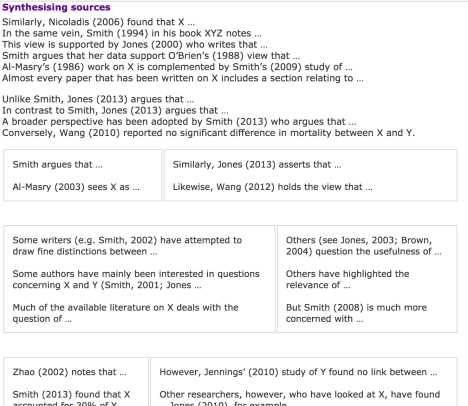
This activity takes the “fishbowl” approach to structuring a speaking activity and uses it as the basis for teaching students about synthesis. Synthesis is basically the process of using and combining multiple sources to support a point, showing where the sources agree and disagree. Linking language and particular reporting structures help the writer to do this. Here is an example of the kind language that is used in synthesising sources, taken from Manchester University’s  Academic Phrase Bank:

So now that we know what synthesis is, back to the fish bowl. In a fish bowl speaking activity, students sit in two circles, an inner circle and, around the outside of that circle (funnily enough), an outer circle. (As per the picture below, assuming that each X represents a student!)

Inner circle students face each other. They will be the speakers. Outer circle students watch the inner circle. They will be listener/note takers.

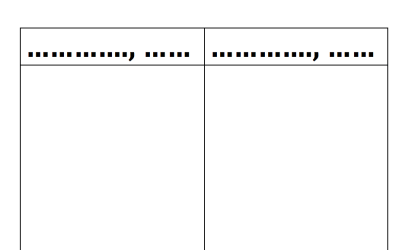
Each student/speaker in the inner circle receives a piece of paper like this:


On it they write their surname and a (fairly recent) year e.g. 2014.

Each student/listener-notetaker receives a piece of paper with a table like this on it:

The table would have enough squares for each student of the inner circle to be represented (which would usually be about 4 – you don’t want the inner circle to be too big! For larger classes break them down into sub-groups within each of which there will be an inner and outer circle).

The inner circle discusses whatever topic you set them, the outer circle makes notes on what they say. (You can make this harder if you have really good students: the outer circle could listen and take notes that evaluate the inner circle’s arguments  e.g. “Good example from X of……../Y needed more support for what he said about bla bla bla/ Z said he agreed but didn’t explain why” etc).

Once the discussion has finished/you have called it a halt, new groups are formed of a student from the inner circle and a couple of students from the outer circle. In these new groups they identify themes that were discussed and look for relationships between the pieces of information they have noted down. I.e. what do the speakers agree about? What do they disagree about? Does a speaker (or more than one of them!) build on anything another speaker has said?

After they have teased these relationships out of their notes, they write a paragraph summarising the discussion (you could use google docs for this). You could give them a framework to use for lower levels, you could feed in language you want them to use (particular verbs or structures), depending how much scaffolding they need. They will need to pick one of the themes discussed (which will provide them with their topic sentence) and then use synthesising language to summarise what was said about it.

This mirrors what they will have to do with academic sources in their writing. We (the teachers) have decided to film ourselves doing the activity in a future scholarship circle session, so that it can be used as the basis of a homework task to prepare students for doing the activity in class themselves.

*Obviously fishbowls are not only useable for teaching synthesis – they are a way of running a speaking activity so that students’ listening skills are worked as well. Of course students take it in turns to be listeners and speakers.

2) Nominalisation game

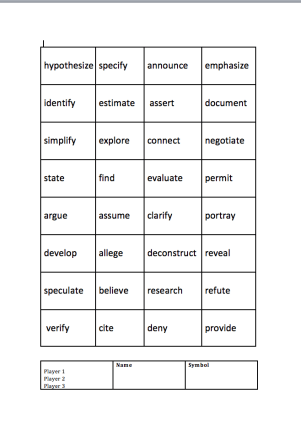
This is the game I put forward last week. This week I actually brought the grid to the session and everyone had a go at playing it. Click on the picture below to be taken to a pdf of that grid.

To quote from last week’s write up, it works like this:

Put students in groups of three and give each group a grid, counters and dice (they can use a phone app and the change in their pockets if needs be!). The aim of the game is to “collect” as many squares as possible by turning the verbs into nouns. To do this, students roll the dice and move their counter the corresponding number of moves. If their square has not been claimed, they can claim it by giving the correct noun form. If they are correct, they draw their symbol on that square. They can move in any direction that gets them to an empty square (backwards, forwards, diagonally, vertically etc) in any combination. They continue until all squares have been claimed or the teacher calls a halt. The winner has the greatest number of squares when the game stops. You can then get the students to group the nouns they have made according to the different suffixes used to create nouns and then try to think of any more verbs–>nouns they know that work in the same way.

That’s all for this week. Just like last week, the session gave me a real boost. There’s nothing like spending some quality time being creative with a great bunch of people! 🙂 Here are a few questions to leave you with:

Have you used a fish bowl activity before? How did you use it? Do you have any other ideas for teaching synthesis or activities for livening up lessons on nominalisation?


Scholarship Circle “TEFLising EAP”

Today was the inaugural session of our new scholarship circle “TEFLising EAP”*. (You can read more about what a scholarship circle is and what it does here.) The idea behind this one is that EAP lessons can get a little dry – learning how to do things academically is not necessarily the most exciting thing in the world even if it is essential for would-be university students – and for the students’ sake (as well as our own!) it would be great to bring in more, let’s say ‘TEFL Tweaks’ – things that we used to do when we taught at language schools abroad (warmers, personalisation, fun activities etc!) and have got out of the habit of doing in the EAP context but that could actually be adapted for use here without losing the all-important lesson content.

The plan is to look at the lesson materials for the following week (all of the courses here except for the highest level one have a very structured week-by-week, lesson-by-lesson syllabus and materials) and share ideas for how to breathe some life into them. We shall be doing this between 12 and 13.00 on a Friday and all in all, we will be aiming, through some most excellent collaboration, to avoid this** happening in our EAP classrooms! 😉


*not necessarily the official name!

**substitute ‘lesson’ for ‘lecture’!

Here are some of the ideas that came out of today’s session:

  1. For a listening and note-taking lesson: when you want students to work in pairs to use their notes to answer questions, make it impossible for them not to (or they won’t!) – you could do this by setting up the activity with clear stipulations i.e. one student to close their folder and one to read out the questions that they then work on together to answer. This avoids students getting buried in their folders, which is the tendency.
  2. For a citation and referencing lesson: students may be good students but may not be familiar with terminology that we take for granted, such as “semi-colon” or “bracket”. To ensure that you start the lesson with all students clear about the language you are going to use in teaching the lesson content, take that terminology (e.g. semi-colon, italics, brackets, et al etc) and use it as the basis for a backs-to-the-board game. This enables you to check that students know the terminology before you use it.
  3. A pronunciation warmer for working on minimal pairs: Minimal pairs phone numbers. Number the board vertically from 0-9 and give each number a word within which is a minimal pair sound. Here are the examples we had: 0-Annie, 1-any, 2-rise, 3-rice, 4-fool, 5-full, 6-light, 7-right, 8-sit, 9-seat. (Adapt it according to the sounds that your group of learners tend to struggle with) You read out your (invented) phone number by saying the word that corresponds with each number. So 989 would be sit seat sit. The students have to write down your phone number by deciding which word you have said and writing down the corresponding number. They can then do it in pairs. This gives them practice in both recognition and production of the minimal pairs.
  4. Do a speaking ladder at the start of the lesson based on the lesson content: It takes some time to do it, but the benefits range from giving the students (who have very long days at the college) an energy-levels boost, get them mingling, get them thinking/speaking in English and make them focus (as it generates a lot of noise, they have to listen very carefully to concentrate on “their noise”). It also gives them some bonus fluency practice.
  5. (This one was mine!) A warmer for a nominalisation lesson: Make a grid of academic verbs, one verb per square. Put students in groups of three and give each group a grid, counters and dice (they can use a phone app and the change in their pockets if needs be!). The aim of the game is to “collect” as many squares as possible by turning the verbs into nouns. To do this, students roll the dice and move their counter the corresponding number of moves. If their square has not been claimed, they can claim it by giving the correct noun form. If they are correct, they draw their symbol on that square. They can move in any direction that gets them to an empty square (backwards, forwards, diagonally, vertically etc) in any combination. They continue until all squares have been claimed or the teacher calls a halt. The winner has the greatest number of squares when the game stops. You can then get the students to group the nouns they have made according to the different suffixes used to create nouns and then try to think of any more verbs–>nouns they know that work in the same way.
  6. Academic style: When the activity requires students to edit sentences to make them more academic, here is a fun way to do it in groups. Write each sentence at the top of a blank piece of paper and make sure you have enough for each student in each group to have a different sentence. They write their edited sentence at the bottom of the sheet and fold it over to hide it. They then pass their paper to one student and take a sheet from another. Repeat this until all the students have written their edited version on each of the sentences going round in their group. At the end, as a group, they can look at all the different versions and collaborate to make a final “best version”, combining their ideas, and write that best version in their folder.
  7. Working with a text: take out ten key words, do a few rounds of backs to the board; once all words have been guessed and are on the board, get students to use them to predict the possible content of the text.
  8. Summary-writing tasks: get students to record it rather than write it for a change! Put them in pairs and give them time to make notes, discuss what they want to say and decide who will say what, then get them to record that. They can send you the recordings to listen to and give some feedback on.

The hour went by very quickly, it has to be said. Looking forward to more next Friday! 🙂 (I am planning to share the ideas here regularly but marking 30×3000 word essays [in chunks of 1 and 2000 words] is likely to get in the way somewhat! Hopefully I will catch up eventually though. )


IATEFL 2017 – In one ear and out the other: does feedback work? (Lorraine Kennedy)

You’ve got to love IATEFL Online! This year I didn’t make it to IATEFL for both personal and professional reasons; the first time since 2012 that I haven’t attended for at least some of the days. I wasn’t able to follow IATEFL Online at the time of the conference, but I think it’s marvellous that all that footage is stored for so long, giving teachers across the world the chance to access it when they are able to. As for me, finally I am addressing the “IATEFL 2017” gap that is no longer in the conferences category of this blog!

I decided to start by watching Lorraine Kennedy speak about feedback as it is something that I think about a lot in my professional day-to-day life: I am currently working for the ELTC at the University of Sheffield International College and the teaching here is focused on academic skills for students who hope to start an undergraduate or postgraduate degree in the following academic year. The academic writing strand is built on the process of drafting work, receiving feedback, reflecting on it and responding it, in order to develop sufficient skills to survive and hopefully thrive in the university environment. The question of how to improve the quality of my feedback, both written and spoken (in tutorials) is one that I continuously ask. While this talk focuses on giving feedback to in-service teachers rather than students, some of it is bound to be transferable with a little thought!

Lorraine starts by pointing out that we are all both givers and receivers of feedback. She also reminds us that feedback is prominent in the world today, so much so that we often ignore requests to give it (e.g. your hotel, the flight you travelled over on etc, all of them apparently want your feedback!). In one ear and out the other. She describes an article based on research done back in 1996 that says that 1/3 of feedback has a positive result, 1/3 has no result at all and 1/3 has negative results. So that means 2/3 of feedback has no effect or a negative effect. To Lorraine this means we need to take a step back and think about it and review our thinking on it. She informs us that Deloitte Consulting Company are trying to take performance management out of the workplace, as it isn’t working.

Her first main question is: What is the point of feedback and does anything change when we give it? We need to stop and think about some fresh questions – what will I achieve by giving feedback? Does the person I’m speaking to want my feedback? Have they requested it? How can we explore the issues that we want to discuss in feedback effectively? – and we need to start with the assumption that people will not necessarily accept feedback. Giving feedback is not by definition positive or constructive, it is just an act or a form of communication. Only feedback that is accepted is likely to have an impact. Lorraine’s focus is in-service feedback for growth and professional development.

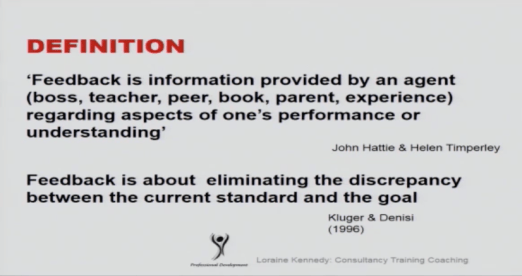
Having raised these questions she moves on to provide a definition for feedback:

Nobody is questioning that feedback done the right way is a good thing. The Hattie definition has a broad range of providers for feedback – reading a book is a form of feedback, rather than the stricter definition of expert to novice feedback. The traditional format for feedback is the sandwich approach – good, bad, good. She wonders if it has any impact on teaching practice rather than documentation just being put in a drawer and kept for inspectors to look at. She also remembers what it was like first and foremost to receive feedback – terrifying to be observed and receive feedback on that. Then she became more confident receiving feedback and also became better at assessing herself and less bothered about someone else’s opinion. She wonders how many other people experience that. The same went for giving feedback. She was uncomfortable initially and then through becoming a coach it became a more positive experience.

Lorraine is interested in 3 areas.

1) Which is better positive or negative feedback? The research will say things like if someone is a novice, focus on their effort/commitment/progress but if someone is quite experienced, you need to be more ‘brutal’ – are you successful all the time? If not, come on, let’s look at the constructive things we should look at and focus on that. It depends on the individual, the context and whether the person is listening in the first place.

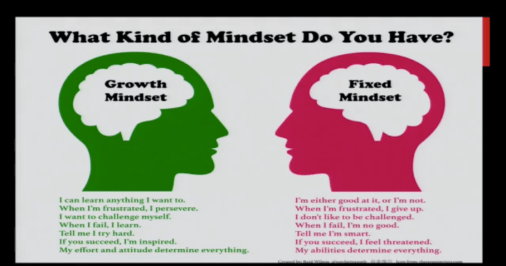
2) Mindsets – growth mindsets and fixed mindsets:

Everyone likes giving feedback to the “growth mindset” people, the fixed mindset not so much. The idea is that we should work towards developing a growth mindset in everybody. What do you do with people who have been around for a while as vs children?

3) Feedback styles – there is a lot of work out there on communication styles and feedback is one aspect of that. One of the most difficult conversations to deal with is giving feedback. How to make it palatable and make people listen? Some people like it direct, no touchy feely stuff, some are the opposite. But how helpful is that? We can’t read other peoples’ minds to know if they are open to feedback and what style they appreciate unless we know them very well and even then they may change depending on the day.

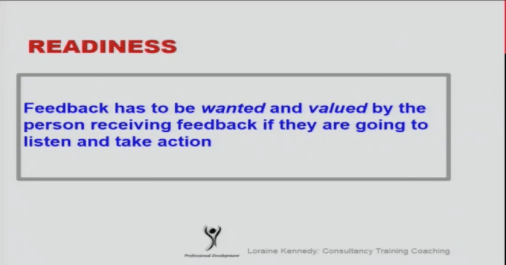
Lorraine puts forward the following:

If it is unwanted or not valued, perhaps you are wasting your time. So the starting point is to be with the receiver mentality and think how does the receiver want feedback and who from? Perhaps it is not you.

She then makes some suggestions:

  • remove the word feedback from the language – has negative connotations and teachers tend to become weary of receiving it. “Really? Am I still not good enough? Do I still have to prove myself through an observation?” Instead, talk about “insight” into working performance – as a more neutral/positive term/concept.
  • use a coaching conversation technique. It doesn’t matter if you are the boss or a peer, this approach dictates that the person who has been observed takes the lead. The assumption is that if they are engaged and leading the conversation, then they are much more likely to engage willingly in that professional conversation. It could be “what would you like to talk about? what aspect of your development would you like to discuss?” (This does not apply to substandard performances but people who are well-established in the establishment).
  • coaching should lead to mentoring: the conversation should lead to your input as “giver of feedback” being requested e.g. “what would be your one suggestion to improve what I have done?” to which you could respond: “which bit would you like me to focus on?” So it is specific and requested by the individual.
  • more self-assessment should be used, so that teachers can start to lead on their own self-assessment more (performance management or observations). Very little need to tell people what to do different For this to work you need SMART objectives and it needs to be clear how progress is being measured/looked at. Encourage people to watch other people so they have benchmarks and point of comparison.
  • explore teacher beliefs about teaching and learning: it’s an important place to start. What is good classroom management? How do teachers teach well? What is a good teacher? What is effective learning? When you start with these kinds of questions you find common ground or differences of opinion to build the conversation, so that you know what perspective they are coming from and how to reach them.
  • focus on development not evaluation: if people are developing then quality results and evaluation will happen. Development is a better starting place. Goal-setting is a priority – future focus not past focus and goals need regular review. Takes the emphasis off process and puts the emphasis on results. Focus on how to impact positively on student progress and confidence? View the principles of teaching through that lens.
  • a variety of observation practices: video, audio, camera focused on the students, followed up with a coaching conversation is also valuable. Peer observation is also valuable but only when it is well set up and when people doing observations have been trained in having the post-observation dialogue. People do appreciate professional dialogue with their peers and also from managers who take the role of a peer.
  • encourage teachers to get feedback from students directly: what worked for you today? what did you find challenging? what would help next time? Five minutes at the end of a class. You can make it more formal if you wish. If we can get teachers to engage with student feedback then you won’t need to go through the managers – the teachers can report to the managers what they are learning from the students. It should be a regular part of teaching and learning.
  • establish learning culture led by teachers: creating collaborative opportunities, positive culture of growth and development. (I think my workplace does this well, with teacher-led scholarship circles)

In conclusion:

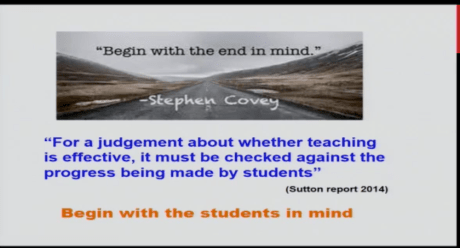
The progress being made by students doesn’t just mean results or what students got in a test, but many useful formative mechanisms in place to look at effort, confidence, support, growth, engagement etc.

Lorraine finally changes Stephen Covey’s quote to: “Begin with the students in mind” when you think about feedback in that line, greater impact on teaching and learning will result.

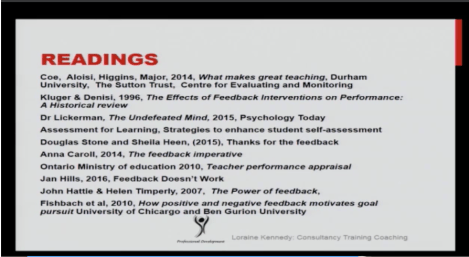
Here are the references she used:

Just a reminder that you can watch the full talk here.

I found this a very interesting talk and while it is focused on in-service teacher development, I wonder how I could incorporate some of what she has discussed into the feedback tutorials I have to give students based on their academic writing. As I said at the start of this post, I have done a lot of thinking about feedback, and giving feedback, since I have been working here and giving it on a fairly regular basis.

I think the process of reflecting each time on what I do, and what I could do differently, has helped me improve a bit each time. Partly I have become more confident about delivering the feedback (mirroring what Lorraine said) and so rather than being nervous I enjoy the experience of working with the students to help them improve. This is connected with increased confidence in being able to identify key areas for students to work on, that will have the most impact on improving their academic writing, and point them towards resources to help them with those. I know I used to give too much feedback initially, out of a desire to help the students as much as I could, such that it was nigh on impossible for the students a) to take it all in and b) to respond to it all in the time frame available to them. I think both the quantity and clarity of my feedback – or feed-forward if we must – has improved in this respect. Students receive the written feedback in advance of the tutorial, so they have time to look at it before they come and see me. To capitalise on this, where I used to launch straight into what I wanted to say, I now start the tutorial by asking the student if they have any questions about the written feedback or if they have any issues with their writing that they particularly want to discuss with me. Nine times out of ten, they do. Hopefully once these are dealt with,  this means they are more receptive to the rest of what I have to say and are less distracted by what they may have been worrying about up till that point. 

This term I intend to read up on and implement relevant coaching conversation techniques in my tutorials, to see if I can continue to increase their effectiveness for my students. I suspect there may be more posts in future relating to feedback!

Questions for you, if you got this far: 

  • How do you feel about giving feedback?
  • What kinds of feedback do you have to give in your job?
  • How has your style of giving feedback changed over time?
  • How would you like it to change in future?
  • What resources have you found useful in helping you with giving feedback? (Blog posts, journal articles etc)

(Feel free to pick out any of the questions that interest you and ignore the rest, or answer them all, whatever suits!)

The Eaquals Framework for Language Teacher Training and Development and its companion the E-Grid

In Kirsten Holt’s IATEFL 2016 talk, (yes, 2016 – yes, this post has sat as a draft in my posts box for rather a while now! Better late than never…) she makes reference to the Eaquals Framework and its companion the e-grid. I was immediately curious so thought I would try the e-grid, which generates your ‘professional profile’. The profile produced is not saved on their website, it just creates a soft copy for you to keep on your computer.

After completing fields for name and address, and employer name and address, the next step was language proficiency:

Screen Shot 2016-05-18 at 11.53.47

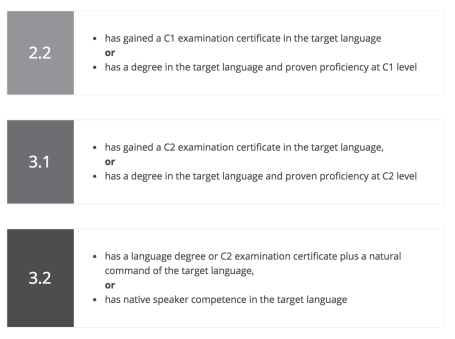
You pick your level starting from 1.1 (studying the target language at tertiary level, achieved B1 proficiency in the target language) up to 3.2 (see picture above) My questions:

  • I have a degree in the target language, two actually, but I don’t have proven proficiency at C2 level as I have never done a proficiency test.
  • What is this “natural command” that differentiates between 3.1 and 3.2? How is it measured?
  • “has native speaker competence” = 3.2 but all levels below that focus on language proficiency only for people who have learned the language in such a way that certification and examination has been part of it i.e. not people who have grown up speaking it as their mother tongue. So there are 6 levels you can pick but if you are a “native speaker”(definitions and implications of which term are another can of worms) you are automatically assigned the highest level, level 6, aka 3.2…  Are all “native speakers” equally proficient? “Proficiency” can be defined as a high degree of skill or expertise. Do all “native speakers” have that to a uniform level – in this case 3.2? (NB later in the self-assessment language awareness is dealt with separately.)

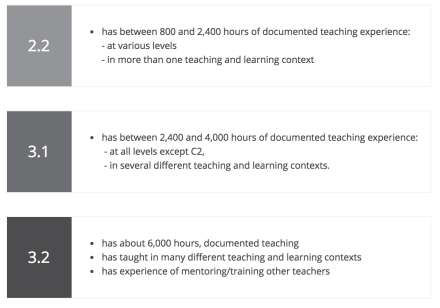
My next ?? moment came in the teaching experience question:

Screen Shot 2016-05-18 at 12.01.42

I have no idea how many hours I have taught. Also:

  • What does it mean by documented?
  • What would happen for the teacher who meets the 3.2 criteria but happens never to have taught at C2 level? Or does lack of C2 level stop mattering after 4000 hours of experience?
  • What happens if you have between 2400 and 4000 hours of teaching experience including classes at C2 level?
  • What if your 2400 – 4000 hours of experience all happen to be in the same place?

I actually did keep a record of the hours I taught and to which class in my first year of teaching. Unfortunately, I have no idea where that document is. It was several computers ago and seems to have got lost in the mists of time… I probably don’t have squillions though, given I only started 7 years ago, spent one of those years doing my Delta and M.A. full-time so only taught once a week during the Delta and some part-time work later in my M.A., worked part-time between October 2015 and March 2016 and though full-time now, have a relatively small number of contact hours per week with my groups. (What do you do the rest of the time, I hear you ask? Well, there is also cover, Writing Advisory Service sessions and at certain points, megatons of marking – 2000 – 3000 word essays rather than 250 word essays… and – woohoo! – CPD!) Then, I’ve taught C1 but not C2. Am I a 2.2? A 3.1? Is x hours of teaching the same level of experience regardless of what development has taken place alongside them? In other words is it quantity over quality?

Once you’ve finished doing the self-assessment, you can export the results as a PDF, bearing in mind it will not be saved on the website itself. You can also export the results in e-grid format, which you could later re-upload to the website and edit. So, having used the E-grid, it was time to look at the framework itself. On the website, the main aims are set out as follows:

to help practising teachers to assess and reflect on their own language teaching competences, and set their own goals for further development


to help managers to identify training needs and plan professional development programmes for practising teachers

to encourage teachers to continue their professional development on their own and with the support of their institutions

to help document the design of public training courses for practising teachers


to serve as a tool for evaluating and accrediting teacher training courses.

There is then a link to the framework, a 42 page document, which you can download and peruse at your leisure. The framework divides teacher development into 3 phases, and assumes that teachers can be in different phases of development for different skill areas. The phases don’t map to seniority of position. There are five main areas each with different sub-sections. Each of these key areas is broken down into “knowledge of” and “skills”, so theory and practice. I am assuming that the 1.1 – 3.2 in the e-grid relate to the three developmental stages in this framework, although on the E-grid webpage, it says descriptors cover six developmental stages.

Have you used this framework to help you develop? Have you used it to help other teachers develop? How did you do it? Please share your ideas with me and others by using the comments box below – you are also very welcome to use it for answering any of the questions I have raised in this post or just any related thoughts! I will share my ideas for using it in a later post. Meanwhile, don’t forget to have a look at Kirstin’s ideas as disseminated at IATEFL 2016.


MaW SIG Online Event: From Pen to Press – your questions answered

On Saturday 18th February at 4pm, MaW SIG hosted an online panel discussion event using Adobe’s webinar platform. We had four panellists join us and share their views on a range of questions that had been submitted in advance via MaW SIG’s social media. The panellists were Vanessa Reis-Esteves (young learners author), Sarah Milligan (commissioning editor for Onestopenglish), Julie Pratten (founder of Heart ELT Publishing) and Lyn Strutt (freelance ELT content editor, copyeditor and proof reader). 

While the event was unfolding, in addition to being behind the scenes on the webinar platform, I was also giving my fingers a brisk workout i.e. attempting to take notes on what was said. Here is a write-up of what I managed to catch, which is far from everything as I am just human! There is a recording that IATEFL members can watch too though, available here (scroll down until you see it – recordings are not organised chronologically).

Question 1 : Are there any agreed upon principles about materials writing?

There’s a lot of advice out there now that there wasn’t a few years ago on how to write and how to achieve writing goals. There are principles but it depends on who you are writing for, not everybody has exactly the same rules. E.g. for publisher in Portugal rules less strict and more adapted to the context of writing. But definitely procedures spending on age group. E.g. young learners, you’d be allowed to do certain things that you wouldn’t do if you were writing for older learners.

This links to the question of whether things have changed in last 20 years. What works in materials classroom is what works in the classroom. Is it going to be clear? Is it going to make sense? Is it going to achieve its aim?

Useful links suggested (by Lyn):

Question 2: What design principles do you use when planning layout, colours, fonts and image and text incorporation?

For young learners everything needs to be visual and guide the learners.

In the past, we might have used colour for prettiness or attention grabbing but nowadays these are looked at from the point of view of students with special learning needs/requirements and whether they will be able to access them. Will learning be easier not only in terms of context but also the layout? Every image has a purpose, which is to help students master and take control of learning in a particular task.

Materials are much more visual/magazine-like, lots of powerful images used, not always directly connected to task but as lead ins to topics etc. In commercially published materials, design is not material writers’ job. The in-house designers at the publishers will work with a design agency who will plan the design for the book, influenced by the market and other books by the publisher on the market and in a series, all influenced by market the book is being sold into. A major course book series, the author will be involved in the discussion and allowed to have input but not control. Author and editor may fine-tune it later one but the overall structure, key colours etc will be designed earlier than that (by the design team). If you are into self-publishing, look at successful books and books you think work in the classroom and use those as a guide, as they have been done by people who know what they are doing.

This link may be of interest: EMC Design blog

Question 3: How important is the inclusion of cultural content in instructional materials design?

Becoming more and more important, lots of courses cropping up for teachers. A change or shift in publishing creates a need for training teachers and writers. Teachers need to be more competent themselves in terms of recognising differences in their students or within a particular context depending on where they work. It’s a tricky one because if you have a coursebook meant for a general market, which is appealing to publishers, it is not that easy to create the intercultural part of it as so many different things to bear in mind. Writers need to skill up on it as teachers expect it more and more.

In the past, would be asked to include anglo-american culture in the books but now in 21st century learning, ministries are feeling the need o prepare their students to work with other cultures. So they want you to bring in some kind of intercultural awareness into the materials but not necessarily including anglo-american, but for example getting kids to understand that one culture isn’t better than another but just different and to value differences rather than judging and stereotyping. A lot of training is needed because people don’t know exactly what is needed. But it is an exciting time as this element grows.

There is a move away from anglo-centrism and towards something more global, which can only be a good thing.

Question 4: With so much free content online, both for students and teachers, what can paid content offer?

Onestopenglish – a subscription website. Paid for content vs free content online offers professionalism and is content that maybe is trusted slightly more because it has to go through editorial rigour. Free content is fantastic in many ways but when you put content through a publishing cycle then it doesn’t just have one pair of eyes on it but rather several – writing, design, editorial process – so it can offer higher quality in terms of the way its presented and the way that it reaches the teacher.

Question 5: Is there a market for self-publishing?

Still a bit of stigma attached to it, in terms of association with vanity publishing. But there is a possibility that it goes through stages of editing. Where you haven’t got multiple pairs of eyes scrutinising it, there might be big issues with it. Perhaps publishers could take on materials that have been self-published and do something with them? It’s getting big but people need to get together, collaborate, so that quality will improve. The role of an editor is still important in self-publishing, as self-publishers use editors. In self-publishing, you may have great ideas but you need an editor to work on it (not just about typos and silly mistakes but other professional eyes on the material) – the more input you get on your materials, the better they will be. It’s got to be good, useable and make teachers’ lives easier if it’s going to sell.

Question 6: Although in academia the NS x NNS seems to be history, what are the real chances of NNS writing ELT material for international markets?

The chances are 100%, the same as for NS author/writer. Sarah was surprised and saddened that the question was being asked. If a writer is turned away due to being an NNS then that’s discrimination. It’s the same as the argument for teaching. Hopefully it won’t even be an issue in the next few years. Publishers should be choosing their writers according to whether they are writing good material, excellent material. Onestopenglish does employ NNS writers.

There is a lot of discussion about the position of the NNS teacher at the moment.

Julie’s concern as a publisher is that the ideas are good, the content is good and there is a need for the material. She has several NNS authors on her books at the moment. In the NNS community there is a feeling that they are being ignored. But if you look at what’s available e.g. in an online ELT bookstore, it is not all British/American names. And it should continue to grow.

Rachael has worked with plenty of NNS publishers and editor as well. Hopefully it’s a non-issue now.

Vanessa thinks an NNS will know their context better in terms of difficulties those students might have, so they should be seen as an asset. It’s more about the contribution you are bringing to the material rather than the language/country on your passport.

Question 7: What is THE qualification you need to get into writing?

Be a teacher at heart, understand how kids (or whatever age group) learn. Need to be able to see how students learn. While she would agree each teacher is an author, not necessarily able to write a book. Need to be able to be a bit more objective to assess whether something would work with most teachers/students or just with you. You need a very big teacher heart and a lot of resilience and taking on board other people’s ideas and not just sticking to your own.

You need to love teaching to be able to teach and write. Start from a creative spark. If you had 5 new, fresh authors who hadn’t written but had taught for a while, they could bring a fantastic approach to a certain teaching point. We need space for creativity. Julie wants to run courses that will generate that buzz, that spark and then put all the scaffolding into that material. There is no one formula to getting to a good piece of material. We always need innovation, that’s what publishers are looking for.

If you collaborate as teachers, someone with ideas could work with someone who is better at writing. Sarah is always looking for writers who can think outside the box in terms of activities that would be enjoyable to do in class and have a little spark but also you want someone who can write a lesson plan/worksheet that has a strong learning outcome to it. A collaboration of those two types of writer/teacher would be really powerful.

Question 8: I know plenty of people who’ve sent publishers book proposals but not heard anything book while some established names have been involved in book after book. Is this because the book proposals were not good enough or because editors prefer writers they know? (AKA how do you get into writing materials)

For Sarah, it’s becoming rarer for publishers to accept proposals because when you are thinking about a publishing plan, you are basing that on research that you’ve done looking at various markets and pinpointing what’s important and what needs there are. So it’s harder and harder for writers to submit proposals because publishers have specific things in mind that they are trying to do. Publishers do accept new authors but if you find a writer you love working with (meets deadlines, produces quality material), why would you let that writer go if you are an editor? However, those writers become more and more popular and then they don’t accept your work anymore as too busy and then you take on a new writer. If you want to submit something, you can submit a proposal, but a CV with experience and expertise is more useful as publishers can see if that matches up with what they are trying to do.

Vanessa thinks it’s worth a try to do lots and lots of talks. Make sure you have something to say and that what you have to say is of interest. So, go to IATEFL, join a SIG, be an active member of it, do little things and learn with others, collaborate a million times, and if you do it enough, then somebody will be there and notice you. It’s about being in the right place, putting yourself in the right place. An editor won’t miraculously appear and send you a proposal. You need to network. You can meet fantastic people by working on things. IATEFL is a great place to start networking, local organisations and conferences too. Sometimes people get into writing by having a great blog and that blog being noticed. If you have an audience, people will notice you sooner or later.

Lyn wanted to emphasise that she knows several authors who got spotted at PCEs and talks at IATEFL and have plenty of work because of that. A blog is a very good way of proving you can write. The idea is that you give away some of your ideas to prove that you have ideas and then people may buy your further ideas. If you have lesson plans and tips, and can show that you are able to produce material, that’s what’s going to make publishers look at you and think you can do something bigger. Proving that you are reliable is important.

Julie wants to add that IATEFL etc is expensive, even if done on a budget, if you don’t live nearby. What about all the other people who can’t do that? She thinks publishers could do more to help new blood into books. But there is a problem, for example if writers don’t deliver beyond the sample material. Julie offered a writer the chance to do a guest activity in a book. This is something that publishers could try to give young people a chance to get in the book and something that Heart ELT does. It was first come, first served, and they ended up with a split of well-known names and unknown names and the unknowns sent in good, well-structured material.

Sarah thinks that the big publishers could definitely do with giving people a few more chances and go to more local conferences. You will find that publishers and commissioning editors going to local conferences to find people who can’t afford to go IATEFL in the UK. But also, there are competitions. Any sort of writing competition is useful to enter. Editors do look at people who have self-published and done workshops and if they are good, they will want to ask them to do something.

At this point, we ran out of time! A huge thank you to all the panellists (and if you read this and think I have misquoted you, please let me know!) and to everybody who attended the event. 

 

Today at 4pm! From Pen to Press: your materials development questions answered

screen-shot-2017-02-18-at-07-50-27

For the last few weeks, MaW SIG have been collecting materials development-related questions from members and non-members alike. This afternoon, from 4pm – 5pm GMT, our panel of speakers – Vanessa, Sarah, Julie and Lyn – will be giving their time and sharing their varied expertise with us, answering as many of those questions as time allows.

If you would like to join us, this is the link: MaW SIG Webinar Room

Don’t miss out! 🙂

2017 (Or, how to set better goals!)

Happy new year, everybody! The first 10 days of 2017 seem to have flown by. For my first post this year, I’m going to write about resolutions and effective goal-setting.

On Sunday I delivered a workshop as part of the Teaching Listening course that forms part of this year’s EVO.

(To quote EVO and explain what it is:  Every year in January and February, the Electronic Village Online (a project of TESOL’s Computer-Assisted Language Learning Interest Section) brings together English language educators from around the world to engage in free, collaborative, online professional development sessions. Last year, we had over 8,165 participants in 14 sessions.)

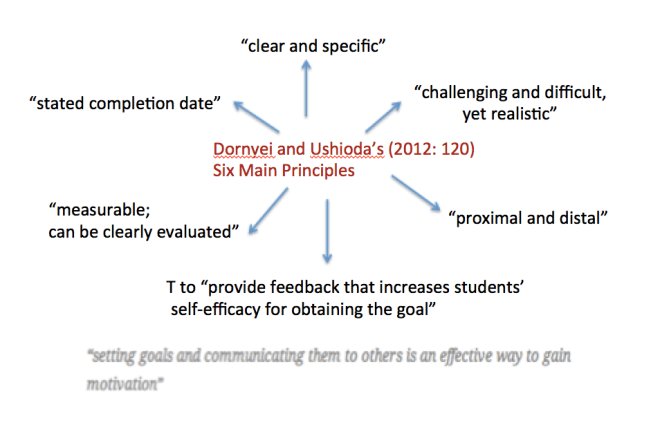
My session focused on helping learners become more autonomous listeners and the main task the participants will do this week is to set up an out-of-class listening scheme to use with their learners; considering, amongst other things, about what they want the learners to do, how they will introduce the different elements to the learners, how they will help learners to maintain their motivation. Of course, within my session, within the discussion on motivation, I talked about the importance of goal-setting and the features of an effective goal according to Dornyei and Ushioda (2012). Here is my slide which summarises these:

screen-shot-2017-01-10-at-13-46-29

I always make New Year’s Resolutions. There is something magical about the beginning of a new year, and the potential it holds, that gets me really excited and I enjoy making my resolutions as a way of sizing up that potential and giving it some form. Usually, however, my resolutions are a bit fluffy and I forget about them fairly soon afterwards. This year, in order to help myself not to forget about them, I have copied them into a sticky note on my desktop so that I am reminded every day of the things that I set out to do. I also tried to make them more specific than usual, so that I can actually tell not only when I have achieved them but measure my progress along the way. It must have been preparing for the EVO workshop that subconsciously made me apply Dornyei and Ushioda’s (2012) principles for effective goals to my resolutions for 2017!

In the interests of gaining (extra) and maintaining motivation on the languages and ELT front, I’m going to communicate my resolutions relating to these areas here. Rather than just a list of goals, I am going walk you through the mental process I went through in making them, shaping them from a vague initial idea into something more specific, tangible and therefore achievable.

  • Learn Arabic. I started learning Arabic last year in around October, as I was going to be volunteering at a secondary academy here in Sheffield, working with a number of learners whose first language was Arabic. That fell through (2016 was one of those years?) and after an initial burst of enthusiasm, the Arabic fell to the wayside too. End of story? Evidently not. I didn’t stop wanting to learn Arabic but the related work situation had demotivated me somewhat so mentally it became easier to ignore both. 2017 seemed like the perfect way to reinvigorate it. First I reflected on why I want to learn some Arabic. Initially, it was instrumental motivation (the work situation). Theoretically, that is still potentially the case as ELT in the UK can often involve working with Arabic L1 students. But that vague possibility won’t in itself be enough to motivate me to study Arabic every day. What about enjoyment? Well, I enjoy learning languages (hence currently studying 11 of them, including Arabic) but why Arabic? I think it appeals because it is (to me) so different. It has an alphabet that doesn’t look like anything to me. Just as English has an alphabet that doesn’t look like anything to Arabic L1 speakers when they first encounter it. I am interested in the process of learning a language with a different alphabet. So, going back to my “Learn Arabic” goal, being as I am not a genius I am not going master Arabic in one year, not even nearly. So if I left my goal at that, I would be setting myself up for failure. I need to make it more realistic. How can I do that? Make it more specific. So my goal became: “Learn to read the Arabic alphabet and speak/write some basic words and phrases.” That seems entirely more realistic, it reflects my motivation for studying, progress will be measurable (by way of the number of letters and eventually words I can recognise and produce – which, by the way, there are more than you might think as they change a little depending on whether they are at the beginning, in the middle, or at the end of a word!), it is challenging (did you read what I just wrote in the last set of brackets?!). My completion date is 31/12/2017 but I do of course plan to monitor and decide if the goal should be developed before then. It will depend on my progress: there is room for extension!
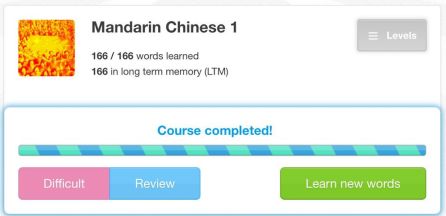
  • Continue with other languages. Of course. That would be French, Italian, Spanish, German, Polish, Romanian, Indonesian, Mandarin. Plus the newly added Dutch and Swedish. But for this resolution to make sense, what exactly am I going to do with them? What counts as “continue with”? I need some parameters. For the first five, this means Memrise plus as much reading, listening, speaking and writing as possible. I’ve found someone with whom I will be able to practice my Italian and French, possibly also some Spanish, and as for Polish there is always my sister’s husband to practice with, when I visit them. I’ve catalogued all my DVDs so that although I don’t have the cases for most of them, I know easily what I’ve got and what language(s) I can play them in. For the second five, I’m going to focus on Memrise and shift into using them when I’ve got a bit more vocabulary. (The cool thing is Polish used to be in that category but now it’s in the “I need to use it” category – that’s progress! The other cool thing is that in the series episode I was watching with my housemate today, there was a bit of Mandarin with English subtitles and I heard and understood three words without the subtitles! For me and Mandarin, that is exciting, believe me!) I have ear-marked particular courses on Memrise that I want to complete and obviously goal way-points will be in evident in the number of words/phrases learnt, number of days in a row studying consistently (or “streak” as they call it – for Polish currently 113!) and how well I do when reviewing stuff.
    This was a motivating way-point!

    This was a motivating way-point!

    As with Arabic, I will monitor my progress and adapt the goal/resolution as necessary. For example to make it include having a pop at watching or listening to something in one of the 5 ‘weak’ languages (or 6, counting Arabic!) if/when I feel it would be worth a go.

  • Do lots of CPD. Do not we all start our year with this resolution? And perhaps renew it if academic year and calendar year don’t coincide (i.e. northern hemisphere), or when feeling inspired at the beginning of a new term. At the moment, for me, this is a tricky one. The only work I’ve got at the moment is a bit of private tuition. I had been all excited about volunteering in an EAL setting but that fell through (as mentioned above – and don’t get me started on academy management organisational skills…) which was a bit of a bump to the motivation. Currently I am also tutoring on the EVO course, as I mentioned at the beginning of the post, but that is obviously a very short term thing. An interesting one, though, as it combines my interest in teaching listening and my interest in tutoring teachers! So, it would be easy to let CPD slip. In order to avoid that, I need some specific goals, rather than the nebulous ‘do some CPD’. I will be doing two sessions on the Leeds Beckett M.A. ELT Multimedia and Independent Learning module again this semester and I hope also to deliver a version of my IATEFL talk at the ELTC (I do it free of charge in exchange for the opportunity to work on my workshop delivery skills!). IATEFL itself is another focal point for me, in terms of workshops, as, hopefully, will be doing another British Council TeachingEnglish – related webinar. Additionally, each week I want to watch at least one webinar and read something ELT-related. Finally, as my pet project, I want to make some EAP-related materials in advance of the pre-sessional summer school period. As a specific starting point, I want to make some materials to help students become better able to synthesise sources effectively (this inspired by memories of my colleagues and I feverishly looking for any such resources last summer and not finding quite what we were after!). This will require looking again at the demands/criteria that we were trying to help the students to meet, as these would be similar this year at ISS or, if it turns out that way, other pre-sessional courses, reading relevant chapters from EAP Essentials and other such EAP teaching bibles (de Chazal’s comes to mind, though I forget its name!) and of course the actual materials creation and subsequent editing. Keeping with the weekly timeframe, I will expect myself to make tangible progress each week, which I will monitor via a log.

When I went through the mental thought processes described above, I wasn’t doing it with Dornyei and Ushioda’s (2012) principles in mind, but it’s clear that subconsciously they had an influence. And so I should think, the amount of time I’ve devoted to studying motivation, within learner autonomy, and trying to get students started on their autonomous learning pathways! I think as teachers, if we are able to apply what we want students to do to our own learning (of languages, of teaching) and have a clear idea of how to get ourselves from A to B (A being hazy ideas of goals, B being effective goals), we will be better able to help our learners go through that process themselves in the context of their language learning (if they want to then apply it to their New Year’s Resolutions and other aspects of their life, that is up to them!) with the idea that they leave our classroom better able to map and follow their learning goals. There is no one size fits all goal solution but we can help students become better able to set, and by extension meet, their own objectives more effectively.

What are your New Year’s Resolutions? Do share them in the comments – remember, communicating goals increases the motivation to achieve them! 😉

I hope 2017 is a fulfilling, successful and peaceful year for you all.

screen-shot-2017-01-10-at-15-46-59

References

Dornyei, Z. and Ushioda, E. (2012) Teaching and Researching Motivation (Applied Linguistics in Action). Routledge.


Chatting in the academy: exploring spoken English for academic purposes (Mike McCarthy)

Another addition to my collection of write-ups based on the talks recorded by IATEFL Online and stored on the website for everybody to access. What a wonderful resource! This one is by Michael McCarthy, and, as you would expect, is based on corpora and vocabulary – this time in the context of academic spoken English… 

MM starts by saying it is easier to study academic English in its written form and much more challenging in its spoken forms. His main point is that there is no one single thing that we can call Spoken Academic English. His talk will draw on information from corpora and show how it can be used in materials. He is going to use a corpus of lectures, seminars, supervisions and tutorials from the humanities and the sciences, the ACAD, and a sub-corpus the Michigan Corpus of Academic Spoken English, MICASE. He is also going to be using from the CANCODE corpus the sub-corpus of social and intimate conversations. This is the data that MM used.

Corpora are widely known and accepted in our profession, so MM didn’t need to introduce what they are and why we use them. He looked at a frequency list of words, the simplest job you can do with a corpus. You can also do keyword lists, which tells you more than just if something is frequent: it tells you whether it is significantly statistically frequent or the opposite, significantly statistically infrequent. We can also look at chunks and clusters, the way words occur together repeatedly. We rarely go beyond 5 or 6 words, due to the architecture of the human mind. Chunks are most common in the 2-4 word chunk-size. Dispersion is another thing to consider, in terms of the consistency of words being used, to know whether a particular text or genre is skewing the data.

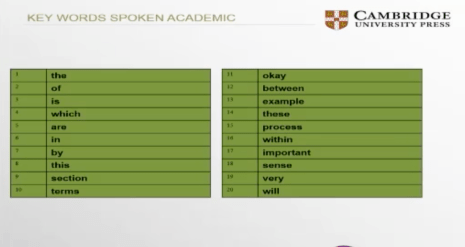
In the spoken ACAD, in the top 50 frequency list, there are lots of the usual conversation markers, lots of informality, lots of you, I, yeah, er, erm. There are lot of familiar discourse markers, such as right and ok, and response tokens, i.e. the words or sounds used to react. The most frequent two word pragmatic marker in ordinary social conversation is you know – 66% of the occurrences of the word ‘know’ are in the form ‘you know/y’know and the picture looks the same in the academic corpus. This, however, is not the whole picture. We have something like everyday conversation but when we go into the keyword analysis, things become a bit more interesting. The top 20 keywords in spoken academic data are:

screen-shot-2016-12-05-at-10-16-14

Now, a lot of familiar conversational items are present but also some that if your friends used them with you in everyday conversation over a cuppa, you’d lose the will to live. So there are words here that don’t have the informal conversation ring. Not least the preposition within which is right up there in the top 20. We will come back to which, terms and sense later.

Keywords tell us more than just what is frequent – they enable us to have a greater, more nuanced picture of how words are functioning in the data. We can find some interesting differences between conversational and academic spoken English: If we do a straight frequency count, the discourse marker “ok” comes out higher in a keyword list than the frequency list, in the academic spoken English corpus.

screen-shot-2016-12-05-at-10-22-17

MM found that 95% of the “ok” in the data are either response tokens e.g. that’s ok, well, ok or discourse markers signalling phases e.g. “ok let’s go on to look at <something else>“. They are used overwhelmingly by the lecturers or tutors. MM had a PhD student with an annoying habit: after exchanging pleasantries, the student would say “ok, now I want to talk about…” and then once they had, he would go “right, ok..”  – MM thought it should be HIM saying those phrases. Students very rarely respond with “right, ok“. So in academic speaking, we are looking at a different set of discourse roles than in conversational English, that is what the corpus is showing us. The roles are directly related to the language. Some items that are present in the frequency list disappear in the key word list, i.e. fall too far down the list for MM to be prepared to go through and find them e.g. well, mm, er, you. This negative result says that these words do not distinguish academic speaking from any other kind of speaking. However, some of the language is particular to the roles and contexts of the academic set-up.

MM says it takes a long time and a lot of hard work to actually interpret what the computer is trying to tell you. It is dispassionate: no goals, prejudices, aims or lesson plans. It just offers bits of statistical evidence.

screen-shot-2016-12-05-at-10-28-31

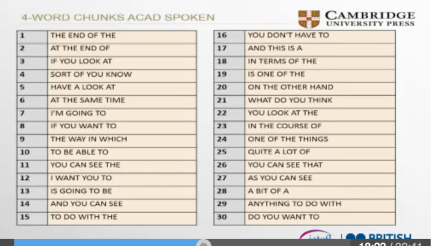
What struck MM when he looked at this list is that on the conversational side, at least 3 and possibly more of these are remarkably vague. It surprises people that there is a great degree of vague category markers that come up to the top of this spoken academic discourse, but it shouldn’t because the student is being nurtured into a community of practice and in any community with shared values/perspectives/opinions, you don’t need to specify them. You can simply say x, y, etc or x, y and things like that. This presence of the vague category markers is crucial – not only do you have to hear and understand them but you have to be able to decode their scope, and know what the lecturer means when they say them. Vague category marking is something that is shared with everyday conversation but the scope is within academic fields.

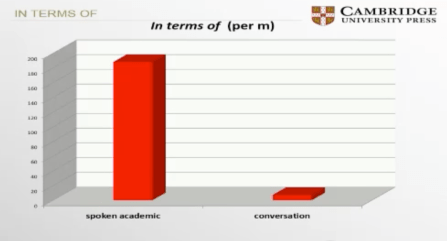
At no. 18, “in terms of the” – not surprising because in academia we are always defining things in terms of something else, locating pieces of knowledge within other existing/known knowledge – the discipline as a whole or a particular aspect of it. It is much more widely spread in academic spoken discourse compared with conversational:

screen-shot-2016-12-05-at-10-47-54

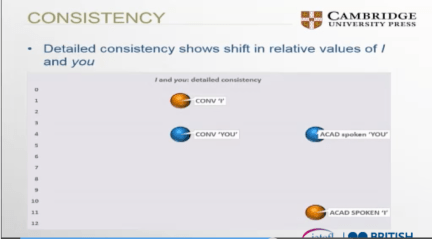
MM goes on to look at the consistency, or spread of items across data – looking for things that occur in a great number of texts. In social conversational data, the dispersion of I and you is consistently high. The picture in academic spoken English is different:

screen-shot-2016-12-05-at-10-41-07

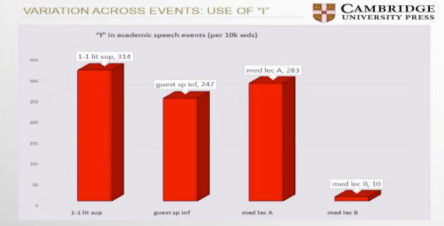
The pronouns are reversed – you is more frequent than I. This brings us back to the fundamental business of roles: most of academic discourse is about telling “you” how to do things and become part of the community of practice. Thinking back to the chunks “you can see” etc. A transmissive you. However, we do notice there is quite a bit of I in the academic spoken, it’s not remote. I is generally used by lecturers and tutors. But if we look across events, there is great variation. Even within two science lectures, in one there is a personal anecdote, so more use of “I” (more, even, than the informal guest speaker), in another not:

screen-shot-2016-12-05-at-10-46-18

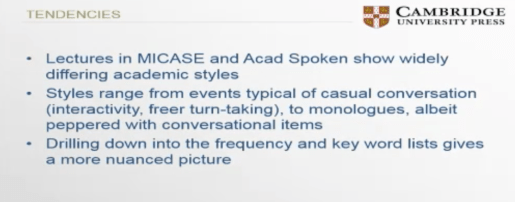
Here is a summary of the tendencies MM has covered:

screen-shot-2016-12-05-at-10-47-18

The remainder of the talk is an advertisement for Cambridge University Press’s Academic Vocabulary in Use book, which draws on what is learnt from the data, trying to capture the mix of chatty conversational items and items that are very peculiar to the academic discourse. The best grip on spoken academic discourse is through understanding the discourse roles of the tutors and the students, which influence how they speak – i.e. differently. They will use certain keywords and chunks, but the labels (e.g. lecture, seminar, supervision) used for speech events are a very imperfect guide of what will be included there.

This was a fascinating talk, one I’m glad I’ve finally caught up on! I always find it interesting to see how corpora are used and what is discovered in the process. Nice to see the “in terms of” chunk in there – it reminds me of my first year at the Sheffield University International Summer School, where during the induction Jenifer Spence – author EAP Essentials  and leader of the theory side of our induction programme that year – spent a fair bit of time hammering the importance of “in terms of” into us: we were always to be asking, and encouraging students to ask/consider, “in terms of what?” in relation to whatever it was that they were writing or saying! I had never considered how odd it would sound in an informal chat though, as per MM’s example “How was your holiday?” “Well, in terms of the accommodation…”  – not really! Unless you felt like being particularly pompous, I suppose… 

Winning the battle against low self-esteem (A guest post by Katherine Bilsborough)

Katherine Bilsborough has worked in ELT for 30 years. These days she lives in the mountains of northern Spain where she divides her time between writing and gardening. She very kindly agreed to write this guest blog post for me to share with you all. Enjoy it! 

Kath Bilsborough

Kath Bilsborough – copyright Katherine Bilsborough, used with permission.

Winning the battle against low self-esteem

Last year I wrote a couple of journal articles and gave a BELTA webinar on the topic of self-esteem. I looked at the psychology underpinning low self-esteem and in particular, its causes and consequences. I then suggested some practical ideas for increasing self-esteem, focusing on the ELT teacher. My reasoning was that if we can find strategies to increase low self-esteem in ourselves, we’ll be equipped to help our colleagues and our students too; first by recognising the signs and then by responding in a number of ways.

My interest in self-esteem emerged from my own professional insecurities and, in particular, from conversations I had with colleagues. They found it hard to believe that behind my apparent confidence and self-assurance lay a wobbling, self-conscious doubter who felt like a fraud and was constantly questioning her ability as a teacher and her right to be standing at the front of a classroom. I might have doubted my skills as a teacher but I was, apparently, an excellent actor. I’ve come a fair way since those days but I still have spells of insecurity and vulnerability. The difference is that now I’m armed with strategies to deal with them and it helps to know that I’m not alone. Even the most experienced, ‘big name’ professionals go through wobbly patches.

For this post, I’ve researched the subject further and come up with a more comprehensive list of practical ideas to help improve self-esteem. Items on the list are sometimes specific to ELT teachers but simple tweaks can make them relevant for students too.

Recognising low self-esteem

It is perfectly normal for everyone to feel down about themselves at times and even the most self-assured people suffer from a lack of confidence from time to time. But when the feelings persist it can be an indication that you need to sit up and do something about it. Some of the most common signs of low self-esteem are:

  • Being overly critical of yourself.
  • Ignoring your strengths and accomplishments.
  • Focusing on your weaknesses.
  • Comparing yourself with other people.
  • Being unable to accept compliments when they are given.
  • Having a negative outlook on life.
  • Worrying about not doing well or not being liked.
  • Exaggerating the things you perceive as negative.

 It isn’t always easy to identify the causes of self-esteem. Things like constantly being overlooked for promotion or being bullied are clear-cut. But sometimes motives are less obvious. The good news is that self-esteem levels aren’t fixed and there are plenty of things you can try to address the problem.

Twenty tried and tested recommendations

screen-shot-2016-10-31-at-16-38-17

The keys to winning that battle! (Picture by Bohman Keys, certified for non-commercial reuse with modification.)


1          Practise positive self-talk in order to build your confidence.

2         Keep a ‘positive calendar’ in which you write down three things each day that went well in class because of your efforts or actions.

3         Know your subject matter as well as you can by studying it further. CPD is an excellent way of increasing self-esteem.

4         Invest time and effort into the things you can change and try to ignore the things you can’t change.

5         Increase your understanding of the theories that underpin teaching and learning. This will make you a more confident teacher.

6         Do regular exercise. Being fit and active relieves stress and helps you feel good about yourself.

7         Do at least one thing that you enjoy every day. This doesn’t have to be something big. It can be something as simple as meeting a friend for a coffee or listening to your favourite music.

8         Make sure you are surrounded by people who are supportive, in the real world and in cyberspace.

9         Distance yourself from people who are critical. If this is difficult, try telling them how you feel and politely ask them to think before they criticise you in future.

10       Stop comparing yourself to others. We all have a unique blend of strengths and weaknesses. Everybody is good at something.

11       Don’t be too hard on yourself when you get something wrong. Learn from your mistakes and move on.

12       Get to know your students. The better you know them, the more effective your teaching (and their learning) will be.

13       Celebrate every achievement, however small.

14       Know your work context well. Make sure you know where resources are kept and how the latest technology works. Don’t be afraid to ask for help.

15       Talk to a colleague (or colleagues) about problems or worries you might have with your classes. Most of the time a problem shared really is a problem halved and two heads really are better than one.

16       Take pride in your ideas and your opinions and don’t be afraid to voice them. But don’t be afraid to change your ideas too. Willingness to change is a strength, not a weakness.

17       Don’t aim for perfection, it’s unachieveable so disappointment is inevitable.

18       Have realistic expectations in the classroom. For example, if you teach in a monolingual context, don’t expect all of your students to speak English all of the time. It isn’t going to happen.

19       Try to keep a positive attitude towards teaching. Joining social media groups of ELT teachers or creating a PLN will help with this.

Above all …

20       don’t be afraid to ask for professional help. Sometimes self-esteem can become severe and lead to depression. If this happens, you should speak to a doctor or a psychologist. Don’t forget that everybody is human and a cry for help isn’t a sign of weakness, it’s common sense.

All change!

Having spent 6 months (April – September) teaching EAP to approx. B2-level students preparing for entry into Sheffield University, and the last year teaching high fee-paying exclusively reasonably high-level adult learners (the youngest of whom were student age) a mixture of General English and EAP, I am now working in an EAL (English as an additional language) setting at a secondary school. My students are in their young to mid-teens with a very low level of English. They are refugees. The set-up in the school I am at is that they spend 12 weeks in an EAL unit, during which time they need to acquire enough English to join mainstream classes. If they don’t acquire sufficient language they have to repeat the programme. They are Arabic-speaking, Romanian-speaking  (have now added Arabic and Romanian to my list of languages I am studying!) and Slovakian-speaking. This may change, as new students can enter the unit at any time. The level of English within the group is very, very mixed. The level of home-language numeracy and literacy is also very, very mixed. I started on Monday, which was brilliant, and then the school got an OFSTED alert for this week so I’ve had to stay away since then. Of course next week is half term so I will start again the following (w/c 31st October). Am really impatient for it to roll around!

So, from thinking about how to teach synthesis of sources and paraphrasing and the like, I am now thinking about the list of topics we (my co-teacher and I) will be looking at next time I’m in, which includes things like The Gruffalo, Halloween and measuring length/time. My co-teacher is keen for me to come up with imaginative, practical, fun activities to do with these topics, to make them more memorable. This feels like it is just up my street! Unfortunately it is not a paid gig, I am volunteering. However, I think I will get a lot of out of it as an experience/opportunity to learn and hopefully can make a positive difference to these kids’ learning and school life. Interestingly, this is the kind of thing I was interested in doing before I did my M.A. ELT and Delta. In fact, for my Delta Module 3 I wanted to focus on EAL but it didn’t work out (crossed specialisms and lack of access to a group of learners for doing needs analysis etc). I guess this is one of the things I love about ELT – there is a lot of scope for variety, when you think about it. It covers such a multitude of contexts and focuses.

No doubt there will be multiple blog posts related to my new work, so watch this space! And meanwhile, if you have any fantastic Gruffalo and Halloween-related ideas, please do comment with them. Also, if you can recommend any YL-focused blogs/resources that would be grand too! Thank you! 🙂