IATEFL 2018 Materials Writing PCE Session 5

Designing materials that address learner and teacher spiky profiles

– Julie Day

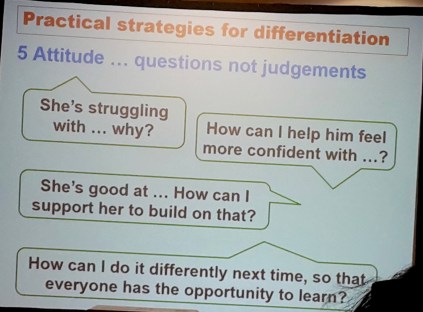
Differentiation – it’s time consuming and does it work anyway? We all pretty much agree that it is important and effective. “Plus-one learning” is owed to every student, ensuring that whatever their starting point, they advance (John Hattie).

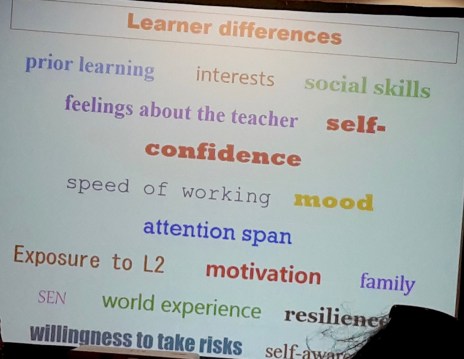
As writers, we should be helping teachers do this. In the classroom, we have students with spiky classrooms i.e. stronger in some skills than others, more or less literate in first language, more or less opportunities to use English outside the classroom. Teachers may also have spiky profiles, in terms of experience, qualifications, language level. Writers need to support both learners and teachers in this respect. So all learners learn the most they can.

Differentiation can be by:

Outcome: learners can produce somehting different e.g. sentence vs paragraph

Process: how they do it can be different e.g. some put sentences in order, others circle the correct word to show they understood

Content: learners do different activities depending on their abilities, interests or needs.

E.g. For a controlled reading practice: “easy”: T works with group to read words and identify initial letter; “middle”: match words to images; “top”: write missing words in spaces in a sentence.

If you expect differentiation, provide support to teachers to help them do it. E.g. “English My Way”

Activity: we looked at some tasks and discussed issues around difficulty and whether it creates more work for the teachers.

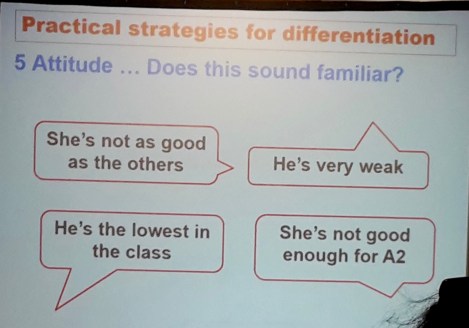
Initially as a teacher, you need to gather information about the learners through observation, to know what they need and what they can do, then plan and use materials accordingly. Materials writers can help by giving suggestions about how to differentiate at different points in their materials.

Activity: we looked at different ways of differentiating and discussed issues around them.

I don’t seem to have written much done for this talk, but there was a lot of pair work activity and heated discussion around it during the feedback stages, so I must have been too busy participating, spectating and digesting! 


IATEFL 2018 Materials Writing SIG Session 4

Writing for language education in emergencies and development

– Psyche Kennett.

Psyche started by sharing some staggering statistics and issues to consider:

It’s a big and difficult world out there. 66 million forcibly displaced people. 10 million are stateless, they have no third country to go to, no freedom of movement, no access to education or health care. 20 displaced people per minute. Of the 65 million displaced, 1/3 are refugees in camps/settlements and half of that 1/3 are under 18. Imagine you are a Syrian 17 year old, you are about to do your school leaving exam, and you are displaced, now you are in Turkey and you have to take it in Turkish. Imagine you are a Burundi teacher displaced in Rwanda. Rwanda has the most open education context for refugees but that would require switching to KinRwanda and English as the medium of instruction.

The rest of the talk addressed the issues which are raised by the issues touched on above.

How do we stop a generation of youth becoming the lost generation?

Language for resilience – harnessing the power of literay in additional languages so that forcibly displaced people can anticipate, withstand, recover and transform from shocks and crises.

By strengthening:

  • home language early education and adult literacy for social identity: being illiterate in L1 makes it very hard to learn another language. If you lose the identity of your home language and over-adopt the language of the place you move to, and then are rejected by that place (bad schooling etc), you have a huge problem. These people have alientation through loss of identity, no home identity and not accepted into the new society. This can lead to radicalisation.
  • strengthening second/other languages for access to education and employment
  • using participatory methodology for core skills and good governance. This is at the core of everything, that’s where the social inclusion/critical thinking skills will come from. ELT uses learner-centred techniques far better than many other subjects, this needs to be drawn on.
  • language programmes for providing safe spaces and addressing trauma – whether the physical space where the refugee is learning or the topics that are discussed e.g. avoiding talking about home and family.
  • institutional capacity for formal and informal language teacher education – are there enough teachers? do they have inclusive participatory methodology to help refugee kids?

Education in emergencies is usually catch-up education, condensing years of education into catch-up courses. This doesn’t work for language, you can’t teach it any faster than you already teach it. Education in development is national curriculum reform, writing textbooks for grade 5-9 etc It’s not an emergency situation, it’s a developing country situation. Working in camps in emergency situations gives you more flexibility than improving education in a school system, where you have to work with other stakeholders. In an informal situation in the camps, you have a wide open space. The problem is, parents want their kids to have the formal thing. Although there is a psychological attachment to the conventional idea (e.g. school leaving cert in a new language), what the kids need is other sorts of language and core skills.

The LFR materials development strategy does the following:

Tries to give refugees a sense of normality, if you give refugees a normal off the peg course book, that’s like saying “you are normal, you can do this”: uses an expediency approach. Also uses ‘methodology first’ materials for a process-based approach. E.g. Scaramaga camp in Athens, there are Afghans, Syrians and Yasidi Christians.  Syrians are on top, going on to a third country, Afghans are at the bottom as not going anywhere and there’s also a  third group who exclude themselves due to religious differences, so inclusive methodology is needed to help people from different backgrounds to participate together. Uses mother tongue materials in the classroom, and a community language approach, where the teacher works with the group to reformulate what is being said. Language identity is part of the content of the materials for a pluralinguistic approach. Core skills, peace education and citizenship materials for a rights-based approach.

Consensus orientation is an important skill. It means giving up you hold dearly and the other side giving up something they hold dearly so that they can move forward together. It should be taught on a daily basis. E.g. by doing a pyramid discussion. We did an example of this, starting by writing down three things that have struck you so far as important to think about in this context. (Then we did the pyramid discussion thing). If the list is a low stakes list, then consensus orientation is easier to build in, it’s easier to give things up. In a lot of contexts, women would give up ideas more easily as socially conditioned to do so. Through jigsaw reading, onion/mingling groups, pyramid groups, you are teaching, through the activity, a kind of socialisation, participatory skills. One of the root causes of conflicts is education – if you rote learn everything in education, you will follow orders and respect authority, not dissent, not change things. Critical thinking for refugee learners is important as it gives them the human right to analyse, to dissent, and also gives them a new skill they need to survive in a new world. For materials writers, if we use Bloom’s Taxonomy, we are teaching critical thinking – the sub-skills of critical thinking. It shouldn’t be a separate subject, but should be a fundamental core skill through having different tasks in the material that we write. Recall – concept checking; Process – thinking task, cognitive task, work through what you’ve understood; Produce – freer task, having analysed and synthesised and evaluated something you can produce something new. If you analyse a lot of textbooks in developing countries e.g. Burundi, Sudan, Nigeria, Syria, they often don’t go further than the remember/recall. Synopsis is a high level task, as you have to eliminate things and prioritise things yourself, make those decisions.

No one is writing anything for these contexts. Education in emergencies, you are relying on a big donor. They are reluctant to do English. UNICEF/UNHR are beginning to see that language is a massive excluding factor, not only race/geography/special needs etc There is a lot of money out there but it’s hard to access it. You can’t have global refugee textbooks. Biggest need is A1-A2 in middle Eastern contexts and A0 in sub-saharan contexts. As well as the language, non violence communication, equity and equality, accountability, transparency etc need to be written in, overlaid into the materials, as well as functional survival literacy skills for survival in the new place. E.g. register for housing, go to the bank etc. The proposal has to go to the big donors. They are just cottoning onto the need. For a framework rather than material.

You need to integrate citizenship skills, survival skills and language skills. For Greece, Turkey, Syria, Germany, there is a space for something they could all use, that kind of book. The British Council need to bring the publisher and the donor together like a broker.

IATEFL 2018 Materials Writing PCE Session 3

Are you writing for all learners?

– Romulo Neves

The most unequal thing is to treat unequal people equally.

Romulo did an activity to demonstrate how students may feel in the classroom when they are finding something harder than others. (We had to say the alphabet and follow instructions, allocated by letter, to lift our left or right hand – harder than it might sound!) The goal for today is not to suggest that materials writers are doing the wrong thing but to show us some ideas to help certain types of learners so that we could take one or two forward when writing the next course book/set of materials.

Autism

difficulty with social interaction, limited or inappropriate interactions, robotic or repetitive speech. Also love repetition and structure, if they can’t predict what is going to happen, they feel anxious/nervous and start to daydream/escape. Lowering the bar is inappropriate as they may be as  bright as others.

Romulo did an activity in which he read a sentence and we had to write down certain words. The goal was to show us how easy it is to get lost and switch off. Then we looked at a page from a course book in two different versions – the more inclusion friendly version looked less “pretty” but had the capital letters at start of sentence in bold to draw attention and boxes to write the answer, as well as less content on the page/more white space. No Picture. The names of the characters in a dialogue are in a different font and colour to differentiate between the names and the speech. If you have a choice of words to fill in a blank, have a blank box to write the answer and the choice words after it. Every unit should follow the same pattern i.e. what you are going to do in each activity – a “map” of this is helpful.

Reduce instruction words and teacher talk by including cards at the back of the book for “Feeling great” “Have some doubts” “Need help” so they don’t have to interrupt to communicate. With speaking, give an example of what they are going to say so that they have something to guide them to know how to work together.

ADHD

They do pay attention but they pay attention to many things at the same time so it is hard to focus. They have no idea of time management, they are always moving. Matching is easier than writing an answer, as no scope for misspelling. Two questions rather than three – same amount of time, do it better. Separate texts, e.g. if there are two postcards, don’t have them together on the page, and use less imagery. Mini-whiteboards are calming as they write rather than speak. Emphasise good behaviour not bad behaviour – give a sticker for good rather than chastising for bad.

SPLDs

Letters, numbers, right/left, rotation problems.

Visual dyslexia – need to listen to the information in order to understand completely as the letters rotate.

Auditory dyslexia – need to read the information as short term memory disorder.

Reading rulers are useful. OpenDyslexic in a new open source font created to increase readability for dyslexic students. Record as much as of the course book as you can in audio that students can access online. Use visual aids (e.g. arrows) to show where to get the information from and vocabulary tables with “I know this word”, “I recognise this word”, “I don’t know this word”. Provide templates and examples for them to follow.


IATEFL 2018: Materials Writing PCE Session 2

The second session was led by Laura Patsko, talking about…

Creating effective pronunciation materials.

  • Why include pron in materials and classes?
  • Market demands vs market needs (not always the same thing!)
  • Principles for designing useful pron activities
  • Mini-workshop

Why?

Research says it works – controlled practice carries over to other contexts. Helps intelligibility and listening, but also improves reading speed for example, spelling, writing, grammar and vocabulary. Students may avoid structures because they can’t pronounce them rather than because they don’t know them. Teachers around the world often lack confidence and training (related – training and confidence go hand in hand!) Students and teachers want help with pronunciation. Laura has done lots of training with different teachers, in different places, they often say the want it!

Market demands vs market needs

When teachers look for pron in materials, they are looking for activities that will help students get rid of problematic pronunciation and sound more native-like. Worth reiterating that the vast majority of English users do not speak how materials suggest they should. “We are already living in a world where most of the varieties we encounter are something other than British or American English” (Crystal, 2000) so we are not helping students if we only teach them using British/American models. Research also shows that accent and intelligibility are not the same thing. They are related (Derwing and Munro, 2009 or anything they have written is worth reading on this issue) but they are separate phenomena. Communication and pronunciation is a two-way street. A listener’s expectations of what they are going to hear will impact the extent to which they find someone intelligible. Ample research suggests that monolingual native speakers are often the most difficult to understand in international settings.

Market demand that requests native speakers is largely our own fault as an industry as ss are stuck in a vicious circle that we perpetuate. “All varieties are equal but some are more equal than others” is the message if the only variety they encountered in their materials is a prestigious minority variety (which has been the case for many years). We need to bear in mind how much of what markets say they want vs what they need (what they will encounter outside the classroom or even inside the classroom). Realistically and psychologically we are also asking for a leap of faith, we are trying to get students to leap into the 21st century – even if we are convinced, students need convincing. So materials need to be high quality.

Evolution not revolution with regards to approach: we don’t have to reinvent the wheel.

Principles for designing effective pron materials for an international world:

  • identify appropriate priorities for the syllabus (nothing new but we need to consider what these are in an lingua franca English setting, what we are preparing students for)
  • identify the key markets for the course – cover the needs of speakers from those L1 groups. The strongest influence on L2 pron is L1 pron. Important to match areas of ease and difficulty. Hard but not impossible for a global market. You may need to research the L1 if you don’t know a lot about it.
  • Distinguish between productive and receptive focus in activities. Issues in listening can arise from pronunciation. Make it clear why activities are useful, what they are focusing on, for both students and teachers.
  • As a general rule, start productive tasks by raising receptive awareness, within a syllabus and within activities.
  • Include a variety of authentic accents not actors doing voices. Hard if writing for a publisher, hard to find actors etc from all over the place but if you have a voice actor putting on an accent, it’s false and defeats the object of what you are trying to do – raise awareness of the diversity of accents.
  • Pronunciation can and should be integrated with other skills. E.g. in guided discovery of grammar, include some pron questions. Developing phonological awareness can improve all four skills.
  • Repeat key features across multiple levels. Repeat, revisit, revise, just like you would with anything else.
  • Include pronunciation in revision/review sections – not only grammar and vocabulary. Don’t give them impression that it didn’t really matter or you justify skipping it.
  • Be careful in the rubric about how you present information about accent and voice. E.g. “we say” – who is we? There are ways of grading that avoid that kind of possessive language. E.g. “some speakers say”,  “clear.
  • Ensure design is consistent with other important sections. Don’t make it look expendable. No smaller font size or different heading. It makes it look less important. With bigger publishers and extensive teams, designers may not know this so have that discussion. If it looks missable, it will be skipped.

Principles for supporting teachers through materials. (Research suggests that published materials could do more to support teachers.

  • Offer guidance in how to evaluate and assess students’ pronunciation. How do they know if the students achieved it well? Explain it clearly.
  • Include clear explanations of pronunciation features – don’t assume teachers know. Otherwise they will skip it because they won’t know how to answer student questions.
  • Remind teachers of other points in the course that it might be useful to refer back to. E.g. “We’ve seen this in unit three” or “See explanation in unit 3” i.e. where they can find the information elsewhere.

The rest of the session was spent on the practical workshop aspect, in which we were applying these principles through looking at tasks in Laura and Katy’s new book:

Click to find out more…

Based upon this talk and the tasks we looked at, I would highly recommend having a look at it!

IATEFL 2018 Materials Writing PCE Session 1

Here I am again at a MaW SIG PCE, which no doubt, going on past experience, will not disappoint!

The theme of today is Writing for the World, based on the realisation that a lot of writers are writing for specific situations/populations with unique needs. Mainstream materials are not sufficient, so something else needs to be done. Tania gave the example of writing for aboriginal students in North America. Who are they? What do they need? How can we give them that? The PCE will be looking at situations where English is a lingua franca, writing for refugees, writing for ESOL learners (who have spiky profiles) and writing for students with special educational needs.

The first session of the PCE is by Marek Kiczkowiak, the founder of TEFLEquity Advocates:

ELF and materials writing

There is a huge problem when it comes to job ads, many still require native speakers only and tehre is a widespread belief that NS speak with the “correct accent”, have a feel for the language that NNS can’t have etc. Debatable. What is important for today’s talk is that these beliefs don’t just lead to discriminatory hiring policies but also influence how materials are written. When we write materials for EFL or ESL, we are quite likely to emphasise conformity with a standard model, there has also been emphasis on “target culture” (often British/American). This would be fine if it were like Polish, if you were learning Polish it would be because you wanted to learn about Polish culture and interact with Polish people. English however is now a global language so why would we focus on native speaker culture and norms? We need to prepare learners to use English as a lingua franca, which requires a different approach to materials writing. Such a change would help the profession move away from the damaging beliefs around NS-NNS and reflect the global nature of the language.

How can we make this transition from writing materials for EFL to writing materials for ELF?

  • What is ELF?
  • 7 assumptions behind writing materials (not an attack but a call for change, a suggestion for change, to move from writing materials for EFL to writing for ELF)
  • Three practical activities that could be included in coursebooks, could be used by materials writers.

Definition of ELF – a context where lots of people speaking different languages use English to communicate as the only common language between them. E.g. in business meetings. Business is primarily conducted in English. Also in conferences, lots of different L1’s, but English is the common language of communication. Higher education is another context, as well as tourism. ELF is a 3rd paradigm, distinct from EFL and ELF.

Assumptions:

The more native-like the pronunciation of a student, the more intelligible they will be. However: it is not proximity to NS model that makes a speaker intelligible in an international setting. It can actually make you less intelligible in a LF setting. A study took over 1300 people from 11 different countries and had to listen to recordings of different speakers, only one spoke a standard variety (American) and he was judged as least intelligible across the board (second only to one from Hong Kong).

Frequently focus on NS models of culture – British or American typical. Tomlinson and Masuhara (2013) concluded that materials predominantly focus on British or American culture. Another study found that when other cultures were introduced, it was done in a very simplistic way that resulted in stereotyping other cultures and critical reflection on other cultures was not encouraged.

The language that students were taught in coursebooks analysed by T and M, standard middle class British English was the target. However proximity to a standard model is not what makes ELF communication successful, it is particular communicative skills. A study looking at students from various countries studying in Italy, analysed 120 hours of communication, one of the communicative strategies that helped communication be most successful was paraphrasing.

We also need a wider variety of authentic non-native accents. Exposure to lots of accents helps students understand those accents. We do a good job of helping students understand standard native speaker accents, we need to extend this.

Authentic English examples are taken from corpora but they are native speaker corpora. What is authentic language for non- native speakers? Language used in multingual settings, between non-native speakers. We need to use ELF corpora e.g. VOICE, ACE, ELFA, to tap into authentic language.

If you are multilingual, you know that when you speak the language you will use words from other languages. That doesn’t mean you don’t necessarily know the word but you want to facilitate communication, or to signal identity, or it’s just easier. Marek uses Polish, English and Spanish interchangeably. At his hotel, speaking to a Polish speaker, the hotel clerk used words like checkout and checkin.

We also need to raise students’ awareness of all the issues talked about in this session, about the global nature of the English language. They don’t need to agree but it is important that they consider the issues critically.

Focus on 3 areas and 3 activities to use in materials writing

Intercultural skills

List three things that define you as an individual and three things that define the people in your country:

Me: Vegan, teacher, gay

People in this country: ???

We then had to discuss some questions which had us compare lists with a partner, see if there was anything surprising in the country lists and suchlike. The final question was: What does this tell us about culture and identity?

Promote multilingual English use

We looked at a dialogue with some code-switching in it – réunion vs meeting (building rapport?) – and parfait/buenìsmo (could be signalling identity). Shouldn’t assume they don’t know the English words.

  • In a course book in Germany – 25/29 interactions were only between native speakers of English.
  • When NNS appear in dialogues, often they are not successful ELF users, they are someone struggling to buy a ticket for example.

Marek has developed an easy to follow step by step guide for teaching and writing for ELF (see flyer – can also download the slides) – prerecorded sessions, reading suggestions, forum – with special offers for IATEFL week: plus free teaching ELF pronunciation course plus pronunciation interviews with experts plus teaching ELF interviews with experts.


Preparing for IATEFL 2018 (paragraph blogging)

I first came across the idea of paragraph blogging because Sandy Millin gave it a go and I read her blog regularly. Given I am using bullet points, this isn’t technically a paragraph BUT it is a much shorter post than I am usually given to writing, so I think that is in keeping with the general concept, one which I may revisit post IATEFL as it is about the only way I will have time to publish anything for the next couple of terms!

Usually my preparations for IATEFL include asking and answering the following questions:

  • What will I see (peruse the programme and highlight far too many things – how many can I squeeze in?)
  • Who will I see? (make plans to catch up with a bunch of people)
  • What/where will I eat? (are there any eateries that are me-friendly i.e. cater for vegans? If not, where is the nearest supermarket? Thank goodness for self-catering.)
  • How will I decompress? (Any nice spaces for walking or running to alleviate the effects people-heavy nature of conferences on an introvert?)
  • How do I get from my accommodation to the conference centre and back again? (study Google Maps and pray)
  • Who is covering my classes at work? (Make sure they have everything they need to do it easily)
  • Have I packed my data cable? (Where did I put it after the last conference???? In a safe place…)

This year, I am adding the following questions:

  • How many essay outlines can I give feedback on via Turnitin while I am at the conference? (There are up to 30 – if all my students submit – being submitted on Sunday and I have two weeks to mark them in. One of those weeks is IATEFL. The other of those weeks is one in which I will need teach all my classes, mark up to 80 listening exam scripts, or two groups worth + double marking, and do all my ADoSing duties as I have been made an ADos for this term and next term.)
  • Can I finish marking all the reading and writing practice exam scripts (x30) on the train on the way down South? If so, will there be time also to look at the conference programme and my talk (which I prepared, thankfully, late last year but need to review)?
  • How best to organise my time at the conference to maximise on good sessions, catch up with people, keep up with marking and decompress as needed (and ideally fit in some eating and sleeping too!)?
  • How much extra admin (e.g. tutorial timetables, speaking exam timetables, meeting notes, checklists, draft emails) can I do this week to save myself a few headaches in Week 3 (a.k.a. the crazy week awaiting me on my return)?

To anybody attending IATEFL this year, or to anybody who has attended IATEFL in the past, what questions do you ask and answer in preparation? 🙂


18 things for 2018

The first month of 2018 is already at an end (how did that happen?!) and I’ve yet to publish a single blog post! This is due to a combination of a busy week-day schedule and my no-work-at-weekends policy (something I aim for but don’t always succeed with – I gave a webinar for an EVO course a couple of weekends ago, for example.) Anyway, finally I am getting round to writing a blog post again. “18 things” is, deliberately, rather vague. Things to do? Things to remember? Things I am thinking about? Things I am putting off? Things I am looking forward to? Things I am trying to do? The answer, is a mixture of all the above!

Things to do

  • Write a 7000 word book chapter (so far, the abstract is done and submitted – all of 500 words…!)
  • Mark 48 formative assessment paragraphs (well, strictly speaking this will enter the list on Monday from 9am!)
  • Figure out how best to teach the dependent and independent clauses lesson that is scheduled for my lessons next Thursday/Friday (when I have volunteered to be observed by a CELTA trainee from the ELTC!).
  • Go to that training session about “Learning Conversations” (tutorials) that is scheduled for today.

Things to remember

  • If it’s not raining, stick waterproof trousers in the pannier anyway – it probably will be for the ride home later! NB no rain does not necessarily equal no need for waterproof trousers – the roads may still be wet from the last lot of rain and therefore you will end up being liberally covered in ‘rain from below’ (aka spray) sent up by your wheels or passing car wheels.
  • Studying Polish on Memrise is really quick, I can fit it in. Progress may be slow when doing it in such tiny increments but it is still better than nothing!
  • It’s ok not to do all the things. There are only a fixed number of hours in a day and days in a week (sadly) so the need for first, second and third-level lists of things to do is real. Some things may not make it on to any of the above and that is ok too!

Things I am thinking about

  • How cool is google docs? We have been working on main body paragraphs and cohesion and introductions/conclusions in recent lessons, and having students write them in pairs on a class google doc not only makes it so much easier for me to give feedback/suggestions as they are writing but also enables the students to redraft in successive lessons based on new input.
  • What makes a woman a woman? What is a woman? Seems like whatever definition you come up with excludes people that are also definitely women! On a related point, is being a woman but bucking stereotypes/gender roles etc similar to being ‘non-binary’ or ‘gender-queer’ or not? If not, what is the difference? (I am doing the online dating thing at the moment and have encountered a fair number of people who identify as gender queer, non-binary or androgynous, which is what has sparked this question!)
  • It’s already half way through week 4 of term – how did that happen? I have three lovely groups of students (now 16 to a class but initially were 20 to a class). Am I ready for tomorrow’s lessons? (yes) Have I sorted out all the admin-y things I need to have done at this point? (I think so…) I need to bring more teabags into work soon. Where is that training session happening again? (Errr) …Aka general teacher-y thoughts, I won’t bore you with any more!

Things I am putting off

  • Making a dental appointment. I really ought to go to the dentist for a check-up. Finding time for the initial appointment and the inevitable follow-up fix everything appointments hasn’t happened yet. This may have been on my list of things to do since about last summer…
  • Making a decision about the mountain marathon I entered last year, that will take place in July this year. This term my schedule in combination with winter doesn’t lend itself very well to running training, so my longest run for a while has been 12k. Realistically I won’t be able to run a marathon in July. But you never know…next term and the one after might be different…and the days will be lighter longer so there will be more scope for training…

Things I am looking forward to

  • I always look forward with great enthusiasm to my next meal or even snack. I suppose that is a consequence of all the exercise I do! In relation to this, also to any cooking (always in batches cos time!) and baking (see “snacks” above) I do.
  • IATEFL!! I am going this year, unlike last year. The accommodation is booked and everything.
  • Trips to Sicily to see my horse babies. Star was born 9 and half months or so ago (mid-April, apologies if my maths is incorrect!), I will be going to see him and mother Alba in late March, when he will be nearly a yearling! Also hoping to go in June and September. Haven’t been since last September. A long autumn term and that pesky thing called Christmas cause the imbalance in numbers of trips able to be made!

Things I am trying to do

  • Keep a healthy work-life balance (the “no-work-on-weekends” rule is part of this! Additionally, as my schedule involves early morning work and late afternoon work, for the most part, I am aiming to do some form of exercise on all the days in question – either swimming or bouldering, as these are most accessible from my workplace – in order to get me out of work and off my behind briefly each day in the long hours between the cycle commutes.)
  • Keep studying Polish. I have given up on all my other languages for now. (Except Italian which I keep up out of habit, ditto French) There isn’t enough time for everything. Hopefully in future I will get back to them again.
  • Get back into climbing…I used to be a keen climber until about 2010 when I went abroad to teach. Since then I have done the tiniest smattering. I’d like to get back into doing it outdoors on rock. My indoor bouldering this term is hopefully a precursor…

So, I think that’s 18 things (I counted twice but I don’t trust my maths at the best of times…) that give a snapshot of where I’m at the moment. I will endeavour to squeeze in more blogging in the coming months – at least there’s sure to be a good handful in April! 😉 I’ve just noticed the “Things I am trying to do” section is all non-work related. I’m trying to do lots of work-related and CPD-related things too though.

If anybody fancies writing their own list of 18 things, like this one, and finds the time to do so, I’d like to see your snapshots too so share a link with me in the comments here! 🙂

Belated happy new year to all of you!

Mental Health in ELT – the discussion continues…

A few months ago, I wrote a blog post about mental health in ELT, sharing links to various newspaper articles that point to an increase in mental health problems within education in general, among both teachers and students, and sharing my own experience of poor mental health in the workplace. I am pleased to now share with you all the good news that the topic of mental health, which we can all agree is a very important one, will be the focus of at least one session at IATEFL.

Phil Longwell will be doing a talk about mental health, part of which will draw on the results of a survey that he has published in order to collect qualitative data relating to this subject. It would be great if as many people as possible complete the survey, as this would provide an interesting insight into the state of mental health of teachers in various ELT contexts. I encourage you all to complete the survey and look forward to hearing about the insights gained when I attend Phil’s talk next year.

IATEFL Webinar – “Research is for teachers? You must be joking!”

I have a geeky liking for research so my interest was piqued by the title of this IATEFL webinar by Richard Smith of Warwick University, so I decided to attend. It was an interesting way to spend an hour on a grey Saturday British winter’s afternoon. Here is what I managed to catch with my ears and fingers: 

Richard aims to offer positive solutions to the research – teaching gap. He wants to advance the claim that there can be research for ELT Practitioners but we need to rethink how we think about research in some ways. He wants to focus on teacher research.

Background:

There have been articles recently and last year in the ELT journal stating that research is largely irrelevant to teachers. Richard did a poll for what we think from strongly agree to strongly disagree 1-5. It can’t be denied that there are many teachers that would agree with this. R isn’t going to go over all the arguments in the articles by Medgyes and Maley. Teachers say researchers just talk to one another, research isn’t accessible to teachers, we have to pay for access to them and even then they are written in a language we can’t understand, while researchers say they need to be precise, use a precise language, hedge, show the complexity of issues. The argument can go back and forth, with quite a lot of heat. If you look at the articles to Medgyes and Maley, you will see there some good responses, some supportive and some against.

Richard thinks there is a lot of truth in the idea that a lot of research is not so relevant to teachers but there are some quite bad stereotypes regarding what research is, imagining it as positivistic and experimental, but also imagining that researchers are very far from teachers. Smith sees himself as a teacher, a teacher educator and a researcher, and this is how he has always seen his role. He feels that in his work he relates what he is doing to how he was as a teacher and how he is now as a teacher, and that other researchers do too. He thinks we need to find a middle way where we are not stereotyping or dichotomising researching and teaching.

He did a poll regarding “not all applied linguistic educational research is relevant to teachers”. Which was mostly agreed with. He said that suggests that some research IS and shifted the focus to that more positive direction. He showed us this:

In this book, Palmer was trying to set up something like applied linguistics, a research field of study that would help teachers to found their teaching or base their teaching on firmer foundations. In the book is a lot of complex jargon but also it’s an explicit attempt to link science and language teaching. 1917 is considered the beginning of a scientific period in language teaching that went for at least 50-60 years, and you could argue still continues now. How can we improve language teaching through reference to background disciplines? A past example is the audio-lingual period, based on ideas that linguistics can provide answers to language teaching in a very direct way. There were also things going on before Palmer:

Non-native speakers in France wanted to use phonetics, something from linguistics, in the classroom, as something helpful for language teaching. The indispensable foundation for language teaching according to Henry Sweet.

According to Palmer, we don’t lack method, we lack the basis for the  method. He wasn’t a dogmatic methodologist, he believed that we needed research to have a rational basis for decisions regarding what is good in different contexts. For different kinds of classes or students. Prabhu, in India, has said the same thing – that there is no one best method, we need different ways of teaching to meet different needs. However, this has not always been the case, there have been plenty of people with attachment to one particular method or another, in a quite dogmatic way. Palmer says we don’t just take from background disciplines, we have to as practitioners confirm and justify these principles by putting them to the test of actual and continual practice. As a teacher, in Belgium, he explored the possibilities of various methods, one after another, adopting and discarding one or another as the result of research and experience. He was an action researcher. In 1922 he went to Japan and founded the Institute for Research in English Teaching.

This institute involved many Japanese school and university teachers and was like a teacher association. There were annual conferences. They issued “The Bulletin”. He also put out books e.g. English through actions.

It was just one way. There were different ways, and the idea was for the teachers to pick and choose.

Michael West was another person who worked in a similar way, in Bangladesh, producing especially reading materials. He and Palmer were both active in the development of extensive reading, and reading material for teaching a foreign language language e.g. graded readers. Palmer’s materials influenced Hornby’s approach (situational language teaching).

<My internet died briefly at this point so some more information along this vein is missing. I pick up with the return of my internet below:>

1970s – there was a golden age of good links between theory and practice, in terms of applied linguistics in the UK. This was when communicative language teaching was developed. Smith says it was perhaps unfair of Maley to say there was nothing coming from research to teaching. There was a lot of good linkage but nevertheless there is a perception that the two sides have grown apart again. The ‘problems’ regarding English language teaching are now ‘bigger and wider’, maybe?

Smith says we can try to change the situation and this is the focus for the next part of the talk. He talks about a project that started in 2009, whereby British council recognised that real world concerns of practitioners not being addressed by research. So, they wanted to do a survey of ELT research. They were keen for the project to look for research that is relevant to English teachers. ELT research was defined as:

He did this with Sheila Rixon. They were interested themselves, as they didn’t know what research was going on that wold be relevant to teachers. The answer was, more than you might expect. The project has now finished, so the database is no longer updated but at the time a lot of research was going on around testing, much by Cambridge Assessment/CRELLA. There was also a lot of research being done by publishers to find out more about materials and target markets, but that isn’t published research. There was not much research into English for young learners. Which is a paradox as it is the most widely taught across the world. There was also not a lot of research into language teaching in developing countries except by visiting PhD students. Finally, there was also not a lot of teacher research published.

Positive ways for bridging the gap that Smith has seen:

  • TESOLacademic has recorded keynote speeches and made them freely available.
  • ELT research bites (E.g. Language Teaching in the past)
  • Blogs e.g. by Scott Thornbury, Geoff Jordan who mediate between research and teachers, making it more accessible.
  • There are also an increasing number of open access journals/articles/chapters.

However, there is a perception that research is still very much removed from teachers.

Smith argues that we should take the idea of ELT research further. Define it more strongly as research for ELT practitioners. He thinks it has started to happen in some ways. British council has started some research awards:

He puts forward something that sounds good in theory:

And says he has seen it in practice. E.g. researcher/teacher collaboration. Allan Waters was very keen on this idea. It doesn’t go on as much as it should but there are some positive examples. University/training college partnerships and teacher association research are other possible contexts for this. Encouraging teacher research is another form of this reconceptualisation of research.

Teacher research is:

In the context of these debates, teacher research has come up to some extent but could be addressed more. It’s quite common for teachers to say they don’t have time, researchers may look down on it. Smith doesn’t want to go into that today. Instead, he wants to share some of his own experience in introducing teachers to teacher research. He has come to see it as a useful and important way to address and solve (to some extent) problems. We need to address the images that teachers may have about research not being for them but for scientists, involving a lot of reading and report writing. We need more appropriate definitions, images and models of research.

Here are defintions that he has used with teachers:

If we use definitions like this, we can start to show teachers that research is something they carry out in their everyday lives.

This is something Smith does in his teaching fairly often:

Do we think it is research, he asks. Data is collected. Categorising is analysis of data. It’s useful for him. Does research have to be shared widely? Not necessarily? It’s also feasible for teachers to do.

Research is exploration, he puts forward. Feasible for teachers even in difficult circumstances. With a group of teachers he went through the following process: What are the problems? Turn the problems into questions. Try to answer the questions. Go away and try out some of the ideas put forward in the answers.

Exploratory action research – The Champion Teachers project in Chile. This was a more gentle introduction to action research, ensuring that the action would come from the exploration of the context. He didn’t have time to talk us through the example but you can read about it in British Council open access book about exploratory action research.

If you are interested in this topic and want to know more:

  • In January/February there is an Electronic Village online where there will be aClassroom-based research for professional development. The link to it is on the page of links here. It is free and gives you guidance on doing classroom based research. They will have 25 voluntary mentors. It takes place over five weeks from January to February.
  • There is also a Facebook group for Teacher research.
  • There is the Research SIG.

Here are some useful links that were shared in the “Links” part of the webinar platform by various people:

From the Q and A at the end:

Coming up with questions related to the situation – what is bothering you? Un-peeling the onion of the situation. Asking yourself questions and then finding the answers by collecting and analysing data. (Exploratory) Then you plan some change, try the change and analyse what happens (action research).

If it is so close to practice and what we do anyway, then why call it research? Is the word research itself the problem?

It does have the connotation of being far from teachers, reflected in the arguments that go on, Smith has been arguing that it shouldn’t be seen in that way. Research can be an empowering form of inquiry into what goes on in the classroom. ELT research can include teacher research and university researchers who work with the concerns of teachers, with a coming together in the middle. This goes back to the collaborations that he spoke of earlier. We should aim to find the middle ground.

If you attended (or are Richard!) and think I got anything down wrong, do let me know so I can edit it! Thank you Richard and IATEFL for a great webinar. 

Bite-size TD at the ELTC

Teacher development is a key part of working life at the ELTC and the team who are in charge of it this term recently rolled out a new initiative, “Bite-size TD”. The idea is to build up a collection of recordings done by teachers of short talks on a range of topics, that other teachers can watch when they have 15-20 minutes spare and fancy a bit of CPD.

I volunteered to do a whistle-stop tour of www.wordandphrase.info/academic which is a corpus tool. Without the /academic part of the web address, a general corpus of texts is analysed, with the academic part included, it analyses a corpus of academic texts from a range of disciplines. Both sites work in exactly the same way, so what I talked about today could equally be applied to the general version. My powerpoint was adapted from one that I used with my ESUS (English Skills for University Study, which has since undergone a few changes and been renamed) students last term, with the aim of introducing the site to them through the medium of guided discovery.

My talk worked in two ways: a) For teachers unfamiliar with the site, I suggested they use the pause button a bit and try to do the activities on the site as they went along, to understand better how it works. b) For teachers who were already familiar, and for the teachers in a) once they were familiar, it modelled my approach to introducing students to the site and provided some example activities that they could use with students.

I suggested that as well as using this approach in class with the students as an introduction, it’s useful to reinforce it by:

  • modelling use of it yourself in class if students ask you something about a word/phrase. (Particularly if you can project it)
  • using it in tutorials based on students’ written work, to guide error correction
  • encouraging students to use it before submitting a piece of work, to check their use of key language

Here is the powerpoint I used (click to download):

I’ll add the recording later if the link is a public one, but you should be able to follow what to do via the powerpoint, it’s step-by-step and the answers are included.

Do you use wordandphrase.info(/academic) with your students? How? Would love to hear about your approach/ideas for using it via the comments box below. 🙂

Happy weekend, all!