
ELTC Training Day 2016 – my takeaway (including lots of tech-y stuff!)

After I did my learner autonomy workshop in November, I was invited to repeat it as part of the ELTC Training Day which took place on Thursday 14th January this year. I didn’t need asking twice to be part of this exciting programme of sessions – so duly organised my holiday to be back from visiting family and horse in time to participate! The day didn’t, of course, disappoint. There were two parallel sessions running throughout the day with a tech-focused block and a development-focused block in the morning and again in the afternoon. (I gather the lunch provided in between these two sets of session blocks was rather good, though I did the packed lunch thing which is always easier when you’re vegan :-p )

As all the sessions were really useful, I thought I’d share my notes/take-away from each of the ones I attended…

Smartboard Extras

Smartboard Fun!

Do you have Smartboards at your school/centre? We have. And with Smartboards comes the responsibility of a) knowing how to use the thing properly and b) using it in a principled manner in your lessons!

It turns out that the newer versions of Smartboard (Version 15.1 onwards) have some additional interactive functions built in, that allow for student participation using mobile devices. Much of it is geared towards school children *but* one of our tech gurus, Nick, identified and shared with us a couple of features that lend themselves to use in the ELT classroom.

The first of these is the ability to post things to the board. This can be text or images (pre-selected by the teacher depending on requirement) and the board can be open or divided into categories (again, pre-set by teacher).

Basically, to set this game up, the teacher selects the “Lab” button, which is in the toolbar of Smartboard and looks like a Top-hat that a magician would use, and chooses to add an activity of “Shout it out” which is mobile-enabled. The default setting is “categorised” board and you can either switch that to open board or keep “categorised” so that in the next step you will then set the category titles. You can have up to four categories. You also need to choose the type of contribution (i.e. text or images) and the maximum number of contributions per device. 3 is the default but you decide and change accordingly. NB: one device could mean one student, a pair of students or a group of students, depending how you want to run the game/your goals. You could then add a timer or buzzer if you felt it necessary (bearing in mind that timing out doesn’t stop the game and stopping the game doesn’t stop the time! It’s not that fully integrated yet…) and load the game.

You will have a dialogue box and if it is the first activity you do on a day with a group, there will be as yet no contributors. If you do a second activity, the contributors remain loaded, but can be added to. When you click on “start activity” a code is generated and students must input the code into http://www.classlab.com. They will have a screen that requires the code and a username. This username will be associated with a symbol and that will appear next to all their contributions on the board. (NB you may want to turn off the screen while the students do the activity to stop them seeing each other’s contributions, if it is a competitive activity!)

It is useful to cue your computer to the point of the dialogue box being open and the code being generated (so clicking on “start activity” after which you can pause it) before class starts, as it takes quite a while to load fully. You can hide the dialogue box by clicking on the “activity” button, and clicking again reveals it again.

Suggestions for use include but are not limited to revision of vocabulary and academic language e.g. linkers. (One of my challenges to myself is to come up with different ways of using this with my latest group of students who I started teaching yesterday evening, so watch this space for related blog posts! Likewise the picture activity that follows… )

You can use the same activity “Shout it out” for picture sharing. In this case, the set up is the same but you select images rather than text as the contribution type and use ‘arranged randomly’ rather than setting categories (a setting that could also be useful for brainstorming vocabulary, for example, if you use text rather than images!). Again, a code is generated, which the students enter into http://www.classlab.com.

Smartboard also has the capacity to enable teachers to create quizzes and questionnaires. This works in a similar way to google forms but with the added advantage of students being able to respond live in the class, using their devices, alone or in pairs/groups while the teacher can control the time spent per slide or per activity as a whole. It also enables you to view/display graphics showing answers chosen by participants.

A final tip we were given was in use of the pens. You know how when you write on the Smartboard and it looks like a five year old could have done better? Well, if you choose “Text Pen” which is under the pen function, when you write on the board it automatically converts into text! According to Nick it’s pretty accurate even with his writing, and you do have the option to select “x” if it gets it wrong, and that will revert it to handwriting again. Or you can select the tick and edit it, if you prefer.

Ideas for doing a TD session

This was the other TD block session I went to other than my own, and it too gave some food for thought. The TD programme at the ELTC is very teacher-led – the TD team are teachers (as vs. managers) and of course the scholarship circles are teacher-managed too. There seems to be one and often more than one workshop in any given week, with various focuses. Teachers are always encouraged to give workshops (as part of their own development) and attendance isn’t compulsory. Of course, teachers are expected to log 3hrs a week of scholarship time, and workshops can be useful to this end.

Anyway, this session was aimed at teachers who are interested in delivering workshops and we looked at:

  • reasons for attending a workshop
  • reasons for giving a workshop
  • different delivery formats
  • things to keep in mind when preparing a workshop

Reasons for attending included: to support a colleague, to help log scholarship time, to see what others are doing in the classroom, to share ideas, to learn/increase knowledge and skills, amongst others. Reasons for giving included: to help log scholarship time (!), a way of developing yourself, sharing research, sharing ideas and getting feedback on them, feeding back after attending a conference, amongst others.

We looked at different delivery formats and suitability to different scenarios, so talks, presentations, workshops, panel discussions, structured discussions and unstructured discussions, and also agreed that within a single session there may be elements of multiple formats.

Things to keep in mind in preparing a workshop included: knowing your audience (and possible mismatch between their and your aims), knowing the context (e.g. here, it’s not compulsory and teachers are therefore there by choice but that doesn’t mean they aren’t tired at the end of a long week etc.), choosing a suitable format with maximum possibility of engagement, not being OTT (we watched a brief youtube clip parodying a TD session!), amongst other things.

It was an interesting session and I made a few minor changes to the delivery of my session (which was in the afternoon TD block of sessions) based on what I had picked up.

Tech Timesavers

This was one of those sessions that was a whirlwind of little tech things that make you go “ooooh I wish I had known that before!!”

Our main browser on the centre computers is Firefox, so the first thing we looked at was some handy add-ons:

Screen Shot 2016-01-19 at 15.04.14

  • “Reader” enables you to extract articles (except from BBC) without all the ads and links, so that when you open it in Word, you start with a much cleaner piece of text.
  • “Clippings” is a clipper tool that enables you to reuse chunks of text. So, first you create them (think of and input phrases that you commonly use in giving feedback or report writing – I think this would be super for my colleagues at IHPA during report writing, for instance!) and then you can drag it into any browser window or programme for reuse.

We were also shown how to set the options so that: downloaded files are always saved to a specific location (rather than in some hard to find temporary folder somewhere!) – by clicking on the three horizontal lines, going to options and under general selecting “always ask me where to save files”. The browser will then remember the first location you pick for the rest of your browsing session, which is handy!

Finally, we learnt how to save things to the toolbar by selecting “bookmark this page” and changing the option in the drop-down menu to “toolbar” and THEN how to create folders in the toolbar. So Nick has an ELTC folder with things like the portal link in it.

We then moved on from Firefox to other things…

Screen Shot 2016-01-19 at 15.10.25

  • Sticky notes – my notes for this read “(like Mac!)” … I’ve had my current laptop for nearly five years now and I remember when I first got it, Stickies opened automatically. So I’ve been using it since then. It is basically a programme that enables you to have post-it notes on your desktop screen, in a choice of colours. So you could colour code for priority, for instances. Turns out this programme also exists on PCs! Little did I know… It’s pretty basic in terms of use, you just add new sticky, write what you need to remember on it and drag it to where you want it to be on your desktop. You can also resize them according to need, and, as I mentioned, select the colour, as well as setting a due date (must check how to do this on Mac!). One of the teachers mentioned that when she initially started to use it, she needed a real post-it on her real desk to remind her to look at the electronic ones on the computer desktop! 🙂 So maybe it takes some getting used to. Good though. One thing to remember if you use a “managed desktop” : the stickies only open on the first computer you log into. So, for instance, if you got in and went to your classroom to set the computer up, the stickies would appear on there. If you then went to your office and loaded up that computer, the stickies wouldn’t then appear on there too. So, you need to make sure you first access the computer you want the stickies to show on!

Screen Shot 2016-01-19 at 15.06.45

  • Google Keep – this is available to anybody who has a Google account. So, when you are in your email, you go to those nine squares in the top righthand corner of your screen, and click on “more” as many times as you can, including “even more from Google” and in “Home and Office” you will see Google Keep waiting for you. There is also an app for it that you can download onto mobile devices, so you can use it “on the move”. Basically, it’s a lot like Evernote but free. If I didn’t already use Evernote, then I would use Google Keep. The concept is great. An electronic organiser that lets you do most things you could think of – write notes to yourself and keep them in different notebooks, of course, but also saving pdfs/links etc., making checklists that you can tick off, speaking into it for it to convert to text etc. You can colour code notes and add labels (like tags in blog world!) that make the notes more easily searchable, like an index system. And you can share notes.

Next we looked at a couple of things that Google Drive allows you to do:

  • Convert a photograph of a .pdf file into text – take a photograph or screenshot (saved as a .jpeg) of a pdf and save it in your drive. In the options (three vertical dots), open it as a google doc and ta-dah! It doesn’t, however, pick up on italics or reproduce diagrams/images.
  • Voice to text: This only works when using Google docs in Google Chrome browser, apparently. You go to ‘tools’ and select voice typing. You will get a pop-up message asking you to allow use of your microphone and then you are away. Say stuff and it will appear on screen. It also converts punctuation – e.g. if you say fullstop it types a “.” and so on. “New paragraph” and “new line” also have the desired effect. You can imagine the potential of using this with students when creating dialogues etc…

Finally we looked at a few more general things:

Screen Shot 2016-01-19 at 15.03.52

  • Web CorpA corpus tool that bases its analysis on up-to-date web data. You can specify exactly what it looks at using the advanced options. (E.g. newspapers, which type of newspapers etc.) You can also generate a wordlist for a text that you input (by link or by copy-paste) that ranks words by how often they appear in that text. This could help you decide what language to focus on before teaching a text, for example.
  • Lynda.com: This is NOT free. However, Sheffield University has some kind of licensing agreement with it, so teachers can access it for free, except not me because I am an associate not a teacher apparently! Anyway, if you work for a university, or big institution, could be worth checking if your place has such an agreement and therefore you have free access. It is basically a collection of tutorial videos on everything under the sun, indexed. Would have liked to have had a proper gander but who knows, hopefully one day!
  • Youtube playlists: Unlisted playlists are a good way of collecting videos and sharing them with students. When you find a video you want to share with a class of students, click on “add to” to add it to a playlist. You can then create a new playlist, which you would probably name after your group of students (for ease of identification for you!) and set it as “unlisted”. This means that it won’t appear in search engines but that anybody with the correct link can access it. You copy and paste aforementioned link into whichever platform you use with students (e.g. Edmodo, Google Classroom etc.) in a static location, so that they can easily access it.

At this point we sadly ran out of time and the whirlwind of techy stuff tour came to an end! And you can imagine, at this point I had to directly change classrooms, set up my workshop and deliver it! My poor little brain…

Learner Autonomy

So, my Learner Autonomy workshop was in the last slot of the day (save the Tech Q and A and TD Q and A drop-in sessions, where you could ask the TD team and the tech team any questions – I, for example, asked for a re-run of the questionnaire/quiz thing in Smartboard as I had missed the crucial bit of information for how to access it!), with all that had gone before being a tough act to follow. It seemed to go well enough though, with teachers doing their best to push their tired brains just a little bit longer in order to participate. I enjoyed delivering it, but then I am an LA geek, can never get enough of talking about LA and motivation, and, all-importantly, hearing what others have to say about it too. 🙂 For example, one of the teachers told us about his successful reading project, which sounded really good. In fact, hmm, wonder if I could elicit a guest post…

And that was the training day! Lots of useful stuff to kick start the new term and year with, which I look forward to implementing/using…

Hope some of it is of use/interest to you too!

30 questions to ask yourself

According to Sandy Millin, at the end of 2014 Anna Loseva posted a list of 30 questions to ask yourself on New Year’s Eve. Sandy followed suit on NYE 2015/2016. Clearly afore-mentioned NYE is long gone and being as I was in Cape Town at the time, visiting family and family friends, blogging wasn’t high on my priority list! However, the holidays are now over and to kick start 2016 and get blogging again, I thought answering these questions would be a nice opening post. Obviously the ‘this year’ in the questions is in fact last year…! Whereas “next year” = this year! 😉

1. THE BEST MOMENT OF THE YEAR.

I have enjoyed a lot of lovely moments this year – lucky me! – but probably the best would have to be a mixture of when my horse, Alba, became my baby in June and all the moments I spent with her in the second half of the year.

Me and my baby :)

Me and my baby 🙂

2. WHAT INSPIRED ME THE MOST THIS YEAR?

The thought of getting work at Sheffield Uni and coming home. I worked towards that in the first half, realised it in the middle and thoroughly enjoyed it from then on! Also, all the CPD opportunities I’ve experienced since starting at Sheffield Uni. There is always so much going on!

3. THE MAJOR NEWS OF THIS YEAR.

Finally moving back to Sheffield in June. Starting with my second summer school and continuing with General English evening classes. After 5 years working abroad (nearly – actually one of those was spent in Leeds doing my M.A.! Away from home still…) I am finally back home and trying hard to stay! But also my ELTon-winning dissertation materials appearing on Onestopenglish (and all the behind the scenes editing I’ve been doing working alongside my editors!) Then there is always IATEFL, the journal article I got published…  Oh, and Alba, of course! 😉

4. ANTHEM OF THE YEAR 2015.

Like I know any songs that came out this year…

5. THE MOST IMPORTANT PEOPLE IN MY LIFE.

My friends, my family, my horse, my hamster. Who else?! 🙂

6. WHAT WAS MOST DIFFICULT FOR ME TO DO THIS YEAR?

Leaving Sicily. Much as coming home was the best thing ever, saying goodbye is never easy! I have definitely left part of myself out there… just as well I get to visit it frequently!

7. WHAT COLOUR WAS THIS YEAR?

Creamy grey – the colour of Alba! Or blue – the colour of the skies whenever I visit Sicily (please may it continue that way!)

8. WHICH EVENT OF THE YEAR WOULD I CHOOSE TO REMEMBER FOREVER?

Other than those already mentioned (becoming Alba’s person, starting work at Sheffield University), probably my first vegan festival, which was in Manchester! So much vegan-ness in one place, hurrah!

9. WHICH WORD DID I USE MOST OFTEN?

I really don’t know…you would have to ask the people I speak to all the time… but probably ‘Alba’…!

10. MY MOST RIDICULOUS PURCHASE OF THE YEAR.

A horse who lives in a different country from me? Not your everyday situation…

11. I SHOULDN’T HAVE EXPERIMENTED WITH …

Nope, can’t think of anything!

12. THIS YEAR WAS WONDERFUL BECAUSE …

I found the horse of my dreams AND came home to stay.

13. WHICH INNER PROBLEM DID I SOLVE SUCCESSFULLY?

Erm…whether or not to buy Alba and where to keep her? Definitely made the right choices!!

14. WHO DID I HUG AT NIGHT?

My little hamster, Flora. Gently. 🙂

Flora the Explorer

Flora the Explorer – she likes kale too!

15. WHOSE WEDDING DID I HAVE FUN AT?

I didn’t go to any weddings! But in 2014 there was my sister’s, if that counts….probably not…was good though!

16. WHAT WAS MY AVERAGE SALARY THIS YEAR?

God knows… Maths, not my strong point!

17. DID I HAVE A CONVERSATION THAT TURNED EVERYTHING UPSIDE DOWN IN MY HEAD?

Err…don’t think so… unless it was the conversation where I realised that Alba risked being sent to slaughter because she was lame and therefore no longer useful, so suddenly I had to process that awful piece of information and decide I was going to stop it.

18. WHAT NEW PROJECT DID I START IN 2015?

Getting my ELTon-dissertation materials ready for publication on Onestopenglish. They are coming out at the rate of one lesson plan, including teachers’ notes, per month. In 2015 the first half made it out. The second half will appear at monthly intervals during the first half of this year.

19. IF I COULD BECOME A SUPERHERO FOR JUST ONE DAY, WHAT WOULD I DO?

Teleport. Definitely Teleport. So I could visit Alba every day just for a little while, and take in a few friends along the way too!

20. WHAT AM I DREAMING ABOUT NOW?

My horse, of course!

21. WHAT DO I CONSIDER TO BE MY MOST IMPORTANT ACHIEVEMENT?

Getting through the year in one piece, happy and healthy? Also having a much, much better work-life balance. And, yes, this means I have rather a backlog of blog posts but…I’m sure when I wind up on my deathbed, I won’t be thinking I should have put life in the backlog in favour of the blogposts! They will arrive in due course… Patience! 🙂

22. THIS YEAR UNTIL THIS MOMENT IN ONE SENTENCE.

‘And I was filled with such delight…’

23. THE LATEST MESSAGE I’VE SENT.

Thanking a friend for some vegan dhaal she brought round for me to try that I had with my lunch today. Nothing earth-shattering!

24. A QUOTE THAT IS MOST SUITABLE FOR MY YEAR.

“There’s no place like home.”

~Dorothy Gale, Wizard of Oz.

“There’s no horse like my horse.”

“There’s no fridge like my fridge” (You’d have to be Vegan to really understand this feeling! :-p )

~Lizzie Pinard, Sheffield.

25. DID I ACHIEVE EVERYTHING I’D PLANNED FOR THIS YEAR?

Moreorless… I don’t have a *full-time* job at the uni, which was the general aim, but hey I have work, that’s a good start!

26. HOW MANY NEW FRIENDS DID I MAKE THIS YEAR?

Plenty! Have also managed to build up a little circle of vegan friends, since being back in Sheffield, which is nice.

27. WHO DID I HELP THIS YEAR?

Anybody that I could!

28. WHERE DID I TRAVEL?

Mostly Sicily! But also Botswana to visit my Dad and Cape Town to visit our family friends, over Christmas and New Year.

29. WHICH PROJECTS AM I PUTTING OFF TILL NEXT YEAR?

The next ones on the list of things to do! Which include continuing work on the ELTon-Macmillan materials, working on my co-authored book project, various workshops, webinars, conference talks etc.

30. WHAT DO I WANT TO ACHIEVE NEXT YEAR?

A full-time job would be nice! Put as much in and get as much out as I can at Sheffield Uni. I also want to get out climbing, as in outdoor climbing rather than indoor bouldering which I am already back on, and do more running. An ultra would be nice. Of course I also want to see Alba as often as possible. And go to more Vegan Festivals 🙂

Well, belated Happy New Year everyone! And thank you for the inspiration, Sandy and Anna, however slow I might have been to actually act on it! 🙂 Now that I have kickstarted the blogging, hopefully it won’t be so long till the next post! (I have tons to say – as you can probably imagine…! – just need to put fingers to keyboard more often!)

Workshop on Learner Autonomy at the ELTC

Yesterday (Wednesday the 3rd December, 2015) saw me deliver my first workshop at Sheffield University’s ELTC. This seems a rather fitting way to round off (well, there *are* only a couple weeks left!) my first full term as a teacher here! Inevitably, perhaps, my topic of choice was Learner Autonomy.

In preparing this session, the main challenge that I faced was the wide range of teaching programmes that run at the ELTC and elsewhere around the campus by the ELTC. This contrasts with my previous context where General English (for all ages) was the main offering, with a smattering of exam prep in the form of IELTS classes. At the ELTC, the courses on offer split into three major categories – full time, part time and language support, and there are a lot of acronyms in use (to add to the vast quantities in the ELT world in general!).  For example, we have PAE (Pathway)  and AEPC (Academic English Preparatory Course) which are both full time courses run during the academic year, and ISS (International Summer School) which is the full time summer programme. As well as the academic focus classes, there are exam preparation classes (IELTS, FCE, CAE, as well as the USEPT, which is the ELTC’s equivalent to IELTS and, along with IELTS, is accepted as an entrance requirement) and General English classes (e.g. my own Upper Intermediate lot). You can find more information about the ELTC’s programmes here.

My own experience is limited to General English, exam prep and two summers of ISS. So, my general idea of the workshop was to share my own experience and some of the theory behind what I’ve done with learner autonomy within this, and encourage exploration of how this could be applied or adapted for the various programmes running at the ELTC. I believe that much of what I shared was adaptable for use on various programmes, as I offered various frameworks for systematising the fostering of autonomy which are based on Smith (2003)’s strong methodology so start with and build on what the learner brings to the table. Also, on a more selfish note, as I hoped, I also managed to learn more about these different programmes here in the process of sharing my ideas! Fortunately my colleagues are a nice bunch, so while I was incredibly nervous beforehand (particularly with regards to how much more experience and knowledge they have compared to me!), I could at least be reasonably sure they wouldn’t chew me up to spit me out in a thousand little broken pieces, which was reassuring! 😉

I started with a little discussion and drawing activity, to elicit participants’ ideas of what learner autonomy is and looks like, highlighting that definitions of learner autonomy tend to depend on the context, beliefs and past experiences of the person doing the defining. We all talk about learner autonomy but often we are talking about different things. I guess this could be called the buzzword effect! From there, we looked at some of the theory around learner autonomy in the literature, starting with Holec (of course!)’s both oft-quoted and less frequently referred to ideas. Different perspectives of learner autonomy (as described in Oxford (2003), different aspects of learner autonomy (Benson, 2011), the role of motivation (see Dornyei and Ushioda, 2012) and methodological possibilities (e.g. Smith 2003) were also considered.

I then shared a little bit about how I get students reading and using English outside the classroom, highlighting the importance of effective goal setting (see Dornyei and Ushioda, 2012 – 6 main principles of goal setting) and motivational flow (see Egbert 2003 in Dornyei and Ushioda, 2012) as well as looking at use of internet based tools (Google Classroom, Blogs and Wordandphrase.info) which lead to some very lively discussion around the use of technology in the classroom! Next I moved on to talking about my EAP experience (yep, all two summers of it!) and some of the tools I used with my learners in the listening component of the summer programme, such as listening logs, strategy tables and metacognitive pedagogy (see Vandergrift and Goh 2012).

To round off with, I used a few sound bites from the literature and strongly recommended Morrison and Navarro (2014) and Vandergrift and Goh (2012) as go to books for ideas of how to systematically bring autonomy into the classroom.

Here are some of the resources I used:

Here is a list of the references I used:

Benson, P. (2003)  Learner autonomy in the classroom in in Nunan, D. [ed] Practical English language teaching. PRC: Higher education press/McGraw Hill.

Benson, P. (2011) Teaching and Researching Autonomy (2nd Edition) Harlow: Pearson Education.

Borg and Al-Busaidi (2012) Learner Autonomy: English Language Teachers’ Beliefs and Practices London: British Council.

Dornyei and Ushioda (2012) Teaching and Researching Motivation (Kindle Edition) Harlow: Pearson Education.

Holec, H. (1981) Autonomy and foreign language learning. Oxford: Pergamon. (First published 1979, Strasbourg: Council of Europe.)

Holliday, A. (2005) The struggle to teach English as an International Language (Kindle Edition) Oxford: Oxford University Press.

McCarthy, T. (2013)  Redefining the learning space: Advising tools in the classroom in in Menegale, M [ed] Autonomy in Language Learning: Getting learners actively involved. (Kindle Edition) Canterbury: IATEFL.

Morrison, B. and Navarro, D. (2014) The Autonomy Approach: Language learning in the classroom and beyond. Delta Publishing.

Oxford, R. (2003) Towards a more Systematic Model of L2 Learner Autonomy in Palfreyman, D and Smith, R. [Ed] Learner Autonomy Across Cultures. Basingstoke: Palsgrave Macmillan.

Smith, R. and Ushioda, E. (2009) Under whose control? in  in Pemberton, Toogood and Barfield [Ed] Maintaining Control: Autonomy and Language Learning. Hong Kong: Hong Kong University Press. Hong Kong.

Smith, R. (2003) Pedgagogy for Autonomy as (Becoming) Appropriate Methodology in Palfreyman, D and Smith, R. [Ed] Learner Autonomy Across Cultures. Basingstoke: Palsgrave Macmillan.

Vandergrift, L. and Goh, C. (2012) Teaching and Learning Second Language Listening: Metacognition in Action. Oxon: Routledge.

*The* keys! :-) Image taken from Google image search for images licensed for commercial reuse with modification.

Could these resources be the key? 🙂 Image taken from Google image search for images licensed for commercial reuse with modification.


My ELT Book Challenge (Update 1)

About a week ago or so ago, I invited you all to join me in an ELT Book Challenge. Judging by the number of comments it attracted (much more than I had expected), I’m not alone in looking at my collection of ELT books and thinking “I really should open you more” …!

It’s been a bit of a juggle this week (and will continue to be for a while!), as I had already borrowed two ELT theory books from the staffroom library: Garton, S. and Graves, K. (2014) International Perspectives on Materials in ELT  published by Palgrave Macmillan, and Roberts, J. (1998) Language Teacher Education published by Arnold. I chose the former because it’s come out since I did my M.A. ELT and read All The Books about materials development, which I continue to be interested in, and the latter after being inspired by the Teacher Education Scholarship Circle. However, in order to fulfil my aim to pick up also one of my own books, I decided to continue with Eggins, S. and Slade, D. (1997) Analysing Casual Conversation published by Equinox, which I’ve been meaning to read for ages – since I dipped into it for my LSA4 speaking skills essay, in fact!

Pleasingly, my choice of books spans not only a large time range (1997 to 2014) but a nice spread of topics – materials development, teacher education and spoken language analysis. I say “pleasingly” as it feeds my hunger for variety!

In terms of materials development, so far I have read the introduction of the book, Materials in ELT: Current Issues, which, as you would expect, situates the book, and the first chapter, The ELT Textbook, which was by Jack Richards and opens Part 1 – Global and Local Materials. (This is an edited book, so each chapter is by a different author and on a different topic, making it nice and easy to dip in and out of!) Richards looks at the role of the textbook in language teaching, making reference to McGrath’s (2002) metaphors for describing teacher relationships with textbooks and exploring issues such authenticity and representation (this is something I explored in my research module, as I looked at phonological representation in that well-known course book series Cutting Edge), as well as the process of choosing a textbook, distinguishing between analysis and evaluation (including pre-, during and post-use), and, briefly, adapting it. This was quite a general chapter, and for me was a useful revision of aspects of materials use that I studied in the academic year 2012-2013. I imagine those who are doing the course now would probably find it a good starting point, as it is brief and general, and would be able to use the bibliography to go into greater depth on the various elements explored.

As for Teacher Education, I am still on part one (in my defence, it goes up to page 61!), which looks at theories of learning and teacher education and is titled thus. This is an interesting read, as it revisits the theories of learning that I looked at as part of my Delta and M.A., but relates them to teacher education. So, there is a little bit of revision but also adds something new. So, it considers the behaviourist approach, where trainees are expected to follow a particular model of teaching, with no deviation, so that learning to teach is an exercise in imitation; the humanistic approach where change is enabled rather than directed by other people, giving the trainee more control; the constructivist approach, which draws on Kolb’s theory of experiential learning and draws on a trainee/learner’s existent knowledge and experience, so they are no longer a blank slate but somebody who brings something of value to the table; and finally a socialisation approach, where as well as the trainee’s own experience and background, influences on the trainee are also taken into consideration e.g. the school, the community, the education policies in play etc. According to the contents, the author is going to conclude that a social constructivist approach is the best, but I have not yet read the conclusion (that is the point I have reached!) so I am not sure exactly what reasons he will put forward. (Though, I could probably guess at some of it, as when I was studying, I, too, became a big fan of this approach in language teaching!)

Finally, as far as Conversation Analysis goes, I’ve read chapter 1, called Making meanings in every day talk, in which the authors demonstrate that language is “used as a resource to negotiate social identity and interpersonal relations”, giving examples of conversation and showing how we can begin to guess at the type of speaker (gender, class etc.) based on the language they use. Apparently what’s special about casual conversation is that it seems trivial and yet is anything but trivial. It is carefully constructed even though that careful construction is achieved without the speakers thinking about or being aware of that construction.  Casual conversation is different from transactional or pragmatic conversation (e.g. buying something) in a variety of ways, including length (casual conversation tends to be longer), formality (casual conversation is generally more informal) and use of humour (casual conversation uses humour). In the second chapter, which I have only just started, the authors start to discuss the different approaches to analysing conversation, which are sociological, sociolinguistic, logico-philosophical, structural-functional, critical linguistics and critical discourse analysis. As I have only just started, I can’t tell you the difference between them all for now, but I assume I will have a better understanding of this by the end of the chapter.

As is usual at the beginning of a project, excitement and motivation were sufficient to allow me to not only do the theoretical reading but also use one of my more practical/methodological books. I had planned to use two, but ran out of time and cut my use of the second one, though I think it will fit nicely into next lesson.

The first book I used was part of the Delta Publishing Teacher Development series: Morrison, B. and Navarro, D. The Autonomy Approach. This is a book that I discovered at IATEFl last year, and was delighted because it reflected and extended the approach I had been using with my learners in Palermo, in terms of helping them become more autonomous. The great thing about this series of books is that they combine theory and practical ideas for implementing it. In my case, I had gathered a lot of the theory during my M.A. and set about trying to implement it once I returned to teaching. I’m quite glad I didn’t discover this book until after I had tried to do that, as it was a really interesting and rewarding process to go through, but would nevertheless recommend this book to anybody with an interest in learner autonomy and its development (which surely should be most, if not all, of us!).

I chose an activity for reviewing resources, as I have been encouraging my learners to choose different activities each week to try. This activity can be found on page 67 of the book. The heart of the activity is a set of questions that encourage reflection on the use of a set of student-chosen resources. In my case, it was student-chosen activities rather than resources, but there is some overlap, as the activity tends to specify the use of a given resource. I decided to do it as a speaking ladder activity, as I wanted it to be reasonably fast-paced and I wanted the students to talk to as many classmates as possible. Why? Well, students had chosen different activities to try, so hearing about what classmates have tried could sow seeds of interest and inspiration for future weeks. I did the activity at the start of the lesson, and it certainly lifted the energy levels in the room, ready for the rest of the lesson. There was potential for chaos, as the questions didn’t explicitly ask students to tell each other WHAT activity/resource was under discussion (the activity assumes sustained discussion with the same group of people) but students are not stupid, and indeed they quickly explained their activities to their partner before launching into the discussion of the particular question at hand. There were enough questions that they spoke to some people twice, so then there was familiarity with partner’s activity and a bit more depth was gone into via the additional question.

The second book I chose to use (but didn’t get round to using) was The company words keep, another Delta Publishing special. However, as I didn’t get on to using it, I will save it for a future post!

Have any of you started the challenge yet? Have you blogged about it? If so, either link to your blog post below, or use the comments to share your thoughts on what you have read or tried. I look forward to seeing what you have all been up to! 🙂 Not sure when my next update will be – hope to strike a balance between too often and not often enough, though!

My ELT Book Challenge

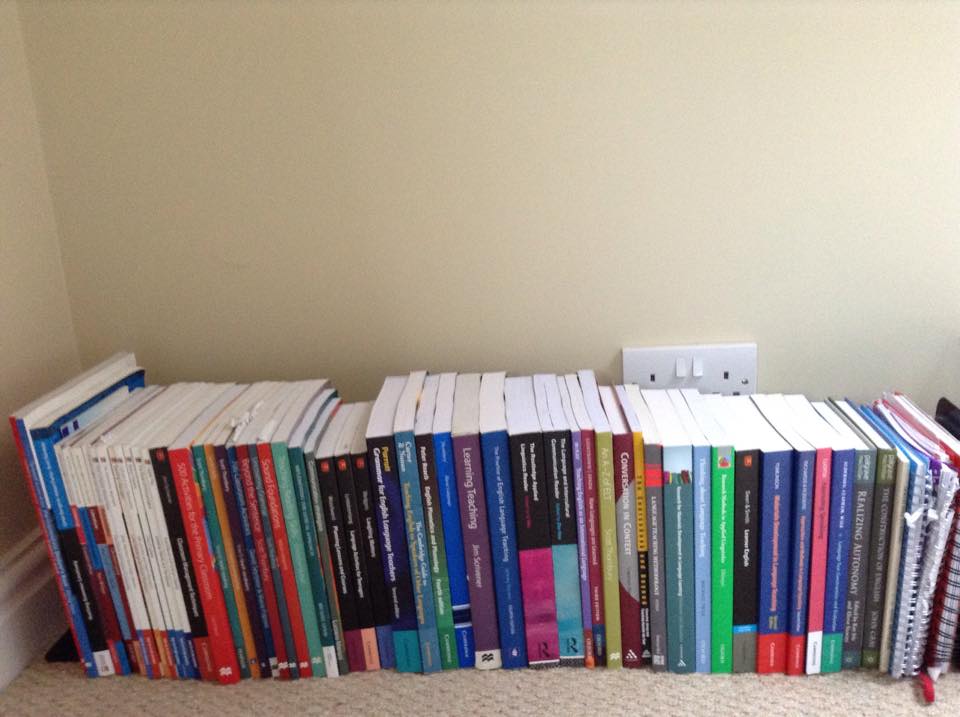
The summer before I started my M.A. ELT/Delta, that is, summer 2012, saw me starting to build up a collection of ELT books. Prior to this, I mostly just had my trusty Scrivener and Parrott books from my CELTA days and my copy of Harmer acquired later upon recommendation from one of my CELTA tutors when I asked her what would be a good book to buy. Now my collection looks like this:

My books! (Not pictured: Eggins and Slade: Analysing Casual Conversation – which is by my bed…)

Many of them were acquired during summer 2012 and the academic year 2012-2013, and a handful since then too (though nowadays I tend to buy kindle editions rather than paperback, as carrying an iPad/e-book reader is so much easier!). Roughly half have a practical/methodological emphasis and half are more theory focused. During my M.A. year, the (growing) stack lived under my desk in several piles. Since then, they have mostly lived in boxes/crates, too heavy to take with me on subsequent adventures, save a select few. Finally, they have found their way back into the open. As yet there is no book case to house them, but a patch of carpet and some book ends have done the trick. The next trick is to actually open them again! And this is where the challenge comes in.

The challenge

I challenge myself (and, of course, anyone who cares to join me using their own collection!) to try something new from one of the (methodological/teaching ideas) books each week or read a chapter (from one of the theory-focused ones), and, of course, to reflect on what I try or read.

Even if I don’t manage it every week, having a goal will help me do it more frequently than having no goal would! 🙂

The teacher education circle

Yesterday I attended the Teacher Education scholarship circle. I wasn’t really sure what to expect, but this was how it was described in the circular email: “It is aimed at anyone interested in training and development of teachers to share some development ideas and training methods.”  I joined this circle because I am interested in the area of teacher education, and becoming a CELTA trainer is on my long-term list of things to do, so I figured that whatever shape the circle took, I would learn something. In the post linked to above, I promised a write-up, so here it is!

Earlier in the day yesterday, a few hours before the meeting, an email went round saying that  “The first theme for discussion will be ‘Teacher Training v Teacher Development’ – what’s the difference?”. 10 of us turned up. This difference was one of the topics treated in the IH tutor training course I did that started around this time last year. I spent the bike ride into work pondering the difference, initially feeling it as one of those things where you know it is different but pinning it down is more difficult. On my bike ride I came up with:

  • training is finite, development is infinite.
  • training is done to you, you do development.
  • training is a short burst of something with a very specific goal, development is more of a journey.

10 of us turned up at the circle and we split into two groups of 5 to discuss the difference, followed by “half-assed dribble feedback” (or was it “drivel”? One of the teachers, who is a teacher trainer, was saying that he dislikes the whole putting people i.e. students or trainees, into groups to see what they come up with and then doing some “half-assed dribble/drivel feedback” where nothing is really added. Though we all seemed to agree that as part of a test-teach-test kind of approach/task-based approach, it can work really well, provided the teacher/trainer does add value in subsequent stages. Certainly, in our case, for example, a more senior member of the group did provide some of the definitions from the literature in the follow-up discussion.)

Here are some of the distinctions that were discussed:

  • training has a structure imposed by a course/syllabus (so something external), development is structured by the individual (but has the danger of lacking any structure and becoming unwieldy)
  • the motivation for training tends to be extrinsic (a qualification, a work requirement, a better salary) while the motivation for development tends to be intrinsic (to learn!)
  • that there can be overlap: a workshop could be training for the receivers and developmental for the deliverer.
  • being trained feels different to being developed.

This last one I found interesting. Up until that point, I hadn’t thought about development as being something that somebody else does to you (as evidenced by my bike ride thoughts). Perhaps it’s just semantics though, as of course the concept of being helped to develop is something with which I am fortunate enough to be very familiar!

Something else that came up in discussion, particularly in reference to “scholarship time” (hours that are timetabled and paid, specifically for development): the difficulty of knowing what to do with that time. It is only for full-time members of staff, so this is not something I have to had to grapple with personally (yet! I live in hope!), but it was very interesting to hear from people who do. It was put forward that it can be daunting to face this time and know what to do with it, in terms of “I want to develop but I’m not sure what to do or where to start”. It was recognised that not everybody wants to aim towards management (i.e. follow that linear route)  – which is certainly the case for me, no thanks! – but that in terms of salary, if you don’t go up that ladder, then you cannot earn more, because of how the pay structure works. Somebody mentioned that the question that is uppermost in their minds when doing something is “why am I doing this?” and described for example the situation of needing to do a particular qualification in order to stay in a job. The idea of a mentoring system was also suggested, where more experienced teachers would be available to help less experienced teachers approach their development.

There are several things that interested me within the discussion described in the above paragraph.

  • When I heard about “scholarship time”, my immediate reaction was, “Wow! That’s so cool! Having actual timetabled time for development stuff AND being paid for it!” And, as I mentioned here, I found the whole concept very teacher empowering. It didn’t occur to me to wonder what I would do with that time if I were a full-time member of staff. (I just thought that I’d have more time for all the development things I am used to doing in my own time!) Now, I wonder if all those things would count/be acceptable use of the time. Or, if some would and some wouldn’t, which would/wouldn’t and why? So, for example, my current materials writing work with Macmillan, where I am editing my ELTon materials to make them suitable for publication on Onestopenglish; now finished but I’ve put in a lot of hours of my own time into my journal article and book chapter, both of which are due out soon-ish (the journal article I believe early next year and the book chapter when the publication process is completed!); participating in #eltchat and #eltchinwag (which are like scholarship circles in themselves, only with a regularly changing focus!); blogging (both this blog and the one I co-manage with Sandy, Independent English); writing my column for the IH journal (not anymore, of course, as I no longer work at IH!); the corpus linguistics MOOC run by Lancaster University (which I am currently studying on); reading ELT-related literature; reflecting on, and making materials for, my learner autonomy projects (I would have been thrilled to have some time allocated to that when I was at IH!); certificate training courses like the IH certificate in teaching YL and the IH Tutor Training certificate that I did while at IHPA. (Having time timetabled for those, rather than it filling up the majority of my free time for the duration, would have been amazing too!); preparing IATEFL talks/online conference talks or webinars; watching webinars and talks online… and so on.
  • As is clear from the above point, being unsure what to do next hasn’t really been a problem for me! However, looking back over my career thus far, I can see that I HAVE had mentors even though I have never participated in a mentoring scheme. My CELTA tutors Beth and Cilla: I stayed in touch with them after the end of my CELTA, and emailing them telling them about my teaching was a rudimentary form of reflection that would later become more developed in other ways (e.g. Delta, M.A., blogging), in that I would think about what I did and tell them, from time to time. And they would respond, which I would learn more from. My M.A. tutors Heather, Naeema and Ivor: while doing my Delta/M.A. ELT, I learnt *how* to develop. Obviously from the Delta it came through the PDA (Personal Development Assignment) and the EP (Experimental Practice) parts of Module 2. From the M.A., though, I learnt how to do research, how to write up research, how to present research, how to write materials, how to write a journal article. And these are all things I’ve since used and will continue to use. (They are also things that I think would be really invaluable as INSETT sessions, as well as the usual “how to teach pronunciation” and “how to use technology x” type sessions.) Of course all these tutors as much as anything have been a source of encouragement and support, which has been invaluable. However, colleagues can be an equally valuable resource in helping one to develop. Sandy Millin springs to mind here. I met her through Twitter and have learnt a huge amount from her. Seeing her develop has also provided inspiration for my own development. Currently we also collaborate over at Independent English, as mentioned earlier. Additionally, I suppose I have been very opportunistic – seen opportunities to use the skills I mentioned above and gone for it. With the “there’s nothing to lose” mindset. I wonder if perhaps people are put off trying things because they think they aren’t/won’t be good enough? I think the learning and development comes through the trying, regardless of the outcome.
  • “Why am I doing this?” Well, I don’t want to be a manager (that may change but for now that is my feeling!), the teaching salary offered at the ELTC is plenty good enough for me (of course as a non-full-time teacher, the downside is lack of hours but hopefully they will grow in number!). I suppose partly it’s to make myself more employable (who doesn’t want some job security!) but a large part of it is also joy of learning and trying new things, cheesy as it sounds. I do really enjoy learning – reading, discussing, attending events like conferences, and challenging myself. It is also joy of creativity. Writing (materials or articles or blog posts) is an outlet for creativity for me, as is taking what I learn and finding ways to use it in the classroom then seeing what happens and building on that, all of which I love. As for attending and speaking at conferences: as well as all the learning, it’s so much fun! And all of this just also happens to be developmental too – bonus! Be this all as it may, what struck me is that I hadn’t really questioned this before the teacher raised the “Why” question. I had just accepted it as an enjoyable interesting part of my teaching career. (Have you asked “why” before? What answers did you find?)

Next session (in a month’s time I think it was) we are going to look at different models of development, which sounds like it should be very interesting. Meanwhile, flitting through my mind is the question “Was I/am I being developed or Was I/am I developing?” and also the question “How can I help other teachers in their developmental journey?”, rather than taking it for granted that it’s as straightforward for everyone else as it has been for me. (Mind you, I do think I have been extraordinarily lucky every step of my career so far!) I suppose this blog has been one way of helping, for example all the Delta posts I have written – I wonder if I could do anything else with it in the vein of helping people develop. Mind you, Sandy’s IH column would be a great place for anyone wanting development ideas, so maybe I could signpost my colleagues towards that, for starters. (And any of you out there looking for ideas, I suggest you have a look too!) I have actually thought of another possible way, but can’t go into that here and now. If the channel I am pursuing for it doesn’t work, then perhaps it will become a blog project too though! 🙂

In conclusion, what a fascinating 45 minutes the circle was! (Although of course if you add on the bike ride and the length of time I’ve spent reflecting on what we spoke about since, 45 minutes is just the beginning…) Which also brings to mind my belief that a huge part of teacher development is motivation, and maintaining motivation. (Oh dear, don’t get me started on talking about motivation or this post will never end..!) Suffice to say, yesterday has certainly been a good injection of motivation for me.  I’m looking forward to the next session and wondering what I will achieve in the mean time. For now, though, editing ELTons materials beckons…

Scholarship Circles

In this post, I’m going to write about something that I had no knowledge of until I started working at Sheffield University this year: Scholarship Circles (SC). “Er, what is an SC?” I hear you say. (Well, at any rate, that was my first question when met with the term for the first time!) Don’t worry, just read on and all will become clear!

What?

This is a form of teacher development.

Up till now, for me, CPD has mostly meant either something I do myself, in my own time – for example, seeking out opportunities to be published (materials writing, article writing etc), blogging, reading ELT-related literature, using Twitter and so on – or attending (and occasionally delivering) workshops at work. Of course it has also entailed being observed and being given feedback on that. IHPA had a good CPD programme, with regular workshops for teachers and encouragement to do things like write for the IH Journal and present at the IH teachers online conference. I was also lucky enough to be given leave in order to speak at IATEFL in the UK two years running.

Scholarship circles, however, rather than being either individually motivated projects or management-organised top-down fare, are teacher-led and collaborative. They can take many different forms, depending on teachers’ interests. It is not necessary for everybody to participate in the same circle at the same time (which is good because obviously that would be nigh on impossible with all the different timetables in place!). For example, you could have a reading circle, where members take turns to choose an article for the group to read, which is subsequently discussed by members together at an agreed time/location.

How?

At Sheffield University, full-time teachers have three hours timetabled as “scholarship time” i.e. time allocated for CPD. That is to say, not in addition to the full timetable, but timetabled teaching hours were reduced by three hours to allow for this. It should add up to 90 hours over the academic year, so some weeks you may do more than three hours, others less. That’s fine, as long as it is recorded and you can show that you have fulfilled the obligation over the course of the year, as it is paid working time. As I said, teachers have to keep a record of how they use this time (a log is provided for this), so that they can demonstrate to have used it fruitfully. This includes things such as attending the (optional) workshops that are scheduled on a regular basis, delivering such a workshop, participating in scholarship circles and also individual endeavours such as working on a part-time PhD/Masters or doing a MOOC course. (I’m an hourly paid teacher currently, so I am not paid for “scholarship time”, BUT I may participate in as much of the CPD opportunities available as I care to, which is great!)

As far as Scholarship Circles go, anybody can set one up, on any area of interest. I have already mentioned the reading circle, which was set up jointly by two ELTC teachers, one of whom selected the article for the first meeting. Google docs is used as a way of organising the circles, so there is a document with a table containing each circle, its coordinator and meeting time. It can be edited by all teachers, so anybody can sign up for any circle or, indeed add a circle which others can sign up to. I have also signed up for a teacher education scholarship circle, which is for anybody who is interested in training teachers. The first meeting is tomorrow, so I can’t tell you anything about that yet! I am most excited about it, however.

Thoughts

What I like about scholarship circles is that they are teacher-led rather than being management-led like traditional CPD. It is up to teachers to decide what and when, according to their interests and availability. Obviously the reduction in teaching hours makes this kind of development a much more realistic prospect, both in terms of timetabling and motivation. The CPD programme as a whole seems to empower teachers, as it is up to teachers how they use their “scholarship time”, something that really appeals to me. It also recognises that everybody is at different places in their development and has different needs/interests, and enables these to be pursued rather than a one-size-fits-all approach.

I really enjoyed the first meeting of the reading circle and volunteered to pick the article for the next session. Sessions are fortnightly to give time for article picking, sharing and reading. You can learn so much from the people you work with, just  by having time to do something like this – be it reading and discussing an article or any of the other circle focuses.

Over to you!

Have you ever participated in or organised a scholarship circle before? (Even if it didn’t go by that name!) If so, what did it entail? If you haven’t, do you think it would work in your workplace? Why?/Why not?

Really look forward to hearing about your experiences/thoughts on this. In exchange, I promise I’ll write about the first meeting of the teacher education circle! 🙂

Circles! (Taken from commons.wikimedia.org)

Circles! (Taken from commons.wikimedia.org)

New beginnings…

Yesterday evening, my upper intermediate General English course at Sheffield University’s ELTC started. I will be meeting this multilingual, multicultural group of students twice a week for the next 12 weeks (including this week). The course does not have an exam at the end, which is not something I have encountered often in my teaching career to date! The Social English class I taught on the 10 week pre-sessional at the university this year also wasn’t assessed as it was made up of students who had already met their conditions, but it wasn’t a four skills integrated standard course either. The only other occasion for me has been the continuous enrolment intensive courses at a private language school in Leeds that I taught on during the third semester of my M.A. but those were every day with continuously changing groups of students rather than twice a week with the same group. The course book for this course is New English File Upper Intermediate, another first for me, and we are using the version where it is broken down into book A and book B, so book A is the book for the next 12 weeks. I’m also planning to use all the learner autonomy materials I’ve developed during my couple of years at IHPA – the reading project, the experimenting with English project and so on. Finally, I am hoping to use the ELTon award-winning materials I wrote for my dissertation, as I haven’t worked in the UK since finishing them so it is a golden opportunity!

Yesterday’s class was the first class I’ve taught at the ELTC since finishing my CELTA there in March 2010. I *have* done two summer school pre-sessional programmes with the university since then (10 weeks this summer just gone, 10 weeks in the summer last year) but those take place elsewhere on campus rather than at the centre itself. It’s lovely being back the centre – it’s a purpose-built building, with lots of space and a wealth of resources. A lot of value is also placed on teacher development, which I am looking forward to exploiting in the coming months. Indeed, I had my first bit of training yesterday, when I attended a refresher session for using Smartboards combined with an introduction to using Google classroom. Fortunately the tech team have prepared “how to…” guides for both of these, which can be accessed via the teachers portal. It was a lot of information to take in at once! I fully intend to get to grips with both the Smartboard and Google classroom in the coming weeks: Google classroom is very similar to Edmodo, so my interest in that is hardly surprising, and the Smart Board has some potentially useful features. I’m sure it can do lots of fancy, advanced stuff too, but what stood out for me is that you can also do a range of little things with it, that enhance rather than take over your teaching. As I try them out and see how I (and the students) get on with them, I’ll share anything of interest that I learn here. Of course, Google classroom will tie in nicely with my above-mentioned learner autonomy projects.

Yesterday I also signed up for a free course delivered by Lancaster University, called Corpus Linguistics: Method Analysis, Interpretation. It’s an 8-week course which involves video lectures and interviews, tasks, discussions on a forum, and which allows you take from it what you want to take from it. I learnt about the existence of Corpus Linguistics and corpora during my M.A. ELT/Delta year at Leeds Met, and it’s something I’ve wanted to follow up on since those days but have lacked the time to do anything beyond using Wordandphrase.info with my students and developing some materials to help me to do that. I’m hoping this course will give me the understanding and tools to use corpora more effectively, both for my own and my students’ learning.

All in all, my professional life is a very different picture from what it was this time last year, when I was just starting back at IHPA for a second year and about to embark on my IH tutor training certificate. As ever, I firmly believe this academic year will be what I make of it, and I plan to make as much of it as I possibly can, especially as there is no shortage of opportunity. After a quiet month or so on this blog (time off is good!), I hope to post more regularly again, both teaching-related and corpus linguistic course-related. Watch this space…

Watch this space!

Screen Shot 2015-04-11 at 21.59.37

My professional home now. 🙂

My ELTon-winning materials have gone live on Onestopenglish.com!*

*well, some of them have anyway! The rest will hopefully follow suit in due course…

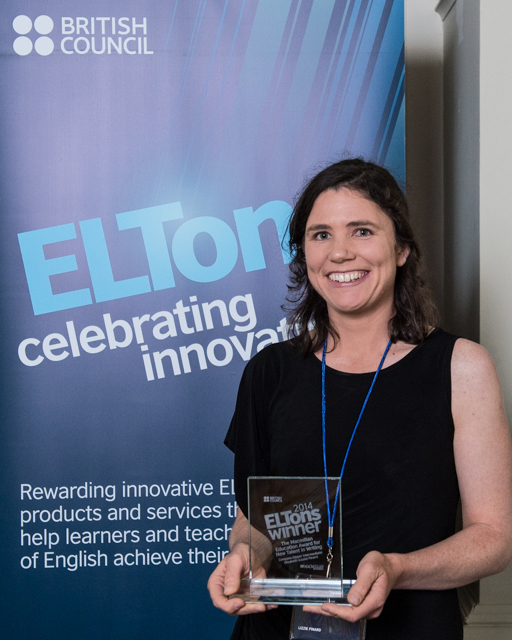
Some of you might remember that I rather unexpectedly (so much so, that I found myself writing the speech I didn’t make after the event!) found myself standing on the stage at the ELTons award ceremony in May 2014.

Macmillan winner 3

In the interview (which you can see here if you click on the The Macmillan Education Award for New Talent in Writing tab on the right-hand side of the video screen), I explained that the materials were as yet only available on my hard drive.

Fast forward a year and a bit, to September 2015, and I can, with great pleasure, announce the appearance of my ELTon materials, the fruits of my dissertation project labour of love in 2013, at Leeds what was Metropolitan now Beckett University, on Macmillan’s Onestopenglish website! I have been working with Sarah Milligan from Macmillan to prepare my materials for publication on this website, which has been a great learning opportunity for me.

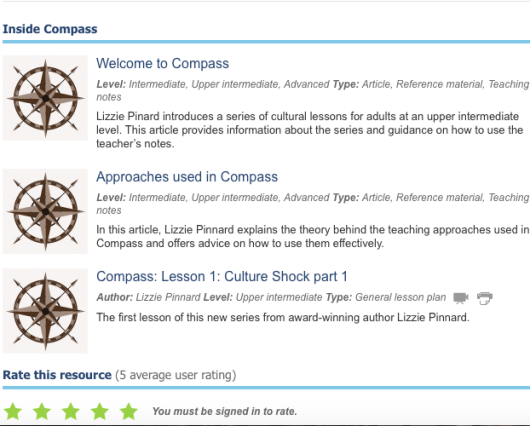
You can find the materials by clicking on either of the photos below:

Compass!

Screen Shot 2015-09-02 at 19.26.42

– I hope you enjoy using them – let me know how it goes if you do! (And yes, I know, yet again my name has been misspelt: good job I’m all too used to it! 😉 Correction hopefully to follow!)

Making general EAP more specific – academic writing

The 10-week pre-sessional programme at Sheffield University is an English for General Academic Purposes course rather than an English for Specific Academic Purposes course. This means that students learn general academic skills and vocabulary rather than subject specific. However, even working with a general EAP course book, like Oxford EAP, it is possible to tweak a lesson so that it links in with students’ academic fields, and, in my experience, this has a very beneficial effect on students’ engagement with the (often rather dry) lesson content, as the relevance and usefulness is clearer to them and the content more meaningful. I managed just such a lesson tweak in my most recent academic writing lesson (yesterday). Though far from being rocket science or anything particularly special, a few simple tweaks made a big difference, so I thought I’d share what I did here…

The aim of the lesson was for learners to be better able to write comparison essays, in terms of structure and complex comparison sentences using subordinators. The Oxford EAP spread was logical:

  • dividing a list of ideas corresponding to a given essay title by perspective (e.g. financial, social…)
  • focusing on the overall structure by getting students to match block and point-by-point outlines (with no content) to descriptions
  • matching outlines with content relating to the beginning essay title and evaluating the clarity of each
  • producing an outline for another essay title (using notes given to help)
  • identifying the chosen outline in a paragraph of text responding to another essay title and using this as a springboard for focusing on subordinators (highlighting, analysing, controlled practice)
  • writing a comparison essay (in response to another title)

My students are approximately 50% medicine, 50% dentistry in terms of field, so for this lesson I got them to sit grouped accordingly. Before starting on the above sequence, I encouraged them, in their groups, to brainstorm a list of comparisons they might make in their field. For example, in dentistry, they might compare systemic fluoridation with topical fluoridation (as I have discovered in the course of the project thread of this programme!). Once they had generated their lists, I asked them to look at each item and think of at least two perspectives from which they could compare their items. So, for the above example, it could be from a financial perspective or a health perspective. These are M.A. students to be, so they are interested in what they are going to study. Thus, starting the lesson in this way immediately grabbed their attention because it was fully relevant to them.

Having done that, with relevance of comparison essays established, we moved onto the OUP EAP sequence and worked through it up till the end of the controlled practice activity for subordinators. Then we returned to the information generated in the above-described opening sequence, from which they selected a comparison and produced an outline (choosing a block or point-by-point structure) based on that, thus linking the learning back to their field. They also wrote some complex sentences, using subordinators, comparing their chosen items from their chosen perspectives. This was far more engaging than writing sentences in response to a random essay title that they didn’t really care about. Obviously in an EGAP course these are inevitable, but even on such courses it definitely pays to be on the look out for ways of linking the general content back to the specific disciplines. (Without needing to be an expert in those fields, of course!)

Next week we are looking at problem-and-solution essays: hopefully I can make these as engaging as comparison essays turned out to be!

Yay, writing! ;-)

Yay, writing! 😉 (Image licensed for commercial reuse with modification)