How do you keep track of your professional development? Where I work, we have a log (a Google sheet) which is shared with us at the start of each calendar year and which it is our responsibility to keep up to date. There are two elements (each with its own tab on the sheet),
1)Training log (mandatory) – “21 hours per calendar year, with a balance where possible between centre-wide development, programme-specific development and external development. These activities may include online or face-to-face training courses, talks, and workshops.”
2)Scholarship log (optional) – “…scholarship can be defined as broad and varied activities which are personal, but structured and reflective in their nature. This could be done by further qualifications or research. […] The definition of scholarship is knowledge acquired by study. In the context of learning and teaching, it might mean evaluating the impact of new approaches in your teaching or carrying out projects to answer specific pedagogical questions.”
I think it is good to have this framework for recording development, as otherwise I’ll attend stuff/watch stuff/do stuff, blog about some of it, but not have an overview. Recently 4C in ELT posted asking “How often do you actually seek out recordings to talks you missed and watch them?” – I was able to look at the log and identify at least 12 (there’s another session I watched via recording too that I haven’t yet added!) for this calendar year. I like accessing sessions via recording because then I can pause them whenever I want to (for a wee, to get a cup of tea, to have a thinking break…). Anyway, in total, in this calendar year, to date (it’s not over yet, for all it’s December already!), I’ve logged 129hrs in my training log (!)
The biggest chunk of that, weighing in at 50 hours, is the Instructional Design course I have completed this semester. 10 weeks, at 5hours per week. (The course reckons 5-6 hrs per week so I took the lower bound for logging purposes.) It includes synchronous tasks and a weekly one hour Google Meet session. There is also an optional assessment, creating materials using one of the tools which I did in a race against time, while I still had access to the free trial of the tool in question! It wasn’t a rush job but there were definitely extra hours squeezed into those weeks! I have been fitting the course in around everything else, piecemeal – Google Calendar and Google Keep have been my very good friends this semester, for keeping track of everything going on. (There are two more weeks of the course, but I’ve logged the course as one entry using the lower bound of the time, as otherwise there would be a million mini-entries of time spent! Suffice it to say it is unlikely to be *less* than what I’ve logged, much more likely to be more!)
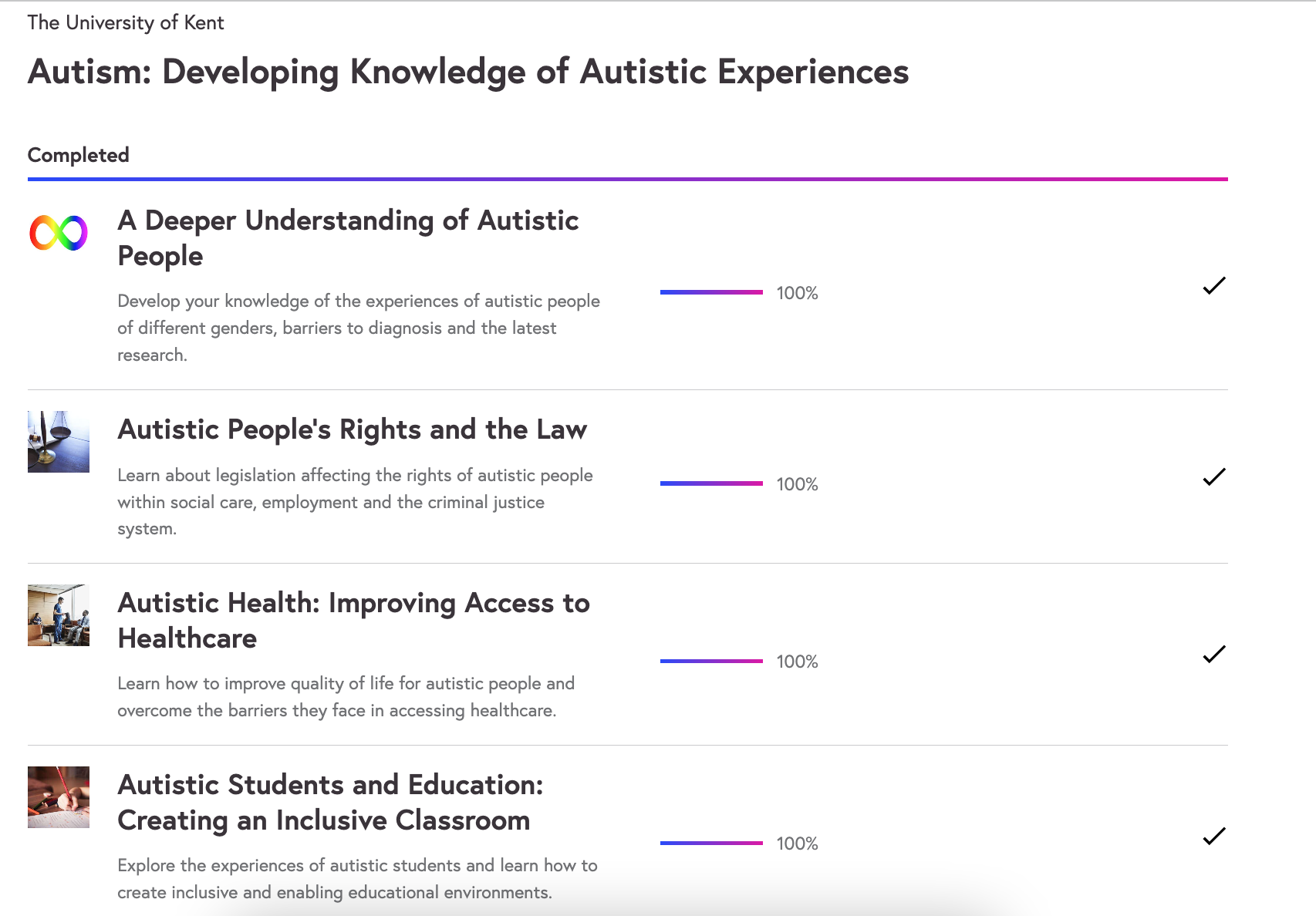
The second biggest chunk, at 48hrs, was a FutureLearn Expert Track (which is a set of courses on a particular theme) – Autism: Developing Knowledge of Autistic Experiences:
I completed this Expert Track during the summer holidays this year – 4 courses, 4 weeks each, 3hrs per week. However, I did them in a more compressed time frame – more hours per week, fewer weeks. Hyperfocus is a wonderful thing!
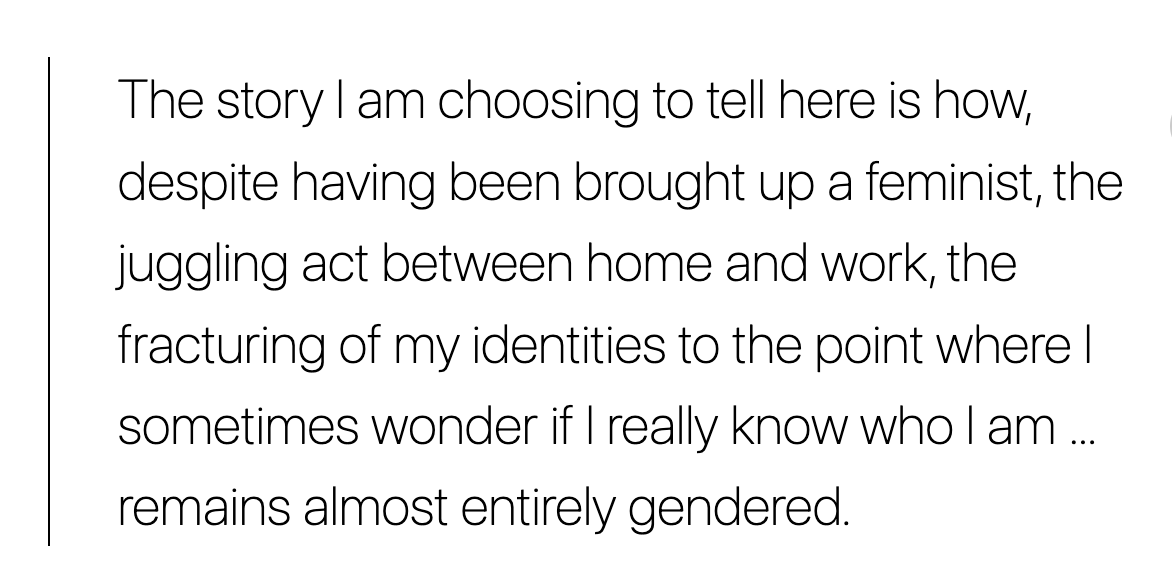
So, those two, between them, account for nearly 100hrs out of the 129. It’s inevitable that a course is going to represent a larger number of hours than one-off things can. A distant third, in terms of chunks of hours, is the ELTC Away Day which accounted for 6hrs: A morning of talks and an afternoon of workshops, all F2F. For me the highlight of the day was the session in the afternoon about the EdDoc run by Sheffield University’s School of Education. In an ideal world I’d like to start doing one in the academic year 2026-2027. Since that session, which took place in late September, I’ve come up with an idea and started doing some reading around it – though the Instructional Design course temporarily moved further reading/preparation to the back burner (time is finite, however hard I hyperfocus!). Close behind the Away Day, in terms of hours, was a “slow conference” called Feminism X EAP, which I spent 4hrs on, not consecutively but over the course of a week or so. It seems a long time ago now, but it took place between the 9th and 15th May. It was really interesting, Story – by Bea Bond. It was Activity 2/3 on Thursday 9th May::
I recommend having a read! I hope there will be another slow conference next year, I’d never participated in one before but it is a format that really appeals to me.
The remaining hours have mostly been made up of watching recordings of various sessions and attending a small number of live online sessions too. Many of the recorded sessions I found via MyDevlopment which is our university professional development portal, combining internally made content and curated external content. Through it I discovered a treasure trove of webinars hosted by CareScribe – and in seeking out this link, I notice that there are a number of new ones which I am keen to watch when I can! Carescribe focus on neurodiversity and was founded by an NHS doctor, strategy consultant and software engineer in 2020, and the tag for their events page goes thus: “We run free online events to raise awareness and support neurodiversity in the workplace. See what talks are coming next and sign up below.” Highly recommended.
I wouldn’t have known about them without MyDevelopment, where some of the recordings are linked to as part of the curation side. I suppose one of the challenges of development is finding the sessions to attend (or watch via recording) in the great jungle of the internet. We are quite lucky in this regard. We have MyDevelopment, as already discussed, but it is a university-wide platform so it doesn’t curate ELT-specific content. However, our TD team put out a weekly bulletin via Google Workspace highlighting external opportunities amongst which webinars and recordings. There is also an internal one highlighting sessions the TD team is hosting and also sessions that University are running relating to education in general e.g. about AI, about Blackboard Ultra, about how to teach inclusively etc. Examples of sessions I’ve attended live online via MyDevelopment are Supporting Dyslexic Students and Students with SpLD and Supporting Students on the Autism Spectrum.
In terms of ELT-specific online sessions and recordings, there has been plenty of AI-focused content delivered and recorded by the ELTC TEL team, which I have accessed via a mixture of watching recordings on our ELTC TD portal (separate from My Development, just for our department) and attending live online when I can. I have also watched an older recording about pronunciation teaching in EAP by Gemma Archer (of Strathclyde University, at least at that time). In terms of external content, there was a recording of a Penny Ur session called “Getting them to talk in English” which lives on YouTube, recommended by Sandy Millin in one of her TYT Delta Newsletters (you don’t have to be doing the Delta to benefit from them!).
All in all, it has been a good (calendar) year for development, though I’ve not done much blogging. I think I’ve ended up instead with bits and bobs of notes – in the development log, in google docs linked to in the development log. Thank goodness for the development log, without it I would be like “ehhh I didn’t do THAT much development this year really, did I…how remiss of me” because it all becomes part of the blur of everything else we get up to at work (or in the summer holidays in the case of the Expert Track!) – but all evidence points to the contrary! Perhaps one of my New Year’s resolutions for next year will be to write more blog posts linked to the things I do for development/my reflections on it! (Perhaps I could put some of the links in the other tab of the scholarship log, which for this year is rather empty…)
Anyway, circling back to the question at the start of this post (and congratulations if you made this far!) – how *do* you keep track of your development?Do you have an effective system for it? And also do you have any links to cool stuff you’ve read or watchedthat you could share with me so that I can have a look too? 🙂 I look forward to hearing from you via the comments!
On 29th November 2023, I attended a webinar, “Supporting autistic students”, run by NATESOL and delivered by Carly Miller, who is a disability coordinator at Leeds University. This post will use the slides she so kindly provided to summarise the session and reflect on what she said, relating it to my own experience and practice.
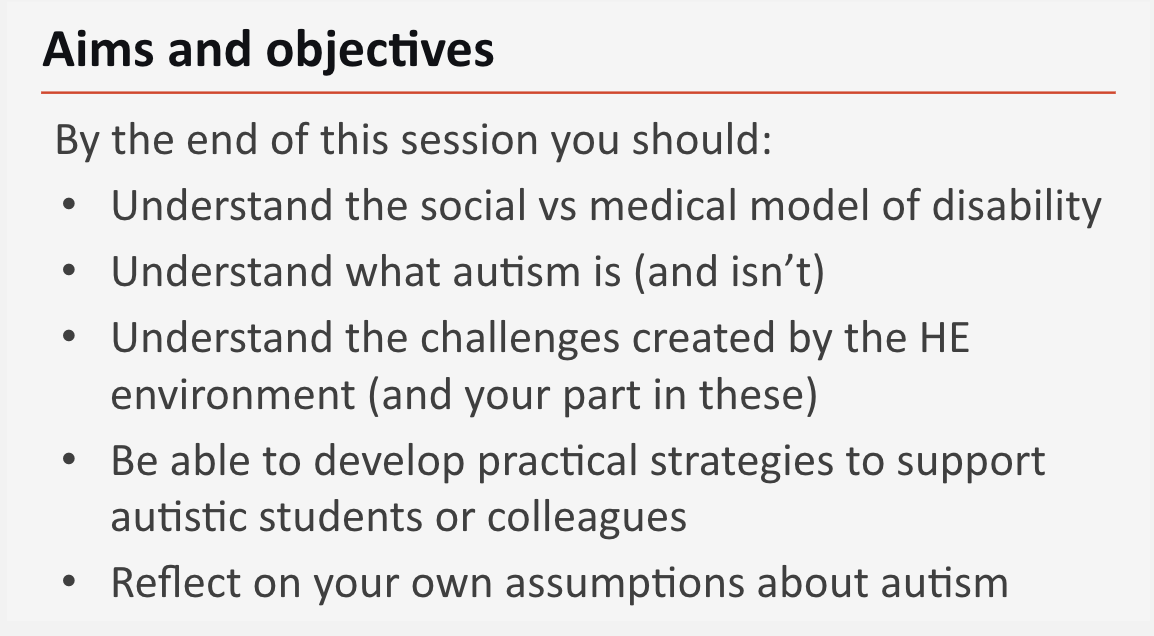
These were the aims and objectives:
Carly started with defining the social and the medical models of disability:
In the medical model, the disability itself is the barrier, while in the social model it is the environment and society that create the barriers. Of course the session being delivered by Carly ascribes to the social model given that it is to raise awareness of autism and how to make there be fewer barriers for autistic students.
Next was the definition of autism:
Here is a very helpful explanation of how the autism spectrum works, explaining that it is not linear (and nowadays labels such as “high-functioning” and “low-functioning” are increasingly being moved away from) and illustrating how someone with autism usually has a spiky profile in terms of challenges and strengths. There is thought to be a genetic component but not a straightforward “this gene makes this happen” one. There is no cure. Going back to the disability models, in particular the social model of disability, many problems experienced by autistic people arise from trying to operate in a neurotypical world with a brain that perceives things differently from neurotypical brains. Hence this session.
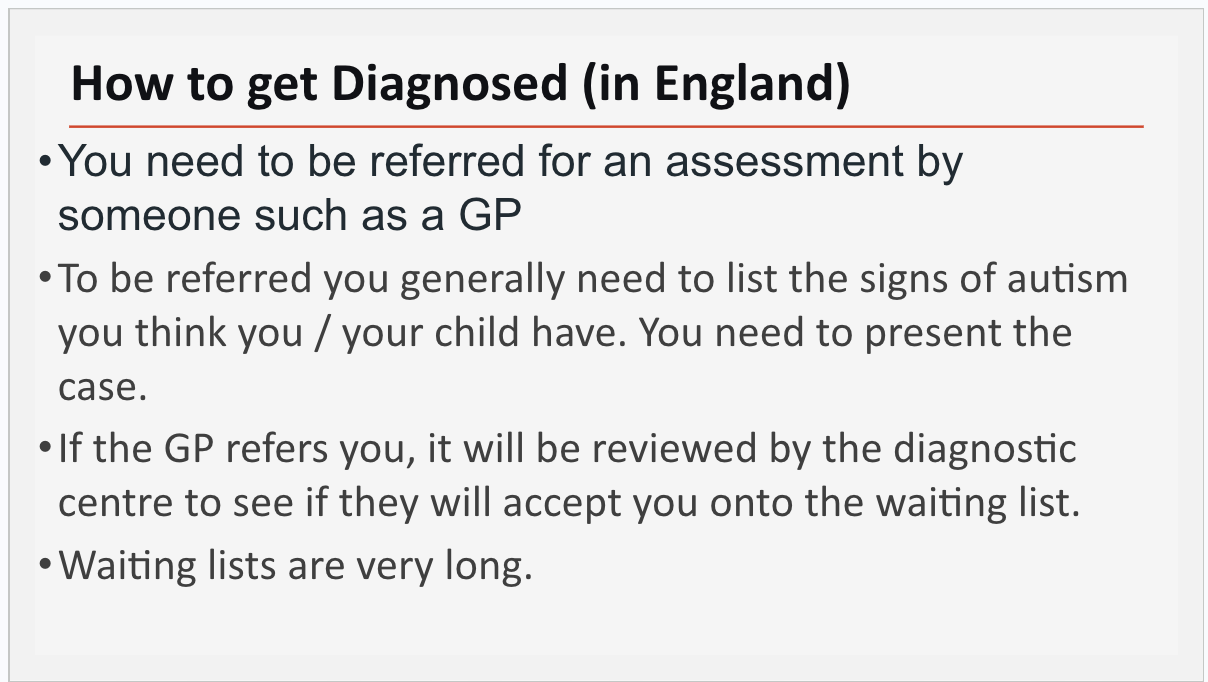
Next Carly explained the diagnosis process in England:
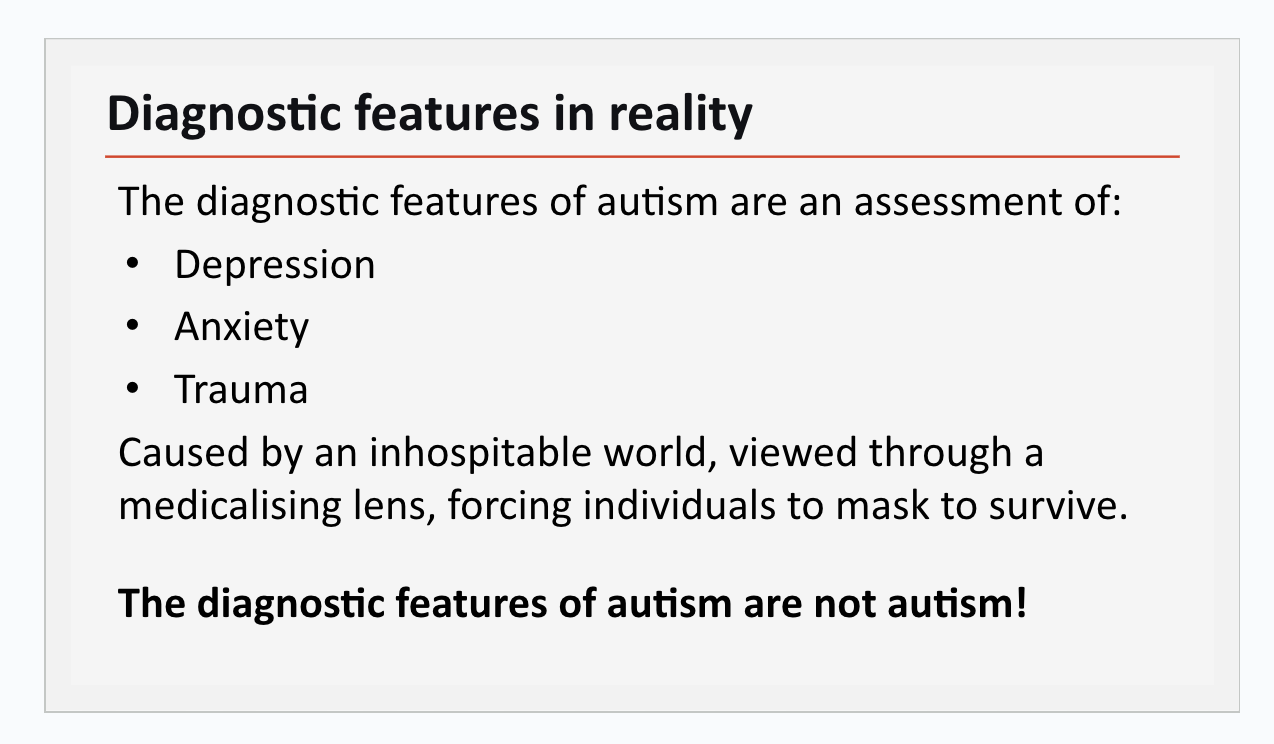
As is clear from the above, it is difficult to get a diagnosis. Carly told us that she has been on the waiting list since she got on to it after the pandemic, having noticed during the pandemic various aspects that made her suspect she was autistic. As with everything NHS-related, it takes a long time. For example, I saw my GP on the 7th November and got referred to be assessed, but at the time of writing have yet to know whether I have been accepted on to the waiting list! Fortunately, at the university, despite not having a diagnosis yet, I have been able to request and get a reasonable adjustment in place to alleviate my sensory sensitivities (one of the possible elements of autism). Carly also suggested that depression, anxiety and/or trauma are frequent consequences of being autistic and may lead to it being diagnosed but that they are not autism, they are just the result of the way in which autistic individuals must operate in a neuronormative world, in which we are viewed through a medicalising lens:
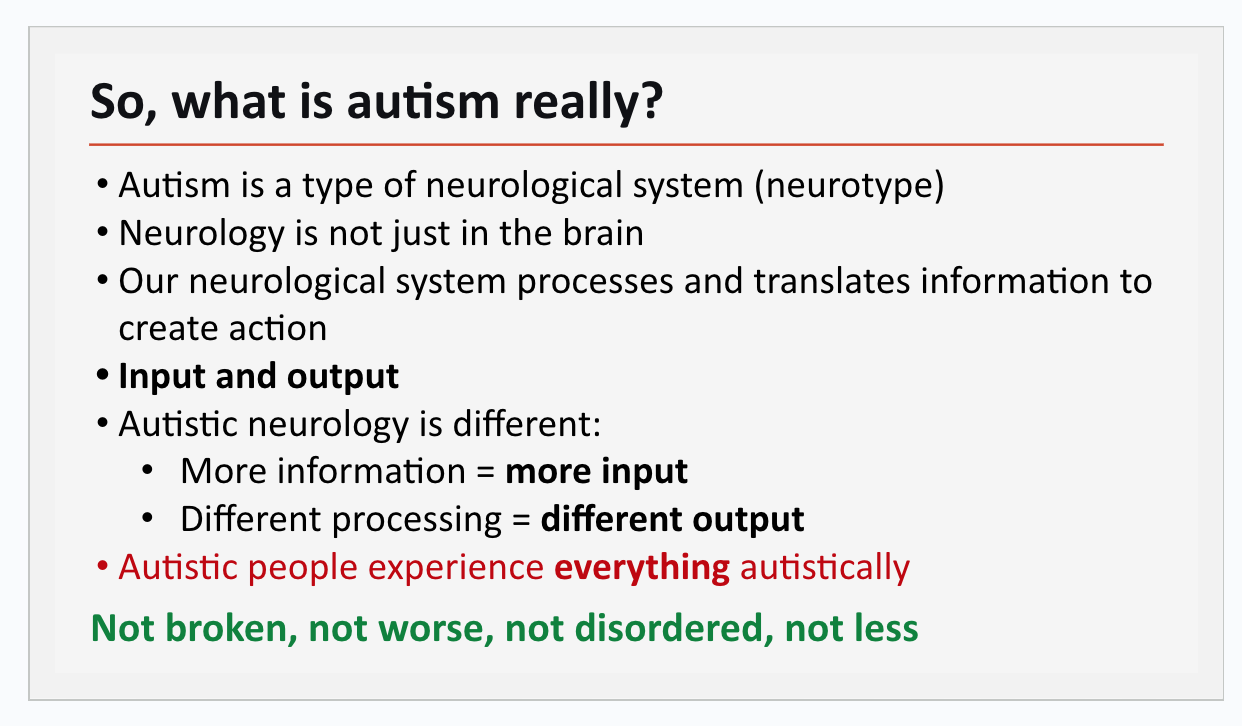
So…what is autism then? Here is Carly’s summary of it:
Autism is a type of neurology/neurological system. Autistic brains take in more information and they process it differently, resulting in different output. Different rather than worse/broken/disordered. Diagnostically, however, the criteria are framed as deficits/viewed negatively and that is linked to the historical evolution of autism and autistic brains as a concept. (Asperger and Kanner are the earliest people to have worked on it scientifically, and at the time Eugenics was very dominant…). According to Carly, approximately 1 in 100 people are diagnosed as autistic but that is potentially a huge underestimate. (Somewhat unsurprisingly given the barriers to getting diagnosed.) Part of the underestimate relates to what she discussed next – autism and females:
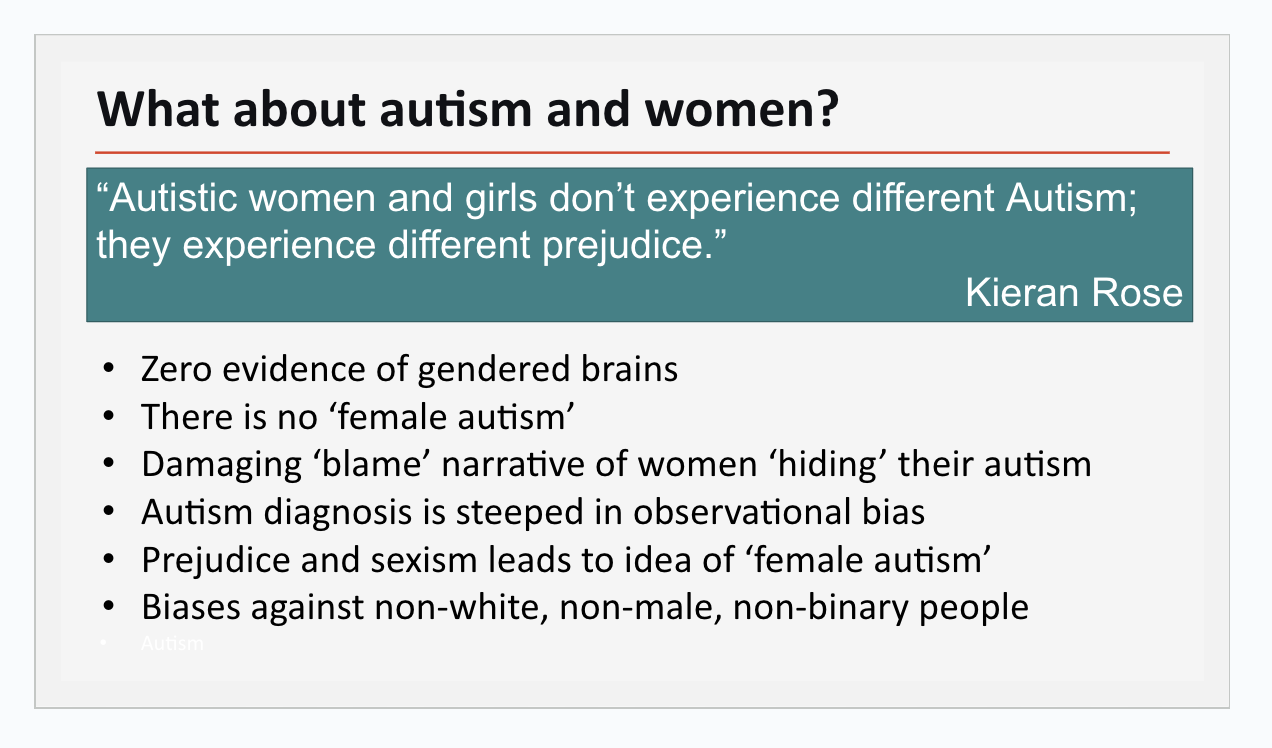
The stereotypical autistic person is a white, cis-het young male. (I believe this is at least partly due to the early work published by Asperger and Kanner focusing on boys – at the time, girls were more likely to be dismissed as “feeble-minded” and institutionalised for being different – though they did also work with girls, and diagnostic criteria developing accordingly.) However, there is no ‘female autism’. Rather, the spectrum of traits associated with autism is broad and autistic peoples’ ability to mask is also varied, regardless of their gender. Of course, masking also contributes to diagnostic barriers. For example, if the person doing the diagnosing observes an autistic person making eye contact during the diagnosis, that might count against them being diagnosed when in fact they have learned to make eye contact in order to be acceptable, and carry it out with discomfort. Carly summarises thus:
(For anybody who isn’t aware, “stims” are usually repetitive movements which autistic people do either because it feels good or as a coping mechanism when overstimulated. The stereotypical one is rocking backwards and forwards but autistic people often find ways to stim that are less noticeable when around people e.g. tapping a foot, twiddling hair, fidgeting with an object.) Eye contact is an important one to think about in the context of teaching. We are taught that eye contact and sitting still shows that someone is paying attention. For an autistic person it more likely means they are working hard on doing the eye contact thing and sitting still, but therefore have less brain available to actually take in what is being said/the content of the lesson. So as teachers we need to accept that traditional images of what good learning looks likes do not apply across the board. This is an example that leads nicely into what Carly talked about next:
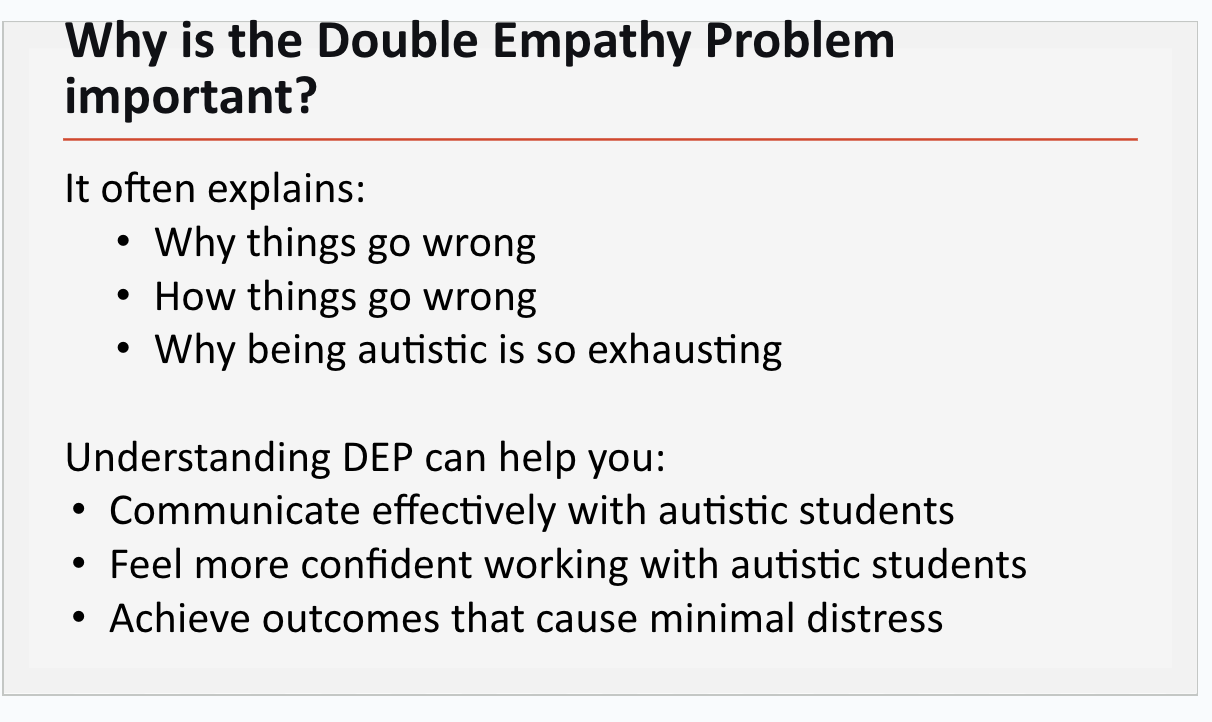
What this slide illustrates is that generally, when a neurotypical person is talking with another neurotypical person, and when an autistic person is talking with another autistic person, communication is generally successful. However, when a neurotypical person and an autistic person communicate, there is a much higher chance for communication issues/breakdown/misunderstandings. (Diagnostically, this is framed as an autistic deficit, of course!)
A personal example of things going wrong that fits nicely here: We were unpacking the car and I was holding the keys and a bunch of other stuff that had been in the car. My wife asked me to put everything inside. So I did. Came back out, we got some more stuff and she asked me where the keys were, in order to lock the car. They were inside, in the place where the keys go! Taking things literally is common in autistic people. (I now know that “everything” doesn’t apply to keys in this situation!) A teaching example that also fits nicely: I always did a brief meditation at the start of class with my students, setting it up as a routine at the start of the course. On one occasion, the second time I did with a particular group of students, after the “and then when you are ready, you can open your eyes” at the end, one student sat with their eyes closed for markedly longer than everyone else. “You said ‘when you are ready'” they said afterwards. Fair!
So, speaking of teaching, Carly next moved on to talking about what issues might arise in the higher education environment (NB much of it is applicable to any other teaching environment!):
It’s not first on the list but I am going to lead with “navigating the sensory environment” as that is something that neurotypical people do not typically perceive as a potential issue. Autistic people often are hypersensitive, hyposensitive or a combination of the two to their environment/what is happening. So, hypersensitive is when you are overstimulated by elements of the environment e.g. light (fluorescent lights in particular!), sound, smells, temperature and hyposensitive means experience low levels of sensory feedback. For example, I attended a work training day that took place in a room with lots of fluorescent strip lights and with lots of people who at times were all talking simultaneously (group work!) and at lunchtime instead of attending the lunch provided, I crept off to an empty classroom with the lights off and waited for it to stop hurting. (Spoiler: it didn’t fully stop hurting until the following afternoon!) In our classrooms, I usually switch some of the lighting off so that it is less overwhelming (fortunately most of the rooms enjoy a lot of natural light so it doesn’t mean we are sitting in semi-darkness! Obviously in winter this is trickier…).
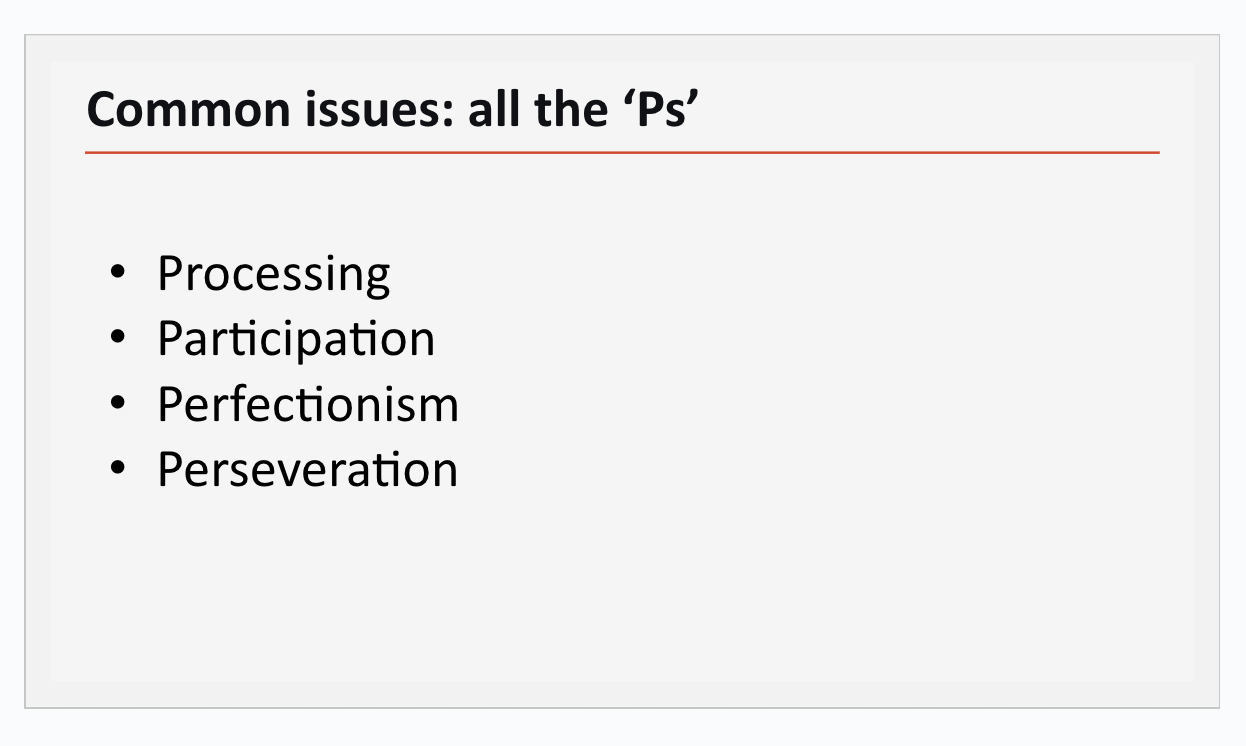
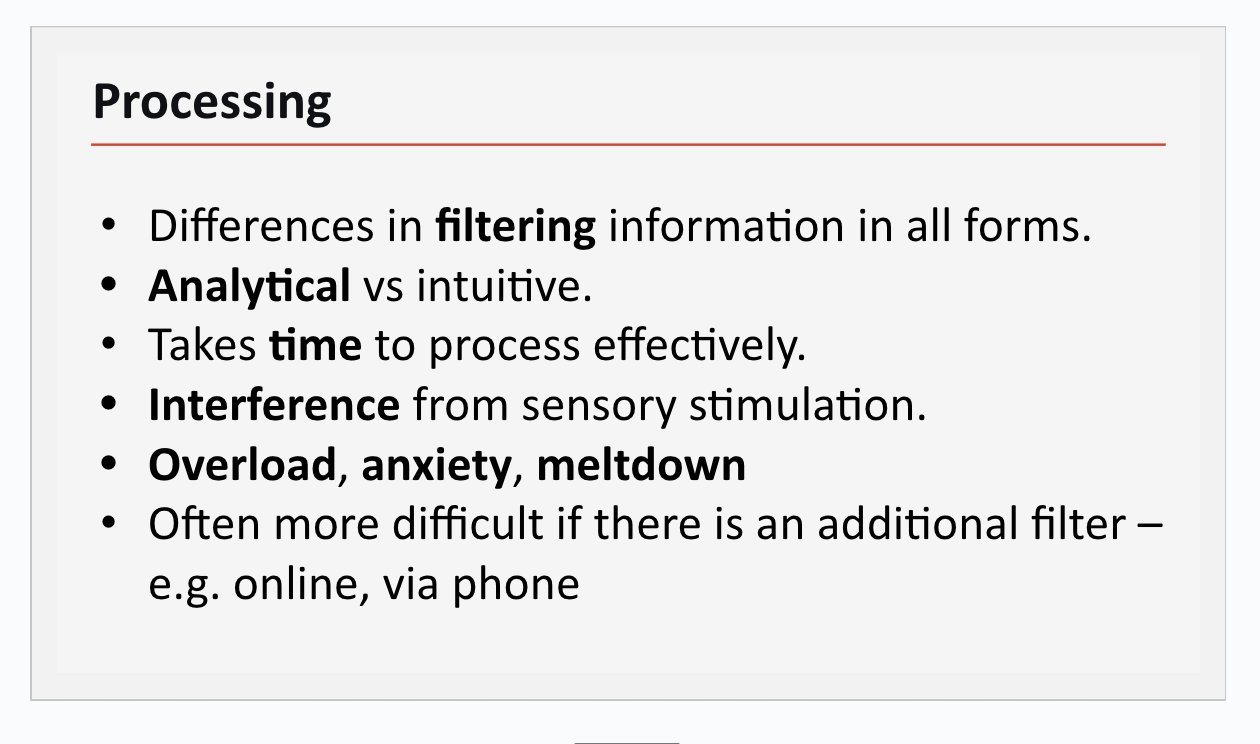
Anyway, Carly focused on the common issues as follows:
Starting with processing:
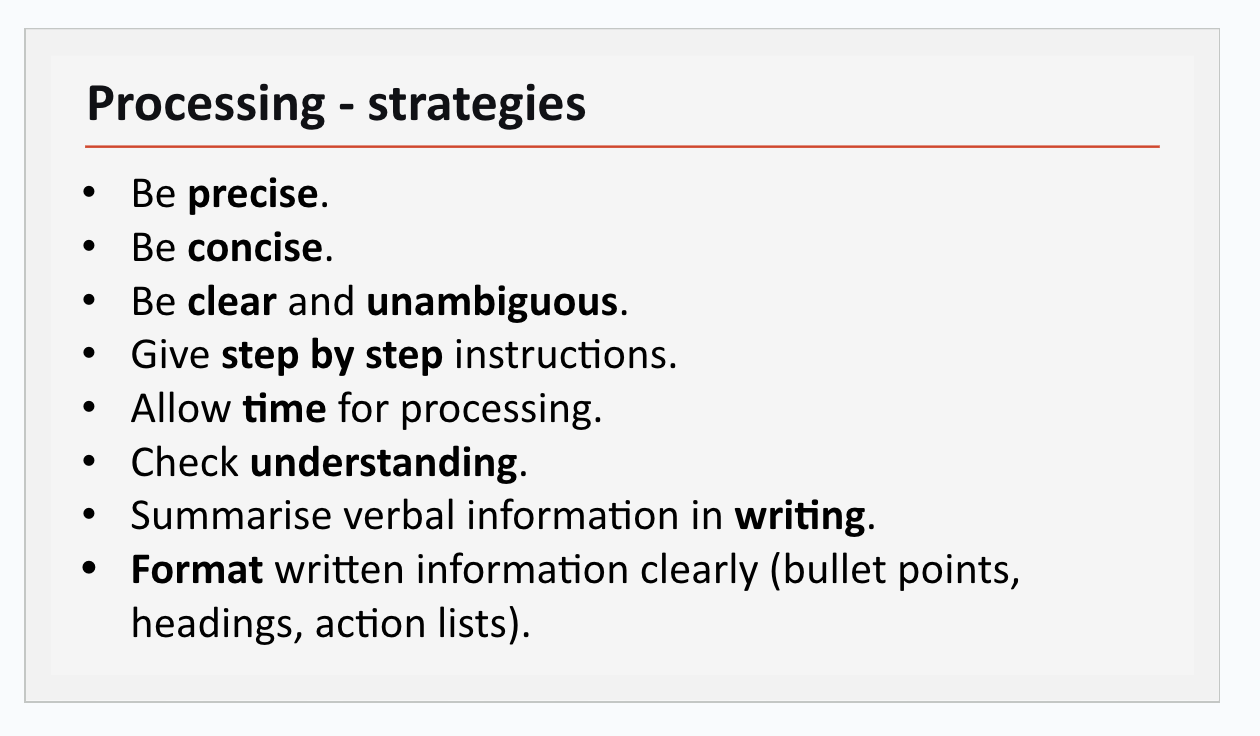
If you are neurotypical, for “interference from sensory stimulation”, imagine you were trying to be a student in a language lesson that was taking place in a night club (ugh) or in a supermarket (ugh) at busy time. Imagine how it would feel trying to concentrate on what you were being taught and asked to do. How long might it take you to complete a task? For a student in your classroom, as well as hearing you, they hear (at the same volume) whatever is going on outside an open window/door, the air system, the lighting (yes lights are loud!), the noise of other people existing in the same space, possibly whispering, typing etc. So focusing on what you are saying/asking them to do is hard work! So how can we help? According to Carly:
What do we notice about this? Yup, it’s general good practice for the most part! But this is even more important for autistic learners and also any learners who are neurodivergent in whatever way. I would add: consider that the classroom doesn’t actually *need* to be maximally bright… Also, let students wear noise-cancelling earphones for individual tasks if they want to. And remember silence can be golden – as in, don’t be afraid of it! Pause for longer between instructions, allow longer thinking pauses before eliciting ideas. At the start of a task, give students a chance to get started before deciding they weren’t listening and approaching them. Also, don’t hint at what you want them to do because they probably won’t do it and it won’t be because they are being bloody minded!
Group work can be very hard work for autistic students. (If we think back to the double empathy thing) For starters, at school, you were probably the kid who nobody wanted to work in a group with because you were ‘weird’. You have to achieve a task, but you also have to figure out how to contribute while dealing with the noise of all the voices in the surrounding groups. Figure out when is the right time to try and say something without being rude e.g. for interrupting. Process what your group-mates are saying and be able to respond/contribute before they have moved on to another part of the task. All of which is compounded if the purpose of the task isn’t clear in the first place! These are Carly’s suggestions for addressing the issues:
So obviously task set-up is important. I think that is something that could also be helped by consistency – having a routine around how tasks are set up, started and brought to an end so that students know what to expect and what’s going to happen. Being clear with timings could also be helpful. Maybe at the start of a course, explicitly talking about group work and how to do it effectively. Maybe at the start of group work tasks, reminding students to find out what everybody in the group thinks about each element/idea/question/answer before moving on to the next.
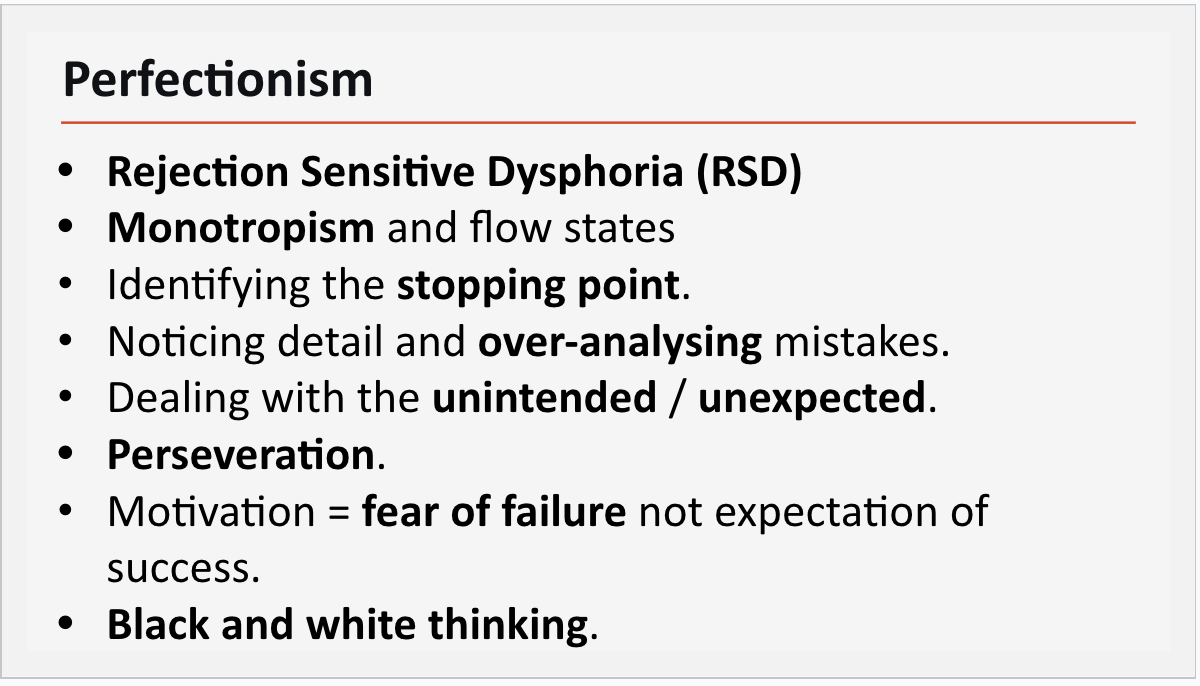
Have you heard the saying “the perfect Ph.D is the finished Ph.D”? I imagine you can see from the above list that these students are likely to be the ones who don’t submit an assessment draft because it’s not finished/perfect enough, or who spend all the time on one part of the task (and do it really well!) but then don’t manage to finish the rest. The ones who worry a LOT about Everything. The ones who struggle when something unexpected happens and disrupts the usual way of things. Here are Carly’s suggestions:
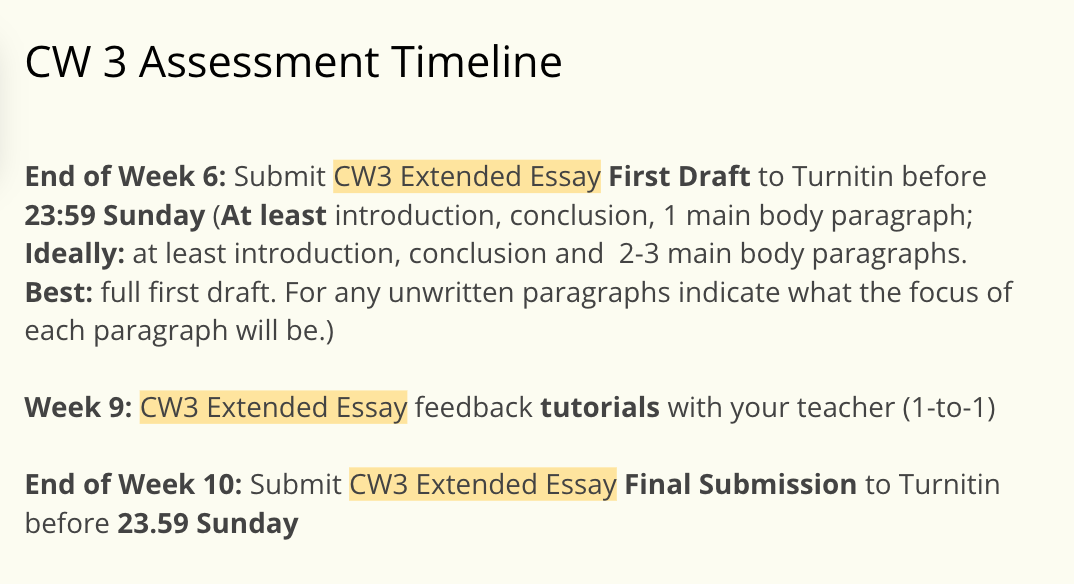
I think an example of this from my teaching last year would be at the first draft of a 2500 word coursework essay stage. Students submit a “first draft” and get feedback on it, which should help them improve before the final submission. This time, because I had pre-masters students and they are notorious for being completely overloaded with assessments, I was very explicit, in multiple lessons and end-of-week emails, about my expectations for first draft submissions:
All students submitted a first draft (result!), drafts were widely varying degrees of complete (from the “at least” to the “best”). They all had at least an introduction, a conclusion and one body paragraph. The “at least” requirement was doable, even with all the drains on their time. It also hopefully helped all of the students who would otherwise have potentially submitted nothing rather than submitting something incomplete. I also did explain why “best” was best (maximum feedback potential) but that “at least” is also good/a success, not a failure, and so much better than nothing. Also, emphasising that “if you don’t submit anything, I can’t give you any feedback help you improve it” (I guess this is clarifying consequences and dealing with “what if I haven’t finished” type thoughts!). Anyway, back to the session:
Here is a good explanation of monotropism. (Note: it can also be positive!) In terms of challenges, changes of attention/focus (so transitions in lessons, transitions between lessons) can be difficult. Carly offered some strategies for dealing with perseveration when it becomes a problem.
I think it could be helpful, in addition to making sure task timings are clear ahead of the task, during the task (especially for longer tasks) give a good lead-time to the end of the activity. So firstly, making it clear when a task is a short task, a medium task or a longer task. With a short task (5 minutes), saying when two minutes are left, one minute. With a medium task (up to 15 minutes, say) 5 minutes, 2 minutes. With longer tasks, depending on the length, give a warning half way through, 10 minutes before the end, 5 minutes, 2 minutes. So that there is time for the student to take themselves out of that activity and be ready for the next. Depending on the type of task and the desired outcome, where relevant reassure students that it is ok if they haven’t finished by the allocated time. In terms of looped thinking and anxiety, personally I have found mindfulness meditation to be a game changer. This is why I persevere and will continue to persevere in introducing it at the start of a course and doing the short meditation at the start of each lesson thing – I wish someone had introduced me to it when I was a student! I think also it really eases the transition from the previous lesson to the current lesson as brains are all over the place when students come into the room.
Finally, Carly finished with her 10 top tips for working with autistic students:
I suppose a lot of this comes back to challenging our assumptions about what good learning looks like and what a good learner does and doesn’t do. Maybe when we are planning tasks, think also about how we expect the task to look when being done ‘right’ and then applying the double empathy lens. How else could it look? Is the student who isn’t talking much or who isn’t looking at me actually disengaged? What could we do in the task set-up to enable participation for those who struggle to participate? How might that participation look? What evidence of engagement can I look for outside of habitual ones? What problems might occur? How could we address them? Is there a way to set up the task so that students have more choice about how to participate? And when reflecting on tasks and lessons during and after the event, “are my students learning? how can I tell? how can I find out without viewing them through a neurotypical lens and judging accordingly?”. Then, of course, clarity. Be explicit and don’t assume knowledge! I think possibly also providing opportunities and being supportive, but accepting when students decline those opportunities because they are exhausted/overwhelmed. E.g. building in opportunities to speak, scaffolding/enabling them, but not taking it as a failure if students don’t use it quite as you’d hoped. Maybe having a more flexible framework for mentally evaluating that. Looking at the bigger picture, if you imagine students doing multiple lessons in a day in their various subjects, if we are all demanding speaking and group-work and whatnot, repeatedly, that’s exhausting. I suppose at university, there may be more of a spread of lectures and seminars/practicals, so in some lessons, students can just sit and listen/make notes (which brings other problems for autistic students e.g. around sensory sensitivities), others require more active participation. Maybe within a lesson, don’t assume that they have to be speaking/collaborating to be learning. Quiet tasks are valid too. Maybe all of this also comes back to getting to know your students. Rather than jumping to conclusions, learning about how they learn and what they look like when they are learning/confused/enthusiastic/worried etc.
That brings me to the end of this post (finally, I hear you say!). Here are the links that Carly left us with at the end of the session:
Today I did something very radical. After I finished planning my lessons, I took off all my hats (or put them all on at once?) and decided to update my scholarship log. To explain, here at USIC/ELTC@The University of Sheffield, our schedules include 3hrs per week scholarship time, with the freedom to use it as we please as long as it is CPD-related. The TD team (including me) provide support/ideas for this through the bulletin (my current baby), and a varied programme of workshops. In order to monitor this/hold teachers accountable for it, we have to log what we do on a template provided centrally which we all make a copy of and share with our line managers. So back to today, which indeed is in February so actually (terrifyingly enough) not hugely far off half way through the academic year, I finally got round to sorting mine out for this year (new version each year required so that the document doesn’t get too unwieldy!). Which translates as being faced with trying to log, including dates and time spent, everything I did CPD-wise last term. Can I remember off the top of my head? Hell no. If I asked, I would have said well I did my SFHEA, suppose I haven’t done heaps else otherwise. However, fortunately, most if not all of the CPD I do includes an element of reflection carried out via my old friend, this blog.
In fact, it turns out that last term and into the beginning of this one I have:
completed and submitted my SFHEA application (watch this space), which probably accounts for more than enough scholarship hours on its own!
listened to Garnet Education’s podcast about teacher wellbeing and mindfulness by Rachael Roberts, which I will be writing up next!
…which is actually a fair chunk! Thank you blog for being my memory and reflective aide!!
Having done all the scholarship log updating and looking through my blog in order to do so, I am filled with fresh enthusiasm to add more, albeit time is not often on my side! 🙂
So that is just one reason why blogs are useful! Of course there are many more…
The British Council TeachingEnglish (TEBC) Webinar series can be found on the TEBC website. This is the link to Paul’s webinar that took place on the 19th May 2016. This is a summary of that webinar.
TEBC summarises the webinar thus:
“He [Paul] talked about the British Council’s CPD framework for teachers and different factors that can influence successful continuing professional development. This webinar explored some of the ways we can focus on our continuing professional development (CPD). We looked specifically at the British Council’s new CPD framework for teachers, the self-evaluation tool and resources on TeachingEnglish for professional development.”
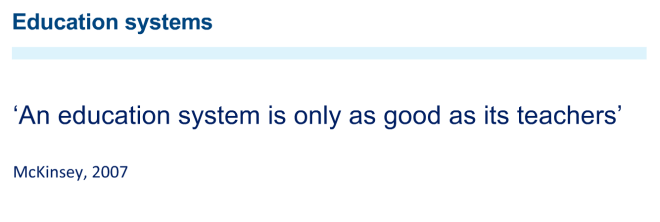
This is the quote that Paul Braddock starts us off with, one that is apparently much-used if you look on Google. However, it’s not as universally accepted as Paul thought before he read around it. The quote has been changed in the following way:
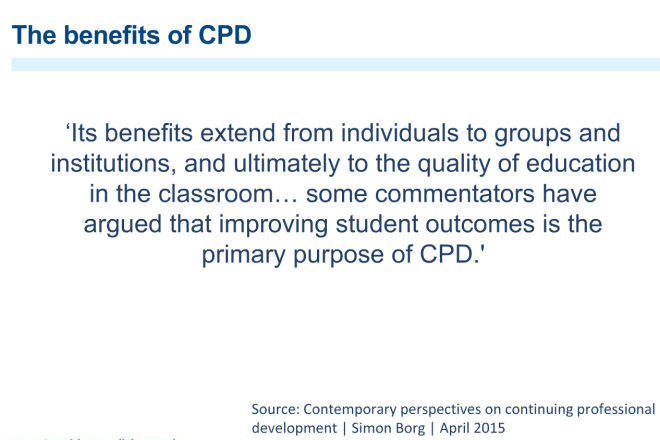
According to Paul, Husbands (2013) argues that what makes the most different to pupils is teaching. All teachers can be better but it’s teaching that improves and develops. Focusing on teaching focuses on more on the need to work continuously to improve the quality of teaching across schools. This is where CPD becomes essential. Especially as teaching changes and the skills needed change over time. What was a good teacher ten years ago might not be a good teacher now. Teaching needs to be develop.
Paul moves on to look at the 7 things that influence positive professional development, based on a report by Walter and Briggs (2012). What 7 things make professional development a positive thing for you?
Professional Development that makes the most difference to teachers is:
concrete and classroom-based (looking at what teachers do in the classroom e.g. action research)
brings in expertise from outside the school (Potentially expensive but expense can be kept down by use of webinars, online conferences, social media e.g. blogs)
involves teachers in the choice of areas to develop and activities to undertake (includes using tools to help you identify your areas for CPD and this is where frameworks come in)
enables them to work collaboratively with peers (physically within a context or with an online community of practice – requires time and space!)
provides opportunities for mentoring or coaching (again, offline or online includes being a mentor or a coach as well not just being mentored/coached)
is sustained over time (an action research cycle with the teacher him/herself as the focus)
is supported by school leadership (so the school recognises it’s important despite budget cuts etc.)
In other words, investment in CPD is useful and worth money.
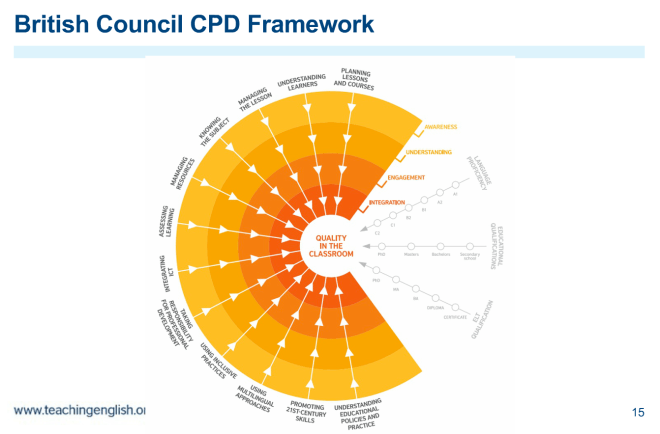
It is divided into 12 different aspects of professional practice:
It is also colour coded by stages of development (Awareness, Understanding, Engagement, Integration). The BC was trying to address the misconception that CPD is linear. This is to be a tool that would more accurately reflect this. It is supposed to empower teachers by providing a framework for them to engage with CPD. Also to be used by groups of teachers for collaboration and cooperation. For more information about each professional practice see the document linked to above. He says it is designed to be flexible and teachers can change/adapt it to better fit their context. The process that you would go through is self-evaluation. The BC are currently developing a self-evaluation tool to help teachers decide which professional practice to focus on. At the integration level, this is where you’d then look at mentoring or coaching.
Next, Paul draws attention to the BC TeachingEnglish website. Within the Teacher Development tab, there is a section for Continuing Professional Development.
Here, you can find resources linked to each of the professional practices in the CPD framework – articles, blog posts, webinar recordings etc. (Fab! Look forward to exploring this!) The idea is, once you identify areas for your own development, you can use this site as a starting point for research, to support you in your journey. Click on the picture above to visit the page. This is an example of access to outside expertise!
TEBC also already offer out-of-the-box full courses such as Primary Essentials, TKT Essentials, Learning Technologies etc. These run for about 12 weeks, moderated or self-access. They are now thinking about how they can provide training that addresses aspects of the framework more closely. So, they have started to modularise the training, so by next April there will be the option of modules packaged into courses or individual modules you can follow (a module running for about 3hrs of study). This is so that you can bring in some training once you have identified which aspects within the framework that you want to develop.
From the 5th to 9th October, there will be an online conference run by TEBC too. (5th October is World Teacher Day!)
This CPD-focused conference is being launched to coincide with World Teachers Day. A date for our diaries! The picture above links to the link shown, for more information. This conference is free and aimed at teachers as well as teacher trainers. It will run from approx. 11 to approx. 4 UK time.
Paul also encourages us to investigate the following names in relation to CPD.
I’ll stick my neck out here and add Sandy Millin to the list! Her blog has a lot of useful content for developing teachers and also exemplifies reflection/reflective practice.
Here are the links provided by Paul finally:
NB: You can access the teacher educator framework from the English Agenda website, which is a sister website to TEBC.
It’s clear that a lot of thought and effort has gone into producing all these resources to help teachers develop – the frameworks, the accompanying resource curation on the TEBC website, the modularisation of the training courses that is to come. I certainly look forward to trying out a module without having to commit to a whole course. The abundance of resources available online for teachers looking to develop never ceases to amaze me and this is no exception. Thank you to the British Council and TEBC for doing their part in enabling this – by no means a small part.
Between discussions in the Teacher Education circle at work and watching IATEFL talk recordings such as the one by Kirsten Holt (courtesy of Macmillan) and the one by Shirley Norton/Karen Chambers (also made possible by the British Council!), I have been doing a lot of thinking about these teaching frameworks including the British Council one, so watching this webinar was the next logical step. I’m currently working on a few ideas of my own as to how teachers can use the British Council framework to develop, which should hopefully complement what’s already out there, so watch this space!
You spend ages anticipating it, it finally arrives and then it’s over in a flash! That’s IATEFL for you. I’ve also heard it described as:
“an unnaturally high concentration of TEFLers in a single location.”
“a human pinball machine” [@hughdellar: If you’ve never attended IATEFL, imagine being propelled round a human pinball machine containing everyone you’ve ever met in ELT]
…neither of which I would argue with!
What do you take away?
Now that it’s over, all that remains is a bunch of footage on the British Council Harrogate Online site, happy memories and hopefully other take-aways too. And I’m not talking pizza here. Neither am I just talking ideas, though there are plenty of those. (I’m glad I blogged so much – it means that now I have the opportunity of going back and reminding myself of all the ideas I’ve been exposed to over the last week!) I think a major take-away from a conference like IATEFL is that of challenge.
the challenge of grappling with all the new ideas you’ve met.
the challenge of actually experimenting with those new ideas in your school/lesson.
as a speaker, the challenge of reflecting on your talk/workshop and identifying what lessons you can learn from it, to improve for next time.
the challenge of articulating, at least to yourself, why it is that you don’t agree with everything that you heard, rather than dismissing anything that doesn’t fit in with your current beliefs as just plain wrong.
the challenge of deciding where CPD will take you next – and acting on that. (Is it just a personal action research/experimental practice plan? a training course? a renewed resolution to read more – books, articles etc? submitting a speaker proposal for a different conference?)
Challenge is important
Many attendees have been up-in-arms over the final morning plenary by Sugata Mitra (summary here), with quite a backlash of Tweets and Facebook posts resulting. – I think that’s great! They – and their beliefs – have been challenged. If you only ever attend talks that you completely agree with, your beliefs may become entrenched and less open to change/development/evolution. (That’s not to say that attending talks whose speakers you are on the same wavelength as is a bad thing: far from it – it can be quite a euphoria-inducing thing to hear somebody else articulate those things that you, yourself, feel strongly about. I think people quite naturally like to feel validated in what they believe.)
At IATEFL, the spread of topics and contexts that you can attend talks and workshops on, is phenomenal, and this is part of what is so special about it. In my Day 2 reflections postI comment on this:
“To me, IATEFL is about the learning (attending talks, giving talks) but also about keeping in touch with the big, wide ELT world that exists out there.”
Hugh Dellar touched on this during his talk, too, suggesting that when we attend conferences, we shouldn’t exclusively be looking for new ideas to take away and try in the classroom, but also look to engage with theories. To theories, I would also add different aspects of our profession: talks related to different areas of professional development, to contexts that we don’t currently work in and to research. Why? To broaden our horizons. To engage with our profession as a whole rather than just our tiny day-to-day slice of it. To challenge our beliefs and practices.
Challenge and growth
My three-part challenge to all participants of IATEFL 2014, whether live or online, is:
to not move swiftly on and forget about it till next year’s IATEFL rolls around but rather to reflect on what you’ve learnt and decide how it’s going to affect your beliefs and practice in the time to come: try new things out, experiment with adjustments and see if they are effective or not…find out more about anything that was new to you, and see where that takes you…
to fully engage with anything you disagree with. Debate it. Argue with it. But don’t just say it’s wrong and dismiss it. (And I can already see some people are engaging – fantastic!)
to remember how big and varied the profession is, when you’re back in your tiny slice of it and life has moved on and keep abreast of it through reading – books/journal articles/anything that reunites you with the wider world of ELT and opens your mind to what’s happening outside your little patch – and interacting with colleagues world-wide online through various channels of communication.
What would you challenge everybody to do post-IATEFL?
Or, how has IATEFL challenged you? Let’s share challenges, challenge each other and, in so doing, help each other stay engaged and on the ball?! 🙂
Thank you, IATFL, for an enriching few days and to everybody who has been part of my IATEFL this year. See you all next time?
On Friday, we had a really fantastic CPD session. It was such a very simple idea, yet worked so effectively – well done, our DoS!
I really think all schools should incorporate this idea, or variations on it, if they can, from time to time (perhaps once or twice a term, depending on term length), so I thought I’d write about it here, for others to try.
Materials:
Sets of questions relating to teaching, professional development and career paths (e.g. about recent good lessons, bad lessons, favourite activities, recently used activities, memorable students, courses you’ve done, courses you’d like to do, how you got into ELT etc etc – the possibilities are endless!)
Time:
As long as you have! – Whatever time allocation you have for workshops.
Procedure:
Put the kettle on. Allow teachers to get their tea/coffee and biscuits.
Put your teachers into small groups.
Let everybody sit around little tables (sunshine optional but much preferred!).
Give each group a set of questions and encourage them to discuss these together.
Change sets of questions periodically, change groupings periodically.
Repeat until questions/time have run out!
Yes, it’s that simple. 🙂
CPD in the garden! 🙂 Photo taken from en.wikipedia.org via google search for images licensed for commercial reuse with modification.
Benefits:
Time to talk: never underestimate the value of time set aside for talking: though you could argue talking about classes etc happens in the staffroom, generally that is amidst lesson planning, admin and the usual 101 things to do. It was really nice to be able to just…talk! And learn from each other. The combined experience and knowledge in a team of staff is huge and varied, so time focused exclusively on tapping that was time well spent.
Increased motivation: we all felt rather up-lifted by the end! The atmosphere after the session was relaxed and happy, with us all feeling enthusiastic despite it being Friday and therefore the end of a long week – a real morale booster.
New ideas: talking to people about things they’ve done is a great way to collect some new things to try and to think about things you might not have thought about otherwise.
Reflection: Having to discuss your answers to the questions encourages you to reflect on them, and reflecting on your teaching/learning/development etc is always beneficial.
To all the DoS’s out there: It’s well worth giving it a go! And a really good use of 1.5hrs of INSET training time.



















 Lizzie Pinard