An annotated list of resources I found useful in preparing for and doing the Delta

I read a colossal amount both in the run up to and during my Delta course at Leeds Met, so have decided to blog about (some of!) what I read in that time, for prospective Delta students (and any other teachers interested in ELT-related literature!) to use as a point of comparison for their own reading, and even – perhaps – find a couple of things they haven’t read as yet, which might be of interest. It’s not an exhaustive list because if I were to list everything I read and used in preparation for and during the Delta, then this post would be as overwhelming and therefore as limited in utility as the official recommended reading lists!

I’ve divided up the books/articles up by module (and in the case of Module 2 sub-divided further) in the hopes of making the list a bit less unwieldy. There’s some overlap, inevitably, especially for module 1, so will cross-reference where relevant. All books are linked to Amazon, where you can have a sneak preview of many of them, but do be selective in what you buy. (One of the good things about doing the course at Leeds Met was having access to the library, which has all the essential books and many others besides!) Try to beg/borrow/maybe not steal first!

So, here goes, in no particular order:

Module 1

For the exam, a lot of general reading is helpful. And if you start well in advance of doing a course (if you plan to do a course for this module), it gives you time to absorb what you are reading and get repeated exposure to terminology in context. This is helpful for Paper 1, questions 1 and 2, but also just in giving you a sound basis of theory to draw in throughout the Delta and beyond.

About Language

This book by Scott Thornbury is very useful for making sure you know the English Language inside out – what everything is called and, importantly, how it works. It contains information and exercises, with a handy key at the back of the book. I worked through the whole of this book in preparation for starting the Delta – doing the exercises, checking the key and then filling in any gaps in a different colour font to remind me of where my gaps were when using the document as a revision tool. (I wouldn’t have had time to do this alongside doing the Delta, so this is definitely something I recommend doing in advance of starting!)

Beyond the sentence (also LSA2)

Another Scott Thornbury special, this looks at English from a discourse perspective. It’s really interesting, clearly and accessibly written, and in more mundane terms very useful for Paper 1 question 4, which carries a lot of marks. Also, of course, recommended for if you do an LSA on Discourse, of course! In fact, I used it for my LSAs on Listening and Speaking as well, language as discourse being such a central part of what language is and how it works. Another mixture of theory and tasks with key, enabling you to test what you’ve learned and then check your understanding. I made a lot of notes based on this book prior to starting, which were useful to refer back to during the course. Of course it also gives you exposure to more useful terminology in action (a lot of which was new to me, words and concepts both, hence the copious notes!).

Sound Foundations (also LSA3 and PDA)

This I read after I decided I wanted to do the Delta, quite far in advance of actually doing it. Someone had mentioned that it was important to learn about phonology before doing the Delta and of course whoever it was (I forget now but thank you very much to you!) was absolutely right.

Underhill helps you to understand phonology through a mixture of theory and practical discovery activities that guide you through the phonemic chart, the way all the sounds work, as well as word level and sentence level phonological features, and how everything fits together. He also provides plenty of suggestions for classroom use, as an added bonus. Indeed, this is another very clear, accessible read – and the latest edition features a helpful accompanying CD. You might as well get friendly with phonology before starting the Delta, it will be useful for Paper 1 question 4 and also for your LSA lesson plans, for the target language analysis part.

I found that understanding how phonology works at sound level made it a lot easier to learn the phonemes/how to write in phonemic script, which, geekily enough, I quite enjoy doing having learnt how! (Soon after completing my CELTA I tried to learn them just through memorisation and it just didn’t stick.)

How languages are learned

This is a useful overview of Language Acquisition theory, by Lightbown and Spada, exploring both first and second language acquisition theories as well as how they apply to the classroom. I read it cover to cover in advance of the course, again making copious notes because most of it was new to me, and found it useful to consequently have a bit of background knowledge to draw on in this area.

The A-Z of ELT Methodology.

Yet another Thornbury gem, this is a useful starting point whenever you come across something you aren’t sure of. I don’t recommend reading it cover to cover – too much information on too many different things. Rather keep dipping in and out, use it as a reference when you get confused about stuff, and use it as a revision tool: open it a random, pick a term, try to define it then look at how Thornbury defines it. Repeat.

The Practice of English Language Teaching

I imagine most teachers have come across this one of Harmer’s. My CELTA tutor recommended it to me when I asked for suggestions of what to read beyond the course (our general methodology text was Scrivener’s Learning Teaching). So I had it and I had dipped in and out. But once I had been accepted on the course, I dutifully ploughed through it, which was good for checking what I knew, remembered, had forgotten and didn’t yet know. It’s a useful book for giving you a bit of information about all sorts.

Thinking about Language Teaching

This book of Michael Swan’s is one I bought at the IATEFL conference in 2012 (got it signed by Michael Swan too! :-p) because it looked interesting: It’s a collection of articles he’s written over the ages and as such provides a fascinating insight into the development of ELT over the past few decades. As well as being interesting, it turned  out to be a useful one for Delta too. There are a lot of arguments for and against various approaches and having an understanding of these doesn’t go amiss. You may pick up titbits of information that come in handy for Paper 2 question 4, for example. Plus he writes really well!

Approaches and Methods in Language Teaching

Richards and Rodgers’ take on the many different approaches and methods that have come in and out of fashion over the years is a very useful overview. I read this before doing the course too, and made a timeline summarising the information. I found this helped me get my head around it all, as well as creating a useful document to refer back to during the course.

And, finally, here is a list of resources I put together especially for revising for the Delta Module 1 exams.

Module 2

Obviously, what’s useful depends on what your focus is for each of the 4 LSAs. If you happen to plan on doing Lexis, Listening, Phonology and Speaking, then you’re in luck! :-p There are a couple of books that are useful generally too. 

General

Learner English: a teacher’s guide to interference and other problems

This book, by Swan and Smith, is useful regardless of the focuses you choose for your LSAs: It outlines the problems (grammatical, phonological etc) that learners from different countries have with speaking English, relating these back to the L1. I bought it before going to teach in Indonesia – happened across it in a bookshop and got it because it looked interesting and useful: I wasn’t wrong!

Classroom Management Techniques

(See PDA/Experimental Practice)

LSA1 (Lexis) 

The Lexical Approach

The classic read if you are doing a Lexis LSA. However, if you are short of time, rather than reading this cover to cover, start with Implementing the Lexical Approach, which condenses the theory and provides lots of ideas for practical application. Then use the Lexical Approach to plug any gaps. If you are planning to do a Lexis LSA and you know this before you start your course, though, the Lexical Approach would be a good one to include in your pre-course reading. I think a lot more can be got out of it, because there is so, so much in it, if you have that bit of extra time to absorb things, i.e. without an impending LSA draft deadline looming.

Teaching Collocations

This is useful, funnily enough, if you decide, as I did, to focus on collocations (of some sort – you’d need to narrow it in some way e.g. I narrowed mine down to verb-noun and adjective-noun collocations for lower level learners) for your Lexis LSA.

How to teach Vocabulary

This I read prior to doing the course, as part of my preparation and I found it gave me a lot of useful background information, a good overview of lexis, which meant that when it came the first LSA, which for us happened to be Lexis, I was in a good position to chose what I wanted to focus on and get down to work, which in turn meant I was able to make better use of the draft-feedback system at Leeds Met, meaning that by the end of LSA1 I had a handle on exactly what was required (which was no small feat, as I was miles off to start with!) for each of the components.

Thornbury again, and again that handy combination of theory and tasks with key. Lots of useful terminology in use. Lots of useful activities for teaching vocabulary to learners effectively. I really enjoyed reading this and doing the tasks. Again, a lot of it was new to me.

Vocabulary: Acquisition, Description and Pedagogy

This is an edited book, so though it’s big and fairly dense, once you know what your focus is, you can dip in to the relevant chapters and extract useful information. It’s an interesting read, (one I plan to return to once I’m finished studying and can choose what to read then do so in my own sweet time…) but I would recommend waiting till you know what your focus is before hitting it as opposed to reading it before you decide on your focus, as general reading. Potentially too time-consuming otherwise! Unless you happen to fancy reading it prior to the course and have bags of time to do so… (Of course this is just personal opinion! I think something like How to Teach Vocabulary is more useful as a general starting point..)

Articles

A couple of articles on collocations that I found both useful and interesting (and I think would make good reading for any teacher, Delta trainee or otherwise) were:

Woollard, G. (2005) Noticing and Learning Collocation in  English Teaching Professional Issue 40 pp 48-50 Pavillion

Hill, J. (April 1999) Collocational Competence in English Teaching Professional Issue 11, pp.3-7. Pavillion

LSA2 (Listening)

Listening in the Language Classroom

This was recommended by my tutor to all of us who chose to do listening rather than reading for our first skills LSA. Had never heard of it before but found it absolutely brilliant. I read it cover to cover, used it heavily for my LSA and have incorporated the approach into my teaching ever since.  John Field breaks listening down into Decoding and Meaning building processes, going into great depth about what sub-processes make these up, why they are important, how they all interact and, of course, how you can help learners develop them. It also gives a useful overview of previous approaches to teaching listening to contextualise it all. I would highly recommend this book to any ELT professional.

Second Language Listening: Theory and Practice

Another useful text, by Flowerdew and Miller, this provides a historical background to the teaching of listening, puts forward a pedagogical model together with ideas for its application, and considers key issues in teaching and testing listening.

A lot of my reading for this LSA was related to the particular genre I was focussing on, which was radio news broadcast.

LSA3 Phonology

Sound Foundations (see Module 1)

Pronunciation 

This is a very accessible overview of features of pronunciation, by Dalton and Seidlhofer, with theory strongly rooted in practical application.

English Phonetics and Phonology: A Practical Course

Recommended by my tutor when I decided to do phonology for my third LSA, this book by Roach is quite academic. Like Sound Foundations, it comes with an accompanying CD. I found it was very useful for the analysis section of a Phonology LSA. And of course, if you come to it having already decided on your focus, you can zone in on the relevant sections.

Teaching English Pronunciation

This, much like Dalton and Seidlhofer, gives an accessible overview of features of pronunciation, again combining theory and practical application. It also contains useful lists of difficulties (at sound, word and sentence level) that learners from different countries may experience with English pronunciation.

Listening in the Language Classroom

See LSA2. Additionally: parts of this book are relevant to phonology essays, though of course the focus is on the receptive aspect of pronunciation i.e. how we decode a stream of speech.

LSA4 Speaking

Conversation: from description to pedagogy

This book by Thornbury (again!) and Slade is brilliant and I highly recommend reading it – I read it cover to cover before deciding what to zone in on for my speaking LSA. (Helping higher level learners with anecdotes was the final decision). It does what it says on the tin, and it does so clearly and accessibly. It goes into plenty of depth but it’s not arduous reading at all. It looks at things like the grammar of conversation, the vocabulary of conversation, the discourse features of conversation and different genres within conversation, as well as issues of acquisition, how to teach conversation and how it has been taught in the past.

Analysing casual conversation

This is by Eggins and Slade, and a really fascinating read. I borrowed it from the library initially, once I had decided on my focus and read the relevant sections. Have since bought it and plan to read it cover to cover once I’ve finished studying because it just all looks so interesting. But I didn’t have the time to read what wasn’t related to my LSA and haven’t had time since either! Despite the amount of reading I did prior to the course, it was always the case of so much to read, so little time… the pattern continued for my M.A. semester too! Very useful for the analysis section of the essay – unsurprisingly! Of course, it will only be of use to you if your LSA-focus is one of the elements of casual conversation dealt with… that’s what the contents pages and index are for!

How to teach Speaking

You can guess who this one is by…yup, that’s right, it is Thornbury once more! Like the other books in this How to.. series, this is another handy combination of theory and practical application, as well as tasks and a key for you to check your understanding with. This is a useful one to read before deciding on your focus as the content is relevant generally. I read it prior to starting the course and found it a useful base on which to build, so can recommend this route, if you are able to access it.

Articles:

Jones, R. A consciousness-raising approach to the teaching of conversational storytelling in ELTJ volume 55/2. Oxford University Press. Oxford. 2001.

The above article I recommend for anybody, Delta trainee or not – it’s clearly written, practical, provides an activity for use in the classroom that is readily adaptable and exemplifies an interesting approach.

Mumford, S. Analysis of Spoken Language: A Case for Production. in ELT Journal Vol. 63/2. Oxford University Press. Oxford. 2009.

PDA

Classroom Management Techniques

In a nutshell, this one is useful because it contains information about a range of techniques you can use in the classroom. That’s useful for the PDA because you can probably find something related to what you are working on, if you are working on anything to do with classroom management. Then you can try out Scrivener’s suggestions, see if they work for you, collect evidence for your appendices, reflect on it etc. Even if you aren’t focusing on classroom management for your PDA, trying out different techniques is a good thing to do and may also help you improve between LSAs if any of your minor weaknesses (not major enough to merit being selected for PDA but still earning you “partially met” instead of “met” and therefore bringing your LSA achievement down) are classroom management related.

Experimental Practice

Obviously what you find useful for this will depend on what you want to experiment with. I would recommend using a range of resources – books, but also magazine and journal articles and internet-based resources. English Teaching Professional and Modern English Teacher both contain lots of articles that very usefully combine bite-size theory and practical ideas.

Module 3

For Module 3, my specialism was Teaching English in an English-Speaking Environment. I really enjoyed doing the project and learnt a lot. I also read a huge amount in the process… For the introduction, what I read was specialism specific, but for the other sections, there was a lot of reading that applies whatever the specialism, in terms of the principles involved. I will focus on the widely applicable reading here. Of course application of the principles is then specialism-dependent. I will put what sections I found each book helpful for in brackets. If you want a copy of my complete bibliography, leave a comment at the end of this post with your email address and I’ll send it to you. It’s farrrr too long to put everything down here and annotate!

Language Curriculum Design (For: sections 2,3,4)

Nation and Macalister’s book was the one I found most helpful for module 3, in terms of bringing everything together in one succinct, slim volume. It’s a very useful overview, and goes systematically through principles of Needs Analysis, Course Design and Assessment/Evaluation. It really helped me get my head around the process. It would be my top recommendation for Module 3. Insufficient on its own, of course, but incredibly useful in helping one to make sense of everything. I read it after I had read lots of bits and bobs of other stuff and had multiple input sessions and found it brought order to the chaos of information jostling around in my head.

Teaching and Learning in the Second Language Classroom (For: sections 2,3,4)

Tricia Hedge’s book is useful generally, containing sections on systems, skills, learner autonomy, the classroom etc, and could/should come into play for all of the modules, but for me it really came into its own for Module 3, where I was very grateful for Part 4 – Planning and Assessing Learning. 

Testing for Language Teachers (For: sections 2 and 4)

This is a very clearly written book in which Hughes covers all the ins and outs of testing. Well worth getting hold of. Also useful for module 1 paper 2 question 1 (where you have to analyse a language test). I read it cover to cover in preparation for a homework task based on that question, and it definitely helped. In terms of module 3, the relevant principles are covered. I think it’s even useful if you are not doing/planning to do the Delta – assessment is something we are all involved in as teachers, so it’s good to know a bit about it.

Curriculum Development in Language Teaching (For: sections 2,3,4)

This book, by Richards, is another key one for module 3. It provides in-depth coverage of the whole process of developing a course, including evaluation.

Designing Language Courses (For sections 2,3,4)

Another key text for module 3, again covering the whole process of developing a course, including needs analysis. It also has case studies detailing teachers’ experiences of course design.

Articles:

Black, P(2009)  Formative Assessment Issues Across the Curriculum: The Theory and the Practice. TESOL Quarterly. Vol. 43, Issue 3, 519-523. (For section 4)

Cotterall, Sara.(2000) Promoting learner autonomy through the curriculum: principles for designing language courses. In ELTJ vol 54/2. Oxford University Press, Oxford. (For section 2)

Davies, A. (2006) What do learners really want from their EFL course? in ELTJ Vol 60/1. (For Section 2)

Graves, K (2008) The Language Curriculum: A social contextual perspective in Language Teaching vol. 41/2. Cambridge University Press. Cambridge. (For section 3)

Perrin, G (2009) Diagnostic Procedures in Language Learning MET vol 18 no 4. Pavillion. Accessed: 14 October 2012. (For section 2)

Seedhouse, P (1995) Needs Analysis and the General English Classroom in ELT Journal Volume 49, 11 January; Oxford University Press. (For Section 2)

Stoynoff, S (2012) Looking backward and forward at classroom-based language assessment in ELT Journal Volume 66/4 Special issue. (For Section 4) 

Reading tips:

  • Read as much as you can before you start the course – it really, really helps!
  • Have a look at English Teaching Professional, ELT Journal and Modern English Teacher. Short, up-to-date articles can really complement the books you read a treat. If you’re doing your DELTA with a university-based centre, make use of the library journal subscriptions: Look at the bibliographies in the books you read and articles from the above-mentioned magazines and journal, and search in the library database for journals that are mentioned, to see if your institution has a subscription. There’s loads of interesting stuff out there, as I’ve discovered.
  • An extra journal/article type mention, if you can access it: The State-of-the-art article series in Language Teaching Journal are really good, providing overviews of the literature associated with various aspects of ELT. There is one such article per journal edition. Very useful if the aspect happens to coincide with something you are focussing on.
  • When you make notes, note also page numbers and what book you’re making notes from (having “Thornbury” in brackets won’t narrow it down much, see…)  – this will help when it comes to writing essays, saving precious time that will no longer need to be spent paging through books looking for where that useful yet mysterious quote you want to use originated.
  • When you read, take more time to think about how what you are reading connects with what you already know and what you have read elsewhere. (I think doing that really helps strengthen your understanding of things.)
  • Once the Delta is over, enjoy the bliss of having *time* to read, *freedom* to choose what to read and *space* to try out what you are reading with your learners. Aaaah! 🙂
  • Edited books are very useful: some, like Vocabulary: Acquisition, Description and Pedagogy, contain thematically linked chapters, others like Teaching English to Speakers of Different Languages, contain chapters related to a range of topics – skills, systems, assessment/course design/needs analysis etc. You can zone in on chapters of interest and get a nice, succinct take on any given focus.  When you are pressed for time with LSA deadlines looming, this can be very helpful!
  • If an author, e.g. Michael Lewis, has written a book, chances are they also have articles in ELT Journal and/or other magazines/journals. If you have online access to these, do an author search – you may find something more up-to-date written by them or something that preceded the book. Of course, articles are shorter so if you are struggling for time with getting through a book, so in looking for articles by the same author on the same topic, you may find a much briefer take on what you are looking at.

Finally, please feel free to add books you’ve read and found useful – for the Delta or otherwise – by commenting using the box below. Ideally, a reference, a brief description of the book, and how it could be helpful for the Delta (which module[s] etc) or otherwise would be good.
My DELTA-related posts *aren’t* a load of rubbish after all… :-)

I got my Delta results on Friday and they turned out to be a triple distinction. I still can’t quite believe it, it seems rather flukey! Nevertheless, here I am now fully Delta-qualified. And, since I did well, I don’t have to surreptitiously and sheepishly remove all of my Delta-related posts from my blog, which is nice! I might even get round to writing up my Delta tips for Module 3 (the only module currently without any posts)…

For me, my triple distinction doesn’t suddenly mean I’m some kind of amazing teacher. But it does prove a few things in my mind:

  • one, that I can work damn hard. (None of it came easy, was just non-stop work work work during Delta semester. I had no life at all! If I can work hard enough to get through the Delta with good grades, I should definitely be able to work hard enough to give any future jobs the effort and commitment they deserve.)
  • two, that I know how to learn more. (What I have learnt is only the tip of the iceberg, I feel, but at least I have learnt about different ways of developing: e.g. reflective practice, using a range of resources – books, journals, magazines, internet-based stuff – to expand my knowledge, action research etc. This means now that I [will]have the pieces of papers saying I’m qualified, I can get down to the serious business of learning how to be a better teacher and how to help my learners as best I can.)
  • three, related to two, that having done the course and got the maximum learning I could out of it, I am now more aware of how little I know in the great scheme of things, as well as of how much there is out there to learn and experiment with. I look forward to that!
  • fourth, and last but certainly not least, that the  Delta course at Leeds Met really *is* brilliant, as are the Leeds Met tutors, from whom I’ve learnt so much. (I knew very little when I began the course, so it was a steep learning curve, but they got me through it by being tirelessly supportive and helpful, giving extensive feedback on all my work so that I could know how to improve it and meet the Cambridge requirements and providing lots of engaging, useful input sessions. Could not have done it without them! Which, fair enough, is the point of doing a course, but they really did go above and beyond. I’m really glad I found the leaflet for this course in my conference pack last year!)

So, all the hard work (both mine and my tutors’!) has paid off. But hard work also continues – my M.A. ELT dissertation is as yet incomplete and there are 1001 other things to juggle too, including maintaining this blog! (Hopefully now that I am back from holiday – which was an amazing seven day complete break from work,  my first since starting the Delta last September! – new posts will start appearing again! Maybe more regularly once the dissertation is in, mind!)

I hope everyone else whose results were determined in this June to August 2013 grading session is happy with what they achieved and are feeling as positive about their onward learning as I am! 🙂

Dissertation Diary 9 – The words behind the silence…

I’ve decided to use my blog as a reflective tool while doing my dissertation project – the final component of my M.A. in ELT –  hypothesising that this will make it an even more effective learning experience for me, by mapping it, enabling me to look back on my thought processes and decisions and see what effect these have on the project development. (Other posts in this series can be found here) Once I get to the end (13th September is D-Day!), as well as looking back over the experience of doing the project, I plan to try and evaluate the effect of these reflective blog posts on it.

Well, suddenly there’s precisely 7 weeks and 3 days remaining before submission, and ten days of that (coming up shortly!) I shall be on holiday! There will also be the small matter of moving house two weeks before the due date. Gulp…

All I’ve really done since the last post in this series, as far as my dissertation is concerned, is get down to the business of actually making the materials and be treated to an incredibly useful tutorial. (Outside of that, I’ve also been preparing for and participating in a conference, working part time and doing all the little tasks that winning the British Council blog award necessitated doing…) After all the planning and rationalising, finally there was no more avoiding the actual task of making the materials – so up to this point, I’ve made 3 tasks out of what was originally going to be 8 x 2.5hr tasks, but, following feedback from my latest tutorial (last Wednesday) has now been cut down to 6 x 3hr tasks. The remaining 2hrs are allocated to the two lots of homework that are set during this now 6-task module. I’m a lot happier having made these changes – the module now feels more compact and also more realistic in terms of time allocation vs content. It also means I won’t be producing far too much material for the 20hr requirement, which is a good thing as I would gain no extra marks for doing so and time spent producing superfluous material would be time taken away from honing the requisite material. I’ve also made initial drafts of the remaining three tasks minus the supplementary handouts. So progress is being made, slowly but surely.

I recorded the last tutorial (just I have been doing all along – and it’s so useful to have that record as well as to know that during the tutorial you can focus on what is being said rather than on frantically making notes for future reference) and then subsequently sat down, re-played it and took notes of recommended changes and things to think about. It came to 3.5 pages of 12pt. Suffice to say, I have my work cut out for me! Fortunately, a good few of the recommended changes are very minor in terms of time requirements.

At least I’m on the mountain proper now, no longer in the foothills! The down-side is, all of my time and then some is spoken for at the moment, between this project and work (and imminently my holiday!), which leaves little to no time for blogging! But don’t worry, I will be back… (I have a couple of posts up my sleeves for when I’m able to find time to get them down!)

Watch this space! 😉

#Eltchat 29.05.13 Summary: How to use a great resource like eltpics for your teaching

For anyone who is not yet aware of it: #Eltchat is a Twitter hashtag which offers Twitter-based discussions that take place every Wednesday at 12.00 and 21.00 BST/GMT (when the clocks change). The topics, all related to the ELT industry, are listed on the  #Eltchat website, together with some background reading, a few days in advance of the discussions. The tag #eltchat can also be seen throughout the week as an identifier of all things that might interest those who work in the EFL industry.

On 29.05.2013, the 12.00 BST discussion was on the topic “How to use a great resource like Eltpics for your teaching”. Here is a long-overdue summary of all the fantastic ideas that were generated during this #Eltchat:

First of all, what is Eltpics? 

  • Eltpics began in 2010 as an image resource bank created by and for teachers in the ELT sphere  (tweeting an intro from FB page) (@Marisa_C)
  • Great idea by them, and helps to avoid copyright issues etc. Also, nice and easy to access. (@jo_sayers)
  • RT @Marisa_C: huge congratulations for making the shortlist at the #Eltons awards in 2013 #eltchat > yay, seconded!! (@cerirhiannon)
  • Here is the link to the #eltpics on facebook  (@Marisa_C)
  • Here also you can find the #eltpics photostream on Flickr (@Marisa_C)
  • So, it looks like a great collection of free images for teachers by teachers (@Marisa_C)
  • best to follow the #ELTpics FB page. Every 2 weeks new set announced (@JulieRaikou)
  • And here’s an article in Spanish to introduce #eltpics to non ELT Spanish teachers (@pacogascon)
  • And great to not have to worry about copyright (@jo_sayers)

Ok, great, sounds good, but how do I use these #Eltpics images correctly and legally?

  • What’s the proper way to attribute #eltpics if using them on the web? #eltchat – in class I would assume there is no issue right? (@Marisa_C)
  • [This is] for [correct] image attribution  (@JulieRaikou)
  • If using pics on the web, author name, license details (for example, CC BY-NC 2.0) and link back is good practise (@esolcourses)
  • Using them in class is not an issue, although if you are printing out/sharing then you should include author credits (@esolcourses)
  • And if you embed in blog, the photo itself will link back to the flickr page (@jo_sayers)

What about some practical ideas for what I can do with these images in the classroom?

  • The “take a photo and…” #eltpics blog is a great place to start  (@cerirhiannon)
  • I like using the sets with  mosaic maker    –  set the no. of squares  for mosaic , paste in the URL & voila! (@cerirhiannon)
  • Another thing I like to do is ask students to spot pics that have been/could have been taken in their part of the world (@cerirhiannon)
  • Making collages can be useful. was introduced to @PicMonkeyApp the other day too, via @ij64 (@teacherphili)
  • Great for personalising vocab sets (@cerirhiannon)
  • Picmonkey is one of my favourite sites for editing images, with great tools for adding text and effects (@esolcourses)
  • Picture Karaoke is a fave – slideshow images with or without words/phrases to use obligatorily (@Marisa_C)
  • –> Slideshow of images – with timer – and you can add a word or phrase at bottom or not. Ss keep talking storytelling (@Marisa_C)
  • Students can choose photo and write crazy captions a la Spike Milligan – see old post here  (@Marisa_C)
  • For anyone who’s interested there are a few ideas and a web tutorial on PicMonkey here  (@ij64)
  • Did a 10min talk on mobile photos recently, ideas would work just as well with #eltpics (@Shaunwilden)
  • Do check out the blog (address here) lots of guest posts on how to use #eltpics in different ways (@Marisa_C)
  • Here’s a link to a write up of @fionamau ‘s presentation on using #eltpics at TESOL Spain this year (@cerirhiannon)
  • Ask ss to find the pic that best represents them (either from topic or all) (@jo_sayers)
  • Good use for critical thinking skills is getting students to find/make connections between pics (@jo_sayers)
  • Students makes a connection (the less obvious the better), and others decide if they agree/it’s true and discuss. (@jo_sayers)
  • Like @fionamau ‘s idea – choose faces from feelings set to set up role cards and talk about different opinions on the same topic (@cerirhiannon)
  • Learners take pictures of places that are important for them and then describe them here or upload ELTPics (@Whippler)
  • Here is one of the reasons I love #ELTpics
  • Start the class with 4 pictures based on the same topic/subject and ask students to work out what the connection is between them (@nroberts88)
  • Describing pictures in only 6 words (@nroberts88)
  • Loved this close-ups post by @cerirhiannon on #eltpics back in the days (@Marisa_C)
  • Describing pictures in only 6 words #eltpics; nice one.. then make a poem 🙂 (@Marisa_C)
  • ask students to look for images to replace the ones in a CB  from one of the #eltpics sets & explain their choice (@cerirhiannon)
  • Term-long proj: redesign CB! (@BobK99)
  • Here’s a link to the post (replacing images in CBs) (@cerirhiannon)
  • You could get students to take a pic to add to #eltpics themselves! (@jo_sayers)
  • How about getting students to choose an eltpic and then try to recreate it for homework, then show result next lesson and tell about how they did it (@LizziePinard)
  • Then play spot the difference between students’ pictures and originals (@LizziePinard)
  • A follow-up to idea of a pic for HW: Ss pick one write detailed description – exchange with sb else who must draw pic (@Marisa_C)
  • More ideas for using images: here (@LizziePinard)
  • Give students a few key words/ask them to think of words related to topic, then give random pic and challenge to make relevant sentence (@pjgallantary)
  • If you make mosaics mixing students ‘like/hate/love’ or ‘wish I had,could,were/wish I hadn’t/wish people wouldn’t pics, partners speculate (@fionamau)
  • Give ss a pic each – they describe and partner draws pic OR they arrange items in room/other students into a tableau (@pjgallantary)
  • You can use images from the Sequences set for “blind” ‘spot the difference’ pairwork i.e. don’t show partner, describe & find differences (@fionamau)
  • Choose four/five pics – ‘which one is the odd one out and why?’ (@pjgallantary)

And if I want more images than #eltpics has to offer?

  • You can use this page to just search Flickr for creative commons images (@esolcourses)
  • Or this has all kinds of search options (@jo_sayers)


I know – hard to believe so many ideas could be generated in a single hour! But so it was. I hope you enjoy experimenting with them – why not comment below and let us how it went? And if you have any ideas for using images, please also share them with us by commenting below. 🙂

Delta Tips 8: Experimental Practice

This is the eighth in a series of blog posts I’m doing in response to the number of Delta-related searches that bring visitors to my blog. Each post in this Delta Tips series will deal with a different element of the Delta, based on my experience of doing it (and surviving to tell the tale!) at Leeds Met.

Module 2 is divided into two parts: Firstly, the set of 4 LSAs (consisting of Background EssayLesson Plan/Observed Lesson and Post-Lesson Reflection/Self-evaluation) that you do during the course of your training and secondly, the PDA. The PDA is also divided into two parts: Part A is a reflection and action cycle and Part B is your Experimental Practice. Both parts aim to help you develop into a reflective, self-aware practitioner. Done effectively, there is a lot to be learnt from both parts, that you can use beyond the end of the course to keep furthering your development as a teacher. This post will focus on Part B. (Part A can be found here.)

The experimental practice is your opportunity to: select a specific approach, procedure, technique or tool that you haven’t tried before, research it, try it out in the classroom and evaluate the effectiveness of it. This process is something you will hopefully continue to do beyond the end of the course, though you may not wish to write an essay every time! 😉

You produce:

  1. a background essay: 750-1000 words, in which you synthesise your research on your chosen object of experimentation and give a rationale for your choice.
  2. a lesson commentary and objectives for teachers/learners: 750- 1000 words, the commentary is similar to the rationale in the LSA lesson plan i.e. you are justifying your planning decisions in relation to a specific group of learners and in addition, you state your objectives, the lesson objectives for the learners and the ways in which you will evaluate these.
  3. a lesson plan: this does not contribute to the word count. It is basically an LSA lesson plan minus the rationale/commentary (as this is included in the background essay document)
  4. a post lesson evaluation: 400-500 words (depending what remains when the above sections have been completed): you evaluate these exactly as you said you were going to. You need to mention the strengths and weaknesses of your lesson and how you will apply what you’ve learnt in future.

Tips for doing it effectively and getting the most out of it:

  • Don’t put it on the back burner: start work on it as soon as your centre tells you to. The sooner you do it, the sooner you can benefit from the positive impact it should have on your teaching and on future LSAs.
  • Choose something you are genuinely interested in learning more about and experimenting with: If it ties in with your PDA goals, so much the better. (E.g. one of my PDA goals related to making lessons more student-centred and for my experimental practice I did Cuisenaire rods, which can be one way of doing this)
  • Use a variety of different sources for your background reading: E.g. books, journal articles, magazine articles etc. I found English Teaching Professional was quite a handy magazine source, as it contains lots of practical ideas as well as theory.
  • Use sub-headings: These really help to make it clear that you have covered each of the criteria.
  • Be specific in your objectives and your intended methods of evaluation: How are you going to collect evidence? You might like to consider asking a colleague to observe your lesson and complete a tailor-made observation form, and/or film your lesson to analyse later, and/or elicit feedback from you students either orally or via forms or both, and/or jot down notes as your lesson progresses. The more evidence you have, the easier it is to identify if your objectives have been met or not.
  • Apply what you learn from doing the experimental practice to your PDA: I didn’t really “get” the PDA until I’d done the EP and realised that the process of investigation, experimentation, evidence collection and evaluation is exactly what works well for the PDA albeit on a smaller scale.
  • View it as a learning process rather than a test: If whatever you do doesn’t work, it’s equally as valuable a learning experience as if it does – provided you are clear about why.
  • Be systematic: do your investigation/research, decide what to do in your lesson and what the objectives are for you/your learners, decide how you are going to collect your evidence, get exactly that evidence and use it to evaluate your lesson.
  • Consider all of your evidence: Compare the results that each of your evidence collection methods yields. This will give a more complete picture of your lesson and so enable a clearer, better balanced evaluation.
  • Write the essay before you make the lesson plan and do the lesson: Ideally. It’s the logical path through. If time is tight, at least have clear notes, based on your reading, that you can later write up into an essay, from which to work.
  • Make sure your lesson plan is as detailed as your LSA lesson plans: And remember how long it takes to complete that bad boy when you are organising your time!
  • Enjoy it! It’s a great learning opportunity and complements PDA part A. Make the most of it and take the lessons learnt, both in terms of what you experimented and in terms of the process itself, forward.

If you think I have left out anything essential, or simply have any helpful tips to add, please do so by commenting on this post. If you are embarking on your Experimental Practice, good luck – it is a valuable experience!! 🙂

MATSDA 2013 (through my eyes)

This is a whistle-stop tour of talks I attended at MATSDA (Materials Development Association)’s 2-day annual conference, all of which I thoroughly enjoyed. (For those who have never been to a MATSDA conference, I highly recommend it: The atmosphere is lovely – everyone is really friendly, enthusiastic and there to share ideas. Talks are generally quite informal and interactive – the audience is encouraged to participate and everyone gets involved. It’s a good recipe and yesterday the proof of the pudding was definitely in the eating: a good time was had by all.)
Screen Shot 2013-07-14 at 20.33.54

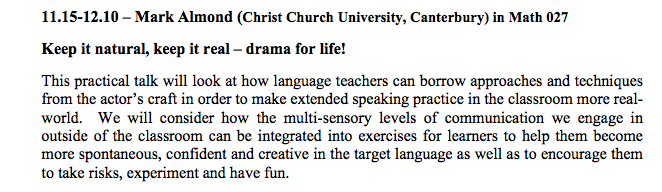
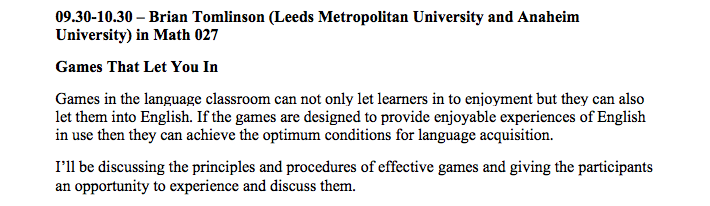
Brian started us off, of course, talking about games – except there was a lot more doing than talking! Brian argued for a game driven approach, but not as the only approach: as an important component of (to the *complete* astonishment of the audience, of course! 😉 ) a text-driven approach. He also took the stance that enjoyment is necessary for language acquisition, but insufficient in itself: Just because learners enjoy something, doesn’t guarantee acquisition. There are other criteria to fulfil.

He then had us try out a few games:

  1. 3-word stories:  In pairs, we each wrote down 3 (consecutive) words to start a story. A said their three words to B, starting the story. B had to respond immediately by continuing A’s story with another 3 words. If either person was unable to continue without pausing, it ended. B then started the next story with their 3 words. (Brian explained that this could be followed by a written phase and a performance phase, using interest as the main criteria)
  2. The second game he had us doing was a game with stones and a wooden board (which exists in many different versions in many different countries) – he had us doing it with circles drawn on paper and tiny balls of screwed up paper. It was complicated but requesting clarification of the rules was all part of it.
  3. Mrs King strikes back: Brian described setting it up by telling the learners they are going to watch a dvd called Mrs King strikes back and eliciting predictions of what it is about. He then proceeds to happen to have forgotten to bring it in. Thus we had to act scene 1 of the film while he narrated it (people are not forced to join in at this stage, watching is fine), playing every role. We then read a text, the ‘true story on which the dvd was based’, and were put into teams, with two minutes to read the text and identify differences between the version just narrated/mimed and the text. An elicitation game followed.
  4. Newspaper hockey: We were put into teams and each team had to produce two hockey sticks and two balls made out of newspaper (except this bit had bee done for us!). In our demo, we had 4 per team. We were numbered off 1-4. We lined up facing each other and at either end was a chair/goal. Your team’s hockey stick is on the opposite chair/goal from the one you are aiming at. Firstly, simply numbers were shouted out. If it was your number, you had to try and score a goal. Then came the more complicated version, in order to know which number is being called, we had to work out the answer to a mathematical problem e.g. the number of people in two tennis doubles matches minus the number of people in a bridge game. (4) Everyone got thoroughly into the spirit of the game and we were all well warmed up for the talks to follow.

Screen Shot 2013-07-14 at 20.34.12

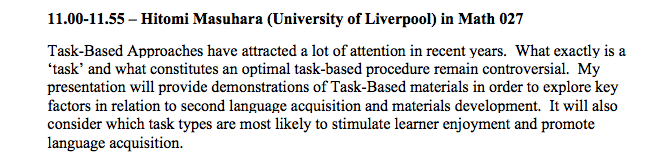
Next up was Hitomi. This was another engaging session, in which, amongst other things, she talked us through a task-based sequence for teenagers based around the topic of magic tricks: Hitomi actually demonstrated a magic trick and then elicited ideas of how it could have happened (she tore a tissue up and then made it whole again – was very cool!). We concluded that angels had kissed it. 😉  She explained that learners could then be taken through a process of searching for similar magic tricks/explanations on youtube, learning how to perform and presenting a performance of whichever trick they have chosen and described optional but recommend follow ups, such as recording performances and/or creating a booklet. The importance of initial focus on content during peer review was emphasised.

(I found it particularly interesting when she contrasted her sequence with Rod Ellis’s (2010) shopping task, pointing out that tasks are used for both research and pedagogical purposes but that tasks with a pedagogical focus emphasise broader educational development, while research tasks are geared towards study of language input, intake and acquisition. So a perfectly good research task may not be the most engaging or effective task pedagogically. However, don’t discount such tasks: do think about how to make them more interesting/engaging/relevant etc.)

Screen Shot 2013-07-14 at 20.37.00

Fortunately, I then went to this talk! 😉 I had a great audience, so the discussion generated was very interesting – everyone had their own views and ideas to contribute, which was great. More information to be found here. (Unfortunately as the recording is only of a rehearsal, you don’t get the interactive flavour of proceedings – which is arguably the best part! – only the general content…)

Screen Shot 2013-07-15 at 06.53.13

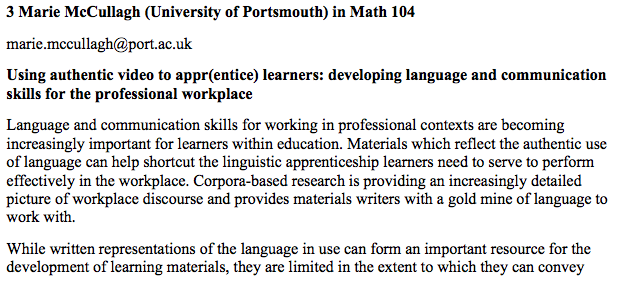
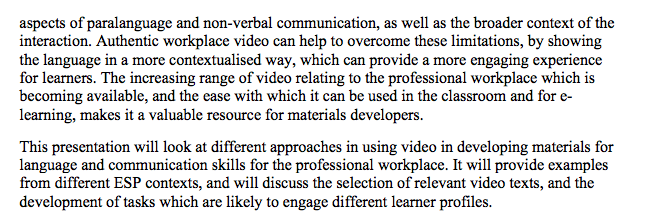
Screen Shot 2013-07-14 at 20.35.05This was a fascinating talk. Marie talked to us about combining Tomlinson’s text-based approach with a discourse analysis approach, using corpora based research to inform language focus. She made the very good point that in course books, transactional and interactional talk are most often separated, whereas in real life, transactional talk includes, and needs, interactional talk. She showed us types of language associated with interactional talk – such as language for expressing stance, hedging and politeness, referring to shared knowledge and showing solidarity. Marie also demonstrated her ideas by showing us materials she’d made for her learners using a video clip from The Apprentice.

Screen Shot 2013-07-14 at 20.35.39

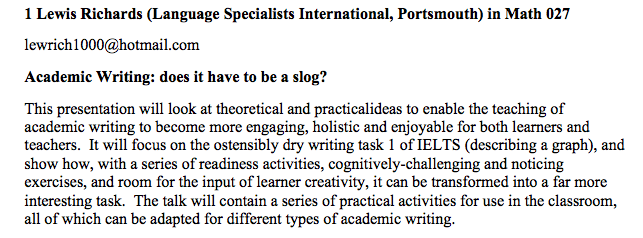
This talk was brilliant – full of simple, useful ideas of how to turn dull as ditchwater IELTS tasks into something interesting and engaging. For example, for the boring, pointless writing about a process task,  Lewis played us a recorded spoof example of the process of making tea from planting it to pouring out the tea, as though it were something two friends would discuss. It was hilarious! It also contained all the necessary language, which learners could extract. He also showed us a spoof model answer to a writing task, in completely the wrong register/genre and suggested getting learners to identify all the inappropriate elements. The true model answer could then be used for cognitively engaging noticing activities.

This was the kind of talk that you left absolutely raring to try out all the ideas! 🙂 The perfect end to day 1.

Screen Shot 2013-07-14 at 20.36.48Day 2 started later than planned (long story!), nevertheless the talks I was able to attend were great. This was the first and it was a lot of fun. The main focus was on improvisation. Volunteers from the audience were required to demo all the activities, of course.

  • There was the bus queue one – we had to stand in a line, one end was the front of the queue, the other was the back. Then there was a really interesting one for exploring the role of status in communication. The demo group consisted of six people and they had to role play different statuses, depending on the playing card they were given. Aces were high. The audience had to guess what their status was by the way they behaved. Obviously in reality, it is less clear cut; indeed, when putting the group in order of status, the audience had different opinions – and this is where the potential for lots of interesting discussion comes in, with potential of course for intercultural comparisons to be made.
  • In the second version, group members each had a playing card again, but this time they couldn’t see it. They could only see the cards of the rest of the group (everyone stuck their cards to their forehead). So here, they had to guess what status they had by how they were treated by the rest of the group.
  • The final one was about blocking and accepting: Blocking – when you stop communication by using disagreement (verbal or nonverbal) or non-sequiturs, for example, to shut it down. Accepting – basically the opposite: you agree (positive verbal or nonverbal language), use back-channels, question tags etc. Two audience members had to role play a shop assistant and customer in a shoe-shop. The first time, they had to accept everything, but not buy/sell any shoes. The second time, one had to accept everything and one blocked everything. For the last one, they both had to block everything.

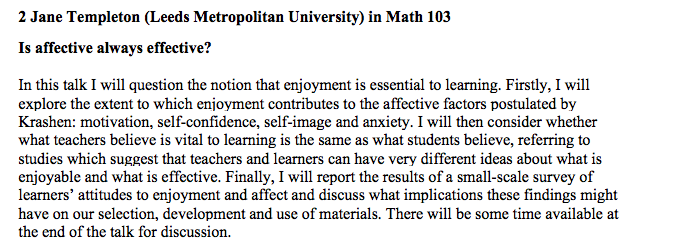
(I think it might be interesting to combine some of these activities with elements of the corpora talk earlier and ideas from the “Is affective always effective?” talk that followed – so, get some friends to role play these tasks and record  it. This could then be used after the activities as a point of comparison and for some awareness-raising/noticing activities for whatever elements of language use stand out when the transcript is analysed. Not in a “this is the right way to do it” way but in an exploring the differences and possibly making intercultural comparisons kind of way. Obviously not authentic language per se, but whoever is role playing and recording themselves would, I imagine, be using the types of language and structures that they would use in these situations.)

Screen Shot 2013-07-14 at 20.34.33

Jane argued that engagement, affect and motivation are crucial and interlinked. Enjoyment is hard to separate out but not the central aim. She showed us some interesting materials, in which a recording became a point of comparison between spoken and written anecdote telling. Jane had us discussing the materials and thinking about how we’d work with them and lots of great ideas emerged.

Screen Shot 2013-07-15 at 15.11.14

Claudia kept us on the edge our seats by walking us through a sequence which involved used of a video. After doing some readiness activities with us, she played us a dramatic excerpt of a boy cycling very quickly away from something and falling off his bicycle in the process, all to very horror film music. We then had to predict what had happened to lead up to that event. She demonstrated the power of narrative when events are not told in simple linear order. She also showed us excerpts of course material dealing with narrative, published ten years apart, so that we could see how little has changed in that time. Even the cathedral bells, which went through a phase of ringing and ringing incessantly for a spell, couldn’t distract us from this session!

Screen Shot 2013-07-14 at 20.37.54

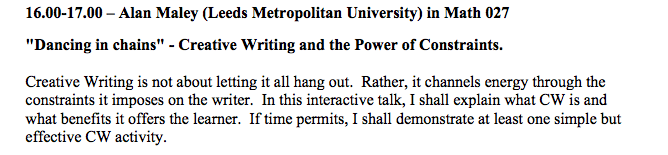
Alan Maley brought proceedings to an end, with an all too short creative writing workshop, taking us through a range of activities which could be used with learners, encouraging creativity and language play. There was theory too, to back it up, discussed briefly but not dwelt upon as we were running late but had to vacate the building at a particular time nevertheless. One of the activities we did was producing a 50 word saga based on the fable of the Fox and the Crow. Here is what I produced:

The fox, he was hungry; the crow, she had food.

This put the fox into a very bad mood.

But he was cunning, he flattered the dame,

And when she responded, down the treat came.

Ladies, be careful for foxes may lurk

Don’t be fooled by a two-faced jerk.

There were some shorter activities too, for example the two line poem:

Hello ________.

Goodbye ________.

I came up with

Hello dissertation, goodbye sanity. 😉

It was brilliant hearing other peoples’ creations and the session was a lovely way to finish a really great conference. There will be several MATSDA conferences next year, in Dublin, Brazil, Germany and I forget the other two places. Anyway, keep an eye out and if one comes to a place near you, then I would definitely suggest going.

Thank you to all the organisers for a wonderful weekend.

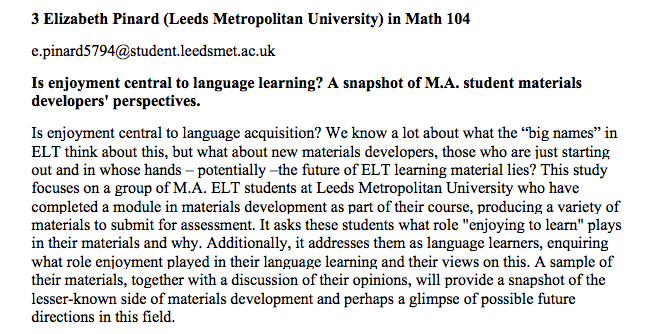
MATSDA Conference 2013 Presentation: Is enjoyment central to language learning? A snapshot of student materials developers’ perspectives.

Conference: The MATSDA/University of Liverpool 2 day conference, themed “Enjoying to learn: the best way to acquire a language?” 13th and 14th July 2013, University of Liverpool

Topic: Is enjoyment central to language learning? A snapshot of M.A. student materials developers’ perspectives

Abstract: 

Is enjoyment central to language acquisition? We know a lot about what the “big names” in
ELT think about this, but what about new materials developers, those who are just starting
out and in whose hands – potentially –the future of ELT learning material lies? This study
focuses on a group of M.A. ELT students at Leeds Metropolitan University who have
completed a module in materials development as part of their course, producing a variety of
materials to submit for assessment. It asks these students what role “enjoying to learn” plays
in their materials and why. Additionally, it addresses them as language learners, enquiring
what role enjoyment played in their language learning and their views on this. A sample of
their materials, together with a discussion of their opinions, will provide a snapshot of the
lesser-known side of materials development and perhaps a glimpse of possible future
directions in this field.

Recording: Here. (Not of the actual presentation – due to technical fail – but of a rehearsal)

Write up: Here.

References used in presentation: 

Bolitho et al. (2003) Ten questions about Language Awareness in ELTJ vol. 57/3 Oxford University Press. Oxford.

Dörnyei, Z. (2005). The psychology of the language learner: Individual differences in second language acquisition. Mahwah, NJ: Lawrence Erlbaum.

Dornyei (2013) Plenary at Warwick International PG Conference of Applied Linguistics

Dellar, H. (2013) Twenty things in twenty years, part 7: Input is more important than output. Blog post, address: http://hughdellar.wordpress.com/2013/06/09/twenty-things-in-twenty-years-part-seven-input-is-more-important-than-output/

Gadd, N. (1998) Towards less humanistic English teaching. in ELTJ vol 52/3 Oxford University Press. Oxford.

Gilmore, A. (2007) Authentic materials and authenticity in foreign language learning. In Language Teaching vol. 40. Cambridge University Press. Cambridge.

Lightbown P and Spada N  (2006) How languages are learned Oxford University Press. Oxford.

Richards, J. (2006) Materials development and research – making the connection in RELC vol. 37/1 SAGE publications

Schmidt, R. (1990) The role of consciousness in language learning in Applied Linguistics vol. 11/2 Oxford University Press. Oxford.

Scrivener, J.; Underhill, A.  The issues Blog post, link: http://demandhighelt.wordpress.com/2012/03/02/the-issues/

Swan, M. Language Teaching is Teaching Language. Hornby Lecture given at IATEFL Conference 1996.

Tomlinson (2010) Principles of effective materials development in Harwood N. (ed.) English Language Teaching Materials: Theory and Practice. Cambridge University Press.

Tomlinson (2012): Materials Development for Language Learning and Teaching in Language Teaching vol. 45/2 Cambridge University Press. Cambridge.

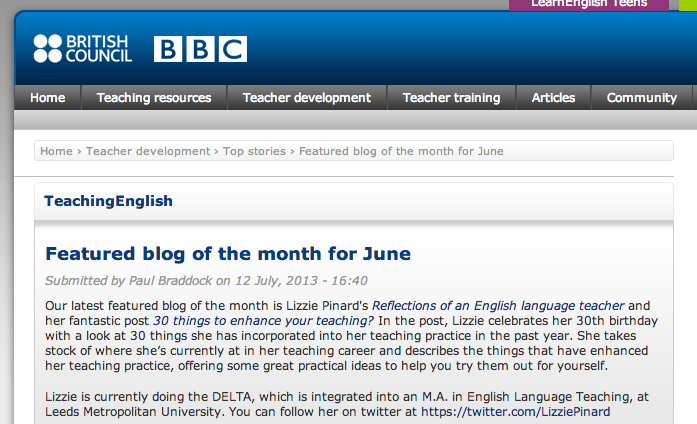
The British Council TeachingEnglish blog of the month!

It’s official:

Screen Shot 2013-07-14 at 06.15.39

So it is that finally getting round to synthesising some of what I’ve learnt in the past year led to winning an award. I rather feel I ought to pass it on to my department, though, since I learnt it all thanks to them! 🙂  Thank you, Leeds Met M.A. ELT/Delta tutors! It’s been an incredible year.

Here is a link to the guest post I was asked to do for the British Council blog (the title of which was coined by the editor – as far as I was concerned, I was writing about reflective practice! Had the brief included that title, I would probably have run a mile… :-p ) following notification of my victory. Thank you to the British Council for giving me that opportunity to write a post for them, and indeed for the award itself – both of which are a great honour.

Finally, thank you to everybody who has visited my blog and all who has commented on my posts: without you lot, this blog would be of little value and certainly wouldn’t have won an award. So, thank you for making it what it is. 🙂

Icebreaker Idea

Sandy Millin’s recent (ish!) post, “A map of me”offers a simple yet effective means of breaking the ice in a novel way – important when breaking the ice is a regular requirement, as is the case in language schools with a continuous enrolment system. I am also currently working in a school that uses such a system, and Sandy’s post has inspired me to get creative and expand my repertoire of such activities. So, here is one that I have come up with:

  1. Give each student a piece of paper and ask them to write down a list of information about themselves on it. Specify the number of statements and stipulate that some of the information should relate to things they’ve done in the past, some should be true of now and some should relate to future plans. (The number of statements and the number of stipulations will be level-dependent). NB Students must NOT write their names on their papers.
  2. Take in their sheets of paper and redistribute these so that each student has a piece of paper belonging to another student, identity unknown.
  3. Students should now mingle and ask questions in order to find out who their sheet of paper belongs to. The catch is, they cannot ask yes/no questions. E.g. If a student has written “I have two dogs and a cat”, the questioner cannot ask “Do you have two dogs and a cat?” – they should ask something like. “Have you got any pets?” and proceed from there.
  4. Students continue mingling and questioning until everybody has discovered whose piece of paper they are they are holding. Challenge early finishers to find out as much as possible about everybody in the room by the time the rest of the students finish.

Stipulating a range of time frames for the information encourages learners to use different tenses, so you can get a feel for which they are less comfortable with and for varying levels within the class. Meanwhile, the students get to know one other a bit better, and you can also get to know them a bit better through monitoring and/or through making copies of their information sheets.

This activity is as yet unnamed – if you have any suggestions, answers on a postcard! (Aka in the comment box below :-p)

And if you use it, or come up with any variations on it, let me know how it goes, or what your variations are so I can try them out too! 🙂

Shortlisted for British Council TeachingEnglish blog of the month award!

I’m very excited to have been shortlisted for this award (again!), this time for my post entitled “30 things to enhance your teaching?” 

If you enjoyed this post and want to vote for me, please follow this link (it will open in a new window) and click “like”!

Meanwhile, and either which way, thank to everybody who has visited and followed my blog to date. 🙂