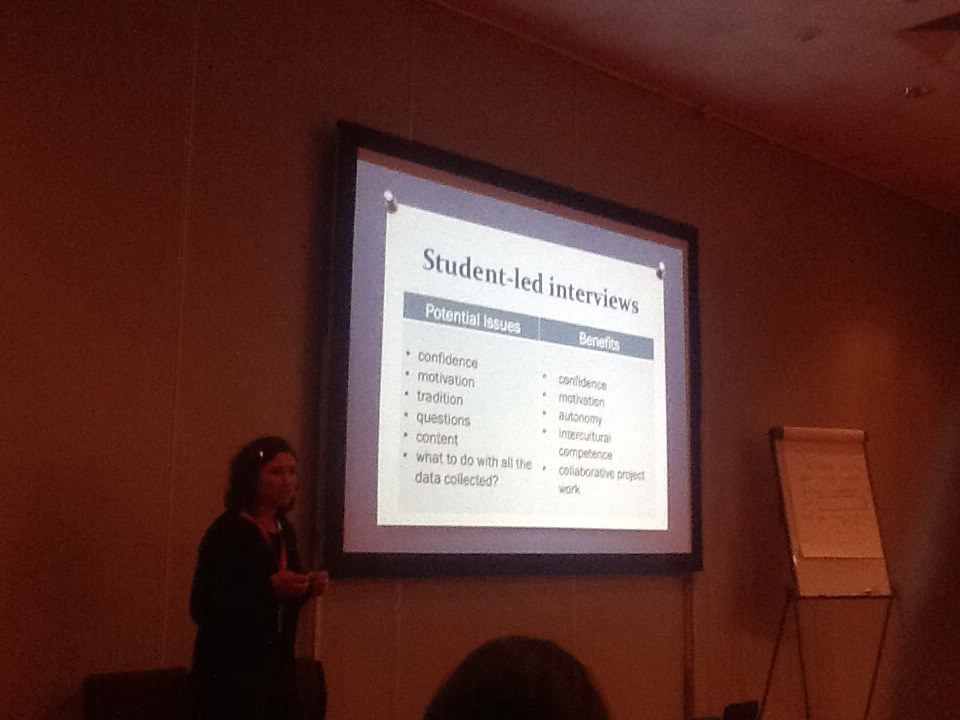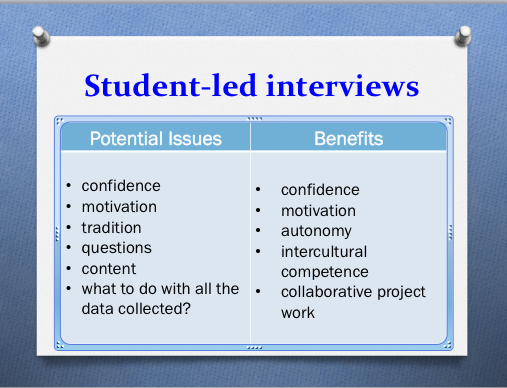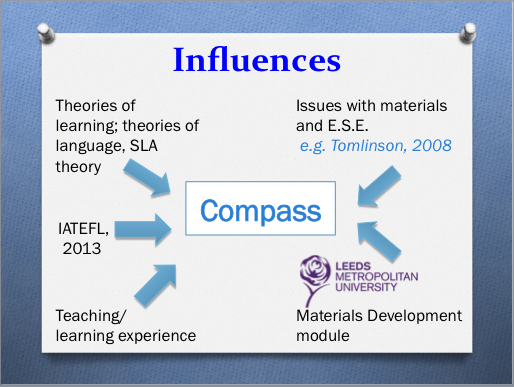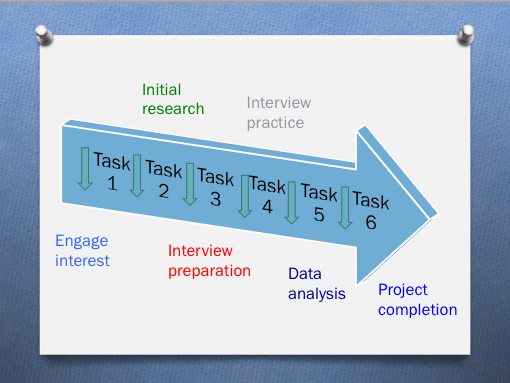
Nigel Harwood: Content, consumption and production: three types of ELT textbook research

ELT Textbooks (or ‘coursebooks’): not just books, all the paraphenalia that goes with. The focus for today is on global coursebooks e.g. Headway.

Why should we do research on textbooks at all? 

  • One powerful argument: teachers have to use them! Most teachers in most parts of the world are required to use textbooks to some degree.
  • Often responsible for end-of-term exam content and things like that.

Important to see if they are fit for purpose.

  • research that has been done can be criticised for lack of rigour, so more rigorous research is needed.

Harwood proposes a research agenda for textbooks:

  • studies of content: look at what textbooks include and exclude in terms of language, topics and culture. So, traditional content analysis.
  • studies of consumption: how the books are used by teachers and learners. Looking at lesson plans, looking at what happens in the classroom, looking at how learners feel about the book etc.
  • studies of production: the process of writing, the process by which the book are shaped and distributed.

Why does this matter?

Content analysis: for accuracy and appropriacy

E.g. of a content study of language:

There are lots of studies comparing language in corpora with language in textbooks. E.g. Ruhlemann (2009) – reported speech in seven intermediate level course books and BNC data. Evidence suggested that the corpus wasn’t being consulted.

E.g. of a content study of culture: 

Solokik (2007) – focused on grammar books and found that they are helping to transmit certain cultural images.

Gray and Block  (?missed the date, expect you can find it on slides online at some point) – earlier textbooks contain more reference to the working classes, but in none of the books was there any discussion of class issues. This is part of the discourse of textbooks as entertainment rather than serious education. Nowadays, the working class appear in pictures, in service encounters, but still no discussion.

Limitations of content analysis: 

Only gives us the “what”, not the “why” – we need to talk to writers and publishers about that. Also doesn’t tell us how material is used.

Consumption studies

This is focusing on actual use. Why does this matter? Because teachers use books differently. We need to try and explore the relationship between teacher’s profile and what they do with it. A book could look fantastic at page level but be used ineffectively.

Shawer (??) divides teachers into 3 categories:

1. Curriculum-makers: rare use made, they make their own based on learners’ needs.

2. Curriculum-developers: use it but supplement it with own materials

3. Curriculum-transmitters: slavish use of the book

Teachers do use books very differently.

Why? The content affects use; the teacher’s beliefs etc; the learners’ needs, age, level etc; institutional factors

So textbook use is context-bound and influenced.

Harwood then told us about a study he did with his PhD student. They found “john” used the book very rarely and they looked more deeply into this via various means. Turns out he was a “curriculum maker”. Looked at an exercpt; John didn’t use it. Why? Don’t like the topic, don’t think it’s useful, don’t like the visual presentation of the book; the topic wasn’t suitable for the level (his learners’ level was too low); the learner age was wrong for it; it’s too Euro-centric etc.

This study took Shawer’s work further in that Shawer developed the categories, they looked an example of one and tried to identified the reasons why. The findings map well onto Hutchinson’s (1996) model.  Also shows how textbook use is mediated by the teacher.

Textbook production

How writers write, what publishers do and so on. Why does this matter? Can help us understand how difficult it is to write a book. Very easy to criticise a textbook. But studies like this reveal all the hidden pressures at work. Can also reveal things that writers believe and publishers believe. May explain why there are problems.

Bell and Gower (2011) – chapter about all the compromises writers have to make. The unenviable task of the materials writer; trying to be all things to all people, but with constraints of space, tight deadlines (affecting piloting).

The new book

Contains, amongst others, a study by Dr. Ivor Timmis (the one and only!) – describes his experience of writing a textbook for publication in a context he had no firsthand experience of. It discusses the compromises as well e.g. conflict between text driven approach that they wanted to use vs the requirement “there must be three grammar points per unit” meaning he had to put in exercises that he otherwise wouldn’t have. Some material had to be cut due to influence from the ministry of education via the publisher. Very difficult to meet all requirements.

Conclusion

These three areas provide us with a framework for future research.

Harwood also briefly discussed the contents of this edited book: a variety of studies related to each element of the framework put forward in this talk. It looks like an interesting book.

Plenary Day 2 – Kathleen Graves: The efficiency of inefficiency: an ecological perspective on curriculum

Plenary: Kathleen Graves – The efficiency of inefficiency: an ecological perspective on curriculum


This was my second talk for the morning and here are the notes I made:


Argument: an approach to learning that seems inefficient may actually be efficient in terms of reaching ed goals in lasting ways.


Efficiency: how to achieve maximum productivity with minimum wasted effort or expense.


In the hospital:


The reasons for success can be the very things that are considered inefficient. Time-costly caring creates he relationship between the doctor and the patient and that is the secret of healing. The secret of patient care = inefficiency.

Long-term view vs. short-term results.


How about the classroom?


Ed is increasingly focused on efficiency and the push for efficiency centres on standardization of outcomes, prepackaged curricular and tests that test short term results rather than long-term results. Very true of ELT. This creates tremendous pressures on teachers and students to produce quantifiable results in the classroom, emphasis on tests rather than learning. But learning a language is a process that takes time.


Can we apply the efficiency of inefficiency to language learning?


It is a human process, organic, unpredictable and dynamic. Looking at how time is used in the classroom – what would the efficiency team consider efficient in the classroom? Getting the job done in as few turns as possible. Question; response; confirmation. But is it efficient in terms of learning? Is it really productive?


Graves makes a comparison of an “efficient” exchange and a longer, “inefficient” but learning efficient exchange.


What are some of the differences?


<slide shot> (coming soon!)


The non-efficient exchange is not efficient in terms of time but is in terms of ss participation. She builds on what the student has to offer in turn by asking the student to complete his thought, and then asks him to use technical language to express what he knows. This is very important in terms of learning the academic register is not just to understand the terms but to use them. She also creates an atmosphere where all the students feel comfortable to co-construct/contribute. 12 turns vs 3 turns: the efficiency of inefficiency. Making the best use of the resources – the learners – to achieve the results – learner understanding.


Physical and abstract resources – not just materials:


–       the learners and the teacher

–       the curriculum


How can we use these resources so they can thrive. Looking at this is in line with an ecological perspective on learning.


Leo Van Lier: passed away a little over a year ago but left an important legacy.


Ecology: the study of relationships among the elements in an environment or ecosystem and how they interact between themselves and with the environment.


In a classroom:


People: learners, teachers, others

Curriculum: materials and concepts

Environment = physical and social


Language is “Relations between people and the world

Language learning is learning ways to relate more effectively to people and the world


Ecological approach:


People

Relationships/interactions

Activity

Quality

Autonomy/Agency


You can have a high standard of living but a low quality of life. E.g. in the US – mansions and Mc Jobs = high standard of living but quality?


Testing system bypasses the quality of the educational experience and the wellbeing of the learners. We lose sight of the educational experience itself and how it contributes to quality of life. Focus on experience and wellbeing of learners harks back to caring for patients, in the hospital.


Not transmission of knowledge but a community where learners go about the business of learning by carrying out activities together, side by side or on their own.


Autonomy does not mean individualism or independence but having authorship of ones speech and actions in ones community of practice. Learners are sources of knowledge as well as learners of knowledge. Have opportunities to exercise their agency as sources of knowledge.

There must be room for learning – for a variety of expressions of agency to flourish.


An ecological approach to learning treats the classroom as a dynamic, evolving ecosystem. Relationships are built within the environment. Teacher and learners define their own meaning and purpose to what they do. The quality of these relationships matters. Focus on what is meaningful and helpful to the students.


<A clip with the sound turned off, to focus on what you see rather than what you hear>


– To give some insight into the potential of an ecological approach to curriculum.


–       Who are the participants/interactants?

–       Who interacts with whom? What kind of relationships are at play?

–       What kind of activities are the participants engaged in?

–       I what different ways are the participants acting?


<same clip with sound>


What is the role of language in this classroom?


Moving them towards standard language of schooling without devaluing what they are moving from (i.e. home use of language) – mentioned by a woman on the clip.


Language plays a role on several levels – on a social level (participants use language to interact with each other and carry out activities) but also on a symbolic level. Learners have symbolic resources – their own language they use with family and friends, an important part of their identity: African-American vernacular English. Is a linguistically complex systematic rule-governed variety of English. E.g. “We don’t have nothin’ to do” – The copula of be “He funny” is systematically omitted. Not broken English. Accurate to this variety of English. An educational system as an ecosystem uses existing resources to extend and build new resources. The home language is a resource to be used to contrast with academic language. The learners learn to use linguistic tools of contrastive analysis to identify similarities and differences. They learn a third language too – that of linguistics.


Autonomy – having authorship of one’s actions and speech within one’s community. Learners here are authors of and authorities on their language.


But why are you taking this time-consuming task – we just want them to speak correctly so just correct their incorrect language. i.e. a more “Efficient” approach. Mrs Sword could be said to be more efficient than Mr Russell but actually it’s a deficient approach. Ss own language is considered substandard and be overcome through correction. Ss own language is devalued, as are the ss. Whereas Russell’s approach is ecological, ss are resources and have resources i.e. their own language. They can tap it as a basis for learning Standard English by contrasting the two and learning the meta-language to do that. They are active participants in the process of learning and development, exercising their agency and challenging sophisticated processes. Students and language are both valued.


(Mrs Sword took a similar trajectory to Mr Russell, and used the analogy of wearing different clothes in different situations)


But first, ss stopped asking questions in order to stop being corrected and risk embarrassment. So rather than providing tools to expand resources, she shut them down. The focus was on the end result rather than on the learner and the process of learning.


Whereas Mr Russell’s class illustrates the efficiency of inefficiency: It led to increased understandings that could be demonstrated through test performances. But they also gained much more than could be measured in a test – confidence, social skills, problem-solving, how language works in different contexts, all these gains will serve them in life not just in school.


An approach to learning that seems inefficient may be much more efficient to reach long-term learning goals.


“My goal is to provide readymade answers or prescriptions but to provide food for thought, to encourage reflection about language and education, to stimulate discussion…”


A brilliant talk, that I very much enjoyed!


IATEFL 2014 day 1: Thank goodness for MaW SIG!!

My IATEFL 2014 has begun! I arrived at the conference centre in Harrogate – *finally* – soon before 5 and was happy to be able to register and go on in – live, finally, rather than just online!

iatefl-harrogate12-banner-300x200

Admittedly, having been travelling since 06.45 this morning, I was perhaps not the most with it that I’ve ever been, but Hugh Dellar (@hughdellar)’s tweet that I saw subsequently really sums it all up:

“If you’ve never attended #iatefl, imagine being propelled round a human pinball machine containing everyone you’ve ever met in ELT”

Laden down with 3 bags and rucksack by this point, I walked through to the exhibition room (my overriding impression of the conference centre so far is “labyrinth”!) and walked round it once. I think it was the final break of the day and there were TEFLers everywhere! I felt both overwhelmed and daunted – then I bumped into Ela Wassell (@elawassell), who welcomed me with a big smile and suddenly I felt a little better! Not long after that I bumped into @Marisa_C. By this time, I was trying to find my way to Harewood to find the MaW SIG gang – it seemed the only logical thing to do! It took a lot of getting lost in the labyrinth before I got there, so I missed the beginning of the talk  but I think I got most of it and it was very interesting. Really glad I managed to find the room – I think the alternative was turning tail and slinking off to find (read get even more lost on the way to) my hotel and this was the much better option!

So what does that involve? K Woodward et al. (et al. is Liz, in this case)

I was too dazed to make notes during it, I had a pounding headache, but listening to Kate and Liz talk made the day melt away and by the time it finished I felt so much better. I jotted down some notes afterwards, while waiting for the MaW SIG Open Forum to start, and essentially it was about the complex issue of selecting vocabulary to teach intermediate learners. Making word lists. The fact that the words that we automatically teach related to various topics are all well and good, but we tend to forget the more “general” words that we used to talk about them. So, we were shown some Wordles related to a few topics, and they threw up some general words that are less “expected” in association with the topic but very useful.

For example, taking the topic of jobs, something like “Oh, what does that involve?” is something we might say when we know what someone’s job is like but want to know what it is they actually do. And that’s another question we might use: “What is it that you actually do?”. Or, if we look at the topic of eating out, vocabulary is usually around menus, bills, ordering etc but something like “Oh, I haven’t decided yet!” in answer to what you’re going to get, when looking at the menu, is important but generally overlooked. We also saw the topic of personality, and Kate/Liz (I forget which!) advocated teaching things like “He’s always + ….” e.g. “He’s always talking” – as a negative description, or “He never + ….”, for a similar effect. Or for higher levels, “He tends to…”

They told us about a project they’ve been working on which involves lists of most commonly used words in other languages being translated into English, to influence what we teach as well, because for example “earthquake” doesn’t make the 6000 most commonly used words in English – but probably does in places with less stable tectonic plates! (It was more complex than that, but that was the general idea). They also mentioned Felicity O’Dell’s criteria for choosing what vocabulary to teach, and pointed out that the criteria might conflict with each other, so that there’s a lot to consider in vocabulary teaching.

After a short break, in which an extremely welcome cup of Cava came my way, it was time for:

MaW SIG Open Forum!

Nick Robinson got things started by reminding us of MaW SIG’s mission statement, which is promoting best practice in ELT materials writing (including in terms of teachers making materials for their own use, not just in the publishing world)  introducing the rest of the committee (Rachael, Lyn, Sophie, Karen and someone who was absent whose name I can’t remember) and then talking about what the SIG has been up to since being born.

It set out with 5 objectives for its first year:

  • Find the best committee for the job
  • Run a stand-alone event
  • Publish a newsletter
  • Run an IATEFL Pre-Conference Event
  • Make a website

It’s done all of those (in spades!) except make a website (and so far the Facebook page is fulfilling that role) and in addition has brought us a webinar too – you may remember John Hughes spoke a few months ago.

The stand-alone event involved 4 panels and lots of discussion generally about New Directions in ELT; the P.C.E. focused in depth on Writing for Digital; the newsletter is beautiful and will soon be downloadable – the need to get it published before IATEFL to avoid delay was the priority but .pdf format etc will follow.

Nick also mentioned that there will be four webinars in May! Very exciting. There is also likely to be a blog set up at some point. Meanwhile, the topic for next year’s P.C.E. has to be decided by this Friday!

Once Nick had finished telling us about MaW SIG, past present and future, there was some time for questions and answers. Here is some of what was discussed (paraphrased…!)

Q. Do you help people towards being published?

A. Would like to think we help people – our mission is to promote best practice in ELT. Will be interesting to see how it works for experienced people vs. newcomers, as needs are very different. Interested in bringing in inexperienced people and helping them develop. There were publishers at the January event, who got new writers: MaW SIG collected business cards, made a collation of information, and gave it to publishers e.g. Pearson. Attending events does give an opportunity to meet people.

Q. How about a discussion forum?

A: Will it become a ghost town? Onus is on members to take part, if we do make one!  [There was a lot of discussion around the pros and cons of such a discussion board, and it will be further discussed in the committee meeting tomorrow]

Q. How about writing workshops at weekend?

A: Absolutely, we are looking at different formats for future events. There is definitely potential for this. Maybe a virtual writing group online, working together on projects?

Q: How about writing “retreats” (with yoga involved)

A: A bit of a stretch for the second year perhaps? GIve us some time! Once the membership grows (and there is huge demand it seems) – if we can fill up a venue for two days, we’ll do it! 2 days max for the next year though.

Q: How about access to emails of people in the same location?

A: Not allowed to share this information – data protection – but there is Karen’s google map on Facebook where everybody was invited to share their location. We want to go where there are members who will attend events. Get in touch – tell me “I think you should do an event in <this town> and here’s why! We’ll consider it if you convince us!

The End (and the beginning…)

Finally there was a raffle and three lucky winners of their choice of ELTTeacher-to-Writer ebooks and more Cava-aided discussion.

I finally met Lyn, who I’ve had a lot of contact with in relation to the beautiful newsletter, which I contributed an article to, and Sophie, who was responsible for making it beautiful, and Rachael, who so kindly looked at and commented on my materials a few months ago, and Karen with the many hats – though I’ve yet to have a proper chat with her. Lots of super friendly people, and I came away from the Open Forum meeting feeling very positive and excited about the future of MaW SIG, as well as lucky to have met a bunch of lovely people! A far cry from the frazzled, daunted wreck that I had arrived in the room as! Thank you, MaW SIG, for existing! 🙂

Getting lost has become a key feature of this conference for me so far, hopefully tomorrow I’ll begin to get to know my way about. (Especially, it would be useful to be able to find my room at 17.45 tomorrow!!) So far, following much walking, some with lots of bags, I have located my hotel room and a supermarket – a good start!

Looking forward to tomorrow, seeing lots of talks and giving one. (I may be slightly terrified!) It’s a different IATEFL this year, as I’m going it alone, no hotel-mates (yet) etc. However, luckily everybody is so friendly that it doesn’t matter too much! 🙂  Here’s to the days to come!

Learning Technologies SIG P.C.E. – Adrian Holliday “Web-based learning, cultural travel and claiming the world”

I had an email through yesterday, telling me this P.C.E. would be streamed live and so it is that at 11.00 C.E.T. (10.00 B.S.T.) I’m waiting for my first IATEFL Harrogate experience to begin unexpectedly early! Happy days, as I was disappointed not to be able to attend one of the P.C.E.’s in person this year. 

I first discovered Adrian Holliday during my M.A. ELT studies at Leeds Met last year – The struggle to teach English as an international language featured, as did a chapter in an edited book from Routledge about Applied Linguistics that I read, not to mention the journal articles. He comes across very strongly in his writing – a man with opinions, which he isn’t afraid to express! So I was delighted to discover that I have the opportunity to watch him talk via the live-streaming despite not being able to attend the P.C.E. day.

Here are the notes I made during this talk:

Adrian Holliday: Web-based cultural travel and claiming the world

Adrian says he has never thought of himself as a technology person but does like technology, and is happy to be here in his home area, able to eat in Betty’s restaurant, and to have had a good night’s sleep!

The topic connects with something he is very interested in – cultural travel and claiming the world. What tech does is bring out something that has often been hidden. Web-based and digital tech liberate a world that has been hidden.

“Young people on the march” – teachers in Iran can’t cope, there are so many youn people learning language and they are way ahead of their teachers. Inspiring but can be worrying if we don’t allow things to open up. This is what this talk aims to do.

Multi-literacies and claiming secret sites of learning

Holliday cites a secondary school in Hong Kong, demonstrating the power of technology to reach students, then a Sri Lankan secondary school with American textbooks with glosses scribbled in by learners that characterise their interests. They write their own script onto the dialogue. They convert what they get, out of sight of the teacher. He speaks of the amazing creativity of university learners in Kuwait and then inner-London secondary schools in the UK, where students play with each others’ languages, demonstrating incredible skill, and Chinese secondary school students’ diaries again demonstrating immense creativity. Teachers may think learners lack autonomy, but in fact learners may practice their autonomy in private by themselves.

Autonomy, authenticity and choice

Holliday believes that everybody has the innate ability to be autonomous and that people practice it privately, but that it is not always visible in the classroom because the classroom doesn’t allow it to work. He provides an example of technology bringing creativity and choice into the language learning environment, making it visible where it was hidden and secret. He is strong in his views that British or American models should be moved away from, but accepts that learners may choose them as not the core but something exotic. They are attracted by the “brand”. He says it becomes in the domain of motivation rather than that of model.

We are moving away from a native speaker norms:

When we think about technology, we need to remember that a lot of research has gone on that has changed the way we think about language. English can attach itself to any cultural reality. He quotes Chimimanda Ngozi Adiche’s use of “How did you come out this morning?” as a greeting between people in a book of hers, and says we all know what it means, but that most teachers would not allow that kind of language in the classroom but that we should actually allow language learners the freedom to work by themselves and bring stuff like this in from their communities, expanding English as never before.

Holliday moves on to discuss India and how people may speak five different languages, a multi-lingual society. So you become a native speaker not of a particular language but of the whole linguistic repertoire that you use. (Quoting Rajogopolan, 2012) and then a Syrian student who he described as travelling within the language according to her use of it.

“You speak the language, not let the language speak you. ….To stamp the language with your identity”(Clements and Higgins, 2008) Holliday thinks that technology allows this sort of thing to come into clear view.

Taking care of identity

Holliday describes coming from your own cultural background and claiming the world, as taking it on in your own terms – a kind of “bottom-up globalisation”.

He describes Norton (2014)’s quote “Learner’ – camera – ‘journalist'” – mentioning the questions that were attached with regards to who gives the camera and why do they need to?

The internet provides incredible exposure to things across the world. So is there an existing cultural capital that has the resilience to withstand the images from elsewhere? For the picture of Italian learners that Holliday displayed earlier, he thinks yes. He doesn’t believe that anyone lacks cultural capital or identity but that we have to be careful, and this is where the role of the teacher comes in. There is a large role for the teacher in providing social support. As young people are very able to work with new devices, they might not know the strategies this could be used for. He is interested in the ethics, morality and control of using blogs, as discussed in Gollobin (2014). When the students in that study began to blog, they were freed from their identity. They don’t lose anything but they can be whatever they wanted to be. You wouldn’t know age/race/gender/class from their writing. Any newcomers could go on the blog and work out exactly where they should be on the programme and position themselves.

Underlying universal cultural processes

Holliday offers us some theory from his own work:

Cultural background: national, regional or religious ‘culture’ doesn’t confine you or bind you but provides you with cultural resources. Different people will bring different cultural resources. This explains why somebody in Gollobin’s (ibid) class who has never done blogging before, as soon as they work out the basics of what to do, they knew what to do. They drew on experiences and skills which they could bring to this. But there’s something else there that ties everything together. Universal underling cultural processes. How we all engage with culture everywhere in a similar way, in terms of constructing and engaging with social rules and relationships.

Holliday is a cultural traveller when he reads Jane Austen. We are all cultural travellers whenever we go anywhere or read anything. We bring things from our own background that help us to unlock what is happening elsewhere. When you visit the family next door, as a child, that is your first major culture shock. And you have to work out how to be yourself in a completely different domain from what you’re used to. It’s this underlying ability that enables us to travel culturally. All the students referred to earlier in the talk are doing this, but doing it outside the classroom. Holliday thinks that technology should enable use to bring it INTO the classroom.

Holliday doesn’t think you need to learn another culture in order to learn another language. You need to recognise existent cultural resources and how they can be used.

Screen Shot 2014-04-01 at 11.59.25

But there are somethings that get in the way. What? 

  • outdated ideas about English and Culture: he has spoken to young people who tells him that their teachers tell them they must speak British English or they won’t be understood. In this day and age, teachers and parents are telling their children/students this.
  • cultural disbelief: we must never believe that people come from somewhere that makes them wired in a way as not to be able to use technology: we mustn’t deny the value of existing experience, it is rich and productive, wherever people come from, whatever their experiences.
  • institutional structures which don’t allow space: they’ve kept the creativity of students hidden and marginalise what can be done with technology.
  • empty bullet points
  • existing curriculum:  clinging to positivist research approaches
  • do not get beneath the surface: what we know about society across the world is struggling at the margins because the big narratives tell us that people can’t, when actually people can. We have to learn from the margins.
  • Top down globalisation: the western idea that certain people don’t have autonomy etc.

Holliday thinks that we need to be strategically unobtrusive. Language learners are more creative than we imagine, but we don’t see it, then teaching can actually get in the way. Technology puts technology and experience between teacher and student, somehow. Holliday thinks teachers need to step back and let the technology work by itself. To allow students to be who they want to be and bring what they can from their background. Somehow you have to allow space to be there, which the students can populate in their own terms. So what we mustn’t do is go around telling people how they should behave with technology. Holliday worries about the larger than life language teacher, always there in the middle. He thinks autonomy needs to be de-centred.

You need to ask questions without dominating questions and not ask questions which push your agenda. The technology is there, the opportunity is there, people have the wherewithal to stamp their own identity and take things where they want them to go.

Holliday finished there, and there were a couple of minutes for questions…

Q: Do you think the identity is because they are learning a new language and later their identity would in fact be seen in their writing?

AH: This wasn’t a matter of removing identity but protecting identity. When you learn a new language you bring your identity into the language and populate it, there is expansion and things move on. But you’ve got to protect peoples’ private choices about what they do with their identity. But I don’t believe that when you learn English, you get a new identity, you expand your existing one into the language. 

Q. Are emergent and secret forms of learning a threat to the teacher? 

A.H: Yes I think they are. I think you have to be quite an agile and confident teacher to deal with this sort of thing. The job is shifting from someone who projects a model of the language to someone who facilitates learning. We are asking a huge amount of teachers to be able to field and work with this emergent creativity.Going back to the example of the lang students in Hong Kong, the story goes that the teachers weren’t able to deal with the creativity of the students so used the excuse that cultural background wouldn’t allow them to be creative, so the teachers were using the excuse to protect their domain, have to be very careful. 

At this point I had to depart – duty called! But thank you to Adrian Holliday for a very interesting talk and to the LT SIG for streaming it! A great start to IATEFL 2014, for me! (An aside: Adrian  Holliday doesn’t look anything like I imagined! )

Here is a screen shot of the references slide – not very clear, sorry,  but am sure the references will be available elsewhere online anyway!

Screen Shot 2014-04-01 at 12.04.17


IATEFL Harrogate 2014: What *I’m* looking forward to…and how about you?

It’s nearly time for IATEFL 2014! I’m sure we’ve all been trawling through the programme pdf and the app, seeing what’s on and getting excited – well, I have anyway! I think anticipation is such a fun part of it all!  

Here are the workshops/talks/events going on that have caught my eye so far:

Wednesday

(Unfortunately I’m going to miss most of Wednesday, but if I were going to be there on Wednesday, my timetable might look like this…)

  • Plenary session by David Graddol: English and economic development [at least this I can catch the recording of… I wonder if I will be able to watch some of the live stream while travelling? Time will tell…]
  • Session 1: Either EAP writing: getting down and dirty by Richard Hillman [because I’m hoping to be teaching on a pre-sessional course at a university this summer] or Demand High and lost learning by Adrian Underhill [because who doesn’t like watching Adrian Underhill talk!]
  • Session 2: Global coursebooks: helpful scaffold or debilitating crutch by Heather Buchanan and Julie Norton [because I participated in the research that fed into this talk and and am curious about the outcome; also because Heather was my tutor and dissertation supervisor during my M.A. ELT at Leeds Met, so I know that what she has to say is good value!]
  • Session 3: More than just a worksheet: writing effective classroom materials by Rachael Roberts [because she has a great blog full of useful and interesting ideas, as well as lots of materials writing experience, so I could learn a lot from this session. Plus she’s involved with MaW SIG and has, in that capacity, already commented on some materials I’ve made, so I’m very interested to meet her! 14.05-14.50…will I have arrived yet? Will it be recorded? Have to wait and see…]
  • Session 4: Do materials writers have principles? by Jill Hadfield [Another MaW SIG SIG day speaker, and another person I’m interested to meet! Also because I read a lot about materials development during my M.A. and am interested in the topic and the process. The question is, will I make it in time?]
  • Session 5: Tech Hacks for classroom activities, materials writing and course design by Andy Johnson [because this workshop sounds really useful and practical and relates to technology AND teaching AND materials writing AND course design – what more could you want! 😉 Hmmm, I might actually have made it to the conference by this point! Here’s hoping!]
  • Session 6: Materials Writing Special Interest Group Open Forum  [Please let my flight/trains not be delayed, so I’m at least there in time to go to this session! Golden opportunity to meet other people who are interested in materials writing and the MaW SIG committee!]

Thursday

  • Session 1: How to get published in a refereed journal with Graham Hall (08.15 to 08.45) and Plenary session by Kathleen Graves [because I want to be published in a refereed journal at some point and Kathleen’s talk looks really interesting!]
  • Session 2: Academic writing materials: from research to online delivery [because this looks like a really interesting materials writing project, involving making and using a corpus.]
  • Session 3: A fresh approach to advanced listening practice by Sheila Thorn [because this sounds both interesting and directly useful – ideas to take into the classroom and try with my advanced gang as soon as I get back to Palermo!]
  • Session 4: Content, consumption and production: three types of ELT textbook research by Nigel Harwood [because I got to know his name during my studies and I’m intrigued to put a face to it… Also because the talk looks interesting!]
  • Session 5: Upgrade! Demand High to bring a grammar lesson alive by Jim Scrivener [because he’s always a pleasure to watch and generally sends you away armed with tons of ideas that you can try out next time you walk into a classroom!]
  • Session 6: Sit out – to remember what on earth it is I am going to say in Session 7
  • Session 7: Bridging the gap between learning materials and an English-speaking environment by Lizzie Pinard. [Well, I had really better attend my own talk, hadn’t I!!]

Friday

  • Plenary session by Michael Hoey [because who’d miss it! Michael Hoey is awesome – I saw him present at MATSDA last year, never seen a more crazily energetic presenter: should be the perfect way to energise oneself for the day, better than a coffee!]
  • Session 1: How do engineers say that? Encouraging academic independence by Julie Moore [because this talk combines my future professional needs – how to EAP – and my current professional interests – how to help learners become more independent!]
  • Session 2: Teaching English for Academic Purposes: insights from experience by Penny Ur [because it sounds like it will be a very useful session, where I can hopefully learn from her and everybody else’s experiences, which will help me when I move into EAP teaching]

[Looking at my planner, the next few sessions are where it gets complicated! – read: multiple overlaps!]

  • Session 3: I need to choose between… i. Making the most of minimal material by Kate Evans [because personal experience of learning from her means I know what she says is worth hearing! Plus it looks interesting!]; ii. Professional development in the experimental practice jungle by Christina Rebuffet-Broadus and Jennie Wright [because it sounds like a lot of fun as well as useful take-away tips] iii Stepping into the real world: transitioning listening by Sandy Millin [because there will be lots of useful take away and Sandy does awesome stuff!]

Which to choose? Answers on a postcard… 

  • Session ? [getting confused now, lots of little numbers in the app!] but the tail-end of the creativity symposium that starts in Session 3 – I’d like to see Brian Tomlinson’s talk Creative use of the coursebook because I’ve discovered we share similar ideas with regards to the role of the teacher and the role of learning materials, and because it sounds like there will be some useful take-away that I can apply directly on my return and beyond.

Saturday

  • Session 1: How to move from being a teacher to becoming a teacher trainer with Silvana Richardson and Plenary session by Sugatra Mistry [the first because teacher training is an avenue I’m interesting in exploring in my career and then because Sugatra’s talk sounds intriguing!]
  • Session 2: Twenty things in twenty years: this much I know by Hugh Dellar [because his blog has inspired me a lot, as did the talk I saw him do at IATEFL last year. Am looking forward to seeing him talk again and hopefully meeting him this time.]
  • Session 3: Write here, write now by Fiona Johnston [because I’m using various online communication platforms with my learners, so this talk interests me as another potential avenue to explore within this.]
  • Session 4: Motivating students in the EFL classroom by Elizabeth Davies [because she motivated me hugely when I was a CELTA trainee at Sheffield ELTC and because the role of motivation in language learning is hugely interesting to me – I’ve read a lot about it during the last six months as well as studying it during my M.A.]
  • Closing plenary: session by Jackie Kay, to bring it all to an end for 2014. [Shhh, don’t think about that yet!]

What talks are you looking forward to?

Comment and see if you can convince me there’s something else I need to see too! 🙂 – Or help me decide between my clashes…!

Non-talk related things I’m looking forward to:

  • Meeting people! As in meeting new people and catching up with old friends/colleagues/various lovely ex-tutors… IATEFL is such a grand social occasion! So please say hi if you see me! 🙂 And all the talking that goes with it. Nothing like a good discussion!
Screen Shot 2014-03-28 at 22.28.59

This is me! (I shall try and carry this turquoise scarf with horses on it around either on my neck(!) or tied to my bag so you can identify me! 😉 )

  • Leeds Met M.A. ELT/Delta Q and A: I shall be hanging out with the Leeds Met lot, in capacity of ex-student willing to answer questions about my experience, probably on Friday morning during the break. Come and see what it’s all about if you like! 🙂 [Exact time and location tbc – I will update this post with details of location once I know them, so check back if you are interested!]
  • The exhibition: When I’m not running like a headless chicken from talk to talk, I must make time to have a look round all the lovely, colourful stands and see what all the exhibitors are so keen to show us all! 🙂
  • Just…being part of it: Just being there, part of all the buzz, soaking up all the positive energy and idea-sharing going on – a recipe for motivation and renewed vigour if ever there was one! 🙂

What else have I missed? What are you looking forward to?

Tell me what you’re looking forward to, what you’re excited about,  by commenting on this post: The more excitement, the merrier!

See you in IATEFL in a few days! 🙂

IATEFL 2014 – “Chain Reaction” interview with Mura Nava

“I choose two or three of this year’s registered bloggers and introduce them on my blog. These bloggers then in turn choose other registered bloggers and interview them… and so it goes on until you all have a good idea of who will be blogging about this years event.”  

I did my first chain reaction interview with Sandy Millin. This second one is with Mura Nava, who I discovered via my interest in and series of blog posts on wordandphrase.info (which is an interface for analysing a corpus – the COCA in this case) : Mura has a keen interest in corpus linguistics too. (For a list of the talks at IATEFL which are related to this area, see Mura’s first IATEFL 2014-related post .)

iatefl-harrogate12-banner-300x200

Nearly time for IATEFL, wherever you are in the world! Click this image to find out how to follow online.

Here are Mura’s answers to the questions I got from Adam and adapted for use with Mura, who isn’t attending live but will be following avidly online:

Please introduce yourself

My name in Mura, I work as an English teacher in France. I have a soon to be 2 year old son who is at that age which is really interesting if you are into language learning. His current favourite word now (after ballon) is pantalon.

Which sessions are you looking forward to watching live or online this year? 

Well only the plenaries have been revealed as being filmed so for sure has to be Michael Hoey’s session. I have also heard that Russ Mayne’s (@ebefl) talk will be taped so will watch that.

I am hoping that Simon Smith’s session on Using lecture notes to create domain corpora will be taped, if not maybe one of your Harrogate-2014-going readers will cover it 🙂

Why are you interested in the areas represented by the talks/workshops you want to see?

I have seen Michael Hoey talk before and he is both informative and entertaining, I know Russ Mayne from twitter so be great to see him chat in real life and I am very interested in corpora and language learning/teaching so the session by Simon Smith suits me great.

What do you hope to learn from the sessions you plan to watch?

From Simon Smith’s session how to get students to build their own corpora as I am part of a project that will deal with similar issues.

Do you blog? Could you tell us about your blogs (s)?

Yes I do at eflnotes.wordpress.com though I am more active on the Google+ community for corpus linguistics – https://plus.google.com/u/0/communities/101266284417587206243

What other aspects of the conference are you looking forward to?

The online forum discussions sometimes throws up good stuff.

Why did you sign up as an IATEFL registered blogger?

I have been doing it last 2 years and in fact in 2012 coincided with me launching my blog (properly, as I had written first post sometime before then) so I remember how it helped me with an instant audience.

Thanks, Mura! I hope you enjoy following IATEFL online and that lots of the talks you’ve ear-marked are covered via filming or blogging! 


Edmodo Workshop: 28/3/2014 (A how-to for teachers…)

Today I did a workshop on using Edmodo, for my colleagues here at IH Palermo. It was a very practical workshop, with the goal of sending teachers away with the technical know-how necessary for using Edmodo and some ideas for integrating it into their classes. I thought I’d share what I did and the materials I made/used here, in case it’s of interest to anyone else who wants to run a similar workshop at their school – or anyone who wants to learn how to use Edmodo, themselves! (The handout with step-by-step instructions for teachers and students, and my power point slides with step-by-step screen shots, are at the end of this post.)

Edmodo home

Welcome to Edmodo! – A screenshot of Edmodo’s homepage!

This was the outline of my workshop:

  • What is Edmodo?
  • Edmodo as a teacher (“How do I…?”)
  • Edmodo as a learner (“How do they…?”)
  • Integrating Edmodo (Homework; autonomous use)
  • Potential issues (“But what about…?”)

What is Edmodo?

For the “what”,  I used Edmodo‘s own description of itself:

“a free and safe way for students and teachers to connect and collaborate”

– in combination with the way I explain it to  my learners:

“a space for this class to use English together at any time, to discuss, to share links, to share pictures, to share files. And sometimes, a space for homework!”

It isn’t a millstone, it’s not compulsory, it’s an opportunity. I think it’s important to put it like that, so that students feel they are getting something extra rather than being forced into doing something.

 “Edmodo as a teacher” 

This involved getting all the teachers registered and attached to our school, as well as exploring the Edmodo platform from a teacher’s point of view. I had prepared powerpoint slides with screen shots, which I used to take the teachers through these steps. Registering is a one-off process, so getting it done in the workshop meant that teachers didn’t have to fiddle about with it on their own later on, which might have been off-putting during an already busy day.

Edmodo as a learner” 

For this part, I gave the teachers a group code, which was for a group I had set up in advance, getting them them to register as students in this group. This was to give them a flavour of Edmodo from the students’ perspective. As well as the powerpoint as a guide, I had my own Edmodo account open on the group page, so that they could see what happens on the teacher’s page, when a student joins a group and uses the page. I had set up a little poll and a quiz for them to do as students too. Hopefully having used Edmodo as a student will help them be better able to help their students, if it is needed.

“Integrating Edmodo”

Now that my colleagues had played with Edmodo, both as a teacher and as a learner, I got them to brainstorm ideas for using it with their learners. I also gave them links to my two blog posts, on using Edmodo to make homework more interesting and on using Edmodo for fostering learner autonomywhich each contain a series of ready-to-use ideas to experiment with. The goal of this part of the workshop was to arm them with ideas so that they could easily start to use Edmodo with their own learners. 

“But what about…?”

This section was to give teachers the opportunity voice their concerns about using Edmodo and hopefully to address these. I started with the slide of potential issues (though some had cropped up as the workshop progressed, of course):

  • But what if my students don’t like social media?
  • But what if my students don’t use Edmodo?
  • But what if my students think this is a stupid idea?
  • But I don’t have *time* for this!!
  • But how do I give feedback?
  • But I’m rubbish with technology!
  • …any more?

These listed I could address:

  • I’ve had students who hate Facebook but love Edmodo. The trick is avoid selling it as Facebook the second. It’s not. It’s a tool to support their language learning and to enable them to communicate in English more than they otherwise could.  They may not be too sure about it as first, but just give them time and don’t force it down their throats. It’s an opportunity not a millstone.
  • That’s ok. It’s not compulsory to use it. Also, hopefully, as they see course mates using it, and finding it useful, they will want in on the action too! Again, don’t force it. But allow a bit of class time for discussion about it (within discussion about activities using English outside the classroom), so that those who don’t use it are exposed to the experiences of those who have, which will be potentially motivating.
  • I haven’t had a student yet who’s thought it’s a stupid idea. Students tend to like things that have been made specially for them – it makes them feel special!
  • With regards to time, once you are registered, it’s quick and easy to use. If you use it for homework, then you are only using what time you would be using for marking.
  • Feedback can be done in a variety of ways: you can reply to posts with both response to content and corrections, if it’s a case of homework – I usually copy the sentence with the error, put it in quotation marks, then paste it again and correct it, with the corrections capitalised so that they are easier to spot. Alternatively, you could use it for delayed feedback in the classroom – it’s easy to copy and paste to a slide and project it in the classroom.
  • With regards to technological prowess,  very little is needed in order to use Edmodo. As long as you can type a message in a box where it says “Type your note here”, type in a group or student name where it says “Type the name of a group, student or teacher here” and click send, and as long as you can type a message under student’s note, where it says “type your reply here” and click send, you’re away! Anything else (polls, quizzes etc) is an optional extra. You also don’t need a Facebook account or an email address, or anything else, in order to use it.

The teachers then had time to voice any more, for discussion of how to deal with them.

Finally, I showed them some of my own class pages, so they could see it in action. I had even got some of my students to write a post for me to show the teachers, saying why they like Edmodo (and therefore why it’s good for teachers to use it with students!)

Here is the handout I made for extra reference (made for use in conjunction with the powerpoint, hence lack of screen-shots!)

Here is a copy of my slides (which are mostly step-by-step for how to use Edmodo)

To conclude this post, I’d like to say a big thank you to Sandy Millin, who introduced me to Edmodo, by essentially doing a mini-version of this workshop with me, when I visited her last year! (And also, when I mentioned this workshop to her, for reminding me of the value of an opportunity to play about with it, if you are a teacher coming to it for the first time!)

And thank you, of course, to my DoS, for giving me the opportunity to deliver a workshop to my colleagues, which was a rewarding learning experience.


Holidays, a song (“Brighton in the Rain”) and the good ol’ present perfect!

I first learnt about “Brighton in the Rain”, by Robert Campbell and Jonathan Dykes, from my CELTA tutor at Sheffield University, many moons ago.

When I first used this song, I struggled to find a recording – lots of googling led me to a discussion thread/feed where it had been mentioned and emailing the person who mentioned it finally scored me a copy. (Thank you, whoever you are! I can’t remember your name or where I found that obscure thread, but it was good to get my hands on the song at last!) Of course, nowadays it’s freely available on youtube.com and various other websites – like so much else.

Anyway, faced with a grammar-heavy few pages of course book (present perfect central!), I dug it out – the first time in a while! – and used it with my pre-intermediate students to lighten it up for them a little. Topic-wise, it feeds nicely in to what comes next in the book, which is travelling-related (and a heap more present perfect information!).

Here is what I did with it:

Time: 

1hr 20 minutes

Materials: 

a recording of the song (now available here); cut-up lyrics; a handout of the complete song lyrics; this powerpoint (shared here minus the photos I used, as those were copyrighted – but all you need to do is a Google images search for pictures of Brighton in the rain and a picture of Brighton on a map !); this handout (based on the powerpoint – for the learners to have a take-away record); this empty rubric, which is based on the song.

Focus: 

Review of the present perfect for life experiences, use with “ever“/”never“/”always“/”only“, asking and answering questions using the form, using the form to discuss their own experiences; listening, speaking, writing.

Procedure:

Listening

  • Put learners in pairs/small groups and give them these questions to discuss:
  1. Tell your partner about some of the places where you have been on holiday.

  2. Do you usually go somewhere different or do you go back to the same place every year?

  3. What are the pros and cons of going to the same place every year and going to a different place every year?

  • Do a quick whole class feedback phase.
  • Show learners the pictures of Brighton, in the rain, ask if they can guess where it is (Brighton) and then what the pictures have in common (it’s raining!).
  • Ask learners if they have ever been to/heard of Brighton before. (If they haven’t, would they like to go?)
  • Play the recording of the song (if using the version I linked to, don’t show the learners the video; hide it and get them to listen only) and have learners listen for the answers to these two questions:
  1. Does the singer visit different places every year? (No!)

  2. Where has he been? (Only Brighton and the Isle of Mann! – but of course the learners will hear lots of places that he hasn’t been to…)

  • Give learners the cut-up lyrics (I like to make the lyrics a large font size and get learners to work together, using the floor space, to do this activity – but I’ve only done it with small classes!) and have them listen and put them in the correct order. (This worked really nicely today, the learners were very in to it. I paused the recording periodically to give them time to catch up and fed in some prompting questions to get them using linguistic and logical skills.)
  • Play the song again and get learners to sing along! (Mine were silly-dancing too!)
  • Put learners in pairs or small groups to discuss the following questions: (This we did briefly as a whole class, because we were a small group anyway, while still stood up around the lyrics – it was more of a quick chat!)
  1. Do you think the singer is happy? (No!)
  2. How do his travel experiences compare with yours?
  3. Have you ever done any of the things that he hasn’t done? Which?
  4. Would you like to do any of the things he hasn’t done? Which? Why?
Brighton_Pier,_East_Sussex_-_geograph.org.uk_-_707356

Brighton in the rain! (image taken from advanced Google images search, licensed for commercial reuse with modification, from commons.wikimedia.org)

Language focus

  • Keep learners in pairs/smalls groups (you could change groupings if you want to), give them each a copy of the full song, and get them to look at and discuss the present perfect form and meaning focus questions:
  1. What tense do we use to talk about life experiences?

  2. How do we form it? (positive sentence, negative sentence, question, short answers)

  3. Do we know when the experience happened?

  4. Does it matter when the experience happened?

  • Do a whole class feedback phase and then move onto the next questions:
  1. Look at these lines from the song. What do the words in bold mean? How would you translate them into your language?

– I’ve never been to Athens and I’ve never been to Rome.

– I’ve only seen the pyramids in picture books at home.

– I’ve always spent my holidays in Brighton, in the rain!

  1. Look at these questions based on the song. What do the words in bold mean? (This should be “2” but WordPress won’t let it be!)

– Have you ever been to Athens?

– Have you ever been to Rome?

  • Check their answers in a whole class phase, and give them time/space to ask any questions, and then let them move on to the next activity: in their pairs, they should make, ask and answer some more questions like the above examples, based on ideas from the song.

Speaking and Writing

  • Put learners in pairs. Give each learner a copy of the blank rubric of the song.
  • Get them to interview their partner about his or her life experiences, and complete the blank rubric using their partner’s answers. (You could do an initial brainstorming stage for possible topic areas/questions to ask, to help get learners’ creative juices flowing! It also really helps to demonstrate this activity with one of the learners before setting them off.) Encourage learners to ask interesting questions.*
  • Put learners in groups so that the above-mentioned pairs are split up. Ask them to take it in turns to tell their group about their partner, using the rubric (they will need to convert the sentences into the third person for this). Their group should ask, say, five questions about each person, which the learner whose partner it is should note down.
  • Put learners back in their original pairs and let them find out the answers to their group’s questions.
  • Regroup them into the same groups as above, for them to give their group the answers to their questions.

*Variation

If you run out of time (cough cough!) around the stage I marked with an asterisk, I recommend getting the learners to finish completing the rubric as their partner (so, as they have begun via interview but by guessing the information about their partners rather than doing it through questioning). At the beginning of next lesson, I plan to get them back in the same pairs again to see how near or far they were with their guesses!

Possible homework/follow-up

(If you use Edmodo) Get learners to write a few sentences about their experiences (encourage them to use experiences they have not yet discussed…) and send them directly to you (using that function on Edmodo!) and then you post all of their experiences onto the class page. They should then read and guess which experiences go with which classmates!

Thoughts:

I think this lesson worked well, to give the learners a bit of extra time to get their mouths and minds around the present perfect. In the book, a lot of information comes at them in a short space of time – for, since, ever, never, contrasting with past simple and so on, so this broke it up a bit and gave them extra opportunities to hear it used and use it themselves – as well as being a bit of fun to break up a very grammar-heavy unit a bit! 🙂


IATEFL 2014 – “Chain Reaction” interview with Sandy Millin

In the lead up to the IATEFL 2014 Harrogate conference, Adam Simpson has started a ‘chain reaction‘ blog challenge:

“I choose two or three of this year’s registered bloggers and introduce them on my blog. These bloggers then in turn choose other registered bloggers and interview them… and so it goes on until you all have a good idea of who will be blogging about this years event.”  

I have firstly decided to interview Sandy Millin, with whom I attended my first IATEFL and who got me into things like blogging, using Edmodo and not using ten words where three will do when it comes to writing instructions! She’s an inspiration to teachers and students alike. For this interview, I used the same set of questions that Adam gave me.

iatefl-harrogate12-banner-300x200

Follow all the conference goings on at IATEFL online!

Here are the questions and Sandy’s answers:


  • Please introduce yourself

My name’s Sandy Millin. I’ve been the Director of Studies at International House Sevastopol since September 2013. As I’m sure you’ve probably seen in the news, it’s in Crimea, which is probably now in Russia, although some people may argue with that! I’ve been teaching EFL for seven years, and have previously taught in Borneo, Paraguay, the Czech Republic and the UK.


  • Could you give us brief details about your session at IATEFL 2014?

My session is called ‘Stepping into the real world: transitioning listening’. It’s on Friday 4th April, 14:35-15:20 in Room R. It’ll also be available on my blog afterwards if you can’t make it: http://sandymillin.wordpress.com/iatefl2014


  • What should your audience expect to learn?

It’s a workshop, so there’ll be practical activities showing how to help your students prepare for real-world listening, which can often be quite different from coursebook listening.


  • Why are you interested in the area you’ll be presenting on?

I got interested in this area while working in Newcastle in the UK. My students came from all over the world, and no matter how high their level was, they almost all had trouble with listening, both to other students in the class and people in the outside world.

During my Delta, I did one of my observed lessons on listening, and read John Field’s Listening in the Language Classroom at Lizzie Pinard’s recommendation. It was really useful, and completely changed the way I approach listening. I’d like to share some of that at IATEFL.


  • Do you blog? Could you tell us about your blog(s)?

I have three blogs, although two of them having been ‘sleeping’ for a year or so.

My main one is at http://sandymillin.wordpress.com. I normally write about teaching and share materials, although recently I’ve been writing a lot about the situation in Sevastopol and Crimea. That’s where I’ll be doing my IATEFL blogging too.

Screen Shot 2014-03-26 at 08.05.34

Visit Sandy’s blog!

Independent English is designed for students. On it there are ideas for how to become a more autonomous learner.

Infinite ELT Ideas is a set of prompts. The idea is that people look at the prompts and leave comments suggesting how they would use them in class. This worked better when I first started the blog!


  • What other aspects of the conference are you looking forward to?

My favourite thing about IATEFL is the social side. I can honestly say that IATEFL Glasgow and IATEFL Liverpool were two of the best weeks of my life. It’s great to be surrounded by passionate educators, and people who really want to improve themselves, and I always go away on a huge high. I’ll particularly enjoy IATEFL Harrogate as it will probably be my last one for a while – it’s not so easy to get there now I live in Crimea!
This year I’ll also be adding two whole new experiences to my repertoire: I’ll be presenting at the Pecha Kucha evening on Friday 4th April. If you’ve never seen one, a Pecha Kucha is a presentation made up of 20 slides, each lasting 20 seconds. The presenter has no control over the slides, and just has to keep up with them for the 6 minutes and 40 seconds they run for. If the test runs I’ve done are anything to go by, I’ll be very out of breath by the end, but I’m really looking forward to it! The other new experience is the fact that it’ll be livestreamed, so you can watch it at IATEFL Harrogate Online  🙂


  • Why did you sign up as an IATEFL registered blogger?

I’ll be blogging a lot while I’m at IATEFL, so it makes sense to be a registered blogger! It also means you’re part of the patchwork of the IATEFL experience, and you can get a fuller picture of the whole event. Only a few days to go now…


Thank you Sandy! I hope you have a great IATEFL 2014 and am looking forward to seeing you there! 🙂 

CPD and a cup of tea in the sunshine: go on, give it a go!

On Friday, we had a really fantastic CPD session. It was such a very simple idea, yet worked so effectively – well done, our DoS!

I really think all schools should incorporate this idea, or variations on it, if they can, from time to time (perhaps once or twice a term, depending on term length), so I thought I’d write about it here, for others to try.

Materials:

Sets of questions relating to teaching, professional development and career paths (e.g. about recent good lessons, bad lessons, favourite activities, recently used activities, memorable students, courses you’ve done, courses you’d like to do, how you got into ELT etc etc – the possibilities are endless!)

Time: 

As long as you have! – Whatever time allocation you have for workshops.

Procedure:

  • Put the kettle on. Allow teachers to get their tea/coffee and biscuits.
  • Put your teachers into small groups.
  • Let everybody sit around little tables (sunshine optional but much preferred!).
  • Give each group a set of questions and encourage them to discuss these together.
  • Change sets of questions periodically, change groupings periodically.
  • Repeat until questions/time have run out!

Yes, it’s that simple. 🙂

OLYMPUS DIGITAL CAMERA

CPD in the garden! 🙂 Photo taken from en.wikipedia.org via google search for images licensed for commercial reuse with modification.

Benefits:

  • Time to talk: never underestimate the value of time set aside for talking: though you could argue talking about classes etc happens in the staffroom, generally that is amidst lesson planning, admin and the usual 101 things to do. It was really nice to be able to just…talk! And learn from each other. The combined experience and knowledge in a team of staff is huge and varied, so time focused exclusively on tapping that was time well spent.
  • Increased motivation: we all felt rather up-lifted by the end! The atmosphere after the session was relaxed and happy, with us all feeling enthusiastic despite it being Friday and therefore the end of a long week – a real morale booster.
  • New ideas: talking to people about things they’ve done is a great way to collect some new things to try and to think about things you might not have thought about otherwise.
  • Reflection: Having to discuss your answers to the questions encourages you to reflect on them, and reflecting on your teaching/learning/development etc is always beneficial.

To all the DoS’s out there: It’s  well worth giving it a go! And a really good use of 1.5hrs of INSET training time.