The role of metacognition in language learning

According to Vandergrift and Goh (2o12:loc 360), “metacognition, or the act of thinking about thinking, refers to the ability of learners to control their thoughts and to regulate their own learning.”  They go on to explain that despite the fact that metacognition is key to listening (the focus of their text), its role in the classroom remains minimal. I believe metacognition is a crucial part of language learning in general, but even broadening the scope in this way, I suspect the degree to which it is integrated into language learning is probably still fairly minimal, as with listening.

Indeed, in my own language learning at school and university, I can remember there being a lot of content – grammar, vocabulary etc – but I don’t remember learning how to regulate my own learning or being helped to develop metacognitive awareness. I managed, however, to learn reasonably well in the end – I did German to A-level and French up to university level, getting good results. So what difference does metacognition and metacognitive awareness make to language learning? If I managed well enough with French and German, without any, or perhaps very little, metacognitive awareness, doesn’t that suggest it’s not really necessary as long as your teacher tells you what activities to do and when?

I would say, speaking from experience, that it hugely affects what you are able to achieve independently:

I went to work in Indonesia in 2010, and was there for a year and a half. I’d just done my CELTA. I spoke no Indonesian prior to arriving – other than a smattering of phrases that I taught myself before I left home. I did manage to learn a little bit of Indonesian while in the country, but not much. I was keen but my efforts were clumsy and ill-informed, with very little in the way of success, so I then got demotivated, as well as losing confidence, so learning was very minimal overall. Then I did my M.A. in ELT and Delta, and actually learnt a bit more about how languages are learnt and taught, coming across all manner of theories and being encouraged to consider them all critically.

I came to Italy to work last September. This time, I have had much greater resources to draw on in my language learning. I’ve been able to apply what I’ve learnt about learning and teaching English to my own learning of Italian, and, in 7 months of self-study, get myself from complete beginner to (very) low pre-intermediate level (though I sometimes still sound like a total beginner when I get my tongue all in knots! :-p ). Obviously I’ve benefitted from my knowledge of French, but I’d argue that here, it’s not just the fact that I speak French that helps, but the fact that I’m aware of how to use that skill/knowledge to my benefit while learning Italian.

I’ve been able to use a whole range of metacognitive and language learning strategies that I wasn’t able to use while learning Indonesian, as well as a range of task types, clear in my understanding of what I could achieve in using them and how to maximise that benefit. As well as not being put off by initial difficulties e.g not understanding what I was listening to when I first starting watching things without subtitles. This is part of what Vandergrift and Goh (2012) would refer to as strategy knowledge and task knowledge. I’ve also been able to manage my motivation a lot better and avoid getting discouraged when progress has been slow or when I thought I’d never get out of my “silent period“, for example. This is part of what Vandergrift and Goh (ibid) would refer to as person knowledge.

I would suggest that as learners spend the majority of their time outside the classroom and mostly don’t have the opportunity to do whole courses devoted to theories of learning and how to learn, it is up to us, as language teachers, to ensure that we help them develop sufficient metacognitive knowledge and understanding of how language learning works – how to approach tasks, how the tasks can be beneficial, what strategies you can use to gain the most benefit from them etc –  for them to be able to help themselves learn without the teacher always telling them exactly what to do and when (so that they are able to learn outside of the classroom), and, all-importantly, manage their own motivation. Vandergrift and Goh (2012) contains lots of ideas for developing metacognitive awareness in relation to the skill of listening and a lot of their ideas, I would suggest, are adaptable and applicable to other areas of language learning. I wonder how widespread their use is.

My questions for you:

  • Have you used your knowledge of learning theory and language teaching in your own language learning? How?
  • Have you helped your learners to develop their metacognitive awareness and become more able to manage their own learning? How?

Here are some posts about my own language learning and what I’ve learnt from it:

And here are some of my ideas for helping learners to develop metacognitive awareness and apply it to their learning, to help them become more autonomous:

Finally, if you have written any posts that are relevant to the theme of language learning and applying metacognitive awareness to your learning processes, or write any in response to my questions, please do link to them in the comments section of this post!

 References:

Vandergrift, L. and Goh, C. Teaching and learning second language listening: metacognition in action Routledge. Screen Shot 2014-05-13 at 09.13.23

Top ten resources for teachers

The internet is a great place for English language teachers, if you know to where to look! Here are my top ten resources (ok I cheated a bit by grouping some!) – have you used them all yet?

Conversely: What is your favourite resource?

– Have you used any resources that completely wowed you, that aren’t on this list?

Please comment and let me/everybody else know about them!

In no particular order then…

British Council Teaching English – website and Facebook page

Screen Shot 2014-05-11 at 20.40.15

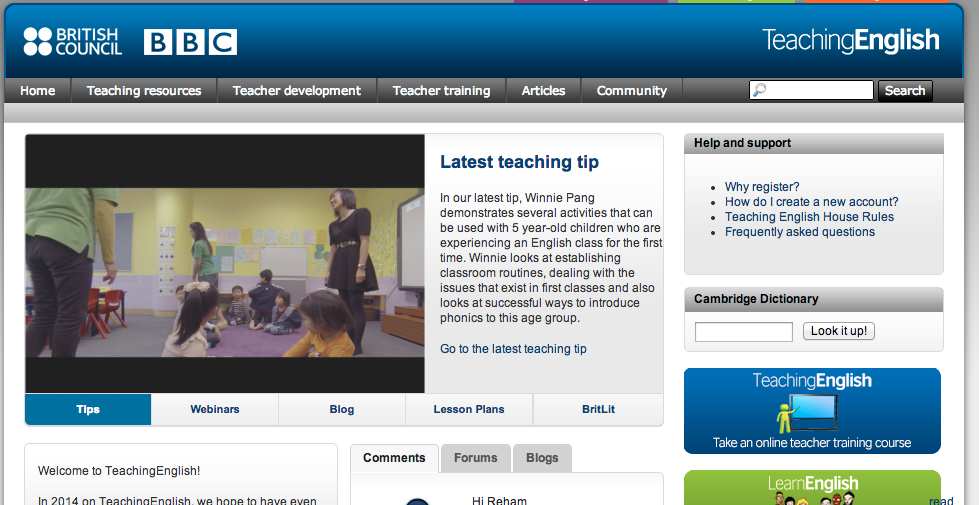
http://www.teachingenglish.org: screenshot of the home page

The British Council Teaching English website and Facebook page are both very valuable resources for teachers with any level of experience.

The website contains a wealth of freely available content, such as:

  • teaching ideas
  • articles on methodology, skills etc.
  • webinar recordings
  • downloadable ELT-related research
  • links to the blogs that have been awarded the popular “blog of the month” award and associate blogger posts
  • information about professional development courses

…and much more besides!

Screen Shot 2014-05-11 at 20.40.44

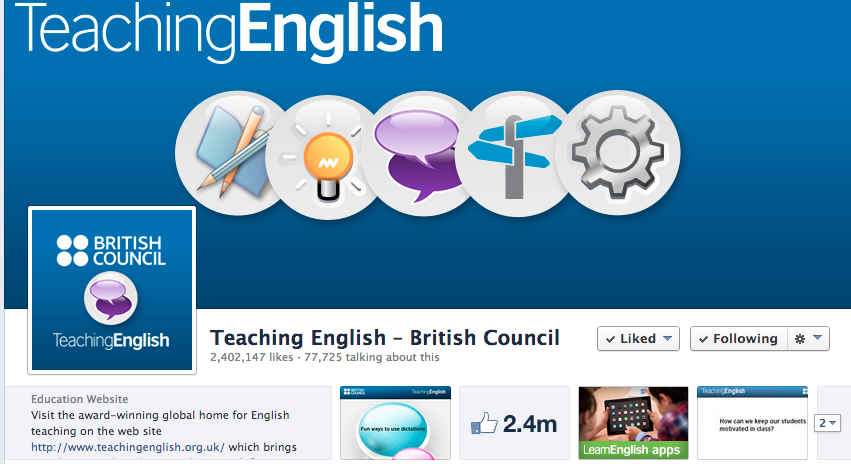
Screenshot of the British Council Teaching English Facebook page


The Facebook page is where links are shared and people can be found discussing the ELT-related issues that those who run the page raise for this purpose on a regular basis. Both are well worth a visit!

Onestop English

Screen Shot 2014-05-11 at 20.39.23

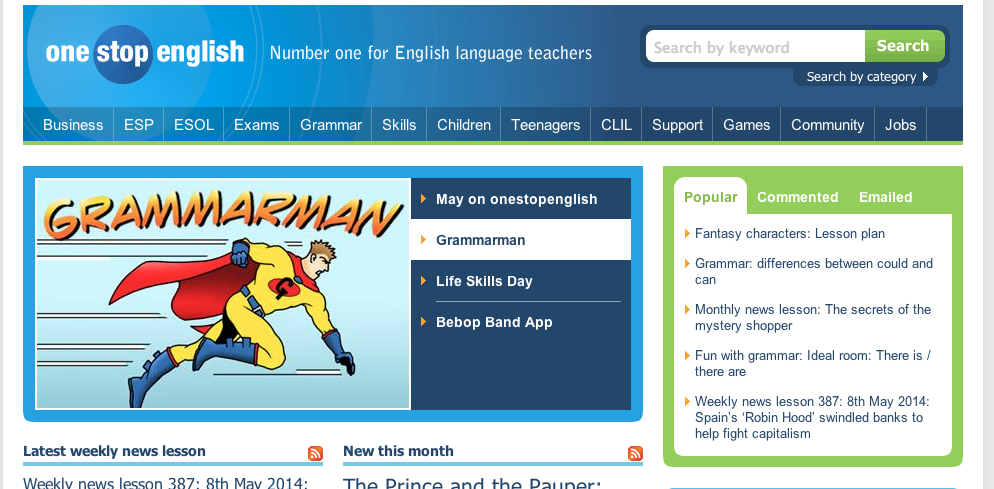
http://www.onestopenglish.com: screenshot of the homepage

onestopenglish is another goldmine of ideas for lessons and articles about different aspects of teaching. Good things about this website include the breadth of its resources (which are regularly added to) – as well as general English (divided into Grammar and Skills, which in turn are sub-divided into numerous other categories) the site holds ideas for teaching:

  • Business English
  • CLIL
  • TKT
  • ESOL
  • Young learners and teens

– and the ease with which it is possible to find things due to clear categorisation. In addition to resources, they also have a handy jobs section. Some of the resources are freely available, while some are only available if you subscribe.

Academia.edu

Screen Shot 2014-05-11 at 20.39.39

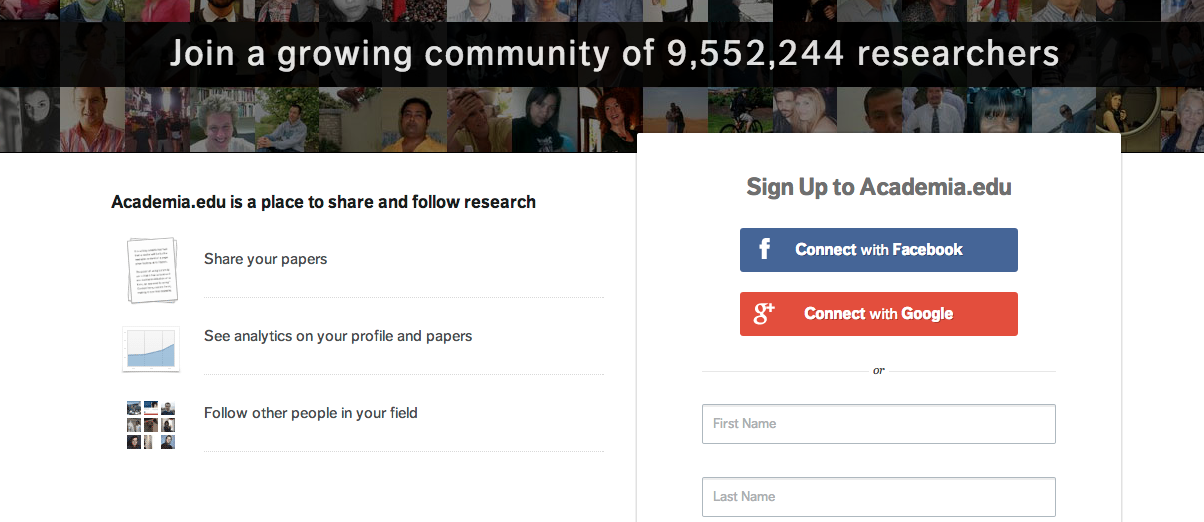
Academic.edu: screenshot of homepage.

Academia.edu might seem less user-friendly than the above two websites, but is nevertheless a very valuable resource: as a researcher, you can register and upload .pdfs of articles that you have written, to share with the community, and as a teacher/reader, it gives you access to research for free, which is not something to be sniffed at!

English Teaching Professional magazine’s website

www.etp.com : a screenshot of the home page

http://www.etp.com : screenshot of the home page

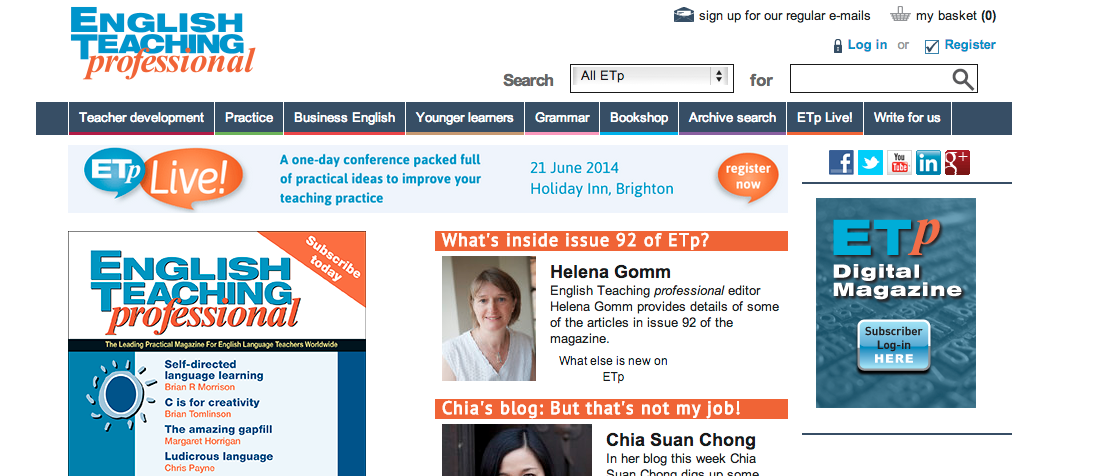
You have most probably read, or at least heard of, the ETp magazine for teachers, which contains articles and activity ideas, book reviews and much more. Well, the ETp website is equally worthwhile and demonstrates commitment to professional development in the resources it provides to this end. Each of the different sections contain links to articles around various topics and the site also has its very own registered blogger, Chia Suan Chong, whose posts are always worth reading. Currently, EtP are also organising a one-day conference, which will be held on 21st June 2014 in Brighton.

Twitter

Screen Shot 2014-05-05 at 14.46.31

The ubiquitous Twitter bird via Google search for images licensed for commercial use with modification.

Naturally! By Twitter, I don’t mean the Twitter website, per se. What I mean is the wealth of links it can make available to you and the discussions you could participate in, if you use it professionally. As everything you need to know is in the afore-mentioned link, I’ll leave Twitter right here.

Teacher blogs

Many ELT professionals these days maintain a blog. It is considered to be a valuable form of professional development to do so. It is easy to follow these blogs and be notified each time a new post is added. Here are a few to get you started:

Screen Shot 2014-05-12 at 08.29.42

Sandy’s blog – a screen shot

  • Sandy Millin’s blogSandy is a DoS at IH Sevastopol and has been blogging for a number of years now. Her blog contains a wealth of teaching ideas that she has tried and tested, reflections, collations of useful links, for example relating to the Delta qualification that she recently completed and to Cambridge exams like FCE. You might also like to check out her (Almost) infinite ELT ideas blog too, if you require an injection of fresh inspiration! In this blog, which is all about collaboration, she publishes a potential resource and canvasses ideas for how to use it with students. Now that she has finished Delta and is settled in her post-Delta new job, this site has been resurrected so keep checking back.
Screen Shot 2014-05-12 at 08.30.45

Adam’s blog – a screenshot

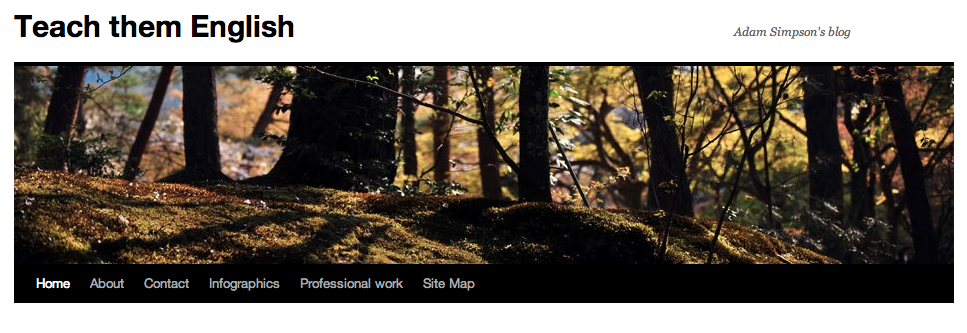
  • Adam Simpson’s blog:Adam works at a Turkish university and is dedicated to his students and to his own professional development, as well as sharing these passions with others. His blog contains a wealth of interesting posts related to this.
Screen Shot 2014-05-12 at 08.34.35

Rachael’s blog – a screen shot

  • Rachael Roberts’s blog Rachael Roberts is a teacher, MaW SIG committee member and materials writer, and her blog contains lots of useful teaching resources and materials that she has developed, together with the rationales behind them, and tips for creating your own materials too.

Some of these blogs sport a “blog roll” of other blogs that the owner has found interesting and useful, so it would be worth checking these out too. Of course there are hundreds more I’d love to name, but this post would get awfully long if I did so!

Some of the “big names” in ELT  also maintain blogs:

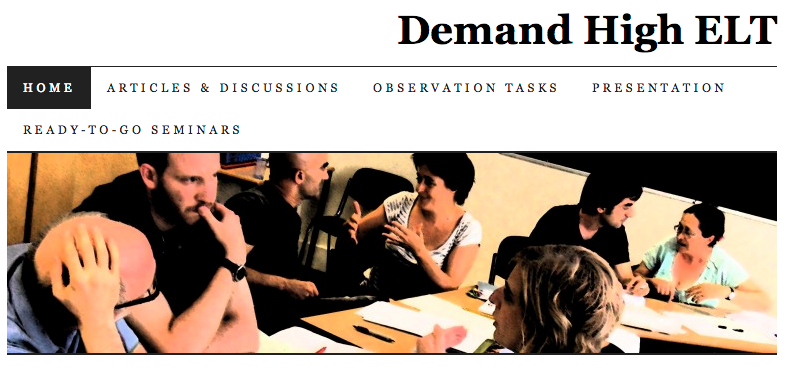
Jim and Adrian’s Demand High ELT blog – a screen shot

  • Demand High ELT is a growing site, owned by Jim and Adrian, and devoted to Demand High ELT. There is discussion, links to relevant resources, materials for seminars and more.
Screen Shot 2014-05-12 at 08.39.42

Scott Thornbury’s blog: a screen shot

  • An A-Z of ELT is Scott Thornbury’s blog, containing a wealth of articles about a range of ELT-related topics and issues.
Screen Shot 2014-05-12 at 08.40.49

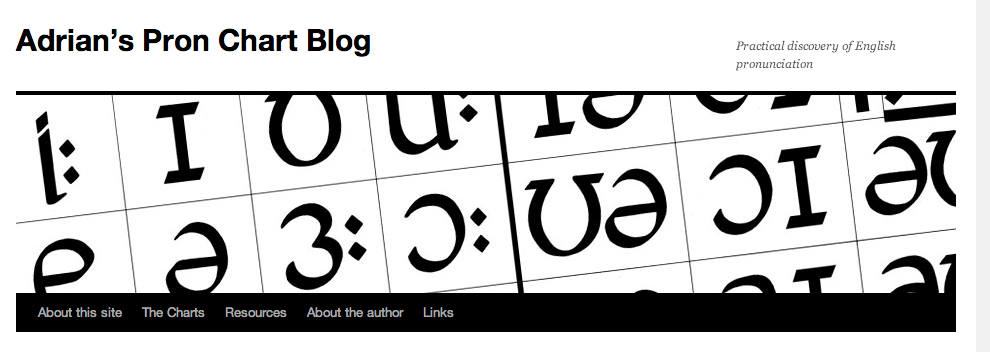
Adrian’s pron blog – a screen shot

Screen Shot 2014-05-12 at 08.29.24

Hugh’s multi-faceted blog – a screen shot

  • Hugh Dellar’s Blog is full of interesting discussion about various ELT-related topics and ideas that you could try out in your own classes, as well as recordings of talks he’s given at past events.

Of course, the kind of blogs you read will depend also on your own interests within the profession.

For example:

To see links to blogs which relate to ELT management, please click here.

To see links to blogs which relate to Delta please click here.

Why not start blogging yourself, too, if you don’t already? There are lots of good reasons to do so!

Free Webinars for Teachers

Free Webinars for Teachers

Free Webinars for Teachers

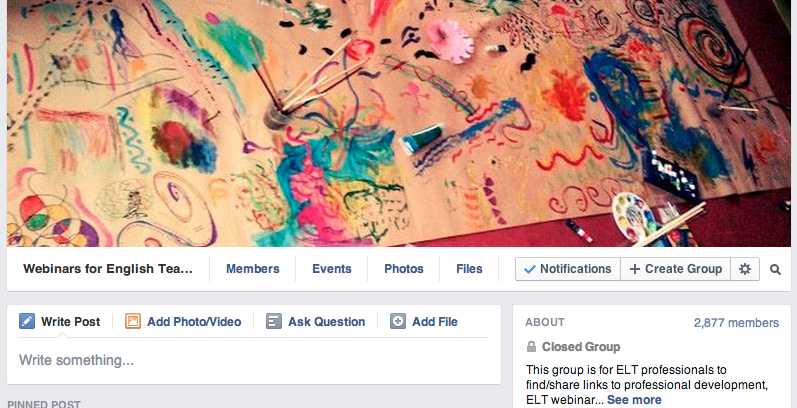
Free Webinars for Teachers is a Facebook group where people share information about free webinars that teachers can attend. This makes it a good way of keeping up with what is available in this area of online professional development. You need to make a request to join and posts are moderated so that content remains useful to members. You can choose whether or not to receive notifications when something new is posted.

Technology

There are three major players in the technology game, all of which are worth keeping an eye on in order to stay abreast of technological innovation:

Screen Shot 2014-05-12 at 08.49.11

Nik’s technology lover’s paradise – a screen shot

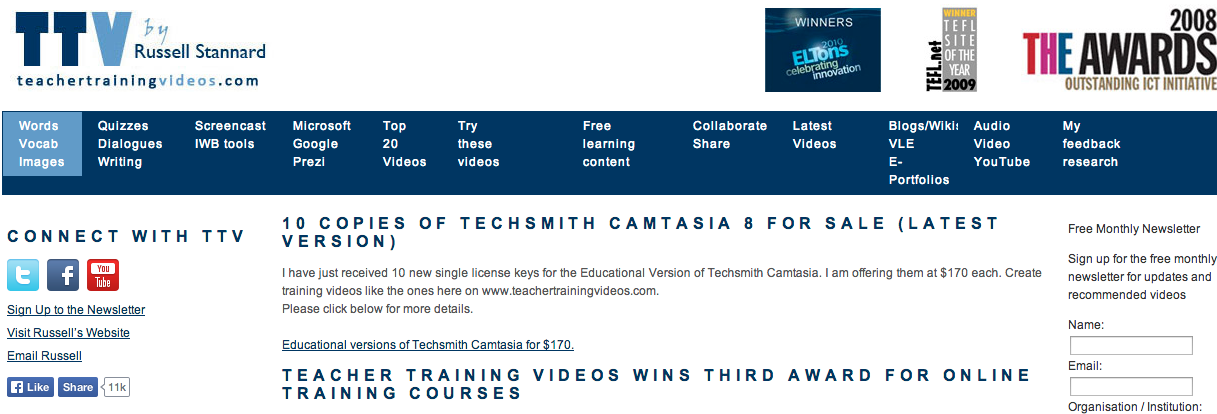
Russell Stannard's website which answers "How to..." for pretty much anything technology-related.

Russell Stannard’s site which answers “How to…” for pretty much all techy questions – a screen shot

The Consultants-E

The Consultants-E – a screen shot.

  • The Consultants-E : These guys offer training courses and consultancy services but also carry some freely available great resources relating to technology on their website. You can find these by clicking on “Resources” on their home page.

#ELTChat

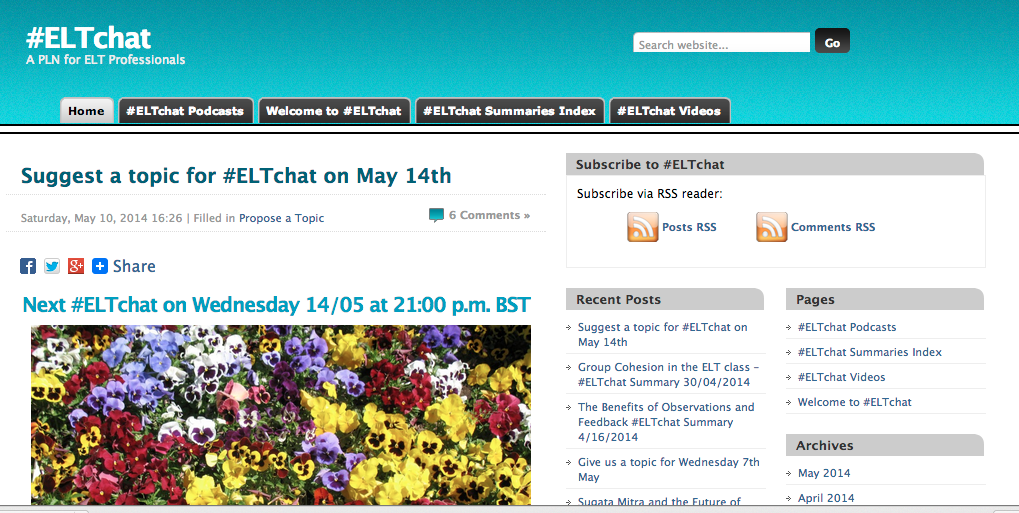
You could argue that this is part of Twitter, but these days #ELTchat exists beyond the bounds of Twitter too. There is the website, where you can find all the summaries carefully indexed by date, as well as links to podcasts and videos.

ELTchat - a PLN in the making: a screen shot.

ELTchat – a PLN in the making: a screen shot.

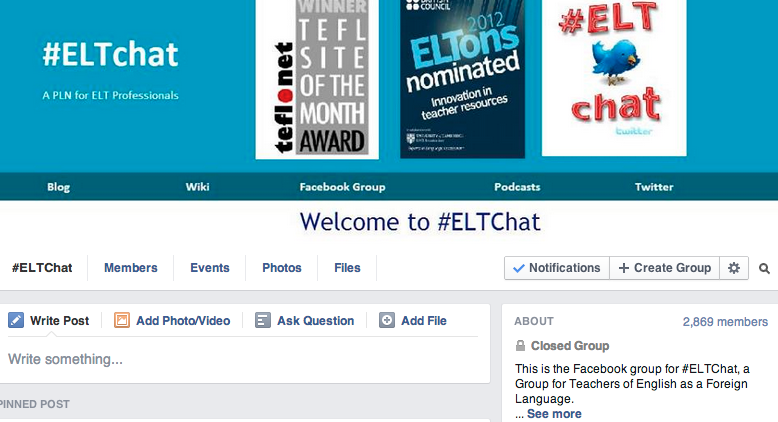
And there is also the Facebook group, where people share links to interesting sites they’ve found, to recent chat summaries and more.

Screen Shot 2014-05-12 at 09.14.01

…and the Facebook group page – a screen shot.

IATEFL

IATEFL is the International Association for Teachers of English as a Foreign Language. This organisation has a website , a Facebook group page , and lots of satellite pages run by various of the SIGs or Special Interest Groups.

IATEFL.org - a screen shot

IATEFL.org – a screen shot

The website contains information about forthcoming events, links to webinars that the association has put on (as well as information about those forthcoming), information about the afore-mentioned SIGS and of course its jobs pages where you can see job advertisements, especially in the run up to the annual IATEFL conference, due to the job market place that runs during this event.

IATEFL Facebook group page

IATEFL Facebook group page – a screen shot

The Facebook page is a space to discuss ELT-related issues and share links of interest to others in the profession. It is not a place for self-promotion and advertising (or spamming!).

In terms of SIG pages, here are a few that I know of:

  • MaW SIG Facebook page : For materials writing fans –  here you can find information about events run by MaW SIG, links to materials writing-related blog posts and sites, information about other materials writing-related events and connect with people who are also interested in materials writing.

Here is a list of all the SIGs currently in action, so if you find one in your area of interest, google it and you will doubtless find a Facebook page and/or a website that it maintains. You could also email the coordinator (name and contact details given in the list) for more information.

SIGs are a great way to connect with like-minded individuals and keep up with issues in your professional area of special interest.

You have to pay to join IATEFL, as well as any of the SIGs themselves (which is highly recommended, as you get plenty of membership benefits), but following their Facebook pages and Twitter handles is open to all.

image taken from openclipart.org via Google search licensed for commercial reuse with modification

Don’t forget: share your favourite resources too, by commenting on this post!  – image taken from openclipart.org via Google search licensed for commercial reuse with modification.

I hope this post gives you some new resources to look at and I look forward to hearing about the other resources you’ve tried…

Teenagers, “have to” and “can’t” for complaining – and a student-generated card game

My teenagers had to (!) learn how to complain in English today. We’d touched on it last lesson via input and a bit of language focus, and today I wanted to give them a bit more opportunity to use it and lodge it a bit more firmly in their brains. Basically it was a communicative drill dressed up as a game. So, to get away from the book activity, which was to use the prompts given to make little dialogues, I made it into a…

Student-generated card game!


My students aren't this old (nor, fortunately, this dour-looking) but they like cards!

My students aren’t this old (nor, fortunately, this dour-looking) but they like cards! (Image from http://www.flickr.com, via google image search licensed for commercial reuse with modification)

Level:

Pre-intermediate (but adaptable)

Preparation:

None!

Materials:

Each student needs a piece of paper from their notebook (or provided by you)

Procedure:

  • Get out a piece of paper and get learners to do the same. Fold and tear it into 4 pieces and get learners to do the same.
  • Ask learners to write a sentence on each paper. 2 sentences should be with “have to” e.g. I have to get up early. 2 sentences should be with “can’t” e.g. “I can’t stay up late”. These pieces of paper become the students’ playing cards. (You could use actual card if you wanted to be posh! My learners were perfectly happy with paper…)
  • Put learners into groups of three or four and tell them to keep their cards hidden!
  • Tell learners that the aim of the game is to get as many cards as possible.
  • Do some quick drilling of suitable intonation for complaining so that learners know what you expect. This should be quite fun! You can also kill two birds with one stone and model the game in the process, getting them to follow your example, get two learners to model in front of the class etc.
  • To get a card: Each learner takes a turn to ask another learner in their group a question using “have to” i.e. Do you have to get up early? or “can’t” – e.g. Can you stay up late? If that learner has a card with, in this case, I have to get up early or I can’t stay up late, then they must relinquish the card to the learner who asked the question. So, essentially, the learners are trying to guess what their fellow group-mates have on their cards. The same question can’t be asked more than once per round.
  • Language control: If a learner speaks L1 during the game, they have to pass one of their cards to the person on their left. They don’t want to do this = suddenly no Italian, just English – very quickly!

Benefits:

  • Learners use the target language communicatively, in a semi-controlled way, repeatedly but in a cognitively engaging way.
  • They get lots of practice with questions and answers, and should start to associate the structures with the activities they have to/can’t do, which makes the language more memorable.
  • They drill themselves. Teacher can monitor and correct where necessary, or encourage improvement in the intonation department.
  • Student-generated, so more memorable than the prompts in the book while achieving the same aims.
  • Requires no preparation!

Ideas for adaptation:

  • Could be used with verb patterns such as I enjoy + verb-ing, fed up with + verb-ing etc (Do you enjoy swimming? Do you enjoy going to the beach? Are you fed up with studying?) topic vocabulary e.g. Things I like doing (Do you like playing netball? Do you like playing tennis?) 
  • Increase the complexity for higher level learners by using more difficult language e.g. If I had a million dollars I would… If I were _____ I would – Would you buy a house if you had a million dollars? Would you be….? and so on.
  • Suitable for adults as well as young learners!

IHTOC (International House Teachers Online Conference) May 2014

At 14.20 CET (12.20 GMT, 13.20 BST) I took part in the International House Teachers Online Conference (a.k.a IHTOC). Each talk in this conference is ten minutes in length, with talks being divided up in to 50 minute sessions. In my session, I had the honour of talking in the same session as David Petrie of IH Coimbra (with whom I’ve been discussing the future of language teaching, on our respective blogs) whose topic was “What I did on my holidays – six things from IATEFL 2014“; Emma Cresswell from IH Santander who gave a talk called “From conference to classroom“; Anya Shaw who hails from IH Buenos Aires Belgrano and spoke on the topic of “Homework: rethinking our routines” and last but assuredly not least, Sandy Millin, the DoS at IH Sevastopol who shared “Five ways to raise your professional profile“.

My own talk title was “From teacher to enabler: stimulating acquisition outside the classroom“. Those of you who have read my blog before will know that I am very interested in the prickly issue of Learner Autonomy and exploring ways of enabling language acquisition during the many hours learners spend outside class. Little wonder, then, when I was invited to submit a speaker proposal, this interest came to the fore.

In my ten minutes, I discussed why the step from teacher to enabler is important to make and suggested 3 simple ways to do this.

  • Encourage experimentation
  • Get learners goal-setting
  • Keep talking!

The rationale behind the first point is that learners, myself included when it comes to Italian, tend to stick with one or two “safe” activities, if they do any work at all outside class time. In order to broaden their range of activities and help them remain motivated to try new things, scaffolded experimentation can be very effective. However, giving learners a bunch of ideas and then leaving them to it is not helpful in terms of maintaining motivation. Chances are they will file away the handout and quickly forget about it, reverting back to their mainstay activities.

This is where points two and three come in.

Setting challenging yet achievable intermediate, mid-term goals can help learners maintain their motivation by breaking down the monolithic task of learning a language into more manageable chunks and increasing the chances of success: t

The experience of success, especially that which is hard-won, is one of the motivational factors that Dornyei (2013) includes the third channel of his L2 Motivational Self-System – the language learning experience.

Regular discussion, in which learners communicate their goals and discuss their learning experiences gives rise to the benefits of heightened commitment to the goals, greater satisfaction in attaining goals as they share their achievements, and less isolation when they are in a learning slump – indeed, during these times they can ‘feed off’ the motivation of others and regain the desire to have another go; and then be the ones that give faltering classmates that extra push.

I suggested that this recipe was not limited to the handout I shared, but could also be applied to extensive reading or anything we want learners to do outside the classroom.

My ideas drew on goal setting theory (Lock and Latham, 1990), motivation theory (Dornyei, 2014) as well as the idea of motivational flow (Egbert, 2003) and, of course, learner autonomy theory (e.g. Benson, 2011, Oxford 2003, Smith, 2003)

10 minutes is not a long time, so I had to wrap it up pretty quickly, having elaborated on my three-step plan and hand on to the next speaker!

Here is a copy of my slides and here  is a link to the recording.

References:

Benson (2011) Teaching and Researching Learner Autonomy Pearson Education. Harlow

Egbert (2003) in Dornyei and Ushioda (2012) Teaching and researching motivation Pearson Education. Harlow

Dornyei, Z. (2014) Plenary talk, Motivation and the vision of knowing another language in the Warwick Postgraduate Conference, June 26th 2013.

Lock and Latham (1990) in Dornyei and Ushioda (2012) Teaching and Researching Motivation. Pearson Education. Harlow.

Oxford, R. (2003) Towards a more Systematic Model of L2 Learner Autonomy in Palfreyman, D and Smith, R. [Ed] Learner Autonomy Across Cultures. Palgrave Macmillan. Basingstoke.

Smith, R. (2003) Pedgagogy for Autonomy as (Becoming) Appropriate Methodology in Palfreyman, D and Smith, R. [Ed] Learner Autonomy Across Cultures. Palgrave Macmillan. Basingstoke.


Using Twitter for professional development

What?

Screen Shot 2014-05-05 at 14.46.31

Twitter! Image via google images search licensed for commercial use with modification

Wikipedia defines Twitter as:

an online social networking and micro-blogging service that enables users to send and read short 140-character text messages, called “tweets”

Of course, these days the content of this definition is fairly common knowledge. And people not only send messages but share photos and links too. (And that’s only the tip of the iceberg…)

Twitter distinguishes itself from other social media due to the above-mentioned need to be concise: 140 characters is not a lot.

Why?

Initial questions: 

The first question, once you know what Twitter is, might be, “But, why should I join? What will I gain from it?“, followed by “But… I don’t want to know what everybody has for breakfast…”. (Don’t worry: used professionally, it is easy avoid this genre of tweets! As you will see during this post, there is plenty that is of value on Twitter – if you know where to look.)

As an ELT professional, Twitter provides a platform for connecting with like-minded fellow professionals and sharing links to useful resources, as well as discussing ideas and issues.

Conferences often have hashtags (e.g. #IATEFL2014) which allow participants to share goings on with a wider community of teachers, those who are unable to attend. So next time there’s a conference you wanted to attend but couldn’t, you could look out for the conference hashtag, and join in that way?

If you’re still uncertain as to whether you’d get anything out of using Twitter, I suggest that you have a look at this link to a series of articles collected under the title “Why Twitter for teachers?”

For some more anecdotal evidence of why it’s worth joining:

I joined in 2011, because someone recommended it to me on an ELT forum. As well as this leading to me getting involved with #ELTchat (see below) and starting to blog, I happened to see someone post a link to the IATEFL conference scholarships. Prior to that time, I didn’t even know such scholarships existed. I applied for several and was lucky enough to win one, and as such was able to attend my first IATEFL conference in 2012, in Glasgow. At that conference, as well as well and truly getting the conference bug, I found the leaflet for Leeds Met University’s M.A. in ELT with Delta in my conference pack. As you can see from my blog site, the rest is history! So in my case, joining Twitter was literally life-changing!

How?

  • Create a Twitter handle:
    Screen Shot 2014-05-05 at 15.45.39

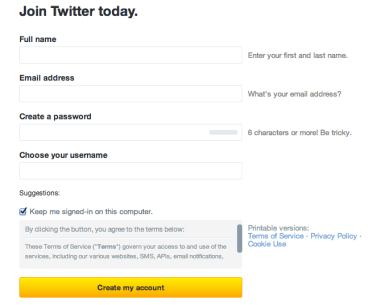
    Screen shot of Twitter registration form

    As you can see, it’s a quick, easily completable form. Once you have set up your account, you will be able to do the following:

  • Follow people:Many institutions, teachers, teacher trainers, DoS’s and other members of our profession have active  Twitter handles.As well as individuals, IATEFL SIG groups have them (e.g. @MaWSIG, @IATEFL_BeSIG), as does IATEFL itself (@iatefl).  If you follow them, their tweets will appear in your feed, when you log in. This can be a good way of keeping up with the online professional development opportunities that they organise e.g. webinars.

    Major publishers have them (e.g. @OUPELTGlobal, @CambridgeUPELT, @Pearson_ELT, @MacmillanELT, @Richmond_ELT) so you can keep up with what these influential players in the ELT field are up to.

    Professional magazines have them (e.g. @ETprofessional) and tweet a range of interesting, relevant links.

    Finally, some popular, useful ELT websites such as the British Council Teaching English website, have a Twitter handle (@TeachingEnglish) in addition to their Facebook page.

  • Retweet what you find helpful/useful/interesting:
    Screen Shot 2014-05-06 at 08.08.39

    To retweet a tweet, click on the retweet symbol – two little arrows that form a square.


    When you retweet somebody’s tweet, it appears in the feed of anybody who follows you and returns to the top of the tweets indexed to any hashtag mentioned in the retweeted tweet, meaning that more people are likely to see it.

    Retweeting somebody’s tweet indicates that you have found what they had to say interesting, or if the tweet includes a link, that you have followed the link and feel it is worth sharing with others. Therefore, it makes sense not to retweet any links that you haven’t looked at! If you want to tell the writer of the tweet that you think the content of it is really good, you could also “favourite” it. Once you have retweeted and/or favourited it, it will look like this:

    Screen Shot 2014-05-06 at 08.11.28

    I have retweeted and favourited this tweet!

  • Try new ideas:Part of professional development is finding new things to try and reflecting on the outcomes. Twitter can be a great source of new ideas and things to try, shared by fellow professionals via links and discussions. Many Twitter users also have blogs. You might like to start blogging as well – if you don’t already blog. There are lots of benefits to doing so! Summarising hashtag discussions (see below) can be a good way in to blogging.
  • Search for hashtags

    There are hundreds of hashtags in use by different groups of teachers and educators worldwide. A hashtag is a means of indexing tweets. If the author of a tweet includes a hashtag within their tweet, that tweet becomes searchable via the hashtag. Anybody who searches for a #hashtag will see all the tweets which include that hashtag, ordered from most to least recent.Some of the hashtags are defined by location (e.g. #AusELT) some by specialism (e.g. #EAPchat, #edtech). Some are more general (e.g. #elt and #tesol or #ELTchat) Finding a hashtag that relates to an area of the profession that you are interested in learning more about can be an easy way in to accessing a regularly updated range of resources related to that area.

    Many hashtags (e.g. #ELTchat, #EAPchat, #Edtechchat) run discussions at regular intervals, where people from all over the world – or a particular area of it – join to discuss a proposed topic, using the hashtag in question to gather the tweets. To find out about what hashtags are in use, you could look at this index of hashtags that was created by Chiew Pang and has been edited by people around the world since.

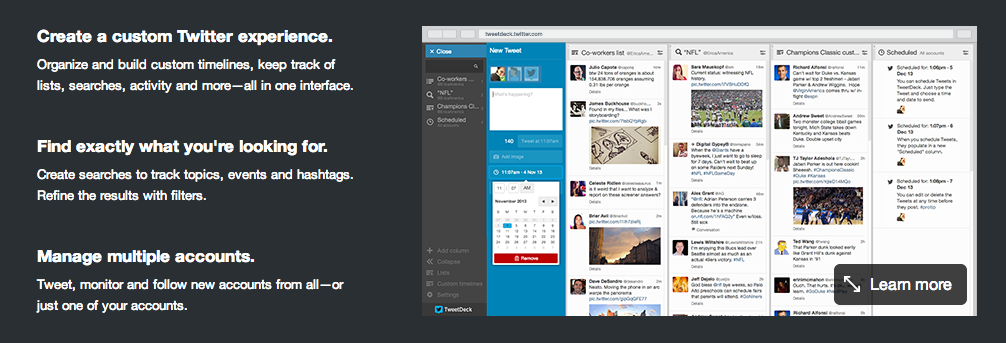
  • Use Tweetdeck:Tweetdeck is a platform for navigating Twitter. When you search for a hashtag, it generates a column for that hashtag, within which all the tweets indexed to it appear. It updates as tweets are added. You can keep columns open so that it is easy to open Tweetdeck, have a quick look at what’s new and close it again. You can also generate columns to display any notifications (you get a notification whenever somebody retweets a tweet you posted or mentions your twitter handle in a post) and private messages, known as “direct messages” (you can send a direct message – with the same length constraints as a tweet – to anybody you follow who also follows you). Thus, using Twitter doesn’t have to be hugely time-consuming.You can use Tweetdeck by logging in via a web-browser but you can also download a programme, which is a convenient way of using it, to avoid having more browser windows open than absolutely necessary! (NB: You don’t need to “manage multiple accounts” for it to be useful – I only have the one!)
Screen Shot 2014-05-05 at 14.26.36

Screen shot from the Tweetdeck website

Who?

I could go on forever, listing oodles of people that you could possibly choose to follow, in addition to the examples I picked above…

However, I would suggest that rather than following people because I, or anybody else, said so, you do the following:

  • Use the hashtags as a means of helping you find people to follow: Search for a hashtag, see who posts and what they post. If you are interested in hearing what they have to say and seeing the links they share, follow them!
  • When you find people of interest, have a look at who they follow, if anybody from their list stands out, have a look at that person’s past tweets and decide if you want to follow them too.
    Screen Shot 2014-05-06 at 08.32.49

    When you visit somebody’s “homepage”, you will see their total number of tweets (1,928 for me!), the number of people they are following (252 for me!) and the number of people who are following them (720 for me!) – if you click on any of these, more information will appear: i.e. recent tweets/retweets or a list of the people being followed or a list of followers.

    Screen Shot 2014-05-06 at 08.31.35

    This is an extract of what you get if you click on “252” in the first image. Of course, here, where it says “following” in the blue rectangles, it will say “follow” if you don’t already follow the person in question. When you “follow” someone by clicking the “follow” button, they get a notification telling them that you have followed them. 

  • As you become more active, retweeting others’ tweets and sharing your own ideas too, people will start to follow you too. When someone follows you, have a look at their past tweets and see if you want to follow them back.

When?

Now! Why not have a look! 🙂 You don’t have to tweet straight away, it is perfectly normal to start using Twitter by simply “lurking” – which means to look without participating and is definitely not as dodgy as it might sound!  – and learning how it works through observation. You can learn a lot by seeing how other people use it.

  • #ELTchat discussions take place once a week for one hour, on Wednesdays, at 12.00 BST (GMT in winter) or 21.00 BST (GMT in winter) on alternate weeks. During these hours, the hashtag is dedicated to the discussion, so you should refrain from using it to tweet links or ideas that are not related to the discussion taking place. It may seem completely chaotic the first time you watch or take part, but you’ll soon get used to it! For more information about how to propose and vote on topics and what the next topic will be, visit the associated website.

If you know about any other regular ELT-related Twitter discussions, please comment on this post with details and I will add the hashtag and discussion times to this post.

 Remember!

  • Be polite: as with any social media, it is advisable to use it courteously. This makes it more pleasant for everybody involved! If someone is abusive towards you, or spams you, you can both block them and report them to Twitter. A good post by Nathan Hall about manners on social media, as well as the importance of approaching it critically, can be read here .
  • Don’t use it purely for self-promotion: You may have lots of good ideas and links to share, but take time to look at others’ too, and retweet anything you think is of interest.
  • It’s like a massive staffroom with no walls: Treat it well (see first bullet point!) and you can connect with people all over the world – what better if you want an injection of fresh perspectives on the profession!
  • Don’t get overwhelmed: Yes, there is lots of information out there, but a) you don’t need to look at it all and b) the really good stuff will get retweeted so you’ll see it eventually anyway.
  • You don’t need hours a day: Which is good, because who has that kind of time?! As little as 5-10 minutes will mean you catch a lot of good stuff – even if you can’t immediately read all the links you end up bookmarking. Using Twitter doesn’t have to mean a massive time commitment. To help you, it might be advisable to streamline your curating system – do you use Diigo? Evernote? Whichever means of organising information you do use, it will come in useful when you uncover useful stuff during your Twitter travels.
  • If you use Tweetdeck: You can change the settings so that it doesn’t beep at you every time something happens (the default)! Each column you generate has the symbol you see highlighted on the right-hand side at the top. When you click on that, the options appear. Make sure “Alerts” is set to “None”!
    Screen Shot 2014-05-06 at 07.10.40

    Get rid of those beeps!


  • *Everybody* can read your tweets: Tweets are all publicly viewable. The only tweets that are private are direct messages. Your boss could follow you on Twitter. (E.g. my current DoS follows me!) A prospective employer could look at your tweet history. Therefore, it makes sense to only say things that you are comfortable with sharing publicly. Avoid saying anything you might later regret. As a rule of thumb, if it’s private or personal, it’s best off not being shared on Twitter!

If anybody with Twitter experience reads this and thinks I have missed anything vital/useful/interesting from this post, please comment and let me know so I can add it! And finally, I hope it is useful to those of you who aren’t yet using Twitter professionally.

How I’m learning Italian (inspired by the one and only Sandy Millin!)

Sandy’s brilliant post on how she’s learning Russian has inspired me to reflect on and write about my own efforts to learn Italian, with a bit of comparison between my way and hers.

The first difference between our learning is that, when not cancelling them, she is having lessons. What’s more, they are one-to-one lessons. I had a few small group lessons when I first arrived in Italy, and established that I was a terrible classroom learner. Like Sandy, I, too, felt sorry for my teacher having me as a student! I wonder if I would do better in one-to-one classes? It would be interesting to have a few and find out…

I suspect, though, like any adult learner of a foreign language, time management would be an issue. Especially, like Sandy, the whole HOMEWORK bit! During the time period of the small-group lessons, near the beginning of my time here, I mostly did my homework half an hour before the lesson started – it couldn’t have been any nearer the time because our weekly staff meetings immediately preceded the lesson time-slot! On the surface you’d have assumed I was an unmotivated, bad learner. Not so. The problem was that I was too motivated – I had already met what we were looking at in class during my own self-study. So the homework – gap fills and writing out verb conjugations and so forth – was boring.

(Or would it? If I were in a one-to-one class, then theoretically we’d be doing stuff I was interested in knowing, both in the classes and, by extension, for homework. Ah, homework. It’s compulsory to set it here, so with my own experiences in mind, I’ve worked very hard on trying to ensure that the homework I set is meaningful and of interest to my learners.)

Needless to say, I stopped the lessons (time was at a premium and the lessons weren’t doing it for me) and went it alone.

Reading


Screen Shot 2014-05-04 at 08.10.46

Harry Potter: tutti i libri!


Knowing that I enjoy reading in languages others than English (especially French), I immediately decided I had to start reading in Italian. So I bought Il piccolo principe from the local bookshop (had to be done, was the first book I ever read in French too…) and downloaded a complete set of Harry Potter books in Italian onto my e-book reader. I also dug out a pdf. of Harry Potter 1 in English. I used them side by side. Sometimes I read a few paragraphs in English, followed by those paragraphs in Italian, and repeat. Sometimes I did the reverse. It was a fascinating voyage of discovery, seeing how things were said in Italian and taking care to keep an eye out for any similarities with French – lexical or grammatical. So I suppose, though I was reading extensively, I was also reading intensively – using the text to learn about language.

Eventually (somewhere part way through this first in the series), I gave up using the English version and just used the Italian version. It wasn’t a conscious decision, so much as a gradual realisation that I had enough language not to need the side-by-side translating any more. I graduated to looking words up when necessary. Initially, quite a few words. (What a terrible language learner! You’re supposed to guess by context/ignore etc. Oh well!) As time passed, fewer and fewer words. What I now rather like doing with words I don’t know is guessing what they mean and then looking them up to see if I’m right or not.

I also downloaded an audio book of Harry Potter 1, having read an article suggesting that extensive listening to audio books, in addition to extensive reading of the same books, can be beneficial. I still haven’t finished listening to it. But I’ve listened to a few chapters, some while reading at the same time and some just listening. A few of my students swear by it (they like graded readers that come complete with audio!).

It’s ok, I haven’t read Harry Potter exclusively – I’m also ploughing my way through a series of books about horses aimed at teenagers. Which is actually useful because I’ve taken up horse-riding again since I’ve been in Sicily, so having a working knowledge of that vocabulary is relevant! I’ve yet to find a use for all the magic-related vocabulary I’ve picked up… 😉

Actually, reading didn’t come first. What came first started before I even got to Italy: Memrise.

Memrise


Screen Shot 2014-05-03 at 21.44.44

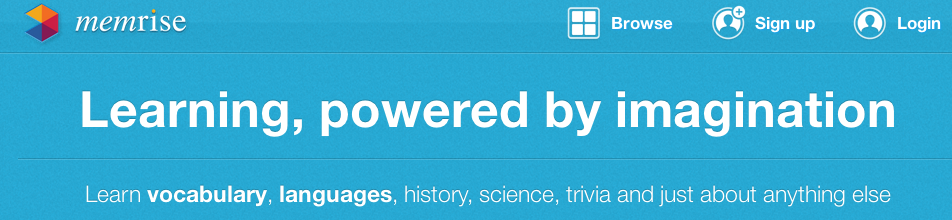
Screenshot of Memrise site


Once I accepted the job at IH Palermo, I downloaded “Basic Italian” from Memrise, using the app on my Ipad. From this little gem, I learnt how to say something could be dangerous (potrebbe essere pericoloso), to comment on how many taxis I could see (ci sono molti taxi), to ask where the Vatican is (dov’e il Vaticano?), and the Italian for pork (carne di maiale). Which, as a vegetarian, I haven’t had to ask for, but it’s useful to avoid on menus! *NB excuse any errors – it’s been a while since I reviewed these and I don’t often write!

Memrise teaches you chunks and provides lots of random pictures which are supposed to help you remember words. (All I can remember of the pictures was that an alarming number of them featured busty women which had nothing to do with the chunks in question! But I’m sure there were some good ones too.) It also gives you a sense of progress by likening the learning progress to growing flowers. You plant seeds, you grow them,  you water them, etc.

Things I like about Memrise:

  • It gives you chunks: I like chunks. Once I’ve learnt them and can say them, I like analysing them and seeing how they’re made and seeing if I can manipulate them to do other things.
  • Instant feedback: It gives you a chunk, in Italian or English, you touch what you think is the translation (out of the choice they give you) and it tells you if that is correct or incorrect.
  • The inbuilt spaced review: It “locks” sets until you need to “water” them.
  • Audio and visual: As well as seeing the chunks, a voice says them to you. Therefore you can repeat them after the voice.
  • Priming: You see language in the multiple choices given that you focus on subsequently. So you’ve seen it repeatedly before you focus on it, so it’s a little bit familiar already. Although, who knows how useful that is when it’s all out of context?

Things I don’t like about Memrise:

  • For the most part, it’s matching/multiple choice. It would be nice if, as well as that, you could graduate on to typing in the translation for long chunks. With multiple choice, sometimes you know which one it is because you know which ones it isn’t. (Though that in itself is an interesting exercise and tests your knowledge of other chunks, I suppose!) I think the closest you get is choosing words from a selection to form the chunks and spelling out words from a selection of letters they give you.
  • The randomness: There seemed to be little rhyme or reason to the chunks selected. I suppose you could make your own sets like on Quizlet, and then it would be more specific/tailored, but I haven’t got that far with it – it got forgotten before that!

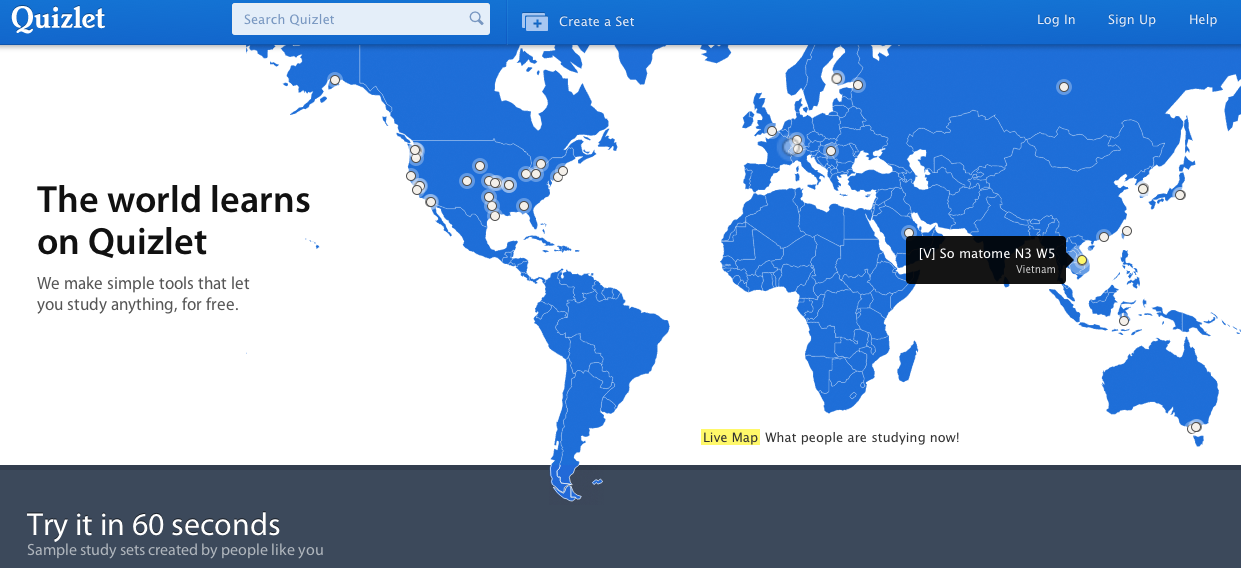
Memrise has the dubious honour of being the only language learning app/programme that I’ve ever used properly. (I’ve also dabbled with Babel but abandoned it very quickly!) Unlike Sandy, I haven’t used Quizlet as a language learner. I’ve used it to revise Delta terminology and I’ve made self-access materials to help my learners use it (though very few of them have got particularly keen on it) but I haven’t tried to use it to learn language. I used Memrise prior to departure from the UK to give myself *something* – as that would be better than arriving in Italy with absolutely *nothing*! I didn’t use it for long after I actually got to Italy. Now that I’ve said that, I plan to open it, run through the sets and see if I can get 100% or what it teaches me this time round!

Vocabulary

So if I don’t use Quizlet and my use of Memrise has died a death, how do I learn vocabulary? Well, I haven’t used vocabulary lists, I haven’t post-it’ed my flat, I haven’t made index cards. I did have a vocabulary note book (which was an appalling example of a vocabulary notebook!) – where I’d note down any words or phrases that interested me, higgledy piggledy, and look over them periodically. I’ve also learnt a bit of various topic-related vocabulary from my course book (daily routine, things in a house, going on holiday, shopping and eating etc. the usual kind of thing!). But the majority of it, I have learnt through reading, as described above. I like the idea of using Quizlet but… a) I’m not sure what vocabulary I’d choose to input. But more importantly, b) I have limited time to devote to language learning and I really like reading and watching dvd series or films. <Bad learner flag!> …although I think I pick up a fair bit of vocabulary from those activities. I feel it’s slightly more meaningful to see vocabulary repeatedly in context rather than in flashcards/lists. Perhaps another thing for my to-do list, though, is use Sandy’s Quizlet guide and see what other people have done with it in terms of learning Italian. That will be most interesting, even if I don’t actually do the games and stuff.

I learnt fruit and vegetable vocabulary from the market, which is also my main location for recycling that vocabulary! Other food vocabulary has come via studying menus in various restaurants. Helpfully enough, my course book had a sequence dedicated to market shopping, so I learnt a few useful phrases that way too.


Screen Shot 2014-02-26 at 06.52.15


Listening

I’ve been watching dvds – films or episodes of series – in Italian fairly regularly since my arrival in Palermo. To start with, I used subtitles in English and then very soon switched to Italian subtitles. Then I bought a DVD series with no Italian subtitles! Shock horror! So I had to watch without subtitles. At first, it was just a case of looking at moving pictures and catching the very odd word once in a while. I persevered. A few episodes in, I noticed I was no longer just looking at pictures but also actually understanding some of what was said. Now I can follow reasonably well. I haven’t used subtitles since buying this DVD series, even on subsequently bought DVDs which do have them. Why? I tried it and found the subtitles annoying.

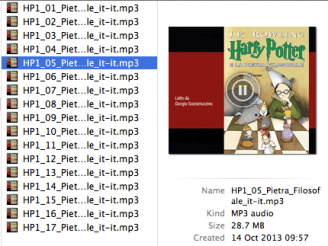
As mentioned earlier in the post, I’m also listening to Harry Potter 1 very sporadically.
Screen Shot 2014-05-04 at 08.21.03

….very sporadically!


I’m very unlikely to finish it in the next few weeks, but it will come in very useful over the summer, when I need to find ways to maintain my Italian while not in Italy!

Another good source of things to watch and listen to in other languages is Youtube. I found a lovely cartoon film which had been dubbed in Italian, which I really enjoyed watching while I was in England over Christmas, in a desperate attempt to hold on to some Italian:

Screen Shot 2014-05-04 at 08.26.52

Such a lovely little story – do watch it, in whichever language you want to! 🙂


I haven’t used Youtube overly much while in Italy, though, due to my internet connection being limited – I get a certain number of gigabytes of data per month, which streaming would eat into massively. I plan to mine it over the summer – another thing for the Italian Maintenance list…

For the same reason (limited data connection), my use of Italian radio has been… limited. I really should either find my Ipod, which picks up radio but which I’ve managed to lose, or pick up a cheap little FM radio.

My TV doesn’t work, so that hasn’t been a possibility – perhaps next year! (I shall be living in a different flat – hurrah!)

I had some good listening practice during my recent holiday – I wound up having to make and receive a couple of phone calls – every language learner’s nightmare. I used context and key words to get by! I didn’t understand everything but I understood enough – and more than I would have expected to understand. I didn’t worry about the bits I didn’t understand. I also used strategies to check my understanding of what was important e.g. repeating it back and paraphrasing.

Maybe I should do more intensive listening? Make myself do mini-dictations and the like?

Writing

I don’t do a lot of writing. I have, however, tried one thing to give myself writing practice: I started an Italian blog. No, you can’t see it – it’s deliberately set to private!! It has a grand total of about three entries, though there is one entry in my Ipad notes that I haven’t yet uploaded, I don’t think. I can’t even remember. The majority of the writing has been done in Ipad notes, while on planes to and from Palermo. Being captive for three hours seems to work!

What I like about blogging in Italian:

  • It makes me actually use the language productively. (My receptive skills are so much stronger than my productive skills!)

What I dislike about blogging in Italian:

  • Time-consuming! So I should maybe set myself a mini-goal such as writing something once a week. Or write less per post and more frequently, until I can do it more quickly.
  • I can’t say complex things yet (or at least couldn’t when last I tried!) so frustration often accompanies it!

I really ought to dust the blog off and get using it again…

Speaking

Speaking is the missing link in my language learning. I don’t do it nearly enough. For ages I’ve been meaning to try and set up a language exchange but have kept putting it off. Why? Well, what will I say? I’m not that talkative at the best of times! What I’d really like is PSP Speaking sessions like we have in our school (an hour-long, mixed level, group discussion in English on different topics, done in pairs/small groups and then whole-group, with some feedback given) in Italian! Maybe next year I’ll get round to setting up a language exchange…

Grammar

I’ve learnt quite a bit of grammar from an A1/A2 course book that I’ve worked my way through. It’s not bad – generally involves giving you a text in Italian, reading or listening. If a listening text, the transcript is then printed for mining in subsequent activities once you’ve listened for meaning. The grammar comes out of the texts, which have clearly been written for that purpose. I suppose it works for me because I like language in context. I’ve got the B1/B2 book, but I haven’t yet done much of it. I lost my habit of getting the book out first thing in the morning, sometime soon after Christmas. I really should find it again. And remember how lucky I am that I’ve found some Italian course materials that work for me – sounds like it’s much harder with Russian!

What I haven’t done is sit down and learn verb endings. I know plenty of regular verbs/endings  in the present, and I can form the past. I have quite a few past participles (or whatever they are called in Italian, the form you use to express the past along with avere). I know some future forms. I know a handful of conditionals. But during the holidays, I noticed that since I never say “we”, I struggled when I wanted to use a conditional “we” form. Of course I found ways around it. So it probably wasn’t necessary. But perhaps it would help to have a look at some verb tables, now that I have picked up a variety of verbs and endings via reading and listening, and compare it with what I’ve picked up.

Productive vs. Receptive

Like many learners, I have a very spiky profile. My receptive skills are pretty strong, while my productive skills are a lot weaker. My receptive vocabulary is pretty big now, my productive vocabulary a lot smaller – though words and chunks are moving across all the time, the more I meet them in various contexts. Perhaps, like Sandy, I should record myself speaking and listen back for mistakes. Perhaps I should pull my finger out and sort out that language exchange. Or, have a few private lessons… I also definitely need to do more writing, as that at least would also force me to produce.

Time

I’m a big fan of little and often, so I don’t need to challenge myself to do ten minutes a day as Sandy did. What I need to do is challenge myself to vary what I do more within the time that I do use. Difficult, though, as the reading I do in the evening (20 minutes) doubles as unwinding and when I watch series in the morning, I’m eating at the same time. When I read Harry Potter during the day, again I’m generally eating. So, maybe, then, I need to *add* ten minutes of non-extensive reading/listening – related activities to what I already do.

Some conclusions

Well, I’ve already drawn plenty of conclusions here , but…

  • Homework needs to be meaningful if you want your learners to actually do it!
  • Extensive reading is a very valuable learning tool and should be encouraged. It can be combined with intensive reading of the same text. (I’m sure people won’t necessarily agree with this, but it worked for me so I can live with the disagreement!)
  • Extensive listening is too!
  • Language learning is very personal: One man’s meat is another man’s poison. Many of Sandy’s methods don’t appeal to me at all and require much more discipline than I have, but they clearly work for her. Don’t force learners to learn outside the classroom in ways they don’t find useful/appealing. But do encourage experimentation with new ways of learning. (I will try Quizlet, honest…)  – This way, they/we may find more ways of learning that work for them/us.
  • Chunks are good! I agree with Sandy here. As a beginner, starting with chunks then analysing them for grammar later on is a good way forward.
  • Comparing texts in L1 and target language is useful: I found it invaluable when I started reading. I would have struggled a lot more if I hadn’t had that way in. It made reading in Italian accessible to me.
  • Reflecting on your learning is also useful: It enables you to be clear about what you’re doing and why, and to identify the gaps in it, as well as look for ways to try and fill those. Metacognitive awareness is very valuable.

I think, also, interestingly, I may be a terrible language student (in a classroom situation) but I’m not too bad of a language learner. I’m motivated, I’m self-aware, I’m fairly disciplined, I work hard. However, I could be better: I don’t vary my activities enough, I rely too heavily on extensive reading and listening.

Methodology

Well, I haven’t experienced Dogme as a learner yet, but, as with Sandy:

All good in my experience!

I would also add:

Looking ahead

What do I need to do in order to develop my Italian? And what do I need to do in order to maintain it for the nearly four months that I’ll be in the UK over this summer?

  • Keep reading! (That shouldn’t be a problem – I’m only on Harry Potter 5, L’Ordine della Fenice …)
  • Broaden my reading: investigate different genres – there must be plenty to find on the Internet: newspapers, magazines, forums etc.
  • Watch films/series in Italian regularly: I will have a decent internet connection while in the UK so no excuses!
  • Listen to Italian radio: As above!
  • Speak!: Really need to set up that language exchange…
  • Try Quizlet?: Investigate it again and see if I can make it work for me. And/or maybe try making a set on Memrise
  • Get a grammar book out: Look at the verbs, look at some other grammar and see what I have picked up from reading/listening extensively. Give it names. Look at a few rules. That kind of thing!
  • Get my course book out: It wouldn’t hurt, would it? Get that routine going again…
  • Add ten minutes! Do at least ten minutes of studying a day that isn’t extensive reading/listening.

I know from experience (the Christmas holidays – 2 weeks)  I will have to make an extra effort to keep it going during the summer. At least the fact that I’m coming back here after the summer should be a good motivating factor!

Watch this space – I’ll post an update on how my aims, above, panned out – especially over summer…

And thank you, Sandy, for inspiring this post!

(PS: to those who are waiting for me to pick up where I left off with the social side of language learning and to respond to comments on the last post I wrote in relation to this, I will get there soon, honest! I’ve been on holiday for a few days so got some catching up to do…)

In reply to David’s rebuttal: the future of language learning part 2

Firstly, I would like to thank David Petrie for this opportunity to debate and discuss that has arisen out of his thought-provoking post for the British Council Teaching English site and equally well-written rebuttal of my response to that post. For me this is one of the magic things about blogging: the opportunity to engage in critical, reflective discussion and debate on our teaching and learning beliefs, our pedagogies, our methodologies, with fellow members of the profession, so that much less of it becomes entrenched or gathers dust.

I will now respond to David’s rebuttal to my original points and weave in a few more points of my own along the way.

David explains that:

I certainly didn’t mean to imply that language is anything but social or used for anything other than a communicative purpose.  I don’t see, though, how this belief mitigates against learning in an online environment.  People do, after all, communicate quite effectively online. 

Absolutely. People do communicate very effectively online and language is used communicatively. Computer-mediated communication (CMC) tools are brilliant – I use Edmodo and blogs with my students regularly. However, does this use of language fully prepare learners for face-to-face encounters? I would argue that it doesn’t. Spoken communication and use of language involves so much more than words. Online communication recognises this: we try to bridge the gap between online and face-to-face communication by using emoticons ( 🙂 ) , abbreviations for paralinguistic devices (LOL! <sigh…>) [For more about this overlap between spoken and online communication, see my summary of Fiona Johnston’s talk at IATEFL this year: Write here, write now- developing written fluency ] and we manage most of the time – give or take a few arguments when tone is misread. However communicating in this way does not fully capture the diversity of spoken communication. For this reason, I feel that while online collaborative platforms are a valuable additional opportunity for meaningful language use, learning language exclusively through their use is insufficient. I think online learning may be better suited to content learning, which we are able to package in words and diagrams, rather than language learning, which is a lot more complex to package. (This perhaps being one of the reasons why technologically based language learning has seen lots of change and innovation, and is continually evolving, but has not taken over classroom-based language learning despite this kind of prediction.)

However, in addition to this, David argues that sites such as Vocaroo mean that speaking can be included in online learning too. Yes, again, absolutely. In response to this, though, I would like to highlight the difference between this form of speaking – making a voice recording, listening to someone else’s voice recording, responding to that voice recording in a further recording etc – and a face-to-face conversation. If you are not sure what I mean by this, record yourself and a few friends having a conversation. Now try and transcribe it. Can you capture the full meaning of what was said? How much code do you need to be able to do that? Do you notice how you pick up what your friends are saying, interrupt or overlap and complete their utterances? Do you notice the wide range of different tones used? What about non-verbal communication? How do you capture it all? Now how do you transfer that to online communication such as that done using Facebook messenger or similar? Spoken conversation is co-constructed and we have to co-construct differently online, mimicking spoken conversation but adapting to the different medium. Clearly it would not be possible to interact online using discourse analysis transcription coding to capture spoken communication – it would take far too long and be too complicated; beside which, until technology enables us to see what someone is typing as they type it, then mimicking interruptions and overlaps, as they happen in spoken conversation, are not possible in any case. So I would say tools such as Vocaroo are great for helping learners to practice speaking in terms of stringing words together fluidly and coherently over the piece of discourse as a whole, and certainly lend themselves to practicing presentations or other single-turn speaking, but they do not enable learners to practice genuinely conversing in real time in the target language. (And this, together with the social side of language learning, is why PSP Speaking and Thursday night English-speaking pub night are so popular with our students – they recognise that in order to use English more competently, as well as learning and developing skills, they need opportunities to converse in English.Skype and other similar video-conferencing software such as Adobe are another possibility, but even this is limited.

I would argue that since language began as caveman noises which in turn became utterances and developed into the complex form of spoken communication as we know it today, if learners want to learn language in order to be able to use it face-to-face, then they need opportunities to use it face-to-face in a supportive setting. If they don’t live in a situation/community/location that allows this, then the language classroom and, indeed, the language community of the language school, can provide such opportunities. Returning to the social side of language learning, I would also argue that online socialising is no replacement for face-to-face communication. As a friend of mine who is currently working in a small place, far away from friends and family put it, and I paraphrase, “I feel isolated. Having people on the end of a skype call is not the same as having them there with you.” To illustrate this further, would you prefer to spend the evening having a drink while talking with people in Second Life or similar and trawling Facebook, sat at your computer, or join those people for a drink in real life? Being able to communicate online is brilliant, and social media have helped bring like-minded people together from all four corners of the world, it is true (#ELTchat is one such shining example, as is the British Council Teaching English Facebook page); but think how excited we get at the prospect of attending a conference and talking to members of our online PLN in person! I believe there will be no small number of learners who feel the same way about their course mates. (I know I’d give anything to be back in a room with my fellow M.A. DELTA course mates of 2012-2013, for a good discussion, and our Facebook group just isn’t the same – as a small example!)

Well, despite the length of this blogpost, I’ve only scraped the surface of David’s second blogpost and there is so much more there to deal with. However, for now, work beckons and will be followed by a 3-day holiday from the computer, so you’ll have to wait a bit for the next instalment! 🙂

open clip art org

Computers are great but grrrr! 🙂 Photo taken from http://www.openclipart.org via Google image search labelled for commercial reuse with modification.


The Future of Language Teaching – a reply to my critics

David Petrie blogs again in response to my response (https://reflectiveteachingreflectivelearning.com/2014/04/26/what-about-the-social-side-of-language-learning-in-response-to-david-petries-the-future-of-language-teaching/) to his blog post (http://www.teachingenglish.org.uk/blogs/david-petrie/future-language-teaching-%E2%80%93-a-case-study-2034) for the Teaching English British Council website! Thank you to David for opening up a really interesting discussion – stay tuned for my next response! 😉

David Petrie's avatarteflgeek

divided brain

About a week ago, I wrote a piece on “The Future of Language Teaching” for the Teaching English blog.  It seems to have been slightly controversial.

In it, I tried to paint a picture of what language learning might look like in twenty years’ time, drawing largely on themes and ideas I had come across in various talks and presentations at the IATEFL conference, as well as my own experiences as a teacher and learner.  In short, I argued that students of the future won’t need to learn languages at a language school as they’ll be able to do it all online.

You can read the full piece here: “The Future of Language Teaching – a case study from 2034

It was a deliberatively provocative piece which I wrote with the intention of opening up a debate on where we think language teaching should be going…

View original post 1,307 more words

IATEFL blog award for best coverage of IATEFL Harrogate 2014!

 To quote from the Teaching English British Council website:

As with recent years, the British Council invited a number of ELT bloggers interested in reporting on the annual IATEFL conference to become a ‘Harrogate Online Registered Blogger’. Over 40 bloggers signed up and did a fantastic job of reviewing and commenting on the conference.

As many of you know, TeachingEnglish has a featured blog of the month award. For April, we also have an additional award for the best blog coverage of IATEFL Harrogate online 2014.

Below is the winner, the shortlist, a selection of recommended posts and special mentions.

WinnerReflections of an English language teacher – Lizzie Pinard

Congratulations to Lizzie, who provided insightful and extensive coverage of IATEFL online 2014. Each post gave a very clear overview of the session and a well-balanced personal reflection. Read their posts by going to the link above or click here


Quite chuffed with that! 🙂 Was a big surprise when I had a message out of the blue saying I’d won – I hadn’t realised such an award existed!

 Thank you, Teaching English British Council! And a big thank you, again, to my school, IH Palermo, for giving me the days off work required in order to attend the conference. It was a wonderful experience from which I learnt and gained huge amounts.

To see a collation of all my blog posts from IATEFL 2014, please click here.

Since then, I’ve also summarised the Q and A session hosted by IATEFL, in which Sugata Mitra answered the questions that arose in response to his controversial plenary. You can see my summary here.

IATEFL_blog_award_2014

12 things I’ve learnt about language learning by being a language learner!

Italian and I…

We had barely met when I first arrived in Palermo. I called bruschetta “brooshetta” , pizzeria “pizzERia” and could barely string a sentence together. I had a few Memrise chunks – they meant I could ask where the vatican is (might have got some odd looks from the good people of Palermo if I tried that!*) and comment on the large number of taxies in sight, or surmise that something might be dangerous (me attempting to do anything in Italian, perhaps?) but when I went into a bar/cafe near where I work, I didn’t have the confidence to attract their attention or the language to follow it up with getting what I wanted.

I did have a few lessons but dropped out fairly early on because of a combination of lack of time and being driven slightly mad (much as it was interesting to see the classroom from the learner point of view!). I was, however, very motivated to learn, so worked my way through an A1/A2 coursebook and picked up some useful stuff and some less than useful (the only time I’ve needed to describe my daily routine at length was in a speaking test which formed part of an entrance test when I was thinking of joining a class again! :-p ). I’ve watched a load of dvds, films and series, with then without subtitles. I’ve read extensively. I’ve used what little language I have with various people. The latter three things I’ve kept up while the coursebook (the B1 version now) has fallen by the wayside. Though now that I’ve decided to do another year here, I have renewed my intentions to pick it up and continue…

I love Italian and have enjoyed the learning process thus far. Having just been on holiday around Sicily and having succeeded in putting my language to good use, I feel extra positive about it now! So I thought I’d pull together some things I’ve learnt on my journey as a learner up til now…

12 things I’ve learnt so far from my language learning:

  • 20 mins morning and evening is worthwhile. It must be-it’s all I’ve ever have time to do during the week and I’ve dragged myself from zero to A2 in my 7 months here so far. (In my entrance test I was one point off B1 for the written bit and my speaking was in the same general ball park). However, learners often think that if they don’t have an hour or so to spend, it’s not worth starting. Being busy people, finding that hour is, of course, difficult. 20 mins could be much easier! (I’ve a project under way currently to work on making small slots of time more appealing and likely to be used!)
  • Read, read, read! When I started Harry Potter one, I was looking up rather a lot of words and I also used a parallel English text alongside the Italian, varying which I’d read first; but now (I’m half way through Order of the Phoenix) I can read, understand and only look up the occasional word (or ignore it and read on!) Also, just because I was a (very) basic user, that didn’t mean I couldn’t start reading books in Italian. Familiar stories can be very useful for soaking up new language. My experiences of extensive reading have fed into my reading project.
  • I should listen more. I’ve done well with dvd films and series but I haven’t mined radio – took ages to discover I could get it through my ipod and plug that into speakers then promptly forgot ever to do so. (Internet radio is no go because I have a limited monthly data allowance which streaming radio would kill!) I really need to dig out my ipod again…
  • (Related to above point) getting into a learning routine is really useful! I automatically do my reading each evening (and often with lunch too); for a while (3 months?) I also opened my coursebook religiously each morning with my morning cuppa. Then it just becomes what you do as part of a day rather than an added extra that can be forgotten. How can we help our learners develop helpful routines?
  • Mapping to other languages is so helpful. French is related to Italian and I have reasonable French, which I’ve used to my advantage in looking for similarities and differences, both of which are useful memory aids. Not to mention just being really *interesting*! While on holiday, my aunt (who has good Spanish and French, but little Italian) and I (good French, basic Italian) were often making comparisons between these languages and also German (we both have a smattering of that too) for both of the reasons mentioned above. So, other languages should be welcomed in the classroom, I think.
  • I can do more than I perceive. Have just been on this holiday around Sicily, which involved doing a lot of taking charge, as my aunt and uncle, who travelled round Sicily with me, have little (her) to no (him) Italian. I managed. Including several phone calls! I found I had more vocabulary than I realised and could make myself understood fairly easily. When I first arrived, as I said earlier, I once went into a bar to try and get a slice of pizza or similar, but didn’t even have enough language to get their attention and was also too scared to say anything. Progress has definitely been made and that is hugely motivating! (Which underlines how important it is to help learners discover that they can use language – a bit like the budding readers in my classes have done with reading in English…)
  • Though I didn’t give myself another (Italian) name in the end (see my post about identity here), I’ve noticed that before I speak in Italian, there is a split-second moment where my Italian mindset slips into place, just before I open my mouth. It’s not a “how do you say xxx?” type switch, more of a changing channels to my Italian channel. Maybe this is slightly related to second language identity? (I have to become “Lizzie who CAN speak Italian”…) I’ve also noticed that I respond in Italian automatically when, for example, I bump into someone and need to apologise or what have you. Without thinking. So maybe the Italian mindset is on more than I realise, but when I speak with purpose, I become aware of it?
  • I have found myself at times trying to apply what I teach to my own learning, especially, for example, the metacognitive approach for listening to stuff, and at times going completely against it (e.g. all the words I looked up initially in Harry Potter!)  I have concluded that all is very useful to be aware of, but it’s important to feel the freedom to break rules too: language learning is so personal. Rather than tell a learner you should/shouldn’t do this or that, I’d involve them in a discussion about possible ways of doing things and benefits/limitations of each.
  • Living in a country doesn’t necessarily mean you do tons of speaking to native speakers, especially if you are low level. But nevertheless, being surrounded by the language counts for a lot. Even just in terms of reminding you to study :-p But also you hear it and see it regularly, even if you don’t do much speaking. When I went to UK at Christmas, I found it much harder to study, a) having lost my routine and b) being surrounded by English again. However, as time passes, and you become more comfortable in your use of the language, exploiting opportunities that DO arise becomes easier.
  • Losing self-consciousness and focusing on communicating definitely helps. A dash of necessity is useful in making this step. And when you are understood, and manage to do what you want to do, you feel dead chuffed! Again helpful to try and replicate this to some degree in the language classroom, at whatever level. (I think I’d have found it much more motivating to do a task where use of personal details was needed than I did the language practice activity I did have to do, which was pretty much a communicative drill. Not knocking the communicative drill, but maybe an extra task too…)

  • If you speak other languages, it’s good to try and maintain them while learning the new one. I read in French regularly – generally every evening after I’ve done my 20 mins of Italian reading. (I have a 40 min piece of music that is neatly divided into two sections, so no clock watching needed!) I think a) it’s nice not to lose the previously learnt language and b) it must be good brain gym switching between languages!
  • If you learn a new word, it’s like making a new friend – in a crowd of other words, where before it would have been just part of that “sea of faces”, once you make friends with a word, it stands out. E.g. I learnt “condividere” today and then overheard some random Italians speaking and picked out that word amongst others. (Was I primed to notice it by having focused on it earlier in the day?) But like human relationships, if you only meet someone once, you may then forget their name/face and need reminding at the next meeting, when you know you know them from somewhere but can’t place them. (Which is more likely to happen when you meet them out of what you perceive as their usual context)

And last but not least, though more being reminded than having learnt:

How much I love languages, language learning and language teaching! 🙂

(* I know – I can substitute other things too…)

Italy_flag

La bella Italia – Italian flag: from commons.wikimedia.org – licensed for commercial reuse with modification