At the British Council ELTons, 2014!
At the risk of sounding unbearably smug and like I’m blowing my own trumpet at full volume etc. (which, let’s face it, would be most un-British!), I’m going to allow myself one more post about the ELTons 2014 and my very unexpected win. Why? After all, yesterdays news, today’s fish and chip papers and all that…

Well, I’ve been given permission to upload my “winner’s interview” (recorded after the awards ceremony, when I was still completely stunned!) onto my blog – and being as realistically I’m never going to win an ELTon again, and, even if blue moons were to happen, will definitely never win the Macmillan New Talent in Writing award again (for obvious reasons…) So I’ve decided to go ahead and have my interview on my blog – it’s the first time I’ve ever been interviewed, and probably the last, so why not!

Here it is:

As I said in the interview, you can’t get hold of the materials yet – they are still just my dissertation project, so there is only one printed copy (first edition!) gathering dust in my tutor’s basement somewhere and a .pdf or two on my hard drive – but here is some information about them if you are interested!

And here are a smattering of the wonderful tweets I received following my win:

Screen Shot 2014-05-30 at 14.40.38Screen Shot 2014-05-30 at 14.50.16Screen Shot 2014-05-30 at 14.50.21Screen Shot 2014-05-30 at 14.50.29Screen Shot 2014-05-30 at 14.50.37Screen Shot 2014-05-30 at 14.50.52

And, yes, yes I did “favourite” them all! 🙂 I also attempted to respond:

Screen Shot 2014-05-30 at 14.59.41

Thank you, again, to all who sent me such lovely messages. I couldn’t put them all on here, or this post would be endless! But it was very enjoyable to receive them all, they were much appreciated. 🙂

I will be very interested to see how it all unfolds – when I will hear from Macmillan, what they will say… I haven’t heard anything from them yet, however, which I’m actually quite surprised about: I suppose I had expected some kind of acknowledgement from them, that I have won their award this year! But then, these are not circles in which I’m accustomed to moving, so I can’t say I have anything solid on which to base my expectations! The good news is that the B.C. ELTons team are taking care of the prize money aspect and arrangements regarding this are under way. Yay!

Interesting times, especially having read this post by Nicola Prentis. All I can say is, watch this space! Meanwhile, there is no shortage of “things to do” on my never-ending list! 🙂

41st ELT Blog Carnival on Learner Autonomy – coming soon!

I’m delighted to be hosting the 41st ELT Blog Carnival in June this year and looking forward, very much, to seeing lots of posts written by lots of people, all about learner autonomy – the 41st Blog Carnival topic of choice.

To find out about how to get involved, how to submit posts, how to avoiding missing out on ELT Blog carnivals to come and where to go to catch up with ELT Blog carnivals past, click on the image below:

Screen Shot 2014-05-20 at 16.58.38

Get your thinking caps on, everybody!

Let the carnival begin!

Let the carnival begin! Image taken from en.wikipedia.org via Google search for images licensed for commercial reuse with modification

Let the carnival begin! Image taken from en.wikipedia.org via Google search for images licensed for commercial reuse with modification


One little thing… (A guest post by Ceri Jones!)

A little over a month ago, I issued a challenge to all who read this blog. The challenge was to reflect on and write about a little thing that has made a big difference to your teaching during the last year. All was quiet and then sometime later, there was a flurry of discussion on Twitter 

Little things...

Little things…

little things...

Little things…

as a result of Sandy sharing my link on Twitter and Facebook. (Thank you, Sandy!) And this is where Ceri Jones comes in. Not only is this the first blog post written in response to my challenge, but Ceri also has the dubious honour of being the first person to write a guest post on my blog! I’m delighted to host her post here and hope she will be the first of many guests. Ceri is a teacher, materials writer (you may have seen her name on one of your course books! – Inside Out, Straight Forward, The Big Picture…) and also has a great blog , well worth a visit.

Here it is then, Ceri’s response to my challenge… 

I was sitting on a train using Facebook as a pacifier, when I came across this great blog post by Lizzie. It got me thinking. Then it got me writing. First to Lizzie in the comments and then in my little purple note book.

ceri pic 1

my little purple notebook – © Ceri Jones

One little thing …

Post-its used to be an essential part of my day-to-day teaching kit. I was teased about it, in fact, leaving little coloured squares in my wake wherever I went. But that was a long time ago. And I moved on and discovered other tools that obsessed me instead (scraps of paper, IWB slides, shared photos on my phone, voice recordings on our class blog.)

Then, a few months ago, I attended a workshop at a conference by a teacher taking the reverse journey, from technology to paper. And more specifically exploring the potential of post-its. It wasn’t her ideas as such (though she had some great ones to share) but the objects themselves that inspired me. And on Monday morning I bought a stack of post-its and took them into my beginners class. And alongside the whiteboard, the miniboard, the projector, and the blog, they became a new focus for collecting and organizing and revisting and recycling emergent language in our barefoot classroom.

My purple notebook started to bulge with them. The walls of the classroom were decorated with them. The photos from our classes were dotted with them. I don’t think it’s changed the way I taught as such, but it did refresh it and made playing with language (literally) more hands on.

Here are a few examples:

Post-its in action

Post-its in action – © Ceri Jones

In this class, the post-its helped us look back at what we’d studied last term, and look forward to what we wanted to do next. I’ve kept them in my notebook as a reminder.

ceri pic3-2

post-its and question words – © Ceri Jones

In this photo, taken in yesterday’s class, we’re revisiting question words. The students matched the words with their meanings. Then we took away the words and they remembered them from their meaning. Then we took away the meanings and remembered them from the words. Then we moved them around and regrouped them, comparing e.g. who, which and what, or how, how much, how many, how often. The little pink stack will come back to the table at the beginning of the next lesson again to be fingered and matched and moved around.

Ceri pic 4

question words in context – © Ceri Jones

Here the words have gone back into the context of the questions the students had asked in the lesson before. And later, after we’d followed the various tangents thrown up by the questions, they stayed on the board without their questions as memory hooks.

The colour and the movement and the manipulation makes the language, and the lesson, just that little bit more memorable. A little thing … but thanks for giving me the time to think about it Lizzie!

Thank you, Ceri!

I hope everybody enjoys Ceri’s post as much as I have.

If you would like to write a guest post in response to this challenge, or on a different topic (e.g. metacognition , language learning , your Delta/M.A. experiences , learner autonomy, a classroom activity you’ve used successfully… etc!) please do get in touch by commenting on this post or emailing lizzie.pinard@gmail.com.

What’s in a name?

What *is* in a name?

This blog post was inspired by a recent email exchange with somebody who wrote to me asking for information about the Leeds Met M.A. ELT/Delta. However, the “biggest concern” that this person had, and the main question they wanted me to answer, was with regards to the university’s reputation and the impact of this on post-qualification job-hunting.

It’s a fair question.

In fact, before I went to Leeds Met, I also had the same question. Although, my concern was more immediate – about the quality of the course rather than what would happen beyond it.  I suppose big names are reassuring: If you go to a school with a big name, you embark on your mission with confidence in what will happen – it will be as high a quality as befits such a name. Small names are perhaps more of a gamble. I had never heard of Leeds Met until I found the course leaflet in my conference pack when I went to Glasgow in 2012.

Why did I make that gamble?

I investigated the course website very thoroughly, looking at the staff profiles relevant to my course, and was reassured by the extensive experience the tutors could lay claim to, teaching (both in years and variety) and academic (presentations. publications etc). Additionally, of course, not any centre can run a Delta course – they have to meet all sorts of criteria and be externally assessed periodically to ensure that they are meeting those criteria. The tutors have to be suitably qualified and experienced as well – naturally.  I was planning to take the Delta/M.A. route, where the Delta is integrated into an M.A. in ELT. So in the end, I thought that at the very least I would (hopefully!) come out of the course with my Delta, which is universally recognised, and if the M.A. wasn’t much good, so be it – I’d make of it what I could.

Outcome

In the end the gamble I made paid off in spades: I learnt a huge amount and have been trying to put it all to use, and build on it, ever since; in various ways. The course was practical as well as rooted in theory, my tutors were so supportive of all my efforts and I’ve also had a wealth of opportunities since, that have emerged as a result of doing the course and putting that learning to use. Most recently, of course, I’ve won an ELTon for the materials I produced as my dissertation project.

Question

To those in the position of hiring people in the ELT profession, do you look at C.V.s and make a decision to short-list or not short-list a person for an interview based on the name(s) attached to their qualification(s)? How much does it influence you and why?

To all those who have done M.A.s in an ELT-related field, or any other ELT-related qualifications, what influenced your choice of institution?


Question time! (image taken from pixabay.org via google search for images licensed for commercial use with modification)

Question time! (image taken from pixabay.org via google search for images licensed for commercial use with modification)


My latest British Council Associate blog post: RESET – five tips for staying motivated!

My British Council Associate blog post for May was on the topic of teacher motivation. I came up with a cheesy acronym for my tips – RESET! (or: Read, Experiment, Step back, Evaluate, Take a break)

Click on the Wordle below (based on the content of the post!) to be taken to the British Council Teaching English site page where my post can be found.

RESET: 5 Tips for staying motivated

RESET: 5 Tips for staying motivated

I think motivation is a fascinating area of study and that it’s important for both teachers and learners to be able to manage their motivation effectively. It’s a theme I shall definitely be returning to in later blog posts.

Thank you, British Council Teaching English team, for the continued opportunity of writing as a Teaching English associate blogger, it’s a stimulating project that I am very much enjoying! 🙂

To read posts by all the other wonderful associate bloggers that I am honoured to share my title with, please click this link. And do have a look at Rachael Roberts’s insightful blog post that is also on the topic of teacher motivation and avoiding burn-out: in it, there some very valuable tips for all.

British Council ELTons 2014: the speech I *didn’t* make

As everybody who follows this blog (and one or two others who don’t) know, I was nominated/shortlisted for an ELTon this year. I was delighted when I made the long-list back in November – would have been quite satisfied just to have got that far – then thoroughly wowed when I made the short-list in March.

Tonight, thanks to my lovely Dos and my school director, I was able to attend the awards ceremony, along with my M.A. ELT tutor/”product team”, Heather. Prior to the ceremony, all nominees had been emailed to request that we prepare a speech for just in case we should win the award. Well, suffice to say speech-writing didn’t happen, end-of-term report writing (and a million other things) did – but that’s ok, it wasn’t like I was going to actually win or anything… Except, I did. Miraculously enough, I am now an ELTon winner in the category of Macmillan award for new talent in writing. (Thank you, Macmillan and thank you British Council!)

Apparently I won!

Apparently I won!

I was so stunned when they announced me as the winner, that I had to be shown the way to get onto the stage. And then, of course, I was presented with the award (which I can vouch is very solid glass, going by the weight – wouldn’t like to drop it on my toes by mistake…) and asked to say a few words. Rabbit in the headlights comes to mind, but nevertheless I duly made a speech of sorts. Which could be summed up in the following sentence: “I was super lucky because I went to IATEFL a couple of years ago, found a flyer in my conference pack and as a result wound up at Leeds Met, where my materials were born” I clean forgot that one is supposed to thank every man and his dog on such occasions – and it’s not like I’m without people to thank. Fortunately, I have a blog, so now I’m going to write the speech I should have said! (Though I think what I said was a good start…)

“I’m standing here (now a figurative here!) tonight because of a flyer. Two years ago, I went to the IATEFL conference in Glasgow and I found a flyer in my bag. It was the flyer for Leeds Metropolitan Uni, where I would go on to do my M.A. in ELT. It wasn’t a decision taken lightly – it was a risk. But sometimes, taking risks pays huge dividends. I didn’t know Leeds Met. I didn’t know that I would find the best tutors (thank you all!) and course-mates (thank you too!) I could ever have hoped to have there. I stepped into the unknown – and got super-lucky. I’m mostly here tonight because I’m lucky…

My biggest thanks has to go to Heather Buchanan, course leader of the M.A. ELT/Delta at Leeds Met, from whom I learnt so much during the materials development module, and who gave me so many hours of her time and so much support throughout the course and especially while I was creating these dissertation materials (and trying to decide how to answer the awkward questions she asked me about them on a regular basis!). Also, for not letting me bin them halfway through the summer when I had decided they were rubbish and I’d be better off starting again! Thank you for everything, Heather. 🙂

Secondly, I must thank Sandy Millin, who I met thanks to Twitter and #ELTchat and who has been a massive source of inspiration to me ever since. If it weren’t for her, my materials would be twice as long as they currently are, as the instructions would all be epically long, rambling nightmares. One weekend, Sandy eventually managed to just about beat the habit of using ten words where three would do out of me, as well showing me a wonderful world of computer shortcuts that made my life (well, using Indesign and MS Word) a lot easier, during a rather trying several months! Thank you so much, Sandy! 🙂

Thirdly, a big thank you is also due to Jane Templeton, one of my course mates at Leeds Met. She had the unenviable task of putting up with my regular whinging about the D-beast. (On the plus side, she got to moan about her assignments to me too, though!) Seriously, though, things are made so much easier by the support of others who know what you’re going through, so you can cuss together over a glass of wine! Thank you, Jane! 🙂

Finally, though they only came into my life after the big project was complete, I want to thank my current employers and colleagues. I work in a fantastic school, with really supportive people around me and that is invaluable. Currently, it is the busiest time of the year at IH Palermo, but my DoS let me attend the ceremony tonight nevertheless and has been so very supportive of me in every way, while my colleagues have, between them, covered the classes I will be missing as a result. Thank you Jonny, Pat and Silvio, and everybody else at IH Palermo. I’m very glad to be going back for another contract after the summer!

I’m also here because my Grandad left me some money when he died, and it was that money that I used to pay for my course at Leeds Met. He was an amazing man, who lived an amazing life and I wish he were able to see what a difference he’s made to my life. My M.A. ELT/Delta year was life-changing in so many ways. And this ELTon award is one of the wonderful outcomes of it.

I’m delighted to accept the award (yep, still delighted!) and (still pretty much as) stunned (as I was when I stumbled onto the stage this evening). Thank you everybody.”  Fortunately I hadn’t prepared a speech so the audience didn’t have to sit through this when I was unleashed on the microphone. 😉

It’s been a crazy journey getting to this point, and I look forward with interest to the next stage. Meanwhile, it was a brilliant experience being at the ELTons ceremony tonight, albeit rather surreal for a little nobody like me! 🙂 My warmest congratulations to all the other winners in all the other categories!

And now, 20hrs after I woke up in Palermo this morning, goodnight world! 🙂

Autonomous listening skill development: activity 1

How do I help learner get beyond “just” listening?

Listen! (Image taken from www.pixabay.org via Google search for images licensed for commercial reuse with modification)

Listen! (Image taken from http://www.pixabay.org via Google search for images licensed for commercial reuse with modification)

I encourage learners to listen extensively outside class, and extensive listening is recognised as beneficial to language learning. But what about actually developing listening skills? As in, listening with a view to improving both decoding (“translating the speech signal into speech sounds, words and clauses, and finally into a literal meaning” (Field, 2008:kindle loc. 2386)) and meaning-building (“adding to the bare meaning provided by decoding and relating it to what has been said before” (ibid)) skills.

How can I help learners to actively work on their listening outside class as well as during listening lessons? Part of learning autonomously is awareness of a range of task types and their potential learning benefits, and the corresponding ability to pick tasks according to learning goals. Helping learners become able to do this with their listening is something I have begun to work on within my learner autonomy projects.

What activities can learners do to help themselves develop their listening skills rather than just listening?

In this series, I will describe some listening activities I’ve done with learners to help them become more autonomous listeners by giving them something tangible to do with their out of class “listening practice”.

This first activity works well as a follow-up to a lesson with focus on weak forms , in which you have raised learners’ awareness of weak forms in connected speech.

Aims:

  • increase perception of weak forms in connected speech
  • develop sense of rhythm and the role of weak forms and word/sentence stress within this
  • develop learners’ ability to chunk written language correctly when they read it

Materials:

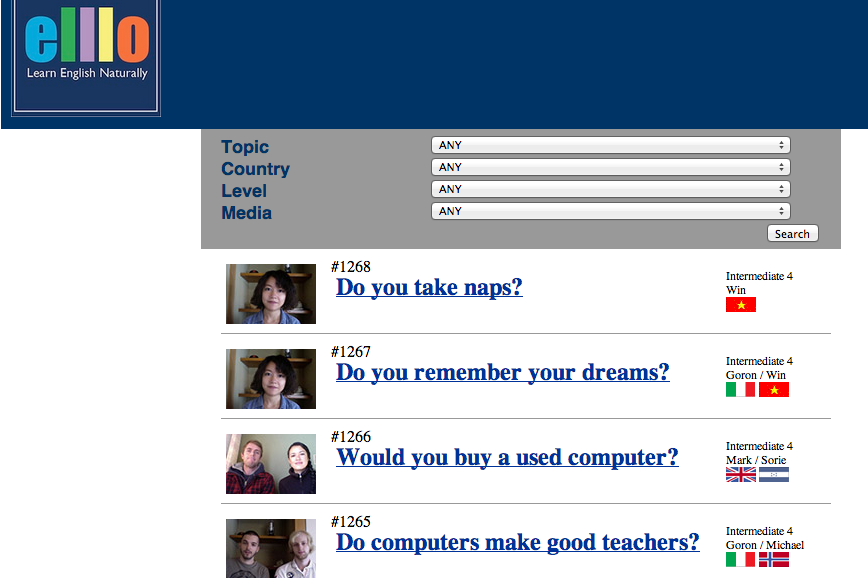
  • Learners will need a recording that has an accompanying transcript. (For learners at intermediate and below, www.elllo.org could be a useful resource for this; for higher level learners, a possible resource is the BBC “Voices” project )

Procedure:

  • Learners should, of course, first listen to their recording for meaning (identify main ideas, key information etc.)
  • Once learners have listened for meaning, they can compare what they heard with the transcript and check.
  • This done, learners play the recording again and mutter along with the recording, aloud. (For this, it could be worth selecting a portion of the recording rather than trying to do the whole thing.)
  • Ensure that learners are aware that initially this will be very difficult. The speakers will speak “too fast” for learners to keep up. However, if they replay and mutter along with a portion of the recording several times, then they will be able roughly match it.
  • How do they match it? In order to keep up with the recording and not get out of synch, they will be forced to use the same rhythm and stress as the speaker. This means they will need to stress certain words and shrink others – i.e. the weak forms. NB: The goal of this isn’t to try and get learners to speak in this way: it’s to develop their perception of the stress and rhythm of English, which they can then use to help themselves listen more effectively. However, I think the productive element is important as it helps to increase their perception by making it physical. 
  • Follow up: Once learners have muttered along enough times to be able to do so relatively comfortably, they could then record themselves reading the transcript aloud, trying to maintain the rhythm they developed during the muttering activity. They could post their recording and a link to the original recording on a collaborative platform e.g. Edmodo and compare each others’ efforts.
  • Breaking the activity down: With my learners, I did this as a series of homework activities:The first was to find a recording, listen for meaning, check with the transcript, then do some muttering.The second was to do some more muttering and then record themselves.The third was to listen again to the original recording, with the transcript, and mark all the pauses they heard, and use those pauses to help themselves manage their breathing while muttering and while recording themselves. Then they compared the first lot of recordings with the second lot.Of course this third step could be done earlier: Done in the order I did it, learners benefit from the comparisons they can make, but done earlier, they may benefit from that scaffolding sooner.

Benefits:

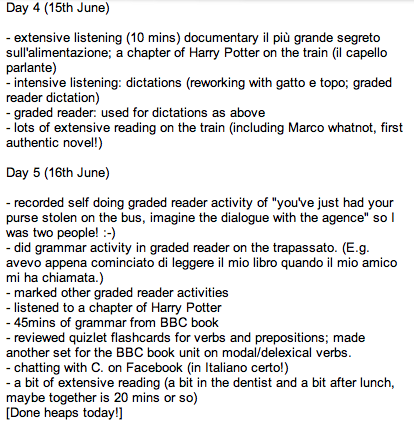
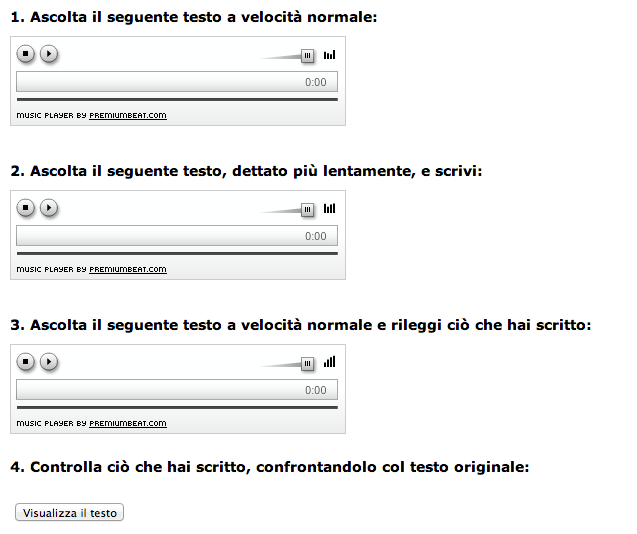
  • Because learners have to use correct word and sentence stress in order to keep up with the recording, it draws their attention to these. (I found when I tried the activity with an Italian recording, I’d get out of synch and lose the rhythm when I put the stress in the wrong place in a word. E.g. “gentile” springs to mind, and “sapere”, “utile” and “omeopata” – you realise that you keep getting out of synch at particular points, listen again and pay special attention to those points, then try again with the correct pronunciation, and then, with persistence, it works better.)
  • Recording yourself and listening to the recording, as well as comparing to the original, can help you pick out weaknesses in your pronunciation, and in doing so become more aware of what you are hearing.
  • Listening to, looking at and producing the weak forms helps learners become better able to recognise them through familiarity: it draws very focused attention to how the words look vs how they sound when condensed in connected speech, which is highlighted by the physicality of having to produce it.

Important to remember:

  • Bring it back into the classroom: give learners time to discuss at the beginning of the lessons following those when you set this activity as homework.
  • Ensure learners know they aren’t expected to speak in this way: Otherwise put, ensure the goals of the activity are clear to learners. When you set the activity, having done your focus on weak forms lesson, encourage learners to make the link between that lesson and this homework activity.
  • Scaffold it: You might have noticed that my lesson on weak forms involves some muttering along with the transcript. This means that before I got my learners doing the activities described in this post, for homework, they weren’t starting from a blank page – either from the pronunciation awareness perspective or from the task knowledge perspective (accustomed to using transcripts for listening activities, done similar activities in class, know how to approach them vs. “the transcript is that strange bunch of text that lurks in the back of the course book”!). Hopefully this will have made it less daunting and less confusing; well, certainly my learners all managed to do the task successfully and were enthusiastic about it.

Conclusion

Helping learners develop their listening autonomously is something I will be doing more work on in the future: exploration only began post-IATEFL (using Sandy’s ideas as a way in) and has been sporadic since then (I’m human! There are only 24hrs in a day and some of those are needed for sleeping/eating etc.!) with a burst of ideas emerging very recently through experimentation with my learners and in my own language learning. I’m planning to build on it, and work it into my learner autonomy projects more systematically as next steps, especially during the next set of courses that I teach.

References:

Field, J. (2009) Listening in the Language Classroom. Cambridge University Press.

My top ten learner autonomy and metacognition resources

Are you interested in the prickly issue of learner autonomy? Do you feel that metacognitive awareness is important in language learning? Do you want to find out more about these thought-provoking elements of ELT? This latest post in my ‘ELT top ten’ series offers a list of resources to get you started with learner autonomy and metacognition. 

As with all the other posts in this series, please do respond with your own opinions of resources that should be included in this list.

Books

There are tons of good books out there on the topic of learner autonomy, and I could go on forever listening ones that would be worth reading. I’ve narrowed it down to three, but I don’t doubt that there will be some disagreement with those I have chosen, and feelings that other books should have been included as well/instead. Please do comment on this post to recommend any other books that you strongly feel should be read by anybody who is interested in the topics of learner autonomy and metacognition. 

  • Phil Benson: Teaching and Researching Autonomy

Screenshot from Amazon.co.uk

Screenshot from Amazon.co.uk

This book offers an in-depth treatment of autonomy: Starting from theory, it looks at different definitions of learner autonomy, the history of autonomy theory, perceptions of autonomy in fields outside of language learning, issues of definition and description of autonomy and its different dimensions. The second section moves on to considering autonomy in practice, looking at a range of different approaches to fostering it, while the third part considers it from the angle of research (typical of this series of books), looking at different methodologies and case studies.

  • Learner Autonomy across cultures: language education perspectives

Screenshot from Amazon

Screenshot from Amazon

This is an edited book, with chapters written by authors from a range of contexts. These are case studies and reports on the subject of learner autonomy and its relationship with different cultures – not limited to national culture but also institutional, small-group and other types of culture. I found two chapters in particular heavily influential, and those are the chapters by Rebecca Oxford and by Richard Smith:

Oxford, R. (2003) Towards a more Systematic Model of L2 Learner Autonomy in Palfreyman, D and Smith, R. [Ed] Learner Autonomy Across Cultures. Palgrave Macmillan. Basingstoke.

Smith, R. (2003) Pedgagogy for Autonomy as (Becoming) Appropriate Methodology in Palfreyman, D and Smith, R. [Ed] Learner Autonomy Across Cultures. Palgrave Macmillan. Basingstoke.

  • Vandergrift and Goh: Teaching and learning second language listening: metacognition in action

Screenshot from Amazon

Screenshot from Amazon

This book takes the theory of metacognition and applies it to the learning of listening, offering a theoretically based pedagogy for teaching listening. This was my first proper introduction to metacognition theory, and I found it a very accessible way in. Particularly useful are the different example activities provided to show how the theory can be put into practice. It also uses narrative extracts at the beginning of chapters to illustrate learning and teaching listening, and the processes used, together with reflective questions about these, and this feeds into the content that follows. Well worth reading.

NOTE: In terms of books that are cheap and easily accessible, it is worth bearing in mind that the IATEFL learner autonomy SIG (see “online resources” below) has published a series of edited books related to learner autonomy, that are available in e-book format. 

Articles

As with books, there are hundreds of articles I could have selected for inclusion here. In order to narrow down the selection, I tried to go for articles which don’t require subscription to journals. This made the pool substantially smaller! For an extra list of freely available articles, you could look at the 2nd ELT Research Blog Carnival , in which you can find links to bloggers’ reviews of a selection of further freely available articles about learner autonomy. Additionally, if you can access any of Anita Wenden’s articles on the topic of metacognition, you won’t be disappointed. (E.g. from the ELTJ “Helping language learners think about learning” or from Applied Linguistics, “Metacogntive Awareness and Language learning” – and if you can only get hold of one of those, I’d go for the latter!) 

  • Smith, R. (2008)

Key concepts in ELT: Learner Autonomy (retrieved from: http://pracownik.kul.pl/files/10134/public/learnerautonomy.pdf on 20/05/2014) in ELT Journal vol. 62/4. Oxford University Press.

Part of ELT Journal‘s key concepts series, this article is a very concise summary of what the concept Learner Autonomy is all about. A useful way in to the complex field of theory that comes under the umbrella of learner autonomy.

  • Phil Benson (2006)

State of the art article: Autonomy in language teaching and learning (retrieved from: http://www4.pucsp.br/inpla/benson_artigo.pdf on 20/05/2014) in Language Teaching Journal vol. 40 p.21-40. Cambridge University Press.

This article is a more in-depth starting point, as it is a literature review of all the literature related to the topic of learner autonomy, up until 2006. As a result, it offers not only a lengthy reference list that could keep you going for years, but also concise information about all the texts referred to, to help you identify those which are most likely to provide you with the information you are looking for.

  • Borg and Al-Busaidi (2009)

Learner autonomy: English Language Teachers’ beliefs and practices published by the British Council

Part of the British Council’s efforts to make ELT research freely available, this publication can be downloaded with no charge from the British Council Teaching English website. As indicated, it is a study of teachers’ beliefs and practices in relation to the topic of learner autonomy.


Online resources:


  • The IATEFL Learner Autonomy SIG

Screenshot of the LA SIG website

Screenshot of the LA SIG website

This is one of the special interest groups affiliated with IATEFL (the International Association of Teachers of English as a Foreign Language). It organises one- and two-day conferences in various locations, pre-conference events and SIG days at the IATEFL annual conference and has a publishing presence through the edited books its members have edited and its newsletter, Independence. If you are interested in learner autonomy, it could be worth joining this group in order to share your ideas with others who share your interest.

The Learner Autonomy SIG also has an online presence, hence inclusion in this section, through this Facebook group. It is a closed group but anyone with an interest in learner autonomy can request membership. And you can find out more about the LASIG, and what it does, on their website. 


  • Science Direct

Screen Shot 2014-05-20 at 11.58.53

Screenshot of ScienceDirect.com

This website is one that I’ve only discovered recently, but as far as I can understand it basically enables you to search for different articles, and contains links to .pdfs of articles that are freely available as well as links to ones that you have to pay to access. If you download an article via one of these links, it then offers to generate a list of “recommend articles” related to the topic of the article you downloaded.

Here, for example, is a list of articles generated on the theme of metacognition.

  • The Autonomy Approach

Screenshot from Delta Publishing site

Screenshot from Delta Publishing site

A fairly recent publication, The Autonomy Approach is aimed at teachers, with a goal of helping us understand the theory behind autonomy and put it into practice. You could argue that it should be under books, but I’m putting it under online resources because on the Delta Publishing site (as vs. on Amazon etc) you can find sample pages from the book e.g. the introduction to Part B and sample activities. This makes it an online resource that you can try, before committing to buying the book.

  • My “Learner Autonomy” page!

Screenshot of my L.A. page!

Screenshot of my L.A. page!

On my Learner Autonomy page , I have collected blog posts I have written that relate to learner autonomy and metacognition. This includes

  • summaries of learner autonomy-related talks at IATEFL
  • write-ups of my own learner autonomy-related projects (with reference lists)
  • a write up of the 2nd ELT Research blog carnival on Learner Autonomy, which I hosted
  • links to articles relating to learner autonomy and/or metacognition that I’ve written for publication on other sites (E.g. IH Journal, Teaching English British Council)
  • links to materials I’ve made for helping learners use tools like wordandphrase.info and Quizlet independently
  • links to a webinar and a ten-minute conference presentation that I have given on the topic of learner autonomy

and will hopefully also grow to include links to posts written by other people, on the topic of learner autonomy and/or metacognition. So please get in touch if you have a post/website which would fit this bill!

If you know any other great resources for learner autonomy and metacognition, please comment so I can have a look and then add them to the list – it can grow into the top ten (plus)! 


Want a distinction*? Useful links for Delta module 1- happy revision!

*Sorry, I can’t give you one – struggled enough to get there myself! :-p – but I can offer a few links that may be of help for exam revision purposes… 🙂

The Delta module 1 exam is coming up in a few weeks – which means it’s nearly a year since I did mine! How time flies…

For those who are less fortunate and have the exam looming large, this post is everything I have to offer on the topic of this (ahem!) well-loved exam:

This post details how Module 1 paper 1 is structured, explaining requirements, point allocations and how to lay out your answers in an examiner-friendly way. Time spent on revising the structure of the exam and how to lay out your answers is time well-spent: no good knowing all the content if you can’t package it the Cambridge way!

This post does the same as the above post, but for Module 1 paper 2.

This post collates links to resources you might find useful as you revise for the exam.

  • Revision chart: A colourful revision chart that I made for the Module 1 exam

This is a chart I made while I was revising for the exam, to help me learn the structure.

And finally, a check-list, based on what I did for my own revision, to help you make sure you haven’t missed anything!

Screen Shot 2014-02-28 at 22.07.04

Good luck! 

ELTchat summary (14/05/14) – “Intercultural awareness: what our students need to know”

#ELTchat discussions take place once a week, on Wednesdays, at 12.00 or 21.00 each week, on a rotating basis. (To find out more about #ELTchat and these weekly discussions, please visit the #ELTchat site.) On the 14th May the chat took place at 21.00 BST (22.00 CET – yawwwn!) and the topic was ‘Intercultural Awareness: what do our students need to know?

What a can of worm! :-)

What a can of worm! 🙂

It quickly became apparent that the answer to this question was a) definition-dependent b) context-dependent and c) the usual can of worms job!

To summarise this discussion, I have decided to go with the following structure:

  • Definition(s) – defining the topic
  • Context – need to knows/teaching ideas and issues
  • Context – need to knows/teaching ideas and issues
  • Context – need to knows/teaching ideas and issues
  • Activities/approaches we could use across contexts
  • Resources/Links
  • Conclusion

Here we go then…

Definition(s)

Well, looking back over the talk, we picked at the issue of definition a bit but didn’t really come to any firm conclusions. To me, this mirrors how complex culture is – something that is further complicated by the fact that English is used as an international language and as a lingua franca. There is tension between ‘English as associated with western culture’ and ‘English as not belonging to any particular culture’, the relationship between language and culture in general, and the role of the English language teacher within this. Of course context and needs are very important – like so many other ELT issues, there is no one size fits all answer to be found with regards to this topic.

Topic is  huge methinks – we could only tackle aspects of it – e,g, topics, culturally loaded materials, even approach to teaching (@marisa_constantinides)

So does it mean teaching the culture of the language or teaching culture in a wider sense? Or both? (@theteacherjames)

…or adapting teaching to cultural contexts or awareness of differences in class (@hartle)

A culture includes behaviours, traditions, food, socialising, etc – these are all topics included in materials – could extend topics. (@marisa_constantinides)

Shouldn’t the question be whether we serve as language teachers or as ambassadors of the broader English culture as well?  (@angelos_bollas)

Depends on context – if students will mostly be speaking to native speakers or using ELF in which case need broader cultural issues. (@GemL1)

Well… in a UK context, using polite language is important in some situations (saying please, thank you, etc) (@esolcourses)

Because English is global maybe more useful to raise awareness that difference between its many users exist despite same language used. (@LizziePinard)

Depends on the student’s origin. For some, English equals western. (@angelos_bollas)

Wary of just English culture, Ss learning English will use it in China or South America too, English as way to view different world cultures. (@eilymurphy)

Isn’t it a question of context? What do the students need the language for? (@SueAnnan)

Culture is much more than grouping countries and labelling them. Many other factors involved. (@MajorieRosenbe)

From my wife’s cultural awareness studies: culture absorbs and changes language and vice versa (@ELTexperiences)

Culture isn’t static so you can’t teach it as a body of content? (@LizziePinard)

Culture even changes through generations within the same country. (@HadaLitim)

We also need to remember that within “a culture” are many subcultures. Very complex. (@LizziePinard)

So, having opened the can of worms, we discussed ways of dealing with all the worms, when it comes to our learners in our different contexts.

Context – monolingual classes 

Monolingual classes are generally associated with L2+ instruction happening in non-English-speaking countries. However, monolingual does not mean monocultural (see last tweet in the definition(s) section!) and even within these classes, intercultural awareness is important. For example, learners in these classes

Need to know behaviours, mannerisms especially in business settings, but also for classroom. (ChristineMulla)

Once we recognise that monoculture is non-existent, we can see that

Monolingual doesn’t necessarily mean mono-cultural (@HadaLitim)

Each group has a cultural mix in every individual even in monolingual classes, so by comparison of what is “normal” for each of us.. (@hartle)

Agreed – personal, family, building, neighbourhood – many different kinds. (@ChristineMulla)

That’s true. There are sub-cultures as well as national cultures. (@ELTexperiences)

Learners learning in their L1 context, who have to deal internationally with other people, for example at work, may still struggle with culturally related issues:

My sts have great difficulties on conference calls etc (@theteacherjames)

Context – multilingual classes

Multilingual classes could take place in English-speaking countries but may also take place in non-English-speaking countries. If we associate language and culture, then it is immediately obvious that in such classes there is a lot of potential for raising intercultural awareness:

How about students teaching each other about culture? Less teacher, more student interaction. In my experience they love it. (@ChristineMulla)

Of course this approach is not precluded in any other contexts, as we have already seen. It is also not without issues:

Discussed culture yesterday and an Austrian student said she felt left out because foreign students form closed groups. Different perspective. (@MarjorieRosenbe)

Context – ESOL

By ESOL contexts, we mean learners who have entered an English-speaking country with the goal of settling there. This would in due course involve citizenship tests:

With ESOL learners in the UK they need to be aware of cultural aspects to pass the Citizenship test! (@languageeteach)

Yeah they also need to know loads of silly facts for no apparent reason 🙂 (@Shaunwilden)

The need to integrate distinguishes ESOL contexts from other multilingual contexts: multilingual classes are not only found in English-speaking environments (E.S.E) and, even if such a class does take place in an E.S.E., the learners in them do not necessarily have any integrative goals: they could be young learners attending a summer camp, for example. However, there is still some overlap between the two contexts in terms of cultural resources within the class.

In ESOL classes, we can assume that learners will need to speak to native speakers, though not exclusively. Therefore certain elements of language and culture may need to be taught.

The ‘unwritten rules’ of correct behaviour in one culture don’t necessarily transfer to another one…(@ESOLcourses)

Yes, and the importance of hedging language esp when asking for a favour. (@Languageeteach)

Some aspects of language, too – tag questions in particular can be confusing for learners! (@ESOLcourses)

I always cover them in small talk lessons (@SueAnnan)

Seeing students arrive in the UK and the progress they make to become more culturally aware is amazing. Good to monitor. (@ELTExperiences)

This doesn’t come without its issues:

With ESOL ls, especially mature learners, they can be reluctant or scared to assimilate into the target culture.(@Languageeteach)

A problem that I see with ESOL students is they incorporate their own culture in their home. …female ESOL students then have problems coming to class as their husband dictates when they can and can’t go.(@ELTexperiences) 

Of course, if we are thinking about immigrants spending a prolonged period of time in an English-speaking country, and potential issues they could face, we should also think of issues faced by students who study in such an environment:

An increasingly important issue is training L1 lecturers to teach an international class (@ShaunWilden)

Activities/approaches we could use across contexts

There were plenty of ideas for bringing culture into the classrooms and thoughts about how it could emerge naturally too, as well as potential issues…

I do games, activities, discussions and personal stories from me and from students (@MarjorieRosenbe)

Greetings across cultures – shake, nod, nose touch etc. (@ChristineMulla)

We use a great GTKY activity with our students to encourage cultural awareness. It prompts discussion on proxemics, etc. (@ELTexperiences)

I think these issues / topics tend to come up naturally in class either through the language forms (politeness etc) or discussions (Gem1)

Business E books often have units on intercultural awareness. (@MarjorieRosenbe)

“I tried to do it in an enjoyable way – quizzes, games, etc. So in the end yes. I teach at a public grammar school in CZE” (@HanaTicha)

I had to teach British culture to my Spanish students and it occurred to me that we could learn imperatives while making brownies (@anasainzc)

A fun activity which dealt with culture was to ask students to bring superstitions from their countries.  Fascinating. (@MarjorieRosenbe)

Authentic videos are great for those who’re not sure about cultural aspects of different countries (@HadaLitim)

In my experience, I thought I learnt things from films etc but then I was very surprised when I got into trouble (@HanaTicha)

 A story of a faux pas might be a good lead-in to the topic  can elicit suggestions on how to get out of trouble! (@Philip_Saxon)

In business classes, case studies involving faux pas (or worse) can be instructive. (@Philip_Saxon)

Culture is a natural part of life – society and language based. Automatic learning if open to it  (@ChristineMulla)

I also get students to discuss the importance of colour in their culture. (@ELTexperiences)

Gestures is always a great one (@HadaLitim)

Or personal stories. They work well as well. (@MarjorieRosenbe)

Creative Drama would be great for culture awareness, too. (@angelos_bollas)

You could look at idiomatic expressions from other cultures and get students to tell each other idioms or expressions. (@ELTexperiences)

Creating realistic situations in the classroom, would be a great option. (@perikleis)

If learners are in an E.S.E, you could get them to do research then go and interview people on the street to learn more – I made materials to maximise the learning in these activities… (@LizziePinard)

Challenging stereotypes can be really interesting: thrifty Scots, direct Germans etc. (@Languageeteach)

But dealing with them and trying to see beyond the stereotypes can make a good lesson too. (@dimodeca)

Role-play situations in a TBL sequence might work – ask students to act out in own lang THEN watch in L2 (@Marisa_C)

Not hard in multilingual classes. Had a Saudi student trying to convince a Mexican about the advantages of having several wives (@ditaphillips)

Did PARSNIPs this week too and Spanish students didn’t get what the big deal was till we discussed different cultures learning from same books! (@Noreen_Lam)

Can also try to get students from different backgrounds to work together in groups – they have a shared goal, after all. (@Philip_Saxon)

Should we try intercultural lessons? One class in one country connects w/ a class from another country and share experiences?

I did an exchange between teens in Brazil and S.Korea, they loved it and learnt so much, very effective (GemL1)

There are some great intercultural wiki collaborations going on as we speak (@Marisa_C)

Get sts to think about what they think is British Culture. I’ve heard a range of answers: men with top hats and walking sticks,etc. (@ELTexperiences)

Pitfall with teaching british culture, is: what is it? Danger of stereotypes.. (@hartle) [Applies perhaps as a potential pitfall for teaching about any culture.]

My school organise an international food day every 3 month. Ss and Ts make food from their country share! Yum! (@ditaphilips)

Topic of culture also allows students to be ‘experts’ on an area. Great for motivation.(@ChristineMulla)

Identifying cultural elements in films/video clips could be a class activity (@Marisa_C)

Can ask monocultural classes what advice they’d like to give to foreign students coming to their country to study. (@Philip_Saxon)

Can get students to turn local news into a BBC or CNN treatment and vice versa (@Marisa_C)

Organize an international day at school.Ss in charge of research, organization and reaching out. (@Laila_Khairat)

We can ask Ss to interview family members who have lived abroad (@Laila_Khairat)

 Resources/Links

Delta Publishing: Culture in our classrooms

ELTExperiences blog: British Culture quiz 

Why not try post-crossing: Post-crossing website

…or a virtual exchange project? – see Rose Bard’s project for inspiration!

Routledge: Language, culture and teaching: critical perspectives

Cambridge: Cambridge Intercultural Resource Pack

Kwintissential: International Business Etiquette website/app ; International Etiquette guides

Wiley: Multicultural Education: issues and perspectives

Adrian Holliday: Authenticity, communities and hidden potential – video presentation

and I would add:

Sandra MacKay: Teaching English as an International Language: rethinking goals and approaches  

Adrian Holliday: The Struggle to teach English as an International Language

Ed. Farzad Sharifian: English as an International Language: Perspectives and pedagogical issues 

Corbett (2003) An Intercultural Approach to English Language Teaching. 

Nault, D. (2006) Going Global: Rethinking Culture Teaching in ELT Contexts  in Language, Culture and Curriculum vol. 19/3  (If you have access – I no longer do but did when I was at Leeds Met!) 

 – all of which I have read and highly recommend! 

Conclusions

It’s all very well but..

Speaking of cross cultural communication, I wish someone would teach English L1 speakers how to talk to an international audience! (@theteacherjames)

Seriously (although in all seriousness you can’t disagree with the quote above!), it was a very interesting discussion to have with a cross-section of teachers from a multiplicity of contexts – and surely a conversation we need to keep having, issues we need to keep interrogating…

In fact, we had a different version of this discussion a few years ago, which I also summarised, called The effect of culture on teaching and learning. Might also be worth a look if you were interested by what we had to say this time around! 🙂

Looking forward to the next #ELTchat – now that I’ve cleared my summary backlog!  If you participated, let me know if I have missed anything you consider crucial or feel I have represented anything incorrectly.