New horizons, challenges and professional development

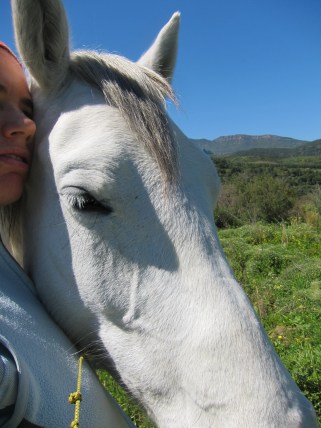
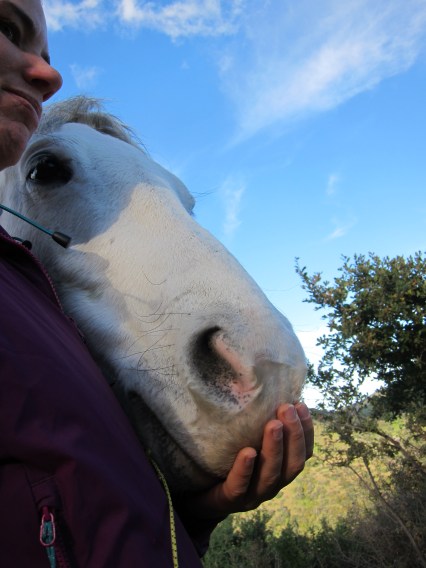
I’ve been on holiday for the last two weeks! And guess what? I didn’t do any work. At ALL! It was bliss. Days and days of spending time with my gorgeous horse – isn’t she lovely?!

IMG_1480

Now, however, it may be the weekend (by the time this blog post is finished, nearly the end of it!) but the holiday is distinctly over and I am hard at work in preparation mode:

On Monday I will be starting full-time work in the University of Sheffield International College‘s English department, which is staffed by the University’s ELTC (English Language Teaching Centre) where I have been working (on a summer school and then on part-time evening classes) since last June. I actually did two weeks’ worth of cover work at USIC last term, so the set-up isn’t brand new to me, which is nice! Not only do I know the building a little (including how best to get there on my bike – no small bonus given that I am directionally challenged!), and how the teaching works, but also a fair number of my colleagues I know from summer schools and from doing the cover work. The type of teaching (EAP skills-based) is also familiar from summer schools. The result? I can look forward to the challenges without worrying too much about the ‘being new overload’ that usually goes with starting a new job!

Since September, while working at the ELTC part-time, I have been milking the ELTC teacher development programme for all I’m worth – attending scholarship circles and workshops, delivering workshops and so on. Now, I’m also getting excited about the developmental opportunities that lie in the challenges I will face in my new job.

For example:

  • apparently getting students to do their independent learning work is an issue. This self-study works on the basis that for every hour of class time, students need to do an hour in their own time. In this time, they have to complete various tasks which relate to the work done in class. They often need to have done certain tasks before a class in order to gain the most benefit from it. Being the learner autonomy geek that I am, this automatically looks like just the kind of challenge that is right up my street! We’ve been sent a journal article on Flipped Learning/Team-Based Learning which suggests a seven-step procedure to prepare learners for this kind of approach, so I plan to adapt that and then, in addition, apply my own principles for enabling the kind of independence the approach requires.
  • WAS, or the Writing Advisory Service, is a one-to-one service offered by the ELTC which gives students the opportunity to bring a sample of writing to show to a tutor and receive guidance on how to improve it – in terms of structure, organisation, vocabulary, referencing etc – as well as signposting to useful resources that they can use to continue this improvement beyond the end of the appointment. It is not a proof-reading service. A small number of these WAS appointments will be included in my timetabled hours. I have completed an online induction for this, which involved watching a sample annotated session, with annotations focused on what the tutor was doing throughout the session, and then a second longer sample, with no annotations, with accompanying questions to answer. While time-consuming, it was very useful to watch these samples as I feel I now have a much better idea of how to negotiate a WAS appointment as a tutor! The challenge here is to implement what I have learnt from the induction hours! This one-to-one writing coaching is something that I haven’t done before but I do have some experience helping students with academic writing from my two summer schools, so that should help. Equally, doing these WAS appointments and getting better at them will hopefully help me come summer school time.
  • EAP! On the plus side, I have two summers of EAP under my belt now (and of course the two weeks of cover work I did at USIC last term) so I’m not starting from scratch by any means. Nevertheless, I’ve also just had two terms of General English courses so I need to get back into the swing of EAP. A change is as good as a rest, so I’m looking forward to getting stuck in to this form of teaching again.
  • Dare I say it, work-life balance… I’ve enjoyed having one of those for the last 10 months, since starting at Sheffield University with the summer school and continuing from there, and I hope this will continue to be the case. I plan to keep up my ultra-running training (am currently preparing for a 30 mile event in August!), get out on my bike as much as I can, try and play my clarinet from time to time (!), keep the garden in hand and – who knows – do some language study (Italian, French, German, Polish) once in a while too…? Not to mention some relaxation occasionally! At least the days are now getting longer and brighter, always helps. Hurrah for Spring! 🙂
  • IATEFL – I’m speaking at IATEFL again this year, on the topic of learner autonomy and academic listening, and look forward to all the learning that will take place there too. I think my attention will mainly be divided between EAP-focused sessions, teacher training-focused sessions and materials development-focused sessions.

Exciting times ahead – watch this space!

Teacher Education Circle (2)

This blog post has been waiting a LONG time to be written! The second meeting of the Teacher Education Circle was well before Christmas… Better late than never!

So, sometime before Christmas, there was the second meeting of the teacher education scholarship circle at the ELTC in the University of Sheffield. Prior to that, I had of course been reading Language Teacher Education by Jon Roberts, in particular the opening section in which different approaches to teacher education were explored. Here is my summary from my much-neglected ELT book challenge (yet another post waiting to be written…!) :

[…]it considers the behaviourist approach, where trainees are expected to follow a particular model of teaching, with no deviation, so that learning to teach is an exercise in imitation; the humanistic approach where change is enabled rather than directed by other people, giving the trainee more control; the constructivist approach, which draws on Kolb’s theory of experiential learning and draws on a trainee/learner’s existent knowledge and experience, so they are no longer a blank slate but somebody who brings something of value to the table; and finally a socialisation approach, where as well as the trainee’s own experience and background, influences on the trainee are also taken into consideration e.g. the school, the community, the education policies in play etc.

So, 4 approaches:

  • behaviourist
  • humanistic
  • constructivist
  • socialisation

Fast forward again to the Teacher Education Circle. We started by considering some approaches to teacher education (as planned at the end of the first meeting, hence my reading around the subject) and since that point I have been planning to compare my notes from the Jon Roberts book with the handouts from the circle. Finally, here goes!

The handouts were taken from Training Foreign Language Teachers. A Reflective Approach, published in 1991. The Jon Roberts book was published in 1998, so fairly close together in the great scheme of things. I haven’t read the book so this is what I have gleaned from the diagrams on the handout and our discussion. Feel free to jump in and disagree in the comments!

Wallace offers 3 “Models of Professional Education”:

  • the craft model
  • the applied science model
  • the reflective model

The craft model has a lot in common with the PPP approach to teaching grammar. You study with someone experienced, who instructs you and demonstrates how it is done, after which you practice a lot and in due course you become competent.

The applied science model starts from scientific knowledge, which is applied and refined by experts, then once refined it is passed on to student teachers, who practice it and in due course become competent. There is another loop in the diagram of “periodic up-dating in-service”, so presumably teachers receive more input from experts at various points which is then also practiced and also contributes to greater competence.

The reflective model draws on both received knowledge (content dictated by what is considered to be necessary for a member of the profession to be able to do) and experiential knowledge (also called “knowledge in action”, gained through experience) and there is a repeated cycle of practice and reflection which leads to professional competence.

We agreed that current training methods draw on a mixture of these. Take the CELTA for example. You study with an experienced practitioner, you receive input (based on current knowledge of how languages are taught and learnt, mediated by an experienced practitioner), you practice, you’re encouraged to reflect on your practice, and so on.

I would say the craft model and the applied science model both have elements of Roberts’s behaviourist approach in them, as the experienced practitioner provides the teaching model in the craft model and the embodiment in practice of the scientific knowledge in the applied science model, and the route to competence is likely to involve a good bit of imitation of those models. The reflective model, on the other hand, is more like the constructivist approach, in that previous knowledge/experience are acknowledged rather than the student teacher being an empty sheet of paper and reflection on experience is part of the learning process.

I suppose the humanistic approach could become an element in any of the models, if trainees are given more control over the learning process.

Based on the name of the book, we can guess which model Wallace champions!

After we had discussed these approaches, we started to develop a model for a teacher mentoring system at the ELTC (which we had come up with as an idea in the previous meeting). It was really interesting to be involved in this, to have input into the development of something new. Watch this space!

The next meeting is on the 18th Feb, so I have at least managed to write up the last one BEFORE the date of the next one! Win. Be interesting to see what comes up next. Meanwhile, I have recently read an article called “Writing for publication as a tool in teacher development” (Rathert, S. and Okan, Z. (2015), published in the ELTJ Vol. 69(4), pp.363-372) which was interesting, and have a set of three articles about getting into teacher training which I plan to read as soon as I finish preparing the session I will be doing at Leeds Beckett University tomorrow, for the Multimedia and Independent Learning module.

Never a shortage of things to do! (Or blog posts to write…I will keep chipping away at the backlog whenever I can…)

TD Sig Web Carnival: “Time is of the Essence!”

Screen Shot 2016-01-30 at 20.41.12

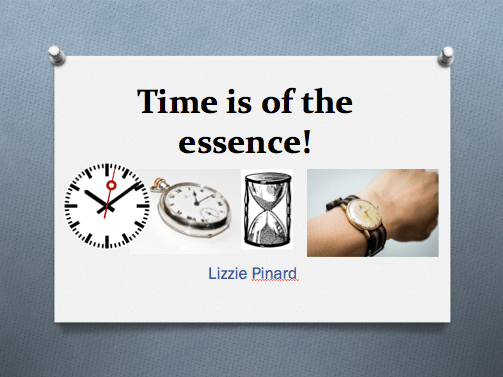
Yesterday, I delivered a session as part of the TD (Teacher Development) SIG (Special Interest Group)’s Web Carnival. I was one of four speakers and the opening speaker for the event, both of which scenarios were new to me! My session, as you can see, was called Time is of the Essence (the reason for which will become clear in due course…)

Screen Shot 2016-01-30 at 20.41.21

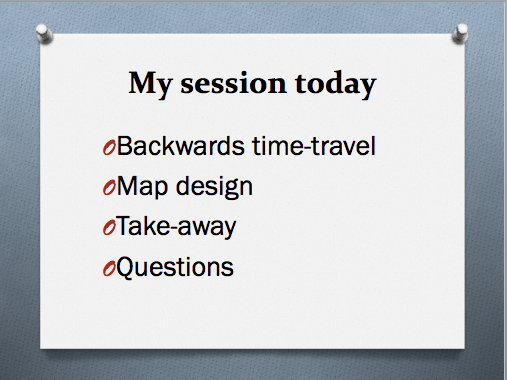
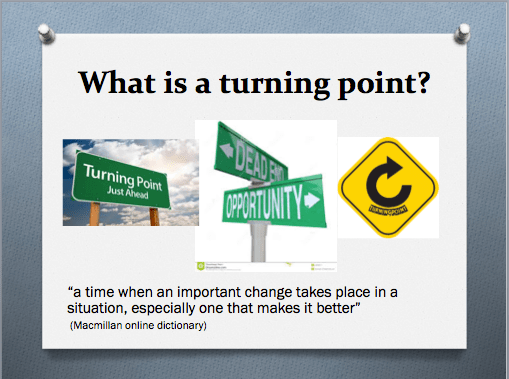
This is the outline of the session I delivered. ‘Backwards time-travel’ may sound a little ambitious but in metaphorical terms it actually worked really well. I made sure to tell the attendees that their active participation would be required, and they delivered 110%! Before starting on our journey back in time, we established the definition of “turning point”:

Screen Shot 2016-01-30 at 20.41.29

Then it was time to kick off!

Screen Shot 2016-01-30 at 20.41.36

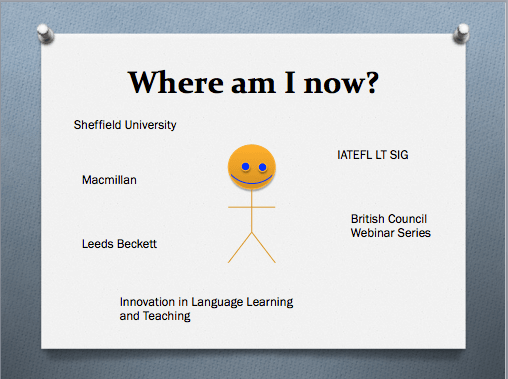
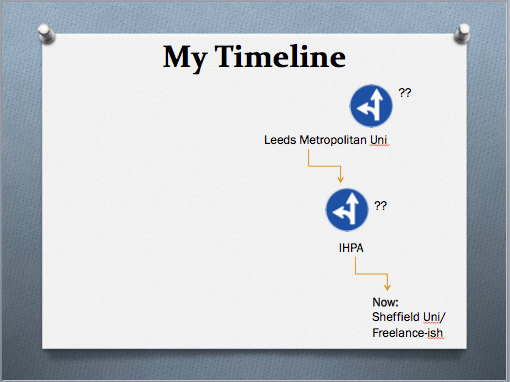
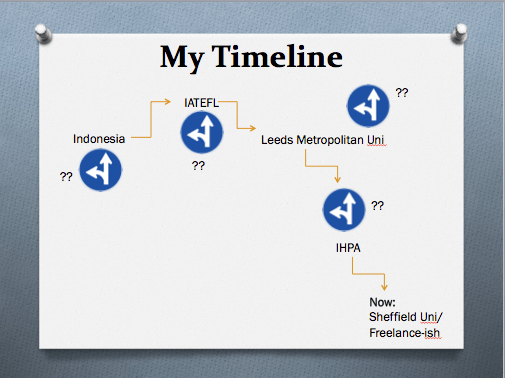
This is me now. An amazing likeness, don’t you agree? I’m currently working at Sheffield Uni, teaching on a General English evening course as well as delivering a workshop for my colleagues every so often. Alongside this, I am working on some materials with Onestopenglish/Macmillan, will be doing a couple of workshops for the M.A. in ELT multimedia and independent learning module at Leeds Beckett uni. Finally, I have got a book chapter coming out in a forthcoming IATEFL LT SIG book and recently had an article published in a peer review journal for the first time.

Screen Shot 2016-01-30 at 20.41.45

At this point, it was the attendees’ turn to tell me about where they are now, and I can tell you, it was a real eye-opener! Such a diverse crowd all doing really exciting things! And this continued throughout the session as at each development point on MY map, I asked them to share theirs. I think I overused the word “awesome” in response, because their responses really were!

Anyway, I suppose you could say I am “Freelance”, ish. I suppose it all sounds pretty cool. *But*, I am just a normal human bean. Mmm beans. So how did I reach this point? And what about this magic turning point?

Screen Shot 2016-01-30 at 20.41.53

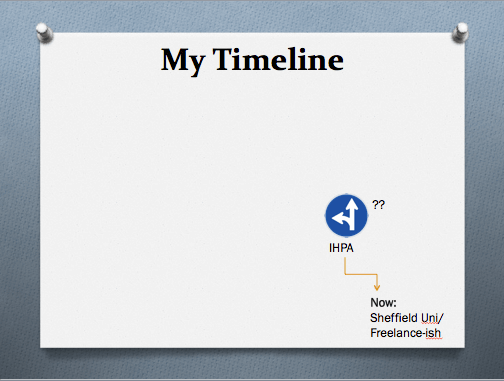
International House, Palermo. (IHPA)

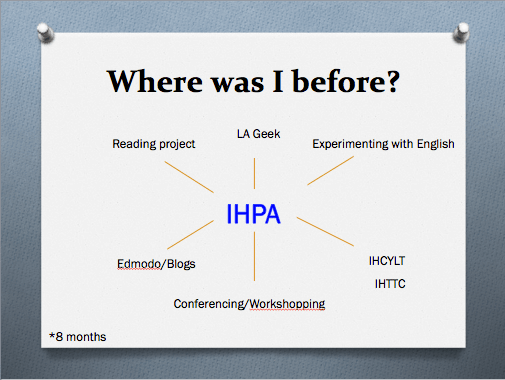
Most recently prior to Sheffield Uni, IHPA. It was a good place to develop. I did a couple of certificates (IHCYLT, IHTIT) , delivered some workshops (at work, online for IH World Organisation, online for IH Teachers online conference), was allowed to attend/speak at IATEFL each year, did a LOT of teaching. And, of course, I worked on my own little projects. You see, when I arrived at IHPA I had recently become an LA geek. Nothing to do with Los Angeles, everything to do with learner autonomy and all things related, especially metacognition and motivation. I did some classroom based research on it, trying to use all the theory I had absorbed and put it into practice with students. Thus, the following were born:

I collected feedback at the end of each term to find out what the students made of it all as a whole and it was positive by and large, making it all worthwhile.

Screen Shot 2016-01-30 at 20.42.03

All this would feed into my book chapter for LT SIG. So was this my turning point? But wait…what about the materials stuff? And the journal article? So, what came before IHPA?

Screen Shot 2016-01-30 at 20.42.11

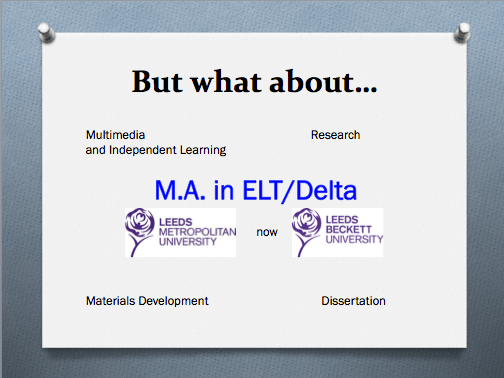
My M.A. ELT/Delta!

An amazing, grueling, challenging, rewarding, exhilarating year. In the Delta portion, probably the key thing I learnt was how to reflect effectively and constructively on my practice. As well as a whole bunch of other stuff a lot of which you can see on this blog! In the M.A. portion, you would think I learnt a bunch of theory. Well, yes. But I learnt a load of practical stuff too, through the assessment. I did a research project in the research module (with the assessment being the presentation and write up of the research), created materials for the materials development material, wrote a journal article (criteria styled on the ELTJ) for the methodology in context module, and made a website for the multimedia and independent learning module. The assessment was able to be linked with the materials development, so the website linked to the materials I made for that assessment. As it happens, I used the skills developed in building that website using WordPress to completely overhaul my blog, and also developed my voice (hence now I never shut up, where before I didn’t think I had anything to say!)

So I was basically able to develop the skills that would enable me to pursue a variety of opportunities. But that isn’t all… for my dissertation project, I wrote some task-based learning materials (which I talked about at IATEFL the year before last – that long already!) which on a whim I submitted for the ELTon Macmillan new talent in writing award. Then I got shortlisted, which in itself amazed me. Then I won! Hence the earlier-mentioned materials writing…I am editing those materials to make them suitable for publication on Onestopenglish, and we are about half way there. Will miss it when it’s over!

Screen Shot 2016-01-30 at 20.42.18

So that MUST be the turning point, right? Well, I would absolutely say it was. If you ask me what the turning point was, that would come to mind. But…let’s go back a bit further…

Why did I do that M.A. at that university?

Screen Shot 2016-01-30 at 20.42.27

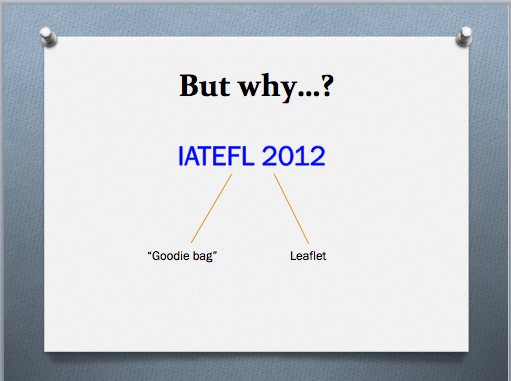
IATEFL 2012!

I went to IATEFL in 2012, my first ever IATEFL! Oh the excitement… And you know how you get a goody bag at the beginning? Who doesn’t love a good goody bag?! So, the first night back at the hotel room, I’m going through my goody bag and find a leaflet for this M.A. ELT/Delta at Leeds Met. So, 2012. Lizzie, at nearly 29 years old is feeling very old and under-qualified! I got into this ELT malarkey late, 26 and a bit years old. (Is/was it late? Lizzie thought so at the time…) Lizzie had to make up time…(hence the session title!) Lizzie had also just been rejected from a PGCE primary programme at Warwick University (thank the good Lord!) and was all “now what?” and so my guardian angel sent me the leaflet. After IATEFL finished, I applied, got accepted and the rest was, as they say… history!

Screen Shot 2016-01-30 at 20.42.35

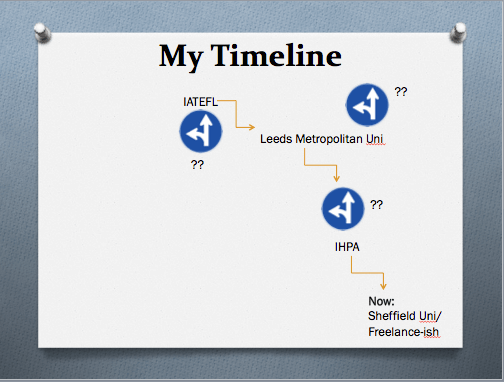
So THAT MUST HAVE BEEN THE TURNING POINT!!!! Again, absolutely yes. Except… ooops back up a bit… How did I come to attend IATEFL 2012?

Screen Shot 2016-01-30 at 20.42.48

Cactus to conference scholarship! I remain indebted to them. But….how? Where was I? How did it happen?

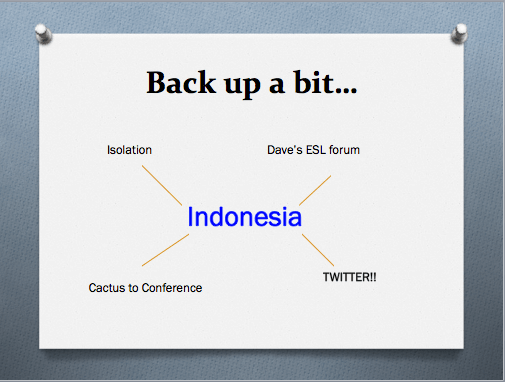
Indonesia…

I worked in a couple of private language schools in Indonesia after graduating from my CELTA, as one does. I was feeling quite isolated so was on the internet a lot. I found a forum called I think Dave’s ESL forum or something (does anyone remember this? some of my attendees did and apparently it is still going!) and started a post on there. I can’t even remember about what, maybe about how to develop or something. Anyway, one of the respondents pointed me towards Twitter. And ELTchat. (Or did I find ELTchat after I found Twitter? I can’t really remember!) Anyway, the important thing is, I got on Twitter. Did ELTchats, summarized them (The dark beginnings of my blogging!) AND…one day…saw a link to IATEFL scholarships. Didn’t really know much about IATEFL other than it’s an ELT conference, but it seemed to be a big deal, so I applied for several and won the Cactus one, much to my amazement.

Screen Shot 2016-01-30 at 20.42.56

So was THAT the turning point? Getting on Twitter? Again, there is a valid argument for it!

But… why was I bothering with looking for ways to develop, in my isolation? I could done other things than looking for ELT forums etc!!

We had better rewind some more…

Screen Shot 2016-01-30 at 20.43.03

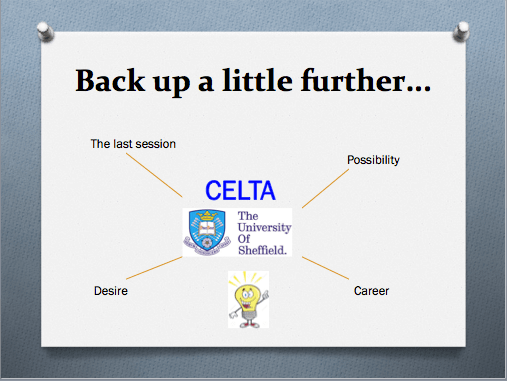
My CELTA course!!!

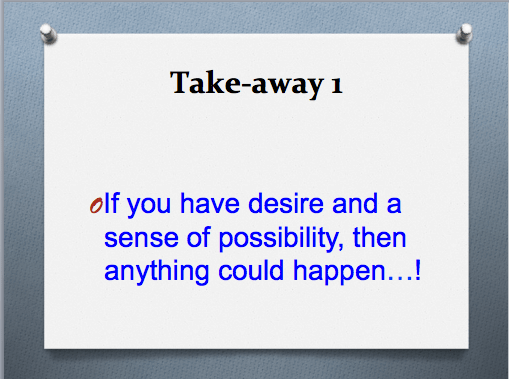
The beginning of everything… But in particular the professional development session towards the end of the course, where we were made aware that you could make a career out of ELT and shown some possibilities, through our tutors’ stories and suggestions of what we could do to develop in future. (For example, that there exists this thing called the Delta that you can do after you have some more experience!) Honestly, I don’t actually remember many of the details of that session, but the important thing is it awakened in me a desire to develop and make a career out of ELT, it gave me that sense of possibility. And perhaps the awakening of that desire and sense of possibility was the biggest turning point of all?

Screen Shot 2016-01-30 at 20.43.14

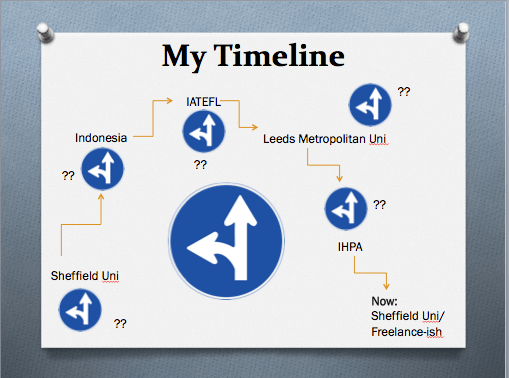
But all the other turning points were just as important for me! How to choose only one…! As the attendees mapped backwards through their careers to date, sharing their stories as we went along, it was clear that they had plenty of turning points too…

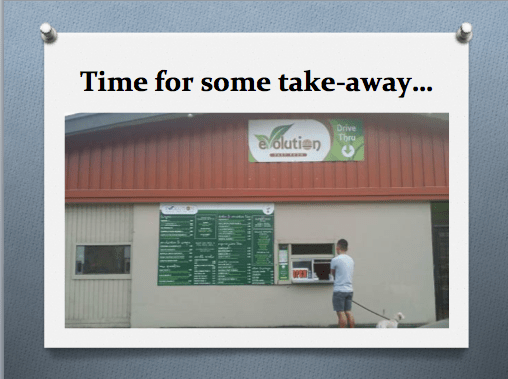
I concluded the session with a bit of take-away…

Screen Shot 2016-01-30 at 20.43.23

…warning the attendees that it might be a bit of a cheesy takeaway (but if from this drive thru it would be vegan cheese 😉 )

Screen Shot 2016-01-30 at 20.43.33

Well, everything that has happened to me so far stems from this, so…

Screen Shot 2016-01-30 at 20.43.41

Most of the attendees mentioned that discovering the online teaching world as key in their development. Of course, for me, if I hadn’t discovered Twitter, I wouldn’t have seen the Tweet advertising IATEFL scholarships, so wouldn’t have made it to Glasgow 2012, wouldn’t have found that leaflet…etc!

Screen Shot 2016-01-30 at 20.43.49

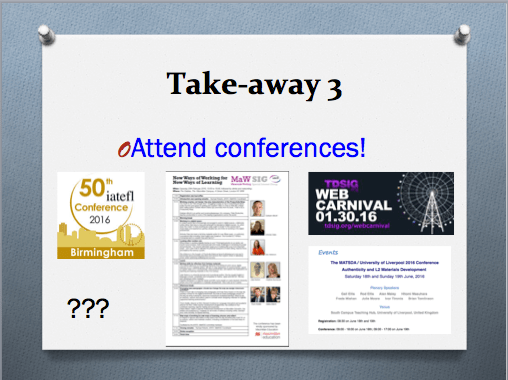
Because they are Good Things. And if I hadn’t…well you know the story already! Be warned: they are addictive!

Screen Shot 2016-01-30 at 20.43.58

If I had acted according to my confidence in my ability to succeed, then a lot of what I have done I wouldn’t have dared to embark on in the first place! (I never in a million years thought I would win an ELTon, for example!) We (attendees and I) agreed that people often fail because they don’t try in the first place. And often that not trying in the first place stems from thinking “I’m not good enough, that’s for people who are better than I am”. But if there is one thing I have learnt, it’s that you only get “good enough” by jumping in in the first place.

Screen Shot 2016-01-30 at 20.44.05

Turning points may not advertise themselves to you as such. It’s often only looking backwards that we realise that such or such an event or situation was a turning point for us. Hence the importance of saying yes! (Even if saying yes all the time can make you awfully busy! 😉 Seriously, who knew the start of 2016 would be so jam-packed!!)

Screen Shot 2016-01-30 at 20.44.16

What you learn needs to be part and parcel of your professional life, weaving it’s way through, not something separate, on the side. For example, if I hadn’t tried to put the theories that struck me on the M.A. into action, my projects wouldn’t have happened and thus neither would my LT SIG book chapter. Not only that, but learner autonomy/metacognition/motivation etc wouldn’t have become part of my teaching, which would have been a shame from the students’ point of view!

Screen Shot 2016-01-30 at 20.44.23

Life is short. Be where you want to be. If you aren’t, then keep udging towards where you want to be. Right now, I am very happy. I am where I want to be and I can highly recommend it! 🙂

Thanks to the TD Sig for this opportunity and to all the attendees for making it such a fun, interactive session to deliver.


30 questions to ask yourself

According to Sandy Millin, at the end of 2014 Anna Loseva posted a list of 30 questions to ask yourself on New Year’s Eve. Sandy followed suit on NYE 2015/2016. Clearly afore-mentioned NYE is long gone and being as I was in Cape Town at the time, visiting family and family friends, blogging wasn’t high on my priority list! However, the holidays are now over and to kick start 2016 and get blogging again, I thought answering these questions would be a nice opening post. Obviously the ‘this year’ in the questions is in fact last year…! Whereas “next year” = this year! 😉

1. THE BEST MOMENT OF THE YEAR.

I have enjoyed a lot of lovely moments this year – lucky me! – but probably the best would have to be a mixture of when my horse, Alba, became my baby in June and all the moments I spent with her in the second half of the year.

Me and my baby :)

Me and my baby 🙂

2. WHAT INSPIRED ME THE MOST THIS YEAR?

The thought of getting work at Sheffield Uni and coming home. I worked towards that in the first half, realised it in the middle and thoroughly enjoyed it from then on! Also, all the CPD opportunities I’ve experienced since starting at Sheffield Uni. There is always so much going on!

3. THE MAJOR NEWS OF THIS YEAR.

Finally moving back to Sheffield in June. Starting with my second summer school and continuing with General English evening classes. After 5 years working abroad (nearly – actually one of those was spent in Leeds doing my M.A.! Away from home still…) I am finally back home and trying hard to stay! But also my ELTon-winning dissertation materials appearing on Onestopenglish (and all the behind the scenes editing I’ve been doing working alongside my editors!) Then there is always IATEFL, the journal article I got published…  Oh, and Alba, of course! 😉

4. ANTHEM OF THE YEAR 2015.

Like I know any songs that came out this year…

5. THE MOST IMPORTANT PEOPLE IN MY LIFE.

My friends, my family, my horse, my hamster. Who else?! 🙂

6. WHAT WAS MOST DIFFICULT FOR ME TO DO THIS YEAR?

Leaving Sicily. Much as coming home was the best thing ever, saying goodbye is never easy! I have definitely left part of myself out there… just as well I get to visit it frequently!

7. WHAT COLOUR WAS THIS YEAR?

Creamy grey – the colour of Alba! Or blue – the colour of the skies whenever I visit Sicily (please may it continue that way!)

8. WHICH EVENT OF THE YEAR WOULD I CHOOSE TO REMEMBER FOREVER?

Other than those already mentioned (becoming Alba’s person, starting work at Sheffield University), probably my first vegan festival, which was in Manchester! So much vegan-ness in one place, hurrah!

9. WHICH WORD DID I USE MOST OFTEN?

I really don’t know…you would have to ask the people I speak to all the time… but probably ‘Alba’…!

10. MY MOST RIDICULOUS PURCHASE OF THE YEAR.

A horse who lives in a different country from me? Not your everyday situation…

11. I SHOULDN’T HAVE EXPERIMENTED WITH …

Nope, can’t think of anything!

12. THIS YEAR WAS WONDERFUL BECAUSE …

I found the horse of my dreams AND came home to stay.

13. WHICH INNER PROBLEM DID I SOLVE SUCCESSFULLY?

Erm…whether or not to buy Alba and where to keep her? Definitely made the right choices!!

14. WHO DID I HUG AT NIGHT?

My little hamster, Flora. Gently. 🙂

Flora the Explorer

Flora the Explorer – she likes kale too!

15. WHOSE WEDDING DID I HAVE FUN AT?

I didn’t go to any weddings! But in 2014 there was my sister’s, if that counts….probably not…was good though!

16. WHAT WAS MY AVERAGE SALARY THIS YEAR?

God knows… Maths, not my strong point!

17. DID I HAVE A CONVERSATION THAT TURNED EVERYTHING UPSIDE DOWN IN MY HEAD?

Err…don’t think so… unless it was the conversation where I realised that Alba risked being sent to slaughter because she was lame and therefore no longer useful, so suddenly I had to process that awful piece of information and decide I was going to stop it.

18. WHAT NEW PROJECT DID I START IN 2015?

Getting my ELTon-dissertation materials ready for publication on Onestopenglish. They are coming out at the rate of one lesson plan, including teachers’ notes, per month. In 2015 the first half made it out. The second half will appear at monthly intervals during the first half of this year.

19. IF I COULD BECOME A SUPERHERO FOR JUST ONE DAY, WHAT WOULD I DO?

Teleport. Definitely Teleport. So I could visit Alba every day just for a little while, and take in a few friends along the way too!

20. WHAT AM I DREAMING ABOUT NOW?

My horse, of course!

21. WHAT DO I CONSIDER TO BE MY MOST IMPORTANT ACHIEVEMENT?

Getting through the year in one piece, happy and healthy? Also having a much, much better work-life balance. And, yes, this means I have rather a backlog of blog posts but…I’m sure when I wind up on my deathbed, I won’t be thinking I should have put life in the backlog in favour of the blogposts! They will arrive in due course… Patience! 🙂

22. THIS YEAR UNTIL THIS MOMENT IN ONE SENTENCE.

‘And I was filled with such delight…’

23. THE LATEST MESSAGE I’VE SENT.

Thanking a friend for some vegan dhaal she brought round for me to try that I had with my lunch today. Nothing earth-shattering!

24. A QUOTE THAT IS MOST SUITABLE FOR MY YEAR.

“There’s no place like home.”

~Dorothy Gale, Wizard of Oz.

“There’s no horse like my horse.”

“There’s no fridge like my fridge” (You’d have to be Vegan to really understand this feeling! :-p )

~Lizzie Pinard, Sheffield.

25. DID I ACHIEVE EVERYTHING I’D PLANNED FOR THIS YEAR?

Moreorless… I don’t have a *full-time* job at the uni, which was the general aim, but hey I have work, that’s a good start!

26. HOW MANY NEW FRIENDS DID I MAKE THIS YEAR?

Plenty! Have also managed to build up a little circle of vegan friends, since being back in Sheffield, which is nice.

27. WHO DID I HELP THIS YEAR?

Anybody that I could!

28. WHERE DID I TRAVEL?

Mostly Sicily! But also Botswana to visit my Dad and Cape Town to visit our family friends, over Christmas and New Year.

29. WHICH PROJECTS AM I PUTTING OFF TILL NEXT YEAR?

The next ones on the list of things to do! Which include continuing work on the ELTon-Macmillan materials, working on my co-authored book project, various workshops, webinars, conference talks etc.

30. WHAT DO I WANT TO ACHIEVE NEXT YEAR?

A full-time job would be nice! Put as much in and get as much out as I can at Sheffield Uni. I also want to get out climbing, as in outdoor climbing rather than indoor bouldering which I am already back on, and do more running. An ultra would be nice. Of course I also want to see Alba as often as possible. And go to more Vegan Festivals 🙂

Well, belated Happy New Year everyone! And thank you for the inspiration, Sandy and Anna, however slow I might have been to actually act on it! 🙂 Now that I have kickstarted the blogging, hopefully it won’t be so long till the next post! (I have tons to say – as you can probably imagine…! – just need to put fingers to keyboard more often!)

New beginnings…

Yesterday evening, my upper intermediate General English course at Sheffield University’s ELTC started. I will be meeting this multilingual, multicultural group of students twice a week for the next 12 weeks (including this week). The course does not have an exam at the end, which is not something I have encountered often in my teaching career to date! The Social English class I taught on the 10 week pre-sessional at the university this year also wasn’t assessed as it was made up of students who had already met their conditions, but it wasn’t a four skills integrated standard course either. The only other occasion for me has been the continuous enrolment intensive courses at a private language school in Leeds that I taught on during the third semester of my M.A. but those were every day with continuously changing groups of students rather than twice a week with the same group. The course book for this course is New English File Upper Intermediate, another first for me, and we are using the version where it is broken down into book A and book B, so book A is the book for the next 12 weeks. I’m also planning to use all the learner autonomy materials I’ve developed during my couple of years at IHPA – the reading project, the experimenting with English project and so on. Finally, I am hoping to use the ELTon award-winning materials I wrote for my dissertation, as I haven’t worked in the UK since finishing them so it is a golden opportunity!

Yesterday’s class was the first class I’ve taught at the ELTC since finishing my CELTA there in March 2010. I *have* done two summer school pre-sessional programmes with the university since then (10 weeks this summer just gone, 10 weeks in the summer last year) but those take place elsewhere on campus rather than at the centre itself. It’s lovely being back the centre – it’s a purpose-built building, with lots of space and a wealth of resources. A lot of value is also placed on teacher development, which I am looking forward to exploiting in the coming months. Indeed, I had my first bit of training yesterday, when I attended a refresher session for using Smartboards combined with an introduction to using Google classroom. Fortunately the tech team have prepared “how to…” guides for both of these, which can be accessed via the teachers portal. It was a lot of information to take in at once! I fully intend to get to grips with both the Smartboard and Google classroom in the coming weeks: Google classroom is very similar to Edmodo, so my interest in that is hardly surprising, and the Smart Board has some potentially useful features. I’m sure it can do lots of fancy, advanced stuff too, but what stood out for me is that you can also do a range of little things with it, that enhance rather than take over your teaching. As I try them out and see how I (and the students) get on with them, I’ll share anything of interest that I learn here. Of course, Google classroom will tie in nicely with my above-mentioned learner autonomy projects.

Yesterday I also signed up for a free course delivered by Lancaster University, called Corpus Linguistics: Method Analysis, Interpretation. It’s an 8-week course which involves video lectures and interviews, tasks, discussions on a forum, and which allows you take from it what you want to take from it. I learnt about the existence of Corpus Linguistics and corpora during my M.A. ELT/Delta year at Leeds Met, and it’s something I’ve wanted to follow up on since those days but have lacked the time to do anything beyond using Wordandphrase.info with my students and developing some materials to help me to do that. I’m hoping this course will give me the understanding and tools to use corpora more effectively, both for my own and my students’ learning.

All in all, my professional life is a very different picture from what it was this time last year, when I was just starting back at IHPA for a second year and about to embark on my IH tutor training certificate. As ever, I firmly believe this academic year will be what I make of it, and I plan to make as much of it as I possibly can, especially as there is no shortage of opportunity. After a quiet month or so on this blog (time off is good!), I hope to post more regularly again, both teaching-related and corpus linguistic course-related. Watch this space…

Watch this space!

Screen Shot 2015-04-11 at 21.59.37

My professional home now. 🙂

Learning Polish – being a true beginner (my newest challenge!)

Those of you who follow read my blog regularly will have seen a number of posts relating to my journey of learning Italian, something that I have thoroughly enjoyed doing. In my two 8-month stints in Palermo, I have managed to get myself from beginner level to intermediate level, though a lot of that improvement actually took place during the summer between those two contracts where I studied intensively and independently, partially to improve my Italian and partially to experiment with independent learning techniques.

This year, I am leaving Italy and returning to the UK, a move which I hope will be permanent. While I fully intend to hold on to my Italian (by speaking to Italian friends, reading in Italian and watching films in Italian, for example), I also decided that it was about time for a new linguistic challenge.

Enter Polish.

Why Polish? 

In no particular order:

  • I am a complete beginner at Polish. I can only say goodbye (but not spell it) – because once upon a time my mum had some Polish kids in her L2 unit at primary school. (Once I started secondary school, holidays did not coincide and so when I was on half term or holiday, I would often go into school with mum and listen to kids read and suchlike. The Polish children used to say goodbye in Polish at the end of the day when they went home.) = indubitably a challenge!
  • I have never tried to learn a language whose alphabet is different from English. Polish has some different letters, as well as using some consonant clusters that English either doesn’t use or doesn’t use in the same way. So, not as difficult as, say, learning Arabic would be but more difficult than French, German or Italian, which are the languages I have learnt to varying degrees so far. From a learning perspective, this is a challenge; from a teaching perspective, this should help me better understand the problems students whose L1 is further from English might experience.
  • My sister’s husband is Polish and his family don’t speak a lot of English, so it would be nice to be able to communicate basically with them when they visit. Of course, my sister is learning Polish too, for obvious reasons. And anything she can do, I can do better, right? Well, maybe not but we can egg each other on and practice together on Skype and stuff, I imagine. 🙂 And of course, when I visit them, I get practice opportunities!
  • Sandy Millin is moving to Poland to take up a DoS job there, and I would like to visit, as I have never been to Poland before. It would be nice not to be completely helpless if this happens! Also, a bit of healthy competition never hurt anybody! 😉

What I have done so far:

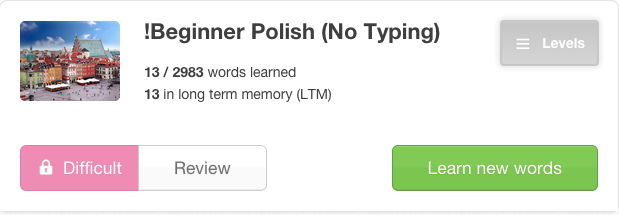
  • Downloaded a Memrise course in Beginners Polish.

(This was my starting point for Italian too…).

The good thing about this is the recordings that accompany the words and the memes that you have to choose to help you remember the words. The memes for my Italian course seemed all too often to involve random rather unhelpful busty blonde women, whereas the ones in this Polish course so far are quite useful memory aids. However, I have noticed that I can often remember the sound of the word via the meme, but then can’t remember the spelling associated with it. So on my list of things to do is get to grips with the sound-script thing. Fortunately this shouldn’t be tooooo difficult (famous last words?) because, as I understand it, Polish is written phonetically, with a very small number of exceptions. I need to stop applying English sound-spelling rules (dodgy as they are!) to Polish words.

Screen Shot 2015-05-25 at 11.27.03

Beginner…that’s me!


  • Looked for resources: 

This started as a hunt for Graded Readers, but apparently these are thin on the ground where Polish is concerned. What wouldn’t I give for an A1 Black Cat Graded Reader in Polish now… Nevertheless, I have found a Polish for Dummies book which looks promising (I have been looking at the free sample!). It comes with an audio disc (or, as I would get the e-book, an audio download) in that it explains the pronunciation and some grammar stuff, as one would expect, but also apparently has lots of conversations recorded. I feel like it would be helpful for me to just read and listen a bit to start with, to help me get to grips with what Polish looks like vs how it sounds, because in my life, I have not heard a lot of Polish or seen a lot of Polish. Hardly any, actually!

For Dummies like me! :-)

For Dummies like me! 😉

I have also seen some Usborne Everyday Words flashcards, which I find rather appealing. Which reminds me, I must have a trawl through Quizlet and see if there is anything ready-made on there that I could use. I should also start to make my own in due course. The Usborne ones I saw have also reminded me that I could also post-it everything when I get back to the UK… 😀

Screen Shot 2015-05-25 at 11.23.45

Yay, pictures!


Finally, I will confess, Harry Potter in Polish has crossed my mind as a possibility… or perhaps Twilight … using the same approach as I did with Italian initially, i.e. the original text and the translation side by side until I can manage without the original, but I think I need to get my head around pronunciation first!

Good old Harry Potter...!

Good old Harry Potter…!

What happens next?

  • Probably very little this week, being the last week of term and therefore very busy. If I can log on to my Memrise course a couple of times and do some review, I would be happy with that!
  • Once I am on holiday, download Polish for Dummies and start listening and reading. And work on the sound-spelling thing.
  • Then, when I get back to the UK, make myself a learning contract!

Of course, it’s going to be a bit different from last summer.

A) there is no time limit on the Polish, whereas with the Italian I wanted to get it down by the end of the summer last year.

B) I want to work on my other languages too – my French, my German and, of course, keep up the Italian. I am wondering what my brain will make of juggling 4 languages plus English on a regular basis. (Another experiment…) So I suppose my room will be little Europe rather than little Italy as it was last summer!

Let’s see what happens… I’ll aim to post another update in a month’s time! For that matter, I also aim to actually publish some of the pile of drafts that have built up on my blog ‘work-desk’ since IATEFL!! It’s been a busy time. The tumbleweed will get booted out of the way soon, though – watch this space! 🙂

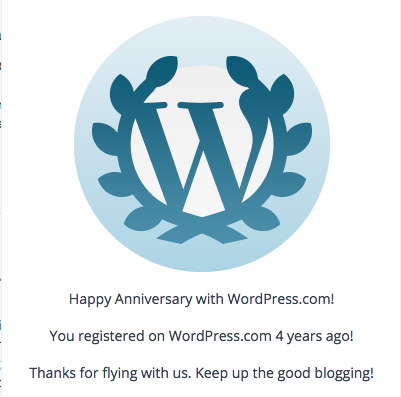
My blog is 4 years old today!

Screen Shot 2015-05-01 at 21.43.44   I was closing tabs in my browser when I reached one that was open to a WordPress site, not mine. However, as I am logged in, my tool bar was in evidence along the top and I noticed a little cup symbol in the notifications part. I clicked on it out of curiosity (knowing it couldn’t be about likes or stats because I have been allowing tumbleweed to blow through my blog since IATEFL – work issues have kept me occupied) and discovered that, as per the image above, I registered with WordPress 4 years ago today…

Where was I?

4 years ago, I was coming towards the end of a year in Indonesia. I couldn’t remember why I decided to start blogging, so I dug out my first blog post and it turned out to be part of the ‘30 Goals Challenge‘, created by Shelley Terrell, which I believe is now in it’s I don’t know how many’th reincarnation and even has a related e-book out. I had found out about it through Twitter. My early posts largely fell into 2 categories – 30 Goals Challenge  and #ELTChat summaries. (It wasn’t until I did my M.A. ELT and Delta at Leeds Met, now Beckett, that I started writing in earnest, as it was then than I found my voice…)

Where am I now?

Now I am nearing the end of a second year at IH Palermo. My blog bears little resemblance to how it looked in the early days (during my M.A., I learnt about tech-y stuff and then gave my blog a complete overhaul, in an attempt to make it more attractive and user-friendly to navigate; it also now has 270 posts, 9 pages, 777 followers, 336,634 views and 1,370 comments) and I, myself, have had quite a journey since then too…

What have I learnt?

In no particular order…

  • how to relax!! (I have been perfecting the art today, in fact, as it’s a national holiday in Palermo! This is extremely important for avoiding burn-out…)
  • that saying ‘yes’ can lead to lots of unforeseen opportunities (it’s been an exciting few years!)
  • that you have nothing to lose in trying something, and everything to gain (e.g. I only submitted my dissertation project for an Elton because I had nothing to lose, in the end I won a prize which has led on to other exciting things…)
  • that the world of ELT is so big and multi-faceted. We may see only a tiny corner of it for the majority of the time, but attending conferences like IATEFL puts things in perspective and helps you see how rich (not in the monetary sense of the word!) a world it really is. You can then differentiate between ELT as your job and ELT the profession that you are a tiny part of.
  • that I can work really damn hard (c.f. M.A./Delta year and the distinctions I got out of it plus all the blood, sweat and tears that have gone into all my jobs before and since!)
  • that I love CPD (action research, reflection, materials writing, presenting at conferences, attending talks at conferences, doing webinars – as presenter or participant, blogging, chatting on Twitter when I can, writing articles/book chapters, doing courses..and so the list goes on…)
  • that however hard one works, it’s never enough so one has to decide when enough is enough.
  • that it’s ok to have a life outside work and stop thinking about work from time to time 😉
  • that I can’t please all of the people all of the time, and however much I put into my lesson planning and teaching, some students won’t be satisfied. This does not make me a bad person.
  • that 10-12 year old Italian children can get very excited by post-its. This is a blessing when you forget to take the soft balls into class for vocabulary review! I love my M2s. 🙂
  • that the amount of time spent doing things expands to fill available time. If available time is limited, things have to get done quicker. And Things to Do lists can develop multiple layers of priority!
  • that the beauty of learning is that it is never-ending. 🙂

And the list goes on…

What next?

I haven’t renewed my contract at IH Palermo this time around, so I am stepping out into the unknown again. I have a ten-week summer contract at Sheffield University lined up but beyond that? Who can say. One thing’s for sure though, I will keep blogging and I will keep saying yes when opportunities arise. And see where it takes me next… Thank you all who follow my blog, read my blog, comment on my blog and in so doing make it what it is. And happy 4th birthday, Blog! 🙂 (Also, to anyone who watched my recent webinar on Metacognition, the promised write-up will happen… just as soon as I can make the time without overly upsetting my precarious work-life balance! 😉  )

One step forward, two steps back! (Or, the joys of language learning…)

One step forward…

My computer has been playing up since Christmas, so finally I decided it was time to take it to the Apple store for some TLC. More specifically, the Palermo Apple store. I don’t have much, if any, computer-related vocabulary in Italian… I can also be rather lazy. This means I didn’t get round to looking up useful verbs (e.g. shutdown, reboot etc.) before going to the store. During the 25 minute walk to get to the store, I did however at least think about how to paraphrase the afore-mentioned verbs and about quite what I was going to say. I will admit, part of me thought that I might find someone with a bit of English working there (as I had been lucky enough to do at the TIM phone shop soon after arriving here the first time around with only about one ciao and one grazie to rub together!) but that wasn’t to be…

Turns out the Apple store here works differently from the ones I’ve been to in England too – there was nobody waiting to greet me, ask what I wanted and direct me to the relevant place, so I had to find someone, explain why I was there, ask what I should do, get sent to the relevant place and find crowds of people all waiting for various things. Cue explaining, again, what I wanted and getting more specific re-direction. Then I finally spoke to one of the “Geniuses”, only happily enough they don’t go by that rather cringeworthy name here! What followed was a textbook example of negotiation of meaning. I tried to explain what was wrong with my laptop and he translated it into Italian computer language. This required gestures, paraphrases and a slightly pleading expression in my eyes. What was good was when he dutifully provided a verb and I could then use that verb for the next part of the explanation! I was lucky that he was patient and didn’t seem unduly perturbed by my ignorance! 🙂 I felt quite satisfied when I left the store, armed with what I went in for – instructions for how to fix my laptop.

Two steps back…

Contrast the above rather satisfactory exchange with me on Friday afternoon, talking (or attempting to talk might be a better description) with an Italian colleague, and conjugating the verb I wanted to use in the first person instead of in the second person – i.e. the equivalent of Ok, so I’ll give it to me later instead of Ok, so you’ll give it to me later. I heard the mistake as soon as I said it, and self-corrected, but oh my lordy lordy could I make a more basic mistake?! I know how to conjugate dare in second person simple future, I know what I had wanted to say, but it just came out wrong… Was I tired? Was it just a clumsy moment? Does there have to be a reason? Who can say…

Conclusion

C’est la vie! Che ci vuoi fare. Unfortunately my self-study has dwindled to almost nothing and my Italian course that I did is receding into history. (Though I do still make an effort to monitor my use of pronouns, using what I learnt that week to use them correctly!) I’d love to be amazing at Italian, but it’s not going to happen – so I might as well just enjoy the fact that I *can* get by independently here and not worry too much about all the mistakes I make along the way. 🙂 Also, being able to paraphrase/circumlocute is a very handy strategy!

Diary of an intermediate language learner (Part 3)

Diary of an intermediate language learner comes to an end with… 

PART 3

(You can also read Part 1 here and Part 2 here.)

Day 4 – Thursday 26th February 2015

I turned up bright and early (despite no sleep to speak of the night before, worse luck), with all my homework done (yay!), and a plate of brownies to share with my classmates. They were a little goodbye from me, this being my last day, and on a more personal note a celebration of the summer job offer I had from Sheffield University yesterday! It was brought to my attention that I had perhaps been too dominant in the first three days of the course, so I took it very quietly today.

Today, there was no recounting what we did yesterday. I have, however, had an idea of how we could have done it: I was thinking it would have been nice to return to the chunks for recounting that we met on Day 1. The task could have been to use these to recount what we did yesterday, however mundane. The challenge would be to recount these potentially mundane things using the chunks to pretend like it was exciting, and as listener to respond as though it were super exciting. E.g. (Loosely converting the Italian chunks we used into English…) “You’ll never guess what happened [yesterday]! “Do tell..” “Well, first of all, I actually woke up!!” “Really?! Wow!” “Yes, and then, get this, I had breakfast!” “No!!!” etc. I think it could be fun! As well as some nice language-recycling. 🙂

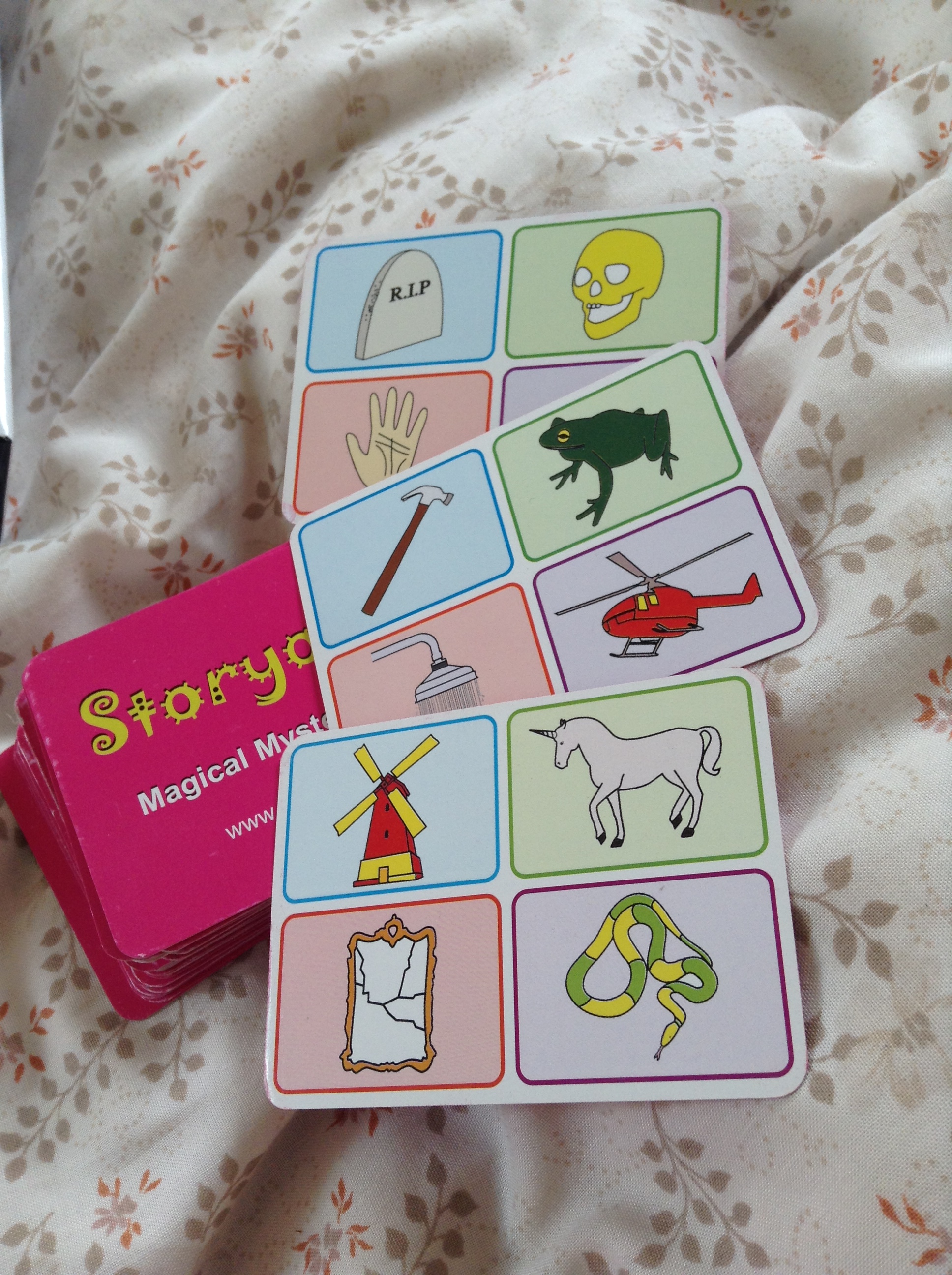
Storyonics!

Storyonics! To be combined with lovely Italian chunks…? 🙂

In the event, we started instead by checking our gap-fill homework in pairs, while C wrote the solutions up on the board and then we checked against those and had the opportunity to ask any questions. This was quite a time-efficient way of dealing with the homework check, though inevitably a fair bit of discussion arose. Of course, as with previous days, it was useful. Next up was yesterday’s recipe which we had rewritten for homework, and we went through this open class with C nominating us in turn to read sections of it.

We continued with the theme of recipes: the first task of the day was to work in groups and create a recipe. However, this time the recipe wasn’t for food but for love. Nevertheless, though, imperatives and pronouns were of course required! One group had to write a recipe for winning a girl over, the other (my group) had to write a recipe for achieving the opposite effect. So here was the opinion gap opportunity I was wishing for yesterday! I mostly listened rather than spoke, and it was clear that everyone found it a fun, engaging activity. C did lots of monitoring and helping us fill in gaps in our language and pronoun usage, which was useful. Once we had finished, we paired up with someone from the opposite group and shared our recipes. Finally, C boarded each recipe in turn, using the opportunity to do some pronunciation drilling.

IMG_20150226_114925

Our recipes!

After break and brownies, the theme continued but the focus shifted to a song by Marco Ferrandini : Teorema. The gist question was to listen for whether Marco’s theory was for winning a girl or getting rid of her. It seemed to be the former, but there turned out to be a twist, which we discovered on listening to the second part. Conveniently enough, the song was full of imperatives and pronouns, which C exploited by getting us to try and complete the gapped text with these; first from memory and then listening to check. This was followed by a similar activity based on the second part of the song, but this time focusing on prepositions.

So this was a task-based lesson, with the main task being production of a recipe and the work with the song being post-task focus on form activities. The non-linguistic outcome was, of course, the recipe. The language focus was imperatives and pronouns, which C encouraged us to use in our recipe production, so it was an overt language focus. I suppose, therefore, purists might argue that because we were guided towards use of a particular form (i.e. imperatives and pronouns), which we had been studying, that it was more a language practice activity than a task. However, there was definitely a non-linguistic outcome, with an opinion gap which required collaboration and negotiation in order to complete the task. Or, perhaps it might be that the recipe activity wasn’t the main task; it was a pre-task activity, with the main task being the work with the song. In which case you could perhaps argue that the completed song was the non-linguistic outcome?

I was thinking an alternative approach could be:

  • to start with a brief discussion about what makes relationships successful or unsuccessful
  • use that as a springboard to elicit/brainstorm/board relevant vocabulary, useful verbs and nouns (pre-task activity)
  • then do the recipe activity as the main task, but with no overt form-focus (interestingly, to me anyway, in this case, as we had done the recipe activity the previous day, that would have acted as a facilitating activity [I remember Willis and Willis in Doing Task-based teaching saying that pre-task preparation can carry over from a previous lesson], which would hopefully mean that what we produced in the main task would be less ‘impoverished’ [common criticism of TBL output] than it might have been otherwise!)
  • and then input the song, keeping the gist stage that we had, whereby we discovered the twist in it, then treat the first verse as a dictogloss, so that we would try to reconstruct it from key words noted down
  • and then compare our reconstruction with the transcript, with relevant focus on form emerging at this stage
  • and finally go back to our main-task recipes and upgrade them based on what we had gleaned from the song (enter, at this point, hopefully, all the wonderful form focus work that emerged from this activity when we did it with C!)

I love that there are so many different ways of using a given set of materials (in this case, a song text) and I think the way C used it was very creative. I especially liked how the recipe theme carried over from the previous lesson, giving the lessons a non-grammatical link/flow. And thinking that brings to mind another can of worms: planning over a series of lessons, as well as within individual lessons! There is so much to think about as a teacher…

Teacher Take-away

Here is the customary subjective summary of what I learnt…

  • Tasks with a non-linguistic outcome are a Good Thing. From a student point of view it doesn’t matter whether or not they strictly speaking fit the criteria of a task according to purists.
  • Focusing on language that emerges from a task is a Good Thing. (E.g. in this case the imperatives and pronouns emerging from the recipe-writing) …Especially with a teacher who does it well. 🙂
  • Continuity of theme/topic, not only of grammar structure, is a Good Thing.
  • It’s fun doing songs in class! (This is something I should do more of…a challenge?!)
  • There are countless ways of using the same materials. As a T, this week has made me think more about alternative ways. Good to get out of a rut?
  • Prepositions are a bitch! 😉 (But it is motivating when you are the only one to figure out what the correct preposition is before listening! Of course I have now forgotten both the verb and preposition in question…)
  • Sometimes things happen outside a lesson that affect how you participate in that lesson. That’s life. Learner life doesn’t cease to exist when inside the classroom.
  • I’m now a fan of TBL from student point of view as well as from teacher point of view!

Final reflections

Some might think I’ve been overly critical of C’s teaching in this reflective journal and that therefore I didn’t find the course good, but it’s not true:

Firstly, I feel a lot more secure in my understanding and use of pronouns. Not just in terms of form, but also pronunciation. (I won’t forget ‘glielo’ and yellow!)  I’ve also picked up a fair bit of new vocabulary, both words and chunks. (I want to try out the story recounting chunks, I might try it with my storyonics cards! And maybe also if/when I start private lessons again, [still to be confirmed…]). So as a linguistic exercise, it has been recognisably very valuable. Am very jealous of the students who get to spend a month in this class! 😉

Secondly, I’ve experienced a wide range of activity types and teaching techniques from a learner’s point of view, which for me has been very interesting. Of course my reaction to any given activity or technique is very subjective. But experiencing my reactions to activities and techniques, to things that arise in the classroom, to lessons as a whole, will hopefully make me that bit more empathic and responsive to the reactions that I notice in my learners when I teach.

Finally, not only is C clearly a born teacher, but she has a lot more teaching experience than I have, and so from this point of view I’ve found participating in the lessons a very valuable learning experience – lots of activities to ‘steal’ and techniques to try out, but also, in attempting to evaluate my experience of the lessons, trying to think critically about my experience, I’ve enabled myself to ‘steal’ not only things that actually happened but also additional possibilities. For me, teaching is about endless possibilities, puzzle pieces that can be put together in different ways and bring out different pictures, depending on who is in the classroom at the time. I now look forward to experimenting (further!) with my own puzzle pieces, based on all the new possibilities that have opened up in my mind as a consequence of joining this Italian class for a week. Lucky me! 🙂

Thank you, C, for letting me into your class for a week: it was great!! And thank you IHPA giving me the opportunity to flog myself with being a full-time language learner AND teacher all at the same time. Utterly exhausting but oh so worth it and something I would highly recommend to any teacher who has the opportunity to do so. Spending some time in a classroom as a learner, you learn ever such a lot about teaching, as well as of the target language itself, in the process: it really is time well-spent.

All of us ss and t together: Happy language learners, lucky to have such a good teacher! :)

All of us ss and t together: Happy language learners, lucky to have such a good teacher! 🙂

Diary of an intermediate language learner (Part 2)

Diary of an intermediate language learner continues with…

PART 2

(You can also read Part 1 here )

Day 2 – Tuesday 24th February 2015

Today we started by recounting in pairs what we had done since yesterday’s lesson. This time, we had to do it by drawing and guessing. It was great fun, but took ages and I felt I wanted to TALK rather than draw and guess. However, for those who have been in the class for a while and have already had plenty of speaking opportunities, this is a great way of adding some variety. I wonder how we’ll do it tomorrow? I must say, I felt rather envious of my partner who had spent his afternoon visiting a monument, buying theatre tickets for tomorrow, going dancing, and other students who had gone home, changed into gym clothes and been to the gym, then done their homework. I, meanwhile, had left Italian class, swallowed lunch, taught 2 classes, did All  The Things, including homework, in my ‘break’, then taught two more classes before dragging myself home to a cup of tea and bed! I think the perfect combination would be a language learning and horse-riding holiday. Learn in the morning, ride in the afternoon, or vice versa, and some days with just horse-riding too. Bliss! 😉

Next up was homework checking. This took a long time, but was very useful. I suppose in a 3hr class you have much more time to play with than a 1hr20 minute class (the usual length of the classes I currently teach). Checking the homework involved teamwork/points for correct answers, which was fun except for the point where I had been nominated by my group to read out our answer, but it was the last one in the section and for the final gap I had apparently misheard the final decision, in the scramble to wrap up, so I made a mistake and lost the point for our team le stelline. I crettini got it instead, and one member of my group had a right go at me! That was rather upsetting and threw me temporarily but then I got over it.

Once we had finished checking homework (I was chuffed that I had done it all!), we returned to the stories we had written yesterday. C had looked at them all and marked up the errors using a correction code. They were stuck up around the classroom and we had to go round and try to correct the errors she had highlighted. This was a really lovely activity (another one I plan to steal! There’s an IELTS group-essay writing activity that I think this would make the perfect follow-up to…) but I found that I was very focused on the errors and didn’t really pay much attention to the story itself. So much had happened since we wrote them (work, life, homework, a lot of homework correcting!) that I could barely remember the premise. So, I think it might have been nice to have had a quick look at the stories right after we had written them yesterday, in order to enjoy the nonsensicality and humour, and do all the meaning processing, to then return today for the error correction activity.

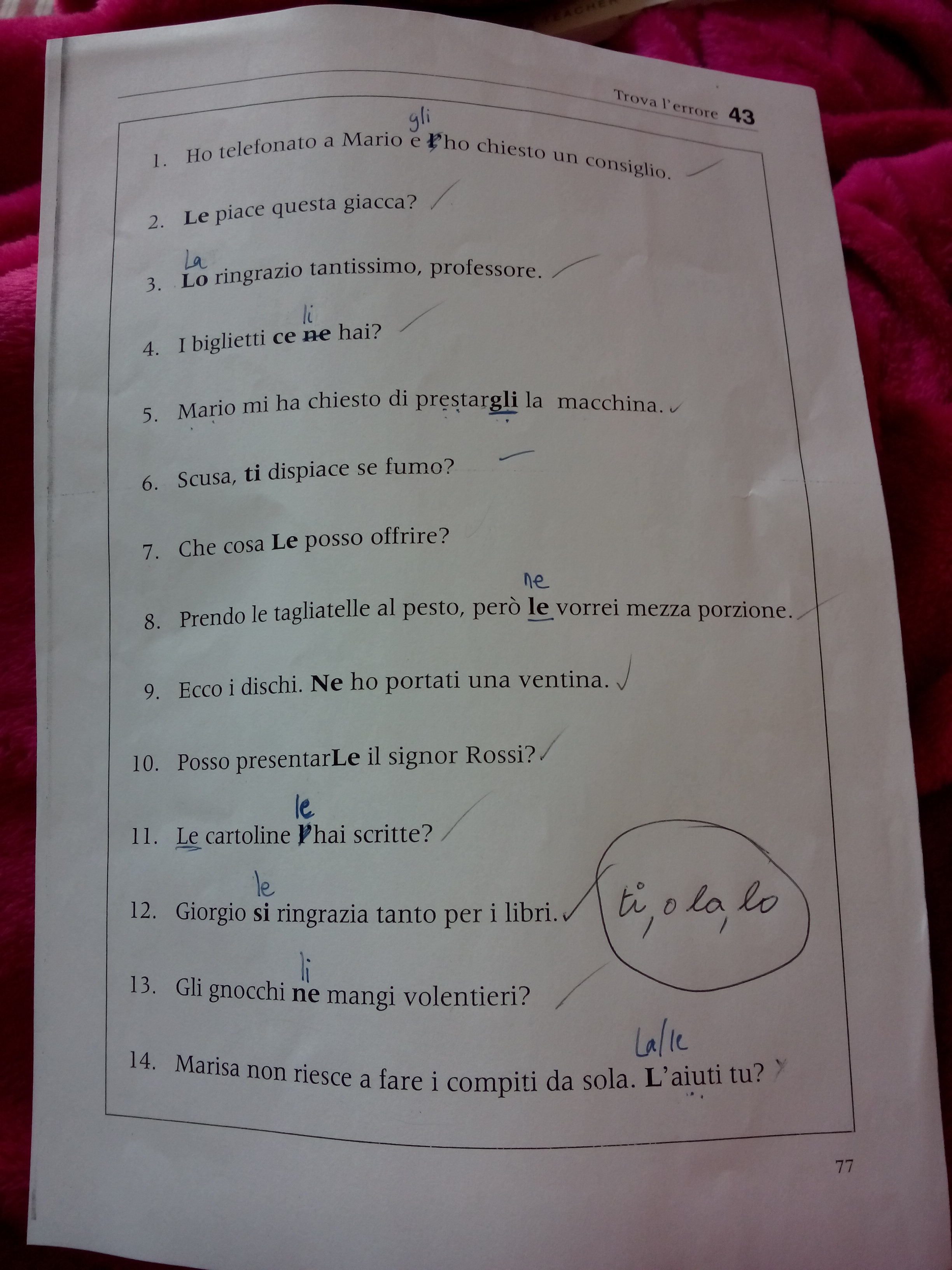
The remainder of the lesson, following the break, was focusing on pronouns. We had a list of 14 sentences with errors in, which we had to correct in teams. This I found a bit frustrating because in my group of 4, two students hadn’t studied pronouns at all before, one a little bit and me not masses but definitely more. I wanted to be in the other group. :-p Frustrating, though, not because I was impatient with my classmates but because I found it difficult to explain in Italian what I understood. (Lack of language classroom experience – not used to discussing language in the TL – as anticipated on Day 0!) And so my poor group mates were doubly challenged, by their lack of prior knowledge and my rubbish Italian! For example, how the formal ‘Lei’ works. Fortunately, for this one, C stepped in and explained nicely and clearly! She also gave the two who had no prior some scaffolding (a table of subjects and pronouns – direct and indirect). So I experienced as a student the value of good monitoring and responding to situations that arise (obviously this kind of situation is not unusual in mixed-level classes). Whole class feedback took the form of a point scoring game. It was funny because there was this two-tier point-scoring system and everything carefully written up on the board but then at the end, after all that, we didn’t add up the points! Not that it mattered.

(Interestingly for me, from a classroom management perspective, in terms of group work, I sometimes found groups of 4 unwieldily big for discussing, but also discovered what a difference moving furniture makes. Obviously I “knew” before, and one always does encourage learners to move into a tighter grouping prior to discussion, but I didn’t appreciate what a difference it makes until experiencing as a learner first-hand,  the contrast between starting spread out and then continuing after C had duly pushed us into a tighter grouping.)
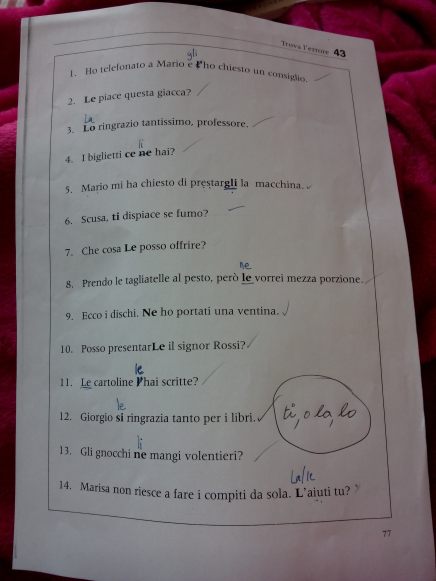
Teamwork! (The ticks refer to which ones have been done - the game meant we went through them in random order - rather than what we got right or what was right to start with...)

Teamwork! (The ticks refer to which ones have been done – the game meant we went through them in random order – rather than what we got right or what was right to start with…)

Finally, homework was of course set. So much to do, so little time. Thank goodness a) the writing homework (writing a correct version of one of the marked up stories we’d looked at earlier) is not due for tomorrow and b) I hopefully will finish at 7.20 tomorrow, meaning I’ll have time to do written homework. Meanwhile, All The Things (preparation, marking, tussling with cantankerous photocopiers, eating, gap-fill homework due tomorrow) must be done between 4.30 and 6. Am utterly exhausted. But can’t believe 50% of the course is already gone. Must. Make. Most. Of. Rest.

Overall, today’s lesson was fun but seemed very grammar-heavy. The individual activities were all engaging and useful, but felt a bit disconnected one from the next. Unlike yesterday, there was no context, no text, no situation. And all the speaking we did was about language. I think maybe having spent as long as we did on homework correction, I perhaps wouldn’t have then gone into the story correction activity at that point (though such a nice activity) because it constituted more correcting, albeit of  a different sort. Whereas possibly a complete change of focus, keeping the story correction for a later stage, might have been good. So, for example maybe instead of the correction activity, working with a text, or having a discussion, and introducing some kind of context for the pronouns work.

Am slightly sad that this week’s focus is pronouns, as it would have been interesting to study something I haven’t studied before, to feel what it’s like to learn something from scratch in a group. However, I’m crap at pronouns so it’s no bad thing linguistically! 🙂  I hope tomorrow there will be more speaking, listening or reading and fewer grammar activities.

On reflection, I think that C tends to favour a test-teach-test lesson frame (which is cool – start from what we learners know and build on it) and perhaps where we finished with the pronoun game, that was a ‘test’ element, with feedback providing some ‘teach’ but perhaps running out of time was the reason for the lack of text or context introduced in this lesson – it might have been next on the list? Nevertheless, I think it would be nice if the ‘teach’ bit wasn’t necessarily board-based explanation. C’s explanations are very clear, supported by equally clear board work, which is very helpful (I really wish my explanations and board work were as good!), but, pain in the butt that I am, both linguistically and pedagogically I’m also interested in experiencing a guided discovery activity as a learner, whereby the group-work would encourage us to investigate and work linguistic things out, with some kind of scaffolding questions, rather than just test us (as, for example, the pronouns game did). This way, sometimes the board-based explanation could fill in the gaps that remain rather than be the dominant mode, adding extra variety and catering for different learning preferences. The structure of the course (long [3hr] daily lessons) might also lend itself to a task-based learning lesson frame and/or some kind of project work. Which I’d also like to experience! Not that I am at all demanding… 😉

Meanwhile, today has set me thinking about the importance of lesson shape, flow and providing opportunities for speaking not only about language: a trigger for closer scrutiny of my own teaching… I have also realised that I have been applying some of what I learnt on the tutor training course: particularly that relating to lesson observation. While, of course, I am a participant rather than an observer, so in some ways it is flawed as an observation, in others it makes the process even more powerful as an experience, because you actually feel the effect of what is being done rather than just observing it. So that’s another layer of learning for me: language learner, teacher AND tutor-in-training!

Day 3 – Wednesday 25th February 2015

Today, again, I was in bright and early, ready to start. This time, however, I plucked up the courage to chat with partner in Italian while waiting for others to arrive! 🙂

This time, we didn’t discuss yesterday’s events straight away. Instead, we all had to write our favourite word (learnt so far on this course) on a piece of paper. I chose ‘ingannare‘ – make someone believe something that isn’t true. Then C gave us all someone else’s piece of paper, and we had to tell our partner what we had done yesterday since the lesson, with the challenge of slipping in the word/chunk on our new piece of paper. Partner, of course, to guess what the word/chunk is. (Another activity I fully plan to steal! Edit: Tried it with my Level 3’s, another win! Note to self: Adapt it for use with my EAP students over the summer…) I had “fa venire i brividi” and spoke about my photocopiers woes – it was the passage of time (wasted) vs the need to do All The Things (of which there were many), and the rising of panic in direct proportion to said waste time, that mi faceva venire i brividi. Within the process of playing this game, a nice expression emerged related to the word I had written down initially: “ingannare il tempo” – in English, ‘kill time‘; as C said, Italians are less brutal and just dupe it/beguile it instead. 🙂

Then, it was homework checking time. This time, no games. For me, a relief after yesterday’s episode! (Though the girl in question was absent today anyway!) It didn’t take quite as long as yesterday. Again, though, it was useful. Inevitably, from time to time, in the process of these discussions, we lapsed from Italian into English. I like how C deals with this: She would say something along the lines of “That doesn’t sound like Italian to me…maybe it’s some kind of strange Sardinian dialect. I don’t speak Sardinian so I don’t know.” – essentially, drawing attention to the issue (being that we needed to be speaking in Italian not English) but in a humorous way, thereby achieving the goal (we’d switch back to Italian) without it becoming a “thou shalt…” mandate and keeping a pleasant, fun atmosphere in the classroom. This is another technique I want to adopt. On a side note, it’s been interesting to experience the question of rapport from the learner seat, and how nice it is when the atmosphere is comfortable, when there is a lot of humour and banter both between students and between the teacher and students. It definitely does oil the wheels of the learning process!

Review emerging from homework

Review emerging from homework

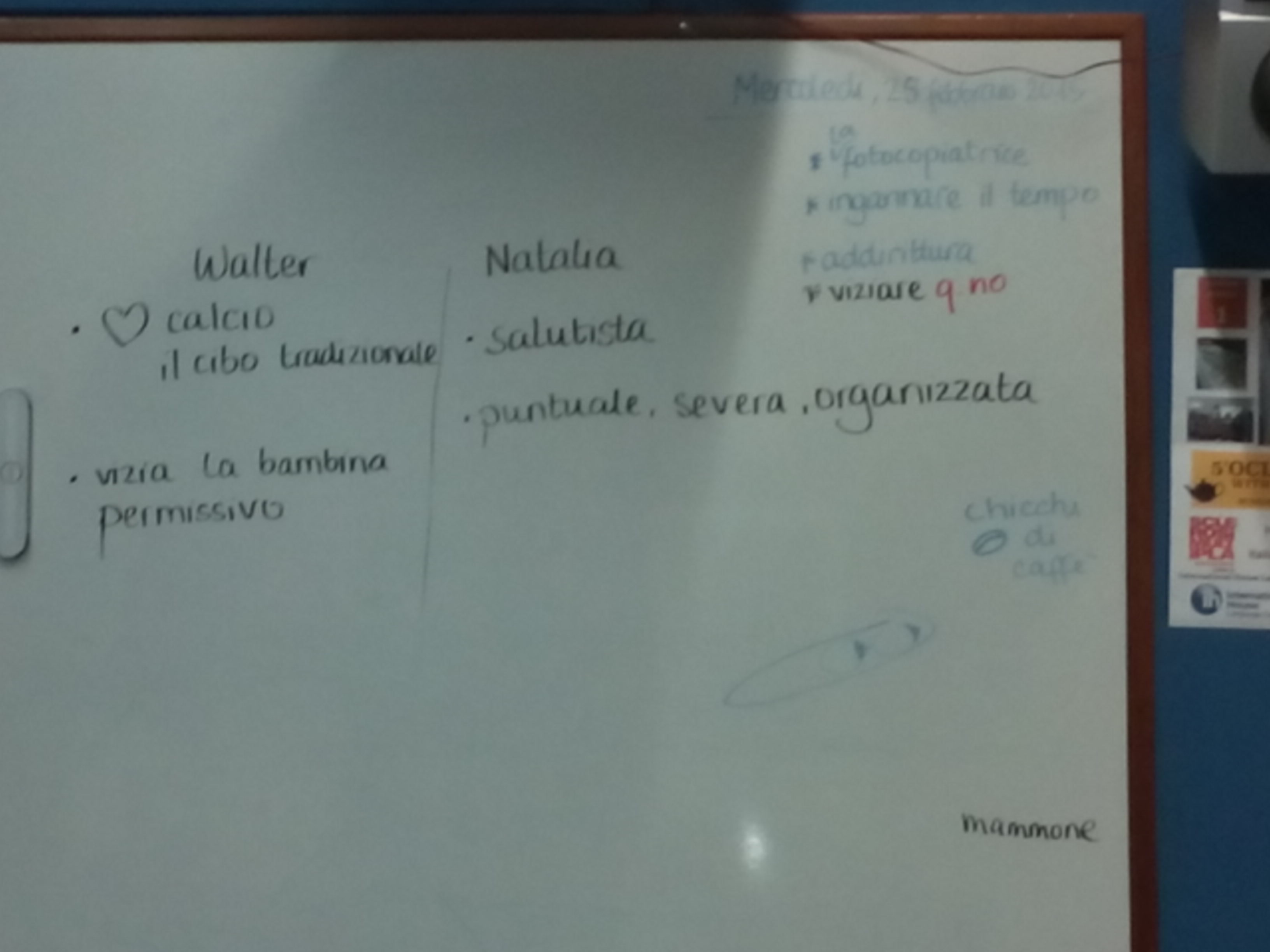
Next, joy, we got a context! Enter Walter and Natalia. Fortunately, one of my classmates requested for the clearer black pen to be used at this point. Which reminds me, I really need to get some more pens from the office – my only remaining pens are red and green, which isn’t great if any of my students are red-green colour-blind. Plus, green isn’t much better than fading blue, visibility-wise, as a main colour! Better for marking up/highlighting things. (Edit: Now fully armed with new pens and am paying much more attention to my board-work! And generally writing more things on my board, having found it very helpful when C wrote emergent vocabulary up on the board, which she always made a point of doing.)

Meet Walter and Natalia!

Meet Walter and Natalia!

C elicited adjectives to describe this married couple who have a little girl, by telling us how they behave. Next we did a vocabulary matching activity, during the feedback of which lots of extra language emerged and was dealt with. C is very good at responding to emergent language and random questions in a way which I find is really, really motivating from a learner’s perspective. I wonder how I compare in that way. Another thing to put under scrutiny in my next classes! I also noticed that she does concept checking/display questions really well. (Jealous!) She puts on a sort of ingenuous air that makes it all rather humorous. As a learner, I find the question process reassuring – that I have understood correctly. So I think I’d also like to adopt/steal this approach to concept questions, as I might then feel less awkward than I have been known to feel when doing this type of checking and therefore ask more of these questions! [Edit: I duly tried it in my first class after this lesson and it worked a treat! Something else to play with more…]

Next, we got a jumbled up conversation. Clear instructions and instruction checking questions ensured that we didn’t write anything in the gaps, we didn’t reorder the conversation, we just picked out which lines were Natalia’s and which were Walter’s. Once that was done, we were able to reorder the conversation and then practice it together, putting appropriate pronouns in the gaps. This was followed by whole class feedback, in which we were nominated in turn to read out the line, inserting the relevant pronoun. That brought us to break-time.

After break, we got a handout with the gapped dialogue in order, and went through it AGAIN line by line, nominated, inserting the correct pronoun. I found this a little tedious and would have preferred to have had the handout when we went through it the first time round. However, more questions did come out the second time round, so therefore for those with less experience of pronouns, this was valuable. E.g. who is the subject, what is the object, what is the pronoun substituting, how does word order affect meaning etc. (I wonder if all my reading has helped me get over these word order issues?  Or possibly because French also has special word order with pronouns so as a concept it is familiar to me…Still, whatever the case, it’s still way more interesting than the alphabet was! 😉 ) I think after this extensive language focus, it would also have been nice to try and ‘perform’ the dialogue without looking at it. This would have required some improvisation but should have been doable as by this point we were very familiar with Walter and Natalia and the meaning-content of the dialogue. We could have then been given some delayed feedback on our use of pronouns in the process of our improvisations.

In the event, we abandoned Walter and Natalia rather abruptly, and appeared to abandon pronouns, to move on to a guessing game where C gave out clues on cut up pieces of paper, one at a time, to different individuals to read out to the rest of the class, the aim of which was to have us guess what traditional dish she had written a recipe for. It was fun and a lovely way to bring some culture into the lesson. But I was also quite tired by this point and confused about what this had to do with all else in the lesson up to this point, which had revolved around Walter and Natalia, as well as pronouns. They – and their child – had now disappeared from the scene! Eventually, after we had guessed what the recipe was, and done a vocabulary matching activity (during which again lots of interesting language emerged and many random questions were dealt with! 🙂 ), we were given the recipe, which, it transpired, had been written without pronouns! Aha! All became clear: the missing link. And so it was that our homework task was to rewrite the recipe WITH pronouns. C gave us a bit of input on imperatives (which she elicited as commonly used in recipes) and pronouns first, to set us up for this. (Note to self: steal this recipe-guessing activity to adapt for Level 2 to review quantifiers…and then see which other levels I can shoe-horn it into as well!)
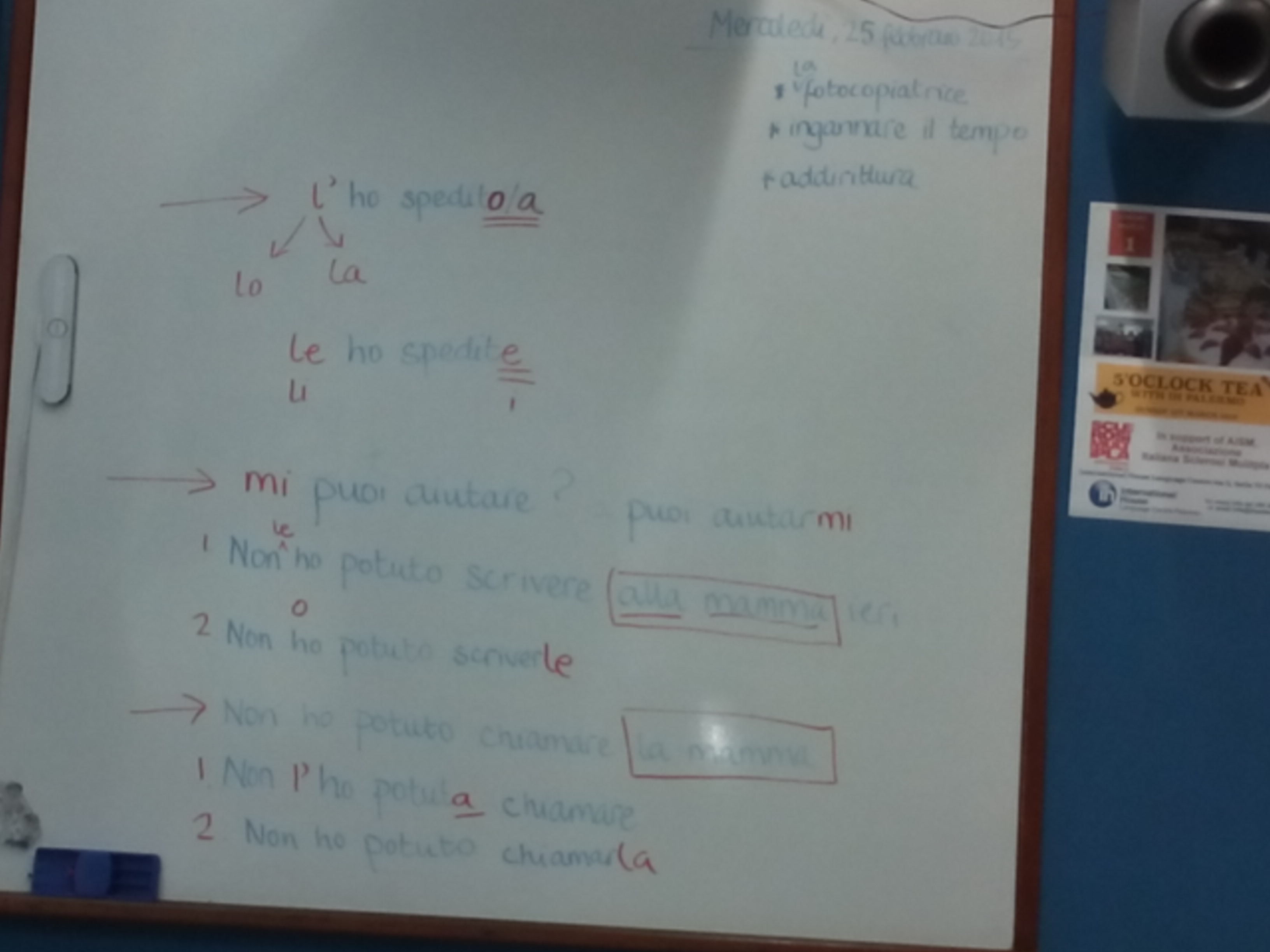
And that brought us to the end of the lesson and the end of day three. The recipe was a lovely personal touch, but I wonder if there would be a way to make it flow more smoothly from what had come before. I haven’t yet had time to think enough about this to come up with a ‘solution’ (‘..’ because it’s not a ‘problem’ as such, just a point of interest to me! And, again, is just making me ponder lesson shapes, flow, staging, explicitness of connections between activities and so on. All of which is useful to think about!)

All in all, I enjoyed today’s lesson and was relieved when use of context came into play. I think chopping up the dialogue was a great way to introduce it and get us to process it for meaning before working on the pronouns. And the clear instructions were important to make sure we didn’t screw up the staging by focusing on the gaps too early. Must remember this! One thing that I do notice is that it is the end of Day 3 and I still know very little about my classmates. I would really like there to be some kind of opinion exchange speaking activity, where I could find out what they think about stuff and have a go at expressing my own opinions on stuff. I think I mean speaking activities that allow some personalised use of all language resources, not just target structures or discussion thereof. This has made me pay particular attention in my lessons today subsequent to this class, to what opportunities I provide for interaction of this nature. In the form of lead-ins, response to texts and so on. I also wonder if we will do some reading tomorrow, as we haven’t yet.

I think so far my favourite day has been day one, with today in second and yesterday in third place. But don’t get me wrong: I have thoroughly enjoyed being in the classroom every day, particularly the way that it has, without fail, enabled to me to shut the outside world out temporarily, it’s really nice to engage that intensively with something.

 Teacher Take-away

Here is my subjective summary of what Days 2 and 3 taught me:
  • it is difficult to focus on errors and meaning at the same time (cf. the story-writing correction activity).
  • activities can be really good individually but lack flow as a series.
  • sometimes the link between activities can be immediately obvious to teacher but not to the learners.
  • context is very important for flow/lesson shape and having a context makes everything a lot more fun and meaningful.
  • talking only about language isn’t enough.
  • related to above point, if talking opportunities are mostly language-related, you don’t get to know your classmates.
  • discussing language in the target language is actually quite difficult if you aren’t used to it! If one person in a group isn’t used to it, it can make things more difficult for the other group members too.
  • effective monitoring and classroom management is so helpful. 🙂
  • it’s really nice when the teacher personalises the materials.
  • concept checking can be reassuring as a learner, and there are ways of making it fun as a teacher.
  • responding well to emergent language is very motivating for learners.
  • non-gap fill homework makes a nice change! But is much more time-consuming, which is difficult when you have a heavy schedule. Conclusion: when giving more time-consuming homework, give a longer deadline (as C did).
  • Decent board pens make a big difference to clarity of board work!
  • Clear board work is lovely to be on the receiving end of!

End of Part 2