
This summer, I worked on a pre-sessional course for the very first time…
At Sheffield University, as well as teaching your tutor group writing skills and guiding them through the process of producing an extended written project, each teacher is responsible for teaching one of the other skills (reading, speaking or listening) to their own and a further two groups. For me, that skill was listening, 8 weeks of academic listening. And it was really interesting!
In this post, I’m going to share some of what I’ve done with my students and some of what I’ve learnt in the process. I also want to reflect on what might be transferable back to the general English classroom at International House, Palermo – rather imminently! (This post has been a few weeks in the pipelines!)
The 8 week listening thread of the pre-sessional course at Sheffield University was based on OUP EAP upper intermediate/B2 (de Chazal & McCarter, 2012) The listening skills development in this course book, to me, seems very strongly rooted in strategy development: students are equipped with strategies to use in order to help themselves listen more effectively to academic texts e.g lectures. Generic elements and functional language are teased out and students’ awareness raised, combined with scaffolded practice opportunities. This scaffolding is evident within units and across the book as a whole, where a gradual decrease can be identified, as students are expected to listen increasingly more independently.
This in mind, was all I had to do turn up and open to page x? Possibly not! In any case, having read a lot about teaching listening (e.g.Teaching and Learning Second Language Listening: Metacognition in Action Vandergrift and Goh 2012), much of which seemed applicable to academic listening, and adding to this what I had gleaned from the induction week as well as the relevant chapter in EAP Essentials (Alexander, Argent and Spencer, 2008), I had a clear idea of what I wanted to do with the listening skills thread:
- Include (systematically, with gradually decreasing scaffolding) review activities at the start of the class and reflective activities at the end. (3hr lessons lend themselves to this approach beautifully!)
- Avoid the scenario of students meeting a new strategy and then consigning it to the dusty depths of a folder, never to be used again.
- Enable students to track their progress/development and recognise an accumulation of strategies being at their disposal. Not only this but also encourage *regular use* of them.
- Linked to all of the above, help the students become more independent listeners.
How did I do this?
-
Long-term planning
I made a hand-out to accompany each class, based on the activities in the course-book. Each handout guided the learners through the lesson from reflection to main content to review, also highlighting any new strategies introduced, and I made several weeks’ worth in advance. The main reason for this was time-management, trying to free up time for intensive marking periods and planned absences (graduation, wedding). However, I noticed that it really helped the coherence, especially as I had Vandergrift and Goh (2012) in mind, in terms of systematically reducing scaffolding and guiding learners towards independence in planning, monitoring and evaluating their strategy use. There was clear progression, explicit progression, from one class to the next.
Result:
Increased coherence, making the content more useful for students.
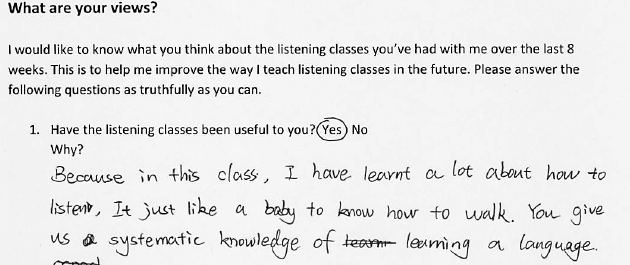
I had the ss fill in a feedback form at the end of the class – 4 questions, no numbers, to encourage reflection (for them) and to gain an insight into their thoughts (for me).
Out of 36 responses, one was withholding judgement until he/she knew whether he/she had passed the USEPT exam (the university entrance proficiency test), one thought it was partly useful but felt we talked too much, and the rest were “yes”‘s.
Transferability:
It’s different in a General English environment, as courses tend to be organised around grammar structures. However, what I want to try and do this year at IH Palermo is help students see how they are building on what they have learnt and be more systematic in how I approach my lessons in terms of review and reflection. Of course, being 1hr20 minute lessons rather than 3hr lessons limits the amount of time available for this. Nevertheless, working with the time available, a similar ratio could usefully be applied.
-
Strategy tables
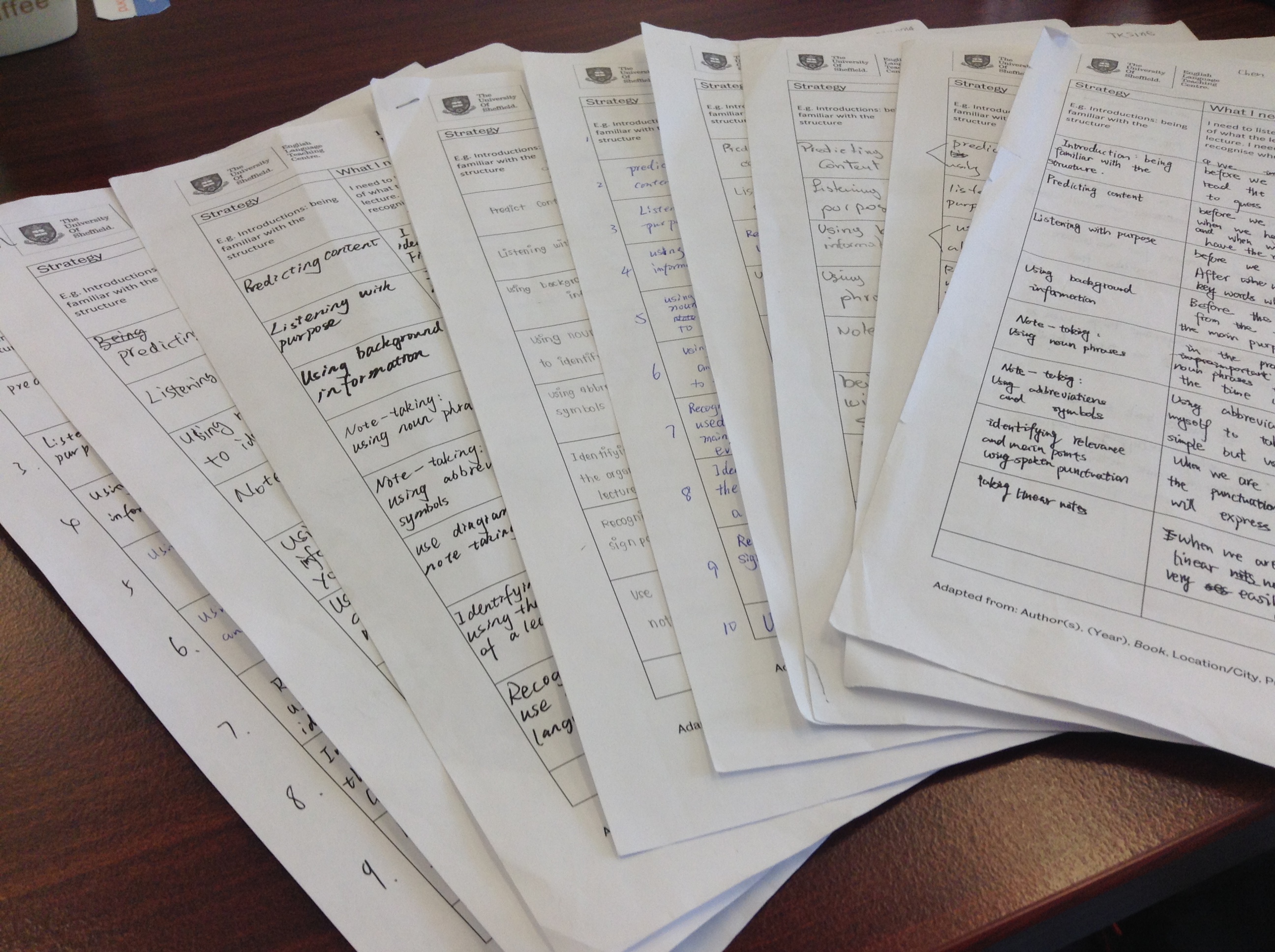
Strategy tables kept and updated by the students over the duration of the course.
I made these between week 2 and week three of the course, following the blank stares that emerged in the initial review section of week 2. The idea was to help students build up a reference/resource, where at a glance they can see what strategies they have learnt and how to use them. This means they should be more likely to use them independently, rather than systematically forget about them, as new strategies are encountered. I completed the first strategy as an example, gave the students a little bit of time at the end of the class in week three to start updating them (so as to ensure they knew what they were doing) and then sent them off under instructions to bring their tables up to date. An important thing that emerged from this was the fact that it was not an instant success. The following week, not all students had updated their tables. However, by bringing it back into the classroom each week at the beginning of the lesson (students would compare their tables), an expectation of autonomy was created. In due course, all the students did live up to that expectation. This coincides with the recognition of the value of what they are doing and the behaviour becomes truly independent rather than purely response to expectation.
Result:
Students finished the course with a record of what they had learnt, a resource to take away, and a more independent approach to their listening skills development. Out of 36 responses, 35 were “yes” and one was “no”, who thought that there were too many strategies to juggle. This student hadn’t yet reached the point of being able to select strategies independently. With 8 weeks of teaching, expecting all students to reach that point may be a little over-ambitious. Many students commented that the strategy tables were useful for reviewing what had been learnt in previous lessons and made remembering the strategies and how to use them easier. I was particularly pleased with comments that cropped up regarding the utility of the strategy table beyond the end of the course. If learners can see how something is going to be useful to them long-term, they are likely to invest more in using it, and be more independent in their use of it.
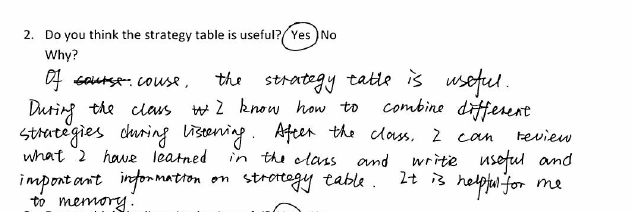
Comments on the strategy table.
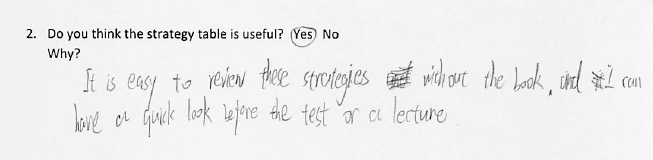
Comments on the strategy table (2)

Comments on the strategy table (3)
Transferability:
I think use of a strategy table would transfer nicely to exam preparation classes, where exam strategies are key to success. It could also potentially be useful in terms of accumulating a record of learning strategies met and experimented with, or resources. In the past, I have given learners a handout with different resources for them to try. I wonder if getting them to create this handout themselves, collaboratively perhaps, might be even more effective…
-
Listening logs
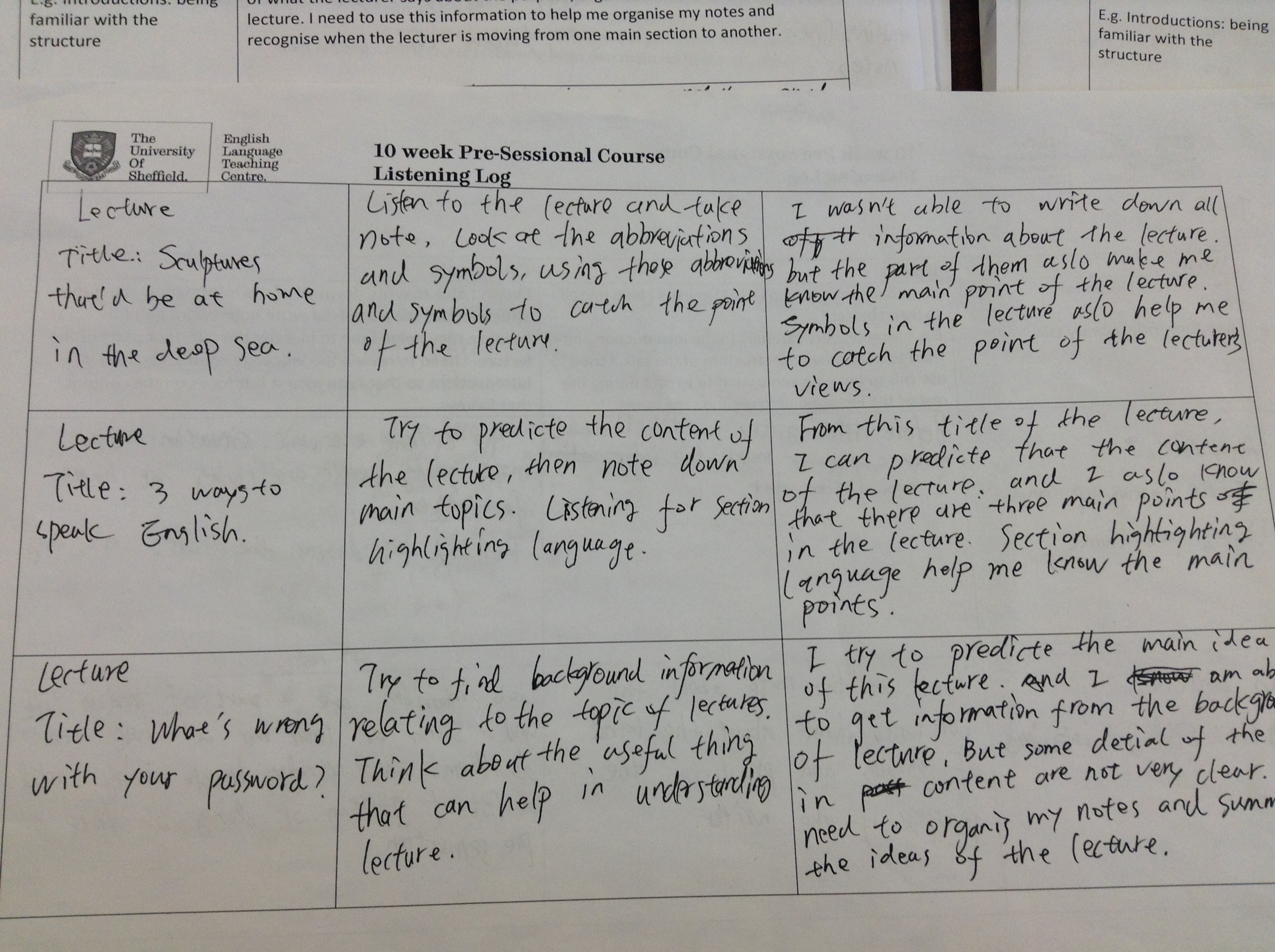
Listening log in action!
These were made and introduced alongside the strategy tables. The idea was not by own but based on what I’ve learnt by reading about teaching listening. I adapted it to this context. As with the strategy tables, I started the learners off with an example. The goals were to encourage independent listening, to help learners develop metacognitive awareness and to avoid the scenario (much bemoaned by listening teachers) of the question “What have you listened to since the last lesson? Which strategies have you practiced?” being met with blank stares. Again, as with the strategy tables, learners compared their logs at the beginning of each lesson.
Result:
Some students thought the log could be improved by including space for their actual note-taking. Others thought it wasn’t for them. Those that used it, however, did find it useful, as a means of structuring and tracking their out-of-class listening and tracking their progress.
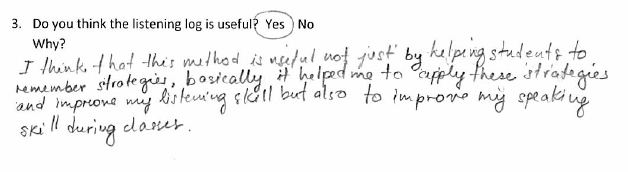
Listening log comments (1)
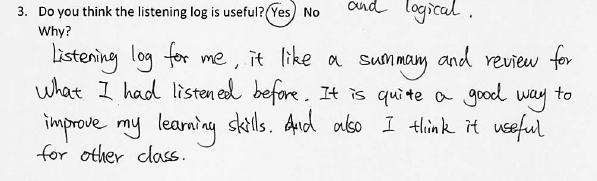
Listening log comments (2)
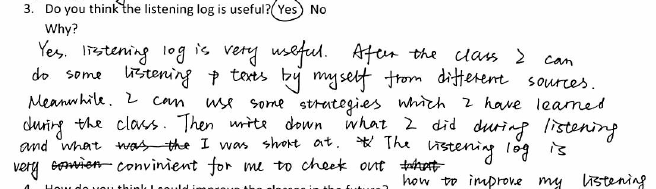
Listening log comments (3)
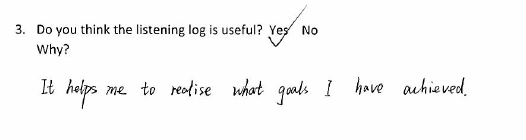
Listening log comments (4)

Listening log comments (5)
Transferability:
As I have learnt through my own language learning this summer, as well as through these students’ experiences, logging is an incredibly useful thing to do. I think it is very transferable to the General English classroom. Students can log their out-of-class study and in the process create a record of their efforts, achievements and progress. Personally speaking, I’ve found it a useful way of maintaining motivation. I think learning logs could be also usefully used in conjunction with something like a learning contract. I think it needs careful thought though, as to how valuable it’s going to be. For example with these students, it wasn’t just what they did that they recorded, but how they went about it (in terms of strategy choice) and reflections on that experience.
-
Reprocessing information/strategies
As well as using listening logs and strategy tables with the students, I also used classroom activities to encourage them to reprocess what they were learning and really internalise it. For example, mingles in which the students played strategy guessing games or simply recalled as many strategies (and what they involve) as they could in a given time frame, swapping partners frequently and repeating (generally also collecting and taking with them information/ideas from their various partners – enabling them to benefit from a collective understanding of what they were learning).
Another effective activity was getting students, in groups to create mind-maps of the strategies, which they then presented to their classmates:

Mind-maps (1)

Mind-maps (2)

Mind-maps (3)
Result:
This encouraged deeper processing both of what the strategies involved and how they relate to each other as well as to the task at hand. We did the activity in a lesson subsequent to one in which the focus of the lecture extract was on categorisation (e.g. Aristotle’s classification of the world) and using diagrams in note-taking, so this task also developed that theme by requiring students to categorise the strategies and present their ideas visually.
Transferability:
Activities like this obviously have great transferability potential, and, as well as encouraging deeper processing of lesson content, give students opportunity to use language meaningfully and benefit from each others’ knowledge and understanding.
-
Systematic introduction of out-of-class listening resources
At the end of each class, I gave students a new resource to try (e.g. Oxford University podcasts, UCL lunchtime lectures etc.) and at the beginning of the next class, they had to report back to their classmates regarding what they had done with the resource and an evaluation of it. This was done in conjunction with using the listening logs described above. Again, uptake wasn’t instantaneous, but perseverance meant students did use the resources in due course – and develop their listening.
This was a more directed version of my Experimentation with English project. It seemed logical as EAP is more directed too: goals are very specific, and specific needs relating to these require specific resources. I think there is something to be said for for introducing resources piece-meal, in terms of not overwhelming students. Having said that, my students at IH loved the handout with all the different resources.
Transferability:
I wonder about using this approach in conjunction with my EE project. So, as well as giving learners the resource, going through a more directed process so that all the learners end up trying at least some of the resources. Then, those who are more independent will inevitably try more besides, but perhaps the gap between the more and less independent might be lessened by the extra direction. I think this could also be transferable to exam preparation classes, in terms of encouraging students to use different exam preparation resources to prepare, and sharing what they learn with each other.
Conclusions:
It was a very interesting summer, and, I am happy to say, my three groups performed very strongly overall in the listening component of the listening proficiency/entrance exam. Importantly, they also felt they had made progress, thanks to the concrete means of measuring it (e.g. strategy tables and listening logs), which helped maintain motivation and encourage a feeling of all the hard work they were putting in being worthwhile. Equally importantly, they were equipped to continue to develop their skills independently and apply what they had learnt in the new context. (Encouraged by frequent pushing from me to reflect on the relevance of what we were doing to what they would be doing in the future – i.e. their university courses!).
I now look forward to trying to transfer what I have learnt to my current context and help my new students to be develop as effectively as possible over the short duration that they are studying with me.

 Lizzie Pinard