ELT Teacher 2 Writer: Training teachers to be writers

Excited to be at this talk as I missed the ELT Teacher 2 Writer talk at Liverpool last year… More materials writing-related larks! 🙂 And it’s clearly going to be a good one – we have exciting task handouts on our chairs and key-rings being given out! 

Training teachers to be writers

Sue and Karen are going to talk to us about how ELT Teacher 2 Writer can help teacher materials writers.

  • the database: established writers and people interested in writing can all be in the database

Publishers can search the database when they are looking for new writers but also when they are looking for people to pilot materials/write users reports/answer questions for market research. There are a mixture of publishers national, international and independent.

  • the training modules: developed by ELT Teacher 2 Writer

Where does materials writing feature in a teacher’s professional development?

Within the British Council Framework puts it at stage six (specialist) but teachers do it from day 1, with their own learners.

ELT Teacher 2 Writer did some research into existent writing courses and tried to learn lessons from these. (All non-ELT related) e.g. journalism, creative writing… They discovered that the only common ground that all of these course had was a module that urged users to know their market/know a little bit at the industry. So they had a look at ELT materials writing to see what was involved in writing materials.

They broke it into 3 main categories:

  • core skills
  • market-specific (e.g. ESP materials)
  • component-specific (e.g. writing a teacher’s book/grammar summary/worksheets

There are now 30 titles on the website. All written by experienced authors and they share the lessons they learnt in their own process of being published. All available for download on Amazon/Smashwords (special IATEFL discount ends tomorrow!) These are relevant for people writing for developers, teachers writing for their own classrooms and teachers wanting to self-publish.

Task 1: How ELT publishing works  – time to do a task! (T/F statements about publishing)

  • True: publishers DO decide things well in advance. They have 5 year plans, which they check at intervals to make sure they still make sense. They use market research to inform this.
  • False: the best way to get published is NOT to send a complete manuscript to a publisher!
  • False: you don’t need an M.A. or a Delta to write materials. Relevant teaching experience is essential. Delta/M.A. can be positive but publishers may fear an overly academic manuscript.
  • True: lots of investment goes into publishing, it is expensive, so publishers DO want to make sure everything works and DO do a lot of market research to this end.
  • False: You *do* have to meet deadlines! In publishing, there are many people writing to the same schedule. If you don’t meet it, there is a huge negative knock-on effect.

Task 2: What makes a good rubric? (or direction line in Am. E!) i.e. instruction to the students within a piece of materials.

This is an important skill to learn and is thus included in several ELT Teacher 2 Writer modules.

Rubric checklist

  • Rubric language should be less complex than the language point being addressed.
  • Use small sets of words
  • Use the same rubric for all similar activity types
  • Be careful with staging – sometimes better to break things down into two activities rather than one.

We had to apply these criteria to some sample rubrics. We saw one that was too long and in which it wasn’t clear what was required. We saw one where the language used was too complex for the learner level aimed at – here it would be necessary to simplify the language and helpful to include examples. The third was too complex and needed breaking down. The fourth was rambling and dense, requiring major surgery to sort it out!

Task 3: How to write a graded reader?

Graded readers are great to write – they combine fiction and education! The answer to the task question? Can be found in Sue Leather’s module.

Sue (presenter) read from Sue (writer)’s module to comment on this. Here are couple of quotes:

“An idea is the story’s essence”

” It should include a vital issue that needs to be resolved one way or another”

Skills are needed for the following:

  • language and story
  • drama and premise
  • high stakes
  • conflict and choice
  • action
  • character
  • dialogue

We applied this to three story ideas, deciding that two had wheels and one was dull – the two with wheels are in fact in print! The other, not so much…

Task 4: Writing a critical thinking activity 

What is a CTA? What does a good one look like? Equally importantly, and what may shed some light on this is, what is it not?

  • It is NOT a pure comprehension question.
  • It is NOT a do you agree/disagree discussion.
  • It is NOT a T/F statements activity
  • It is not a question about the literal meaning of vocabulary in a text

In a general comprehension activity you find:

  • identify ideas
  • vocabulary meaning-related activities
  • agree/disagree discussions

In a critical thinking activity you find:

  • Why does the author present the ideas like this?
  • Why are these vocabulary items chosen?
  • Does the author support the ideas? How? What evidence is there?
photo (3)

Some critical thinking activity types

We looked at some sample activities and decided whether they were CT activities or general activities.

Finally, we learnt some more about the ELT Teacher to Writer website:

As well as the database, it includes a resource section for writers.

The Writer’s Toolkit

  • style sheet: publishers have in-house ones of these – if you are working independently, this  will help you to be more consistent.
  • template: example template for styles for rubrics/body text etc. and layout/order/structure
  • permission grid: a grid that lays out the information that is needed in order for an editor to apply for permissions to the copyright holder. It is very important to get all the permissions needed e.g. for different platforms etc.

You can find out more about ELT Teacher 2 Writer by:

Liking their Facebook page: http://www.facebook.com/ELTT2W

Following them on Twitter: @ELT_T2W

My last talk for the day and like all the others I’ve attended: super-interesting and worthwhile! 🙂


IATEFL 2014: Bridging the gap between materials and the English-speaking environment

My very first IATEFL talk!

Screen Shot 2014-04-01 at 09.21.10

Date: Thursday 3rd April 2014

Time: 17.45-18.15

After introducing myself and my three invisible hats (teacher of English, learner of language/teaching, ex-student of the Leeds Met M.A. ELT/Delta – the origin of the ideas on which this talk was based), I provided the following talk outline:

  • Over to you! (A few questions…)
  • Student-led interviews (benefits and issues)
  • My materials
  • Using the framework

Attendees then discussed the following questions:

  • What context do you teach in?
  • What materials do you use?

Which led to these:

  • Do the materials exploit the rich resources of language outside the classroom?
  • Do the materials encourage students to exploit it?
  • Do materials scaffold students to exploit it?

Following this discussion, I revealed two quotes by Tomlinson (2008, 2013):

“None of the books seem to really help learners to make use of the English which is in the out of school environment everywhere.” (Tomlinson, 2008)

“Little[No] attempt is made to encourage the learners to make use of English in their actual or virtual environments outside the classroom.” (Tomlinson, 2013)

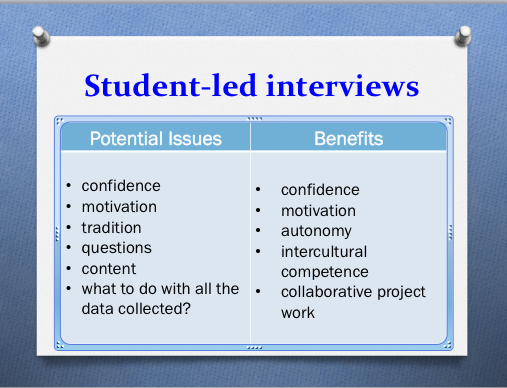
One way in which language schools try to encourage learners to engage with the language in the out-of-classroom environment in English-speaking places is to send learners out to interview members of the public. I asked attendees to consider the benefits and potential issues with this activity, before providing some of my own:

Screen Shot 2014-03-30 at 09.32.42

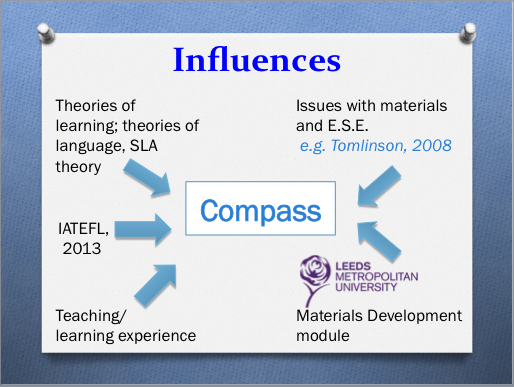
The question of how to guide learners across the murky waters of the potential issues to reap the possible benefits is where my materials come in. The next part of the talk discussed the influences that informed the development of my materials:

Screen Shot 2014-04-01 at 09.23.56

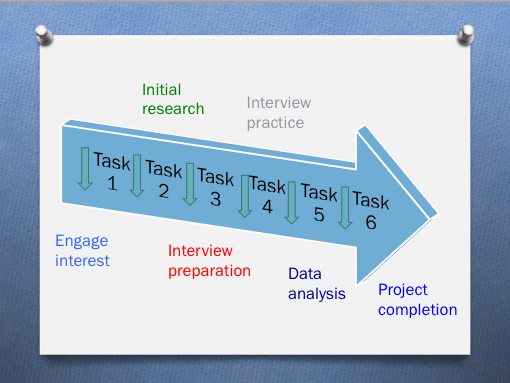
And then revealed the basic framework I’d created using Task-Based Learning (Ellis, 2003; Willis and Willis, 2007), Language Awareness Approach (Svalberg, 2007) and the Intercultural Approach (Corbett, 2003):

Screen Shot 2014-03-30 at 09.41.48


Of course this bare frame doesn’t demonstrate how those theories were woven in, and does give rise to possible questions/issues. So at this point I predicted some possible questions that might have been forming in the audience’s mind:

But…

  • Won’t they get bored?
  • Is it a good use of so much time?
  • What about linguistic development?
  • Isn’t it a cop out? Mucking about instead of learning language?

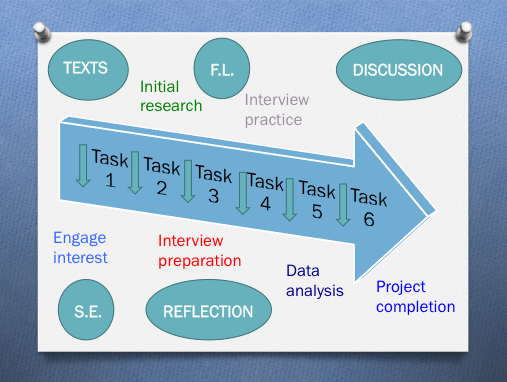
And then explored how I used the approaches I’d chosen, to address these issues and to maximise learning and learner engagement, and how I’d addressed issues that critics have raised with regards to the theories. The result was this framework:

Screen Shot 2014-03-30 at 09.42.00

(F.L. stands for functional language and S.E. stands for students’ experiences.)


The final part of the talk dealt with using this framework and exemplified this with a task from my own materials. The initial steps of using the framework have much in common with a genre-based approach:

  • Think about how you want your ss. to use language
  • Find texts produced in that genre/those genres. (Or make your own with your colleagues!)
  • Identify common generic features (language, structure, organisation, appearance etc)

To this I add:

  • Pinpoint interesting/engaging non-linguistic outcomes.
  • Consider scaffolding.
  • Pick out linguistic and cultural dynamism.
  • Build in reflection.

Obviously the first bullet point of part 2 of the list is in keeping with TBL tenets. The second refers to how the tasks are going to feed into each other, how the activities within each task are going to feed into each other and how the whole is going to enable learners to be able to do something by the end of it. The third is in keeping with the Intercultural Approach and the Language Awareness approach. The final bullet point, opportunities for reflection, is crucial to all three approaches as well as being the key to turning experiences into learning, and connecting learning to experiences.

To exemplify this, I used the third task of my materials:

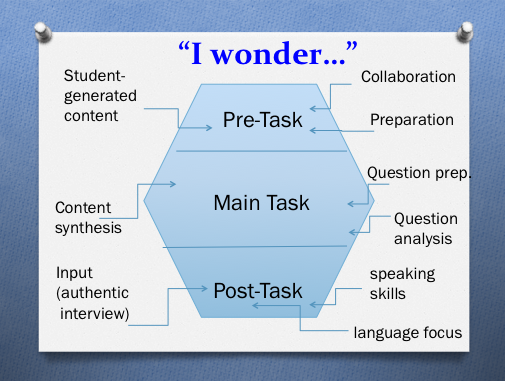
Screen Shot 2014-03-30 at 10.03.44


I discussed how content generated by students in the second task fed into the pre-task activity, in which students collaborate and exchange information, in preparation for the main task of this third task. The main task requires learners to synthesise the information they’ve collected between them, and use it as the basis for their question preparation. They are then helped to analyse  these questions by considering cultural and pragmatic issues, before moving on in the post-task activities to engaging with input in the form of a real interview, which leads to language focus and speaking skills development. Throughout the task, learners are encouraged to reflect and connect their own experiences and knowledge with what they are learning, and to identify similarities and differences between their own culture, other learners’ cultures and the target language culture.

Being a twenty minute talk (plus ten minutes for questions), I had to bring it to an end pretty swiftly by this point, by thanking International House, Palermo, for allowing me to attend IATEFL 2014, and the Leeds Met M.A. ELT department (and especially Heather Buchanan, who was my supervisor for the dissertation project in which I made these materials) for all the guidance and support that I was given in my learning and in realising my ideas, because without the course I most definitely wouldn’t have been giving this talk today. And the final thank you, of course, to everybody who attended!

Here is a list of references for my talk:

Svalberg, A. (2007) Language Awareness and Language Learning in Language Teaching vol. 40/4. Cambridge Journals

Moran, P. (2001) Teaching Culture: Perspectives in Practice Heinle and Heinle. Canada

Murray, N. (2012)  English as a lingua franca and the development of pragmatic competence in ELT Journal Volume 66/3 Oxford University Press

Corbett, J. (2003) An Intercultural Approach to Language Teaching Multilingual Matters. Clevedon

Ellis, R. (2003) Task-based Language Learning and Teaching Oxford University Press Oxford.

Willis D. and Willis J. (2007) Doing Task-based Teaching Oxford University Press, Oxford

Tomlinson, B. (2008) English Language Learning Materials: A Critical Review Continuum London

Tomlinson, B. and Masuhara, H. (2013) Survey Review: Adult course books in ELT Journal Volume 67/2. Oxford University Press Oxford

MATSDA, here I come!

I’m delighted to have had my speaker proposal accepted for the MATSDA (Materials Development Association) 2 day conference on the last weekend  (28th/29th) in June, this year. The theme of the conference is Second Language Acquisition and Materials Development.

This is the abstract that I proposed:

What about the other 165 hours a week? Developing materials that scaffold and encourage out-of-class language acquisition, through their use as classroom tools.

Is this title a contradiction in terms? Perhaps not: the average language learner spends around 2-3 hours a week in the classroom, implying that for acquisition to take place, exposure to the target language shouldn’t be limited to classroom confines. Indeed, learner autonomy is somewhat of a buzzword in ELT – we recognise the inadequacy of classroom time with regards to acquisition, as well as the issue of syllabus structure often being at odds with learner ‘readiness’ to acquire, meaning that what learners do outside class time becomes of the utmost importance. However, there is often a gap between what we expect our learners to do outside the classroom and how we help them to do it. This talk looks at ways of helping learners harness the target language in their environment, real and/or virtual, effectively, and the role that learning materials, and their use in the classroom as well as beyond it, can play in scaffolding the process, in addition to stimulating and maintaining motivation, curiosity and the desire to acquire.

Last year, MATSDA was great fun – a friendly atmosphere full of banter and loads of interesting ideas to assimilate. I’m sure this year will be no different. I hope to see some of you there. For those who can’t make it, the usual write-up and references will follow – linked to on my Presentations page.

🙂

British Council ELTon/”Macmillan Education award for new talent in writing” shortlisted!

Not long before the British Council ELTon application deadline last year, I submitted some of my materials for “The Macmillan Education Award for new talent in writing” (previously called the Award for Innovative Writing), deciding I had nothing to lose by doing so.

To quote from the British Council website,

“The ELTons, sponsored by Cambridge English, are the only international awards that recognise and celebrate innovation in English language teaching (ELT). They reward educational resources that help English language learners and teachers to achieve their goals.”

The Macmillan award is in its sixth year of running, while the ELTons as a whole are in their twelfth year.

I was delighted when I learnt I’d been long-listed, but didn’t dream I’d get any further than that; but, somehow or another, I have! I have now been shortlisted for the award, which means I’ve made the top five out of all the applications submitted. What an honour!

D646 Eltons 2014 Nominated MacmillanInnovative rgb FINAL OL

Shortlisted!

The materials I submitted are not on my blog, but once the competition is over and I haven’t won (I can’t even begin to imagine that I will win, which is fine: I’m just jubilant to have got this far!), I’ll upload some samples. I made them while at Leeds Met : they, alongside a 5000 word rationale, were my dissertation project and represent hours upon hours upon hours of work. Not only the time spent on the project itself, but all the reading done and hours of classes attended for the Materials Development module, too. I won’t go into details about the content of the materials here and now, as my talk at IATEFL Harrogate in two weeks’ time, which will be written up here in due course, is based on them: I don’t want to steal my own thunder! 😉 But it was all those hours spent that nudged me to enter: having devoted all that time to working on something, the last thing you want to do is consign it to a dusty cupboard forever!

Anyway, for now, suffice to say, I feel extremely lucky to have got as far as the shortlist. And grateful that I had a dissertation supervisor who, having given me a solid foundation of knowledge from which to start (as my Materials Development tutor),  pushed me to do my absolute best with my dissertation materials, by asking hundreds of awkward questions (! 🙂 ) and giving unstinting time and support throughout the process. It was a very valuable experience for me.

Congratulations to all the other nominees – in my own and all the other categories! Let’s see what happens in May!

Helping language learners become language researchers (part 3): concordance activity outcomes

In the first post of this series, I described the potential power of Wordandphrase.info and offered some materials I had made to introduce my students to the site. I also identified the possible issues around getting learners to use this site independently and wondered about helping them do so by bringing the site into the classroom through concordance activities based on information from it.

My second post described the first three activities that I created and did with my advanced and upper intermediate learners subsequently. 

Since then, both groups of learners have done a task for homework: the upper intermediate learners completed the task started in class while the advanced learners did a separate task. For each group the scaffolding process was different. This post discusses the process used for each group and the subsequent outcomes, as well as lessons learnt from this.

Advanced learners:

We did two concordance activities in class before they had to do any independent homework using the site. The first activity encouraged them to use concordance lines to discover the error in a sentence one of them had written, while the second looked at information taken from the website with regards to three words – concordance lines and frequency information – and required the learners to guess which word each set of information corresponded to. (NB: They had met the vocabulary prior to this!)

The homework I gave them was to use wordandphrase.info to find out about three more words from the same list of vocabulary that had been thrown at them at the end of unit 5 in Headway advanced and come to the next lesson ready to share what they had discovered. We shared out the words so there was no duplication of information.

Last night we met again and it was time to discuss the homework. I had anticipated that some of them wouldn’t have done the homework and that there may have been problems using the site (despite having the materials – those I shared in the first post of this series – to help them) but, in fact, all of the learners turned up with information they had found out and printouts from the site (some learners had printed directly, others had created a new document using information copied and pasted from the “print screen” page, to be more selective about what they printed). They each took a turn to tell their classmates and me about the three words they had explored.

Once that was finished, I asked them how they had found the activity and another interesting discussion ensued. They had found it very interesting but a couple mentioned that while the site was very interesting, it was also very time-consuming because it has so much information. Another learner very cleverly pointed out that if you had a purpose/goal in mind, and kept that as your focus, then it’s much less time-consuming (which is perhaps true of using the internet in general, as was also discussed: a digital literacy skill). She loves the site and intends to keep using it. None of them were scared or put off or scarred for life in any way – so that’s good! 😉

This made me think back to the first post I wrote about wordandphrase.info, when I mentioned my Leeds Met course-mate’s materials that had been written to help learners use the site with a specific purpose (to choose which vocabulary to learn from texts): in that post, I wondered if her materials would be more effective than my more general “how to use the website” ones. The answer arrived at from the above discussion would seem to be “yes“. However, there may be an argument for letting learners come to that conclusion themselves, as happened here. Perhaps starting from the more general, learning what the website is capable of, realising that using it without a goal equals spending a lot of/too much time and then building up a bank of purposes may help learners more in terms of independent usage, especially in terms of being able to add to that bank of purposes independently beyond the end of the course.

Outcomes: I’m very proud of my learners and feel that they are making steps towards independent use of the site. Next steps will involve getting them to use it to help them edit pieces of their writing and exploring other purposes with them, so that they start building up that bank of purposes to use it for.

Upper-intermediate learners

With these guys, it’s less of a success story (so far!) but a lot learnt (by me) as a result. We did a “find the missing word” concordance activity (again, based on previously met vocabulary) in class, but didn’t have time to complete it, so the questions regarding the patterns in the concordances became homework. What I should have done is left it when we ran out of time, and come back to it at the start of the next lesson. At the time, I thought it would be interesting to see what they could do.

The problem was, as we hadn’t done a similar activity before, they didn’t understand what was expected of them and answered the questions according to their intuition rather than by using the concordance lines. So the rubrics weren’t clear enough and my instructions weren’t either! (Though some of them had understood, so perhaps it was just last-thing-on-a-Tuesday-night syndrome for the rest! They are busy bees and last lesson finishes soon before 9, so it makes for a long day) Of course, had we done a similar activity before, fully in class, then they would have understood what was expected. Compare this with the advanced learners, with whom I did 2 activities in class before expecting any independent work.

Outcomes: 

My next step is to do some more in-class activities, to help the learners understand what is required, and develop the necessary skills, then try again with getting them to do the activities independently and using the site. I will then apply what I’ve learnt from my advanced gang and help them to build up a bank of purposes to use the site for. (I’m also going to edit that activity *again* to try and make the tasks clearer…!) My upper intermediate learners are interested but confused, as far as wordandphrase.info and related activities go. But I’ve got time to remedy it…

What I have learnt from both of these experiences?

  • Adequate scaffolding is crucial for independent success – whether with these activities or using the website. I unwittingly experimented with both approaches – both adequate and inadequate scaffolding!
  • Expecting too much too soon is counter-productive. On the other hand, when properly scaffolded, the learners can use this site really successfully.
  • Just because I understand what is required, doesn’t mean it’s going to be clear to my learners. They haven’t come across concordance-based activities or a tool like wordandphrase.info before. Rubrics, rubrics, rubrics!

Conclusion:

I’m really enjoying this project and it’s still early days – looking forward to seeing what I can do with it in the fullness of time (read: during the rest of the course). I think I’m also learning about as much as my learners are – there’s a lot to learn! 🙂  Hopefully you can learn from my mistakes too… 😉

IATEFL Materials Writing SIG

I’m sure you’ve heard of them already, (I believe they are) the newest addition to the list of SIGS associated with IATEFL, but if not, this is their Facebook page and you can find them on Twitter too, using the @MaWSIG handle. While they are still a very young SIG group, with a birth/launch date of last year’s IATEFL making them just under a year old, they have been very active in that time: a webinar, a conference and a newsletter (in the pipelines, due out in March) have all emerged in their first year of existence, and Nick Robinson has spoken about the group at other events such as the BESIG online conference in June last year. A summary of his talk can be found here. In that talk, Nick says this of the Facebook page:

MaW SIG also has an active Facebook page, through which you can access people who have been doing materials writing for a long time. There is a lot of knowledge out there, which can be shared and this page aims to provide a platform for this.

Of course it’s very easy to say such things, but in the case of MaW SIG and the Facebook page, I’ve just had a very positive first-hand experience of how this works. That is what has inspired me to write this post: I want to write about MaW SIG and my experience, so that other (possibly would-be) materials writers see another aspect of what it has to offer:

I wrote some materials last year while studying at Leeds Met. Since then, I have spent a lot of time trying to improve them based on what I subsequently learned in the course of my dissertation, which was materials-based, and uploading them onto my blog. I shared this link  to my materials on the MaW SIG Facebook page and soon after, Rachael Roberts (whose blog you’ve no doubt visited on many an occasion) , who is very involved with the SIG, contacted me, saying she had made notes on the pdf’s of my materials and asking how she could send them to me. So it was that I got some really useful feedback on what I’d produced. I hope to meet her and other MaW SIG people at IATEFL this year.

For new materials writers like me, this kind of support/guidance is invaluable, and very hard to come across. Of course the SIG is run entirely by volunteers (thank you, all!), so these are people who have jobs and other commitments as well as the SIG, but somehow make time to make it the success that it has been so far, and, I am sure, will continue to  be.

Unfortunately I’m not able to make either the IATEFL pre-conference event on the Tuesday or be part of the SIG day on the Wednesday, due to work commitments, but if you are able to attend and do have an interest in materials development, I would strongly urge you to take the opportunity. Bringing materials writers together and enabling knowledge and know-how to be shared is something which will no doubt bring something very positive to the world of ELT materials writing and publishing, and I look forward to seeing how it unfolds and getting involved!

Thank you, MaW SIG, and here’s to another successful year! (During which I certainly hope I will be able to attend many of the webinars and workshops that you organise…) 🙂

Laila’s Story: the next instalment of my materials (listening, language focus and pronunciation) at last!

Months ago (erm, late September to be slightly more precise!), I started uploading instalments of the unit of materials I made for the assessment component of my Materials Development module at Leeds Met last year. Life, a new job, the IHCYLT and everything else took over, and I didn’t get any further than the reading section. At long last, then, here is the next instalment!

This is the listening section of the aforementioned unit and is based on a recording I made of “Laila” telling me a story about something life-changing that happened to her at school as a child and the effect she feels it had on her as a person. This instalment includes:

  • a listening sequence which uses  Vandergrift and Goh’s (2012) metacognitive approach
  • a language focus on features of spoken narrative
  • a pronunciation focus on contrastive stress

All activities draw out different elements of Laila’s story. You can find the following materials  on the Materials Page of this site:

  • Student book pages
  • Teacher’s book pages (including the transcript of the recording)
  • The recording of Laila’s story (for personal use with students only, not for reuse in other materials or websites)
  • The pronunciation tracks

If you use these materials, I would be interested to hear about how you used them and you/your students’ response to them. So, please do comment on this post or on my Materials Page and let me know! 🙂

Blogging highlights of 2013: me versus WordPress Monkeys!

I received an email from WordPress this morning: Your 2013 year in blogging. I also recently read 12 from ’12: The best of your posts from this year (blog challenge) by Adam Simpson. I had planned to round off 2013 by writing something along similar lines to identify my blogging highlights for this year. This post will be a mixture of that and response to WordPress‘s report on my blog activity this year…

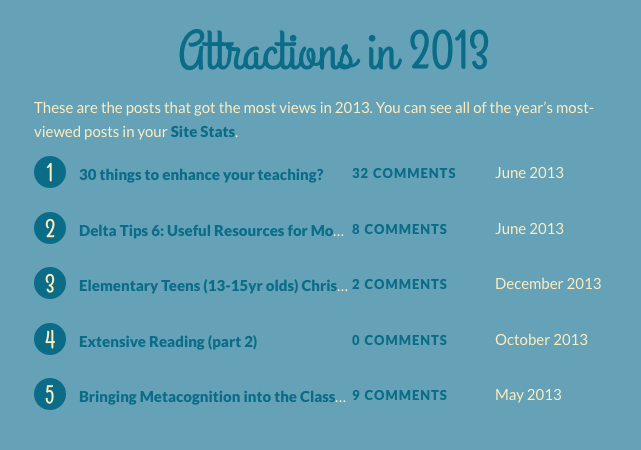
According to WordPress, here are my top 5 posts for this year.

This is based on the number of views received. So, according to their quantitative analysis:

Screen Shot 2013-12-31 at 10.05.32

The best according to WordPress!

Though I hadn’t started writing the intended Top 13 from ’13 blogpost before receiving WordPress‘s email (unless you count setting up a draft post with a title as starting :-p ), I had started thinking about what blogposts I would choose:

WordPress and I agree with regards to number 1. 30 things to enhance your teaching? would definitely have headed my list of my favourite posts of mine from 2013. Why?  Because it got me loads of views? No. Because not only did it win me the British Council blog of the month award for June 2013 (which, to be fair, accounts for it topping the “number of views analysis”), but, as importantly, it is also a reminder of the fantastic flavour of learning that I tasted while doing my course at Leeds Met Uni during the academic year 2012/13. I had the time of my life, learnt loads and look back on the experience with great fondness and appreciation.

Of the rest of that list, 4 and 5 would also definitely have made the 13 for ’13 cut. Extensive Reading part 2 is important to me because it came about as as result of my (on-going) learner autonomy development projects and as a result of my own recent experiences of using extensive reading for my own language learning. Bringing Metacognition into the Classroom would have made the cut because I still find the whole area of metacognition and metacognitive awareness development and its role in language learning fascinating. My interest was sparked by Teaching and Learning Second Language Listening by Vandergrift and Goh, which I read in preparation for designing the materials I created for my Materials Development module assessment, having stumbled across it by chance in Leeds University Library (making use of my SCONUL card!). A chance discovery that had a deep impact both on my assignment and my conceptualisation of language teaching and learning.

Delta Tips 6: Resources for Module 1 exam revision would probably not have made the cut, but I would certainly have chosen a post from my Delta Tips series, as representative of the series, which I enjoyed writing because it gave me the opportunity to reprocess all my learning and create a record of it to look back on (we always extol the virtues of peer-teaching in the language classroom and I think as teachers we can benefit as much as our learners by sharing and reflecting on what we learn), and because judging by the number of views the various posts in the series have had, they’ve been at least moderately useful to other Delta trainees.

The final post listed in the WordPress top 5, at number 3, (Elementary Teens (13-15 year olds) Christmas Lesson) wouldn’t have made the cut for my 13 for ’13 list either. I think I would have gone for my Elementary Teens Global Issues SIG challenge materials/lesson plan instead. Why? Because it was a rewarding process making materials to meet the challenge both of Global SIG’s food awareness month and of engaging my teenagers early on in their course.

Other posts that didn’t make the quantitative top 5 but would make my qualitative top 5 (or 13 from ’13) would be:

  • my posts, Part 1 and Part 2, about my Delta and M.A. respectively, because they act as a reminder of the professional and personal growth I’ve enjoyed since September 2012 and a motivator to continue pushing myself to use what I’ve learnt and add to it.
  • a post as representative of my Dissertation Diary series, e.g. this one, which helped me achieve a solid mark for my dissertation materials/rationale and which provides me with a window to look back on that process and remind myself of what I learnt as well as how.
  • In response to Observations of an Elementary Language User as representative of all my posts relating to my experience of being back in the Elementary language learning seat, which has also influenced my teaching and my learner autonomy projects in various ways.
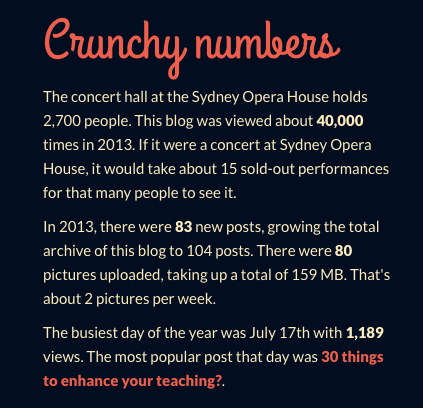
Screen Shot 2013-12-31 at 17.24.01

Posting a-go-go!

2013 has definitely been a year of blossoming for my blog: The 83 posts mentioned above were all written from May onwards this year, so in the space of about 8 months. Meanwhile, the three previous years of blogging yielded the other 21 – quite a stark contrast! What have I gained from blogging so extensively? Well, my British council blog award and resultant webinar (forthcoming!) on learner autonomy, for starters. But also, a space to reflect and re-process my learning, as well as a record of my professional development over the course of time. It gives me a lot of pleasure to look back over posts I’ve written and recapture the excitement, motivation, inspiration etc that the posts were borne of, while reminding myself what I’ve learnt.

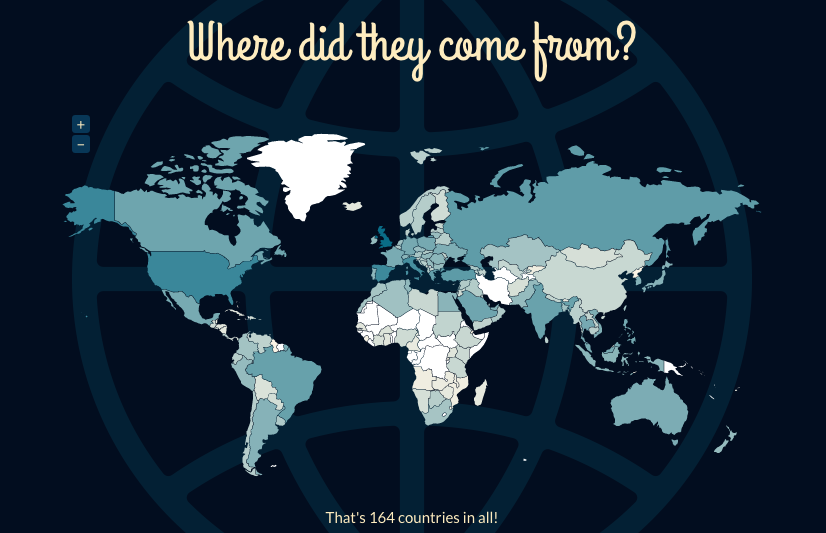
Screen Shot 2013-12-31 at 17.24.41

Countries, countries, everywhere!

That my posts have been read by people from 164 countries makes me feel a sense of connectedness to teachers and the industry worldwide – I feel a part of something. The teachers I communicate with via Twitter, via this blog, via their blogs (I’m planning a post where I list the blogposts by others which have most inspired me in 2013 – stay tuned! Update: That post is now written and can be found here) and other means of online CPD (e.g. participating in webinars) are all part of the big online staffroom that I am lucky enough to be able to pop into on a regular basis and from which I gain and share ideas, creativity, motivation and inspiration.

Blossoming blog (“Frangipani_flowers” taken from Google images search, licensed for commercial reuse with modification)

And finally, to end my last post for this year, a big thank you to everybody who has been part of my 2013 and all my very best wishes for a happy and fulfilling 2014. Carpe diem! 🙂

100th post: Looking backwards, looking forwards…

This post sees the neat coincidence of several things:

  • my 100th post on this blog (this one!)
  • my 100th follower of this blog (a few days ago)
  • my 40,000th view (earlier today)
  • the end of the year (very shortly)
  • the first ELT Blog Carnival of 2014 (for which submissions are open, with a topic of “New Year’s Resolutions)

It’s been quite a year! 🙂 In this post, in keeping with the Blog Carnival abstract, I am going to reflect on what I’ve achieved this year, as well as my projects, plans and goals for next year.

Looking back…

At the beginning of this year, I was in Leeds. I had completed the input sessions for the Delta portion of my course at the end of the previous year, but had all the external assessment (Module 2 LSA 4, Module 3 extended assignment, Module 1 exam) all looming over me. So I still very much count the Delta as part of this year – after all, I only received the qualification in August! (I was on holiday in Italy, up a mountain riding a horse, when the news of my distinctions arrived in the form of happy emails from two of my tutors…)

It’s interesting (to me) to think that at the beginning of this year, I was feeling quite demotivated and felt I hadn’t achieved anything despite working so very hard in the first semester of my course. I’d learnt a lot but nothing was finished (other than the Delta mock exam that provided the M.A. grade for that module, which I thought I’d done badly in – though it transpired that I hadn’t!). Goes to show, perhaps, that achievement shouldn’t necessarily only be associated with completed things…

Since that rather inauspicious beginning to the year, which followed a Christmas “holiday”, which I spent redrafting my Delta module 3 and preparing the M.A. module presentation based on it, loads of exciting things have happened:

  • my M.A. modules!

They were brilliant. What a wonderful, wonderful course. I learnt ever such a lot (for evidence of this look here) and had such a lot of fun in the process, thanks to lovely tutors and lovely course mates. The best thing is, I’ve been using my learning from the modules ever since: For example, from Multimedia and Independent Learning came my interest in learner autonomy and resultant projects that are currently in progress at work, and thanks to the Materials Development module, I’ve thoroughly enjoyed making several sets of materials, some of which you can find here.

  • my British Council Blog of the Month award

My 30 things… post, which came about as a direct result of all the learning in my time at Leeds Met, managed to win the June 2013 edition of this award – a great honour for little ol’ me and something that has brought with it opportunities that I wouldn’t otherwise have had. For example, the British Council webinar I will be doing in February next year: my first ever webinar. I’m not at all scared….ahem. On the theme of blogging, my little blog has blossomed this year. I started blogging in May 2011 and between then and May this year, posted very little and was visited very little. Then I suddenly found I had things to say and share, resulting in a lot of content being added to this blog over the last 7 months. I also went from 4,000 odd views to now just over 40,000. Quite a big jump! But it’s not the numbers or quantity of content that is important, it’s the profound effect that having this reflective space has had on my professional life. It’s a wonderful thing, being able to share teaching-y things with teachers all over the world. And, of course, reading others’ blogs has remained a great source of inspiration to me.

  • my first conference presentations

I presented for the first time at the 16th Warwick International Postgraduate Conference in Applied Linguistics, which was on the 26th June 2013 at the University of Warwick. My presentation was based on the research project I did for the Research module of my M.A. and I thoroughly enjoyed the experience. It was a gentle way in, being as all the other participants were also students and I had already presented my research as part of the assessment for the M.A. module. This first time was swiftly followed by the second time, less than a month later:  This was at the MATSDA/University of Liverpool 2 day conference, themed “Enjoying to learn: the best way to acquire a language?” on the 13th and 14th July 2013 at the University of Liverpool. If you haven’t been to a MATSDA conference before, I highly recommend it. It was a lot of fun and a very supportive atmosphere for a novice presenter. For details of my presentations, please see this link.

  • my dissertation

Bubbling away in the background, behind all the excitement of the presentations and blog award, was my dissertation. My constant companion for about 4 months, the D-beast definitely represents a large chunk of the time, energy, focus and dedication that has gone into this year. It was worth it in the end, as not only did I find it a very satisfying experience (though towards the end I was worried I would never finish in time!), but I also came out of it with a respectable 82%. This sealed my overall distinction for my M.A. in ELT, of which I am very proud: it represents a LOT of very hard, yet enjoyable, work. But not only hard work on my part: my tutor who supervised me for the dissertation gave up a lot of her time in order to meet with me and look at/feed back on what I’d produced at various points, as well as giving me lots of support and encouragement throughout the whole process: Thank you, HB!

  • my new job in Palermo

I am fortunate enough for teaching at IH Palermo to have become my first post-Delta job. It’s a great school to work in, with a very supportive and friendly atmosphere, as well as a lot of opportunity for continued development. Since I have been here, I have attended workshops on teaching young learners, teaching using Headway, teaching teens, dealing with parents and, last but not least, pronunciation. I have also been observed while teaching, and received a high quality of helpful, constructive feedback subsequently, as well as had the opportunity to observe my peers. And then, of course, I have embarked on the IHCYLT (IH Young Learner Cert) course – which deserves its own bullet point!

  • IHCYLT

This, I am still very embroiled in. In fact, I’m about half way through and hanging on by a very slender thread. Turns out starting a new job, working full-time, learning a new language AND doing a training course is quite the balancing act. Fortunately, the afore-mentioned supportive nature of the workplace and my DoS and YL coordinator have helped me keep going thus far. How it turns out remains to be seen – I suppose I shall either make it, just, or crash and burn spectacularly! I think it may possibly be course over-load for one year but at least it’s nearly Christmas and hopefully after a break I will have what it takes to push through what’s still to come. I’ve discovered that I’m not a huge fan of distance/online learning as vs. face-to-face study and am heartily glad/relieved that I did not attempt the Delta via distance learning, as I don’t think I would have made it through or done anywhere near as well as I did. Thankfully, as the YL course is blended, the observation (both being observed/the feedback and observing others) element has balanced out the online component. (NB: the online tutors are fantastic, so my lack of love for the online element is no fault of theirs…)

  • Italian

I’m also learning Italian, being as prior to moving to Palermo I had never learnt nor spoken any Italian in my life before. (Oh except learning the numbers, the word for England and good afternoon/please/thank you when I came on holiday here with my aunt’s family, aged 16 or so) I study every day before work and read extensively every evening and over the weekend. I also listen extensively. I think I’ve learnt a lot of language since I’ve been here (still just under three months though it seems like forever longer!) and it’s been fascinating being a language learner again. I did a few lessons at the school but stopped for a variety of reasons (including lack of time, the YL course starting, and just not getting on that well with the lessons). Learning independently has been a lot more successful and I’ve learnt a lot from how I learn – if that makes sense (it does to me…)!

So, I think that just about covers looking back…

Looking forward…

  • Christmas Holidays!!

Thank goodness. This time next week I will be on holiday. I intend to finish all the YL coursework I need to do *before* the holiday and have a complete rest (if you can call Christmas etc  a rest :-p) over the 2 weeks I’m off work. It will be the first real, proper holiday since August 2013. I am very, very, very in need of it!

  • British Council webinar

In February, I will be giving my very first webinar (as mentioned earlier in this post), on the topic of learner autonomy. I hope my audience will be gentle with me… 😉  I’ve been experimenting away with various tools and ideas for helping learners become more autonomous and am looking forward to sharing what I’ve learnt and to having peoples’ responses to what I say inform what I do with my projects in future, too.

  • A workshop at work

One of my goals for next year is to deliver a workshop at work. (Sometime *after* the YL course finishes, of course! 😉 ) I think it would be a very valuable experience.

  • Presenting at IATEFL

I’ve been accepted to present at IATEFL, which is very exciting. Still a few teething issues with regards to attending, but here’s hoping I’ll make it… 🙂 (Much as the thought of it also terrifies me…. 😉 )

  • Attending other conferences

There’s a MATSDA conference in June, when I shall be back in England (8-month contract), which I very much hope to attend. I love conferences: they are so inspirational.

  • Working at a university

One of my goals for next year is to work on a pre-sessional course at a University in the U.K. over the summer.

  • Continuing work on my projects

I am thoroughly enjoying working on my learner autonomy projects and helping my learners become more autonomous learners and this is something I want to continue working on next year. I want to read a lot more on learner autonomy theory and motivation theory (currently in the middle of a book on each subject).

  • Reading

As well as the afore-mentioned learner autonomy and motivation theory-related texts, I want to keep abreast of developments in the ELT world by continuing to read the journals and professional magazines that I have discovered through doing my Delta and M.A. I also want to reread and reprocess my notes from these courses, and keep the learning fresh as well as add to it.

  • Using my learning

I *really* want to experiment with what I’ve learnt through the Delta and M.A., experiment, reflect, evaluate, experiment some more, write about it… this is one of the reasons I am looking forward to the YL course finishing: at the moment I’m struggling for brain space. The YL course is ramming more and more learning into my poor little brain when all I really want to do is draw breath and work with what I’ve got. Nevertheless, when it does finish, I’ll work with that learning too, of course! 🙂

  • A PhD

Not next year! But sometime… to research something related to learner autonomy and motivation. (Of course that may change by the time I get round to doing one!)

  • Learning more Italian

I want to keep working on my Italian – I’m feeling enormously motivated – and for my speaking to catch up with my reading and listening….at least a little!!

  • A better work-life balance!!!!!

At the moment, my work-life balance is not awesome. (Thanks, YL course!) I’m very much looking forward to having my weekends back but, that aside, outside of frenetic times (of which there will be another in late January when a whole bunch of courses end) I want to try and spend less time at work and get more exercise during the week. If I keep going for toooo much longer at the current rate, I suspect I will burn out.

Plenty to be getting on with…!

Meanwhile, I’ve one more week left of term, which will see teaching practice observation no.3/4, parents consultations, a course ending (and attendant marking/reports/admin) and the usual load of YL tasks to be getting on with… no rest for the wicked!

2013 has been fairly phenomenal all in all: and I am eternally grateful to all who have helped to make it that way – my wonderful tutors, my course mates, my colleagues, my DoS, and, best of all, my lovely, lovely family and friends. Thank you all for your support, for putting up with me and not giving up on me. 🙂

Here’s wishing everybody a fantastic 2014 – live your dreams!

CPD: What does it mean to you?

CPD (Continuing Professional Development) is a well-used phrase. But what does it really mean? What does it involve? To me, it covers a whole multitude of things:

Courses

This is arguably the most obvious element. You identify a gap in your skill set or a need for general upgrade of your skills/knowledge and search for a course to suit your needs. Courses come in all shapes and sizes, varying in length, focus, outcome, commitment requirements, cost and so on.

The DELTA (Diploma for English Language Teaching to Adults) or its Trinity counter part, the Trinity Dip. TESOL, is a popular choice for qualified ESL teachers wanting to take the next step. These are internationally recognised professional qualifications with a practical focus. The DELTA is a modular qualification and modules can be taken separately or concurrently, distance or face-to-face, part-time or full-time, intensively or non-intensively. The trick is to make the right decision regarding which of these options will work for you. Being a level 7 qualification, the DELTA gives you a number of credits towards a Masters qualification, depending on the university and the course chosen.

M.A.’s (Master of Arts) or M.Sc.’s (Master of Sciences) are generally considered to be more theoretically focused. Popular choices for teachers include Masters in English Language Teaching, Applied Linguistics and TESOL and pure Applied Linguistics. Some M.A.s manage to combine the more theoretical focus of an M.A. with practical application. One such is the Leeds Met M.A. in ELT, which focuses on what you can do with the theory rather than on just learning and writing about it: in the second semester, for example, you design materials, undertake research, develop multimedia tools and write a journal article. First semester content depends on whether or not you choose to do the integrated DELTA option.

Shorter courses

I think these tend to have a narrower focus and there are lots of options out there. International House, for example, has a range of courses, of various lengths, some blended and some purely online. (I shall be doing the Young Learner training, starting tomorrow!) I won’t go into depth on all the courses available out there, or it will treble the length of this post! 😉

Work-based CPD

This, most obviously, would include workshops (both attending and delivering), formal observation, peer observation and the opportunity to participate in short training courses. And, I have discovered, if you work somewhere that truly values CPD (actively, not just paying lip service), then these things become amazing opportunities.

I had my first formal observation earlier this week. Scary scary. BUT the DoS had emphasised that this was developmental rather than a test and an opportunity to experiment. So I experimented for the first time with some techniques I’d read about shortly prior to the observed lesson. It was so valuable to then be able to discuss the techniques, difficulties in applying them and ideas for continuing to apply them, during the feedback with my DoS. I now have a lot of detailed feedback notes to read and reflect on before I next teach. However, I have also already had two classes, directly following the feedback, and tried to put into practice the ideas discussed during the feedback, with some good results. So exciting!

There have been two workshops since I started here, too, both very thought-provoking and useful. It’s always good to be back in the learning seat. In due course, I hope also to deliver one, as I think this would be a very valuable experience. In addition to this, last weekend I did some Cambridge speaker examiner training for KET and PET exams, which was an interesting process.

Personal CPD

This is everything you do to learn that doesn’t come under a formal label! In this diverse category comes things like:

  • attending (and/or presenting at) conferences (face-to-face or online)
  • attending (or giving!) seminars (or webinars)
  • reading journals/professional magazines
  • reading relevant books
  • reading relevant blogs
  • using Twitter (e.g. participating in #Eltchat discussions, following up links)/Facebook (e.g. the British Council TeachingEnglish Facebook page.)
  • writing blog posts
  • writing journal/professional magazine articles/contributions
  • making learning materials
  • carrying out classroom-based research projects
  • reflecting on your teaching/development and making plans for what to try out next.
  • being a language learner again (!) (Being a learner in a language classroom again has shone a whole new light on learning, to consider as a teacher!)

For Me:

I found my Delta and M.A. immensely challenging and rewarding. But I think what comes next is equally important. The CPD doesn’t stop when you finish the course and get your certificate. The course provides you with new knowledge, techniques, methodologies etc. but true CPD is what you do with all of that afterwards. Do you put your certificate in a file and then continue as before? Or do you experiment with everything you’ve learnt and look for new things to try out and connect to your previous learning?

At the moment, I have a couple of projects on the go that are very much the result of having done the Multimedia and Independent Learning module of my M.A., that will culminate with my first webinar (in February next year) and recently I’ve also been exercising my materials development learning in making materials for the Global Issues month as well just for my own use with learners. And I’m finding all of this really satisfying, interesting and exciting. I think, too, that having a supportive DoS is key to effective CPD – there’s nothing like being actively encouraged to develop and helped to do so.

To me, CPD is the spaces between the words. It’s what and how you learn but also, all-importantly, what you do with what you learn, it’s being aware of opportunities and taking them when they arise. It’s what herbs and spices are to cooking – not strictly speaking necessary but it turns a bland dish (one day of experience repeated for twenty years) into something delicious and taste-bud tantalising!

I’m sure I’ve missed plenty of CPD options out of this post, so please comment with any additional CPD ideas you have! Inspire me!! 🙂 What does CPD mean to you?