Have you seen these? My top 5 2013 blogposts from other blogs

As promised in  my self-indulgent review of my own posts from 2013, I will now look at some of the posts I’ve read that were produced by other people…

In 2013, I read dozens of interesting, well-written blog posts that inspired me to try out new things in the classroom and to respond with reflections of my own. For my first post of 2014, I’m going to attempt to pick out my top 5. (Choosing 5 out of so many was a difficult enough task, so I’m not going to attempt to rank them! 😉 )

  • Ways of exploiting lexical self-study material in the classroom part two: some things we can get students to do.  This is the second post in a series written by Hugh Dellar, on his well-known blog. I first became aware of this series of three posts when a member of my PLN tweeted part 2 of the series (as linked). Of course I then also read part 1 (and part 3 when it later came out!) Bursting with helpful ideas, these posts really got me thinking and indeed experimenting in the classroom. I drew on part 2 when I did my first observation in my current job and opened up a key area to develop within my practice, which was (and is) very exciting. I really recommend reading these posts if they’ve slipped beneath your radar thus far…
  • The case for: 6 reasons why our language learners should get homework. This post by Adam Simpson was brought to my attention by another member of my PLN, this time by way of Facebook. It particularly resonated with me because I’m working in a context where giving homework is compulsory, and I’ve tried really hard to make the homework as meaningful and relevant to the learners as possible, as well as trying to use it as a tool to help them become more autonomous. What I particularly like about this post is the inclusion of questions for us teachers to ask ourselves when we are thinking about setting homework. These are questions I want to return to regularly this year, as I continue in my mission to make homework really worthwhile for my learners.
  • Teacher Dereliction Anxiety Disorder  Yet again, I became aware of this post by Kevin Stein as a result of a member of my PLN sharing it via social media. (Are we sensing a pattern here?? 😉 ) It is the second in a series of posts about extensive reading, on a blog called The other things matter – which I think is a fantastic name and concept, by the way! Don’t you agree? The “other” things really do matter, in teaching. The post contains a lot of useful ideas for getting learners reading extensively whilst combatting teacher anxiety at using class time for “such things”. Although in my current context, contact time is too brief for a lot of what is suggested, the concept of using time for things other than teaching <insert language point here> is far from lost on me: my current learner autonomy development and extensive reading projects require brief but regular use of class time to maintain – time that I would argue is well spent.
  • Writing journals with students  by Sandy Millin is one of the many posts that I read on her blog last year. In this post, she tells us about how she used journals with various of her classes in Newcastle, and the benefits this had for both her and the learners. The activity may need a little adjustment/adaptation to work in contexts with less contact time available but nevertheless it’s another shining example of the wonderful “other” things teachers do with their learners, so if you haven’t read it yet (unlikely – everybody has read Sandy’s posts, I think! 😉 ) then get on over to her blog and have a squiz.
  • Can teachers do research? is by Marisa Constantinides. She talks about a research project she carried out and then goes on to discuss the question in the title, providing suggestions to help teachers get started with action research. I like this post because I strongly believe that doing classroom-based research is a great way to develop and can also be very motivational for teachers: instead of getting bogged down in a rut and doing the same thing, in the same way, time after time, it allows you to explore and evaluate different ways and new ideas for doing things. I’m currently in the middle of some small-scale learner autonomy-related research projects with my learners, as a result of which I’ve done fair bit of reading of relevant literature and reflecting over this break and am keen to continue working with my learners, and see where the project takes us next. (Just as well, as the holiday is all but over!) Maybe 2014 could be the year for you to start researching in your classroom too? Have a look at Marisa’s post for tips on how to go about it…

So, that’s my top five. I could have kept listing posts ad infinitum, but, instead, over to you: It would be fantastic if you could comment on this post with a link to any one (or two or three..) blog post that caught your eye and inspired you in 2013. 🙂 I look forward to seeing your comments and visiting the posts you recommend…

Blogging highlights of 2013: me versus WordPress Monkeys!

I received an email from WordPress this morning: Your 2013 year in blogging. I also recently read 12 from ’12: The best of your posts from this year (blog challenge) by Adam Simpson. I had planned to round off 2013 by writing something along similar lines to identify my blogging highlights for this year. This post will be a mixture of that and response to WordPress‘s report on my blog activity this year…

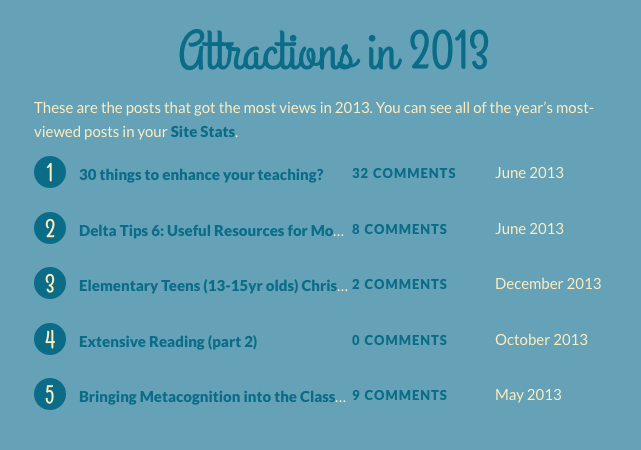
According to WordPress, here are my top 5 posts for this year.

This is based on the number of views received. So, according to their quantitative analysis:

Screen Shot 2013-12-31 at 10.05.32

The best according to WordPress!

Though I hadn’t started writing the intended Top 13 from ’13 blogpost before receiving WordPress‘s email (unless you count setting up a draft post with a title as starting :-p ), I had started thinking about what blogposts I would choose:

WordPress and I agree with regards to number 1. 30 things to enhance your teaching? would definitely have headed my list of my favourite posts of mine from 2013. Why?  Because it got me loads of views? No. Because not only did it win me the British Council blog of the month award for June 2013 (which, to be fair, accounts for it topping the “number of views analysis”), but, as importantly, it is also a reminder of the fantastic flavour of learning that I tasted while doing my course at Leeds Met Uni during the academic year 2012/13. I had the time of my life, learnt loads and look back on the experience with great fondness and appreciation.

Of the rest of that list, 4 and 5 would also definitely have made the 13 for ’13 cut. Extensive Reading part 2 is important to me because it came about as as result of my (on-going) learner autonomy development projects and as a result of my own recent experiences of using extensive reading for my own language learning. Bringing Metacognition into the Classroom would have made the cut because I still find the whole area of metacognition and metacognitive awareness development and its role in language learning fascinating. My interest was sparked by Teaching and Learning Second Language Listening by Vandergrift and Goh, which I read in preparation for designing the materials I created for my Materials Development module assessment, having stumbled across it by chance in Leeds University Library (making use of my SCONUL card!). A chance discovery that had a deep impact both on my assignment and my conceptualisation of language teaching and learning.

Delta Tips 6: Resources for Module 1 exam revision would probably not have made the cut, but I would certainly have chosen a post from my Delta Tips series, as representative of the series, which I enjoyed writing because it gave me the opportunity to reprocess all my learning and create a record of it to look back on (we always extol the virtues of peer-teaching in the language classroom and I think as teachers we can benefit as much as our learners by sharing and reflecting on what we learn), and because judging by the number of views the various posts in the series have had, they’ve been at least moderately useful to other Delta trainees.

The final post listed in the WordPress top 5, at number 3, (Elementary Teens (13-15 year olds) Christmas Lesson) wouldn’t have made the cut for my 13 for ’13 list either. I think I would have gone for my Elementary Teens Global Issues SIG challenge materials/lesson plan instead. Why? Because it was a rewarding process making materials to meet the challenge both of Global SIG’s food awareness month and of engaging my teenagers early on in their course.

Other posts that didn’t make the quantitative top 5 but would make my qualitative top 5 (or 13 from ’13) would be:

  • my posts, Part 1 and Part 2, about my Delta and M.A. respectively, because they act as a reminder of the professional and personal growth I’ve enjoyed since September 2012 and a motivator to continue pushing myself to use what I’ve learnt and add to it.
  • a post as representative of my Dissertation Diary series, e.g. this one, which helped me achieve a solid mark for my dissertation materials/rationale and which provides me with a window to look back on that process and remind myself of what I learnt as well as how.
  • In response to Observations of an Elementary Language User as representative of all my posts relating to my experience of being back in the Elementary language learning seat, which has also influenced my teaching and my learner autonomy projects in various ways.
Screen Shot 2013-12-31 at 17.24.01

Posting a-go-go!

2013 has definitely been a year of blossoming for my blog: The 83 posts mentioned above were all written from May onwards this year, so in the space of about 8 months. Meanwhile, the three previous years of blogging yielded the other 21 – quite a stark contrast! What have I gained from blogging so extensively? Well, my British council blog award and resultant webinar (forthcoming!) on learner autonomy, for starters. But also, a space to reflect and re-process my learning, as well as a record of my professional development over the course of time. It gives me a lot of pleasure to look back over posts I’ve written and recapture the excitement, motivation, inspiration etc that the posts were borne of, while reminding myself what I’ve learnt.

Screen Shot 2013-12-31 at 17.24.41

Countries, countries, everywhere!

That my posts have been read by people from 164 countries makes me feel a sense of connectedness to teachers and the industry worldwide – I feel a part of something. The teachers I communicate with via Twitter, via this blog, via their blogs (I’m planning a post where I list the blogposts by others which have most inspired me in 2013 – stay tuned! Update: That post is now written and can be found here) and other means of online CPD (e.g. participating in webinars) are all part of the big online staffroom that I am lucky enough to be able to pop into on a regular basis and from which I gain and share ideas, creativity, motivation and inspiration.

Blossoming blog (“Frangipani_flowers” taken from Google images search, licensed for commercial reuse with modification)

And finally, to end my last post for this year, a big thank you to everybody who has been part of my 2013 and all my very best wishes for a happy and fulfilling 2014. Carpe diem! 🙂

The 2nd ELT Research Blog Carnival on Learner Autonomy has arrived!

Here it is, ladies and gentlemen, the moment you’ve all been waiting for: the opportunity to see, for the first time united in one place, a collection of links to a series of reviews of articles related to the fascinating area of study that is learner autonomy!

First up we have:

Anthony Ash writing about an article that features in the English Language Teaching Journal (vol. 62/4) published by Oxford University Press. This article is entitled Learner Autonomy and was written in 2008, by Richard Smith.  Please find Anthony’s review here and a link to the original article here. A fine choice of article and a succinct review. I’d highly recommend reading the original article, it’s freely available and offers a brief overview of issues around the concept of learner autonomy.

The second contribution came from:

Me! I reviewed an article by Robert Godwin-Jones (2011): Emerging Technologies: Autonomous Language Learning in Language Learning & Technology vol. 15 number 3. October 2011. You can find the review here. This article looks at various technological tools from the perspective of interest in developing learner autonomy. Godwin-Jones also addresses various issues related to learner autonomy along the way. Again, freely available by clicking on the link attached to the title (above) of the article.  In my review, I also finish off by indulging in some of my own reflection on the content.

The third review to join the party was sent by:

Another Anthony! He treats an article by Cynthia Carr: Enhancing EAP Students’ Autonomy by Accommodating Various Learning Styles in the Second Language Writing Classroom which appeared in the INTESOL Journal,  vol 10/1 in 2013. As well as reviewing Carr’s article in depth, Anthony writes of his own experience as a teacher and learner in relation to learner autonomy and learning styles. You can find his review here. The article itself is available freely, but the link I found generates an automatic download rather than a webpage. So, if you want to read it, just put the title and author into Google and click on the link provided. 

Our fourth contributor was:

Mura Nava, who reviewed Possible effects of free online data driven lexicographic instruments on foreign language learning: The case of Linguee and the Interactive Language Toolbox in Procedia – Social and Behavioral Sciences , issue 95, a conference paper by Buyse K. & Verlinde, S. (2013).  You can find the paper here. The paper reports a study of the use of online corpora-driven dictionary Linguee and their success in comparison with other online dictionaries.  Mura’s review is available here.

The fifth review was submitted courtesy of:

Nathan Hall, who reviewed the following article: Lee, Lina. (2011). Blogging: Promoting learner autonomy and intercultural competence through study abroad in Language Learning & Technology, 15(3). 87-109. You can find this article here.  As the review explains, it reports on a study relating to the use of blogging tools  and ethnographic interviews in the context of studying abroad. Nathan brings out and comments on some interesting elements of the study, and you can read his review here.

Finally, in by the skin of his teeth, came:

Glen Cochrane and his review of Dias, J. (2000). Learner Autonomy in Japan: Transforming ‘Help Yourself’ from Threat to Invitation in Computer Assisted Language Learning, 13(1), 49-64. This article treats an action research project at a university in Japan, in the context of a speaking/listening class. Unfortunately, the article is not freely available, but nevertheless Cochrane gives a detailed synopsis of the findings and again highlights the importance of sensitivity to context in the development of learner autonomy. You can read his review here.

This brings us to the end of the 2nd ELT Research Blog Carnival, which has brought together an interesting range of perspectives on the topic. I hope you’ve enjoyed this snapshot of ELT Research on a very topical issue in ELT If your interest has been aroused, I recommend also having a look at the following pieces of work, if you can get your hands on them:

  • Benson, P (2007). Autonomy in Language Teaching and Learning in Language Teaching vol. 40 /01. January 2007, pp 21 40. Cambridge University Press. Cambridge.

(An overview of all the literature related to LA up to the point of publishing!)

  • Illes, (2012) Learner Autonomy Revisited in ELTJ vol. 66/4 Special Issue. Oxford University Press. Oxford.

(A look at some of the very interesting and pertinent issues that emerge in relation to LA in this day and age.)

  • Oxford, R. (2003) Towards a more Systematic Model of L2 Learner Autonomy in Learner Autonomy Across Cultures. Ed Palfreyman, D and Smith, R. Palgrave Macmillan. Basingstoke.

(A brave – and extremely useful! – attempt to synthesis and systematise the theories surrounding Learner Autonomy)

  • Smith, R. (2003) Pedgagogy for Autonomy as (Becoming) Appropriate Methodology in Learner Autonomy Across Cultures. Ed Palfreyman, D and Smith, R. Palgrave Macmillan. Basingstoke.

(A look at different approaches to realising learner autonomy as well as the importance of context and its influence on the approaches chosen.)

**Learner Autonomy Across Cultures is a great book if you can get hold of it, brings together a lot of interesting research and theory on the topic of LA

  • Vandergrift L. and Goh, C (2012) Teaching and Learning Second Language Listening. Routledge. Oxon.

(An in-depth look at metacognition, which also addresses the role it plays within the development of learner autonomy)

And finally, from the most recent ELT Journal, (an article I read yesterday and would have liked to review for this carnival if I hadn’t already done one on a different article!):

  • Humphreys, G. and Wyatt M. (2014) Helping Vietnamese Learners to become more autonomous in ELTJ vol. 68/1. Oxford University Press. Oxford.


100th post: Looking backwards, looking forwards…

This post sees the neat coincidence of several things:

  • my 100th post on this blog (this one!)
  • my 100th follower of this blog (a few days ago)
  • my 40,000th view (earlier today)
  • the end of the year (very shortly)
  • the first ELT Blog Carnival of 2014 (for which submissions are open, with a topic of “New Year’s Resolutions)

It’s been quite a year! 🙂 In this post, in keeping with the Blog Carnival abstract, I am going to reflect on what I’ve achieved this year, as well as my projects, plans and goals for next year.

Looking back…

At the beginning of this year, I was in Leeds. I had completed the input sessions for the Delta portion of my course at the end of the previous year, but had all the external assessment (Module 2 LSA 4, Module 3 extended assignment, Module 1 exam) all looming over me. So I still very much count the Delta as part of this year – after all, I only received the qualification in August! (I was on holiday in Italy, up a mountain riding a horse, when the news of my distinctions arrived in the form of happy emails from two of my tutors…)

It’s interesting (to me) to think that at the beginning of this year, I was feeling quite demotivated and felt I hadn’t achieved anything despite working so very hard in the first semester of my course. I’d learnt a lot but nothing was finished (other than the Delta mock exam that provided the M.A. grade for that module, which I thought I’d done badly in – though it transpired that I hadn’t!). Goes to show, perhaps, that achievement shouldn’t necessarily only be associated with completed things…

Since that rather inauspicious beginning to the year, which followed a Christmas “holiday”, which I spent redrafting my Delta module 3 and preparing the M.A. module presentation based on it, loads of exciting things have happened:

  • my M.A. modules!

They were brilliant. What a wonderful, wonderful course. I learnt ever such a lot (for evidence of this look here) and had such a lot of fun in the process, thanks to lovely tutors and lovely course mates. The best thing is, I’ve been using my learning from the modules ever since: For example, from Multimedia and Independent Learning came my interest in learner autonomy and resultant projects that are currently in progress at work, and thanks to the Materials Development module, I’ve thoroughly enjoyed making several sets of materials, some of which you can find here.

  • my British Council Blog of the Month award

My 30 things… post, which came about as a direct result of all the learning in my time at Leeds Met, managed to win the June 2013 edition of this award – a great honour for little ol’ me and something that has brought with it opportunities that I wouldn’t otherwise have had. For example, the British Council webinar I will be doing in February next year: my first ever webinar. I’m not at all scared….ahem. On the theme of blogging, my little blog has blossomed this year. I started blogging in May 2011 and between then and May this year, posted very little and was visited very little. Then I suddenly found I had things to say and share, resulting in a lot of content being added to this blog over the last 7 months. I also went from 4,000 odd views to now just over 40,000. Quite a big jump! But it’s not the numbers or quantity of content that is important, it’s the profound effect that having this reflective space has had on my professional life. It’s a wonderful thing, being able to share teaching-y things with teachers all over the world. And, of course, reading others’ blogs has remained a great source of inspiration to me.

  • my first conference presentations

I presented for the first time at the 16th Warwick International Postgraduate Conference in Applied Linguistics, which was on the 26th June 2013 at the University of Warwick. My presentation was based on the research project I did for the Research module of my M.A. and I thoroughly enjoyed the experience. It was a gentle way in, being as all the other participants were also students and I had already presented my research as part of the assessment for the M.A. module. This first time was swiftly followed by the second time, less than a month later:  This was at the MATSDA/University of Liverpool 2 day conference, themed “Enjoying to learn: the best way to acquire a language?” on the 13th and 14th July 2013 at the University of Liverpool. If you haven’t been to a MATSDA conference before, I highly recommend it. It was a lot of fun and a very supportive atmosphere for a novice presenter. For details of my presentations, please see this link.

  • my dissertation

Bubbling away in the background, behind all the excitement of the presentations and blog award, was my dissertation. My constant companion for about 4 months, the D-beast definitely represents a large chunk of the time, energy, focus and dedication that has gone into this year. It was worth it in the end, as not only did I find it a very satisfying experience (though towards the end I was worried I would never finish in time!), but I also came out of it with a respectable 82%. This sealed my overall distinction for my M.A. in ELT, of which I am very proud: it represents a LOT of very hard, yet enjoyable, work. But not only hard work on my part: my tutor who supervised me for the dissertation gave up a lot of her time in order to meet with me and look at/feed back on what I’d produced at various points, as well as giving me lots of support and encouragement throughout the whole process: Thank you, HB!

  • my new job in Palermo

I am fortunate enough for teaching at IH Palermo to have become my first post-Delta job. It’s a great school to work in, with a very supportive and friendly atmosphere, as well as a lot of opportunity for continued development. Since I have been here, I have attended workshops on teaching young learners, teaching using Headway, teaching teens, dealing with parents and, last but not least, pronunciation. I have also been observed while teaching, and received a high quality of helpful, constructive feedback subsequently, as well as had the opportunity to observe my peers. And then, of course, I have embarked on the IHCYLT (IH Young Learner Cert) course – which deserves its own bullet point!

  • IHCYLT

This, I am still very embroiled in. In fact, I’m about half way through and hanging on by a very slender thread. Turns out starting a new job, working full-time, learning a new language AND doing a training course is quite the balancing act. Fortunately, the afore-mentioned supportive nature of the workplace and my DoS and YL coordinator have helped me keep going thus far. How it turns out remains to be seen – I suppose I shall either make it, just, or crash and burn spectacularly! I think it may possibly be course over-load for one year but at least it’s nearly Christmas and hopefully after a break I will have what it takes to push through what’s still to come. I’ve discovered that I’m not a huge fan of distance/online learning as vs. face-to-face study and am heartily glad/relieved that I did not attempt the Delta via distance learning, as I don’t think I would have made it through or done anywhere near as well as I did. Thankfully, as the YL course is blended, the observation (both being observed/the feedback and observing others) element has balanced out the online component. (NB: the online tutors are fantastic, so my lack of love for the online element is no fault of theirs…)

  • Italian

I’m also learning Italian, being as prior to moving to Palermo I had never learnt nor spoken any Italian in my life before. (Oh except learning the numbers, the word for England and good afternoon/please/thank you when I came on holiday here with my aunt’s family, aged 16 or so) I study every day before work and read extensively every evening and over the weekend. I also listen extensively. I think I’ve learnt a lot of language since I’ve been here (still just under three months though it seems like forever longer!) and it’s been fascinating being a language learner again. I did a few lessons at the school but stopped for a variety of reasons (including lack of time, the YL course starting, and just not getting on that well with the lessons). Learning independently has been a lot more successful and I’ve learnt a lot from how I learn – if that makes sense (it does to me…)!

So, I think that just about covers looking back…

Looking forward…

  • Christmas Holidays!!

Thank goodness. This time next week I will be on holiday. I intend to finish all the YL coursework I need to do *before* the holiday and have a complete rest (if you can call Christmas etc  a rest :-p) over the 2 weeks I’m off work. It will be the first real, proper holiday since August 2013. I am very, very, very in need of it!

  • British Council webinar

In February, I will be giving my very first webinar (as mentioned earlier in this post), on the topic of learner autonomy. I hope my audience will be gentle with me… 😉  I’ve been experimenting away with various tools and ideas for helping learners become more autonomous and am looking forward to sharing what I’ve learnt and to having peoples’ responses to what I say inform what I do with my projects in future, too.

  • A workshop at work

One of my goals for next year is to deliver a workshop at work. (Sometime *after* the YL course finishes, of course! 😉 ) I think it would be a very valuable experience.

  • Presenting at IATEFL

I’ve been accepted to present at IATEFL, which is very exciting. Still a few teething issues with regards to attending, but here’s hoping I’ll make it… 🙂 (Much as the thought of it also terrifies me…. 😉 )

  • Attending other conferences

There’s a MATSDA conference in June, when I shall be back in England (8-month contract), which I very much hope to attend. I love conferences: they are so inspirational.

  • Working at a university

One of my goals for next year is to work on a pre-sessional course at a University in the U.K. over the summer.

  • Continuing work on my projects

I am thoroughly enjoying working on my learner autonomy projects and helping my learners become more autonomous learners and this is something I want to continue working on next year. I want to read a lot more on learner autonomy theory and motivation theory (currently in the middle of a book on each subject).

  • Reading

As well as the afore-mentioned learner autonomy and motivation theory-related texts, I want to keep abreast of developments in the ELT world by continuing to read the journals and professional magazines that I have discovered through doing my Delta and M.A. I also want to reread and reprocess my notes from these courses, and keep the learning fresh as well as add to it.

  • Using my learning

I *really* want to experiment with what I’ve learnt through the Delta and M.A., experiment, reflect, evaluate, experiment some more, write about it… this is one of the reasons I am looking forward to the YL course finishing: at the moment I’m struggling for brain space. The YL course is ramming more and more learning into my poor little brain when all I really want to do is draw breath and work with what I’ve got. Nevertheless, when it does finish, I’ll work with that learning too, of course! 🙂

  • A PhD

Not next year! But sometime… to research something related to learner autonomy and motivation. (Of course that may change by the time I get round to doing one!)

  • Learning more Italian

I want to keep working on my Italian – I’m feeling enormously motivated – and for my speaking to catch up with my reading and listening….at least a little!!

  • A better work-life balance!!!!!

At the moment, my work-life balance is not awesome. (Thanks, YL course!) I’m very much looking forward to having my weekends back but, that aside, outside of frenetic times (of which there will be another in late January when a whole bunch of courses end) I want to try and spend less time at work and get more exercise during the week. If I keep going for toooo much longer at the current rate, I suspect I will burn out.

Plenty to be getting on with…!

Meanwhile, I’ve one more week left of term, which will see teaching practice observation no.3/4, parents consultations, a course ending (and attendant marking/reports/admin) and the usual load of YL tasks to be getting on with… no rest for the wicked!

2013 has been fairly phenomenal all in all: and I am eternally grateful to all who have helped to make it that way – my wonderful tutors, my course mates, my colleagues, my DoS, and, best of all, my lovely, lovely family and friends. Thank you all for your support, for putting up with me and not giving up on me. 🙂

Here’s wishing everybody a fantastic 2014 – live your dreams!

2nd ELT Research Blog Carnival on Learner Autonomy! (A final reminder…)

Don’t forget, the deadline for the 2nd ELT Research Blog Carnival is Friday 20th December – that’s 6 days time! Have you read a good article about Learner Autonomy that you’d like to review and share with us?

Please look at the guidelines here for information about how to participate. (Remember, you don’t even need to have your own blog in order to join in the Carnival: I would be happy to host your review on this blog, as a guest post.)

I look forward to receiving your contributions.

Happy reading and writing! 🙂

2nd ELT Research Blog Carnival: A Review of “Emerging Technologies: Autonomous Language Learning” (Godwin-Jones, 2011)

For my contribution to the 2nd ELT Research Blog Carnival, whose theme is Learner Autonomy, I have chosen an article by Robert Godwin-Jones (2011): Emerging Technologies: Autonomous Language Learning in Language Learning & Technology vol. 15 number 3. October 2011. I have used Godwin-Jones’ own sub-headings to organise my review. Obviously this is only my interpretation of what Godwin-Jones has to say…

LEARNING TO LEARN

Godwin-Jones begins by highlighting the explosion of interest in learner autonomy that has taken place over the last ten years and the relationship between learner autonomy and developments in technology. He acknowledges, however, that learner autonomy, as a concept, substantially pre-dates the age of computing. Like the majority of articles, chapters and books published on the subject of learner autonomy, Godwin-Jones tips his hat to Holec’s work in the late 70’s and explains that learners plus “appropriate learning material” does not equal learner autonomy: necessary, too, are the skills, mindset and motivation that lead to successful independent study.

Godwin-Jones suggests that the development of effective strategies is insufficient without the willingness to reflect on and improve on these over time, as language learning progresses. He cites learner diaries as a traditional means of cultivating this type of metacognitive awareness and suggests that online writing tools such as blogs and electronic portfolios or online editors like Google Docs. He alludes also to the European Language Portfolio and LinguaFolio, and the role these could play in providing learners with “concrete evidence of achievement”.

THE TEACHER’S ROLE

In the second part of his article, Godwin-Jones moves on to consideration of the role of the teacher within learner autonomy. Within this section, he addresses the cultural aspect of learner autonomy, explaining that in a culture where learning is teacher-centred, both teachers and learners may find the role changes required unsettling. He also explores issues inherent in distance learning and learning management systems e.g. Moodle, in terms of learner autonomy, e.g. that the teacher is usually the sole decision-maker with regards to content presentation, organisation and expectation with regards to progress through a course.

A significant role for teachers as individuals, that he discusses, is that of enabler and motivator: teachers need to offer their learners advice regarding online tools and services. Teachers can also help by enabling learners to discover and evaluate tools themselves.

AUTONOMOUS, NOT ALONE

In the third part of his article, Godwin-Jones addresses the importance of a peer network in the development of learner autonomy. He dispels the myth of the autonomous learner as stuck alone in an ivory tower surrounded by materials and cites the prominence of the “social dimension” of learner autonomy within the literature. (Maintaining Control: Autonomy and Language Learning (2009) is offered as an example of this.). He quotes Edith Esch’s definition of autonomy, from her chapter in this volume, “autonomy as the capacity to exercise critical thinking about learning as a participant in a social milieu”.

He goes on to discuss computer mediated communication (CMC) tools such as Second life and tandem learning networks, explaining that teachers may provide initial guidance but ultimate success, in terms of utility, is dependent on the learners themselves. Allusion is also made to peer-scaffolding, in helping learners to become more confident and independent. Godwin-Jones also points out issues with CMC, such as exclusive focus on content at the expense of focus on language, while suggesting that a balance of focuses may be important in language development through CMC.

SELF-DIRECTED STUDY

In this section, Godwin-Jones moves on to consider CALL (Computer Assisted Language Learning) and its role in promotion of learner autonomy, flagging up the issue of getting learners to take full advantage of what is available and the importance of metacognitive knowledge in enabling this. He also discusses tools that enable experimentation with concordancing and the potential effects of such tools on learning.

He also explores mobile devices e.g. tablets and the effect these have on language learning choices, wondering whether the development of these will mean a shift from favouring print materials to preferring multimedia options.

OUTLOOK

In this final section the idea of personal choice is discussed initially in relation to mobile devices and then in relation to examples of learner autonomy that hold a socio-political significance. Godwin-Jones also reminds us again of the effect of culture on learner autonomy, stressing that it will “look different in different cultures”, and the importance of adaptation to these differences by the teacher. He concludes by identifying further areas of potential interest for research (as he does throughout) and expressing “a hope that more emphasis on autonomous language learning results in empowering learners, not sacking teachers”.

References:

Esch, E. (2009). Crash or clash? Autonomy 10 years on. In Pemberton, R., Toogood, S. & Barfield, A., (Eds.). Maintaining control: Autonomy and language learning. Hong Kong: Hong Kong University Press.

NB: A particularly useful element of this article is the inclusion of hyperlinks to the various tools discussed as well as a list of resources as an appendix. 

My own reflections:

Immersed, as I currently am, in learner autonomy directed projects, both as a teacher and as a language learner (currently learning Italian) I have found it interesting to return to this article and re-read it, contrasting it with other articles and book chapters that I have read. He seems to present the influence of culture as a potential barrier to learner autonomy, though he does make up for this by identifying that learner autonomy “will look different in different cultures” and that teachers need to adapt to this, which is more in keeping with Smith (2003), who outlines a strong version of learner autonomy that doesn’t view learners as deficient, lacking certain behaviours associated with a ‘successful autonomous learner’ but rather focuses on helping them develop their own ways of being autonomous. I think this strong version of learner autonomy has a lot going for it.

Returning, to Godwin-Jones, I do appreciate the dedication of a section of the article to the teacher’s role within learner autonomy: I agree, based on my own (albeit limited) experience, that the teacher does play an important role in enabling autonomy. Learner autonomy does not only exist outside of the classroom: what happens in the classroom plays an important role in the promotion of it. Equally important, also discussed in this article, is the role of learners’ peers in development of autonomy.

Godwin-Jones makes a brief allusion to the importance of motivation in independent learning. In some ways it seems obvious that the two are linked. However, obvious though it may seem, it may still be very useful to consider theories of motivation (e.g. Dornyei, 2013) when considering how to scaffold the development of learner autonomy.

It was also interesting to read about the issues with distance learning, as I am currently doing a blended course so can empathise with the issues from a learner’s point of view.

All in all, it is a succinct article, freely available, offering a lot of ideas to experiment with.

References:

Smith, R. (2003) Pedgagogy for Autonomy as (Becoming) Appropriate Methodology in Learner Autonomy Across Cultures. Ed Palfreyman, D and Smith, R. Palgrave Macmillan. Basingstoke.

2nd ELT Research Blog Carnival on Learner Autonomy! (A reminder…)

Don’t forget, there’s just under two weeks to go before the deadline for the 2nd ELT Research Blog Carnival on Learner Autonomy, which I will be hosting on this blog. There’s such a lot of research out there dedicated to this topic, so let’s see what we can do with it!

For more information about how to participate, please see this post about it.

I look forward to reading your posts. 🙂

starling simple.wikipedia.org

Learner autonomy – helping learners find their wings? (“Starling” licensed for commercial reuse with modification)

2nd ELT Research Blog Carnival on Learner Autonomy!

I am delighted to be hosting the second ELT Research Blog Carnival, on a topic that is near to my heart: Learner Autonomy. (To gain an overview of learner autonomy with regards to the ELT classroom, you might like to read the opening chapters of this document from the British Council.)

There are vast quantities of articles related to Learner Autonomy within ELT, indeed it is something of a buzzword in our profession these days. As such, there is no shortage of material for you all to get your teeth into and share with the community via this Carnival. 🙂

The deadline is 20th December 2013.

To participate, write a post reflecting on a research article related to Learner Autonomy, send us your post link via an email to the ELT Blog Carnival Leader, Nathan (nathan@nathanhall.ca), or a tweet to me, @LizziePinard, including the #eltresearch hashtag in your tweet, or simply post a comment here.

I will then publish a blogpost collating all the links and a brief description of what each post contains.

I look forward to reading your reflections, so get involved and get reading/writing! 🙂

Extensive Reading (part 2)

In this post, I wrote about my own experience of extensive reading and reflected on the idea of getting students a) reading extensively and b) benefitting as much they can from it. Following on from this, I have attempted to start the ball rolling and get the pages turning (at the hands of my learners, of course!).

page turning

Let the pages turn! (Taken from advanced google image search filtered for “labelled for commercial use with modification”)

My experimentation thus far is informed by:

  • what I have learnt about learner autonomy (as well as the role multimedia can play in facilitating this).
  • what I have learnt about motivation.
  • what I have learnt about the relationship between these.
  • what I have learnt about theories of learning (particularly drawing on social constructivist ideas).
  • my own experience of extensive reading (as language learner and teacher) as well as others’ (e.g. the experiences related during a talk at a MATSDA conference this year).
  • reflection on the relationship between the implications all of these and the learners in my classes.

My goal is:

To get my learners reading regularly, over a substantial period of time (not a one-week wonder) and reaping the benefits of this. However, it is important that it comes from them, that they are doing it of their own volition not because it’s forced on them, not because Lizzie said so. Ideally, it should also be something they can enjoy. Of course, pleasure is multi-faceted…

For example, this could be pleasure that results from:

  • relaxation.
  • discovery/satisfying curiosity.
  • achievement/success.
  • overcoming a tough challenge.
  • finding something really difficult but persevering nevertheless.
  • feeling a sense of progress – linearly through the book and/or in terms of language learnt from it.

And the type of pleasure experienced, if any at all, is likely to shift regularly.

Why is pleasure important? I think because it is then more likely to be something they do long term rather than just this semester. (I read in French for pleasure still. And it keeps my language ticking over.)

My classes:

For now, I am focussing on adult classes. (Perhaps when I have done my IH Young Learner training certificate, which I am starting soon, I will think about how to set about this project with my low-level teenaged learners…!) I teach a mixture of levels (currently pre-intermediate, upper intermediate and advanced) and I am using a similar approach with all of these levels. I’m keeping track of what I’m doing with the learners and how they are responding over time by recording anything of interest/relevance in a 50-cent notebook. (The same notebook that I’m using to keep track of my experimentation with various multimedia tools for developing learner autonomy, as I think extensive reading can be an important tool for autonomous learning and autonomy is important in extensive reading.)  It’s early days but it’s already really interesting! (I think so, anyway :-p)

My approach (the beginning):

I started the whole process by putting the learners in small groups for a brief discussion about extensive reading (scaffolded by some simple prompt questions).

This enabled me to gauge:

  • their attitude to reading
  • what they already know about the benefits of reading for language learning
  • what approaches they have used and how well (or not) these have worked for them.

At both lower and higher levels, the learners had experience and ideas to share. Unsurprisingly, a mixture of approaches were discussed. Of course, they then looked to me to tell them “the magic way” but that was not to be…

I responded that:

  • all the approaches they had discussed were equally valid
  • all the approaches had different benefits/drawbacks.
  • varying the approach used could be the best way to gain the most benefits in the long term.

I think this was important to discuss, because there is a danger that learners may think there is only one “right way” of doing things (“I must read x type of book in y time using z approach, if I don’t I won’t learn anything”), and if the perceived “right way” doesn’t work for them, they may give up altogether, feeling that their way is wrong and therefore not worth doing. Whereas, there are, of course, any number of ways to skin a cat/read a book/learn a language.

They also wanted me to tell them what to read, so we discussed the benefits/drawbacks of:

  • reading a book that you have already read in L1 vs. a book you’ve never read before.
  • graded readers vs. authentic texts.
  • books vs magazines/newspapers.

I then gave them the task of finding something they wanted to read in English. The only stipulation was it had to be something they could read over time. So, a book, a book of short stories, a newspaper/magazine that they would read regularly (as vs. a single article). I encouraged them to find something that they want to read.

This, of course, is very subjective:

  • Some learners welcome the challenge of an authentic text (like me and Harry Potter in Italian – it may seem a ridiculous prospect, an elementary learner trying to read Harry Potter written for Italians, but it’s working! And, as it happens, one of my level 3’s has picked Harry Potter in English – which he says is difficult but he is enjoying it and wants to persevere – so far! 🙂 )
  • Some prefer the security of a reader graded to their level and will benefit more from this.
  • In terms of subject matter, one man’s meat is another man’s poison.

I think that whatever learners choose to read, if the desire is there, they can gain something from it. Why? Because it will add to the all-important motivation to persevere. And perseverance = exposure to language in use.

The learners themselves had ideas of where to get hold of English reading material:

  • local bookshops
  • the library
  • online sources, for those with kindles
  • I also posted a link to the Gutenberg project on Edmodo for added inspiration.

My approach (further information):

Compulsory?

I did not make this project compulsory, but explained that once a week we would use ten or so minutes of a lesson to discuss progress/difficulties/approaches used etc. As we had already discussed the benefits, they understood why I was introducing this into their course and were receptive to the idea. I’m not forcing this on them, I’m offering it to them as a potential learning tool and scaffolding their independence in using it. A couple of students in one of my classes don’t want to read. So they are going to listen extensively instead. They are going to watch series/films in English with English subtitles on (so, a bit of reading too!). That’s fine. We’ll see – perhaps as the course progresses and the other learners who are reading share their experience of it and how it’s helping them, these learners may be tempted to experiment outside of their comfort zone. Meanwhile, any exposure to English is better than none!

Level?

With the lower levels, this discussion came the lesson after we had done a lesson of which part had focused on learning new vocabulary and the kinds of things you need to know about a word in order to learn it. This tied in quite nicely: Their homework was to find three words/phrases that were new to them, find out the type of information that we had looked at in class (collocations, prepositions, examples of different meanings of a single word where relevant etc. etc.) and post this on Edmodo, to share with the other learners. I put a link for the Oxford Learners Dictionary onto Edmodo for them to help them with this.

With higher levels, I have some other tools up my sleeve to try out with them, but meanwhile the project levels itself by choice of reading matter.

Autonomy potential?

Subsequently, I have told learners that I won’t set this vocabulary work as homework anymore but it is still something they can continue to do. It can also count towards their 10hrs guided study (learners at IH Palermo need to complete 10hrs of independent learning – any time they use English outside of class of their own volition i.e. not homework). Soon, I want to introduce Quizlet as a way of reviewing the vocabulary they accumulate. Over time, I hope to help them build up a range of ways to use reading material and any vocabulary they choose to extract from it. (I’m not dictating when or how often they should look up words, but between them there is a range of approaches in use, which I am encouraging and will continue to encourage experimentation with.)

I have also asked two levels (so far) – pre-intermediate and advanced – to set themselves mini-goals for their reading over the next week. It was their choice what their goal was, the only stipulation was that it should be small enough to be a realistic aim for one week of reading. Next week’s ten-minute discussion will enable them to share what progress they have made with their goals and consider how realistic they were in light of this. Hopefully, success with the goals will be motivating, in terms of the reading, and if any learners don’t achieve their goals (there are bound to be some), collaboratively (and with my help if necessary) they can work out why and adjust their goal-setting for the next week to make their goals more achievable while still challenging. This will hopefully avoid demotivation by guiding learners towards a way of enjoying a series of meaningful mini-successes rather than becoming dispirited because the end goal (the usual, vague “improve my English for xyz reason”) doesn’t seem to be getting any nearer. I’m doing this because I think motivation management is important for the development of learner autonomy and perseverance.

Conclusion

So, it’s early days but I would say a positive start: the learners are on board. For me, the next step is to help them sustain this motivation rather than get bored/lose interest/give up. Additionally, of course, I want to help them become more autonomous learners. This extensive reading project is one strand of that. I have a handful of ideas up my sleeve (in relation to this project and the larger learner autonomy project) and time this weekend (a three-day weekend, hurrah!) to reflect and formulate the next phase of my plan of action.

What’s next?

Well, if you want to know the results of these experiments (what worked, what didn’t, evaluation at the end of these learners’ current course/level, what else I did to try and make these projects successful i.e. the afore-mentioned ideas lurking up my sleeves), I think you’ll have to wait till my British Council webinar on learner autonomy which will take place in February next year, as conveniently enough my current adult classes mostly finish towards the end of January next year (except for one that finishes in December) – just about in time to round up what I learn, and package it suitably for sharing with others… 😉

Your thoughts?

Meanwhile, as usual I would be very interested to hear from anybody with any thoughts on all this. As I mentioned in my previous post, I would love to hear anybody’s experiences of trying to get learners reading extensively and independently, as well as of being a language learner and using extensive reading as a learning tool.