CUP Online Academic Conference 2018: Motivation in EAP – Using intrinsically interesting ‘academic light’ topics and engaging tasks (Adrian Doff)

This is the first session of this online conference that I have been able to attend live this week, hoping to catch up with some of the others via recordings…

Part of a series of academic webinars running this week, this is the 5th session out of 8. Apparently recordings will be available in about a week’s time. Adrian Doff has worked as a teacher and teacher trainer in various countries and is co author of Meanings into Words and Language in Use series amongst other things. He is talking to us from Munich, Germany.

We are going to look at what topics and tasks might be appropriate in EAP teaching, especially to students who both need academic skills in English but also need to improve their general language ability. For most of his ELT life, Adrian has been involved in general ELT as a teacher and materials writer and has recently move into EAP mainly through supplementary material creation.

Our starting point for this webinar: look at some of the differences between GE and EAP. In the literature of EAP quite a lot is made of these differences, partly as a way to define EAP in contrast to GE.

Firstly, the contrast between needs and wants: to what extent do we define the content of the course in terms of the perceived needs of learners and what we think students want to do vs what they need to do. In all teaching and learning there is a balance between these two things.

  • In GE, needs/outcomes define the syllabus, skills and general contexts and they are seen as fairly longterm outcomes and goals, often expressed in terms of the CE framework. E.g. language used in restaurants/cafes, we think it will be useful for learners of English. Equally we consider what students want, and the topics and tasks and texts are more based on interest, engagement and variety. E.g. a common classroom activity is a class survey mingling and asking questions and reporting back. They are not really related to the needs, i.e. we don’t expect students to get a job doing surveys, but it is interesting, lively, generates interaction etc so it is motivating for them to do.
  • If we think about EAP, the needs are more pressing and clearer, dictate the skills, genre and language we look at and that dominates choice of topics, texts and tasks.

Two differences come out of this first one:

  • Firstly, In GE, the overt focus of the lesson is focused on a topic, while in EAP the overt focus is on the skills being developed.
  • Secondly, teachers’ assumptions about motivations in class.

Adrian shows us a quote from De Chazal (2014), saying that motivation is teacher-led while in EAP stakes are high and students are very self-motivated, clear intrinsic motivation from a clear goal. In GE students may not necessarily see tasks/topics relevant in terms of what they need, while in EAP they do.

Next we looked at example materials from GE and EAP, based around the same topic area of climate change.

  • EAP – “Selecting and prioritising what you need”  – students are taken through a series of skills: choosing sources, thinking about what they know, looking at the text, looking at language of course and effect, leading into writing an essay. The assumption is that students will be motivated by the knowledge that they need these skills. The page looks sober, black and white, reflecting the seriousness of EAP.
  • GE – Cambridge Empower, also leads to writing an essay but first there is focus on the topic, listening to new items about extreme weather events and discussion. Then reading a text that leads into writing skills focus on reporting opinions and it leads into the essay. It arouses interest in the topic through: strong use of visual support, active discussion of the topic, listening and speaking tasks used although it’s a reading and writing lesson. Lots of variety of interaction and general fluency practice.

These reflect the different needs of GE and EAP learners, reflects the more serious nature of academic study. This is fine if we can assume that learners in EAP classes are in fact motivated and have a clear idea of their needs and how what is being done relates to that. De Chazal uses “can be self motivated” and “are more likely to be working towards a clear goal” – not definite.

Adrian puts forward a spectrum on which GE, GEAP and SEAP on it but says that many students occupy a place somewhere in the middle of the scale i.e. learning English for study purposes but also need GE and may not have clear study aims. E.g. Turkey. Students who study English in addition to their subject of study in University context. Need to get to B1+, preparing for a programme where some content is in English but not wanting to study in an English-speaking university so don’t need full on EAP, may not necessarily be motivated. In the UK, students need an improved IELTS score, need EAP skills in addition to general skills and are more motivated. In both of these, EAP ‘light’ may be useful.

For the rest of this session, he says we will look at what this might look like and how it might come out in practice. It is clearly possible to focus on academic skills in a way that is engaging for learners who may not be highly motivated while still providing the skills that they need to master.

Approach 1

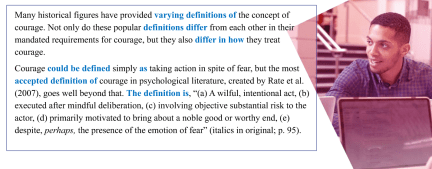
E.g. Skills for writing an academic essay, specifically in the opening part, the introduction, where they may need to define abstract concepts. Students might be shown an example which provides examples of the language needed.

It isn’t in itself a particularly engaging text, but it seems to Adrian that there are ways in which this topic could be made to be more interesting and engaging for less motivated students:

  • a lead-in to get ss thinking about the topic – brainstorming
  • discussion with concrete examples e.g. in what ways mght courage be an asset in these occupations
  • personalisation: think of a courageous person you know, what did they do which was courageous
  • prediction: get ss to write a definition of courage without using a dictionary

THEN look at the text.

So this is an example of bringing in features of General English methodology into EAP. This helps to provide motivation, it is generated by the task and teacher, bringing interest to the topic which does not HAVE to be dry.

Approach 2:

To actually choose topics which have general interest even if not related to learners’ areas of study.

Listening to lectures: identifying what the lecturer will talk about using the signals given (EAP focus: outlining content of a presentation). Can be done with a general interest topic e.g. male and female communication.

  • Start off with a topic focus: think about the way men or boys talk together and the way women or girls talk together. Do you think there are any differences? Think about…
  • Leads into a focus on listening skills: students listen to an introduction to a class seminar on this topic; identify how speaker uses signalling language, stress and intonation to make it clear what he is going to talk about

So those are a couple of examples of directions that EAP light could take. This is a crossover between GE and EAP, skills and language defined by needs, but the initial focus is on the topic itself rather than on the skills. Topics selected as academic in nature but have intrinsic interest. Motivation is enhanced through visuals, engaging tasks, personalisation etc.

Q and A

What is a good source of EAP light topics?

Adrian plugs his Academic Skills development worksheets – generally academic nature but of general interest. (They accompany “Empower”) If you are developing your own, look at the kind of topics in GE coursebooks and see if there are any that would lend themselves to EAP.

What about letting students choose their own topics?

A good idea if this is EAP where students are already engaged in academic study, as they will have a good idea of what they need. In GEAP it is important to choose topics which lend themselves to whatever academic skill you are developing as well.

What were the textbooks used in the examples:

EAP – Cambridge Academic English B2 level; GE- Empower B2 level


Using Google+ Communities with classes (2)

All of a sudden we are 5 weeks into term. This week, also known as 5+1 (so not to get it mixed up with teaching week 6, which is next week) is Learning Conversations week (the closest we get to half term, and only in the September term!) so it seemed a good time to take stock and see how things are going with Google Communities, following my introductory post from many moons ago.

Firstly, it must be said that the situation has changed since I wrote that first post: Now, all teachers are required to use GC instead of my Group on MOLE (the university brand of Blackboard VLE) because we had trouble setting up groups on MOLE at the start of this term. Nevertheless, I am carrying on with my original plan of reflecting and evaluation on my use of GC with my students because I think it is a valuable thing to do!

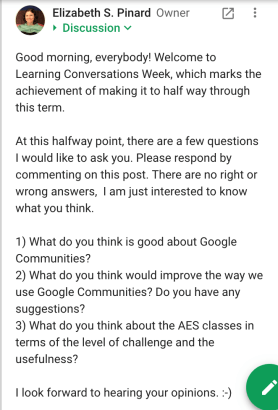
In order to evaluate effectively, I wanted to have the students’ perspective as well as my own, I posted a few evaluative questions in the discussion category of each of my classes’ GC page.

So, no science involved, no Likert scales, no anonymity, just some basic questions. (The third question was because I thought I might as well get their views on how the lessons are going so far at the same time!) I’m well aware of the limitations of this approach BUT then again I’m not planning to make any great claims based on the feedback I get and I’m not after sending a write-up to the ELTJ or anything like that either (would need all manner of ethical approval to do that!). I did try to frame the questions positively e.g. “What do you think would improve the way we use GC?” rather than “What don’t you like about GC?” so that the students wouldn’t feel like responding to the question wasn’t a form of criticism and therefore feel inhibited. An added benefit is that it pushes them to be constructive regarding future use rather than just say how they feel about the current use of it.

Before I go into the responses I’ve had from students, however, it would make sense to summarise how I’ve been using the GCs with them. I recently wrote about GCs for the British Council TeachingEnglish page (soon to be published) and the way I came up with for describing them in that post was “a one-stop shop for everything to do with their [students] AES classes” and that is basically what it has become:

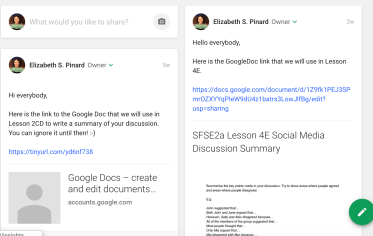
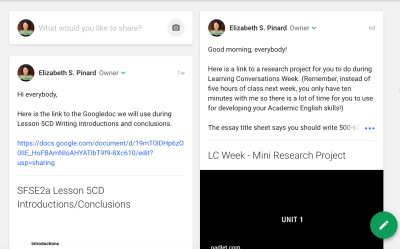
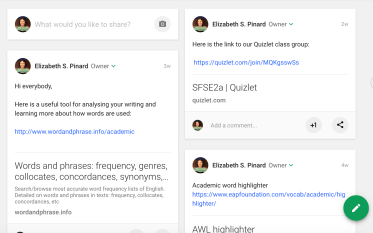
Speaking Category extract


Writing Category extract


Vocabulary Category extract


Listening Category extract

I would say the main use I have made of it is to share materials relating to lessons, mostly in advance of the lessons – TedTalks, newspaper articles etc – but also useful websites and tools, for individual use or class use – AWL highlighter, Quizlet, Vocab.com etc. Finally, it is great for sharing editable links to Google Docs, which we use quite often in class for various writing tasks. Other than these key uses, I have also used it to raise students’ awareness of mental health issues and the mental health services offered to students by the university, during Mental Health Week here (which coincided with World Mental Health Day) and to raise their awareness of the students union and what it offers to them.

In terms of student feedback, they think it’s “convenient”, “easy to use” and they “enjoy using” it. They also mention the ability to comment on posts (not present with My Group on MOLE) and communicate outside of the classroom as well as in it. In terms of suggestions for improvement, one student said students should use it to interact more frequently but that it should be clear which posts are class content and which are sharing/interaction. A couple of students also said they’d like the Powerpoints used in class to be uploaded there. However, those are available on MOLE. The trouble, of course, is that in using GC rather than My Group (which is on MOLE), students are a lot more tuned into GC (which we use all the time) than MOLE. I have no scientific evidence to back this up, but I suspect that be it academically or personally, if you have to use multiple platforms you tend to gravitate towards one, or some, more than others rather than using them all equally, particularly if time is very limited, as it is for busy students! (I could be wrong – if you know of any relevant studies let me know!) Unfortunately GC cannot fully replace MOLE as students need to learn how to use it in preparation for going to university here and they need to submit coursework assignments to Turnitin via MOLE. Perhaps, then I need to come up with ways to encourage them to go from one to the other and back, so they don’t forget about ‘the other’…

In terms of future use, I have set up a little experiment in that as part the of Learning Conversations that are taking place this week, we have to decide on Smart Actions that the students are supposed to carry out. E.g.


Go to Useful Websites on MOLE and explore the ‘Learning Vocabulary’ websites available. Tell your teacher which websites you visited and what you learnt from them by the final AES lesson of Week 6.

Some of them, like the above, lend themselves to posting on GC. In this way, not only do they tell me what they have learnt but also they share that learning with the rest of their classmates. So, in their learning conversations, whenever the Smart Action(s) were amenable to this plan, I have been encouraging students to use GC to communicate the outcome to me and share the learning with the rest of the class. We will see how it goes, if they do post their findings etc. Be interesting to see what happens! Another idea I’ve had is to do something along the lines of “academic words of the week”, where I provide a few choice academic words along with definitions, collocations, examples of use and a little activity that gives them a bit of practice using them, and get them to also make a Quizlet vocabulary set collaboratively (I have a Quizlet class set up for each class). Then perhaps after every couple of weeks we could do an in-class vocabulary review activity to see what they can remember.

Finally, it seems to me that Monday, being the first day of the second half of the term, is a crucial opportunity to build on student feedback by getting them to discuss ways in which we could use the GC for more interactive activities and find out what they’d be interested in having me share other than class-related materials and the occasional forays into awareness-raising that I have attempted. The key thing that I want them to take away is that I want the GC to work for them and that I am very much open to ideas from them as to how that should be, so that it becomes a collaborative venture rather than a teacher-dominated one.

We shall see what the next five weeks hold… Do you have any other ideas for how I could use GCs more effectively? Would love to hear them if you do!


Scholarship Circle: Giving formative feedback on student writing (3+4)

Time and workload have dictated that I combine two weekly scholarship sessions into one post, so this “double digest” is my write-up of sessions 3 and 4.

(For more information about what scholarship circles involve, please look here and for write-ups of previous scholarship circles, here

You might also be interested in session 1 and session 2 of this particular circle.)

Session 3

In session 3, we started by discussing the type of feedback we give students in their coursework. In CW1 (an essay outline), we give them structural feedback as well as pointing out where sources are insufficiently paraphrased, while in CW3 they get structural feedback and language feedback using the error correction code. We also talked more about direct feedback. We questioned where the line between direct feedback and collusion lies and decided that it’s ok to use teacher feedback to improve work but if they hired another tutor to correct their work, it would be collusion. We also came to the conclusion that direct feedback can be useful for certain things and that you could use it to scaffold learners e.g. in the first instance of the mistake, provide the correct form as a model; in the second instance of the mistake, provide the start of the correct form; in the third instance of the mistake, just highlight the type of mistake and let the learner correct it by themselves, using previous instances and feedback to help them. If there are any further instances of that mistake type, indicate to learners that they need to find and correct them.

We also talked more about this issue of correcting mistakes beyond those pointed out by the teacher i.e. proofreading work for more instances of the same mistake. In our experience, it frequently does not happen. In the masters research done by one of our number, the main reasons for that, given by the students when they were asked, were:

  • the belief that no comments = no mistakes
  • not knowing how to find/correct mistakes

However, with regards to the quick marks (i.e. error correction code on Turnitin), in terms of the students who participated in the study, 80-100% of quick marks resulted in successful revisions. Thus, on the whole, only when mistakes are pointed out are they are corrected, in general. This brought us back to the question of proofreading and learner training which we had touched on in previous sessions, identifying it as a definite need.

We acknowledged that we expect proofreading but that it doesn’t happen. This is partly because our learners are not used to it – they are used to having all errors pointed out to them. In some cases, as in one of the participants in the M.A. study, learners are not able to identify mistakes. In that case, the ideal situation would be helping those learners to find and correct the errors they ARE able to deal with it at their level. We decided that in order to help learners in both cases, more proofreading-related lessons are needed. They already have “Grammar Guru” which is an online interactive grammar tutoring tool, within which are activities that prompt proofreading for mistakes with the specific focus of a given tutorial e.g. articles.

However, the only time they do it with their own work is with CW3 and so we wondered if there would be scope for using work produced for writing exam practices as the basis for proofreading activities too.

We also looked at 2 tools for encouraging students to engage with their feedback:

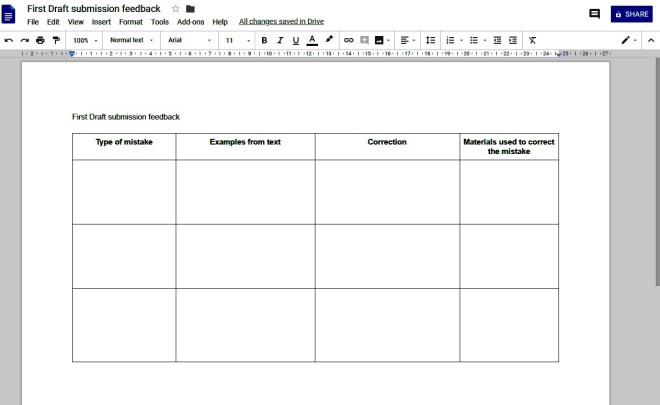
1. A google form, adapted from something similar which is used at Nottingham Trent, that encourages students to find examples of particular mistakes in their text, correct them and make a note of the materials used in order to make that correction:

The idea is that students complete it between receiving their feedback and attending their tutorial, so that during the tutorial the tutor can, amongst other things, check their corrections and suggest alternative sources.

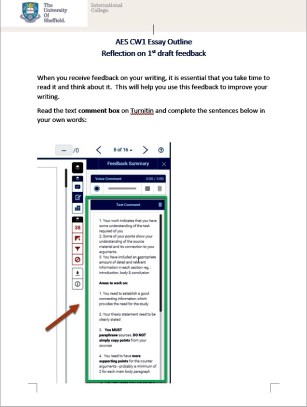
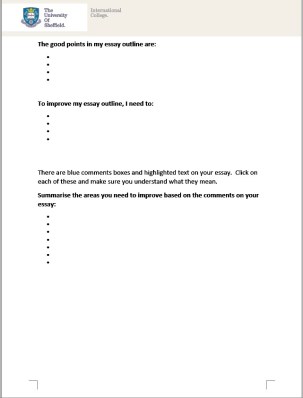
2. A form for students to complete that pushes them to reflect on their feedback:

As with the first one, this is intended to be completed between receiving the feedback on Turnitin and attending the tutorial, thus making the tutorial more effective than the common scenario where the student comes in not having even opened the feedback. We also wondered about the possibility of combining the two, so in other words combining focused error identification and correction with reflection on other aspects of the feedback.

Session 4

This week, in session 4, we mainly focused on the error correction code that we use. We looked at each symbol and accompanying notes, firstly deciding if it was a necessary one to keep and then refining it. The code, used on Turnitin, works as follows: We highlight mistakes and attach symbols to them. When the student subsequently looks at their text, they see the symbols and then when they click on the symbol, the accompanying notes appear. Our notes include, depending on the mistake, an explanation of the mistake, examples of incorrect use and corrected use, and links to sources that students can use to help them to learn more about the language point in question. Here is an example:

We paid particular attention to the clarity of the language used in the accompanying notes, getting rid of anything unnecessary e.g. modals, repetition etc, and the links provided to help students. The code also exists in GoogleDoc format so we all had Chromebooks out and were working on it collaboratively. There are a lot of symbols and there was plenty to say, so actually we only got as far as “C”!! (They are ordered alphabetically….!) This job will continue in the next session, which will be the week after next, as next week we have Learning Conversations which are off timetable so our availability is very different from normal.

I would be interested to hear what approaches you use where you work in terms of error correction, codes, proofreading training, pre-tutorial requirements, engaging learners with feedback and so on. Please do share any thoughts using the comments box below… 🙂

Scholarship Circle: Giving formative feedback on student writing (2)

Before we had time to turn around twice, Tuesday rolled around again and with it our weekly scholarship circle meeting, with its name and focus of “Giving formative feedback on student writing” (For more information about what scholarship circles involve, please look here and for write-ups of previous scholarship circles, here and to see what we discussed last week – in session 1 of this circle –  here)

A week is a short turn around time but a number (9, in fact!) of eager beavers, who’d all managed to read the article “Sugaring the Pill: Praise and criticism in written feedback” by Fiona Hyland and Ken Hyland in Journal of Second Language Writing, turned up to discuss it and relate it to our context. The article is, in its own words, “a detailed text analysis of the written feedback given by two teachers to ESL students over a complete proficiency course”. The authors categorise all the feedback by function; namely, praise, criticism and suggestions and analyse it accordingly. It’s a very interesting and thought-provoking article. However, the purpose of this post is not to summarise it but rather our discussion which arose from it. This is not as easy a task as it might sound!

Praise

We started by talking about praise. Something we found interesting, in both the article and a similar piece of research done for a masters dissertation by one of our number, was that the students in these studies were able to identify when praise was insincere/formulaic/there for the sake of being there. (Here we are talking about the general comments at the end of a text rather than specific in-text comments.) Additionally, also in terms of general end-of-text comments, students who receive substantial formulaic praise may automatically mentally downgrade it, particularly if the balance of feedback overall is in favour of praise i.e. more positive comments than suggestions for improvement. In connection with this, students were also found not to believe the positive general comments if they did not reflect the in-text feedback, which being more directly connected to the text held more weight for them. Finally, both the article and the masters research highlighted the danger of the suggestions for improvement in a praise-criticism sandwich being ignored/missed by a student and the danger of hedged comments (e.g. using modals) being misunderstood.

Another aspect of feedback which it was thought might lead to misunderstanding is our feedback guidelines here at the college, which stipulate that in our general comments we should include 3 positive points and 3 areas to work on. We discussed the possibility that this might be (mis)interpreted by students to mean that the piece of writing was good and in need of improvement in equal measure when in fact that may not be the case. We also discussed the importance of framing the negative points as suggestions rather than criticism, as well as of avoiding hedging and the aforementioned dangers of miscommunication that may go with it:

Compare

“Your writing does not have enough linkers so it is confusing” (highlighting a negative)

with:

“You should include more linkers in your work to make it clearer” (making a suggestion for improvement)

This would, in turn, be easier to understand for a student than:

“I wonder if you could include more linkers in this paragraph? This might help the reader.” (hedged)

or:

“This is a good introduction with a clear thesis statement and scope, however, you need to look at coherence. Go back to …. and consider… . I think you could also benefit from having a look at…  …it is quite advanced but I think you are ready to take your AW to the next level!” (Praise-criticism sandwich: the student in question ignored all the suggestions because the teacher had said it was good so they didn’t feel the need to make any changes!) 

Of course, as discussed in the journal article, teachers do use phrases such as “I wonder if” and questions rather than direct instructions to avoid appropriation of the piece of work and also to avoid being overly authoritative, in order to meet what Hyland and Hyland describe as the “interpersonal goal” aspect of feedback (in contrast with pedagogic and informational goals).  Our conclusion, based on the masters findings, our experience and having read the journal article was that teachers possibly worry too much about being polite in the feedback, which ends up being confusing for the student more than anything else. As here:

When the message gets lost…

Still relating to praise, we agreed that it is most effective when specific i.e. directly highlights something in the text that the student is doing well, a view supported by the article and the masters research. Carrying this over to general end-of-text comments, we wondered if ‘repeating’ what you have said in specific in-text comments (which I admitted to doing quite a bit hence raising the issue), whether positive or negative, might actually be a way of reinforcing the importance of the in-text comments in question rather than being redundant or otherwise negative and making the general comments more personalised/less formulaic.

Finally, one issue I raised was that on Turnitin, if you have all the in-text comments (both positive and negative – “negative”, including suggestions for improvement not just criticisms obviously) in a single colour in terms of highlighting, a student might look at that and assume their essay was terrible because of the quantity of highlighting. I wondered if using different colours of highlighting for positive and negative would alleviate that situation. However, it was also put forward that it might be even worse if students knew that code and had very few things highlighted in the positive colour!

Improving feedback

As well as identifying the potential issues with praise discussed above, we also discussed possible solutions:

Reframing general comments

We agreed that:

  • short, personalised comments would be most useful, to avoid misunderstandings and identifiable insincerity. (Our comments bank – a google doc of generic comments – does not currently fit this bill.)
  • in Turnitin we could make more use of the “T” option (which is along side the QM and the comment bubble options and which most of us were unaware of!). This allows you to write directly on the text in ‘blue ink’ – might be more personalised/allow more flexibility than the general comments in the comments box. It might also allow for less in-text highlighting for comments bubbles.
  • having a “3 positive things and 3 ‘negative’/to improve” one size fits all guideline is problematic as students are all different (though if you have 60+ students’ work to look at in a short space of time, is carefully tailored, individualised feedback realistically feasible?)

Learner Training

We decided that learner training was crucial for enabling students to make full use of the feedback and therefore make doing it worth our time and theirs. Firstly, for in-text comments to be truly useful, it was suggested that we need to explicitly train students to look for further examples of the mistakes we highlight using the Quick Marks (i.e. error correction code) as otherwise they will correct what we highlight but they won’t automatically apply it to the rest of their text. Perhaps part of learner training would be to train them towards the point where they can do that without being continually prompted in comments or tutorials. We also considered the need for recognising and differentiating between “treatable” errors (e.g. articles – there are rules that can be followed) and “non-treatable” errors (e.g. word choice), and giving appropriate feedback. For non-treatable errors, direct feedback, i.e. giving students the correction, is better, while for treatable errors we can use indirect feedback, i.e. identifying the error and asking students to correct it themselves, using clues such as error correction coding. Currently, most of our feedback is indirect, so this is something we may need to reconsider.

Another aspect of learner training that we discussed was how to train learners to make the most of their very brief (10-15 minute) tutorials. For these tutorials to be truly beneficial, we agreed that it was imperative for students to look at their feedback BEFORE coming to the tutorial. In fact, they need not only to look at it but also to attempt to respond to it, so that during the tutorial the tutor can check their attempts and help them with the areas they were unable to address independently. We wondered about using a pre-tutorial sheet to encourage them to do this, something that in order to complete they need to engage with the feedback. A couple of teachers have already experimented with this kind of thing with encouraging results so it is worth looking into.

All in all, we managed to discuss a lot in an hour – or just over, as we lost track of time! (You know it’s a good scholarship circle when the participants just can’t drag themselves away at the end! I think the reason this scholarship circle is going so well is that it has a very specific focus and it is one that is equally important to all of us.)

Homework for next week: to read a chapter by Dana Ferris called “Does error feedback help student writers? New evidence on the short- and long-term effects of written error correction” in a book published by Cambridge University Press called Feedback in Second Language Writing (edited by the same Hylands who wrote last week’s article!) Just from the title I am very curious about what Ferris will say, but I won’t have time to find out till at least the weekend!

Feel free to join in the discussion by commenting on this post! 🙂


Scholarship Circle: Giving formative feedback on student writing (1)

Today, Tuesday 2nd October, was the inaugural meeting of the newly formed “Giving formative feedback on student writing” scholarship circle which will take place weekly on Tuesdays here at the USIC arm of the ELTC. (For more information about what scholarship circles involve, please look here and for write-ups of previous scholarship circles, here.)

With a healthy turn-out of  ten teachers, the main goal for this initial meeting was to pin down what we want to get out of the sessions and how we are going to achieve it. We started with these questions:

  • What are we all here for?
  • What do we want to learn?
  • What shall we do with this scholarship circle?

We established that we were all there because we want to be able to give students better feedback. By better, we mean the right kind of feedback: feedback that they will a) be able to understand and b) benefit from. We therefore want to avoid the situation in which we put a lot of effort into producing feedback on their work and they don’t use it.

Our particular focus for this is first drafts of coursework assignments. We have CW1 which is an essay outline and CW3 which is either an essay based on the essay outline (foundation students) or a synoptic assignment research proposal (pre-masters students).

These are some of the questions that we want to answer, or respond to, in the course of this scholarship circle (the list may grow or change over the course of the scholarship circle, this is just our starting point):

  • How much feedback can students cope with? What is the right amount to give them?
  • What language should be used? (H’obviously this doesn’t translate as should we give feedback in English or Mandarin…)
  • How can we help students to access/use feedback more effectively? This includes Quick Marks (i.e. error correction code, on Turnitin), in-text comments and general comments, as well as helping students use them in combination. We also have some evidence from research done on our students suggesting that students prefer specific in-text comments as they are more memorable long-term than Quick Marks, which is something to keep in mind.
  • How can we help teachers use Quick Marks more effectively and consistently?
  • How and when do we praise students’ work? How do we do this most effectively, without seeming insincere?

From these questions, we settled on a short list of things to do:

  • Read “Sugaring the Pill: Praise and criticism in written feedback” by Fiona Hyland and Ken Hyland in Journal of Second Language Writing, so that we can discuss it next week. Dana Ferris was also recommended as a good author for sources about feedback.
  • Discuss and standardise our use of Quick Marks in a future Scholarship Circle meeting.
  • Discuss designing/creating learner training materials/classes to help our students develop independent use of formative feedback to correct their errors.

It was a short but fruitful session, setting us up nicely for our future weekly meetings. Watch this space for future posts tracking our progress and my reflections on our journey! 🙂

Using Google+ Communities with classes (1)

Have you used Google+ communities before in any capacity? I hadn’t until I and another ADoS colleague were asked to pilot it with our classes this term to see if it’s something we want to roll out for all teachers next term. As it is new to me, I have decided to blog periodically about it (probably this post as the initial setting up/first impressions/early days post, one or at most two posts during using it this term and a post at the end of term evaluating my use of it), primarily as means of reflecting on and developing my use but also as a means of memory outsourcing so that I can refer back to these posts when it comes time to give feedback about it!

In the past I have used other platforms with students e.g. Edmodo, Google Classroom, WordPress blogs and, more recently, MOLE which is the University’s branded Blackboard VLE. We still have MOLE (and will very much still be using it for lesson materials, assessment submission etc) but the Google Community is to replace the “My Group” folder we have on it, which was for sharing additional resources and information like tutorial timetables with students.

Setting up/first impressions:

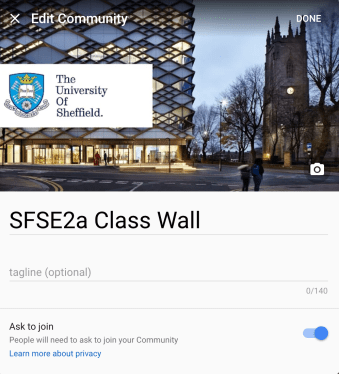
A Google+ community is basically a.n.other social media platform. They can be public or private, you can ask to join existent public ones or create your own and invite people to join you. When setting up, you give it a name and boom it exists. You can then edit it to give it a tagline (if you want to), a ‘banner’ picture (I used a picture of Sheffield University for obvious reasons) and categories. The categories are used for organising posts. The category that it comes with is “Discussion”. To this, I have added a category for each of the four skills and a category for vocabulary. So far that is enough but later I can add more categories as the need arises (it’s a continuously editable set-up rather than a one-off fixed set-up).

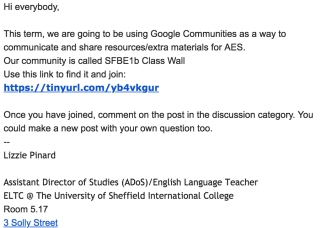
To “register” students, you need to “invite” them. This can be done via a link or via Google+. As far as I can understand, you need to be registered to Google in some way in order to enjoy i.e. Google Plus/Gmail. Our students all have a university email address which is a Gmail account and can access G+, so that isn’t a problem for us. However, it is something to bear in mind for situations where students may use a range of email providers and may not be registered with any Google app/product. I have access to all my students’ university email addresses via our system, so I sent them an email inviting them to join, using a link generated by “invite a member” in the community I had set up for their class:

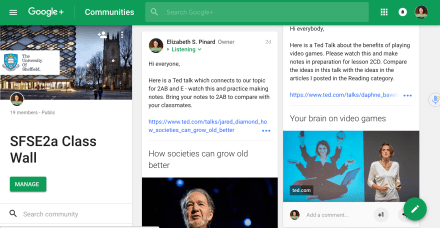
I sent it during the lesson just before I was going to introduce the G+ community, so that I could monitor while they joined and make sure everybody was able to do so etc. Prior to the lesson I added some content so that the students could immediately have a taste of how we would be using it, including a post with a question for them to answer by commenting on it (to highlight that it is their space as well as mine – supported by the set-up email that also encourages them to write a post of their own, which some of them did) and link to a TED talk that I was going to set for homework at the end of that lesson.

Other things I’ve posted so far are a link to a google doc that we will be using in class next week, a link to OALD and a link to some articles an another TED talk which I want them to read and watch in advance of one of next week’s lessons. I could have left them to post next week but I wanted it to not be empty when they registered, in the hopes that they will engage more if they immediately see the use/relevance of the platform. We shall see…

What I like about it so far (admittedly it’s early days, but…): 

  • It’s pretty! (I think so anyway…) I like that it looks nice, which is also helped by…
  • The ability to ‘categorise’ content so it is easier to direct students to it and if they want to go back to stuff, it’s much easier to be able to look by category rather than just a single stream of stuff.
  • It’s an easy way to share links to google docs for them to use in class for collaborative tasks (which we will do quite a bit of)
  • It’s easy to set up and ‘invite’ students
  • It’s easier to use than Blackboard, fewer steps to go through to share materials.

One thing I would like it to have that it doesn’t is the ability to schedule posts to appear at a given time in the future. I know Google Classroom has that function, amongst others, but, having used GC previously, I already prefer Google+ community otherwise. To deal with not being able to schedule posts, I have a sticky note on my computer desktop which is dedicated to reminders about when to post this, that or the other link or file. This is what it looks like so far:

Hopefully that will help me keep on top of things!

Looking ahead:

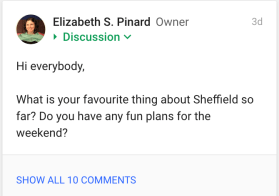
One thing I want to continue working on immediately is getting students to engage with the platform so that it can become more than just a repository for information and links. I’m thinking for starters a weekly discussion thread relating to something relevant to them and their lives as prospective Sheffield University students. Off the top of my head, I think it would be useful to raise awareness of the student mental health services at the university and the student union with all its clubs and societies and the library with all the services it offers. But also, discussions that capitalise on the range of nationalities represented (in one of my classes at least which is very multicultural). I think I also need to revisit the posts I wrote about using Edmodo, as some of the ideas there will be useable/adaptable too, even though the context of use is very different!

Overall, I think it has a lot of potential and I am looking forward to trying to tap into that this term. Watch this space!


ELTC Training Day 17/09/2018

On Monday 17th September 2018, the ELTC kicked off a new academic year with a training day. It was a particularly special day as it brought together teachers based at both Hoyle Street (ELTC) and Solly Street (The ELTC at USIC, which is the University of Sheffield International College run by Studygroup). Usually it is a case of “never the twain shall meet” – not because we dislike each other, but because timetabling just doesn’t allow it. Times that might be convenient to at least a fair number of teachers based at Hoyle Street aren’t possible for the majority of teachers based at USIC and vice-versa.

In the morning, there were parallel sessions running in two rooms, put on by teachers (including me) who had volunteered sessions. (The good news is, the teachers who volunteered sessions have all been asked to make a bite-size video about their session as sessions weren’t recorded on the day due to technical issues. So despite technical issues, we will be able to catch up with what happened in “other room”!)

In the afternoon, we came together in one room and we had a guest speaker talking to us about Mindfulness, a conference feedback session and a session about copyright issues. Before lunch, first I attended a session about the ELTC E-learning strategy which was a review of what has been done E-learning-wise over the last year followed by looking ahead to the forthcoming year and things that it is hoped will happen. For the second session, I repeated the talk/workshop I did at IATEFL about using the British Council Framework to systematise development. The third session in “my” room was the TD team and again it was looking back at TD over the last year and forward to possibilities for future TD.

E-Learning Strategy ELTC

Things we have done in the 2017-18 academic year: 

  • We now have the audio and video for various course books available on our (password protected) Resource Bank website. All relevant permissions for that have been acquired.
  • The Teacher Portal website has been given a makeover to make it more accessible in terms of layout and, amongst other things, now includes a link to teacher development materials (recordings, links etc) that have been and will be shared via email. The idea is to provide a central location where it can all be accessed so that when you finally have a bit of time, you don’t waste it trawling back through emails looking for something that was sent when you were up to your eyeballs in marking and didn’t have time to look at it.
  • The Student Portal website has also been undergoing development to make it more user-friendly and useful. USIC students are able to use it as well as ELTC students.
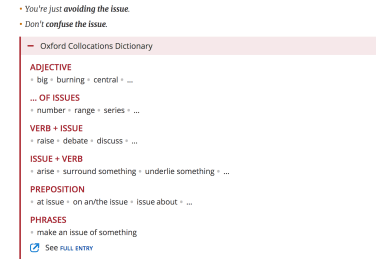
  • The International Summer School Pre-Sessional this year used a flipped learning model for the first time, meaning that half of the content was delivered online and half was delivered face to face. This also meant that a dedicated team produced 60-80 hours of interactive content (defined as “a combination of media such as text, audio or video combined with clickable elements [quizzes, questionnaires, typing in answers etc]”). Welfare-related content was also shared online. We looked at some examples of interactive content that were made for the International Summer School Pre-Sessional and I discovered that the OALD now lets you access Oxford collocations dictionary information when you search for a word: 

    Screenshot example from OALD showing the information from the collocations dictionary

Things we want to do in the 2018-19 academic year:

  • Develop more interactive content, including for year round courses. There is already a project underway working on materials for the SpLD service. Other ideas include induction materials, interactive rubrics to explain assignments e.g. essays, specific materials to support a particular programme, cultural and social guides, guides for particular tools and teacher training guides/content. To these, we were invited to share our ideas too, using a padlet which brought out some more interesting possibilities.
  • Continue working on the portals and the resource bank, to make them more accessible for teachers/students as relevant.
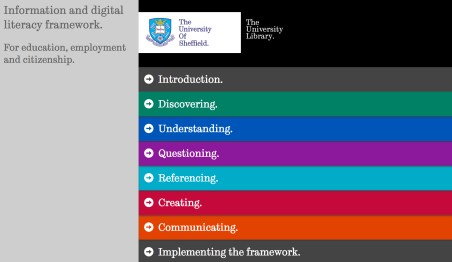
  • Try and link our digital literacy/technology training more closely to university policies/tools in use and “graduate attributes” as put forward by the university so that students . The library has a digital literacy framework with the skills/competences needed so that will also be linked.

    The Information and digital literacy framework page from the University Library

  • Develop online courses for teachers. The Learning Technologies in EAP course has run successfully a few times now with participants from all over the world. In addition, a new course will be piloted in January – “Corpus linguistics for language teachers”. This is a 6-week course to familiarise teachers with online corpus tools and help them use these in their teaching. (Sounds good!)

…In a nutshell! There was plenty of opportunity throughout the session for us to discuss and share ideas for future directions/developments which was nice.

“I don’t want to be a manager – now what?” How to systematise CPD using the British Council Framework (My session)

Here is a write-up of my session from when I did it at IATEFL in April. It was nice doing it at the ELTC as I could link specifically to aspects of CPD available here e.g. the Peer Development Scheme – confidential staff room peer review activities which could involve observing a colleague, team teaching with a colleague, assistance in finding materials, observation with specific developmental focus and discussion. Teachers can contact the Peer Development Team to organise any of these things. One of my goals for this term is to use it! A possible future goal might be to join the team…

“What’ve we got and what d’ya want?” What’s new in terms of TD resources, reflect on TD activities, and what you would like

We reflected on the TD activities offered in the last year. This involved looking at slips of paper, each of which had an activity on it e.g. Bitesize TD (15-30 minute videos made voluntarily by teachers about different things e.g. teaching multi-level classes, using Kaltura, using Googlekeep, Prepositions, Engagement through audio feedback), Training day, emails with mini-reflective tasks and, in our groups, identify which we had engaged with and select a top three. After that, we had to “shout out” (do you know it? It’s a site which allows students to use their mobile phones to send short messages to a central page which can be displayed on the interactive board) ideas for TD activities in the next year.

Activities:

  • Bitesize TD
  • Training Day
  • Emails with mini-reflective tasks
  • Emails with links to webinars/journals articles
  • TD Bulletin
  • Ad-hoc TD sessions
  • Scholarship circles
  • Sharing ideas around a particular topic on a padlet
  • Google Hangout discussions

Everyone was a big fan of the Bitesize TD! One thing that came out of the discussion around what could happen in the forthcoming year was a desire for more activities that bring ELTC and USIC together and, connected, opportunities for team-building as well as knowledge building.

Mindfulness and ELT

What is mindfulness? Mindfulness is returning to the present moment, being aware. You can ask yourself the following questions:

Am I aware of…

  • my feelings now?
  • my physical body?
  • my language?
  • my impact?
  • my state of mind?

Where is my mind?

Feelings change from moment to moment. Do you notice the transitions? Which one is you? Where is the anchor (when encountering difficulties etc.) ? Knowing and being aware of the feelings is an anchor.

We looked at two mindfulness exercises. One was a sitting mediation in which we sat with our hands in our laps with the position of facing upwards, four fingers above four fingers and thumbs joined at the tips. We had our eyes closed. We had to focus on all the different parts of our body and our mind in turn. The second was a walking mediation which entailed walking VERY slowly around the room and being mindful/aware (focusing on) of the entire movement of walking, bit by bit. Walking up and down stairs is another space to practice mindfulness but we didn’t try that.

Thoughts are like guests, while you are the home-owner. Knowing is always present, while thoughts/guests come and go.

In terms of ELT, you could:

  • use mindfulness activities (not necessarily the ones above but for example choosing one or two 2 minute activities from the Eight Form Moving Mediation – Sitting Posture of All Forms) at the beginning and ending of lessons. Being mindful of posture in this way can help maximise oxygen intake and energise students.
  • do a self-communication exercise: Get students to complete the sentence “When I encounter a difficulty, I usually say to myself….” and then “Next time I encounter a difficulty I can say…” This encourages them to think/self-talk in English and to acknowledge what is there, become more aware of it and tweak it to something more positive. This is an example of using awareness.
  • do a peer support conversation: students need reassurance and peers can reassure each other if they have the language to do so.

During the rest of the session, she talked to us about her time spent on retreats in Taiwan and China and the similarities and differences between those experiences (the subject matter of the research she is currently doing), showing us lots of pictures too. It was a very different session and we all felt remarkably refreshed afterwards! We also agreed that it was really nice to have something so different within the training day.

Conference Feedback Session

Five of us had five minutes each to feedback to everybody about a theme or a particular session or sessions that we attended. I spoke about inclusion (which covered differentiation, special needs, LGBT and materials development) and briefly mentioned professional development, in terms of the shift towards bottom-up rather than top-down development programmes that came through in the CPD forum – you can get a flavour of what I said here). Other topics from IATEFL were Action Research, Jim Scrivener and Adrian Underhill’s sessions. Two more sessions fed back from a BALEAP conference and one of those focused on assessing speaking skills, particularly interaction, and another was about acculturation. I couldn’t make notes about what any of them said because I was also at the front of the room! Once we had all had our five minutes, we each went to a different part of the room and teachers could choose one of the themes to hear more about and ask questions etc. It all seemed to work quite well. My group wanted to hear more about SpLD and I will admit to using my blog posts from the conference to help me tell them what they wanted to know! It was a nice interactive kind of session, rather than purely presentation, which it could have been if organised differently.

Copyright

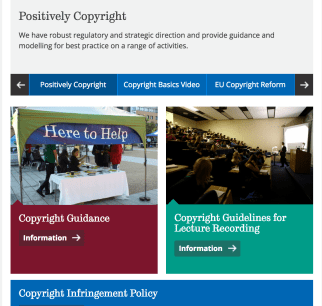
Two members of the library team came and did a session with us about copyright. We were introduced to the Copyright Hub which provides staff with information and guidance about copyright as well as signposting to relevant information. Obviously the information on it is tailored towards the licenses that the university holds, however, for anyone reading this who isn’t from the university, you can still have a nosy without being logged in to the university system!

An extract of the Copyright Hub website

After talking to us about copyright, the team gave use a board game to play which involved considering various situations and answering questions, while they monitored and helped where necessary. A useful session!

Overall, everybody participated very enthusiastically in the training day, which was very varied, and it was a lovely way to start the term. 🙂


IATEFL Webinar: Mental Health Training for Employers within ELT

On the 7th July (I know, I know, catching up…) I attended Phil Longwell’s IATEFL webinar about Mental Health Training for Employers within ELT.

He started by talking about research that he did, which he presented at IATEFL earlier this year, from which key things that came out were

  • most people think it’s a bad idea to disclose mental health issues
  • there is fear of reaction in the countries/cultures in question
  • there is still a lot of stigma around mental health
  • a small number people think it is a good idea to disclose in order to draw on support and to challenge stigma

For Phil’s write-up of his research and findings, please click here.

Then we considered stress. Lots of factors can cause it, there are no universal reasons and it is contextual. In teaching, things that can contribute are:

  • workload
  • perfectionism
  • job insecurity
  • meeting deadlines
  • demanding parents
  • large class sizes
  • lack of support/appreciation
  • harassment/bullying

Phil’s mantra to combat perfectionism and related stress is: “Good enough is good enough.”

Burnout is a significant cause of stress. You may feel overwhelmed by workload and expectations, you may feel complete exhaustion and that you can’t go on. There are various signs of it e.g. moaning, groaning, complaining, change in behaviour, over motivation and enthusiasm, absenteeism, missing deadlines, days off, extended sick leave. Acting on automatic pilot, avoiding contact with others and avoiding eye contact. However, none of these individually is in itself a sign of burnout, if a number are occurring over a certain period of time, it may be indicated.

We also looked at depression, general anxiety disorder, bipolar disorder, OCD, psychosis, panic disorder/panic attacks and schizophrenia. We had to identify each based on lists of symptoms. It was a thought-provoking exercise.

Many of these conditions will be hidden to a manager unless they are disclosed. They are “invisible” conditions. Drink, drugs and addictions can have an effect on these conditions. They may be used as coping mechanisms but can actually make things worse. For example, people smoke to relieve anxiety but it can make the anxiety worse.

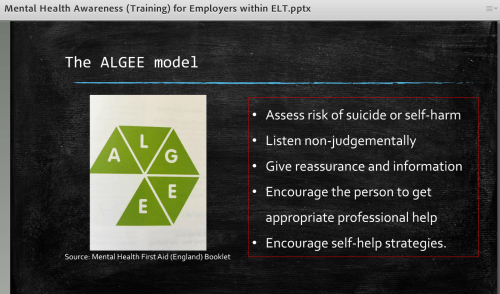
Then we looked at the ALGEE model for helping people who are suffering from a mental health issue.

Anxiety attacks/panic attacks are most likely to occur at work. The reason they occur is that something persuades the amygdala in the brain that there is danger. Therefore, if possible, somebody who is having one needs to get away from the trigger. If somebody has one, you need to help encourage them to gain control of their breathing again. They can last for a long time. You don’t need to be a doctor/medical professional to help someone. Just being there and trying to help them realise that the threat isn’t there.

Institutions can help support the mental health and wellbeing of their employees in a variety of ways:

“A beginner’s guide to being mental: An A-Z from Anxiety to Zero F*ks given” is a book by Natasha Devon that Phil recommends.

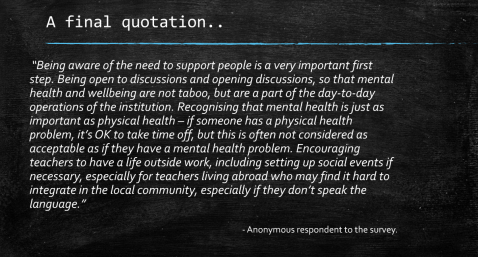
He finished with a quotation from his research:

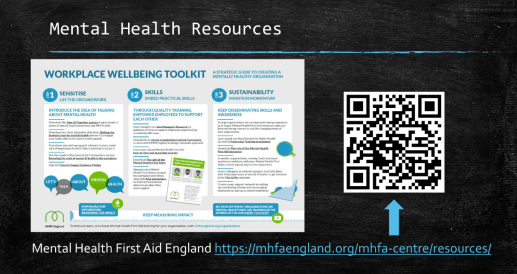
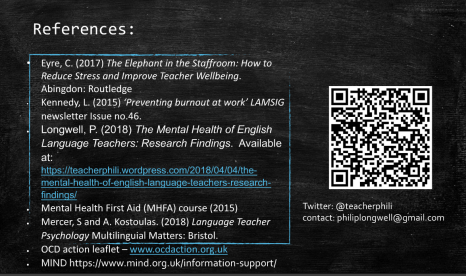
He also provided us with some mental health resources and his references:


Thank you Phil, it was a really interesting and interactive webinar.

I work in an environment that can be very stressful and demanding at certain times – key assessment periods and so on – but fortunately it is also a very supportive environment which to me has made a lot of difference. I think having supportive colleagues is extremely helpful when it comes to mental health. I also think ELT in general has an added layer of complication when it comes to jobs and mental health, in that for many people it involves moving abroad and integrating into a new place and culture, learning a new language etc. Dealing with all of those pressures, wonderful though they can be, is a massive extra load on top of the actual work aspect of it all. For myself, I find that my mental health is better now that I am back home, much as I enjoyed working abroad. I have a much better support network outside work (which I think is important) and I can pursue the hobbies that I love (running and cycling) in the countryside that I love, which is something that I struggled to do while abroad as I was afraid to cycle and lived in cities so running (my kind of running) was very limited. As such, I think it is really positive that mental health/wellbeing is being discussed more openly within ELT. I hope it continues to be the case so that progress can keep being made in this area.

To close, here is a useful set of resources about mental health in ELT from Sandy Millin.

Edit: Half an hour or after I published this post, an email came round from “Juice” – they are the Sheffield uni health and wellbeing lot  – which amongst other things reminded us about the new staff resources for mental health which were launched in May to coincide with Mental Health Awareness Week. Quite a comprehensive resource! It’s not for nothing that I feel grateful to work here.

University of Sheffield Workshop: Promoting positive mental health and challenging homophobic behaviour – 23 July 2018

On the 23rd July 2018, I was happy to be able to attend an LGBT+ inclusion workshop hosted by the LGBT+ Staff Network and Open@TUOS Allies, deliberately scheduled to coincide with Sheffield’s Pride week. (It also coincided with the one Monday that I didn’t have to lead a module meeting at 1.15, which would have clashed with the workshop and a day in which my teaching hours didn’t clash either!)
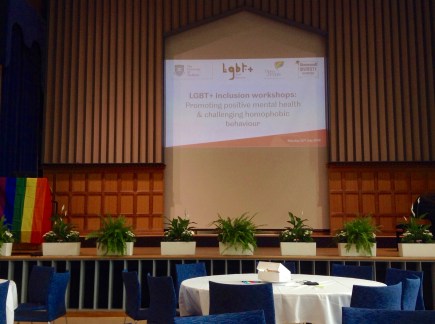
It is part of ongoing LGBT+ inclusion work at the University of Sheffield. Other examples include the “Open@TUOS” campaign (which currently has over 2200 supporters across the university, most of whom wear rainbow lanyards as a visible sign of support) and LGBT History Month . According to Professor Gill Valentine, who is the Provost and Deputy Vice Chancellor and who opened the event, the workshops were hugely oversubscribed.

The workshop was delivered by Josh Willersey from Stonewall.

The first session was focusing on mental health.

We started with a matching activity for terminology and definitions relating to LGBT. I was familiar with all the words except “gender variant”. Click on the link to have a go yourself!

Some of the things I learnt:

  • Until 1990, “homosexuality” was on the WHO’s mental illness list. (Very recent past!)
  • A “cisgender ally” is someone who is not trans but supports trans people. (“Cisgender” means your gender identity matches the gender you were assigned at birth – that I knew)
  • 1 in 200 people are born intersex (that’s more common than having red hair!) but often don’t know until if/when they try and conceive.
  • Gender dysphoria can affect intersex people who have invasive surgery at birth.
  • There is a lot of overlap between Bisexuality and Pansexuality (I knew that!). Some people who come out as Bi may actually identify as Pan but not want to spend their life explaining it to people.
  • 62% of graduates who were out at university go back into the closet when they start work as they don’t know if it is ok/safe/acceptable there or not. (You can out yourself by how you answer general questions e.g. answering honestly about what you did at the weekend. You make the decision whether to do that or not depending on how safe you judge that situation to be. This bit I know!)

After the terminology exercise and feedback, we moved on to mental health. Josh used himself as an example of a person who may be perceived to be “happy” (and even receive an award for it at work) but actually simultaneously be going through a hard time. This led us to the first question.

What are the barriers to talking about mental health?

We had to discuss this in our groups and then there was some “whole class feedback”. Here is a list of everything I managed to note down in the course of this:

  • still a stigma about admitting it
  • looked at different to physical health (e.g. at the uni, NHS delivers physical health services, but mental health services are the university’s responsibility)
  • people feel they should be stronger, that mental health issues are a sign of weakness and they don’t want to appear weak
  • labels have certain connotations – a person may be suffering from from a particular issue but not actually match up with peoples’ perceptions of what a sufferer of that issue is and does.
  • people feel like a failure if they have to “admit” to a mental health issue
  • the term “mental health” is too broad to be helpful. E.g. within the NHS they wouldn’t say “let’s improve our physical health service” it would be more specific like “we need to improve our asthma-related services”
  • gender issues e.g. “I am a man therefore I cannot talk about this” (i.e. norms and expectations)
  • cultural issues/pressures (again, norms and expectations-related)
  • lack of support available

Then we had a few statistics:

  • £70-100bn is the estimated cost to UK of mental health issues
  • 91 million working days are lost to mental health, it is the most common cause of absence (UK centre for Mental Health)
  • 53% of people would not feel comfortable disclosing mental health issues to an employer (MIND)

Focusing on LGB+ issues:

  • LGBT+ people are 50% more likely to experience long-term mental health issues
  • LGBT+ people are 2 times more likely to commit suicide than the wider population
  • Bisexual men are 4 times more likely to commit suicide than the wider population
  • 45% of LGBT+ young people are bullied at school, including via social media and text: home is no longer an escape/safe space. They are often bullied for being different, which is closely to linked to gender norms/expectations.
  • Young LGBT people are 6 times more likely to commit suicide
  • Alcohol misuse is 50% higher

Focusing on Trans issues:

  • 88% of trans people have experienced depression vs 1 in 4 of the wider population
  • Trans people are faced with two challenges: dealing with their own experience and dealing with transphobia in society which may take the form of harassment in the streets, people denying their identity, rejection by friends/family/general society
  • Transphobic rhetoric/language use is on the rise at the moment because of the changes in policy being discussed currently that would make it easier for trans people to transition
  • 60% (or 66% I can’t read my writing!) of trans people have attempted suicide
  • 77% have used antidepressants

In terms of health care provision:

  • 6/10 health and social care workers don’t believe orientation is relevant (And if LGBT+ people seek care, they may have to explain themselves/educate the care worker
  • 51%of mental health workers/counsellors/psychologists don’t believe orientation is relevant to mental health
  • 1 in 10 care practitioners believe you can be cured of being LGBT+ (Though there is now a commitment from the government to ban conversion therapy as it is proven to be very damaging)

Intersectionality

  • People with BAME backgrounds are more likely to be detained compulsorily for mental health issues
  • The greater someone’s level of socio-economic deprivation, the higher the risk of suicide being attempted
  • 25% of older people have a mental health problem
  • 54% of people with learning difficulties have a mental health problem

Having considered these statistics, we moved on to the all-important question of…

How the workplace can help/support people

Again small group discussion was followed by “whole class” feedback

  • take time to ask how people are and listen to the response
  • be alert to recognising differences in peoples’ behaviour that may signify that something is not right
  • be aware that people may be putting up a front (and a knee-jerk “yes” to “are you ok?” may not reflect the true picture)
  • be careful how you talk about people with mental health issues – others will pick up on it and respond accordingly (i.e. if you are disparaging or negative, they will endeavour to hide problems)
  • #Timetoalk prompts: shouldn’t need a prompt, caring, supportive discussion should happen all the time
  • if it reaches a “crunch point”, too many opportunities to intervene have been missed – it shouldn’t get that far
  • One of our group who works in the uni health service said they have a buddy system and timetabled coffee breaks for GPs, to combat isolation/stress
  • If someone is off sick, keep in touch with them (in a supportive way rather than a harassing way!)
  • Training about mental health should be offered (awareness-raising etc)

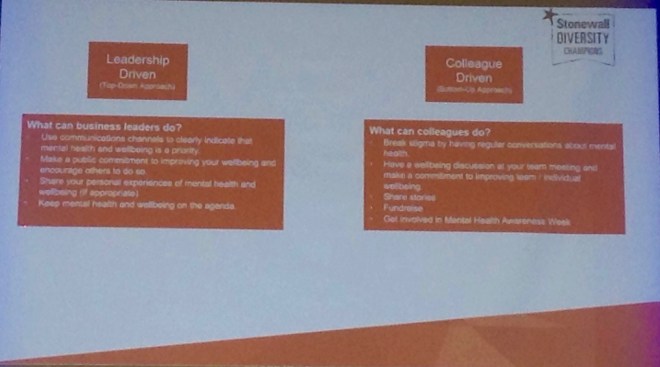
Here is the slide of suggestions that Josh shared afterwards:
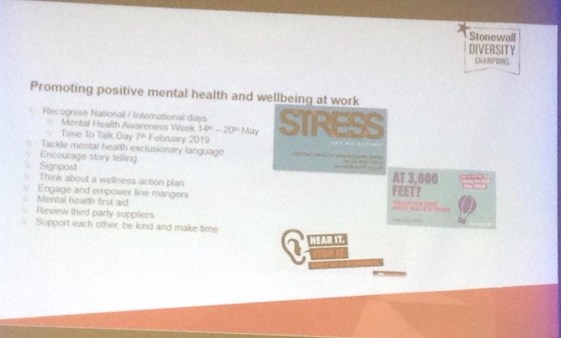
We were finally given some suggestions for promoting better mental health in the workplace and some resources relating to LGBT+ and to mental health:
The second session focused on bullying and harassment in the workplace specifically in relation to LGBT+ people. 

We started with some statistics relating to bullying/harassment of LGBT+ people in general:
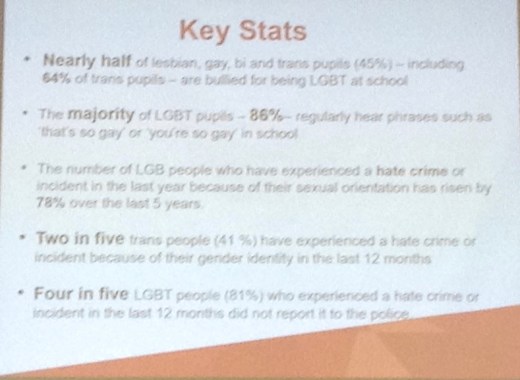
Bullet point three is partly due to increased likelihood of reporting compared to before but also links to rise in populism and validation of far right attitudes that has been seen in the last 5 years.

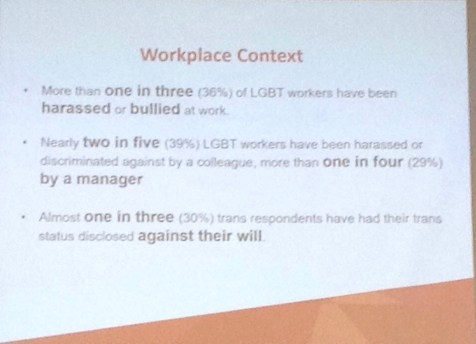
Then we looked at statistics specific to the workplace:
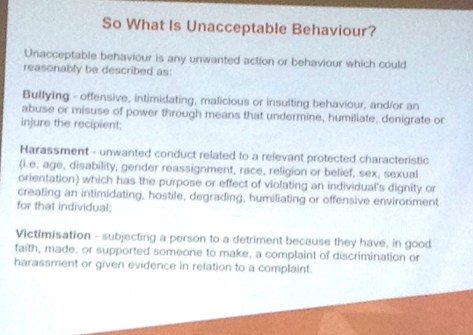
We talked about  behaviour and what is unacceptable behaviour:
Homophobia

  • Still rife in modern society, common to hear language such as “poof”, “gay boy” or “faggot”
  • There is still “moral panic” i.e. a fear of LGBT+ being more acceptable having a negative effect on children (why it should have a worse effect than heterosexuality being acceptable, I’m not sure…)
  • Calling something “gay” to mean sad/pathetic/rubbish still common e.g. “This lesson is so gay”. This use of language does impact people who hear it.

Biphobia

  • People consider bisexuals to be “confused”, “greedy”, “selfish”, “going through a phase”
  • People say bisexuals should choose one or the other – “choose a side”
  • People say that you can’t be bisexual unless you’ve slept with ‘both’ genders
  • People consider bisexuals to be more likely to cheat on their partners
  • People say things like “she used to be bisexual but then she married a man” (This does not make her magically straight…)
  • People make assumptions based on who the bisexual person is in a relationship with at that time
  • Bisexual people face discrimination within the LGBT community as well as from heteronormative society

Transphobia

There are more people identifying as non-binary (or various other gender labels, other than male/female) these days. This is partly because there is now the language to express it, there is information available online and times are changing: fluidity is more acceptable among young people. (This acceptance of fluidity and increased likeliness to have a fluid identity applies also to sexual orientation, with 50% of young people identifying as something other than 100% straight in a recent survey)

  • Tends most heavily to be aimed at male to female transsexual as that is the most commonly known about narrative
  • language such as “tranny”, “shemale”
  • People might say something like “you really can’t tell, can you” – which can be hurtful because the transition wasn’t about pleasing people aesthetically, it’s about identity
  • People might say something like “oh she was such a pretty woman before”
  • People might assume that it’s “just a phase”
  • People might police the toilets – “Excuse me, I think you are in the wrong toilet”.

(This seems like a good place to share a photo taken at the IATEFL conference in Brighton this year:)
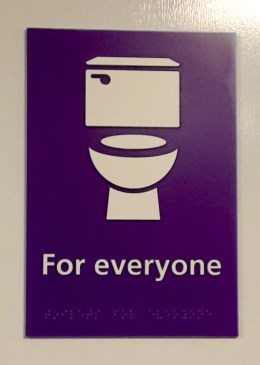
Like our classrooms should be – nice one, Brighton Centre!

  • Continued use of the wrong pronouns despite knowing the person’s preferences
  • Continued use of an old/dead name -known as “dead naming”, shows non-acceptance of the true identity
  • Asking what someone’s “dead name” was – can be hurtful/upsetting as often it is loaded with trauma for the person
  • Asking a trans person when they will have surgery – not all trans people do a medical transition

Then we considered what barriers there may be to reporting bullying/harassment in the workplace…

  • Fear of the effect on one’s career: not wanting to rock the boat.
  • Knowing that it could be explained away as “banter” (which can cover a multitude of sins)
  • Not wanting to be out to your manager
  • Not wanting colleagues to look at you differently

as well as the impact it can have on the person and the organisation. For a person, they may develop low self-confidence, become demotivated and/or suffer from anxiety/depression. For the organisation, overall it can lead to low staff morale, increased absenteeism, reduced productivity, recruitment and retention problems and possibly costly legal action/

So what can organisations do? 

  • Cultural change (takes time)
  • Policy: it should mention LGBT phobia as unacceptable specifically – it’s a lot harder to report something if it isn’t clearly articulated in company policy
  • Organise training around awareness-raising
  • Make use of inclusive messaging e.g. messages sent to all staff that send a positive, inclusive message around LGBT+ (such as the LGBT+ history month here)
  • Make sure reporting routes are clear to all employees
  • Have an LGBT employee network group

Responsibility

Who is responsible?

  • The source: the one whose behaviour is offensive
  • The target: should tell someone if their behaviour is upsetting. Discriminatory behaviour must be challenged (also among students!)
  • Any observers: there is no such thing as an innocent bystander, you should call out offensive behaviour
  • Person in authority: Managers should address inappropriate behaviour. It is the employer’s responsibility to maintain a respectful, inclusive environment.

How to call out inappropriate language/behaviour

UHT – I UNDERSTAND you don’t mean to be offensive when you say x, HOWEVER, it is offensive (and against company values?) to say x. THEREFORE, please don’t use language like that again.

Stop, Identify, broaden: Stop the harassment (if you feel threatened, you could just speak to the target so that they aren’t stuck in a 1-1 with the harasser); Identify the behaviour as discriminatory; Broaden the response by linking to company values etc.

I feel <x feeling> when you do <y action> and I’d like you to <a preference>

Having considered these approaches, we looked at three case studies:
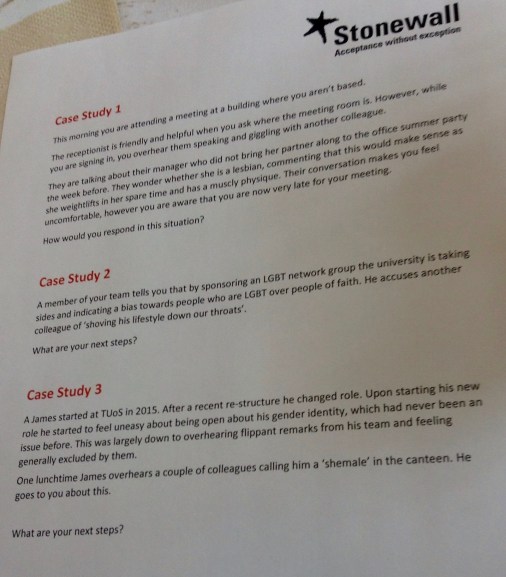
Again, group discussion was followed by coming together.

Case Study 1

  • We thought the main difficulty in such a situation is having “a way in” to talk about it. We came up with “I’m sure you’re not trying to cause offence but…”
  • We also thought the response might depend on the environment e.g. if this was at the uni, we’d be acting in a professional capacity and know that it is against organisational values etc. Policies/training may not be in place elsewhere, so if you are elsewhere, you might flag it up to a manager
  • Flip side, if you only speak to a manager, nothing may happen, so it may be better to speak to the receptionists (especially as regardless of location, reception is public-facing so anybody could hear what they were saying)
  • Don’t just do nothing

Case Study 2

After making sure the person being harassed is ok, challenge that person by getting them to explain their statements, using “why” a lot. Challenge their thinking:

  • There are LGBT+ people of all faiths. There are inclusive people and readings in all faiths. The two are not mutually exclusive.
  • Orientation is not “a lifestyle”, it’s part of someone’s identity
  • Both people of faith and LGBT+ have experienced discrimination for that identity
  • Faith values: acceptance and love, not hatred.

Encourage the person who was being harassed to report it

Case Study 3

  • Ask James what he wants you to do/how he wants you to proceed (very important)
  • Offer support/options (e.g. confront the colleagues involved, make a formal complaint)
  • If you are a colleague, encourage reporting
  • If you are a manager, follow it up

Focus on the action

In all cases, it is important to focus on the action rather than the person. I.e. “x is a homophobic thing to say/do”, rather than “you are being homophobic”. If you use the latter, then they will immediately be focusing on defending themselves (“I’m not, I have a gay uncle, I have gay friends” etc!) and that is not dealing with the issue of the behaviour.

Don’t be complicit

It is uncomfortable to challenge but it is also important, as we don’t know who is listening or how it could be impacting them.

That brought us to the end of the workshop.

My thoughts

I feel very lucky in that my workplace (my staffroom, my colleagues etc) always feels like a very warm, safe environment. I love seeing the rainbow lanyards around! It’s a nice feeling. I love that this university is 24th in Stonewall UK charity’s list of the top 100 most inclusive employers.

I think the topic and content of this workshop also has relevance to the classroom and to us as teachers as well as as workers. Statistically, there will be LGBT+ students in our classrooms. We need to actively make our classrooms an inclusive, safe place for them. This means that if students say things that are LGBT+phobic, we, as teachers, shouldn’t be a quiet Switzerland on the issue. We should be calling it out. Obviously this gets a lot more complicated if you are working in a context which is not tolerant of LGBT+ people and/or in an institution whose policy on this is undefined. I think ELT school managers should, where possible, have clear policy around LGBT+ bullying being unacceptable and teachers should be aware of this and know that they would be supported in calling students out on it. (A teacher can’t tackle such a problem without the support of the school – if the student complains, the school needs to be supporting the teacher.) This, of course, is affected by the students as customers perception that is common throughout ELT. Training around how to deal with LGBT+ issues in the classroom may also be useful. E.g. what would you do if in a unit talking about personal relationships, a female student refers to her partner as “she”? Is it a pronoun mistake or an assertion of identity? How do you establish which it is? How do you deal with other students’ response?

I also think that ELT materials need more LGBT+ normative content (gay people rarely exist in ELT course books – as Scott Thornbury famously said, they are firmly in the course book closet), but that’s another topic for another day…

What do you think?

Questions I want to leave you with

  • Is your workplace supportive of people with mental health issues?
  • Does your workplace have policy in place to combat workplace/classroom LGBT+ bullying/harassment/phobic behaviour?
  • Would you feel able to report this kind of behaviour (would you know who to report it to?)
  • Do you think that if you did report this kind of behaviour that something would be done?
  • Have you ever attended training relating to LGBT+ issues?
  • Have you had to deal with LGBT+ phobia in the classroom? What happened? How did you deal with it? (To give an example, I remember I taught a class that consisted of 3 Arabic men and I can’t remember why it came up but at some point they were ALL spouting some seriously vitriolic opinions about gay people. This was in the UK, in 2012. I had no idea what to do and I didn’t/don’t know what that school’s policy was on the issue. It was very awkward and uncomfortable! What would you have done? Fast forward to 2017, working at the ELTC, and in my elementary group, one of my students said he hadn’t seen any gay people in Sheffield/at the university. I challenged that by asking how he knows and gently pointing out that gay people don’t go around with labels on their foreheads to tell us they are gay. Gay people are just normal people. I also included gay family images in my Smartboard materials for the unit on families to supplement what was in the course book and statistics around mental health in wider vs LGBT populations in the UK in the spread on mental health issues. That was a much more benign situation BUT it needed to be dealt with and there was scope for awareness-raising. It DOES happen, the frequency is irrelevant – that it happens at all means we need to be equipped to deal with it effectively when it does. I think it would be useful for there to be more help with how to do that.)

Sorry for an extraordinarily long post, but it’s an important topic and there was a lot of ground covered in the workshop!

IATEFLections: a round-up for 2018

Reflections rather than elections! I thought I’d do a post that brings together the many posts I wrote at IATEFL in Brighton this year and my experience of the conference, accompanied by a spot of reflecting (this is, after all, Reflections of an English Language Teacher!)

Inclusion

For me, one of the themes I followed through the conference was that of inclusion. How to differentiate in the classroom? How to be more LGBT (and other “others”) friendly? How to recognise and deal with special educational needs in the classroom? How to adapt activities in a course book students with different needs? I think these are all very important issues to consider, as it is part of our job as language teachers to make our classrooms a welcome, helpful, inclusive place for all students. We need to get them all dancing (to borrow from a quote that Maria Dolores Gomez opened her presentation with)!

Like our classrooms should be – nice one, Brighton Centre!

Here are my posts related to this theme:

Differentiation

Difabilities (a better way to put it than “disabilities”)

Including everybody

I think there’s a lot we can do as teachers to make our classrooms a place for everybody, regardless of what they bring with them. I plan to blog more about this soon – am currently doing the Futurelearn course on Dyslexia and Foreign Language Learning that Lancaster University has put together and it is super interesting! Week 1 was mostly theory-based, the remaining three weeks have a lot more practical focus in terms of things to look for and things you can do. I’m looking forward to using some of what I learn.  Click on the picture below to find out more!

I’m already using some of the ideas and insights picked up in the talks at IATEFL. Nothing very dramatic so far, but it’s made me consider my practice from another perspective, according to different criteria, and make little tweaks, which is an interesting process!

Teacher Development and Teacher Training

I know these are two different things, but for the purposes of this post I have decided to group them. Especially because the teacher training post is about development for new teacher trainers!

I attended the Teacher Development forum, and it was interesting to see the 3 different approaches that representatives of 3 different institutions have used to create a culture of CPD where they work/manage. It’s always nice to get an insight into how other places do things. There seems to be a definite shift from top-down development to development programmes that enable teachers to take more control of their development while providing the scaffolding required for that to be done successfully.

I also participated in a workshop by Beth Davies and Nick Northall, who work at the ELTC here at Sheffield Uni and were both, in fact, tutors on the CELTA course that I did many moons ago. Though I am not a teacher trainer yet, it is an avenue I am interested in pursuing in due course, so it was interesting to have a glimpse of the things that new trainers have to consider and learn about. The session was as hands-on and action-packed as I remember my CELTA input sessions being, back in the day – rather a lovely trip down memory lane in that sense!

Finally, my own talk was about using the British council framework as a way of making development more systematic. In a nice, interconnected kind of way, given how the theme jumped out at me throughout IATEFL, I demonstrated the approach I set out using the “Using inclusive practices” portion of the framework. I had 40-something attendees, of whom, amusingly enough given the title, a fair number were managers! I think it went well – no rotten tomatoes were thrown at any rate…

Here are links to the write-ups of each of the above:

Emotional and Social Intelligence

I attended two talks which looked at different aspects of intelligence. One was about emotional intelligence in managers and one was about social intelligence for teachers. If I had to pick out something very simple yet very important from the social intelligence one, it’s that in order to have a successful group discussion, you need to get into group mode. In other words, you need greater awareness of the people around you and the space you are sharing together – focusing outwards as well as inwards, and being aware of your effect on what’s out there. The question that it sparks in my mind, though the talk was teacher-focused, is when we do group work with students, how do we help them to get into group mode? Bearing in mind that it may be more difficult for some students than others to do this. I don’t have all the answers, is just one of the many things I am thinking about at the moment! As for emotional intelligence in managers, the four key elements of it are: Self-awareness, self-management in terms of emotion, awareness of others (aka empathy) and managing others’ emotions. If you can’t do the former effectively, then you probably won’t be able to do the latter very effectively either, as the one is necessary for the other to be successful. Anyway, you have to deal with other peoples’ emotions more when you are an ADoS too, so it was an interesting talk for newly ADoS me! Who still doesn’t want to be an actual manager 😉

In the classroom

I always like to attend a few sessions that are directly linked to the classroom and practical things you can do it in. This year, in addition to all the talks about differentiation/inclusion which were also directly linked to an aspect of the classroom, I also went to a talk about peer assessment as a means of developing independent learning (something which we do a fair bit of here in the USIC arm of ELTC/University of Sheffield). I was familiar with many of the activities mentioned, but it was interesting to see how it is being done elsewhere and get a few ideas for possible tweaks for what we do here.

Another talk I went to which fits this theme was one about learning affordances in the classroom, which arise as a result of something unexpected. He showed us how to impose some order on those moments where you go off plan, and run with something that comes up, to maximise the benefit of these occasions.

Finally, James Taylor’s talk about teaching English in the post-truth classroom got to the heart of the need to equip students with the tools and skills to deal with a world in which truth is no longer a given. A lot of the knowledge and skills he mentions are ones that our students here have to learn in order to select appropriate sources for their academic assignments. It was interesting to see this being applied to classrooms generally, without the academic motivation.

Materials Development

I attended the Materials Wring SIG pre-conference event, which provided the majority of the materials-development related talks that I saw. The theme was “Writing for the World” and two of the talks were about inclusivity with regards to differentiation and special needs, so I have included those in that theme at the top of this post. The remaining talks were about ELF and materials writing (issues with current materials and how to deal with/embrace ELF as a materials writer), writing effective pronunciation materials, writing for language education in emergencies and development, and a panel that gave the audience the chance to question the speakers further about things that arose in the sessions.

In the main conference, I attended Heather and Julie’s session about versioning coursebooks. I’ve always* (slight exaggeration, but since I read Gray’s 2010 book about coursebooks and consumerism) wondered why there don’t exist versions of coursebooks for the UK. As vs using global course books which are not best known for their diversity and inclusivity (I won’t go any more into this now, I might blog more about it soon or wait and see my book chapter about writing materials for an English speaking environment, coming out next year! Suffice to say, when I posed the question at the end of the talk, no one in the audience had seen it done or had an answer!).

Wild card

There’s always a talk that doesn’t fit into any of the categories. This year, it was a talk about labels. I reflected on the content in my write-up so I won’t go further into it here, but I do enjoy the kind of talk that makes you think! Certainly there were some strong reactions from the audience.

So, that was IATEFL! And I shall finish off with a hearty round of applause to Brighton and the Brighton centre for their excellent job in catering for a vegan! I actually got to have the included lunch at the pre-conference event this year, for the first time in my vegan life! Also had some really good value sandwiches that really hit the spot. Pity Brighton is so far away from Sheffield!

Not sure when I will next be able to attend IATEFL but once again it has been a wonderful experience and one that has infused me with motivation and lots of interesting things to think about in relation to my practice. So worth all the time and effort (and dealing with the consequently manic week 3! – good news: I didn’t drop any balls, All The Things got done!!)  🙂

So long, IATEFL, till next time!