Some materials – at last! (Part 2)

I have just added another section of materials to my Materials page!

The materials are some of what I produced for the Materials Development module that I did as part of my M.A. in ELT at Leeds Met. The linked page contains further information and links to the materials themselves. I’d be interested to hear what you think (but understand that this may not be possible until I’ve uploaded the whole of the unit!) 🙂

I have now uploaded the second section of the unit – some reading and language focus – plus teachers’ notes. However, because I haven’t got copyright of the reading text – which is taken from Frank McCourt’s Teacher Man – I have blanked out the text. You could still use the sequence by sourcing the book and pulling out Chapter 14 pages 20-23 from “All right the bell has rung.” to “Just take the story and feel sorry for the kid and the mother with her countenance and, maybe, the dad, and not analyse it to  death.”  This follows on from the speaking section, which I uploaded previously.

Enjoy – and if you use them, please do let me know how it goes by commenting below or on the Materials page…

Language barriers, helplessness and the “new identity” (Part 2)

On the 25th September, I wrote about my experiences of arriving in Palermo, the vibrant capital of Sicily, with virtually no Italian and getting to grips with being a below elementary level language learner again. I also explored the idea of the second language identity, as my experiences made me reconsider the idea of learners having a target language name to use in language lessons (and perhaps mentally when negotiating the target language environment!). You can find that post here. This post is an update!

I had a couple of comments on my initial post, which gave me the idea of asking my learners what *they* think of the idea. This appealed to me because previously I’d only heard the idea of target language learners discussed in terms of ‘giving learners English names’, i.e. the teacher makes the decision and chooses the names. Last night, in my first lesson with my advanced learners, I broached the subject towards the end of the class after we’d done some getting-to-know-you activities and found their response very interesting.

Firstly, to give a bit of context, this was a group of six learners (there should have been more but they were absent!), of whom 50% were comfortably middle aged (two women and one man) and 50% were teenage boys. Quite an interesting demographic for a class (we all thought, it came up in discussion at one point!). Anyway, I started by asking them if they had any experience of being given English names in any of their previous English classes (at IH, at school, at university, wherever they had learnt English before). The answer was a unanimous no. Neither did they know anybody who had been given an English name. I had expected more of a mixture of experience (purely because when I was a British Council language assistant in France, many moons ago, I worked in a few French primary schools and some of the French classroom teachers had given their learners English names for use in English lessons… :-p).

I then asked them if this was something they would be interested in, at this point fully expecting them to say “no” but soldiering on nevertheless because I’d brought up the subject so I had to see it through! However, they unanimously said they would like English names. (I did then explain the reason for bringing it up – i.e. how I’d thought having an Italian name, for learning Italian and helping along my experimentation with Italian words and sounds, might actually be quite a nice idea.) They also asked if I was going to give them English names, but I encouraged them to choose their own. Interestingly (to me), they all chose Anglicised versions of their own names. I say ‘interesting’ because when I thought about having an Italian name, I didn’t then look for the Italian version of ‘Lizzie’ or ‘Elizabeth’ – I looked at a list of Italian girls names, to see if I could find one that appealed. Thinking about it, that’s quite a nice compromise though – you get the other language identity but don’t quite relinquish your own in the process.

Of course, these are advanced learners studying in a non-English-speaking environment so it’s a very different scenario from my own. It’s also a different scenario from what it would be for their lower level counter-parts at this school. Why? Because they already have a strong command of the language. Nevertheless, they are interested and have chosen their names, so next lesson I must remember to use these English names and will be interested to see it how it goes and what they make of it all as the course progresses. I wonder if they will use their English names when (if?!) they use the class blog I have set up for them: they will all have access to it using a single user-name and password, so they will need to put their name in the title line to identify their posts as their own.  I haven’t broached the subject with any of my other classes yet – mostly because I forgot! – but may do in the next couple of weeks. It will be interesting to compare different classes’ (different ages, levels etc.) responses to the idea.

As for my Italian persona, well, I’ve dabbled. I haven’t fixed on a name but the concept of trying to be Italian, I have used a bit – for extra spoonfuls of confidence! And at least I can now manage with ordering food and drink, rather than running away empty-handed: progress!

Finally, my questions from the initial post still stand:

  • Have you given or encouraged your learners to choose different names/cultivate a second language identity before?
  • How did you do it?
  • How did it work out?
  • Also, what was your context? (Were you in the target language country or in the learners’ own country?)
  • Alternatively, have you ever tried adopting a ‘new identity’ of any description before, in learning a foreign language?
  • Ever taken on a different name for your language lessons?
  • Have you ever used any materials (as teacher or learner) that exploit the whole ‘second language identity’ thing? If so, which ones and how did you find them?

I really would be interested to know! 🙂

Delta Tips 11: Writing a Module 3 Essay – the needs analysis section

This is the eleventh in a series of blog posts I’m doing in response to the number of Delta-related searches that bring visitors to my blog. Each post in this Delta Tips series will deal with a different element of the Delta, based on my experience of doing it (and surviving to tell the tale! ) at Leeds Met

 The module 3 extended specialism essay is a very special beast. If you thought Cambridge were demanding in their criteria for Module 2 LSA’s or perversely picky in how they want you to answer Module 1 exam questions – you’d be right! But, it’s nothing compared to what they demand you fit in to a measly 4500 words for Module 3…

  • For an overview of what’s required and tips for starting out, look at Delta Tips 9
  • For information about writing the first section of the essay – the introduction – look at Delta Tips 10
  • The focus of this post will be the second section – the needs analysis.

Now that you’ve done your secondary research and written your introduction, it’s time to think about your needs analysis section. This is where you focus on a specific group of learners and devise a needs analysis assessment, with the purpose of informing your course design (the focus of the third section of the essay).

There are several things you need to keep in mind when designing your needs analysis tools:

  • what you learnt from your secondary research and the implications this generated.
  • the principles of needs analysis, which should inform the design of your tools.
  • what you want to achieve with each of the tools you choose to use, which will also influence the design and delivery of the tools i.e. exactly what information you want to get.
  • where you can get this information from (the learners themselves, previous teachers, other stakeholders such as parents, management etc.)

Within the part two essay section (a whopping 900 words you have at your disposal here!), certain things need to be covered:

  • a brief profile of the group of learners that you are focusing on for this project. (Just so we are clear, these are the learners you do your needs analysis on!! :-p)
  • a brief description of your chosen needs analysis tools (what did you use? why those particular tools? why not any different tools?). This should include tools for identifying learner profiles/needs (e.g. questionnaires; interviews) and tools for ascertaining their language level/needs (e.g. diagnostic tests)
  • a brief outline of the results your tools generated and how this information helped you identify what you needed to know and what you are going to prioritise when you design your course (as well, of course, as why these priorities and not others)

In doing this, you need, of course, to demonstrate awareness of the theory and principles related to needs analysis. As you will be using diagnostic tests, then principles of testing/assessment come into play here: issues such as practicality, reliability and validity are as important in the needs analysis section as they are to the assessment section (part 4), so start reading up on these now!

Tips for successful completion of section 2:

  • Be concise: (Yeah, yeah – same old, same old, but worth repeating!! It doesn’t get any easier as the project progresses!) You have to cover a lot of ground in 900 words, so redraft and cut words down, think about how you can say things super-succinctly!
  • Be clear about how the principles of needs analysis have influenced the design of your tools: If you list a bunch of principles and then briefly mention your off-the-shelf placement test, you won’t be demonstrating awareness/understanding of the principles, only ability to regurgitate information…
  • Read about testing: Andrew Hughes Testing for Language Teachers is a good, clear read for getting the basics down. As mentioned above, principles of testing are very relevant. But look also at articles written specifically about needs analysis and diagnostic testing, as these will cover other related issues (See the bibliography at the end of this post for examples).
  • Read PAGE 72 of the handbook! Then read it again and make sure it went in. Why? Because it has your all-important guiding questions and advice. Worth re-reading both before you start and during and then after to check back and see if  you have done more-or-less what they require. Probably initially you won’t have! Don’t despair, it’s normal, just keep redrafting (both tools before you use them and the write up) – you’ll get there.
  • Show off: Yes, the whole terminology issue applies throughout the assignment – use the terms, reference the terms.  Just a reminder, like! (See my post about the introduction for more information about this! – Bullet point 6 under “Tips for doing this successfully”: Use and reference appropriate terminology)
  • Really think about what it is you are trying to find out with your tools: It isn’t practical to test every single thing under the sun, is it? No. So what are you going to test? Why? How will the information you gain from testing this help you design your course? The same questions go for your questionnaires/interviews – how will finding out this information help you? Whether you find and adapt a test or create one from scratch, be very clear about why you are including each question and what you hope to gain from it.
  • Look at examples and then get creative: In Jim Scrivener’s Learning Teaching, for example, you can find an sample needs analysis questionnaire. There are also examples in Kathleen Graves’ Designing Language Courses. Look at them, both in terms of content and layout. Imagine a student completing one and handing it back to you. How would that information help you? What information would still be missing? How could you get that missing information? When you’ve thought carefully about that, design your tools.  Remember that your answers should be influenced by what you’ve learnt, and the implications you’ve identified, through combining your secondary research with your experience in section one of the essay. When you’ve designed your tools, pilot them. (Get a colleague to complete the questionnaire/tests etc. and see if they find your questions clear!)
  • Analyse and evaluate don’t just describe: You will give your learners the questionnaire or interview them, you will give them diagnostic tests. How did you try to ensure that the results were as reliable as possible and would generate as useful information as possible? Whatever tools you use will have pros and cons – that’s ok: nothing is perfect. BUT make sure you show awareness of this. Why are your tools the best compromise in your circumstances?
  • Make clear links: How did you get from your implications in section one to your tools in section two, to the priorities you have identified from your results? One thing should lead clearly to another:
  1. You may want to refer back to the implications you laid out in section one.
  2. You may want to refer back to your results or to your appendices (where you will put an example of all the tests/questionnaires etc that you used and evidence that you have synthesised the information e.g.charts, tables etc.) when you identify priorities.
  3. This doesn’t need to take a lot of word count: putting A1 in brackets i.e. [statement e.g.”The majority wish to improve their employment situation and integrate socially – their priorities in doing this course”] (A1.vi [Appendix 1, part vi – which in this case was a chart showing reasons for learning English])  is a concise way of cross-referencing.
  • Spell it out! Use sub-headings. And I mean very specific subheadings. I know I already said this in the post about the introduction but it bears repeating. Really make it easy for the examiner to know that you have included everything that you are supposed to. You could, for sure, very cleverly weave everything in together in one body of writing, but then the examiner has to hunt out everything they are looking for. I would say, therefore, don’t bother. Keep it simple. Sub-headings all the way. It helps you keep track of what requisite information you have included and helps the examiner find it. It also makes it clearer for you to see if you have missed something. So, for example, if those are your implications for course design, label them as such. Bullet points are good too. Bullet point your implications and it becomes very clear where one implication ends and the next begins. Examiners like very clear.
  • Remember the importance of context: To an extent, a tool isn’t good or bad in itself – how effective or not it is depends on the context you are teaching in. A given test could be ideal for an exam prep class diagnostic but useless for a general English class diagnostic. A detailed test focusing on only one skill may be great if that skill is implicated as being a priority in your secondary research/implications but hopeless if your course needs a more general focus or a specific focus on a completely different skill. Equally, a questionnaire may suit one group of learners and generate really useful information in that context but produce irrelevant, unhelpful information in another. This is why you don’t just use an off-the-shelf tool without thinking it through and adapting it to meet your requirements first.
  • Don’t make things too complicated: Don’t use any tools for the sake of using them, don’t write reams about principles, that you then proceed to completely ignore in the design of your tools. Identify key principles, apply them to your tools. Demonstrate that you have done this by making it very explicit in your 900 words how you have used the principles to help you make the tools as effective as you could in your context.
  • (This may sound silly but) use colour! It doesn’t take (very) long and makes it easier on the eyes. I’m talking about headings, sub-headings, references to appendices/other essay sections. (Colour is also very useful in the course design section when you do your course map – but more on that later…) NB I don’t mean turn your piece of writing into a rainbow, but if you make all headings/sub-headings/references to appendices or other essay sections/bullet points a colour, e.g. navy blue, rather than black, they stand out better. This really hammers it home to Mr/Ms Examiner that you have, in fact, included what you are supposed to include and cross-referenced it…
  • Don’t forget to include the following: marking schemes for your diagnostic tools – these go in your appendices. Sample completed questionnaires and diagnostic tests as well as some evidence of synthesising/analysing the data. Colourful pie charts and bar graphs are handy for this. Tabulating information and your analysis of it may also be useful. (Exactly what you choose to do with it will depend on the nature of the information, your purpose in seeking it and the evidence you believe it offers.)
  • Remember your project should be comprehensible to a colleague – use this to your advantage: Get a colleague to have a look at your needs analysis section and your tools, to see if your section 2 makes sense to them. (It’s easy, when you spend so long staring at/working on a piece of work, to know *exactly* what you mean, where everything is and precisely how it connects. To an outsider, however, it may be a mystery. Of course, if it is a mystery to your colleague, it may also be somewhat mysterious to the examiner. This is generally not a good thing…! Also, if you can, write a section (and get your feedback, redraft etc etc) and then put it aside for a while. When you come back to it fresh, you may read through it and think, “huh? what on earth did I mean by that?” – in this case, you may want to make a few changes too…

Some useful sources relevant to the needs analysis section:

Davies, A. (2006) What do learners really want from their EFL course? in ELTJ Vol 60/1. Accessed: 22nd September 2012.

Cotterall, Sara.(2000) Promoting learner autonomy through the curriculum: principles for designing language courses. In ELTJ vol 54/2. Oxford University Press, Oxford. Accessed: October 11 2012.

Graves, K.(2000) Defining the Context in Designing Language Courses Newbury House Teacher Development. Heinle and Heinle.

Hughes, A. (2003) Testing for Language Teachers. Cambridge University Press. Cambridge.

Nunan, D. (1997) Getting Started with Learner-Centred Teaching in English Teaching Professional issue four. Pavillion. Accessed: 15, October, 2012.

Perrin, G (2009) Diagnostic Procedures in Language Learning MET vol 18 no 4. Pavillion. Accessed: 14 October 2012.

Seedhouse, P (1995) Needs Analysis and the General English Classroom  in ELTJ vol 49. Accessed: September 22, 2012.

 ***But remember***: New stuff is being written all the time; I’ve used some stuff that I haven’t listed – this is a selected list of references: This list is far from exhaustive!!! So use your search tools (see previous Module 3 posts) to find other books/articles too. Also, if you do get hold of sources from the above list, look at their reference lists (at the end of the article/book) and do the treasure hunt thing: Run your eye over the list, looking at dates and titles, think “hmm this recent and looks interesting, or this was referred to a lot in the book/article, so it might be worth a look” etc. and try to source them through your centre library. 

To see tips for the course design  section: click here.

If you think I am wrong in anything I’ve said or that I’ve missed anything useful from this section, then please comment and I will add whatever is missing to this post!  

Some materials – at last!

Finally I have added some materials to my Materials page!

The materials are some of what I produced for the Materials Development module that I did as part of my M.A. in ELT at Leeds Met. The linked page contains further information about them and links to the materials themselves. I’d be interested to hear what you think but understand that this may not be possible until I’ve uploaded the whole of the unit! (I have only uploaded the first section so far…)

🙂

Delta Tips 10: Writing a Module 3 Essay – the introduction

This is the tenth in a series of blog posts I’m doing in response to the number of Delta-related searches that bring visitors to my blog. Each post in this Delta Tips series will deal with a different element of the Delta, based on my experience of doing it (and surviving to tell the tale! ) at Leeds Met

 The module 3 extended specialism essay is a very special beast. If you thought Cambridge were demanding in their criteria for Module 2 LSA’s or perversely picky in how they want you to answer Module 1 exam questions – you’d be right! But, it’s nothing compared to what they demand you fit in to a measly 4500 words for Module 3…

  • For an overview of what’s required and tips for starting out, look at Delta Tips 9.
  • The focus of this post will be the first section of this essay – the introduction.

Logically enough, you begin your assignment by doing some secondary research i.e. investigating what has already been written about your chosen specialism. This should allow you to identify key common themes/issues. You then investigate these particular key themes/issues further and see if they are common to other specialisms as well, or just to yours. For this assignment, you also draw on your own experience of teaching and observing classes relevant to your specialism.

Thus, in 1100 words, then, you are required to:

  • briefly justify why you chose your specialism.

demonstrate awareness and understanding of:

  • the key theories and principles relevant to your specialism
  • the key themes and issues  relevant to your specialism
  • your own experience and whether this supports or contrasts with what you have discovered in your secondary research (there will likely be a mixture).
  • the implications of all the above on designing a course for a class of learners within the field of your chosen specialism.

NB: you do NOT discuss a particular class of learners at this stage. The key themes/issues/learner needs should be relevant to all learners within the field of your chosen specialism.

Tips for doing this successfully:

  • Draft, redraft, redraft: in my case, the introduction I started with bore only a small resemblance to the final product.
  • Make sure your own voice comes through: Rather than just describing what’s in the literature, also evaluate it in relation to your own experience and the implications this has on teaching and designing a course for such learners. (I struggled with this initially, as when I did my B.A., which was also the last time I had produced anything essay-like, we were generally expected to avoid having opinions except for in the conclusion. Hence, among other reasons, bullet point one…) The key word in the Cambridge handbook here is  “discriminating” – that is what they require your review to be!
  • Use sub-headings: Cambridge are looking for specific information, hence providing you with “guiding questions” on page 71 of the handbook. Fashion those questions into sub-headings and it will focus you on including the necessary information as well as flagging it up to the poor sod whose job it is to read your essay and identify the meeting or otherwise of all bazillion of the criteria on their list! Make their job easier and they will hopefully like your work better…
  • Refer to a wide range of resources: Books, journals, professional magazine articles… The ELT Journal is a great resource, as are English Teaching Professional and Modern English Teacher. With any luck your centre will have a centre subscription to them. If you are lucky enough to have a university library at your disposal, then as well as a ton of useful books, you may have access to a very wide range of journals. I imagine it applies to other universities as well, but if Leeds Met didn’t have a subscription to a given journal, they would source the article you were after for a very nominal fee (£2 or something). You can’t just pick up Harmer’s Practice of English Teaching and summarise what it says. You need to synthesise a variety of pertinent resources. (NB: Cambridge won’t know if you’ve read something unless you refer to it – your list of references is just that, a list of references NOT a bibliography.)
  • Use Google Scholar: It does a database search of all manner of literature. Once you identify what is out there related to your specialism and its key issues/themes, you can then set about finding out what you can get hold of through your centre library. (If you are at Leeds Met, use Discover. You should have written notes on how to use it when you had your induction but if you have lost them and can’t remember how to do it, ask someone who works in the library to show you)
  • Use and reference appropriate terminology: In other words, show off! You need to demonstrate your awareness of key theories/principles/issues. Undoubtedly there is jargon attached. Use it and reference it. It is very important to reference it because different authors often use terms in different ways to mean slightly different things. Which usage you choose doesn’t matter, as long as you make it clear what usage you have chosen and are consistent in your use of it. The easiest way to do this is to use a term and then put a reference ( i.e. author and year of publication) in brackets after it.
  • Be critical: Another key word in the Cambridge handbook in reference to what is expected of you is “critically” – everything should be critically discussed, not just discussed.
  • Remember to make it clear how your specialism differs from others: To show awareness of what makes your specialism special i.e. its key theories/principles/issues, you need to show awareness of how it differs from other specialisms. This may be as simple as contrasting it with a General English class, in the case of Business English/EAP/Exam classes or if you pick Multilingual classes, the obvious comparison would be Monolingual classes, and so on.
  • Make the link between your review and your implications for course design clear: The reader/examiners should be able to see where your implications come from. Don’t write a wonderful, critical, discriminating review and then tack some unrelated implications on the end! 😉
  • Make life easier for yourself: Don’t choose a focus which overlaps more than two specialisms and if you do overlap two specialisms, make sure one has clear priority. It might even be worth just deciding between those two specialisms and focussing on one…
  • Do your research and introduction first: Don’t start on your needs analysis before you have fully investigated your specialism. It will only make things complicated when you discover something key that you hadn’t thought about when designing your needs analysis tools! Probably good to write the introduction first as well as doing the reading: the process of synthesising everything will make it clearer in your head what those key issues etc are, which will enable you to make a better-informed, more useful set of needs analysis tools.
  • Use any support available: If you haven’t already done so, find out what support is available to you. At Leeds Met, MEET YOUR MINI-DEADLINES! 🙂 If you submit your introduction on time, it is a valuable opportunity to get detailed feedback on what you need to do to it to get it up to scratch. You’d also be able to ask questions about any of the feedback in the subsequent tutorial. As they say, well begun is half done. You may not want to, or have *time* to, redraft immediately once you’ve received feedback, but at least the feedback can help inform what comes next. Wherever you are doing Module 3, if you are doing a course, the tutors should know what you need to do – they are clever: they understand what Cambridge is after! – so that is one incredibly valuable resource. They won’t necessarily be specialist in your chosen specialism but they’d be aware of key texts relevant to it and of course of all the Cambridge criteria/how to structure everything etc.
  • Enjoy finding out a bunch of new, interesting stuff! Chances are you won’t know it *all* already, there is always something new to find. Much as it is challenging to meet Cambridge requirements, the project itself, starting from the introduction, should be a positive, useful experience. Especially if you have no experience of course design etc. So don’t forget to enjoy it and maximise on the learning potential.

Coming soon: Tips for the needs analysis section! Stay tuned… 😉 (Update: tips for the needs analysis section can be found here.)

If you think I am wrong in anything I’ve said or that I’ve missed anything useful from this introduction section post, then please comment and I will add whatever is missing to this post! :) 

Language barriers, helplessness and the “new identity”

Yesterday, I arrived in Palermo to start my new job at the International House here. I’ve never worked for an International House before but so far I am hugely impressed with how organised, helpful and supportive they have been (since I had the interview and was offered the job, up until now). Our induction timetable is truly a thing of beauty!!

Help is always good, but never more so than when you are in a foreign country whose language you don’t speak. My Italian is virtually non-existent so I am back to being a language learner – of the less than elementary variety! Back to being reminded just how difficult it can be to do something as basic as go into a cafe/bar and ask for some food/drink. Nothing is straight-forward, nothing is easy, everything is very tiring and daunting. I’ve done it before so I know the feeling but it’s easy to forget once you are over the language barrier and can function relatively normally.

I went into a food bar today, thinking I would pick up a slice of pizza. I went in and stood by the counter. A few minutes later, when nothing had happened and I didn’t have the guts to try and marshall the very simple language necessary to make something happen, I walked out again, feeling quite frustrated with myself. I shouldn’t be this helpless! But it’s daunting to open your mouth when you aren’t quite sure what will come out of it and what will be the result…  However, I also learnt a bit of Italian from an Italian and really enjoyed trying to say it and sound as Italian as possible! I think I was able to do that because it was a non-threatening situation and someone was telling me the words to say. And in those moments, I could imagine an Italian identity for myself – being this confident person able to speak Italian rather than helplessly clam up. Reflecting on that, I thought it would be quite fun to have Italian lessons, which included being given an Italian name to use during those lessons. To cultivate this Italian identity. Not that this identity would be a ‘not me’, but more a space to play with the language in, to experiment freely with sounds and words and gestures.

The funny thing is, I’ve always been quite anti- the idea of giving learners (of English) English names. But maybe instead of ‘giving learners different (English) names’, one could ask them if they’d like different (English) names and let them choose the names. I imagine it’s one of those horses for courses/marmite things – some would love it, some would hate it. I’m playing with the idea of experimenting, creating my own little Italian persona and using it as I try and learn. I’ve got a ‘survival Italian’ class on Friday, so maybe I will do it then – even if only *I* know about it! Maybe it’s something like creating a mental space for myself to get acquainted with the language, to develop some confidence in opening my mouth and asking for something instead of beetling off with my tail between my legs…

Anyway, now I’m very interested to know:

  • Have you given or encouraged your learners to choose different names/cultivate a second language identity before?
  • How did you do it?
  • How did it work out?
  • Also, what was your context? (Were you in the target language country or in the learners’ own country?)
  • Alternatively, have you ever tried adopting a ‘new identity’ of any description before, in learning a foreign language?
  • Ever taken on a different name for your language lessons?
  • Have you ever used any materials (as teacher or learner) that exploit the whole ‘second language identity’ thing? If so, which ones and how did you find them?

And what are your thoughts on this whole issue generally? Answers on a postcard, please!! (aka the comment box below) 🙂

Delta Tips 9: Writing a Module 3 Essay – Overview and Starting Out

This is the ninth in a series of blog posts I’m doing in response to the number of Delta-related searches that bring visitors to my blog. Each post in this Delta Tips series will deal with a different element of the Delta, based on my experience of doing it (and surviving to tell the tale! ) 

The module 3 extended specialism essay is a very special beast. If you thought Cambridge were demanding in their criteria for Module 2 LSA’s or perversely picky in how they want you to answer Module 1 exam questions – you’d be right! But, it’s nothing compared to what they demand you fit in to a measly 4500 words for Module 3…

The brief:

In 4500 words, you have to introduce and discuss your chosen specialism (including literature review, issues that are typical of it, some comparison with a different specialism…), your needs analysis, your course design, your assessment methods (both formative and summative) and your course evaluation, and then, finally, bring your assignment to its conclusion. Each section also needs to showcase your knowledge and understanding of the theory and principles, and therefore the literature, related to it. (Therefore, Concise should become your new middle name!)

The choice of specialisms is as follows:

  • Business English (BE)
  • Teaching young learners/young adults (specified age group required with 5-year range e.g. 8–13, 14–19) (YL)
  • English for Special Purposes (ESP)
  • English for Academic Purposes (EAP)
  • Teaching examination classes (EX)
  • Teaching one-to-one (1to1)
  • ESOL learners with literacy needs (ESOL)
  • CLIL/Embedded ESOL (teaching English through subject/ work-based learning) (CLIL)
  • Teaching monolingual classes (MON)
  • Teaching multilingual classes (MUL)
  • Teaching in an English-speaking environment (ESE)
  • Teaching in a non-English-speaking environment. (NESE)
  • Teaching learners online/through distance/blended learning (DL)
  • Teaching English to learners with special requirements e.g. visual/hearing impairment, dyslexia, ASD (SR)2
  • Language development for teachers (LDT)
  • Language support (e.g. on mainstream teaching programmes, specialist skills support, such as supporting writing needs) (LS)

Starting out

Ideally, you will have thought about what you would like to specialise in before you start your course. Some centres (e.g. Leeds Met) even give you a pre-course task to focus your thinking in this respect. However, don’t be hell-bent on sticking to your initial decision – it may be that what you want to do isn’t an ideal choice. Hopefully you will discuss your choice with your tutor early on, so be open to their advice. I, for example, started out wanting to do Young Learners who need EAL support in schools in the U.K. but I had no access to such learners, no experience of teaching them and it didn’t fit comfortably into the Cambridge specialisms list either. All in all, following a very helpful tutorial, I changed my specialism to Teaching in an English-speaking environment (ESE).

Tips:

  • Don’t choose a specialism that incorporates too many different Cambridge specialisms. E.g. One-to-one business English over the telephone (or Skype) is a type of teaching that absolutely exists BUT it combines Business English, Teaching one-to-one and Distance Learning which is too much to juggle effectively in 4500 words.
  • Do choose a specialism you have some experience with. It’s easy to start out with lofty ideas of using Module 3 to learn about a new specialism, and perhaps if you are doing it over an extended period of time, working at the same time, with access to the type of learners you want to focus on, it may work a treat. However, if you are doing a 10-12 week intensive course and not working, then logistically it becomes a lot more difficult.
  • Do find out what the drafting procedure is with your centre. (E.g. At Leeds Met, they have a series of mini-deadlines where they take in a draft of each section and comment liberally on it, as well as giving you a tutorial to discuss the feedback for each section. Some centres may take in a complete draft to look and feedback on, rather than doing it in stages.) Then, follow it!! Meet all the deadlines, take every opportunity to get feedback/guidance. This will help you fashion something that meets all the pernickety Cambridge criteria.
  • Do read the Delta handbook for Module 3. (I know, it’s at the back of the handbook and, if you are doing all three modules simultaneously, you probably started out with good intentions, but then got bogged down with looking at the Module 1 section and gave up. Skip module 1, save it till later, read module 2 if you are doing module 2 and read module 3. They are shorter sections than module 1 and do contain useful information…)  The module 3 section contains criteria and a series of questions for each section, that your corresponding section is supposed to answer. (At Leeds Met, you do discovery tasks that make you get friendly with these criteria and questions by making you answer questions about them in relation to an example assignment, so you see how they can be answered/embodied. Hopefully your centre will have their own way of helping you get to grips with it all, but, either way, make sure you read the handbook!)
  • Do read lots. Find out what the key texts related to your specialism are (your centre may give you guidance on this – at Leeds Met we got a lengthy reading list divided into specialisms) and get them out of a library or cheaply from Amazon marketplace.
  • Do also think about issues that relate to your specialism e.g. for English-speaking Environment, issues such as intercultural competence, English as a Lingua Franca and culture shock are all relevant.
  • Do use journals and professional magazines as well as books – these contain up-to-date articles and are much quicker to read than books. With ELT Journal, for example, you can do a database search and find articles that are relevant to your specialism and to individual section principles/theory: some will be oldies but goodies, some will be very up-to-date.  A mixture of both is recommended.
  • Do think about your writing style. Are you using the correct way of referencing? Is your writing accessible enough? (Mine was far too academic initially!) You don’t want to include long quotes because the word count is too minimal to allow for it without other things getting lost. Paraphrasing concisely and following it with the reference in brackets is one way of referring to the literature in a word count-effective way.
  • Do build your reference list as you go. Be organised about it. (You don’t want to be running around at the last minute looking for all the details of all the books and articles you referred to throughout the essay. You won’t have time…)
  • Do refer back to the handbook and see if you are in fact answering those questions that they have listed. Ask someone else to compare your assignment and the questions, to see if you are answering them – you may think you are, but another set of eyes may not agree… (Of course, your tutor will also tell you if are missing important stuff. Hopefully sooner rather than later, but that depends on how the course is organised and when they look at drafts etc.)

Coming soon: Tips for the introduction section!

If you think I am wrong in anything I’ve said or that I’ve missed anything useful from this general overview/intro, then please comment and I will add whatever is missing to this post! 🙂 But more specific stuff will come when I deal with each section individually… 

#ELTChat Summary for 18-09-2013: How can we help learners produce natural talk in everyday, casual conversation?

For anyone who is not yet aware of it: #Eltchat is a Twitter hashtag which offers Twitter-based discussions that take place every Wednesday at 12.00 and 21.00 BST/GMT (when the clocks change). The topics, all related to the ELT industry, are listed on the  #Eltchat website, together with some background reading, a few days in advance of the discussions. The tag #eltchat can also be seen throughout the week as an identifier of all things that might interest those who work in the EFL industry.

On 18.09.2013, the 21.00 BST discussion was on the topic “How can we help learners produce natural talk in everyday casual conversation”. (I was busy finishing my dissertation at the time, so couldn’t take part, but volunteered to do the summary when it was offered on the #ELTChat Facebook page!)

The suggestions were many and varied. (I’ve divided them into categories and expanded abbreviations to make it easier to process!):

Authenticity and Input

  • Authentic materials help a lot!  I use “Real Lives, Real Listening” series a lot. (North Star ELT -now Collins) (@elawassell)
  • I encourage watching soap operas – in English – lots of natural exposure, but it might not be everyone’s cup of tea (@elawassell)
  • The thing that needs to be most authentic is the reason for their communication – it has to mean something to them. (@theteacherjames
  • By using listening that contains natural talk rather than ‘model dialogues’ (@Marisa_C)
  • Get involved in social media communication…find real friends to speak English with. (@HanaTicha)
  • Role of input via listening also quite important #eltchat and types of activities which focus on chunks of language (@Marisa_C)
  • Ask sts to repeat what you’ve just said now and then.  See if they’re noticing these natural language chunks. (@ljp2010)
  • Use typescripts etc for them to identify useful chunks. (@Shaunwilden)
  • Teach them discourse analysis i.e. do  conversational analysis – moves, politeness rules, coherence etc (@Marisa_C)
  • Record an authentic conversation on video and use @dotsub to transcribe and share with Ss. Using authentic models are helpful (@ESLhiphop)

Drama

  • Acting out whether playacting (rehearsing) or roleplaying (producing more freely) can help  (@Marisa_C)
  • We’ve been using scenarios for our students..Today is Thurs..your essay should be in by Fri..you are not ready..you have to chat with your tutor.. (@shaznosel)
  • One activity I have used with monolingual classes – act out scenario in L1 then listen in L2 and compare – language/attitudes, style.  Have them prep their improvisations in groups or pairs – act out THEN listen or watch video – it’s fascinating to watch. Often they don’t [end up with similar things] – which is interesting – the cultural element is interesting as this raises awareness of that. (@Marisa_C)  I do something similar by asking students to look at video with no sound and working out conversation from gestures (@Shaunwilden)
  • For freer activities I keep a set of situations which Ss improvise as a skit and class spots roles, setting, relationship etc (@Marisa_C)
  • Drama can include relaxation, trust building and fun, can lead to role-plays and that… with less anxiety (@Marisa_C)

Identity

  • I’ve seen the suggestion that the use of masks can help learners become more uninhibited – they adopt the character of the mask (@pjgallantary)
  • What about props? small things to lend credibility to the new identity?  (@Marisa_C)

Small Talk

  • I think small talk starts with the teacher. It can settle a class and it produces natural language (@SueAnnan)
  • It’s really important to engage students in normal conversations outside of class time, while waiting, break time etc. Helps them relax (@theteacherjames)
  • Finding out about students usually produces natural speech too (@SueAnnan)
  • @sandymillin shared her lesson on #smalltalk here:http://t.co/Yg205gQlGv my Ss found it useful (@Ela_Wassell)

Methodology, Approaches and Techniques 

  • Rehearse and then revisit, all too quickly teachers move on (@Shaunwilden)
  •  How about some good old-fashioned drilling then? (@ljp2010) yes why not? Not necessarily old fashioned but well conducted, snappy oral practice can help a LOT! (@Marisa_C)
  • Don’t throw the baby out with the bath water. ALM is not “stylish” today, but it has its merits (@ESLhiphop)
  • Speaking’s like tennis practice: you need to intensively practice a single stroke, but you also learn by playing games. You need both. (@ESLhiphop)
  • As a variation sometimes you could ask Ss to define the topic and stage manage a CLL lesson where they learn and eventually record new chunks (@Marisa_C)
  • How about getting them to create their own personalised phrasebooks – with functional headings (@Marisa_C) Or a voice memo one should they wish to hear it instead? (ljp2010). Nice idea, phones help with that too as they can record the pronunciation (@Shaunwilden) or make their own recordings on something like Vocaroo and email it to themselves
  • Learning a language again: what sparks our classes are topics we care about, then we make effort even with minimum vocabulary (@annabooklover)

Some potential pitfalls were also identified:

  • When I lived in Brazil, everyone told me watching soap operas was a good way. I’d prefer not to learn the language!! (@theteacherjames)
  • If someone asked me to wear a mask I’d feel about 10x more self conscious! (@theteacherjames)
  • The problem students have with natural talk is ‘performance anxiety’ – in sports parlance, some sudents end up ‘choking’ (@pjgallantary)
  • I think it [new identity] can go too far, e.g. giving Chinese students Western names (@pjgallantary)

Meanwhile emerged some other questions that need to be pondered:

  • It does raise issue of what is ‘identity’ – many students feel like different person when speaking in English. (pjgallantary)
  • Personally I have observed that lack of fluency in any given area is often caused through the teacher’s reluctance to ask students to rehearse (@marisa_c)
  • Do you think teaching language chunks more could help? I think it’s important for fluency (@elawassell)
  • I’m not keen on the new identity, but being forced to temporarily be someone else can be useful (@theteacherjames)
  • But here’s a question: do you feel like a different version of ‘you’ when speaking in different languages? I do! (@pjgallantary)
  • The question is how to scaffold a speaking activity…  (@marisa_c)
  • Does improvisation work that well esp. at lower levels? (@Shaunwilden)
  • Control vs freedom always a worry but teachers need to intervene when needed – either facilitating or providing language needed (@Marisa_C)
  • How do you raise awareness of what is natural and what isn’t? (@Marisa_C)  Aye this is quite tricky, was thinking that listening to people in London today, nothing like we expose students to (@Shaunwilden)
  • Can drama activities help? (@Marisa_C)
  • What do confident,fluent, but not necessarily accurate speakers do that grammatically accurate but reticent speakers don’t? I suspect that confident,but inaccurate,speakers actually don’t give a stuff for the lang. ‘target’ and get lost in the performance (@pjgallantary)
  • How else can one practise a variety of language functions unless some kind or role activity – new ID or self in other contexts? (@Marisa_C)

So plenty of ideas and plenty of food for thought – what more could you ask from an #Eltchat?! 🙂

IATEFL 2013 interview about Learning Technologies

Earlier this year, I was privileged enough to attend the IATEFL conference in Liverpool, enjoying a dizzying array of brilliant talks and catching up with people from all over the world.

Fortunately, by the time of this conference, I’d done just over half a semester of my M.A. in ELT at Leeds Met, and, thanks to the Multimedia and Independent Learning module, I was able to find something to say when I became one of a number of people that Nik Peachey interviewed on the theme of Learning Technologies.

I was very kindly given permission to upload the clip of me being interviewed onto my blog and now I am finally getting round to doing this. (The clip arrived in my inbox shortly prior to my dissertation deadline – ’nuff said!)

The two questions that Nik asked me are:

  • Some people say that technology can replace language teachers. What do you think?

and

  • Do you think technology use in the classroom is driven by technology rather than by pedagogy?

(If I appear a bit confused about where to put my eyes, it was a case of the camera not being behind Nik and me finding it very difficult to look at the camera rather than Nik, unaccustomed as I am to being interviewed! Oops… 😉 )

Don’t worry, the clip is only 2.21 minutes long! 🙂

MATSDA July 2013 Presentation – Is enjoyment central to language learning? A snapshot of M.A. student materials developers’ perspectives (The write-up)

Before I finally consign my cue cards for this presentation to the bin, I thought I’d write up my talk from July this year… 

Is enjoyment central to language learning? A snapshot of student materials developers’ perspectives.

My small-scale project and presentation both emerged from a combination of ruminating on the conference theme, Enjoying to learn: the best way to acquire a language?, and doing a materials development module as part of my M.A. in ELT at Leeds Met. Being an annual two-day conference of the Materials Development Association, the conference theme gave rise to a few questions in my mind:

  • Is enjoyment central to materials development and learning?
  • If it is central to learning, how much control do materials developers have over it?

I decided to focus on the materials development perspective, thinking that it would be interesting to see what lesser-heard materials developers’ voices had to say, since the views of the great and good in ELT are already widely known,  and contrast this with what I could find in the literature.

My intuition told me that the themes of motivation, affect and engagement would feature prominently in my exploration of the issue and this was backed up by the data I collected. Thus, I decided to focus on these themes for my literature review, in addition to the theme of enjoyment itself.

Motivation

Dornyei (2005; 2013) coined the L2 Motivational Self System. This consists of 3 components:

  • Ideal L2 self: This refers to a learner’s future self image, hopes and aspirations in relation to using the foreign language.
  • The ought self: This refers to the attributes a learner believes he or she ought to possess, in terms of using the foreign language. So this relates to someone else’s vision with regards a learner’s foreign language usage.
  • The L2 learning experience: This refers to “situation-specific motives related to the immediate learning environment and experience (e.g. the positive impact of success or the enjoyable quality of a language course)”

Enjoyment, then, fits into the third component of this L2 Motivation Self-system: The “enjoyable quality” of a course may motivate learners to continue learning, as may success. Of the three components, this third is the only one that relates directly to the current learning environment and the effect this has on motivation, and we can draw the conclusion that enjoyment may be a factor in motivation. However, it is worth noting  it’s an “or”, rather than an essential component. How essential a component it is will depend largely on the learner’s personality and learning goals.

Affect

Krashen’s affective filter hypothesis aims to account for lack of acquisition in the face of appropriate input. Within this theory, the affective filter is “a metaphorical barrier that prevents learners from acquiring language even when appropriate input is available” (Lightbown and Spada, 2006:37). Where does enjoyment fit in with this? If we enquire in to what makes the affective filter go up, we find that “a learner who is tense, anxious or bored may ‘filter out’ input, making it unavailable for acquisition” (Ibid). Thus, lack of confidence, worry, insecurity, nerves, or as mentioned by Lightbown and Spada, tension, anxiety or boredom, may all contribute to the affective filter going up and preventing acquisition. This being the case, the learner would certainly not be enjoying him or herself.

However, enjoyment is not the opposite of all of these things, though it may emerge if the opposites are cultivated. The opposites themselves are confidence for lack of confidence/insecurity, interest for boredom, calmness and relaxation for anxiety/worry/nerves. These enable learning by lowering the affective filter. Do they arise from enjoyment? Possibly, but not necessarily.

Engagement

Engagement appears with high frequency in the literature. It often collocates with ‘cognitive’ and ‘affective’:

Cognitive Engagement:

“Thinking while experiencing language in use helps to achieve the deep processing required for effective and durable learning (Craik and Lockhart 1972)” (Tomlinson, 2010:88-89)

 Affective Engagement:

“Affective engagement with language in use also has the considerable advantage of stimulating a fuller use of the resources of the brain (Bolitho et al. 2003:256)

The argument for engaging learners cognitively is that the increased depth of processing that results leads to a greater degree of learning taking place. It requires the transfer of higher level skills such as predicting, connecting and evaluating.  An example of a cognitively engaging activity would be a consciousness-raising grammar-based task.

The argument for engaging learners affectively is that this fires up neural pathways, which enables the multi-representation of language that is required for deeper processing of language and more meaningful learning.

It is widely agreed that both of these are central to language learning and acquisition. Now, one could argue that affective and cognitive engagement equal enjoyment. However, enjoyment does not necessarily equal affective and cognitive engagement. As an extreme example, a learner could be sat in the back of class happy as a clam, daydreaming about the hot date they have planned for that evening – they’d be enjoying themselves but they would not be engaged.

Enjoyment

Having explored the above three themes, I also investigated the role of enjoyment itself in the literature. A search, using Evernote’s search function, of Tomlinson (2012)’s literature review of Materials Development for Language Learning, only identified a single allusion. This was to Grant (1987) and was being used as an example of a poor evaluation criteria. Questionability of criteria aside, this was a case of appropriacy to context/age/level of learners that would be the design goal rather than ‘enjoyment’ per se. Enjoyment may emerge, but not necessarily.

I also searched a few other key articles (see list of references) and then did a database search of the ELT Journal. I looked for “enjoy” and “enjoyment” and limited the search to titles/abstracts as key words should be mentioned in these. This gave me ten results. 8 were related to reading and listening, 1 related to writing and 1 related to strategies, recommending that learners try to enjoy performance anxiety.

There are obvious limitations to this exploration – I did not search all the articles that have ever been written and my database search was only of one journal. However, I felt that if enjoyment was important for materials development, then it would have been mentioned in Tomlinson’s 2012 literature review. I also did not search for synonyms of enjoyment, but this was deliberate: synonyms are tricky and can mean subtly different things. For example, engagement. I found in my study that people often associate enjoyment and engagement, using the two interchangeably in some cases, and of course engagement is prominent in the literature, but they are different.

To illustrate this difference, one need only look at the definitions of each term in the Oxford Dictionary. This clarifies that enjoyment can be passive but engagement is always active. Enjoyment can and might emerge from engagement but it is not necessary for it. For example, that cognitive consciousness-raising task might not be at all enjoyable but learners may be very engaged and learn from it.

In summary:

  • Learning plus enjoyment = fantastic.
  • Learning minus enjoyment = fine, especially in certain contexts.
  • Enjoyment, minus learning = arguably pointless?
  • None of above = the learners will probably not be returning to class tomorrow, given the choice.

When might there be learning but no enjoyment? As per the previous example, the CR grammar task – analytic learners may enjoy it but experiential learners probably will not. Both types of learners, however, may be engaged and learn from it, if they understand the purpose and view it as useful. There could be parallels drawn between this and musicians who practice their scales in order to play beautiful music. A hobby musician like me may not bother with this but the musician who wants to play in a top-class orchestra or pass a grade 7 music exam will. It’s not enjoyable, but it can be worth it. This is where motivation comes in – it affects what is considered important.

The Study

The context for my study was Leeds Metropolitan University’s M.A. in ELT Materials Development module. I had 4 participants – 3 students and 1 tutor – and I had one research question: Is enjoyment central to the development of language learning materials? My hypothesis was No, because I didn’t recall it being prominent in classes, individual tutorials or informal chats with colleagues. Of course, this could have been a flawed recollection, so I decided to explore my course mate’s perspectives on the role of enjoyment in learning materials, by interviewing them and looking at a sample of the materials they produced for the module assessment. I also interviewed our tutor in order to gauge the possible effect of her influence over their answers by looking for similarities and differences and tutorial input vs tutorial take-away. The interviews were all 1-1 interviews, and I asked each course mate the same set of questions. I asked my tutor a similar set of questions but slightly adapted so that they were relevant to her role.

The limitations of my study are, of course, it’s size, imposed by the number of willing participants. However, it still provides a snapshot. I believe the interview effect was not present in either the interviews with my course mates, or that with my tutor – my course mates and I have a symmetrical relationship and they had nothing to gain by trying to impress me, while my tutor and I have an asymmetrical relationship, but in which she is superior to me, so again nothing to gain by trying to impress me.

When I presented this project, before showing and discussing the results, I showed a sample of each respondent’s materials, together with the set of questions used, and asked the audience to confer to infer possible answers.

Results

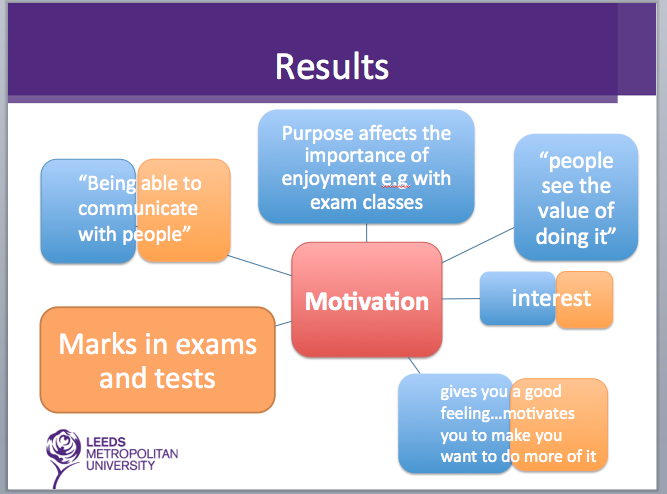
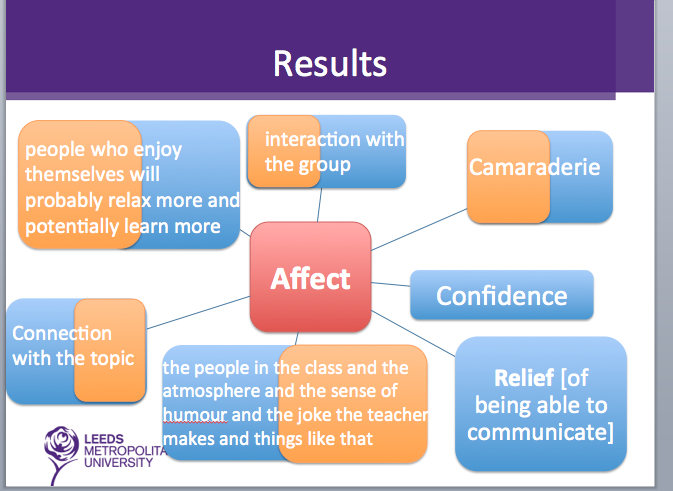
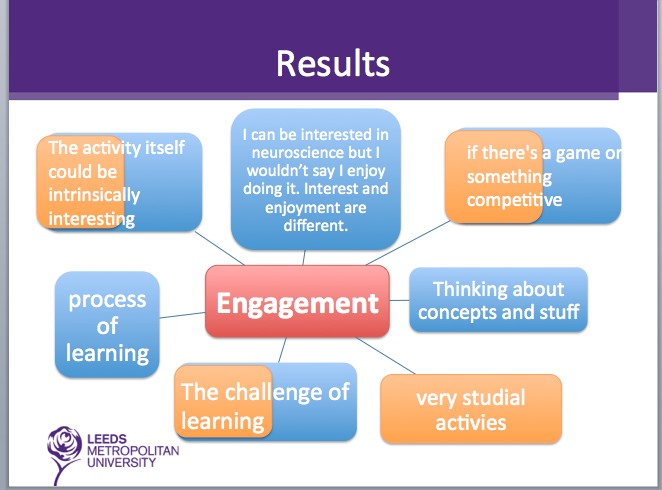
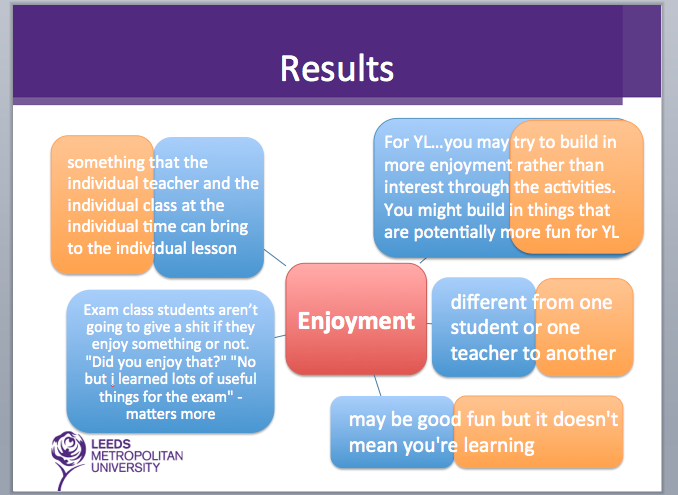
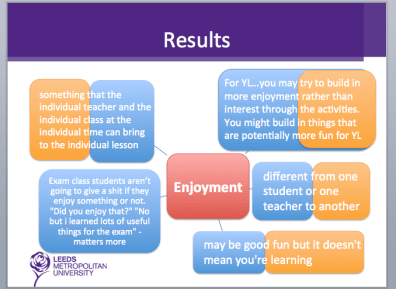
I organised my results around the themes I used to conduct my literature review, using colour to differentiate between ideas that arose from my course mates (blue) and ideas that arose from my tutor (orange). I used a 50% split of colour for the ideas common to both. Perhaps unsurprisingly, as our tutor’s views were bound to be very influential during the course of this module, there is a substantial amount of overlap. However, my classmates did express ideas of their own that weren’t echoed in the answers given my tutor. Here is a summary of the results:

Motivation
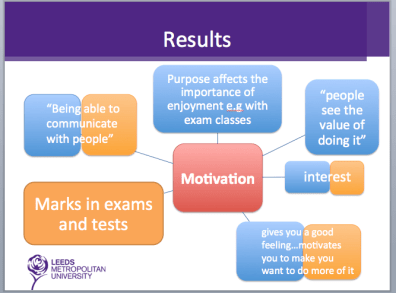
Screen Shot 2013-09-17 at 10.13.02

Results slide 1: results related to motivation

These are the ideas relating to enjoyment that I thought were linked with motivation. Some relate to intrinsic motivation, some to extrinsic motivation (or the ideal self/ought self) and some relate to the L1 learning process leading to motivation. So, motivation is certainly important, according to both my respondents and the literature.

Affect
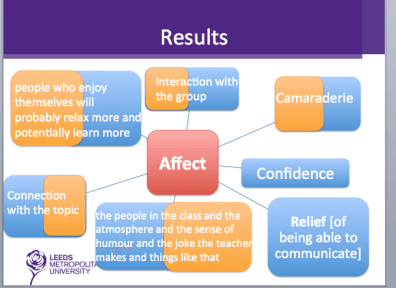
Screen Shot 2013-09-17 at 10.15.01

Results slide 2: results related to affect.

Enjoyment was also linked to positive affect. Thus, relief, relaxation, interaction, camaraderie, confidence and connection with topic all contribute to the lowering of the affective filter, and if these are present then it is safe to say that enjoyment would not be far behind.

Engagement
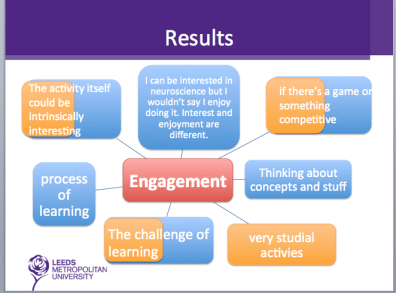
Screen Shot 2013-09-17 at 10.15.08

Results slide 3: results related to engagement.

Enjoyment was also linked strongly with engagement. My respondents seemed to agree that enjoyment emerges as a result of engagement. Thus, interest, challenge, the learning process, studial activities, concepts and games/competitions were all associated with both engagement and enjoyment – possibly because if a learner wants to be engaged in these ways, then when the need is met, their enjoyment will likely emerge.

Enjoyment
Screen Shot 2013-09-17 at 10.15.16

Results slide 4: results related to enjoyment

This is what emerged with regards to enjoyment itself:

  • The importance of it depends on context (age, purpose of learning etc.) and personality (it’s subjective, important to some but not to others).
  • It doesn’t necessarily mean learning.
  • It probably means happy students, unless they are more interested in learning than enjoying themselves and feel that enjoyment is being promoted at the expense of learning.

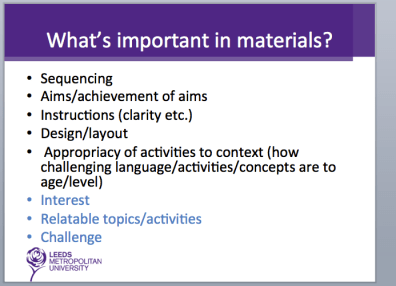
Materials design/development
Screen Shot 2013-09-17 at 10.46.21

Results slide 5: what’s important for materials design/development?

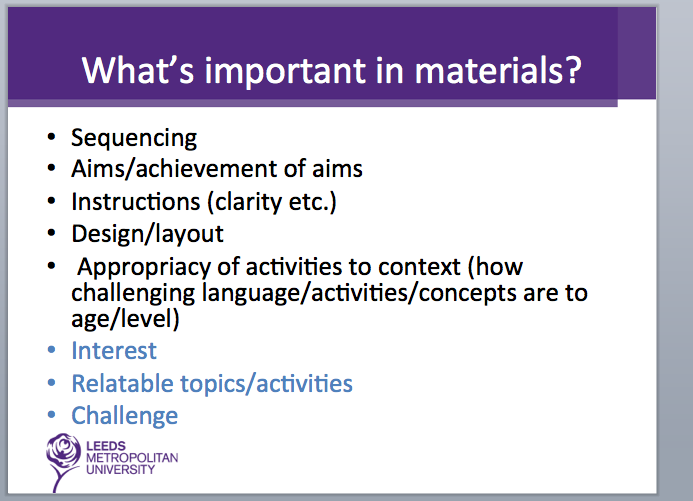
This is what emerged in terms of what is important in the design and development of learning materials. The three factors listed at the bottom of the slide in a different colour from the rest were put forward as factors that make learning materials enjoyable. What also emerged is that for young learners, “fun” and “enjoyable” activities may be more important, as this engages them. It was also agreed by all participants that the role of the teacher is very important, perhaps more so than the materials.

Discussion of results

1. Design implications:

Trying explicitly to build enjoyment into language learning materials may backfire; it may be better to let it emerge from other elements, e.g. cognitive/affective engagement and interest.

2. Goal implications:

Enjoyment can make learning more pleasurable, can emerge from and contribute to the motivation needed to continue learning but it does not CAUSE learning, and language learning is goal of language classes. It could of course be argued that this goal could be better achieved if enjoyment is present.

3. The issue of subjectivity:

As enjoyment is so very subjective, perhaps it is better to cater for different learning styles, embody principles and theory that are widely considered most effective, aim to engage cognitively/affectively and to motivate learners.

Returning to goal implications, you could argue that enjoyment is an indirect goal of language learning and learning materials development: We want it to be a by-product, because we do not want miserable learners. However, there is a problem inherent in this: In Gilmore, 2004 we see: “As Cook (1997) points out, terms such as ‘authentic’, ‘genuine’, ‘real’ or ‘natural’ and their opposites ‘fake’, ‘unreal’ or ‘contrived’ are emotionally loaded and indicate approval or disapproval whilst remaining ill-defined. I would argue that, from the classroom teacher’s perspective, rather than chasing our tails in pointless debate over authenticity versus contrivance, we should focus instead on learning aims, or as Hutchinson & Waters (1987: 159) call it, ‘fitness to the learning purpose’.” – if we substitute enjoyment and it’s supposed opposites in here, then perhaps the same applies, and if the issue of emotionally loaded terms does apply equally to enjoyment, then perhaps it is equally important in this respect to focus on fitness to the learning purpose.

Who would say, “I don’t want my learners to enjoy themselves. No.” If somebody said this, they would probably be labelled the wicked witch of the west. BUT, how about enjoyment at the expense of learning:

Scrivener and Underhill believe “we may have misinterpreted ‘humanistic’ and ‘facilitation’ as a bland ‘being nice to students'” i.e. not doing anything students might not enjoy. Meanwhile, Dellar, in the comment thread of a blog post dated June 9th 2013, remarked on “classrooms full of clowns with their bags of tricks, fun in large neon lights, and loads of hot air. Signifying very little indeed.” One respondent of this blog post quoted their learner as saying “games are fine but they won’t help us enough”. Perhaps, then, it would be more effective to focus on the learning aims and fitness to learning purpose. Therefore, aim for engagement, interest, effective and principled activities and worry less about ‘enjoyment’ as an end in itself. The enjoyment that emerges as a result of these is the type of enjoyment that is surely most conducive to language learning, as distinct from the enjoyment of dreaming about a hot date, or, indeed, playing a particularly pointless game with no pedagogical purpose.

Provided materials engage learners cognitively and/or affectively, and of course there may be more of one than the other and vice versa at various points in a sequence of activities, then enjoyment of the right sort should emerge,  also catering for the learners alluded to in results slide 4, who do not care about enjoyment and probably do not want it rammed down their throats. This approach is likely to be more successful than aiming for enjoyment itself, which is hit-and-miss due to the subjective nature of it, and may be downright annoying, for example if learners did not come to class to be counselled or play games etc. but to learn English. (See Gadd, 1998, for  a criticism, in this respect, of some humanistic language teaching approaches)

Conclusions

The conclusions of my study are that, for my participants

  • Affect, motivation and engagement ARE central to language learning and to materials development, as materials can aim to stimulate these.
  • Enjoyment may emerge from these, or be generated by a range of factors, not necessarily relating to the materials in use, e.g. rapport with classmates and teacher, but it is not the central goal: learning is.

As Swan famously quotes his learner in saying:  “I don’t want to clap and sing, I want to learn English”

As our tutor said to me: “I’m more interested in whether students are going to learn language from these materials than whether students are going to enjoy them.”

References:

A list of references referred to in the talk and in this write-up can be found here.

This was an interesting project to undertake and I much enjoyed the opportunity of presenting my findings at the MATSDA conference. Many thanks must go to my participants for giving up their time to be interviewed and contributing samples of their work for me to show in my presentation, to Brian Tomlinson for allowing me to present, and to my tutor for all the help/support/advice she gave while I was planning and preparing my presentation for the conference.