MaW SIG May: Cleve Miller – ‘New Publishing’ : a summary/write-up

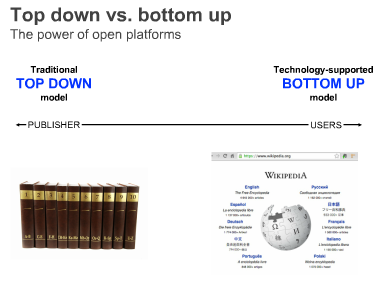
Cleve compares the old internet to a pipe. We would passively consume content that was very much top-down, expert-created, static. It was a continuation of how publishing had worked for the last 500 years. Since 2002 we got what we call the new web, though it’s not new anymore. This is an open platform where we contribute, collaborate and create content. This is where need to locate ourselves as content creators, as materials designers.

Screen shot of slide

Screen shot of slide

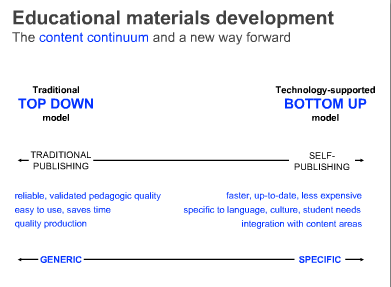
The content continuum – the fundamental driving force behind the way materials design is going. On the one extreme, we have traditional publishing (the old web, the “pipe”) and on the other extreme we have a bottom-up self-publishing model. To allow this bottom-up stuff is the advent of web and web-technology. With a blog, we can publish to thousands of people, for free, in a very short space of time.

There are advantages and disadvantages to both. The top-down model is expert-created and high quality, but it is also a generic, one size fits all. 5 year publishing plans are normal. And it runs into a barrier. The bottom-up model is faster, up-to-date and isn’t restricted to a 5 year plan. It can be specific to language culture and student need. It is the difference between generic content and specific content, along a continuum. There are times when the top-down model is appropriate, and the one-size fits all is fine, this isn’t to knock publisher content. But there are also opportunities on the other end of the continuum, which Clive wants to look at with us.

The power of open platforms. 

E.g. Encylopaedias: on the top-down side, we have Encyclopaedia Britannica, on the other end we have Wikipedia. Wikipedia contains multilingual, user-generated information, meaning that for example things that don’t have much coverage in the traditional encylopaedia can in Wikipedia. It is much more localised.

screen shot of slide

screen shot of slide

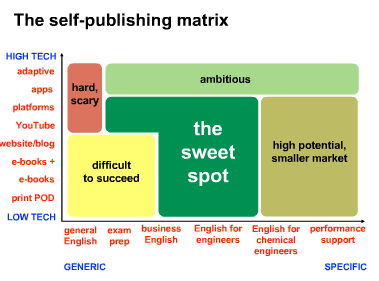
ELT also has a general to specific continuum. From General English to English for Chemical Engineers or any other ESP or more specific e.g. English only for Brazilian students. Most specific would be materials designed for an individual student to meet their needs.

Screenshot of slide - Clive's ELT self-publishing matrix

Screenshot of slide – Clive’s ELT self-publishing matrix

From a self-publishing perspective, let’s imagine you are going to design, on your own, some materials. How do you focus what you are looking at? If you are looking at low tech, general English, that is the difficult to succeed area because that is what publishers know how to do really well and they have lots of money to put into it. If you try and make an app for General English, then it’s still difficult because you are competing against the publishers, with all their money. There are platforms you can use, but it is tough and expensive. If you move towards the more specific end of the spectrum, then making an app is still ambitious but you at least will not be competing with the publishers when you are aiming towards something more esoteric, so it is ambitious in  terms of technology rather than competition. In the middle of both spectrums is the sweet spot (not too hot, not too cold), if you get more specific, then the market is much smaller e.g. English for chemical engineers, but it is needed.

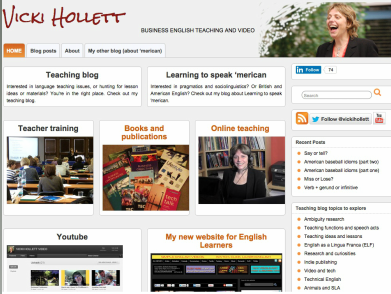
There are of course exceptions to all the above. E.g. the case study that we will look at. Which is by Vicki Hollett. She started with the difficult to succeed, scary area. She already has content published in traditional models but she is doing this anyway. And her content is multi-modal. Online teaching, you tube channel, website. Her revenue model for You Tube is the advertising.

screenshot of slide

screenshot of slide

What are the success principles for Vicki Hollett?

screenshot of slide

screenshot of slide

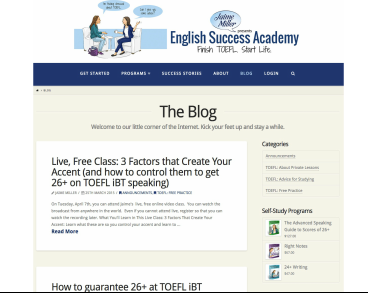
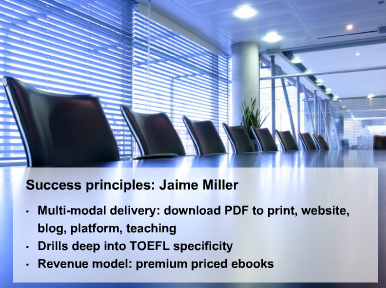
The next case study is English Success Academy by Jaime Miller. It’s one exam. Nothing but TOEFL prep. She is engaging, has lots of videos, a well-designed website, she does one-one teaching her content is multi-modal. Her revenue model is premium price e-books.

screenshot of slide

screenshot of slide

What are her success principles?

screenshot of slide

screenshot of slide

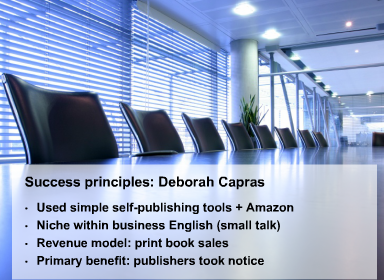
The third case study is Deborah Capras. She wrote a book and is delivering it on Amazon. Very specific topic. Business, politics, small talk. Her revenue model is print book sales. And the mainstream publishers then took notice of her.

screenshot of slide

screenshot of slide

What are her success principles?

screenshot of slide

screenshot of slide

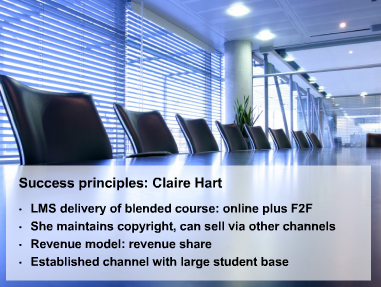
The final is Claire Hart. Blended English for Engineering. She used English 360 platform. There is an online component but then there are also face-face lesson plans and all the handouts you need, for the university department customers. Importantly, she copyrighted it. She can sell it by way of other channels. Claire can take the content and repurpose it into a print book on Amazon, or put it through YouTube as videos, she can use it in any way.

screenshot of slide

screenshot of slide

Her revenue model is revenue share between Claire and the platform who takes 40%. If you use a platform with a good user base, the marketing is there for you.

What are her success principles?

screenshot of slide

screenshot of slide

“Self-publishing”

  • Rather than thinking of self-publishing, you are thinking of developing a new product. So you are an entrepreneur. You need to think like a business person. You need to think about “sales-y things”. The hardest part is the marketing. How many videos are there on youtube? How many books are there on Amazon?
  • You need to get an editor. Very important, indispensable, in order to maintain a good level of quality. Clive thinks that peer editing could be an interesting possibility. So that there is a network of self-publishers that support each other.
  • You need a niche. Be the very best at one specific thing. That is the most powerful way to move forward. E.g. Ros with regards to English for Medicine. There’s a lot of ways to get specific. Combine your teaching with it. Niches are much easier to market to. Go to professional associations, look on LinkedIn. If you market to a niche, it’s not expensive, if you narrow your focus it’s not and you can do it.
  • Pull everything together on a website or blog.
  • Think outside the box for customers. For example, can you add value to a Business?

To summarise, the future of materials design is bottom up. That doesn’t mean top-down will disappear, but bottom up is the way forward because it can be more specific than any top-down model can be. Britannica doesn’t have the resources to produce 17 pages on Salina, Wikipedia enables that.

In the Q and A time, Sue Lyon-Jones reminds us:

“Keeping your copyright doesn’t always mean you can publish your work elsewhere. Some contracts may grant publishers exclusive rights to publish in specific formats or for a set period of time, for example. Make sure you read and understand the small print, folks!”

When you use a platform (e.g. Instagram, YouTube), lots of times you give up control. So be aware.

To contact Cleve for more information about any of this: cleve@english360.com


My blog is 4 years old today!

Screen Shot 2015-05-01 at 21.43.44   I was closing tabs in my browser when I reached one that was open to a WordPress site, not mine. However, as I am logged in, my tool bar was in evidence along the top and I noticed a little cup symbol in the notifications part. I clicked on it out of curiosity (knowing it couldn’t be about likes or stats because I have been allowing tumbleweed to blow through my blog since IATEFL – work issues have kept me occupied) and discovered that, as per the image above, I registered with WordPress 4 years ago today…

Where was I?

4 years ago, I was coming towards the end of a year in Indonesia. I couldn’t remember why I decided to start blogging, so I dug out my first blog post and it turned out to be part of the ‘30 Goals Challenge‘, created by Shelley Terrell, which I believe is now in it’s I don’t know how many’th reincarnation and even has a related e-book out. I had found out about it through Twitter. My early posts largely fell into 2 categories – 30 Goals Challenge  and #ELTChat summaries. (It wasn’t until I did my M.A. ELT and Delta at Leeds Met, now Beckett, that I started writing in earnest, as it was then than I found my voice…)

Where am I now?

Now I am nearing the end of a second year at IH Palermo. My blog bears little resemblance to how it looked in the early days (during my M.A., I learnt about tech-y stuff and then gave my blog a complete overhaul, in an attempt to make it more attractive and user-friendly to navigate; it also now has 270 posts, 9 pages, 777 followers, 336,634 views and 1,370 comments) and I, myself, have had quite a journey since then too…

What have I learnt?

In no particular order…

  • how to relax!! (I have been perfecting the art today, in fact, as it’s a national holiday in Palermo! This is extremely important for avoiding burn-out…)
  • that saying ‘yes’ can lead to lots of unforeseen opportunities (it’s been an exciting few years!)
  • that you have nothing to lose in trying something, and everything to gain (e.g. I only submitted my dissertation project for an Elton because I had nothing to lose, in the end I won a prize which has led on to other exciting things…)
  • that the world of ELT is so big and multi-faceted. We may see only a tiny corner of it for the majority of the time, but attending conferences like IATEFL puts things in perspective and helps you see how rich (not in the monetary sense of the word!) a world it really is. You can then differentiate between ELT as your job and ELT the profession that you are a tiny part of.
  • that I can work really damn hard (c.f. M.A./Delta year and the distinctions I got out of it plus all the blood, sweat and tears that have gone into all my jobs before and since!)
  • that I love CPD (action research, reflection, materials writing, presenting at conferences, attending talks at conferences, doing webinars – as presenter or participant, blogging, chatting on Twitter when I can, writing articles/book chapters, doing courses..and so the list goes on…)
  • that however hard one works, it’s never enough so one has to decide when enough is enough.
  • that it’s ok to have a life outside work and stop thinking about work from time to time 😉
  • that I can’t please all of the people all of the time, and however much I put into my lesson planning and teaching, some students won’t be satisfied. This does not make me a bad person.
  • that 10-12 year old Italian children can get very excited by post-its. This is a blessing when you forget to take the soft balls into class for vocabulary review! I love my M2s. 🙂
  • that the amount of time spent doing things expands to fill available time. If available time is limited, things have to get done quicker. And Things to Do lists can develop multiple layers of priority!
  • that the beauty of learning is that it is never-ending. 🙂

And the list goes on…

What next?

I haven’t renewed my contract at IH Palermo this time around, so I am stepping out into the unknown again. I have a ten-week summer contract at Sheffield University lined up but beyond that? Who can say. One thing’s for sure though, I will keep blogging and I will keep saying yes when opportunities arise. And see where it takes me next… Thank you all who follow my blog, read my blog, comment on my blog and in so doing make it what it is. And happy 4th birthday, Blog! 🙂 (Also, to anyone who watched my recent webinar on Metacognition, the promised write-up will happen… just as soon as I can make the time without overly upsetting my precarious work-life balance! 😉  )

Write-up of Andrew Walkley’s BELTA webinar: Language-focused teacher development

This afternoon, I have had the pleasure of attending a fantastic webinar presented by Andrew Walkley, one half of the popular Dellar-Walkley duo whose project Lexical Lab you might be aware of. 

Andrew delivering an awesome webinar!

Andrew delivering an awesome webinar!

The focus of the webinar was Language-focused teacher development, looking at the way we deal with vocabulary in class and what we need to be doing outside class in order for this to become more effective. I took notes as we went along, so here they are, slightly edited to make them more comprehensible…

  • First we were asked to put groups of four words into order of their frequency.
  • Then we were asked to make examples for a set of seven words and a structure (the past continuous).

Andrew went on to explain that within the CLT era, we have seen some particular types of approaches emerge, that are language rich and responsive – TBL, Lexical Approach, Dogme, Demand High…

  • In TBL, if there is breakdown in communication, this is where learning is supposed to happen, the teacher facilitating this learning.
  • In Dogme, maybe some further practice together will be done too.
  • With Demand High teaching (which concept he said sparked this talk), there was a complaint that a lot of teaching taking place where you move from task to task but without much actual teaching happening. The teacher needed to be stronger in saying ‘no, this is wrong’ or pushing individual students and teaching them in the moments where they are struggling. A lot of Scrivener’s solutions were technical, technique-type things, e.g. the teacher pretends not to understand what the student is saying, thereby forcing them to explain why what they were were saying was right.

That’s ok to a point, but Andrew felt that it wasn’t the real reason why the teaching wasn’t happening.  He has been interested in the Lexical Approach since its publication 20 years ago now, he has also been aware of the expectations of thinking about language and dealing with language that are advocated in LA are high. He recognises that it is difficult.

Andrew then introduced us to a book, Thinking Fast and Slow by Daniel Kahneman. It deals with the difficulty for experts in employing their expertise. This is because of the need for fast, in the moment, spontaneous thinking, where rather than think clearly about certain aspects of thinking, we replace a kind of logical thought with heuristics i.e. a generalised idea of something.

This brought us back to the task we did at the start.

Andrew showed us the answers to the frequency question:
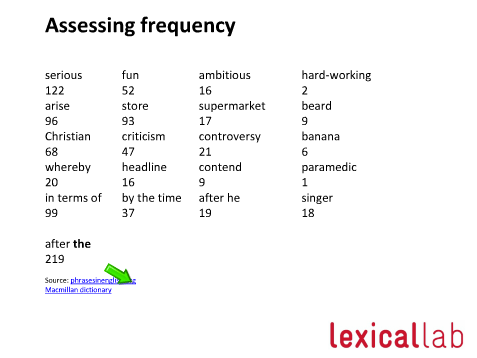
Screenshot of the answers to the frequency quiz

Screenshot of the answers to the frequency quiz

Then he asked whether the corpus frequency answer (biased towards written) is reflective of the bias in native speaker natural use? His feeling is that often we overestimate certain frequencies of words and underestimate others. In the spoken corpus, arise and beard come at a similar level. Many students are interested in academic and professional lives in English, where they may not be using the language all the time in the workplace or study in Britain etc, but the resources they use may be in English, so a word like ‘arise’ would have a higher frequency and value.

As for the activity of making examples: our tendency is to produce examples like the ones we produced, but sometimes these aren’t actually the most common uses or even the way we use the language. Of this type of example, they may be one in a thousand in the corpus. E.g. She is a Christian. So… how is Christian really used? Andrew confessed that he might struggle with some of these words, in terms of making examples. E.g. whereby, arise, in terms of. Some of these are more difficult to think of examples from. They don’t fit into that simple x is y pattern. They require more complex sentences:
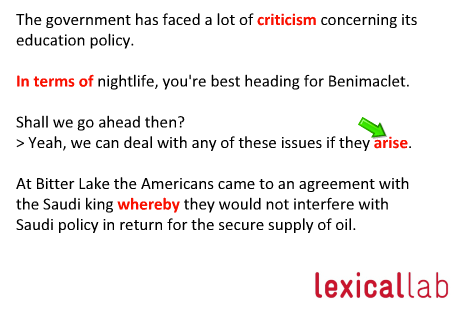
Screenshot from the webinar

Screenshot of Andrew’s examples from the webinar

It’s difficult to think of these kind of examples on the spot, Andrew explained, the Daniel Kahneman book offering some very clear reasons as to why. This is to do with biases that overtake logical thought. Our tendency would be to put words like blonde, banana etc. higher up because we know we can think of examples for these more easily than arise or whereby. If we think about the number of different contexts that we use banana or arise, then it becomes clear that arise would occur in academic texts, meetings, and several more possible contexts than the word banana or beard. Similarly serious vs. fun, there are a wider number of things that can be serious than there are fun things. As I understood it, this is availability bias, one of three factors that affect our choice:

  • availability bias
  • representational bias
  • priming

Apparently words also have a representational bias, e.g. x is y, x does y, doctor has a white coat etc. So the examples and explanations that come to mind are often of that nature.

Finally, priming: In English language teaching, this is quite strong. E.g. I was having a bath when the phone rang.

  • Because of what we’ve learnt before and what we’ve seen in coursebooks before, we think of certain examples and contexts, and we don’t see the wider context we could use.
  • Sometimes when we are trying to hear what students are saying, and trying to correct them, often what we are primed to notice is basic grammar, typical grammar that we have taught before. So, we will commonly notice the present perfect used incorrectly or missed third person ‘s’ and these we look to correct.

Andrew explained that this is problematic in terms of these responsive methodologies. There is too big a cognitive load for any teacher trying to use these methods.

When you are in class, e.g. with TBL you are catering for individuals and have to do many things, which he went on to describe:

  • You have to hear the student first, which is already difficult possibility due to layout and noise levels.
  • You have to understand what they want to say/write, recognise the error/gap in their language, and give the ‘correct’ example (” because sometimes what we want to be doing is extend ss knowledge, e.g. where they use a particular word where another less frequent use works better)
  • You then have to explain or check why one is correct and the other isn’t, if we are talking in terms of TBL and Dogme, then extra examples of new language are necessary, and for Dogme also further ‘spontaneous’ practice.
  • Finally you need to remember it in order to revise and recycle it at a later date.

That’s a lot to expect. And multiplied by all individual students with individual needs. So, instead, Andrew said, we fall back on examples given before, or focus on relatively infrequent words and give simplified examples which don’t necessarily reflect enough of how those words are used. Yet if you are a believer in a more lexical approach to teaching, one of the most important things is giving good examples of how language is used.

So, this is the big issue with these methodologies. Ironically, often, somebody who doesn’t like coursebooks will give examples that have been seen in one before! Coursebook writers are similarly primed. You come up with examples which afterwards you think ‘what was I thinking? Nobody would ever say that!‘. If you believe that exemplifying natural use is important than you need to also think outside the class. Inside the class it is too difficult due to cognitive load. It may also be that to become a better non-course book user, we need to become better coursebook users and writers!

The more we focus on different words and how we might exemplify them and ask questions about them, and think about spontaneous practices for them, the more we will get better at doing it spontaneously. Kahen (of the above-mentioned book) suggests the example of chess players who basically learn lots and lots and lots of moves. It takes all those hours of practice in order to become spontaneous in the context of a chess match. We may not have so much time to prepare in our lives but it’s an ongoing process so if we work at it incrementally, we’ll get better at it.

In terms of training and development, however, most focus is grammatical, rather than lexis. Grammar rules into which we slot the words. Andrew doesn’t particularly agree with this. At this stage in the talk, he outlined some potential issues for teacher development:

  • In terms of the planning, on training courses and post-qualification, planning focuses on activities: thinking of activities to help practice bits of grammar or vocabulary in the course book. Whereas we should think a lot more about the lexis and the questions we are going to ask about it etc. in the planning.
  • Judgement of lessons in observations shouldn’t based on fulfilling aims as it goes agains the idea of being responsive to students. So we need to think about how we think about language AND expectations of what a good lesson is.
  • Teacher development tends to focus on learning new techniques. E.g. Demand High. Frustrating because it is more techniques, other ways of doing somehting. Wehreas I feel we need to focus more on actual language.

Andrew put forward some alternatives:

Frequency training

  • Macmillan dictionary: game to decide if it is three star, two star or one star words. (Different frequencies) Once you realise that something is frequent, thinking about why it’s frequent and as a consequence thinking about the kind of examples you might give to reflect that frequency.
  • The compleat lexical tutor: I missed this explanation!
  • Phrasal English.org: Uses the BNC. Put in a word or two, request exact word or same lemma. E.g. inc plural, past participle form included. Gives a rough count and a concordance. (Like wordandphrase.info, I think?)  May be skewed by names. E.g. Christian. But still gives an idea. You might just take this as a staffroom thing, e.g. reading something or taking a collocation. Have competitions who thinks something is more common than something else. E.g. ambitious plan vs ambitious scheme. Then find out. To help us think about frequencies.

Exploiting vocabulary exercises

Essentially a lot of vocabulary activities focus on single words. Increasingly, now, you also get collocation exercises, matching two words to make a collocation. You might even have whole sentence exercises e.g. gap fills, little dialogues matching question and response. We need to think about slightly different ways of using these.

  • In a single word exercise, we should think about what collocations to elicit from students about these words and questions to ask about the vocabulary. Not just meaning focused but usage focused.
  • With collocation exercises, now we need to think beyond the collocation and think about the collocates of the collocations e.g. example sentences and dialogues, or a story to tell?
  • And then if you think about the whole sentence exercises, ask questions to get students reuse grammar and chunks, and other vocabulary that isn’t the focus but can be exploited.

Take for e.g. a ‘Which is the odd one out?’ exercise

The temptation is to say the non-odd words out are the same. But are they? And what do the students get apart from adding re-? Instead think about how we can use these words more. What collocations can go with these words?

  • Is what we reconstruct the same as what we rebuild?
  • Is what we reconsider the same as what we reexamine?
  • E.g. we can rebuild a relationship but we don’t reconstruct or remake it. We reexamine the evidence but we don’t rethink the evidence. We might rewrite an essay but not reword it. We might reword something shorter like an answer. We remake a film but we don’t rebuild it.

These are the kinds of things we want to be able to tell our students. We need precise examples. Going back to supermarkets, we might overestimate its frequency, quite often we don’t say I’m going to the supermarket, we say I’m going to Tescos or Carrefour. Perhaps these are better examples for our students in some ways.

Take for e.g. a collocations exercise

We need to think about:

  • What works with these collocations e.g. swimming pool and swimming trunks. Fishing rod and fishing gear. After you have matched them up, possibly with a picture thrown in, what next? Need to know how to use them!
  • A second question you might ask is who would you say it to, when would you say it, why would you say it? Think of how they might work in a dialogue. Sometimes the compound gets split up. E.g. see you on the track in half an hour. (Running track) Or swimming pool. Let’s go swimming. Ok see you at the pool in 15 mins.

Andrew suggests that we need to spend more time thinking about this aspect of language rather than on activities, in our planning.

  • Think about the kind of questions we ask about vocabulary. Can we generate language around target words? E.g. What might you ask if someone is carrying a lot of gear? Can I help you? Oooh where are you off to?
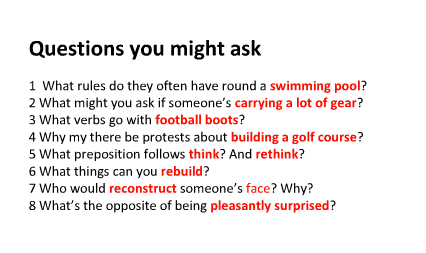
The questions we could ask

Screenshot of the questions Andrew says we could ask

  • Thinking about these kind of questions on the spot is quite difficult, you need to think about them beforehand to be able to ask them on the spot.

More complex sentence examples show more of how language works, so students see more examples of grammar in use.

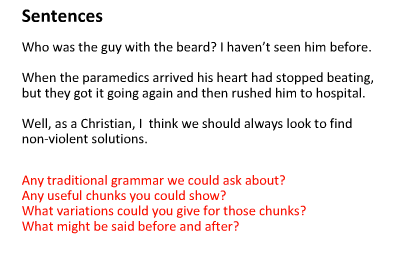
  • Rather than x is y. (She is a Christian vs As a Christian, I think we should look for non-violent solutions = As a x, I think we should y.
  • Who was the guy with the beard? I haven’t seen him before = who was the guy with…the blonde hair, sitting next to you… etc. I haven’t seen him before.
  • Through vocabulary, we can ask simple quick questions to review grammar. E.g. When the paramedics arrived, his heart had stopped beating but they got it going again and then rushed to the hospital. –> Draw attention to the past perfect, when you get something going again, why/where else do we rush to?
Things to think about

Screenshot of the questions that Andrew suggests we ask

There are lots of these kinds of patterns we could draw attention to, that are useful and interesting little patterns that students could use but don’t make it into coursebooks. You have to have thought about the example before, but once you have thought about it in planning before, in the context of a text or language focus etc. it makes it available to use spontaneously in response to students in the future.

Andrew then told us about one aspect of his and Hugh Dellar’s Lexical lab:  you can send in a completed exercise and Andrew/Hugh will suggest questions/chunks relating to it and invite suggestions from others too.

Other tips from Andrew:

  • Think about what the students might want to say in the speaking exercises you plan to set up. It may mean either doing the task yourself, or with a teacher partner, and seeing what comes up.
  • Get teachers to record their answers. Notice the language that is repeated or could be useful for the students to do the task. Often there is a disconnect between grammar practice and single word practice and the task we set which requires a more complex use of language and may include a variety of things we haven’t thought about.

Ongoing questions to ask to promote teacher development:
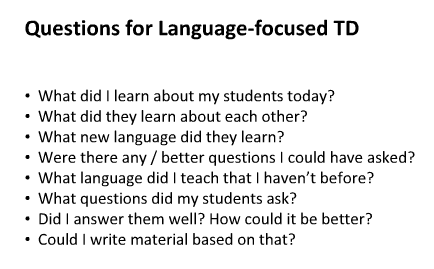
Questions to help us develop!

Questions that Andrew recommends asking to promote development!

The first two questions require genuine interaction in the classroom, where rich language can be found. The third is important as what is new? A new combination? New phrases around known words? Because often the grammar or word is known, but the language around it isn’t. The fourth encourages you to reflect on the questions you ask and improve them for next time. The last question is based on the idea that we do get better at dealing with language if we write material. Ideally do it with someone else, get someone else to look at it. This encourages you to be critical and think about language in use and how students might want to use it.

Being able to answer language questions and being able to ask questions about language in this way is not a natural thing but a little bit like relearning the language and a process that needs to be ongoing along with your students. You need to practice it.

Language-focused TD is like language learning: it never stops! 

Thinking about the wider context of language use. We need to think beyond the obvious. Maybe students won’t use the banana example because they go to the shops themselves and don’t have anyone to ask to buy bananas for them! Whereas the words we thought less common might have more possible contexts of use and so be more common than we thought.

In response to concerns that this approach may become too teacher-centred, Andrew responded: talking about language and giving examples is student centred, as it is what the students want to say and need to hear in order to be able to say them better. Teacher talk: needs to be for the students’ benefit. It is also important to use generative, slightly open questions. Students might make jokes in response to them. E.g. Why would you want to reconstruct someone’s face? Because they are plug-ugly vs. after an accident.

I found this webinar absolutely fascinating. It reminds me of my last observation where I think basically my DoS was recommending that I do this. I.e. that I plan my vocabulary focus more, because of it being difficult to respond effectively on the hoof, and I think the intention was in this vein. Having watched this webinar, I now have a much clearer idea of how to go about that than I did previously. Am looking forward to implementing this and gradually developing in this area. 

It was my first time to see Andrew speak and I have to admit to now very much looking forward to hopefully attending his talk at IATEFL! 

Thank you very much, Andrew, for a really valuable hour and a bit! And thank you, BELTA, for hosting him!

Teaching teenagers “have to” and “can’t” for complaining – resurrected in TEA issue 71!

A while back, I blogged about an activity I had done with my teenagers, to help them get to grips with ‘have to’ and ‘can’t’ for complaining. Some time down the line, Philip Kerr from TEA (Teachers of English, Austria) approached me to request permission to publish the activity in the TEA online magazine winter 2014 issue, which I, of course, duly granted.

Here is a link to the magazine, where, as well as my little activity, you can find pieces by Ceri Jones, Lindsay Clandfield and others, on a range of focuses.

Enjoy!

(PS: there will be more blog posts soon… when the time – things to do ratio is just slightly less punishing!! 🙂 )

Keeping teachers motivated

A few weeks ago, at IH Palermo, we had a workshop on Demand High Teaching. We looked at various techniques for ‘getting closer to the learning’ in the classroom and were then sent off to experiment in our classes, with the promise that there would be a subsequent ‘reporting back’ session. This happened today, as part of a rather informal workshop in which we discussed what we had learnt/taken away from/experimented with from recent ‘buzz observations’ (short i.e. 10-15 minute pop-in peer observations) and reflected on our experimentation with Demand High. The final part of the workshop was dedicated to a ‘swap shop’ where many of us shared activities we have done in the classroom recently.

To me, this is rather an effective way of motivating teachers. By telling us that there would be a future session in which we’d talk about what we had done with the techniques learnt about in the Demand High session and what we’d taken away from the buzz observations, there was immediately more chance that we would make more of an effort to do something in the meantime! This mirrors what I strongly advocate doing with learners, in terms of fostering learner autonomy: bringing it back to into the classroom. I think it’s equally important and effective where teachers are concerned, because like our students we are busy people. And sometimes, CPD might get put on the back-burner as a result. Yet, effective CPD is done little and often, is an on-going process of growth.

The workshop was interesting: as well as sharing ideas and experiences, we discussed the pros and cons of buzz observations and full lesson observations, from the peer observation perspective. I found this particularly interesting as I am doing the IH Tutor Training certificate course at the moment, and one of the recent modules looked at organising observations. Turns out there are more types of observation than I was aware of! Anyway, I hadn’t come across buzz observations before we did them here this term, but we all agreed that they are a Good Thing. Why? You get to see ‘snapshots’ of other teachers’ lessons and gather ideas for use in your own. It may not necessarily be things that are new to you, but it may remind you of things that you haven’t done for a while. (Over time all build up a range of techniques and activities that we use, but the more time you teach for, the more you build up, the more you can forget! And, of course, we generally tend to stay in our comfort zones!) You also get to see a range of teaching styles and a range of levels in a short space of time, so it is very time effective. Of course, full length observations have different benefits: you get to see the shape of the lesson, where an activity fits into the great scheme of things, how learning is built on in the course of the lesson etc.

From the point of view of being observed, we agreed that it is less stressful not to have the same person sitting in for the whole lesson, but yet, having people pop in and out does make you ‘up your game’ – naturally! I have to admit, I found it particularly gratifying today when one of the teachers who observed me mentioned how clear my instructions were! Instructions (which in my recent YL observation we renamed ‘demonstrations’ to help me…) have always been my nemesis. I suppose this teacher caught me on a good day! (Or, a good activity, rather! Inconsistency is where I’m hovering with instructions currently…) Perhaps this ‘gratification’ is another positive aspect of this type of workshop where we feedback on what we have learnt from one another: it reinforces that we all have something to offer and that we can all (and should!) learn plenty from one another. And it helps us all feel valued, which is important, even if it may seem like a small thing.

In conclusion, workshops don’t have to be complicated and full of bells and whistles in order to be very effective. (I must remember this, as I am on the module for planning input sessions now…!) It is also A Very Good Thing when a couple of kettles, some mugs and a good supply of teabags are involved! 🙂

I leave you with a link to my most recent British Council post, which discusses CPD at IH Palermo and how it works here, as well as the effect of this on teacher motivation. Enjoy! And if your school isn’t doing any of the things I’ve discussed in this post and my BC post, why not suggest that they do? Evolution is healthy! I also leave you with a request: let me know (comment on this post!) what kind of CPD you’ve been up to recently – through your place of work or independently – I would love to hear.

OLYMPUS DIGITAL CAMERA

CPD and cups of tea/coffee combine very well! Image taken from google image search for images licensed for commercial reuse with modification.


British Council Videos: ‘Teacher Talk’

One of the perks of being a British Council Associate is that as well as having had the opportunity to deliver a webinar (with another on the cards for next year!) I have also been able to participate in a project called ‘Teacher Talk‘. This is a series of videos edited by the British Council, which feature some of the BCAs talking about various ELT-related issues.

So far, you can watch short video clips about:

(Click on the title to be taken to the relevant video – I think there may be more forthcoming, but I can’t actually remember at this stage how many topics there were in all!)

I think part of the beauty of these clips is that they are so short – within a few minutes you can either pick up a few new ideas or remind yourself of things you knew but hadn’t been uppermost in your mind recently, becoming buried amongst the myriad other things that we, as teachers, have to juggle.

The other thing I like about them is that you hear a range of voices on a single subject, particularly as the British Council has edited the videos very cleverly, so that although they cut from one person to another, the flow of ideas is seamless and easy to follow.

From my own selfish developmental point of view, making the videos, which I sent to the British Council to be included in the editing process, encouraged me to reflect on and synthesise (very succinctly by my standards – the videos had to be fairly brief!)  my views on these various important elements of ELT. Watching the videos now, months down the line, it encourages me to question whether I practice what I (and the others in the video clips) ‘preach’ and how I could try and do so more effectively.

All in all, a very rewarding project to have been part of. Thank you, British Council, for this fantastic opportunity! 🙂

What’s in a name?

What *is* in a name?

This blog post was inspired by a recent email exchange with somebody who wrote to me asking for information about the Leeds Met M.A. ELT/Delta. However, the “biggest concern” that this person had, and the main question they wanted me to answer, was with regards to the university’s reputation and the impact of this on post-qualification job-hunting.

It’s a fair question.

In fact, before I went to Leeds Met, I also had the same question. Although, my concern was more immediate – about the quality of the course rather than what would happen beyond it.  I suppose big names are reassuring: If you go to a school with a big name, you embark on your mission with confidence in what will happen – it will be as high a quality as befits such a name. Small names are perhaps more of a gamble. I had never heard of Leeds Met until I found the course leaflet in my conference pack when I went to Glasgow in 2012.

Why did I make that gamble?

I investigated the course website very thoroughly, looking at the staff profiles relevant to my course, and was reassured by the extensive experience the tutors could lay claim to, teaching (both in years and variety) and academic (presentations. publications etc). Additionally, of course, not any centre can run a Delta course – they have to meet all sorts of criteria and be externally assessed periodically to ensure that they are meeting those criteria. The tutors have to be suitably qualified and experienced as well – naturally.  I was planning to take the Delta/M.A. route, where the Delta is integrated into an M.A. in ELT. So in the end, I thought that at the very least I would (hopefully!) come out of the course with my Delta, which is universally recognised, and if the M.A. wasn’t much good, so be it – I’d make of it what I could.

Outcome

In the end the gamble I made paid off in spades: I learnt a huge amount and have been trying to put it all to use, and build on it, ever since; in various ways. The course was practical as well as rooted in theory, my tutors were so supportive of all my efforts and I’ve also had a wealth of opportunities since, that have emerged as a result of doing the course and putting that learning to use. Most recently, of course, I’ve won an ELTon for the materials I produced as my dissertation project.

Question

To those in the position of hiring people in the ELT profession, do you look at C.V.s and make a decision to short-list or not short-list a person for an interview based on the name(s) attached to their qualification(s)? How much does it influence you and why?

To all those who have done M.A.s in an ELT-related field, or any other ELT-related qualifications, what influenced your choice of institution?


Question time! (image taken from pixabay.org via google search for images licensed for commercial use with modification)

Question time! (image taken from pixabay.org via google search for images licensed for commercial use with modification)


My latest British Council Associate blog post: RESET – five tips for staying motivated!

My British Council Associate blog post for May was on the topic of teacher motivation. I came up with a cheesy acronym for my tips – RESET! (or: Read, Experiment, Step back, Evaluate, Take a break)

Click on the Wordle below (based on the content of the post!) to be taken to the British Council Teaching English site page where my post can be found.

RESET: 5 Tips for staying motivated

RESET: 5 Tips for staying motivated

I think motivation is a fascinating area of study and that it’s important for both teachers and learners to be able to manage their motivation effectively. It’s a theme I shall definitely be returning to in later blog posts.

Thank you, British Council Teaching English team, for the continued opportunity of writing as a Teaching English associate blogger, it’s a stimulating project that I am very much enjoying! 🙂

To read posts by all the other wonderful associate bloggers that I am honoured to share my title with, please click this link. And do have a look at Rachael Roberts’s insightful blog post that is also on the topic of teacher motivation and avoiding burn-out: in it, there some very valuable tips for all.

My top ten ELT books – how many have you read?

Faced with the hundreds of ELT-related books there are out there, an oft-repeated question, when teachers want to learn more about their profession and develop themselves as educators, is “What should I read first?”. Here is a list of books that I believe you can’t go wrong with. I have made the list deliberately wide-ranging in terms of what is covered (i.e. it’s not a list of ten vocabulary-related books!), again slightly stretching the concept of “top ten” with a little bit of grouping! 

If you disagree and feel that there’s another book that definitely ought to be on this list instead of one of the ones listed, please comment and say so! 🙂 Hopefully in the end, this post will be a list of books that everyone believes are a good starting point for teachers who are also motivated learners… And do comment in relation to the title question too! 😉

NB, I am not on commission! Also, I do not condone downloading any of these for free from any online sources. Some of them are available as e-books but you still have to pay! I do recommend checking if your school has them available to borrow. If your school is a CELTA (or equivalent) or a Delta (or equivalent) centre, then it is very likely to do so, and even if it isn’t, it may have acquired a few books that it makes available for teachers to borrow. University libraries (if the university does any ELT/TESOL/Applied linguistics type degrees) are good place to try too, if you can get access. 

In no particular order, then…

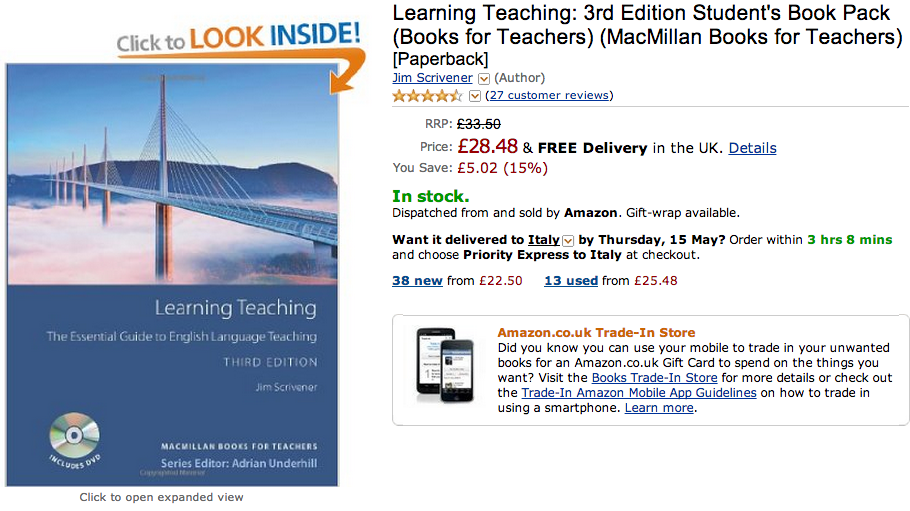
  • Learning Teaching by Jim Scrivener

Screenshot from www.amazon.com

Screenshot from http://www.amazon.com

Initial teacher training courses tend to have a core text that trainees are required to buy and from which various portions are set as compulsory reading. For me, that was Learning Teaching (though this was pre-inclusion of free DVD). The usual alternative is The Practice of English Language Teaching by Jeremy Harmer. Either of these two general methodology books are a great starting point for a novice teacher  – or an experienced teacher looking to refresh their memory. I’ve read both from cover to cover. I also dipped into Learning Teaching extensively in my first post-qualification year of teaching. They give you a good overview of the many different elements that come together to make up language teaching. I’ve chosen Learning Teaching over The Practice of English Language Teaching to list here on a purely subjective basis: I found it more readable. I’m sure there are people who will read this post who would staunchly argue the reverse. My advice would be, take your pick – you can’t go wrong with either!

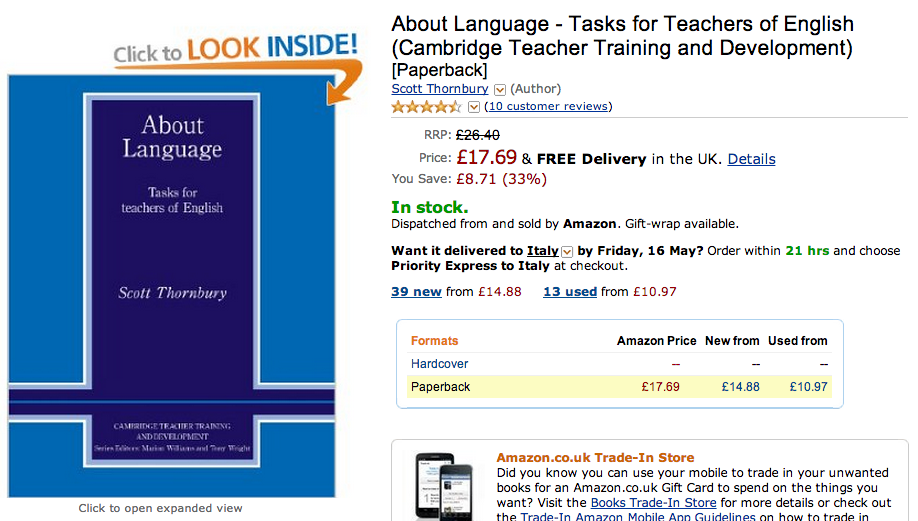
  • About Language by Scott Thornbury

Screenshot from Amazon.com

Screenshot from Amazon.com

How is your language awareness? By this I don’t just mean are you a grammar genius. What about discourse? lexis? Phonology? I didn’t use this book until I was preparing for my Delta but I firmly believe that all language teachers should make their way through it at some point. The great thing about it is that it doesn’t just describe things, it makes you do hundreds of tasks (for which the answer keys are at the back of the book) so you can test your understanding of what is being discussed. Why not do ten or fifteen minutes on a regular basis as part of your continued professional development?

  • Teaching and learning second language listening: metacognition in action by Larry Vandergrift and Christine Goh

Screenshot from Amazon

Screenshot from Amazon

This gem of a book was in close competition with John Field’s Listening in the language classroom but won its place on the list by combining its extensive treatment of teaching listening with discussion of metacognition and how to integrate development of metacognitive awareness into listening pedagogy. It has a strong theoretical thread running all the way through, but manages to be very readable as well as containing plenty of very practical ideas for implementing the theories discussed. I’ve read both Vandergrift&Goh and Field from cover to cover, as well as dipping into them repeatedly since, both are well worth investing in and reading.

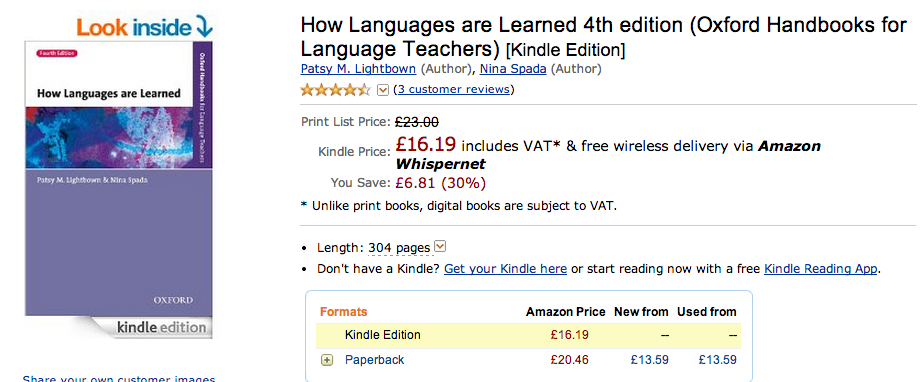
  • How languages are learned by Patsy Lightbown and Nina Spada

Screenshot from Amazon.com

Screenshot from Amazon.com

How languages are learned is an accessible introduction to the theories behind first and second language acquisition. As teachers of language, it is helpful for us to have an understanding of theories surrounding learning and acquisition, as these have informed the approaches, methodologies and teaching techniques that evolved over the course of time. This book is good because as well as discussing a wide range of FLA and SLA theories, it encourages reflection on the topics discussed through the reflective questions that punctuate it at the end of every chapter. There are also activities that you can do to explore topics further. I read this book in preparation for Delta but I think there’s no need to wait until you are doing such a qualification before you open it.

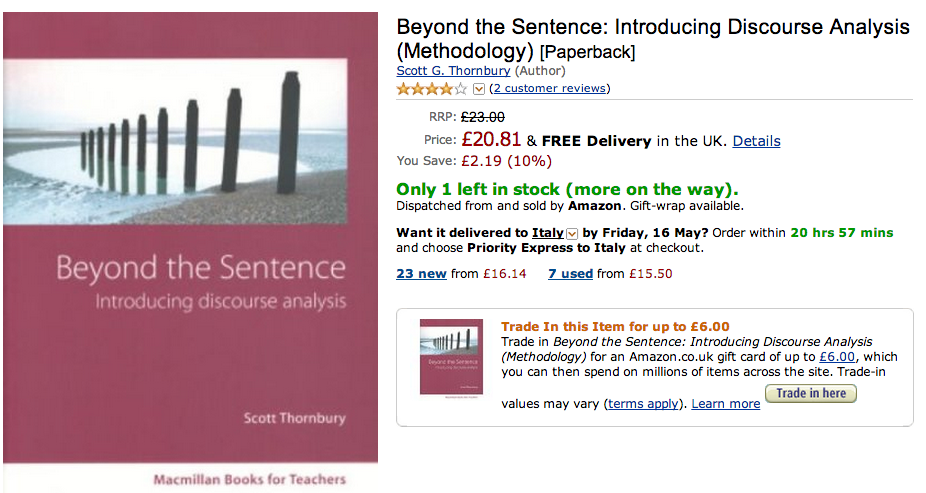
  • Beyond the sentence by Scott Thornbury

Screenshot from Amazon.com

Screenshot from Amazon.com

Another Scott Thornbury gem – his name features rather heavily in this list, I’m afraid! – Beyond the sentence is a great introduction to discourse analysis. Each chapter has a corresponding task, for which there is an answer key, to focus you on the main points of what has been discussed and get your brain zooming out from individual grammar and lexical items to think in discourse terms. The activities are readily adaptable for use with students. A lot of of the lexical and grammatical choices we make are down to the influence of language we use not existing in a vacuum but as discourse, so it is worth learning about how discourse works. It makes more useful pre-Delta reading, and whether or not you plan on doing the qualification, is worth spending time on.

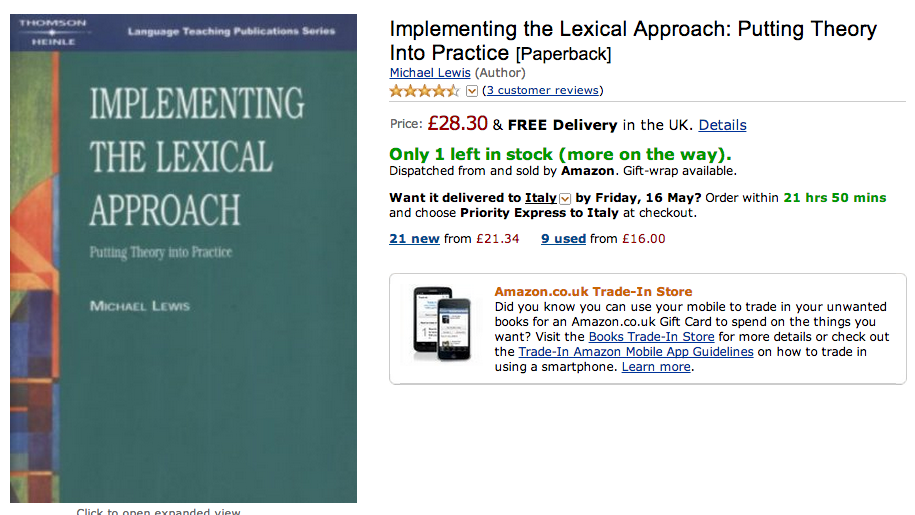
  • Implementing the lexical approach

Screenshot from Amazon.com

Screenshot from Amazon.com

Some will argue that I should put The Lexical Approach in instead of Implementing the lexical approach but what I like about the latter is that as well as presenting all the theory around the lexical approach, it also offers lots of ideas for using the approach in the classroom. The best thing to do, of course, would be to read both! And then follow that up with Teaching Collocation. All three of these were published by Thomson and Heinle, but Teaching Collocation is edited by Michael Lewis with contributions from Peter Hargreaves, Jimmie Hill and Michael Hoey. All three contain valuable information about how lexis works and why we should change our focus from grammar which we slot bits of lexis into to looking at the grammar of lexis and the company words keep. I didn’t read these until I was doing my Delta – I didn’t know about them before then. So here we go, the secret is out! 😉

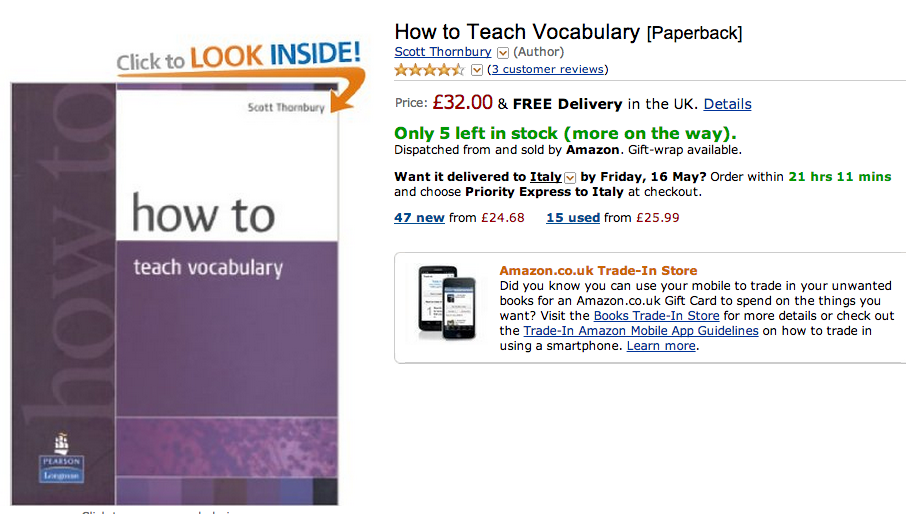
  • “The How to…” series – especially How to teach vocabulary and How to teach speaking, both by Scott Thornbury

Screenshot from Amazon

Screenshot from Amazon

Screenshot from Amazon

Screenshot from Amazon

How to teach speaking doesn’t actually look like that anymore – now it’s a green version of How to teach vocabulary! Both are really great in terms of being very readable and combining theory with practice, in terms of giving you lots of ideas to try out, as well as the rationale behind them. I read them both cover to cover before starting Delta and found they gave me a really good grounding, which I was able to build on with more in-depth theoretical stuff when it came to essay-writing. Both highly recommended whether or not you intend to go on and do a further qualification.

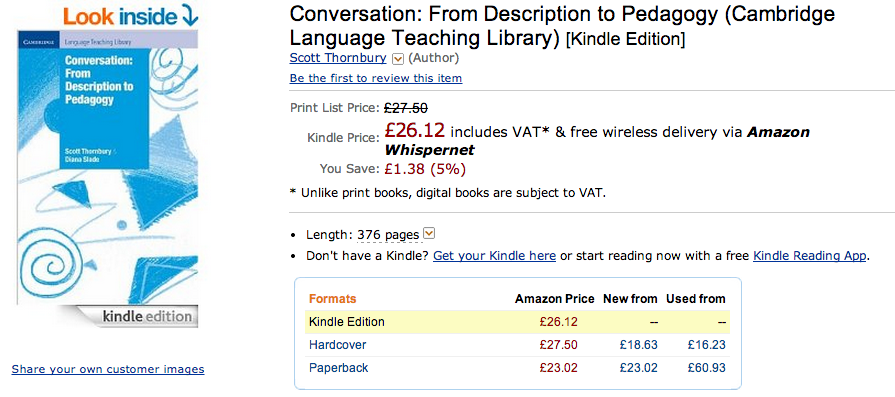
  • Conversation: From description to pedagogy by Scott Thornbury (!) and Diana Slade

Screenshot from Amazon

Screenshot from Amazon

This book is fascinating. It analyses conversation, taking it apart and explaining how it works, why and how we do what we do when we speak, as well as looking at the implications of this for language teaching. Not a whizz-bang of activities to deploy following a five minute flick through, but well worth making the effort of sitting down and reading it, to expand your understanding of how conversation works. This is another book I didn’t discover until I was doing my Delta – the library had multiple copies so I had one out while preparing my LSA4 on speaking, but again merits not being consigned only to being read by Delta/equivalent trainees!

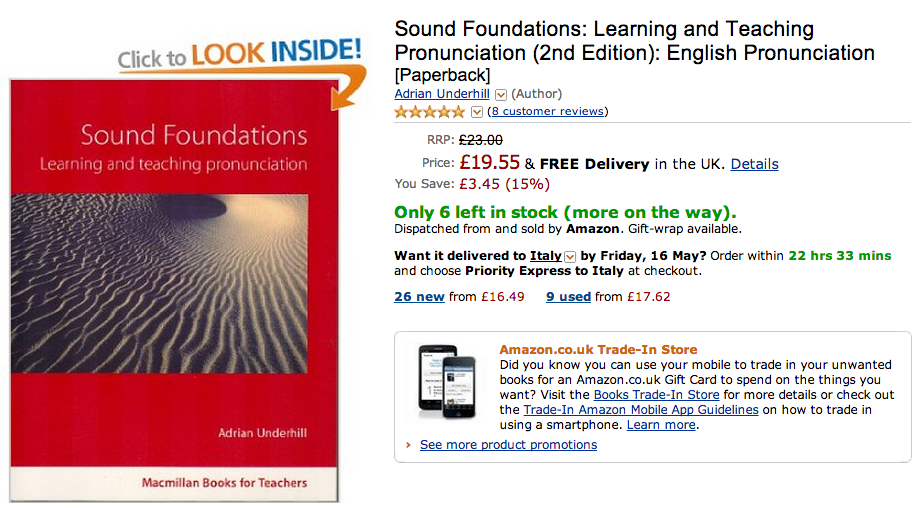
  • Sound foundations

Screenshot from Amazon

Screenshot from Amazon

This was one of the first books I read (apart from Learning Teaching) post-CELTA. I happened upon it in the teachers’ library at my second school. It absolutely revolutionised my understanding and teaching of pronunciation. That was also when I learnt about phonemic symbols and used to practice writing with them. Then it turned out that it was very useful to have already read the book and processed it, as well as having learnt the symbols, prior to starting Delta, as I had a good knowledge base to take in with me. However, it is definitely recommended regardless of your further qualification plans, in order to extend your pronunciation teaching skills. It contains theory written in easily understandable language, as well as lots of discovery tasks to help you understand how sounds work and lots of activities you can take into the classroom with you too.

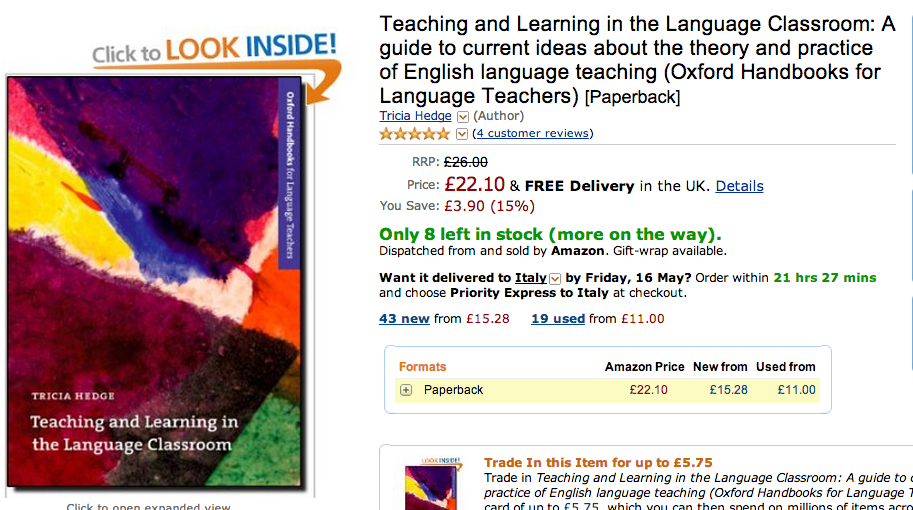
  • Teaching and learning in the language classroom by Tricia Hedge

Screenshot from Amazon

Screenshot from Amazon

This is another more general book, and its strong points are that it goes into reasonable depth on a range of things, including course design and assessment, learner autonomy and so on, as well as the treatment of the more obvious elements like teaching the skills (reading/writing/speaking/listening), grammar, vocabulary and pronunciation. It is a good, solid all-rounder to have at your finger tips. It also sports “further reading” lists at the end of each section, which are a great place to start if you are looking to explore something further and increase your depth of knowledge and understanding with regards to that topic.

A good grammar reference

As well as this list of books, every self-respecting language teacher should have (access to) a good grammar book. This will probably have been written by someone with a surname that is also an animal. E.g. Martin Parrott (Grammar for English Language Teachers), Michael Swan (Practical English Usage)…! Which you choose will be a matter of taste. Ideally, try and have a go at using a few different ones and find one that best suits the way you think. For me, it’s Parrott, but that’s largely because it’s the one I bought and used during my CELTA, and I became rather attached to it!

Reference Lists/further reading

And don’t forget: if you have read all of the books on this list, they all have bibliographies/reference lists, in which you can find the details of a whole load more books and articles that could be worth your attention! You can never run out of things to read! And that is a Good Thing. 🙂

Happy reading! And don’t forget to suggest books that YOU think should be on this list!!

reading glasses pixabay

Image taken from pixabay.org via google search for images licensed for commercial reuse with modification


Top ten resources for teachers

The internet is a great place for English language teachers, if you know to where to look! Here are my top ten resources (ok I cheated a bit by grouping some!) – have you used them all yet?

Conversely: What is your favourite resource?

– Have you used any resources that completely wowed you, that aren’t on this list?

Please comment and let me/everybody else know about them!
In no particular order then…

British Council Teaching English – website and Facebook page

Screen Shot 2014-05-11 at 20.40.15

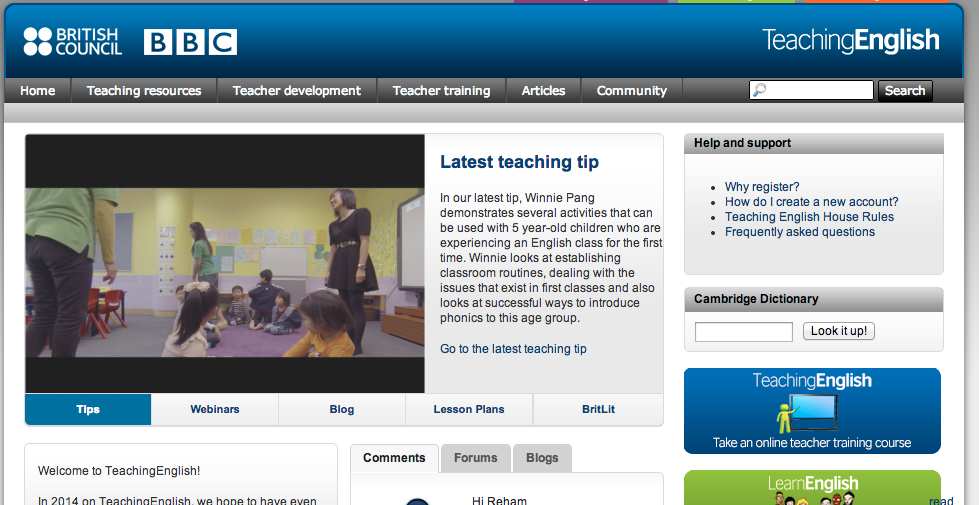
http://www.teachingenglish.org: screenshot of the home page

The British Council Teaching English website and Facebook page are both very valuable resources for teachers with any level of experience.

The website contains a wealth of freely available content, such as:

  • teaching ideas
  • articles on methodology, skills etc.
  • webinar recordings
  • downloadable ELT-related research
  • links to the blogs that have been awarded the popular “blog of the month” award and associate blogger posts
  • information about professional development courses

…and much more besides!
Screen Shot 2014-05-11 at 20.40.44

Screenshot of the British Council Teaching English Facebook page


The Facebook page is where links are shared and people can be found discussing the ELT-related issues that those who run the page raise for this purpose on a regular basis. Both are well worth a visit!

Onestop English

Screen Shot 2014-05-11 at 20.39.23

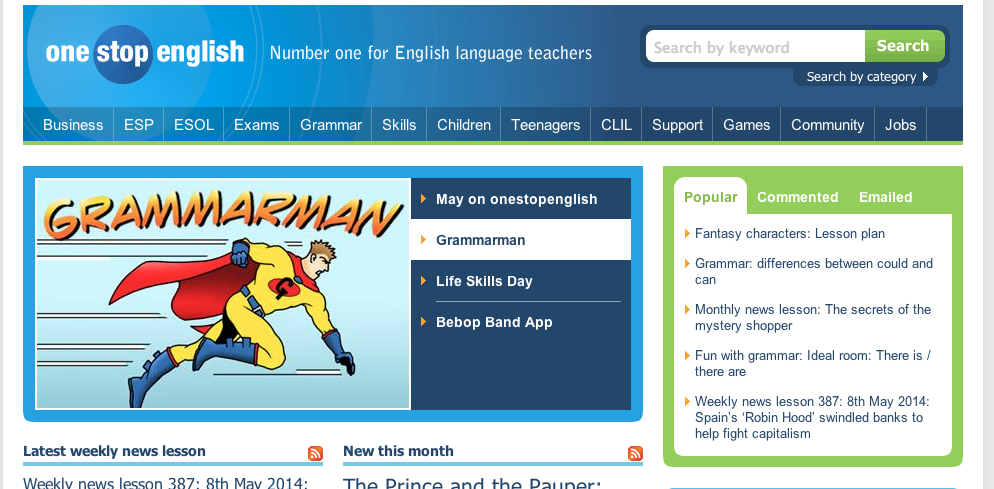
http://www.onestopenglish.com: screenshot of the homepage

onestopenglish is another goldmine of ideas for lessons and articles about different aspects of teaching. Good things about this website include the breadth of its resources (which are regularly added to) – as well as general English (divided into Grammar and Skills, which in turn are sub-divided into numerous other categories) the site holds ideas for teaching:

  • Business English
  • CLIL
  • TKT
  • ESOL
  • Young learners and teens

– and the ease with which it is possible to find things due to clear categorisation. In addition to resources, they also have a handy jobs section. Some of the resources are freely available, while some are only available if you subscribe.

Academia.edu

Screen Shot 2014-05-11 at 20.39.39

Academic.edu: screenshot of homepage.

Academia.edu might seem less user-friendly than the above two websites, but is nevertheless a very valuable resource: as a researcher, you can register and upload .pdfs of articles that you have written, to share with the community, and as a teacher/reader, it gives you access to research for free, which is not something to be sniffed at!

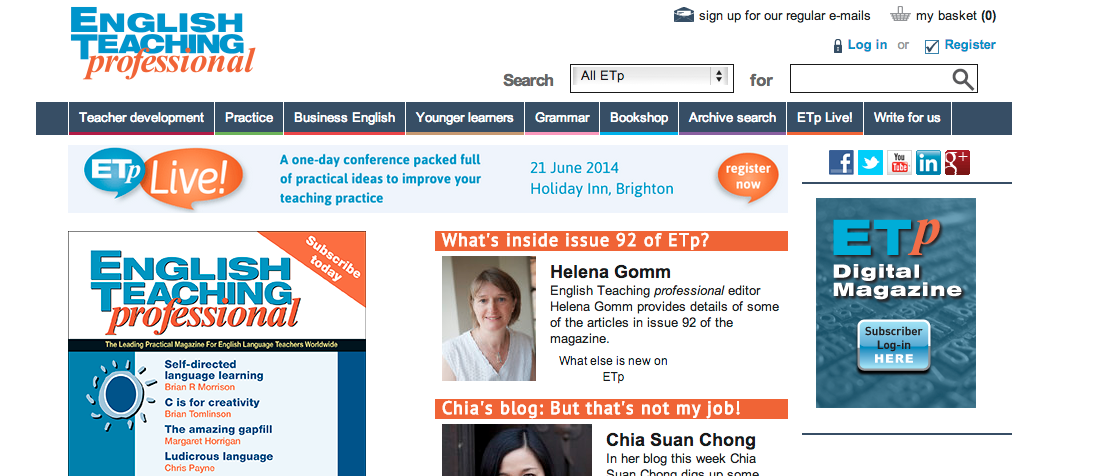
English Teaching Professional magazine’s website

www.etp.com : a screenshot of the home page

http://www.etp.com : screenshot of the home page

You have most probably read, or at least heard of, the ETp magazine for teachers, which contains articles and activity ideas, book reviews and much more. Well, the ETp website is equally worthwhile and demonstrates commitment to professional development in the resources it provides to this end. Each of the different sections contain links to articles around various topics and the site also has its very own registered blogger, Chia Suan Chong, whose posts are always worth reading. Currently, EtP are also organising a one-day conference, which will be held on 21st June 2014 in Brighton.

Twitter

Screen Shot 2014-05-05 at 14.46.31

The ubiquitous Twitter bird via Google search for images licensed for commercial use with modification.

Naturally! By Twitter, I don’t mean the Twitter website, per se. What I mean is the wealth of links it can make available to you and the discussions you could participate in, if you use it professionally. As everything you need to know is in the afore-mentioned link, I’ll leave Twitter right here.

Teacher blogs

Many ELT professionals these days maintain a blog. It is considered to be a valuable form of professional development to do so. It is easy to follow these blogs and be notified each time a new post is added. Here are a few to get you started:

Screen Shot 2014-05-12 at 08.29.42

Sandy’s blog – a screen shot

  • Sandy Millin’s blogSandy is a DoS at IH Sevastopol and has been blogging for a number of years now. Her blog contains a wealth of teaching ideas that she has tried and tested, reflections, collations of useful links, for example relating to the Delta qualification that she recently completed and to Cambridge exams like FCE. You might also like to check out her (Almost) infinite ELT ideas blog too, if you require an injection of fresh inspiration! In this blog, which is all about collaboration, she publishes a potential resource and canvasses ideas for how to use it with students. Now that she has finished Delta and is settled in her post-Delta new job, this site has been resurrected so keep checking back.
Screen Shot 2014-05-12 at 08.30.45

Adam’s blog – a screenshot

  • Adam Simpson’s blog:Adam works at a Turkish university and is dedicated to his students and to his own professional development, as well as sharing these passions with others. His blog contains a wealth of interesting posts related to this.
Screen Shot 2014-05-12 at 08.34.35

Rachael’s blog – a screen shot

  • Rachael Roberts’s blog Rachael Roberts is a teacher, MaW SIG committee member and materials writer, and her blog contains lots of useful teaching resources and materials that she has developed, together with the rationales behind them, and tips for creating your own materials too.

Some of these blogs sport a “blog roll” of other blogs that the owner has found interesting and useful, so it would be worth checking these out too. Of course there are hundreds more I’d love to name, but this post would get awfully long if I did so!

Some of the “big names” in ELT  also maintain blogs:

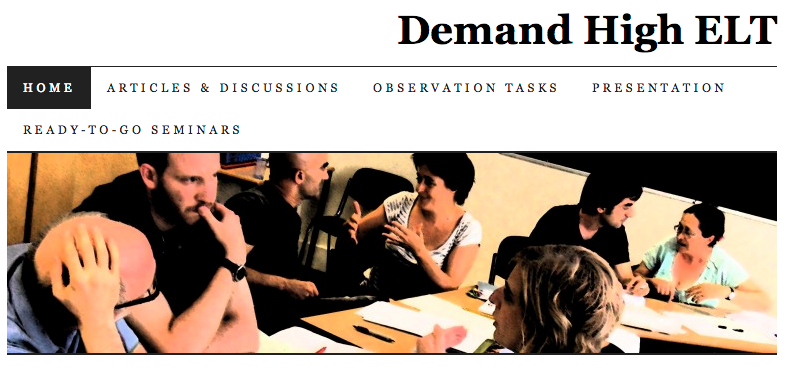
Jim and Adrian’s Demand High ELT blog – a screen shot

  • Demand High ELT is a growing site, owned by Jim and Adrian, and devoted to Demand High ELT. There is discussion, links to relevant resources, materials for seminars and more.
Screen Shot 2014-05-12 at 08.39.42

Scott Thornbury’s blog: a screen shot

  • An A-Z of ELT is Scott Thornbury’s blog, containing a wealth of articles about a range of ELT-related topics and issues.
Screen Shot 2014-05-12 at 08.40.49

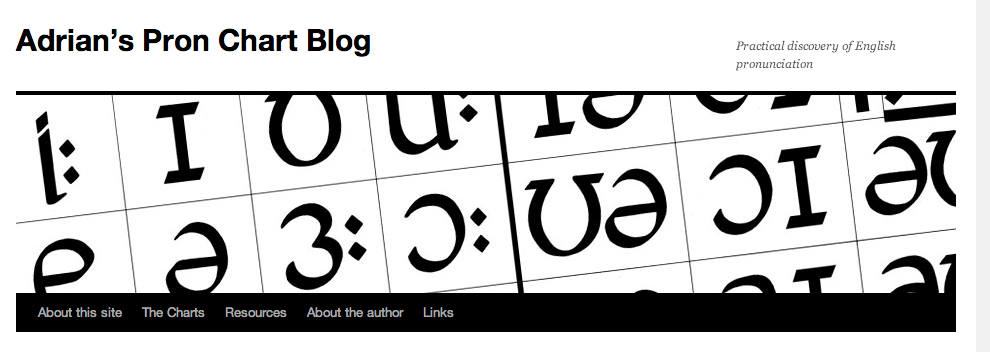
Adrian’s pron blog – a screen shot

Screen Shot 2014-05-12 at 08.29.24

Hugh’s multi-faceted blog – a screen shot

  • Hugh Dellar’s Blog is full of interesting discussion about various ELT-related topics and ideas that you could try out in your own classes, as well as recordings of talks he’s given at past events.

Of course, the kind of blogs you read will depend also on your own interests within the profession.

For example:

To see links to blogs which relate to ELT management, please click here.

To see links to blogs which relate to Delta please click here.

Why not start blogging yourself, too, if you don’t already? There are lots of good reasons to do so!

Free Webinars for Teachers

Free Webinars for Teachers

Free Webinars for Teachers

Free Webinars for Teachers is a Facebook group where people share information about free webinars that teachers can attend. This makes it a good way of keeping up with what is available in this area of online professional development. You need to make a request to join and posts are moderated so that content remains useful to members. You can choose whether or not to receive notifications when something new is posted.

Technology

There are three major players in the technology game, all of which are worth keeping an eye on in order to stay abreast of technological innovation:

Screen Shot 2014-05-12 at 08.49.11

Nik’s technology lover’s paradise – a screen shot

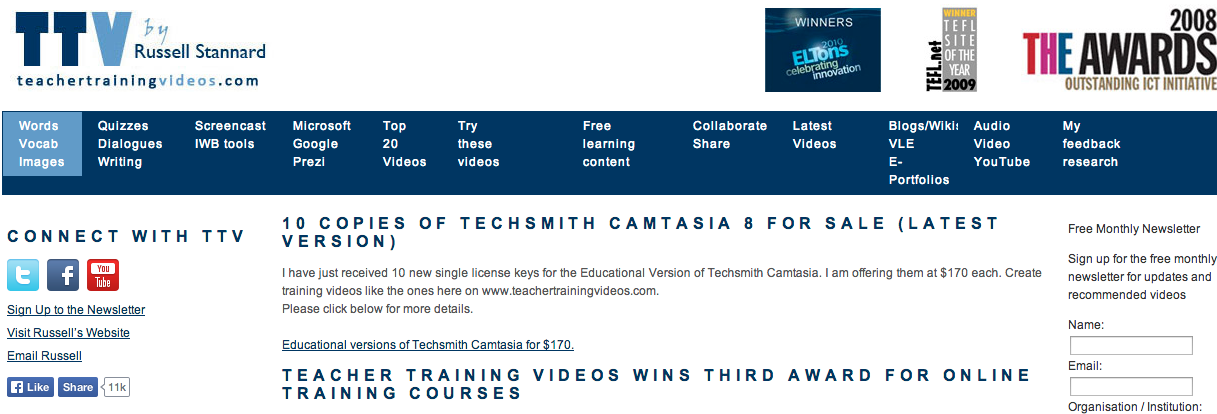
Russell Stannard's website which answers "How to..." for pretty much anything technology-related.

Russell Stannard’s site which answers “How to…” for pretty much all techy questions – a screen shot

The Consultants-E

The Consultants-E – a screen shot.

  • The Consultants-E : These guys offer training courses and consultancy services but also carry some freely available great resources relating to technology on their website. You can find these by clicking on “Resources” on their home page.

#ELTChat

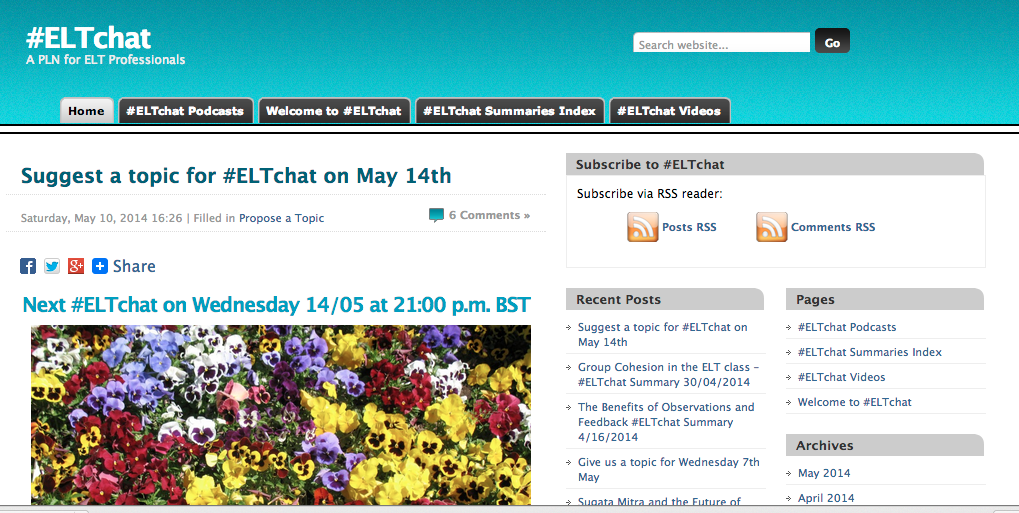
You could argue that this is part of Twitter, but these days #ELTchat exists beyond the bounds of Twitter too. There is the website, where you can find all the summaries carefully indexed by date, as well as links to podcasts and videos.

ELTchat - a PLN in the making: a screen shot.

ELTchat – a PLN in the making: a screen shot.

And there is also the Facebook group, where people share links to interesting sites they’ve found, to recent chat summaries and more.

Screen Shot 2014-05-12 at 09.14.01

…and the Facebook group page – a screen shot.

IATEFL

IATEFL is the International Association for Teachers of English as a Foreign Language. This organisation has a website , a Facebook group page , and lots of satellite pages run by various of the SIGs or Special Interest Groups.

IATEFL.org - a screen shot

IATEFL.org – a screen shot

The website contains information about forthcoming events, links to webinars that the association has put on (as well as information about those forthcoming), information about the afore-mentioned SIGS and of course its jobs pages where you can see job advertisements, especially in the run up to the annual IATEFL conference, due to the job market place that runs during this event.

IATEFL Facebook group page

IATEFL Facebook group page – a screen shot

The Facebook page is a space to discuss ELT-related issues and share links of interest to others in the profession. It is not a place for self-promotion and advertising (or spamming!).

In terms of SIG pages, here are a few that I know of:

  • MaW SIG Facebook page : For materials writing fans –  here you can find information about events run by MaW SIG, links to materials writing-related blog posts and sites, information about other materials writing-related events and connect with people who are also interested in materials writing.

Here is a list of all the SIGs currently in action, so if you find one in your area of interest, google it and you will doubtless find a Facebook page and/or a website that it maintains. You could also email the coordinator (name and contact details given in the list) for more information.

SIGs are a great way to connect with like-minded individuals and keep up with issues in your professional area of special interest.

You have to pay to join IATEFL, as well as any of the SIGs themselves (which is highly recommended, as you get plenty of membership benefits), but following their Facebook pages and Twitter handles is open to all.

image taken from openclipart.org via Google search licensed for commercial reuse with modification

Don’t forget: share your favourite resources too, by commenting on this post!  – image taken from openclipart.org via Google search licensed for commercial reuse with modification.

I hope this post gives you some new resources to look at and I look forward to hearing about the other resources you’ve tried…