IATEFL 2016 Materials Writing SIG Open Forum

Rachael Roberts starts by welcoming us to this open forum by explaining about MaW SIG. It is for everybody!
IMG_20160412_214454

She’ll tell us about what has happened this year and plans for the future, which will be followed by a financial report and a talk by the scholarship winner. This will be followed by the raffle and some nibbles.

The MaW SIG year

2015

Rachael tells us that MaW SIG are very keen to foster links with associates in various countries to set up more meet-ups. There were meet-ups in Oxford and Berlin. There was also an online meet up, the MaW Online Festival.

A sad thing happened in that Hans Mol passed away in November, he was in charge of publications and was a founding member of the SIG.

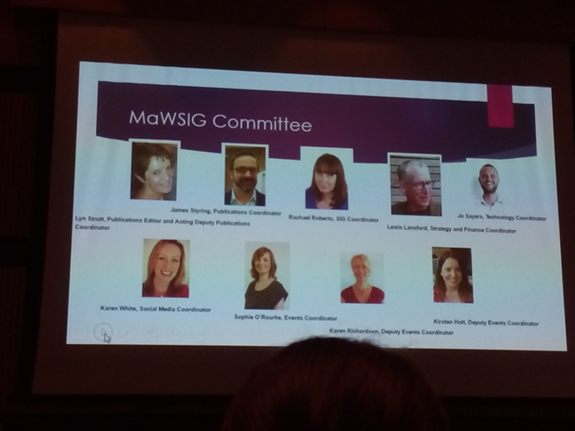
The committee!

The committee!

The SIG is looking for someone to do the Deputy publications coordinator. They are also looking for a Technology Coordinator and a Deputy Events Coordinator. If you are interested in these roles, you have till the 22nd April to apply.

The SIG is looking for someone to do the Deputy publications coordinator. They are also looking for a Technology Coordinator and a Deputy Events Coordinator. If you are interested in these roles, you have till the 22nd April to apply.

In 2015, MaW SIG also brought out their first e-book, a collection of the blog posts on their website plus two bonus articles not on the blog. There is a new post out on the blog today, written by Kieran Donaghy, giving advice about setting up an ELT materials website.

In February this year, there was the annual face-to-face conference in London, at the Stables of Macmillan. This was organised largely by Kirsten. (Read more about it here!)

Looking ahead

Working in cooperation with BESIG, there will be a conference in Munich from 4-9 November 2016, which is a BESIG conference with a materials writing thread. Proposals don’t have to be only about business material writing, so anything that could be used by Business English writers would be great. So, for example, writing video scripts. Not specifically BE but still useful!

There is also the  website, which has the blog. On Social Media, Karen White does a fantastic job of keeping the Facebook Page, a closed Facebook group for members and LinkedIn as well as Twitter. There will be a suggestions page added to the website, as they are keen to hear from members about what they would like the SIG to be doing/not doing. So please do use this page.

This year they also did their first scholarship in collaboration with OUP, in materials writing. A challenging task was set: writing a piece of material that dealt with the theme of the environment in a fresh and interesting way. Moundir Al Amrani won the scholarship!

He tells us he is very excited happy to be here and to have won the scholarship. He had started to think he wasn’t cut out for this but the scholarship has given him fresh enthusiasm for materials writing. He is from Morocco, a teacher and materials writer. He has won the lesson share competition on Onestopenglish.com twice, back to back. After which, he won the scholarship.

He shows us where Morocco is, its flag and tells us a bit about what he does. EAP, ESP, BE and GE teaching, as well as content courses in the humanities and literature at University. He is also a novice teacher trainer and a materials writer. He writes worksheets, multi-skill lesson plans, vocabulary and grammar activities, course books, teacher notes and a book to meet the specific needs of his students.

Why does he do this? Because it is his passion. He wants to be productive and learn. There is a saying that goes if you love what you do, then you never have to work a day in your life. He loves what he does, his career. He wants to be a better teacher, write better teaching materials, give back to the teaching community and be part of ELT innovation and development. He finishes by thanking MaW SIG and OUP for the scholarship once again.

OUP representative Emma takes the opportunity to say that if you are interested in sending materials for the OUP blog, please do, she also looks after a newsletter about teaching adults that goes out to 28000 teachers globally and they are always looking for people to submit materials/articles/thoughts on any aspects of teaching adults.

Lewis Lansford tells us about the running of his pub in York. There’s always the point where you have to talk about the budget and it’s the low point of the meeting. Now he is going to be that guy, presenting the budget. This is his bid to sugarcoat the process, discharge the obligation and not make us feel “oh no”.

Budget comes from the Latin “Bulga” (pouch or knapsack). It entered English with the French meaning (bag), but by the end of the 16th century included contents as well as bag. 1733 was the first finance connection.

2014-2015 accounts. It took him a while to work out where the money was but in Sept 2014, there was £5,502 profit, earnt not spent. Events and subs produced £8,387, then expenses £5,592. Anyway, the surplus at the end of the year was £2,911. September opening reserve was £8,413, and the closing reserve is £8,731. (Not really sure what it all means!! But it’s there!) And thank you to Macmillan for sponsoring the conference in February as that helped the budget!


On that note it was time for the raffle, eating and talking!


IATEFL 2016 The N-Factor: follow-up workshop to Silvana Richardson’s Plenary talk

Now it’s time for Silvana’s Day 2 Plenary follow-up workshop. As you would expect, there is a good turnout!

IMG_20160414_091359

A little reminder from the day 2 plenary!

Silvana starts by welcoming us and telling us that as it is a workshop, we are going to be doing most of the work. She plans to recap the main points of the plenary, ask us some questions, and hopefully explore some future directions.

Rather than writing up her recap here, I encourage you to take a look at my full write-up of her wonderful session here.

Silvana gave us the following questions:

  1. Why did you come to this workshop?
  2. What struck you most about yesterday’s plenary?
  3. What questions/comments would you like to ask me?

Then once we had discussed in small groups, we had to hand questions in to Silvana.

Question 1: One question that seems to recur is the question of terminology – what can we do to improve on NEST and NNEST?

Audience 1: Why not just say I’m an <country adjective> English speaker. One of his students wrote “I like speaking English with an Italian accent”. So that is what we aim for, a confident English speaker who is proud of his/her background and identity. Audience 2: I think there is a difference between being a speaker and being a teacher. Penny Ur speaks about highly proficient users of English. Becoming a native speaker is not am ambition that can be achieved. Audience 3: Why would we want to? Silvana: I’m a native speaker of Spanish, sorry. Audience 4: If we wan to do away with the discriminatory side of things, let’s have “I’m a teacher of English”. Why come up with something that will go against us? “I’m a qualified and experienced teacher of English. And I’m proud to be Hungarian and give a Hungarian English model to my students”.  Audience 5: We should let our students know who we are and that we have worked hard to become proficient at the language. Audience 6: What’s really important is to be a good teacher. That you use the language you have, whatever the level, in the right way with the students. Teaching is about the student talking time. Silvana: What we are teaching is English. For me, being competent and highly proficient is important. If I am teaching, and I am A2 level, then I should want to go on and improve that. Marek: For too long, there has been an obsession with native-like proficiency. It’s unfair to ask for C2 level all the time, we can’t turn a teacher down because they have slightly lower proficiency. That doesn’t mean they shouldn’t improve. Silvana: It’s about subject knowledge isn’t it. Audience 7: It’s very difficult for us to be respected by society because we allow ourselves to be considered great teachers with an A2 level and it’s ok. If we were doctors and had a superficial knowledge of the human body…? Marek: Proficiency is not the only aspect. For example don’t require people to be proficient in methodology, they can’t be after a 4 week course. Audience 8: I was just wondering..I will always be proud of being an NNS but the time it would bug me would be if someone doesn’t want to employ me because of it. I don’t have a problem with being referred to as such, but if someone says we don’t employ NNS, then I have a problem. Audience: The solution in my opinion is rooted in the perception on the clients side, on the learners’ side of what the NNS has to bring to the table. Let me ask you a question. Do you know what the Fair list is? An award giving to organisations where there is gender equality for example at conferences. Maybe we could have one for NS-NNS equality.

Question 2: The NN teacher’s voice is an incredibly powerful source of quality exposure in low resource environments, how can we encourage this to be valued?

Audience: students will value a NNS more because they can see them as a model of what they could aspire to, so they can relate to it. A “we could do that too” thing. Marek: Haven’t found a single study that supports that a majority of students prefer native speakers. Good English was important. Audience 2: I think proficiency is an issue here. We are trying to do away with the native speaker as an idea but we need to put something in place of that, so that students have something better to strive for. We can’t improve anyone if we don’t know what we are trying to get at. I’m not saying we can agree on one particular standard but there should still be something up there. Our students would like to see that they improve and know what we expect from them. Audience 3: I’m troubled that we are still talking in terms of dichotomies. As Silvana said, we have to do it together. It’s not dispensing with the idea of NS-NNS, it’s actually being equal and that equality to be placed on the basis of qualification and competence which includes language competence. But language competence doesn’t mean native modelling. Audience 4: I guess what we are facing here is a social issue. We are talking about equality. It’s a social change. And it will not come from textbooks or top-down, probably as social change  generally doesn’t. It will come from us. I agree with our Hungarian friend, it’s about unity. It’s us uniting and joining together, joining strengths.

What are we going to do about this?

(NB: Again, deliberate use of extra large font above!) 

More discussion questions:

  • What changes would you like to see?

Silvana says we need awareness, advocacy and activism. What are you going to do in your context to make this change? To make change, it happens with small steps. So we need to start looking at what step one is. What possible first steps could you, your school, your teaching association take? We are asked to listen supportively.

She invites us to share ideas for change. Various audience members share the following:

  •  I might be in the minority here because I’m English. My point is, I teach ESOL here in the UK. I’m fully qualified, I’m doing a Masters at the moment. My problem is I am lumped in with the people who go abroad, with no qualifications, to get summer jobs. It’s not just a problem overseas, we’re having similar problems here. The government doesn’t want to pay us. I don’t know how to change that other than doing the best job I can. My manager is Polish, I have a French colleague, both fully qualified. They’re getting jobs here and not being discriminated again so it’s kind of we need to change it not just for the rest of the world but also in ESEs so that people recognise the jobs we do.
  • I used to be a teacher in a secondary school. I had to do a 4 year degree then an M.A. in teacher education. That is what you need in Ireland. With a 4 week course to become qualified, it gives the impression of not being a real profession.
  • I think all of us can chip away at the prejudices. But it can be top down too, I’d like to see other institutions getting involved like TESOL France. These organisations are powerful in their countries and can send a powerful message.
  • I’m going to set up a blog aimed at learners about what they should look for in their teachers. So that they can see that no matter whether they are native or non native, what is important.
  • I think if you work from the grassroots, you engage in local association of English teachers, that would be a good thing to do. If there isn’t an association, make one. We should be focusing on the professionalism of a teacher not their origin.

There are so many questions here, and we have only just started. The conversation will continue at Marek’s TEFLEquity blog.

IATEFL 2016 I’m a non-native English speaker teacher – hear me roar! (Dita Phillips)

Dita starts by telling us what her talk is NOT about – statistics, definitions, discrimination etc.

Then she tells us about Martina who was incredulous that it was possible to be Czech and teach English in Oxford.

Dita started learning English when she was 6 years old. She did her CELTA in Czech Republic, with British and Polish tutors. It was great for the NNS to have Polish tutors but it was never discussed, which was a real missed opportunity. Would have been good to talk about teachers as role models. She was one of the first NNS teachers in the first school that hired her, as it was new for them to recruit NNS. When she got to Oxford, applying for jobs, a number of schools told her yes your qualifications and experiences are good but we don’t hire NNS but finally she did get a job at a school with a different policy.

She was very nervous to start with, about student reactions. She was asked to teach an exam class and the students were a bit rowdy and she eventually said they should listen because this is what worked for her, and then the rest of the lesson was a Q and A about how she had done, it – they wanted to know. This was her eureka moment and she feels all NNS teachers deserve this experience.

As a teacher trainer, Dita thinks that for those who are still waiting for that eureka moment it should be provided vicariously – through teacher training. Of course she tries to be a role model to trainees on her course. If you can’t be that yourself, you might have a colleague you could invite. Other options: you could go online – show them the NNEST of the Month Blog etc.

Barbara is another teacher that Dita met on a similar course to Martina, and she said she would be disappointed if her teacher in Oxford wasn’t an NS, not realising that Dita wasn’t. Is it because they’ve been told so many times that NS are better, that they have come to believe it? The dilemma – should she tell them or hide it, that she is an NNS? Teachers have developed lots of coping mechanisms – Dita knows, she has tried them all. But these days she is more relaxed about it. But one thing she sees as her responsibility as a trainer is that the discussion about native and non-native needs to be raised. On a mixed CELTA course that is not difficult to do, it comes up naturally for example in a language awareness session. The discussion of ELF can help steer towards it to. There is a BBC I-Player 30 minute Word of Mouth about English as a Lingua Franca, Dita will play 15 mins of it and it really gets participants talking.

Maria’s quote is about fear regarding not sounding like a native speaker despite being C2 – i.e. a fear of inadequacy. There isn’t a lot of research into teachers’ attained level vs their perception of their level. Whatever they think impacts their professional self-esteem and confidence. Language development should be part of developmental courses however language proficiency is only one element of proficiency, it’s also about knowing how to teach.

Suggestions for TT:

  • Provide role models – trainers, guest speakers, online
  • Create discussion
  • Focus on language development including what they know
  • Focus on teaching pronunciation
  • Connect peers

A C2 level teacher shouldn’t be going around saying they are no good. Positive role models and awareness of NNS who can and do would help this issue.

Dita gives an example of the second point: a video of Gordon Strachan is used with no preparation. A tricky listening but they could understand what was said. Would you use it with students? Jargon, background noise, accent etc and then Dita likes to point out, ok, indeed it has, and YOU UNDERSTOOD IT! Something to be proud of…

Another example given is Sonia, who thinks she can’t teach pronunciation because she is not a native speaker. Pron is linked to language proficiency but the last thing that identifies people as NNS. E.g. Sonia’s English was amazing but she had a hint of an accent, and thus couldn’t bring herself to work on pronunciation in class. Dita wants teachers who leave her course not to think they can’t do something for such a reason.

Dita shows us a video of an NNS teacher speaking confidently about teaching pronunciation having done a pronunciation course and recommending this. NNS teachers tend to know all the theory but might shy away from doing it in the classroom, so it’s useful to provide positive experiences and engaging materials. Hopefully they can take this and use it in their classrooms. It doesn’t matter what material you use but two things should come out of it: teachers should go away knowing where to find such activities easily and having had a good time. That is the major thing to help them overcome that fear in the classroom.

Dita’s course receives positive feedback regarding collaboration between NS and NNS, so that both can appreciate each others’ strengths. So it is a good idea to have mixed CELTA courses, Erasmus programmes and show trainees where to go online for support, to discuss these issues. E.g. TaW SIG, TEFLEquity, NNES in TESOL Interest Section.

For a comprehensive reading list visit: www.multilingually.wordpress.com

There was some audience discussion:

Audience: terms NNEST and NST are propagating the problem. We should use “preferred language”, “competent language”, “proficiency”. Dita: A valid point, I agree. There is a transitional stage where we have to work out how to talk about these issues and not perpetuate it.

Audience: Where does the native speaker label come from? I got a job as a native speaker because I have an Australian passport but I don’t speak English as my first language. Dita: Where does it come from? I guess from Chomsky!

Audience: Any suggestions for helping trainees to distinguish between accent and pronunciation, in that pronunciation matters and accent doesn’t matter, as teachers? Dita: accent perception depends on where you are e.g. a glaswegian in Birmingham wold be perceived as having an accent.

Audience: It depends on your perception of yourself. To start with I hid it but now I have relaxed about it. Dita: And that’s the kind of attitude I would like people on my courses to go out with.

@ditaphillips

Dita.phillips @british-study.com


IATEFL 2016 Moving EAP students to metacognition and autonomy (Michelle Tamala)

Michelle has been involved in English language intensive courses for overseas students for about 20 years. She is a regular speaker at learner autonomy events.

This talk is a narrative. She is going to tell us about a journey she has embarked on, originally started as an idea for some action research. With research, once you start… Michelle has come up with more questions than answers.

Students: upper intermediate level, university pathway college in Australia, trying to get their English to move up by .5 of an IELTS band in ten weeks, learning academic skills as they go through. Autonomy is a strong theme in Australian schooling from primary to university, seen as being important. Michelle’s belief is that if we can get ss to use indirect learning strategies (metacognitive) to decide what cognitive strategies to use, when completing a task, they will be more effective and successful learners. Students will move from being taught to actually learning. Requires a big shift for them and for how teachers approach their teaching. Michelle wants to move away from practising for an exam to actual learning.

The starting point for the research was a student survey on student learning – to complement the other surveys that have to complete at the end of a ten week course. She wanted to find out if students at different levels were more less reliant on their teachers to inform what she needed to do.

IMG_20160414_111311

In terms of self-assessment, students mostly thought they had improved. Superficial results but a place to start. In terms of problem area identification, the lower level students were teacher reliant, the post-grad students were more able to work it out themselves. One teacher has been quoted as saying “I know what my students need, I tell them what to do”…needs a bit of re-education.

IMG_20160414_112429

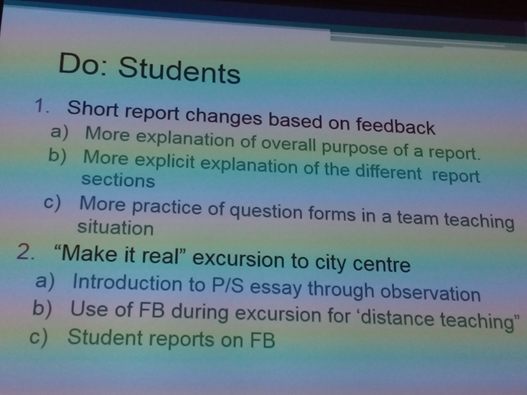
Michelle’s plan was to get both the teachers and students involved in her action research, through learner journals and through take up of change/meetings/reflective writing for the teachers. Students had two major writing tasks – short report and longer problem/solution essay. She did a learning survey in week 2 and 9, students are invited to join a closed class FB page (generally successful and sought after by ss). The students fed back that they didn’t understand the purpose of the report, they had trouble writing questions…because the task was designed to give them autonomy as to what went into the report and they had to reflect on it on a weekly basis in their journal. Michelle created an FB page for discussion and sharing of ideas among teachers and wanted meetings to focus more on task design, learning strategies and indirect metacognitive strategies used in daily classwork (rather than just administrative stuff).

IMG_20160414_112447

The changes made

Another survey showed the following positive changes between early on in the course and late on in the course.

IMG_20160414_112919

IMG_20160414_113017

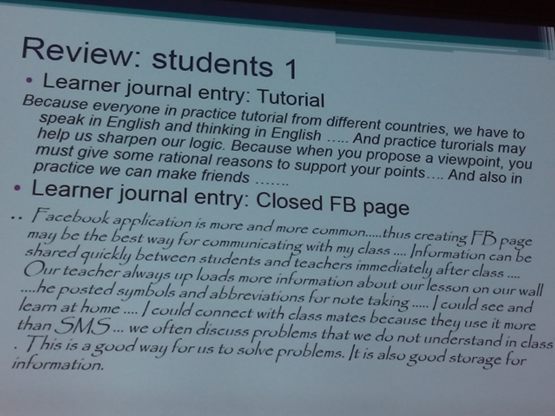
Their journal entries relating to the various aspects of Michelle’s project also showed positive feedback:

IMG_20160414_112623

IMG_20160414_112803

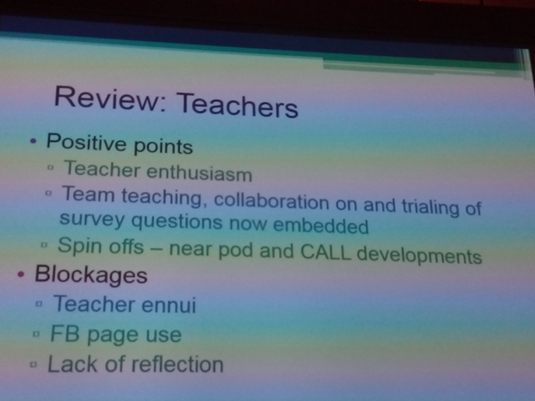
Teacher engagement during the project was mixed:

IMG_20160414_113323

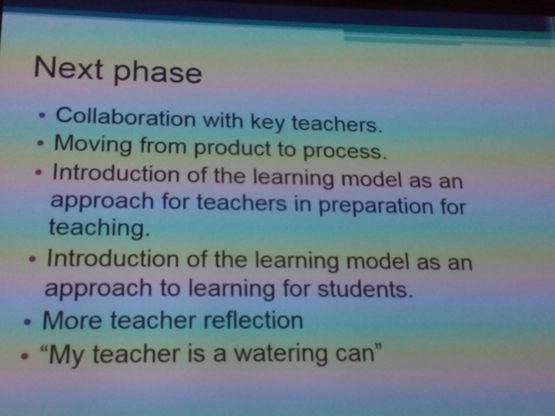
In terms of future directions, Michelle is looking to build on what has been done so far…

IMG_20160414_113349

The product to process is because most teachers favoured a product approach due to time limitations but Michelle wants to explore alternatives.

IATEFL 2016 How to optimise EAP tutorial time: introducing the 20-minute fix

David Jay is from Anglia Ruskin University and will talk about EAP tutorial time.

In this 20 minutes, David is going to tell us a story. A story of the last 5 years and insights from that, which will be followed by a ten-minute discussion for adapting the ideas to our context.

The story begins in 2011, when David was asked to look after the in-sessional support service which at that time was a drop-in service that took place 2 hours per week. Any students who needed help with Academic English and skills were welcome, including undergrad and postgrad students from three different faculties.

It tended to go wrong in two different ways. A load of students would arrive at once, all wanting help, from a range of backgrounds and with a range of needs. Meaningful support was difficult to offer. Otherwise, one student would turn up with an essay and ask him to proofread it. He felt he was ending up marking their work but the input was superficial as only surface errors would be dealt with in the time available. It was also too teacher-centred.

The first change was to make it appointment-based with one appointment per week limit. Where possible, work would be sent in advance (with a maximum of 500 words at least 24hrs in advance of the appointment). Student feedback was positive. Not a very original system, he says. (And indeed, yes, we have something similar at Sheffield Uni ELTC!) 

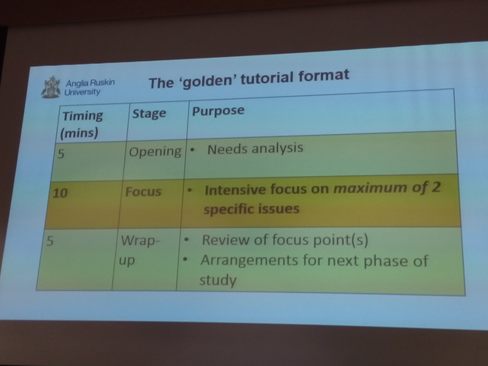
David settled on 20 minutes as a good length of time for tutorial as it provides enough time for 1-1 consultation, in terms of diagnosing problems and giving clear guidance. Crucially, it’s not long enough for it to end up being proofreading. He structured it as follows:

IMG_20160414_163642

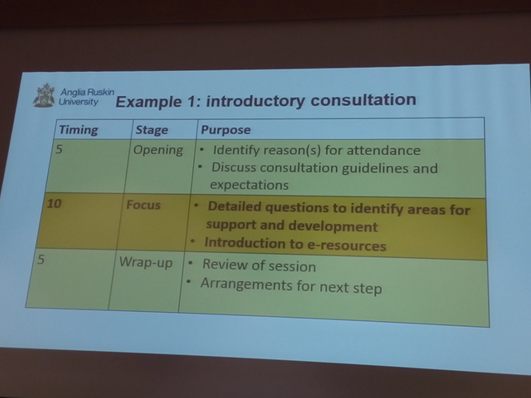
How does it work in practice? The introductory tutorial:

IMG_20160414_163737

The length of time and focus on identifying resources that will be used encourages autonomy.

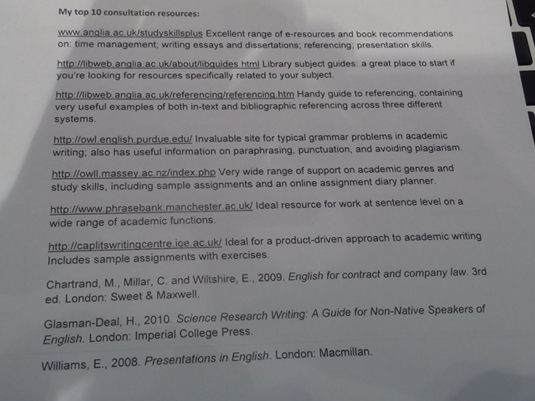
Good resources:

IMG_20160414_165055

Another resource: www.griffith.edu.au/englishhelp

A writing consultation:

IMG_20160414_163831

David thinks that 20 minutes is the right length of time as the sessions help develop learner confidence and practical training in personal agency which will help with future using office hours effectively. For tutors, it is enough time for diagnosis and support but maintains focus on autonomy. For other stakeholders, it optimises service uptake.

david.jay@anglia.ac.uk

Twitter: @cambthink

IATEFL 2016 Ten great educators and their legacy (Alan Maley)

This one intrigued me! Who will be the ten chosen ‘great educators’ and what IS their legacy?

Alan says he only has 30 minutes but has two days’ worth to say. Perhaps won’t be able to say all of it…

He kicks off with a poem by that well-known poet Anon. It may not matter. Very nice.

Why bother with the past? It gives us some perspective on the present, it brings humility and recognition, it is a reminder of what we may have forgotten, it gives courage and comfort, it gives inspiration for the future.

Alan thinks there are two major views of education.

Education as instruction, characterised by its being directive, using controlled prescribed input, this leads to predicted intake (what we teach is what is learnt), places emphasis on language system (i.e. here, English), teaches the subject matter, focus is on technique and assessment is heavy.

Education as ecology: it is responsive, the input is flexible, the emphasis is on language use, it teaches the person rather than the subject.

Dewey: education is about people, helping them fulfil their potential

Rudolph Steiner: the child is the centre of education, there should be a balance of artistic, practical and intellectual activity.

Montessori: each child born with a unique potential to be revealed, rather than a ‘blank slate’ waiting to be written on. Adapt the environment to suit the children not the other way around. Never help a child with a task at which he feels he can succeed (i.e. don’t get in the way).

A S Neil: happiness is the goal of education. Hate breeds hate and love breeds love.

Ashton-Warner: Start from where the child is. No need to plan, trust in the organic process with the kids.

Paulo Freire: Marxist revolutionary in Brazil mainly involved in literacy programmes, believed in the link between literacy and freedom. Very against the banking system of education. (You bank knowledge and pay it back in tests) You can’t tell people what they need to know, you need a dialogic process.

David Horsburgh: Vertical classrooms. Taught practical things. Boys were taught embroidery, girls were taught motor mechanics. His teachers were not ‘trained’ because he didn’t want to have to retrain them. Competition, rewards and tests are all negative factors. A wide curriculum is important.

John Holt: School is a very negative influence on children. Teaching gets in the way of desire to learn and creativity. Against institutionalised education. Schools are full of fear, confusion and boredom. The true test of intelligence is not how much you know how to do but how we behave when we don’t know what to do.

Dorothy Heathcote: Drama should be at the heart of education. The curriculum should be evolved as you go along, with what the children bring to it.

Ken Robinson: Education should foster diversity but instead it’s getting narrower and narrower.

So what are schools for then? Custodial care (keeping them off the streets), social conformity (making sure they don’t rock the boat), sorting kids into categories (who passed, who failed), education (teaching them? helping them learn?). Education is only a minor part of school life!

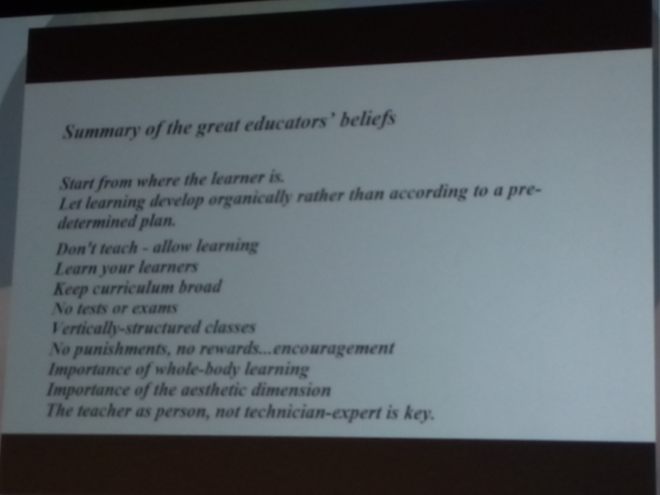
Summary of the great educators’ beliefs:

IMG_20160414_125550

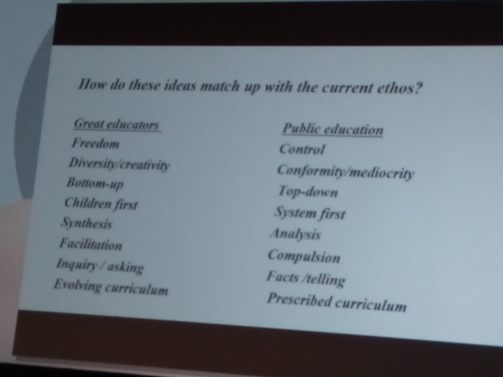
These are the common features of these educators’ beliefs and what they are advocating. How do they match up with the current ethos?

IMG_20160414_125633

No match at all. So you have a complete mismatch between the educators that everybody bows down to and the actual practice taking place. If we go on in this way, we are going to have problems because we are condemning future generations of kids to failure and there’s too much failure around at the moment as it is. We need to create a groundswell of opinion which will favour change – not just more of the same. Not necessarily revolutionary change, you can make small changes too.


IATEFL 2016 You tell me! Practical ideas for student-led tasks in ESAP (Anne Heaton)

Well, I had been planning to go to the ELTJ debate about teacher training, after lunch, but then my interview slot with IATEFL Online clashed with the start so instead I am attending Anne Heaton’s talk on student-led tasks in ESAP. Anne is Associate Director of Pre-sessional English Courses at Coventry University.

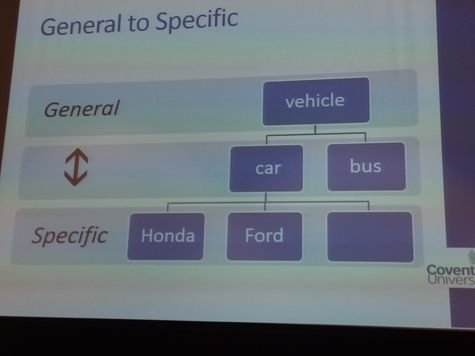
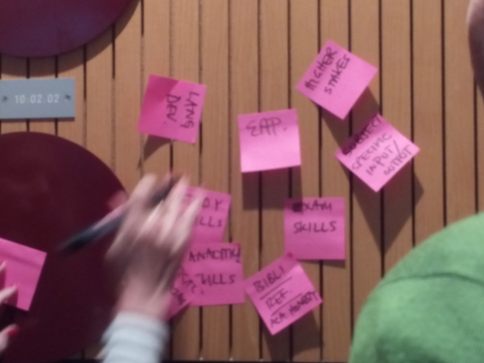
Anne starts by talking about the general to specific continuum. You could use this activity in an EGAP class to get students used to the idea. Start with some gaps in the chart for the students to fill in:

IMG_20160414_150811

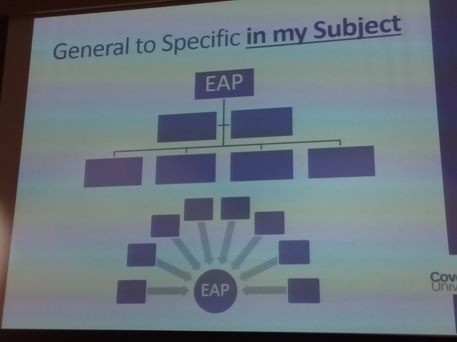
Thinking more specifically about general to specific in my subject we are going to take “EAP” as our subject. We are going to look at the same activity.

IMG_20160414_150936

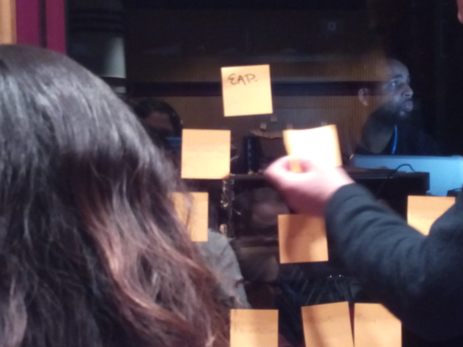
The best way to do it is using post-it notes which they can then freely move around. This means you can add in different layers/categories to the spectrum/chart. We tried it out:

IMG_20160414_151611

IMG_20160414_151749

These are the principles of the tasks we are looking at today:

IMG_20160414_152253

Where Ann works, there are 8 intakes a year and within that 1000 student enrolments. They have two large pre-sessionals, one pre-September and one pre-January. Students have a wide variety of destination subjects (60). As there are so many students, tutors with a wide range of experience end up working there at busy times. Until 2014, the courses were EGAP institution generic courses. There is an even split between postgrads and undergrads. The majority are from China, followed by Middle East. BA in International Business is the biggest subject and B.A. in Business-related subjects make up the majority of students. Same with the post-grads.

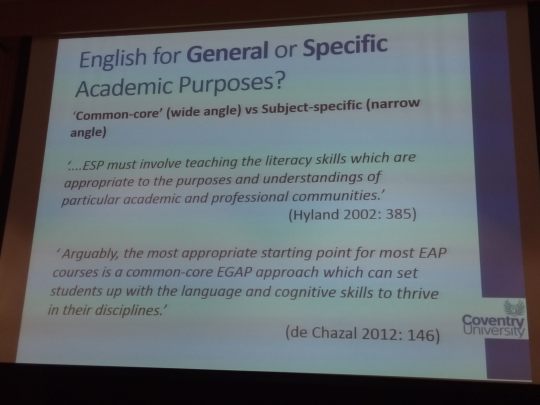
Ann outlined the differences between EGAP and ESAP:

IMG_20160414_152822

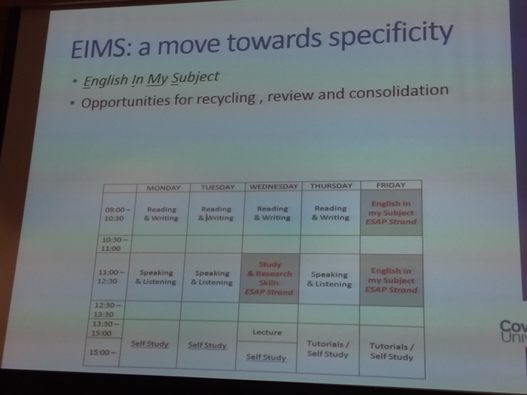
It is set up as a dichotomy but the two co-exist in reality. In 2014 they decided to make a move towards an ESAP approach. Not to lose the EGAP but to sit ESAP alongside it. Difficulties included establishing collaboration with subject specialists but information is needed from them as we aren’t experts; dealing with ‘odd’ subjects; deciding how to group students when there is a mix of undergrad and postgrads; managing the issue of teachers feeling underprepared to teach.

They have re-named it EIMS (English in my subject) to emphasise it is language not content. This is a typical timetable:

IMG_20160414_153138

They use a parallel structure so that the same task type or skill will be introduced across all EIMS groups but it will be tailored content-wise to the specific subject. As much as possible, they get students to generate the ideas, students positioned as experts in their subject. Students can tailor an activity to their specific interests.

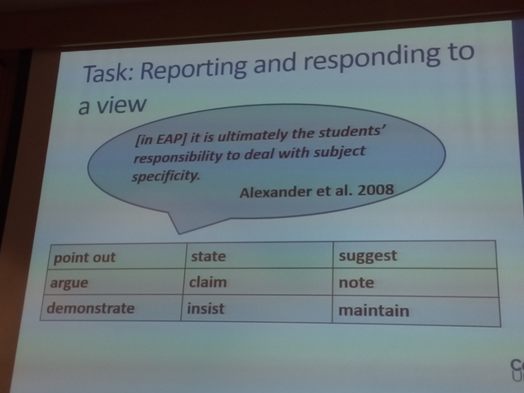
Our next task was:

IMG_20160414_153417

Different reporting verbs can be used to indicate the writer’s stance in relation to what is being quoted. Agreement and disagreement are introduced and continued differently. In the ESAP classroom students would have looked at a similar activity in their EGAP lessons and might do something like this in relation to their own subject to practice it and make it more motivating. All the teacher has to do is find a contentious view within the specific subject and it can generate a lot of discussion. The teacher can also get the student to come up with the view as well. It works well set as homework so that students have time to think about it. Students within a subject will come from different backgrounds. Students can be allowed to put forward their own views or from the literature. They write it on a piece of paper, teacher collects them all and redistributes so that students respond to the view using reporting verbs.

IMG_20160414_154237

One thing that they are looking to do more now from this year is to look at different genres of academic writing. The pre-sessional course focuses almost exclusively on essays because they occur in all disciplines and are the most frequent genre overall. Most EAP lecturers tend to come from a background where they are familiar with essays. Therefore they are easier to teach and to test. But Ann wants to move to a wider genre focus. The approach is to use the students as “chief investigator in their discipline” (De Chazal).

This is what students will have to do:

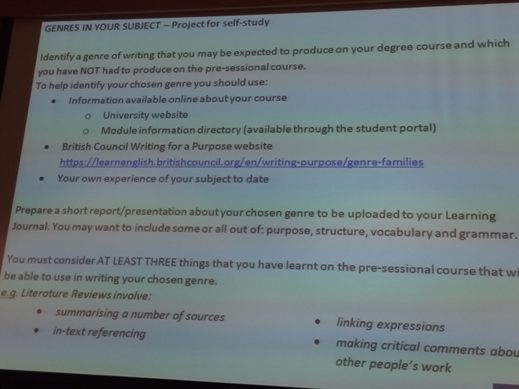
IMG_20160414_154544

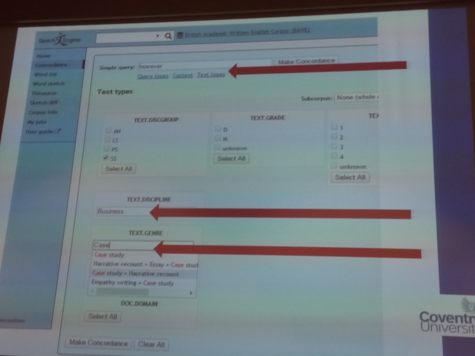
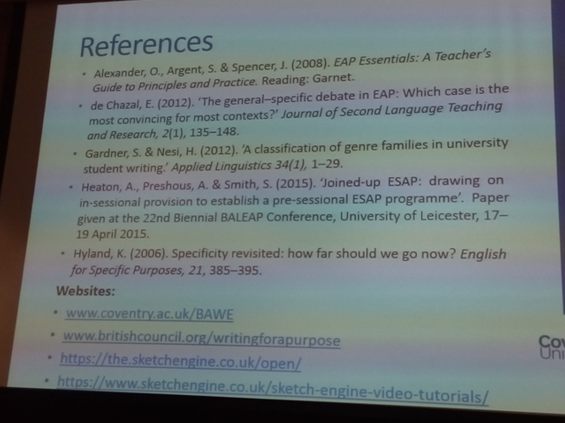
Students can look in the British Council writing for a purpose website to find out more and there are activities to help them. They are also encouraged to use corpus tools to help inform themselves, such as Sketch Engine, where searches can be narrowed by text type:

IMG_20160414_154728

Student feedback has been positive so far.

IMG_20160414_154843

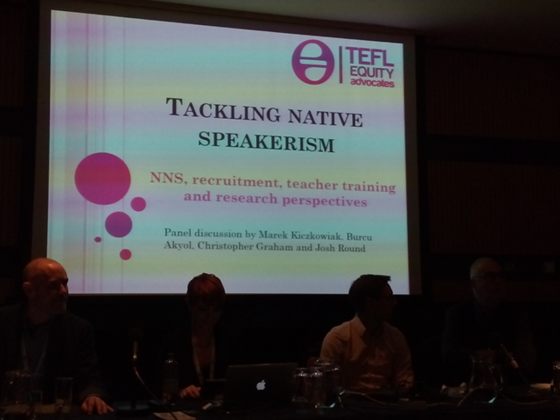
IATEFL 2016 Tackling Native Speakerism (Marek Kiczkowiak, Burcu Akyol, Christopher Graham, Josh Round)

After this morning’s plenary, I couldn’t resist coming to this session to see the discussion continue. This time it’s a panel of speakers rather than Silvana holding the fort alone, and I have to say I am surprised that there aren’t more people here!

Marek introduced the session, telling us that there will be about half an hour the panel talking and then the discussion will open to the floor. He of course alluded to this morning’s plenary and what a difficult act it is to follow.

(Edit: It was tricky keeping up with everything, so please use the comments to let me know if you think I’ve made a mistake/missed something!)

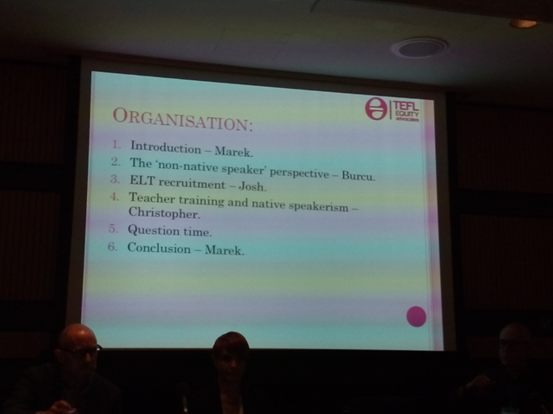
The panel are:

IMG_20160414_172441

The plan is:

IMG_20160414_172957

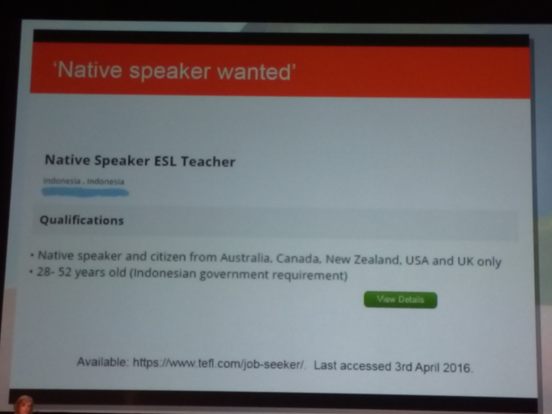
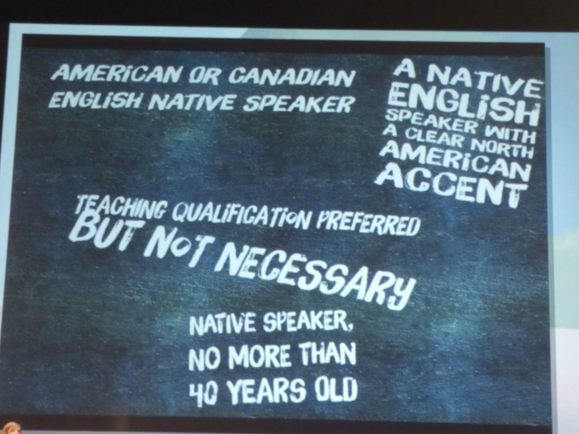
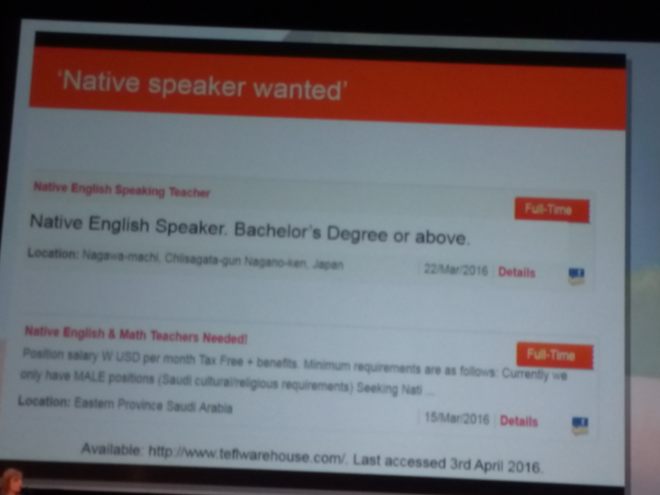
We start by looking at a job ad from TEFL.com. As Silvana mentioned, such ads are common. Depending on where you are in the world, between 72 and 88% of ads request native speakers.

What is Native Speakerism? It was coined Adrian Holliday in 2005. Like other isms, it’s a kind of discrimination/prejudice/bias. Teachers are classified on the basis of their mother tongue. Those who fit the native speaker description get a better deal, those who don’t will often struggle. In Japan, Houghton and Rivers pointed out that Holliday’s definition was limited as it also affects Native Speakers there, in that they can only lead conversation classes so development is limited.

It influences professional opportunities, recruitment policies, teacher training, SLA research with its monolingual bias where the native speaker is the ideal model. However, it can be tackled in various ways, which is what this session is going to look at. For example, proactive research that doesn’t separate NS and NNS into two different species and rather than identifying problems offers solution. There will also be reference to examples of bottom-up action, top-down action and how to be involved and committed to this.

Burcu Akyol

She started learning English at Middle School. Her whole learning experience took place in Turkey. She wants to tell us about IATEFL 2009 in Cardiff, her first experience. Her presentation had been rejected by another organisation due to not being a native speaker. Teachers want to listen to native speakers, she was told. After that bitter experience, she expected few people in her session at IATEFL and was then shocked to have around 60 people in her room. This was a big turning point for her, in terms of of her perception of herself as a Turkish English teacher. Things are changing. Turkish presenters may not be turned down but they may have fewer audience members. As Silvana pointed out this morning, over 80% of English teachers are NNS. So we need to talk about this discrimination issue more openly.

In Turkey learning English is considered very important. Policy makers decided to employ a large number of NS teachers to teach alongside NNS teachers. There have been similar attempts in other countries: to import NS teachers to cure ‘the problem’. However, after 2011 there was no more said regarding that policy announcement. Fortunately. Policy makers need to support NNS language development and teaching skills. This will produce more permanent results than employing 40,000 NS.

It’s not about being NS or NNS, it’s about being qualified. Both have strengths and weaknesses, things found easier and more difficult. We need to free ourselves from our prejudices and stereotypes, leave aside prejudices to really talk about education.

Christopher Graham

He is lucky because when he qualified as a teacher, with a British passport as a NS there were lots of opportunities. It was great. Someone said to him, why has he got involved with this TEFL Advocacy movement because he thinks EVERYONE should have these opportunities. His interest comes from reflecting on his own personal luck. The plenary this morning was a significant moment. The issue has now gone mainstream. It has been around for a long time, some of the research is quite old, but now we are talking about it. Trouble is, talking doesn’t get things done, we need to start DOING something.

One thing that Christopher has done is write about it. He found a bunch of people like Marek, offered them some questions to answer and had some incredible viewing figures. He also had nasty hate mail such as “You are betraying your tribe”. (Wow…) However, the point is, we can all write, blog, Facebook, to get the message out there. 96% of the teachers Christopher works with are NNS teachers teaching in their own countries. He asked for a university posters to be taken down, with “Native Speaker” above his picture. Amongst certain communities there is a perception that “Native Speaker” is something special. A lot of bilingual and NNSTs can be their own worst enemies. So Christopher has started bringing this up as a topic. Some people think he is just trying to flatter/win brownie points. But then they also see the possibility of being valued. So he spends time talking about what NNS bring to the party. It is tremendously important to do this. To sow seeds.

He also thinks its important to say he does have sympathy with the small private school owner working somewhere with the 20 year long USP of the Native Speaker. It’s like telling McDonalds to go vegan. Change will be a slow process to go through… He is not pretending that bilingual speakers (and monolingual!) need language support has part of professional development. It is a question of going out there and doing something. If it makes one teacher feel more positive about looking for employment, then that’s already something!

Josh Round

Josh has been a DoS for 10 years, in London. UK-centric context. As a DoS of course he is a recruiter. It’s about having a fair and equal process. The starting point is having an Equals Ops policy and a mission statement. Inclusiveness would be a good word to have in a mission statement – applies to staffing as well as students. If there is an HR department (unusual), they can help, otherwise it comes down to the DoS. Instead of having shortlisting filters that look at L1 and country of origin, look at the competencies needed for your teaching team. Pedagogical skills, language proficiency, behaviours. These become your recruitment criteria. The process has to be quite systematic. Needs a system that minimises bias and has a balance of perspectives.

The next thing is this idea that students only want native speakers. In Josh’s experience that’s not true, as Silvana’s myth-debunking research showed. Students want and value other things i.e. having a great teacher (who could be native or non-native  – and bad and good are present in both categories!). It is important to say that English proficiency has to be talked about. This is the difficult decision area. If you are open about your approach, at some point you need to make a judgement call on level of proficiency. “Native speaker competence required” should be moved away from, instead “competent user of English” – but what does it mean? This can be a difficult area for recruiters. Managers who do recruit NNS say that students will sometimes complain and that the most common complaint is accent and pronunciation. Of course NS teachers have some special accents too.. So what do we mean? And of course English is a world language which students will need to deal with in the real world. So let’s have different varieties on the team to expose students to.

Be ready to deal with complaints. They’ll come along. Have your strategies and deal with them in the same as any other. What do they want? What do they think they need to learn the language effectively? Then educate them. Also important to be transparent, celebrate the strengths of your team and that becomes your selling point. NNEST CAN be best. Be open in your process and if the best candidate is NNEST, then go for it. They can offer a lot, as has been discussed. On a team of teachers, you need diversity to offer different, complementary skill-sets. Recruiters who have positive experiences of this kind of recruitment should share it, get it out there.  It’s about raising awareness.

Question/comment/story time

  • Teacher trainer in Egypt: only NS working with bilingual teachers, gets lots of daft questions from middle management e.g. when should be give the children sandwiches? can you take this class because you are an NS. How to deal with this kind of situation in a positive, proactive way? What to say when put in that situation? Josh: Suggest some kind of meeting or focus group with teachers and managers. Audience 1 (bilingual teacher): Josh’s idea is one, but also dealing with it in a natural way. “Sure I can do that but not because I am a native teacher but because I can handle the sandwiches or whatever.” So it’s not the fact of being born in a particular country that gives you skills, point that out gently. Audience 2: When it comes to the sandwiches, it’s a culture problem. Sandwiches is British therefore… Teacher trainer: wants to offer teachers sessions etc but it’s the middle management that are the real challenge as she has less access to them. Audience 3: If you really don’t think should be the one doing the sandwiches – “I could but I think soandso would be better doing it.”
  • (Audience) Teachers association perspective, South of Germany: a couple of years ago in first year as chair, uncomfortable with the fact that job adverts on the website were being accepted with NS speakers only. Didn’t know what to do about it, wasn’t until she came across Marek’s website that it’s illegal to do this, as goes against the charter of human rights. With this piece of ammunition, she felt she had the courage to say to potential employers that the adverts wouldn’t be accepted as it contravenes international law. The feedback was positive in terms of hadn’t thought of that before and were willing to change it to something acceptable e.g. proficient in English. Encourage your local association to do this, to disallow this kind of advert. Josh: a lot of influence may lie in management associations. Marek: native-like is a bit like a requirement for man-like strength and bravery. It is discriminatory. If you say C1/C2 level at least it is something that a bilingual teacher can attain, unlike “native-like”. A proficiency level is much fairer.
  • Audience: The idea is going against “native” as the norm. To get around it. According to the Fair List, if the two sexes are represented equally among the plenaries, then they get a tick. Would IATEFL 2016 get a tick if such a thing existed for NS-NNS? Marek: No and a half? Audience 2: feels she has been treated as a pseudo-native speaker, which is a whole other level of discrimination. Christopher Graham: It takes time. A lot of people don’t know about the EU law and that is a great stick. Audience 3: We need to move away from a yes-no tick. How can we create more a community and avoid the hate mail discussion. We need to be careful not to antagonise. Christopher: the haters were mostly Johns (re Silvana’s speech) – blokes of his age, mainly Brits living in South East Asia.
  • Teacher trainer in Oxford: Not much to be done about that kind of people but on CELTA courses where she is there are a mixture of NS and NNS, which is an opportunity to get groups to cooperate. I’m a Non-Native Speaker here me roar! Exec Room 7 11am.
  • Audience (bilingual speaker): two years ago at IATEFL giving a talk to an audience of teachers, about teaching unplugged. Live listening was mentioned, using the teacher as a source of listening to the learners. An NNS was angry because she didn’t feel that solved her problem. That mindset is problematic. That NNST do feel less than NS. It is an issue.
  • Audience (bilingual speaker): A key question is teacher development – it’s how we differentiate teachers. Most teachers in Brazil are B1/B2 tops and there is nothing being done to deal with that. When she was doing her CELTA, a key point of development for her was language proficiency, she was advised to do a language certificate. There is a myth that talking about a teacher’s language level is offensive but she doesn’t feel it is. Why don’t we actually talk about a proficiency level for teachers, what IS a good level of proficiency for English teachers in general (NS or NNS!) Marek: Agree, you can’t be a maths teacher without knowing maths and there are different levels of knowing maths. Same in English. However, important to remember that proficient speaker does not necessarily equate to proficient teacher. Of course if you are low-level, you need to improve it. But we need to avoid an obsession
  • Audience (Nepal): Nepal is multilingual, ethnically complex. In his class, the students come from 10 different language backgrounds. Students rejected a teacher because they couldn’t understand what she said. The problem was her accent was a native speaker accent. From his perspective, a level of proficiency is needed but who designs the test? How is he or she judged? If an NS develops a test, an NNS may not get the level but they may still be suited to teaching in a different country. For example, IELTS, a teacher may not get 7 but may be a good teacher in a particular context.

Wrap up (Marek )

There are lots of positives. TESOL International, TESOL France with public statements. Lots of websites are changing the way they are hiring teachers. EU Legislation helps but there is still the issue of “Native level of fluency”. There are also different levels of qualification required depending on language background. (E.g. a native speaker only required to have a Batchelor degree while a non-native speaker is required to have a Masters or a PhD!)

Ours is a strange profession, which accepts discrimination. What makes or breaks a teacher is passport and mother tongue. It is time to change that.

Visit the TEFLEquity website for more information. 

IATEFL 2016 Plenary Day 2 (Silvana Richardson)

The “passionate and inspiring Silvana” (as she was introduced and I agree with based on the few minutes I saw her speak for at the Cambridge networking thing last night!) will speak to us about the ‘native factor’ – the haves and the have nots. (Twitter name, in case you are interested: @laIoli)

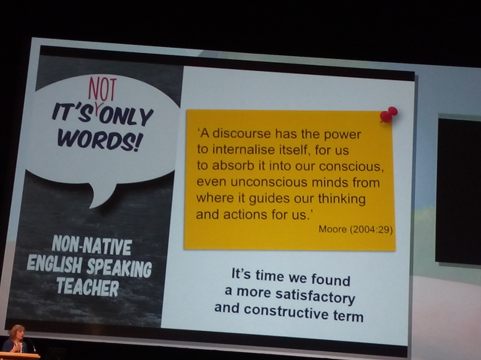
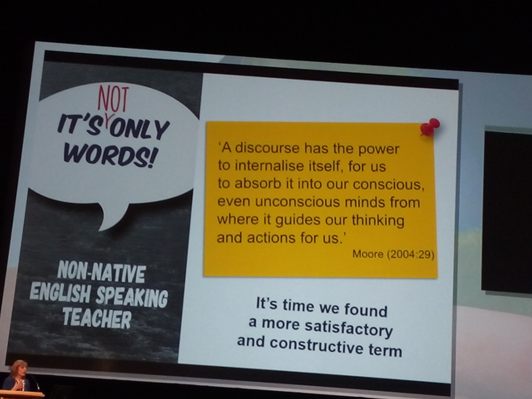
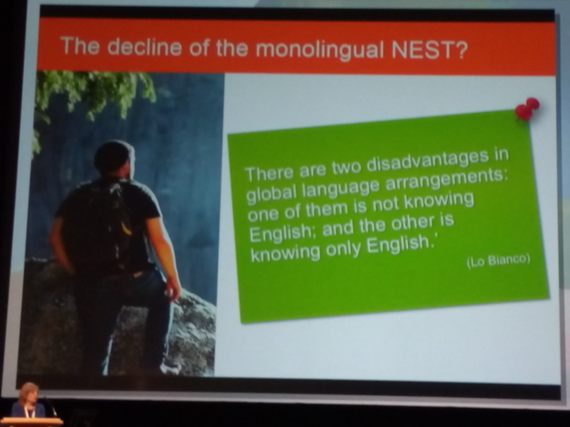
Silvana starts by telling us a few things about herself: she is not tall, she is not male, not single, not atheist, not sport, not fantasy buff, not a native speaker. She uses this ‘ridiculous way of introducing herself’ i.e. litotes (negation of one quality to emphasise another) to pose a question: what quality is she emphasising by saying that she is a non-native English speaker? Why do we still refer to an aspect of the professional identity of over 80% of the teachers of English as a ‘non’?

How is it still a legitimate term?!

It’s not just a word.

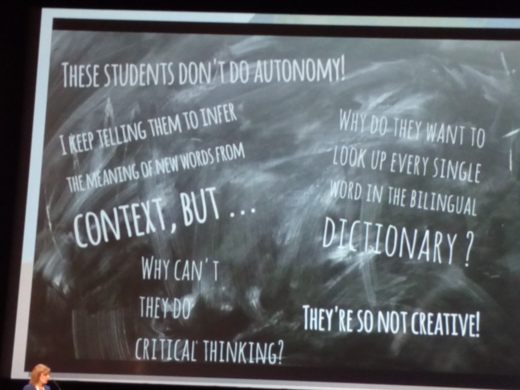
IMG_20160414_091359

It’s time to find something better!

Next Silvana gave us –

The one minute history of Native Speakerism starring the Monolingual Bias.

She takes us  back 100 years to The Direct Method: thou shalt not use your own language in class. This and subsequent methods created a monolingual bias which gave a biased view of the native speaker. The common goal was to achieve native-like competence. Meaning 3 things: That NS is the best model, that the way that the NS acquires L1 is the best way to acquire a foreign language and that the NS makes the best teacher. This creates a deficit view of the learner’s own language – it becomes a source of interference and an obstacle, and a deficit view of the NNS as defective, a failed monolingual of English. The ideal native speaker according to Kramsch is monolingual, monocultural, speaks only a standard variety of English, and is equally competent in oracy and literacy skills. This concept has been critiqued as a figment of linguists’ imagination (Palkeday 1985). It is, however, a very resilient myth. Take for example the European Profiling Grid which is used in recruitment of teachers. The ultimate goal is “Has native speaker like competence in the target language”.

How does this notion impact on identity, as an NS or an NNS?

If you have the native factor, you can safely assume that: The native speaker is the best model, the ideal teacher. I am an NS. Therefore I am the ideal model and ideal teacher.

If you are a non-native speaker, it is the reverse. I am not the ideal model. I am not the ideal teacher.

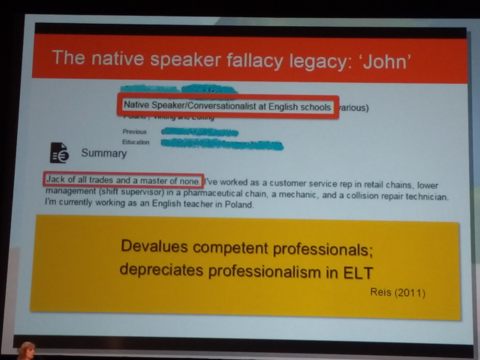
Very problematic and toxic logic. Kamhi-Stein (2005) criticises this ‘native speaker fallacy’. It makes assumptions that NS have particular features but actually they can all be acquired through training. Silvana then shows us a linkedin profile and what it does! It devalues all of us and professionalism.

IMG_20160414_092313

The logic also creates a competence dichotomy. A very unhelpful separation into camps. An us versus them. It’s very damaging to all of us.

The Plight of the Have Nots

We will look at this from four perspectives.

1.

The Market forces’ discourse: customers prefer native speakers

“It is a truth universally acknowledged that a student in need of English language lessons must be in want of a native speaker”

DO customers prefer native speakers? How true is this claim? Is it based on reliable records or on impressions? Out of 1000 students how many is it? 500? 5? The two who shout loudest? What does research say about what students prefer? This is a relatively new area of study. She is gong to look at a few studies and we have to decide what the findings support.

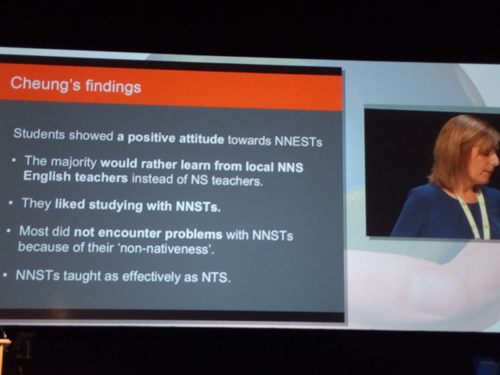
Cheung 2002 – attitudes to NS and NNS and the strengths/weaknesses of both. Questionnaires, interviews, observations, 420 ss at 7 universities in Hong Kong. Findings:

IMG_20160414_092806

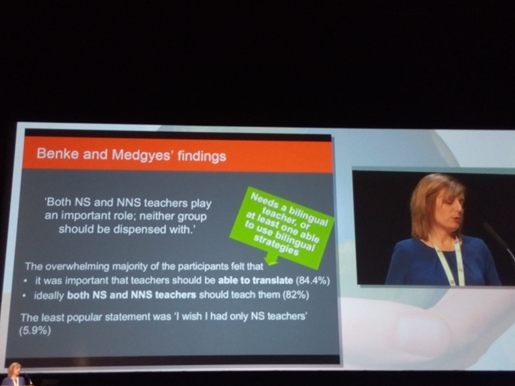
Benke and Medgyes (2005) – SS perceptions of NS and NNS teachers, questionnaire, Hungary.

IMG_20160414_092932

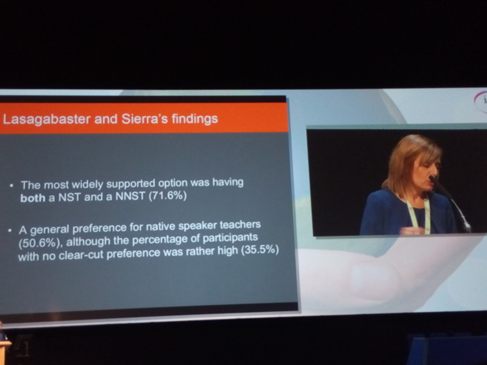
Lasagagabaster and Sierra (2005) – Students perceptions of NS NNS;  Closed and open questions; Basque area of Spain

IMG_20160414_093015

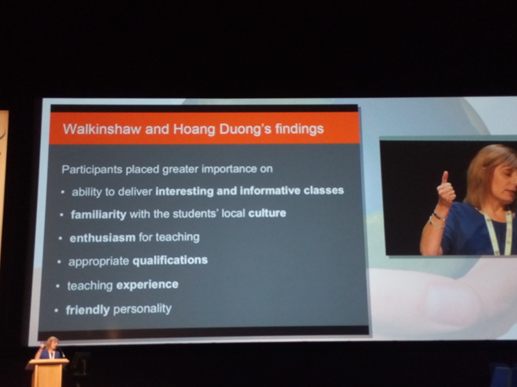
Walkinshaw and Hoang Duong (2012) – how learners rate ‘native-speakerness’ compared with 7 qualities valued in EL teachers: rating survey and questionnaire, Vietnam.

IMG_20160414_093123

Silvana then presented a summary of the perceived advantages of NNESTs:

  • Declarative knowledge: knowledge about English (They had to learn it!)
  • Ability to identify areas of potential difficulty: when you know the L1, you know what will be easy or difficult, from your own experience.
  • share and use the students own language
  • able to make cross-linguistic and cross cultural comparisons
  • teach grammar more effectively
  • empathise with the learner (been there…)
  • provide appropriate strategies
  • willing to work hard

Followed by those of NS:

  • procedural knowledge (how to use English, tacit and unconscious)
  • teaching of lexis (idiom, colloquialism, slang)
  • fluency in English with ‘original English accent’
  • no apparent language difficulties
  • linguistic authenticity
  • teach speaking and listening more effectively
  • cultural understanding (of own culture)
  • more relaxed attitude to error correction

These perceptions were taken from various studies.

Silvana summarises by saying that students generally value professional and personal qualities over nativeness. Both NEST and NNEST are perceived to be competence each with unique strengths. Preference is inconclusive. Some indicate both, some one, some the other.

There is the discourse of Employers having no choice. This is discrimination. These are discriminatory practices disguised as common sense. Actually, employers always have choices. Collusion with inequality and prejudice is a choice. Discrimination is a choice. Also, “just because the market is demanding certain things, it does not mean that the market cannot be made to see things differently” (reference missed, sorry!).

Is the customer always right? Silvana did an experiment a few months ago. She had a two-hour conversation with a student who adamantly wanted a native speaker. He was shocked that it only took a month to become a teacher. He changed his mind. The real question is, are customers expectations realistic? How do we behave when they aren’t? What if their preferences are racist or discriminatory? “I didn’t come to the UK to be taught by a trainer who is a native speaker of my own language” – has been said. First they ask those who said it if there is anything in the promotional literature about this? No. This is because we are equal opportunities employers and we are proud. Proud to employ the best trainers and nativeness doesn’t come into it. They are told to give the trainer a chance and come back in a few days if still unhappy. They don’t come back.

Why are NNS rejecting themselves? (As per above example)

2. Discrimination and recruitment.

IMG_20160414_094428

No EFL qualifications required in either!


IMG_20160414_094516

Even narrower!

This is the reality:

This is the lay of the land.

The lay of recruitment land.

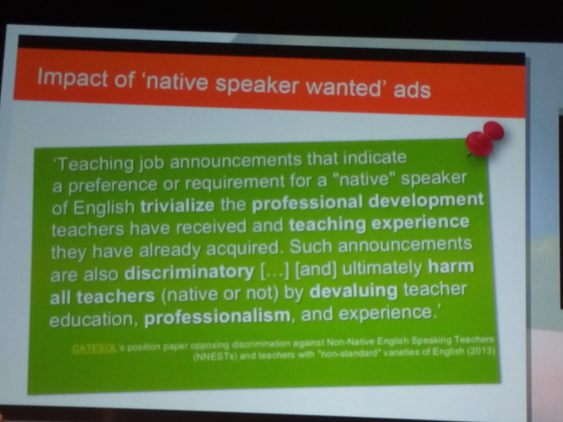
And these announcements are damaging:

IMG_20160414_094646

Clark and Paran (2007)

Looked at the recruitment of NNESTs in the UK. 72.3% of participant institutions judged nativeness to be very important.

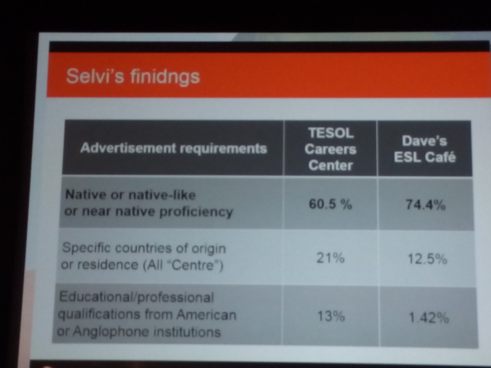
Selvi (2010) 

A vast majority of the advertisements favoured NESTs and rejected NNESTs. He describes discrimination as a multi-faceted phenomenon. There is also the issue of variety of English, where qualifications are obtained (golden standard: Anglophone institutions) and location of citizenship.

IMG_20160414_094900

Mahboob and Golden

Focused on East Asia. Nativeness was the single most frequent criterion mentioned in the ads. 49% of the ads listed specific countries from which the applicants must come.  US being at the top. Some ads also specify colour. Nativeness is linked to inner circle countries only. Students are being taught by ‘teachers’ who are not qualified to do so.

3. The mono-training orthodoxy

If you look at SLA in the 20th century, if you look at the theories, you find yourselves in a very confined cognitive space. Very little reference and interaction with the world around you. The result of this is narrow approaches to teaching, learning and teacher education. Native speakerist, monolingual and monocultural.

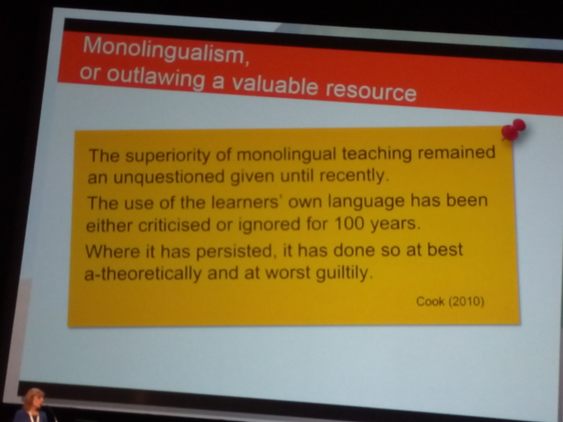
If we look at the areas in which native speakerism has dominated, no stone left unturned -theory, research, publishing, teaching and learning materials etc. Cook puts it very eloquently:

IMG_20160414_095516

There is no research evidence on whether students learn better in an ‘impossible to code-switch’ classroom environment.

Ernesto Macaro’s study on code-switching: little known but important!

Monolingual approaches abound. There is a cultural appropriacy issue with this. An approach designed to work in a BANA country will not necessarily work elsewhere. Silvana gives another snapshot of realities around the world:

IMG_20160414_095811

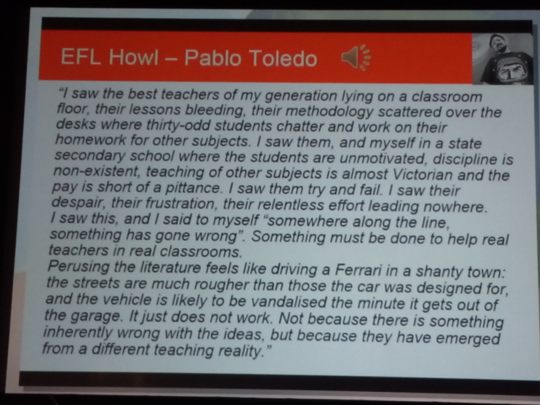
She then plays us a clip from Pablo Toledo – EFL Howl on teaching in difficult circumstances:

IMG_20160414_095919

4. Issues of confidence and self-esteem

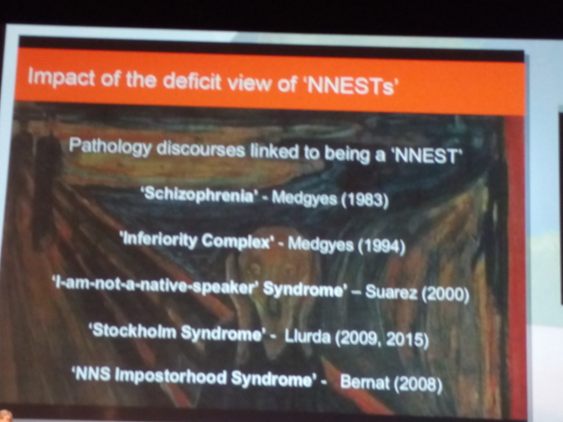
What has all this done to the T whose first language is something other than English?

IMG_20160414_100103

Inferiority complex: belief that own knowledge is inadequate to the linguistic standards (think back to the teacher standards we looked at earlier – ‘native speaker’)

Stockholm syndrome: secretly admiring the NS and denying self the right to be a recognised language user.

Impostor syndrome: feelings of inauthenticity and inadequateness.

Faking it: If you can’t be a native, at least try and pass for one. Hope that students won’t notice but concerned about being ‘caught out’. There is still institutional pressure – schools asking Ts to pretend to be a different nationality. What does this do to identity?

Silvana thinks NNS develop coping strategies. 

  1. Shying away: in EFL contexts, shying away from modelling language and instead ‘play the tape’ so that the script models the language; and away from using English in the classroom as the language of instruction and communication.
  2. Hiding own identity in terms of L1 status: In English as home language context never telling the students that you aren’t a native speaker; hiding it initially and then gradual or final revelation, like an embarrassing confession. “I only tell them once they trust me and like me”.

The future?

  • The wider context
  • Overcoming the dichotomy
  • What can we do?

The Wider Context: Multilingualism

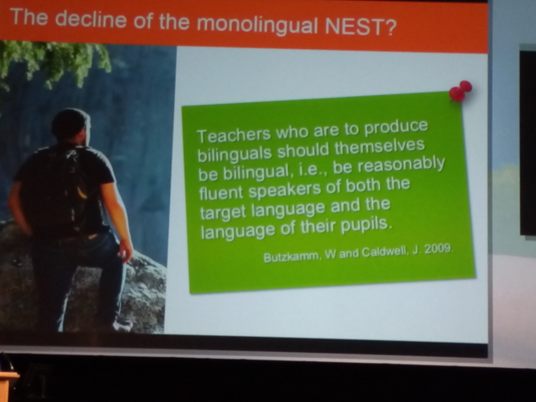
A paradigm shift is unfolding out there as we sit here in this auditorium. It is now the turn of the multilingual. Multilingualism is the new norm in a Globalised world. Recent publications reflect this. It is a trend to watch and find out more about. We are moving from a deficit view of the learner’s own language to an asset view. We are moving away from an NS view of acquisition to a bilingual view. Second language acquisition is moving towards plurilingual development. The perception  of learner’s own language is moving from obstacle to resource. The goal of learning is moving from near NS competence to multilingual competence.

IMG_20160414_100950

IMG_20160414_101007

Monolinguals, take note…

Overcoming the dichotomy 

How can we overcome the dichotomy? We, as in those of us who were born and raised using a language other than English can’t do this alone and neither should we. This is a major battle about ethical and principled professionalism against prejudice. We need to stop thinking about them and us and start looking at professionalism as a continuum. On the continuum we can look at professionals as being more or less prepared, knowledgable, competent, proficient USERS of English.

What can we do?

(NB: deliberately larger font!!!) 

What can we do? We need to find out more about this issue, become more aware. Write about equality for NESTS and NNEST.

Teachers: Join an advocacy campaign and show support. There is a forum this afternoon about it! Write a statement supporting this campaign. Promote advocacy initiatives on social media. Start a discussion in your workplace to raise awareness. Do research, more is needed.

Teacher educators: review programmes in terms of the scope. What is the ultimate goal of these programmes? To develop well-rounded critical professionals or churning out skilled technicists who can produce monolingualism for export? Consider the content and methodology – is there critical exploration? Are they sufficiently inclusive? Sensitive to glocalisation? Using the students’ own language? What about bilingual identities? The elephant in the room is teacher’s own language proficiency – how can we help teachers develop this?

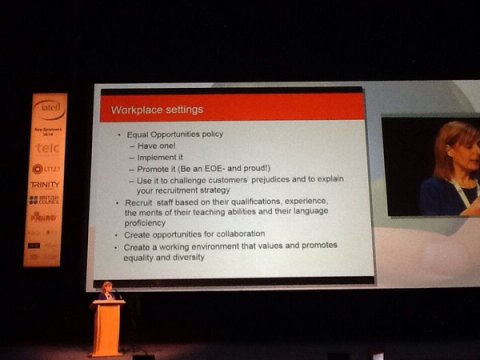
Workplace: Do you have an Equal Ops policy? Do you implement it? Are you proud of it? Do you challenge students’ expectations? Do you recruit based on merit?

Equal ops in work place

Teachers associations: Issue a statement against the discrimination of NNESTs. TESOl France writes to employers who write native speakerist ads to discourage them from that. Create alignment maps of professional qualifications of teachers of EFL at regional, national and international levels. Encourage members not to apply for positions where advertisement is discriminatory.

There is a lot of work to be done to make our professional equitable.

And the only way is to work together. Silvana’s dream is that teachers be judged on their merits as a teacher not on an accident of birth. Silvana’s real name is Silvana Ioli. She was born and raised and educated in Argentina. And she is really proud of it. She is a professional and plurlingual teacher of language.

And oh my goodness what a plenary! Standing ovations, some tears (not only mine!! I fought mine back, then was quite relieved to see someone who hadn’t, meaning I was not the only one to get all emotional!)

In my current context, I finally work in a place that DOES has equal ops (as far as I can tell!), where I DO have colleagues from all over, working there on the basis of their many merits rather than their skin colour or passport type. This should be the rule rather than the exception. Previously, I have worked in schools where: teachers were hired based on skin colour and passport, ‘non-native speaker’ teachers were viewed (including by themselves) as second-class citizens of the teaching world, where all teachers were British, where being male and North American was the basis the recruitment decision was made upon… I’m not going to say which indictments go with which schools. It doesn’t matter. What matters is that we all do as Silvana said and recognise what has gone on, what is going on and where the future is/should lie, and do our bit to push it in that direction, regardless of our role in the teaching world. We are all professionals in the ELT world together, we all need to fight together to make it what we want to be. Jim Scrivener tweeted that this was ELT’s “I have a dream” plenary. It may be cheesy but let’s make it all of our dreams. In the hopes that at some point history will look back on this period as one where finally the paradigm shifted away from the ridiculous. 

Ok, rant over. I have only one thing left to say: this post deserves to be the most read on my blog. Silvana’s words were inspiring. So spread them. Share this post. And, if anyone wants to use my blog as a platform to share their ideas in relation to this topic, please do get in touch. You are welcome, I would be happy to host guest blog posts. 

Oh, one LAST thing: don’t forget to have a look at the TEFLEquity website too! 


IATEFL 2016 Re-placing rather than replacing the teacher (Sarah/Robyn)

As part of the mission around what has the impact, Sarah of Pearson is very keen to partner with any practitioners who are raising attainment outcomes so that she can learn from this and help more teachers make more impact.

One such project was done in partnership with Robyn and she is going to tell us about her flipped classroom.

Robyn started by asking us if we were ‘flippers’ some claimed ‘half flipper’, Robyn started that way too apparently! She plans to tell us why she flipped, some simple strategies she uses and the benefits she has noticed.

She saw an article in the Stanford Daily about this concept and how great it was, and Robyn thought it sounded good. Robyn’s job is to make sure her students can succeed at university. If professors there are using this approach, then they need to be able to use English in this kind of setting, if they are to succeed. After her learners leave her, they become just learners not second language learners, they will have to do the same amount of learning etc as everyone else.

Professors were recording lectures, students watched them at home for homework, then in class they worked on interactive activities e.g. comprehension based, working on projects, problem-solving etc. So students need to be able to actively participate, talk to native speakers, apply what’s being taught rather than just memorise stuff.

Robyn realised that she had to stop panicking, calm down, drink a lot of wine and… realise that she didn’t need to do what all the other professors were doing, she needed strategies that worked for her in the context of teaching students English to succeed in the L1 setting at university. So the flipping strategies needed to be adapted for second language learning, be easy to use but maintain the basic principles of flipping.

  • Homework becomes classwork and vice-versa
  • Flip Bloom’s Taxonomy
  • Re-place myself not replace myself i.e. change role.

One important thing about flipped learning is that you have the exact same amount of class time.

Robyn looked at traditional Bloom’s Taxonomy – in class she was teaching the lower level remembering/knowledge, understanding/comprehension and then sent them home to practice, which required the higher level skills. Now, she sends them home to do the lower level work and the higher level skills are brought into class. So homework should be easier for students rather than harder.

She had 5 issues: materials, transferability to other classes and end goals, technology, student participation/buy in and content creation.

She questioned what materials to use. Could she flip with her textbooks/current content? Could she get students to apply what she was teaching to other disciplines or settings? She wondered if she could manage the technology she needed or could she flip without technology. She wondered about Asian students, would she able to put them into this setting where they had to be very interactive.

Robyn started flipping slowly – an activity at a time. She wanted to keep her materials as the content is sound and included what was needed. The basic comprehension material is available to students all the time, in the book. Students like the book. So she kept her books: that was her first strategy. Rather than teaching students the persuasive essay in class, do basic comprehension work at home and then in class actually work on the writing. She found students get much better grades for higher caliber work. They can apply what they have learnt while Robyn circulates and helps them work on it. Much easier to grade a second or third draft.

She tried using authentic materials and materials from other classes (student selected) in reading classes to teach skills like skimming or scanning. They practice on their own with the textbook and then in class they bring anything that they are interested in (from another class etc) and work on a skill like annotating which she could help them work on it. So that they became better able to annotate the material rather than just highlight All The Words!

With regards to technology, she was worried because she knew that ELT doesn’t lecture like other disciplines. So what should go on videos? And what about settings where students don’t have access to technology? She explored other alternatives. Video isn’t necessary. She has used reading material, powerpoint (can also be printed), previously recorded materials (by others) e.g. Jennifer ESL for grammar, publisher or campus systems (e.g. Macmillan Campus). In her Grammar class, she kept the book and paired it with Jennifer ESL video. Students read a couple things in the book, do a bit of practice, watch the video and then in the class they do something more engaging that makes them use the structure/language focus in question.

In order to get students to buy in to this approach, she had to overcome her nerves with regards to an article written by a high school student who wrote about a flipped chemistry class and he and his friends decided they weren’t going to like it and weren’t going to participate. Robyn decided not to tell them it’s a flipped classroom. They expect some homework anyway so what difference does it make what it is? She gives the example of her listening class – she didn’t have to worry as much about cultural differences etc as it is a level playing field. Ss listen to the audio outside class as many times as they want – once or many – so they come to class starting from the same place. She doesn’t have to worry about time management either.

In terms of filling classroom time, she needed quality material but it turned out not to be such a problem as there is lots of extra material in the course books that she never had time to use because of time constraints when doing everything in class. So the approach to textbook use changed. Instead of the freer practice being squidged in at the end, it becomes the main thing e.g. with question formation, they learn how outside the classroom and then have a guest speaker who presents something about which they can ask questions.

She finds her class time is much better managed. So e.g. with listening instead of playing the recording multiple times in class so that the better students get bored and the weaker can catch up, they do the listening in their own time. Much better use of time as well to have more difficult activities happening in class rather than for homework. She moved from ‘sage on the stage’ to ‘guide on the side’.

rbrinks@stanford.edu

I will leave you with another kind of Flipper:

Taken from Pixabay

Taken from Pixabay