
On Saturday 20th June, I attended the one-day InForm Conference hosted by Birmingham International Academy, home of the International Foundation Year at Birmingham University. The whole conference focuses on Foundation Year programmes, and is therefore very relevant to my current role. My notes from all the talks I attended will be tagged InForm2026 for easy location.
CQ stands for Cultural Intelligence, it turns out. Adam begins the talk by “playfully” changing the title to BBQ (Barbeque). He is going to give us 3 scenarios to think about.
Scenario 1: your friend invites you to a bbq. Your friend tells you the bbq starts at 2pm on Saturday. What time would you arrive at the bbq? (I’m autistic so probably 2pm…if I didn’t call in sick…)
Scenario 2: while at the bbq you suggest to your friend that they do a science fiction themed one next time. Your friend replies by saying “Oh nice idea” – will your friend host that party? (Doubt it! It’s like “We should have lunch sometime”)
Scenario 3: you are introduced to mutual friends but they don’t say anything or make eye contact. What does it mean? How do you think they feel? (Maybe they are autistic!)
The above scenarios incorporate: scheduling a time, deciding when to arrive, sharing ideas, receiving feedback on the ideas, meeting new people and encountering silence/lack of eye contact. All of these could happen in foundation year classrooms. How confident are you that everyone in the room had the same answer as you to these questions? What influenced your answer? What influences how decisions made, how feedback is interpreted or how silence is interpreted? Culture is one answer.
Definition of culture for today is based on the two fish story: Once upon a time 2 fish, swimming in an ocean, met an older, wiser fish. Wise fish said morning kids, how is the water? 2 fish replied, what is water? Like the water to the fish, culture surrounds us. It is vital to our survival but we might not always be aware of it. Refers to all norms, expectations, behaviours that all around us but we might take for granted.
How does that relate to us in our role on IFY programmes? We (teachers and students) need to routinely reflect on our ability to adapt effectivly to new cultural contexts. This is cultural intelligence.
Earley and Ang (2003) coined CQ. It’s not about changing your identity, just about reading the room and being able to build relationships with others. Ang et Al (2007) created the CQ scale= self-assessment tool for measuring CQ.
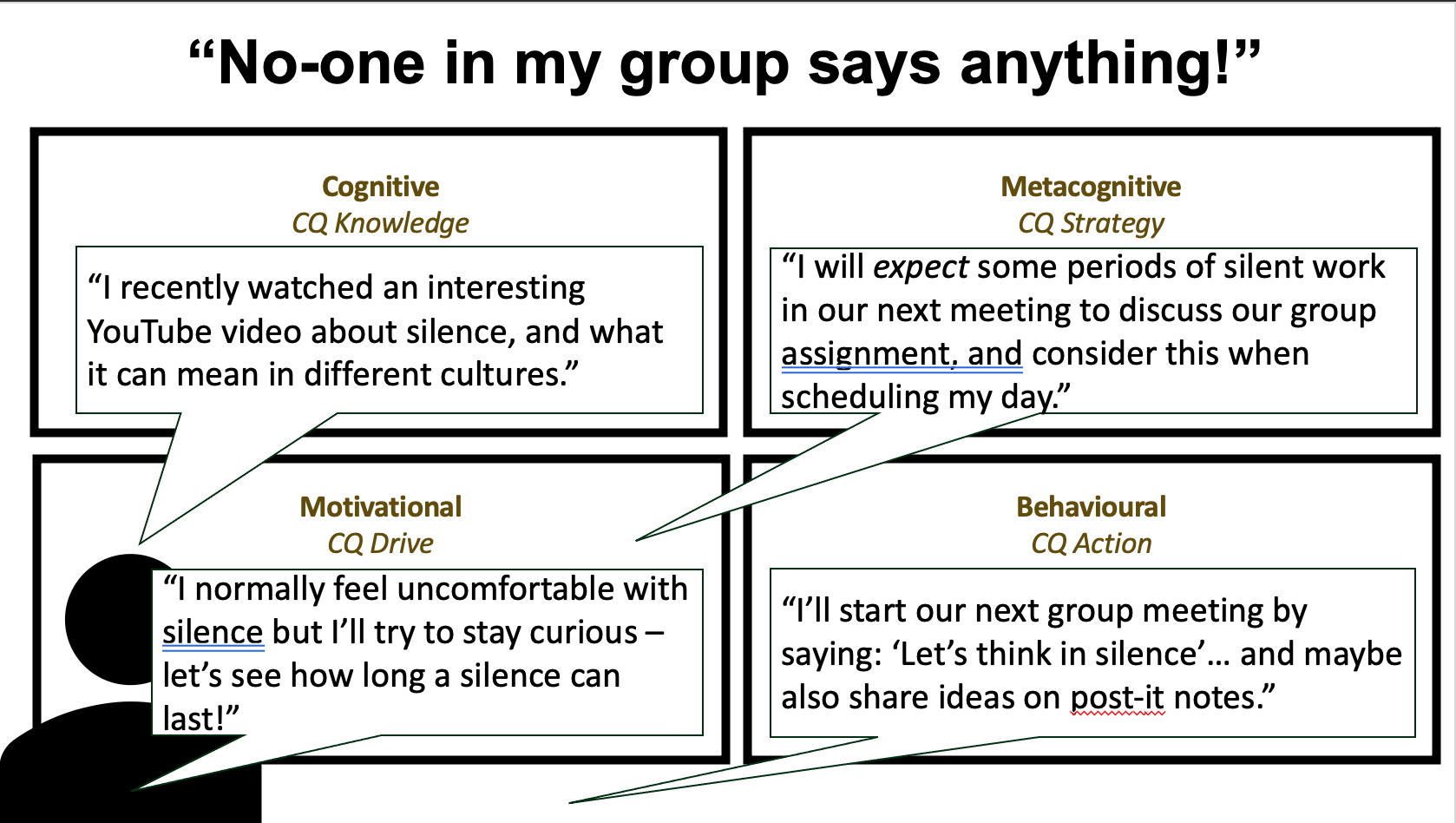
How does CQ work? CQ is comprised of 4 areas: cognitive (CQ knowledge), motivational (CQ drive), the metacognitive (CQ strategy) and finally behavioural (CQ action). Put more simply, CQ prompts us to ask questions such as what do I know about different cultural expectations and how do I use this to plan interactions? How do i feel in intercultural interactions and why? What am I able to do and say in these situations?
If the goal is working across cultural boundaries, CQ is one tool we can use (not the only way), it is just one way, one tool, that we can use. Much of the early work on CQ is in the area of business and management. What Adam is proposing today is not to measure CQ, but to use it as a tool for reflection, a reflective framework to help us and our students to trigger positive change.
“No one in my group says anything” – use CQ – can be reframed as:
“No one arrives to our meetings on time” use CQ – can be reframed/trigger positive change:
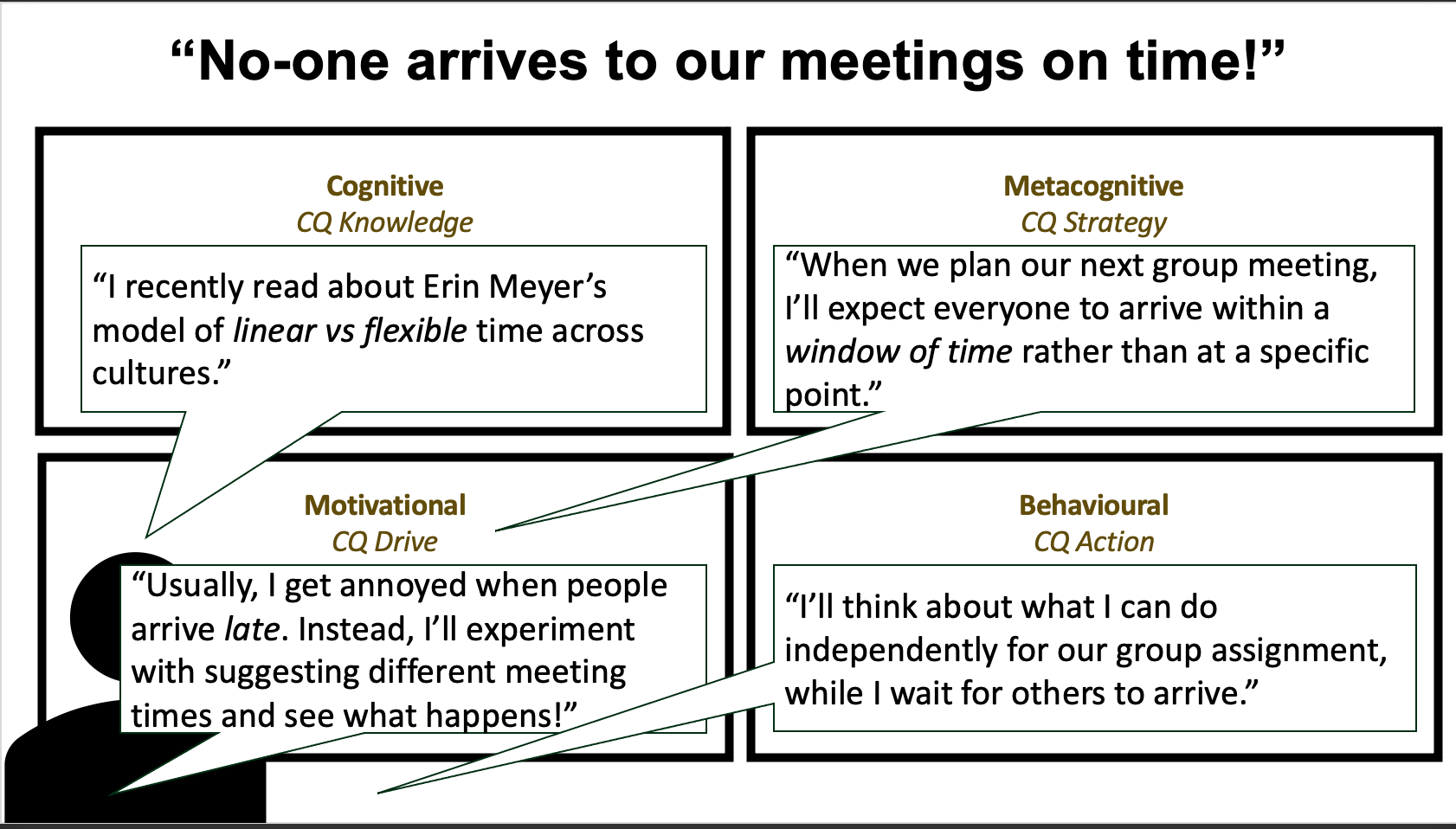
This can be summarised in one word: curiosity. We can help students to foster their sense of curiosity about their peers, the environment they are studying in and the wider world around them.
How could this construct help us/our students? (Those four areas of CQ and the questions we can ask.)
- What do I know about different expectations
- How do I feel?
- What can I say/do?
Curiousity helps prevent you being closed behind a barrier. Stay curious!
Audience question: how would you introduce this to students? He hasn’t settled on an answer to this yet. Maybe alongside other models of reflection. He hasn’t incorporated it into materials yet but works on materials so at some point, hopefully over the next academic year…
Audience question: what about monocultural groups? Can still faciliate reflection, get them thinking about different ways of doing things.
Audience question: what about needs analysis question? Could do anonymous poll questions about the kind of thing we talked about at the start of the session and then reveal and discuss the answers.
Audience comment: about the stereotype of the awkward silence and the value of reflecting on that and remembering that engagement isn’t necessarily visible.
My thoughts:
Another interesting session. “Engagement isn’t necessarily visible” reminded me of the reflection workshop and the line drawn from lots of noise to engagement! Be interesting to ask students “What does engagement look like for you?”. It’s true that part of our role is helping students to adapt to a new cultural context. Both big C culture and small c culture. This also reminds me of the opening plenary and this: “Students need to have the academic language, the way of talking that exists in a university; they need to understand the culture – of the country, the city, the university, the school, the knowledge.” and “What we need to do as EAP practitioner: you don’t need to know about physics to teach physics students but you do need to know about their culture and values, how the discipline behaves; a philosophical understanding: how do they create and think about knowledge?” (Quoting from my blog post and by extension the opening plenary!).
I suppose that is one tricky thing with being an EAP tutor: for the people within the discipline, that is the small c culture that they are immersed in and know, while for us we would ideally need some kind of understanding of it all across a range of different departments/disciplines. Or do we? What about the students’ foundation subject module tutors, are they not better placed for that than we are?
I think curiosity is very important. We should remain curious and always question all the assumptions we make about student behaviour and what it means rather than auto-labelling it. We should also remain curious about our own responses (emotional, verbal) to their behaviour and what assumptions drive them and whether there are alternative interpretations and paths to take. I’d imagine it would be difficult to help students develop their CQ if we never work on our own!

