
On Saturday 20th June, I attended the one-day InForm Conference hosted by Birmingham International Academy, home of the International Foundation Year at Birmingham University. The whole conference focuses on Foundation Year programmes, and is therefore very relevant to my current role. My notes from all the talks I attended will be tagged InForm2026 for easy location.
The first talk is the plenary: Changing Language(s) and Discourse(s) about and in the International Foundation Year.
What Bee is focusing on today is the language part of the International Foundation Year (IFY) – the EAP bit. The importance of connecting between disciplines and EAP teaching.
She is an outsider but has been aware of IFY, staffing it, talking to people on it. A lot of the thinking is in collaboration with those colleagues at the language centre. Everything in EAP is (or should be) collaborative. These are the questions she will consider:
- What is an IFY?
- What is the role of EAP on an IFY?
- How do we think about language in Higher Ed
- What could the role of EAP be on an IFY?
- Leeds: a work in progress (has been for years)
IFY = one year programme for international students, and it focuses on English language competency in order to succeed at University. The only difference between an IFY and a regular foundation year is the focus on language competence. Language is studied alongside subject modules in IFY while in regular foundation year, only subject modules are studied. This assumes that all international students have language competence issues and all home students do not.
- What is an international student?
- Why do we use this term?
- What does it represent?
- What is the hidden agenda?
- Who stands to gain?
These are important questions to consider. She says it is a category or label with no nuance, either you are or you aren’t. There is some confusion around whether it is about fees or another aspect of the student journey. As a label, it can be counterproductive as it reduces and separates students out. It supports unequal fee structures. International students are seen as cash cows. VCs in universities are open about it now. Lack of international students has led to the financial difficulties that the HE sector are in now. It also supports deeper underlying ideologies and power structures. Theologies around what it means to be a native speaker of English still very prevalent in universities.
When we are working with students who have their support structures in another time zone/country/space, it is a different experience from someone whose parents live two hours away. There is a need for psychological and social adaptation. It is an unfamiliar social environment and educational environment. IFY is an access programme. Students need to have the academic language, the way of talking that exists in a university; they need to understand the culture – of the country, the city, the university, the school, the knowledge. They need disciplinary knowledge and resources. They are not separate needs, but most university structures send students off. The culture is ignored, the language they come to us, the disciplinary knowledge they provide. It would be better if they were all interconnected.
Bea thinks the needs are similar in International Foundation Year and regular Foundation Year. So she isn’t sure what the difference “international” makes. Why should EAP be the alongside bit in IFY but not exist in regular foundation years? She is arguing that EAP should be built into all foundation years. Most people think of international students as those who need an IELTS score but there are also students from Australia, and the Middle East who study in English before they come. What is the difference?
Are there any examples of where language has come of interest or consideration in your teaching or other aspects of your professional life?
E.g.
- disciplinary considerations
- different registers
- different types of English
- different language varieties.
This really hit home for Bea when she sat in a lecture (different subject) and tried to observe in terms of EAP and all she managaed to do is write down a list of words: architecture, expression, density, culture, sequence, transcription, translation. We were asked to guess what discipline this was. It was plant cell biology but these words all have different meanings which might be more likely to be taught/learned outside of that discipline. We need to think about the discipline the students are going into. If you are an international student or student who is being taught the meaning of words in your EAP class, the cognitive load of translating from the way you are taught them into what they mean in a subject discipline is huge.
More questions:
- When and how do some students and staff feel linguistically excluded or disadvantaged?
- How do we make it clearer what proficiency level is expected and what that looks like. Do we know how and where to teach it. The assumptions about language proficiency tests don’t match. Even as EAP practitioners we may not be sure how and where we teach that.
- The “non pedagogy of osmosis” = assumption that language gives immediate access to knowledge and must therefore be transparent. Need to understand that language is integral to the academic learning process not separated out.
- We need to differentiate between communicative and technical proficiency. Students need to know that there will be differences between what we do and what they will do in their disciplines.
- In what ways can we bring students’ other languages into the learning environment, that they can help?
Non-international Student quote: was never taught the style, just “learnt from science”. International student quote: shocked that language wasn’t marked, only disciplnary knowledge. But actually it is assessed because you need it to communicate your knowledge. Lecturer quote: She’s done the presessional course, why is she so bad? When Bea looked at the writing, It was clear that actually it was the understanding the discipline that was the problem, which we don’t teach.
We need to move away from systemic deficit approaches. Academic tutors complain about simultaneous translation, rather than saying to students why are you doing this, and trying to understand and help. Cushing and Snell (2022) say systemic language bias begins at school and rockets at university. We are positioned as meant to be socialising them into higher education, and our entry requirements, language tests etc all support the deficit view.
We need to move from languages as stable, fixed, a skill indiiduals master, neutral, a problem to language as dynamic, evolving and connected, a social resource for meaning-making, a source of cultural and symbolic capital.
Bringing it back to IFY and EAP:
EAP = to give students access to ways of knowing and ways of thinking about knowledge. Hyland, 2018; 390. What we need to do as EAP practitioner: you don’t need to know about physics to teach physics students but you do need to know about their culture and values, how the discipline behaves; a philosophical understanding: how do they create and think about knowledge? And then, knowledge and discourse, which is mainly linguistic in nature, and more familiar to us. Ferguson, 1997 p85.
We also need a better understanding of our own culture and epistemology. We position ourselves in deficit as much as the university does.
Leeds:
- IFY housed in International Pathways Centre
- EAP tutors are also Academic Personal tutor
- Modules taught within disciplinary schools
- Compulsory 40 credit EAP (Academic Study Skills for….) e.g. arts and social sciences, STEM, BUsiness, Medicine and Health.
There are issues around coordinating across modules (everyone is somewhere different) and the way fees work means departments who won’t receive the student, and their fees, in the future are less invested in them at this stage. The title (Academic Study Skills for…) is going to change.
EAP component issues: lack of engagement, lack of connection, assessment workload, integrity, value and trying to do too many things. We need to make clearer the link between these skills and students’ studies. Curriculum entropy: a lof of thought went into the split 8 years ago but a lot has changed since then (added, changed, removed) and the instigators have left, and along the way the meaning has been lost. Need to go back to basics and clarify it all.
Principles for building languages into a curriculum:
- Context (developing intercultural understanding)
- Collaboration (EAP and disciplines) to make it more meaningful
- Co-construction (between EAP, disipline specialists/students)
- Challenge (for all)
- Confidence and self-efficacy (to be developed).
Main question: what does good academic literacies and communication provision on a foundation year really look like? (from a student, tutor and institutional perspective)
Sharing practice: Classroom pedagogies
- How/when/where/why do you take language into consideration while teaching?
- How do we think about it?
- How do we help our students?
- What about feedback?
- Approach to linguistic barriers?
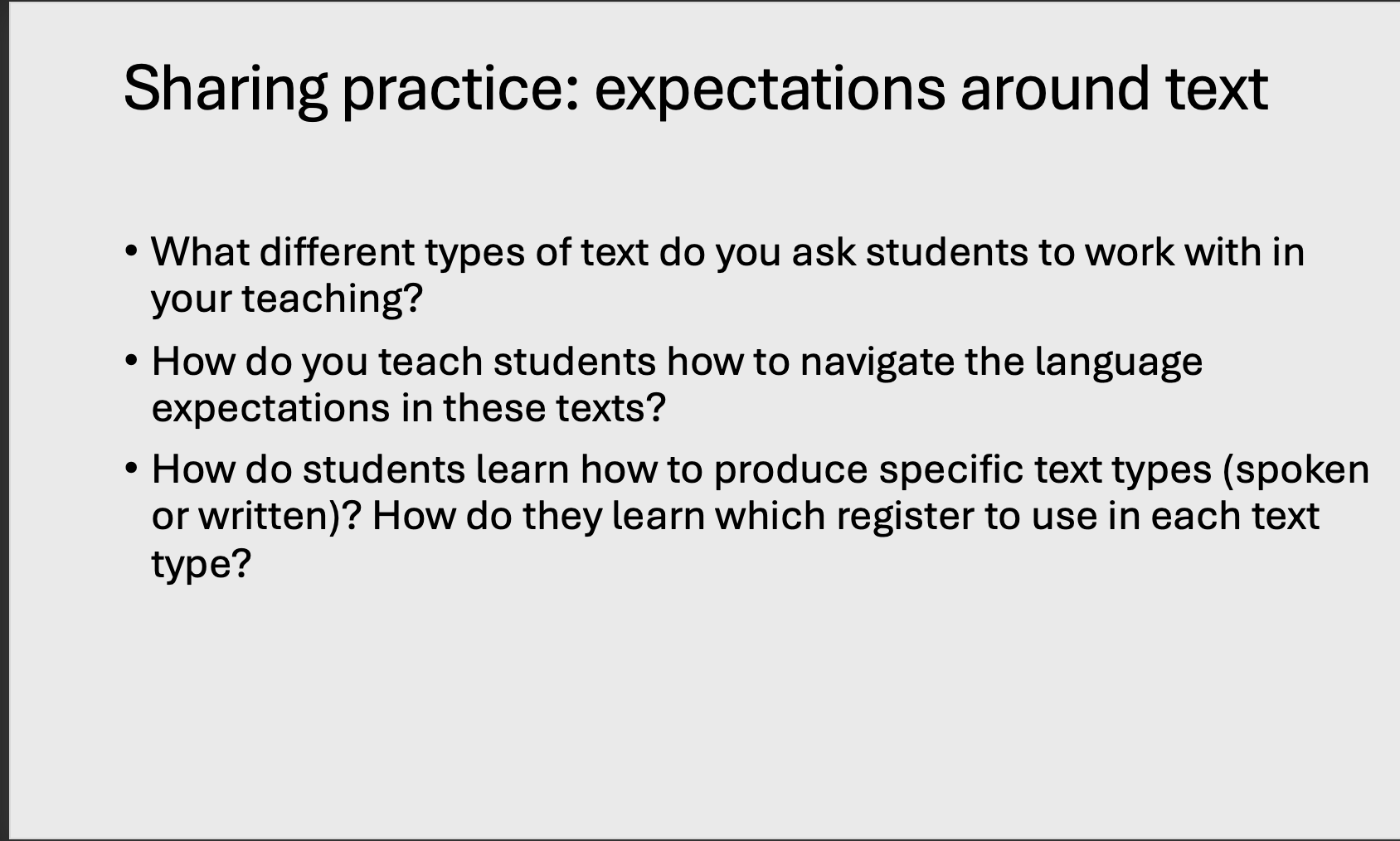
Sharing practice: Expectations around text:
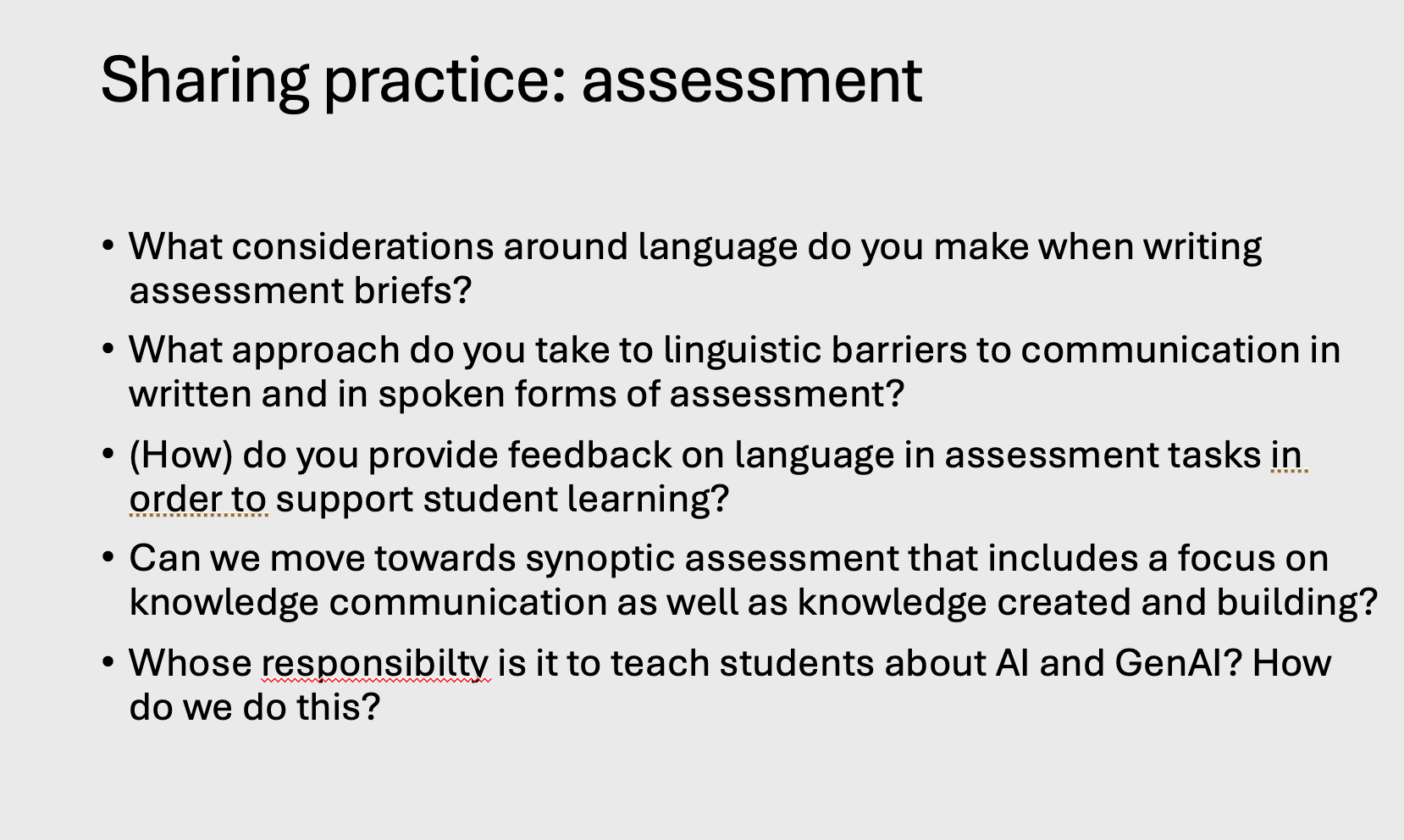
Sharing practice: assessment:
Leeds assessments:
- STEM: students have to write a lab report in S1 but computer science ss don’t do lab work so that is problematic.
- Multiple mini interview for medical students.
- Social sciences: Essay, but also a viva/presentation in response in part to genAI.
- Still an essay in a lot of the programmes
My thoughts:
A very thought-provoking opening plenary. This idea is I think important: “Students need to know that there will be differences between what we do and what they will do in their disciplines”. We can’t be all things to all students, there is a limit to what we can teach them; but alongside that, if they are at least aware of the limitations and the potential differences it can help them. Foundation students might get a sense of that just with the gap between EAP and their subject modules (particularly STEM students). I suppose a tiny example of us making students aware of the differences between we do and what they will do in their disciplines comes in the context of teaching citations. We use APA 7th. We can’t teach every citation method that they might encounter going into their departments but we do ensure that they know that there are many different approaches and that they will need to find out which one their department uses. We also signpost resources they will be able to use to help with that.
Regarding assessment, I’m pretty sure our STEM students write a lab report in one of their subject modules where relevant and I think they may be best placed to teach that. Once upon a time, we had synoptic assessment for pre-masters students, where we focused on linguistic elements of a piece of work they produced with and also for a subject tutor. For Business Studies, Social Sciences and Humanities it was a research project proposal (they didn’t do the actual primary research I don’t think) and for STEM it was a literature review. As there was a presentation element, timetabling it all was something of a nightmare, certainly from the teacher perspective (you could end up doing a great number of them in a row) and I am sure from those doing the timetabling’s perspective too! There is always tension between wanting to make assessments as good as they can be and the potential workload issues that might result.
It was interesting to hear about how things are done in Leeds. It sounds like they have gone through as much change as we have over the years. I know Leeds has a Studygroup centre but Studygroup wasn’t mentioned by name in the talk. I assume it comes under “International Pathways Centre”. That Bee is looking at it all and proposing to apply principles and make changes suggests they have some degree of control over some element(s) of it! In the We’re All in This Together – A Collaborative Approach to Supporting IFP Transition: Preparation, Progression and Early Undergraduate Success’ talk, I learnt about how it works in Bristol. They have a relationship with Kaplan (which includes a centre in London) and also an in-house foundation programme in Bristol University. So that’s different again. Edinburgh University (which I learnt a bit about in ‘A Measured Response to AI and Assessment: Re-designing the ‘Whole’ Rather Than Parts’) seemed to be in-house so they had full control over their assessment programme. So many different approaches to achieving the same general goal (preparing students to study at university and helping them progress on to do that). All with different benefits and constraints.
Ultimately I suppose all we can do is continue to consider how best we can help our students within the institutional constraints of the context in which we find ourselves. All the innovation brought to the conference was examples of efforts to do just that, as far as I can tell!

