
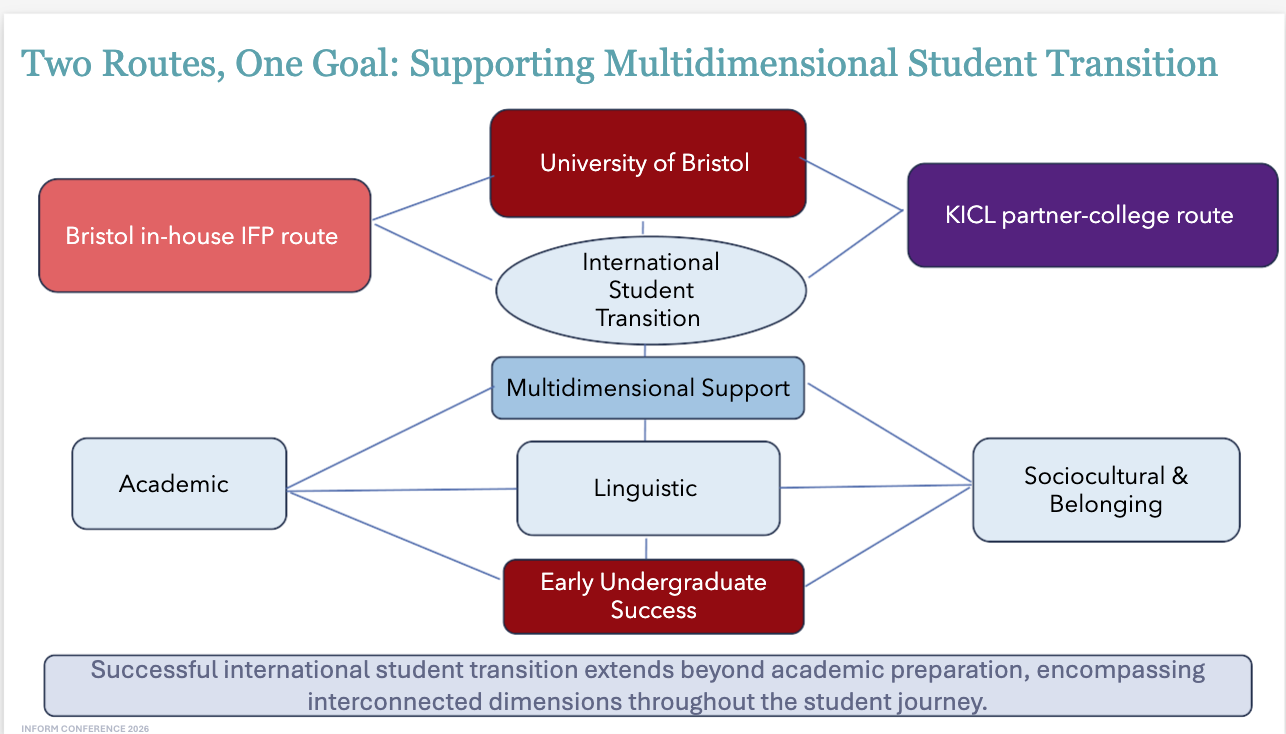
A holistic approach to progression. For University of Bristol (UoB), there are two routes:
- KCL partner-college route
- Bristol in-house International Foundation Programme (IFP) route.
For both, multidimensional support is required including academic, linguistic and sociocultural and belonging. All can impact early undergraduate sucess. So preparation extends far beyond academic preparation.
UoB in-house IFP
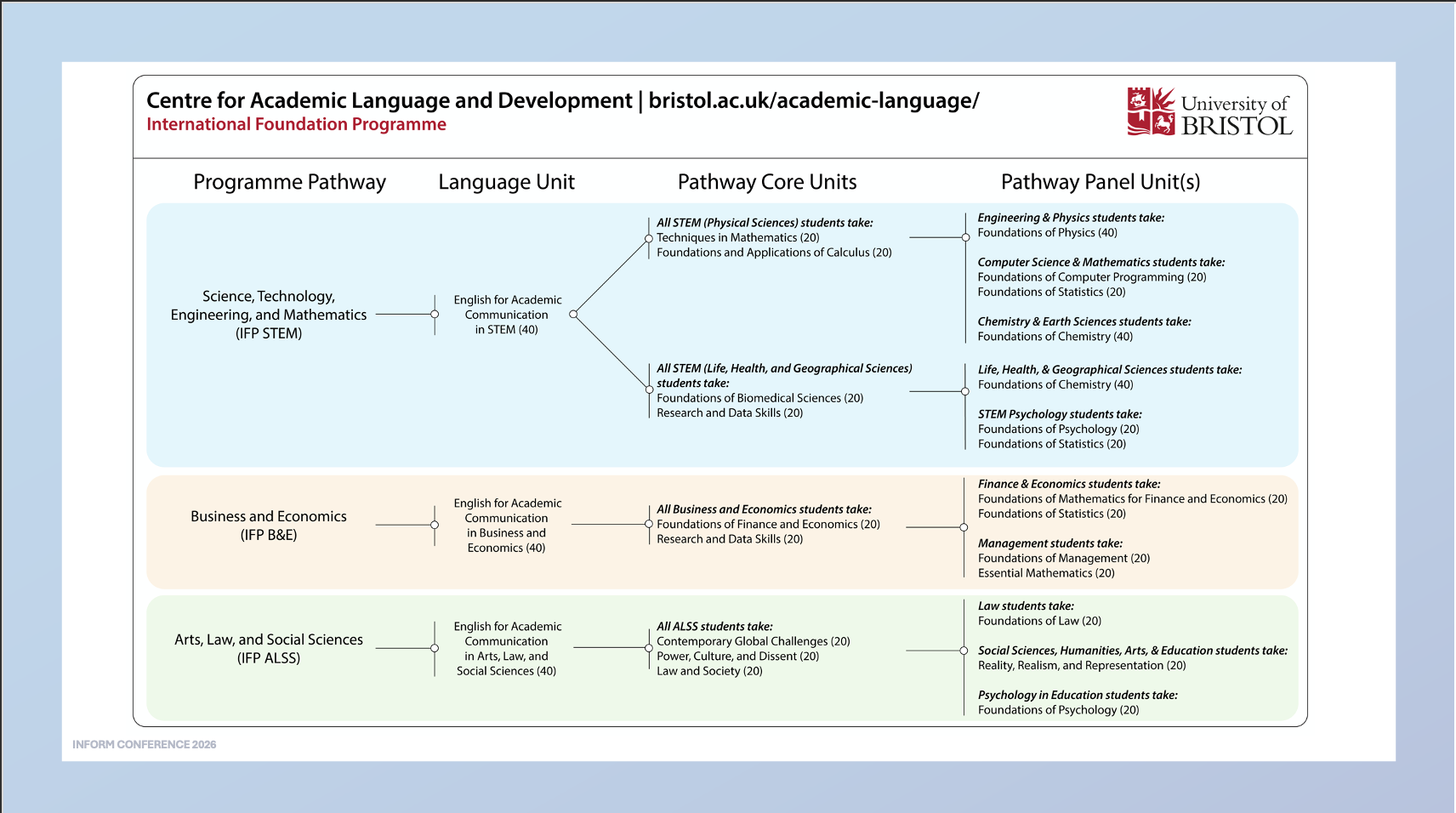
It is based on campus and has close links to the rest of the university though work still be done to make it closer. They are in the process of curriculum revamping, to make more integration between EAP and disciplinary subjects. They also want to connect more with schools to support transitions. They want to introduce students to teaching appraoches at UG level. This revamp has been going on for the last year and will be delivered in September.
They want students to feel more part of the UoB community. There is a unique team on campus called Global Lounge which focuses on community building, and introductory events help the students to learn about it.
KICL Partner-college route
These students are preparing outside the university environment. They need a more intentional transition bridge. They have fewer day-to-day opportunities to build familiarity and sense of belonging. These students are not less capable or prepared but a different route creates different transition needs.
How can this gap be bridged?
- Align expectations. They are working with UoB so that the Kaplan college is more aligned with them in terms of curriculum and assessment.
- Build readiness through uni orientaton week workshops
- Sustain connection through five part summer transition newletter = a structured pre-arrival sequence not a one-off communication: pre arrival preparation, academic transition, Ai and academic practise, suport services, career services.
- Increase UoB exposuure with a transition week including campus visits and tutor sessions. Students can meet staff, ask questions and get an earlier sense of what support services can be like at the university. This turns Bristol from an abstract destination into a visible and relational place.
- Review and refine: post-progression outcomes. Student voice and Bristol partner feedback used.
It is embedded, collaborative, multidimensional and transferable. Progresison is not a handover point, it is a process.
Students ask about campus and learning spaces, workload and study hours, unit chocies and assessments, career opportunities. = Students needed clarity on lived reality of year 1 study, not only entry requirements.
Feedback suggests that students valued this. Especially the Q&A and small group discussions. They wanted more time for Q&A and more visual examples of the campus.
They can’t recreate the Bristol experience at the college but they can support that transition.
Post IFP collaboration
Case study: Engineering. Lower progression of ex IFP year 1 students to Year 2. So the academic and pastoral support team was born. They meet ex IFP students every two weeks for small group tutorials and 1-1 on request.
Challenges to progression:
- prior subject knowledge
- language proficiency and confidence
- academic culture; time management/organisation
- independent study skills (maturity?)
- wellbeing
- motivation
- assessment: type, clarity of brief, questions, timing, familiarity.
Academic and Pastoral Support tutor role:
- Identify challenges
- Ensure all students are aware of academic and pastoral support
- Provide support to specific students (who need it)
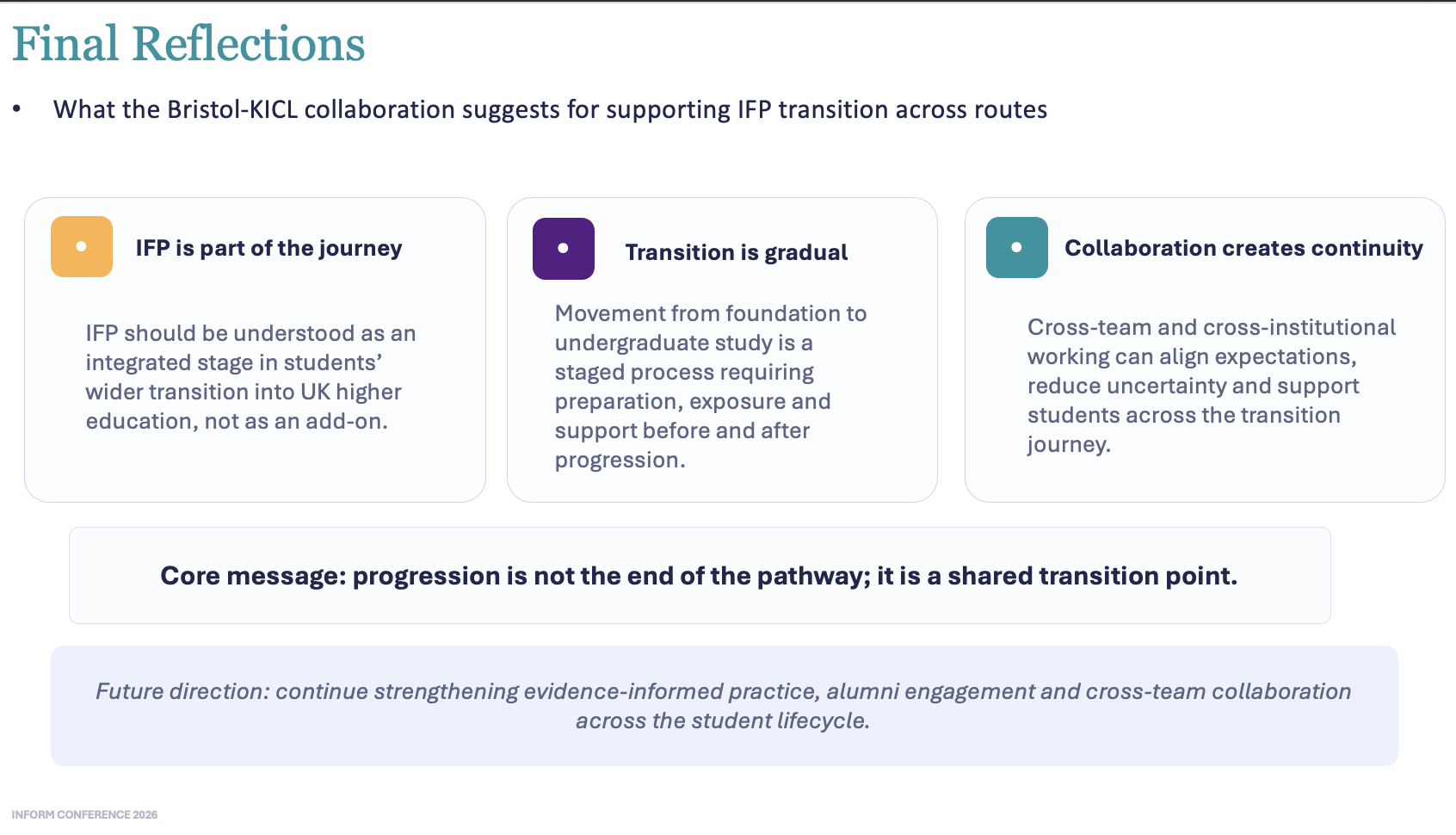
IFP should be understood as an integrated stage of students wider transition into UK higher education, not as an add-on. Transition is gradual, requiring support before, during and after progression. Collaboration between different teams means there is more connection between different stages, so it is all more joined up. This continuity helps reduce uncertainty and provides a clear route. Progression is not the end of a pathway, it is a shared transition point.
Conclusions:
My thoughts:
Again, interesting to see how other places do things! The transition arc as a whole is not something I have a lot of control over but I know the Student Experience team here have done things involving people from future departments coming and speaking to students and (I think?) students visiting the departments too. I’m not sure what happens to students once in department. I do know there is Deparmental Language Support available via ELTC tutors going into departments and providing support lessons that are open to all students. I don’t know what happens specifically to IFP students who progress to the university.
I suppose challenges to progression are something for us to keep in mind, as perhaps those we can help with e.g. time management/organisation and independent studyskills are something we could scaffold, and by making our assessments reflective of what students will meet at university, including in how AI is treated, we can help them in that way too.
 Lizzie Pinard
Pingback: InForm 2026: Changing Language(s) and Discourse(s) about and in the International Foundation Year – Prof. Bee Bond – Lizzie Pinard