
On Saturday 20th June, I attended the one-day InForm Conference hosted by Birmingham International Academy, home of the International Foundation Year at Birmingham University. The whole conference focuses on Foundation Year programmes, and is therefore very relevant to my current role. My notes from all the talks I attended will be tagged InForm2026 for easy location.
Talk no.3 of the day. after a much-needed 30min coffee break!
This is a workshop session. Apparently we wil be talking and doing as well… <Edit: oh, didn’t we just…>
(Notes are a mixture of what I got during the session and what I could remember afterwards – often no time to write during!)
We started with an activity where statements were revealed one by one such as: “I reflect on my teaching regularly”; “I encourage students to reflect regularly”; “I am comfortable teaching students how to reflect”; “I am comfortable assessing reflection”. We had to treat the line from wall to wall as the spectrum between agree and disagree and place ourselves according to our views/experiences. We then had to discuss the statement with whoever was nearest to us.
(Note: I’ve done this with agree/disagree and other such opposites before, before but not as a spectrum – would like to try that sometime. It was interesting that the presenters said afterwards that they were happy that the room was so noisy – and don’t we often as teachers equate noise with engagement and participation. It took me 1 statement to realise that I couldn’t cope with the noise and got my noise-cancelling headphones on. Gamechanger – I could then participate as I could hear what the person nearest to me was saying rather than just freeze in a well of noise. Am now considering how I can help my students all be able to participate fully in such activities.)
Then, there was some input on how to scaffold reflection, with the following ideas shared:
- sentence stems
- reflective models
- end of class slides
- peer reviews
- project debriefs
- tutorials (co-construct the reflection with the student)
- drama techniques e.g. forum theatre
Our next activity combines tutorials and forum theatre. <God help me>.
First, what is forum theatre? Augusto Boal developed this in the 1970s as part of his theatre of the oppressed. He was interested in how or the potential of theatre to help people examine and challege the social structures that were shaping their lives. He felt regular theatre situated people as passive observers but to effect change they need to be more involved. Instead of sitting back and watching a scene unfold, audience is invited to come up, pause the action and change it. He called audience “Spect-actors”. He just wanted people to engage with the problems and explore different possibilities. Boal called this a rehearsal for reality. The scope for rehearsing difficult situations has brought it into contemporary situations e.g. healthcare training and even higher education now. Louise uses it with her students. Forum theatre is reflection in the moment. Everybody is analysing/processing as they go.
Forum theatre process:
- Watch
- 2. Stop (at any time)
- Step in (and make any changes)
- The scene is replayed with the new intervention
- Consider what is learned
It is about exploring possibilities, challenging assumptions and imagining change.
Today:
- Kate and Louise perform a dialogue
- As we watch, we should notice anything that jarrs and think about what the motibations are of the student and the tutor
- Then we will have the chance to view the script and identify something we want to do differently (this wouldn’t usually happen).
- Then they start the dialogue again and you should sto when you want to change the action.
- You improvise the continuning dialoge.
<Ok, phew, we don’t have to role play, it is optional>
You can take the place of either character.
Context:
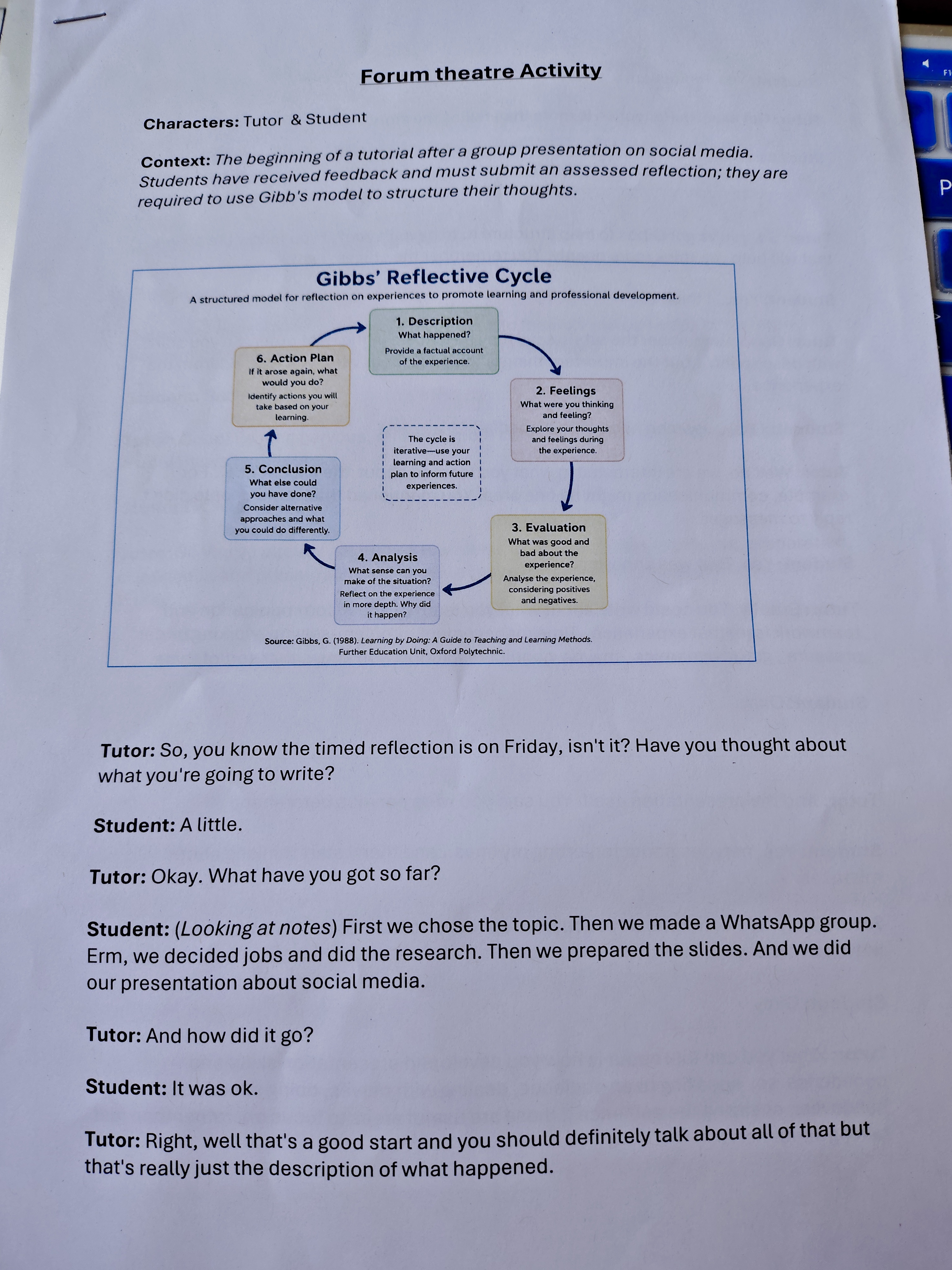
- a tutorial after a group presentation on social media
- Students have received feedback and must submit an assessed reflection
- the teacher is helping the student to prepare for a reflection assessment
- Students are required to use Gibbs model of reflection to structure their reflection
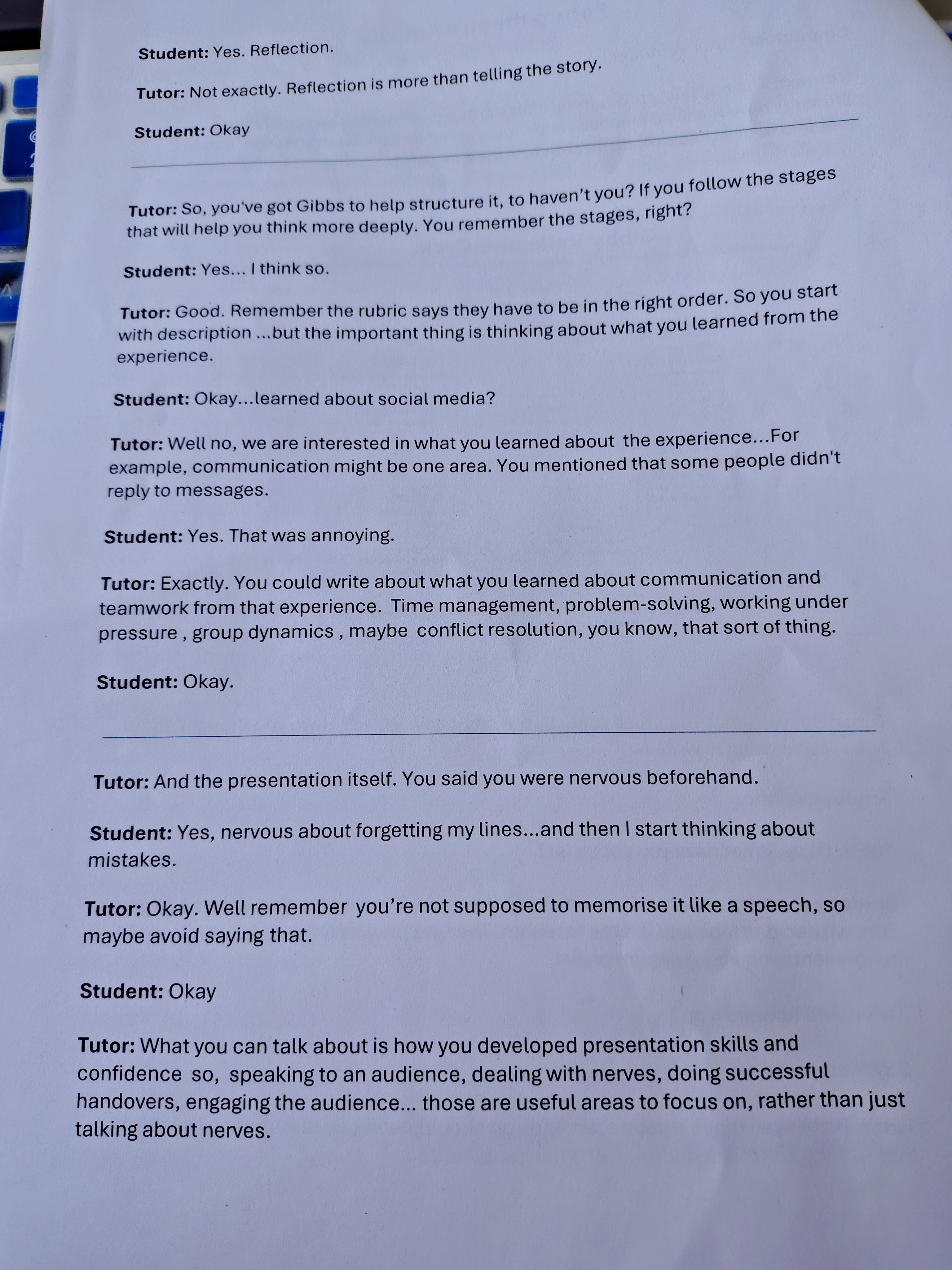
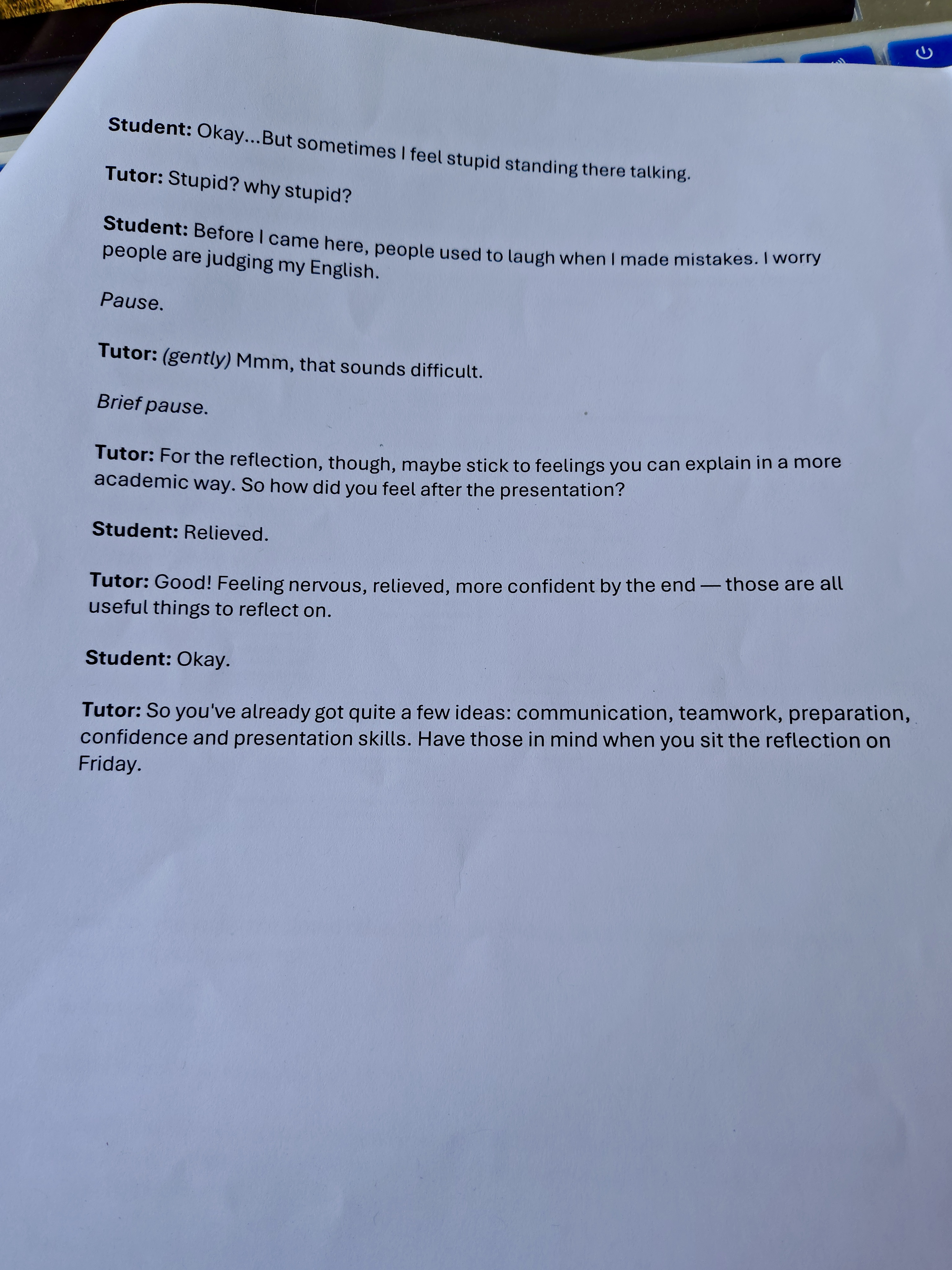
It was a really enjoyable activity once it was clear that participation in the role play was optional. Chapeau to those who did have a go. We had a lot of dicussion about the script (below) – there were lots of issues:
- we could see evidence of a time-pressed tutor who is trying to get the student to jump through the hoops correctly
- we could see a student who didn’t necessarily understand what it was they were supposed to do but was making note of what the teacher said to regurgitate at the appropriate moment (the assessment)
- we could see evidence that the focus was on the rubric (“Remember, the rubric says…”) more than the actual process of reflection
- we could see a learning opportunity being lost “Okay. Well remember you’re not supposed to memorise it like a speech, so maybe avoid saying that.” “Okay” …Whether or not it was supposed to happen, it did happen. Evaluating how it helped and hindered would be actual reflection.
Assessed reflections
We’ve looked a bit at reflective practice and started to look at assessed reflections which are a bit more of an issue. In academia, in our setting, there is increasing emphasis on it. Next we are looking at some student reflective writing done in such an assessment. These 4 students did the presentation alluded to in the forum theatre and did the written reflection that was the focus of the forum theatre. We look at four examples from the four students who were in one group for the group presentation:
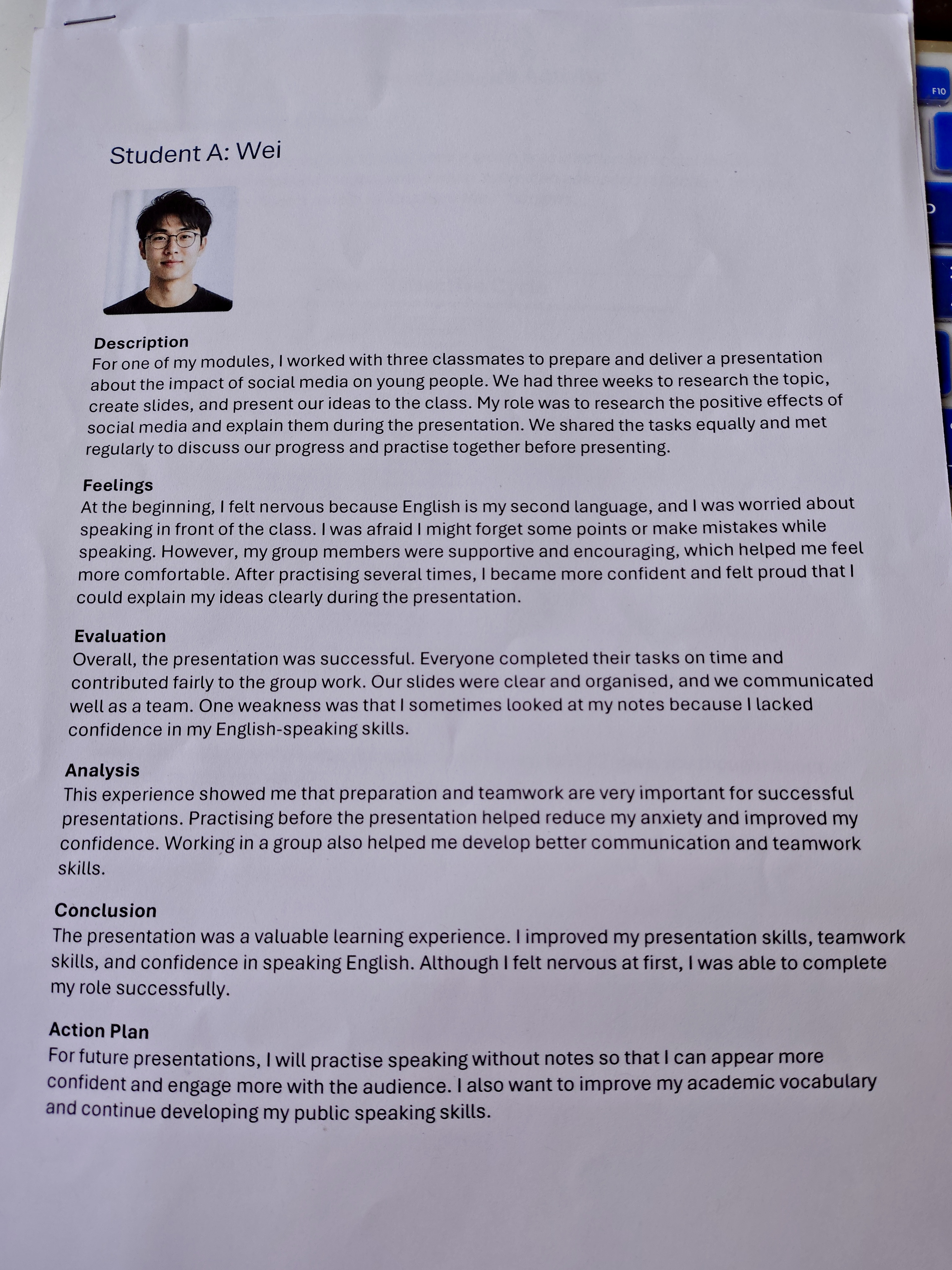
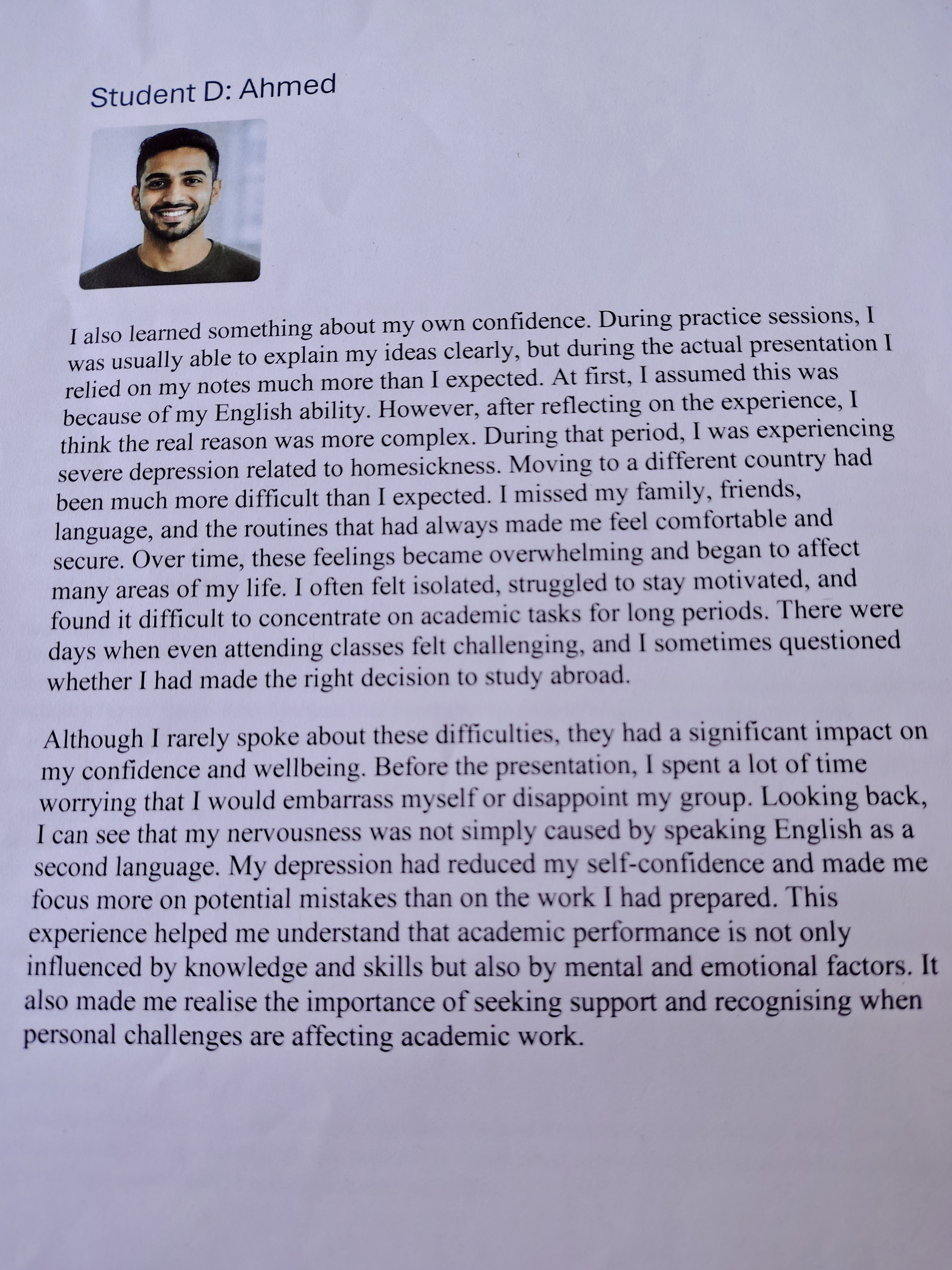
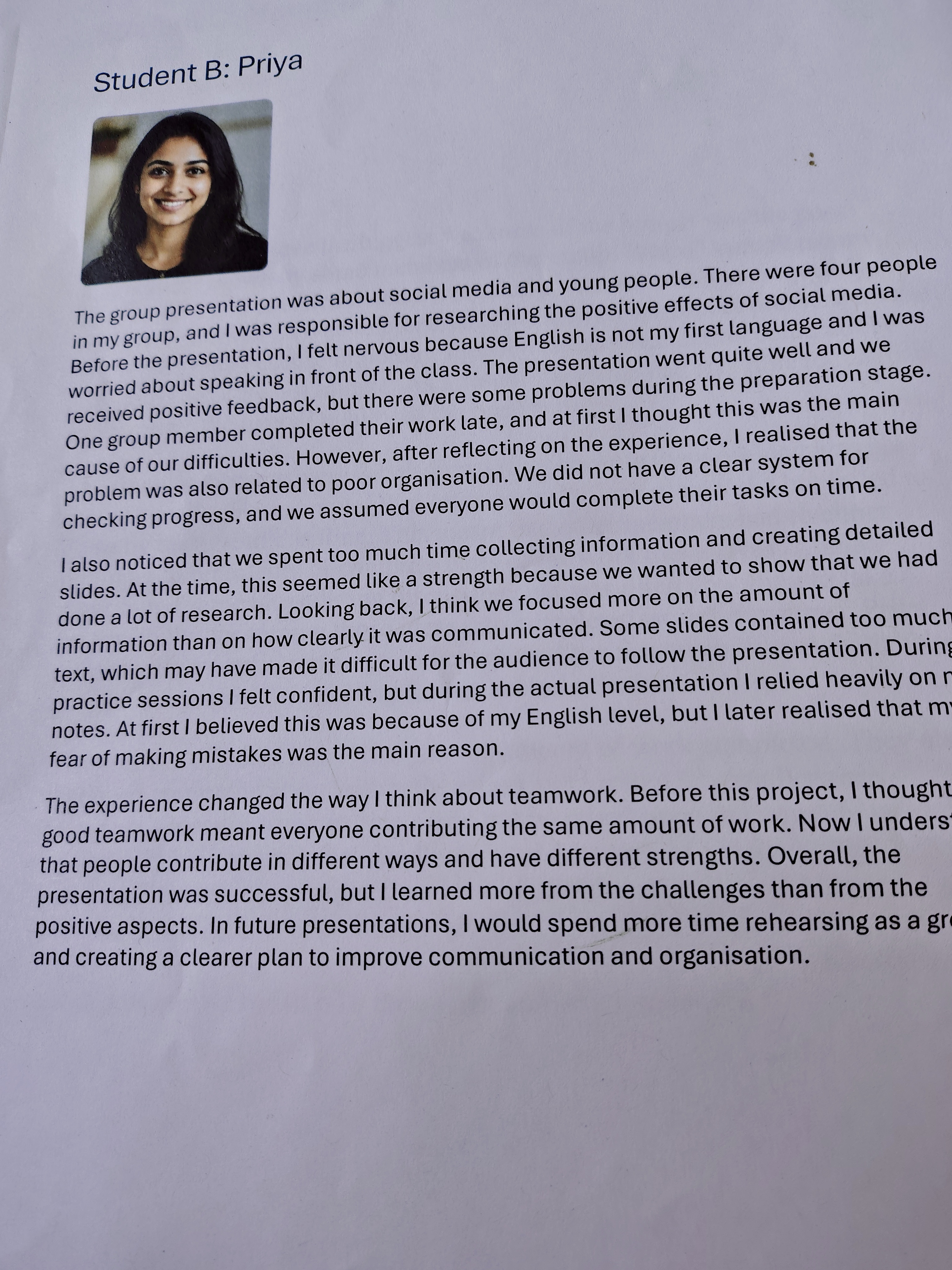
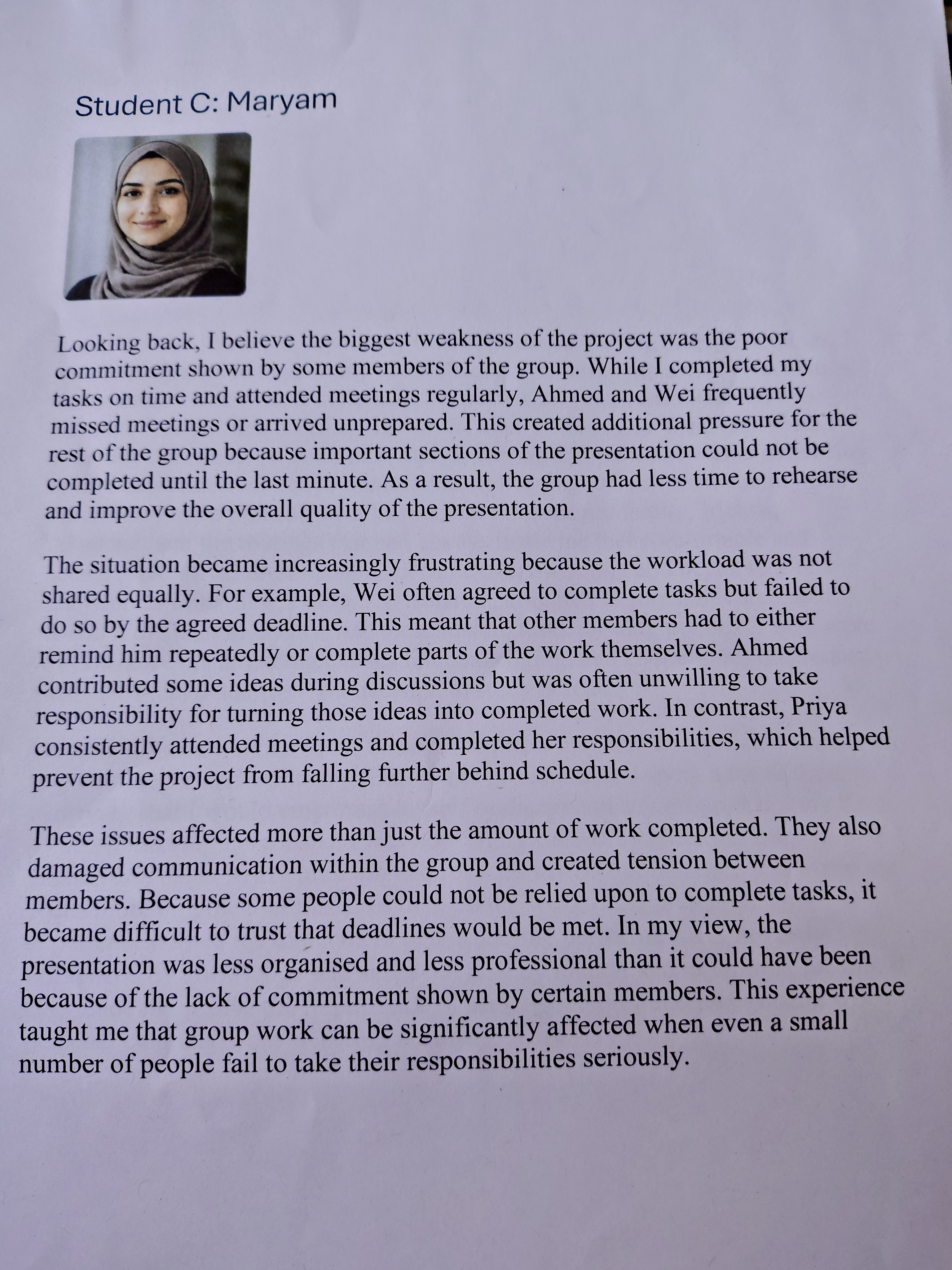
They had very difference experiences of the group presentation and very different approaches to reflection. We had to consider/discuss the following questions:
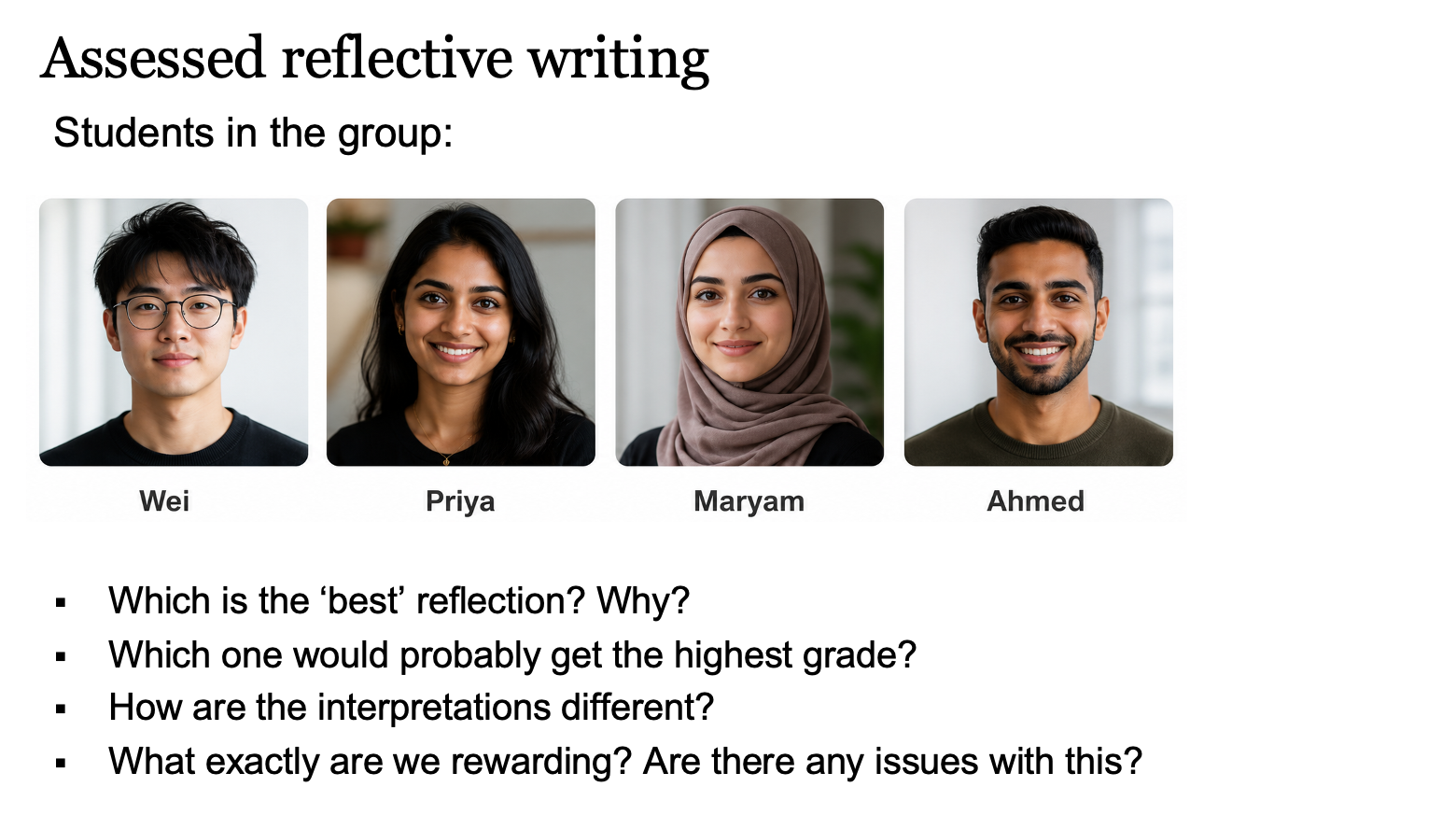
After this activity, the presenters shared some thoughts with us:
Deep learning is achieved through thoughtful engagement with experience. But in higher education, it is performative and often assessed. Once reflection is assessed, it has to both support learning and provide evidence of learning. This is where the ethical questions begin to surface.
- Disclosure: reflection asks students to draw on thoughts and feelings. So what are we asking students to reveal when they are asked to reflect. We want them to be authentic etc but they know they will be judged. If some students are naturally more comfortable sharing than others, then are we creating an assessment that is genuinely fair to everyone? Reflective writing asks students to adopt a very particular voice and in reality experiences don’t come neatly packaged and people don’t make the same sense of the same situations. Whose realities are most likely to fit our academic expectations? How voluntary is disclosure when there are marks attached to it? Students are not only deciding what they can safely disclosed but also what kind of reflection is going to be more rewarded.
- Performativity: when reflection becomes highly structured, students may begin to focus on what successful reflection is expected to look like rather than on reflection itself. So it becomes performance. And in this case is it still reflective practice or are we just teaching them genre conventions? An activity designed to give students voice actually strips it away. Are we assessing reflectioin or a well-crafted account of reflection?
- Relationality: understanding our practice requires engagement with multiple perspectives not just our own. Once we understand that other perspectives matter, reflection becomes more than just a private act, it becomes a relational practice. Students might feel pressure to write honestly about any peers who did nothing. On the other hand, other students won’t tell the truth because they want to protect valued relationships. Assessment adds another layer of complexity as the person reading the reflection is the person grading it. The teacher has evaluative power and the students know they are going to be judged. Can reflection happen in isolation? Who benefits from reflective assessment? Students can benefit fro making sense of an experience but reflective assessment is there fore instituational purposes.
We need to reflect critically on the practices we ask students to undertake. We work within intitutional structures and assessment regimes but we can still advocate for pedagogically and ethically sound practices.
Reflection questions:
We were given these to think about at the end of the session:
- what are we asking students to do when we ask them to reflect?
- what kind of spaces are we creating for this reflection?
- What kind of reflection are we rewarding and what might we be overlooking?
My thoughts:
This was a very interesting session. Currently, on our IFY at USIC, we don’t have any assessed reflection tasks. We do encourage regular reflection via reflection slides in lessons and for the coming year there will also be 3 1hr online lessons which are reflection-focused (one following the Reading Report, one following the mock seminar discussion and one following the mock presentation). This year, we had two reflection-focused lessons but we found that the reflection task at the end of the Reading Report got a bit lost so one of the changes to the Reading Report sequence was refocusing the existing reflection-focused lesson onto that and then as that lesson no longer focused on the seminar discussion, we added in a lesson for that.
Just had a vague idea that forum theatre could be an interesting thing to do with a seminar discussion lesson, such that students end up forming an effective seminar discussion. But definitely no obligatory participation – you can learn from watching too. So I guess it would depend on the class and whether you think there are any/enough students who would be up for having a go. The presenters said that usually there isn’t a script, but I wonder if an alternative to the forum theatre would be doing a task like we did with the script, where you look at the script and identify issues/alternatives. Perhaps as a pre-tutorial preparation task. It’s an interesting idea. As ever, the main thing we come up against in our course is lack of time. So much to do, so little time. It’s hard to imagine where such a task could fit in before the tutorial in Semester 1. Semester 2 might be more possible (the tutorial there focuses on their coursework essay). And seminar discussion lessons are few, far between and packed. Still, I will keep it all in the back of my mind.
I’m quite glad we don’t have any assessed reflection at this stage. It does seem to be quite a can of worms! As for regular end of lesson and end of week reflection, I will continue to experiment and try to find more effective and meaningful ways to do it with students.


Pingback: InForm 2026: ‘A Measured Response to AI and Assessment: Re-designing the ‘Whole’ Rather Than Parts’ (Philip Davies) – Lizzie Pinard