
MATSDA 2013 (through my eyes)

This is a whistle-stop tour of talks I attended at MATSDA (Materials Development Association)’s 2-day annual conference, all of which I thoroughly enjoyed. (For those who have never been to a MATSDA conference, I highly recommend it: The atmosphere is lovely – everyone is really friendly, enthusiastic and there to share ideas. Talks are generally quite informal and interactive – the audience is encouraged to participate and everyone gets involved. It’s a good recipe and yesterday the proof of the pudding was definitely in the eating: a good time was had by all.)
Screen Shot 2013-07-14 at 20.33.54

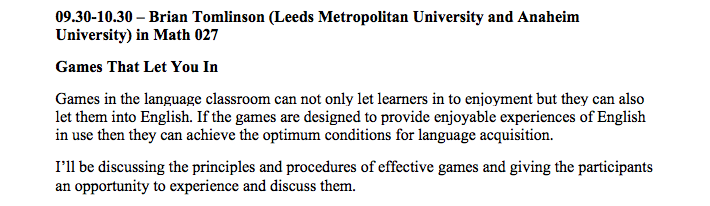
Brian started us off, of course, talking about games – except there was a lot more doing than talking! Brian argued for a game driven approach, but not as the only approach: as an important component of (to the *complete* astonishment of the audience, of course! 😉 ) a text-driven approach. He also took the stance that enjoyment is necessary for language acquisition, but insufficient in itself: Just because learners enjoy something, doesn’t guarantee acquisition. There are other criteria to fulfil.

He then had us try out a few games:

  1. 3-word stories:  In pairs, we each wrote down 3 (consecutive) words to start a story. A said their three words to B, starting the story. B had to respond immediately by continuing A’s story with another 3 words. If either person was unable to continue without pausing, it ended. B then started the next story with their 3 words. (Brian explained that this could be followed by a written phase and a performance phase, using interest as the main criteria)
  2. The second game he had us doing was a game with stones and a wooden board (which exists in many different versions in many different countries) – he had us doing it with circles drawn on paper and tiny balls of screwed up paper. It was complicated but requesting clarification of the rules was all part of it.
  3. Mrs King strikes back: Brian described setting it up by telling the learners they are going to watch a dvd called Mrs King strikes back and eliciting predictions of what it is about. He then proceeds to happen to have forgotten to bring it in. Thus we had to act scene 1 of the film while he narrated it (people are not forced to join in at this stage, watching is fine), playing every role. We then read a text, the ‘true story on which the dvd was based’, and were put into teams, with two minutes to read the text and identify differences between the version just narrated/mimed and the text. An elicitation game followed.
  4. Newspaper hockey: We were put into teams and each team had to produce two hockey sticks and two balls made out of newspaper (except this bit had bee done for us!). In our demo, we had 4 per team. We were numbered off 1-4. We lined up facing each other and at either end was a chair/goal. Your team’s hockey stick is on the opposite chair/goal from the one you are aiming at. Firstly, simply numbers were shouted out. If it was your number, you had to try and score a goal. Then came the more complicated version, in order to know which number is being called, we had to work out the answer to a mathematical problem e.g. the number of people in two tennis doubles matches minus the number of people in a bridge game. (4) Everyone got thoroughly into the spirit of the game and we were all well warmed up for the talks to follow.
Screen Shot 2013-07-14 at 20.34.12

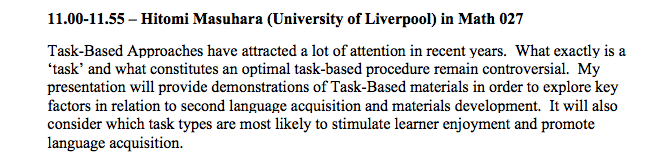
Next up was Hitomi. This was another engaging session, in which, amongst other things, she talked us through a task-based sequence for teenagers based around the topic of magic tricks: Hitomi actually demonstrated a magic trick and then elicited ideas of how it could have happened (she tore a tissue up and then made it whole again – was very cool!). We concluded that angels had kissed it. 😉  She explained that learners could then be taken through a process of searching for similar magic tricks/explanations on youtube, learning how to perform and presenting a performance of whichever trick they have chosen and described optional but recommend follow ups, such as recording performances and/or creating a booklet. The importance of initial focus on content during peer review was emphasised.

(I found it particularly interesting when she contrasted her sequence with Rod Ellis’s (2010) shopping task, pointing out that tasks are used for both research and pedagogical purposes but that tasks with a pedagogical focus emphasise broader educational development, while research tasks are geared towards study of language input, intake and acquisition. So a perfectly good research task may not be the most engaging or effective task pedagogically. However, don’t discount such tasks: do think about how to make them more interesting/engaging/relevant etc.)
Screen Shot 2013-07-14 at 20.37.00

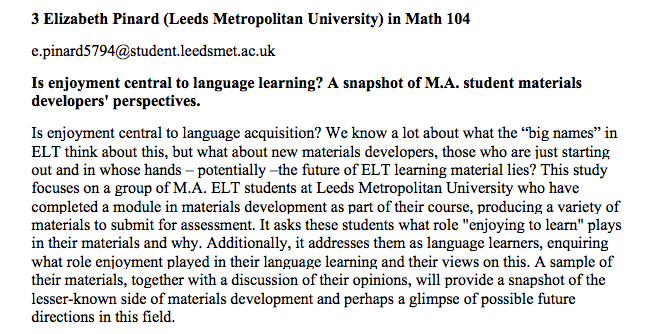
Fortunately, I then went to this talk! 😉 I had a great audience, so the discussion generated was very interesting – everyone had their own views and ideas to contribute, which was great. More information to be found here. (Unfortunately as the recording is only of a rehearsal, you don’t get the interactive flavour of proceedings – which is arguably the best part! – only the general content…)
Screen Shot 2013-07-15 at 06.53.13

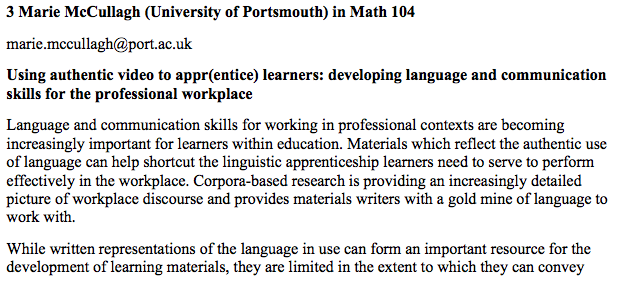
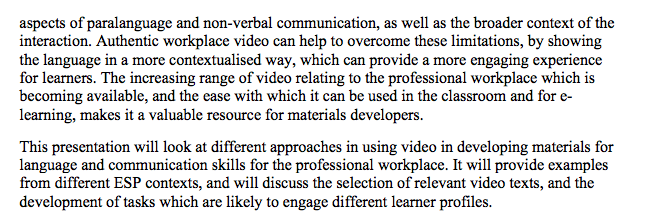
Screen Shot 2013-07-14 at 20.35.05This was a fascinating talk. Marie talked to us about combining Tomlinson’s text-based approach with a discourse analysis approach, using corpora based research to inform language focus. She made the very good point that in course books, transactional and interactional talk are most often separated, whereas in real life, transactional talk includes, and needs, interactional talk. She showed us types of language associated with interactional talk – such as language for expressing stance, hedging and politeness, referring to shared knowledge and showing solidarity. Marie also demonstrated her ideas by showing us materials she’d made for her learners using a video clip from The Apprentice.
Screen Shot 2013-07-14 at 20.35.39

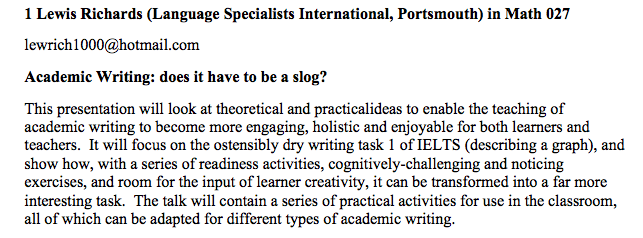
This talk was brilliant – full of simple, useful ideas of how to turn dull as ditchwater IELTS tasks into something interesting and engaging. For example, for the boring, pointless writing about a process task,  Lewis played us a recorded spoof example of the process of making tea from planting it to pouring out the tea, as though it were something two friends would discuss. It was hilarious! It also contained all the necessary language, which learners could extract. He also showed us a spoof model answer to a writing task, in completely the wrong register/genre and suggested getting learners to identify all the inappropriate elements. The true model answer could then be used for cognitively engaging noticing activities.

This was the kind of talk that you left absolutely raring to try out all the ideas! 🙂 The perfect end to day 1.
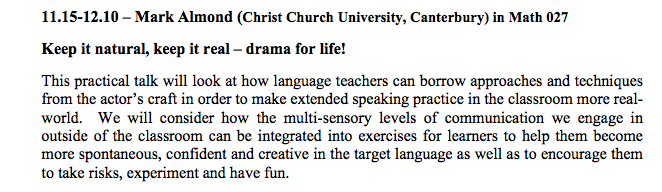
Screen Shot 2013-07-14 at 20.36.48Day 2 started later than planned (long story!), nevertheless the talks I was able to attend were great. This was the first and it was a lot of fun. The main focus was on improvisation. Volunteers from the audience were required to demo all the activities, of course.

  • There was the bus queue one – we had to stand in a line, one end was the front of the queue, the other was the back. Then there was a really interesting one for exploring the role of status in communication. The demo group consisted of six people and they had to role play different statuses, depending on the playing card they were given. Aces were high. The audience had to guess what their status was by the way they behaved. Obviously in reality, it is less clear cut; indeed, when putting the group in order of status, the audience had different opinions – and this is where the potential for lots of interesting discussion comes in, with potential of course for intercultural comparisons to be made.
  • In the second version, group members each had a playing card again, but this time they couldn’t see it. They could only see the cards of the rest of the group (everyone stuck their cards to their forehead). So here, they had to guess what status they had by how they were treated by the rest of the group.
  • The final one was about blocking and accepting: Blocking – when you stop communication by using disagreement (verbal or nonverbal) or non-sequiturs, for example, to shut it down. Accepting – basically the opposite: you agree (positive verbal or nonverbal language), use back-channels, question tags etc. Two audience members had to role play a shop assistant and customer in a shoe-shop. The first time, they had to accept everything, but not buy/sell any shoes. The second time, one had to accept everything and one blocked everything. For the last one, they both had to block everything.

(I think it might be interesting to combine some of these activities with elements of the corpora talk earlier and ideas from the “Is affective always effective?” talk that followed – so, get some friends to role play these tasks and record  it. This could then be used after the activities as a point of comparison and for some awareness-raising/noticing activities for whatever elements of language use stand out when the transcript is analysed. Not in a “this is the right way to do it” way but in an exploring the differences and possibly making intercultural comparisons kind of way. Obviously not authentic language per se, but whoever is role playing and recording themselves would, I imagine, be using the types of language and structures that they would use in these situations.)
Screen Shot 2013-07-14 at 20.34.33

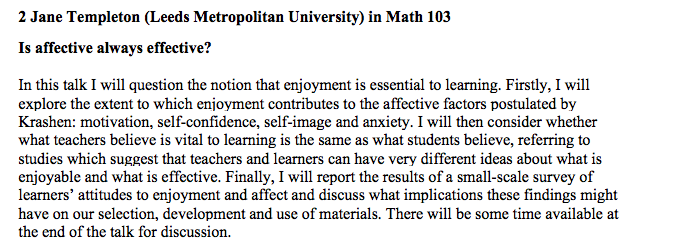
Jane argued that engagement, affect and motivation are crucial and interlinked. Enjoyment is hard to separate out but not the central aim. She showed us some interesting materials, in which a recording became a point of comparison between spoken and written anecdote telling. Jane had us discussing the materials and thinking about how we’d work with them and lots of great ideas emerged.

Screen Shot 2013-07-15 at 15.11.14

Claudia kept us on the edge our seats by walking us through a sequence which involved used of a video. After doing some readiness activities with us, she played us a dramatic excerpt of a boy cycling very quickly away from something and falling off his bicycle in the process, all to very horror film music. We then had to predict what had happened to lead up to that event. She demonstrated the power of narrative when events are not told in simple linear order. She also showed us excerpts of course material dealing with narrative, published ten years apart, so that we could see how little has changed in that time. Even the cathedral bells, which went through a phase of ringing and ringing incessantly for a spell, couldn’t distract us from this session!
Screen Shot 2013-07-14 at 20.37.54

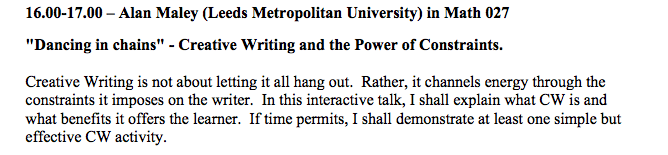
Alan Maley brought proceedings to an end, with an all too short creative writing workshop, taking us through a range of activities which could be used with learners, encouraging creativity and language play. There was theory too, to back it up, discussed briefly but not dwelt upon as we were running late but had to vacate the building at a particular time nevertheless. One of the activities we did was producing a 50 word saga based on the fable of the Fox and the Crow. Here is what I produced:

The fox, he was hungry; the crow, she had food.

This put the fox into a very bad mood.

But he was cunning, he flattered the dame,

And when she responded, down the treat came.

Ladies, be careful for foxes may lurk

Don’t be fooled by a two-faced jerk.

There were some shorter activities too, for example the two line poem:

Hello ________.

Goodbye ________.

I came up with

Hello dissertation, goodbye sanity. 😉

It was brilliant hearing other peoples’ creations and the session was a lovely way to finish a really great conference. There will be several MATSDA conferences next year, in Dublin, Brazil, Germany and I forget the other two places. Anyway, keep an eye out and if one comes to a place near you, then I would definitely suggest going.

Thank you to all the organisers for a wonderful weekend.

MATSDA Conference 2013 Presentation: Is enjoyment central to language learning? A snapshot of student materials developers’ perspectives.

Conference: The MATSDA/University of Liverpool 2 day conference, themed “Enjoying to learn: the best way to acquire a language?” 13th and 14th July 2013, University of Liverpool

Topic: Is enjoyment central to language learning? A snapshot of M.A. student materials developers’ perspectives

Abstract: 

Is enjoyment central to language acquisition? We know a lot about what the “big names” in
ELT think about this, but what about new materials developers, those who are just starting
out and in whose hands – potentially –the future of ELT learning material lies? This study
focuses on a group of M.A. ELT students at Leeds Metropolitan University who have
completed a module in materials development as part of their course, producing a variety of
materials to submit for assessment. It asks these students what role “enjoying to learn” plays
in their materials and why. Additionally, it addresses them as language learners, enquiring
what role enjoyment played in their language learning and their views on this. A sample of
their materials, together with a discussion of their opinions, will provide a snapshot of the
lesser-known side of materials development and perhaps a glimpse of possible future
directions in this field.

Recording: Here. (Not of the actual presentation – due to technical fail – but of a rehearsal)

Write up: Here.

References used in presentation: 

Bolitho et al. (2003) Ten questions about Language Awareness in ELTJ vol. 57/3 Oxford University Press. Oxford.

Dörnyei, Z. (2005). The psychology of the language learner: Individual differences in second language acquisition. Mahwah, NJ: Lawrence Erlbaum.

Dornyei (2013) Plenary at Warwick International PG Conference of Applied Linguistics

Dellar, H. (2013) Twenty things in twenty years, part 7: Input is more important than output. Blog post, address: http://hughdellar.wordpress.com/2013/06/09/twenty-things-in-twenty-years-part-seven-input-is-more-important-than-output/

Gadd, N. (1998) Towards less humanistic English teaching. in ELTJ vol 52/3 Oxford University Press. Oxford.

Gilmore, A. (2007) Authentic materials and authenticity in foreign language learning. In Language Teaching vol. 40. Cambridge University Press. Cambridge.

Lightbown P and Spada N  (2006) How languages are learned Oxford University Press. Oxford.

Richards, J. (2006) Materials development and research – making the connection in RELC vol. 37/1 SAGE publications

Schmidt, R. (1990) The role of consciousness in language learning in Applied Linguistics vol. 11/2 Oxford University Press. Oxford.

Scrivener, J.; Underhill, A.  The issues Blog post, link: http://demandhighelt.wordpress.com/2012/03/02/the-issues/

Swan, M. Language Teaching is Teaching Language. Hornby Lecture given at IATEFL Conference 1996.

Tomlinson (2010) Principles of effective materials development in Harwood N. (ed.) English Language Teaching Materials: Theory and Practice. Cambridge University Press.

Tomlinson (2012): Materials Development for Language Learning and Teaching in Language Teaching vol. 45/2 Cambridge University Press. Cambridge.

Dissertation Diary 6

I’ve decided to use my blog as a reflective tool while doing my dissertation project – the final component of my M.A. in ELT –  hypothesising that this will make it an even more effective learning experience for me, by mapping it, enabling me to look back on my thought processes and decisions and see what effect these have on the project development. (Other posts in this series can be found here) Once I get to the end (13th September is D-Day!), as well as looking back over the experience of doing the project, I plan to try and evaluate the effect of these reflective blog posts on it.

The homework I left myself with at the end of the last post in this series was:

  • Address the culture issue
  • Continue mapping my skeleton back to the theory/principles and fleshing it out/pinning it down
  • Once vertical sequences all mapped out, combine that with the diagram, thereby producing a framework for my materials.
  • Write rationale.

Progress report:

As far as the issue of culture is concerned, I’ve found a theoretical anchor for what I’m doing with culture within my materials: Corbett (2003) An Intercultural Approach to English Language Teaching. Multilingual Matters. More specifically so far, chapter 6: Exploring Culture Through Interviews. This is essentially what my learners will be guided through doing in the course of the macro-task cycle. What I need to do is link this anchor to my stance on culture, which should be backed up by further related theory (this should not be difficult, having spent a semester doing a module on “Methodology in Context”, in which culture featured prominently…) This is something I need to include in my rationale.

As to mapping the skeleton out properly and justifying each step of it, that I have finally done. It’s taken 48 power point slides. The first 27 consist of theory and notes to myself of the links I need to make in relation to my materials. This, I think, is another step towards being able to produce the rationale. The last 22 slides are the map of my materials, consisting of a series of diagram (but in the end not filled in because there isn’t enough space, so the content is on subsequent slides), task description slide and task justification slide. Each vertical task in the horizontal macro-cycle  represents a 2.5hr lesson, and 8 of these bring me to the required 20hrs of materials, if my maths hasn’t failed me.

Materials Framework Draft 2

I might possibly now need another interim stage, between this Materials Framework Draft 2 and writing a draft of my rationale, where I explicitly link the first 27 slides (+other associated theory I’ve read) with the last 22 slides… The justification slides were made with the first 27 slides etc in mind, but it might be useful to go through them and cross-reference. I think it would be as simple as putting a (see slide x) or a (see [e.g.] Ellis 2003:xx) in brackets after elements in the justification. That should make it easier for H to negotiate the document when I send it in advance of our next meeting, and to see more clearly why I’m doing what I’m doing (hopefully…), and, for me, it should also make writing my rationale that much more straight-forward. Again, hopefully… It will also make me double check everything I’ve done so far in terms of the framework, which means if there are any anomalies I can also hopefully spot them and eliminate them. This is still very much a work in progress.

I haven’t started writing my rationale yet. Not formally, anyway. (Another way to look at it would be to say that everything I have done so far is rooted in writing the rationale. Maybe this is a process approach.. :-p)

So, next lot of homework:

  • Cross-reference justification to theory (either slides or texts)
  • Synthesise my approach to culture
  • Write a draft rationale

I have 11 days before my next meeting (it’s on the 27th June), although several of those will be taken up conferencing (Warwick PG Conference of Applied Linguistics) and some time will need to be dedicated to preparing for further conferencing (MATSDA). It should be perfectly feasible, even with everything else I have planned between now and then. As Sandy said, if you need something doing: ask a busy person…

Meanwhile, thoughts/criticisms/suggestions/comments etc are welcome. 🙂

Summary of BESIG Online Conference Session – Nick Robinson: “How (and why) to join a group of materials writers?”

This session was delivered by Nick Robinson, who is one of the coordinators of the Materials Writing SIG (MaW SIG) – at impressively high speed due to technical difficulties taking over the first half of the session!

The aim of the session was to give a short overview of MaW SIG, in terms of why it was set up and what the coordinators hope that members will be able to get out of it. Thus, rather than a “how to” session, it was more of a “why to” session.

So, why was MaW SIG created?

Well, until now, with the creation of MaW SIG, there hasn’t been a special interest group aimed especially at materials writing. (It is important to note the -ing there: materials writING, not writers. It is aimed at anyone who is interested in the process of materials writing. You don’t need to be published, or a big name, in order to be a member of this group. The only essential is interest in the process of materials writing.) However, nearly every English language teacher in the world writes all the time – you may not call yourself a materials writer, but every time you produce a worksheet or a quiz, you are writing materials. Some people do write to be published or to sell their materials, others write materials to share, and others write just for their students to use. The common thread, though, which runs through all of these reasons is the act of writing. MaW SIG wants to bring together a group of people around that thread.

The world of publishing is changing very fast, especially in the past ten years. This creates both a need and an opportunity for people to come together in order to share best practice and ideas and to give advice on how to adapt to this new environment. What MaW SIG provides is a single forum for people to come together and do this, a single forum for the sharing of materials writing knowledge, best practice and continued professional development.

Why should you join MaW SIG?

Publishing is still a who-you-know business, so the connections you make are hugely important. MaW SIG intends to run two conferences a year. In terms of what is forthcoming, the first event will hopefully be held in October, while the second will be a Pre-Conference Event at IATEFL. These events aim to offer you the opportunity to network with established writers, authors, publishers, editors and anyone else who is involved in all the different aspects of materials writing.

This SIG is all about professional development and training, so therefore the stand-alone conferences (like the one planned for October) will be very hands-on. This will help you learn to write better and best practice will be promoted; it is an opportunity to learn from experts in the field.

MaW SIG also has an active Facebook page, through which you can access people who have been doing materials writing for a long time. There is a lot of knowledge out there, which can be shared and this page aims to provide a platform for this.

Finally, if you are interested in getting work published, it is worth remembering that publishers don’t only look at the quality of your materials. They look at a range of other things, like how you interact with the wider ELT community, how interested you are in the field, how active you are in blog-writing and on Twitter, how active you are in attending conferences. Joining and being part of MaW SIG is another way of demonstrating commitment to the field as well as the willingness to learn and develop as much as you can.

How can you join MaW SIG?

You can join by adding MaW SIG to your IATEFL membership, alongside any current SIG membership. (You can also wait until your current SIG membership runs out and replace it with MaW SIG if you so desire!)

You can also join the Facebook page  for which you do not need to be a member. (But of course you’ll gain more from the SIG by joining it!)

You can follow the Twitter handle (@MaWSIG) (As above, you do not need to be a member to do this but the same applies in terms of benefits!)

And you are also welcome to email Nick or Byron to ask any questions you might have. (I didn’t catch the email address but I’m sure you can get it via the Facebook page or Twitter!)

MATSDA (Materials Development Association) Conference, 13-14 July, University of Liverpool

On the 13th and 14th of July, the University of Liverpool will be hosting MATSDA’s annual 2-day conference. Well worth attending to catch up with the latest developments in the world of ELT materials!

You can find an advert for the conference here, and a full programme of who will be presenting on what topics, including abstracts, here. Please do download them and share them with anyone who might be interested in going!

These are the plenary speakers:

  • Mark Almond
  • Thom Kiddle
  • Alan Maley
  •  Hitomi Masuhara
  • Brian Tomlinson
  • Jane Willis

I’m going to be presenting on the Sunday too! All very exciting.

So if you have any time to spare and are able to get to Liverpool for a weekend on the 13th/14th July…

You know you want to! 🙂

Dissertation Diary 4

I’ve decided to use my blog as a reflective tool while doing my dissertation project – the final component of my M.A. in ELT –  hypothesising that this will make it an even more effective learning experience for me, by mapping it, enabling me to look back on my thought processes and decisions and see what effect these have on the project development. (Other posts in this series can be found here) Once I get to the end (13th September is D-Day!), as well as looking back over the experience of doing the project, I plan to try and evaluate the effect of these reflective blog posts on it.

Yesterday (a day earlier than planned, by necessity, but it worked out well in the end, happily!) I had my second tutorial with H. It was fantastic! Much better than the previous meeting (which was also really, really good, don’t get me wrong!), because I’d done some proper work on the project, so there was something to properly pull apart and get our teeth into. So, this post will summarise what we covered in 45mins of tutorial as well as the next set of goals that have emerged. Boy, do I ever have my work cut out for me now! (Both in synthesising that little lot AND implementing the resulting plan of action!)

(But a quick aside before I start: I think doing a dissertation project like this, with an experienced supervisor whom I trust implicitly (important because it means I feel comfortable discussing my [often questionable] ideas), a.k.a. a “more experienced other”, means exactly working in my own “Zone of Proximal Development” (a la good old Vygotsky) – I’m being scaffolded to work beyond my current capabilities and produce something that I wouldn’t otherwise be able to produce, acquiring valuable skills/learning in the process. Socio-constructivist learning in action. And I LOVE it! :-))

Right, to business…

We began with a somewhat timid “What do you think of my ideas?” from me, and the first thing addressed was a glaring gap in my reading thus far. So, next on my list to read is:

Willis D. and Willis J. (2007) Doing  Task-based Teaching Oxford University Press.

Or it might be…

Willis, J. (1996) A framework for Task-based Learning. Longman.

Ach, why not both! Basically, there is a Willis (and Willis?)-sized hole to be filled! I don’t have to follow the Willis framework but it can be a starting point, even if it becomes a case of simply rationalising why it isn’t there or using it as a point of comparison when discussing Ellis’s version. Not unreasonable – a dissertation project based on TBL with no mention of Willis OR Willis might be rather questionable!

H likes the combining the Language Awareness work with Task-Based Learning idea, so that was a good start. I need, though, to clarify exactly what the cross-over is between Ellis’s Consciousness-Raising and Language Awareness – if I claim they are similar, I need to be very clear how they are similar and how they are different.

Regarding the culture element, for the rationale I need to be aware (and state) exactly what my approach is:

  • what cultural content am I including?
  • what exactly is it that I am aiming to do AND aiming not to do in terms of culture? E.g. I’m not trying to get them to learn about the Queen/parliament!, it’s a different kind of culture and a different approach, an enabling approach.
  • what exactly are the materials doing and not doing with culture?
  • what about intercultural capability?

We discussed how I am approaching the syllabus. My task cycle is preparatory tasks, the main task (exploiting the ESE), then tasks using the information gathered, then ending up with it on the wiki and then reflection. I need to think about/justify in the rationale my approach to language focus (in terms of selection).

Then we moved onto the (somewhat half-baked) framework I produced yesterday (just in time for the meeting!) and spent the rest of the meeting pulling it apart in great detail, which was very useful (genuinely!).

Here is the framework as it was: Framework Draft 1  

One of the criteria for calling something “task” is that it must have a non-linguistic outcome. (NB: A non-linguistic outcome needs to be tangible e.g. for the task “Find 3 pieces of dirt under your table”, the outcome would be the three pieces of dirt!) “Page 1” involves scaffolding use of the self-access centre. However, that may be the pedagogical goal of the sequence but it isn’t an outcome – as far as the task goes it’s a means to an end. The leaflet that the learners are going to produce is an outcome but it’s an outcome of the post-task element rather than the main task. In the end we established that the data collected through use of the self-access centre (scaffolded via a worksheet which will be a photocopiable resource in the teacher’s book) was the non-linguistic outcome of the main task. Getting from the outcome of the main task (the data collected) to the outcome of the post-task (the completed leaflet) will require more scaffolding for the learners. Another task…

And herein lies a major flaw in the current framework: The word “task” is repeated so many times that it becomes at best confusing and at worst meaningless. I need to decide what I am going to label a “task” and what I am going to label an “activity” and I need to be careful in applying these labels.

  • What I call things needs to be principled and thought out so that it is clear when the big task is coming, which will have all the qualities specified in the literature.
  • Avoid the trap of calling everything a “task” and then not knowing what is meant anymore. It will make things seem more sensible.

“Page 2” – With regards to the vocabulary focus, I need to think very carefully about how to focus on form in a) Task-based learning and b) Language Awareness approach. Is this going to be teacher and materials led or is it going to be students finding what they find useful? Need to link back to the theory – look carefully at what L.A. says about how much it should be teacher/materials-led and how much it should be open to students to look for examples of x and work out the rules for yourself. Need to think about exactly how I am going to do this.

  • Will the students be able to work out the rules?
  • What happens if they can’t?
  • Are the resources there for the teacher to guide them?
  • Is the L.A. approach suitable for everything? Or suitable only for some language points?

For the materials-led form focus, I can have a language reference in the book as well as the L.A. stuff, but I need to justify why I am combining these approaches. Now is the time where I need to go backwards and forwards between this initial draft framework and the theory, it’s a good stage to do this. And keep asking for every step of it:

  • Is this compatible with the theory or am I just trying to shoehorn something in for the sake of it or something that doesn’t quite fit with the ethos of what I am doing?
  • What am I going to put in my rationale to justify this?
  • Is the world ready for this?! Or might I want to include something a bit more traditional (e.g. the language reference vis-a-vis Language Awareness approach) to make it more palatable?
  • What are the non-linguistic outcomes for each of the tasks in the task cycle?
  • What exactly is the purpose of each main task?
  • Exactly which part of the task is the main part? (It is from this that the non-linguistic outcome must emerge.)

“Page 3” – It starts to become clear that I am taking the students through a process, almost like a research process, some input at the beginning and preparing them for the main task (exploiting E.S.E.) through making questions/a questionnaire and then exploiting the data collected. So each of the stages is a mini-task but the whole thing is also one big task cycle.

To make it easier to understand:

  • I need to make a framework of the macro task cycle, divided up into stages, A/B/C/D etc however many stages.
  • That framework then should be reflected in the mini-tasks that go on in each lesson so that each lesson is going to take on a task cycle.

It’s a matter of the labels and the language I use around it that will make my pattern transparent.

  • I need a formula that will be followed for each mini task and for the overall task.
  • A diagram in the rationale would be good.
  • And I must pay attention to the headings for everything and the language used to describe everything (very important!).

That’s what will (hopefully!) make it understandable for me/H/teachers and students who use the materials/to anyone who looks at the materials: They would be able to look at the pattern, understand it, see how everything fits in. That will also make it fit what I say it’s doing, vis-a-vis the theory (Ellis and Willis and so on), which will be important for the rationale: bringing it all together in perfect harmony… (ah, can you just imagine it…somewhere wayyy up the dissertation mountain…)

So, next goals:

  • Address all the above bullet points/questions
  • Think about how long each mini task cycle is going to take and therefore how long the macro cycle will take as well. (This is important because if it’s a 20hr cycle, then I only need to make one but if it’s a 10hr cycle, then I need to make two)
  • Make sure the task sequence that is followed each lesson is clear (in terms of non-linguistic outcome, duration etc)
  • Maintain the inclusion of different kinds of tasks.
  • Map out the the materials – an outline (what is each task going to be, what is each stage in each lesson going to be, that kind of thing)
  • Draft a rationale if possible (or headings and notes and references otherwise)

There’s no one way to structure the rationale, but I do need to consider and include:

  • Description of the context
  • What theories I’m drawing on (methodology, SLA, materials design…) [this is the biggest part of it]
  • Main principles behind what I’ve chosen to do.
  • Make an argument for the design of the materials in the way that I’ve done it (why I’ve chosen the methodologies/principles that I’ve chosen )
  • Why TBL? What task cycle am I using? What kind of tasks? How are the materials organised? Exemplify it.

Essentially it’s a whole justification of what I am doing. So I can make a diagram of the task cycle, relate it back to the theory and justify why it is that students will be learning from this task cycle in that context better than they would if done in a different way. It answers the question: “Why are my materials like this?”

At this point time ran out (I reckon we could easily have gone on for another 15mins or half an hour if H hadn’t had back to back appointments all afternoon – we only talked through the first two pages of the plan and touched on the third!). Next meeting will be at the end of June. Plenty to be getting on with meanwhile… So many questions to answer, so much thinking to do, so much to produce. I think I might still be in the foothills of this dissertation mountain!

First things first, time to go to the library and dig out the Willis collection…

As ever, any thoughts/criticism/comments etc all very welcome! 🙂

Dissertation Diary 3

I’ve decided to use my blog as a reflective tool while doing my dissertation project – the final component of my M.A. in ELT –  hypothesising that this will make it an even more effective learning experience for me, by mapping it, enabling me to look back on my thought processes and decisions and see what effect these have on the project development. (Other posts in this series can be found here) Once I get to the end (13th September is D-Day!), as well as looking back over the experience of doing the project, I plan to try and evaluate the effect of these reflective blog posts on it.
    Having spent the last 24hrs reading and grappling with the theory behind Task Based Learning, what does and doesn’t constitute a TBL task, how to design a Task-Based Syllabus, how to grade tasks in terms of their complexity and the different criteria that need to be considered in order to do this, how to sequence tasks to maximise learning and so on and so forth, (the beginnings of) my plan (well, plan A anyway – no guarantee that this will actually be implemented, more than likely it will just be the first to be discarded!) is slowly emerging. In fact, according to Ellis (2003:229), I may just about have started to establish my “starting point” – “the determination of the goal(s) of the course in terms of its pedagogic focus (general or specific purpose), skill focus (listening, speaking, reading, writing, learner training) and language focus (unfocused or focused)”…
Continue reading

Dissertation Diary 2

I’ve decided to use my blog as a reflective tool while doing my dissertation project – the final component of my M.A. in ELT –  hypothesising that this will make it an even more effective learning experience for me, by mapping it, enabling me to look back on my thought processes and decisions and see what effect these have on the project development. (Other posts in this series can be found here) Once I get to the end (13th September is D-Day!), as well as looking back over the experience of doing the project, I plan to try and evaluate the effect of these reflective blog posts on it.

Delta module 1 exam is over, all semester 2 assignments are in: time to focus on this dissertation now. My next meeting with H is on Wednesday (assuming I’m ready), so I’m in the process of responding to everything that was raised for consideration in the first meeting. As well as getting my head around all those questions that emerged, I need to prepare a possible framework for my materials. So, here goes…

So far, since my last dissertation meeting, I’ve read (in order):

Nault, D. (2006) Going Global: Rethinking Culture Teaching in ELT Contexts  in Language, Culture and Curriculum vol. 19/3.

Ellis, R. (2009) Task-based language teaching: sorting out the misunderstandings in International Journal of Applied Linguistics vol 19/3. Blackwell Publishing.

Svalberg, A. (2007) Language awareness and language learning in Language Teaching vol. 40/4. (Abstract: http://journals.cambridge.org/abstract_S0261444807004491) Cambridge Journals.

Bolitho et al. (2003) Ten questions about language awareness in ELTJ vol. 57/3. Oxford University Press.

Next on my list to read: 

Van den Branden, Bygate and Norris ed. (2009) Task-Based Language Teaching: A reader John Benjamins Publishing Company.

Ellis, R. (2003) Task-based Language Learning and Teaching Oxford University Press.

My context:

Private language school in Leeds

Upper intermediate learners

Multilingual classes

Continuous enrolment (students arriving and leaving regularly, some stay for a number of months, others as little as a week or two)

Big mixture of learning goals (some want to study in the U.K., some want to improve their English because it will help in their job back home, some are on holiday and want to improve their English at the same time, for some it’s a hobby).

They study General English in the morning and in the afternoon the sessions are more skills-focused and for those that want it there is the possibility of joining an IELTS preparation class or having one to one tuition.

Students can also use the self-access room, which has a suite of computers, some graded readers and other resources. This is supervised on a daily basis by different members of staff, for 2hrs on a Monday and an hr Tuesday to Thursday, who are on hand to help the students find something suited to their needs/wants.

The majority of the students particularly want to improve their speaking and listening, but there are some whose speaking/listening are already pretty good and whose writing lets them down. These tend to be the students who want to study in the U.K. and choose the IELTS afternoon classes. Students also tend to have learnt English at school in their home countries, usually with a heavy grammar focus.

I want to make materials for the morning classes, so systems and skills needs to be integrated and content suited to General English learners.

The teachers at this school are all pretty experienced and used to preparing weekly schemes of work based on the course books in use. There are also regular CPD sessions. They do, however, make good use of teachers books in their planning – whether or not they then elect to adhere to what the teachers book says. So, a good set of teachers notes to accompany my materials will be a must. Ideally, these notes will have a lot of flexibility built in, rather than being didactic.

Theory:

Having (re)read the articles listed above, I think a well-designed set of TBLL materials, using elements of the Language Awareness approach would work well for this context:

  • Although usually associated with speaking tasks, Ellis (2009) points out that tasks can be input-based too. Apparently in a book of his, he has a chapter on the use of listening tasks in TBL – I will be reading that! I believe it should therefore be possible to design materials, using this approach, that ensure focus on all 4 skills, as well as grammar/vocabulary/pronunciation – Ellis (2009) explains that focus on form is not limited to grammatical form and cites studies that show focus on vocabulary and pronunciation. So it’s possible, the challenge will be designing materials that promote and enable this.
  • Tasks can be focused or unfocused. A task-based syllabus can be purely focused, purely unfocused, or a mixture. I would go for a mixture, as I can see benefits for both task types.
  • Language Awareness can be deductive or inductive, but inductive is most common. According to Borg, cited in Svalberg (2007), there are five main features of an LA methodology:
  1. It involves an ONGOING INVESTIGATION of language as a dynamic phenomenon rather than awareness of a fixed body of established facts.

  2. It involves learners in TALKING ANALYTICALLY about language, often to each other.

  3. It considers essential the INVOLVEMENT of learners in exploration and discovery.

  4. It aims to develop not only the learners’ knowledge about and understanding of language but also their LEARNING SKILLS, thus promoting learner independence.

  5. The aim is to involve learners on both a COGNITIVE and AFFECTIVE level.

(Svalberg, 2007:291, emphasis here as per the article)

  • (Continuing from the above bullet point) As is mentioned in this article, there is a crossover here between LA and Ellis’s Consciousness-Raising approach to grammar, which he believes is compatible with his TBLT framework. I’m inclined to agree with Ellis on this one, I think his TBLT framework and elements of the LA approach could complement each other nicely. I would add a further metacognitive element, so that learners are helped to understand this non-traditional approach and not feel threatened by it.
  • Combining the two approaches would enable a greater variety of learning styles to be catered for: LA is very analytical BUT, as cited above, aims to involve learners affectively too. Affective engagement could come, for example,  through use of engaging texts, to which learners respond, in input-based tasks as well as through use of input or output-based tasks which draw on learners’ experiences and backgrounds.
  • Using tasks which generate written output would enable learners who are keen to improve their writing the chance to do this, while those learners who are most interested in speaking would still benefit from the task process, which would involve collaboration and therefore the opportunity to speak. Speaking skill development, meanwhile, could come through form focus in speaking tasks, by focusing on features of spoken discourse. In keeping with the LA approach, awareness of how and why these features are used, and to what effect, would need to be incorporated.

Other features that my materials will include:

Development of intercultural awareness

This, I believe, would be helpful for learners, whether they stay long term in the (multicultural) UK, e.g. to study, or whether they return to their own countries and use English as a language of wider communication. Nault (2006:323) recommends that more attention be focused on “issues such as cultural misunderstandings, cross-cultural pragmatics, stereotypes, non-verbal communication and culture shock”. Of course, the question is quite how to go about this. I think one immediate resource would be the diversity of learner backgrounds within classes in my context. Another interesting resource would be recordings of learners’ own interactions with each other during tasks. These could be compiled into a corpus and learners could look for patterns. (This needs further thought with regards to how it would work on a practical level!)

Use of the English-Speaking Environment

This is a valuable resource for these learners, so it would be beneficial for materials to exploit it. I think this would work well as a project thread. So it could be that tasks prepare learners to undertake the project, then scaffold them through the process of undertaking it, after which it could be used as a basis for further tasks. Then the cycle would begin anew. For this element, I am also considering use of a wiki. The non-linguistic goal of the wiki would be to create a resource for incoming learners to access, which would help them better understand and negotiate the ESE of Leeds. In terms of dealing with the constant flow of new learners, new learners would join existing groups (as these lost members) and existing group members would then explain what they have been doing and what they intend to do. New learners would also access the resource, once established, and begin to participate, helped by their group.

The school/context has a social programme, which learners can take part in. This would be a resource that could be tapped in the course of these projects. Additionally, learners stay in residences with other non-native speakers or in host families. This, too, could be exploited by the materials. For example, activities could include surveys and interviews about what people do for fun in Leeds or the types of films they like and why. Learners are keen to interact with people in their environment, so giving them a purpose and scaffolding the process through use of pre-, during- and post-project tasks would be helpful for them and may also motivate and help those who are keen but uncertain about how to go about it or perhaps shy. The collaborative element would provide additional support.

Information gathered, e.g. what people do for fun in Leeds, could be compared with learners’ own countries/cultures, but also in terms of different-subcultures, such as different ages, different social backgrounds etc. A task could be used to scaffold this process, the outcome of which could also go on the wiki. Thus, as well as information about Leeds and the people who live in it, either temporarily or permanently, there would also be information about how this compares with other countries in the world. Newcomers to the class could add their perspective to such tasks at any time, if their country wasn’t represented in a particular task, or they wanted to add to the representation of their country, as well as participating in whatever the current project was.

This will be where the “originality” of my materials comes in: Because they are designed specifically for the E.S.E. rather than as a global course book, they will scaffold the use of this environment as a learning tool. (In fact, Tomlinson, 2008, complains that “none of the books [that he reviewed for this volume] seem to really help learners to make use of the English which is in the out of school environment everywhere”.)

Use of multimedia

As well as the wiki/project element, it would be useful to scaffold learners’ use of the self-access centre computer suite, to enable them to benefit more fully from this resource. In order to do that, tasks could be used which require grouped learners to use the suite initially during class time and then outside of class time, with subsequent in-class discussion/reporting/presenting/reflecting/evaluating based on this.

And now it’s time for me to go away, get more books out of the library and work on a unit framework and an organisational framework within which units will sit. For it to be task-based, the task needs to be the unit of organisation, but also to consider is the task-as-plan vs task-as-process, sequencing of tasks to maximise their yield for learners, and how this will fit together with the ESE project and intercultural awareness threads…

References:

Ellis, R. (2009) Task-based language teaching: sorting out the misunderstandings in International Journal of Applied Linguistics vol 19/3. Blackwell Publishing.

Nault, D. (2006) Going Global: Rethinking Culture Teaching in ELT Contexts  in Language, Culture and Curriculum vol. 19/3.

Svalberg, A. (2007) Language awareness and language learning in Language Teaching vol. 40/4. (Abstract: http://journals.cambridge.org/abstract_S0261444807004491) Cambridge Journals.

Tomlinson B. and Masuhara H (2008)  Materials used in the U.K. in Tomlinson, B. (ed.) English Language Learning Materials: a critical review. Continuum. London.

Hopefully progress is being made…  However, I would be interested to hear anybody’s thoughts on what I have explored in this post – be as critical as you like! 🙂

Dissertation Diary 1

I’ve decided to use my blog as a reflective tool while doing my dissertation project – the final part of my M.A. in ELT – hypothesising that this will make it an even more effective learning experience for me, by mapping it, enabling me to look back on my thought processes and decisions and see what effect these have on the project development. Once I get to the end (13th September is D-Day!), as well as looking back over the experience of doing the project, I plan to try and evaluate the effect of these reflective blog posts on it.

 My dissertation project will involve creating 20hrs worth of learning materials and a 5000-word rationale for these. The other option was to do a traditional research project of 10, 000 words, so electing a route to take was the first major decision. I’ve opted for materials development, not because I didn’t want to do research (au contraire, I think it would have been really cool to do a research project!), but because doing this reasonably substantial materials project under the guidance of a highly skilled, experienced supervisor should be a great opportunity to further develop those skills that I started to develop during my materials development module and that I hope to use in my post-course professional life.

I had my first post-proposal submission meeting with my supervisor (H) on Friday. When I went in, my thoughts regarding my project were very woolly. Truth be told, they are still pretty woolly but I now have a list of things I need to consider, a bunch of reading I need to do and a clearer idea of how to go about marshalling said woolly thoughts. So, quite a lot of progress for one meeting!

The first thing was to decide whether to do English for Academic Purposes (EAP) materials or General English (GE) materials, as initially I had decided on GE materials but then, since submitting my proposal, had the idea that making EAP materials might be beneficial in terms of compensating slightly for a lack of EAP teaching experience when I come to apply for EAP jobs (my goal…). We discussed the advantages of doing each and through that I came to the decision that perhaps making good quality, principled materials is the main thing, regardless of type. If I’m able to do that, then when I’ve got some EAP experience, I should be able to transfer that skill to making EAP materials if the need/opportunity arises. Meanwhile, I will read up on EAP and learn what I can about it. H also suggested observing a few classes, which I will definitely look into the possibility of doing. Of course, a major benefit of making GE materials is that, as I will be teaching GE part-time over the summer, there may be the opportunity to pilot what I create, which would be very useful.

Having settled on GE, a whole new set of considerations and decisions to make emerge:

  • Will my materials integrate all four skills, like a standard coursebook, or focus on specific skills?
  • What type of teachers are the materials being made for? This will influence what goes into the teachers’ book and how ‘adventurous’ the materials themselves are – as the more adventurous they are, the more experience might perhaps be required of the teacher in using them. (An important factor to think about in designing materials.)
  • What approaches will I use in the materials? Using two approaches, would I go with using both at slight separate times in the unit, depending on the language point or stage in the unit, or combine them? Will combining them work? Will I take a particular approach and select certain aspects but not others? What would be my rationale for these decisions?

I need to be clear about what the approaches are saying and then what my approach to those things is going to be – I don’t necessarily have to go along with every single element of a given approach in my materials. I can synthesize, adapt and change things, but I must think about what it is I am changing and why, and be able justify those decisions in the rationale.

H suggested that a good place to start could be to look at the approaches, have a really good think about each one that I might possibly want to use in my materials, (re)read up on them and decide which to use. From a practical point of view, I need to be selective: The more approaches I try to combine, the more unwieldy it becomes, the more difficult to give each one enough focus, and the more there is to justify in the 5000 word rationale. Not impossible, but it is more straightforward to choose fewer.

I need to think about the theory but then in the back of my mind also be thinking about the project and about how it’s going to work with my context, and which of the theories are going to be workable in the kind of materials that I want to develop.

More questions that were raised and that I need to answer:

  • What is going to be original about my materials?
  • Will the materials be the basis for the main bit of teaching in the day (G.E.), which case all systems and skills will need to be addressed (unless the rationale contains a very good reason for why not!), or the ‘afternoon slot’ i.e. materials for a more specialist focus e.g. pronunciation or speaking.
  • Intercultural skills: will it be comparison between one culture and another or developing intercultural communicative competence? If culture is going to be a feature of my materials, I need to do some reading around culture and decide where I stand on the various different questions around what we do with culture. Everything is potentially offensive: including content about different cultures can offend people or seem stereotypical. But then it’s needed to get interesting content and it’s an important thing to help learners with.
  • Criticality: Why would I want to develop criticality on a G.E. course? More usual for academic courses. If doing it on a G.E. course, need a rationale for it.
  • What sort of format will the multimedia take?  (There’s no obligation to use any particular format.)

To do for next meeting (before the end of June):

  • Start by doing some reading
  • Put together an outline of the rationale. (Headings and notes) that can be used for the basis of discussion in the next meeting.
  • At the same time, develop a skeleton framework for the materials – framework of a unit, a list of what it will constitute – then the two can be looked at in conjunction. It would help if they relate… 😉

Aim: ideas for rationale and materials need to be more firmed up.

So, all in all, I have a lot of reading to do, a lot to think about and a lot of decisions to make. But that will start to happen post-5th June (Delta Module 1 exam, preceded by final semester 2 deadline on the 3rd). Until then, all of these questions and thoughts will just keep percolating away in the back of my head…

Bringing Metacognition into the Classroom

Towards the end of the 9p.m. #ELTchat discussion on Twitter yesterday, @Sandymillin asked for ideas of how to develop skills, rather than just practicing them, at intermediate level – as a means of helping learners get off the intermediate plateau. I piped up with the suggestion of using metacognition. Sandy recommended that I blog about what I meant by this, so here it is…

I’ve spent the past 8 weeks or so developing a set of materials for the assessment (finally submitted on Monday!) of the materials development module on my M.A. in ELT at Leeds Met, and one of the threads of this set was the development of metacognition. As such, it’s been uppermost in my mind for some time now! As far as developing listening skills goes, I would highly recommend reading Vandergrift and Goh (2012): Teaching and learning Second Language Listening, which lays out the theory behind the development of metacognitive awareness, a pedagogical framework for bringing it into the classroom and example activities which demonstrate the practical application of it all. Very inspiring. I do believe, however, that this approach can be useful not only for listening but for development in all four language skills and that if our materials do not reflect this (my assessment materials did attempt to!), then we, as teachers, can compensate for this in how we use these materials in the classroom.

The idea behind developing metacognitive awareness in listening is that if learners are more self-aware, task-aware and strategy-aware, they will be able to help themselves listen better when the teacher is not there to do this for them. Many course materials provide listening practice – you have your readiness activities, your listening text, various activities based on the text, form focus etc, and if you’re lucky, then you’re using a coursebook that does this effectively or you’re free to pick and choose the materials you use, in which case you sequence your choice of materials and activities in the manner you believe to be most conducive to learning. However, what about the learners in all this? They dutifully do the activities, and we, as teachers, often assume our purpose of using them is crystal clear. The reality, though, is that if you ask them why they think you have requested that they do a particular activity or sequence of activities, they will probably reply (as did the group of IELTS learners I put this question to yesterday during a class I covered, in the context of a vocabulary activity) with a mixture of blank expressions or “to help us improve our English, teacher” –type responses combined with a quizzical look that appears to wonder why such a clearly obvious thing would be questioned. If you think about it, learners are not generally encouraged to question materials. Some materials, promoting critical thinking, encourage questioning of the texts therein – for example in terms of writer’s purpose, choice of language and how it affects the reader/listener and so on – but very rarely are they required to question the activities themselves or the approach behind these. Materials are usually the authority, they know best.

I think this is a pity because a lot of time and effort goes into developing learning materials and they strive to combine activities that will promote most effective language learning, and we as teachers put a lot of time and effort into deciding how we can exploit them most usefully. We try to include a varied diet of activities, so as to meet as wide a variety of learner preferences and needs as we can. We know that any given activity will be more useful to some learners than others and vice versa. Different learners are engaged by, enjoy, struggle with, find useful, are challenged by and are bored by very different activities. There is a lot that learners could learn from all this. Perhaps, then, as well as attempting to meet all these different needs and styles within a lesson, we can go a step further: We can encourage learners to think about why they are doing/have done a particular activity, what they have got out of doing it, why they found it useful/challenging/boring/difficult. It could be that if they are convinced enough by the purpose, then they will try harder next time to overcome the negative response they felt towards it this time round, perhaps developing a style of working that isn’t their first choice but may benefit them in the long run. As their understanding of the different activities found in their materials increases, they may be better able to apply the principles behind these to their encounters with language outside of the classroom. Taking this a step further, we could encourage learners to collaborate and create their own activities, based on authentic materials (“the language produced by a real speaker/writer for a real audience, conveying a real message” – Gilmore, 2007. Note there is no mention of the native speaker here, so this can apply to texts produced by any user of English) of their choice, for use by their colleagues. (For any who may be interested, creation of own materials for learning comes under level 4 out of 5 of Nunan’s (1997) levels of implementation [I’m glad I noticed that Word auto-changed implementation – presumably with a typo – to implantation! That could have sounded a bit dodgy!] of autonomy and level five is the highest level, where the learners connect their learning with their language use in the real world). This would, of course require some guidance. Vandergrift and Goh (2012) provide a useful example task scaffolding this process of learner production of materials for use with listening texts.

Ok, now that I’ve bored you with my rationale, if you’ve got this far I will reward you with a few practical ideas for use in the classroom:

  • Start building critical reflection into your lessons gradually. So for example, you could start by using a Demand High technique, mentioned by Jim Scrivener in his Classroom Management Techniques book: At the end of the lesson, instead of just bringing the final activity to a close and sending your learners off home, ask them what three things they found most useful in that lesson and, all-importantly, why. Give them time to discuss in pairs and/or groups. Encourage them to appreciate everybody else’s responses and reasoning, which will no doubt be influenced by previous learning experiences and current learning habits.
  • Start encouraging learners to think about the purposes behind the activities you are using, to question their utility. It’s ok for them to think an activity is useless – as long as they can justify it! However, it would be useful to encourage them to think about how it could be useful. Or how it could be adapted to become more useful to them. (If you then in a future lesson, when you have a similar activity planned, allow them to adapt it, then you will be letting them operate on level 3 of Nunan’s levels of implementation of autonomy)
  • Subvert your course book (they tend to follow a predictable pattern so breaking it can spice things up). Or your usual approach to sequencing activities. Skip an activity/a stage that you would usually use to help the learners. (But be nice about it – explain that today you are going to do things a bit differently before launching into a different game plan: get them on board and ready to spot the differences!) Build in time for discussion following your atypical choice of activities/sequencing and get learners to think in what ways the lesson was different, and what impact this had on how easy/difficult they found the (reading text/listening text/speaking task/writing activity etc.). In this way, learners will become more aware of the value of different activities for them, in approaching texts or tasks.
  • Use a listening text as a basis for a text reconstruction activity, then encourage learners to compare their reconstruction with the transcript. Give learners a list of potential difficulties they might have had understanding the text. Have them circle words/phrases in the transcript that they had difficulty with and identify what it was that caused them difficulty. This helps raise their awareness of what they struggle with, enabling them to target these elements in any out of class listening work they do. You could also target difficulties that are common to the majority of learners, for example doing some receptive pronunciation work to overcome difficulties in handling the elisions/assimilations etc. associated with connected speech. (This idea, I must attribute to Vandergrift and Goh, 2012!)
  • At the end of a course book unit, build in a reflection and evaluation phase, where learners look back over the unit and identify what they have learnt, what activities they found most useful and why.
  • At the beginning of a course book section, get the learners to look at the sequence of activities and interrogate the choice/sequencing of activities, to consider whether adding an activity in anywhere, or omitting/substituting an activity might help them.
  • Get learners to work in groups, give each group a reading text and have them create an activity, or sequence of activities, based on this for use by one of the other groups. They will, of course, find this easier if they have a better understanding of the activities used with texts in their course book or provided by you.

As with anything, don’t try and do it all at once – the learners might think you’ve completely lost the plot and run away. Do it gradually, bit by bit. Experiment. Make sure the learners understand why you are asking them to do things they may not be accustomed to doing – like thinking for themselves and critiquing their learning materials/teacher’s activity choices. Don’t over-do it, anything over-done goes stale! Finally, be supportive and open to feedback from them, so that you can also learn from the process.

And let me know how it goes! 🙂

References:

Gilmore, A. (2007) Authentic materials and authenticity in foreign language learning. In Language Teaching vol. 40. Cambridge University Press. Cambridge.

Nunan, D. (1997) Designing and Adapting Materials to encourage Learner Autonomy in Autonomy and Independence in Language Learning. Benson and Voller (ed). Pearson Education. Harlow.

Scrivener, J. (2012) Classroom Management Techniques. Cambridge University Press. Cambridge.

Vandergrift L. and Goh, C (2012) Teaching and Learning Second Language Listening. Routledge. Oxon.