IATEFL 2015 Fostering autonomy: harnessing the outside world from within the classroom – Lizzie Pinard

Well, I thought I had better attend my own talk…

My abstract for this year’s talk is as follows:

It is widely acknowledged that language learning requires use of the target language outside the classroom as well as inside it. However, learner autonomy is often expected rather than fostered. This talk looks at what can be done in the classroom to help learners harness the rich resources of language accessible outside, with greater confidence and effectiveness.

The outcome

My talk outline was a simple one:

  • Definitions of learner autonomy
  • Problems with learner autonomy
  • Solutions and ideas (My 7 top tips)
  • Discussion

Being the good old graveyard slot, getting towards the end of the day, I decided to turn my talk into a game: good old-fashioned bingo!

So having looked at what learner autonomy is and involves:

Learner autonomy

Learner autonomy

…and the issues we face in trying to foster it:
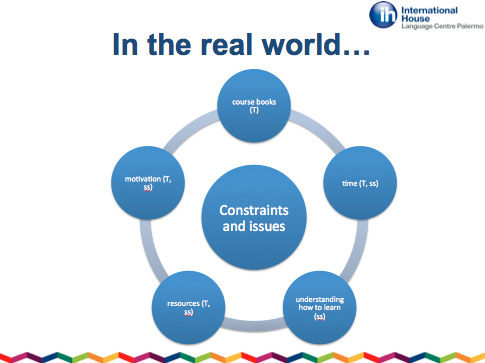
Problems problems!

Problems problems!

I asked the audience to pair up and brainstorm their top 7 tips. This became their ‘bingo card’, to compare with my own 7.

My top 7 tips

1.
Tip 1

Tip 1

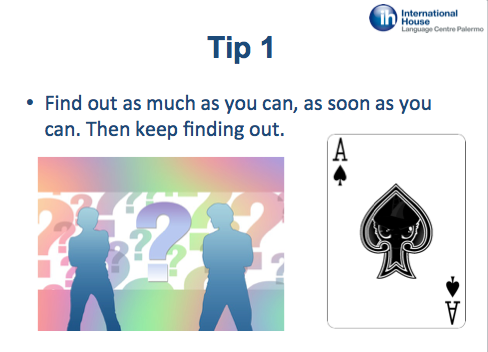
What I mean by this is, find out as much as you can, as soon as you can, about what your students do and don’t do already. Encourage them to find out as much as they can about what their peers are doing. This is your starting point. How: For example, at the beginning of the course, you could use a Find Someone Who activity (they find out about each other, you listen in and find out about them), followed by writing you a letter (you find out some more). They aren’t empty vessels.

Here is an example FSW I made and used with some of my classes.

2.
Tip 2

Tip 2

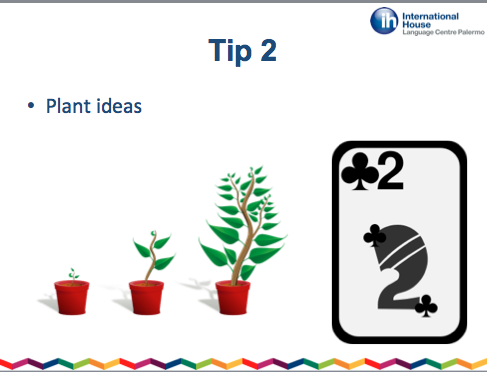
In a nutshell, provide ideas. E.g. my experimentation with English handout. With higher levels, encourage them to add and share ideas of their own. There is no such thing as an exhaustive list. (For more information about this, look at my previous related posts! )

3.
Tip 3

Tip 3

Nothing happens overnight…

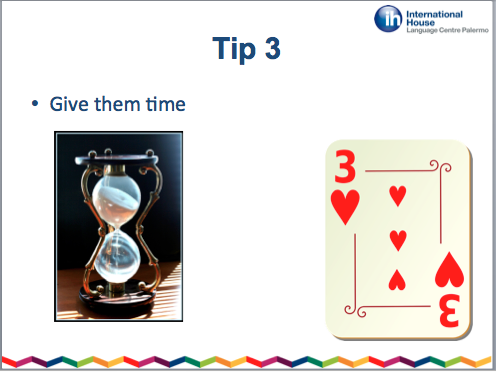
In fact, the question of time works on many levels. Firstly, give them time to talk about their outside class activities in class. Doesn’t have to be heaps of time. Little and often is good. This provides opportunities to bolster each others’ motivation, spark interest in untried ideas, share victories or issues, celebrate, troubleshoot and so on. It also motivates them to keep going. Secondly, in terms of take up: Don’t worry if they aren’t all enamoured with the project from the get-go. Give them time to get used to it, and to start to recognise the benefits. Encourage discussion of the benefits.

4.
Tip 4

Tip 4

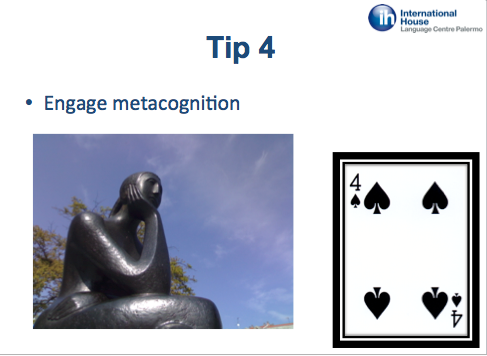
This links to my previous tip, in terms of discussion of benefits. Helping students develop meta-awareness of the learning process is important, as understanding the why behind activities will help them be better able to select suitable activities themselves, independently. This makes them less teacher-reliant in the long run. This contrasts with just blindly doing what teacher tells them. For ideas of how to engage student metacognition, I suggest reading/using:
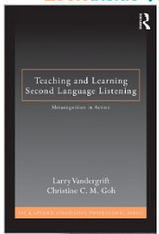
Vandergrift and Goh (2012)
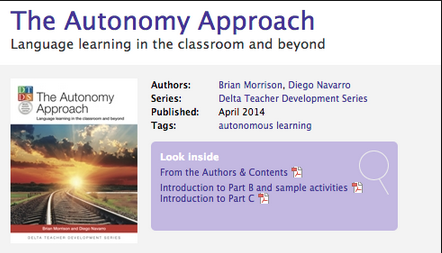
Vandergrift and Goh (2012)

Note the free samples also!

Note the free samples also!


5.

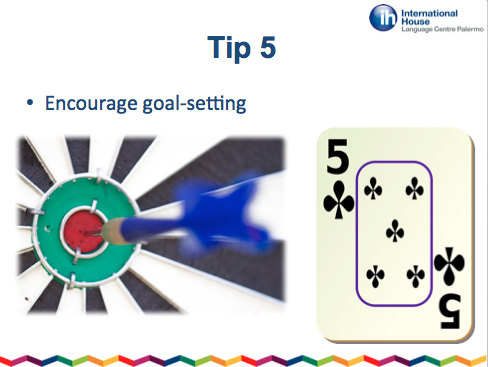
Tip 5

Tip 5

Having realistic goals to aim towards helps to break down the mammoth task of learning a language into achievable steps in the right direction. This helps students not to lose motivation and to be more aware of their own progress.

6.
Tip 6

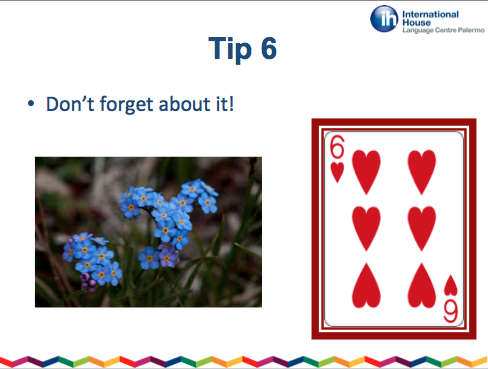
Tip 6 – Forget-me-not!

It’s important not to set everything up and then forget about it. Keep being interested in what the learners are doing. Give them that bit of time regularly, as mentioned before. If you forget about it, chances are they will too. Let them show off! Keep bringing it back into the classroom.

7.
Tip 7

Tip 7

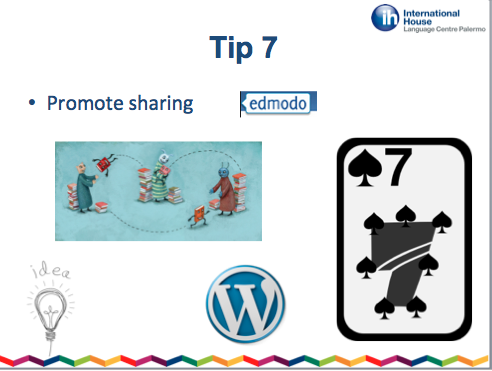
Use some kind of platform that allows them to share and communicate outside class e.g. Edmodo or a class blog or wiki. This immediately increases the scope and variety of what learners can do outside class. More activities become possible. (For ideas of how to use Edmodo or class blogs/wikis in this way, see the posts I have written in relation to this!)

Feedback

Having shared my 7 tips and so brought the game of Bingo to its end, I shared a bit of feedback from students:
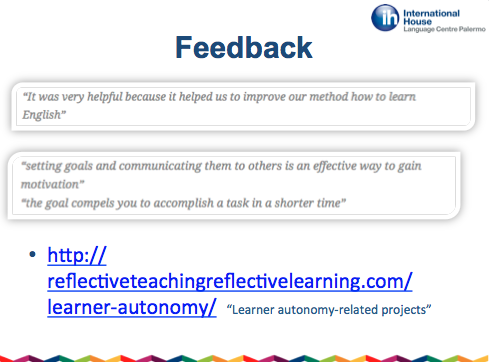
Screen Shot 2015-04-12 at 07.08.15

Feedback


Then I asked the audience to discuss how they might apply these tips to their own context:
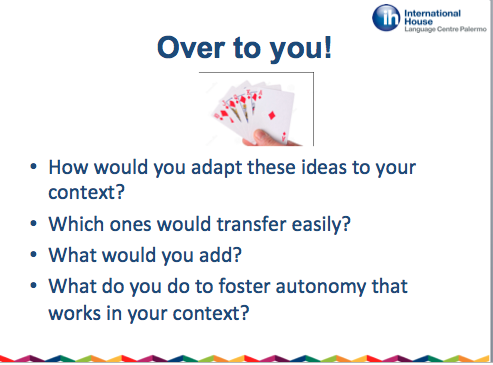
Screen Shot 2015-04-12 at 07.11.10

Discussion questions


And finally offered a list of references/recommended reading:
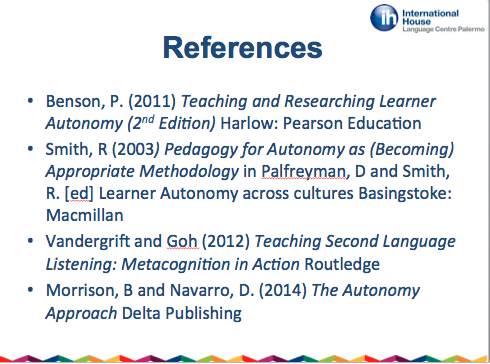
References

References

Thank you to all who attended my talk, it was a pleasure to speak at IATEFL for my second time and I look forward to the next time! 🙂



IATEFL 2015 – Academic Writing Forum

I’m only staying for the first half of this, as I want to head to the MaW SIG open forum, but hopefully the first half will be the best half! 😉 I think I actually wanted to be in the Forum on Different Perspectives on Feedback, but at 2 minutes before start time, I am actually too exhausted to try and start finding the appropriate room in this absolutely vast building. So EAP writing it is! 

15 minutes per talk then questions, so I should catch just under 2 talks.

Integrating simulations in a seminar based approach to EAP writing

Learning the context and conventions of writing in another language is a great challenge for students (Hyland, 2003)

The advantage of a content-based approach is providing a more focused background and vocabulary for students’ writing. However, non-native speakers may be reticent in seminar situations. A simulation enables students to participate in a real-life like situation by assuming real roles. It is a reality of function, as participants have to act according to a role. The environment is simulated, life-like but not real. It is structured.

4 stages to a simulation:

  1. Briefing (readings and discussion; at the end of the stage, instructions, handing out roles)
  2. Preparation/group work, depending on the type of simulation. Debates work well, so students are on one side or the other.
  3. The simulation stage is where the debate takes place, so students give persuasive speeches and discuss.
  4. There is finally a debriefing for some cooling off.

Advantages:

  • Learners are motivated and gain opportunities for meaningful practice.
  • Creativity is encouraged.
  • Realism and relevance are injected into the classroom.

How about in EAP writing? 

Readings and discussions can give students background/information about essay topics.

Sample simulation 1: Endangered languages

image6-1

  • Students are given the above situation. They receive roles for the hearing. Readings are assigned too. Journal articles and newspaper articles. Videos are watched.
  • Students spend a class period and time outside class preparing. Then in a subsequent class, the hearing takes place.
  • Several writing assignments can be integrated into this: summary responses to the readings, journal entries describing the simulation role, argumentative essay, different topics possible.

Why do students like this?

By the time they write about the topic, they are primed by all the background information. They gain an opportunity to be creative in developing their roles. Most students enjoy debating.

Some students felt shy in role, some felt the roles were too restrictive, some thought too much research was involved. Some students were too dominant.

Conclusions:

Simulations provide an effective framework for thinking about the topic of the essay and lots of background information. More in-depth reading and discussion is promoted. 4 skills are integrated.

Jennifer Macdonald: Beyond the 5 paragraph essay

This refers to the formulaic “McEssay”/IELTS essay – intro, three body paragraphs, conclusion; based on personal opinion/experience. Not based on external sources/research.

It shouldn’t be the sole genre of writing classes, as  it only really exists in writing courses. Corpus data suggests that other genres of writing are more common for undergrads and postgrads at university. So to prepare them for what awaits them, they need something else. They need to be able to refer to source texts, for example. Many students’ English training focuses on preparation for a standardised test e.g. IELTS so they think 5 paragraph essay is all there is.

How can we break this mould?

  • Teach concept of genre. Get students to think about it before and during writing.
  • Unpack the genre. What is the purpose, what is wanted?
  • Provide resources on genre that students can access independently
  • Assign (For reading and writing) a variety of texts (explanation, definition, methodology, recount, case study etc.)

Genres are like footwear, need to use the right one in the right context. Not the end of the world if you don’t but it’s “kind of weird” if you don’t e.g. snowboots on the beach. Inappropriate.

Most likely you teach mixed disciplines/backgrounds so you probably can’t teach a genre with full authenticity but in the assignments you give, aim for as many aspects as possible. You also need to find work-arounds for research as much isn’t practical.

Look at the British Council LearnEnglish Writing with a purpose website.

Explanation: descriptive account, written to demonstrate understanding of the object of study and the ability to describe and explain systematically how it functions.

-> Can be a paragraph (topic sentences, paragraph-level skills can be introduced)

What to describe? Anything! Draw on web etc.

(Within academia this would be part of another genre.)

Definition: structures used in this genre are of particular interest.

Methodology recount: description of procedures undertaken by a writer – methods, results, discussion.

At this point it was nearly time for me to leave and I also ran out of steam! Though corrected now, I kept making typos because my fingers (and brain?) were so, so tired!! Anyway, it’s ok because Jennifer’s slides are available here. And the upshot of it all was that there is life beyond the 5 paragraph essay and lots of it! I will definitely be having a look at her slides when my brain is functioning better… 

IATEFL 2015 – IELTS Swap-shop!

Time to attempt to reinvigorate my attitude towards IELTS! Hoping for some good ideas…

Noooo...! ;-)

Noooo…! 😉

Aims:

  • For us to go away with as many ideas as possible, having talked to as many people as possible! (Perfect!)
  • For our ideas to be published! (Sounds good!)

IELTS are trying to increase resources available. Not to be sold but to give them away and generate more ideas on the back of them. A process of this interaction, some editing, a webinar that we’ll be invited to, then (I missed the rest of the process but it all sounds positive!)

***

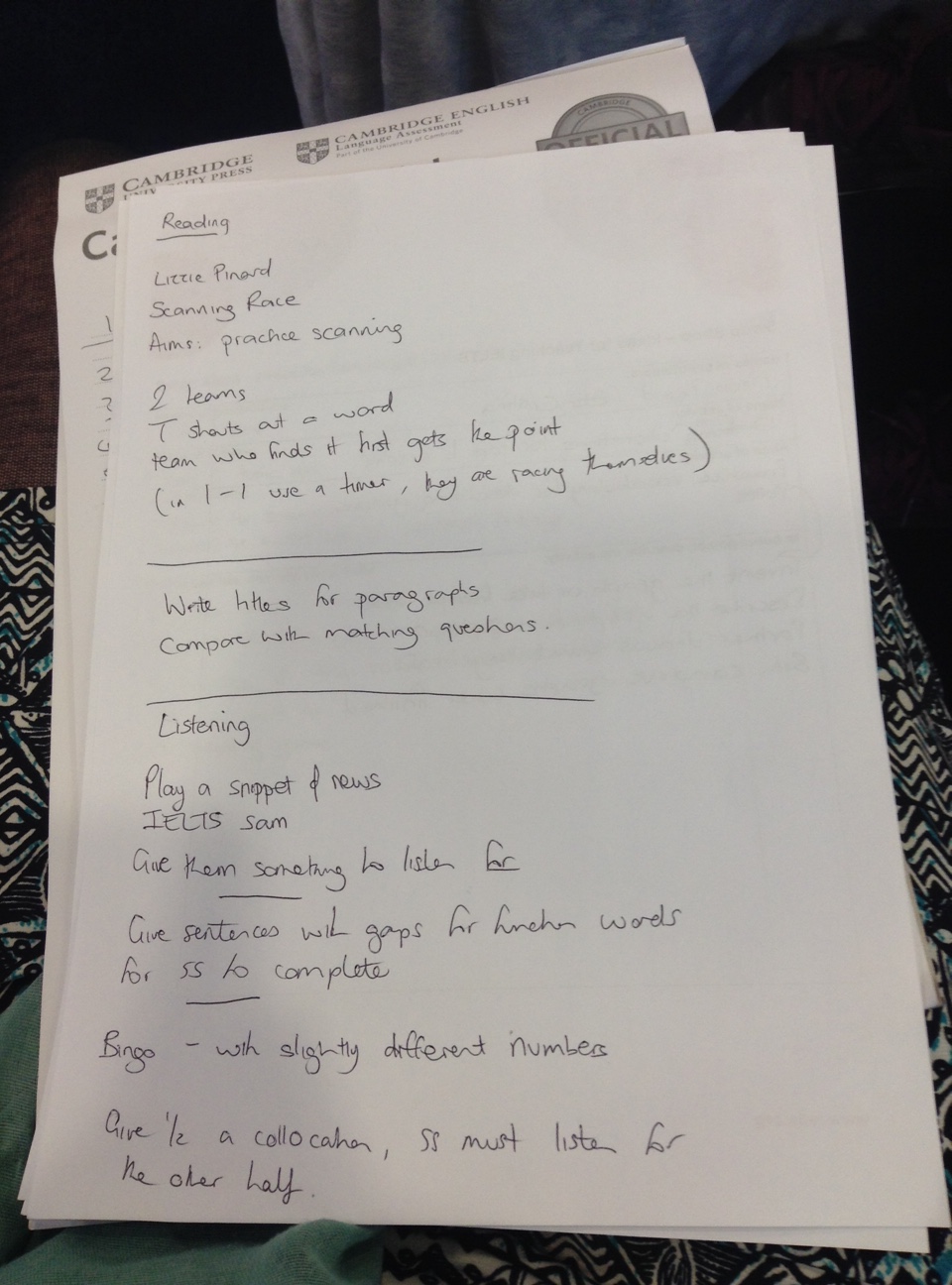
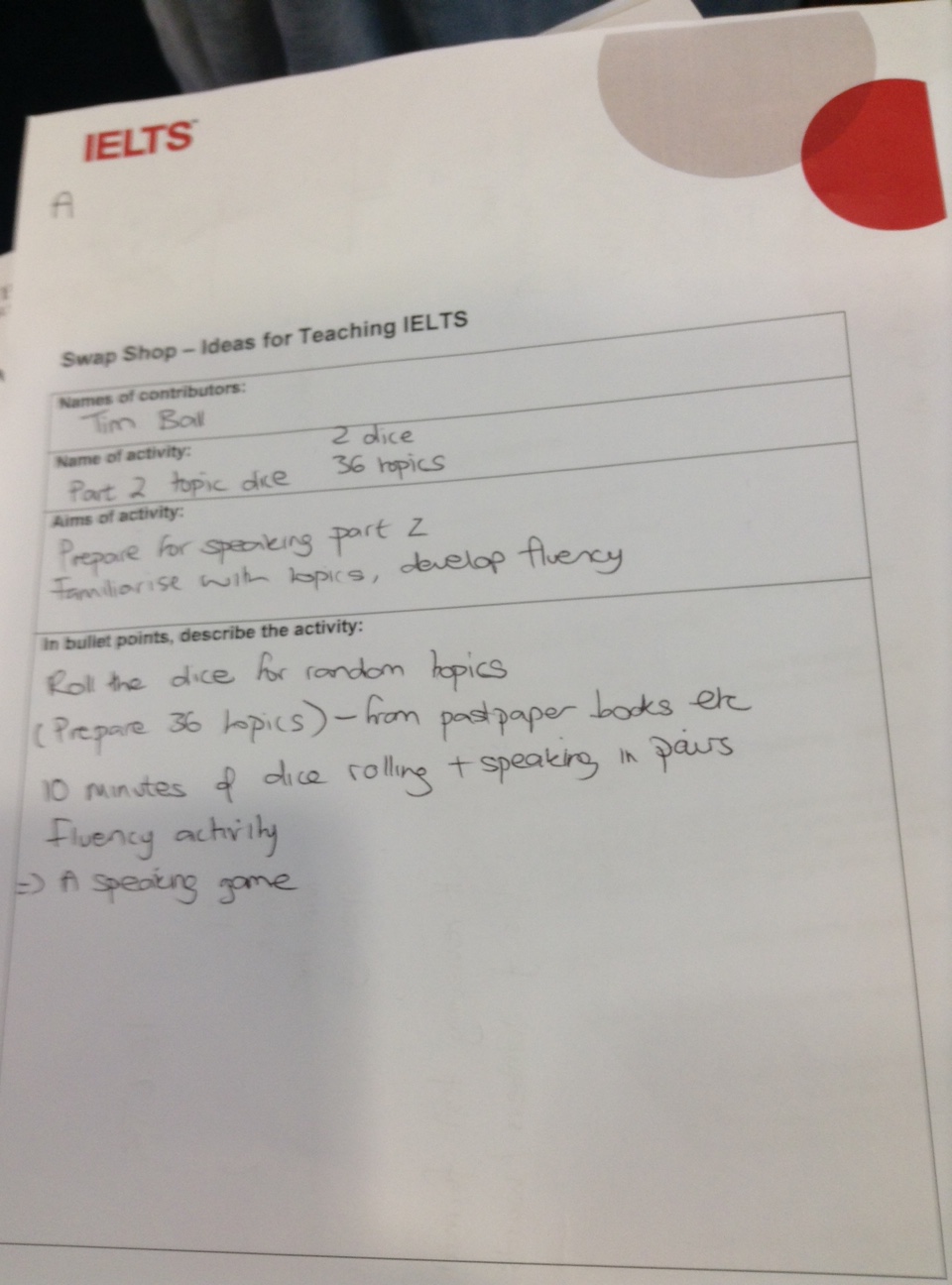
Well, it was an action-packed workshop, including group work and idea generation, as promised. No time for typing! Here are the pen notes I scribbled down:

Ideas

Ideas

More ideas...

More ideas…

They already make less sense than they did at the time…

Regards the top sheet, you can see we have to put our names on the papers, as we handed them all in at the end. The process of Mina liaising with us and editing a massive pile of papers into a coherent set ideas will take a while, but it should be good in the end. She reckoned September, which sadly doesn’t help me for the next 6 weeks, but hey! I have taken a few ideas away:

  • Mina (as in, she who ran the workshop) showed us how the traditional getting to know you “significant numbers” game could be applied to IELTS. So, first she did it the traditional way, we had to draw her, then write the numbers she dictated around the picture, and finally guess what they were via yes-no closed questions. This can also be used for getting to know the exam, using numbers relating to the exam, words, pictures, a mixture, fewer if initial getting to know you, more if review and so on.
  • Tim (one of the many Sheffield Uni ELTC folk that I have bumped into at IATEFL this year!) shared a great game for Speaking part 2 – you create a grid of 6 x 6 in which each square contains a Part 2 topic (mined from past papers). Students roll dice in order to select a topic and have to speak about it for 1-2 minutes. I imagine points for keeping going could come into play. The aim is familiarise with the types of topics, get used to speaking about them and develop fluency. So there’s a nice warmer for me to use with my students on my return!
  • I overheard about a collocations activity, where you give students the first half of a collocation and they have to listen out for the other half in a listening recording. I wonder if you could also give them paraphrases of words in the recording and see if they can listen and identify the matches…
  • For writing part 2, Tim also suggested gathering a selection of IELTS past paper answers and getting students in groups to judge them using the criteria, give them a band score. Then do a game-show type judging where each group holds up their chosen band score at the same time. I suppose also ranking a selection of sample answers from best to worst would also be good. In all cases, of course, encouraging students to justify their scoring and ranking would be key. The goal of the activity is to familiarise students with requirements and give them more idea of where they fit in and where they want to be, as well as what the gap between those really is.
  • For reading, Cristina suggested getting students to write a statement summing up the main idea of each paragraph of a text. You could then go on to get them to compare these to the ones written by Mr IELTS in the heading matching question type. I was thinking getting them to do this mentally with a text might help them with this question type, as they would approach the list of statements with more idea of the kind of thing they are looking for. But of course as with most things in IELTS, there are many ways to slice it.
  • Another listening idea, from another Elizabeth, was to make gapped sentences from a listening recording, with the gaps being function words. To train students’ decoding skills.
  • And then another nice one was to play Bingo with listening part 1 style numbers. And within the bingo grid would be numbers that are ever so slightly different from one another. I suppose you could extend this to spellings as well, of names and addresses, as often arises.

Suffice to say, time ran out really quickly! For more ideas, you’ll have to wait till Mina produces whatever it is that our ideas are all going to turn into. I suppose a digital resource of some sort! On the plus side, I have now got my teaching mojo back *even* where IELTS is concerned! Gotta love IATEFL!! 

IATEFL 2015 21st Century Teacher Education: the knowledge and expertise we need to teach with digital technologies – David Coulson

Teacher education time!

David Coulson is from Brighton, the University of Sussex and Brighton. 20 years ago he did a BA in modern languages and recently finished an MA in media-assisted language teaching. (Hadn’t made the connection between this talk and having met him yesterday until he stood at the front! Shows how good I am with names…)

Teachers, if given confidence and left to work together, will be able to create. That is what we do. We are in an important time at the moment – a tipping point. David’s children use mobile phones and have a great aptitude for this, proficient but not in an educational way. But the devices have a great capacity for being used in an educational way. On the other hand, he lived on a farm with some horses, a goat, two dogs and two children, in Portugal, for 15 years. From that, he learnt to have a go at things, to try. This is what we have to do with technology. We have to not be afraid to have a go at using tools. Sometimes there is a culture of fear around using these tools. It’s a really crucial time for using tools at the moment. We have to have the knowledge to be able to react to any tool that comes out and be able to understand if we can use it or why we would want to use it, for education. The right reactions are essential.

Do you think EFL teacher education or education in general will be the same in 10 years time?

David feels this is particularly a time of change, more so than say 10 years ago.

We discussed and here are some audience ideas:

  • change of mindset in using technology
  • change of role in teacher education e.g. not “the technology input session” but integrated into the bigger picture (mine)

David tried to find out what the required knowledge and expertise required to be an effective teacher and where technology fits into this. He did interviews with experts in the field of education and and technology, and investigate the integration of technology into teacher education.

At the moment, technology is “normalised”, common in everyday interactions. According to the Economist, by 2020, 80% of the population will have a super computer in their pockets. Technology is offering new opportunities for us but also new problems and concerns. We need to learn when, where and how we are using it. We have an abundance of technology but all of our rules and what we do are built on scarcity. In a time of scarcity, you take whatever you can. In a time of abundance you have to be able to select.

David had a “ZX81” – you wait for half an hour to load up, but you get to 25 minutes and it wouldn’t work and you have to go back to the beginning again…!

A Wicked Problem

Trying to find out the knowledge and expertise that teachers have is a wicked problem, really difficult. David quotes Amy Tsui as saying it’s not just a matter of skill or competency alone but a combination of different things – knowledge bases, processes of pedagogical reasoning, skills of teaching and beliefs.

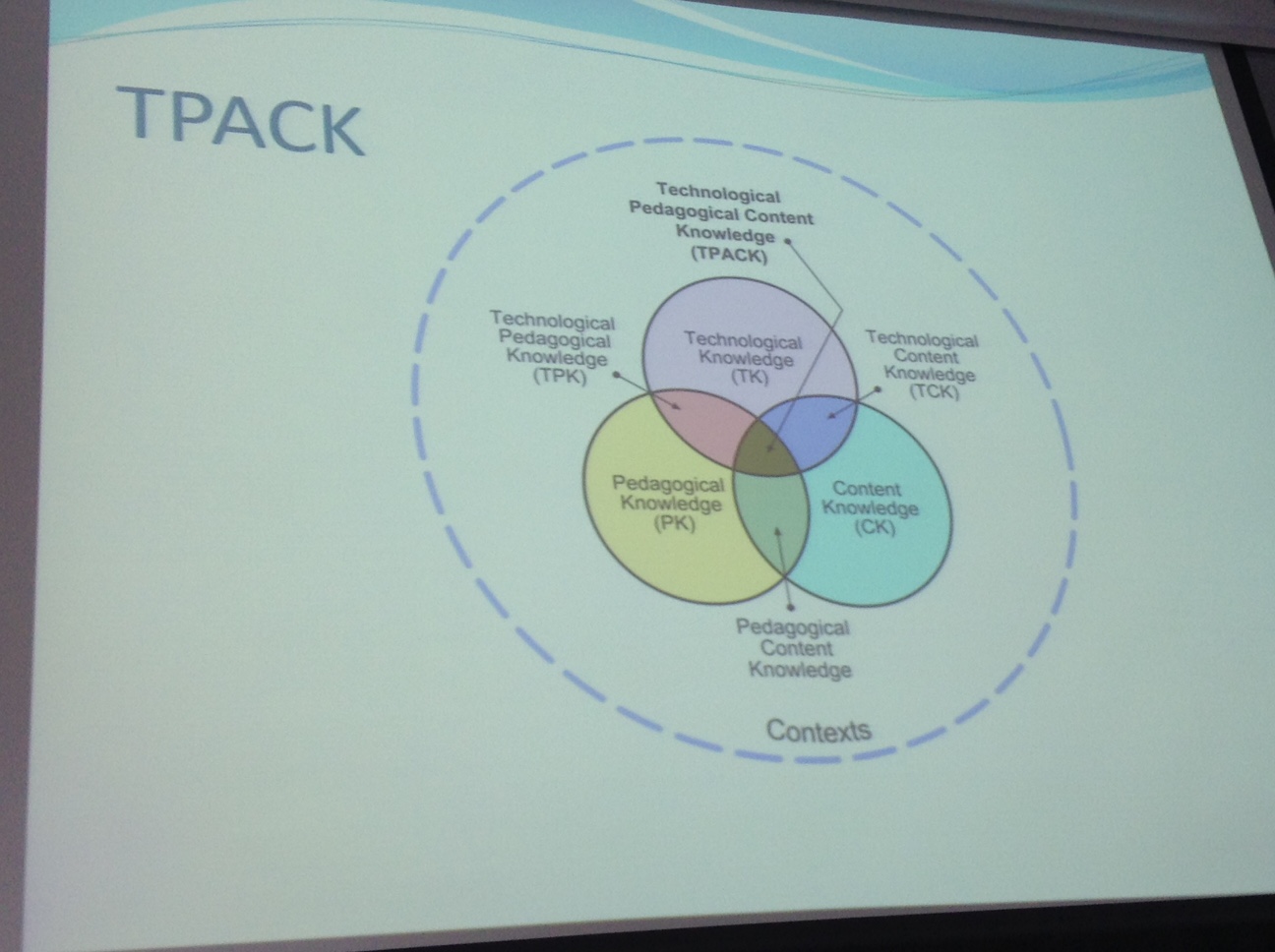
image1-2

There should be no pure Technical knowledge, pedagogical knowledge or content knowledge, standing on their own, they need to intersect, we need to be working in the middle area. And they all need to be situated, exist within a context.

Technical skills are not particularly important as new technologies are easier and easier to use. But selectivity – selecting which technologies to use – is very important. A trainee will copy what they see. Loop training is useful. Technology needs to be integrated into the class. They should be taught to use the best tool for the right purpose at any given moment, from the abundance of tools on offer.

The best sort of transformation happens under the radar. The main problem is a lack of confidence in the technology amongst trainers, which is transmitted to the trainees. It’s a fear of losing control, their relevance in the classroom, of being taken over by technology. However, a teacher’s ability to step back and allow students to have some control of the lesson may well be the way forward in the 21st century.

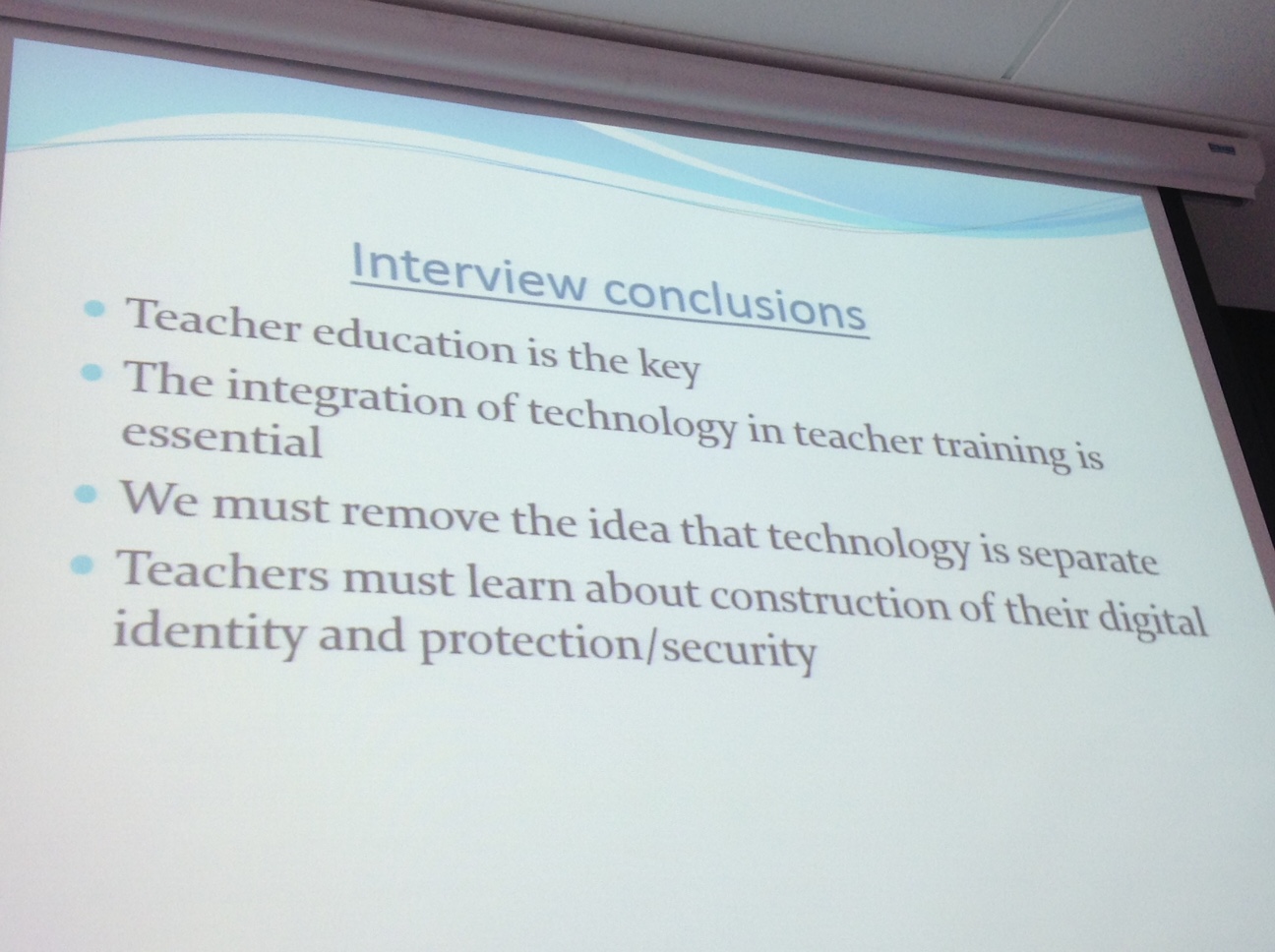
Interview conclusions:

image2-1

Teachers must look at the why underpinning the use of technology. The role of the teacher is not diminished but repositioned. It’s not a threat but an opportunity.

21st Century skills

  • creativity and innovation in use of technology
  • critical thinking and problem-solving
  • collaboration and teamwork
  • flexibility and lifelong learning

Same skills as ever, but within the context of technology. So that the role of the teacher and student are reimagined, with the teacher as a guide, and the student more active.

Solutions for teacher training

  • use communities of practice, where people work together with a common learning goal
  • expert-novice teacher mentoring e.g. expert teachers with novices who are technologically advanced
  • flipped classroom – trainees and teacher educators learn how to use a piece of technology in their own time outside the classroom and share their ideas and experience within the framework of the session

The idea of this talk was to make us think “Why am I using this? What am I using it for? What alternatives do I have?” – this is the way to face the abundance of technology and be selective.

Another really interesting talk. 🙂

IATEFL 2015: The Why and How of Self-Publishing – Johanna Stirling

And time for another talk on the topic of materials development!

Johanna is going to talk about the nuts and bolts of self-publishing. It’s really the why, what and how, but it just didn’t fit! We are looking specifically at print books.

We’re going to look at why you might want to self-publish to start with and Johanna starts by telling us about the experience of holding her published book for the first time!

Johanna's baby! ;-)

Johanna’s baby! 😉

She used print-on-demand, which means she did almost everything herself except for the cover (an ex-student graphic designer did that!).

Why did she self-publish?

  • She had complete autonomy – no compromises had to be made. She was able to avoid publisher requirements (e.g. for a series – she had 70 activities, they wanted it if she could produce 300!)
  • Also for a bigger share of the profit. 70-75% of royalties is what you can get.
  • The biggest thing was SATISFACTION!

Why did other people self-publish?

Nicky Hockly

  • traditional publisher wouldn’t take it because the audience would be too small
  • wanted the speed of getting the book out which isn’t possible with a publisher
  • she feels much more sense of ownership with this one than ones she has traditionally published.

Jamie Keddie

  • no need to fit into a series (which methodology books usually need to do)
  • no need to wait to be commissioned (which usually is the case)
  • can make reference to “taboo” topics (not possible with publishers!)

Rod Bolitho

  • a deal with a publisher fell through and they couldn’t find another
  • wanted editorial control
  • wanted to retain the integrity of the book

But it’s not for everybody…not for you if…

  • you don’t know what to do. (If you just want to get into writing, better to start with a publisher…)
  • if you need deadlines (or you need to be incredibly disciplined!)
  • think you want to write another Grammar in Use book. (you need a niche!)
  • want to write a coursebook
  • haven’t been published before (previous experience with publishers is invaluable)
  • are technophobic (or you’re going to have real problems because you have to rely on technology for a lot of things and use a lot of different tools)
  • need money NOW from it!

If it is for you, then how?

You need The Big Idea. The ones that work best:

  • fill a niche: where there isn’t much else; focusing on a small area, really specific e.g. Nicky Hockly’s webinar book.
  • meet a need: something that teachers need.
  • are new or different in some way
  • are something that you know a lot about and are passionate about!

What about writing?

The most important thing is the content, everything else is peripheral. (Plug: From September, NILE will be doing a materials development course)

Something that Johanna found quite hard was finding her writer’s voice for this. How formal should it be? How academic should it be? Even down to things like to contract or not contract. She wanted to be consistent. It took a long time.

Organisation (of chapters, units, parts) also took a long time.

Saving and storing what you write is very important. But you can get confused about which version is which. So every day, Johanna saved her book as a new day, with the date in the title. After three days, old versions were deleted unless there was a particular reason to keep it. This made it easier to be able to find the latest version more quickly!

Johanna wrote in Word, no fancy packages. She sat down one weekend and went through all the menus and learnt what it did. E.g. it will do your indexing for you. (Link to Sandy’s friend’s Word tutorials)

For the cover design, if you are not a designer it is hard to get it right – worth paying for. As is a proof reader. When it came to the layout, Johanna looked at other books and looked for a layout that she liked. She liked the Dummies (yellow and black) book layout, so she copied that but for e.g. logos in the margins, Word couldn’t do. For layout, she recommends  The Non-Designer’s Design Book by Robin Williams.

In terms of editing, her one real regret is not using an editor. She could have saved a lot of money by spending it. She took three years rewriting it, but if she had someone look at it and make suggestions, she could have taken on other work at that time, paid work! Information on prices can be found on a website called Joanna Penn, The Creative Penn e.g. novel £7.50/1000 words. For Johanna’s book that would be £500. (Plug: Karen White, White Ink Limited, get  in touch in order to find out about costs, which are often by the hour for this kind of project)

Regards printing and production, there are 3 main companies that print on demand: Lulu.com, createspace by Amazon and IngramSpark (a relatively new kid on the block). With Lulu, Johanna wrote her book in word, converted it to a PDF and then uploaded it to Lulu.com and the cover as well, as a pdf. As simple as that. As it is print on demand, you can order one book and they will print one book. You pay what one book costs. You don’t have to buy a fixed number of books, just the number you want. You can get your one copy to be photographed with it. Then you find all the mistakes, you can correct it, re-upload it and there you are! You can keep doing it till you are happy. It’s the writing that is difficult…

If you want to sell it in bookshops or on Amazon, you need an ISBN. You can either buy your own or get a free one. There are various advantages and disadvantages to both – look into it when you get this far! For pricing, look at similar books and set your price somewhere in the middle of them. Distribution can be online, or bricks and mortar (even if they just order it in on demand)

The work does not stop here. Marketing is important. E.g. blogging (Johanna has the Spelling Blog), social media – the more connections you have the better, word of mouth, flyers (sent out to people – electronic and paper – to libraries), award nominations (e.g. ELTons), talks e.g. at conferences (Johanna has done talks on spelling), articles for teachers associations newsletters or journals. The more work you do on this, the more you sell and vice versa…

Good luck! says Johanna. 🙂  It’s not just an alternative to traditional publishers. There are many other reasons to do it!

Johanna’s blog (handout available) here.

IATEFL 2015 Making up Grammar Rules or What a teacher can do to motivate students during a grammar lesson

This talk is part of the Young Learners and Teenagers SIG day… So here I am in the interests of variety: I’ve hit technology, EAP, materials writing, pronunciation, teacher drawing skills, and now it’s time for some YL! And later on, a splash of IELTS and some teacher training may be on the cards! (I say “may” – we all know how fluid and last minute these decisions are…! ) Nothing like a bit of variety to reinvigorate the teacher soul! 🙂

This talk was inspired by a talk given by Ken Wilson last year, apparently. Entitled Motivating the unmotivated. Ken focused on 10 points out of which today we will focus on 5. But first, we need to think about why, for this topic.

Why teach grammar?

  • He doesn’t want his students to sound like Borat.
  • He wants students to produce good, reliable, accurate language.
  • He wants his students to be consistent.
  • Students ask for it. (He recommended students a grammar book as an option, and ALL of them bought it)
  • For the general public, a self-respecting language school cannot not teach grammar.

How?

  • Let students use their imagination; find out what they know and what they are good at. Ask them about school subjects. What is their favourite subject? In Georgios’s case, most of his students liked maths, history, literature, biology, and foreign language was way at the bottom. Ask about their interests. Many areas will be identified.
  • Make them curious. Since the enjoy maths so much, Georgios wanted to show them that there was logic in grammar. He shows us a greek word which has 3 words in the English equivalent. You were running: Who, when, what, continuously. Greek students often make the mistake “you running” – if they produce that he can point out that we need to know when.
  • Challenge them. Elicit. You only get your allowance from your parents if you work for it, then you develop more respect for it. Mental effort in learning language makes it more memorable. Elicitation develops problem-solving abilities and stimulates critical thinking, and all of these lead to greater learner autonomy and self-reliance. Encourages students to personalise grammar rules.
  • Anticipate errors and USE them!

image4-2

  • Examples must generate the target structure, be relevant and appropriate.
  • Devolve responsibility: make a student an “expert” in something e.g. the past simple ‘did’ auxiliary; the expressions that go with the past simple e.g. “last night”. This creates a memory palace – each students has his or her area of expertise. Students remembered who said what. But students MUST participate voluntarily. It’s a game, they don’t want to be left out; it seems like an easy, fun thing to do; their sense of Philotimo kicks in (it’s the right thing to do). Gives a confidence boost, a way to engage weaker students, it’s stress free environment as a game, it encourages an environment of support.
  • Use Double Jeopardy: you can’t kill your husband twice = no double negative, no I didn’t went etc.
  • VIP rule: What’s most important goes first. Active voice – the subject, passive voice – the object etc.
  • Mr Grumpy: Mr Wilson is always yelling at Denis when he plays near his house. Associate pictures with structures.

Possible problems: Not for beginners or very young students; can be time-consuming; can lead to an unhealthy obsession with accuracy at the expense of communicative competence.

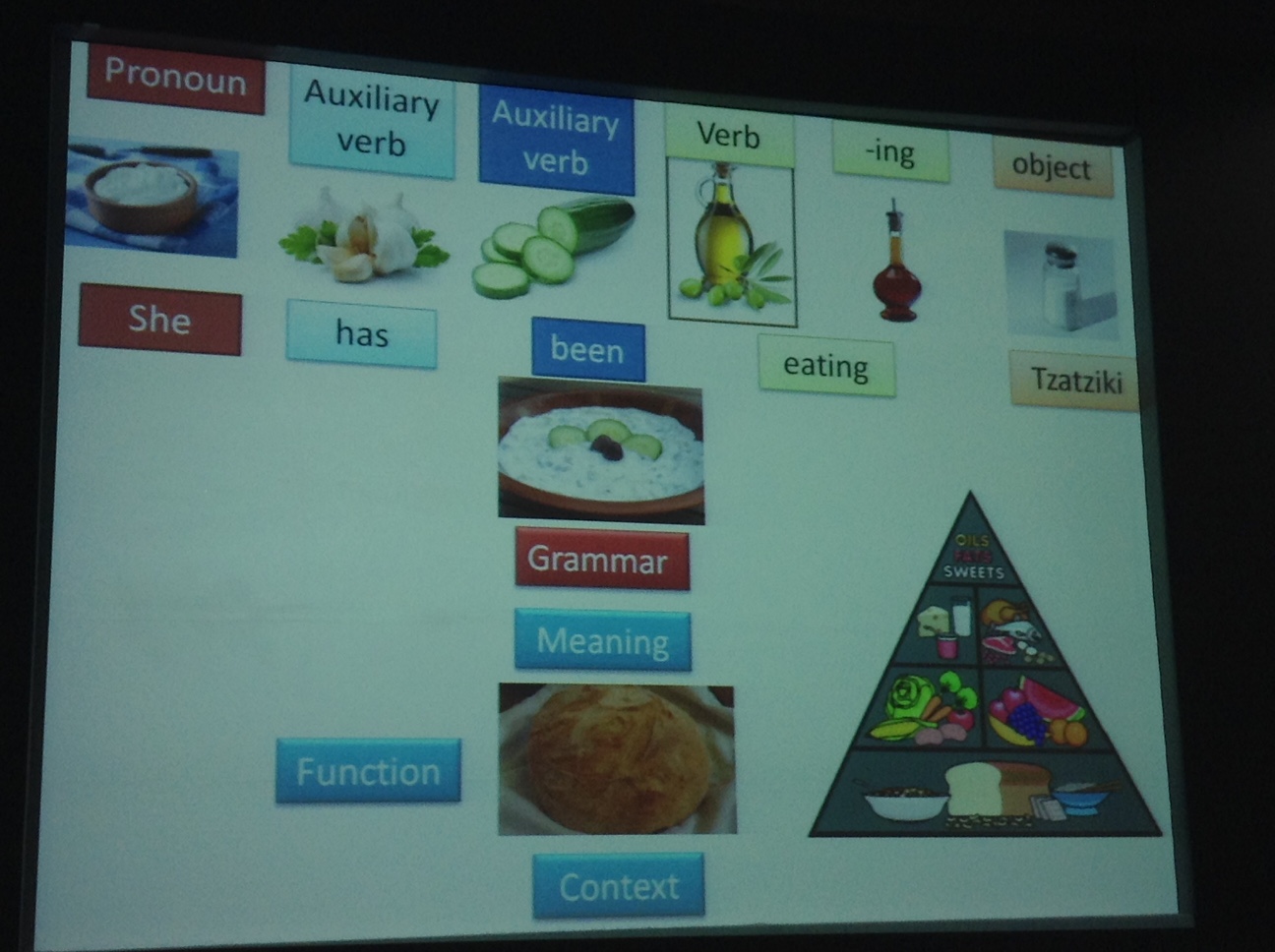
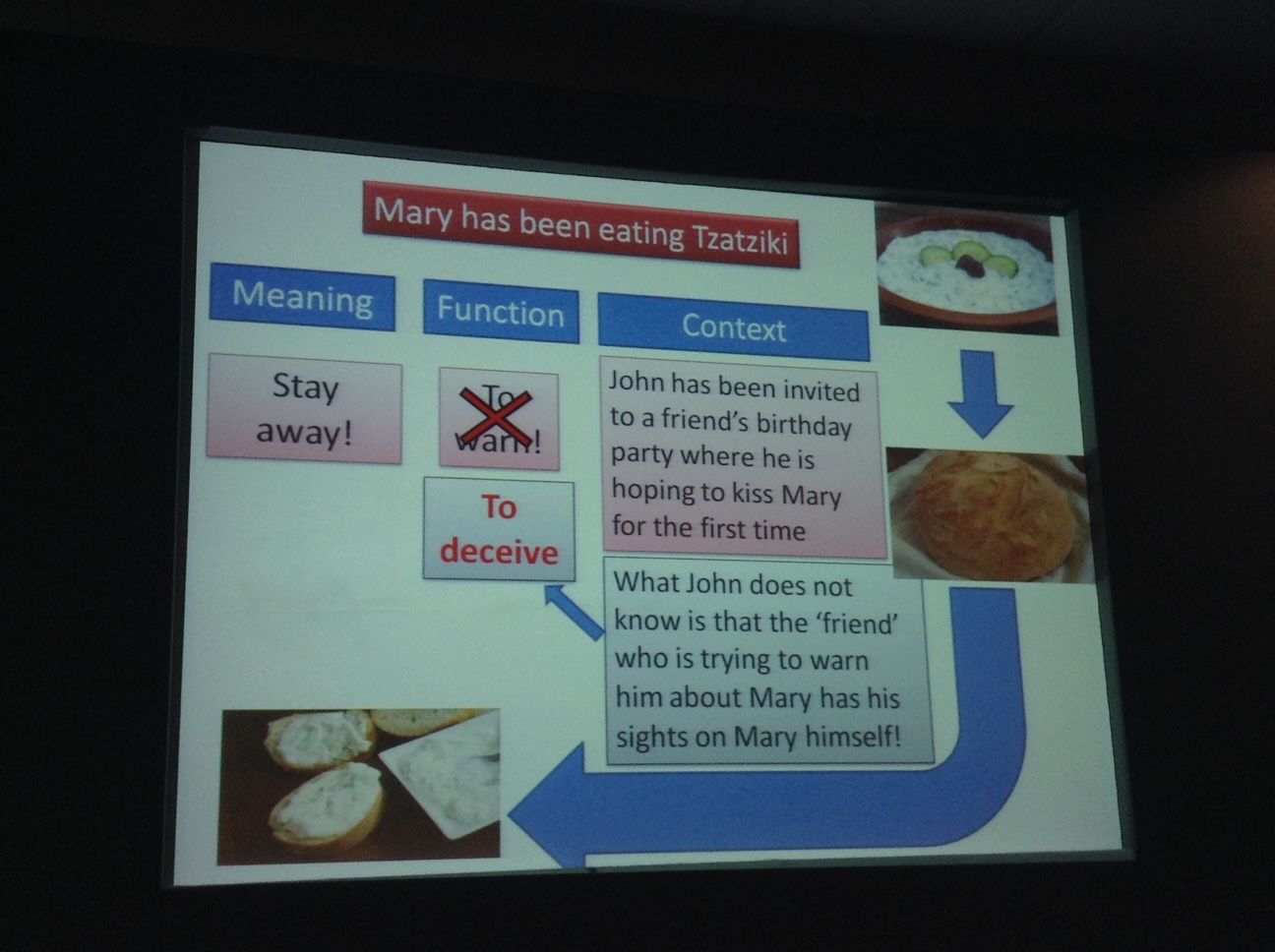
And don’t forget, you need meaning with grammar, like Tzatziki needs bread…

image3-2

image2-2


IATEFL 2015: Academic Reading Circles – Tyson Seburn

Time for another EAP-related talk…

This is something that heretofore has existed only on Tyson’s blog, but a book is coming out on the Round – watch this space…

The main roles of Academic Reading Circles:

image1-2

This project was developed and implemented at the University of Toronto by Tyson on a reading and writing course. The goal wasn’t to improve the reading speed but rather the deeper level comprehension, so that they are able to talk about it intellectually and use it in their writing. His students are undergraduates, and there are 16 per class, predominantly Chinese with a few Russian and Ecuadorians. Tyson has them for 24 weeks over the academic year.

Problems that Tyson noticed with his students:

They need to engage deeply with course texts in order to demonstrate understanding in their written work. The problem was, they were not. They were only doing superficial reading, which became evident when they were asked questions about the text or asked to discuss it, they stayed at a lexical level. Applied understanding was rare. They needed to synthesise content from a variety of texts, which requires deep understanding.

Tyson decided to try the idea of literature circles, which has been adapted to ELT. However, traditional style didn’t work. Literature circles are more about fun and don’t have a connection with writing, while academic context requires something more serious and robust. So not new, but adapted for a new context.

Start with a common text, usually teacher chosen, these materials are going to be used for writing. Students are given different roles (as pic above and detailed descriptions below) and work specifically within that role on the text outside of class. In class they work in a group and co-construct knowledge/understanding of the text.

1. Leader:

situate text and gauge group. Finding out things like the purpose for reading (not the teacher said so!), the text source, the target audience, bibliographical information (also see the first couple of steps of the 12 steps approach discussed by Barbara yesterday). Create basic comprehension questions to use in their group to check their understanding. To do this, they need to identify the statements that represent key points. So, for our example:

Which statements represent key points:

1. Cyclists once influenced Jarvis Street’s lanes.

etc – 5 ish statements, some of which do and some of which don’t represent key points.

2. Contextualiser:

Pick out the people, places, events, pieces of research in texts and identify them as research opportunities. They go to the internet and find out more about these contextual references. To be able to tell the group why the research may have referenced these. E.g. “as a cultural corridor with an emphasis on its historical significance” (useful)  or “city cyclists declared victory (not so useful). They could look up “the mayor” and “Ford”.

3. Visualiser

Find things in the text that could be graphically represented e.g. as videos, images, timelines, infographics etc. E.g. in this text, a google map showing where Jarvis street is situated, as we don’t know Toronto; a photo of Jarvis street showing the bike lanes; political/satirical cartoons with relevance. By bringing this in, a new element for understanding the text is added.

4. Connector

Causes transferability (of skills)  between courses. When you force them to make connections in a text, it builds up this ability. Make connections to other studies, other events, other experiences. A couple of questions that might come up as the connector for this text:

  • “Have there been other asinine government decisions?”
  • “Does this situation remind you of anything from your other classes?”
  • “Does the configuration of Jarvis street remind you of a street you know?” (This can help to visualise/understand the argument

Give prompts e.g. make a connection to another event; make a connection to other classes; make a connection to somewhere you know

5. Highlighter

Focuses on lexical items to facilitate meaning. But not only unknown vocabulary (NB not only words but phrases). There are 3 types: 1. unknown, yes, of course e.g. corridor; short-lived; had their day. How frequent is this vocabulary?  2. topical vocabulary – used within a particular discipline. E.g. in this case related to transportation. When we force them to notice this topical vocabulary, the process – exploring it etc. – makes them better able to use it in their own writing. 3. tonal language – that shows author feelings and attitudes towards what they are talking about. e.g. “quite costly”   “just 18 months later” (not a significant amount of time) “included mere painted borders” (mere – shows it is not sufficient)

Specs

  • One common text (it is a required text)
  • There is indivudal work that you give to the students, they need to go away and do that work in order to do the subsequent group work in class. Follow up/talk about what is happening in the text as a whole class.
  • Rotate roles, so students are taking a different role each week. So 5 weeks to get through all the roles. The first time they do the roles, they are not that good at them.
  • Leads to deeper comprehension and better use of texts in writing.

Another reference to De Chazal…really need to read that book… 😉 Really interesting talk, great to meet Tyson finally, and I also bumped into a Sheffield Uni colleague from last year, who is keen on these reading circles so will be picking her brains over the summer for a context (very) specific perspective and useful hints/tips. This kind of thing is what I love about IATEFL and ELT! 


IATEFL 2015 Plenary Day 2 – Joy Egbert

IATEFL Day 2 Plenary session time!

Screen Shot 2015-04-12 at 09.54.29

Before coming to IATEFL, Joy tried to learning British as a Foreign Language (BAFL – baffle!) with Doctor Who:

  • No social interaction,
  • No fb or support,
  • Challenge too great,
  • Loss of interest,
  • Lack of engagement/learning

Leads on to topic:

Engagement and practice in classroom learning, language and technology

Why are we talking about it? In high school, she took 4 years of Spanish, in university she took two years of Spanish, but never really learnt how to speak. There has to be something better? A better way to learn? 4 years of Russian at university. Used PLATO – a system that gives no feedback and you have to sit in front of it till you give the right answer. Has been around the world and seen a lot of people trying to use technology to learn language. Her children have very different teachers – her son gets to sing songs and play games, her daughter has to learn lists of words including a car part that I can’t spell (carburator?).

But a teacher’s goal is to provide an environment where students will succeed and learn effectively. One of the ways to think about how to engage our students is to think about how languages are learnt. What opportunities do your students have for using language? We know that activities need to be engaging – the more engaged students are, the better their language achievement will be (in their terms – their goals). Students become disengaged when they do things that don’t make sense to them, that aren’t relevant to them. What we want is students participating, focusing, leaning in etc.

Engagement deals with the relationship between the learner and the task. The teacher can set it up, but then the learner has to carry it out. If the task is engaging, the learner wants to carry it out.

Engagement can occur with opportunities that:

  • include authentic tasks (as perceived by students)
  • integrates connections with students’ lives
  • provide social interaction or deep individual focus
  • offer practice and feedback of an appropriate kind
  • offer connections to authentic audiences and materials.

And technology use can help teachers meet these engagement principles. However, there are issues with it. So, perhaps people don’t use technology, or pedagogy doesn’t change to use the affordances offered by technology, or people use it atheoretically i.e. use is unprincipled.

Today we will discuss a principled and effective use of technology.

The first step is getting to know your students. <Joy had us complete a questionnaire about our students at this point> These are the kinds of things we need to know about our students, but in general knowing about our student is important.

Thinking about authenticity: what can I do that can help my students be involved in this task? You can use different materials for different students, which help them achieve the same goal in different ways.

Connections:

Three things to frame a lesson:

  • “Yesterday we… and today we’ll…”
  • “You’ve said you like to learn by…..so we’re going to try that today”
  • “This makes a difference in your life/connects to your life outside of class in this way..”

Social interaction/deep focus:

How to make group-work successful?

  • Need to encourage cooperation/collaboration
  • Structure roles: put students in charge of different things (typist, artist, etc.)
  • Let students answer their own/others’ questions
  • Students need a reason to listen

Think about what students are going to do with the information they are listening to. Take notes BECAUSE…. <e.g. they are going to do a project>.

Feedback and support:

We need to think of ways that students can use the feedback/support in other activities. For example, in MS word, you can use text comments or voice comments – depends which your students prefer.

Challenge/skills balance:

You need the students to be in the flow channel, where there isn’t anxiety of it being too difficult or boredom of it being too easy. Students can learn something and teach other people, choose their own materials, create tasks, get feedback from peers. So you allow students to learn and to teach. E.g. expert groups and jigsaws.

Important:

  • We need to work from students’ strengths but also help them work on their weaknesses. All students will rarely be engaged all at the same time, all the time; BUT all students can be engaged most of the time.
  • There are many technologies that can work across contexts e.g. storyjumper, googledocs, MS Word, Open Office, TikaTok
  • There is a wide variety of uses for these technologies. E.g. Popplet – a brainstorming software – could be used for word walls, timelines…
  • Can’t use all the new technologies all the time, but simple things can be so effective e.g. email.
  • We need to think about what we are getting out technology use. We need to evaluate it. What does it work for? With whom? What kinds of technologies, integrated how, into what kind of syllabi, at what level of learning, for what kind of learners? etc
  • If it helps you to meet your goals better, use it; if it doesn’t, don’t use it!

It’s about devising engaging tasks that are going to lead to language learning. Use or not of technology depends on how it fits in with this.

If you want to know more, you can contact Joy on jegbert@wsu.edu

….common sense? 😉

IATEFL 2015: Structured Reading Tasks for Using Authentic Materials to Teach Academic Skills – Dr Barbara Howarth

Another academic session! 

Barbara Howarth is from Glasgow International College in Scotland. The approach she is talking about originates from Edward de Chazal. She works in a pathway college – students there are aiming to get into university, they aren’t there yet. This could be pre-masters programmes, science and engineering students. They teach a range of academic skills.

In the “research project” module (a min. of 5.5 IELTS score in reading  and IELTS 5.5), students get 20 weeks and they are aiming towards writing a research project based on secondary research. 10-15 students per group. Materials are provided. Within these are a number of authentic texts. The overall approach is a task-based approach and reading is integrated into this. The form of assessment is an 8000 word written report and a poster presentation. The students choose their own topic.

(So this is similar to what the Uni Sheffield students I teach have to do, except my students get about 8 teaching weeks to produce a 2000 word written project based on secondary research. They also give an oral presentation on the same project.)

A 12-step approach 

<For a list of all the steps see handout page 1>

The rationale is to grade the tasks and present them in a logical order, so that students are taken naturally through the reading process. Work with these tasks repeatedly so that a level of automaticity is developed.

Step 1:  Bibliographical details identification

It’s very important that students have bibliographical details for any text they are working with. So getting them to highlight the relevant information is a straight-forward task to start with. However, issues can emerge, such as lack of issue number on the front page, but if you look in a database, you can find the issue number. To deal with this, use follow up homework tasks to get the students into the library and databases to find such information.

Steps 2 and 3 (see the handout)

Step 4: Labelling abstracts.

Starting to think about information and what type of information is in this text. One element is the abstract/summary, another element is the analysis. This might involve the results but for these to make sense, you need to understand the aims. They need to be interpreted, so you need to draw conclusions i.e. evaluate the findings. So the task at this stage is for students to label an abstract. Show them a model first. Things that aren’t straightforward for students: The aim sits within the method. Sometimes its difficult for the students to label up the aims.

Up to this stage, we have mainly been previewing the text – bibliographical details, what kind of information is in there, how it is structured. Basic things but things that are necessary in order for the students to approach meaning.

Step 5 (see handout)

Step 6 Meaning

The aim of the task is to write a summary. The abstract is a summary, yes, but what is the point of the whole paper? The main point will correspond to the aims of the paper. The main points are determined by these. In the example paper, there are two aims – to analyse the carbon sequestration and to simulate the potential carbon sinks. Important for students to identify these and break them down. Getting them to copy bits of information encourages them away from the laptop. In this case, the aims. Anything they copy should be denoted by quotation marks and include a citation. So this gives them the main information with other distractions removed. The example summary is a two-sentence summary reflecting the two main aims. Insisting on reduction of number of words encourages paraphrasing.

Step 7 and 8 (See handout)

Step 9 Language

Language is a means of expressing meaning. So the language that you choose to look at arises from the steps that have preceded. E.g. in this case, the language of analysis, relating to the informational elements in question. This task is a categorisation task – identifying topic-related vocabulary (e.g. carbon sequestration, forestation) and vocabulary related to analysis (e.g. rate, applied to, empirical growth curves) Then divide the vocabulary up into word type. Follow up work could involve the Oxford Dictionary of Academic English. All the words identified are present. Underlined words are head words. Red words are on the AWL (Coxhead 2000)

Step 10: Critical thinking and evaluation

After dealing with meaning and language, students are in a position to start engaging with slightly more higher order cognitive tasks. E.g. discussion questions. Students need to learn that they need to justify their opinions. Another task is to look at conclusions and relate them to the results, and realise that they contain an element of evaluative judgement.

What Barbara has seen

Students go from the state of being buried in their laptops and make a transition into being really thoughtful readers. That change may be brought about by giving the students a structured step by step that they can use, working from simple to more complex tasks necessary in academia. The magic moment for Barbara is when she hands out a reading text and students automatically start to apply the process – e.g. highlighting the bibliographical information.

There will be a link to the handout here (once I have photographed and uploaded it!)

An interesting session! And a reminder that I STILL need to get round to reading de Chazal’s book that has been sitting on my kindle since last year… 

reading glasses pixabay

Let’s read! Image taken from Pixabay.