Upper Intermediate Italian Lesson 5

Despite my busy week (I am now officially a Mental Health First Aider!), I am managing to squeeze publishing this post in as my last task for the week! That means I will now be up to date with this series of posts again!

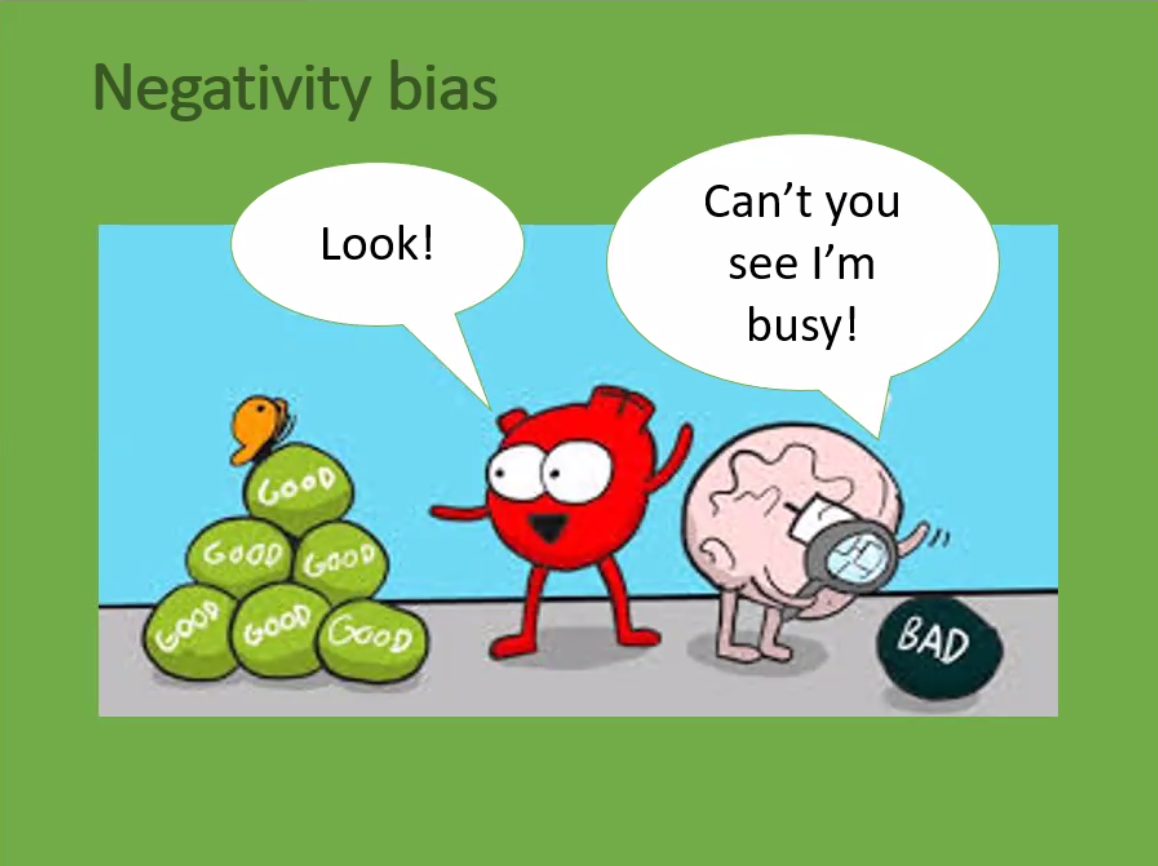
I am first as usual! :-p So punctual, me. And I am here with all my positive attitude. I realised I have mostly focused on challenges/difficulties/negative things (not exclusively though!) so tonight I am going to focus on positive things! Try to challenge the old negativity bias.

….And I am alone…! Phew another student arrived. Until she did, I was chatting with the teaching in Italian, which was nice. ..Aand another. Now we are three and the teacher. And we are talking about the newsletter thingy from last week. Also, I did my homework so I am all prepared for it, whoop. My girlfriend gave me an idea for what to write about!

Qualche settimana fa, c’era c’è stato un incidente di macchina stradale a Woodseats, su una piccola strada nella periferia di Sheffield. Erano Coinvolte erano tre macchine, due delle quale che andavano troppo veloce e una che era parcheggiata accanto al marchepiede marciapiede. Una delle due macchine che andavano troppo veloce era rimasta sottosopra si è ribaltata. Quella che era parcheggiata sosteneva ha subito anche dei danni. Gli autisti non erano feriti ma poi hanno litigato nel bel mezzo della strada. La polizia dovevano ha dovuto chiudere la strada. Uno degli autisti lavora per una pizzeria e sfortunatamente i clienti quella sera non ricevevano non hanno ricevuto le pizze.

  • Novità?
  • Che mi racconti di bello?

These are ways to ask someone for their news, which is apparently what we are doing here!

I had to share my homework in the chat and like the one at the end of last lesson, we are going through correcting it, with the teacher displaying it on screen. (And I corrected my version above as we did it!)

Hurrah I passed! It satisfied requirements. Phew. It was nice to get all the corrections. I have discovered I need to review when to use imperfect vs perfect tenses. I can find where in the coursebook that is covered and use it to review 🙂 (When I get time, not this week which is crazy busy!)

Now we are talking about news again.

Notizie su – news about

La pagina culturale – culture

Societa – lifestyle

La salute e il benessere – health and wellbeing

We have to do another one for next week, but something like an article that belongs in the above section…I think… Still needing these 5 ‘w’’s but I think maybe it is flexible… I will again invent something anyway. All good. (Haha uploading this blog post has reminded me I still need to do this before Monday evening, haiyaaa!)

And now onto grammar review of the unreal if clauses.

Se Boris Johnson avesse preso delle decisioni adeguati, non avremmo passato un’anno così caotico.

P.86. We have to listen and tick but I don’t have a pencil to do so, so doing it this way instead:

  1. C
  2. G
  3. M
  4. C
  5. G
  6. M
  7. C
  8. G
  9. G
  10. M
  11. M

This kind of activity is harder than a T/F kind because the statements can’t follow the order of the text so you have to have attention in multiple places. We listened to the first part/person. Then stopped and read the statements we are to tick aloud. Then listen with pauses and teacher repetition. Then went through the answers for the first person. Then we listened to the next one twice through and then went through answers. Then the third one once. I managed reasonably well! This time the teacher had the audio ripped into their computer and was able to play it for us and it worked ok. When I’ve done listening with my students, I’ve had them go away and listen to a link and then come back. I suppose with a small group as we are tonight, there is a lower likelihood of audio and connectivity problems as fewer students to have them. Also we in this class are all UK-based while my students are all over the place with varying quality of connections!

BREAK TIME

Only 2 of us came back after break. Lost the other. <shrug>

p87 A speaking activity based on the listening. We had to use those unreal conditionals to talk about one of the speaker’s life.

Se Monica non avesse smesso di giocare a calcio, non avrebbe studiato all’università. Se non fosse andato all’università, non sarebbe diventata un insegnante e non avrebbe tempo per fare la fotografa.

Next exercise is doing something similar but with our own experiences!

  • Se non avessi fatto preso il diploma CELTA, non sarei diventata insegnante di Inglese come lingua straniere.
  • Se non avessi preso il diploma DELTA, non sarei andata a Palermo.
  • Se non fossi andata a Palermo per insegnare, non avrei imparato l’Italiano.
  • Se non avessi provato un sito di incontri, non avrei trovato la mia compagna.

Ooo the one other student who came back after break taught English in Poland for a while! (I learned this via her sentences for the above activity!) We only did 2 of the sentences so no coming out for me after all. :-p

Next, listening to a song. We have to write down the phrases we understand and write down any vocab we don’t know. We should also try to understand the general meaning of the song.

  • Io e te by Battisti
  • Qualcuno ha scelto forse per noi
  • Poi ho incontrato te
  • L’esistenza è diventata
  • La stagione nuova
  • Fra le tue braccia calde
  • Io e te
  • Stesso io desiderio

I have been told to listen for general meaning this time round.

Con lei non ha paura di morire…?

 It’s quite long and whiny hahaha. Lurrrve song. But I could understand a fair bit til the background music got too loud compared to the voice. I also had to unplug my big monitor to adjust the volume as it was too loud then after teacher’s voice was too soft so more unplugging and replugging. Tech! But I managed. The third time round we listen with the lyrics. Then we look at the lyrics and discuss the meaning. Then we did a memory based gap fill lockstep. Then teacher tried to make us memorise each line.

And, with some more discussion of it, that brings us to the end! Now half way through the course!! And thinking after the end if I can do another online class (if they are still available, not all back to f2f) with another language centre, e.g. IH, it would be interesting to compare!

Reflections

  • I quite enjoyed the lesson. Partly because it jumped about less than previously (we stayed in the same general vicinity of the coursebook once we moved onto it; the existence of homework linked us back to the previous lesson for some review as well as going through the homework; we did some grammar review; the listening was connected to the language point. Only the song was random but hey why not!).  Partly because every week I am a little more used to how it goes and what to expect and therefore it is less stressful.  It’s taken me to half way through the course for this to happen. Wonder if it would be quicker in a subsequent course. Something to do with getting used to being a learner again in a formal setting i.e. the (virtual) classroom. It’s also about getting used to having to find the energy on an evening after work – I am less exhausted by half way through the lesson now, though I do appreciate the break half way through – enough time to get a cup of tea and have an eye break.
  • I get excited every time I learn some little snippet about my classmates. I want to know more about who they are and what keeps them plugging away at these courses. As in their motivation for learning. Sandy commented on a previous post-lesson blog suggesting I try to give the teacher feedback directly about the lack of groupwork but I don’t feel comfortable to. The other students may be quite happy with the status quo (they are back for another course after all!), I don’t want to rock the boat being the only newcomer.
  • It’s interesting that there are two of us who are teachers. Not sure what the other three do. The other teacher is the one who uses English strategies a lot. The only other thing I know about her teaching is that it involved a school trip to Germany a couple of years ago as that featured in the anecdote she did for the first newsletter thingy. I wonder what teaching and learning experience and beliefs she has.
  • I’m starting to consider other courses after this one = I am enjoying being a learner again despite all my trials and tribulations with it! In one sense it’s a pity it didn’t occur to me sooner to try (the pandemic has made online learning opportunities proliferate where they didn’t before) but on the other hand I had enough on my plate coping with adjusting to new work conditions, building my new relationship, negotiating health issues and moving house!
  • So far I have been first to arrive and first back after the break every lesson and the only one to have attended all five lessons from beginning to end. I hadn’t anticipated this being unusual given it isn’t free! I used to admire my students in Palermo for coming to their evening classes regularly twice a week in the 1930-2050 slot – they had to actually come to the school not just log onto a computer on time. I can just about cope with once a week on a computer in my house! No travel time or effort needed.
  • It’s been interesting seeing how the teacher does feedback on oral and written production. How to do feedback effectively is something I think about a lot! Of course what works with a class of 3-4 students isn’t necessarily compatible with a class of 18-20 students! However, using the share screen function to use a word doc with a text and making corrections to it live is certainly something I could try. Though, share screen uses a lot of internet and could create problems for my students with dodgy connections I think. We are advised to avoid it where possible. But I suppose a Google doc that students have the link to could be used in the same way. I will keep it in mind…

Overall, half way through the course, I’m really glad I signed up for it. It’s been so interesting to go through the process of being new to the class, getting used to how it works, working through the barriers created by my expectations and frustrations. I feel really positive about it. Let’s see how the next five weeks go! It’s nice to be blogging regularly again too. I think once this course (and any sucessors I might join) comes to an end, I will try to set aside time each week to self-teach myself again. Continue with Italian? Try Polish again? Try Mandarin again? And blog about it, of course! We shall see. I just love language learning!

Upper Intermediate Italian Lesson 4

<I am running a week behind as last week was especially busy due to the need to prepare for this week where I am only in work two days because of the remaining three one (today) is my not at work day and two are allocated to a Mental Health First Aid Course – starts tomorrow, eek! So there will be two posts this week and then I will be up to date again!>

I am first to arrive again. Insufferable. :-p Then one other student arrived so we could do some talking. But through the teacher, not directly, of course! Bit by bit, students arrive. I feel more relaxed tonight, so I think my reflections after the last lesson have helped me! 🙂 My webcam isn’t working tonight, not sure why. Tech, always tech.

= Some of the vocab that came out of the chat – the question was ‘what are you missing during lockdown?’ – Also vedere gli amici/la famiglia più facilmente

Then we moved on to…

Se aveste 1000 sterline a spendere in modo frivolo, come li spendereste?

Tonight I am experimenting. Using the everyone chat to communicate directly with students. The everyone chat though. Trying to get some kind of rapport with them! I tried with the student who arrived late, in response to the teacher-directed conversation.

Se avessi 1000 sterline, andrei in Sicilia, poi darei il resto in beneficenza.

We are up to our full 5 students including me again. Me and two others with no webcam, the teacher and two others with webcam.

We are going back to the topic of last week. p80. Grammar presentation. The one we opened with 3 mins to spare last week. We are reading it aloud. Haiya… And teacher is explaining, in Italian and then in English.  I guess we are doing ye olde PPP! At least being done in Italian first, I can get some listening practice from it!

Ohhhh, I was thinking it feels like way too much explanation, but then remembered I have the advantage of knowing these structures, on a metaknowledge level, in English, because of being a teacher. 

  1. Se Luigi avessi preso la medicina, forse adesso sarebbe guarito.
  2. Se il vestito avesse costato meno, forse l’avrei comprato.
  3. Forse sarei riuscità ad andare al lavoro ieri se non ci fosse stato uno sciopero degli autobus.
  4. Se fossimo stati meno stanchi,  saremmo partiti per il fine settimana.
  5. Se fossimo usciti più presto, forse saremmo arrivati in tempo all’appuntamento con il nostro amico.
  6. Se l’agenzia di viaggi

We did the above as read aloud and answer directly, no time to do it ourselves first. I wasn’t asked to answer before I had done them all first. Mini-success for me, making it work for myself. I think the teacher feels the need to be talking to us all the time, not letting us do activities by ourselves or in pairs in between.  Ah ooops, turns out there are more questions so we went through them in order, 1-4, up til me and then suddenly jumped two ahead so I hadn’t done it in advance. (I might have got that far if I’d realised the activity went overleaf so could have continued doing it for myself in advance, oops.) Still, I can complete the exercise in my own time for practise. No problem. Good revision.

Reading, a text. Waaaait. We might be doing a jigsaw of sorts, We have been allocated paragraphs. We must read and make a summary. Omg, I think my feedback landed. Amazing.  I got to read my paragraph and the rest of the text and write my one sentence summary. So nice to have actual time to read silently. And the text was on the page after the grammar exercises and actually relates to them. Hurrah.

L’autore parla dei rimpianti che possiamo avere se ci chiediamo cosa avrebbe potuto succedere se avessimo fatto scelti diverse di quelli che abbiamo fatto.

*cosa sarebbe potuto succedere

*scelte diverse

*da quelle

We each did our summary of our little paragraph and then…

BREAK!

Now we are jumping back 30odd pages, p54

Whyyyyy. Oh well. Here we are.

Studentesse rubano profumi per regalarli ai loro fidanzati = a title. Then there are some words in a bubble.  Ci sono vari elementi.

Era poco prima di San Valentino. Tre studentesse  sono andate in supermercato. “Pensavamo di comprare qualcosa per dare ai nostri fidanzati ma poi abbiamo visto quanto costavano e non potevamo permettercele” hanno spiegato più tardi quando erano arrivati i Carabinieri di Monteverde dopo la sicurezza li aveva visti che rubavano alcune confezioni di profumi invece di pagarli.

Quite happy with my effort!

Then the teacher started on about chi (who), dove (where), cosa (what), quando (when), perché (why) and that these 5 things are in every newspaper article.

NB still not a clue how, or if, this links to the first half of the lesson!

La cronaca – local news. In it: Moda, sport, pettegolezzo, cibo, viaggi, tecnologia. Tanti argomenti che si referiscano alla propria vita.

I chose food. Teacher suggested I write something about healthy food. For a weekly class newspaper.  But I am confused because a food column isn’t really a wwwww thing. So I wrote in the chat in Italian to ask, then audio and teacher replied in English, doh. Said I could change theme then.  I literally have no idea what to write about. Teacher is keen to put it in an Apple pages template we were shown. 

Ok we are supposed to do it now. I think I now gather that this is not going to  be a weekly thing as in doing it every week, just a way of describing the output for tonight.

Interesting: I am using the chatbox more tonight because my webcam isn’t working. But in general anyway I like writing and putting it in the chatbox ok (except tonight when I really don’t know what to write!), but another student in the class is quite resistant to it and prefers speaking. Ooo according to her anecdote she is a teacher. See if we had ever had an opportunity to converse, I might know that already, I’d like to ask her about it.  I did put a question, in Italian of course, in the chatbox, asking what she teaches, but she is busy trying to deal with the task, which is fair enough. Bad timing! My chatbox experiments are falling flat on the communication with other students front.

Still don’t know what to write. I don’t have a picture in my head of what the finished product is quite supposed to be like. I totally understood the first activity with the prompts. But I am confused as to the content of this one. It’s supposed to be about me? But nothing happens to me, especially now. And it doesn’t fit the genre of newspaper. Am I supposed to make it sound like a newspaper article but it’s something banal? One student told an anecdote from two years ago about a pickpocket. How does an anecdote from two years ago fit with newspapers or food writing? Having discarded that theme, what theme should I do and how to connect that? One wrote a few sentences about what gossip is and illustrates which was a different genre again. I…(shrug). But teacher is more fixated on this Apple pages template thingy and in goes the anecdote, which the teacher is now going through and correcting with the student who wrote it.  Am hoping that we will run out of time to get to me. But two students left at break time so there is less cushioning time-wise in that sense.

WE HAVE HOMEWORK! The above. Ok, I will write something. Maybe I will just invent something. I tried to explain my problem. The mismatch between an anecdote and a newspaper and not understanding what it is I am supposed to write, I said I’d like to see an example of what I am aiming for, but it fell on deaf ears. The teacher got quite defensive. Even though I tried to explain I want to do it I just don’t understand what to produce.  

Interesting night!

Homework

  1. Se Luigi avessi preso la medicina, forse adesso sarebbe guarito.
  2. Se il vestito avesse costato meno, forse l’avrei comprato.
  3. Forse sarei riuscità ad andare al lavoro ieri se non ci fosse stato uno sciopero degli autobus.
  4. Se fossimo stati meno stanchi,  saremmo partiti per il fine settimana.
  5. Se fossimo usciti più presto, forse saremmo arrivati in tempo all’appuntamento con il nostro amico.
  6. Se l’agenzia di viaggi fosse stata sempre aperta, sarebbero potuto comprare il biglietto.
  7. Se fossero arrivati in tempo, non avranno perso il treno.
  8. Se non avessi mangiato troppo, non avresti avuto un indigestione.
  9. Se non avessi passato troppo tempo al computer ieri sera, non avrei avuto mal di testa.
  10. Se fossimo rientrati più presto, avremmo potuto vedere un bel documentario in tv.

Qualche settimana fa, c’era un incidente di macchina a Woodseats, su una piccola strada nella periferia di Sheffield. Coinvolte erano tre macchine, due che andavano troppo veloce e una che era parcheggiata accanto al marchepiede, e una delle due che andavano troppo veloce era rimasta sottosopra. Quella che era parcheggiata sosteneva anche dei danni. Gli autisti non erano feriti ma poi hanno litigato nel bel mezzo della strada. La polizia dovevano chiudere la strada. Uno degli autisi lavora per una pizzeria e sfortunatamente i clienti quella sera non ricevevano le pizze.

Reflections

  • It is weird when the first half of the lesson before break and the second half after the break have absolutely no discernible connection. Would have been nice to do some speaking or writing that were connected to the text we read, which itself connected to the grammar we had done. Or at least either at the end of the first half or start of the second half some kind of transitional element between the two.  I seem to spend a lot of time wondering where we are going and how where we are relates to where we have been. So though I began the lesson feeling more relaxed, it was a bit stressful at times. But not as stressful as it would have been if I hadn’t been more relaxed to start with! So I still feel that I am making progress in (coping with) being a learner again! 🙂
  • We are now 4 lessons in to the course, nearly 50%, and there hasn’t been any opportunity for speaking directly to classmates even though we are upper intermediate and capable of conversing even if we make a bunch of mistakes. Nearly half way through the course and I barely know who they are.
  • It is really hard when, with the best will in the world, you don’t understand the task you have to do. Especially if that is then taken as being obstructive. Relatedly, models are worth a thousand instructions. If I could have seen a model, I would have been able to figure out the task requirement. Not understanding made me feel frustrated and sad. I wasn’t being deliberately obtuse. Would have been handy to be able to ask classmates quietly, as one could in a regular classroom!
  • It was exciting to have homework even though I didn’t understand it very well. I also made my own homework by finishing the activity we started in class. And it was also good to have time to read silently before doing things with the text. Hopefully this won’t be a one-off!
  • My couple of attempts to use the everyone chat box to communicate directly with other learners kinda failed. But at least I experimented! It might be because who I addressed is the same one who doesn’t like writing because it is too time-consuming.
  • Having background grammar knowledge is useful. More difficult if L1 doesn’t have equivalents or you don’t have explicit meta-knowledge of the L1 equivalents.

Upper Intermediate Italian Lesson 3

I am here with a minute to spare. Phew. Ooooo Ghost Student (the silent “X’s Ipad) from the last two lessons now has a face (and a new internet connection – apparently that was the issue), yay!

Omg we’re back to the fridges! But just a short review, this time, phew.

Oooo there’s a new student, but connecting connecting…

p75 Se le strade del mio quartiere potessero parlare (parlassero), chiederanno chiederebbero dove sono tutti gli abitanti.

I had to complete above phrase, from course book but then we have switched to chatting, with the new student (she managed to connect in the end! – new to me but not new to the courses). New student is really good at having a go and not worrying about making mistakes, seeking missing language etc, though speaking in English a lot around the Italian. Is interesting, the use of various strategies but so much in English.

Ooo back to my sentence. Oh except now being asked again which one I want to do. I had thought I was being asked for my sentence because we went through the which do you want to do ok now do it before. Oh well. Everyone has now got a sentence to complete.

My feedback may have been listened to – we were told the purpose of this activity: to review the grammar structure. At the same time, we are talking about a listening activity but some of us don’t have the cd (others) or haven’t got it on the computer (me). The chopping and changing is a bit confusing.

Back to the sentences, teacher has now changed the stem a bit, hence the bit in brackets. Oooo there are now four of us students. I wonder if pair-work will be a thing tonight?

My turn for the sentence: p75 Se le strade del mio quartiere potessero parlare (parlassero), chiederanno chiederebbero dove sono tutti gli abitanti.

I made a mistake with the conjugation – I am tired! I guess we all are.

Now p65 – for the listening activity (jumping around in the course book big time!)

No time to read the questions, then a leetle bit of time cos tech issues. But not enough!

1.a 2 falso (vero – in parte, stupid question) 3 falso 4. vero 5. vero 6 un litigio…/ una tempesta 7. falso 8. falso 9. alla rubrica delle lettere 10. vero 11. falso

We listened once in entirety then went through bit by bit. The audio quality was poor.  The teacher repeated the audio slowly and then elicited answers from us (also making us read aloud the question first, of course!). No pair checking stages or anything.  

It’s also difficult when teacher connection struggles and words get lost. Or is it my connection creating this… connections, ay. Perennial problem.

…break time? Hopefully soon, is the time. I need it! Ahhh after we have finished this feedback. Yayyy.

BREAK

Everyone came back after break – there’s a first time for everything!

The teacher did a screen share, my screen then went funny format-wise (went tiny, couldn’t see them etc), I was on mute but didn’t realise, all a bit of a mess but eventually sorted it.  Gotta love tech. We are looking at images which apparently have something to do with some reading we will do. Hopefully not aloud. No idea where in the course book or the overall topic…! Trying to see poor quality pics and understand what is happening is hard, turns out…

p.84 (!) Oh we’re reading aloud. Joy. Guess my feedback fell on deaf ears. Teacher started to tell us to read it ourselves but then stopped and reverted to read aloud. I made everyone wait very briefly so I could read my bits quietly first, so I could chunk it all properly – that worked better. Then I read the whole text properly while teacher did the ‘underline the words you don’t know’ and my classmates took turns asking their words. Given the chance to read, I didn’t need to ask about any words. I had no understanding of the text until I could read it through quietly myself though. Only my bits in isolation, not the meaning of the whole.

We then had to put the pictures in order according to the story. Except we can’t see them all, so we have to have the memory of all them and which are and aren’t already used. And the teacher is scrolling up and down randomly which hurts my eyes. Haiya.

We are asked who wants to retell the story using the pictures (that are still being repeatedly scrolled…). I didn’t volunteer.  This could have been a good activity in pairs having sent us a pdf with the pics on it. Both the ordering and telling. The pairs/groups feedback also fell on deaf ears I guess. In the coursebook, this and another text were a paired information gap activity, but not for us. We just looked at the one text as described. I had to contribute anyway, to this retelling, and managed to without any trouble. (See, I did understand the text when given the chance to actually read it…)

5 minutes before the end of the lesson, the teacher started explaining the (different from the one we have already looked at which came later in the course book) congiuntivo structure in the text (there was one example). Haiya…

p.81 with 3 mins to go… we look at an activity  about this new grammar point and then the teacher does the first one for us and that brings the lesson to an end with a “we’ll continue this next time” – which I can try to use as a springboard for preparation!

What I learnt about being a student in this session:

  • Jumping around in the coursebook is confusing. This doesn’t mean I think it should be followed to the letter, but at least the general direction for new learning should be forwards through the units (within each of which, of course, you might add, add to, remove from, remove etc activities depending on the type of lesson and students). It’s been a while since I have taught using a coursebook though – in my current context, we have set materials for each lesson (powerpoints, student handouts where relevant). I edit them to suit my class but that is generally in terms of how I think best to reach the goals of the week across the 3 lessons I have with students. This term I am reteaching Term 1 to a new cohort so last term I made a lot more changes, this term it’s more tweaks based on the students being different and what did/didn’t work last time. I think, on reflection, having been an EAP teacher for a good number of years now, I am used to EAP-style teaching and learning, which is quite different from general language teaching and learning. So being a student in a general language classroom is another level of very different experience, than just being in student shoes full-stop is. This is helpful to realise though. From my point of view as a student, I realise I need to relax my expectations as to what I will get out of the course learning Italian-wise and accept that’s it’s just a once a week general language evening class and there won’t be the structure to things that I am used to in my context. I came into it wanting to get as much as I can out of it, maybe I need to be more realistic about what that is. E.g. the opportunity to speak was a big one but given pair and group work aren’t a thing, there’s more limit on how much – I need to work with that, figure out how to maximise what there is. But also, from my own students’ point of view that this is how they might feel as they adjust from their previous systems of learning to the college’s system of learning. So this is now another way I can empathise with my students.
  • Jumping around in the coursebook being a thing means it is impossible to prepare for lessons in advance unless information about the following lesson is given in advance. Of course I am referring to my plan to read ahead to make the reading aloud thing less of an issue for me. I didn’t actually get round to it in advance of this lesson (partly  I suppose because I was hoping my feedback would lead to there being time to read silently before reading aloud! As, I had an email saying the feedback had been anonymously passed on to the instructor and would be acted on…) but if I had, it would have been fruitless anyway.  I would have had to have read about 10 pages of coursebook, including well into the next unit. For the listening, another 10+ pages in the other direction. I think next lesson, if we have to read aloud without time to read silently first, I will raise my hand and ask for a couple of minutes! Try the direct approach to problem solving.
  • It takes time to read and understand listening questions. Because they are out of context, you need to read the question, process the language and deal with the decontextualised nature of it all. Particularly when questions are quite random! And if you don’t have time to do that before you start listening, you get woefully left behind, trying to read questions and listen to the recording at the same time. Ohhhh, we didn’t do any lead in to the listening topic.  I think a bit of a lead-in and some time to read the questions before listening would have helped a lot. A pair work stage after the first listening would have been good too, to share what we understood so far before listening again. I think because we are a small group, the teacher doesn’t think breakout rooms are necessary, maybe. But I think they could still be put to good use.
  • It’s frustrating to be asked to give feedback, to put effort into making it constructive (rather than just complain without explanation or suggestion or just say all is fine) and for it all to be ignored even though it would be easy to implement. I suppose the centre is collecting feedback rather than the tutor. (The original information about the course email said there will be questionnaires sent out regularly to get feedback to improve the courses etc so I guess I will be asked again. We shall see!) Where I work, feedback is also solicited at centre-level, but I do my own Google forms as well. I’m assuming there is no test for us to take at the end of the course, though I guess there might be and I just don’t know it yet! There shouldn’t therefore be tension in terms of what needs to be covered in a given time period (this supposition is also based on how long we spend on some activities and the repetition of the activity from the first lesson which didn’t go exactly to plan etc.). Honestly, I have no idea. I don’t know where we are headed or how we are planning to get there or how we will know when we have arrived. Actually I remember in the first class of the course, it didn’t feel like a first class because I was the only new student and it seemed like a continuation of something else rather than a beginning. I’m assuming we aren’t intending to get all through the course book given we only have 10 lessons and it is a substantial book. Half of it maybe? I remember that is how it was when I taught in Italy. Half a book per course. Clearer information around this would be useful, not least to inform expectations!
  • If you want students to look at pictures and do things like order them and use them to tell a story, make a one page pdf that they all fit on to and share that with the students to refer to during those activities. This would save eye strain from the repeated scrolling up and down thing and free up brain space that would no longer be taken up by trying to remember which pictures have been used and which still remain and what are they again. Handouts can still be a thing in the virtual classroom?
  • I think the teacher can over-rely on students’ L1 to explain things. I don’t speak enough Mandarin or Arabic for that to be an issue for me with my students (majority of them are from those linguistic backgrounds) but when I was in Italy and had learned some Italian, I didn’t keep speaking to the students in Italian. It would be the odd incidental word where translation would be easier than explanation, not instructions and explanations of instructions etc. I think encouragement to speak the target language combined with patience when understanding or communicating falters would be better. I wonder if that student using all the communication strategies in English would be able to use those strategies in Italian if that – classroom language/language for clarification/circumlocution etc in the target language – had been encouraged to develop (by Upper Intermediate, there is no reason why that shouldn’t be possible) rather than reliance on L1 still being a thing.
  • It’s hard to feel comfortable with classmates who you don’t have the opportunity to speak directly with. There was very little in the way of getting to know you in Lesson 1 and no incidental chat can happen if you are never in pairs or groups with any of them. It’s a bit of a shame really, in that if I am not getting to know my classmates or working directly with them, I might as well be in a 1-1 lesson or teaching myself. Until now, they are mostly just people who happen to be in the virtual classroom with me. I don’t know their motivation for doing the class, I don’t know what they do outside the class, I don’t know how they feel about the activities we are doing and so on and so on. I think virtual classrooms are tricky. Unless you use breakout rooms, it’s like the teacher is standing on top of you the whole time and the focus is on the teacher so there is no room for target language phatic communication. In a real classroom you can be less conspicuous but if you are all in the main room, whatever the size of the group, it is as though in a real classroom the teacher is sitting at the table with you or standing right by it (and in this case leading the discussion/task/whatever it is at the time). As teachers, we learn how to use body language and position in the classroom to achieve various things; I guess we have to relearn how to do that in a virtual environment effectively too.
  • Being a student really is a great way to challenge and explore one’s beliefs about teaching and learning!

Cambridge Assessment English – Resilience: Teaching in tough times webinar

Here is the link to this webinar. It was delivered by Pablo Toledo and Alberto Costa. The link has links to related handouts too. I recommend checking those out! I was alerted to the existence of this webinar by the ELTC TD team (of which I am no longer part as I stepped down at the end of last academic year!), thanks guys! While watching the webinar, I made the notes here below and also reflected on the webinar content (at the end of this post). Hope someone finds this interesting/useful!

What is your life like now? is the first question asked. There has been lots of change with Covid and the shift to online teaching and learning. There are many strategies teachers are using to adapt to our new reality and there have been lots of articles about this. One such article has a headline “Teachers reinvent themselves to teach online” Teachers mentioned improvisation, getting used to new tech, learning from the experience and drawing conclusions from it. During another webinar by CAE, they used a poll to survey the teachers about the platforms being used – Zoom, Google Hangouts, Microsoft Teams, other. Zoom was the majority choice by a big margin. In the current webinar, the speakers give us a different poll relating to the initial question, What is your life like now?

  1. in full lockdown, without teaching?
  2. teaching online from your institutional platform?
  3. teaching online using your own online tools (e.g. Skype, Zoom, Hangouts)
  4. a combination of 2 and 3 above?
  5. teaching face-to-face in an ordinary classoom?

For me, the answer is 2. We use Blackboard VLE including Collaborate for online lessons and Google Hangouts and chat for working with colleagues. In a previous delivery (the previous day) of the webinar, most of the participants selected 2, while in the current delivery 3 and 4 were more common. The fact that Covid and lockdowns just happened with no warning means that there was no time to prepare, which had an impact of stress and resilience.

What is resilience?

The speaker quotes Nelson Mandela “Do not judge me by my success, judge me by how many times I fell down and got back up again.” and defines resilience as the ability to be happy, successful etc. again after something difficult or bad has happened. Definition taken from Cambridge Advanced Learner’s Dictionary. The relevance to current times is clear. Psychologists define resilience as the process of adapting well in the face of adversity, trauma, tragedy or significant stress. It involves bouncing back and can also involve profound personal growth. This is according to the American Psychology Association. It is a good thing but feels messy. It doesn’t mean that you will not experience difficult or distress. If something difficult happens and you feel bad, that is normal, you are not doing anything wrong and it doesn’t mean you won’t recover. It is not a personality trait that only some people possess, it can be developed by anyone. It isn’t a fixed quantity, you can’t use up all your resilience. There is always more, you can always develop more. To do that we need to take into consideration what resilience is about and how to build it.

How to build resilience.

This is very important for teachers. It’s a difficult time both in the home sphere and the work sphere, and it is a difficult time for our students and for society at large. We have responsibility for ourselves personally and professionally but also for our students as we are leaders in their learning so we need to support them through this too. The seven Cs of resiliences are as follows:

C1 – Control

The most disempowering feeling we can have is that something bad is having and we can have no effect on it. We need to provide ourselves and students to feel a sense of control. Offer students choices, things that they can manage. Let them make some decisions. Also about realising that we can take an active role in our emotional health.

C2 – Competence

We have the skills to get through this. Teaching online happened, it is difficult and stressful but we have our competence and skills as teachers to bring to it, which will help us get through. We can help students identify how they are handling the challenges of the situation and what strengths they are bringing to it and this will help them too.

C3 – Coping

Managing. How do we manage the situation? When something difficult happens, we respond to it in different ways. Distraction for example – shifting attention away from something difficult on to something else. Withdrawal – I cannot deal with this today – and denial – No no not happening! These aren’t positive strategies but they are strategies. An example of a positive strategy is positive reframing. Good idea to talk to students about coping strategies, different options they could use.

C4 – Confidence

Feeling confident in yourself and your ability to manage the situation is important. We can praise students for overcoming obstacles and help them realise it isn’t luck but agency.

C5 – Connection

We are at home but not alone. We feel emotionally secure when we are connecting with other people. Staying in touch is very important. Developing that connection and empathy is important. The most important question to ask students in a class is “how are you? how are you feeling? how are you doing with your school work?”. Not an activity to do and move on. Spend time with it. The teacher-learner relationship is more important now than ever. Not a book/explanation/platform etc that is doing the teaching, it is the relationship between the teacher and the learner.

C6 – Character

Need to develop character. We have to strengthen our characters, our personalities. We should talk to students about their values, about who they are, their identity, what makes them who they are. The things that they believe in and which re important and strong for them.

C7 – Contribution

You have to acknowledge the contribution you are making for the situation. How can we help students with this? Talk about the ways in which they are contributing e.g. at home – making the bed, cleaning the house, staying in your room and trying not to make noise while your parents were working in the living room. These are all positive contributions.

Teacher resilience checklist

  • look after yourself
  • be true to yourself
  • be realistic
  • keep in touch
  • trust
  • focus on the essentials

If you are not ok, you cannot teach well. Look after your mental health, your body, work on your resilience. You are your key tool.

Be you. YOU can do this.

Don’t set crazy expectations. If you feel that it is too much, pull back. Don’t try to be normal. You almost certainly can’t do as much as before, don’t judge yourself by past metrics.

Connect, connect, connect.

Trust yourself, your colleagues, your learners, that things will get better. How do we know students are telling the truth? We just have to trust.

Focus on the basics. Don’t try and be fancy.

“Keep calm and carry on” was a WW2 poster but the message for resilience is “Keep calm and adapt” – nothing is normal/the same. We need to adapt.

Embracing change

When we are struggling with new platforms, resources, environment, we are doing our best to make learning effective. There is a lot of trial and reflection. Lots of new tools and terminology to deal with it, very different from before. We need a computer with a camera, a headset, stable internet connection and a platform for teaching live. But we also need staples like a whiteboard, pictures, puppets, realia. There is a vast array of online resources. Your students also need to get used to them. Think about context and learners:

  • What is the actual learning environment like?
  • How can I engage my students?
  • What can technology offer me?

Are you teaching synchronously or asynchronously? Both? How about the families? Are they ready to deal with the new reality? How much access to online resources do you and your learners have? How old are your students? How expert are they at using technology – their own and that which you provide? Students are at home and may be interrupted by other family members doing housework. playing, using band-width?

To engage students, you need empathy. See the situation through the other person’s eyes rather than your own. Withhold judgement and provide as much support as you can. Try to understand students’ feelings and communicate that to students. Allow for short breaks when you are teaching. Make sure things are clear. Clear instructions and task steps. Help students learn how to study in this way, to organise their learning etc. Where relevant, advise family on their role in this.

Technology offers variety and flexibility. Flexibility is very important. We can’t reproduce classroom teaching exactly, there have to be lots of adjustments. Tech offers creative language practice, opportunities to develop learner autonomy. You need to teach them how to be autonomous. What kind of resources can they make use of for this? Online dictionaries? Make sure you allow for self-assessment. Ask them how did you feel after completing this task? How did you like this handout, did it help you? What do you think about this way of using online dictionaries, did it help? Set up collaborative projects e.g. doing research together, short presentations, recording videos of it. You can also use a flipped classroom approach. Tech also allows for lots of professional development – learning how to teach remotely and make use of resources is a good opportunity for development.

Points of reference are helpful. E.g. https://thedigitalteacher.com One of things this portal allows is to do self-assessment of where you are at technologically and suggestions for moving from the level where you are now to the next level. There is also a review section which has reviews about different online views. Along with the reviews there also strategies for using the tools and short courses in using them. A good go-to place for developing digital skills.

Choosing digital tools for language learning

There are 3 things to consider when choosing online tools.

  1. user experience
  2. language learning
  3. technical information

It’s very important to establish clear criteria and we can use the above categories.

  1. Is the content presented clearly? Is it aesthetically pleasing? Is navigation easy?

2. What skills can learners practice through the resource? How much control do learners have over pace of learning. This goes back to learner autonomy and giving learners control. How helpful is the tool for teaching large classes? Can learners set their own learning goals? Are there self-assessment opportunities? Does it allow students to reflect on their completion of the task? Can teachers observe learners’ strengths and weaknesses? What opportunities are there for communication between learners? What collaborative opportunities are there? E.g. using breakout rooms in an online platform. Padlet and Flipgrid are other tools which enable this. What kind of communities can develop? What opportunities are there for developing intercultural skills (essential in today’s world). How can learners use language to build knowledge in school subjects? What critical thinking skills can learners develop?

3. What devices and internet connections are needed? Ones that require a lot of bandwidth can create difficulty. How will the product company use your data? What user support does the product company provide?

Cambridge Assessment English has put together “Supporting every teacher” which is a one-stop shop for many things such as webinars for teachers, activities for learners and lots of different things to help you and your students. Cambridge Assessment International Education also has a support pack that can help you keep abreast with this new reality. You can also find a playlist of all the webinars that have been delivered (there are 3 or 4 every week). CUP has World of Better Learning which has great blog posts from teachers, course book writers etc. You can also download a number of resources which help you extend your repertoire of ideas.

Recap

As we apply these principles and start teaching in new ways, there are 4 fundamental questions that we should take away and use:

  • What really matters? What are the key things that learners should take away?
  • How much structure does it need? There is a tendency to over-plan. Sometimes a very structured lesson is exactly what you need, sometimes you need to go in with a few questions and just let things happen.
  • Should I try new approaches today? You are using an LMS and video conferencing. Don’t try to do everything new all at once, innovate step by step.
  • What I have learned so far? Keep being reflective, reflection is very important now. Talk to your class, talk to colleagues, keep a journal.

Today’s takeaways

This is new, this isn’t normal, but we are still teachers and we are still teaching students, who are people first and students second. So, do what you know. Make use of your pedagogical skills. You can do this. Good enough is good enough. What you are doing right now is making a difference – so celebrate instead of feeling guilty.

“I can be changed by what happens to me but I refuse to be reduced by it.” – Maya Angelou

My reflections:

I actually found this webinar to be a bit disjointed (BUT got a lot out of it never the less!). The blurb focused on resilience so I was surprised by the switch to the focus on technological tools. I had thought the tools it referred to in the blurb (“the tools that can help us make sense of tough times”) would relate to resilience.

Nevertheless, my favourite part of the webinar was the bit about the seven C’s and how to help our students with them. The timing of when I watched that part (I couldn’t watch the recording in one sitting as time didn’t allow) meant it influenced the shape of my tutorials with my new group of students this morning and I think in a beneficial way. It has also helped me think of ideas for asynchronous content to include in my Class Noticeboard padlet. Firstly, a column for “getting to know you” in which so far I will add a new question each week for students to respond to, so that the group continues to get to know each other in the background of the lessons. (My context is EAP and the duration of the lessons and course in combination with the assessment demands means that there is limited space for personalisation as speaking activities tend to be focused on topics that require research and evidence to support ideas etc.) Secondly, a Wellbeing column, to share links about maintaining mental health and wellbeing generally and in trying times. I am hoping by making it a part of the Noticeboard, and therefore students’ daily life, it will emphasise the importance of it and normalise talking about it and asking for help when things are difficult.

Otherwise, it is always helpful to hear the need to look after oneself be reiterated. It is the foundation of everything else but it is so easy to either let it slip or feel guilty for doing it! And while the bit on technological tools was nothing new to me, it still has given me food for thought.

Wrapping up 2020 with a reflective “challenge”!

I am signed up to the emailing list for Life-Resourceful, Rachael Roberts’s website, which connects with her Facebook group, Lightbulb Moments – helping ELT Professionals manage stress and gain balance. (If you want to sign up too, it is easy to do so via her website and Facebook.) In her most recent email, she invited us to reflect on 2020 in a positive way despite what a challenge it has posed globally. She offered us the following questions as a starting point:

  1. What achievement this year are you most proud of?
  2. What new things did you discover about yourself this year?
  3. Which of your personal qualities was the most helpful this year?
  4. What new skills did you learn, work-related or otherwise?
  5. What, or who, are you most grateful for?
  6. What little things did you most enjoy during lock-down, and if you want to, how could you make them part of your life going forward?
  7. Which worries turned out to be completely unnecessary?
  8. What experience would you love to do all over again?
  9. Who or what had the biggest positive impact on your life this year?

I’m a sucker for reflective questions, so I thought I would accept the challenge and have a stab at answering her questions as a wrap-up post for 2020.

Question 1 – What achievement this year are you most proud of?

No answer came readily to mind, largely because this year seems to have lasted about 60 squillion days so I’m not sure what counts! Turns out I was in fact awarded SFHEA (Senior Fellow of the Higher Education Academy) recognition this year not last year. Ah yes, having confirmed the date via my email inbox, a vague recollection starts to swim to the surface – working on the portfolio and getting it finished at the end of last year, to then submit in late January this year (the halcyon days of pre-Covid!) and receive confirmation of my success on 4th May.

So I suppose that would be my greatest work-related achievement for this year. There again, so was the (really not so) small matter of surviving the shift to online teaching and ADoSing thrust upon us by the pandemic! In connection with that, getting better at asking for help/support at work when I have needed it has proved useful, as has making the conscious decision to prioritise my health and wellbeing, and that of my relationship. This doesn’t mean slacking off, it just means being more careful about what I take on at work – what I say yes to, and what I say no to. It has also meant going down to 4 day weeks from the beginning of this academic year which has made a real difference to my life balance!

Question 2 – What new things did you discover about yourself this year?

  • I discovered that Google meet gives me sensory overload quite easily. I had to come up with strategies to deal with this when the high volume of meetings that characterised the start of lockdown made it apparent. It made me wonder if I am neurodiverse in this way because others I spoke to didn’t experience the same effects as I did.
  • I read extensively in the area of neuroscience and now have a much better (though still growing) understanding of how brains, and my brain in particular, work. This helps me handle myself better in both professional and personal arenas.
  • I like working from home! (Apart from the Google meet thing :-p ) The lack of commute time freed up lots of time for pre-work exercise and a lunch break is a real break (with freshly prepared food rather than food that has sat in a thermos all morning!). I find it easier to concentrate too as it is quieter at home than in a staffroom.

Question 3 – Which of your personal qualities was the most helpful this year?

Ummm….my carefully cultivated ability to find things to be grateful for and feel positive about? Does that count? I started keeping a gratitude calendar in December last year; it started as an advent calendar but I kept going. And every day, however difficult, there has been something and mostly (always?) more than one thing, however small, to write on it. Or…maybe that I am mentally and emotionally quite strong as a consequence of the challenges life has thrown at me over the years? I’m not really sure! Maybe I need to further clarify for myself what my personal qualities are before I can evaluate them in terms of helpfulness during a pandemic!

Question 4 – What new skills did you learn, work-related or otherwise?

  • How to teach online! Including how to use Blackboard collaborate, how to adapt materials to make them work in an online classroom, how to build rapport with students online and so forth. A steep (and ongoing) learning curve!
  • How to keep a new relationship going through lockdown – not an experience I wish to repeat. Of course, like anybody, I am hoping this relationship is it so no more new relationships! It involved establishing routines, using google meet for things like yoga, crossword-ing, art, dancing – being creative, really!

Question 5 – What, or who, are you most grateful for?

My lovely girlfriend. This year would have been the pits without her! Being able finally to move in with her so we don’t have to wonder if/when the government/pandemic will stop us seeing one another again. Also, my job/people at work. I am so lucky to work with a fab team of colleagues.

Question 6 – What little things did you most enjoy during lock-down, and if you want to, how could you make them part of your life going forward?

I really enjoyed doing more art! I could make it part of my life by….doing it more! Hopefully that will be a thing once the moving in/unpacking has finished. I also enjoyed being able to be selective in my exercise due to not commuting to/from work on the bike. Commuting to/from work will be a thing again but now I live closer to work so commutes will be short unless I want to make them long by going via the Peak!

Question 7 – Which worries turned out to be completely unnecessary?

Hard to say… Mindfulness has helped me become better at noticing when I am worrying about the future and shifting my attention to now. I worried a lot when family members were ill with Covid but though they are now better I would not say that was unnecessary worry. I suppose in the earlier part of this year, worrying that my girlfriend would get to know the real me and be disappointed! But I did recognise the irrationality of that at the time and manage it successfully.

Question 8 – What experience would you love to do all over again?

Long bike rides on sunny days, days out paddling with my girlfriend, walks in the Peak district in the sunshine together…. there will be more of all the above in 2021!

Question 9 – Who or what had the biggest positive impact on your life this year?

I guess the answer to this is obvious! My girlfriend, hands down. Also my line manager/programme leader though. He has been incredibly supportive and another year of working in a supportive environment has done wonders for my confidence and calmness professionally. For a “what”, mindfulness. It has helped me negotiate a very challenging year in a generally positive way.

2020 has certainly been…different! I am lucky to have come through it as well as I have. I am lucky that I had such a positive thing (my relationship) threading through all the challenges I’ve faced.

As for 2021… these are the goals, or values, I identified at the start of the academic year and they stand:

  • Be curious! By being curious about everything that I encounter, all the newness that is ahead, I can open up lots of opportunities for learning and growth. 
  • Be patient! With myself, with my colleagues, with my students. It won’t be an easy year and that is ok, it can still be a positive one.
  • Be grateful! Look for the positives and appreciate them. Smile lots. 
  • Be open to challenge! It’s ok, good even, for things to be difficult, challenge leads to discovery and growth. 
  • Be kind to myself! Look after myself appropriately, maintain a good work-life balance (easier with the 4-day week!), keep meditating, eat well, exercise regularly, spend quality time with my girlfriend regularly.

Happy Christmas and New Year everybody. I (as ever) hope to blog more next year, particularly as I will be starting an online Italian course in late January and am hoping to learn as much about teaching and learning a language online as I do about Italian, so see you on the other side! Here’s hoping 2021 is kinder to us all.

To finish off, here is a 2020 meme that made me smile:

Sophia Mavridi – Interactive virtual learning for the synchronous and asynchronous EAP classroom

The speaker is Sophia Mavridi, who did this talk for BALEAP TELSIG – Interactive virtual learning for the synchronous and asynchronous EAP classroom

As Sophie begins by saying, this is an important topic in E-learning. It is also very topical in the Covid19 era. This was the session plan:

She started by asking us “What is interaction?” some ideas that came out from participants were it’s a 2 way process, students sharing ideas, showing that you are engaged, being engaged. Then she gave us two definitions:

How does this relate to online learning?

She says we often talk about how pedagogy informs decisions, and so before the practical element she wants talk about some pedagogical theory, specifically theories of constructivist learning environments, the flow model and social presence. Looking at these will help to answer the question why interaction is so important when it comest o online learning.

According to cognitive constructivism, knowledge is constructed and this requires meaningful and interactive materials. They need to make meaningful connections between prior knowledge and new knowledge. Social constructivism meanwhile focuses on the idea that learning is a social process requiring scaffolding, which is interaction with the teacher or peers, but it also includes interaction with materials when it comes to online courses.

The FLOW model is the point of maximum concentration and involvement with an activity. The “flow zone” is where we are at this point. For students to reach the flow zone, the activity cannot be too challenging or too easy, as this leads to loss of concentration/focus.

Social presence is the extent to which someone perceives a person as ‘real’ in computer mediated communication. It influences students’ sense of belonging and engagement with collaborative activity. There is a strong correlation between social presence and successful online learning.

So how can we use these fundamental principles in synchronous and asynchronous classrooms?

In the synchronous classroom, physical distance is an obstacle. But it is usually pedagogical distance rather than physical distance that is an obstacle to learning. Sophie shares 6 techniques for embedding and integrating into online teaching/learning:

  1. Turn on your camera. Challenging for the teacher to speak to avatars/names but not all students have good computers or connections and may not be able to use cameras, some students may be sharing their room with a sibling or may not be comfortable sharing their house. We need to be sensitive towards student’s privacy. But WE can turn on our cameras. It is important to do so.
  2. Try to be animated and use eye contact/gestures. Don’t be a talking avatar.
  3. To maintain attention, ask questions every 3-5 minutes. E.g. start with an icebreaking activity e.g. share in the chat a word that describes your day and explain in a sentence why. For content questions, short questions, not too difficult or easy, will help keep them in the flow zone. Get them to use the chat as the mic activation process (“can you hear me?” etc) will be too time-consuming for these frequent little questions.
  4. Ask them to do things hands on. When you give feedback, share the pdf or slides with them and get ss to annotate the slides themselves or add the answers. This gives them something to do.
  5. Use polls and interactive tools – e.g. Padlet, wooclap (interactive platform for collecting immediate answers to questions of different types) – this allows you to get feedback and share resources. You can upload recordings, youtube videos (and ask questions) etc.
  6. Use breakout rooms or 1-1 chat for class collaboration. They are good for discussion and collaborative projects, can also be used to break up the lecturing time and avoid the lesson being too teacher-centred, which synchronous sessions tend to be. For a short question, you wouldn’t use them. Instead, ask them to message the next person on the participant list and discuss the question in chat. That is a quick way to do interaction and pair work.

Interaction in the asynchronous class

Live classes are fantastic for social presence but even the best live class is predominantly teacher-led and that’s why we need to the asynchronous bit. This can be more student centred and it is where students become more autonomous.

LMS = Learning Management System e.g. Google classroom, Moodle, Blackboard, Canvas, Edmodo, Schoology. If you don’t have one, get one and make use of it! Sophia gave us some ideas to do this:

Think about how you did skills and what tools you could use now. E.g. Google Docs, OneNote Reading annotation apps e.g. GoodReader, use Youtube/Ted Talks/Flipgrid/podcasting. You can still do Group work. As well as in live sessions using break out rooms, you can run asynchronous group projects. They are more effort to set up but it is very worth it. Tell students to find a way to communicate (Zoom, whatsapp, we chat) – their responsibility.

Sophie says forums are important and they need to be kept alive by a moderator which is usually the teacher who may ask interesting questions, keep students on their toes and on topic. We need to teach students to add quality comments. If they just say “that’s a great idea, I agree”, that’s a positive comment but not necessarily a quality one. We need to teach them how to participate in a forum. This is an important skill as applicable to participation in a community of practice at university.

In terms of materials, there should be an element of interactivity in any materials. E.g. short and interactive video recordings, self-correct quizzes, questions, reflections. If we just share pdfs, there is no interaction. Even a simple pdf can be made more interactive, it can be broken down by adding in questions. Recordings of longer than 10 minutes mean students are more likely to disengage. Short chunks and frequent questions are better. The ideal length of video for asynch learning is 6 minutes – anything more than that, students tend to switch off. If you really need to record something of 15 minutes, periodically ask them to stop the video and reflect on a question. You can’t expect them to stay focused for 15 minutes watching the video, there are too many distractions to impede that.

Sophie goes on to talk about VoiceThread. It is a collaborative multimedia tool, where you can add images, documents, slides and videos. Users can navigate slides and can leave comments through text, video or voice. It makes materials more interactive and is easy to use as an educational technology. She says ease of use is very important in tech tools, which is why she likes this one. It shouldn’t take a long time to create.

She shows us an example she made. It is a powerpoint with an embedded video of her speaking. You can add multiple recordings to one slide via voice messages. which means if you forget to say something you can add it rather than re-recording. Students can click and select text, audio or video comments. You should specify which according to what skills you want to focus on. E.g. audio and video for practising speaking. Some students aren’t comfortable being on camera, so may be better not to exist on that.

Then she tells us it took 5 minutes to create, record and share (not the slide itself but putting it in VoiceThread and recording the video. It is interactive as students can respond to the questions in the video by typing or speaking. Students add their comments, then as a follow up should listen to/watch classmates comments and complete a task.

Next, participants are asked to go to a link of one she made and leave a video/audio comment, text comments acceptable if you are that shy. To leave a comment, you will be prompted to sign in for an account which just takes a few minutes to set up. The comments appear down the side of the slide off to the left. Sophie plays a few comments to show us.

What can we do with VoiceThread?

It seems like a pretty versatile tool based on all these ideas from Sophie! Recordings can come from Youtube and be embedded. Before you share something with students, you need to change the share settings to allow anyone to view/comment.

It is free for 3/4 voice threads but after that you would need to delete previously made ones or upgrade.

Finally she suggests watching this video with ideas for using VoiceThread in higher education.

You can find Sophia on Twitter with @SophiaMav and her website is sophiamavridi.com


10-year Challenge

Sandy’s 10-year Challenge has inspired me to do one of my own (something which the original 10-year challenge she mentioned did not manage – she is clearly more inspiration than it was :-p ). A whole decade is coming to an end (something which escaped my attention until I read Sandy’s post – I blame the cough and snot-fest I’ve been partaking of since Christmas Eve…) so I concur it’s a good time for a reflective activity.

Here is a photo of me from April 2010 (the first photo of me from 2010 I could find on Facebook where my face is vaguely visible and I’m not with other people who may not want their faces in this blog post!):

It’s at a crag called Bamford Edge in the Peak District. Up until June 2010 was the last time I climbed at this level or frequency so this photo is definitely fittingly symbolic of the decade preceding this one. What happened to make me stop? Don’t worry, no horrific accident or anything. What happened was I completed my CELTA in March 2010 and then went abroad, to Indonesia, to teach: the beginning of my ELT career. I didn’t manage to keep up the climbing and got woefully out of practice. Since moving back to the UK in 2015, to date I’ve not been able to bring the single-minded energy and focus back to it that it would need for me to get properly into it again. The point of this ramble is that priorities change and that’s ok. A lot of outdoor climbing may not have happened this decade but a lot of other cool stuff has!

Here is a photo of me taken in Holyrood Park, Edinburgh, on Christmas Eve (the third of the only three healthy days this holiday!):

Lizzie dec 2019

Photo c. Rosa Pinard

Just like Sandy did, I will list 20 things that have happened in the 2010-2019 decade:

    1. Got my CELTA (Pass B, which I sulked about for ages because it wasn’t an A :-p, March 2010), did my Delta (Triple Distinction, which I worked very hard for so once in a decade I will exercise my bragging rights, August 2013), did my M.A. ELT (with distinction, see above, alongside the Delta, September 2013).
    2. Did various other training courses e.g. the IH Certificate in Teaching Young Learners and Teenagers course and the IH teacher trainer certificate course. (While at IHPA, 2013-2015)
    3. Won an ELTon (“New talent in writing”, May 2014).
    4. Published one or two posts on this blog (!), (which I started writing in May 2011 if I remember correctly, though not in earnest til 2012/2013 when I embarked on the Delta/M.A. thing). Got published in a peer reviewed journal and an edited book:
    5. Worked as a teacher in two different parts of Indonesia (Lampung and Jakarta, 2010-2012), Sicily (Palermo 2013-2015) and three different towns/cities in the U.K. (Newbury 2011, Sheffield summer 2014, 2015-now, and Leeds summer 2013).
    6. Presented at various conferences including IATEFL several times.
    7. Became an Assistant Director of Studies (ADoS) where I work now (April 2018-ongoing) and a Teacher Development Coordinator where I work now (September 2019-ongoing). (With the recent promotion of one of my co-ADoSes to interim Academic Director, I will now be the most experienced member of the current ADoS team by length of time in service in the role, which is weird!)
    8. Finally got an open-ended contract (May 2019), thus fulfilling a goal/dream set at the start of the decade (being able to live where I want to – here in Sheffield – and work in a job I want to work in – at the uni).
    9. Ran 30 miles in one go (an ultramarathon event, Dig Deep, August 2016). Ok so I walked on some of the uphill bits. It was in the Peak District for goodness sake! Also done a 78 mile bike ride (and lots of other cycling – this year alone a few thousand miles worth!), lots of indoor bouldering and even climbed outdoors a couple of times post-June 2010.

      Photo c. Nick Smith

    10. Did an Olympic distance triathlon (by myself rather than an event, summer 2019). So much fun that one of my goals for 2020 (and/or beyond) is a half ironman!
    11. Rescued/adopted the best horse in the world (Alba, June 2015), been surprised by a horse pregnancy, watched a baby horse grow in his mum’s belly and then outside it as well, Nursed the best horse in the world through colic and lost her (September 2018). Baby horse (Star) now 2.75yrs old!
    12. Adopted and cared for five hamsters, two of whom are still with me, all with unique personalities. Being a hamster mama is important to me. 🙂
    13. Understood and become comfortable with my sexuality (gay, demisexual*) and been on some nice dates. (I believe losing my mum at age 25 delayed things somewhat as grief took centre stage for a long time.) *Google it if it is a new term to you! 🙂 . Lucky to work somewhere where colleagues of any sexuality can and frequently do choose to wear a rainbow lanyard to show their support of LGBTQIA+ colleagues. I love my lanyard and I love seeing so many of them around.
    14. Became vegan (July 2014) and learnt how to cook lots of lovely things (ever since). Living in line with my values with regards to compassion for all living beings and respect for the environment in this way has made a positive difference to my mental wellbeing as well as my physical health.
    15. Learnt Italian (Summer 2014, intensive self-study) as well as bits and bobs of a host of languages that Memrise supports. I love Italian and continue to enjoy reading/watching/listening and when in Sicily speaking it. Memrise is one of the many things I don’t do enough of because I have so many places to put every minute.
    16. Started practising mindfulness/kindfulness and meditating regularly (since February 2019) which has improved my mental health/wellbeing dramatically. Done the Monash Futurelearn courses Mindfulness for Wellbeing and Peak Performance and Maintaining a Mindful life.
    17. Spent my longest time living full-time in one house (and therefore also one place) since when I turned 11 and went to boarding school (the house I am currently in, in Sheffield, since June 2015! Very nearly long enough to be able to fill in my CRB check application form – no longer called that but you know that thing – were I to need to, without reference to the several pages long list of addresses I previously had to type up and save for such occasions!).
    18. Got a piano again! (May 2017) I don’t play it as often as I “should” (so many things competing for my time!) but I do love it.
    19. Met and got to know loads of amazing people in all the different aspects of my life, who have inspired me and helped me become who I am today. Thank you all!
    20. Learning how to live without my mum who I lost in August 2009 (so it was a decade since she died this August just gone) and have space for happy too. This has been the first decade without her, so I am even prouder and more grateful of 1-19 in that context.

Been quite the decade! What’s next? Well, this time 10 years ago I would have been hard-pushed to predict any of the above! In fact if you had put this list in front of me this time 10 years ago, I would have probably sniggered and gone “sure, yeah, as if…” or similar. So, who knows where the next 10 years will take me? All I can hope is that I can continue to be positive and live life to the full, whatever it brings, and learn to befriend all moments and events, so to place myself firmly in the life I am living. There is only one and this is it. Today. Now.

Happy 2020 and beyond, everybody!

Image from Pixabay, licensed for reuse

Macmillan World Teachers Day Online Conference – Emma Reynolds: Mind full or Mindful?

On the 2nd October 2019, Macmillan Education hosted an online conference in honour of World Teachers Day. I managed to tune in for Emma Reynolds who presented second, though I had to leave before it finished as the day was running late and I had a meeting to attend. I have finally caught up with what I missed via the Youtube recording of the event. (Check it out if you also missed out!)

Emma is an MBSR-accredited teacher who lives just outside Barcelona. This is her website and here is the Macmillan recording (again) but cued to her session (which I really recommend watching – she delivers it in a very engaging way and you get to experience mindfulness rather than just read about it in my blog post!)

Her session was called…

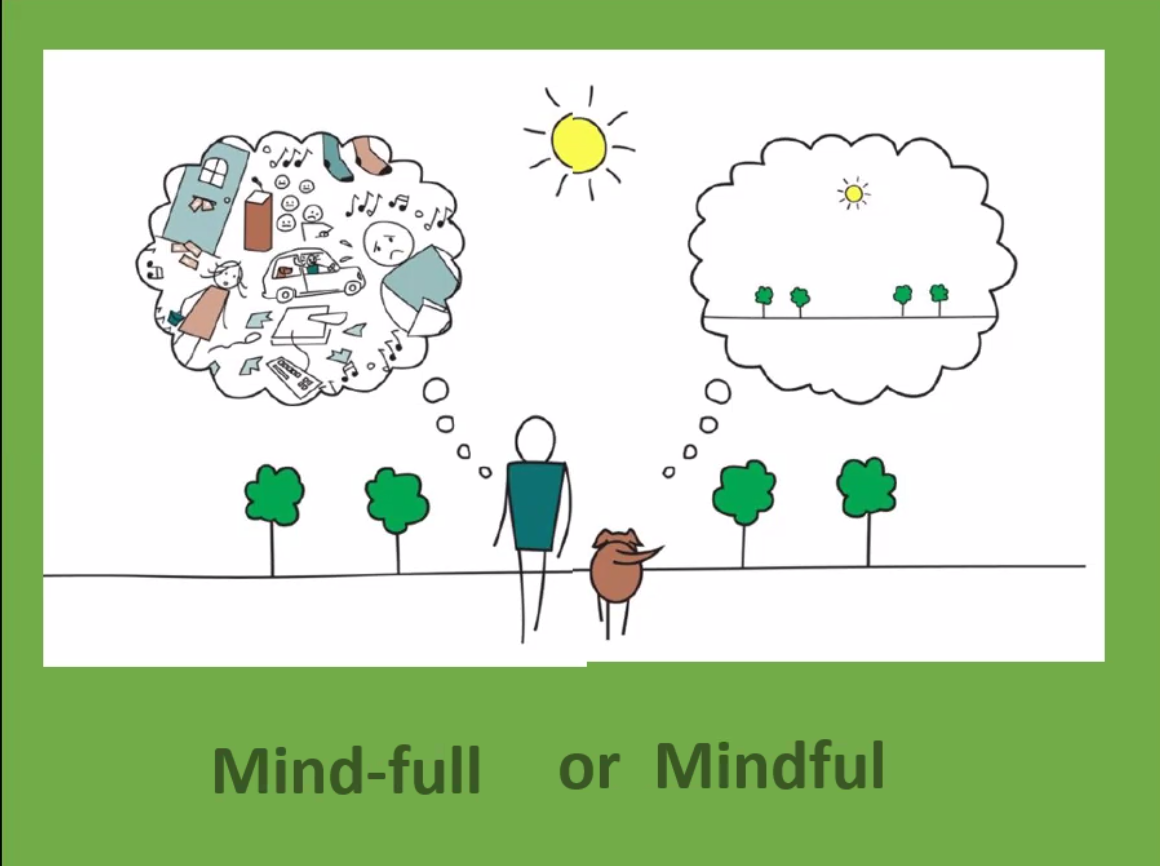
Mind full? Or Mindful?

She started by inviting us all to close our eyes and just notice sound. That could be sounds in the room, sounds outside, even the sound of our own breathing. Then we were asked to notice our breathing and the movement of breath in and out of the body. In other words, a very brief awareness of sounds and breathing meditation. A quick, easy way to get back in touch with the senses, which is one of the key elements of mindfulness.

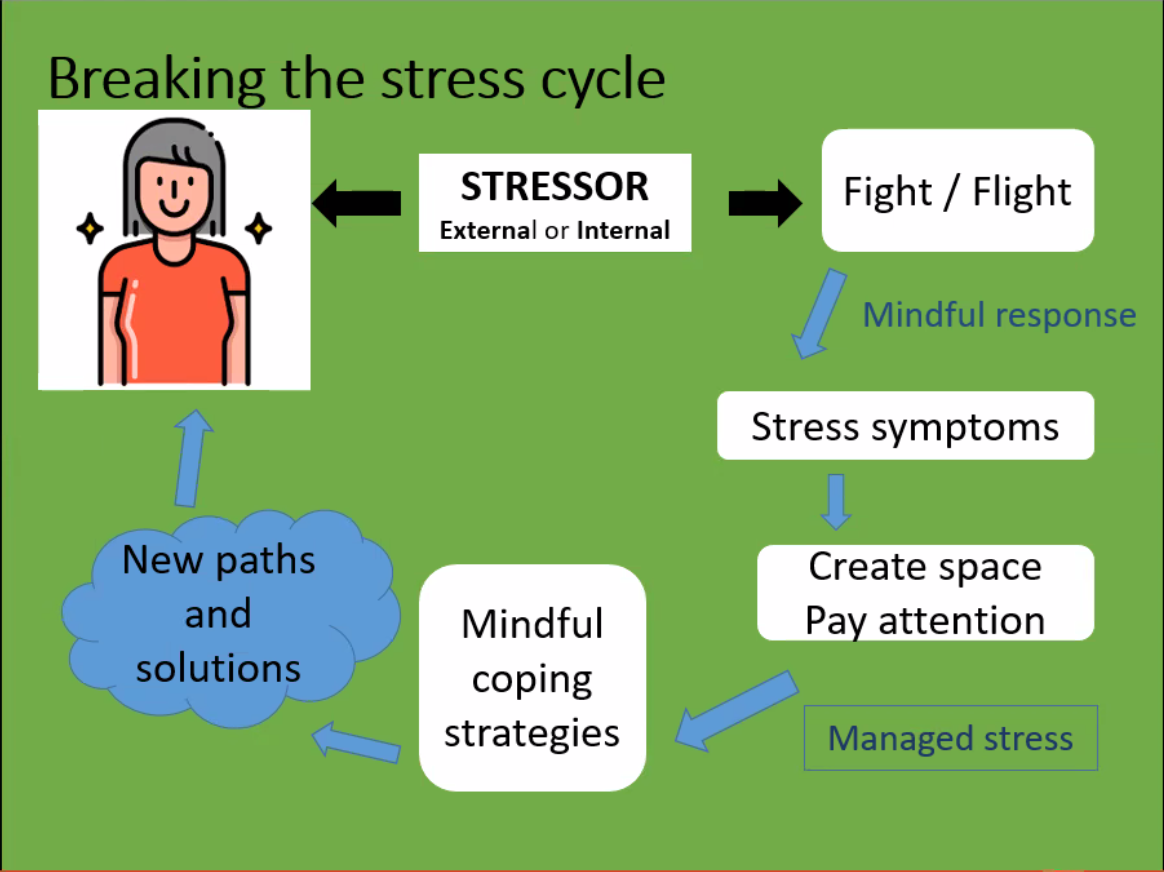
Then she told us that she usually starts sessions like this by asking participants to put their hands up if they have ever experienced stress. Of course, everyone puts their hands up. Life is stressful. Being human is stressful. Being a teacher is stressful, it is a stressful profession. Emma proposed to offer us some practical tools for teachers to bring to classroom experience, to calm nerves, to deal with emotions, to avoid the spiralling mind, so that we can be present with our students. As one of the webinar participants said, though, these aren’t just strategies for the classroom/workplace, they are strategies for life.

We moved on to the following questions:

  • what is stress?
  • how does it feel?
  • how does it affect us?

Emma invited us to think of something that had happened in the last week or two (not a really big, traumatic life experience, just a run of the mill stressful situation), to close our eyes and put ourselves there for a moment, to picture where we were, what we said out loud and what was said inside ourselves. Then we had to feel it – how does it feel in the body? Where in the body? Is it a tightness in the chest/belly? Tension in the neck muscles? Faster breathing? Pounding in head? There is an actual physical experience.

When something stressful happens, we start with a thought process, which then fuels emotions which then show up in body sensations. That is the fight or flight system in our brain kicking in. That system is a survival mechanism which all humans and animals have. It responds to threats by preparing us to fight, freeze or run away. All the physical ‘symptoms’ of stress are connected to it. It is the body being told by the system “We need to do something and do it NOW!” Which was useful when we were faced by sabre-tooth tigers back in the day but how useful is it when it’s triggered by an email arriving in your inbox? Or a chance comment from someone? Probably not very.

The fight-flight system, Emma explained, is a very finely tuned mechanism, like a hair trigger. And if you are tired or overwhelmed, then even more so – one small thing can make you explode. She talked about the amygdala area of the brain, which is the primitive alarm centre that acts on instinct and the pre-frontal cortex which is rational, thinking part of the brain. She asked us to imagine walking down the street, not concentrating, when a bus starts coming, we step off the pavement, the bus might be about to hit us but then…we’d be propelled back onto the pavement. Without thinking about it, it would just happen instinctively, spontaneously. The image of the bus would hit the retina of our eye, trigger the alarm system and flight would get us back onto the pavement. The prefrontal cortex gets flipped out of the way by the amygdala and it happens in milliseconds – “before we know it”. It is very reactive, which is useful for running away from tigers but not at work. At work it looks more like receive a rude email, reply, send, and then “oh…er…oops…”. Stress, frustration and anger have the same effect as the tiger. So we may be reactive to situations, shouting at a class, being rude to someone, feeling cut off from everyone.

What can we do about this? How can mindfulness help? Everyone has that reactivity, the amygdala brain area, but we can learn to notice and bring back control to the thinking part of the brain. The mind is often full of thoughts:

It wanders off into the past, rehashing situations that have already happened, or the future, planning all sort of things e.g. what if this, what will I do when; projecting usually stressful, worrisome thoughts about the future or “if only” about the past. The brain has a negativity bias, or a tendency to look for problems/scan for threats. It likes to worry about how to fix things that may or may not happen in the future. I.e. imagined problems, so trying to fix things that aren’t actually there. This means that you are here but your mind is not. You are not present. And that means you are missing the positive present moment experiences. Emma suggested next time we are in the shower, to try to be present – be aware of the smells, the sounds, the sensations. That is an example of getting into the senses and out of the mind.

Children are all about the senses but as we become older and socialised, we lose contact with the body and get stuck in the mind. Lots of stressful ruminating results. Emma told us about a Harvard study which found that we are lost in thought 47% of the time. In other words, stuck on autopilot. There was an app that pinged participants every so often and asked them What are you doing? What are you thinking? And it would be something like having dinner, thinking about tomorrow’s presentation. What are we missing? The shower, the food, the lovely sensations, the appreciation, the excitement, in other words enjoyment of now. We are always somewhere else.

Automatic pilot is not bad. It can be useful. For example, riding a bike we can just get on and ride without thinking about it. We need a certain amount to function in life. However, it is not useful to be stuck/lost in thought all the time, or stuck in the present moment being judgemental of it. (“I don’t want to be here. I don’t want this. This is bad” – resentment, stress.) Mindfulness can help us here. Emma’s definition of Mindfulness is knowing what you are doing whilst you are doing it without judgement. And the without judgement part is important – we may often notice what we are doing but in a resentful/judgemental way, ruminating. Mindfulness allows us to notice what is happening and step away in a non-judgemental, kind way. It is a way to step of the the cycle and start to do something proactive to calm down and get the thinking lid (prefrontal cortex) back down, so that you can deal with the situation creatively and with wisdom.

Emma then talked to us about formal and informal practice. She said the formal practice, meditation, is a loaded word but it’s really just sitting down, being quiet and tuning into sound, breathing and the body. Informal practice is noticing the senses, or information from the senses, in the present moment, for example in the shower or brushing teeth or eating. When your mind is full of to do list or worrying, tune back into the senses and what is happening now. Notice the sensation of feet on the floor. She explained that we can send our concentration/awareness/mind to different places, e.g. the feet. The untrained mind flies about all over the place, training awareness can bring it back., place concentration where you want it to be. When you notice it wandering, you can bring it back. The more you practice, the less and less it will wander. She likens the mind to a puppy. When you are training it to sit and stay, it will keep wandering off every two minutes but practising over and over and over, giving praise, reward, treats, bit by bit the puppy will stay. The same goes with mindfulness. We need to practice over and over but in a kind, non-judgemental way. Notice the mind has wandered, not get frustrated, just gently bring it back.

All of this is also relevant for students. When they get angry or upset, it means they are flipping their lid, and as teachers we can recognise they are stressed and feeling threatened, and help them bring their thinking lid back online again.

Bring awareness to thoughts (gentle curiosity). What is the narrative? What emotions are in there? How does it show up in the body? Curiosity is key.

Emma told us about the “3 step breathing space” activity:

  1.  How are my thoughts? Allow thoughts be, just noticing but not getting caught up in a narrative. What emotions are here? How am I feeling? Where is it in my body?
  2. Centre attention on the breath.
  3. Become aware of sounds or the body.

This can be done very quickly to bring yourself back to the present moment with kindness, care, compassion.

Emma said that the language we use is very important here. “There is anger here” not “I am angry” – the former gives us some distance, allowing it just to be, noticing how it feels in the body, recognising that it is just that system response. Then we give the mind something to do e.g. focus on the breath. You can do it whenever and wherever you notice yourself getting stressed/frustrated, to break the cycle through the moment of awareness.

Then she gave us some other activities we could try:

  • “Look up and smile”

If you are feeling a bit stressed, e.g. before you go into the classroom, look up and smile. It releases good, positive chemicals in your brain, even if you don’t feel like smiling. Then you can enter the classroom with better energy.

  • Frame things differently

The thought “I’ve got so much to do” usually hunches you over and makes you feel very heavy very quickly. Instead, straighten up and shout it out loud (as if you are excited about it!) How we frame things can make us feel better. Sensations of stress also accompany excitement. It’s the same sensations but a different narrative/framing.

  • Labelling

Stop the alarm bell by labelling what is going on. “There is anger/frustration/tiredness here”

  • Take in the good

Consider what is good right now in this moment. This counters the negativity bias.

  • Create calm moments

There is so much bombarding us these days, that our minds can’t tell the difference between real threats and perceived threats. The stress response happens just the same – we get adrenaline and cortisol flowing. But what we need is the calm, soothing rest and digest system, to give the fight/flight system a break. One way to do this is slow down. E.g. walking, try walking a bit slower, noticing how it feels, what you can see, hear and smell, to take you out of the mind and into the body.

  • Traffic light bell

(She suggested this during the Q&A but it fits in with this section of practical suggestions.) Use red traffic lights as a mindfulness bell: instead of getting irate because it is delaying you, think “ah, red light.” And do the 3-step breathing space activity while you wait. Then you are back with a choice, you can choose not switch on the negative complaining narrative about the red light.

Emma gave us the secret that repeated behaviour, whether good or bad, gets wired into the brain and becomes more likely to be triggered in the future. Mindfulness gives us a choice to respond differently. Ultimately, if what you are doing doesn’t serve you, do something differently. Mindless chatter generally isn’t serving.

She recommend using apps such as Calm, Headspace and Insight timer, and doing an MBSR course. Once you do such a course, you could then train to become a mindfulness teacher and bring it into your school.

She finished with this lovely quote: Happy teachers will change the world. 🙂

A really fantastic session, great to see it as part of the Macmillan World Teachers Day conference line-up!

End of Academic year (nearly!) reflections

It’s that time of year again (already!). Actually, the term is not quite over – we still have three weeks of tutorials, mock presentations and final presentations/exam marking BUT “teaching proper” finished today (at time of starting to write! now also known as Friday 26th August!) – I had my final lesson with my lovely JFBE1a group (January Foundation Business and Economics – but I teach them AES – Academic English Skills – NOT Business and Economics, thankfully!). I’ve had them for 2.5 terms (not quite 3 as they didn’t become a group until after IELTS-based streaming in Week 4 of their first term here) and it’s been so lovely working with them. They are pre-Bachelor degree students so still youngsters really. We don’t necessarily keep our groups for all three terms – sometimes a group might have a different teacher each term, or one teacher for two terms and another for the third, or one for the first term and another for terms two and three – so I consider myself very lucky to have done so with this group! Our academic years, however, are four terms so I had two groups from the September cohort in the September term (first term of the year), who were also lovely (but seem a long time ago now!).

Aaaanyway, I know very well that I will be, shall we say, pressed for time the next few weeks (!) and then I’ll be on holiday (woohoo!) so thought I would get a head start on the old end of year reflection.

A lot seems to have happened this year!

  • My fixed term contract became open-ended (woohoo!), meaning for the first time in my life I now have job security, in as much as it is possible to in this day and age.
  • I did a full year of ADoSing this academic year (my two term ‘trial’ at the end of last academic year went well enough for me to continue in role – always good!) and have continued to thoroughly enjoy working on the ADoS team. I’m a lot more confident now than I was (it really helps having a manager who is very positive about my capabilities!) which also helps – if I recognise my strengths, I can build on them…
  • Recently I took the role of Joint Teacher Development Coordinator for our centre and so far have put out two bulletins, with another – final one for the term – due out next week – very excited about this role and what I can do to help teachers develop!
  • I completed my SFHEA application (yesterday! *also known as Thursday 25th August!) – it’s not ready to submit yet, I need to put it into the portfolio platform when they unveil the one they are changing to from Pebbledoodah, but I’ve done all the donkey work for it.
  • I received two recognition awards from the powers that be (as did the other ADoSes, of course) – one for “‘going the extra mile’ especially with the massive contribution to AES development (in February) and one, “an exceptional contribution award” (today – 26th July – may not still be today when I get round to publishing this :-p )
  • I discovered Mindfulness, and as well as transforming my own life with it, have started to experiment with it in the classroom with promising results thus far – something to build on! (But that’s another blog post, when time allows…)
  • I wrote a book chapter for Routledge Handbook of Materials Development (recently got the first draft feedback back, so it’s back on the “list of things to do” – eek!)
  • I’ve done multiple Futurelearn courses (Dyslexia and Foreign language learning, 2 x Mindfulness, Developing Professional Resilience – which is still in progress) – I love learning!

All in all, it’s been a very positive year despite the tragedy that marked the beginning of it (losing my beloved Alba horse to colic).

A couple of things I realised today (*at time of writing, possibly not at time of publishing!):

  • Some years ago now, I discovered that I didn’t get a CELTA pass A because one of my tutors thought I wasn’t resilient enough. Today I realised that I’m really glad they made that decision. Because, perhaps if success (Pass A) had come easy, I wouldn’t have been quite so determined in all my future endeavours in the profession.
  • I am as excited about the future now (and the possibilities that lie ahead with regards to teaching, ADoSing, TD coordinating) as I was at the end of my CELTA session on continuing professional development/making a career out of ELT.

Things I am looking forward to in the next academic year:

  • Using my role as TD coordinator to build up a culture that puts teacher wellbeing at the centre of teacher development (my current passion!) – already got some innovations in the pipeline (watch this space!)
  • Developing my ‘helping teachers’ skills in my ADoS role
  • Continuing to work with Mindfulness both in terms of myself and in terms of using it with students
  • Continuing to develop and grow as a teacher, try new things in my lessons and make them as beneficial as possible for my students
  • Finishing that darn book chapter! (Well, the next deadline is end of August so that might/should technically happen before the next academic year starts…)
  • Hopefully getting to IATEFL again (I’ve written a proposal but need to go through my institution’s selection process AND – if successful in that – IATEFL’s selection process.
  • Learning more!

(NB As you will have noticed, I have focused on the positive. This is because, thanks to the negativity bias, it would be all too easy to ignore the positive in favour of the negative. Being positive about what I have achieved does not mean the next step is to put my feet up and stop putting any effort in, it just means I will be starting the next chapter with a “can do, can learn” growth mindset rather than an “I’m rubbish, why bother?” fixed mindset. 🙂 )

If you have a September to August academic year, what have been your highlights? What are you looking forward to for next academic year?

Workshop: Supporting our Chinese Learners – Tim Cooper

Earlier this year, in February (I know…I only managed to attend half, then had to teach, then had to catch the rest via a recording when I finally made time to!), I attended a fascinating TD session called Supporting our Chinese Learners by Tim Cooper who works for the university and who delivered this session of his especially for the ELTC. Here are my notes from it(/the recording).

Some statistics:

  • 1 in 5 students at the University of Sheffield are Chinese (!)
  • That’s 2/3 of the international student population
  • 150 nationalities are represented at the university, with the biggest representation being Chinese, mostly from the Eastern Seaboard area of China
  • China is the second largest economy and £100 million per year comes from Chinese students

Then we moved on to some history:

  • The cultural revolution impacted students’ parents and grandparents. People were stopped from being doctors (for example) and relocated to work on the land.
  • For a period of time there was of course also the one child policy

A result of these things is that Chinese students are under a lot of pressure to succeed from parents and family.

The social system in China and how it influences Chinese students’ behaviour in the UK both in and out of class

  • The three main doctrines are Confucianism, Buddhism and Taoism
  • Due to the one child policy (in a generation since 1979, most families have been affected by the one child policy, with its consequences of gender imbalance and female infanticide – with the two child policy being introduced in 2016), being an only child, they are used to getting what they want and need. Away from that support system, often they want help, they need help, but they don’t ask for help. Silence does not always mean everything is well: among male Chinese students, the self-harm/suicide rate is increasing.
  • “guanxi” –> it’s not what you know but who you know: Chinese students rarely operate in isolation, especially females. They tend towards groups of three – one who is the best at English, one who is the most confident overall and one friend. Being collectivist, they find it difficult to do things as a single person. “Friendship groups” (like described above) work better for them than 1-1 buddy systems with home students or things of that nature.
  • “Saving face” – with friends, class, family, town, is very important. It is possible to lose face forever and no one wants that! This translates into fear of making mistakes/getting it wrong.
  • Young men tend to be clueless, young women tend to be more resourceful, as, if you are a – much-coveted – boy, everything is done for you while if you are a girl, not so!

 Chinese Education.

The system looks like this:

  • Kindergarten
  • Primary School (7am – 5pm)
  • Middle School (7am – 7pm, meal, homework)
  • High School (as above)

It is geared towards acquisition of knowledge and is heavily test-based, and obviously involves very long hours (poor teachers too!)

  • Entry into higher education is by way of the Gaokao (and a big exam is taken at the end of this high school). You need a high score to get into a good university. (It is a massive thing, parents come to see their kids off on big coaches to the test centre, there are armed police guards etc!)
  • Education is test-focused not critical thinking-focused.
  • Children are tested once a week from primary school upwards, so children always know their position in the class – top, bottom, etc.
  • The final two years of Gaokao preparation = fats, facts, facts + regurgitation of said facts.
  • In some cases, parents send their kids abroad to avoid Gaokao.
  • The Chinese system (all that testing!) may seem brutal to us but it is reassuring to them because they know where they stand.
  • Critical thinking and plagiarism don’t exist. Teachers speak truth, students write down and regurgitate truth.

Impacts on how they learn here:

  • They are unsettled by a (relative) lack of exams/testing here
  • Failure is confusing – a. “How am I failing when I have paid 20k to be here?” and b. “I didn’t know I was doing badly”
  • Regular little tests can be reassuring e.g. there was a big seminar group, issues with student participation; the teacher introduced a little 5 min multiple choice test done at the start of the lesson relating to previous content and the students were happier and more engaged afterwards, having spent a bit of time in their comfort zone
  • The issue isn’t that plagiarism is complex, it just has no meaning as a concept. “It’s not your own work” is meaningless to them. The reason so many Chinese students get done for cheating and there is a lot of collusion/unfair means is that they don’t understand it. One of Tim’s colleagues said “We are also good at cheating” – a consequence of Gaokao being such a big thing is that it’s a case of any means to an end.

With all of the above in mind, given that we have so many Chinese students here, we need to gain an understanding of where we are with them – their feelings and experiences. We have a big job to do, to meet them in the middle.

In 2012, Tim and colleagues did some focus groups and surveys with little samples, with the following findings:

  • Students tend to seek advice from a friend in the first instance rather than officially.
  • A high proportion of students ignore official university/departmental email. Email never got the same kind of traction in China as it did in the West. Email confuses them with regards to levels of formality required, they are not used to using it as a media. Most students (and staff over there!) use Wechat most of the time. So, at a networking event at Nanjing university, Tim noticed there was a lack of business cards being exchanged and instead it was QR codes, connecting via touching phones and usually/often there was a dancing panda involved! (Very different from “Dear Dr Soandso, it was great to meet you…”!)
  • Wechat is very informal but is used as a means of conveying everything. Emojis are used a LOT e.g. Tim sends a message saying “Shall we meet and discuss x” and the response might be a mouse blowing kisses. That doesn’t mean the person is blowing kisses, just the mouse, the person is just saying yes, great.

What does this mean for us?

  • Emails need to be brief and get to the point as quickly as possible, and ideally include a picture where possible.
  • Use transparent language e.g. “the document you need to open a bank account” not “bank letter”
  • Think about using a Wechat group to tell them when you have sent something important. NB Wechat is monitored in China. So in communication terms, great, but increasingly problematic.

Other findings from 2012:

  • Students can be reluctant to provide undeferential feedback – will always nod and say yes to “Do you understand xyz?” or “Is everything ok?” It means “I respect your authority and am listening (but not  necessarily understanding)”. So you need to find subtle ways of checking understanding. (At least this is something we as language teachers are good at generally!)
  • They are used to being monitored/recorded but this causes worries for example if someone suggests counselling to them – they will worry that it will end up on their academic record (MSc in Engineering, with mental health issues!) so you need to explain otherwise.

2015-2016 findings:

  • 60% of a statistically valid sample experienced difficulty with the expectation of expressing their opinions in class
  • 46% experienced some difficulty in complying with university plagiarism regulations
  • 46% experienced difficulty in working with other students in groups
  • Most students were expecting a more British experience or a warmer welcome from home students

=> It’s hard for them to adjust to independent study requirements at university as vs. reliance on teachers and textbooks (there, each subject has THE textbook). However, most students within the course of their studies will have a successful journey and they will get it, and appreciate it (e.g. critical reading etc) – they just need time to understand the system.

Things to consider:

  • Need to manage expectations with regards to support: the majority come here after 4 years of undergrad in China, aged about 22. During that 4 years, they will have had 24/7 access to a “fudaoyuan” (personal tutor/coach) – these are recent graduates on the bottom rung, who are given a work phone, and told be on on call at any time and to check up on charges regularly. E.g. a student forgets the due date of an assignment, they can call their fudaoyuan up at 1am to ask them; a student who is considering suicide might tell their fudaoyuan as the first port of call; a student who thinks they are pregnant and are worried the family will disown them etc will also call their fudaoyuan. So this is very different to “not after 5pm or at weekends”  We need to explain to students how it works, tell them not to panic if we defer availability, we WILL deal with something and deferring is not personal.
  • With regards to students “always going around in groups” and “always speaking Chinese” – they are far from home, they gravitate towards people in the same boat and agents often even put them on the same flight etc (and remember how you coped when you went to work abroad, at least initially!).
  • Need to make sure students get information about contraception etc. sensitively – local NHS here worked out that a spike in number of abortions was a spike in Chinese girls and approached the university about it. There is a lack of sex education over there and when they come over here they are no longer being watched and this is a consequence of that. There was a campaign about this but it got dropped unfortunately.
  • Whatever students’ IELTS score is when they arrive, it can drop/their language level can regress through lack of use.
  • If they are doing something wrong, we need to meet them half way and help them learn how to do things appropriately here.

Focusing on adaptation and integration:

  • social activities based on drinking generally have limited appeal
  • culture shock an issue – prolonged feeling of being an outsider/visitor
  • buddying schemes can be beneficial but “friendship groups” may work better
  • need to keep in mind Chinese vs. Western views of health and the body e.g. access to warm water is paramount for female students of reproductive age (to them, losing warm fluid = must replace it with warm fluid!) and there needs to be sensitivity around health issues
  • silence does not equal all is well (as mentioned earlier)
  • students are used to being given homework, can feel lost without it
  • they are under enormous pressure to succeed, consequences of failure are enormous
  • remember, in China, teachers do learning to you, here you have to do it yourself = a big adjustment to make

You can watch a video of the students themselves speaking here.

Finally, and very interestingly, we were given a photographic tour of a Chinese university campus:

Nanjing University, a top 3 or 4 university which has recently expanded with a brand new campus and is very modern:

  • The old entrance in town has philosophical writing of a big figure of that town. You go through that entrance into a campus, a bubble, a safe place. (So students are baffled by Sheffield, they think Glossop Road/West Street is “on campus”
  • Learning takes place in lecture theatres
  • Self study areas consist of rows of desks and chairs – no sofas etc
  • In luxury residences, there are 4 girls to a room. The room has bunks and desks. A thin curtain on the bunk is the only privacy. (Non-luxury = a dorm)
  • Cooking facilities are not important, you go to the canteen which is huge and has lots of choice. HOWEVER hot water dispensers are VERY important! (Lots of machines for that)
  • It is normal/acceptable to fall asleep in the library

Tim concluded by saying that three years ago, getting a degree in the UK was “the biz”, but this is starting to decline. In the world rankings we have slipped behind Australia to third place. So, we need to do more! 75% of students said they were “satisfied” but their expectations are low, so we do need to do more to improve their experience (- or help them improve their experience?) (and our ranking!).