One little thing… (A guest post by Ceri Jones!)

A little over a month ago, I issued a challenge to all who read this blog. The challenge was to reflect on and write about a little thing that has made a big difference to your teaching during the last year. All was quiet and then sometime later, there was a flurry of discussion on Twitter 

Little things...

Little things…

little things...

Little things…

as a result of Sandy sharing my link on Twitter and Facebook. (Thank you, Sandy!) And this is where Ceri Jones comes in. Not only is this the first blog post written in response to my challenge, but Ceri also has the dubious honour of being the first person to write a guest post on my blog! I’m delighted to host her post here and hope she will be the first of many guests. Ceri is a teacher, materials writer (you may have seen her name on one of your course books! – Inside Out, Straight Forward, The Big Picture…) and also has a great blog , well worth a visit.

Here it is then, Ceri’s response to my challenge… 

I was sitting on a train using Facebook as a pacifier, when I came across this great blog post by Lizzie. It got me thinking. Then it got me writing. First to Lizzie in the comments and then in my little purple note book.

ceri pic 1

my little purple notebook – © Ceri Jones

One little thing …

Post-its used to be an essential part of my day-to-day teaching kit. I was teased about it, in fact, leaving little coloured squares in my wake wherever I went. But that was a long time ago. And I moved on and discovered other tools that obsessed me instead (scraps of paper, IWB slides, shared photos on my phone, voice recordings on our class blog.)

Then, a few months ago, I attended a workshop at a conference by a teacher taking the reverse journey, from technology to paper. And more specifically exploring the potential of post-its. It wasn’t her ideas as such (though she had some great ones to share) but the objects themselves that inspired me. And on Monday morning I bought a stack of post-its and took them into my beginners class. And alongside the whiteboard, the miniboard, the projector, and the blog, they became a new focus for collecting and organizing and revisting and recycling emergent language in our barefoot classroom.

My purple notebook started to bulge with them. The walls of the classroom were decorated with them. The photos from our classes were dotted with them. I don’t think it’s changed the way I taught as such, but it did refresh it and made playing with language (literally) more hands on.

Here are a few examples:

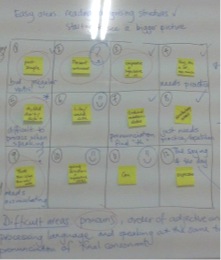
Post-its in action

Post-its in action – © Ceri Jones

In this class, the post-its helped us look back at what we’d studied last term, and look forward to what we wanted to do next. I’ve kept them in my notebook as a reminder.

ceri pic3-2

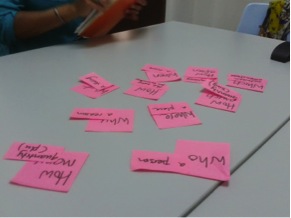
post-its and question words – © Ceri Jones

In this photo, taken in yesterday’s class, we’re revisiting question words. The students matched the words with their meanings. Then we took away the words and they remembered them from their meaning. Then we took away the meanings and remembered them from the words. Then we moved them around and regrouped them, comparing e.g. who, which and what, or how, how much, how many, how often. The little pink stack will come back to the table at the beginning of the next lesson again to be fingered and matched and moved around.

Ceri pic 4

question words in context – © Ceri Jones

Here the words have gone back into the context of the questions the students had asked in the lesson before. And later, after we’d followed the various tangents thrown up by the questions, they stayed on the board without their questions as memory hooks.

The colour and the movement and the manipulation makes the language, and the lesson, just that little bit more memorable. A little thing … but thanks for giving me the time to think about it Lizzie!

Thank you, Ceri!

I hope everybody enjoys Ceri’s post as much as I have.

If you would like to write a guest post in response to this challenge, or on a different topic (e.g. metacognition , language learning , your Delta/M.A. experiences , learner autonomy, a classroom activity you’ve used successfully… etc!) please do get in touch by commenting on this post or emailing lizzie.pinard@gmail.com.

My latest British Council Associate blog post: RESET – five tips for staying motivated!

My British Council Associate blog post for May was on the topic of teacher motivation. I came up with a cheesy acronym for my tips – RESET! (or: Read, Experiment, Step back, Evaluate, Take a break)

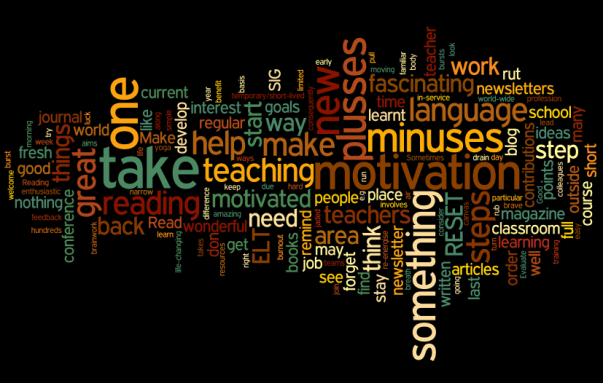
Click on the Wordle below (based on the content of the post!) to be taken to the British Council Teaching English site page where my post can be found.

RESET: 5 Tips for staying motivated

RESET: 5 Tips for staying motivated

I think motivation is a fascinating area of study and that it’s important for both teachers and learners to be able to manage their motivation effectively. It’s a theme I shall definitely be returning to in later blog posts.

Thank you, British Council Teaching English team, for the continued opportunity of writing as a Teaching English associate blogger, it’s a stimulating project that I am very much enjoying! 🙂

To read posts by all the other wonderful associate bloggers that I am honoured to share my title with, please click this link. And do have a look at Rachael Roberts’s insightful blog post that is also on the topic of teacher motivation and avoiding burn-out: in it, there some very valuable tips for all.

How I’m learning Italian (inspired by the one and only Sandy Millin!)

Sandy’s brilliant post on how she’s learning Russian has inspired me to reflect on and write about my own efforts to learn Italian, with a bit of comparison between my way and hers.

The first difference between our learning is that, when not cancelling them, she is having lessons. What’s more, they are one-to-one lessons. I had a few small group lessons when I first arrived in Italy, and established that I was a terrible classroom learner. Like Sandy, I, too, felt sorry for my teacher having me as a student! I wonder if I would do better in one-to-one classes? It would be interesting to have a few and find out…

I suspect, though, like any adult learner of a foreign language, time management would be an issue. Especially, like Sandy, the whole HOMEWORK bit! During the time period of the small-group lessons, near the beginning of my time here, I mostly did my homework half an hour before the lesson started – it couldn’t have been any nearer the time because our weekly staff meetings immediately preceded the lesson time-slot! On the surface you’d have assumed I was an unmotivated, bad learner. Not so. The problem was that I was too motivated – I had already met what we were looking at in class during my own self-study. So the homework – gap fills and writing out verb conjugations and so forth – was boring.

(Or would it? If I were in a one-to-one class, then theoretically we’d be doing stuff I was interested in knowing, both in the classes and, by extension, for homework. Ah, homework. It’s compulsory to set it here, so with my own experiences in mind, I’ve worked very hard on trying to ensure that the homework I set is meaningful and of interest to my learners.)

Needless to say, I stopped the lessons (time was at a premium and the lessons weren’t doing it for me) and went it alone.

Reading


Screen Shot 2014-05-04 at 08.10.46

Harry Potter: tutti i libri!


Knowing that I enjoy reading in languages others than English (especially French), I immediately decided I had to start reading in Italian. So I bought Il piccolo principe from the local bookshop (had to be done, was the first book I ever read in French too…) and downloaded a complete set of Harry Potter books in Italian onto my e-book reader. I also dug out a pdf. of Harry Potter 1 in English. I used them side by side. Sometimes I read a few paragraphs in English, followed by those paragraphs in Italian, and repeat. Sometimes I did the reverse. It was a fascinating voyage of discovery, seeing how things were said in Italian and taking care to keep an eye out for any similarities with French – lexical or grammatical. So I suppose, though I was reading extensively, I was also reading intensively – using the text to learn about language.

Eventually (somewhere part way through this first in the series), I gave up using the English version and just used the Italian version. It wasn’t a conscious decision, so much as a gradual realisation that I had enough language not to need the side-by-side translating any more. I graduated to looking words up when necessary. Initially, quite a few words. (What a terrible language learner! You’re supposed to guess by context/ignore etc. Oh well!) As time passed, fewer and fewer words. What I now rather like doing with words I don’t know is guessing what they mean and then looking them up to see if I’m right or not.

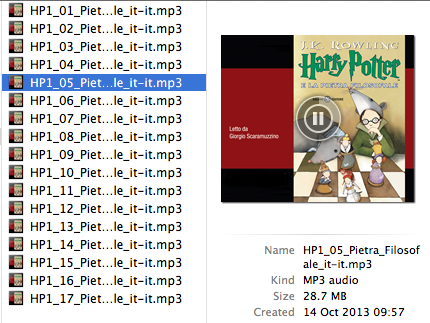
I also downloaded an audio book of Harry Potter 1, having read an article suggesting that extensive listening to audio books, in addition to extensive reading of the same books, can be beneficial. I still haven’t finished listening to it. But I’ve listened to a few chapters, some while reading at the same time and some just listening. A few of my students swear by it (they like graded readers that come complete with audio!).

It’s ok, I haven’t read Harry Potter exclusively – I’m also ploughing my way through a series of books about horses aimed at teenagers. Which is actually useful because I’ve taken up horse-riding again since I’ve been in Sicily, so having a working knowledge of that vocabulary is relevant! I’ve yet to find a use for all the magic-related vocabulary I’ve picked up… 😉

Actually, reading didn’t come first. What came first started before I even got to Italy: Memrise.

Memrise


Screen Shot 2014-05-03 at 21.44.44

Screenshot of Memrise site


Once I accepted the job at IH Palermo, I downloaded “Basic Italian” from Memrise, using the app on my Ipad. From this little gem, I learnt how to say something could be dangerous (potrebbe essere pericoloso), to comment on how many taxis I could see (ci sono molti taxi), to ask where the Vatican is (dov’e il Vaticano?), and the Italian for pork (carne di maiale). Which, as a vegetarian, I haven’t had to ask for, but it’s useful to avoid on menus! *NB excuse any errors – it’s been a while since I reviewed these and I don’t often write!

Memrise teaches you chunks and provides lots of random pictures which are supposed to help you remember words. (All I can remember of the pictures was that an alarming number of them featured busty women which had nothing to do with the chunks in question! But I’m sure there were some good ones too.) It also gives you a sense of progress by likening the learning progress to growing flowers. You plant seeds, you grow them,  you water them, etc.

Things I like about Memrise:

  • It gives you chunks: I like chunks. Once I’ve learnt them and can say them, I like analysing them and seeing how they’re made and seeing if I can manipulate them to do other things.
  • Instant feedback: It gives you a chunk, in Italian or English, you touch what you think is the translation (out of the choice they give you) and it tells you if that is correct or incorrect.
  • The inbuilt spaced review: It “locks” sets until you need to “water” them.
  • Audio and visual: As well as seeing the chunks, a voice says them to you. Therefore you can repeat them after the voice.
  • Priming: You see language in the multiple choices given that you focus on subsequently. So you’ve seen it repeatedly before you focus on it, so it’s a little bit familiar already. Although, who knows how useful that is when it’s all out of context?

Things I don’t like about Memrise:

  • For the most part, it’s matching/multiple choice. It would be nice if, as well as that, you could graduate on to typing in the translation for long chunks. With multiple choice, sometimes you know which one it is because you know which ones it isn’t. (Though that in itself is an interesting exercise and tests your knowledge of other chunks, I suppose!) I think the closest you get is choosing words from a selection to form the chunks and spelling out words from a selection of letters they give you.
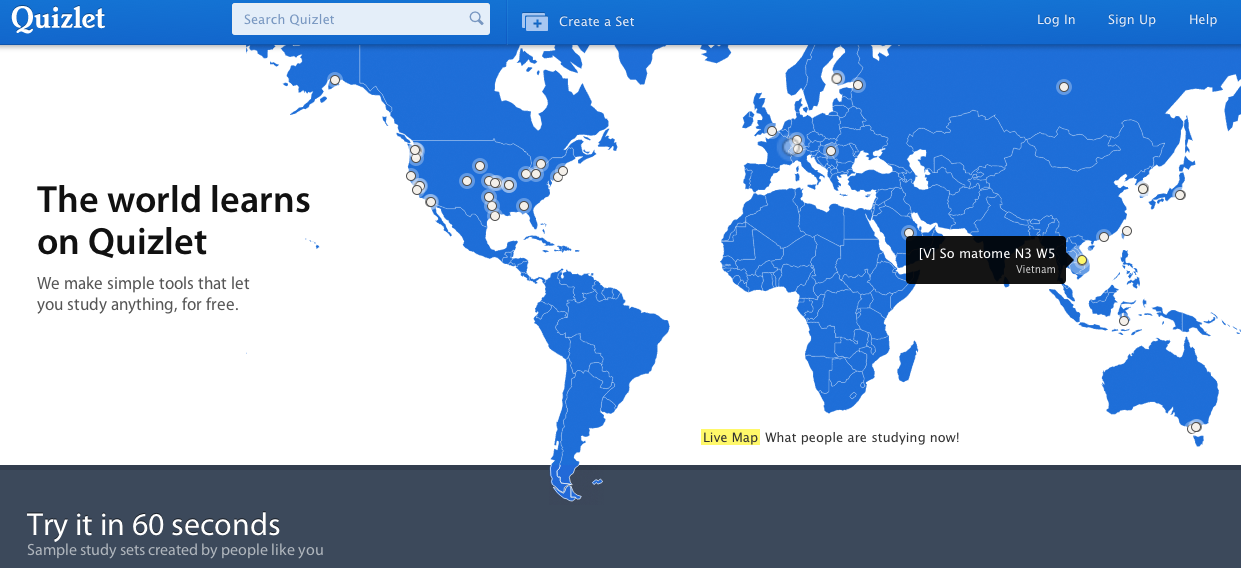
  • The randomness: There seemed to be little rhyme or reason to the chunks selected. I suppose you could make your own sets like on Quizlet, and then it would be more specific/tailored, but I haven’t got that far with it – it got forgotten before that!

Memrise has the dubious honour of being the only language learning app/programme that I’ve ever used properly. (I’ve also dabbled with Babel but abandoned it very quickly!) Unlike Sandy, I haven’t used Quizlet as a language learner. I’ve used it to revise Delta terminology and I’ve made self-access materials to help my learners use it (though very few of them have got particularly keen on it) but I haven’t tried to use it to learn language. I used Memrise prior to departure from the UK to give myself *something* – as that would be better than arriving in Italy with absolutely *nothing*! I didn’t use it for long after I actually got to Italy. Now that I’ve said that, I plan to open it, run through the sets and see if I can get 100% or what it teaches me this time round!

Vocabulary

So if I don’t use Quizlet and my use of Memrise has died a death, how do I learn vocabulary? Well, I haven’t used vocabulary lists, I haven’t post-it’ed my flat, I haven’t made index cards. I did have a vocabulary note book (which was an appalling example of a vocabulary notebook!) – where I’d note down any words or phrases that interested me, higgledy piggledy, and look over them periodically. I’ve also learnt a bit of various topic-related vocabulary from my course book (daily routine, things in a house, going on holiday, shopping and eating etc. the usual kind of thing!). But the majority of it, I have learnt through reading, as described above. I like the idea of using Quizlet but… a) I’m not sure what vocabulary I’d choose to input. But more importantly, b) I have limited time to devote to language learning and I really like reading and watching dvd series or films. <Bad learner flag!> …although I think I pick up a fair bit of vocabulary from those activities. I feel it’s slightly more meaningful to see vocabulary repeatedly in context rather than in flashcards/lists. Perhaps another thing for my to-do list, though, is use Sandy’s Quizlet guide and see what other people have done with it in terms of learning Italian. That will be most interesting, even if I don’t actually do the games and stuff.

I learnt fruit and vegetable vocabulary from the market, which is also my main location for recycling that vocabulary! Other food vocabulary has come via studying menus in various restaurants. Helpfully enough, my course book had a sequence dedicated to market shopping, so I learnt a few useful phrases that way too.


Screen Shot 2014-02-26 at 06.52.15


Listening

I’ve been watching dvds – films or episodes of series – in Italian fairly regularly since my arrival in Palermo. To start with, I used subtitles in English and then very soon switched to Italian subtitles. Then I bought a DVD series with no Italian subtitles! Shock horror! So I had to watch without subtitles. At first, it was just a case of looking at moving pictures and catching the very odd word once in a while. I persevered. A few episodes in, I noticed I was no longer just looking at pictures but also actually understanding some of what was said. Now I can follow reasonably well. I haven’t used subtitles since buying this DVD series, even on subsequently bought DVDs which do have them. Why? I tried it and found the subtitles annoying.

As mentioned earlier in the post, I’m also listening to Harry Potter 1 very sporadically.
Screen Shot 2014-05-04 at 08.21.03

….very sporadically!


I’m very unlikely to finish it in the next few weeks, but it will come in very useful over the summer, when I need to find ways to maintain my Italian while not in Italy!

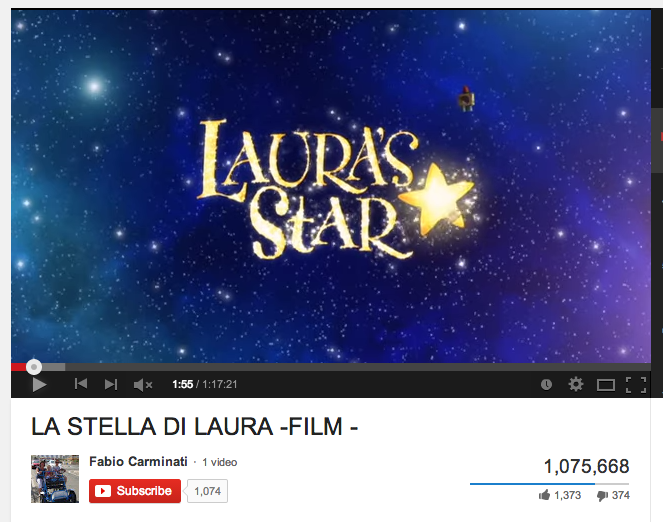
Another good source of things to watch and listen to in other languages is Youtube. I found a lovely cartoon film which had been dubbed in Italian, which I really enjoyed watching while I was in England over Christmas, in a desperate attempt to hold on to some Italian:

Screen Shot 2014-05-04 at 08.26.52

Such a lovely little story – do watch it, in whichever language you want to! 🙂


I haven’t used Youtube overly much while in Italy, though, due to my internet connection being limited – I get a certain number of gigabytes of data per month, which streaming would eat into massively. I plan to mine it over the summer – another thing for the Italian Maintenance list…

For the same reason (limited data connection), my use of Italian radio has been… limited. I really should either find my Ipod, which picks up radio but which I’ve managed to lose, or pick up a cheap little FM radio.

My TV doesn’t work, so that hasn’t been a possibility – perhaps next year! (I shall be living in a different flat – hurrah!)

I had some good listening practice during my recent holiday – I wound up having to make and receive a couple of phone calls – every language learner’s nightmare. I used context and key words to get by! I didn’t understand everything but I understood enough – and more than I would have expected to understand. I didn’t worry about the bits I didn’t understand. I also used strategies to check my understanding of what was important e.g. repeating it back and paraphrasing.

Maybe I should do more intensive listening? Make myself do mini-dictations and the like?

Writing

I don’t do a lot of writing. I have, however, tried one thing to give myself writing practice: I started an Italian blog. No, you can’t see it – it’s deliberately set to private!! It has a grand total of about three entries, though there is one entry in my Ipad notes that I haven’t yet uploaded, I don’t think. I can’t even remember. The majority of the writing has been done in Ipad notes, while on planes to and from Palermo. Being captive for three hours seems to work!

What I like about blogging in Italian:

  • It makes me actually use the language productively. (My receptive skills are so much stronger than my productive skills!)

What I dislike about blogging in Italian:

  • Time-consuming! So I should maybe set myself a mini-goal such as writing something once a week. Or write less per post and more frequently, until I can do it more quickly.
  • I can’t say complex things yet (or at least couldn’t when last I tried!) so frustration often accompanies it!

I really ought to dust the blog off and get using it again…

Speaking

Speaking is the missing link in my language learning. I don’t do it nearly enough. For ages I’ve been meaning to try and set up a language exchange but have kept putting it off. Why? Well, what will I say? I’m not that talkative at the best of times! What I’d really like is PSP Speaking sessions like we have in our school (an hour-long, mixed level, group discussion in English on different topics, done in pairs/small groups and then whole-group, with some feedback given) in Italian! Maybe next year I’ll get round to setting up a language exchange…

Grammar

I’ve learnt quite a bit of grammar from an A1/A2 course book that I’ve worked my way through. It’s not bad – generally involves giving you a text in Italian, reading or listening. If a listening text, the transcript is then printed for mining in subsequent activities once you’ve listened for meaning. The grammar comes out of the texts, which have clearly been written for that purpose. I suppose it works for me because I like language in context. I’ve got the B1/B2 book, but I haven’t yet done much of it. I lost my habit of getting the book out first thing in the morning, sometime soon after Christmas. I really should find it again. And remember how lucky I am that I’ve found some Italian course materials that work for me – sounds like it’s much harder with Russian!

What I haven’t done is sit down and learn verb endings. I know plenty of regular verbs/endings  in the present, and I can form the past. I have quite a few past participles (or whatever they are called in Italian, the form you use to express the past along with avere). I know some future forms. I know a handful of conditionals. But during the holidays, I noticed that since I never say “we”, I struggled when I wanted to use a conditional “we” form. Of course I found ways around it. So it probably wasn’t necessary. But perhaps it would help to have a look at some verb tables, now that I have picked up a variety of verbs and endings via reading and listening, and compare it with what I’ve picked up.

Productive vs. Receptive

Like many learners, I have a very spiky profile. My receptive skills are pretty strong, while my productive skills are a lot weaker. My receptive vocabulary is pretty big now, my productive vocabulary a lot smaller – though words and chunks are moving across all the time, the more I meet them in various contexts. Perhaps, like Sandy, I should record myself speaking and listen back for mistakes. Perhaps I should pull my finger out and sort out that language exchange. Or, have a few private lessons… I also definitely need to do more writing, as that at least would also force me to produce.

Time

I’m a big fan of little and often, so I don’t need to challenge myself to do ten minutes a day as Sandy did. What I need to do is challenge myself to vary what I do more within the time that I do use. Difficult, though, as the reading I do in the evening (20 minutes) doubles as unwinding and when I watch series in the morning, I’m eating at the same time. When I read Harry Potter during the day, again I’m generally eating. So, maybe, then, I need to *add* ten minutes of non-extensive reading/listening – related activities to what I already do.

Some conclusions

Well, I’ve already drawn plenty of conclusions here , but…

  • Homework needs to be meaningful if you want your learners to actually do it!
  • Extensive reading is a very valuable learning tool and should be encouraged. It can be combined with intensive reading of the same text. (I’m sure people won’t necessarily agree with this, but it worked for me so I can live with the disagreement!)
  • Extensive listening is too!
  • Language learning is very personal: One man’s meat is another man’s poison. Many of Sandy’s methods don’t appeal to me at all and require much more discipline than I have, but they clearly work for her. Don’t force learners to learn outside the classroom in ways they don’t find useful/appealing. But do encourage experimentation with new ways of learning. (I will try Quizlet, honest…)  – This way, they/we may find more ways of learning that work for them/us.
  • Chunks are good! I agree with Sandy here. As a beginner, starting with chunks then analysing them for grammar later on is a good way forward.
  • Comparing texts in L1 and target language is useful: I found it invaluable when I started reading. I would have struggled a lot more if I hadn’t had that way in. It made reading in Italian accessible to me.
  • Reflecting on your learning is also useful: It enables you to be clear about what you’re doing and why, and to identify the gaps in it, as well as look for ways to try and fill those. Metacognitive awareness is very valuable.

I think, also, interestingly, I may be a terrible language student (in a classroom situation) but I’m not too bad of a language learner. I’m motivated, I’m self-aware, I’m fairly disciplined, I work hard. However, I could be better: I don’t vary my activities enough, I rely too heavily on extensive reading and listening.

Methodology

Well, I haven’t experienced Dogme as a learner yet, but, as with Sandy:

All good in my experience!

I would also add:

Looking ahead

What do I need to do in order to develop my Italian? And what do I need to do in order to maintain it for the nearly four months that I’ll be in the UK over this summer?

  • Keep reading! (That shouldn’t be a problem – I’m only on Harry Potter 5, L’Ordine della Fenice …)
  • Broaden my reading: investigate different genres – there must be plenty to find on the Internet: newspapers, magazines, forums etc.
  • Watch films/series in Italian regularly: I will have a decent internet connection while in the UK so no excuses!
  • Listen to Italian radio: As above!
  • Speak!: Really need to set up that language exchange…
  • Try Quizlet?: Investigate it again and see if I can make it work for me. And/or maybe try making a set on Memrise
  • Get a grammar book out: Look at the verbs, look at some other grammar and see what I have picked up from reading/listening extensively. Give it names. Look at a few rules. That kind of thing!
  • Get my course book out: It wouldn’t hurt, would it? Get that routine going again…
  • Add ten minutes! Do at least ten minutes of studying a day that isn’t extensive reading/listening.

I know from experience (the Christmas holidays – 2 weeks)  I will have to make an extra effort to keep it going during the summer. At least the fact that I’m coming back here after the summer should be a good motivating factor!

Watch this space – I’ll post an update on how my aims, above, panned out – especially over summer…

And thank you, Sandy, for inspiring this post!

(PS: to those who are waiting for me to pick up where I left off with the social side of language learning and to respond to comments on the last post I wrote in relation to this, I will get there soon, honest! I’ve been on holiday for a few days so got some catching up to do…)

In reply to David’s rebuttal: the future of language learning part 2

Firstly, I would like to thank David Petrie for this opportunity to debate and discuss that has arisen out of his thought-provoking post for the British Council Teaching English site and equally well-written rebuttal of my response to that post. For me this is one of the magic things about blogging: the opportunity to engage in critical, reflective discussion and debate on our teaching and learning beliefs, our pedagogies, our methodologies, with fellow members of the profession, so that much less of it becomes entrenched or gathers dust.

I will now respond to David’s rebuttal to my original points and weave in a few more points of my own along the way.

David explains that:

I certainly didn’t mean to imply that language is anything but social or used for anything other than a communicative purpose.  I don’t see, though, how this belief mitigates against learning in an online environment.  People do, after all, communicate quite effectively online. 

Absolutely. People do communicate very effectively online and language is used communicatively. Computer-mediated communication (CMC) tools are brilliant – I use Edmodo and blogs with my students regularly. However, does this use of language fully prepare learners for face-to-face encounters? I would argue that it doesn’t. Spoken communication and use of language involves so much more than words. Online communication recognises this: we try to bridge the gap between online and face-to-face communication by using emoticons ( 🙂 ) , abbreviations for paralinguistic devices (LOL! <sigh…>) [For more about this overlap between spoken and online communication, see my summary of Fiona Johnston’s talk at IATEFL this year: Write here, write now- developing written fluency ] and we manage most of the time – give or take a few arguments when tone is misread. However communicating in this way does not fully capture the diversity of spoken communication. For this reason, I feel that while online collaborative platforms are a valuable additional opportunity for meaningful language use, learning language exclusively through their use is insufficient. I think online learning may be better suited to content learning, which we are able to package in words and diagrams, rather than language learning, which is a lot more complex to package. (This perhaps being one of the reasons why technologically based language learning has seen lots of change and innovation, and is continually evolving, but has not taken over classroom-based language learning despite this kind of prediction.)

However, in addition to this, David argues that sites such as Vocaroo mean that speaking can be included in online learning too. Yes, again, absolutely. In response to this, though, I would like to highlight the difference between this form of speaking – making a voice recording, listening to someone else’s voice recording, responding to that voice recording in a further recording etc – and a face-to-face conversation. If you are not sure what I mean by this, record yourself and a few friends having a conversation. Now try and transcribe it. Can you capture the full meaning of what was said? How much code do you need to be able to do that? Do you notice how you pick up what your friends are saying, interrupt or overlap and complete their utterances? Do you notice the wide range of different tones used? What about non-verbal communication? How do you capture it all? Now how do you transfer that to online communication such as that done using Facebook messenger or similar? Spoken conversation is co-constructed and we have to co-construct differently online, mimicking spoken conversation but adapting to the different medium. Clearly it would not be possible to interact online using discourse analysis transcription coding to capture spoken communication – it would take far too long and be too complicated; beside which, until technology enables us to see what someone is typing as they type it, then mimicking interruptions and overlaps, as they happen in spoken conversation, are not possible in any case. So I would say tools such as Vocaroo are great for helping learners to practice speaking in terms of stringing words together fluidly and coherently over the piece of discourse as a whole, and certainly lend themselves to practicing presentations or other single-turn speaking, but they do not enable learners to practice genuinely conversing in real time in the target language. (And this, together with the social side of language learning, is why PSP Speaking and Thursday night English-speaking pub night are so popular with our students – they recognise that in order to use English more competently, as well as learning and developing skills, they need opportunities to converse in English.Skype and other similar video-conferencing software such as Adobe are another possibility, but even this is limited.

I would argue that since language began as caveman noises which in turn became utterances and developed into the complex form of spoken communication as we know it today, if learners want to learn language in order to be able to use it face-to-face, then they need opportunities to use it face-to-face in a supportive setting. If they don’t live in a situation/community/location that allows this, then the language classroom and, indeed, the language community of the language school, can provide such opportunities. Returning to the social side of language learning, I would also argue that online socialising is no replacement for face-to-face communication. As a friend of mine who is currently working in a small place, far away from friends and family put it, and I paraphrase, “I feel isolated. Having people on the end of a skype call is not the same as having them there with you.” To illustrate this further, would you prefer to spend the evening having a drink while talking with people in Second Life or similar and trawling Facebook, sat at your computer, or join those people for a drink in real life? Being able to communicate online is brilliant, and social media have helped bring like-minded people together from all four corners of the world, it is true (#ELTchat is one such shining example, as is the British Council Teaching English Facebook page); but think how excited we get at the prospect of attending a conference and talking to members of our online PLN in person! I believe there will be no small number of learners who feel the same way about their course mates. (I know I’d give anything to be back in a room with my fellow M.A. DELTA course mates of 2012-2013, for a good discussion, and our Facebook group just isn’t the same – as a small example!)

Well, despite the length of this blogpost, I’ve only scraped the surface of David’s second blogpost and there is so much more there to deal with. However, for now, work beckons and will be followed by a 3-day holiday from the computer, so you’ll have to wait a bit for the next instalment! 🙂

open clip art org

Computers are great but grrrr! 🙂 Photo taken from http://www.openclipart.org via Google image search labelled for commercial reuse with modification.


The Future of Language Teaching – a reply to my critics

David Petrie blogs again in response to my response (https://reflectiveteachingreflectivelearning.com/2014/04/26/what-about-the-social-side-of-language-learning-in-response-to-david-petries-the-future-of-language-teaching/) to his blog post (http://www.teachingenglish.org.uk/blogs/david-petrie/future-language-teaching-%E2%80%93-a-case-study-2034) for the Teaching English British Council website! Thank you to David for opening up a really interesting discussion – stay tuned for my next response! 😉

David Petrie's avatarteflgeek

divided brain

About a week ago, I wrote a piece on “The Future of Language Teaching” for the Teaching English blog.  It seems to have been slightly controversial.

In it, I tried to paint a picture of what language learning might look like in twenty years’ time, drawing largely on themes and ideas I had come across in various talks and presentations at the IATEFL conference, as well as my own experiences as a teacher and learner.  In short, I argued that students of the future won’t need to learn languages at a language school as they’ll be able to do it all online.

You can read the full piece here: “The Future of Language Teaching – a case study from 2034

It was a deliberatively provocative piece which I wrote with the intention of opening up a debate on where we think language teaching should be going…

View original post 1,307 more words

12 things I’ve learnt about language learning by being a language learner!

Italian and I…

We had barely met when I first arrived in Palermo. I called bruschetta “brooshetta” , pizzeria “pizzERia” and could barely string a sentence together. I had a few Memrise chunks – they meant I could ask where the vatican is (might have got some odd looks from the good people of Palermo if I tried that!*) and comment on the large number of taxies in sight, or surmise that something might be dangerous (me attempting to do anything in Italian, perhaps?) but when I went into a bar/cafe near where I work, I didn’t have the confidence to attract their attention or the language to follow it up with getting what I wanted.

I did have a few lessons but dropped out fairly early on because of a combination of lack of time and being driven slightly mad (much as it was interesting to see the classroom from the learner point of view!). I was, however, very motivated to learn, so worked my way through an A1/A2 coursebook and picked up some useful stuff and some less than useful (the only time I’ve needed to describe my daily routine at length was in a speaking test which formed part of an entrance test when I was thinking of joining a class again! :-p ). I’ve watched a load of dvds, films and series, with then without subtitles. I’ve read extensively. I’ve used what little language I have with various people. The latter three things I’ve kept up while the coursebook (the B1 version now) has fallen by the wayside. Though now that I’ve decided to do another year here, I have renewed my intentions to pick it up and continue…

I love Italian and have enjoyed the learning process thus far. Having just been on holiday around Sicily and having succeeded in putting my language to good use, I feel extra positive about it now! So I thought I’d pull together some things I’ve learnt on my journey as a learner up til now…

12 things I’ve learnt so far from my language learning:

  • 20 mins morning and evening is worthwhile. It must be-it’s all I’ve ever have time to do during the week and I’ve dragged myself from zero to A2 in my 7 months here so far. (In my entrance test I was one point off B1 for the written bit and my speaking was in the same general ball park). However, learners often think that if they don’t have an hour or so to spend, it’s not worth starting. Being busy people, finding that hour is, of course, difficult. 20 mins could be much easier! (I’ve a project under way currently to work on making small slots of time more appealing and likely to be used!)
  • Read, read, read! When I started Harry Potter one, I was looking up rather a lot of words and I also used a parallel English text alongside the Italian, varying which I’d read first; but now (I’m half way through Order of the Phoenix) I can read, understand and only look up the occasional word (or ignore it and read on!) Also, just because I was a (very) basic user, that didn’t mean I couldn’t start reading books in Italian. Familiar stories can be very useful for soaking up new language. My experiences of extensive reading have fed into my reading project.
  • I should listen more. I’ve done well with dvd films and series but I haven’t mined radio – took ages to discover I could get it through my ipod and plug that into speakers then promptly forgot ever to do so. (Internet radio is no go because I have a limited monthly data allowance which streaming radio would kill!) I really need to dig out my ipod again…
  • (Related to above point) getting into a learning routine is really useful! I automatically do my reading each evening (and often with lunch too); for a while (3 months?) I also opened my coursebook religiously each morning with my morning cuppa. Then it just becomes what you do as part of a day rather than an added extra that can be forgotten. How can we help our learners develop helpful routines?
  • Mapping to other languages is so helpful. French is related to Italian and I have reasonable French, which I’ve used to my advantage in looking for similarities and differences, both of which are useful memory aids. Not to mention just being really *interesting*! While on holiday, my aunt (who has good Spanish and French, but little Italian) and I (good French, basic Italian) were often making comparisons between these languages and also German (we both have a smattering of that too) for both of the reasons mentioned above. So, other languages should be welcomed in the classroom, I think.
  • I can do more than I perceive. Have just been on this holiday around Sicily, which involved doing a lot of taking charge, as my aunt and uncle, who travelled round Sicily with me, have little (her) to no (him) Italian. I managed. Including several phone calls! I found I had more vocabulary than I realised and could make myself understood fairly easily. When I first arrived, as I said earlier, I once went into a bar to try and get a slice of pizza or similar, but didn’t even have enough language to get their attention and was also too scared to say anything. Progress has definitely been made and that is hugely motivating! (Which underlines how important it is to help learners discover that they can use language – a bit like the budding readers in my classes have done with reading in English…)
  • Though I didn’t give myself another (Italian) name in the end (see my post about identity here), I’ve noticed that before I speak in Italian, there is a split-second moment where my Italian mindset slips into place, just before I open my mouth. It’s not a “how do you say xxx?” type switch, more of a changing channels to my Italian channel. Maybe this is slightly related to second language identity? (I have to become “Lizzie who CAN speak Italian”…) I’ve also noticed that I respond in Italian automatically when, for example, I bump into someone and need to apologise or what have you. Without thinking. So maybe the Italian mindset is on more than I realise, but when I speak with purpose, I become aware of it?
  • I have found myself at times trying to apply what I teach to my own learning, especially, for example, the metacognitive approach for listening to stuff, and at times going completely against it (e.g. all the words I looked up initially in Harry Potter!)  I have concluded that all is very useful to be aware of, but it’s important to feel the freedom to break rules too: language learning is so personal. Rather than tell a learner you should/shouldn’t do this or that, I’d involve them in a discussion about possible ways of doing things and benefits/limitations of each.
  • Living in a country doesn’t necessarily mean you do tons of speaking to native speakers, especially if you are low level. But nevertheless, being surrounded by the language counts for a lot. Even just in terms of reminding you to study :-p But also you hear it and see it regularly, even if you don’t do much speaking. When I went to UK at Christmas, I found it much harder to study, a) having lost my routine and b) being surrounded by English again. However, as time passes, and you become more comfortable in your use of the language, exploiting opportunities that DO arise becomes easier.
  • Losing self-consciousness and focusing on communicating definitely helps. A dash of necessity is useful in making this step. And when you are understood, and manage to do what you want to do, you feel dead chuffed! Again helpful to try and replicate this to some degree in the language classroom, at whatever level. (I think I’d have found it much more motivating to do a task where use of personal details was needed than I did the language practice activity I did have to do, which was pretty much a communicative drill. Not knocking the communicative drill, but maybe an extra task too…)
  • If you speak other languages, it’s good to try and maintain them while learning the new one. I read in French regularly – generally every evening after I’ve done my 20 mins of Italian reading. (I have a 40 min piece of music that is neatly divided into two sections, so no clock watching needed!) I think a) it’s nice not to lose the previously learnt language and b) it must be good brain gym switching between languages!
  • If you learn a new word, it’s like making a new friend – in a crowd of other words, where before it would have been just part of that “sea of faces”, once you make friends with a word, it stands out. E.g. I learnt “condividere” today and then overheard some random Italians speaking and picked out that word amongst others. (Was I primed to notice it by having focused on it earlier in the day?) But like human relationships, if you only meet someone once, you may then forget their name/face and need reminding at the next meeting, when you know you know them from somewhere but can’t place them. (Which is more likely to happen when you meet them out of what you perceive as their usual context)

And last but not least, though more being reminded than having learnt:

How much I love languages, language learning and language teaching! 🙂

(* I know – I can substitute other things too…)

Italy_flag

La bella Italia – Italian flag: from commons.wikimedia.org – licensed for commercial reuse with modification

What about the social side of language learning? (In response to David Petrie’s “The Future of Language Teaching”)

In his post for the British Council Teaching English website, David gives us a futuristic language teaching case from 2034, study drawing on currently existent technologies and their potential uses. His closing question is,

“Do you think there’s a role for the language school? I’m not so sure.”

But what about the social side of language learning?

In the private language school where I currently work, adult learners jump at the opportunity to do things in addition to their classes e.g. Reading Group, where they read and discuss a given graded reader periodically, and PSP speaking (an hour of mixed-level English conversation) or English-speaking Thursday nights at the pub. Who do they attend with? For the latter two, it is open to any level, and learners often sign up to join with, or in the case of the pub, just turn up with, other members of their class. 

Their language classes are not only about language learning – though clearly this is key! – but also 2 hours and 40 mins to 4 hrs a week (depending on their course intensity) doing something with a group of friends, some of whom have been met in previous courses at the school, some of whom are classmates (for YL, teens, university students), with new friends made each course too, as new learners join, others leave and so the classes evolve. They enjoy being in each other’s company twice or three times a week, in the classroom, learning English together. Perhaps it should be no surprise: after all language evolved because humans are social creatures. The benefits of this in terms of language learning are, of course, the pair –  and group – work potential that is there to be mined, the collaboration, the opportunities to learn from one another, for a start.

Young learners, meanwhile, learn a lot more than language when in the classroom – they learn social skills, cognitive skills, motor skills and so on. And they have fun, too! Would they be there if their language learning at school were super effective? I’m not sure. But I do know that we don’t only have kids in need of remedial help in our YL classes. We have a mixture of brilliant kids/teens, average kids/teens and kids/teens who do need lots of extra help. To me this suggests that they don’t only attend because school language learning isn’t good enough. Some of them love English and learning, some of them doubtless are there because their parents think it is a Good Thing. The latter may start classes because of that and discover that they love learning too.

Perhaps for people who are learning English purely to get ahead in their job, David’s vision is a possible futuristic avenue. (Though I question if after working all day using a computer, as many might, they’d want their language learning to be purely computerised too?) Either way, for people who learn as a hobby, or as part of a holiday, or who combine it with socialising outside of work/school, for whom English is important but who want to use it to speak to people face to face (or on the phone!), technology is better off in a more ancillary role.

For me, the future of language learning still involves groups of people coming together to use and explore language. And the delicate in some ways, robust in others, ecosystem of the classroom, that “small culture” (Holliday, 1999), is part of this. The language school is another small culture, within which that classroom culture operates and by which it is influenced, as is the university language teaching centre, or the primary or secondary school and the languages department within it.

Does this make me a technophobe? Insecure about my future as a teacher? I hope not. I just think there is room for all. And perhaps technology, as used in David’s case study, will make language learning accessible to *additional* learners and become an additional option, rather than becoming a replacement. I think that as far as technology is concerned, as with language teaching and learning methodology, there’s no need to throw the baby out with the bathwater, as Michael Swan would say. I think we should build on what we have rather than lopping off entire aspects of it.

Don't throw the baby out with the bathwater! Image taken from google advanced image search licensed for commercial reuse with modification (source: www.wikipedia.org)

Don’t throw the baby out with the bathwater! Image taken from google advanced image search licensed for commercial reuse with modification (source: http://www.wikipedia.org)

What do you think?

References:

Holliday, A. (1999) Small Cultures in Applied Linguistics vol. 20/2 pp. 237-264. Oxford University Press. Oxford.