EAP-inspired #1: ‘Send a messenger!’ – a technique to get ideas flowing round the classroom

This is the first of what might turn into a handful of posts inspired by working at Sheffield University on a 10 week pre-sessional programme this summer. Through these posts, I want to identify what I can take away from EAP back into General English in the autumn. The ‘Send a messenger!’ technique is one for starters. 

This technique is an alternative way to encourage idea sharing without the need to regroup everybody. I started doing this in my pre-sessional classes in an attempt to address an issue that came out of my formal observation: the need to overcome the limitations of the room and vary interaction patterns. Despite teaching small groups of students, I teach in three different lecture theatres of varying size. Rows of fixed seating presents an interesting conundrum for a teacher who is used to more typical purpose-built language learning classrooms. One of the ways I have overcome it is as follows:

I use ‘Send a Messenger’ to allow my students to benefit from the ideas generated by all the other groups in the classroom, in order to further develop their own, while negating ‘faff time’ that accompanies too much moving around, especially in fixed-seating, where everything is quite awkward!

It’s as simple as this:

  • Learners work in groups on a task. (In fixed lecture theatre seating, a pair talks to the pair behind them etc.)
  • Once they have had time to work on the task, the teacher tells the class that each group is allowed to ‘send a messenger’ to another group to gather more ideas/information relating to the task. A buzz generally goes round the room!
  • The chosen ‘messengers’ move groups and speak to the group they’ve moved to, noting down what they discover. The remaining group members are left with the job of sharing the ideas they’d generated prior to the messengers being sent.
  • Once the ‘messengers’ have spent a short time with each of the other groups, they return to their group and relay what they’ve learnt.
  • Original groups then use the newly gathered information/ideas, in addition to what they had to start with, in order to complete the task.

Benefits:

  • It is a quick and easy way of enabling a class to share ideas with minimal disruption.
  • It changes the pace/flow of the class, as there is movement and new groupings involved, so energy levels go up a bit. (Which is handy in a tiring pre-sessional!)
  • It doesn’t require A LOT of moving around (as with numbering learners off and putting them into new groups) so it is less time-consuming/faffy.
  • Learners like to know what the other groups have thought of and incorporate it into their own work.
  • It allows the class to collaborate and benefit from each others’ strengths (and minimise weaknesses).

I’ve done it at the ideas generation stage, at the task-checking stage and any time in between where it’s seemed like the learners could do with some extra inspiration.

Enjoy!


Messenger pigeons? Courtesy of en.wikipedia.org via Google search for images licensed for commercial reuse with modification.

Messenger pigeons?  Courtesy of en.wikipedia.org via Google search for images licensed for commercial reuse with modification.

My top 10(+!) EAP resources

Now that I am (temporarily) teaching EAP (English for Academic Purposes), I thought I would combine my Top 10’s in ELT idea with my useful EAP resources idea… Here is a list of great resources for EAP teachers and their students. As with all the Top 10 (+) lists, feel free to comment and suggest additional resources – new ideas always welcome!

Books

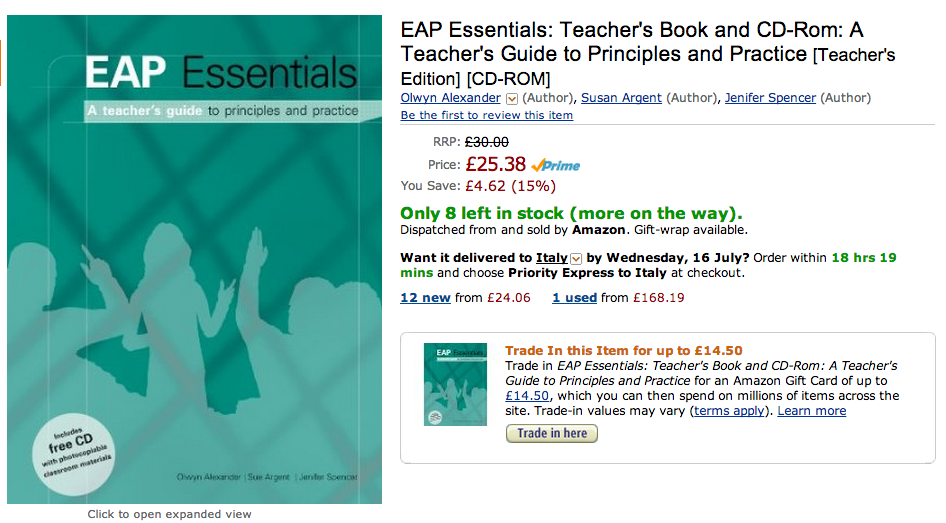
 EAP Essentials – by Olwyn Alexander, Sue Argent and Jenifer Spence.

EAP Essentials - essential in name, essential in nature...

EAP Essentials – essential in name, essential in nature… – screenshot from Amazon

This is a really useful book for anyone in EAP, whether new to it (as I am) or experienced (is my hunch) – it is a very interesting read, treating all aspects of EAP in great detail. It includes tasks throughout, which make you read actively, and a CD with lots of sample EAP materials on it. The materials are cross-referenced to in the text, and exemplify the authors’ perspectives on effective EAP teaching. The lucky teachers on the Sheffield Uni pre-sessional induction were given a free copy before Jenifer Spence proceeded to teach us how to teach EAP! I couldn’t benefit from this freebie, however, as I had already bought my own copy (last year), to try and learn a bit about EAP before applying for jobs…

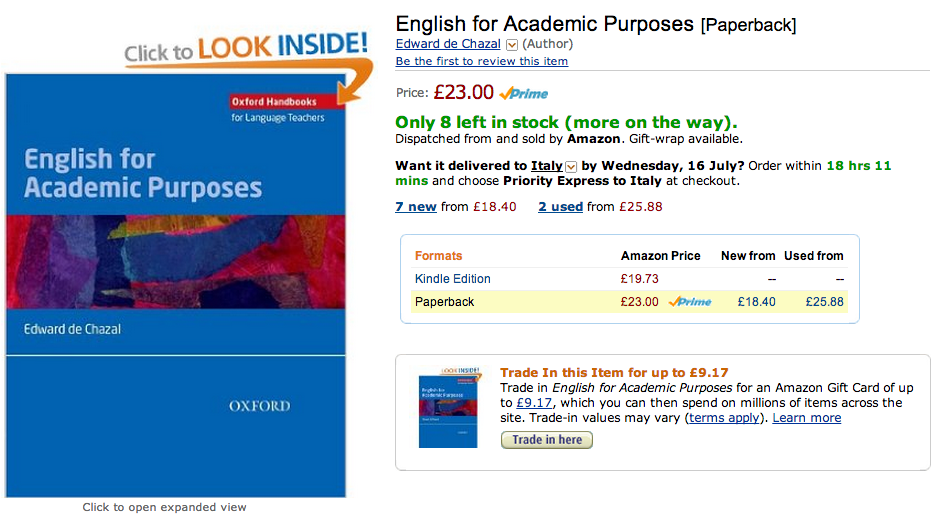
English for Academic Purposes – by Edward de Chazal

Another comprehensive tome...

Another comprehensive tome… – screenshot from Amazon

This comprehensive take on EAP has the added benefit of being available in electronic form. (Generally a good thing if you are in the habit of moving from one part of the world to another on a regular basis!) It deals with the history of EAP, methodology, language, criticality, skills and more.

Online Resources

 The Oxford University Press ELT Blog

Screen Shot 2014-07-13 at 20.56.34

OUP ELT EAP (!) – a screenshot of the search result page

On the OUP ELT blog, you can find a number of blog posts that are EAP-related. Click on the picture to be taken to the results of a search for these posts.

 Lexico Blog

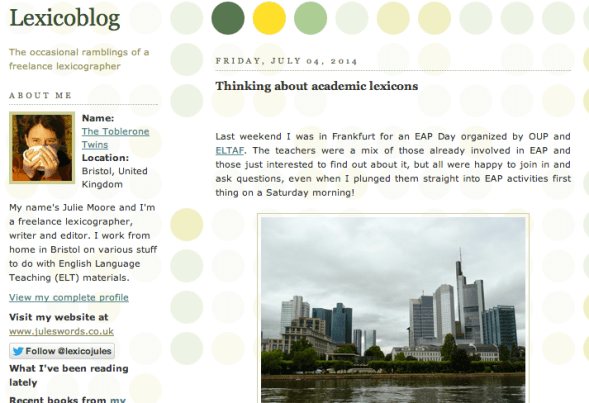
Lexicoblog - a screenshot of the homepage

Lexicoblog – a screenshot of the homepage

I first came across Julie Moore rather recently – at IATEFL, where I attended her brilliant talk . Since then, I’ve also discovered this blog of hers, which is full of high quality posts. Can be relied upon for good food for thought if you are EAP-oriented, or if you just like reading interesting things! In her blog, you can also find some information about the e-book she made for Teacher to Writer, How to write EAP materials. Which is another great resource for the list:

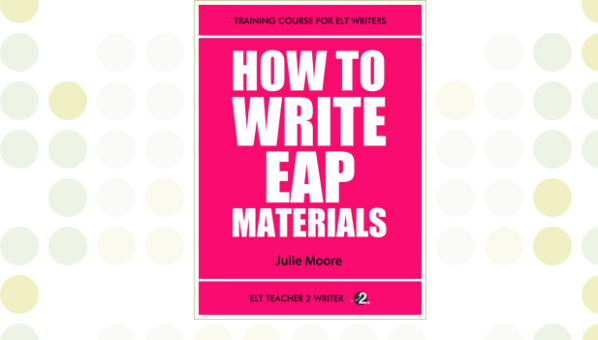
How to write EAP Materials

Screenshot from Julie's post about this wonderful book that she produced.

Screenshot from Julie’s post about this wonderful book that she produced.

Writing materials is something we all do a bit of, even if it’s just for us to use with our own students. This little book is a great way to improve what you create and learn more about EAP in the process! Highly recommended.

EAP Infographics

Screenshot of EAP Infographics

Screenshot of EAP Infographics

EAP Infographics is a project in progress by Adam Simpson, and an ingenious way of presenting EAP language and functions visually. Adam also gives you a run down on the what and how of making and using infographics here . Whether you use Adam’s visuals or start making your own, your students may well find the visuals helpful as a means of making the language and functions clearer and more memorable. They may serve to clear up doubts that learners have regarding meaning and usage too.

Wordandphrase.info 

A screenshot of Wordandphrase.info/academic

A screenshot of Wordandphrase.info/academic

This is a fantastic tool. It is an interface for corpus analysis, which enables the user to generate definitions, synonyms, collocates and concordance lines. There is a special academic section of the site, pictured above, which is where you want to direct EAP students to, rather than the general part of the site. This tool is helpful in pushing learners to become more autonomous, as you can deal with vocabulary-related questions by directing them to explore a word or chunk using this tool, rather than relying on you. If they use a word or chunk wrongly in their writing, you can also direct them to look at it using this tool and try to correct their mistakes independently. Hopefully this approach also makes the correct version more memorable, as more processing would go into the process of correction. Learners may need some guidance initially, as concordance lines can be a bit daunting. The great thing about the concordance lines generated by this site is that they are colour coded by word type, which makes picking out patterns that much easier.

Google docs

Screenshot of my Google drive!

Screenshot of (my) Google drive!

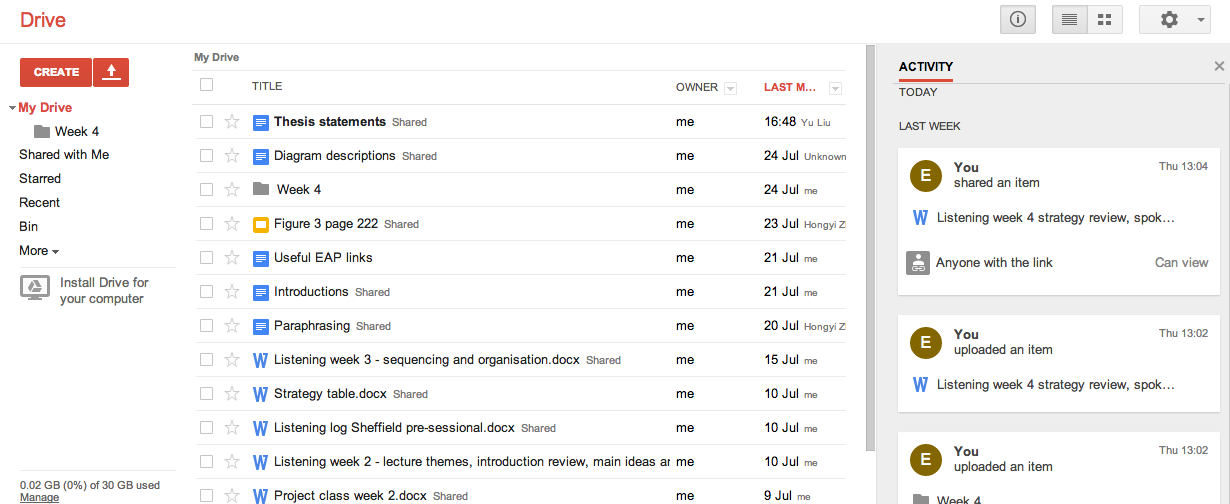
Of course Google docs is not aimed at EAP teachers and learners. It is aimed at and accessible to everybody. If you haven’t got a gmail account, why not make a dummy account so that you as a teacher have access to this valuable tool? Many universities give staff gmail university email accounts, so you might get one that way too! Google docs is a collaborative tool. It allows multiple users to edit documents simultaneously. It also includes a chat function and a commenting function. The combination of multiple editing and chat function means that it is ideal for group projects and the commenting function makes feedback very easy. I’ve used it a lot in my EAP writing classes recently – in class, students work in pairs or groups to do activities (e.g. write an introduction, write a paraphrase etc.), compare their output with the rest of the class and I comment on their output too. The end result is a collection of e.g. paraphrases commented on by the teacher, which can then be a resource for students to come back to, if they are struggling with the element in question. I get them to submit their homework this way too, so that it, too, can be compared and become a class resource. Students can learn from their own and each other’s mistakes. And, of course, unlike the usual scraps of paper that students seem to produce when they have to write anything down, or the haphazard notebook full of anything and everything, documents in google docs are easy to come back to and look at beyond the time of production.

Academic Vocabulary 

Screen Shot 2014-07-27 at 19.39.47

Screenshot of Academic Vocabulary

The University of Nottingham have made this brilliant website based on Avril Coxhead’s Academic Wordlist, which resulted from research she did into vocabulary used in an academic context. Nottingham Uni have developed a collection of tools that make the list even more helpful. For example, you can paste in a text and the site will highlight all the academic words. You can also gap those words out to create an activity for students to do. You could for example do this with a transcript from a lecture: get learners to listen and complete the gaps, thus focusing them on the academic vocabulary. Students could use this tool autonomously too, to help them build up a bank of academic words collected through looking at texts or simply by using the lists and sublists, as well as associated concordance activities.

Using English for Academic Purposes: A guide for students in higher education

Screenshot of Using English for Academic Purposes: a guide for students in higher education

Screenshot of Using English for Academic Purposes: a guide for students in higher education

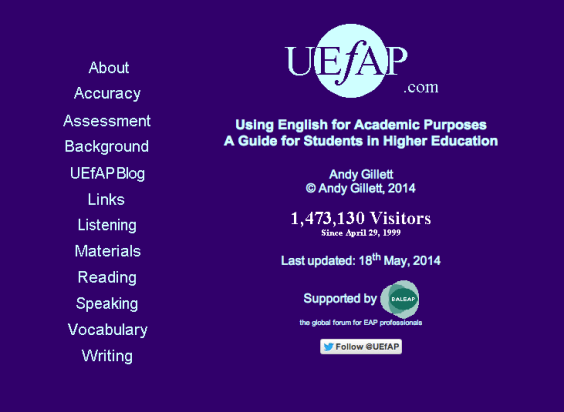
This comprehensive website could be of use to the teacher who is new to EAP and wants to learn more about it (ahem!) as much as for the students it is directed at. Why not divide up the site between your group of students, and get groups of them to explore each section of it. Give groups a little time to discuss what they found, then regroup the groups to present to each other about their section of the website. The next homework could be to try a different part of the website, based on needs, weaknesses and\or interests.

Useful EAP-related resources

Screen Shot 2014-07-27 at 19.30.04

Screenshot of my ‘Useful EAP resources’ post

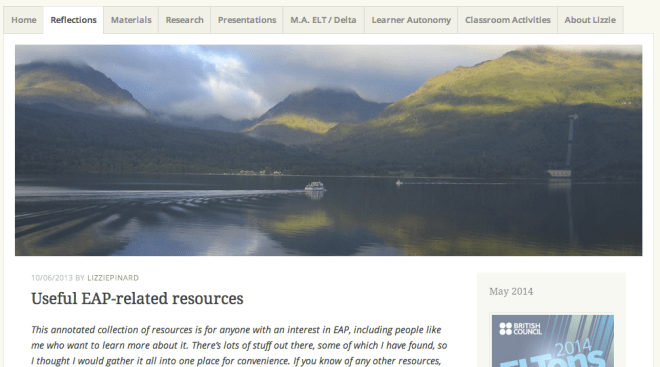
And finally, I am including this post, even though it’s number 11,  because in it are gathered a whole lot more links to EAP-related resources, that I started collecting over a year ago now, to help me find out more about EAP because I knew I wanted to work in a university this summer! 🙂 Happily for me, I made it! Currently working at Sheffield University and loving it. (Though it’s the reason why this blog has been so quiet! Turns out pre-sessionals are all-consuming for the most part! 😉 )

I hope you find these resources useful and please do comment with further resources to add to the list! I would love to know about them! 🙂


Julie Moore: How do Engineers say that? Encouraging academic independence in ELT (Session 1)

This is my first academic English session for the conference! I had intended to attend more, but as I have mentioned in previous posts, the best-laid plans of mice, men and conference participants… It is also the first talk of the day for the ESP SIG Day. We are shown the timetable and I realise I may  be back in this room again after the coffee break! That’ll save getting lost… 😉 Apparently they are also being recorded…

How do Engineers say that? Encouraging academic independence in ELT

Julie starts with thank-you’s and asking the audience to complete the feedback form at the end, and introduces herself.

She is going to talk to us about dealing with mixed-discipline classes and how to encourages students to be more independent. She asked us who are practising EAP teachers and most hands went up except mine – yet! She also asked about management roles and materials developers. Still not me… 😉 She acknowledges that we all want to get different things out of the day. (For me? to learn more about EAP!) She compares us to a mixed-discipline EAP class – going on to different things, with different objectives. The teacher/presenter has to (try to) keep all happy.

She shows us a wordle (word cloud) of the different subject areas of students on her courses. Some are more heavily represented than others, but there is a huge range. The course coordinator often doesn’t know till the last minute who will turn up. Institutional constraints mean they can’t be split up but must be taught in the same class, all with different needs, wanting to learn different things.

Principle no 1:

Identify key, transferable academic principles, features, skills and language: things that will be useful in any discipline. What will be useful to all of my students?

Principle no 2:

Give the students a clear rationale: explain to the students why you have chosen these things and why they are useful. This is a step that often gets missed out but is very important, as students may  not see the relevance. Materials writers should make it clear to teachers and students, teachers to their students.

Principle no 3:

Encourage students to apply general classroom ideas to their own discipline via independent study. We will see an example of how we can encourage students to do this.

E.g. 1 OUP Advanced writing module: A sequence of tasks leading to a writing task

Looking at the task of writing a critical response. Traditionally we teach essays, and essays do come up across discipline, but less common in hard sciences, but the other genre that occurs across disciplines is a critical response/critique/review. When Julie thinks of a critique she thinks of English literature, but students can critique all kinds of things, especially at advanced levels.

This activity presents students with examples (five in the book, three shown on screen), short examples of critique writing from different disciplines. Students asked to think about which discipline they are studying, topics discussed and stances taken. Within the examples, some of the language is in bold.

The first example is a science-y kind of subject. The review is a bit critical, a bit supportive – “significant uses”  but them it expresses limitations “not entirely consistent”: so this is getting students to think about how we evaluate.

So students start to see here that this style of writing occurs across disciplines. This is the very first task. You are showing them upfront that this something that all disciplines need to do. All the examples won’t be directly relevant to the student, but they can see the relevance of the activity. So this is an example of engaging the students upfront.

Identifying skills and features

Julie shows us a lesson sequence, with task headings that are focused on transferable features/skills rather than topics. This draws out skills and language, and how to use abstracts for writing and research. This may be from looking at examples not related to their discipline but then the final task is an independent research project where they are encouraged to find examples related to their discipline and focus on those abstracts. Which features studied in the lesson occur in the abstract and identify the language for describing aims.

But will they really do it? Maybe some of the conscientious ones. But the others won’t bother. Julie says that the important thing is to require students to report back. “Next class bring back what you have found, so you can report back” – that stops it being a throwaway task. (This fits right in with my thoughts/feelings/approaches re autonomy!) 

In a class of 14 students in Julie’s class, there were a total of 23 abstracts, ranging from law, business, electronic engineering, film studies, TESOL – quite a range. What they found was 12 used personal pronouns “I” and “We” – interesting as we often tell students not be personal but in this context, talking about aims, it IS common: important for reading and writing as well. 10 examples of reference to the text itself – “this article” and “this paper”. They also found some verbs for describing aims, some overlapping with what had been discussed in the above sequence from OUP and some new. E.g. examine, discuss, analyse etc

It got the students thinking about similarities and differences between theirs and other disciplines. With all these tasks, the discussion is more important than anything else, giving students time to explore their own discipline in relation to others, giving them the skills to start doing this themselves: transferable skills, helping them to move towards a more autonomous position. You help them develop the skills to explore and analyse for themselves.

(I love this!! So inline with my beliefs!)  

Five minutes for questions: (paraphrased…)

Q Are your students mostly post-graduate students? A lot of my students probably wouldn’t have that sense of their own discipline. 

A: The book we were working on was for Advanced level, so aimed more at post-grad students. You could do it a little bit. One of the reasons we focused on abstracts is that they are freely available, so even if they aren’t attached to a uni yet and don’t have access, then it’s still possible for them to start to explore a little bit. They can still explore texts from their own area.

Q: Presumably you as the teacher could bring in a pile of abstracts to help them, as they may not have the skills to find these themselves. 

A: Yes, you could absolutely.

Q: I was just reflecting on what you were saying about throw-away tasks – I think I’m guilty of this – I think a lot of that comes from nervousness thinking that we need to know about all the disciplines. I’d get nervous that I’d get all these abstracts back the next time and none of them would fit together etc. Any advice for setting up that second task?

A: I think for me it’s just about having confidence in what you do know and being perfectly happy to admit what you don’t know. E.g. this law student who brought in bizarre abstracts that I didn’t understand because of the legal language. All I could say to him was “that’s interesting” but other law students had brought more conventional ones and we explored the reason behind the differences and we came to the conclusion that it was a specific journal with a specific style. Release control, not worry too much and be able to admit that you don’t know. I don’t think you always have to have an answer. You just deal with the things you can deal with.

Audience member comment: Students enjoy explaining at a higher level what they know to students from a different background, when you put them in groups to discuss.

Students are a wonderful resource!



Helping language learners become language researchers: wordandphrase.info (part 1)

What is wordandphrase.info?

Wordandphrase.info is a brilliant website. Essentially, it is a user-friendly interface for analysing a corpus. (For those of you who haven’t come across this term as yet, a corpus is a collection of texts stored electronically.) In this case, it is the COCA (Corpus Of Contemporary American English) corpus, a 450 million word corpus. It is the largest corpus that is freely available, was collected between 1990 and 2012 and contains texts from spoken, newspaper, fiction and academic registers.

Due to its user-friendliness (colour-coding for different parts of speech in the examples, colour-coding for frequency in text analysed etc.), wordandphrase.info seems ideal for use with students, a tool that could help them become more independent, by providing a means of discovering how language is used, that doesn’t rely on the teacher.

It provides information like:

  • frequency of word or phrase use (within the top 500 most-used words, 501-3000, 3000+)
  • frequency of word or phrase use within particular genres (spoken, newspapers, fiction, academic)
  • definitions, synonyms and collocates (for which it also provides frequency information, making it a very powerful collocational thesaurus, for phrases as well as words)

It allows you to:

  • input (type in or copy and paste) a paragraph of text and see at a glance (through colour-coding) how frequent words are.
  • search for a phrase from that inputted text, by clicking on the component words and generate examples of that chunk of language in use.
  • look at a list of colour-coded examples and identify, at a glance, what types of words are used before and after the word in focus (nouns? adjectives? adverbs? prepositions?), with a rough indication of frequency (in terms of how much highlighting of a particular colour you can see in comparison to another) too.

All in all, it enables you to gain a  better idea of the meaning and use of a word or phrase, as well as its potential alternatives.

However, when learners first meet it, it might seem daunting:

  • When you search commonly used words or phrases, large numbers of examples may be generated: this may be confusing for learners, especially as the examples are portions of sentences (x number of words around the word being analysed) rather than complete sentences, and are devoid of context.
  • Before the colour-coding for parts of speech can help you, you need to understand what it means!
  • There is a lot of information on the page – it can be difficult to know where to start.

How can we use this website with learners?

This is something I am still exploring. I think it has massive power but the limitations need managing carefully so that they don’t put students off.

I have already created some self-access materials (inspired by a course mate of mine – see below for more details) which guide learners through using the site, through a series of tasks, and help them to discover what they can do with it. My learners (of various levels) have used these materials and many were able to complete the tasks without too much difficulty. Some learners independently shared information they found via using the site, using our class blog. However, for the most part it “gathered dust”. 

While my materials address the “how” (at a basic level – there is more that the website can do, that I am still finding out!), they don’t help learners become better at identifying the patterns that are present in the examples generated. Perhaps in order for learners to use wordandphrase.info successfully and really harness its power, in-class scaffolding is needed, in the form of using concordances with learners, getting them to produce word profiles and generally developing their noticing skills. Of course, as teachers we are always trying to help learners develop better noticing skills, but we usually work with texts, complete with some kind of context, rather than with sentence fragments devoid of context. Transferring these noticing skills, then, may not be achieved automatically.

One of my aims in the next couple of months is to create some activities using concordances and other information from Wordandphrase.info and use them with my learners, to give them more scaffolding, and help them to develop their use of the site independently, as language researchers. I hope to integrate it so that learners use it to find out  more about the vocabulary we meet in class, as well as encourage them to apply it to language they meet out of class. What I create and how I get on with this project will form part 2 (and onwards?!) of this series of posts.

Here are the materials I have made:

Wordandphrase.info self access  – a guided discovery tour of the website, with an answer key at the end. If you aren’t familiar with the site, these might be as useful for you as for your learners?! 🙂

These materials were inspired by a course mate of mine at Leeds Met , Jane Templeton, who made some guided discovery materials to help learners use wordandphrase.info  to choose mid-frequency vocabulary from texts they encountered, as these mid-range words provide a useful learning focus, and to find out more about their choices. I wanted to use wordandphrase.com with my learners too, but wanted a more general purpose intro to the features of the site, rather than geared towards that particular purpose.  So it was I made my materials, with the example word “outfit” – which may seem a rather random choice! – taken from the page of compounds learners meet in Headway Advanced Unit 6. Though, one might well question whether guiding learners towards a particular purpose, as in Jane’s materials, might be more useful than my vaguer, more general approach… <answers on a postcard!>

How can this website help *you*, the teacher?

Wordandphrase.info enables you to:

  • copy and paste in a text that you want to use with your learners and see at a glance what percentage of high frequency (top 0-500), mid-frequency (500-3000) and low-frequency (outside the top 3000) words are present in your text and so an indication of what difficulties it is likely to present to your learners.
  • You could use this information to guide you in decisions regarding what words to pre-teach, what scaffolding your learners might need when they meet this text, or perhaps what words to adjust to more frequently used synonyms (something else the site can help you find, as it provides both synonyms and frequency information, as well as examples of use, if you are unsure whether you have found the right alternative) if you feel that would be more appropriate, depending on your goals in using the text and the level of your learners.

Conclusion:

Wordandphrase.info is a site with a lot of potential for language learners and teachers alike. I’m still learning how to use it and finding ways to tap that potential. Please let me know how you get on with using the materials I have uploaded here, and the website, whether yourself, or on behalf of your learners – I would be very interested to hear! I would also be interested to hear any ideas, you have and try out, for integrating use of Wordandphrase.info, in any context, and how it has benefited your learners.

Useful EAP-related resources

This annotated collection of resources is for anyone with an interest in EAP, including people like me who want to learn more about it. There’s lots of stuff out there, some of which I have found, so I thought I would gather it all into one place for convenience. If you know of any other resources, which are not included here (and I am sure there will be plenty!), please do comment on this post with a link to the resource and a short description of what it contains, so I can add it to this list – such contributions would be much appreciated!

Blogs

This blog goes with the #eapchat hashtag on Twitter, which was founded by Tyson Seburn (@seburnt). Discussions are had on the first and third Mondays of every month, at 9 a.m. and 3p.m. EST. In between these times, plenty of interesting links appear in the hash stream.

This blog’s tagline is “Polemical. Questioning, debating and exploring issues in EAP” – says it all really! A lot of interesting stuff related to EAP there to get your teeth into.

This blog describes itself as “The diary of an EAP practitioner on a journey to self-educate”  – and the author has been in EAP since 2009. An interesting mixture of things EAP-related to read.

This blog carries some useful posts for people who are trying to get work in EAP – and of course the website itself is where a lot of universities advertise their jobs. The blog describes itself thus: “This blog covers a wide range of topics within English for Academic Purposes (EAP) including English language learning and teaching (ELT) and English for specific purposes (ESP).

Ana Christina’s blog has a page devoted to EAP-related links, including links aimed at students, and lots of other interesting stuff to look at besides.

A blog with reflections on EAP, kept by Steve Kirk – some really interesting stuff, well worth a visit.

Individual Blog Posts

This blog post contains some useful tips for academic listening preparation.

Adam Simpson’s blog post investigates what we should be asking ourselves when we teach EAP.

This blog post looks at the role of humour in university learning. Can students be trained to laugh? Read on and find out…

Websites

“A global forum for EAP Professionals” , BALEAP offers institutional and individual memberships which entitles you to a bunch of interesting stuff (I’m about to join, actually!). They also run various conferences and events.

This is a collection of links to various EAP resources, curated by @PatrickAndrews, including blogs, websites, articles and newspaper articles. Lots to explore!

This is a bibliography related to learner corpora and forms part of a website belonging to the Centre for English Corpus Linguistics. The list and the site itself look to be very useful.

This Scoopit page, curated by Steve Kirk, contains a variety of informative resources for EAP Practitioners. Lots of interesting stuff to go at here!