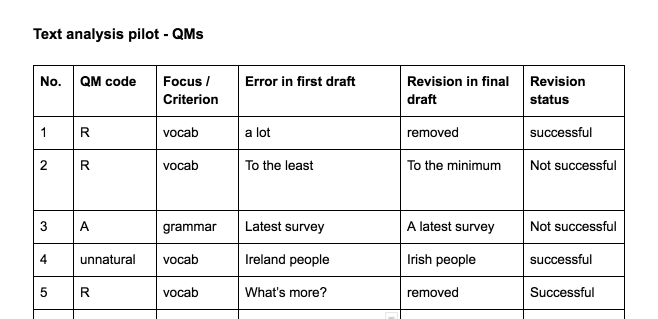
2024 – and what have I done?

It seems odd to think another year has elapsed. Feels like it began simultaneously yesterday and a million years ago! We are in our final week before Christmas. It is a non-teaching week but there are still plenty of other tasks to be done. I decided that one of mine is to look back and reflect on what I have done this calendar year…

Teaching:

  • The January cohort seems a long time ago but they completed their course between January and August this year. JFPH02 (January, Foundation, Physics, Group 2) was my group. They were a very mixed level group and a nice mixture of nationalities were represented. There were 19 of them but their attendance was abysmal so for F2F classes (of which there are 2 a week) it seemed as though I only had a much smaller group. A rotating cast of characters appeared each lesson, with only one or two whose attendance was much more consistent. Attendance was reflected in assessment scores! Low attendance was generally due to students struggling more on other modules and choosing to dedicate more time to them (or oversleeping and missing the 9am as a result of burning the midnight oil in that dedication!). It was frustrating and difficult, but I did my best with the situation, ensuring that those who attended benefitted from it, and ultimately that is all I can do.
  • This semester, I also did some teaching on a programme which consisted of 1-1 lessons on Google meet to women in a location with poor internet connectivity and limited options. They were speaking-focused lessons, with the other course component being app-based learning materials released each week. The 1-1 speaking sessions were based on the topic of the previous week’s materials. It was a very rewarding programme to participate in, as well as very intense (somewhat unsurprisingly)!. It was a very different kind of teaching to the kind I usually do and it was good to have the opportunity to experience it.

ADoSing

I started ADoSing in April 2018 so a fair bit of time ago now – over 6 years. Work is in flux at the moment and we aren’t sure how things will look on the other side but nevertheless this year I did another iteration of ADoSing the January cohort, with my co-ADoS. This included:

  • preparing January course materials
  • preparing and running induction sessions about our programme for the teachers joining us to teach on the January cohort
  • preparing and running weekly module meetings with the January cohort teaching team
  • preparing and running standardisation sessions for three pieces of coursework (reading, writing, speaking) and one exam (the speaking seminar discussion exam)
  • checking rubrics and .rbc files for coursework submissions
  • preparing Turnitin coursework submission points on Blackboard for two pieces of coursework
  • preparing Blackboard announcements for students, relating to coursework, mock exams, real exams, results, tutorials. Many of these include multiple versions due to reminders.
  • responding to queries from teachers
  • attending weekly ADoS team meetings
  • preparing writing exam standardisation materials
  • correcting any errors that show up in course materials
  • preparing submission points, Blackboard announcements, email templates and information packs about resits
  • generally ensuring the smooth running of the January cohort AES programme (to include all the other tasks not in this list but that nevertheless get done!)

This semester, while not actively ADoSing, I have:

  • co-led an SpLD project which involved preparing preview materials for students and listing content topics to act as a trigger warning.
  • worked on development for the 2025-2026 academic year course materials
  • been part of the process of deciding how to integrate the existence of AI into our assessments and course materials
  • started preparation for another January cohort which lies just around the corner!

One thing I will say about ADoSing, it is a good test of organisational and time-management skills! You have to always be thinking many weeks ahead of the current week so that everything is in place when it needs to be and all communications happen when they need to happen. You also need strong attention to detail as there are so many tiny bits of information in so many different documents (and also in things like submission points) in different locations with the potential to create big problems if done incorrectly.

Development

I’ve already written a post about the development I’ve done this calendar year so I will just mention some highlights here:

  • Instructional design course – 10 week course, now completed!
  • FutureLearn expert track on Autism (4 x 4 week courses)
  • Several online sessions about supporting students with SpLD and students with Autism
  • AI – focused sessions run by our digital lead (attended a combination of live online and via catching up on recordings)
  • Hatching a plan to do an EdDoc and doing some preparatory reading (lots more to go but the instructional design course maxed my development hours this semester! Still, there’s time! I’m not starting it until at least 2026-2027 academic year!)
  • Other than the above, I have also finally started blogging again, which I am really enjoying. I had forgotten about the joys of informal publication!

So, it’s been a pretty busy year, as ever! Another January cohort safely shepherded through two semesters. Plenty of teaching, ADoS tasks and professional development. A lot of learning.

Being as it is the 19th December and tomorrow is the last working day before Christmas break, I’m going to go out on a limb and say this is probably the last blog post for this year! I will look forward to picking it up again in the new year.

Thanks to all who have read and commented on this year’s posts. Merry Christmas to those who celebrate it and a happy 2025 to all!

What do you do in the first week of a new course?

(This post may seem somewhat counterintuitive at the end of a semester, just before the Christmas break, but I am looking ahead to our new January cohort who are beginning in the new year, which actually isn’t so very far away!)

I always love the first week of a new course. Our courses follow a blended approach with Semester 1 being 10 weeks at 6hrs of learning per week, divided up into 2 x 1hr online lessons and 2 x F2F lessons, and Semester 2 being 12 weeks at 5hrs of learning per week, divided up into 1 x 1hr online lesson and 2 x 2hr F2F lessons. In Lesson 1, we introduce the course, reviewing its structure, how they will be assessed and how to navigate the VLE (Blackboard). In Lesson 2, students attend a tech induction, to familiarise them with how to use Blackboard Collaborate (for the online lessons) and the Google Suite. In the 2 F2F lessons, students learn about the asynchronous learning content, including establishing the importance of it and guiding them through accessing it, and write a letter to the teacher introducing themselves. All remaining time in the F2F lessons is dedicated to getting to know you activities. There is one provided but teachers are free to use the time as they wish.

These are the activities that I always try to include in Week 1, together with an explanation of why:

In addition to the core content of the Week 1 lessons, there are some elements that always feature in my Week 1 lessons. Here they are:

  • The name game: Like the shopping list game where items are added at every turn, but in this case the items are a student’s name and something they like. This is generally the first activity in the first F2F lesson.

Learning students’ names is hugely important in establishing a rapport with them and being able to interact with them as individuals. For me, the easiest way to achieve this is by playing the name game with them. This is because as well as supporting students when they can’t remember a name or a like here and there, I am constantly repeating the information in my mind along with them. A class’s worth of repetition really helps to get the names embedded in my brain. As well as allowing me to learn their names, they get to know each other’s names as well which is helpful in the process of becoming able to work together effectively.

  • Focus on pair-work and group-work: This starts with a describe and draw activity where, in each pair of students, one student describes a picture that the other must draw without sight of it. The describing and drawing stage is followed by a brief evaluation, in groups, of what is produced and what is missed. Finally, students, in groups come up with a list rules for effective group work.

Pair and group-work are a core part of our lessons, but may not have been much of a feature in students’ previous learning. The describe, draw and evaluate portion of the activity is light-hearted and provides a low-stakes way to experience pair-work and group-work. It also provides inspiration for the following part in which students come up with their rules. These rules can be referred back to in subsequent lessons when students take part in pair-work and group-work activities. For neurodivergent students particularly, a clear understanding of what is expected in group-work, with rules to follow, can help to alleviate anxiety.

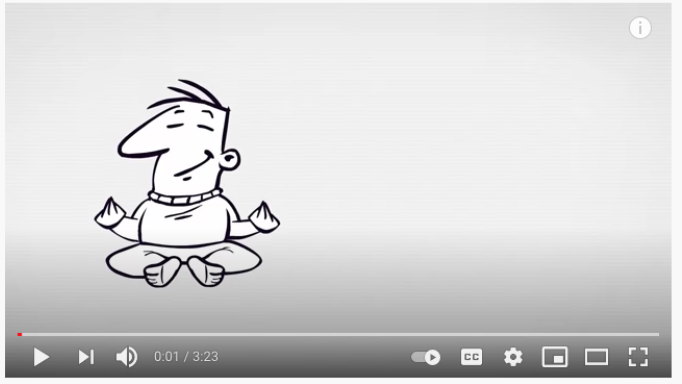
  • Introducing Mindfulness meditation: I start this sequence by showing a still (see below – and click on the link if you’d like to watch the clip!) from a short youtube clip about mindfulness meditation and its benefits, and asking them what they think the video will be about. They then watch the video and make notes, which they use to answer two key questions: What are the benefits of mindfulness? Which of those benefits would be most useful for you? In the final part of the sequence, I show the students the wording of an example short mindfulness meditation and suggest we try it, with me saying the words. Afterwards I ask them how they feel and finish by suggesting that we start each F2F lesson by doing it.

I have been using Mindfulness Meditation with students for some years now and remain convinced that it is beneficial for them. When they come into a lesson, their minds are all over the place – other lessons, assignment-related stress, workload, future plans etc – and doing a short guided meditation at the start of the lesson gives them a few moments of transition time, to really arrive in the lesson. Neurodivergent students particularly struggle with transitions so this is one way to make the switch from one lesson to another less abrupt and painful. The effect is always a class of students who go from being distracted by each other, their devices, their thoughts to being focused, calm and ready to learn. I introduce it the way I do (described above) to give them the opportunity to learn about and experience some of the potential benefits of meditation and evaluate which of those they would most benefit from, thereby turning it from being a random thing that is imposed on them to being something that they understand as beneficial to them. I do this in the first F2F lesson so that the second F2F lesson can already begin with it – start as we mean to go on! As we do the meditation at the start of every F2F lesson, it also becomes one of the many little routines which enable a secure, stable classroom environment for students.

  • Focus on strategies for effective studying: “How can we study effectively?”: This is a simple activity – students work in groups (getting to practise using the group-work rules they have already established) to make a list of strategies. Then, after eliciting all of theirs, I share some of my own.

Students generally come up with ideas that centre around study-skills, time management, organisation, collaboration and the like. My list contains some of those but also focuses on wellbeing, so for example “take breaks”, “exercise”, “meditate”, “try to get plenty of sleep”, and psychology, for example “have a growth mindset” and “tell your teacher when you have a problem”. Each item is accompanied by a brief explanation. Students’ two semesters with us are going to be loaded and stress levels are likely to be high, so looking after themselves is critical to being able to study effectively.

  • a speaking-focused icebreaker: this is less set in stone. My current go-to, though, is “Interview a classmate and then introduce them to the class”. Nothing spectacular, the task is scaffolded by a handout which guides students through question preparation and provides space for notes to be made during the interview. Students then use those notes to tell the class about the classmate they interviewed.

Speaking-focused icebreakers are useful for two key things: giving students the opportunity to learn more about one another (as well as me to learn more about them!), and giving me a reasonable starting idea of students’ speaking abilities. With the above-mentioned activity, I can listen in to their interviews to hear unprepared responses and then the feedback stage demonstrates what they can do with a bit of preparation and some notes. Of course I also get to learn a lot about them as people which is lovely. Happily, remembering it all isn’t critical because the “Letter to the teacher” activity which is part of the core content provides a similar swathe of information in written form. Both the speaking activity and the writing activity inform the initial RAG (Red Amber Green) rating we give students at the start of the course.

Why is Week 1 important?

Week 1 sets the tone for what is to follow. At the end of a good Week 1, you have a class who have started to mesh and who are prepared for what lies ahead. They know a bit about what is expected of them and a bit about what they can expect from your lessons. They feel positive, encouraged, comfortable, respected and this means their brains will be more open to learning. You also have a teacher who knows their students’ names and has started to get to know them as individuals, a rapport being built. These are the foundations of a successful course of study. Also, and I think you will agree, there is nothing like the excitement tinged with nervous anticipation of embarking on Week 1 and meeting your new group of students!

Over to you

What do you always do in the first week of a course with a new group of students? Why? Tell me all about your go-to activities for Week 1 using the comments function – I’d love to hear from you (well, read anyway!).

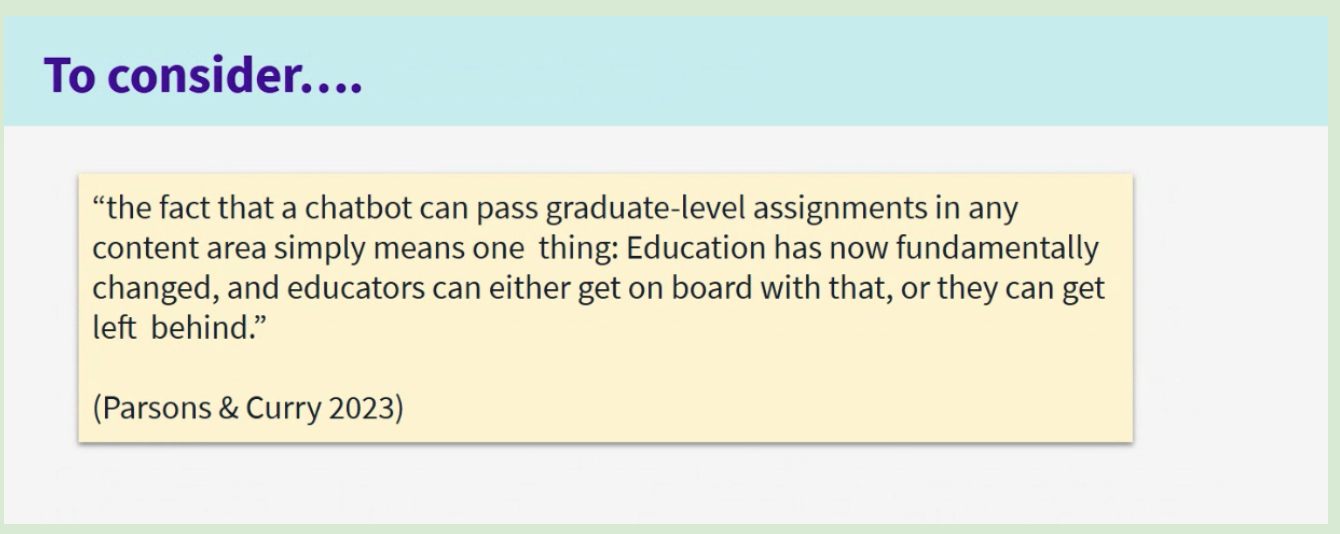
Generative AI and Assessment

A session about Generative AI and EAP that I attended recently provided the above quote for our consideration. I think one of the things that is challenging about the Generative AI landscape and its presence in the context of higher education is that it evolves so rapidly. This rapid evolution contrasts starkly with much slower-moving policy-making and curriculum development processes. Certainly in my current context, this issue of becoming “left behind” has been one that we have been grappling with for a few years now. Initially, there was a period where once generative AI had emerged into existence, all we could do was watch, as it became increasingly apparent that students were using it in their assessments, while awaiting a university policy to inform our response. An extra layer of waiting then ensued because as well as being university policy-informed, we are Studygroup policy-informed. During that wait, our response to generative AI had to be “No. You can’t use this tool. It is against the rules. It will result in academic misconduct.” Of course, being as assessment in pathway colleges is high stakes (the deciding factor in whether or not a student can access their chosen university course), students use it anyway, due to running out of time, due to desperation, due to self-perceived inadequacy.

Now, we have the university policy which centres on ethical and appropriate use of AI, and acknowledging how and where it is used, and, in cooperation with Studygroup, are figuring out how to integrate AI use into our programme. We started by focusing on one of our coursework assessments, an extended essay, and discussing what aspects we thought were and weren’t suitable for students to use AI to help them with. So, for example, we thought it acceptable for students to do the following in their use of AI:

  • generate ideas around a topic, which they could then research using suitable resources e.g. the university library website and Google Scholar.
  • ask AI to suggest keywords to help them find information about the topics they want to research.
  • ask AI to suggest possible essay structures (but not paragraph level structure)
  • generate ideas for possible paragraph topics
  • get AI to proofread the essay but only at surface level, to suggest language corrections (this would only be the case if we no longer gave scores for grammar and vocabulary so will require rubric-level change)

Of course we can’t just implement this, we need to go through the process of getting approval from Studygroup for it and then building it into our materials. We can’t just expect learners to meet our expectations with no guidance other than the above list embedded in an assignment brief. Much like was discussed in the AI and Independent Learning webinar, we need to help the students to develop the skills that they need in order to use AI appropriately and effectively. This will include things as basic as how to access the university-approved AI (Gemini) and how to use it (including how to write prompts that get it to do things that are helpful and appropriate and equally avoid accidentally getting it to do things that aren’t helpful or acceptable). Also important will be raising their awareness of ethical issues surrounding the use of AI and of its inbuilt bias, as its output depends on what it has been trained on and there is always the risk of “hallucination” or false output. They will need to be cognisant of its strengths and weaknesses, and to develop an ability to evaluate its output so that they don’t blindly use or base actions on output which is flawed. Their ability to evaluate will also need to extend to being able to assess when and when not to use it, and how to proceed with its output.

All of the above is far from straightforward! When you look at it like that, it’s little wonder that left to their own devices students use it in the wrong way. So, in order to have an effective policy regarding the use of AI, there is a lot of preparation that is required. That skill-development and awareness-raising needs to be built in throughout the course into all relevant lessons. And that means a lot of (wo)man hours, given our course materials are developed by people who are also teaching, coordinating and so on. In addition, teachers will need sufficient training to ensure they have the level of knowledge and skill necessary to successfully guide students through the materials/lessons where AI features. The other complicating factor is that the extent of the changes means that new materials/lessons cannot be implemented part way through an academic year as all cohorts of a given year need the same input and to take assessments that are assessed consistently through the year. So, if we are not ready by a September, then we are immediately already looking at a delay of another year. It is a complex business!

So, I absolutely agree with the quote at the start of this post but I think it is also a LOT easier said than done. As developing an approach in a high stakes environment takes time but generative AI and tide wait for no man. By the time we reach the stage of being able to implement our plans fully, they will probably need adapting to whatever new developments have arisen in the meantime (already there is the question of Google Note and similar which we have not yet addressed!). For sure, the assessment landscape is changing and will continue to change, but I do believe that we can’t rely on “catching students out” e.g. with AI detection tools and the like. We need to support them in using AI effectively and acceptably, so that they can benefit from its strengths and be able to use it in such a way as to mitigate its weaknesses and avoid misuse. Of course, as mentioned earlier, to be able to do that, we, ourselves, as teachers, need to develop our own knowledge and skills in the use of AI so that we can guide them through this decidedly tricky terrain. Providing training is a means of ensuring a base level of competence rather than relying on teachers to learn what is required independently. Training objectives would need to mirror the objectives for students but with an extra layer that addresses how to assist students in their use of AI, and how to help them develop their criticality in relation to it. Obviously there will be skills and knowledge that teachers have that will be transferable e.g. around criticality, metacognition and so on, but support and collaboration that enables them to explore the application of them in the context of AI would be beneficial.

Apart from the issue of addressing AI use in the context of learning and assessments, in terms of not getting left behind, we also need to ensure that what we are offering students is sufficiently worthwhile that they continue to come and do our courses rather than deciding to rely on AI to support them through their studies, from application through completion and side-stepping what we offer. But that’s for another blog post!

I would be interested to hear how your workplace has integrated use of AI into materials and lessons, and recognised its existence (for better and for worse) in the context of assessment. I wold also be interested to hear how teachers have been supported in negotiating teaching, learning and assessment in an AI world. Please use the comments to let me know! 🙂

Supporting autistic students (Carly Miller, Leeds University)

On 29th November 2023, I attended a webinar, “Supporting autistic students”, run by NATESOL and delivered by Carly Miller, who is a disability coordinator at Leeds University. This post will use the slides she so kindly provided to summarise the session and reflect on what she said, relating it to my own experience and practice.

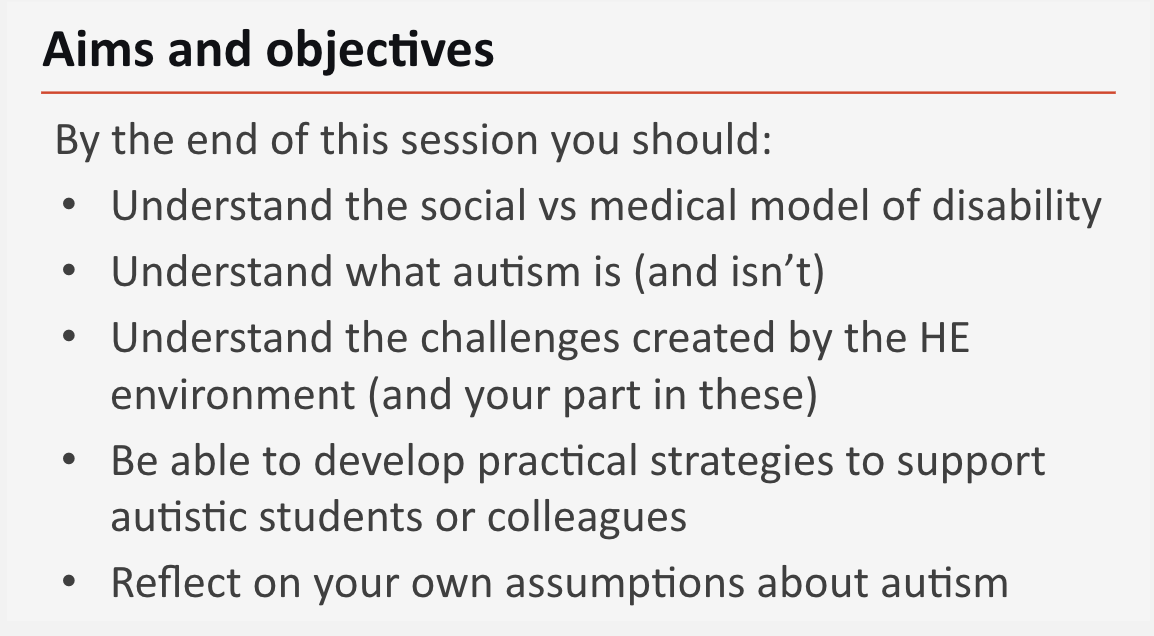
These were the aims and objectives:

Carly started with defining the social and the medical models of disability:

In the medical model, the disability itself is the barrier, while in the social model it is the environment and society that create the barriers. Of course the session being delivered by Carly ascribes to the social model given that it is to raise awareness of autism and how to make there be fewer barriers for autistic students.

Next was the definition of autism:

Here is a very helpful explanation of how the autism spectrum works, explaining that it is not linear (and nowadays labels such as “high-functioning” and “low-functioning” are increasingly being moved away from) and illustrating how someone with autism usually has a spiky profile in terms of challenges and strengths. There is thought to be a genetic component but not a straightforward “this gene makes this happen” one. There is no cure. Going back to the disability models, in particular the social model of disability, many problems experienced by autistic people arise from trying to operate in a neurotypical world with a brain that perceives things differently from neurotypical brains. Hence this session.

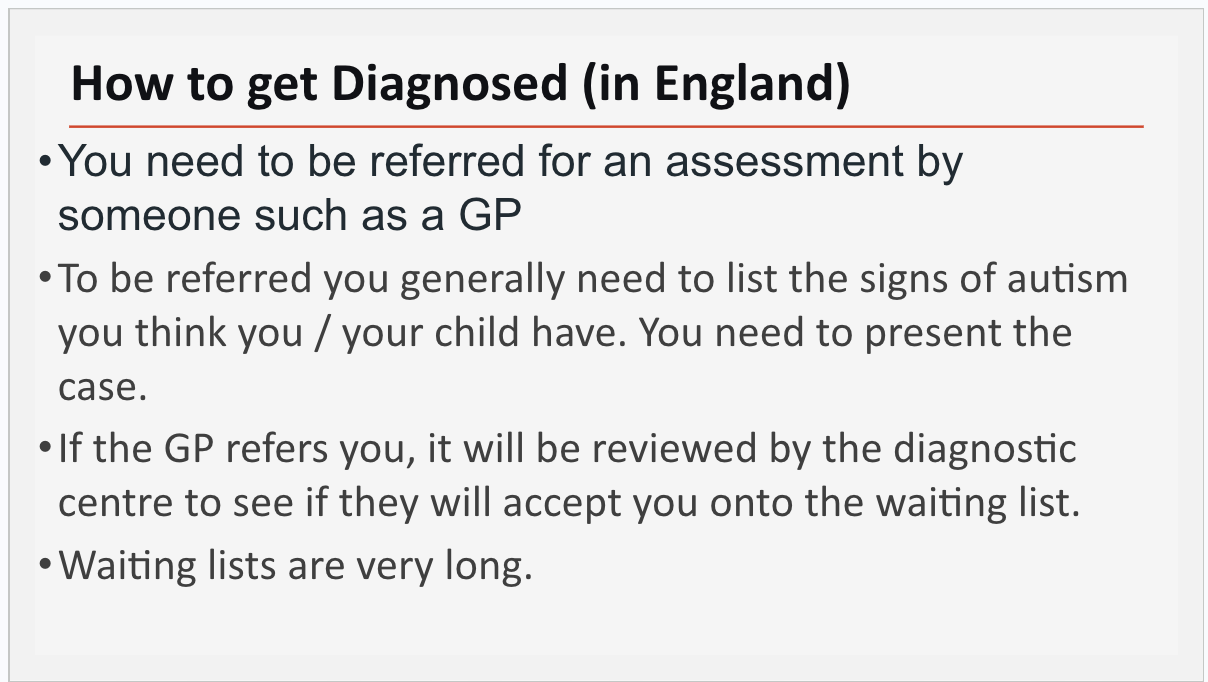
Next Carly explained the diagnosis process in England:

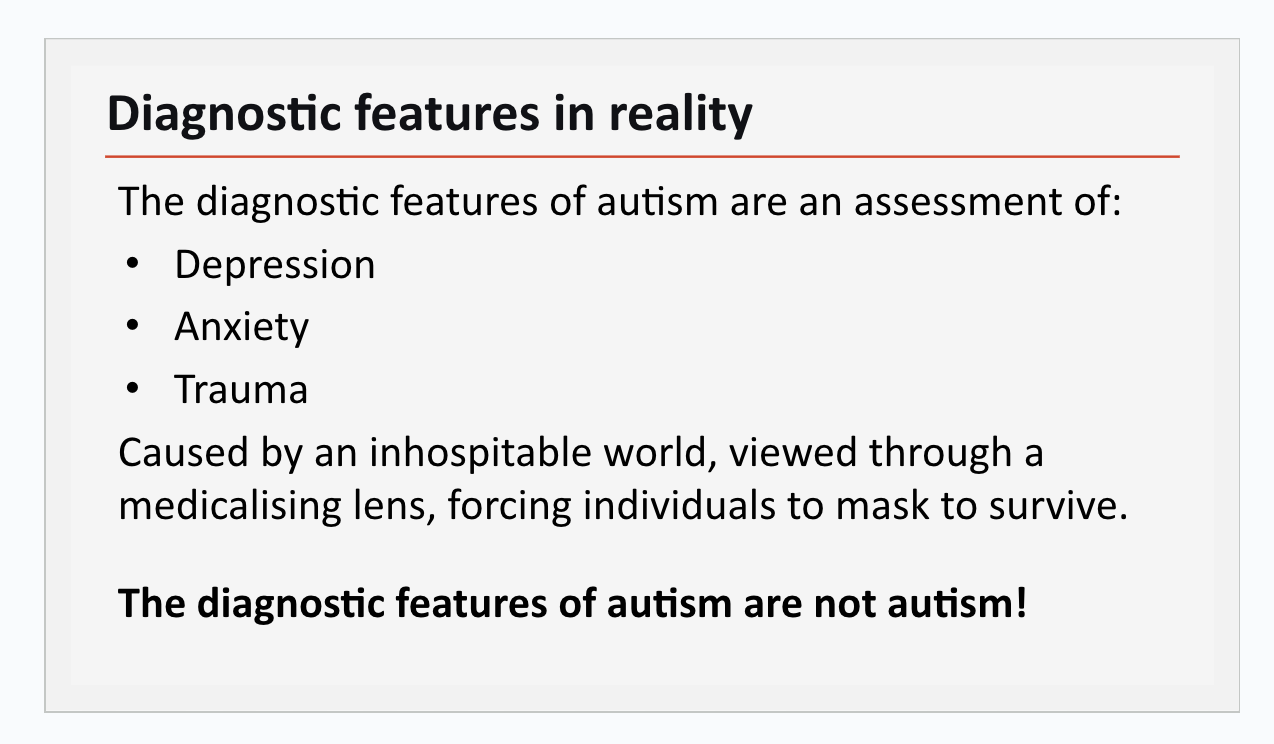
As is clear from the above, it is difficult to get a diagnosis. Carly told us that she has been on the waiting list since she got on to it after the pandemic, having noticed during the pandemic various aspects that made her suspect she was autistic. As with everything NHS-related, it takes a long time. For example, I saw my GP on the 7th November and got referred to be assessed, but at the time of writing have yet to know whether I have been accepted on to the waiting list! Fortunately, at the university, despite not having a diagnosis yet, I have been able to request and get a reasonable adjustment in place to alleviate my sensory sensitivities (one of the possible elements of autism). Carly also suggested that depression, anxiety and/or trauma are frequent consequences of being autistic and may lead to it being diagnosed but that they are not autism, they are just the result of the way in which autistic individuals must operate in a neuronormative world, in which we are viewed through a medicalising lens:

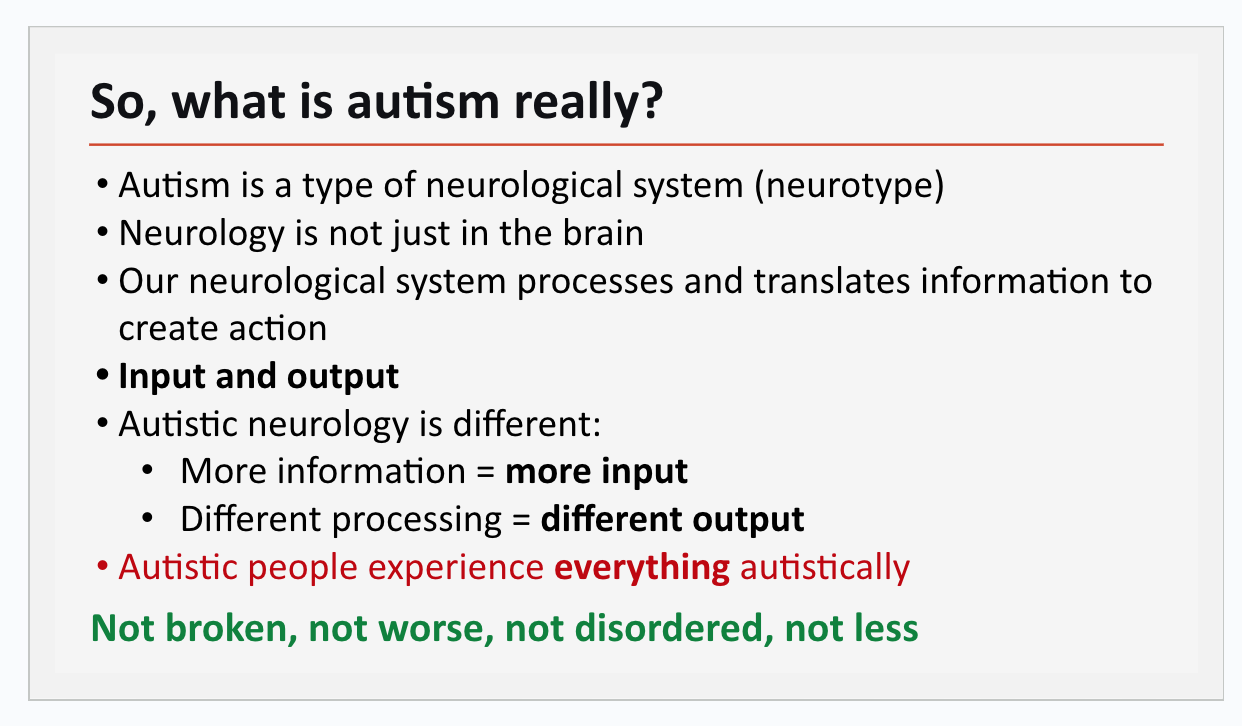
So…what is autism then? Here is Carly’s summary of it:

Autism is a type of neurology/neurological system. Autistic brains take in more information and they process it differently, resulting in different output. Different rather than worse/broken/disordered. Diagnostically, however, the criteria are framed as deficits/viewed negatively and that is linked to the historical evolution of autism and autistic brains as a concept. (Asperger and Kanner are the earliest people to have worked on it scientifically, and at the time Eugenics was very dominant…). According to Carly, approximately 1 in 100 people are diagnosed as autistic but that is potentially a huge underestimate. (Somewhat unsurprisingly given the barriers to getting diagnosed.) Part of the underestimate relates to what she discussed next – autism and females:

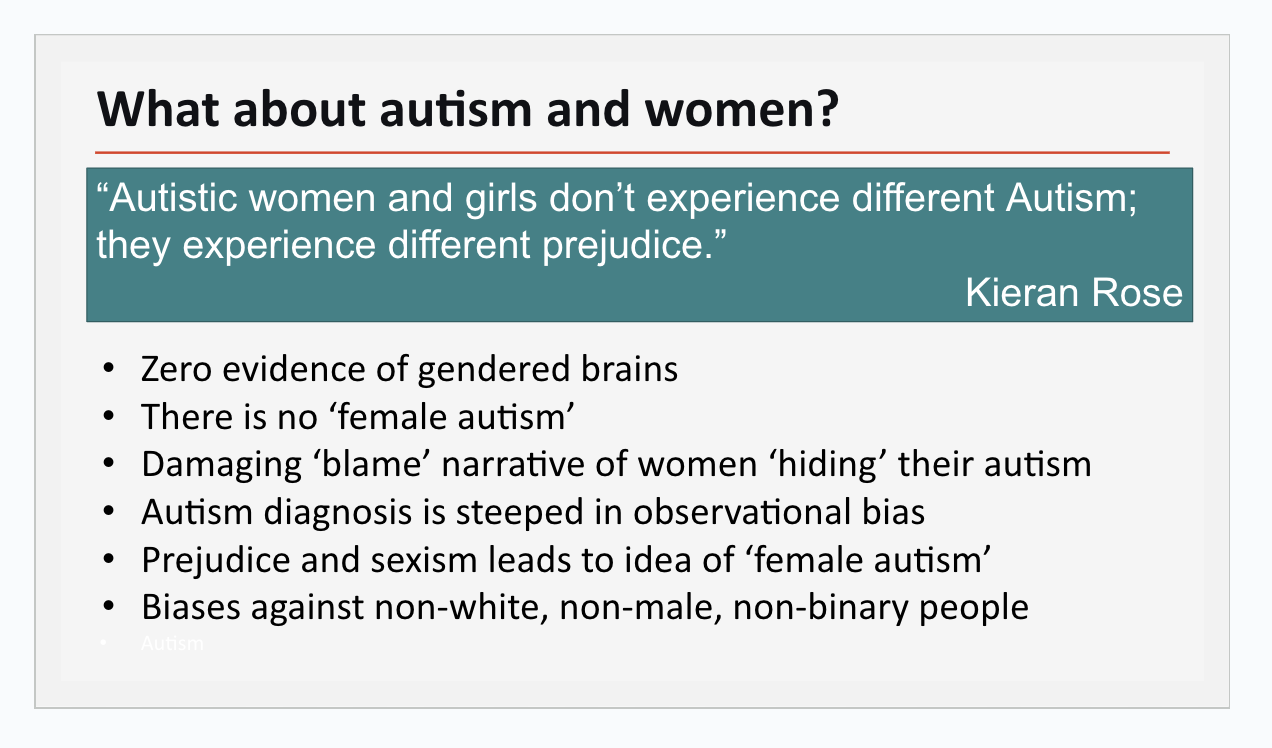
The stereotypical autistic person is a white, cis-het young male. (I believe this is at least partly due to the early work published by Asperger and Kanner focusing on boys – at the time, girls were more likely to be dismissed as “feeble-minded” and institutionalised for being different – though they did also work with girls, and diagnostic criteria developing accordingly.) However, there is no ‘female autism’. Rather, the spectrum of traits associated with autism is broad and autistic peoples’ ability to mask is also varied, regardless of their gender. Of course, masking also contributes to diagnostic barriers. For example, if the person doing the diagnosing observes an autistic person making eye contact during the diagnosis, that might count against them being diagnosed when in fact they have learned to make eye contact in order to be acceptable, and carry it out with discomfort. Carly summarises thus:

(For anybody who isn’t aware, “stims” are usually repetitive movements which autistic people do either because it feels good or as a coping mechanism when overstimulated. The stereotypical one is rocking backwards and forwards but autistic people often find ways to stim that are less noticeable when around people e.g. tapping a foot, twiddling hair, fidgeting with an object.) Eye contact is an important one to think about in the context of teaching. We are taught that eye contact and sitting still shows that someone is paying attention. For an autistic person it more likely means they are working hard on doing the eye contact thing and sitting still, but therefore have less brain available to actually take in what is being said/the content of the lesson. So as teachers we need to accept that traditional images of what good learning looks likes do not apply across the board. This is an example that leads nicely into what Carly talked about next:

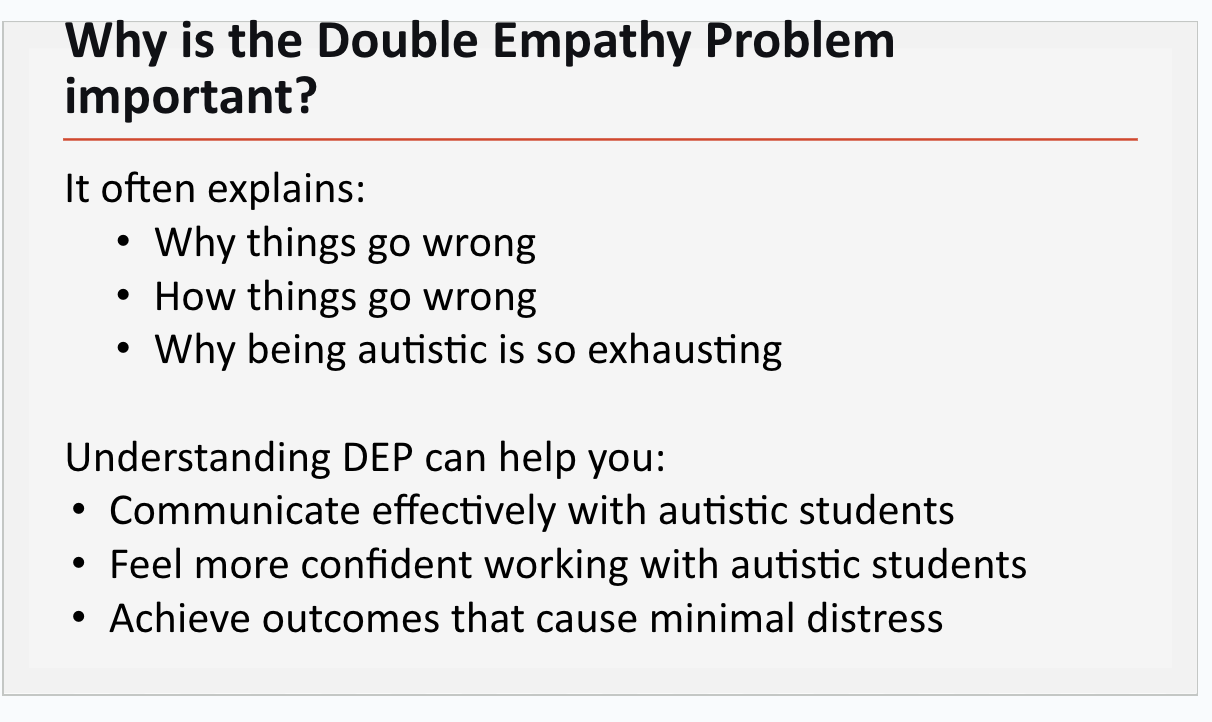
What this slide illustrates is that generally, when a neurotypical person is talking with another neurotypical person, and when an autistic person is talking with another autistic person, communication is generally successful. However, when a neurotypical person and an autistic person communicate, there is a much higher chance for communication issues/breakdown/misunderstandings. (Diagnostically, this is framed as an autistic deficit, of course!)

A personal example of things going wrong that fits nicely here: We were unpacking the car and I was holding the keys and a bunch of other stuff that had been in the car. My wife asked me to put everything inside. So I did. Came back out, we got some more stuff and she asked me where the keys were, in order to lock the car. They were inside, in the place where the keys go! Taking things literally is common in autistic people. (I now know that “everything” doesn’t apply to keys in this situation!) A teaching example that also fits nicely: I always did a brief meditation at the start of class with my students, setting it up as a routine at the start of the course. On one occasion, the second time I did with a particular group of students, after the “and then when you are ready, you can open your eyes” at the end, one student sat with their eyes closed for markedly longer than everyone else. “You said ‘when you are ready'” they said afterwards. Fair!

So, speaking of teaching, Carly next moved on to talking about what issues might arise in the higher education environment (NB much of it is applicable to any other teaching environment!):

It’s not first on the list but I am going to lead with “navigating the sensory environment” as that is something that neurotypical people do not typically perceive as a potential issue. Autistic people often are hypersensitive, hyposensitive or a combination of the two to their environment/what is happening. So, hypersensitive is when you are overstimulated by elements of the environment e.g. light (fluorescent lights in particular!), sound, smells, temperature and hyposensitive means experience low levels of sensory feedback. For example, I attended a work training day that took place in a room with lots of fluorescent strip lights and with lots of people who at times were all talking simultaneously (group work!) and at lunchtime instead of attending the lunch provided, I crept off to an empty classroom with the lights off and waited for it to stop hurting. (Spoiler: it didn’t fully stop hurting until the following afternoon!) In our classrooms, I usually switch some of the lighting off so that it is less overwhelming (fortunately most of the rooms enjoy a lot of natural light so it doesn’t mean we are sitting in semi-darkness! Obviously in winter this is trickier…).

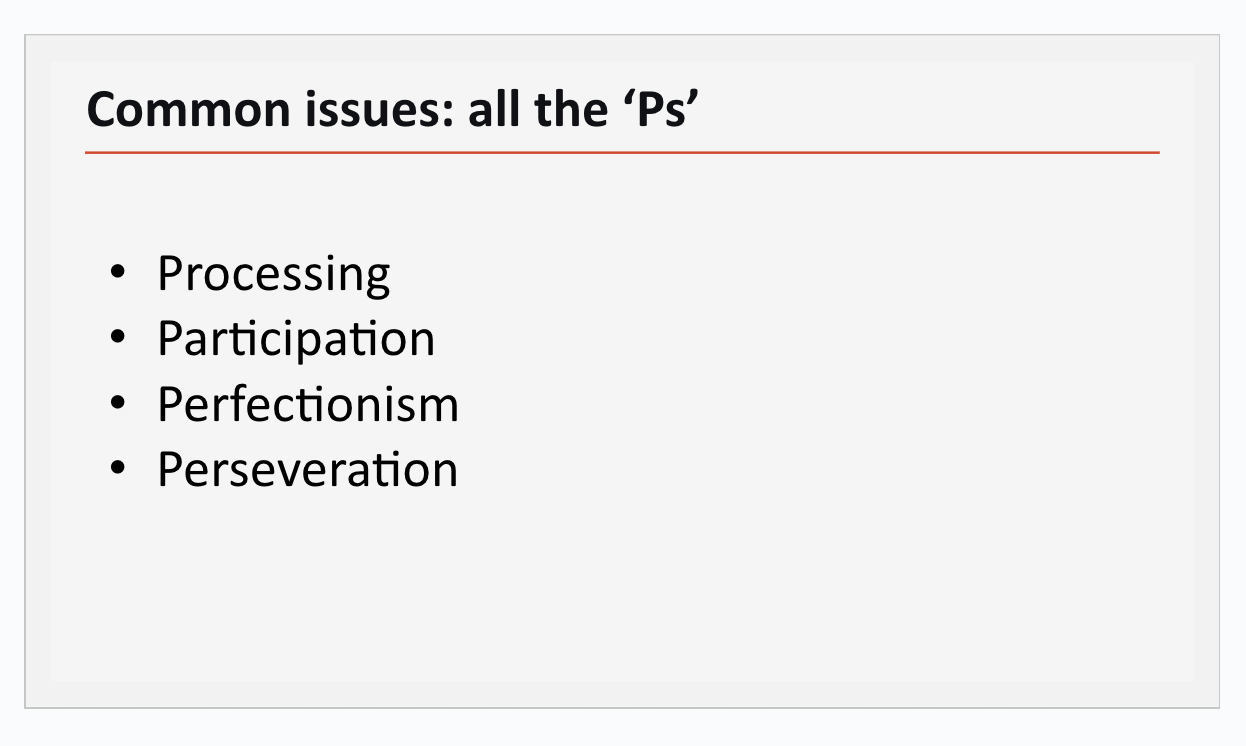
Anyway, Carly focused on the common issues as follows:

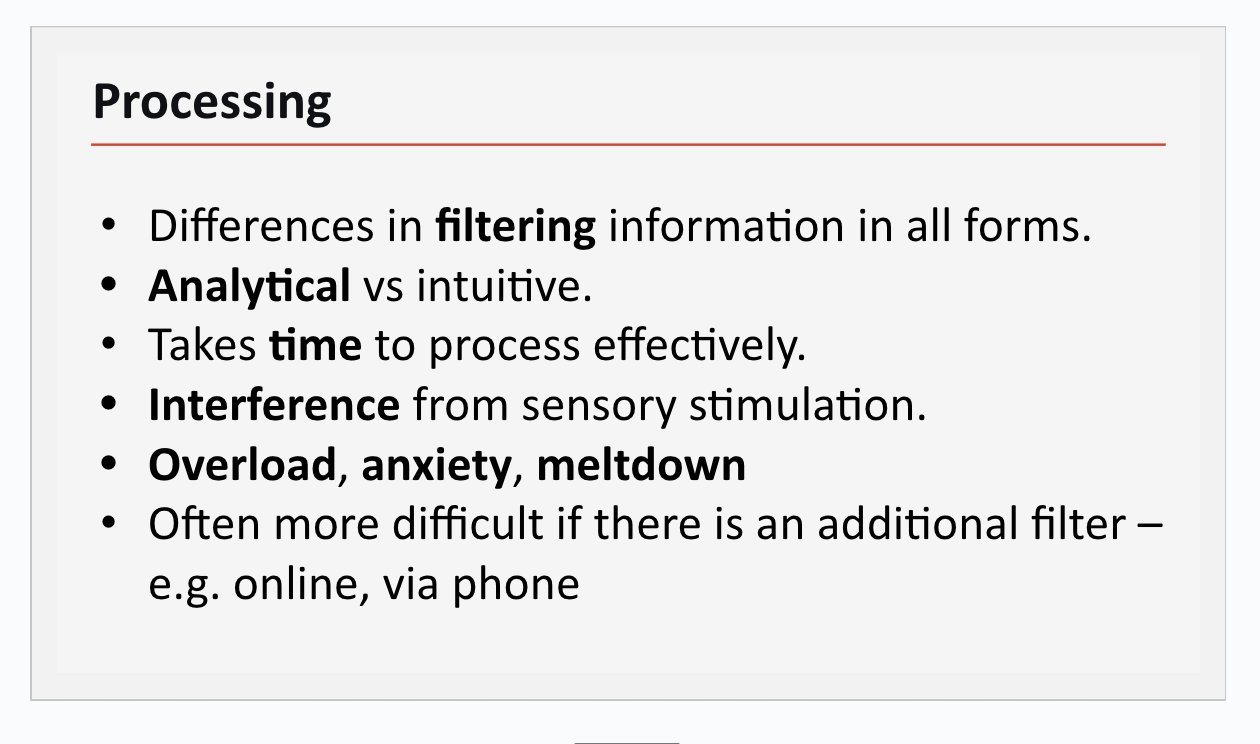
Starting with processing:

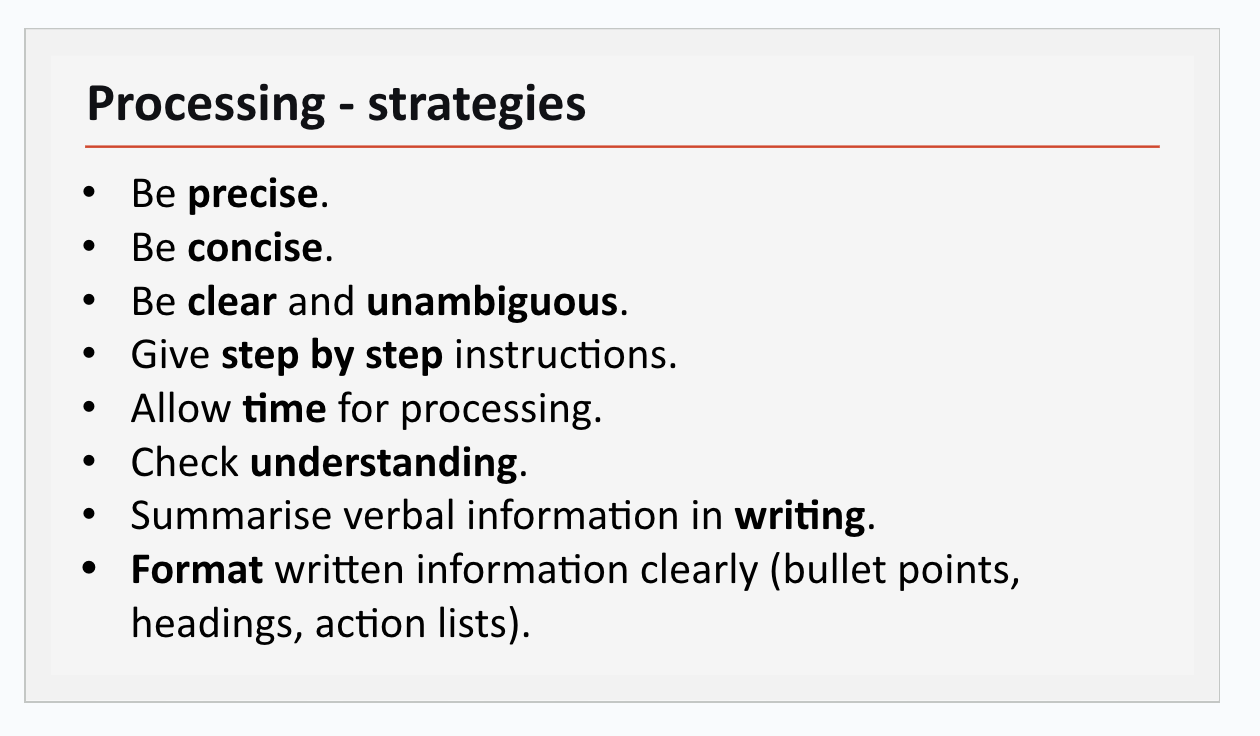
If you are neurotypical, for “interference from sensory stimulation”, imagine you were trying to be a student in a language lesson that was taking place in a night club (ugh) or in a supermarket (ugh) at busy time. Imagine how it would feel trying to concentrate on what you were being taught and asked to do. How long might it take you to complete a task? For a student in your classroom, as well as hearing you, they hear (at the same volume) whatever is going on outside an open window/door, the air system, the lighting (yes lights are loud!), the noise of other people existing in the same space, possibly whispering, typing etc. So focusing on what you are saying/asking them to do is hard work! So how can we help? According to Carly:

What do we notice about this? Yup, it’s general good practice for the most part! But this is even more important for autistic learners and also any learners who are neurodivergent in whatever way. I would add: consider that the classroom doesn’t actually *need* to be maximally bright… Also, let students wear noise-cancelling earphones for individual tasks if they want to. And remember silence can be golden – as in, don’t be afraid of it! Pause for longer between instructions, allow longer thinking pauses before eliciting ideas. At the start of a task, give students a chance to get started before deciding they weren’t listening and approaching them. Also, don’t hint at what you want them to do because they probably won’t do it and it won’t be because they are being bloody minded!

Group work can be very hard work for autistic students. (If we think back to the double empathy thing) For starters, at school, you were probably the kid who nobody wanted to work in a group with because you were ‘weird’. You have to achieve a task, but you also have to figure out how to contribute while dealing with the noise of all the voices in the surrounding groups. Figure out when is the right time to try and say something without being rude e.g. for interrupting. Process what your group-mates are saying and be able to respond/contribute before they have moved on to another part of the task. All of which is compounded if the purpose of the task isn’t clear in the first place! These are Carly’s suggestions for addressing the issues:

So obviously task set-up is important. I think that is something that could also be helped by consistency – having a routine around how tasks are set up, started and brought to an end so that students know what to expect and what’s going to happen. Being clear with timings could also be helpful. Maybe at the start of a course, explicitly talking about group work and how to do it effectively. Maybe at the start of group work tasks, reminding students to find out what everybody in the group thinks about each element/idea/question/answer before moving on to the next.

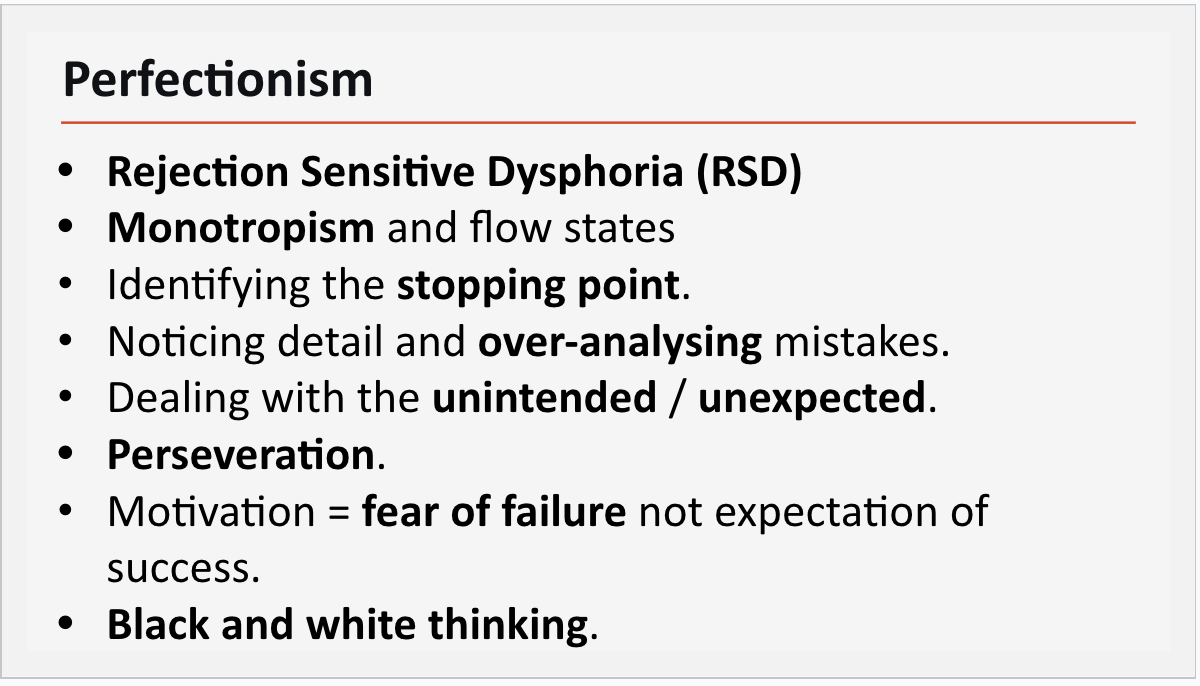
Have you heard the saying “the perfect Ph.D is the finished Ph.D”? I imagine you can see from the above list that these students are likely to be the ones who don’t submit an assessment draft because it’s not finished/perfect enough, or who spend all the time on one part of the task (and do it really well!) but then don’t manage to finish the rest. The ones who worry a LOT about Everything. The ones who struggle when something unexpected happens and disrupts the usual way of things. Here are Carly’s suggestions:

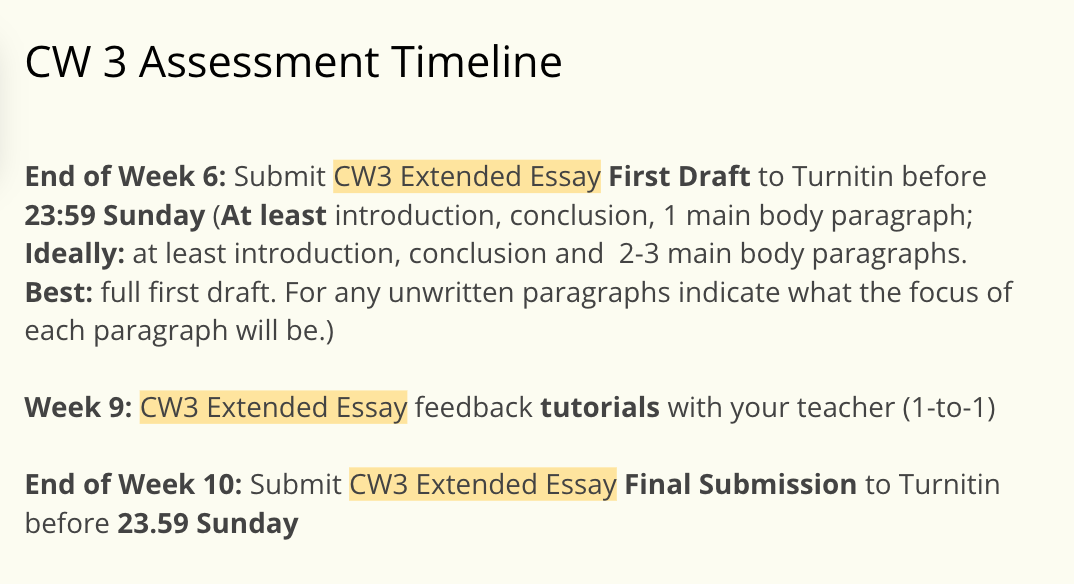
I think an example of this from my teaching last year would be at the first draft of a 2500 word coursework essay stage. Students submit a “first draft” and get feedback on it, which should help them improve before the final submission. This time, because I had pre-masters students and they are notorious for being completely overloaded with assessments, I was very explicit, in multiple lessons and end-of-week emails, about my expectations for first draft submissions:

All students submitted a first draft (result!), drafts were widely varying degrees of complete (from the “at least” to the “best”). They all had at least an introduction, a conclusion and one body paragraph. The “at least” requirement was doable, even with all the drains on their time. It also hopefully helped all of the students who would otherwise have potentially submitted nothing rather than submitting something incomplete. I also did explain why “best” was best (maximum feedback potential) but that “at least” is also good/a success, not a failure, and so much better than nothing. Also, emphasising that “if you don’t submit anything, I can’t give you any feedback help you improve it” (I guess this is clarifying consequences and dealing with “what if I haven’t finished” type thoughts!). Anyway, back to the session:

Here is a good explanation of monotropism. (Note: it can also be positive!) In terms of challenges, changes of attention/focus (so transitions in lessons, transitions between lessons) can be difficult. Carly offered some strategies for dealing with perseveration when it becomes a problem.

I think it could be helpful, in addition to making sure task timings are clear ahead of the task, during the task (especially for longer tasks) give a good lead-time to the end of the activity. So firstly, making it clear when a task is a short task, a medium task or a longer task. With a short task (5 minutes), saying when two minutes are left, one minute. With a medium task (up to 15 minutes, say) 5 minutes, 2 minutes. With longer tasks, depending on the length, give a warning half way through, 10 minutes before the end, 5 minutes, 2 minutes. So that there is time for the student to take themselves out of that activity and be ready for the next. Depending on the type of task and the desired outcome, where relevant reassure students that it is ok if they haven’t finished by the allocated time. In terms of looped thinking and anxiety, personally I have found mindfulness meditation to be a game changer. This is why I persevere and will continue to persevere in introducing it at the start of a course and doing the short meditation at the start of each lesson thing – I wish someone had introduced me to it when I was a student! I think also it really eases the transition from the previous lesson to the current lesson as brains are all over the place when students come into the room.

Finally, Carly finished with her 10 top tips for working with autistic students:

I suppose a lot of this comes back to challenging our assumptions about what good learning looks like and what a good learner does and doesn’t do. Maybe when we are planning tasks, think also about how we expect the task to look when being done ‘right’ and then applying the double empathy lens. How else could it look? Is the student who isn’t talking much or who isn’t looking at me actually disengaged? What could we do in the task set-up to enable participation for those who struggle to participate? How might that participation look? What evidence of engagement can I look for outside of habitual ones? What problems might occur? How could we address them? Is there a way to set up the task so that students have more choice about how to participate? And when reflecting on tasks and lessons during and after the event, “are my students learning? how can I tell? how can I find out without viewing them through a neurotypical lens and judging accordingly?”. Then, of course, clarity. Be explicit and don’t assume knowledge! I think possibly also providing opportunities and being supportive, but accepting when students decline those opportunities because they are exhausted/overwhelmed. E.g. building in opportunities to speak, scaffolding/enabling them, but not taking it as a failure if students don’t use it quite as you’d hoped. Maybe having a more flexible framework for mentally evaluating that. Looking at the bigger picture, if you imagine students doing multiple lessons in a day in their various subjects, if we are all demanding speaking and group-work and whatnot, repeatedly, that’s exhausting. I suppose at university, there may be more of a spread of lectures and seminars/practicals, so in some lessons, students can just sit and listen/make notes (which brings other problems for autistic students e.g. around sensory sensitivities), others require more active participation. Maybe within a lesson, don’t assume that they have to be speaking/collaborating to be learning. Quiet tasks are valid too. Maybe all of this also comes back to getting to know your students. Rather than jumping to conclusions, learning about how they learn and what they look like when they are learning/confused/enthusiastic/worried etc.

That brings me to the end of this post (finally, I hear you say!). Here are the links that Carly left us with at the end of the session:

Feel free to share your comments of your own experience as an autistic person or from working with autistic students/people.

Woah, we’re half way there…

Woah…living on a prayer!

This popped into my head because we are just reaching the end of Week 6 of 12 teaching weeks this semester! 🙂 [Edit: it has become the end of Week 7 – the small matter of some coursework marking to take care of, you see…] And, what with the whole Covid situation and negotiating blended learning and the complications it entails, the “living on a prayer” bit is not entirely untrue either! About 5 weeks into the semester, I remembered I have a blog, and this week I am finally getting round to actually using it for a change. WordPress seems to have changed again since I was last here, as far as how the post drafting page looks. In particular, the font and size; not in a good way either (kind of uncomfortable on the eyes!), but here we all are. I’ve slightly mitigated by figuring out how to make the font bigger and making the background sort of orangey, which makes my eyes feel like they are straining less, though this seems to work per paragraph block rather than the background as a whole. Also not sure how it will interact with the finished product/my website “look”! Will I need to finish by getting rid of these changes? Time – and preview – will tell! [Edit: Preview suggests that things stay very big and orange if I leave as is!! Good to know!] (If anyone has any handy workarounds for making the drafting stage more visually friendly e.g. being able to choose the font/size/background, without it affecting what comes out the published end, please let me know! (Previous iterations of WordPress blog drafting have been annoying sometimes but not uncomfortable so I am not au fait with changing everything up.)

So, blended learning. Our blended delivery works as 2 x 1hr lessons delivered online and 1 x 1hr lesson + 1 x 2hr lesson delivered F2F. In terms of materials, that works out as 3hrs of core material and 2hrs of supplementary material. In practice, I tend to spread the core material over 5hrs and do 1hr of supplementary (usually listening or speaking lessons) each week. Part of the reason I have been so busy is that as well as prepping the new core materials each week and making or adapting new material for the supplementary hours, and working on the development team for the Semester 2 materials, is that I have also been going back and reworking things in previous weeks of this semester, based on this semester’s experience of what is and isn’t working. Overall, being able to spread the core materials out a bit and having more class time to work through the content is working really well and the structure of the week (1hr, 1hr [online], 1hr, 2hr [F2F]) means that the 3rd hour is usually the listening/speaking skills lesson, which breaks the week up a bit and allows a bit more time for homework tasks to be completed between core lessons. I’m really enjoying it all – the teaching and the materials development – but it is keeping me VERY busy (hence forgetting about the existence of this blog!).

Timetabling has been….interesting…this academic year (I am eternally grateful not to be in charge of it!). – Hence “living on a prayer“! We started out with part of our student population already in the UK and another part still abroad at home. So that translated into a mixture of blended and online-only groups. However, that is not static – students are drifting across to the UK in dribs and drabs continually, so it was decided that there would be entry points into the blended learning classes for students arriving in the UK. (To do it as and when would be a timetabling nightmare, apparently it is bad enough with entry points!) So, at the beginning of Week 4 and the beginning of Week 7, our classes have had the potential for change. Mine maxed out in Week 4 so I had no further changes in Week 7 but the shift in ratio of students abroad and in the UK has meant some online classes being closed, some combining and more F2F ones opening. Under 18s do have to be slotted into F2F classes straight away, but for the rest the next entry point is at the end of Week 10 (or was it the start of week 10…). Next semester, we will also have the January cohort doing something similar. By April, all students should be doing blended classes due to visa requirements changing at that point (but we shall see – we had that thought would be the case in September and it was pushed back!), so possibly less chaotic then?!

Nevertheless, being back in the classroom has been brilliant. I and my students all wear masks at all times (other than to have a drink of water from time to time), which makes it harder to hear what they are saying at times but it does push them to speak up in order to be heard! Monitoring speaking activities is particularly challenging because apart from the masks, the classroom layout is not conducive to monitoring (rows of desks) which in one of my rooms I can go to either end of the front row and one end of the remaining rows and the other only one end of any of the rows except the front row. Nevertheless, I just do my best. One thing I noticed at the start was while I could still easily learn their names and faces despite their masks being on all the time (eyebrows, hair, eyes etc.), when they first came in without a mask on (sometimes they get in the room and then put it on), it threw me because I hadn’t learned the usually masked up bit of their faces! It was grand to be able to do the name game (I am _____ and I like_____. This is ________ and they like________; I am________ and I like______ ….and keep adding on student by student) and so nice to get them to do stuff in pairs and groups without breakout rooms coming into it.

One of the things I have been able to start up again is the start of class meditation I instigated a year or so pre-pandemic. I am only doing it at the start of face to face classes, but it does have a positive effect on their focus in those. Mid-semester student feedback has also been positive. I have also brought back the Homework log I used to use with the addition of an in-class materials tab because we no longer have paper workbooks, just electronic handouts. I started out using Padlet, but while visually appealing it was limited by not being unlimited (!) – that is, I couldn’t use a different padlet each week, I had 2 in rotation, so one served odd number weeks and one served even number weeks, which meant there was no fixed point for students to come back to and find their handouts. This means that being able to refer to documents would rely on them having a sensible system of saving them to their Google drives. So, in Week 6 I switched to using the Homework log, with new added in class materials tab on Google sheets. Less visually appealing but more useful in terms of the materials links being in one place, with more added each week, and thereby building up a sort of workbook. The next problem, of course, has been getting them to use it. I’ve yet to get all 19 of them to open it in a single class. (It would have been the same with padlet but is just more immediately obvious with Googlesheets!) Which of course means they cannot participate actively. Well, less “cannot”, more “will not”. (I put the link in the chatbox, literally all they have to do is click on it!) I get it, they are in a new place, there is a lot going on, they have a lot of subjects to follow, they want to party all weekend (away from home, “post-pandemic”, no restrictions here!), and as the loooong semester wears on they become ever more tired etc, but it is still frustrating. Of course the coursework quality is very much divided along the lines of participation – that is, those who don’t participate (and by participate, I am not demanding chatbox interaction/breakout group interaction, I mean, I am, but I would settle for opening the handouts at the relevant time and following quietly if that is all they can cope with on a given day!) have done more poorly, those that do have done much better in terms of what they have produced. Yesterday, I talked to them about it at the end of our F2F class, so we shall see what happens next week. I anticipate they will have forgotten by then, so I will need to incorporate some kind of reminder slide…

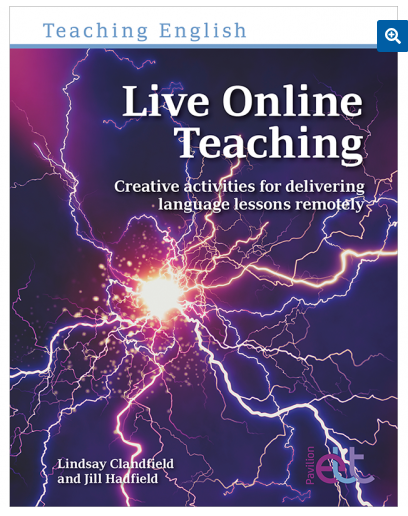
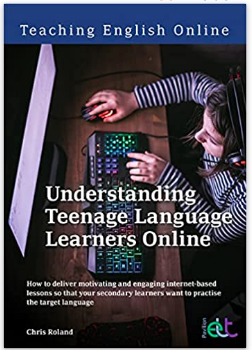
Now that I have built up some experience of blended teaching and discovered some of the strengths and pitfalls, it is time to work out how to make it better, beyond what I have already tried to implement and discovered in the process. As such, I am about to embark on two recently published (April 2021, September 2021) books about teaching online:

(My teenagers are older teenagers but teenagers nevertheless! 17-18 year olds.)

My goal: make the second half of the semester better than the first half. I did my best during the first half but my best can get better! Hurrah for more learning.

What books/articles about online teaching and learning would you recommend? NB those with digital editions preferred! Also those geared towards an EAP context!

Adapting to online teaching – EAP (3)

This is the third and final post that involves me wittering away about what I have done in my weekly 2hr online lessons with the pre-masters group that I share with my co-ADoS.

Week 5

After the low-point that was Week 4’s lesson (which you can read about in the second post of this series which covers Week 3 and 4 – update: the students also didn’t do their homework/preparation for my co-ADoS’s session with them so at least it wasn’t personal 😉 ), I changed my approach in terms of lesson focus. I shifted from trying to tap into and build on the asynchronous content to a straight-forward focus on CW2, students’ speaking coursework which is a presentation based on their CW3 which is an extended writing coursework. (However, it is worth mentioning that this shift would have taken place regardless of how Week 4 went, as at this stage in the term students need help with their speaking coursework!)

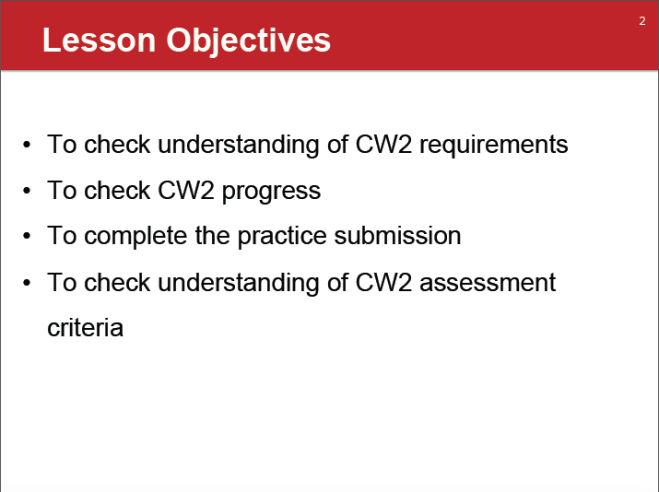
My lesson had 4 objectives. In the event, we only completed 3 of them. This was fine because the final one was only there in case the main task took less time than I’d anticipated, which it didn’t. The final objective will feature in Week 6’s lesson.

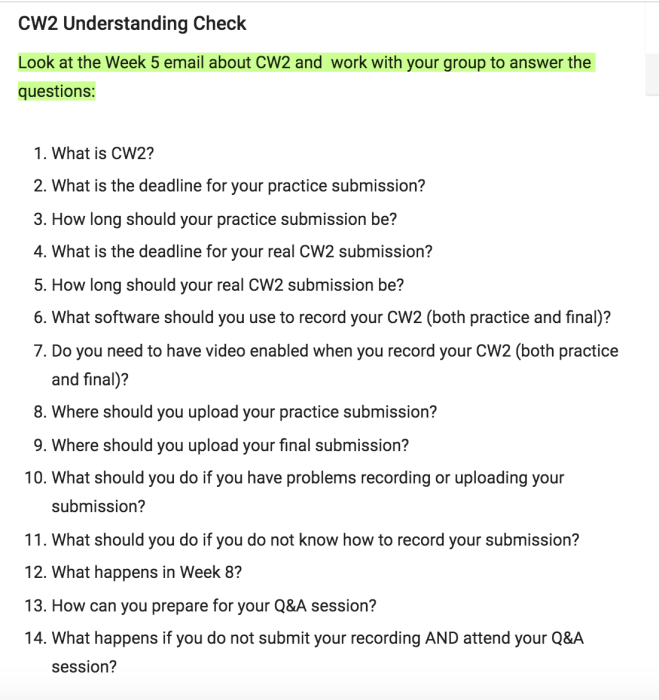
At the start of the week, students had received an email about CW2 with all the important information about it in terms of what it is, how it works and a timeline of tasks and deadlines. I started the lesson with a task based on that email (essentially to make sure they had read it and understood it rather than ignored it!) – working in groups to answer a set of questions based on the email on a pre-prepared Padlet:

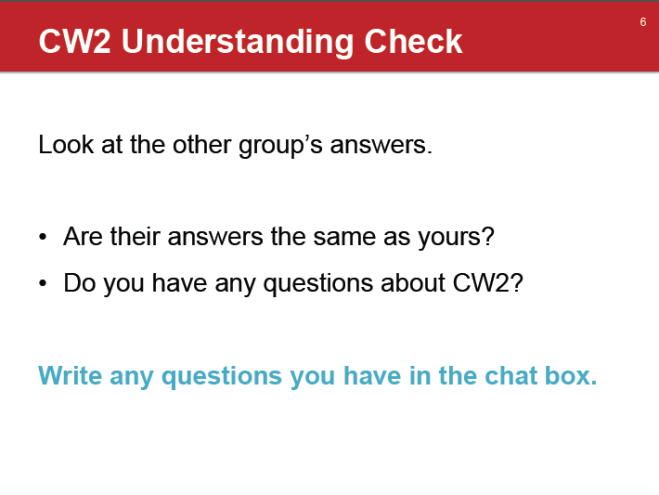
I know – a lot of questions. However, they were quick and easy to answer so the task did not take too long. This was the follow-up:

Some questions came up and I was able to respond to those, as well as reiterating key information.

Positives: The task forced them to read the email. (Students are good at not reading emails!) They had the opportunity to ask questions. They engaged!

To improve: I think I would probably do this the same way in future! Beats talking at them about it.

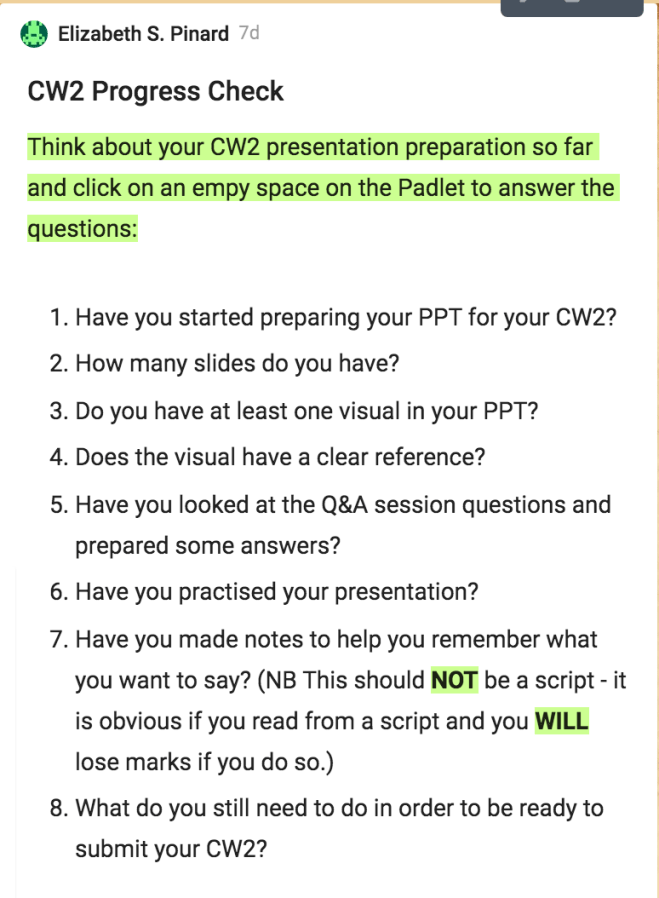
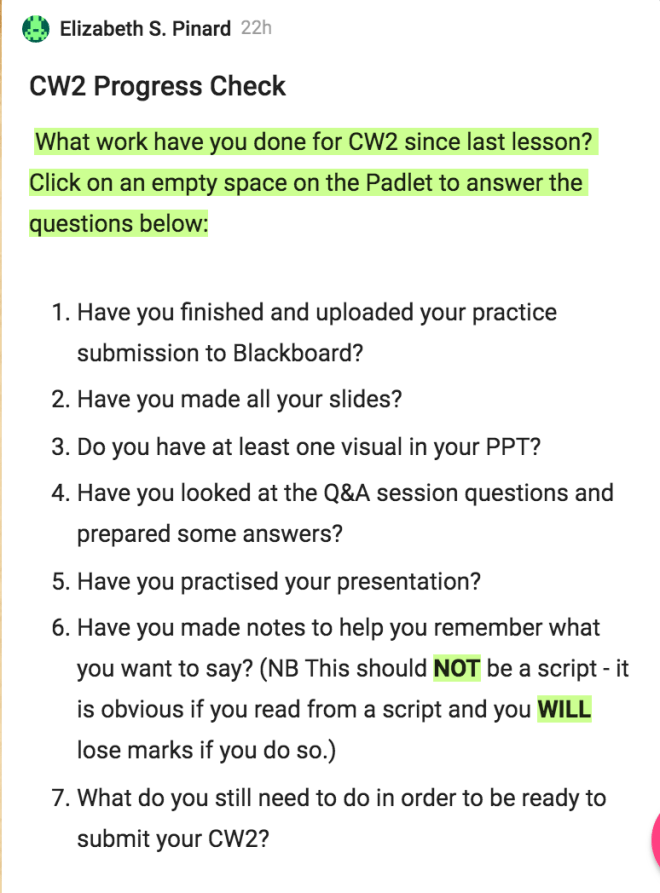
For Pre-Masters students, CW2, like CW3, is synoptic. They work on and submit the same pieces of work for their Research Project (Humanities) or Literature Review (Science and Engineering) module and their AES (Academic English Skills – ours!) module. So in theory they should already have been working on it in their other modules (who focus on content and structure where we focus on language skills). The next step in this lesson, then, was to find out where they were at with it. I used Padlet again, but this time an individual task:

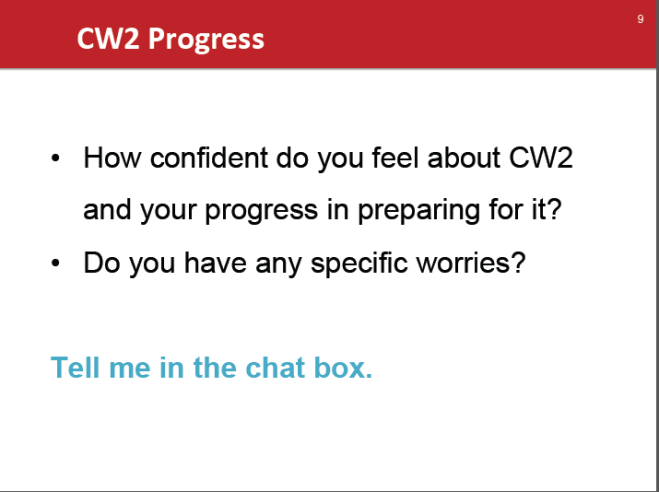
The goal of this task was two-fold – as well as to find out what students have done so far, I wanted students to have a clearer idea of where they were headed next. The questions were based on things they need to do as part of their CW2 preparation, leading them to question 8, where their answers to 1-7 guide them as to what they need to do. Some students had done loads already, some had started, some hadn’t started at all. Fairly typical! (They have been advised that next lesson will start with a progress check and I will want to know what they have done since this lesson! We shall see…)  This was the follow-up:

There were a few worries that I was able to address.

Positives: It gave me a snapshot of where they were at, and the opportunity to set up an expectation, based on the task, for next week’s lesson.

To improve: Their answers to question 8 were a bit vague. Next time I would give an example answer to push them to give more useful (to themselves) answers.

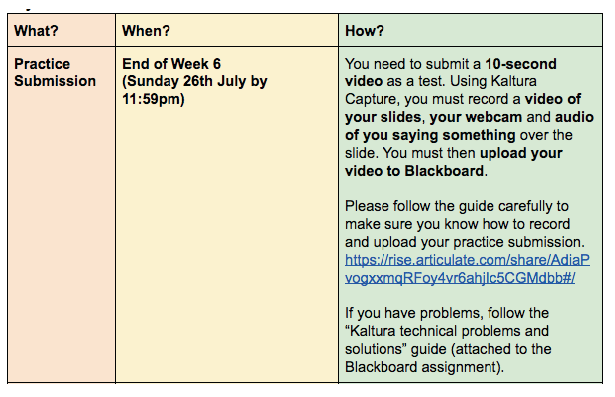
The final task of the lesson was completing the practice submission. This was what they were told about it in the information email:

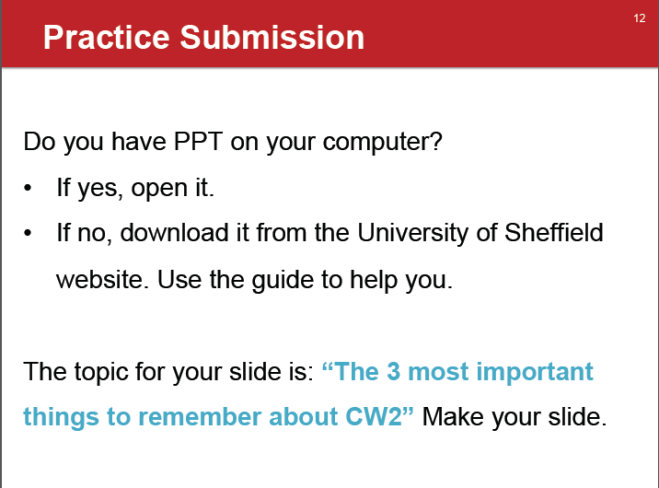
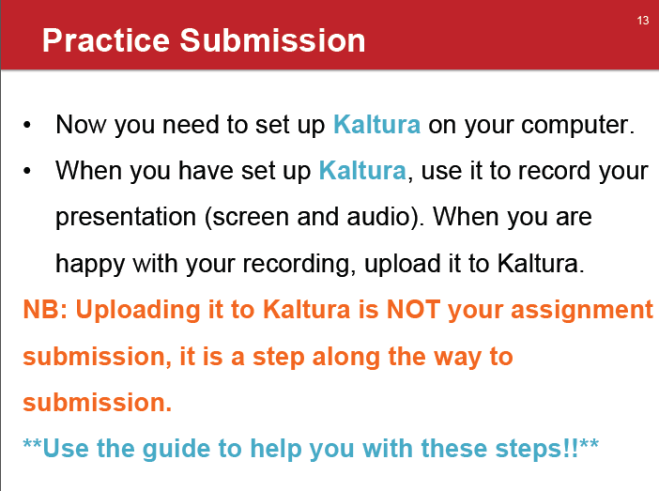
I figured it would be less daunting if we did as much as possible during the lesson and they just had to finish for homework. We did it step by step:

It took them a fair bit of time! In fact, they didn’t quite manage to finish the final stage. Hence why there wasn’t time to embark on the assessment criteria side of things. However, we will now be looking at the criteria at the start of Week 6 and their submission deadline is not til the end of Week 8, so it’s ok.

Positives: It scaffolded an important task (the practice submission) for them. Giving them time in class alleviates (at least slightly) the time pressure they are under currently, which is important.

To improve: I would make more use of the individual chat feature, to prod them/check on them, rather than only the main everyone chatbox.

Overall: Admittedly this wasn’t the most exciting lesson in the world, but it did what it needed to do and they stayed with me! I deliberately over-planned because I just had no idea how long doing the practice task would take them so I wanted to be prepared for whichever eventuality.

Week 6

The final lesson for this term! I started with a chat box warmer, one I’ve used previously – tell me using one adjective how you feel right now. The adjectives were more positive than Week 4 (when I last used this warmer) on the whole, which was encouraging!

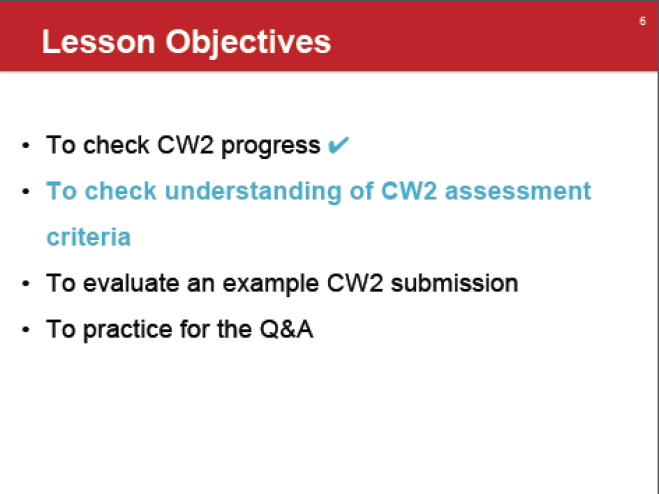
These were my lesson objectives:

For the first, I did a similar task to last week – a set of questions to answer on a pre-prepared Padlet:

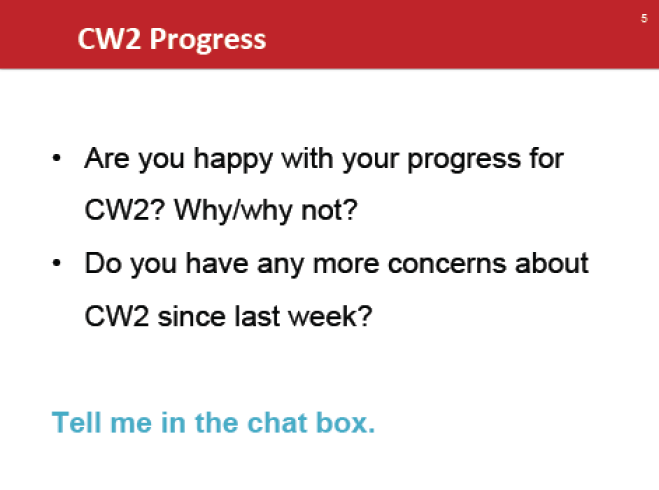
The answers were more encouraging this time round – there were still some who hadn’t started but they were in the minority rather than the majority this week! I had to cajole some of them into responding – by the end of the task I had won 11/15, having started with about 5. Having responded verbally to some of their answers – to acknowledge their progress, to pick up on answers that indicated confusion and to encourage them to keep working hard/not leave it til the last minute – I followed up with this:

There were some concerns that came out, which I was able to address.

Positives about this stage: Students knew they would be expected to give me a ‘progress report’, as I had told them at the end of last week’s lesson. Hopefully more work got done as a result! Knowing that homework (in this case CW2 work) will be revisited in the next class rather than forgotten about is supposed to be more motivating for students. I am getting better at talking into empty space. I think each week since the start of this way of doing things, I have improved and become more comfortable with it little by little (because I only teach one lesson per week, it’s a slow learning curve!). I had thought through feedback and the feedback elements felt less haphazard than they have been known to feel in past lessons.

To improve: I still don’t know what to do with the students who just don’t respond whatever I do or say! Given the stage in the course and the age of the students, though, to an extent I think all I can do is provide opportunities for participation as best I can and make sure they are clearly set up and scaffolded.


Then we moved onto the next stage, which I had carried over from last lesson.

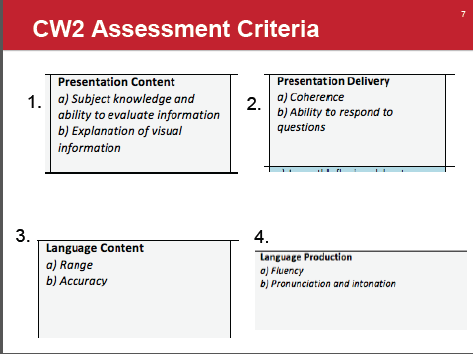
This stage was a preparatory stage for the following evaluation stage and the two in combination were to ensure that students have a clear idea of what they need to do in order to get good marks for their presentations. I introduced the 4 criteria and their subheadings, giving a brief explanation of what each one meant.


To try and make it clearer for students and to check understanding, I then did a little matching task. The example below is one of the items. It was a series of sentences starting “I should…” and students had to match each one to the correct criteria. I asked them to write their answers (e.g. for this example, they would write 2a)

Positives: Links the things students need to do with the criteria they need to do them for. Doesn’t require a lot of student writing.

To improve: Next time I would insert a breakout room stage and have a task with the 4 criteria and a list of the statements and get the students to discuss and match them, then use what I actually did as the feedback stage. On the plus side, the way I did it didn’t have a negative impact on the next (important) task, which was the final part of this stage of the lesson – the example presentation evaluation:

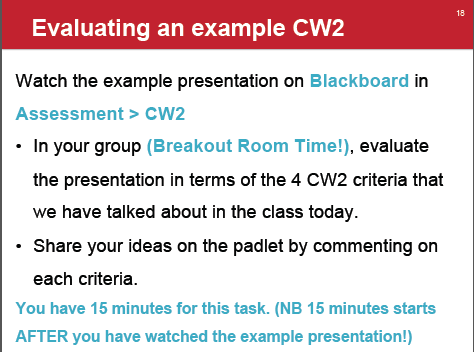
The first step was getting them all to watch it individually rather than playing it and sharing screen, to avoid bandwidth and audio quality issues. I asked them to write “done” in the chatbox once they had finished. Once they were done, I put them into breakout rooms in groups to discuss the presentation in terms of the criteria and add to the pre-prepared Padlet.

Positives: they did the task and showed understanding of the criteria and how the presentation mapped to the criteria.

To improve: I think the instruction slide above should have been two slides. One for watching the presentation and evaluating it individually and one for doing the group task. Fortunately, used as above it didn’t impact the task negatively! Next time, I would also include an element of getting them to engage with the content (which was quite humorous!) rather than only the quality. A couple of them spontaneously mentioned things about it in the chatbox as they watched which was nice! When I planned the lesson, I was too focused on the main task and forgot to allow for personalisation.

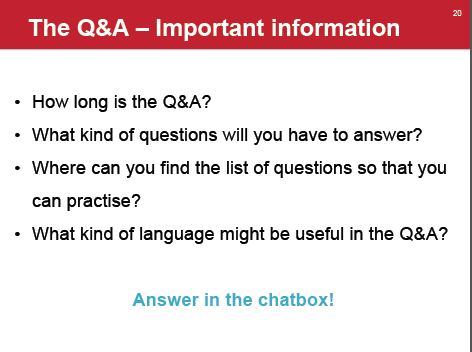
The final stage of the lesson focused on the Q&A. As students are submitting recorded presentations rather than doing them live, we need a live element to address the answering questions part of the criteria (2b!). These will take place in Week 8 and involve use of a list of questions which students are able to look at in advance of their slot (they are already on Blackboard!).

They’ve already had this information (the first 3 questions) on multiple occasions from multiple sources but it bears repetition! (Inevitably, some got it wrong!) Once clarified, we could focus on the fourth question – useful language.

Because we were running out of time a bit, I displayed the above slide and got them to add examples, before getting them to download the list of questions (most of them hadn’t as yet) and putting them into breakout rooms for a bit of practice. Finally, we came back to the main room and I asked each of them one of the questions, just to give them a feel for it.

Positives: They had a chance to practice in groups and a chance to “try it out” in the main room subsequently. They now all have the questions downloaded and have looked at them and realised that it’s not as easy as they had assumed so might actually do some preparation work towards it!

To improve: Next time, rather than bring them back to the main room, I’d do the “giving a feel for it” element in each breakout room in turn. That way, there would be less waiting time for students and they could continue practising after I move to the next group. The final main room stage could then focus on task reflection.

Overall: I finally won at timing! Ok, not quite but much closer than was the case at the start of this term! Nothing took wildly longer than I had anticipated, everything I had planned was done, just in time. The final stage could have used a bit more time but didn’t suffer unduly for it. So, I’m pleased! It means I am getting the hang of estimating how much time it will take to do stuff. As ever plenty to work on and ways to improve but that’s the joy of it. Anyway that is it, for me, for teaching, till September! When it will be a brand new class who come directly to remote learning (the earliest we will do face to face is January and that’s very much dependent on the state of the world by then – anything could happen!). In the meantime, 3 crazy weeks of assessment and then 4 weeks of MUCH-NEEDED downtime are on the way. (I was sick for the whole of the Christmas holiday, my Easter holiday was a stress fest rather than a trip to Sicily thanks to the pandemic, so really, **really** looking forward to some downtime! And then using what I’ve learned this year come the start of next year. 🙂 )


Adapting to online teaching 2 (EAP)

After my first two weeks of whole group online teaching this term, I published this post about my experience of adapting to this way of teaching (behind the curve because we didn’t do any whole group teaching on our course last term, only short small group tutorials, which I mentioned briefly in my post about our experience of throwing an EAP course online at short notice). Another two weeks have passed so here is the next instalment! (It’s ok, we only have 6 teaching weeks this term before the final 3 weeks become all about assessment, so there will only be 3 of these posts in total!)

Week 3

The theme for this week was “Overpopulation – myth or problem?”. Having established in Week 2 that I can do break-out rooms (woo!), I decided to try a speaking-focused lesson with a focus on paraphrasing and summarising sources when speaking (which they will need to do for their Coursework 2 presentations). In preparation for the lesson, students had to find a source to support the position they had been assigned (half the class were assigned ‘myth’, half were assigned ‘problem’). In total, there were 4 break-out room groups, of which the final one was the main discussion task. The first 3 tasks involved random groupings, while the main task I did customised groupings because groups had to have a balance of “myth” and “problem” viewpoints and had to take into account attendance patterns thus far (i.e. I wanted to make sure that as well as being balanced viewpoint wise, no group had more than one student with patchy attendance!)

This was the first task (yes, somehow I forgot about “A”…! Students didn’t say anything about it, if they noticed. Of course they may have thought the chat box warmer task was “A”!)
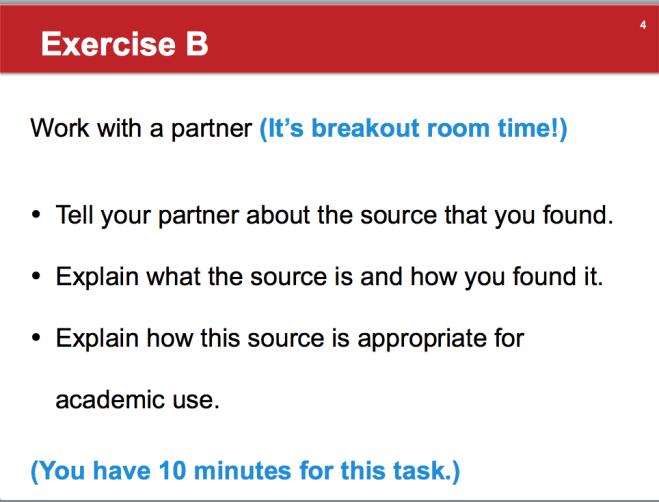
This task reviews the skills learners developed and were tested on in Coursework 1 Source Report. In all the breakout room tasks for this lesson, I included times on the slides to give students an indication of how long they would have in their breakout room to complete the task.

Positive of this task: clear and achievable for students; provided opportunity for speaking/warming up their working in a breakout room mode!

Problem with this task: no tangible output = room for students to slack off. In future I would do something like get groups to report back in the main room, answering questions such as “In your group, whose source was the most current? What different search methods did your group discuss?”

This was primarily a preparatory task for the main discussion but also paraphrasing skill practice. As well as review and practise of written paraphrasing, it encouraged students to pick out key arguments that they could use in the main discussion task. By now, students are used to using Padlet in our whole group sessions both with and without the breakout room/group component.

Positives of this task: useful skill practice, a preparation step for the main discussion, has a tangible/monitorable output (student posts on the padlet)

Problems with this task: my instructions weren’t clear enough – in hindsight I should have included an example post on the padlet!; it took even longer than I had anticipated, which probably also relates to the instructions not being clear enough (fortunately, as has been mentioned previously, timing is very flexible in these sessions this term!); I used the comment function on Padlet to give live feedback/guide students but not all groups noticed the comments as they are not as immediately visually evident as the equivalent on a Google doc would be (I dealt with this by going into breakout rooms and drawing students’ attention to the comments!); my post-task feedback again needed more thought (work in progress!).
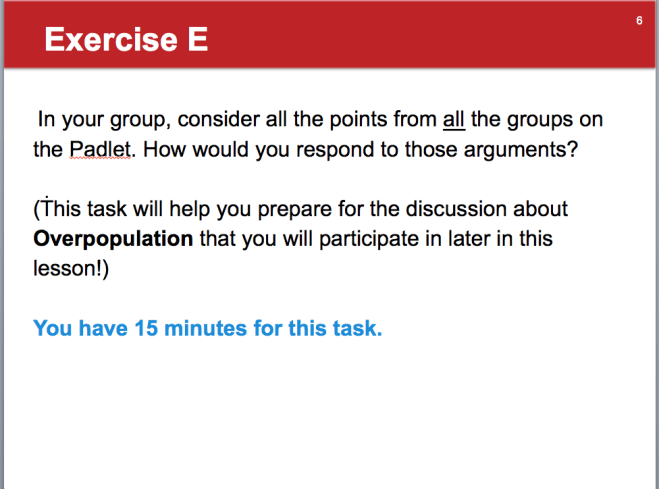
This was the final preparation task before the main discussion task. The goal was to give students time to consider the arguments linked to the alternative viewpoint and possible responses to these, so that the main task discussion could be of a higher quality.

Positives of this task: It used the output of the previous task (the arguments on the padlet) with a focus to how they would be used in the subsequent task, which adds coherence to the lesson arc and hopefully means students can see why they are doing what they are doing – there is a clear direction to the tasks;

Problems with this task: students could think “I’ll manage with the discussion, I don’t need to do this task”; any given student’s experience of this task would vary depending on how forthcoming or not their group-mates were. Group dynamics in the online setting is something I need to think about more – how to help students to work well together in groups, in breakout rooms. Maybe add more structure to breakout room tasks e.g. start them with some kind of mini-activity where students have to write something in the chat box, before moving onto using the audio and doing the actual task at hand.

(No, I don’t know what happened to my grasp of the alphabet in these lesson materials! I think I was so focused on the task content that I forgot to pay attention to numbering/lettering!)

So, the main task! Group discussion requiring use of the sources found for homework (research skills), the key arguments identified, paraphrased and considered in the course of this lesson and language for referring to sources verbally.

Positives of this task: Brings together everything the students have done from homework through to final discussion preparation

Problems with this task: As far as I was able to tell, only one out 4 groups did the task properly! I think again what was missing was a clear feedback stage which students would be made aware of in advance of starting the task and which required them to DO the task fully in order to complete; students who want to do the task properly but are in a group with students who are more interested in slacking off lose out (had one student who when I was in the breakout room monitoring/checking on them, tried to give her opinion and elicit others’ opinions but radio silence followed!).
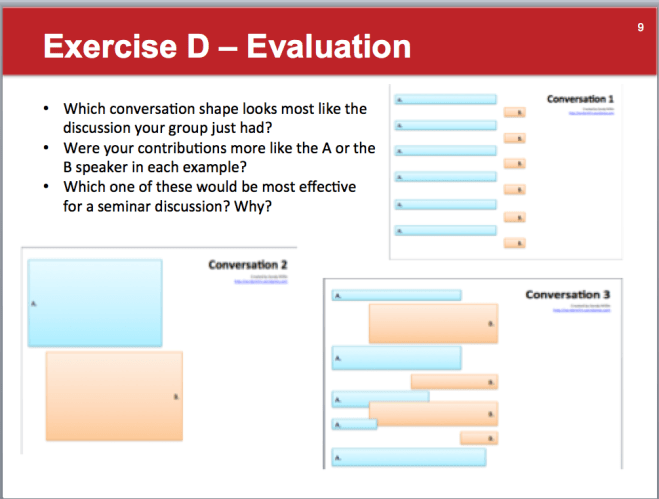
This evaluative element of the lesson comes from Sandy’s recent blog post about conversation shapes. (Although it might be hard to see in this screenshot of the slide, depending on the resolution of your screen, when displayed as a pdf of a ppt in Blackboard collaborate, the credits were clearly visible!) Unsurprisingly, for the group who did have their discussion, it looked most like conversation 2. As a class, we identified that conversation 3 would be most effective – contributions of varying length, responding to the other speakers’ contributions, building on other speakers’ contributions. Obviously in groups, there would be more than 2 speakers but the students didn’t seem to have any problems applying the visuals to a group discussion.

Positives about this task: It was great to have a visual way to think about the discussions the students had had (those who had had them!! But I figure for those who bothered less, this was still useful and could be considered in terms of previous discussions). Having identified that 3 would be the most effective, this can be revisited in future speaking lessons as a prompt in advance of discussion tasks. Could also consider what language and cues would help to build a discussion like this e.g. agreeing and disagreeing language that allows connection to what has been said (that’s a good point, but…/yes, I completely agree, also…), back-channeling etc.

Problems with this task: I probably didn’t go far enough with it. Although, possibly this is not a problem but rather a slow-burn thing that bears plenty of revisiting and therefore doesn’t require lengthy input around it straight away. I think in future I will introduce this after the first suitable seminar discussion practice that students do in the course and revisit it and build on it regularly e.g. have example discussions to match to each shape, the language input as mentioned above etc. (Thank you, Sandy!)
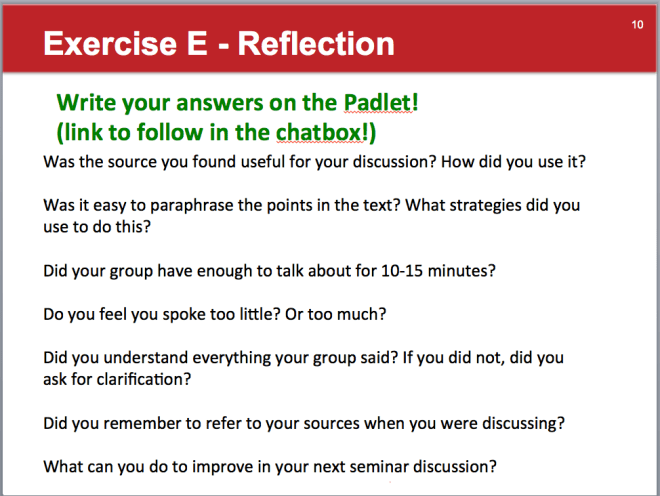
The final task of the lesson was a reflective task, with the output going onto a padlet. Reflection is a key component of learning, of course, and actually these students by and large did a good job of this. This is something I need to capitalise on more in future lessons.

Positives of this task: made students think about what they’d done and evaluate it; those who didn’t speak recognised it in their answers (it’s something!);

Problems with this task: Too many closed questions – need to push them further than that, closed questions are fine but then a follow-up question could be good.
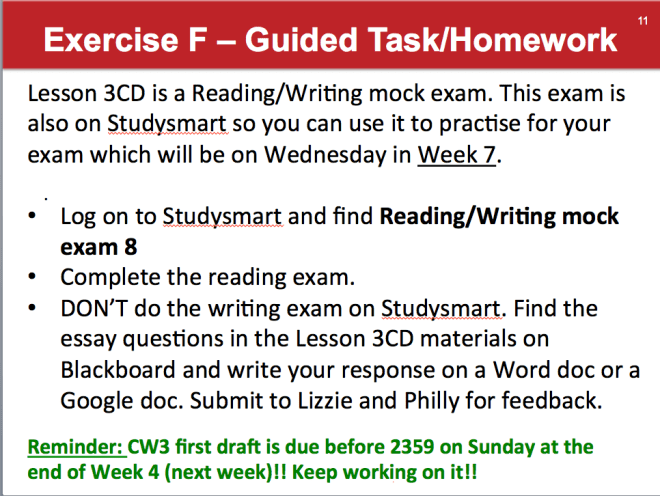
This task reflected weekly lesson content for week 3. In practice, the students had very little in-class time to start it, because all the teacher-led tasks (as above) took a fair amount of time to do, but students are accustomed to fairly substantial homework tasks and as this was part of Lesson 3CD also factors into their asynchronous learning time.

Overall, Week 3 was a useful learning curve for me. There were plenty of positives, there are plenty of things to work on. I find it really useful to consider each lesson in these terms, think about what went well, what didn’t work and how you’d do it differently next time to make it work better, and think about how to reflect what you’ve learned more immediately in subsequent lessons – I guess that is what reflective teaching and learning is all about!

Week 4

Well…you know those lessons where you think you’ve made a really quite good lesson plan and have high hopes for how the lesson will go, but the reality turns out… rather differently? That was week 4’s lesson for me. The theme for Week 4 was Scientific Controversy. The asynch materials included a listening practice based on a panel discussion about genetic modification, which I asked the students in advance of the class as preparation. Though it was homework, it wasn’t extra in the sense that it was part of the core asynch materials for the week.

I began the lesson in the usual way – with a chat box warmer. Today I asked them to pick one adjective that most describes them right now and write it in the chat box. 9/14 responded – tired, exhausted, sleepy, blue, sleepy, energetic, sleepy too, calm, hungry. I acknowledged and responded to all their responses. Then we looked at the lesson objectives. In this lesson, I put extra effort into making sure the lesson objectives were clear and carried through the lesson, so that students could see where they were in relation to the objectives, see progress being made and see how tasks relate to the lesson objectives (I’d read, or watched, I forget which, about the importance of doing this). I did this by repeating the objectives slide at appropriate intervals, highlighting each objective as it was focused on and putting a tick by each objective as it was met. Here is an example:
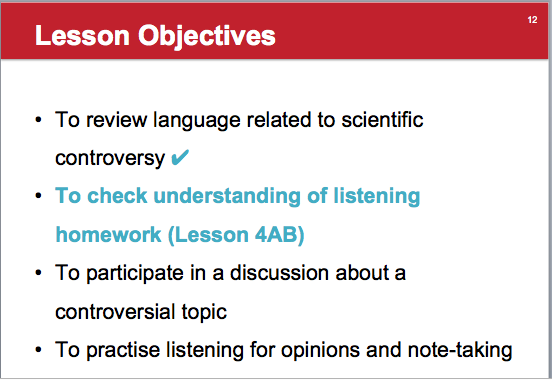
The first stage of the lesson was a language review stage. 

This stage included a definition check for controversy and scientific controversy and a series of pictures of example scientific controversies for which students had to guess what scientific controversy was being illustrated. Here is an example:
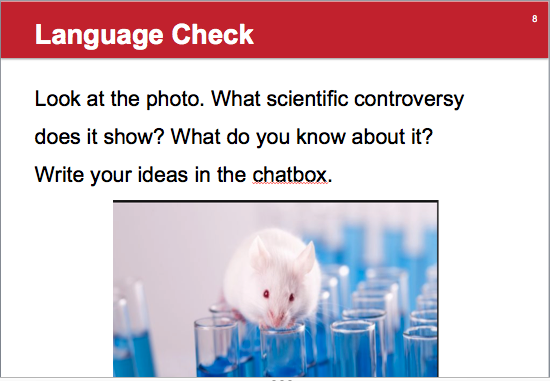
The students responded, and a good pace was maintained. I could perhaps have done more with the second question, tried to get students to share more ideas, but knowing I had some meatier tasks later in the lesson, I didn’t want to spend too long on this one. The final task of the first stage was a quick Quizlet review of some vocabulary from the homework asynch materials. 11/14 did it, which was an improvement on Week 2! I haven’t tried the team/breakout room version yet – that may be for next week!

Positives for this stage: Pacing, student response, topic and activities connected to asynch materials so provide review opportunities, use of pictures.

Problems with this stage: The second question on the picture slides got neglected. I think when it unfolding, I worried that if I pushed the second question, the amount of time they spent typing would negatively affect the pace/mean too long was spent on the activity.

The next stage of the lesson was reviewing the listening homework.

I started with these questions:
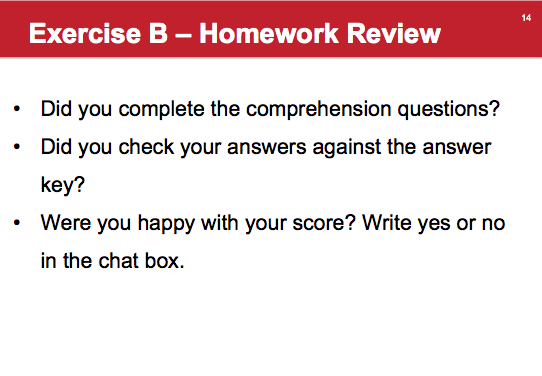
As you can see, I messed up the formatting for this slide so the Write yes or no looks like it only relates to question 3. I corrected it verbally but only got ‘no’s’, for those who responded. Hoping this was for the third question, I reminded them about the online mock exams available, the importance of practice and that that there would be opportunity for practice during this lesson too.

This next task was supposed to be a fairly quick and easy way of getting them to show their understanding of the opinions voiced in the panel discussion:
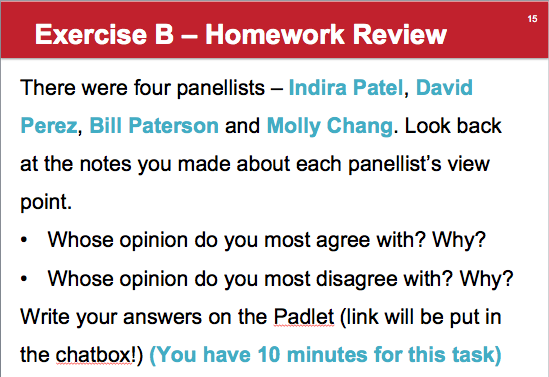
Nobody did it. Nobody responded when I asked why nobody had started doing anything a few minutes later. Eventually I said ok give me a smile emoji if you did the listening homework and a sad face emoji if you didn’t. I only got sad faces. So this task flopped completely. The next one was also not going to be possible as it reviewed the target language from the aforementioned homework:

So I skipped to the point where I displayed the target language and we related it to the conversation shapes we’d look at in Week 3 and then moved on to the final review task:
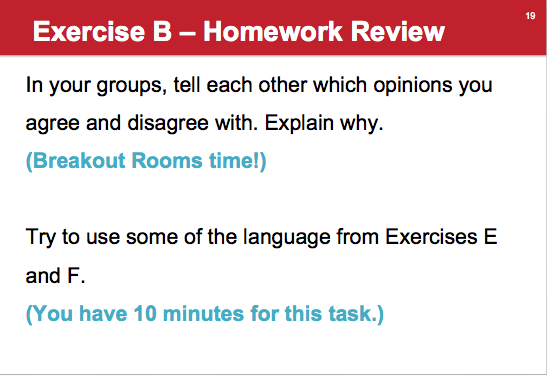
(The opinions referred to are those of the panel speakers again.) Obviously this needed a workaround due to the lack of homework issue, so I had them open up the relevant powerpoint which had notes relating to each panellist’s views and got them to tell me via the chatbox when they had done so.

Positives about this stage: It had a mixture of chatbox and breakout room activities, and focused on the content and the language of the listening homework. I had some workarounds for lack of homework.

Problems with this stage: It relied on students having done the homework! The padlet task had no work around (I was working on the basis that at least SOME of them would have done it and be able to post on the padlet and the rest could interact with that using the comments) for the zero homework completion.

The next and final stage of the lesson was the speaking/live listening stage:
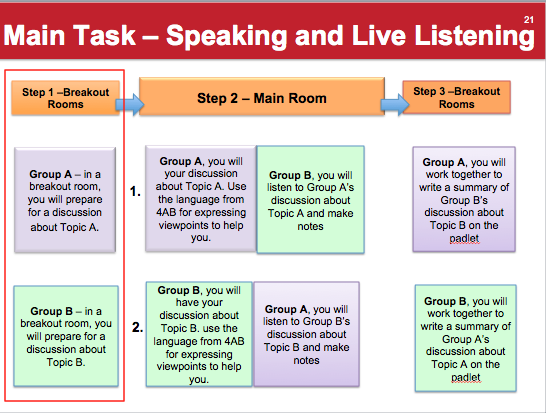
I made this slide a) to give students an overview of this stage of the lesson and b) to insert at the relevant intervals to show which phase of the task we were moving on to. More detailed instructions for each step came at the start of each step. I had hoped this overview would motivate the students to carry out each step as they would know the following steps relied on it and have a clear picture of what they were working towards.

In practice, I put the students into breakout rooms, having set up the task, and went in to each room to check on the students. Group A gave me radio silence. No response. No audio, nothing in the chatbox, whatever I said. So I reiterated what they needed to do and said I would be back in 10 minutes to check on them (the preparation stage was 20 minutes). Group B had some students who did engage and some who did radio silence. Thank God for the ones who did! They asked questions about their topic, I checked their understanding of the task and then I left them to it for a bit (again promising to return in 10 minutes to check on them). At the relevant point I went back to Group A, knowing full well that the chances of them having done anything since I left (no activated mics had appeared at any point) were slim (they could have used the chatbox…they hadn’t!). I tried again, more radio silence. Group B, again, had made progress when I went in to check on them. Then I brought everyone back to the main room. Except…most of Group A didn’t appear/reconnect. (So, presumably, they had done the log on and bugger off thing!) Obviously the plan in the slide above was a write-off (the members of Group A that did show up were still radio silence when addressed/instructed!). In the event, Group B did their discussion and I gave them some feedback, again referring to conversation shapes.

Positives of this stage: It was clearly staged. The group that did the parts that they were able to do made a good effort. (I feel for them, being so outnumbered by ones who won’t participate…)

Problems with this stage: It relied on student participation! Step 3 relied on Step 2 being carried out to some degree of success. Too ambitious? But these ARE pre-masters students, it shouldn’t be! There again, they are all knackered (see chatbox warmer – though Mr Energetic? Group A. Just saying.) If the stage had worked as planned, students may have struggled to summarise the other group’s discussion because poor audio quality makes it harder to follow what is being said.

What am I taking away from these 2 weeks? That I want an article/book/video about classroom management with online platforms! Though quite what can be done if students are completely unresponsive, I’m not sure. I have worked really hard on making everything as clear and as meaningful as possible, in terms of tasks and objectives, which I am pleased with. I continue to try different task types and see what does and doesn’t work (with this group). Possibly I approached it wrongly overall – I tried to connect to the asynchronous material and give students engaging tasks that would help them develop their academic skills and prepare for exams, but maybe I should have focused more on their coursework. The next and final big thing students have to do in terms of course work is prepare and submit a presentation recording, so my final 2 lessons will focus on that! I can but do my best. Importantly, I seem much better able to accept things going wrong, take what I can from it and not beat myself up over it than I have been in the past. I think this links with having had a really supportive line manager/programme leader for a year now – work-related anxiety levels are a lot lower than they used to be – and also, of course, that it has been 1.5yrs now of using Mindfulness to cope better with life, including work.

Watch this space to find out what happens in the last instalment of my teaching reflections for this term. The main purpose of these posts is to be my memory, outsourced, when I come to planning lessons next term with a new group of students! Space and time will make it easier to incorporate what I have been learning these last 4 weeks (lots of learning, hard to keep up but I am doing my best!). The course will look a bit different, and is still under construction, but since it will be what it is from the start, rather than a change being thrust on students part way through, there will be a lot more scope for setting clear expectations and instilling good habits etc from the beginning AND the university will have made it so that students can access Google suite from China yayyy (I forget the technical details but it is some kind of VPN they are purchasing that enables it) – so, exciting times ahead!



What does an ADoS do?

Following Sandy’s post about a busy week in her life as a DoS of IH Bydgoszcz in Poland, which I found very interesting, and attending a Learning and Teaching Professional Scheme introductory meeting and learning that to become a SFHEA one of the things I need to do is write a personal statement about who I am and what I do here at the university,  I was inspired to write a bit about what I do as an ADoS in Sheffield University ELTC’s USIC arm. So here it is! This is what an ADoS does!

(Caveat: every ADoS position is different and depends on the type and size of the institution, as well as institutional requirements – this post is just about what an ADoS does here, where I am – aka what I do! Perhaps the title should be “What does *this* ADoS do?”!)

  • I teach. (Yay!) Currently 6hrs per week plus 3-4 WAS’s (1hr Writing Advisory Service appointments), as of next week 9hrs per week plus 1 WAS. Along with that, of course, comes all the usual planning, prepping, marking and admin. Am also timetabled 6hrs of cover slots per week.
  • I write meeting notes. Well, I co-write meeting notes with my fellow January ADoS. (At this point, I should explain – I am ADoS for the January Foundation cohort of students. We currently have 4 cohorts of students  – September Foundation and Pre-Masters, and January Foundation and Pre-Masters – but will go up to 5 in April. The April lot is always smaller so though there are also a mixture of Foundation and Pre-Masters, they are counted as one cohort.) We do this using Google docs and share them with our teachers towards the end of one week, ready for the meeting at the start of the next week. This means that teachers have a written record to refer back to without having to write copious notes on a scrap of paper that then gets lost or something! We give them a print-out in the meeting, so they can write down anything extra that comes up/anything that wasn’t clear to them that they asked about etc.
  • I run…co-run…weekly module meetings (in previous terms we did the meetings independently but this term about 95% of our teachers are teaching both January cohorts so it made sense to combine it; this may revert to separate meetings next term, depends on timetables and teachers!). These meetings are about what’s got to happen in the immediate future and looking forward to next week’s lessons. (So, as ADoSes, say it’s week 5, we write meeting notes for week 6’s meeting in which we are talking about week 7 lessons!)
  • I make materials. Last term, that included materials for the workbook, as we adapted some lessons based on teacher feedback and student response from previous use of them. This involves not just creating the new materials and putting them into the workbook but also updating the powerpoints, teachers notes and student worksheets that live in our shared drive resources folder so that everything matches up to the changes that have been made. Examples this term include independent listening development materials, and self-study materials and in-class or self-study materials for using www.wordandphrase.info/academic. (Here I have linked to copies of the materials in my personal google drive so that you can see them, but the originals live on my work google drive and are set to be useable only by people with sheffield.ac.uk email addresses.)
  • Relating to the above, I seek feedback regarding the materials in order to use it to improve them for the next time around.
  • I make sure the tracker is up to date and correct. The tracker refers to an excel spreadsheet with marks and progression rating colours for all students, and there is separate tracker for each cohort. This involves inputting data (e.g. the diagnostic test results), reminding teachers when data that they are inputting needs to be done, helping teachers when they have trouble inputting data, correcting mistakes with student information e.g. when they change groups due to changing pathway and fixing it when random things happen like a student ends up with two lines that correspond to their name/number but non-identical scores (cue checking scripts to be able to work out which is the correct row and delete the other). I have learnt what a v-lookup is and what filters are. Either which way, we hate the tracker… 😉
  • I make sure all the other admin happens when it meant to. This includes transferring progression colours from the tracker to the student management system at certain points, generation of learning conversation documents (even if we don’t actually have the conversations, as this term, the data is needed so that academic success tutors can discuss it with students). This term the document generation has been mostly automated but teachers still need to select smart targets in a Google sheet and copy and paste the resultant data from Google docs to a certain spreadsheet that will then be used for a mail merge, and stuff like that. Teachers need to be told it’s coming up, taught how to do it (in the case of new teachers), supported through it (i.e. troubleshooting if/when the struggle) and we have to check everything in the end to make sure all is in order.
  • I deal with unforeseen situations that come up e.g. a teacher being off sick for longer than a day or two when there is a tight marking deadline and other admin too – between us the ADoSes have to cover that teacher’s marking and admin.
  • I make sure everything is ready for assessments. This includes sending mock tests/seminar discussion exam sheets/etc off to be printed well in advance of when the assessment will take place (printing has a two week turnaround and may take longer in busy periods), setting up Turnitin buttons on MOLE, putting coursework templates on MOLE, doing summative assessment papers myself as part of pre-standardisation etc.
  • I am first point of contact when teachers have any questions, problems, issues etc with January IFY students and teaching (and basically anything relating to anything they have to do here e.g. the admin, the tools used to do the admin etc). This is mostly done in person, in the staffroom, but also involves emails. Where relevant we then liaise with the person or people who need to be involved in resolving the issue. Otherwise, we offer support/guidance as necessary. The main skills this requires are patience, supportiveness and ability to be interrupted, provide the help needed and seamlessly pick up the thread of what you were doing when help was needed! I am currently trying to devise a way of providing more support to new teachers than what we currently do, watch this space!
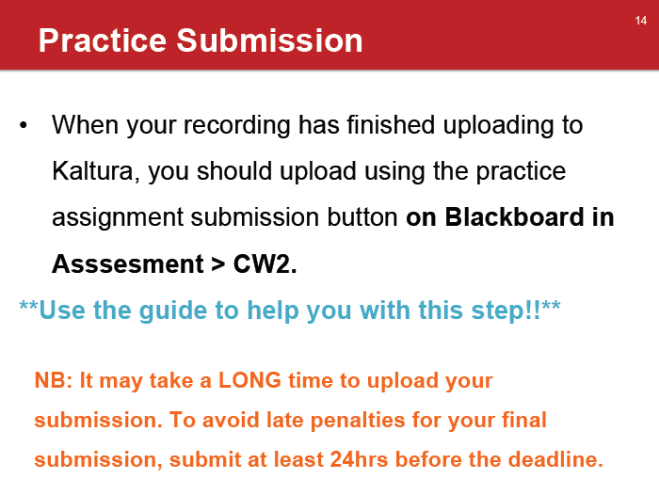
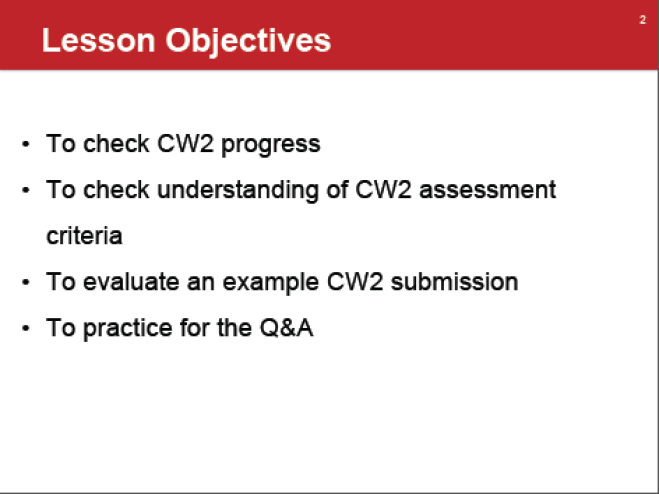
  • I run…co-run…standardisation for all summative assessments. This involves us marking several samples of a given assessment, rationalising our scores (which are under the influence of the centre-level standardisation that Studygroup centres do), agreeing together what the official scores are and then getting teachers to do the same. With exam marking standardisation, we will then all be in a big room while the teachers are looking at and marking the samples and the discussion follows directly. Once complete, marking commences. With coursework, we send out the samples in advance of a given weekly meeting and in that meeting share and discuss scores. We also have to do this for the speaking exams (the seminar discussion and the presentation), which are both done by sending out recordings in advance for teachers to watch and grade, after which scores are discussed as with the written exams.
  • I double mark speaking exams. In order to increase reliability, we double-mark a a couple of groups (seminar discussion) or a few students (individual presentations) with each teacher.
  • I sign marks off and prepare module boxes. Once all marks have been inputted into spreadsheet and student management system, everything needs double-checking. Errors get picked up and changed, and then, when everything is in order, we sign off the marks for a given cohort for a given exam. The paper work goes into the module box along with some samples of high, medium and low-scoring papers and evidence of standardisation. The resultant module box is stored ready to be audited by the external examiner when s/he pays a visit, so it is important that everything is in order.
  • I randomly spot-check first draft feedback on course work to make sure we as a team are being consistent in the amount and quality of feedback that is given and advise where any changes/tweaks are necessary.
  • I do naughty student meetings. These meetings are 1-1 with the student and their teacher, and are held when students plagiarise in the first draft of their coursework. The idea is to find out what’s gone on and why, and to ensure that it will be addressed before the piece of work is submitted finally. (Otherwise, the student will have to go to a misconduct panel hearing and that makes more paperwork for us and more stress for the student!)
  • I prepare academic misconduct case paperwork. If a student’s final draft submission has high levels of plagiarism or it is clear they have received help because the work submitted is too far above their normal level, we need to prepare paperwork for academic misconduct panel hearings. This mostly involves filling in forms and providing evidence (past pieces of written work, which necessitates digitised work folders, which we also set up for teachers to use).
  • I invigilate listening exams. Mostly Studygroup provide invigilators for exams but our listening exams are complicated enough that we provide a chief invigilator per exam room. Generally that’s around 4 chief invigilators per exam. One of those things that is terrifying the first time you do it and then subsequently you wonder what all the fuss was about!
  • I send next term’s workbook off to the printers. Each term, at some point sufficiently in advance of the end of term, next term’s workbook has to be sent off to print. This involves making any changes that have been flagged up, altering or replacing lessons, proofreading, editing, checking formatting hasn’t altered, sometimes throwing in an alternative syllabus at the last minute because we have been told that due to timetabling we will have to deliver a 2hr-1hr-2hr delivery pattern as well as the default 2-2-1 delivery pattern. That kind of thing.
  • I am supposed to do 3hrs CPD a week, but often it gets relegated to the weekend other than an hr of scholarship circle most weeks (unless stuff comes up which needs dealing with pronto, in which case that takes priority!).

So that’s the kind of thing (there is more, but that is all I can think of for now!)… except rather than “I”, it’s “we”, really! Each of the five cohorts mentioned towards the start of this post (bullet point two) has an ADoS and together we are a team. Within that, some of us also operate in sub-teams: I am part of Team Jan ADoS, and the two September ADoSes work together closely too. For me, the teamwork aspect is the best part of it! We bounce off each other, we support each other, between us we have more brains to cope with remembering everything that has to be done, we commiserate with each other (when the tracker plays up, for example!), we help each other out when there’s lots to be done (e.g. the example of covering the sick teacher’s marking and admin, we all took on some of it and between us got it done) and so on.

I like my job, when it isn’t driving me crazy 😉 If you have ADoSes where you work, what similarities and differences are there between my ADoS role and those where you are?

Another and final question I want to leave you with: How do you support new teachers where you work? Will be interested to hear any replies… please comment!

WAS (Writing Advisory Service) at Sheffield University ELTC

Amongst many other things (e.g. pre-sessional programmes, general English classes, IELTS and CAE preparation, foundation programmes, in-department support, in-sessional programmes and credit-bearing modules) the ELTC also provides a Writing Advisory Service (WAS) to all students studying at the University of Sheffield. It is not only international students who use this service, home students use it too. In terms of levels, we get a mixture of bachelors students, masters students, PhD students and lifelong learning students. This post is going to talk a bit about what a WAS appointment offers and my experience of doing them.

What is “a WAS”?

It is a writing advisory service appointment which lasts for one hour. Any students studying at the university can book an appointment. Teachers are timatabled WAS slots and these appear on our timetabling system. When a student books an appointment, we are able to access their information by logging in to this system and clicking on the relevant slot. In advance of the appointment, we are able to see a student’s name, their department and course, their nationality and an appointment history. So, if students have been before, we can see a record of what they brought (i.e. what type of writing) and what advice they were given. If it is their first appointment, then obviously this part will be blank. These are not “our” students; in most cases you see a different student every appointment. Occasionally you get needy students who try to book the same tutor every time, but this is discouraged as we don’t want to encourage over-dependence on a particular person.

How does it work?

Students have to report to reception so that reception can mark them as attended, which unlocks the appointment history so that we are able to edit it. As teachers, we have to be at reception just before the session is due to start, to meet the student and take them to the allocated room, which always has a computer in it. Students have to bring a print out of whatever piece of writing they want help with. We are not expected to read stuff on screen, thankfully! Before I look at the piece of writing, I ask the student about it – what is it? what problems do they think they have with it? is there anything in particular they want me to look at (e.g. structure, referencing etc.) – so that I have a context to start from. Then the student has to sit and wait while I read through their writing and identify issues with it.

Once I have had a chance to look through the piece of writing, what follows is a discussion of it with the student. Generally I focus on structural issues first – so problems with the introduction, thesis statement, paragraph topic and concluding sentences, conclusion. Next would be other aspects of cohesion like linking language, demonstratives and catch-all nouns, lexical chains, etc. Then issues of academic style e.g. formality/appropriate vocabulary and referencing. Finally, I’ll pick out a few persistent grammar issues to discuss. The idea is that it’s NOT a proofreading service, it’s an opportunity for students to learn how to write better, based on a piece of their writing. Therefore, ideally, we need to equip students to deal with their issues independently. One way of doing this, for example, is using www.wordandphrase.info/academic to model how to use it to answer questions relating to what word to use and how to use it. We also direct them to various websites such as the Manchester Phrasebank.

The final stage of the appointment is writing it up in the student’s appointment record notes as they have access to these notes. The notes are written to the student, as they are for the student to refer back to, rather than being written in lesson record style. I usually get the student to tell me what we’ve talked about, as a way to reinforce what we have done, and write that into their records, pasting in any links we have used in the course of the session too.

This is a recording which lives on the Writing Advisory Service web page. Students can watch in advance of their appointment, in order to know what to expect.

My experience of WAS’s

  • It’s not uncommon to get a no-show! Students are encouraged to cancel in advance if they can’t make it but sometimes that doesn’t happen. They may get caught up in whatever else they are doing or forget they made the appointment etc. Repeat offenders get banned from making appointments for a period of time.
  • When students do show up (which is most of the time, to be fair!), they are very enthusiastic and appreciative. They want to do well in whatever assignment it is they are working on and recognise that what you are discussing with them can help them with this.
  • The first one you ever do is terrifying and difficult, but as with so many things, with experience it gets much easier. You learn what to look out for and how to help students get to grips with those issues. You learn not to be daunted by whatever is put in front of you, however obscure it may seem at first.
  • Because I teach EAP generally, it’s easy to pick out materials from our electronic stores of them, to illustrate what I am trying to explain to students. This is very helpful!
  • You get to see a wide range of different types of writing from different subjects. It can be a bit scary to be faced with an essay full of legalese, especially if you are a bit tired anyway (as with my slot last thing on a Friday!), but you get used to looking beyond the subject specific stuff (which we aren’t expected to be experts on!).
  • They are enjoyable! It’s a bit of a faff because I, like my colleagues in this building, are in a different building to where the appointments happen, so though it’s an hour’s appointment, with the walking there and back etc it’s nearer an hour and a half of time gone, but once you’re there and doing it, the hour flies!

Do you have anything like this where you work? How does it work?

Scholarship Circle: Giving formative feedback on student writing (2.2)

For more information about what scholarship circles involve, please look here and for write-ups of previous scholarship circles, here

You might also be interested in session 1 / session 2 / session 3 and 4 / session 5-8 / session 9 / session 2.2 of this particular circle.

In this week’s session of the scholarship circle, we started by doing a pilot text analysis. In order to do this, we needed a first draft and a final draft of a piece of CW3 essay coursework and a method of analysis. Here is what it looked it like:

So…

  •  QM code refers to the error correction code and there we had to note down the symbol given to each mistake in the first draft.
  • Focus/criterion refers to the marking criteria we use to assess the essay. There are five criteria – Task achievement (core elements and supported position), Organisation (cohesive lexi and meta-structures), Grammar (range and accuracy), Vocabulary (Range and accuracy) and Academic conventions (presentation of source content and citations/references). Each QM can be assigned a criteria to attach to so that when the student looks at the criteria-based feedback, it shows them also how many QMs they have attached to each criteria. The more QMs there are, the more that criterion needs work!
  • Error in first draft and Revision in final draft require exact copying from the student’s work unless they have removed the word/s that prompted the QM code.

Revision status is where the method comes in. Ours, shared with us by our M.A. researcher whose project our scholarship circle was borne out of, is based on Storch and Wigglesworth. Errors are assigned a status as follows:

  • Successful: the revision made has corrected the problem
  • Unsuccessful: the revision made has not corrected the problem
  • Unverifiable: if the QM is wrongly used by the teacher and the student has made something incorrect in the final draft based on that QM or has made no change but no change is in reality required
  • Unattempted: the QM is correctly used but the student does not make any change in the final draft.

Doing the pilot threw up some interesting issues that we will need to keep in mind if we use this approach in our data collection:

  • As there are a group of us rather than just one of us, there needs to be consistency with regards to what is considered successful and what is considered unsuccessful. E.g. if the student removes a problem word/phrase rather than correcting it, is that successful? If the student corrects the issue identified by the QM but the sentence is grammatically incorrect, is that successful? The key here is that we make a decision as a group and stick by that as otherwise our data will not be reliable/useful due to inconsistency.
  • We need to beware making assumptions about what students were thinking when they revised their work. One thing a QM does, regardless of the student’s understanding of the code, is draw their attention to that section of writing and encourage them to focus closely on it. Thus, the revision may go beyond the QM as the student has a different idea of how to express something.
  • It is better to do the text analysis on a piece of writing that you HAVEN’T done the feedback on, as it enables you to be more objective in your analysis.
  • When doing a text analysis based on someone else’s feedback, however, we need to avoid getting sucked in to questioning why a teacher has used a particular code and whether it was the most effective correction to suggest or not. These whys and wherefores are a separate study!

Another thing that was discussed was the need to get ethical approval before we can start doing anything. This consists of a 250 word overview of the project, and we need to state the research aims as well as how we will collect data. As students and teachers will need to consent to the research being done (i.e. to use of their information), we need to include a blank copy of the consent form we intend to use in our ethical approval application. By submitting that ethical approval form, we will be committing to carrying out the project so we need to be really sure at this point that this is going to happen. Part of the aim of today’s session, in doing a pilot text analysis, was to give us some idea of what we would be letting ourselves in for!

Interesting times ahead, stay tuned… 🙂