MATSDA 2013 (through my eyes)

This is a whistle-stop tour of talks I attended at MATSDA (Materials Development Association)’s 2-day annual conference, all of which I thoroughly enjoyed. (For those who have never been to a MATSDA conference, I highly recommend it: The atmosphere is lovely – everyone is really friendly, enthusiastic and there to share ideas. Talks are generally quite informal and interactive – the audience is encouraged to participate and everyone gets involved. It’s a good recipe and yesterday the proof of the pudding was definitely in the eating: a good time was had by all.)
Screen Shot 2013-07-14 at 20.33.54

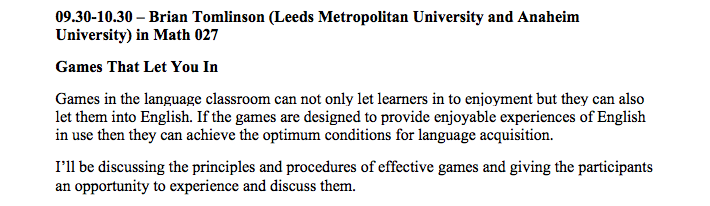
Brian started us off, of course, talking about games – except there was a lot more doing than talking! Brian argued for a game driven approach, but not as the only approach: as an important component of (to the *complete* astonishment of the audience, of course! ๐Ÿ˜‰ ) a text-driven approach. He also took the stance that enjoyment is necessary for language acquisition, but insufficient in itself: Just because learners enjoy something, doesn’t guarantee acquisition. There are other criteria to fulfil.

He then had us try out a few games:

  1. 3-word stories: ย In pairs, we each wrote down 3 (consecutive) words to start a story. A said their three words to B, starting the story. B had to respond immediately by continuing A’s story with another 3 words. If either person was unable to continue without pausing, it ended. B then started the next story with their 3 words. (Brian explained that this could be followed by a written phase and a performance phase, using interest as the main criteria)
  2. The second game he had us doing was a game with stones and a wooden board (which exists in many different versions in many different countries) – he had us doing it with circles drawn on paper and tiny balls of screwed up paper. It was complicated but requesting clarification of the rules was all part of it.
  3. Mrs King strikes back: Brian described setting it up by telling the learners they are going to watch a dvd called Mrs King strikes back and eliciting predictions of what it is about. He then proceeds to happen to have forgotten to bring it in. Thus we had to act scene 1 of the film while he narrated it (people are not forced to join in at this stage, watching is fine), playing every role. We then read a text, the ‘true story on which the dvd was based’, and were put into teams, with two minutes to read the text and identify differences between the version just narrated/mimed and the text. An elicitation game followed.
  4. Newspaper hockey: We were put into teams and each team had to produce two hockey sticks and two balls made out of newspaper (except this bit had bee done for us!). In our demo, we had 4 per team. We were numbered off 1-4. We lined up facing each other and at either end was a chair/goal. Your team’s hockey stick is on the opposite chair/goal from the one you are aiming at. Firstly, simply numbers were shouted out. If it was your number, you had to try and score a goal. Then came the more complicated version, in order to know which number is being called, we had to work out the answer to a mathematical problem e.g. the number of people in two tennis doubles matches minus the number of people in a bridge game. (4) Everyone got thoroughly into the spirit of the game and we were all well warmed up for the talks to follow.
Screen Shot 2013-07-14 at 20.34.12

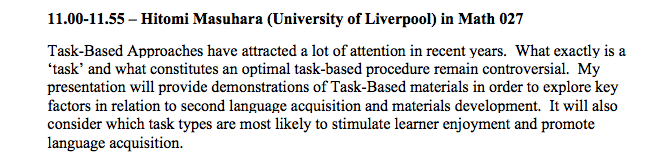
Next up was Hitomi. This was another engaging session, in which, amongst other things, she talked us through a task-based sequence for teenagers based around the topic of magic tricks: Hitomi actually demonstrated a magic trick and then elicited ideas of how it could have happened (she tore a tissue up and then made it whole again – was very cool!). We concluded that angels had kissed it. ๐Ÿ˜‰ ย She explained that learners could then be taken through a process of searching for similar magic tricks/explanations on youtube, learning how to perform and presenting a performance of whichever trick they have chosen and described optional but recommend follow ups, such as recording performances and/or creating a booklet. The importance of initial focus on content during peer review was emphasised.

(I found it particularly interesting when she contrasted her sequence with Rod Ellis’s (2010) shopping task, pointing out that tasks are used for both research and pedagogical purposes but that tasks with a pedagogical focus emphasise broader educational development, while research tasks are geared towards study of language input, intake and acquisition. So a perfectly good research task may not be the most engaging or effective task pedagogically. However, don’t discount such tasks: do think about how to make them more interesting/engaging/relevant etc.)
Screen Shot 2013-07-14 at 20.37.00

Fortunately, I then went to this talk! ๐Ÿ˜‰ I had a great audience, so the discussion generated was very interesting – everyone had their own views and ideas to contribute, which was great. More information to be found here. (Unfortunately as the recording is only of a rehearsal, you don’t get the interactive flavour of proceedings – which is arguably the best part! – only the general content…)
Screen Shot 2013-07-15 at 06.53.13

Screen Shot 2013-07-14 at 20.35.05This was a fascinating talk. Marie talked to us about combining Tomlinson’s text-based approach with a discourse analysis approach, using corpora based research to inform language focus. She made the very good point that in course books, transactional and interactional talk are most often separated, whereas in real life, transactional talk includes, and needs, interactional talk. She showed us types of language associated with interactional talk – such as language for expressing stance, hedging and politeness, referring to shared knowledge and showing solidarity. Marie also demonstrated her ideas by showing us materials she’d made for her learners using a video clip from The Apprentice.
Screen Shot 2013-07-14 at 20.35.39

This talk was brilliant – full of simple, useful ideas of how to turn dull as ditchwater IELTS tasks into something interesting and engaging. For example, for the boring, pointless writing about a process task, ย Lewis played us a recorded spoof example of the process of making tea from planting it to pouring out the tea, as though it were something two friends would discuss. It was hilarious! It also contained all the necessary language, which learners could extract. He also showed us a spoof model answer to a writing task, in completely the wrong register/genre and suggested getting learners to identify all the inappropriate elements. The true model answer could then be used for cognitively engaging noticing activities.

This was the kind of talk that you left absolutely raring to try out all the ideas! ๐Ÿ™‚ The perfect end to day 1.

Screen Shot 2013-07-14 at 20.36.48Day 2 started later than planned (long story!), nevertheless the talks I was able to attend were great. This was the first and it was a lot of fun. The main focus was on improvisation. Volunteers from the audience were required to demo all the activities, of course.

  • There was the bus queue one – we had to stand in a line, one end was the front of the queue, the other was the back. Then there was a really interesting one for exploring the role of status in communication. The demo group consisted of six people and they had to role play different statuses, depending on the playing card they were given. Aces were high. The audience had to guess what their status was by the way they behaved. Obviously in reality, it is less clear cut; indeed, when putting the group in order of status, the audience had different opinions – and this is where the potential for lots of interesting discussion comes in, with potential of course for intercultural comparisons to be made.
  • In the second version, group members each had a playing card again, but this time they couldn’t see it. They could only see the cards of the rest of the group (everyone stuck their cards to their forehead). So here, they had to guess what status they had by how they were treated by the rest of the group.
  • The final one was about blocking and accepting: Blocking – when you stop communication by using disagreement (verbal or nonverbal) or non-sequiturs, for example, to shut it down. Accepting – basically the opposite: you agree (positive verbal or nonverbal language), use back-channels, question tags etc.ย Two audience members had to role play a shop assistant and customer in a shoe-shop. The first time, they had to accept everything, but not buy/sell any shoes. The second time, one had to accept everything and one blocked everything. For the last one, they both had to block everything.

(I think it might be interesting to combine some of these activities with elements of the corpora talk earlier and ideas from the “Is affective always effective?” talk that followed – so, get some friends to role play these tasks and record ย it. This could then be used after the activities as a point of comparison and for some awareness-raising/noticing activities for whatever elements of language use stand out when the transcript is analysed. Not in a “this is the right way to do it” way but in an exploring the differences and possibly making intercultural comparisons kind of way. Obviously not authentic language per se, but whoever is role playing and recording themselves would, I imagine, be using the types of language and structures that they would use in these situations.)
Screen Shot 2013-07-14 at 20.34.33

Jane argued that engagement, affect and motivation are crucial and interlinked. Enjoyment is hard to separate out but not the central aim. She showed us some interesting materials, in which a recording became a point of comparison between spoken and written anecdote telling. Jane had us discussing the materials and thinking about how we’d work with them and lots of great ideas emerged.

Screen Shot 2013-07-15 at 15.11.14

Claudia kept us on the edge our seats by walking us through a sequence which involved used of a video. After doing some readiness activities with us, she played us a dramatic excerpt of a boy cycling very quickly away from something and falling off his bicycle in the process, all to very horror film music. We then had to predict what had happened to lead up to that event. She demonstrated the power of narrative when events are not told in simple linear order. She also showed us excerpts of course material dealing with narrative, published ten years apart, so that we could see how little has changed in that time. Even the cathedral bells, which went through a phase of ringing and ringing incessantly for a spell, couldn’t distract us from this session!
Screen Shot 2013-07-14 at 20.37.54

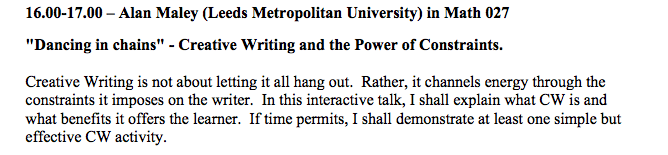
Alan Maley brought proceedings to an end, with an all too short creative writing workshop, taking us through a range of activities which could be used with learners, encouraging creativity and language play. There was theory too, to back it up, discussed briefly but not dwelt upon as we were running late but had to vacate the building at a particular time nevertheless. One of the activities we did was producing a 50 word saga based on the fable of the Fox and the Crow. Here is what I produced:

The fox, he was hungry; the crow, she had food.

This put the fox into a very bad mood.

But he was cunning, he flattered the dame,

And when she responded, down the treat came.

Ladies, be careful for foxes may lurk

Don’t be fooled by a two-faced jerk.

There were some shorter activities too, for example the two line poem:

Hello ________.

Goodbye ________.

I came up with

Hello dissertation, goodbye sanity. ๐Ÿ˜‰

It was brilliant hearing other peoples’ creations and the session was a lovely way to finish a really great conference. There will be several MATSDA conferences next year, in Dublin, Brazil, Germany and I forget the other two places. Anyway, keep an eye out and if one comes to a place near you, then I would definitely suggest going.

Thank you to all the organisers for a wonderful weekend.

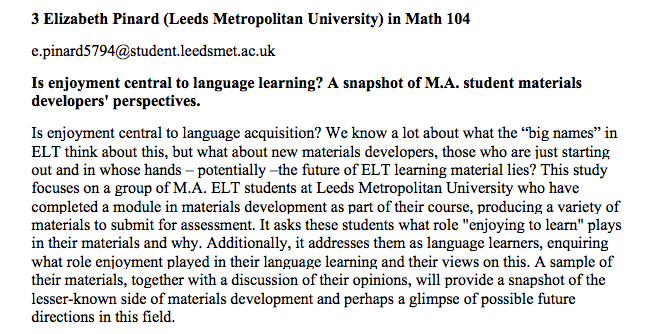
MATSDA Conference 2013 Presentation: Is enjoyment central to language learning? A snapshot of student materials developers’ perspectives.

Conference:ย The MATSDA/University of Liverpool 2 day conference, themed โ€œEnjoying to learn: the best way to acquire a language?โ€ 13th and 14th July 2013, University of Liverpool

Topic:ย Is enjoyment central to language learning? A snapshot of M.A. student materials developersโ€™ perspectives

Abstract:ย 

Is enjoyment central to language acquisition? We know a lot about what the โ€œbig namesโ€ in
ELT think about this, but what about new materials developers, those who are just starting
out and in whose hands โ€“ potentially โ€“the future of ELT learning material lies? This study
focuses on a group of M.A. ELT students at Leeds Metropolitan University who have
completed a module in materials development as part of their course, producing a variety of
materials to submit for assessment. It asks these students what role “enjoying to learn” plays
in their materials and why. Additionally, it addresses them as language learners, enquiring
what role enjoyment played in their language learning and their views on this. A sample of
their materials, together with a discussion of their opinions, will provide a snapshot of the
lesser-known side of materials development and perhaps a glimpse of possible future
directions in this field.

Recording: Here.ย (Not of the actual presentation – due to technical fail – but of a rehearsal)

Write up: Here.

References used in presentation:ย 

Bolitho et al. (2003) Ten questions about Language Awareness in ELTJ vol. 57/3 Oxford University Press. Oxford.

Dรถrnyei, Z. (2005).ย The psychology of the language learner: Individual differences in second language acquisition. Mahwah, NJ: Lawrence Erlbaum.

Dornyei (2013) Plenary at Warwick International PG Conference of Applied Linguistics

Dellar, H. (2013)ย Twenty things in twenty years, part 7: Input is more important than output.ย Blog post, address:ย http://hughdellar.wordpress.com/2013/06/09/twenty-things-in-twenty-years-part-seven-input-is-more-important-than-output/

Gadd, N. (1998)ย Towards less humanistic English teaching.ย in ELTJ vol 52/3 Oxford University Press. Oxford.

Gilmore, A.ย (2007)ย Authentic materials and authenticity in foreign language learning.ย In Language Teaching vol. 40. Cambridge University Press. Cambridge.

Lightbown P and Spada N ย (2006)ย How languages are learned Oxford University Press. Oxford.

Richards, J. (2006)ย Materials development and research – making the connectionย in RELC vol. 37/1 SAGE publications

Schmidt, R. (1990)ย The role of consciousness in language learningย in Applied Linguistics vol. 11/2 Oxford University Press. Oxford.

Scrivener, J.; Underhill, A.ย ย The issuesย Blog post, link:ย http://demandhighelt.wordpress.com/2012/03/02/the-issues/

Swan, M. Language Teaching is Teaching Language. Hornby Lecture given at IATEFL Conference 1996.

Tomlinson (2010) Principles of effective materials development in Harwood N. (ed.) English Language Teaching Materials: Theory and Practice. Cambridge University Press.

Tomlinson (2012): Materials Development for Language Learning and Teaching in Language Teaching vol. 45/2 Cambridge University Press. Cambridge.

16th Warwick International Post-Graduate Conference in Applied Linguistics: Summary – Session 1, PCE 25th June: The cognitive interview and critical incidents (Dr. Keith Richards)

Dr. Richards has very kindly given me permission to post this summary, produced from the notes I took during the presentation he gave on the 25th June at the University of Warwick:

Pre-Conference Event Session 1

Title: The cognitive interview and critical incidents

Speaker: Dr. Keith Richards, Centre for Applied Linguistics, University of Warwick

KR said he was going to start with a problem. Then talk through looking at and responding to this particular challenge, using the cognitive interview.

The aim of the talk is exploring what it can do, seeing what happens when it is tried out and discovering some interesting things. Perhaps the cognitive interview could provide a useful response to what is a challenging problem.

(Looking at an extract from an interview, on a handout)

Problem: the idea of what a story is (as in definition) โ€“ doesnโ€™t fit with Labovโ€™s narrative structure. What we see here is a reflection on a story: it has already been resolved. So there is no climax, it is quite vague. The picture you get is a selection of observations about things, not a story.

However, critical incidents are really important. A bad experience can change the whole perspective on a situation.ย The challenge is: how best to deal with critical incidents?ย Cognitive interviews are one response.

KR explained that we would look at the following:

  • The nature of narrative
  • Interview options
  • Cognitive interview techniques
  • Memory and emotion
  • An illustration
  • Further reading
  • The nature of narrative

One of the aims of delving in to critical incidents is to elicit a narrative/story

Stories are powerful; they help us make sense of our lives and experiences.ย This means we tend to create stories that fit into our life stories. Stories are framed, they have themes, and they fit into a bigger picture. However to get into the experience of a moment, a story may not be the best way to get at it. Why? Because you only get a reflection fitted into a bigger picture. People have two stories: the sacred story (e.g. how I became a doctor) and underneath the mundane, every day stories that have to be elicited in different ways because they are not normally told. (MacLure, M. (1993). Arguing for Your Self: identity as an organising principle in teachers’ jobs and lives. British Educational Research Journal, 19(4): 311โ€“322.)

Interview options

When the police want a statement of what someone saw, they have a special process for eliciting that. They use the cognitive interview: original one used for memory and witnesses.

Definition of cognitive interview: method of eliciting experiential accounts that is rooted in cognitive psychology. Aims to use a variety of techniques to stimulate detailed recall of the event and its temporal, material and affective dimensions.

This does not apply to police interrogations! Thatโ€™s different. Why? Because, a police interrogation and a witness interview serve different purposes and require different styles of interview.

There are different options for eliciting witness statements:

  • Standard (anything but standardโ€ฆ)
  • guided memory (step by step and probe for descriptions of context and emotions)
  • structured (build rapport; allow narrative to develop; interrupt as little as possible)
  • hypnosis (has proved unreliable)
  • cognitive interview

Principles of cognitive interviews:

  • We have limited cognitive processing resources โ€“ therefore, donโ€™t invite the respondent to say a lot at one, focus on single tasks.
  • Witness compatible questioning โ€“ you need to adapt your style and questions to the respondent (so, an interviewer may say virtually nothing, only back-channeling, or there may be bursts of the interviewer speaking a lot)
  • Context reinstatement: stimulate physical, cognitive and emotional aspects โ€“ one might trigger another aspect of memory.
  • Multisensory coding โ€“ going for sounds, smells etc.

The social dynamics are the same as for other interviews. In terms of communication, you need to elicit extensive answers, where the respondent reports everything, leaving nothing out. You can do this by using code compatible output i.e. stimulate memories using associated sounds/smells/tactile stuff.

Cognitive Interview Techniques

Technique, example, psychological basis and evaluation

1. Ask the respondent to reconstruct physical and personal contexts, image of setting, emotional responses and sounds/smells.

The effectiveness of the cue will depend on the extent to which it was encoded with the information to be remembered (like the Madelines in Proustโ€ฆ)

There is some evidence of effectiveness, but results are mixed (as everโ€ฆ)

2.ย Ask the respondent to report everything: this can provide valuable information

3. Invite recall from a variety of perspectives: ask interviewee to see x incident from perspective of someone else who was involved.

There are, however, concerns that if asked to do this, people speculate and start to fabricate.

4. Stimulate retrieval from different starting points: E.g. start backwards from the event, to work backwards through what led up to it. This draws on multiple retrieval pathways.

Some evidence of effectiveness, but inconclusive

So, CI enables a variety of approaches. You need to choose your technique according to what is emerging and what might open it up further.

There are two types of events:

Field events โ€“ This is the same field of vision as original events

Observer events โ€“ This is seen from the observer viewpoint of respondent as an actor in the scene.

To get someone warmed up for this, take a house/flat they know and get them to mentally โ€œlook outโ€ of different windows and describe what they see โ€“ with eyes closed, to avoid distraction unless not comfortable with that.

An example

ย Narrative will yield some things but CI will yield more.

Invite the narrative: (โ€œCan you talk me throughโ€ฆโ€/โ€Can you tell me aboutโ€ฆโ€ – then sit back and say as little as possible, let it flow, unless you need to clarify)

Elicits abstract and orientation (Labov)

Respondent needs to show they are following. But if they say too much, it can change the flow, so you need to be careful. Nodding is good.

Having got the narrative, in order to move onto the cognitive part, you identify the focus: โ€œWhat Iโ€™m going to do is focus if itโ€™s ok on that exchange, the key โ€“ I want to just check that this is the key moment that โ€“ <description of moment> Iโ€™d like to just focus on that moment a little bit more if thatโ€™s okโ€ฆโ€

If it works, the person giving the interview will get into the moment. You can use sensory triggers, work from a sensory thing (e.g. smell of paint) and move out from this into what happens in an incident. Elicit emotions in present tense. From here, you can explore them.

Memory and emotion

Emotions: if you donโ€™t probe in this way, people will generalize things, to avoid reenacting something unpleasant. Crucial if trying to get at a critical incident, when you donโ€™t want vague generalizations.

Memory is unreliable: False memories are contagious. Someone elseโ€™s response may become ours. CI can probe beneath that and get at the reality.

Awareness of memory process: People can be aware of how memory works, conscious of it, much more so in CI than in narrative interviews.

Illustration

ย Laura example (on handout): The cognitive interview reveals the sense of betrayal experienced in talking to the daughter about the issues.

The dog doesnโ€™t feature in the narrative but in the cognitive interview becomes the core of what is important. The real moment of change is linked to the dog and the sense of betrayal, which arenโ€™t in the narrative. => This is the critical incident.

At the end, somebody asked a question, from which the following discussion emerged:

Is it just a question of paradigm? Cognitive interviews are seeking โ€œthe truthโ€ (because that is the purpose of police witness interviews) whereas narrative is constructed. But, we can use techniques of the cognitive interview without committing to the assumption that we are eliciting โ€œthe truthโ€(definitely donโ€™t assume that!), to get certain things to emerge and focus in on moments more effectively.

We can use it to enhance interviewing skills in some situations, especially those involving critical incidents. It is useful if we want to probe something that emerges, if that moment seems to be very important i.e. a critical incident.

All in all, this was a very interesting presentation, with a lot to think about and take away from it.ย 

Phonological Representation in Course Materials: Whose English?

This post contains information related to the presentation I gave during the 16th Warwick International Post Graduate Conference in Applied Linguisticsย on 26th June 2013:

Presentation Abstract:

The role of English in the world today, as a Global and International language, has been the subject of much debate in the last decade, with the role of Standard British English (SBE) being called into question. Content analysis of language materials can offer an insight into how far the applied linguistic research and trends are reflected in what is being taught and learned in the classroom. The current study focuses on phonological representation, investigating the sociocultural spread of accents found in New Cutting Edge Intermediate, a popular global coursebook which claims to bring โ€œthe real world into the classroomโ€, comparing it with Grayโ€™s (2010) findings on the similarly successful New Headway Intermediate, using the phonological component of Grayโ€™s (2010) content analysis framework and finding that RP/modified RP still predominates. The study finishes by exploring possible reasons for this and recommending potential directions for further research.

Recording of my presentation:ย Please click here and it will open in a new tab.ย 

Sources referred to in my presentation:

Grey, J. (2010) The Construction of English: Culture, Consumerism and Promotion in the ELT Global Coursebook. Palgrave Macmillan. Basingstoke.

Jenkins, J. (2000) Accent across boundaries: the Lingua Franca Core. Paper read at the 33rd Annual Meeting of BAAL, 7-9 September 2000, Cambridge.

Jenkins, J. (2006) The times they are (very slowly) a-changing. In ELTJ vol. 60/1. Oxford University Press. Oxford.

Timmis, I. (2002) Native Speaker Norms and International English: A Classroom View. In ELTJ vol. 56/3. Oxford University Press. Oxford.ย 

Sources referred to in my research write up (data and write up are available on request):

Carter, R. and M. McCarthy. 1997. Exploring Spoken English. Cambridge University Press. Cambridge.

ย Cunningham S and Moore P. (2005:a) New Cutting Edge Intermediate. Student Book. Pearson.

ย Cunningham, S. and Moore, P. (2005:b) New Cutting Edge Intermediate. Teachersโ€™ book. Pearson

ย Gray, J. (2010) The Construction of English: Culture, Consumerism and Promotion in the ELT Global Coursebook. Palgrave Macmillan.

ย Hadfield, J. (2012) Becoming Kiwi: A diary of accent change in ELT Journal Volume 66/3. Oxford University Press. Oxford.

ย Holliday, A. (2005) The Struggle to Teach English as an International Language. Oxford University Press.ย  Oxford.

ย Jenkins, J. ย (2002) The Phonology of English as an International Language. Oxford University Press. Oxford.

McKay, S (2002) Teaching English as an International Language. Oxford University Press. Oxford.

Wei, L. (Ed) The Routledge Applied Linguistics Reader Routledge. Oxon.

Sharifian ed. Perspectives on English as an International Language.

Sobkowiak, W. (2008) Why not LFC? in Dziubalska-Kolaczyk, K. and Przedlacka, J. (Ed.) English Pronunciation Models: A Changing Scene. Peter Lang International Academic Publishers. Bern.

Soars and Soars (2003). New Headway Intermediate: Second Edition. Oxford University Press. Oxford.

Timmis, I (2002) Native Speaker Norms and International English: a classroom view. In ELT Journal. Vol. 56/3. Oxford University Press. Oxford.

Timmis, I.ย (2003)ย Corpora, classroom and context: the place of spoken grammar in English language teaching.ย PhD thesis, University of Nottingham.

Yuen, K.M. (2011) The representation of foreign cultures in English textbooks in ELT Journal vol. 65/4. Oxford University Press. Oxford.ย 

Summary of BESIG Online Conference Session – Nick Robinson: “How (and why) to join a group of materials writers?”

This session was delivered by Nick Robinson, who is one of the coordinators of the Materials Writing SIG (MaW SIG) – at impressively high speed due to technical difficulties taking over the first half of the session!

The aim of the session was to give a short overview of MaW SIG, in terms of why it was set up and what the coordinators hope that members will be able to get out of it. Thus, rather than a “how to” session, it was more of a “why to” session.

So, why was MaW SIG created?

Well, until now, with the creation of MaW SIG, there hasn’t been a special interest group aimed especially at materials writing. (It is important to note the -ing there: materials writING, not writers. It is aimed at anyone who is interested in the process of materials writing. You don’t need to be published, or a big name, in order to be a member of this group. The only essential is interest in the process of materials writing.) However, nearly every English language teacher in the world writes all the time – you may not call yourself a materials writer, but every time you produce a worksheet or a quiz, you are writing materials. Some people do write to be published or to sell their materials, others write materials to share, and others write just for their students to use. The common thread, though, which runs through all of these reasons is the act of writing. MaW SIG wants to bring together a group of people around that thread.

The world of publishing is changing very fast, especially in the past ten years. This creates both a need and an opportunity forย people to come together in order to share best practice and ideas and to give advice on how to adapt to this new environment. What MaW SIG provides is a single forum for people to come together and do this, a single forum forย the sharing of materials writing knowledge, best practice and continued professional development.

Why should you join MaW SIG?

Publishing is still a who-you-know business, so the connections you make are hugely important. MaW SIG intends to run two conferences a year. In terms of what is forthcoming, the first event will hopefully be held in October, while the second will be a Pre-Conference Event at IATEFL. These events aim to offer you the opportunity to network with established writers, authors, publishers, editors and anyone else who is involved in all the different aspects of materials writing.

This SIG is all about professional development and training, so therefore the stand-alone conferences (like the one planned for October) will be very hands-on. This will help you learn to write better and best practice will be promoted; it is an opportunity to learn from experts in the field.

MaW SIG also has an active Facebook page, through which you can access people who have been doing materials writing for a long time. There is a lot of knowledge out there, which can be shared and this page aims to provide a platform for this.

Finally, if you are interested in getting work published, it is worth remembering that publishers don’t only look at the quality of your materials. They look at a range of other things, like how you interact with the wider ELT community, how interested you are in the field, how active you are in blog-writing and on Twitter, how active you are in attending conferences. Joining and being part of MaW SIG is another way of demonstrating commitment to the field as well as the willingness to learn and develop as much as you can.

How can you join MaW SIG?

You can join by adding MaW SIG to your IATEFL membership, alongside any current SIG membership. (You can also wait until your current SIG membership runs out and replace it with MaW SIG if you so desire!)

You can also join the Facebook page ย for which you do not need to be a member. (But of course you’ll gain more from the SIG by joining it!)

You can follow the Twitter handle (@MaWSIG) (As above, you do not need to be a member to do this but the same applies in terms of benefits!)

And you are also welcome to email Nick or Byron to ask any questions you might have. (I didn’t catch the email address but I’m sure you can get it via the Facebook page or Twitter!)

MATSDA (Materials Development Association) Conference, 13-14 July, University of Liverpool

On the 13th and 14th of July, the University of Liverpool will be hosting MATSDA’s annual 2-day conference. Well worth attending to catch up with the latest developments in the world of ELT materials!

You can find an advert for the conference here, and a full programme of who will be presenting on what topics, including abstracts, here. Please do download them and share them with anyone who might be interested in going!

These are the plenary speakers:

  • Mark Almond
  • Thom Kiddle
  • Alan Maley
  • ย Hitomi Masuhara
  • Brian Tomlinson
  • Jane Willis

I’m going to be presenting on the Sunday too! All very exciting.

So if you have any time to spare and are able to get to Liverpool for a weekend on the 13th/14th July…

You know you want to! ๐Ÿ™‚

IATEFL 2012: Carol Read on “Creative Teaching, Creative Learning”

Carol Read: Creative Teaching, Creative Learning. (Tuesday 20th March 2012, IATEFL Glasgow)

To be creative is to get on a roll with an idea. You experience โ€œflowโ€ or the positive harnessing of emotions in pursuit of a goal or outcome. It is with this thought that Carol Read opened her extremely creative session on creative teaching and learning.

Carol went on to discuss the necessity of a frame work in order to create. A framework, she said, is energising and liberating: without one, we become lethargic and uninspired. She supported this with a quote from David Ogilvy, โ€œGive me the freedom of a tight briefโ€. Not only do we need motivation and inspiration, both of which are typically associated with creativity, but also disciplined thinking, attention to detail and effort, which may come to mind less readily in connection with the concept.

As a word, creativity has both positive and negative connotations. In the negative sense, it may seem clever but sneaky. For example, filling in expense claim forms to obtain the maximum return. While on a positive note, we think of energy and enthusiasm, thinking outside the box.

But how do people define creativity? Carol negotiated this minefield next.

The dictionary definitions, she told us, are ok but not very helpful. Take for example Macmillanโ€™s free online dictionary:

Creativity: the ability to create new ideas or things using your imagination.

Creative: involving a lot of imagination and new ideas; someone who is creative has a lot of imagination and new ideas.

Having put forward that the dictionary did not hold the answers we were seeking, Carol shared a few quotes about creativity with us:

โ€œCreativity is an act that produces surpriseโ€ – Jerome Bruner

โ€œCreativity is adventurous thinkingโ€ – F Bartlett.

โ€œCreativity is a state of mind in which all our intelligences are working togetherโ€

โ€œCreativity is a cluster of skills which we use to come up with something new and validโ€ – Chaz Pugliese.

Creativity, then, is newness, excitement, something valued in its context. We all know what it is but it is difficult to describe. Carol suggested that itโ€™s not what it is thatโ€™s important but where. That is, the interaction between creative person, social context, field or domain.

A talk on creativity would not be complete without taking a creative twist to the telling of it, or so Carol believed, and as a consequence of this, we were treated to โ€œPrincess Crystal Creativeโ€, based on Babette Coleโ€™s well known spoof fairytale, Princess Smartypants. In Carolโ€™s version, the princess questioned the princes with a series of questions on creativity and each prince got one question further than the last, until finally a prince was able to answer all of the questions…

1. Whatโ€™s the difference between creativity, imagination and innovation?

  • Imagination: pretending, supposing, playing…
  • creativity: generation of new questions, products, ideas; underpinned by imagination.
  • innovation: taking creativity and applying it to the real world.

These are like layers of an onion. Imagination at the centre, followed by creativity, followed by innovation.

2. Whatโ€™s the difference between big C and little c creativity?

  • Big C creativity: This encompasses large ideas, paintings etc that change the world and peoplesโ€™ lives.
  • Little c creativity: This is about personal effectiveness in our daily lives, the creative decisions that we make all the time. For example us delegates negotiating the conference.

In terms of teaching and learning, Big C creativity is something a student produces that is significant to their progress, which gains validation from those around i.e. teacher and peers. Little c creativity, on the other hand, is everything that is going on between us, as teachers, and the learners, and how it is constructing relevance. It is how children use little language to communicate what they want to say.

3.ย What is โ€œcreative teachingโ€ and how does it differ from โ€œteaching for creativityโ€?

  • Creative teaching: effective teaching, using techniques to get things across creatively, thus engaging learners.
  • Teaching for creativity: This is about learner empowerment, equipping learners with the skills they need to be creative themselves. The outcome or objective of a lesson that teaches for creativity is a creative product from the learners.

4. What is creative learning?

Creative learning is when learners are allowed to use imagination and experience in pursuit of learning. Itโ€™s when learners are allowed to exercise choice – both in the process and in the product. Itโ€™s when learners are involved in pedagogic decisions and in shaping the syllabus. Creative learning requires critical reflection and evaluation, learners learn to evaluate themselves, the materials and their teachers. Thus, this type of learning is a close cousin of learner autonomy, in the way that it develops metacognition and meta-skills.

5. What teaching approaches and strategies promote creativity?

Carol suggested that the following would see us on the right path:

  • develop motivation and engagement
  • provide a stimulus, framework and purpose
  • build up self-esteem: security, identity, belonging, purpose, confidence.
  • adopt an inclusive approach
  • model creativity in the way you teach: be โ€œan effective surpriseโ€
  • offer choice and foster ownership
  • give personal relevance
  • consider the role of questions: use open questions as well as closed; allow โ€œthink timeโ€ before students respond; value studentsโ€™ questions too.
  • make connections, explore and play with ideas: connect home life and school life, use different media. This opens up synapses in our brain and makes it open to possibilities.
  • use โ€œpossibility thinkingโ€ e.g. โ€œwhat if….โ€ question.
  • keep options open, withhold judgement, alllow brainstorming with โ€œwhatโ€, โ€œwhyโ€, โ€œwhenโ€ and โ€œhowโ€ questions.
  • reflect critically.

6. What are barriers to creativity?

As important to be aware of as the strategies that we can use to promote it, and in essence the opposites of all the items in question five! Carol warned us against the following:

  • Too much spoon-feeding/scaffolding/help
  • โ€œTellingโ€ vs experiential learning
  • deep end discovery without structure or guidance, where students are thrown in with no rooting: if they donโ€™t know where they are going, how are they going to get there?
  • routinization: plodding through x units of a book per lesson, to the exclusion of all else
  • undervaluing studentsโ€™ knowledge
  • fear of risk-taking
  • over-crowded curriculum: 50% knowledge and 50% creative application would be preferable
  • lack of space, leading to no time for creativity
  • institutional and parental attitudes
  • exam systems, internal or external

Finally, Carol concluded with a quote by Tim Smit:

โ€œEvery good teacher is a catalyst of creativity, a liberator. Every bad teacher creates cages.โ€

(To find out more about Carol Read and see some fantastic teaching ideas, visit her blogย or her websiteย for a wealth of information about teaching young learners as well as talks she has done and books/articles etc that she has had published.)

IATEFL 2012 Opening Plenary: Adrian Underhill on “Mess and Progress”

IATEFL 2012 Opening Plenary: Adrian Underhill

Mess and Progress

On Tuesday 20th March 2012, Adrian Underhill opened the main conference with his plenary speech on Mess and Progress, putting forward the case for engaging systemic thinking and leaving behind heroic leadership.

What is the difference between difficulty and mess? Underhill suggested that the differences lie in the scale and uncertainty:

A difficulty is fairly clear cut and definable. It can be explained and labelled. It is probably solvable with current thinking. We may know what the answer will look like. A mess, on the other hand, is extensive, knows no boundaries, is uncertain and ambiguous. There is no single correct view of it. It resists change. Everything is interconnected so it is hard to know where to start or what the concern really is. There is no tidy fix within current thinking.

Underhill went on to contrast traditional and systemic thinking: The traditional view entails โ€˜thingsโ€™ being considered as primary and relationships as secondary. Conversely, systems thinking ranks relationships as primary and things as secondary. Systemic thinking has developed over the past 50 years to make full patterns clearer, to see connections and relationships rather than isolated entities in a bid to see how to bring about effective change.

He explained that there is a tension between controlling and connecting. Our default preference is control however, while control may work with difficulty, it cannot work with mess.

Having established this premise, Underhill went on to discuss traditionalย leadership and its deficiencies.

New leadership is closer to teaching than traditional leadership. It is time for everyone to take responsibility for their influence. Until recently, the tendency has been towards hierarchical set-ups, also known as heroic leadership. This is changing, though that may not be apparent in the media. This change is obligatory because hierarchical leadership is not smart enough to handle todayโ€™s complexity, where you need intelligence dispersed throughout the system not just at the top.

Todayโ€™s leaders must

  • make decisions based on incomplete data
  • accept that cause and effect are disconnected, which makes it hard to learn from experience: there are layers of outcomes, we do not know what is due to what.)
  • face unintended consequences: each solution has an impact beyond what is expected.
  • serve people not themselves: people demand this, something that is also seen in the classrooms of today.
  • have self-knowledge and personal maturity

Heroic leadership cannot cope with all of this. Underhill shared a quote from Wheatley that summarises this: โ€œThe great thing is to realise that leadersโ€™ work is essentially very different from the pastโ€. (This, then, is presumably why leadership has had to develop accordingly.)

Underhill then moved on to considering post-heroic leadership:

In this model of leadership, instead of looking at a person, we look at activity. Then leadership can come from anywhere in the system e.g. teachers and parents as well as the head teacher. Perhaps there has been a paradigm shift from influencing the community to follow a leaderโ€™s vision to influencing the community to face its problems.

Will things fall apart with less hierarchical control? No, because values, meaning and purpose hold things together. When people are aligned to their purpose, when the gap between values and behaviour closes, what people experience is a stream of ease. A leaderโ€™s job is to help purpose and values line up. Peoplesโ€™ commitment can be developed by aligning with their values. This typifies a healthy organisation. If we engage systems thinking, then we do not damage one thing while trying to develop another: dynamic connectivity. This sort of connectivity cannot come from heroic leadership.

Systems thinking, i.e. thinking outside of the box, is not currently the norm. Underhill quoted Amanda Sinclair on this issue as follows: โ€œwe donโ€™t discuss alternatives to heroic leadership because male heroic leadership archetype is so deeply embedded in our psyche that it has become invisible.โ€

Underhill continued by expanding on learning at organisational and individual level:

He suggested that there is much intelligence in schools but that it is not flowing. It is not allowing relationships to be created that would enable things to be done as fully as they could be. What is needed is, essentially, acupuncture (!), because disconnected humans do not yield human capital.

On the other hand, in a learning organisation, where the intelligence is flowing, the learning of all its members is facilitated and continuously developed. Individual learning can be wasted unless harnessed at organisational level. A company that does a lot of training is, however, not necessarily a smart organisation, as training can still result in an organisation full of smart individuals who are not connected, which does not make a smart organisation. Learning is a leaderly activity: leaders can lead through their learning. Systemic thinking requires slow learning, which is an attitude and outlook that allow different ways of knowing.

Underhill concluded that it is exhausting to maintain the pretence that messes are difficulties. We need to develop a new learning mantra. We need to see what is going on, as well as the impacts and results and the distractions interrupting the sight. Then we need to do something different, prod the system and find out a bit more about how it works. This can be done by doing what we do not usually do and refraining from blindly doing what we would usually do OR by doing what we usually do but watching it more carefully. Finally we need to learn from it and gain insights which should be taken and tested in what we do next. All of this is the key to thinking systemically.

In addition, you need to know your point of view but check out all the other points of view in the room too, as a matter of course. You need to thus depend on diversity. You need to give up on certainty, be uncertain and give up trying to be right. You need to look for unintended consequences. Look sideways at any simple action and you can float outside the box. You need to bother less about control and focus on connecting with others instead. Itโ€™s more interesting! You need to start conversations and see the whole school as an adventure park for learning. Hassle is part of learning: make plans but do not expect them to work out.

Adrian Underhill closed by reminding us that it is fun, inspiring and urgent to explore and that doing something different is an important method of enquiry, which should be fun. After a rousing rendition of reflective practice blues, he encouraged us to try out something different every day.

My reflections:

The world is a chaotic place, so systemic thinking seems, to me, to be a logical means of progression. Furthermore, such an approach is empowering to the individual. We are all capable of contributing through nurturing an enquiring mind and engaging with the diversity that all of our views and ideas embody.

I think the world of #eltchat and blogging is a fine example of systemic thinking, connectivity and expanding on learning. We lead each other forwards by sharing our own ideas and reflecting on those of our PLN, which in turn influence our own. The ELT world progresses, develops, and we are all part of that process. The intelligence is undoubtedly flowing and we all benefit from it as we try new things, inspired by what we read and discuss.

The challenge is to replicate this systemic thinking in our workplaces, embrace the mess and derive progress from it!

The journey of a thousand miles… (a thank-you to Cactus and to #ELTChat!)

…or how inter-related everything is!

Today I received an email from Cactus informing me that my conference scholarship report has finally been published on their website. On re-reading it, I was able to re-live the excitement of IATEFL 2012 and also reflect on what consequences my attendance has so far yielded…

– In my conference pack, there was a leaflet promoting an M.A. course with integrated DELTA. Yesterday I had an interview and was offered a place on this course. I would not have known about the course had I not attended the conference. I am very excited about embarking on this course and feel sure I will grow hugely as a teacher and, indeed, individual, as I negotiate my way through it.

– At the conference, I attended a pre-conference event, that of the Teacher Development SIG. I volunteered to write a report of it and this has been published in a recent TD SIG newsletter. Had I not attended the conference, this would of course not have been possible.

– I also bought Jim Scrivener’s latest book, “Classroom Management Techniques” during my week at IATEFL 2012. I subsequently reviewed this book for The English Teachers Association of Switzerland Journal, invited by Vicky of my PLN (@Vickyloras). Had I not attended the conference, I would not have known about this new book or acquired it so would not have been able to review it. A review of a new book is of greater interest than a review of a book that has been kicking around for years, so this was perhaps instrumental to my work being included in the journal.

– At the conference, I met Jim Scrivener in a post-conference talk and joined in the discussion on Demand High ELT. Subsequently, I proposed this topic for #EltChat and wrote the summary for it, which has been published on Jim and Adrian’s website. Becoming involved in Jim and Adrian’s project has been a source of great excitement for me.

So, all of these exciting things became possible due to my being able to attend IATEFL’s annual conference this year. My attendance was enabled by winning the scholarship from Cactus, for which I am immensely grateful. And finally, I would not have known about these scholarships were it not for #eltchat!! An exciting journey was begun when I signed up for twitter and happened on the #eltchat tag. So many opportunities have been opened up to me as a result and I have met many people who now form part of my PLN, from whom I learn on a regular basis.

Thank you #Eltchat and Cactus for the immeasurable impact they have had on my career to date.

I wonder where the next thousand steps will take me…

IATEFL 2012: Notes and Reflections on Jim Scrivener’s talk on Demand-High Teaching

Jim Scrivener’s talk on Demand-High Teaching took place on 20th March 2012. Demand-High Teaching was not a term I’d heard used before, but one of Jim’s books, Learning Teaching, got me through my CELTA as well as my first year of teaching, so, ignorance be damned, there was no way I was going to miss this talk! It certainly did not disappoint, and, together with the follow-up session that took place two days later, it has provided plenty of food for thought and scope for experimentation in class since.

Jim started with the premise that ELT has become too entrenched, a problem that has gone mostly unnoticed. ELT lessons may be ok, enjoyable for the students, solid and good enough but there’s something missing. Jim suggests that this “something” is sufficient demand on the students. Teachers tend to be satisfied with less than the students are capable of. Teaching skills and methods may be solid and allow the possibility of a higher level of demand but they are not taken beyond “going through the motions”. The communicative approach is established, and we have agreed and established ways of doing things, many of them good, but this has led to a peaceful dead end.

But what of the learning in this dead end? Is there any learning? How could the students or teachers know? What is the point of all the activities undertaken? What was done to promote learning? The activities might be perfectly valid but if the teacher hasn’t thought about what he or she wanted to achieve by doing them, considered the purpose, then opportunities for learning can be lost. This is what seems to meant by “going through the motions”. The teacher races at the speed of the fastest student in the class, in order to satisfy the requirements of the syllabus in the allocated time and the purpose gets forgotten. That leads to demand-low, challenge-low teaching, in which students are regularly asked to do less than they are capable of, while teachers respond over-positively, lacking the skills to help the students develop and upgrade their language. The ability and techniques to intervene have been lost to fear. Teachers sidestep the excitement of working with the learning, wrestling with the language, ‘swimming’ in it.

Jim went on to suggest that we need to be more physically active and interventionist in the classroom. We need to demand in a supportive way. We need to think about how the learning happens and how we can make it happen. The gap-fill work and the pair work are just the vehicles of learning, teachers need to drive them in the desired direction. The current path we tend to send these vehicles along seems to end in a dead end. Helpfully, he ย also discussed how teachers can increase the level of demand in their classrooms.

The premise of all these things is that it really is ok to “teach”. For me, this was the key to the whole talk. This idea that there’s no need to be afraid to go that bit further, and stretch the students that little bit more. We don’t need to stand back or limit ourselves to classroom management. Jim introduced the idea of “intervention” in a classroom context: Anything a teacher does that affects what happens in the classroom; to do/say something or indeed NOT to do/say something. A teacher needs to find a way to be as useful as possible to the learning process, by structuring and manipulating it: a type of classroom management. Classroom management becomes anything that helps more learning to go on in the classroom; so it is taken to another level, beyond the simple ‘crowd control’ that it usually pertains to.

Here are a few techniques that Jim shared with us. (A whole chapter of these can be found in Jim’s new book, Classroom Management Techniques, which I’ve found to be most helpful, as it not only offers a wealth of ideas on how to do things differently in the classroom but also encourages you to think about why you are or aren’t doing them.)

1) Don’t rubber stamp

Rubberstamping is when the teacher says “excellent”, “very good” and other such empty words of praise at every turn. This ends the conversation by closing it down. Whereas, if the teacher withholds that ‘rubber-stamp’, the dynamic is changed and a big difference can be made. This is a way to break out of the chase for right answers. We need to learn to give feedback rather than unearned praise, as praise not only can be a dead end but also inflates: Good becomes excellent which in its turn becomes fantastic until all is AMAZING!

2) Open up questions rather than closing them down

Has terror of hurting students’ feelings has taken over? Either way, intervention and demand-high teaching can be done supportively while still upgrading the students’ level in a way that empty praise cannot. We need to push the students that step further, challenge them by moving away from doing activities ritualistically. Think about the learning process students go through as they encounter a word: Counting syllables, splitting up the syllables, trying it out, comparing with a neighbour etc. Open up this process.

3) Work one to one with a student, making it valid for the whole class.

Jim championed this idea that working one to one with a student can be time well-spent rather than an inefficient use of precious time, as it is often considered. I recently started working at the Berdale Centre in Sheffield, teaching a pre-intermediate ESOL class. One of the things I have experimented with, in the light of this talk, the follow-up discussion and the #eltchat discussionย on this topic, is making one to one work with a student something the whole class can learn from. This has led to students contributing to the process and enquiring deeper into the language in question. I intend to keep a journal to record these moments and others generated by experimentation with this and other demand-high teaching techniques, so more on this later!

Getting to the end of the talk, Jim stressed that the Demand-High Teaching discussion is not a methodology-bashing, course book-bashing or anything else-bashing enterprise. The communicative approach is great, methodology is not a problem, neither are the course books. The issue is how we engage with them and what we get out of using them. There are a lot of positions to take, not just Dogme vs course books. We need to hold on to the many good elements of the communicative approach but find ways to get up close with the learning process. We need to explore it more. We need to demand more of our students.

It’s a small change of attitude that could make a big difference: “They CAN do better”. If you believe in it and ask for it, they will do it.ย 

The talk then ended but the discussion is ongoing: no peaceful dead end here! Jim Scrivener and Adrian Underhill have set up the Demand-High ELT blog. The slides from Jim’s talk can be found here, as well as further input on the topic in the form of articles etc. It is also a space where teachers are welcome to share experiences, questions and opinions regarding Demand-High Teaching.

Being a nervous sort of person, I found this talk quite empowering: “It’s ok to really teach” – done supportively, it doesn’t turn you into the wicked witch of the west or make you some kind of student destroyer. To the contrary, it enables you to really make a difference to the students’ learning. Little wonder then, that I made every effort to attend the follow-up discussion on Thursday 22nd March. This took place in the Crowne Plaza Hotel bar and about a dozen of us spent an hour discussing Demand-High teaching, sharing our thoughts and experiences of it. ย I didn’t take notes on this because I was too busy participating and being thoroughly excited to do so!

Again due to being of a slightly nervous disposition, I came out of my CELTA with my B-pass and the mindset that to teach successfully, I had to do all the things I’d learned to do during the course. Questioning them didn’t occur to me. What right had I to question? So, along with the empowerment as mentioned above, the other main thing I took away from this talk and the follow-up discussions is awareness of the importance of questioning methods and techniques. Not with the aim of rubbishing them, at all (the course was great and I learnt masses of good things that have stood me in good stead!), but rather with the aim of achieving a greater understanding of what ends I hope to gain by using them. This may be obvious to more experienced teachers and more confident teachers, but for me, as a newish teacher of two years teaching experience, this was an important message: I can question and experiment my way off the path to a peaceful dead end.ย