Learning Technologies SIG P.C.E. – Adrian Holliday “Web-based learning, cultural travel and claiming the world”

I had an email through yesterday, telling me this P.C.E. would be streamed live and so it is that at 11.00 C.E.T. (10.00 B.S.T.) I’m waiting for my first IATEFL Harrogate experience to begin unexpectedly early! Happy days, as I was disappointed not to be able to attend one of the P.C.E.’s in person this year. 

I first discovered Adrian Holliday during my M.A. ELT studies at Leeds Met last year – The struggle to teach English as an international language featured, as did a chapter in an edited book from Routledge about Applied Linguistics that I read, not to mention the journal articles. He comes across very strongly in his writing – a man with opinions, which he isn’t afraid to express! So I was delighted to discover that I have the opportunity to watch him talk via the live-streaming despite not being able to attend the P.C.E. day.

Here are the notes I made during this talk:

Adrian Holliday: Web-based cultural travel and claiming the world

Adrian says he has never thought of himself as a technology person but does like technology, and is happy to be here in his home area, able to eat in Betty’s restaurant, and to have had a good night’s sleep!

The topic connects with something he is very interested in – cultural travel and claiming the world. What tech does is bring out something that has often been hidden. Web-based and digital tech liberate a world that has been hidden.

“Young people on the march” – teachers in Iran can’t cope, there are so many youn people learning language and they are way ahead of their teachers. Inspiring but can be worrying if we don’t allow things to open up. This is what this talk aims to do.

Multi-literacies and claiming secret sites of learning

Holliday cites a secondary school in Hong Kong, demonstrating the power of technology to reach students, then a Sri Lankan secondary school with American textbooks with glosses scribbled in by learners that characterise their interests. They write their own script onto the dialogue. They convert what they get, out of sight of the teacher. He speaks of the amazing creativity of university learners in Kuwait and then inner-London secondary schools in the UK, where students play with each others’ languages, demonstrating incredible skill, and Chinese secondary school students’ diaries again demonstrating immense creativity. Teachers may think learners lack autonomy, but in fact learners may practice their autonomy in private by themselves.

Autonomy, authenticity and choice

Holliday believes that everybody has the innate ability to be autonomous and that people practice it privately, but that it is not always visible in the classroom because the classroom doesn’t allow it to work. He provides an example of technology bringing creativity and choice into the language learning environment, making it visible where it was hidden and secret. He is strong in his views that British or American models should be moved away from, but accepts that learners may choose them as not the core but something exotic. They are attracted by the “brand”. He says it becomes in the domain of motivation rather than that of model.

We are moving away from a native speaker norms:

When we think about technology, we need to remember that a lot of research has gone on that has changed the way we think about language. English can attach itself to any cultural reality. He quotes Chimimanda Ngozi Adiche’s use of “How did you come out this morning?” as a greeting between people in a book of hers, and says we all know what it means, but that most teachers would not allow that kind of language in the classroom but that we should actually allow language learners the freedom to work by themselves and bring stuff like this in from their communities, expanding English as never before.

Holliday moves on to discuss India and how people may speak five different languages, a multi-lingual society. So you become a native speaker not of a particular language but of the whole linguistic repertoire that you use. (Quoting Rajogopolan, 2012) and then a Syrian student who he described as travelling within the language according to her use of it.

“You speak the language, not let the language speak you. ….To stamp the language with your identity”(Clements and Higgins, 2008) Holliday thinks that technology allows this sort of thing to come into clear view.

Taking care of identity

Holliday describes coming from your own cultural background and claiming the world, as taking it on in your own terms – a kind of “bottom-up globalisation”.

He describes Norton (2014)’s quote “Learner’ – camera – ‘journalist'” – mentioning the questions that were attached with regards to who gives the camera and why do they need to?

The internet provides incredible exposure to things across the world. So is there an existing cultural capital that has the resilience to withstand the images from elsewhere? For the picture of Italian learners that Holliday displayed earlier, he thinks yes. He doesn’t believe that anyone lacks cultural capital or identity but that we have to be careful, and this is where the role of the teacher comes in. There is a large role for the teacher in providing social support. As young people are very able to work with new devices, they might not know the strategies this could be used for. He is interested in the ethics, morality and control of using blogs, as discussed in Gollobin (2014). When the students in that study began to blog, they were freed from their identity. They don’t lose anything but they can be whatever they wanted to be. You wouldn’t know age/race/gender/class from their writing. Any newcomers could go on the blog and work out exactly where they should be on the programme and position themselves.

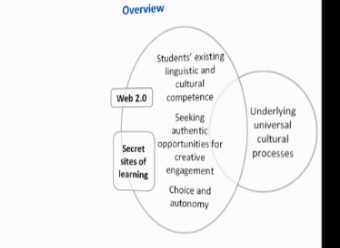
Underlying universal cultural processes

Holliday offers us some theory from his own work:

Cultural background: national, regional or religious ‘culture’ doesn’t confine you or bind you but provides you with cultural resources. Different people will bring different cultural resources. This explains why somebody in Gollobin’s (ibid) class who has never done blogging before, as soon as they work out the basics of what to do, they knew what to do. They drew on experiences and skills which they could bring to this. But there’s something else there that ties everything together. Universal underling cultural processes. How we all engage with culture everywhere in a similar way, in terms of constructing and engaging with social rules and relationships.

Holliday is a cultural traveller when he reads Jane Austen. We are all cultural travellers whenever we go anywhere or read anything. We bring things from our own background that help us to unlock what is happening elsewhere. When you visit the family next door, as a child, that is your first major culture shock. And you have to work out how to be yourself in a completely different domain from what you’re used to. It’s this underlying ability that enables us to travel culturally. All the students referred to earlier in the talk are doing this, but doing it outside the classroom. Holliday thinks that technology should enable use to bring it INTO the classroom.

Holliday doesn’t think you need to learn another culture in order to learn another language. You need to recognise existent cultural resources and how they can be used.
Screen Shot 2014-04-01 at 11.59.25

But there are somethings that get in the way. What? 

  • outdated ideas about English and Culture: he has spoken to young people who tells him that their teachers tell them they must speak British English or they won’t be understood. In this day and age, teachers and parents are telling their children/students this.
  • cultural disbelief: we must never believe that people come from somewhere that makes them wired in a way as not to be able to use technology: we mustn’t deny the value of existing experience, it is rich and productive, wherever people come from, whatever their experiences.
  • institutional structures which don’t allow space: they’ve kept the creativity of students hidden and marginalise what can be done with technology.
  • empty bullet points
  • existing curriculum:  clinging to positivist research approaches
  • do not get beneath the surface: what we know about society across the world is struggling at the margins because the big narratives tell us that people can’t, when actually people can. We have to learn from the margins.
  • Top down globalisation: the western idea that certain people don’t have autonomy etc.

Holliday thinks that we need to be strategically unobtrusive. Language learners are more creative than we imagine, but we don’t see it, then teaching can actually get in the way. Technology puts technology and experience between teacher and student, somehow. Holliday thinks teachers need to step back and let the technology work by itself. To allow students to be who they want to be and bring what they can from their background. Somehow you have to allow space to be there, which the students can populate in their own terms. So what we mustn’t do is go around telling people how they should behave with technology. Holliday worries about the larger than life language teacher, always there in the middle. He thinks autonomy needs to be de-centred.

You need to ask questions without dominating questions and not ask questions which push your agenda. The technology is there, the opportunity is there, people have the wherewithal to stamp their own identity and take things where they want them to go.

Holliday finished there, and there were a couple of minutes for questions…

Q: Do you think the identity is because they are learning a new language and later their identity would in fact be seen in their writing?

AH: This wasn’t a matter of removing identity but protecting identity. When you learn a new language you bring your identity into the language and populate it, there is expansion and things move on. But you’ve got to protect peoples’ private choices about what they do with their identity. But I don’t believe that when you learn English, you get a new identity, you expand your existing one into the language. 

Q. Are emergent and secret forms of learning a threat to the teacher? 

A.H: Yes I think they are. I think you have to be quite an agile and confident teacher to deal with this sort of thing. The job is shifting from someone who projects a model of the language to someone who facilitates learning. We are asking a huge amount of teachers to be able to field and work with this emergent creativity.Going back to the example of the lang students in Hong Kong, the story goes that the teachers weren’t able to deal with the creativity of the students so used the excuse that cultural background wouldn’t allow them to be creative, so the teachers were using the excuse to protect their domain, have to be very careful. 

At this point I had to depart – duty called! But thank you to Adrian Holliday for a very interesting talk and to the LT SIG for streaming it! A great start to IATEFL 2014, for me! (An aside: Adrian  Holliday doesn’t look anything like I imagined! )

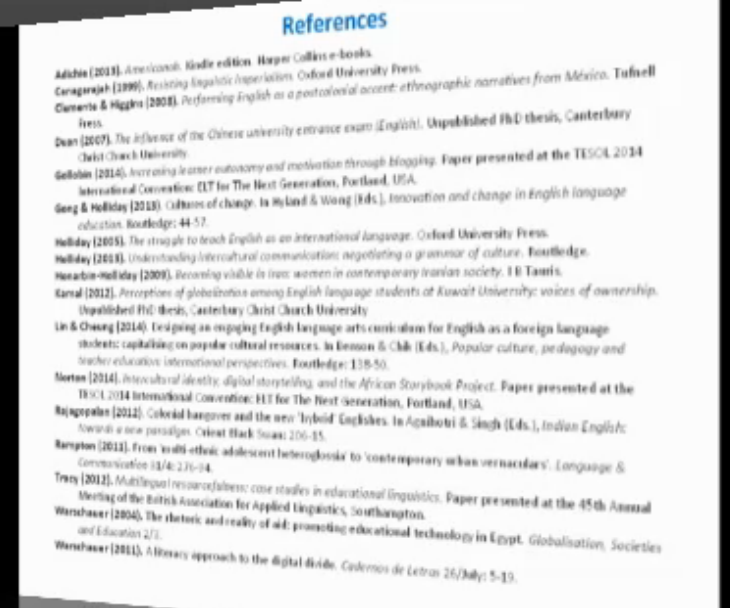
Here is a screen shot of the references slide – not very clear, sorry,  but am sure the references will be available elsewhere online anyway!
Screen Shot 2014-04-01 at 12.04.17


IATEFL Harrogate 2014: What *I’m* looking forward to…and how about you?

It’s nearly time for IATEFL 2014! I’m sure we’ve all been trawling through the programme pdf and the app, seeing what’s on and getting excited – well, I have anyway! I think anticipation is such a fun part of it all!  

Here are the workshops/talks/events going on that have caught my eye so far:

Wednesday

(Unfortunately I’m going to miss most of Wednesday, but if I were going to be there on Wednesday, my timetable might look like this…)

  • Plenary session by David Graddol: English and economic development [at least this I can catch the recording of… I wonder if I will be able to watch some of the live stream while travelling? Time will tell…]
  • Session 1: Either EAP writing: getting down and dirty by Richard Hillman [because I’m hoping to be teaching on a pre-sessional course at a university this summer] or Demand High and lost learning by Adrian Underhill [because who doesn’t like watching Adrian Underhill talk!]
  • Session 2: Global coursebooks: helpful scaffold or debilitating crutch by Heather Buchanan and Julie Norton [because I participated in the research that fed into this talk and and am curious about the outcome; also because Heather was my tutor and dissertation supervisor during my M.A. ELT at Leeds Met, so I know that what she has to say is good value!]
  • Session 3: More than just a worksheet: writing effective classroom materials by Rachael Roberts [because she has a great blog full of useful and interesting ideas, as well as lots of materials writing experience, so I could learn a lot from this session. Plus she’s involved with MaW SIG and has, in that capacity, already commented on some materials I’ve made, so I’m very interested to meet her! 14.05-14.50…will I have arrived yet? Will it be recorded? Have to wait and see…]
  • Session 4: Do materials writers have principles? by Jill Hadfield [Another MaW SIG SIG day speaker, and another person I’m interested to meet! Also because I read a lot about materials development during my M.A. and am interested in the topic and the process. The question is, will I make it in time?]
  • Session 5: Tech Hacks for classroom activities, materials writing and course design by Andy Johnson [because this workshop sounds really useful and practical and relates to technology AND teaching AND materials writing AND course design – what more could you want! 😉 Hmmm, I might actually have made it to the conference by this point! Here’s hoping!]
  • Session 6: Materials Writing Special Interest Group Open Forum  [Please let my flight/trains not be delayed, so I’m at least there in time to go to this session! Golden opportunity to meet other people who are interested in materials writing and the MaW SIG committee!]

Thursday

  • Session 1: How to get published in a refereed journal with Graham Hall (08.15 to 08.45) and Plenary session by Kathleen Graves [because I want to be published in a refereed journal at some point and Kathleen’s talk looks really interesting!]
  • Session 2: Academic writing materials: from research to online delivery [because this looks like a really interesting materials writing project, involving making and using a corpus.]
  • Session 3: A fresh approach to advanced listening practice by Sheila Thorn [because this sounds both interesting and directly useful – ideas to take into the classroom and try with my advanced gang as soon as I get back to Palermo!]
  • Session 4: Content, consumption and production: three types of ELT textbook research by Nigel Harwood [because I got to know his name during my studies and I’m intrigued to put a face to it… Also because the talk looks interesting!]
  • Session 5: Upgrade! Demand High to bring a grammar lesson alive by Jim Scrivener [because he’s always a pleasure to watch and generally sends you away armed with tons of ideas that you can try out next time you walk into a classroom!]
  • Session 6: Sit out – to remember what on earth it is I am going to say in Session 7
  • Session 7: Bridging the gap between learning materials and an English-speaking environment by Lizzie Pinard. [Well, I had really better attend my own talk, hadn’t I!!]

Friday

  • Plenary session by Michael Hoey [because who’d miss it! Michael Hoey is awesome – I saw him present at MATSDA last year, never seen a more crazily energetic presenter: should be the perfect way to energise oneself for the day, better than a coffee!]
  • Session 1: How do engineers say that? Encouraging academic independence by Julie Moore [because this talk combines my future professional needs – how to EAP – and my current professional interests – how to help learners become more independent!]
  • Session 2: Teaching English for Academic Purposes: insights from experience by Penny Ur [because it sounds like it will be a very useful session, where I can hopefully learn from her and everybody else’s experiences, which will help me when I move into EAP teaching]

[Looking at my planner, the next few sessions are where it gets complicated! – read: multiple overlaps!]

  • Session 3: I need to choose between… i. Making the most of minimal material by Kate Evans [because personal experience of learning from her means I know what she says is worth hearing! Plus it looks interesting!]; ii. Professional development in the experimental practice jungle by Christina Rebuffet-Broadus and Jennie Wright [because it sounds like a lot of fun as well as useful take-away tips] iii Stepping into the real world: transitioning listening by Sandy Millin [because there will be lots of useful take away and Sandy does awesome stuff!]

Which to choose? Answers on a postcard… 

  • Session ? [getting confused now, lots of little numbers in the app!] but the tail-end of the creativity symposium that starts in Session 3 – I’d like to see Brian Tomlinson’s talk Creative use of the coursebook because I’ve discovered we share similar ideas with regards to the role of the teacher and the role of learning materials, and because it sounds like there will be some useful take-away that I can apply directly on my return and beyond.

Saturday

  • Session 1: How to move from being a teacher to becoming a teacher trainer with Silvana Richardson and Plenary session by Sugatra Mistry [the first because teacher training is an avenue I’m interesting in exploring in my career and then because Sugatra’s talk sounds intriguing!]
  • Session 2: Twenty things in twenty years: this much I know by Hugh Dellar [because his blog has inspired me a lot, as did the talk I saw him do at IATEFL last year. Am looking forward to seeing him talk again and hopefully meeting him this time.]
  • Session 3: Write here, write now by Fiona Johnston [because I’m using various online communication platforms with my learners, so this talk interests me as another potential avenue to explore within this.]
  • Session 4: Motivating students in the EFL classroom by Elizabeth Davies [because she motivated me hugely when I was a CELTA trainee at Sheffield ELTC and because the role of motivation in language learning is hugely interesting to me – I’ve read a lot about it during the last six months as well as studying it during my M.A.]
  • Closing plenary: session by Jackie Kay, to bring it all to an end for 2014. [Shhh, don’t think about that yet!]

What talks are you looking forward to?

Comment and see if you can convince me there’s something else I need to see too! 🙂 – Or help me decide between my clashes…!

Non-talk related things I’m looking forward to:

  • Meeting people! As in meeting new people and catching up with old friends/colleagues/various lovely ex-tutors… IATEFL is such a grand social occasion! So please say hi if you see me! 🙂 And all the talking that goes with it. Nothing like a good discussion!
Screen Shot 2014-03-28 at 22.28.59

This is me! (I shall try and carry this turquoise scarf with horses on it around either on my neck(!) or tied to my bag so you can identify me! 😉 )

  • Leeds Met M.A. ELT/Delta Q and A: I shall be hanging out with the Leeds Met lot, in capacity of ex-student willing to answer questions about my experience, probably on Friday morning during the break. Come and see what it’s all about if you like! 🙂 [Exact time and location tbc – I will update this post with details of location once I know them, so check back if you are interested!]
  • The exhibition: When I’m not running like a headless chicken from talk to talk, I must make time to have a look round all the lovely, colourful stands and see what all the exhibitors are so keen to show us all! 🙂
  • Just…being part of it: Just being there, part of all the buzz, soaking up all the positive energy and idea-sharing going on – a recipe for motivation and renewed vigour if ever there was one! 🙂

What else have I missed? What are you looking forward to?

Tell me what you’re looking forward to, what you’re excited about,  by commenting on this post: The more excitement, the merrier!

See you in IATEFL in a few days! 🙂

IATEFL 2014 – “Chain Reaction” interview with Mura Nava

“I choose two or three of this year’s registered bloggers and introduce them on my blog. These bloggers then in turn choose other registered bloggers and interview them… and so it goes on until you all have a good idea of who will be blogging about this years event.”  

I did my first chain reaction interview with Sandy Millin. This second one is with Mura Nava, who I discovered via my interest in and series of blog posts on wordandphrase.info (which is an interface for analysing a corpus – the COCA in this case) : Mura has a keen interest in corpus linguistics too. (For a list of the talks at IATEFL which are related to this area, see Mura’s first IATEFL 2014-related post .)

iatefl-harrogate12-banner-300x200

Nearly time for IATEFL, wherever you are in the world! Click this image to find out how to follow online.

Here are Mura’s answers to the questions I got from Adam and adapted for use with Mura, who isn’t attending live but will be following avidly online:

Please introduce yourself

My name in Mura, I work as an English teacher in France. I have a soon to be 2 year old son who is at that age which is really interesting if you are into language learning. His current favourite word now (after ballon) is pantalon.

Which sessions are you looking forward to watching live or online this year? 

Well only the plenaries have been revealed as being filmed so for sure has to be Michael Hoey’s session. I have also heard that Russ Mayne’s (@ebefl) talk will be taped so will watch that.

I am hoping that Simon Smith’s session on Using lecture notes to create domain corpora will be taped, if not maybe one of your Harrogate-2014-going readers will cover it 🙂

Why are you interested in the areas represented by the talks/workshops you want to see?

I have seen Michael Hoey talk before and he is both informative and entertaining, I know Russ Mayne from twitter so be great to see him chat in real life and I am very interested in corpora and language learning/teaching so the session by Simon Smith suits me great.

What do you hope to learn from the sessions you plan to watch?

From Simon Smith’s session how to get students to build their own corpora as I am part of a project that will deal with similar issues.

Do you blog? Could you tell us about your blogs (s)?

Yes I do at eflnotes.wordpress.com though I am more active on the Google+ community for corpus linguistics – https://plus.google.com/u/0/communities/101266284417587206243

What other aspects of the conference are you looking forward to?

The online forum discussions sometimes throws up good stuff.

Why did you sign up as an IATEFL registered blogger?

I have been doing it last 2 years and in fact in 2012 coincided with me launching my blog (properly, as I had written first post sometime before then) so I remember how it helped me with an instant audience.

Thanks, Mura! I hope you enjoy following IATEFL online and that lots of the talks you’ve ear-marked are covered via filming or blogging! 


IATEFL 2014 – “Chain Reaction” interview with Sandy Millin

In the lead up to the IATEFL 2014 Harrogate conference, Adam Simpson has started a ‘chain reaction‘ blog challenge:

“I choose two or three of this year’s registered bloggers and introduce them on my blog. These bloggers then in turn choose other registered bloggers and interview them… and so it goes on until you all have a good idea of who will be blogging about this years event.”  

I have firstly decided to interview Sandy Millin, with whom I attended my first IATEFL and who got me into things like blogging, using Edmodo and not using ten words where three will do when it comes to writing instructions! She’s an inspiration to teachers and students alike. For this interview, I used the same set of questions that Adam gave me.

iatefl-harrogate12-banner-300x200

Follow all the conference goings on at IATEFL online!

Here are the questions and Sandy’s answers:


  • Please introduce yourself

My name’s Sandy Millin. I’ve been the Director of Studies at International House Sevastopol since September 2013. As I’m sure you’ve probably seen in the news, it’s in Crimea, which is probably now in Russia, although some people may argue with that! I’ve been teaching EFL for seven years, and have previously taught in Borneo, Paraguay, the Czech Republic and the UK.


  • Could you give us brief details about your session at IATEFL 2014?

My session is called ‘Stepping into the real world: transitioning listening’. It’s on Friday 4th April, 14:35-15:20 in Room R. It’ll also be available on my blog afterwards if you can’t make it: http://sandymillin.wordpress.com/iatefl2014


  • What should your audience expect to learn?

It’s a workshop, so there’ll be practical activities showing how to help your students prepare for real-world listening, which can often be quite different from coursebook listening.


  • Why are you interested in the area you’ll be presenting on?

I got interested in this area while working in Newcastle in the UK. My students came from all over the world, and no matter how high their level was, they almost all had trouble with listening, both to other students in the class and people in the outside world.

During my Delta, I did one of my observed lessons on listening, and read John Field’s Listening in the Language Classroom at Lizzie Pinard’s recommendation. It was really useful, and completely changed the way I approach listening. I’d like to share some of that at IATEFL.


  • Do you blog? Could you tell us about your blog(s)?

I have three blogs, although two of them having been ‘sleeping’ for a year or so.

My main one is at http://sandymillin.wordpress.com. I normally write about teaching and share materials, although recently I’ve been writing a lot about the situation in Sevastopol and Crimea. That’s where I’ll be doing my IATEFL blogging too.

Screen Shot 2014-03-26 at 08.05.34

Visit Sandy’s blog!

Independent English is designed for students. On it there are ideas for how to become a more autonomous learner.

Infinite ELT Ideas is a set of prompts. The idea is that people look at the prompts and leave comments suggesting how they would use them in class. This worked better when I first started the blog!


  • What other aspects of the conference are you looking forward to?

My favourite thing about IATEFL is the social side. I can honestly say that IATEFL Glasgow and IATEFL Liverpool were two of the best weeks of my life. It’s great to be surrounded by passionate educators, and people who really want to improve themselves, and I always go away on a huge high. I’ll particularly enjoy IATEFL Harrogate as it will probably be my last one for a while – it’s not so easy to get there now I live in Crimea!
This year I’ll also be adding two whole new experiences to my repertoire: I’ll be presenting at the Pecha Kucha evening on Friday 4th April. If you’ve never seen one, a Pecha Kucha is a presentation made up of 20 slides, each lasting 20 seconds. The presenter has no control over the slides, and just has to keep up with them for the 6 minutes and 40 seconds they run for. If the test runs I’ve done are anything to go by, I’ll be very out of breath by the end, but I’m really looking forward to it! The other new experience is the fact that it’ll be livestreamed, so you can watch it at IATEFL Harrogate Online  🙂


  • Why did you sign up as an IATEFL registered blogger?

I’ll be blogging a lot while I’m at IATEFL, so it makes sense to be a registered blogger! It also means you’re part of the patchwork of the IATEFL experience, and you can get a fuller picture of the whole event. Only a few days to go now…


Thank you Sandy! I hope you have a great IATEFL 2014 and am looking forward to seeing you there! 🙂 

See you at IATEFL?

It’s that time of year again, nearly time for the 2014 IATEFL annual conference,this year to be held in Harrogate. Are you going?

I am – thanks to the kindness and support of my employers who are allowing me to attend! Also thanks to the generosity of Leeds Metropolitan University who are fully funding my attendance via a scholarship. And, this year, I shall be presenting for the very first time. (!!)

The title of my talk is:

“Bridging the gap between learning materials and an English-speaking environment”

Here is the abstract:

Private language schools often send their learners out to interview people in the streets, but could these learners get more out of this activity? This talk explores how task-based learning and an intercultural approach can be combined to develop materials that enable learners to benefit more fully from a potentially rich learning opportunity and develop their intercultural communication skills. 

My talk will take place on Thursday the 3rd April at 1745 and will last until 1815: 20 minutes of me talking (but don’t worry that includes you talking too!) and 10 minutes for questions/discussion. The room I’m in apparently holds 180 people – the more the merrier?! This talk is based on the approaches I used in my materials that I made for my dissertation project (which were recently shortlisted for one of the British Council ELTons). If you are at IATEFL and haven’t already tootled off to the pub by that point, it would be great to see you in the audience! (Am *really* hoping not to find myself presenting to an enormous room with about five people in it…)

Of course, if you aren’t able to make it to Liverpool, there will be lots of talks and interviews recorded, and some sessions streamed live. You can find all this and more on the British Council IATEFL Harrogate online website. (Click on the image below)

iatefl-harrogate12-banner-300x200

Bring IATEFL Harrogate 2014 to your sofa! 🙂

I’ve also registered as an IATEFL Harrogate 2014 blogger and aim to upload a few posts based on the presentations I watch, as well as my conference experiences. I will also post a write-up of my talk and my references in due course. So, watch this space! 🙂

I’d love to meet any of you who read my blog, so do come and say hi if you happen to see me!

MATSDA, here I come!

I’m delighted to have had my speaker proposal accepted for the MATSDA (Materials Development Association) 2 day conference on the last weekend  (28th/29th) in June, this year. The theme of the conference is Second Language Acquisition and Materials Development.

This is the abstract that I proposed:

What about the other 165 hours a week? Developing materials that scaffold and encourage out-of-class language acquisition, through their use as classroom tools.

Is this title a contradiction in terms? Perhaps not: the average language learner spends around 2-3 hours a week in the classroom, implying that for acquisition to take place, exposure to the target language shouldn’t be limited to classroom confines. Indeed, learner autonomy is somewhat of a buzzword in ELT – we recognise the inadequacy of classroom time with regards to acquisition, as well as the issue of syllabus structure often being at odds with learner ‘readiness’ to acquire, meaning that what learners do outside class time becomes of the utmost importance. However, there is often a gap between what we expect our learners to do outside the classroom and how we help them to do it. This talk looks at ways of helping learners harness the target language in their environment, real and/or virtual, effectively, and the role that learning materials, and their use in the classroom as well as beyond it, can play in scaffolding the process, in addition to stimulating and maintaining motivation, curiosity and the desire to acquire.

Last year, MATSDA was great fun – a friendly atmosphere full of banter and loads of interesting ideas to assimilate. I’m sure this year will be no different. I hope to see some of you there. For those who can’t make it, the usual write-up and references will follow – linked to on my Presentations page.

🙂

Do *you* use a global coursebook? If so, please read on…

When it comes to global coursebooks, everyone has an opinion regarding their qualities and flaws, and everyone has their own special ways of using them when required to do so…

Heather Buchanan (Leeds Metropolitan University) and Julie Norton (University of Leicester) are doing some research on this topic and are interested in finding out about your views and uses. They will share the results of this research as part of a presentation at the IATEFL conference in Harrogate next month.

Participation in this project is completely voluntary and anonymous. If you would like to help, by sharing your views on global coursebooks and your uses of them, please visit the following link:

Global coursebook questionnaire

When you click on this link, you will be taken to a page which provides you with more information about the project and will then be given a choice of continuing on to answer the questions or opting out of participation. 

Finally, please do share this post/the questionnaire link with any other English Language teachers who you think may be willing to complete it: Heather and Julie would be most appreciative! 🙂

100th post: Looking backwards, looking forwards…

This post sees the neat coincidence of several things:

  • my 100th post on this blog (this one!)
  • my 100th follower of this blog (a few days ago)
  • my 40,000th view (earlier today)
  • the end of the year (very shortly)
  • the first ELT Blog Carnival of 2014 (for which submissions are open, with a topic of “New Year’s Resolutions)

It’s been quite a year! 🙂 In this post, in keeping with the Blog Carnival abstract, I am going to reflect on what I’ve achieved this year, as well as my projects, plans and goals for next year.

Looking back…

At the beginning of this year, I was in Leeds. I had completed the input sessions for the Delta portion of my course at the end of the previous year, but had all the external assessment (Module 2 LSA 4, Module 3 extended assignment, Module 1 exam) all looming over me. So I still very much count the Delta as part of this year – after all, I only received the qualification in August! (I was on holiday in Italy, up a mountain riding a horse, when the news of my distinctions arrived in the form of happy emails from two of my tutors…)

It’s interesting (to me) to think that at the beginning of this year, I was feeling quite demotivated and felt I hadn’t achieved anything despite working so very hard in the first semester of my course. I’d learnt a lot but nothing was finished (other than the Delta mock exam that provided the M.A. grade for that module, which I thought I’d done badly in – though it transpired that I hadn’t!). Goes to show, perhaps, that achievement shouldn’t necessarily only be associated with completed things…

Since that rather inauspicious beginning to the year, which followed a Christmas “holiday”, which I spent redrafting my Delta module 3 and preparing the M.A. module presentation based on it, loads of exciting things have happened:

  • my M.A. modules!

They were brilliant. What a wonderful, wonderful course. I learnt ever such a lot (for evidence of this look here) and had such a lot of fun in the process, thanks to lovely tutors and lovely course mates. The best thing is, I’ve been using my learning from the modules ever since: For example, from Multimedia and Independent Learning came my interest in learner autonomy and resultant projects that are currently in progress at work, and thanks to the Materials Development module, I’ve thoroughly enjoyed making several sets of materials, some of which you can find here.

  • my British Council Blog of the Month award

My 30 things… post, which came about as a direct result of all the learning in my time at Leeds Met, managed to win the June 2013 edition of this award – a great honour for little ol’ me and something that has brought with it opportunities that I wouldn’t otherwise have had. For example, the British Council webinar I will be doing in February next year: my first ever webinar. I’m not at all scared….ahem. On the theme of blogging, my little blog has blossomed this year. I started blogging in May 2011 and between then and May this year, posted very little and was visited very little. Then I suddenly found I had things to say and share, resulting in a lot of content being added to this blog over the last 7 months. I also went from 4,000 odd views to now just over 40,000. Quite a big jump! But it’s not the numbers or quantity of content that is important, it’s the profound effect that having this reflective space has had on my professional life. It’s a wonderful thing, being able to share teaching-y things with teachers all over the world. And, of course, reading others’ blogs has remained a great source of inspiration to me.

  • my first conference presentations

I presented for the first time at the 16th Warwick International Postgraduate Conference in Applied Linguistics, which was on the 26th June 2013 at the University of Warwick. My presentation was based on the research project I did for the Research module of my M.A. and I thoroughly enjoyed the experience. It was a gentle way in, being as all the other participants were also students and I had already presented my research as part of the assessment for the M.A. module. This first time was swiftly followed by the second time, less than a month later:  This was at the MATSDA/University of Liverpool 2 day conference, themed “Enjoying to learn: the best way to acquire a language?” on the 13th and 14th July 2013 at the University of Liverpool. If you haven’t been to a MATSDA conference before, I highly recommend it. It was a lot of fun and a very supportive atmosphere for a novice presenter. For details of my presentations, please see this link.

  • my dissertation

Bubbling away in the background, behind all the excitement of the presentations and blog award, was my dissertation. My constant companion for about 4 months, the D-beast definitely represents a large chunk of the time, energy, focus and dedication that has gone into this year. It was worth it in the end, as not only did I find it a very satisfying experience (though towards the end I was worried I would never finish in time!), but I also came out of it with a respectable 82%. This sealed my overall distinction for my M.A. in ELT, of which I am very proud: it represents a LOT of very hard, yet enjoyable, work. But not only hard work on my part: my tutor who supervised me for the dissertation gave up a lot of her time in order to meet with me and look at/feed back on what I’d produced at various points, as well as giving me lots of support and encouragement throughout the whole process: Thank you, HB!

  • my new job in Palermo

I am fortunate enough for teaching at IH Palermo to have become my first post-Delta job. It’s a great school to work in, with a very supportive and friendly atmosphere, as well as a lot of opportunity for continued development. Since I have been here, I have attended workshops on teaching young learners, teaching using Headway, teaching teens, dealing with parents and, last but not least, pronunciation. I have also been observed while teaching, and received a high quality of helpful, constructive feedback subsequently, as well as had the opportunity to observe my peers. And then, of course, I have embarked on the IHCYLT (IH Young Learner Cert) course – which deserves its own bullet point!

  • IHCYLT

This, I am still very embroiled in. In fact, I’m about half way through and hanging on by a very slender thread. Turns out starting a new job, working full-time, learning a new language AND doing a training course is quite the balancing act. Fortunately, the afore-mentioned supportive nature of the workplace and my DoS and YL coordinator have helped me keep going thus far. How it turns out remains to be seen – I suppose I shall either make it, just, or crash and burn spectacularly! I think it may possibly be course over-load for one year but at least it’s nearly Christmas and hopefully after a break I will have what it takes to push through what’s still to come. I’ve discovered that I’m not a huge fan of distance/online learning as vs. face-to-face study and am heartily glad/relieved that I did not attempt the Delta via distance learning, as I don’t think I would have made it through or done anywhere near as well as I did. Thankfully, as the YL course is blended, the observation (both being observed/the feedback and observing others) element has balanced out the online component. (NB: the online tutors are fantastic, so my lack of love for the online element is no fault of theirs…)

  • Italian

I’m also learning Italian, being as prior to moving to Palermo I had never learnt nor spoken any Italian in my life before. (Oh except learning the numbers, the word for England and good afternoon/please/thank you when I came on holiday here with my aunt’s family, aged 16 or so) I study every day before work and read extensively every evening and over the weekend. I also listen extensively. I think I’ve learnt a lot of language since I’ve been here (still just under three months though it seems like forever longer!) and it’s been fascinating being a language learner again. I did a few lessons at the school but stopped for a variety of reasons (including lack of time, the YL course starting, and just not getting on that well with the lessons). Learning independently has been a lot more successful and I’ve learnt a lot from how I learn – if that makes sense (it does to me…)!

So, I think that just about covers looking back…

Looking forward…

  • Christmas Holidays!!

Thank goodness. This time next week I will be on holiday. I intend to finish all the YL coursework I need to do *before* the holiday and have a complete rest (if you can call Christmas etc  a rest :-p) over the 2 weeks I’m off work. It will be the first real, proper holiday since August 2013. I am very, very, very in need of it!

  • British Council webinar

In February, I will be giving my very first webinar (as mentioned earlier in this post), on the topic of learner autonomy. I hope my audience will be gentle with me… 😉  I’ve been experimenting away with various tools and ideas for helping learners become more autonomous and am looking forward to sharing what I’ve learnt and to having peoples’ responses to what I say inform what I do with my projects in future, too.

  • A workshop at work

One of my goals for next year is to deliver a workshop at work. (Sometime *after* the YL course finishes, of course! 😉 ) I think it would be a very valuable experience.

  • Presenting at IATEFL

I’ve been accepted to present at IATEFL, which is very exciting. Still a few teething issues with regards to attending, but here’s hoping I’ll make it… 🙂 (Much as the thought of it also terrifies me…. 😉 )

  • Attending other conferences

There’s a MATSDA conference in June, when I shall be back in England (8-month contract), which I very much hope to attend. I love conferences: they are so inspirational.

  • Working at a university

One of my goals for next year is to work on a pre-sessional course at a University in the U.K. over the summer.

  • Continuing work on my projects

I am thoroughly enjoying working on my learner autonomy projects and helping my learners become more autonomous learners and this is something I want to continue working on next year. I want to read a lot more on learner autonomy theory and motivation theory (currently in the middle of a book on each subject).

  • Reading

As well as the afore-mentioned learner autonomy and motivation theory-related texts, I want to keep abreast of developments in the ELT world by continuing to read the journals and professional magazines that I have discovered through doing my Delta and M.A. I also want to reread and reprocess my notes from these courses, and keep the learning fresh as well as add to it.

  • Using my learning

I *really* want to experiment with what I’ve learnt through the Delta and M.A., experiment, reflect, evaluate, experiment some more, write about it… this is one of the reasons I am looking forward to the YL course finishing: at the moment I’m struggling for brain space. The YL course is ramming more and more learning into my poor little brain when all I really want to do is draw breath and work with what I’ve got. Nevertheless, when it does finish, I’ll work with that learning too, of course! 🙂

  • A PhD

Not next year! But sometime… to research something related to learner autonomy and motivation. (Of course that may change by the time I get round to doing one!)

  • Learning more Italian

I want to keep working on my Italian – I’m feeling enormously motivated – and for my speaking to catch up with my reading and listening….at least a little!!

  • A better work-life balance!!!!!

At the moment, my work-life balance is not awesome. (Thanks, YL course!) I’m very much looking forward to having my weekends back but, that aside, outside of frenetic times (of which there will be another in late January when a whole bunch of courses end) I want to try and spend less time at work and get more exercise during the week. If I keep going for toooo much longer at the current rate, I suspect I will burn out.

Plenty to be getting on with…!

Meanwhile, I’ve one more week left of term, which will see teaching practice observation no.3/4, parents consultations, a course ending (and attendant marking/reports/admin) and the usual load of YL tasks to be getting on with… no rest for the wicked!

2013 has been fairly phenomenal all in all: and I am eternally grateful to all who have helped to make it that way – my wonderful tutors, my course mates, my colleagues, my DoS, and, best of all, my lovely, lovely family and friends. Thank you all for your support, for putting up with me and not giving up on me. 🙂

Here’s wishing everybody a fantastic 2014 – live your dreams!

CPD: What does it mean to you?

CPD (Continuing Professional Development) is a well-used phrase. But what does it really mean? What does it involve? To me, it covers a whole multitude of things:

Courses

This is arguably the most obvious element. You identify a gap in your skill set or a need for general upgrade of your skills/knowledge and search for a course to suit your needs. Courses come in all shapes and sizes, varying in length, focus, outcome, commitment requirements, cost and so on.

The DELTA (Diploma for English Language Teaching to Adults) or its Trinity counter part, the Trinity Dip. TESOL, is a popular choice for qualified ESL teachers wanting to take the next step. These are internationally recognised professional qualifications with a practical focus. The DELTA is a modular qualification and modules can be taken separately or concurrently, distance or face-to-face, part-time or full-time, intensively or non-intensively. The trick is to make the right decision regarding which of these options will work for you. Being a level 7 qualification, the DELTA gives you a number of credits towards a Masters qualification, depending on the university and the course chosen.

M.A.’s (Master of Arts) or M.Sc.’s (Master of Sciences) are generally considered to be more theoretically focused. Popular choices for teachers include Masters in English Language Teaching, Applied Linguistics and TESOL and pure Applied Linguistics. Some M.A.s manage to combine the more theoretical focus of an M.A. with practical application. One such is the Leeds Met M.A. in ELT, which focuses on what you can do with the theory rather than on just learning and writing about it: in the second semester, for example, you design materials, undertake research, develop multimedia tools and write a journal article. First semester content depends on whether or not you choose to do the integrated DELTA option.

Shorter courses

I think these tend to have a narrower focus and there are lots of options out there. International House, for example, has a range of courses, of various lengths, some blended and some purely online. (I shall be doing the Young Learner training, starting tomorrow!) I won’t go into depth on all the courses available out there, or it will treble the length of this post! 😉

Work-based CPD

This, most obviously, would include workshops (both attending and delivering), formal observation, peer observation and the opportunity to participate in short training courses. And, I have discovered, if you work somewhere that truly values CPD (actively, not just paying lip service), then these things become amazing opportunities.

I had my first formal observation earlier this week. Scary scary. BUT the DoS had emphasised that this was developmental rather than a test and an opportunity to experiment. So I experimented for the first time with some techniques I’d read about shortly prior to the observed lesson. It was so valuable to then be able to discuss the techniques, difficulties in applying them and ideas for continuing to apply them, during the feedback with my DoS. I now have a lot of detailed feedback notes to read and reflect on before I next teach. However, I have also already had two classes, directly following the feedback, and tried to put into practice the ideas discussed during the feedback, with some good results. So exciting!

There have been two workshops since I started here, too, both very thought-provoking and useful. It’s always good to be back in the learning seat. In due course, I hope also to deliver one, as I think this would be a very valuable experience. In addition to this, last weekend I did some Cambridge speaker examiner training for KET and PET exams, which was an interesting process.

Personal CPD

This is everything you do to learn that doesn’t come under a formal label! In this diverse category comes things like:

  • attending (and/or presenting at) conferences (face-to-face or online)
  • attending (or giving!) seminars (or webinars)
  • reading journals/professional magazines
  • reading relevant books
  • reading relevant blogs
  • using Twitter (e.g. participating in #Eltchat discussions, following up links)/Facebook (e.g. the British Council TeachingEnglish Facebook page.)
  • writing blog posts
  • writing journal/professional magazine articles/contributions
  • making learning materials
  • carrying out classroom-based research projects
  • reflecting on your teaching/development and making plans for what to try out next.
  • being a language learner again (!) (Being a learner in a language classroom again has shone a whole new light on learning, to consider as a teacher!)

For Me:

I found my Delta and M.A. immensely challenging and rewarding. But I think what comes next is equally important. The CPD doesn’t stop when you finish the course and get your certificate. The course provides you with new knowledge, techniques, methodologies etc. but true CPD is what you do with all of that afterwards. Do you put your certificate in a file and then continue as before? Or do you experiment with everything you’ve learnt and look for new things to try out and connect to your previous learning?

At the moment, I have a couple of projects on the go that are very much the result of having done the Multimedia and Independent Learning module of my M.A., that will culminate with my first webinar (in February next year) and recently I’ve also been exercising my materials development learning in making materials for the Global Issues month as well just for my own use with learners. And I’m finding all of this really satisfying, interesting and exciting. I think, too, that having a supportive DoS is key to effective CPD – there’s nothing like being actively encouraged to develop and helped to do so.

To me, CPD is the spaces between the words. It’s what and how you learn but also, all-importantly, what you do with what you learn, it’s being aware of opportunities and taking them when they arise. It’s what herbs and spices are to cooking – not strictly speaking necessary but it turns a bland dish (one day of experience repeated for twenty years) into something delicious and taste-bud tantalising!

I’m sure I’ve missed plenty of CPD options out of this post, so please comment with any additional CPD ideas you have! Inspire me!! 🙂 What does CPD mean to you?

IATEFL 2013 interview about Learning Technologies

Earlier this year, I was privileged enough to attend the IATEFL conference in Liverpool, enjoying a dizzying array of brilliant talks and catching up with people from all over the world.

Fortunately, by the time of this conference, I’d done just over half a semester of my M.A. in ELT at Leeds Met, and, thanks to the Multimedia and Independent Learning module, I was able to find something to say when I became one of a number of people that Nik Peachey interviewed on the theme of Learning Technologies.

I was very kindly given permission to upload the clip of me being interviewed onto my blog and now I am finally getting round to doing this. (The clip arrived in my inbox shortly prior to my dissertation deadline – ’nuff said!)

The two questions that Nik asked me are:

  • Some people say that technology can replace language teachers. What do you think?

and

  • Do you think technology use in the classroom is driven by technology rather than by pedagogy?

(If I appear a bit confused about where to put my eyes, it was a case of the camera not being behind Nik and me finding it very difficult to look at the camera rather than Nik, unaccustomed as I am to being interviewed! Oops… 😉 )

Don’t worry, the clip is only 2.21 minutes long! 🙂