In Print!!

I’ve been storing this up for a week because I have not had a moment spare to access my WordPress in between trying to keep up with work, preparation for my M.A., training for my 20 mile running race in September, sorting out accommodation in Leeds for my M.A… phew!

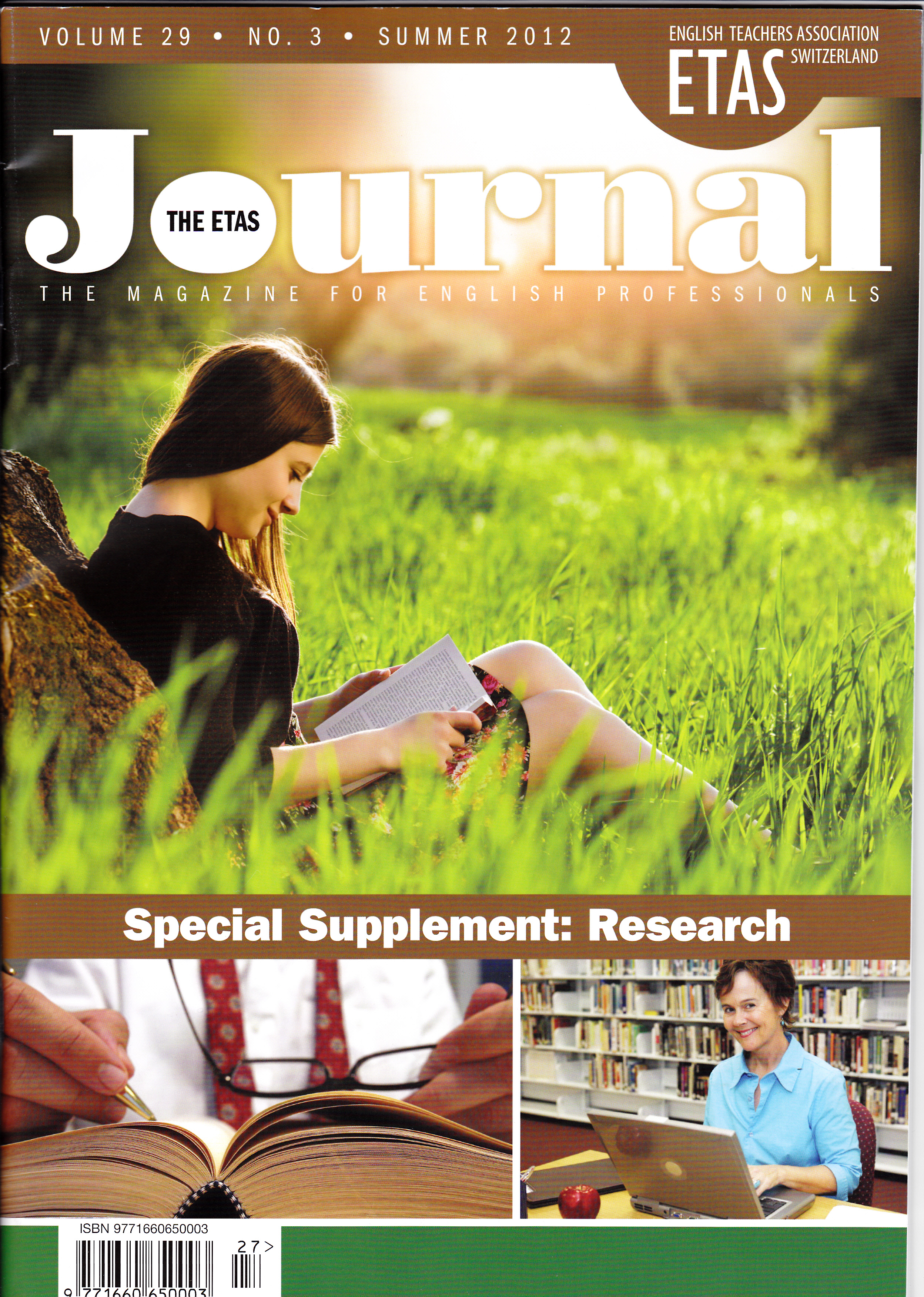
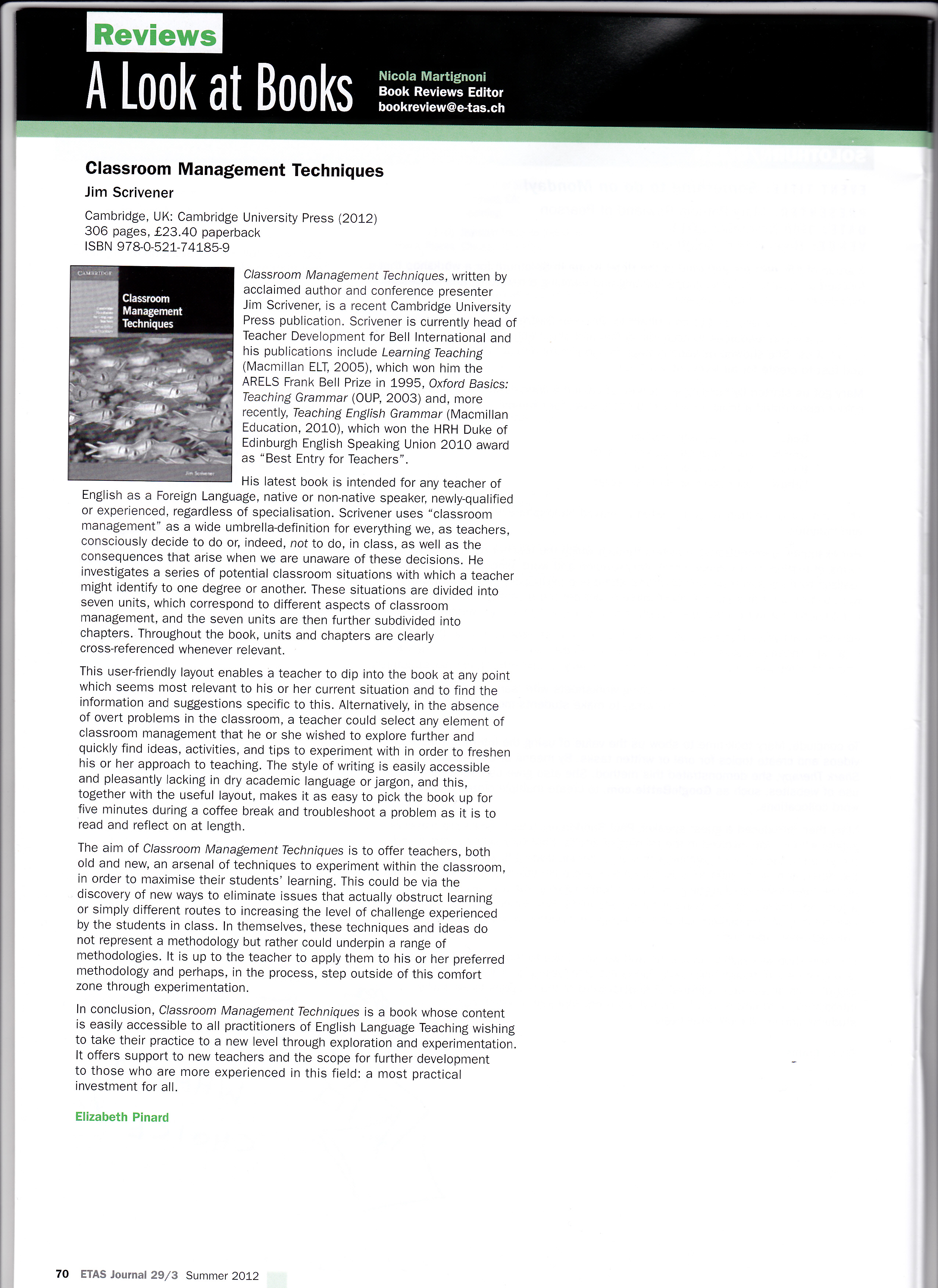
I have been published! In print!! Well, I have known about it for longer than a week but it was a week ago that I received the journal of the English Teachers Association of Switzerland (ETAS) with my book review inside. VERY exciting!

Now I just need to catch up with the #eltchat summaries I’ve promised to do…and edit the remaining IATEFL conference notes that I STILL haven’t yet published on here…

Juggle juggle juggle…

IATEFL 2012: Carol Read on “Creative Teaching, Creative Learning”

Carol Read: Creative Teaching, Creative Learning. (Tuesday 20th March 2012, IATEFL Glasgow)

To be creative is to get on a roll with an idea. You experience “flow” or the positive harnessing of emotions in pursuit of a goal or outcome. It is with this thought that Carol Read opened her extremely creative session on creative teaching and learning.

Carol went on to discuss the necessity of a frame work in order to create. A framework, she said, is energising and liberating: without one, we become lethargic and uninspired. She supported this with a quote from David Ogilvy, “Give me the freedom of a tight brief”. Not only do we need motivation and inspiration, both of which are typically associated with creativity, but also disciplined thinking, attention to detail and effort, which may come to mind less readily in connection with the concept.

As a word, creativity has both positive and negative connotations. In the negative sense, it may seem clever but sneaky. For example, filling in expense claim forms to obtain the maximum return. While on a positive note, we think of energy and enthusiasm, thinking outside the box.

But how do people define creativity? Carol negotiated this minefield next.

The dictionary definitions, she told us, are ok but not very helpful. Take for example Macmillan’s free online dictionary:

Creativity: the ability to create new ideas or things using your imagination.

Creative: involving a lot of imagination and new ideas; someone who is creative has a lot of imagination and new ideas.

Having put forward that the dictionary did not hold the answers we were seeking, Carol shared a few quotes about creativity with us:

“Creativity is an act that produces surprise” – Jerome Bruner

“Creativity is adventurous thinking” – F Bartlett.

“Creativity is a state of mind in which all our intelligences are working together”

“Creativity is a cluster of skills which we use to come up with something new and valid” – Chaz Pugliese.

Creativity, then, is newness, excitement, something valued in its context. We all know what it is but it is difficult to describe. Carol suggested that it’s not what it is that’s important but where. That is, the interaction between creative person, social context, field or domain.

A talk on creativity would not be complete without taking a creative twist to the telling of it, or so Carol believed, and as a consequence of this, we were treated to “Princess Crystal Creative”, based on Babette Cole’s well known spoof fairytale, Princess Smartypants. In Carol’s version, the princess questioned the princes with a series of questions on creativity and each prince got one question further than the last, until finally a prince was able to answer all of the questions…

1. What’s the difference between creativity, imagination and innovation?

  • Imagination: pretending, supposing, playing…
  • creativity: generation of new questions, products, ideas; underpinned by imagination.
  • innovation: taking creativity and applying it to the real world.

These are like layers of an onion. Imagination at the centre, followed by creativity, followed by innovation.

2. What’s the difference between big C and little c creativity?

  • Big C creativity: This encompasses large ideas, paintings etc that change the world and peoples’ lives.
  • Little c creativity: This is about personal effectiveness in our daily lives, the creative decisions that we make all the time. For example us delegates negotiating the conference.

In terms of teaching and learning, Big C creativity is something a student produces that is significant to their progress, which gains validation from those around i.e. teacher and peers. Little c creativity, on the other hand, is everything that is going on between us, as teachers, and the learners, and how it is constructing relevance. It is how children use little language to communicate what they want to say.

3. What is “creative teaching” and how does it differ from “teaching for creativity”?

  • Creative teaching: effective teaching, using techniques to get things across creatively, thus engaging learners.
  • Teaching for creativity: This is about learner empowerment, equipping learners with the skills they need to be creative themselves. The outcome or objective of a lesson that teaches for creativity is a creative product from the learners.

4. What is creative learning?

Creative learning is when learners are allowed to use imagination and experience in pursuit of learning. It’s when learners are allowed to exercise choice – both in the process and in the product. It’s when learners are involved in pedagogic decisions and in shaping the syllabus. Creative learning requires critical reflection and evaluation, learners learn to evaluate themselves, the materials and their teachers. Thus, this type of learning is a close cousin of learner autonomy, in the way that it develops metacognition and meta-skills.

5. What teaching approaches and strategies promote creativity?

Carol suggested that the following would see us on the right path:

  • develop motivation and engagement
  • provide a stimulus, framework and purpose
  • build up self-esteem: security, identity, belonging, purpose, confidence.
  • adopt an inclusive approach
  • model creativity in the way you teach: be “an effective surprise”
  • offer choice and foster ownership
  • give personal relevance
  • consider the role of questions: use open questions as well as closed; allow “think time” before students respond; value students’ questions too.
  • make connections, explore and play with ideas: connect home life and school life, use different media. This opens up synapses in our brain and makes it open to possibilities.
  • use “possibility thinking” e.g. “what if….” question.
  • keep options open, withhold judgement, alllow brainstorming with “what”, “why”, “when” and “how” questions.
  • reflect critically.

6. What are barriers to creativity?

As important to be aware of as the strategies that we can use to promote it, and in essence the opposites of all the items in question five! Carol warned us against the following:

  • Too much spoon-feeding/scaffolding/help
  • “Telling” vs experiential learning
  • deep end discovery without structure or guidance, where students are thrown in with no rooting: if they don’t know where they are going, how are they going to get there?
  • routinization: plodding through x units of a book per lesson, to the exclusion of all else
  • undervaluing students’ knowledge
  • fear of risk-taking
  • over-crowded curriculum: 50% knowledge and 50% creative application would be preferable
  • lack of space, leading to no time for creativity
  • institutional and parental attitudes
  • exam systems, internal or external

Finally, Carol concluded with a quote by Tim Smit:

“Every good teacher is a catalyst of creativity, a liberator. Every bad teacher creates cages.”

(To find out more about Carol Read and see some fantastic teaching ideas, visit her blog or her website for a wealth of information about teaching young learners as well as talks she has done and books/articles etc that she has had published.)

IATEFL 2012 Opening Plenary: Adrian Underhill on “Mess and Progress”

IATEFL 2012 Opening Plenary: Adrian Underhill

Mess and Progress

On Tuesday 20th March 2012, Adrian Underhill opened the main conference with his plenary speech on Mess and Progress, putting forward the case for engaging systemic thinking and leaving behind heroic leadership.

What is the difference between difficulty and mess? Underhill suggested that the differences lie in the scale and uncertainty:

A difficulty is fairly clear cut and definable. It can be explained and labelled. It is probably solvable with current thinking. We may know what the answer will look like. A mess, on the other hand, is extensive, knows no boundaries, is uncertain and ambiguous. There is no single correct view of it. It resists change. Everything is interconnected so it is hard to know where to start or what the concern really is. There is no tidy fix within current thinking.

Underhill went on to contrast traditional and systemic thinking: The traditional view entails ‘things’ being considered as primary and relationships as secondary. Conversely, systems thinking ranks relationships as primary and things as secondary. Systemic thinking has developed over the past 50 years to make full patterns clearer, to see connections and relationships rather than isolated entities in a bid to see how to bring about effective change.

He explained that there is a tension between controlling and connecting. Our default preference is control however, while control may work with difficulty, it cannot work with mess.

Having established this premise, Underhill went on to discuss traditional leadership and its deficiencies.

New leadership is closer to teaching than traditional leadership. It is time for everyone to take responsibility for their influence. Until recently, the tendency has been towards hierarchical set-ups, also known as heroic leadership. This is changing, though that may not be apparent in the media. This change is obligatory because hierarchical leadership is not smart enough to handle today’s complexity, where you need intelligence dispersed throughout the system not just at the top.

Today’s leaders must

  • make decisions based on incomplete data
  • accept that cause and effect are disconnected, which makes it hard to learn from experience: there are layers of outcomes, we do not know what is due to what.)
  • face unintended consequences: each solution has an impact beyond what is expected.
  • serve people not themselves: people demand this, something that is also seen in the classrooms of today.
  • have self-knowledge and personal maturity

Heroic leadership cannot cope with all of this. Underhill shared a quote from Wheatley that summarises this: “The great thing is to realise that leaders’ work is essentially very different from the past”. (This, then, is presumably why leadership has had to develop accordingly.)

Underhill then moved on to considering post-heroic leadership:

In this model of leadership, instead of looking at a person, we look at activity. Then leadership can come from anywhere in the system e.g. teachers and parents as well as the head teacher. Perhaps there has been a paradigm shift from influencing the community to follow a leader’s vision to influencing the community to face its problems.

Will things fall apart with less hierarchical control? No, because values, meaning and purpose hold things together. When people are aligned to their purpose, when the gap between values and behaviour closes, what people experience is a stream of ease. A leader’s job is to help purpose and values line up. Peoples’ commitment can be developed by aligning with their values. This typifies a healthy organisation. If we engage systems thinking, then we do not damage one thing while trying to develop another: dynamic connectivity. This sort of connectivity cannot come from heroic leadership.

Systems thinking, i.e. thinking outside of the box, is not currently the norm. Underhill quoted Amanda Sinclair on this issue as follows: “we don’t discuss alternatives to heroic leadership because male heroic leadership archetype is so deeply embedded in our psyche that it has become invisible.”

Underhill continued by expanding on learning at organisational and individual level:

He suggested that there is much intelligence in schools but that it is not flowing. It is not allowing relationships to be created that would enable things to be done as fully as they could be. What is needed is, essentially, acupuncture (!), because disconnected humans do not yield human capital.

On the other hand, in a learning organisation, where the intelligence is flowing, the learning of all its members is facilitated and continuously developed. Individual learning can be wasted unless harnessed at organisational level. A company that does a lot of training is, however, not necessarily a smart organisation, as training can still result in an organisation full of smart individuals who are not connected, which does not make a smart organisation. Learning is a leaderly activity: leaders can lead through their learning. Systemic thinking requires slow learning, which is an attitude and outlook that allow different ways of knowing.

Underhill concluded that it is exhausting to maintain the pretence that messes are difficulties. We need to develop a new learning mantra. We need to see what is going on, as well as the impacts and results and the distractions interrupting the sight. Then we need to do something different, prod the system and find out a bit more about how it works. This can be done by doing what we do not usually do and refraining from blindly doing what we would usually do OR by doing what we usually do but watching it more carefully. Finally we need to learn from it and gain insights which should be taken and tested in what we do next. All of this is the key to thinking systemically.

In addition, you need to know your point of view but check out all the other points of view in the room too, as a matter of course. You need to thus depend on diversity. You need to give up on certainty, be uncertain and give up trying to be right. You need to look for unintended consequences. Look sideways at any simple action and you can float outside the box. You need to bother less about control and focus on connecting with others instead. It’s more interesting! You need to start conversations and see the whole school as an adventure park for learning. Hassle is part of learning: make plans but do not expect them to work out.

Adrian Underhill closed by reminding us that it is fun, inspiring and urgent to explore and that doing something different is an important method of enquiry, which should be fun. After a rousing rendition of reflective practice blues, he encouraged us to try out something different every day.

My reflections:

The world is a chaotic place, so systemic thinking seems, to me, to be a logical means of progression. Furthermore, such an approach is empowering to the individual. We are all capable of contributing through nurturing an enquiring mind and engaging with the diversity that all of our views and ideas embody.

I think the world of #eltchat and blogging is a fine example of systemic thinking, connectivity and expanding on learning. We lead each other forwards by sharing our own ideas and reflecting on those of our PLN, which in turn influence our own. The ELT world progresses, develops, and we are all part of that process. The intelligence is undoubtedly flowing and we all benefit from it as we try new things, inspired by what we read and discuss.

The challenge is to replicate this systemic thinking in our workplaces, embrace the mess and derive progress from it!

The journey of a thousand miles… (a thank-you to Cactus and to #ELTChat!)

…or how inter-related everything is!

Today I received an email from Cactus informing me that my conference scholarship report has finally been published on their website. On re-reading it, I was able to re-live the excitement of IATEFL 2012 and also reflect on what consequences my attendance has so far yielded…

– In my conference pack, there was a leaflet promoting an M.A. course with integrated DELTA. Yesterday I had an interview and was offered a place on this course. I would not have known about the course had I not attended the conference. I am very excited about embarking on this course and feel sure I will grow hugely as a teacher and, indeed, individual, as I negotiate my way through it.

– At the conference, I attended a pre-conference event, that of the Teacher Development SIG. I volunteered to write a report of it and this has been published in a recent TD SIG newsletter. Had I not attended the conference, this would of course not have been possible.

– I also bought Jim Scrivener’s latest book, “Classroom Management Techniques” during my week at IATEFL 2012. I subsequently reviewed this book for The English Teachers Association of Switzerland Journal, invited by Vicky of my PLN (@Vickyloras). Had I not attended the conference, I would not have known about this new book or acquired it so would not have been able to review it. A review of a new book is of greater interest than a review of a book that has been kicking around for years, so this was perhaps instrumental to my work being included in the journal.

– At the conference, I met Jim Scrivener in a post-conference talk and joined in the discussion on Demand High ELT. Subsequently, I proposed this topic for #EltChat and wrote the summary for it, which has been published on Jim and Adrian’s website. Becoming involved in Jim and Adrian’s project has been a source of great excitement for me.

So, all of these exciting things became possible due to my being able to attend IATEFL’s annual conference this year. My attendance was enabled by winning the scholarship from Cactus, for which I am immensely grateful. And finally, I would not have known about these scholarships were it not for #eltchat!! An exciting journey was begun when I signed up for twitter and happened on the #eltchat tag. So many opportunities have been opened up to me as a result and I have met many people who now form part of my PLN, from whom I learn on a regular basis.

Thank you #Eltchat and Cactus for the immeasurable impact they have had on my career to date.

I wonder where the next thousand steps will take me…

IATEFL 2012: Notes and Reflections on Jim Scrivener’s talk on Demand-High Teaching

Jim Scrivener’s talk on Demand-High Teaching took place on 20th March 2012. Demand-High Teaching was not a term I’d heard used before, but one of Jim’s books, Learning Teaching, got me through my CELTA as well as my first year of teaching, so, ignorance be damned, there was no way I was going to miss this talk! It certainly did not disappoint, and, together with the follow-up session that took place two days later, it has provided plenty of food for thought and scope for experimentation in class since.

Jim started with the premise that ELT has become too entrenched, a problem that has gone mostly unnoticed. ELT lessons may be ok, enjoyable for the students, solid and good enough but there’s something missing. Jim suggests that this “something” is sufficient demand on the students. Teachers tend to be satisfied with less than the students are capable of. Teaching skills and methods may be solid and allow the possibility of a higher level of demand but they are not taken beyond “going through the motions”. The communicative approach is established, and we have agreed and established ways of doing things, many of them good, but this has led to a peaceful dead end.

But what of the learning in this dead end? Is there any learning? How could the students or teachers know? What is the point of all the activities undertaken? What was done to promote learning? The activities might be perfectly valid but if the teacher hasn’t thought about what he or she wanted to achieve by doing them, considered the purpose, then opportunities for learning can be lost. This is what seems to meant by “going through the motions”. The teacher races at the speed of the fastest student in the class, in order to satisfy the requirements of the syllabus in the allocated time and the purpose gets forgotten. That leads to demand-low, challenge-low teaching, in which students are regularly asked to do less than they are capable of, while teachers respond over-positively, lacking the skills to help the students develop and upgrade their language. The ability and techniques to intervene have been lost to fear. Teachers sidestep the excitement of working with the learning, wrestling with the language, ‘swimming’ in it.

Jim went on to suggest that we need to be more physically active and interventionist in the classroom. We need to demand in a supportive way. We need to think about how the learning happens and how we can make it happen. The gap-fill work and the pair work are just the vehicles of learning, teachers need to drive them in the desired direction. The current path we tend to send these vehicles along seems to end in a dead end. Helpfully, he  also discussed how teachers can increase the level of demand in their classrooms.

The premise of all these things is that it really is ok to “teach”. For me, this was the key to the whole talk. This idea that there’s no need to be afraid to go that bit further, and stretch the students that little bit more. We don’t need to stand back or limit ourselves to classroom management. Jim introduced the idea of “intervention” in a classroom context: Anything a teacher does that affects what happens in the classroom; to do/say something or indeed NOT to do/say something. A teacher needs to find a way to be as useful as possible to the learning process, by structuring and manipulating it: a type of classroom management. Classroom management becomes anything that helps more learning to go on in the classroom; so it is taken to another level, beyond the simple ‘crowd control’ that it usually pertains to.

Here are a few techniques that Jim shared with us. (A whole chapter of these can be found in Jim’s new book, Classroom Management Techniques, which I’ve found to be most helpful, as it not only offers a wealth of ideas on how to do things differently in the classroom but also encourages you to think about why you are or aren’t doing them.)

1) Don’t rubber stamp

Rubberstamping is when the teacher says “excellent”, “very good” and other such empty words of praise at every turn. This ends the conversation by closing it down. Whereas, if the teacher withholds that ‘rubber-stamp’, the dynamic is changed and a big difference can be made. This is a way to break out of the chase for right answers. We need to learn to give feedback rather than unearned praise, as praise not only can be a dead end but also inflates: Good becomes excellent which in its turn becomes fantastic until all is AMAZING!

2) Open up questions rather than closing them down

Has terror of hurting students’ feelings has taken over? Either way, intervention and demand-high teaching can be done supportively while still upgrading the students’ level in a way that empty praise cannot. We need to push the students that step further, challenge them by moving away from doing activities ritualistically. Think about the learning process students go through as they encounter a word: Counting syllables, splitting up the syllables, trying it out, comparing with a neighbour etc. Open up this process.

3) Work one to one with a student, making it valid for the whole class.

Jim championed this idea that working one to one with a student can be time well-spent rather than an inefficient use of precious time, as it is often considered. I recently started working at the Berdale Centre in Sheffield, teaching a pre-intermediate ESOL class. One of the things I have experimented with, in the light of this talk, the follow-up discussion and the #eltchat discussion on this topic, is making one to one work with a student something the whole class can learn from. This has led to students contributing to the process and enquiring deeper into the language in question. I intend to keep a journal to record these moments and others generated by experimentation with this and other demand-high teaching techniques, so more on this later!

Getting to the end of the talk, Jim stressed that the Demand-High Teaching discussion is not a methodology-bashing, course book-bashing or anything else-bashing enterprise. The communicative approach is great, methodology is not a problem, neither are the course books. The issue is how we engage with them and what we get out of using them. There are a lot of positions to take, not just Dogme vs course books. We need to hold on to the many good elements of the communicative approach but find ways to get up close with the learning process. We need to explore it more. We need to demand more of our students.

It’s a small change of attitude that could make a big difference: “They CAN do better”. If you believe in it and ask for it, they will do it. 

The talk then ended but the discussion is ongoing: no peaceful dead end here! Jim Scrivener and Adrian Underhill have set up the Demand-High ELT blog. The slides from Jim’s talk can be found here, as well as further input on the topic in the form of articles etc. It is also a space where teachers are welcome to share experiences, questions and opinions regarding Demand-High Teaching.

Being a nervous sort of person, I found this talk quite empowering: “It’s ok to really teach” – done supportively, it doesn’t turn you into the wicked witch of the west or make you some kind of student destroyer. To the contrary, it enables you to really make a difference to the students’ learning. Little wonder then, that I made every effort to attend the follow-up discussion on Thursday 22nd March. This took place in the Crowne Plaza Hotel bar and about a dozen of us spent an hour discussing Demand-High teaching, sharing our thoughts and experiences of it.  I didn’t take notes on this because I was too busy participating and being thoroughly excited to do so!

Again due to being of a slightly nervous disposition, I came out of my CELTA with my B-pass and the mindset that to teach successfully, I had to do all the things I’d learned to do during the course. Questioning them didn’t occur to me. What right had I to question? So, along with the empowerment as mentioned above, the other main thing I took away from this talk and the follow-up discussions is awareness of the importance of questioning methods and techniques. Not with the aim of rubbishing them, at all (the course was great and I learnt masses of good things that have stood me in good stead!), but rather with the aim of achieving a greater understanding of what ends I hope to gain by using them. This may be obvious to more experienced teachers and more confident teachers, but for me, as a newish teacher of two years teaching experience, this was an important message: I can question and experiment my way off the path to a peaceful dead end. 

Summary of #Eltchat on12.00 Weds 28.3.12: Demand-High Teaching

Having been privileged to see Jim Scrivener (@jimscriv) talk at length about Demand-High Teaching (DHT) at the recent IATEFL conference in Glasgow, which led me, via a follow-up session with both @jimscriver and Adrian Underhill, to their blog on this subject as well as his recent book on Classroom Management Techniques, when #Eltchat time rolled around, for me it was the obvious choice of topic to nominate. And, not only was it selected as the number one discussion choice but @jimscriv, himself, was able to join us today from his hotel room in Philly where he is currently attending another conference.

@theteacherjames recommended that we all read this blog post by @jemjemgardner before kicking off and finally, following strict instructions from @marisa_c, the discussion itself began with an introduction from @jimscriv. This culminated with the question,

Is where we are really where we want to be? Or have we just ended up here somehow?

@Jimscriv proposed that we, as teachers, “have drifted into a sort of dead end” and, in response to @Shaunwilden’s argument that a new name is not needed for what is simply expecting the most from our students, states that the main purpose of coining the term, DHT, was to be provocative and generate discussion. (An aim that was certainly achieved during this #eltchat session!)

A lot of questions were raised, and in the spirit of avoiding the spoon-feeding method, I’ll start  by listing these for you to reflect on before offering up the responses that tweeters volunteered.

– Do you think that we’ve drifted into a touchy feely style because we’ve incorrectly associated engagement with fun?

– Has it become ‘politically correct’ to overpraise?

– Does DHT match with learner expectations or wants or needs?

– Is DHT just expecting the most from your students?

– Maybe deferring to the [course] book isn’t all bad, if it leaves more time to allocate to more challenging tasks with pupils?

– Demand high cognitively or linguistically? Some lessons put both at elementary level.

– Are teachers afraid to demand high linguistically?

– Why aim low?

– How does ‘demand-high ELT’ sit with differentiation? Seems a demand too high. I’m already stretch as far as I can be sometimes.

– How do u distinguish between positive feedback and praise?

The discussion focussed initially on defining DHT, reaching an understanding of what it involves and, indeed, what it does not involve. Here are some of the suggestions:

– Demand-High isn’t a negative argument. It’s a positive assertion that it’s ok to “teach”.

– Everyone means well but somehow we have lost touch with where the learning is going on.

– We used to call this ‘having high expectations of our Ss’ and research suggests if you do,ss rise UP to ur expectation.

– We need to treat students like adults (if they are) and challenge them in every way

– Encouragement as valuable. Feedback as essential. Praise as mostly harmful.

– Demand high can be for any kind of student, low or high ability, just have to differentiate the demand.

– It’s about providing the right amount of challenge for each student.

– It’s about not giving indiscriminate praise- which means nothing.

– Of course lessons shld be enjoyable – but that comes from engagement with real learning – not spurious “fun”.

– All sts should be treated like ‘achieving students’ rather than like slowies…..

– I think that there is a way of teaching one-to-one with everyone in a class. And making it useful for all.

– Goal is that feedback is neutral or comes from students themselves, rather than mechanically from T.

– It involves an endless struggle between what Ts believe in and the philosophy of CB-based syllabus and exams imposed by the school?

– DHT means more teaching moments or periods in a lesson

– I think of high demand as my Ss being able to do things with the language. I want to see what they can do. So more them than me.

– Demand-High is definitely learner-centred and learning-centred.

– The challenge must be sensitive and supportive. The aim is not to terrify! But helpful, coaching, focus makes a huge difference.

This led on to exploring the obstacles that obstruct the way to DHT:

– In theory, I see myself as a “demand high” teacher *but* in some contexts, it isn’t always practical/possible

– Demand-low or average teaching is infectious in institutions where there is blame culture

– There is a culture of praising when it isn’t fully due, I’d say – hard to separate from ‘encouragement’

– We also have the difficulty of judging what is demand high of an elementary and what it is for, say, an upper int student

– There’s a misunderstanding that just because they look like they are enjoying themselves, they must be learning

– We need to ensure the level of challenge is right in so many ways (not too heavy linguistically) not too light (content)

– Schools, ministries etc do a great disservice to Ts by imposing targets – so many units a week

– Having to enroll students on a course knowing that they are going to pass the final exam

– The trouble with any term is that it’s open to interpretation.  Inevitable.

– DHT is also demanding of the T – more time, effort, preparation, energy required. Can’t just sit back and do same old.

– I worked in a language school where “no” was a word we were not allowed to say to students. Impossible mission.

– Seen so many teachers getting swept along by syllabus – doing 5 rushed readings per week instead of one good one.

– Uncritical coursebook use promotes a kind of dependency in Ts and Ss – hand-holding all round – we all need a degree of challenge.

– Often teachers are scared that they’ll upset the students. There can be cultural sensitivities in play too.

– Humanism is hugely misunderstood in ELT. It is almost the opposite of “touchy feely”. It is a muscular, robust way to help.

– There’s a lot of treadmill in ELT (& edu generally), often exam driven – more bits of paper

So despite all these obstacles, how can we promote DHT? How can we bring it into our classroom?

– By guiding them [learners], leading them towards an achievable goal, but without a script, adapting to their needs during the lesson.

– If we are going to challenge them we have to know where they are at. Our relationship w the Ss important.

– “Challenge” [the learners] to acquire – if tasks dont’s have enough challenge there is no acquisition.

– Giving hints to get students to reformulate something rather than immediately gving the correct version yourself.

– Teachers need to slow down and learn to stop meeting targets in course books. Focus on what’s happening, then and there.

– Question what we are doing  in class rather than just doing it for the sake of doing it.

– When the topic is ‘tedious and insulting’, we need to find a better angle from the sts (or change the book!)

– We need to train Ts to (a) say “no” supportively and (b) have techniques to help sts to “yes”

– No more spoonfeeding, let them develop ideas and shape them, less book-based teaching and more exploration.

– Being straight foward and asking students to not to settle for good enough.

– I ask them questions that I think may intrigue them.

– Honesty is great, but correction needs to be sensitively and supportively done.

– Choose subjects which the sts will find motivating. High demand will come easier from their own engagement.

– Push them,challenge them, support them then let them lead

– Involve ss in discussing what we’ve done, how can we do it better and what needs to be done next: learner responsibility.

– Get sts working for answers. Get sts to explain rules & meanings. Empower sts & give yourself room to see the bigger picture.

-Look at them as individuals and not homogenizing expectations for whole class

We then considered the role of pre-service teacher training in promoting DHT, what happens beyond this training and what should happen…

There were some questions:

– DHT seems a post-CELTA step to me. A higher plane of evolution. How do Ts get there? Who wil support/guide them?

– Wondering how could this be incorporated into e.g. CELTA..

– What T standards are there post-CELTA? What are Ts goals after they have taught for a few years? Do they get lost in the soup?

And some opinions:

– [Wondering how this could be incorporated into CELTA?]It is, but then it gets lost achieving a tick box criteria

– I think they [pre-service teacher trainers] have a responsibility – more looking at techniques etc rather than here’s a good activity for

-Maybe it’s for post-CELTA, maybe it comes with experience as well. It’s about questioning approaches, methods and techniques.

– Hate to say but maybe Teachers have problems with HDT & support because in their certificate programme their trainer made them feel like an idiot.

– You probably can’t “train” in 4 weeks. That course [CELTA] is survival skills. But an experienced T needs more skills.

– My sense is CELTA (no offense any1!) often pushes Ts 2 follow list of things to do/not do rather than focusing on Student Learning

– We can’t teach this in 4 weeks, but we can make the goal clear and model in own practice

– There is a higher skillset for experienced Ts that is largely unnoticed and untrained.

– At the end of the day it’s not about he qualifications it is about the skills in the classroom

– This is definitely where DoSes come in – observing Ts and forming understanding of what they are about, then guiding.

– Maybe CELTA can promote DHT but we need to develop it ourselves

– It’s hard to get new Ts to reflect and question practices/methods on the Celta when there’s only 4 weeks to teach them how to teach.

– Delta courses “should” go there – but are so wound up in stress and checklists that they tend not to.

-It’s very important that Ts understand the value (or not) of what they’re doing

– I think CELTA trainees can only cope with so much. It’s a survival intro. Sure, intro the idea  but expect “lag”

– A suggestion-come up with a series of DHT commandments. See #dogme for an example. V.useful for post-CELTA Ts.

– Demand-high is the business of in-service development, peer observation, action research, supportive observations etc

– Truly it all begins in the training classroom but the microclimate of institutions also plays an impotrant role

– Ts sit and wait for PD to come to them. They often don’t know where or when to start.

– Hard in a sector where too many institutions r concerned abt bums on seats not quality. Like mobile phone companies.

– Teachers carry around a lot of assumptions – DoSes need to investigate, identify and challenge these regularly.

– Trainers can b afraid 2 stomp on trainees egos -knock-on effect inclassm. ‘Aim high’ should be a life philosophy.

– It’s also about changing preservice teachers perceptions of what teaching is & precedence for lifelong learning

There seemed to be a feeling that some institutions can make it difficult for teachers to be or become demand-high teachers but that despite this, we can still bring demand-high teaching into the classroom, via any of the suggestions for promoting DHT listed earlier in this summary. As a grassroots movement, the best thing we can do is spread the word.

To conclude with, here are four quotes from the discussion that, for me, really summed up what we are trying to achieve with Demand-High Teaching and how those moments might feel:

– Our students are capable of great things if we don’t underestimate them.

– Goethe:  “If I accept you as you are, I make you worse; but if I treat you as I believe you are capable of being, I help you become that”

– How will I know if I am getting my hands dirty? When learners lean back in chairs after class with tired, happy faces.

– You will feel it. Uncertainty. Having to think rather than auto-pilot. A real conversation.

To find out more about Demand-High Teaching and to see the discussion continue, visit @jimscriv and Adrian’s blog.

IATEFL Glasgow 19th-23rd March 2012: My Top Five Highlights

Having ignored my blog for months and months, I feel compelled yet again to give it another lease of life following the amazing, the incredible, the mind-boggling IATEFL Glasgow 2012 conference. I was lucky enough to win a scholarship, from Cactus, giving me entry to all four days of the main conference, in addition to which I treated myself to a Pre-Conference Event (PCE) with the Teacher Development Special Interest Group (TD SIG). It has been a memorable experience, so to start with I am going to attempt to extract what, for me, were the top five (one for each day of IATEFL 2012!) highlights of this past week.

In no particular order then…

– Attending a plethora of talks and workshops, including some given by people whose names I know from the methodology books etc that I have used. E.g. Jim Scrivener, Jeremy Harmer, Adrian Underhill, Michael Swan, Luke Meddings, Lindsay Clandfield. I can’t choose a favourite session because there have been too many brilliant sessions for me to pick only one!

– Participating in the TD SIG pre-conference workshop on using drama and improvisation on Monday 19th March. (Link to a report to come..) A fantastic start to my week, long ago now though it seems! It was a lot of fun, hands-on and we all came away with a host of techniques to try out in the classroom in time to come.

– Putting faces to a large number of Twitter handles: Having participated in #eltchats and followed the hashtag for ten months now, gaining much in the way of inspiration, motivation and support, I thoroughly enjoyed meeting my PLN in person rather than online. I believe we mostly took over the #IATEFL/#IATEFL2012 hashtag! If it weren’t for #eltchat, I wouldn’t have found out about the scholarships and therefore wouldn’t have just attended my first conference: Thank you, all of you!

– Participating in a follow-up session/discussion to Jim Scrivener’s talk on High-Demand Teaching: Wow! Turns out that as well as writing awesome books for teachers, Jim and Adrian are also really nice guys, as were the other dozen or so people who joined in this session. Sharing thoughts and ideas with all of them was a very cool experience indeed.

– Making the most of the Exhibition stands’ discounts and acquiring a small stack of new books to get my teeth into (once my brain has recovered from conference overload syndrome!). It was wonderful to see so many ELT books together in one place, rather than the half a bookshelf they are often allocated in bookshops.

And an additional one for luck: sharing a hotel room and the conference experience with Sandy Millin, who has been to conferences before and offered me support and guidance throughout: far easier and more enjoyable than the solitary alternative. Thank you, Sandy!

To all who I met at IATEFL, to all who presented, to all who worked behind the scenes to make it possible: you rock! (Spot the reference to the closing plenary… :-p)

The 30 Goals Challenge, no 6: Invite them In!

After a prolonged absence from the world of blogging and from #eltchat discussions on Twitter, it’s time to make a trip into back into the blogosphere. Unfortunately my schedule currently prevents me from joining the Wednesday #eltchat discussions, which take place at 7pm and 4 am Indonesian time. However, I shall have a new schedule after the Christmas break, so here’s hoping I will be able to contribute and benefit again then!

“Invite them in”: Ways to invite a teacher, parent or administrator to see the learning taking place in your classroom.

Is this an important thing to do? Why? The stakeholders in question here are all very different and the benefits of greater transparency of the classroom process would, I believe, vary accordingly. For a parent, the desire to know what their son or daughter get up to for the x hours a week they are entrusted to your care would be the driving factor. Especially in a private language school, as a substantial sum of money is given in exchange for classes, so parents are likely to seek reassurance that they are in fact getting value for money. For a fellow teacher, perhaps the desire to learn would be the primary motivator. Being given a window onto other teachers in action can be a valuable learning tool, if it generates curiosity, reflection and experimentation. Ideas can be discussed and shared. For an administrator, perhaps it depends on the role of that person. Are they primarily involved with the business side of things or marketing? Or is their main focus customer service? Greater awareness of the classroom process, while perhaps not essential, may be helpful, to varying degrees, in dealing with client enquiries or planning a marketing campaign or making a business plan. Of course, this is from a private language school slant. This post will focus on the private language school slant, as my experience in EFL has thus far been entirely in this type of environment.

From the perspective of an EFL teacher in a private language school, I would like to explore the value of developing a school magazine/newsletter, as a method of creating greater transparency of the learning process. This is a project I have piloted, in conjunction with the then-school manager of my current school, but that certain untenable events, which occurred at this school, prevented from materialising. However, there are plans in place for this project to be started anew, hopefully working alongside the same manager but at a different school.

A magazine/newsletter is an effective means of communicating what takes place in the classroom to all interested stake-holders with a minimum of disruption. This is achieved by using the magazine to showcase student work, to present interviews with staff, students and administrators, to report on past events and increase awareness of events planned for the future. In addition to being an effective communication tool, it may also foster a sense of community amongst stakeholders.

Students will feel proud to see their work or their voice (in the case of interview) in the magazine, as well as giving them something extra to strive for, as not everybody can feature in every magazine.

Parents will appreciate the chance to see work that has been produced in the classroom, by their son/daughter or his/her colleagues as well as enjoying the perception that they are getting something “extra” from the school.

Administrators can use it as a marketing tool and as a convenient way to show prospective clients tangible evidence of what the school has to offer. We plan to bring out the magazine every two months, as that seems frequent enough to maintain evidence while spaced enough to allow time for production.

Enabling the production of student work for a magazine gives teachers an added opportunity for collaboration and sharing of ideas, as they will regularly have the common goal of producing content for the magazine. Classes can be brought together, shared themes can be generated and a variety of methods for reaching the common goal can be shared and explored.

Finally everybody is regularly given a physical reminder of what the school, and the learning that goes on its classrooms, is all about. Such a physical reminder will engender further discussion between various stakeholders in a variety of settings. For example, students may have discussions with teachers or parents. Parents may have discussions with teachers or administrators. Teachers may have discussions with other teachers, students, parents or administrators. These discussions may of course take a wide variety of paths, depending on which stakeholders are having the discussion.

Thus, as well as being a tool of communication itself, the magazine can bring about further communication, inviting all stakeholders to engage with the school and the learning process that takes place there. This would hopefully help lead to higher quality teaching, greater student numbers and a healthier learning environment.

Watch this space for an update on the effect that starting a school magazine/newsletter will have on a small franchise private language school! Here’s hoping the reality bears out my theory…

Summary of the 12/10/2011 #eltchat on “Detailed paper-based lesson planning: pros and cons”

Welcome to this week’s summary of the 12.00 BST #eltchat! The topic this week was “Detailed paper-based lesson planning: pros and cons.”

(For anyone who is not yet aware of it: #eltchat is a Twitter-based discussion that takes place every Wednesday at 12.00 and 21.00 BST/GMT (when the clocks change). The topics, all related to the EFL industry, are nominated and voted upon by participants prior to discussions. The tag #eltchat can also be seen throughout the week as an identifier of all things that might interest those who work in the EFL industry.)

The first issue to be considered was that of establishing a working definition. What exactly do we mean by detailed? @Naomishema suggested that it “probably means with full objectives, times, full description of activities and what to do if there is time left” while @Shaunwilden proposed that it refers to “the sort of plans you’re expected to produce on TT courses”. These both stuck and the discussion started to refer to “CELTA-type plans”, questioning how useful they are to the trainees using them, to less experienced post-qualification teachers and to the long-term servers of the industry.

Here are some of the opinions tweeters offered, regarding the usefulness of “CELTA-type plans”:

I think  those CELTA plans were useful as a learning tool, but I certainly don’t do them now! (@theteacherjames)

Useful to help with the process of working it all out I think. Not a model for daily teaching. (@teflerinha)

Planning is good, having 2 write it all down over several pages is a waste of time- EXCEPT if being observed or if new 2 teaching.  (@michelle worgan)

It would be almost impossible to do them in a full-time job. (@Shaunwilden)

I always told CELTA trainees not to expect to be able to do it! (@teflerinha)

Long and detailed lesson plan can hinder more than help! (@michelleworgan)

It is a v. good training tool. Makes you think about the structure of the lesson in an analytical way (@theteacherjames)

The discussion moved on to consider the benefits of any kind of planning done prior to teaching a class. What is most beneficial? Do lesson plans help or hinder the teaching process? Should we follow them to the letter or deviate wildly from them? What format should they take? The variety of opinions that issued forth brought to mind the old “to each, his own” saying: In this case, perhaps, “to each teacher,  his/her own method of planning” !

Here are some of the points put forward by various tweeters, as they considered the benefits (or lack of them!) of pre-class planning:

[Planning is] useful for yourself to think through lessons but not necessarily on paper. (@michelleworgan)

If teachers repeat classes, then lesson plans can become an archive. (@barbsaka)

He who fails to plan, plans to fail. (@cybraryman1)

I think that for collaborating, written lesson plans are essential 🙂 (@barbsaka)

I don’t always need a plan, but I’m always prepared. (@theteacherjames)

For me 10 mins of hard thinking about class, 2 mins scribbling on back of envelope suffices. But it’s the thinking that’s important. (@timjulian60)

Also really useful to keep notes on lesson plans (or post-its) about what worked and didn’t. (@barbsaka)

I think a list of points/stages with objectives and any useful information  you may need should be your lesson plan. (@michelleworgan)

With the talk of lesson plans becoming an archive and the possibility of their usefulness in terms of collaboration, it was almost inevitable that someone would raise the following question:

If someone else wrote lesson plans for you, would it save you time or cramp your style?

Tweeters seemed to find themselves largely in agreement that the latter was more likely to be the case…

Definitely cramp my style. (@OUPELTglobal)

Cramp! 🙂 (@Nickkiley)

Cramp. (@RGMontgomery)

Personally can’t ever teach someone else’s plan- its how their mind works, not mine. (@Naomishema)

Another turn that this interesting discussion of lesson plans took was looking at how school policy can affect lesson planning. The general consensus seemed to be that schools do not affect planning in a positive way…

Are any of you required to post lesson plans on a website? I’m waiting until we have to put ours on renweb. UGH. Hope not. (@RGMontgomery) Yuck, why would people make you do that  – plans are for the person. (@Shaunwilden)

For accreditation, we have to keep lesson plans on file. (@RGMontgomery)

In my former school, I had to send my weekly lesson plans in adv. What a waste of time that was. Never read, filed away. (@theteacherjames)

My school asks us to keep a notebook with out lesson plans (no particular format), but they rarely check them. (@escocesa_madrid)

Most FE Colleges in UK do [expect teachers to produce written plans].  Pages of it. One of reasons I got out as I spent more time on plan than materials. (@teflerinha)

I think there can be too much paperwork, leaving less time for Ts to do their job, esp in UK state education. (@michelleworgan)

There was a lot of interest in the question of what makes for a good lesson plan:

 I always describe it as road map, so the essentials are the things you think you need for the journey. (@Shaunwilden)

Essentials: 1. objectives 2. methodology 3. materials 4. tangents 5. supplemental work/differentiation. (@TyKendall)

Essentials of lesson plans are clear purpose, variety of activities & ensuring all individuals & learning styles covered. (@3ty3)

Don’t forget the part” if extra time do this” sometimes activities progress faster than you expect! (@naomishema)

A very pertinent point was raised by (@theteacherjames):

“We need to differentiate between having a plan & being prepared. First can be more rigid, 2nd more open.”

This raised the question of how rigid plans have to be and the role that flexibility plays in the process of bringing the plan to the classroom.

Never have to stick to the plan! (@RGMontgomery)

Plans are made to be changed! V uncreative not to 🙂 (@rliberni)

I’ve even thrown plans out the window entirely, a plan doesn’t have to be a straitjacket! (@TyKendall)

Having a plan is good. But you can go slow or fast, depending on the Ss level! (@juanalejandro26)

Inevitably, the discussion moved on to considering the cons of planning:

Sticking to it rigidly? Overplanning so rushing sudents thru things? Putting material over students? (@shaunwilden)

The problem is – having a written plan often prevents me from seeing/hearing/feeling my ss well at the beginning of a lesson. (@Michelleworgan)

What about students? Where do they fit in to this whole equation? Is it important for them to see evidence of teacher planning?

Important to appear prepared, but not sure that paper lesson plans always show that 🙂 (@barbsaka)

Even if students can tell u haven’t prepared, do they mind? Or do they prefer the class to flow naturally?(@michelle worgan)

You know that when some students see you looking at lesson plan they are thinking “does he really know, why does he need to read that?” (@naomishema)

For my students, it’s essential as it’s part of the value for their investment. (@rliberni)

I think it’s imp for students to see you know what you’re doing, that you have an aim – transmits a sense of credibility. (@OUPELTglobal)

It was suggested that, at the end of the lesson, teachers should ask their students what they perceived the aims of the lesson to be. If students wrote the plan at the end of the lesson, would it tally with yours? The focus on students was maintained as the discussion explored the differences between planning for teenagers and adults.

For teens and adults there tend to be fewer activities, and they vary more.  For YLs there’s more routine. (@escocesa_madrid)

I would definitely not group adolescent with adult with very mature age as learning preferences are all very different. (@JoHart)

I think age controls lesson plans , with young learners u need to plan more creativity. (@PrettyButWise)

All in all, it seemed to be agreed that lesson plans are a useful tool when used judiciously. What constitutes judicious use, of course, largely boils down to personal preference. Above everything else, I would propose that this #eltchat has served the very useful purpose of encouraging us all to think outside of our own personal-preference boxes and consider all of the other alternative horses running about on all the courses out there in this big, wide world of EFL in which we all merrily co-exist.

Look forward to seeing you all in the next discussion! Do not forget: Wednesday 1200 and 2100 BST! Be there or be square…. (Can’t say fairer–or indeed cheesier!!–than that!)

Summary for the 5/10/11@12.00 BST #eltchat on “Fostering Self-Efficacy in our Students”

Well, after a prolonged absence from both the Twitter/#eltchat and the blogging scenes, I am back! To mark my return, here is the summary of the #eltchat that took place at 12.00 on the 5th October 2011. “Fostering self-efficacy in our students”

(For anyone who is not yet aware of it: #eltchat is a Twitter-based discussion that takes place every Wednesday at 12.00 and 21.00 BST/GMT (when the clocks change). The topics, all related to the EFL industry, are nominated and voted upon by participants prior to discussions. The tag #eltchat can also be seen throughout the week as an identifier of all things that might interest those who work in the EFL industry.)

The first hurdle we cleared, during in this discussion on self-efficacy, was to define the term self-efficacy. What does it mean? Is it the same as confidence? Can we talk about efficacy without talking about efficiency? These were some of the questions that arose early in the chat. @Shaunwilden shared an explanatory link whose first line explains that, “self efficacy is commonly defined as the belief in one’s capabilities to achieve a goal or outcome”. As various tweets likened it to confidence, @harrisonmike suggested that it might be “more about belief in capabilities relating to your studies (in this case language) than general confidence” and @janetbianchini said that “the drive and force of wanting to succeed play a big factor”.

Having established a working definition for “self efficacy”, we moved on to the meat of the matter: what barriers there are to self-efficacy and how we can foster this important element in our students.

Firstly, then, a look at the problems that were raised:

– “you could be a very confident person but not have a high level of self-efficacy” (@harrisonmike)

– “students compare themselves to others too much, in a negative light” (@lizziepinard)

– “sometimes there are emotional and psychological barriers to overcome” (@yitzha_sarwono)

– “difficult when learners expect it all on a plate” (@harrisonmike)

– “blaming everything on external factors” (@AlexandraKouk)

– “higher students (esp IELTS) tend to get corrected more often…plays a part in confidence levels?” (@esolcourses)

Fortunately, as well as all of these problems, a good number of solutions and suggestions for promoting self-efficacy were also volunteered! Discussion of solutions and suggestions ranged from the more general to focussing on specific areas such as error correction, the role it plays in self-efficacy and how it should be handled to foster this rather than negativity.

More generally:

– encourage students to “stop blaming everything on external factors and take responsibility for own learning” (@AlexandraKouk)

– “teachers need high efficacy too, we mustn’t overlook this” (@janetbianchini)

– “empowering students is very important as teaching is only a part of the learning process” (@juanalejandro26)

– “autonomy is key, ss need to feel they have the power to improve!” (@lizziepinard)

– “A good teacher can see capabilities in sts they don’t see in themselves and guide them towards success.” (@fbelinch)

Make “sts aware of how they learn best and making them aware that different sts learn differently can help them believe” (@OUPELTglobal)

“Keep on saying ‘I can’t learn it for you’ etc. I think some sts have the opposite views stuck in their heads” (@harrisonmike)

“We also need to bring up cultural context. Self efficacy is fostered differently all over the world” (@bethcagnol)

“Basing content on learner lives √† la dogme/ teaching unplugged IMO could help raise self efficacy” (@harrisonmike)

We, as teachers, should “increase our own awareness and not use a one size fits all approach” (@lizziepinard)

“Students definitely need intelligent & guided goals. Great help with self-efficacy, as long as they achieve them!” (@theteacherjames)

“Also direction, readiness to learn, great support and some of the ‘you can do it’ all helps” (@rliberni)

With regards error correction and feedback:

Avoid using “‘not good enough’/’this is wrong’ rather than framing positively ‘this is great lets expand on this bit'” (@TutorMe_Online)

“Positive feedback plays an important role – encouraging students to reach their potential is appreciated by students and it helps” (@janetbianchini)

Students “should be told if something is wrong, but in a diplomatic way of course – egos can get bruised pretty easily” (@janetbianchini)

Say “‘no’ in the right way!Encouragement to improve/new ideas not just a dead end of ‘it’s wrong'” (@TutorMe_Online)

“With feedback or correcting, the T needs to be seen as facilitating learning, helping the student achieve” (@OUPELTglobal)

“Sometimes you do have to be firm I’m being v blunt w/one std at the mo but I feel I have to be..” (@rliberni)

“The ‘when’ factor is crucial in correcting regarding self-efficacy. At the wrong time, it’s awful.” (@theteacherjames)

“It’s crucial to give sts a regular sense of achievement & progress. Show them that they are learning!” (@theteacherjames)

Do “model practices – e.g. exams in front of the class – to show sts what is expected and show them they can do it” (@harrisonmike)

“Use ‘guided discovery’ rather than explicit correction with lower levels” (@esolcourses)

“Sts tend to focus on what they can’t do or HAVEN’T learned. Focussing on what they HAVE achieved is important.” (@OUPELTGlobal)

All too soon, the end of our precious hour approached and the time came to summarise.

Are we any clearer on self-efficacy and how to promote it?

– “hopefully: it’s more than confidence,  takes time to develop & we need patience, enthusiasm, empathy & sensitive feedback” (@rliberni)

– we have to “build rapport and trust, negotiate clear goals, be aware of class culture and dynamics, give sensitive feedback” (@AlexandraKouk)

– we should “set high expectations for all students, & provide the structure, support and opportunities for them to be successful and show what they know.” (@wilsandrea)

– “Need to be aware that sts have a life outside of class, with all the complications that follow. Got to be realistic .” (@theteacherjames)

Finally, @janetbianchini summed up the way to promote self-efficacy thus: “encourage, empathise, make choices, and be aware of your class on many levels”

Thanks all for a stimulating hour’s discussion! See you next week… (schedule permitting!)