
This session is part of a Cambridge day of webinars. I saw it advertised and had to break my not working at the weekend rule because it sounded too good to miss!
Ben will be talking about inclusion today. There will be a little bit of theory and some practical tips. Sounds awesome! (If anyone attended, or if Ben reads this – unlikely – and thinks I got anything down wrong, please do comment and I’ll be happy to correct it!)
Ben starts by asking: What do we mean by inclusion?
We had to write down in the chat what we think inclusion means. He said use nouns: I came up with welcoming, belonging – others said equity, fairness, embracing differences, differentiation, special educational needs, acceptance, empathy…
It’s a big topic, involving a lot of areas.
The next question was “Why is it important?” My answer: Because everyone has something to bring to the table so we need to make space for them. Everyone deserves a chance to be there. Others said it’s about not being an outcast (and other things I didn’t catch quickly enough to write down).
Inclusion may mean different things to you depending on who you are, your context, etc.
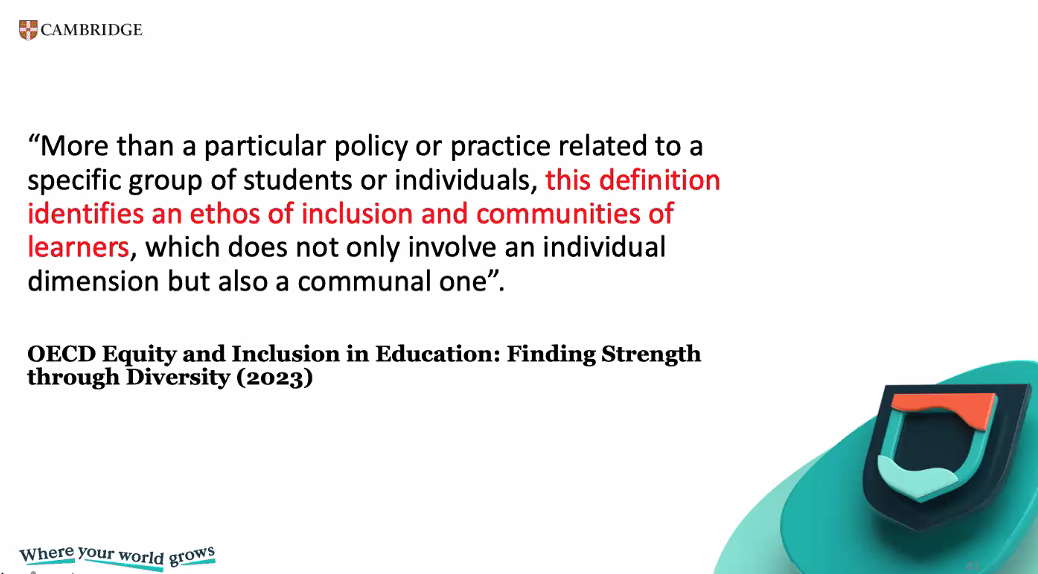
Ben’s view: Inclusion is about recognising, respecting and learning from the “other”. It is important because everybody should have the same rights and opportunities. This strengthens social cohesion.
He then shared a view from the literature:
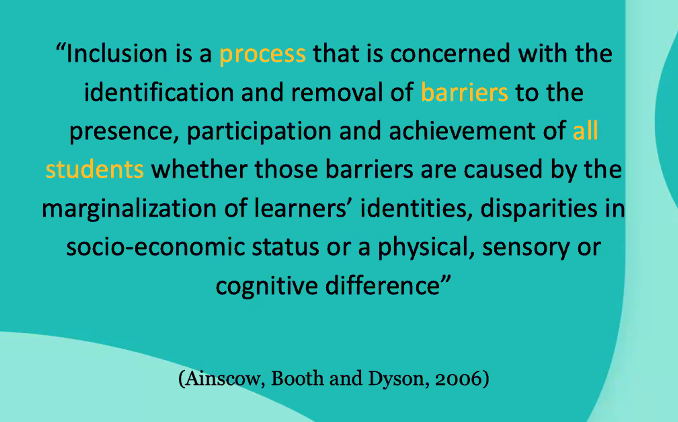
He said keywords were “process” and “removing barriers” and “all students” – not only valid for special educational needs but for everybody.
Equality/Equity, Inclusion, Diversity were the next terms that Ben wanted to unpack. What is the difference between equality and equity?
If you look up EDI/DEI online, sometimes E stands for equity and sometimes equality. But they don’t mean the same thing.
- Equality is giving everyone the same thing
- Equity is giving everyone what they need. Giving everyone the same doesn’t help because everyone doesn’t begin from the same place. Giving everyone what they need is what we should aim for. Focus is on fairness and opportunity.
- Diversity focuses on acknowledging, respecting and celebrating differences. It focuses on representation.
- Inclusion is the specific ways in which Equity and Diversity are realised. So the focus is on participation.
How can inclusion be understood in a language learning/teaching context?
Ben recently ran a course on inclusive practice and got students to say what it means to them in their context.
Ana from Quito, Equador: For her inclusion means removing barriers, not lowering expectations. Students face barriers related to different types of things – language, cultural, background – not only physical or cognitive challenges. It’s about trying to anticipate these barriers and try to allow students to understand what you are teaching them. It’s about flexibility as a teacher. It’s important to have different strategies and materials and supports that can help any students that don’t follow a certain way. It also means creating a classroom culture where everyone feels valued and safe. That’s the first step and the most important one. If they feel safe they will be able to take risks and participate and feel like they are being supported and heard. Once you make a safe space for them for the students to feel part of, then anything else can move on. Something we should talk about constantly among colleagues and promote constantly.
After playing the video, Ben underlined the “it’s about creating a classroom culture where everyone feels valued and safe” and that it is a continuous process. He chose Ana’s video to show us because she emphasises this.
It’s the space that you create with your learners that allows them the opportunity to participate. The most important ingredient. (Yesss! I agree so hard!!!)
Universal Design for Learning:
It’s a practical framework for inclusive practice in education in general, also appropriate for language teaching. 3 central ideas.
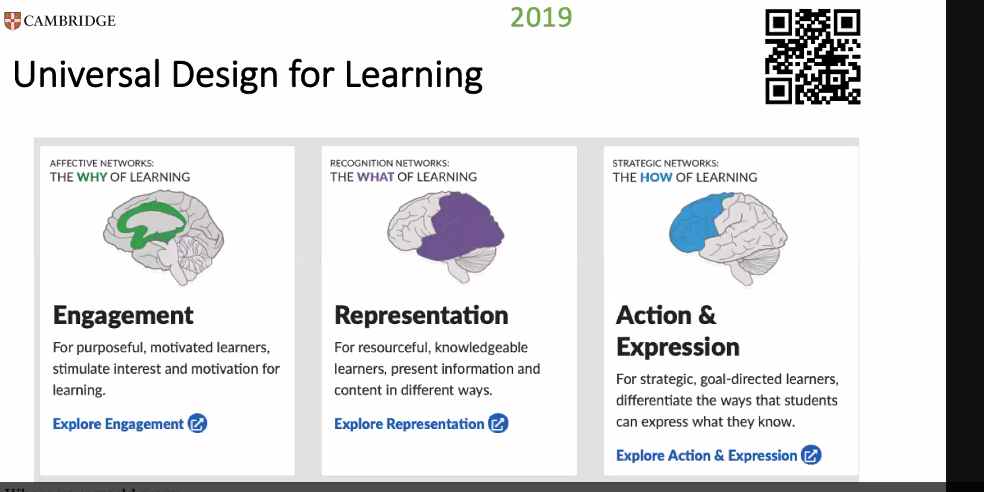
- The idea of engagement: how do you get your learners motivated? How do you stimulate their interest?
- Representation: how do you present th information to them so that they find it accessible?
- Action and expression: how do they express themselves/show what they know?
These 3 ideas are a very good way to think of practical applications for inclusive practice.
UDI allows us to be people led rather than label led, allows for intersectionality. Ben’s approach is a holistic/whole person approach. Learner variability is the norm in class. You know they will be very different from each other as well as sharing things. We need to account for this from the outset in our methodology and materials. You get to know your students on a human level as people not jus as students and this can allow you to adapt your material to them. An inclusive approach must be seen as beneficial to all. Our goal is for everyone to feel connected and belong.
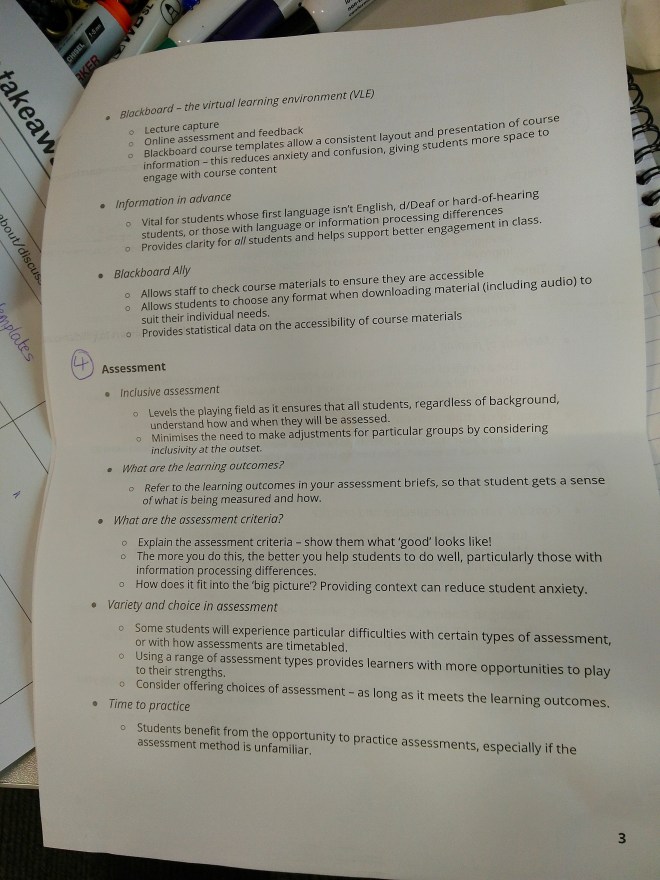
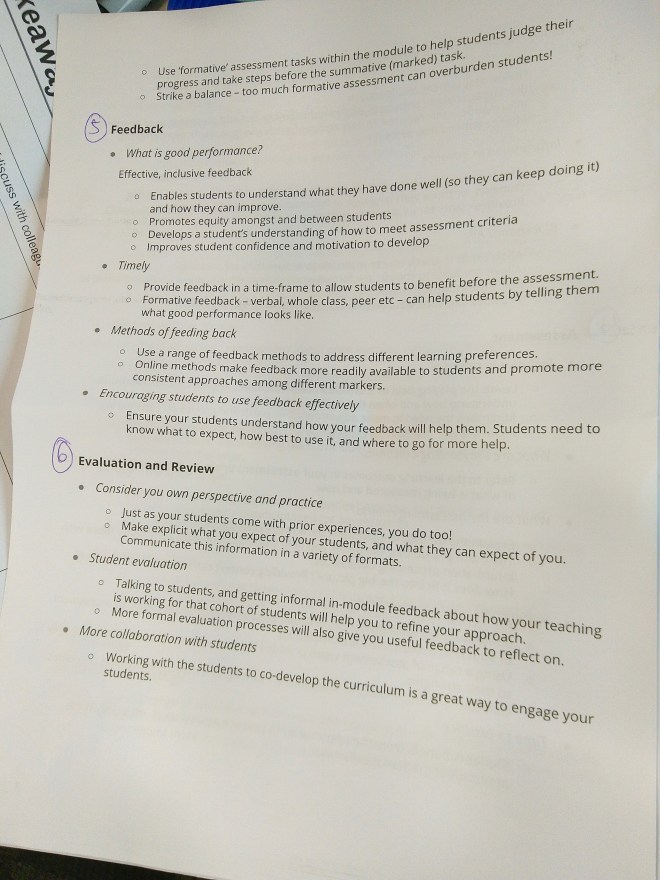
Tips and takeaways for the classroom
Best practice: include frequent breaks, allow more time/use silence, make it visual (use colour), chunk it (break down instructions, write them up on the board), review language/concept check more, vary activities, allow freedom to move.
Doing these things is already being inclusive. It’s not rocket science. But we may not understand it as being inclusive, the difference is in the way we frame it.
- Offering choice
- Building a community
- Using and respecting learners’ own language
- Developing empathy
The above 4 takeaways come from Ben’s book 30 ideas on inclusion in ELT. Some of the ideas talked about now come from the book.
Offering choice is fundamental. How can we offer students choice? Choice of discussion, choice of who to work with, choice of task/topics. This is about being flexible with students. Ben offers:
- seating arrangements
- project/presentations (poster, essay, video) – related to action/expression in UDL.
- Roles (research, organiser, spokesperson). Responses to text (describe a personal connection, answer comp questions, summarise…).
- Goals (identify personal goals and established ones) – this becomes apparent when you get to know students on a personal level.
- Review and reflection (logs/journals) – we all do this in different ways (e.g. today some people will be making notes, typing, or just listening and processing). Give learners choice on how they reflect.
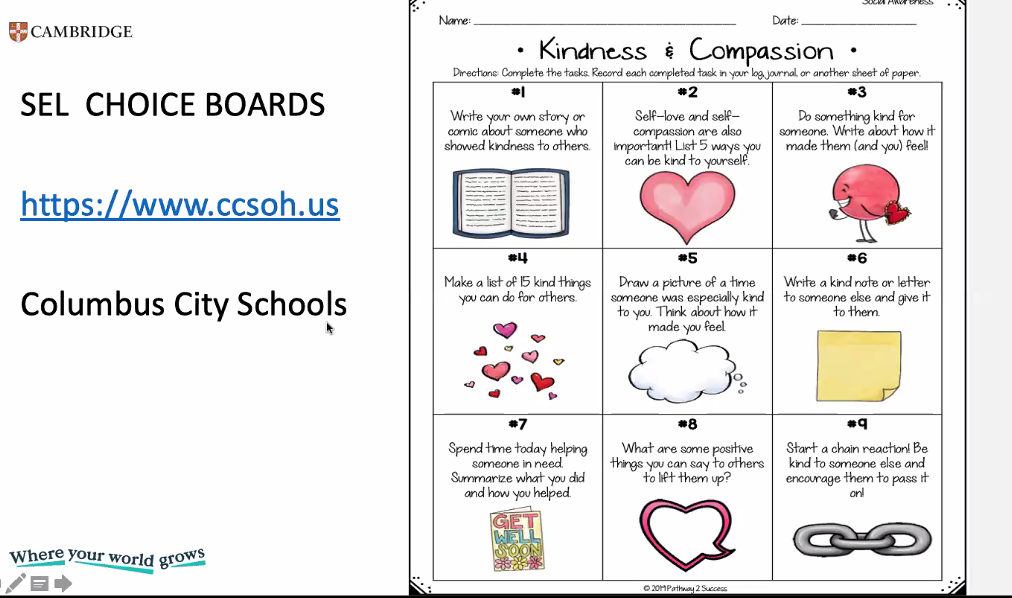
- Choice board – students can choose which activity to do. Google choiceboards to find more examples.
Building a community: classroom contracts. Many are familiar with this. Inclusive pracice is not rocket science, but with familiar things we can give an inclusive twist. E.g. for adult learners, add things like listen carefully to other people’s opinions and do not interrupt. Do not jump to conclusions or make assumptions, be curious and ask questions. Respect the student if you disagree. When showing disagreement, criticise the idea not the person. Keep an open mind with the expectation of learning something new.
Using and respecting learners own language: It is important to acknowledge and respect learners’ language. A plurilingual approach is encouraged by the European Framework. How can we use it?
- Activating schemata/brainstorming ideas can be in L1, then summarise those ideas/reformulate in English. This can save time. This may enable more sophisticated ideas.
- Provide input in L1 and then learners respond in English.
- Own-language moments (e.g. self evaluation, contrastive analysis).
- Sandwiching – e.g. give the instruction in English, translate into L1, then give the instruction again in English. This way students get an ear for the important instructions.
- Conduct an own-language survey: at the start of tern, ask learners to share languages they speak/understand, how the learned them, how they use them.
A way to get them to reflect on their own language/culture in contrast with others:
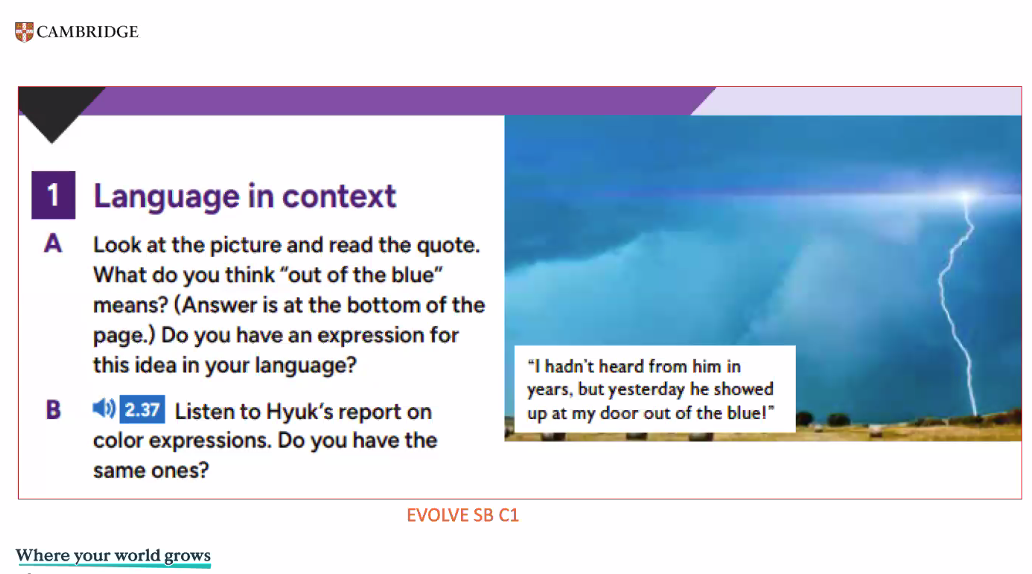
Developing empathy: One way to develop empathy is to tell stories. Ben tells us a story about Hong Kong island, working with teenagers from quite wealthy backgrounds who weren’t particularly motivated, there because their parents wanted them to be. They all had English names. A lot of them liked having English names, made them feel part of the English class. One day he had to do a substitution class in Kowloon, was reading out the register, one of them didn’t have an English name, he didn’t want one. The others started laughing at him for that. Ben stopped the class and said listen if he doesn’t want an English name, that is ok, we need to respect that choice. The next day in that class again, and this time the other students were all ok with it. He realised something imorant: when we talk about empathy, we don’t just mean between teacher and students, but also among students. He realised he had to make sure they valued him and his choice. That was 25 years ago.
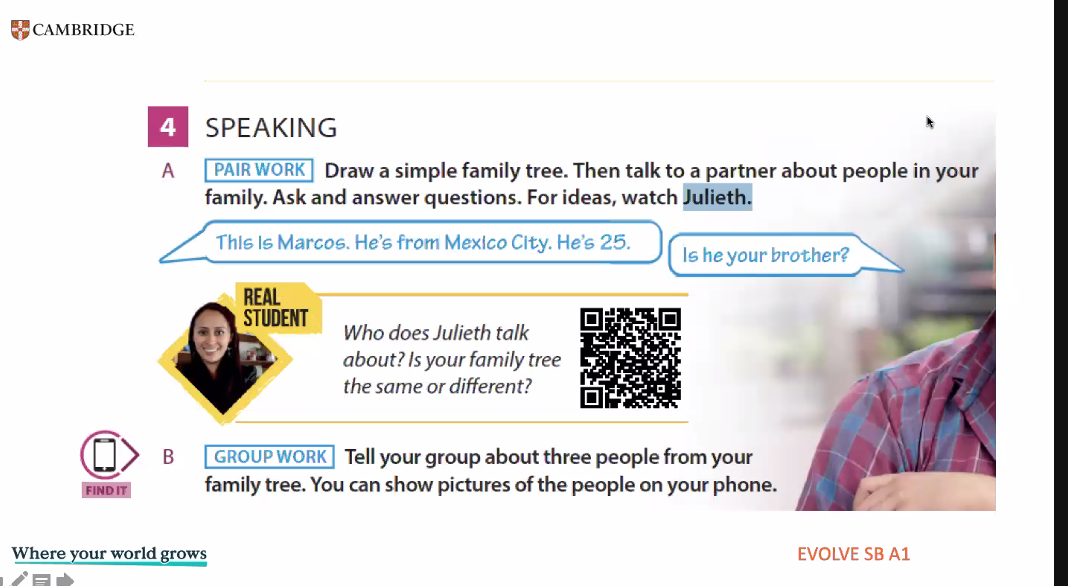
This is focusing on a humanist idea of education in terms of the role of teacher and learner. In Evolve (coursebook), they have students from different countries who are the same level as the coursebook user. When the student does an activity, they watch a video of someone like them doing it. See example below:
Closing thoughts
(There was no time for inclusive materials part of the session, but there will be another webinar about that he will be doing soon!)
- A holistic approach to learning: Put the learner first not the label.
- EDIB (what does the B stand for? Belonging. Why is it important? Because it should be the end goal. The need for social connection and identification within physical environments. Not a declared end state but an ongoing practice. It is not bestowed. No one is in a dominant position. Belonging emerges from meaningful contribution to group. There is a focus on community. Move away from just thinking about differentiation and teh individual and focus more on the classroom as a community.
- Inclusion must be seen as an asset for all. No tokenism.
- Be flexible, curious and kind.
- Many changes can be made for free. Big changes can be made with small gestures. Not change your methodology overnight. Just one little change can make a huge difference in the environment of the class. Gestures made by teachers, school ethos, and in what we as a society decide we want for our future.
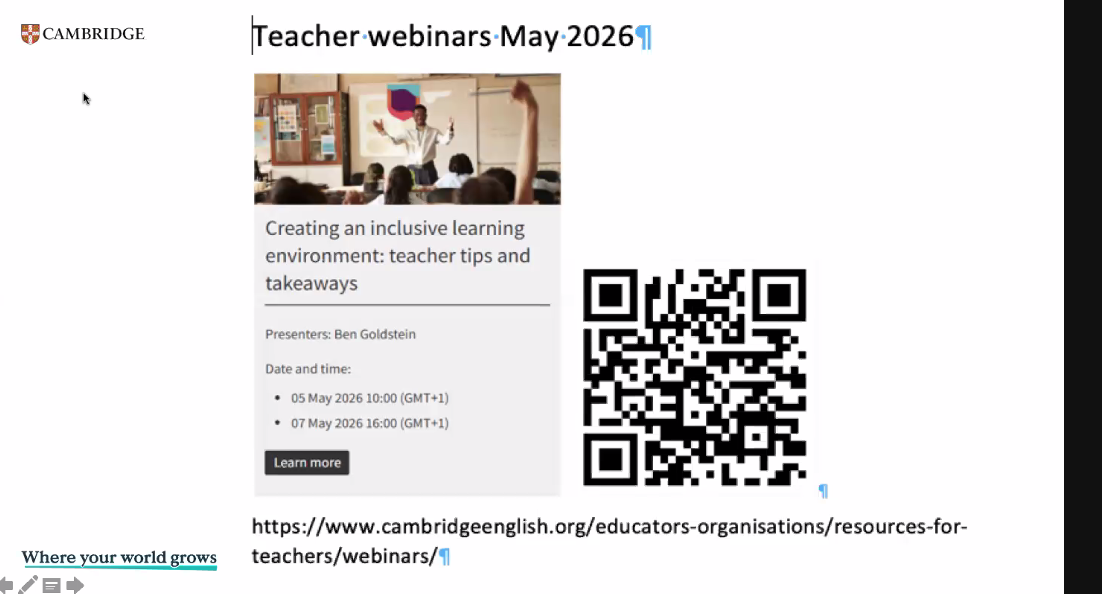
Ben’s webinar about inclusion in materials (yes please!):
Audience Question: Do you have any tips for inclusiveness for students who are troublemakers?
- classroom contract
- A chapter in his book – calling out and calling in – what to do in these situations. He will also focus more on this in May. You need to call out a student and having a contract helps with this. The contract is made with the students so that if the student is not following it and is causing trouble, then you can remind them that they participated in making the contract. Students can call out each other in this way too. Quite a complicated area, maybe requires a webinar on its own.
I have a lot of thoughts about all of this, and they tie in with a lot of my thoughts around everything I’ve read about group dynamics in the last year. But reflecting on and processing all that is far too much to tack onto the end of this already lengthy blog post summary so I shall keep that for another time! Watch this space… 🙂


 Lizzie Pinard