Looking forward: My Resolutions/Goals for 2025

In the interests of starting 2025 on a positive note, I thought I would set myself a few goals/New Year Resolutions. Before starting to write this post, however, I had a look at previous years and what I have blogged about at the start of the year, wondering what past goals had been, and noticed a handful of things:

  • I have actually tended to do more goal-setting at the start of the academic year rather than the calendar year in most instances, when I have done it.
  • Burnout at various points has impacted my goal-setting (before the pandemic: driving a shift from working 5 days to working 4 days which began in September 2020 but was initiated pre-pandemic; during the pandemic: well, obviously….and thank goodness for the afore-mentioned shift part way through; and since the pandemic: the combination of house-buying, house-renovating, wedding planning and moving – the latter 3 all in 2023 and interspersed with ill health – did for me quite comprehensively.)
  • When I did do it at the start of 2017, I drew on this slide from a presentation I had done for EVO (quoting EVO via that blog post – Every year in January and February, the Electronic Village Online (a project of TESOL’s Computer-Assisted Language Learning Interest Section) brings together English language educators from around the world to engage in free, collaborative, online professional development sessions, – not sure if it is still running now!):
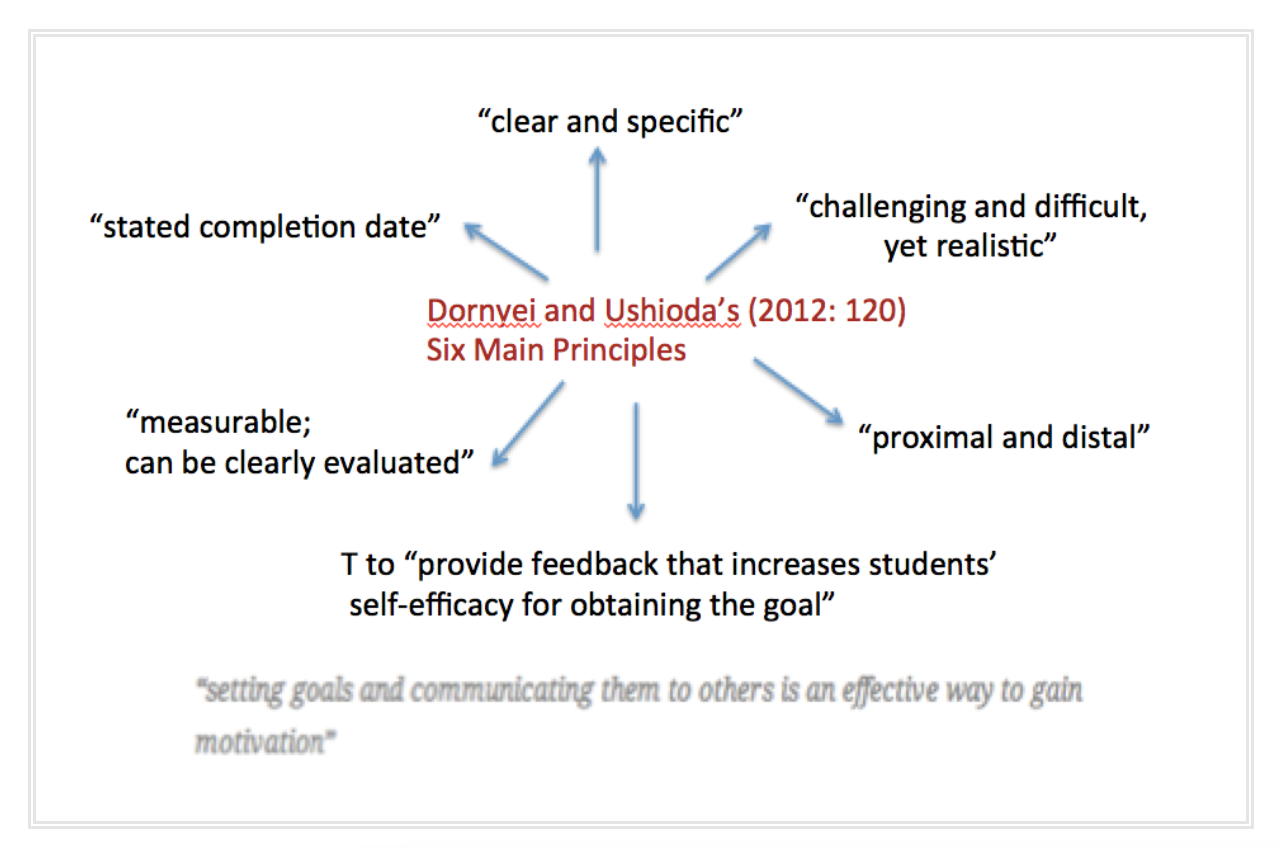
So I suppose this blog post, once complete, will be fulfilling the grey italics regarding motivation at the bottom of the slide.

Coming up with something that is “challenging and difficult yet realistic” is, itself…challenging, I feel! Hitting that sweet spot requires both a good degree of self-awareness and, perhaps, of humility. It’s so easy to aim too high and miss realistic. On the other hand, if one lacks awareness and confidence, it might be equally easy to aim too far the other way and pick something that you duly achieve but is perhaps less satisfying than it might be. This time last year, “challenging” was simply surviving and carrying out my job duties. Nevertheless, I managed to do quite a bit of CPD last year, which goes to show that you don’t necessarily need goals in order to achieve things! It can be a more organic process. If we consider our minds and bodies as our primary tools, they won’t be good for getting anything done if we don’t look after them so that has to come first before the rest can follow. Last summer holiday was certainly much-needed recovery time for me.

So what of this year? Well, so far so good… I had an extra week of leave which meant that as well as doing the famiy Christmas visiting marathon (1 week) and being ill (10 days), I did have a couple of days of real down time and didn’t have to start work while still poorly. This makes a huge difference wellbeing-wise and motivation-wise, the latter because I have actual energy and, also important, ability to generate positivity. This year is going to be very challenging due to external factors but things will unfold as they unfold regardless of what my brain is doing. Which leads me to…

Resolution 1

Channel my brain into positive and creative pursuits (rather than only using it for worrying). Too fluffy? Well what it looks like is:

  • doing more writing: blogging – I’ve not done much blogging recently, up until the second half of last semester when I got started again. I want to do more this year!
  • doing more writing: creative writing (fiction) – I’d done no creative writing since about 2016 or so until last week (life has been a LOT) but oh the joy it’s brought already in the short time I’ve been back at it. 🙂
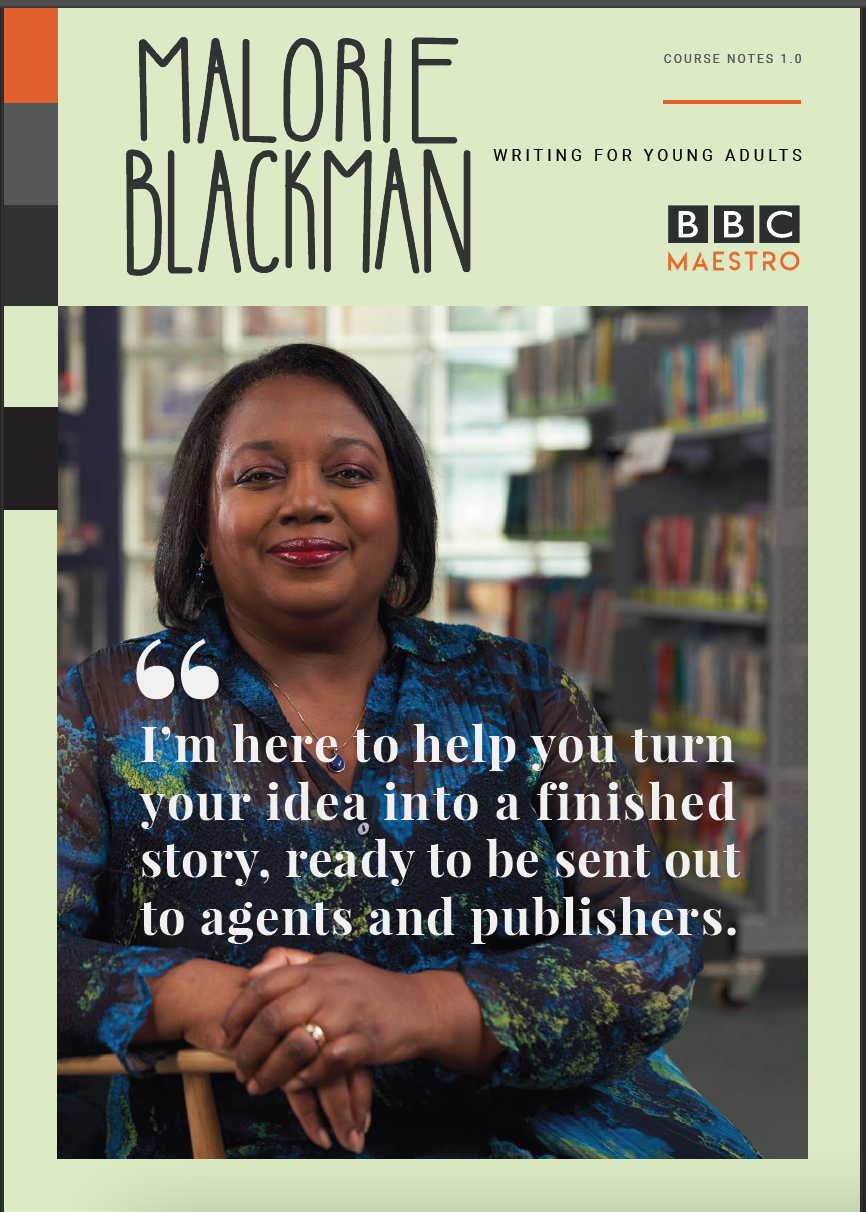
  • creative writing development: I’ve started a course by Malorie Blackman on BBC Maestro about writing YA fiction. My sister gave it to me for my birthday in 2022 and I’ve only now got round to using it!
  • being curious about my students and my team of teachers and using that to feed innovation in how I support them.
  • doing more piano, while not linking success or failure to specific quantities: this may seem to fly in the face of measurability but I have realised that in the past I have set myself time-limited goals e.g. do a bit every day, or x days a week or whatever, and then when I’ve missed sessions I’ve been more likely to then not do it for a spell because missing the session felt like failure. So this time, I will count each time I do it as a success, regardless of whether it’s day 10 in a row or the first day in 2 weeks. After all, it is a pleasure not a rod to beat myself with!
  • learning: doing CPD always brings me great satisfaction and so does learning new things outside of work. I want to do both whenever I can (albeit not simultaneously)! Within this lies continuing preparation and exploration for my future Ed Doc. As well as information-based things, I’d like to learn how to crochet but I’ve never done it before so it needs maybe a holiday in which I am not ill to have the brain space possibly… We shall see!

My next resolution, to balance out no.1, will focus on the physical:

Resolution 2

Prioritise physical wellbeing. I’m no spring chicken and am at that delightful age and stage where I’m actively losing muscle if I’m not working hard to maintain it! Physical health and wellbeing also have an impact on mental health and wellbeing. Too fluffy? Well, what it looks like is:

  • do a regular bouldering session at the bouldering wall: once a week on a Tuesday is doable when I have my NAW
  • Do an additional strength training session one day a week.
  • Keep running 4 times a week (on 2 x work days I go out before breakfast! Which is a lot more enjoyable in daylight once the days get longer!!)
  • Do yoga regularly – I predict being able to manage this approx 5 times a week (my timetable on Thursday and Friday isn’t so amenable to it!)
  • Do lots of gardening (great for getting fresh air and bits of exercise; a short burst of weeding or digging could be a perfect 10 minute break…)

So, that’s me…but something is missing and it is the basis of my final 2 resolutions…

Resolution 3

Put time and effort into my marriage. Too fluffy? Well, what it looks like is:

  • Support my wife in achieving her own goals.
  • Prioritise spending time with her regularly.
  • Continue team-working everything effectively!

I am lucky in having a wonderful marriage but I never will take it for granted!

Resolution 4

(On the topic of not taking things for granted…) Make time for family and friends. Too fluffy? Well, what it looks like is:

  • make the effort to get in touch with friends/family
  • make the effort to see friends/family
  • balance this with my need for solitary downtime/recovery (I need to recognise this need because otherwise I will inevitably burn out!)

So, that covers mental, physical, emotional/connectional areas and encompasses personal, social and professional domains. Circling back to the diagram, these resolutions/goals deliberately don’t have any completion dates as such, because they are ongoing, regular things rather than one-offs. They don’t appear clear and specific on the face of it but I have a clear and specific idea of what they look like in practice, which suffices. Being ongoing things, they are all both proximal and distal. In terms of measurability and ability to be evaluated, I can do this simply by looking back on each day/week/month and seeing what I’ve done. I think they are definitely realistic…are they challenging and difficult (enough)? Well, all the examples require effort to do, but they are positive and uplifting so it is effort I will be happy to make! I do think if our resolutions/goals are uplifting and/or inspire us, we are more likely to carry them out! I would add that as a principle. 🙂

What are your goals/resolutions for this year? Whatever they are, Happy 2025 to you! Let’s hope it is as kind to us all as it can be.

Gen AI and Independent Learning

This was the title of the English with Cambridge Webinar that I watched today (linked so you can watch it too – recommended!) It’s divided into 3 parts – what autonomy is, activities learners can do with Gen AI to learn autonomously and risks to avoid. This post will offer a brief summary of that, followed by some ideas and thoughts of my own.

The first activity is to design an autonomous learner, sharing ideas in the chat. The usual kind of things came up – motivation, confidence, agency, enthusiasm. These wre compared with the literature e.g. Holec (1981) – “the autonomous learner can take charge of their own learning” but the speaker said we need to unpackage and update this. So that, it does involve the ideas that were put in the chat, as well as ability to manage their time and resources, awareness of learning strategies, resourceful (e.g. would think to ask an AI chatbot) but also critical (won’t just accept the response without evaluating it). However, teachers are also very important in the process – autonomous learners aren’t born but are made, with support from teachers. This is important because if you are autonomous, you will achieve better results and improve more quickly. Also, autonomy is important beyond language learning, in the work place, in personal lives etc – it is a lifelong learning and living skill. It goes hand in hand with critical thinking, which is also a key skill. You are also likely to be have better confidence and self-esteem.

The other speaker reminds us that most AI tools require users to be a certain age. E.g. ChatGPT is not for under 13’s and 13-18 year olds need parental consent. So, if you do any activities with students, ensure they are old enough to use them and whether you need parental consent. Then some activities:

  1. Using the Chatbot as a writing tutor. This is a back and forth process, where the student asks the Chatbot to highlight the mistakes but not correct them. The student then tries to correct the mistakes and repeats the activity. They need to tell the Chatbot explicitly not to correct them. This could go through several iterations until the learner has had enough, at which point they prompt the Chatbox to explain the mistakes. “What about this sentence? What is wrong with it? <sentence>” NB: the Chatbot can make mistakes – it can say there are mistakes when there aren’t.
  2. We were shown a sort of tabulated study plan for improving writing and asked what we think the prompt might have been to generate it. Critically: if you want something useful, you need to be very detailed in your prompt to get something useful back from the Chatbot. It was something along the lines of “My teacher says my writing has xyz problems, and I want to take a B1 writing test in 4 weeks. I will have to write x and y. Can you make a study plan for me in a table. Can you include information about what I should do and what resources I should use.”
  3. Similar to the above, we were shown a visual idiom guide and asked what we thought the prompt was. It was something along the lines of “I have to learn these phrases for next week. I’m not a patient student and I think I have dsylexia. Can you suggest some study guides. <Phrases>.
  4. Intonation – Voice chat in ChatGPT. You speak into your phone and you get audio back. “I’ve got to do a presentation. I think my intonation is flat. Can you help me? <Short extract from presentation> And ChatGPT can make suggestions. You can keep going back and forth. Say it again and ask for further suggestions.

(I recommend watching the webinar to receive a full presentation of these ideas!)

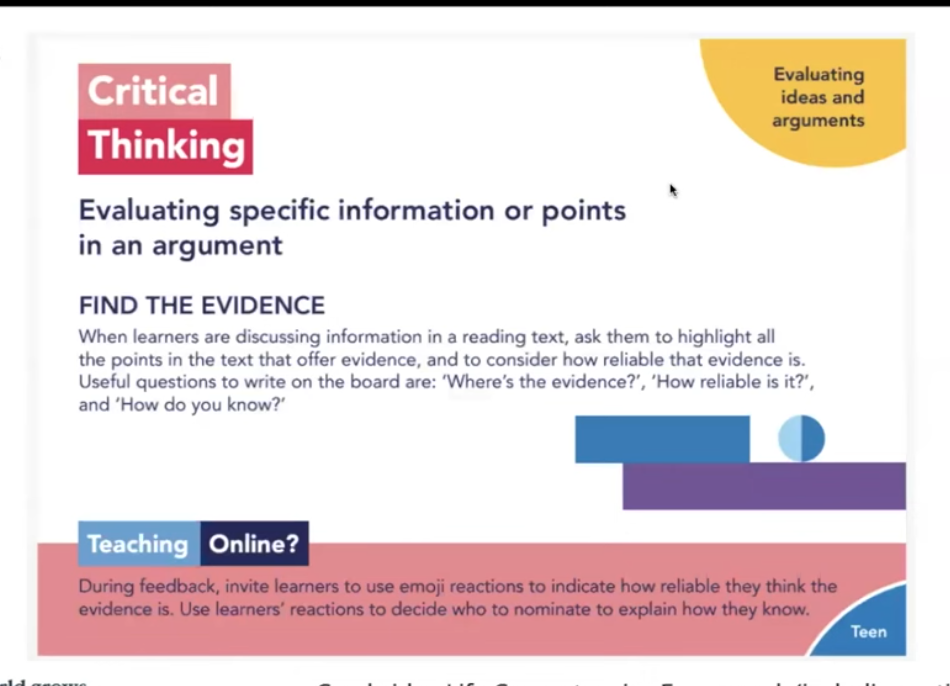
The final part of the webinar deals with the risks of using AI and how to avoid them. There was a poll asking “Has AI ever misunderstood you?” – There were a lot of answers with “yes”. AI is not faultless and doesn’t always understand. Then we are asked to think about what overreliance on AI might look at. Lack of creativity, quite formulaic answers, repetitive were ideas that came up from the audience. To avoid these risks, we need to train learners not to use AI too much. This is also where critical thinking comes in – learners need to be able to make effective choices in use of AI. We want learners to be confident users of AI but in a critical way. We want them to be thinking and reflecting on things like is AI useful, is it doing what it needs to do. Questioning them regularly, getting them to keep a journal of keeping it – when they used it, why, the result, would they use it again – to get them to think about how effective it is. Offering yourself as a resource in terms of support in using AI, that learners can talk to you and get advice when they want to. Cambridge Life Competencies Framework was talked about – there are freely available activities to use with students.

An example activity from this:

This can be used on a text that Generative AI has produced, to encourage students to question what is produced.

Another activity was to ask students to use for a chosen stage of a task. They should explain where they will use it, why they decided to use it for that stage of the task and then reflect on the outcome. This should be a supportive, encouraging environment. The key thing is encouraging reflection.

The final question was “Are you an autonomous learner?” directed at us teachers. We need to build up our knowledge and understanding of things like AI. This will enable us to be able to give support and advice to students. Turn activities into your own, adapted to your own context. We should also be a learning community in terms of AI, as it is new for us all. This would create a supportive environment rather than one of fear for using it in the wrong way.

The webinar concluded with 3 things to keep in mind: Purpose – you need a reason for using AI, don’t use it for the sake of it or because you think you should. Have a plan. Make it sure it fits the purpose. Privacy – any data that you put into GenAI chat becomes part of the data that the Chatbot uses. So anything you put it can be repeated to other users. Therefore don’t enter personal data about you, your learners or anyone else into it. You should also not put copyrighted things into it if you don’t own it. Planet – the use of GenAI has an effect on sustainability in terms of the environment and society as a whole.

My thoughts and ideas

The first thing that I couldn’t help thinking was that when I was learning Italian intensively and autonomously in the summer of 2014, I would have LOVED to have had access to GenAI! Being able to get instant basic feedback on my writing would have been very cool. I wonder how competent I would have been at handling the feedback i.e. at identifying which parts were valid and which parts were sketchy.

There’s also an AI tool we learnt about in one of the AI professional development sessions delivered at work, Google Notebook, where you can feed it a bunch of content and it converts it into a podcast which is a discussion between 2 “people”, in passably natural spoken language. It is called a “Deep Dive”. The usual AI caveats apply, in that what it churns out in the podcast may not be accurate to what was fed to it and it might make stuff up. Personally, I would have loved using it for Italian learning though. It would be really good for generating content to listen to, using topics and vocabulary that you have some familiarity with. You could read the texts in preparation. I don’t believe this is the intended purpose of the tool (it is supposed to be a research assistant, and you are effectively outsourcing reading and summarising texts to AI) but it would be a very good use of it! It would also mean the issue of accuracy was less acute, given the purpose of listening to the podcast/summary would be to practise listening rather than to make high stakes decisions based on that output!

Where I work, we’ve mostly been coming at it from the perspective of how to conduct assessments in a world where AI exists and students use it in the production of their written work. Being part of a university, the first stage was waiting for there to be university policy on it. Now we are at the stage of being able to integrate the policy into our programme. It is still a slow process as there is a lot of procedure to follow when you bring in new things. We are shifting from a zero tolerance policy, which obviously was not very effective but all we had to be going on with, to identifying how and when AI could be used effectively in students’ learning and where the boundaries are. We want to integrate positive use into lessons, which echoes what this webinar was saying. By modelling effective use and giving students opportunities to use it with support, and highlighting its limitations, we hope to help them become more AI literate and therefore less likely to use it in detrimental ways. Maybe at some point we will have to teach them about Google Note and the limitations of it, since it is likely something that they could use at university as part of their process.

It is nice to be moving towards a position in which we can acknowledge the positive elements of AI. Of course, as quickly as we adapt, so quickly will it continue to evolve. (The tools we learnt about in the session where we learnt about the “Deep Dive” – wow! I may turn my notes. or at least some of them, from that session into a future blog post…) I think, going back to the webinar at the root of this post, one of the great things about it (the webinar, that is) is that the skills and criticality, and ideas for teaching those which were presented, will continue to be equally relevant even though the ideas for using the AI itself will change and evolve. As for the part about learner autonomy, in my view they nailed it – it was so good to see them discussing it as something to bring into the classroom and develop (I have done a lot of work on that in my career – through classroom research, through publication, through conference presentations and webinars) rather than something that learners are or aren’t. So, as I said before, it IS definitely worth a watch! Also worth taking some time to look at the Cambridge Life Competencies framework and resources attached to it.

My list of in-house workshops

On my Talks page you can find links to all the talks/workshops I have done externally i.e. at events like conferences (both online and face to face), as a guest speaker, and as webinars. In this post, I have finally got round to listing and, where relevant linking to, all the workshops and scholarship circles I’ve led or co-led as part of in-house CPD programmes, both in my previous job at IH Palermo and my current job at the University of Sheffield’s ELTC. 

ELTC

IH Palermo

  • Fostering Learner Autonomy
  • Take-away from IATEFL 2013
  • Error correction workshop
  • Using Edmodo

Instructional Design Course

I am 8/10 weeks through the Instructional Design course (link) run by some of the good ELTC TEL team folk. Their site is called The Training Foundry and on it you can find information about the courses, but also webinar recordings and blog posts. It’s pretty cool. This is the subtitle for the Instructional Design course (IDC):

“Our Instructional Design for Language Teachers course can help experienced teachers design flipped and asynchronous materials.”

It is a 10 week course and I would quite happily recommend it to anyone who is interested in principles of online learning and learning to use a variety of tools to design asynchronous content. It has a weekly live online session (using Google Meet), and each week there are also a series of tasks to complete. There is interaction between students (sharing output, commenting on others’ output etc) via a forum.

Most of the tools that we’ve learnt the basics in were actually new to me (with the exception of Google Slides [Week 1] but even with that I learnt new things about it!):

  • Wordwall

Wordwall (link) is a very user-friendly tool. It is subscription-based but I haven’t taken out a subscription, just using the limited free version for the purposes of the course. You can make the usual array of ELT activities. One I particularly like is called Word wheel. You input words and it creates a wheel in which each word is a segment of the wheel (looks sort of like a pie chart with equally sized segment). You can “spin” it and it will stop at random on one of the words you have input. You could then get students to define it (as we had to do in one of our online lessons, using vocabulary from an article we had read), for example.

Another online-based tool for making asynchronous content. Also requires a subscription but it offers a free trial which served the purposes of the course. It is pretty versatile. You input information into a form and it spits out an activity. You can also e.g. create a voice recording tool that you could embed into a page on your platform, or whatever asynchronous content tool you were using, for students to use for an activity, make interactive video activities, activities using pictures and much more.

As you can see, my free trial is coming to an end. I’ve had a good play with it though and really like it. But it is EXPENSIVE! So it is something that a business/institution/self-employed person might invest in rather than an individual. Our TEL team has access via institutional subscription, for example. I find it really visually appealing and quite intuitive to use. Interactive elements are built in, if a little limited. But limitations are lifted because you can also embed interactive content from e.g. H5P, Quizlet or its sister tool Storyline (see below for more information about this one!).

  • Storyline

This one, you have to download a programme onto your computer to do it rather than using it in a web browser. It is part of RISE so you can find it there. No screenshot because it only runs natively in Windows and I decided therefore to use an old spare Windows laptop (creak creak creak!) rather than subject my even older Macbook to “Parallels” which is required in order to run it. (Said macbook makes enough take-off noises for using Google meet, so! But for as long as it limps along, I shall use it!!) However, it effectively looks like powerpoint when you open the programme. The area you are working with is slide-shaped/screen-shaped. But unlike powerpoint it has a lot more power in the interactivity department. It has a timeline, it has “layers”, it has “triggers” and all sorts. The newest version also has AI stuff inbuilt. All of this stuff enables you to create a lot of interactivity in various ways. It gives you a 2 week free trial before kicking you out in the absence of a giant pile of moolah. We spent two weeks of the course on it because there is a lot to learn. You would use this if you were creating materials for a course that you were planning to run multiple times because it is a big time investment that is required to create stuff. At the ELTC it is used a lot for flipped content for the summer school and at the bit where I am (USIC) it is used as the basis of most if not all of the interactive content that we embed onto Blackboard for learners, to support the learning done live online and F2F.

In terms of using the interface, I struggled because using it on a computer that hasn’t got strong processing powers and hasn’t got a big screen, it made it even more time-consuming than it should be. Everything is tiny (the parts where you control the “layers”, the timeline and all that jazz) and you have to generate previews to check what you did works properly on a regular basis, and the computer had to strain really hard each time!

The rest of the course

This week we’ve been working on using video in online learning. Which, again, is very time-consuming and requires decent (probably fairly expensive) equipment to produce high quality stuff. We have learnt a bit about video editing (which I have done a little bit of myself in a hobbytastic kind of way!). Still to come in the final two weeks is zooming out to consider more about designing a whole course rather than sub-parts of it and then a final wrapping up and moving forwards week.

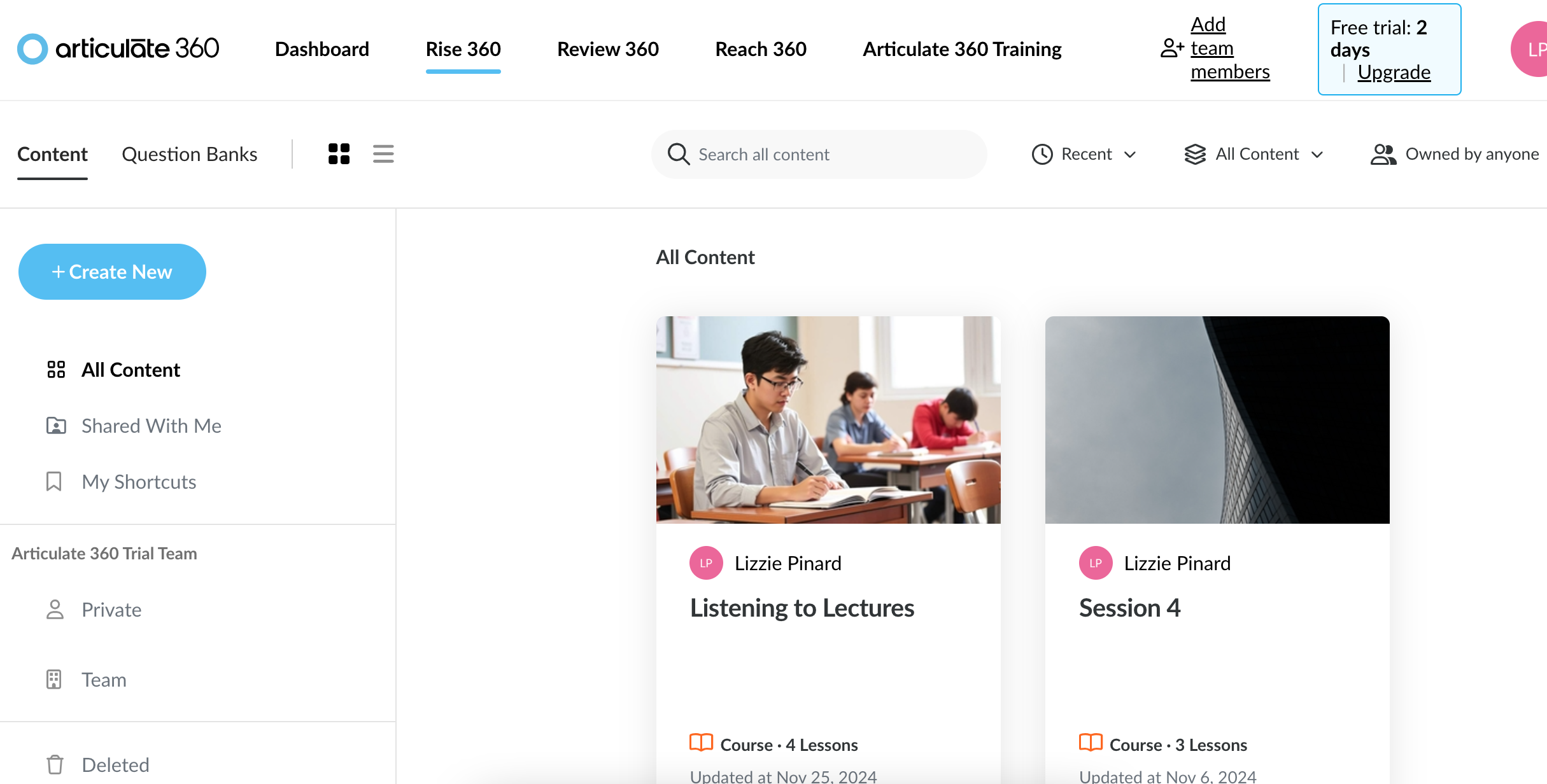
It’s been really nice to learn how to use all these different tools and challenge myself in this way. The final assessment was creating a storyboard and run of lessons in Articulate RISE and I am happy with what I have made for that (I have completed it early because of the whole free trial running out thing!). I based it on an AES listening exam lecture. It was also of course interesting to study some of the theory around online learning, as well as focus on making content accessible (which is a legal requirement!). Overall I think the course works really well, building each week on previous content and progressing logically, and the live online sessions definitely complemented the tasks and forum part.

Have you used any of these tools? Which ones do you favour? Do you use any other tools which I haven’t mentioned? There is a lot to keep abreast of, isn’t there!

Mindfulness for ELT Professionals by Trish Reilly 27 May 2022

This session was hosted by Rachael Roberts/ELT Freelance Professionals Lightbulb Moments/Earn, Learn, Thrive. (Link is to the Facebook Group that Rachael manages, where this session was advertised.)

Trish started with a little breathing exercise, breathing in and out 3 times. 3 breaths stop. Take 3 deep breaths, releasing each one fully. A little break from where we were to the present moment. Any time you need a quick reset, you can do your 3 breaths, without anyone even noticing. A quick, simple technique to learn and use – before a class, before a meeting.

She asked us “Where is your mind?”. We are often on autopilot. She told us a story of how she drove from home to ballet on autopilot and had no recollection how she got there. It’s very easy not to pay attention to what is happening. And before you know it, you’ve had 5 chocolate biscuits from the packet. Regular tasks can be done without fully engaging brains but it doesn’t help us with fully living our lives. Our bodies are here but where are our minds? We live in the story of me. We might be in the past thinking about regrets or anger or frustration. Going over and over things. Or we might be in the future worrying about something that will happen, or fearing it. The story of “what if…”

The mind is its own place and in itself can make a hell of heaven or a heaven of hell (John Milton). We can be in a tricky situation but if we can give ourselves space to be with what is, it can be a situation that we can gracefully take ourselves through. Our minds create our reality. How many thoughts do you think you might have in a day? is the next question. Research says we have up to 70,000 thoughts in a day, which is incredible when you think about it. Most of our thoughts are not real. Mindfulness helps us become more aware of our thoughts and emotions for what they are, thoughts and emotions not facts.

John Kabat-Zinn – “Mindfulness means to pay attention on purpose in the present moment non-judgementally.” We did a short bodyscan and I nodded off, oops. It is also a simple practice moving your attention from one body part to another to another and focusing your attention on it non-judgementally. Next she asks us to remember a stressful moment. That creates stress in our bodies. Our brains can’t tell the difference between imagining difficult things and having to deal with difficult things. So we get the same stress response by thinking about things as by experiencing things. The stress reponse activates the nervous system.

We take a few minutes to deal with that stress before we move on, by doing a short breathing practice called the 3-6 practice. Breathe in to the count of 3, breathe out to the count of 6. The parasympathetic nervous system is activated by this and activating it tells your body that it is in a safe state. Making the outbreath longer than the inbreath calms the stress system.

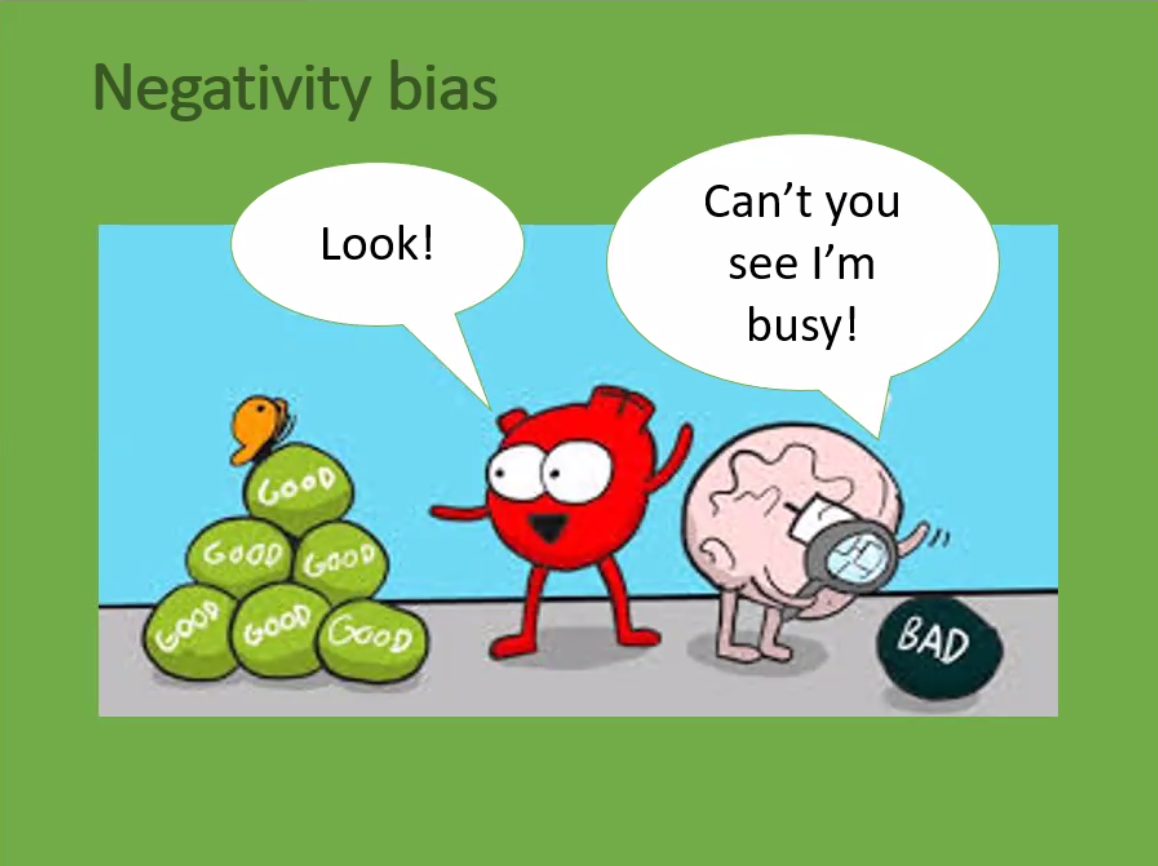
Next she wants to talk about stress. She asks us what comes to mind when we think about stress. All the comments are about the negative aspects of stress e.g. time pressure, anxiety, overwhelm. But the stress system actually evolved to keep us alive. It gets us active in order to deal with a threat. Short term stress is fine, long-term stress can be a problem. Short term it energises us, focuses us; it is a short cycle after which we can return to balance. Long term stress is when it becomes chronic and then it can lead to illness, exhaustion, low performance and you can’t see the big picture. In the modern world, the stress system is triggered many times a day by external stressors e.g. deadlines, meetings, tricky people, pandemics and internal stressors e.g. our thoughts and emotions. Usually a combination of both. We are hard-wired to seek out the negative/danger. If there are a dozen good things and one bad thing, we will tend to focus on the one bad thing.

Oh, brain!

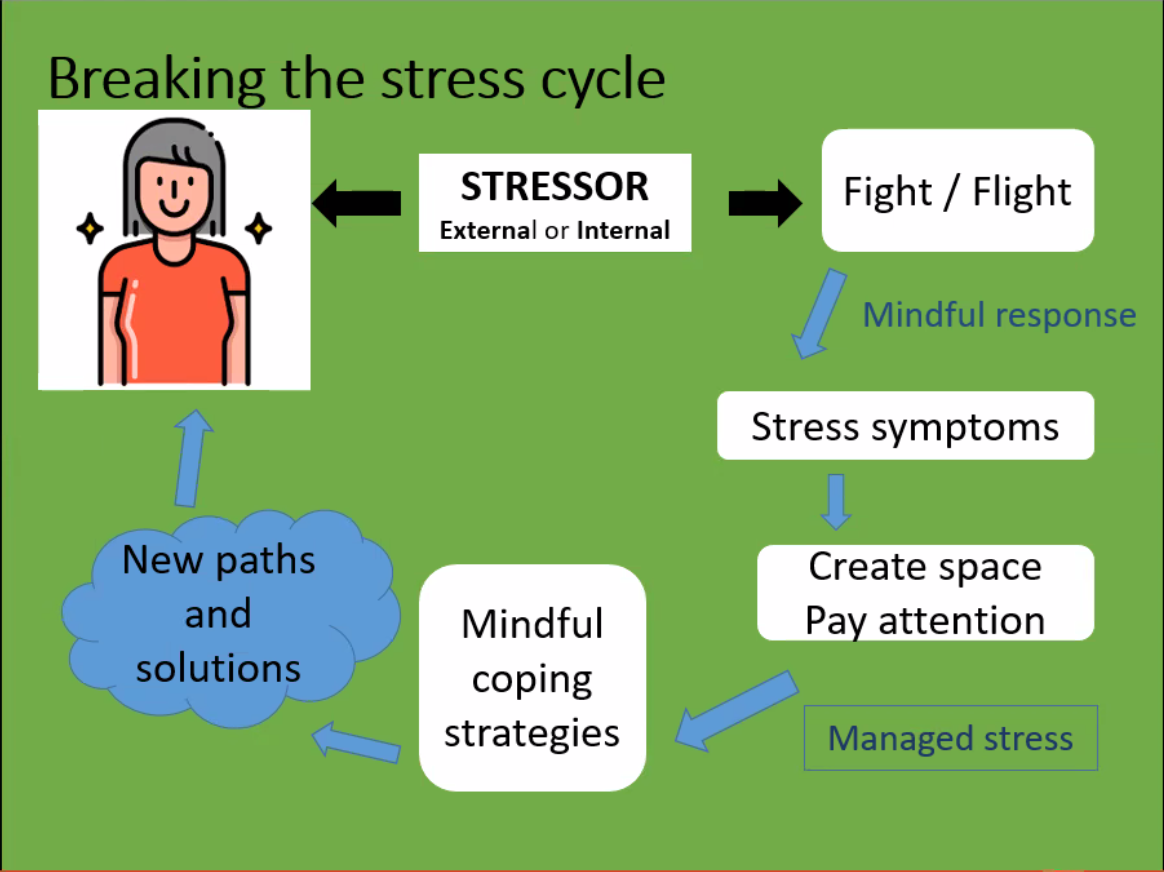
Mindfulness helps us break the stress cycle and avoid getting into a chronic stress state. We pay attention, notice, things like tension in shoulders and jaw, and take a few minutes to do a body scan or some 3-6 breathing and break the cycle by returning to a calm state. The strategies are mindfulness techniques. If you regularly practice mindfulness, you are more able to respond more positively to stressful situations and you create a muscle memory which is able to become your parachute. You don’t want to start trying to do mindfulness practice when you are super stressed, you want to develop it when you are calm so you have more tools to choose from when you are stressed, in order to respond.

Breaking the stress cycle

Research shows many benefits: being happier, better focus, being able to return to calm more quickly, improved relationships, deal better with strong emotions, be better able to learn, plan, think and remember. Mindfulness is any time, any place for anyone. It’s not a religion, you don’t need to be in a particular place or do particular yoga positions, you don’t need to empty your mind. It is simple, practical techniques you can use. It is not a cure for serious depression. It can help anxiety and stress and generally improve our quality of being.

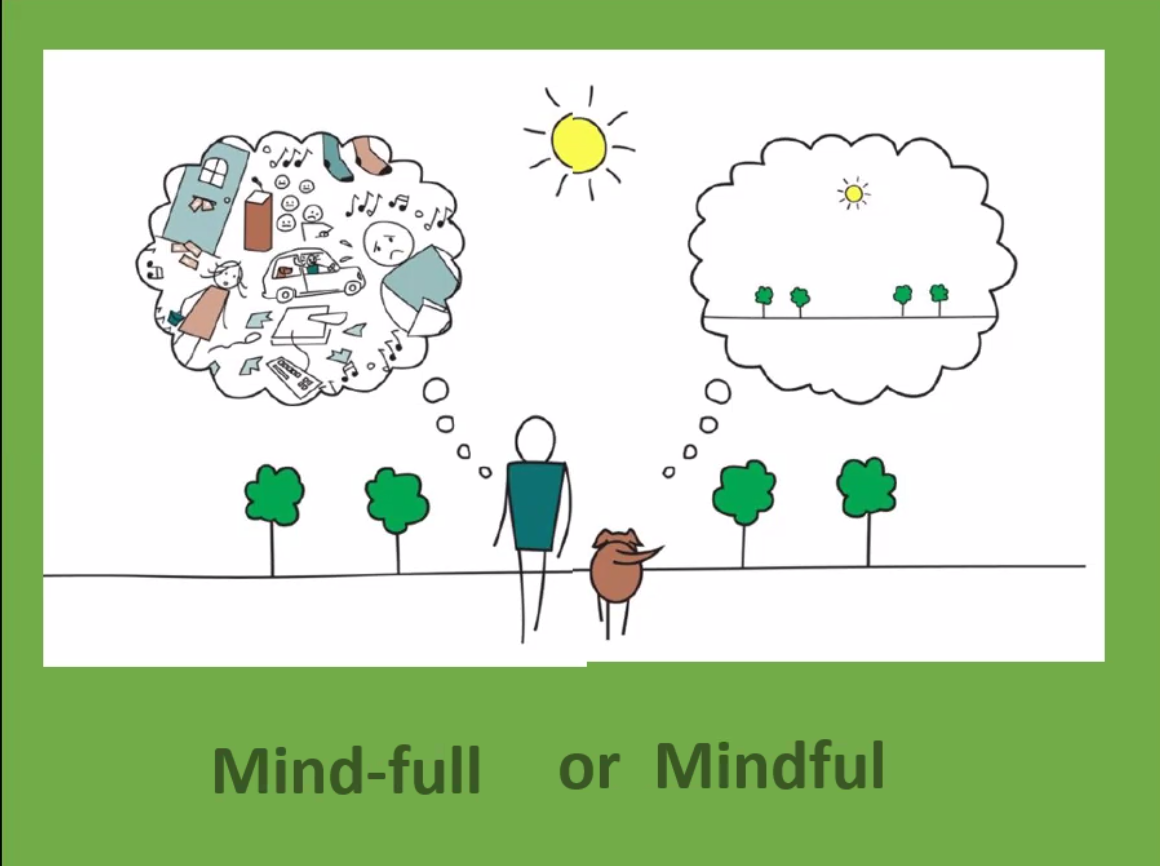
Yesterday is history, tomorrow is a mystery but today is a gift and that’s why they call it the present. Mindfulness is all about being present with what it is, without judging it. The question we want to ask ourselves is do we want to be mind-full or mindful?

Mind-full or Mindful?

John Kabat-Zinn has videos you can look at. Tricia wants to run a course for ELT professionals, which she will post more information about it in the ELT Lightbulb moments group in due course. Mindfulness increases the connections between the amygdala and the pre-frontal cortext so practising is literally ‘weaving the parachute’ – do it on a daily basis don’t wait til you need it! NB it doesn’t need to be an hour a day, 10 minutes on a regular basis will have a positive effect.

And that was the end of the session. My attendance was serendipitous as I hadn’t realised it was on until a minute before it started when I happened to notice an announcement about it! None of it was new to me but it’s always good to be reminded and I’ll be interested to hear more about the course too. I liked the image of not waiting until you are jumping out of a plane to weave a parachute. I.e. develop mindfulness techniques when things are calm so you can use them when things are not calm.

End of (another) academic year

Somehow or another, another academic year is drawing to a close. I said goodbye to another group of students today (lovely group, they were!) and all that remains is some writing exam standardisation, a pile of exam marking, and some coursework misconduct meetings next week. (Also next week, I will be getting my second dose of vaccine, woohoo!) It seems the appropriate point to reflect on the goals I set at the start of the academic year and look forward to next academic year.

I finished last year in a pretty sorry state in some ways – poor health, feeling burnt out and uncertain about continuing in my role as ADoS. A good long break helped and I came back to work with the following goals:

  1. Be curious! By being curious about everything that I encounter, all the newness that is ahead, I can open up lots of opportunities for learning and growth. 
  2. Be patient! With myself, with my colleagues, with my students. It won’t be an easy year and that is ok, it can still be a positive one.
  3. Be grateful! Look for the positives and appreciate them. Smile lots. 
  4. Be open to challenge! It’s ok, good even, for things to be difficult, challenge leads to discovery and growth. 
  5. Be kind to myself! Look after myself appropriately, maintain a good work-life balance (easier with the 4-day week!), keep meditating, eat well, exercise regularly, spend quality time with my girlfriend regularly. 

In the end, I decided to continue in the ADoS role and so now have another year of that under my belt. It has been a year fully spent working online/remotely. It has also now been a year and a half since I last worked in our building, which seems extraordinary to say the least! So, how I have done with the goals?

  1. I have learned a LOT this academic year. Amongst other things, I have put myself in online class student shoes by participating in Italian language classes once a week. I have done courses with two different providers and continue studying with the second provider. Each provider gave a very different learning experience, both of which I have blogged extensively about. What I have learned by being a student, of course, I have also been able to apply to being a teacher. I think I have become a reasonably competent online teacher, comfortable with this way of teaching. However, there is plenty of room for improvement. Use and monitoring of breakout rooms comes to mind. With a class of 20 students, I struggled with this. Feedback from my students, obtained through group discussions of a list of questions which they summarised their answers to in a Google doc will be useful going forward, as will the feedback from my line manager’s observation. I was lucky, they were a great group and I enjoyed teaching them. Other learning opportunities have included attending online TD workshops, from which I came away with ideas and food for thought, and reading – journal articles, blog posts, books. Finally, due to the high standard of my own application, I have been a fellowship assessor for two application cycles, so when people have submitted applications for becoming Associate Fellow of the Higher Education Authority (AFHEA), FHEA, and Senior FHEA (what I achieved in May last year), I have been one of a large group of people who have assessed those applications. I sat out the most recent round (as a voluntary role, you can elect to sit out for a cycle when you need to and I decided for this one I needed to!) but in the two that I did do this academic year, I learnt more about what my colleagues across the university are doing, which was fascinating. I would say yes, I did open up some good opportunities for learning and growth. May this continue.
  2. I think I have been more patient this year and allowed it to be the year that it was. I have tried to meditate more regularly but it has been sporadic. That said, I am nevertheless getting better at pausing rather than reacting, which also helps on the patience front. One of my goals for this holiday is to really get into a proper regular meditating habit as I very much believe it will help me next academic year when things are all change again!
  3. My gf and I keep a gratitude calendar together. Every evening before bed, we add in all the things we are grateful for from that day. It’s just a google doc with a table. Some days it is harder than others but on all days we can find stuff. And that in itself is something to be grateful for! (I recommend keeping a gratitude calendar – I kept one alone before my gf and I got together; we only started doing it together during the first lockdown when we were apart, as a way to continue to bond – it is a great way to cultivate a mind that finds the positives and very simple and quick to do. You could use a notebook, a word doc, whatever works for you.)
  4. Well, this was rather a vague goal wasn’t it. But here we all are. Could almost argue that by doing my job for this academic year I was by definition open to challenge! I think getting fully to grips with online teaching (last academic year was just one term and we were doing a very limited amount of live stuff) has been a big challenge, in particular how to look after my students, how to make the lessons accessible to them, how to support their learning and assessment effectively. I feel I have come a long way since September 2020 when we kicked off. In terms of ADoSing, it was my partner teacher’s second year of doing it so it has been solid. Good teamwork, pretty smooth. The odd hiccup but dealt with effectively. Next year, I will have a new partner ADoS as the current one is going on maternity leave. I think I have been in the position that much longer than last time I was in this position and hope therefore to be a better mentor – it is certainly something I will be focusing on. I will also hopefully be making SMARTer goals… 😉
  5. Ah yes. The first year of 4 day weeks. 🙂 I can say without doubt that it was definitely the right decision for me. I am in a MUCH better state than I was this time last year. While it has been a markedly less stressful academic year than the previous one, in which we were throwing down the train track as we hurtled along it, I am in no doubt that my quality of life has improved significantly with the change from 5 days to 4. The balance is just much, much better. Working from home has continued to be positive, also since I moved in with my gf. Being able to cook and eat lunch together has made eating less monotonous and we manage to do it healthily. Exercise is MUCH easier with a 4 day week because I can do my long runs or bike rides on my not at work day, while she is working, and therefore not be choosing between spending quality time with her and doing substantial exercise. At the weekends we do things like swimming and paddling together and I fit in shorter runs/bike rides sometimes too.

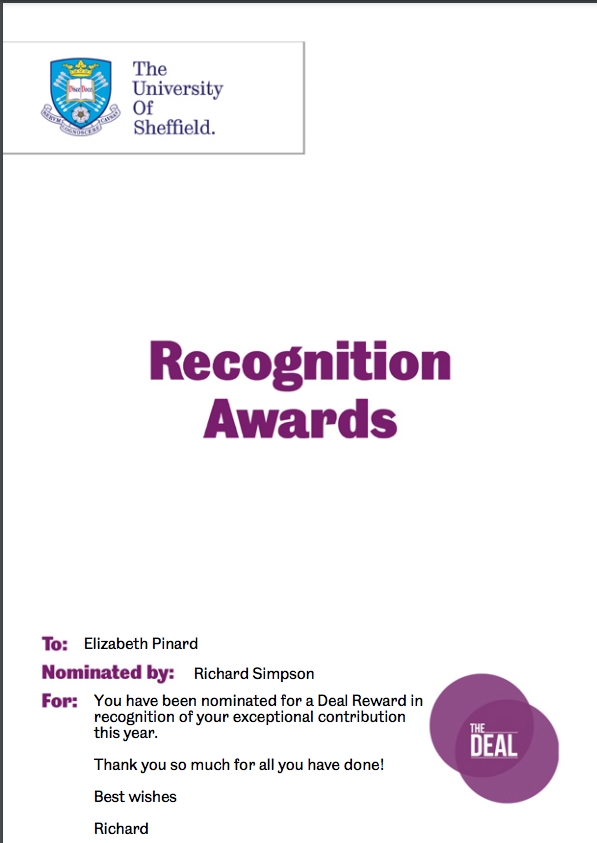
While I was writing this, I just received, in my email inbox, a recognition award:

Not just me, all the ADoSes. Honestly, I reckon the entire centre deserves one. Everyone has put such a lot in since this pandemic started. These awards were put on hold for a while due to financial constraints but it seems they are back again. It is always super nice to be appreciated! Very motivating.

Looking forward to next year, it is going to be a year of great change. After a year of being fully at home and online, it is back to the college for us! Something that is both scary and exciting. However, I am going to treat myself to having my holiday before I think about my goals for next academic year. That will be a job for nearer the time of The Great Return. For now, I will wrap this up and with it academic year 2020-21 (minus the final marking week, of course). Overall, I would say, a definite positive one. Hurrah!

Creative commons licensed https://www.flickr.com/photos/54724696@N07/24160789397 feels fitting for the culmination of this year, made it to the top of another academic year mountain of learning, challenges and life.

Upper Intermediate Italian Lesson 6

Phewwww I made it just on time (and still the first!). Still got my positive attitude, also got a lot of tired because of how intense last week was. I managed to do my homework, amazingly. I wanted to do it enough to make it happen on Sunday, but I did it on my tablet so it has no accents yet <edits furiously while the others arrive> Yet another tech-related thing haha.

Homework: Quest’anno a gennaio, 582,538 persone di 209 paesi sono iscritte a uno sfida globale – Veganuary. Questa sfida richiede a ciascuno che l’accetta di evitare l’uso di ogni prodotto animale, cioè, provare di vivere vegan. Lo scopo di questa sfida e di proteggere sia gli animali che l’ambiente e, faccendo cosi, migliorare persino la salute dei partecipanti. Questa volta la gente pensano anche a Covid perche vogliono anche evitare altri pandemici. Un gran parte di loro continuano a seguire uno stilo di vita vegan.

We started with the newsletter thingy i.e. homework. Turns out Zoom is like Blackboard in that participants only see chatbox content sent after their arrival into the room. So there was a bit of confusion as the teacher hadn’t realised that.  Then I had to read mine from last week aloud, not sure why. Now we are going through one of the other students’ homework, which has given me some welcome breathing space, in between answering questions. That done, we establish that I and two others now have stories in the class newspaper and the teacher asks the remaining two (both of whom are here tonight) for their contribution. We review the 5 w’s again. Major communication issue with the student who was absent last week and doesn’t understand what we are doing – I feel you, student! Eventually we have moved on to something else instead. I’m not sure if the student understood in the end or not because I had a slight concentration lapse as the whole thing took a while. My homework was not required, after all that effort!

Now we are continuing with the grammar point from last week.

Congiuntivo trapassato + condizionale passato.

We use the rest of the exercise that we started two weeks ago and I did as review between the two weeks ago class and last week’s class (so that was nice and easy for me tonight!).

  1. Se fossimo rientrati più presto, avremmo potuto vedere un bel documentario in tv.

Now we are looking at some pictures. Describing what the person is doing and how they feel.

Oberata – overwhelmed by work

One thing I do not like about Zoom: When the teacher shares their screen, it goes full screen on my screen, meaning my notes window is hidden. So then I have to get it to shrink again. Every time.

We are spending a LOT of time on this activity. I am very curious what it will lead into! 🙂 I wonder how it would be if we had been given the pictures and had to work with a partner to say and/or write something about each one, perhaps in response to prompts to direct our attention to what is required, then share whole class quickly…

BREAK TIME! And we are told we will do some reading after the break so I guess that is what it leads into – the suspense is over!

End of break. We seem to have lost 2 students and the other 2 are still switched off but appear soon after.

Wheee I was brave. Teacher set to having us read aloud directly and I asked if we could have 5 minutes to read quietly first. I then had to then clarify that I am happy to do the read aloud thing if we could do that first, as the teacher objected defensively initially, saying they wanted to hear our pronunciation. Am now quite glad I went with my gut instinct on not giving unsolicited feedback on lack of opportunities for group work! At least this was just a simple request and that was hard enough.

Ho fatto la fame – suffer from hunger (hyperbole)

So we read silently then aloud. We didn’t discuss pron though <shrug>. Vocab, yes. So that is a bit confusing! But never mind. Then we had to write comprehension questions. Actually we did this whole activity from lead in to this point with the other text of this pair a few weeks ago, I just remembered! So I guess we will be retelling the story using the pictures after this.

My question: Che tipo di carattere ha Natalia Aspesi?

Yep, we are doing the retelling the story using the pictures thing. Fair enough. At least this time there are only 2 pages of pictures! Less epic scrolling up and down by the teacher necessary! Yay!  Ohh, also because we didn’t have to do the ordering thing this time so as they are on the page they are in the right order for the text. Everyone had to take a turn doing this. Which I only discovered when I eventually got called on. Confession time, I was splatted on the futon behind my computer at the time. Having one of THOSE evenings. But I managed just fine.

Now we have moved on to object pronouns suddenly, 9 minutes to go. A bit disorienting! And we are reading aloud a grammar explanation page. We have used this book before and it isn’t the course book (as I have discovered since getting the course book). It is aimed at English people. Teacher is explaining mostly in Italian which is nice. Then we made a list of things to take to a party and went through it saying “I will take it” or “I will take them”.  I wonder if this means we have finished with the unreal if clauses now. Next week we will do combined direct and indirect pronouns. No homework. So…I guess we have finished with the newsletter thingy? In which case I did my homework for nothing. On the other hand, if we do go back to it even though it wasn’t reset for homework explicitly this time round, I can use it. We will see…

Reflections

  • For the first time since the course began, I did not put 100% in during the lesson. My intrinsic motivation was outstripped by my fatigue and I didn’t find the lesson engaging enough to balance that out! I am reminded of Dörnyei and Ushioda (2012)

“Motivation is responsible for why people decide to do something, how long they are willing to sustain the activity and how hard they are going to pursue it” (ibid: kindle loc 259, emphasis as per original)

and also the motivation model with its ideal self/internal factors, ought to self/external factors and L2 learning experience as the three contributors to motivation (kindle loc 1852) and how motivation is not static (kindle loc 1903). It is so true. Also, I don’t blame the teacher for it. I found the pace too slow but that doesn’t mean the pace was too slow – it might have been just right for some or a bit quick for others. I feel that my motivation is my responsibility but equally I am not going to beat myself up for not putting 100% in to this lesson. Energy is limited. Good enough is good enough. Nobody died! I think we need to accept this with our students as well. Their motivation, performance, participation will all fluctuate from lesson to lesson and within lessons. And that’s ok. We do our best to create an engaging learning experience but we won’t always be able to balance out everything else that is going on. Even more so when there is a global pandemic going on!

  • I’m glad I finally addressed the reading aloud issue. I thought when he let us read silently before the jigsaw activity in a previous lesson, we had cracked it but it turned out not to be the case. I think it’s important for teachers to listen to student requests and, where possible, if they aren’t unreasonable, fulfil them. In this case, all that was requested was 5 minutes of delay in order to read quietly first before reading aloud, so a very small ask. The teacher wasn’t happy, though. I think we need to remember that a request is not a criticism of us as teachers, it is just something that the student wants/needs in order to learn better. I actually struggled to read the text in five minutes because of how tired I was. Turns out reading in another language is hard when you are tired. Despite the fatigue and struggle, though, I did the reading aloud thing much better having read to myself first. I won’t be addressing the lack of pair/group-work thing as the above response suggests the teacher wouldn’t be open to it especially as it would require a greater degree of change than the five minutes of silent reading request.
  • It’s annoying from the student perspective if homework is set and then forgotten about. I don’t mind that much because I know doing the homework helped me learn more, made me use more Italian. But if I’d known it wasn’t going to be used or submitted or anything, then I might have chosen to just go splat on Sunday (when I did it) instead, because I was exhausted from the work/mental health first aid course combination of during the week beforehand. We’ll see what happens in the next lesson. It may be we do something with it then, in which case I am ready already which could be a score – watch this space!
  • Thinking about homework has also made me think about how I have done very little autonomous learning thus far. I completed an activity we had started in class on one occasion (the one we then came back to in this lesson!) but other than that about all I manage to do is watch something in Italian about once a week (on my NAW day). Why? Because priorities and juggling. Work, obviously. But in my free time, I spend time with my girlfriend and that is important to me because I think quality time is important for a relationship to flourish. It’s not long since I moved in with her so there has been a lot of adjusting to a new way of being. It is (obviously) very different from living alone/with a housemate. I also need to exercise regularly. Plus cooking and cleaning and suchlike. Time is finite and there is a lot to pack in. I suppose also it comes back to motivation. I’m really motivated to do my best in lessons and learn what I can, when it isn’t trumped by fatigue, but doing extra work outside the lessons is an extra time commitment and I lack the motivation to prioritise it. Other things have higher priority as mentioned above. And I don’t mind if it slows down my rate of improvement either, I’m not in a hurry and have no external factors pushing on me for it (e.g. moving to the country, needing a particular level of the language for work or study etc). Yet I remember when I was in Palermo, we had a big expectation on students to do lots of autonomous learning and I did loads of work trying to get my learners to engage with that (which was far from wasted!). I think ultimately it’s about making it clear to the learners that improvement will be quicker if they do engage with autonomous learning and making sure they have the tools and know-how to do it, providing the support, but letting them make the choice as to whether and how much they engage, which will depend on their motivation for doing the course and on what else they are juggling in day to day life and how they choose to prioritise things. It may be the course is a once or twice a week time to do something nice and different for oneself but otherwise not a priority, just a bit of fun and that should be just as valid as doing it for work/to be able to move somewhere else/to get more money etc where autonomous learning may be more likely to be prioritised if the learner is aware of the value of it. As far as my current students are concerned, I am not trying to get them to do any extra stuff at all. They simply don’t have time. They have multiple modules all with a heavy workload (and at least one is attending school in her own country – China – as well!). If they do their coursework, their homework and any flipped preparation, that is enough. There is extra stuff available and signposted but it is entirely their choice how much or if they engage, so that it doesn’t become another stressor for them. They have enough of those filling their buckets!
  • Was just thinking, there are only 4 more lessons left for this course (and even this far in, I come out of it with something new to chew over every time!). This means I should start looking into other courses like I said I was going to… Time, eh. Maybe that will be my homework for this week! Before any more marking comes in on the teaching side of things…

Ok, wittering over for another week! See you next time! 🙂

Upper Intermediate Italian Lesson 5

Despite my busy week (I am now officially a Mental Health First Aider!), I am managing to squeeze publishing this post in as my last task for the week! That means I will now be up to date with this series of posts again!

I am first as usual! :-p So punctual, me. And I am here with all my positive attitude. I realised I have mostly focused on challenges/difficulties/negative things (not exclusively though!) so tonight I am going to focus on positive things! Try to challenge the old negativity bias.

….And I am alone…! Phew another student arrived. Until she did, I was chatting with the teaching in Italian, which was nice. ..Aand another. Now we are three and the teacher. And we are talking about the newsletter thingy from last week. Also, I did my homework so I am all prepared for it, whoop. My girlfriend gave me an idea for what to write about!

Qualche settimana fa, c’era c’è stato un incidente di macchina stradale a Woodseats, su una piccola strada nella periferia di Sheffield. Erano Coinvolte erano tre macchine, due delle quale che andavano troppo veloce e una che era parcheggiata accanto al marchepiede marciapiede. Una delle due macchine che andavano troppo veloce era rimasta sottosopra si è ribaltata. Quella che era parcheggiata sosteneva ha subito anche dei danni. Gli autisti non erano feriti ma poi hanno litigato nel bel mezzo della strada. La polizia dovevano ha dovuto chiudere la strada. Uno degli autisti lavora per una pizzeria e sfortunatamente i clienti quella sera non ricevevano non hanno ricevuto le pizze.

  • Novità?
  • Che mi racconti di bello?

These are ways to ask someone for their news, which is apparently what we are doing here!

I had to share my homework in the chat and like the one at the end of last lesson, we are going through correcting it, with the teacher displaying it on screen. (And I corrected my version above as we did it!)

Hurrah I passed! It satisfied requirements. Phew. It was nice to get all the corrections. I have discovered I need to review when to use imperfect vs perfect tenses. I can find where in the coursebook that is covered and use it to review 🙂 (When I get time, not this week which is crazy busy!)

Now we are talking about news again.

Notizie su – news about

La pagina culturale – culture

Societa – lifestyle

La salute e il benessere – health and wellbeing

We have to do another one for next week, but something like an article that belongs in the above section…I think… Still needing these 5 ‘w’’s but I think maybe it is flexible… I will again invent something anyway. All good. (Haha uploading this blog post has reminded me I still need to do this before Monday evening, haiyaaa!)

And now onto grammar review of the unreal if clauses.

Se Boris Johnson avesse preso delle decisioni adeguati, non avremmo passato un’anno così caotico.

P.86. We have to listen and tick but I don’t have a pencil to do so, so doing it this way instead:

  1. C
  2. G
  3. M
  4. C
  5. G
  6. M
  7. C
  8. G
  9. G
  10. M
  11. M

This kind of activity is harder than a T/F kind because the statements can’t follow the order of the text so you have to have attention in multiple places. We listened to the first part/person. Then stopped and read the statements we are to tick aloud. Then listen with pauses and teacher repetition. Then went through the answers for the first person. Then we listened to the next one twice through and then went through answers. Then the third one once. I managed reasonably well! This time the teacher had the audio ripped into their computer and was able to play it for us and it worked ok. When I’ve done listening with my students, I’ve had them go away and listen to a link and then come back. I suppose with a small group as we are tonight, there is a lower likelihood of audio and connectivity problems as fewer students to have them. Also we in this class are all UK-based while my students are all over the place with varying quality of connections!

BREAK TIME

Only 2 of us came back after break. Lost the other. <shrug>

p87 A speaking activity based on the listening. We had to use those unreal conditionals to talk about one of the speaker’s life.

Se Monica non avesse smesso di giocare a calcio, non avrebbe studiato all’università. Se non fosse andato all’università, non sarebbe diventata un insegnante e non avrebbe tempo per fare la fotografa.

Next exercise is doing something similar but with our own experiences!

  • Se non avessi fatto preso il diploma CELTA, non sarei diventata insegnante di Inglese come lingua straniere.
  • Se non avessi preso il diploma DELTA, non sarei andata a Palermo.
  • Se non fossi andata a Palermo per insegnare, non avrei imparato l’Italiano.
  • Se non avessi provato un sito di incontri, non avrei trovato la mia compagna.

Ooo the one other student who came back after break taught English in Poland for a while! (I learned this via her sentences for the above activity!) We only did 2 of the sentences so no coming out for me after all. :-p

Next, listening to a song. We have to write down the phrases we understand and write down any vocab we don’t know. We should also try to understand the general meaning of the song.

  • Io e te by Battisti
  • Qualcuno ha scelto forse per noi
  • Poi ho incontrato te
  • L’esistenza è diventata
  • La stagione nuova
  • Fra le tue braccia calde
  • Io e te
  • Stesso io desiderio

I have been told to listen for general meaning this time round.

Con lei non ha paura di morire…?

 It’s quite long and whiny hahaha. Lurrrve song. But I could understand a fair bit til the background music got too loud compared to the voice. I also had to unplug my big monitor to adjust the volume as it was too loud then after teacher’s voice was too soft so more unplugging and replugging. Tech! But I managed. The third time round we listen with the lyrics. Then we look at the lyrics and discuss the meaning. Then we did a memory based gap fill lockstep. Then teacher tried to make us memorise each line.

And, with some more discussion of it, that brings us to the end! Now half way through the course!! And thinking after the end if I can do another online class (if they are still available, not all back to f2f) with another language centre, e.g. IH, it would be interesting to compare!

Reflections

  • I quite enjoyed the lesson. Partly because it jumped about less than previously (we stayed in the same general vicinity of the coursebook once we moved onto it; the existence of homework linked us back to the previous lesson for some review as well as going through the homework; we did some grammar review; the listening was connected to the language point. Only the song was random but hey why not!).  Partly because every week I am a little more used to how it goes and what to expect and therefore it is less stressful.  It’s taken me to half way through the course for this to happen. Wonder if it would be quicker in a subsequent course. Something to do with getting used to being a learner again in a formal setting i.e. the (virtual) classroom. It’s also about getting used to having to find the energy on an evening after work – I am less exhausted by half way through the lesson now, though I do appreciate the break half way through – enough time to get a cup of tea and have an eye break.
  • I get excited every time I learn some little snippet about my classmates. I want to know more about who they are and what keeps them plugging away at these courses. As in their motivation for learning. Sandy commented on a previous post-lesson blog suggesting I try to give the teacher feedback directly about the lack of groupwork but I don’t feel comfortable to. The other students may be quite happy with the status quo (they are back for another course after all!), I don’t want to rock the boat being the only newcomer.
  • It’s interesting that there are two of us who are teachers. Not sure what the other three do. The other teacher is the one who uses English strategies a lot. The only other thing I know about her teaching is that it involved a school trip to Germany a couple of years ago as that featured in the anecdote she did for the first newsletter thingy. I wonder what teaching and learning experience and beliefs she has.
  • I’m starting to consider other courses after this one = I am enjoying being a learner again despite all my trials and tribulations with it! In one sense it’s a pity it didn’t occur to me sooner to try (the pandemic has made online learning opportunities proliferate where they didn’t before) but on the other hand I had enough on my plate coping with adjusting to new work conditions, building my new relationship, negotiating health issues and moving house!
  • So far I have been first to arrive and first back after the break every lesson and the only one to have attended all five lessons from beginning to end. I hadn’t anticipated this being unusual given it isn’t free! I used to admire my students in Palermo for coming to their evening classes regularly twice a week in the 1930-2050 slot – they had to actually come to the school not just log onto a computer on time. I can just about cope with once a week on a computer in my house! No travel time or effort needed.
  • It’s been interesting seeing how the teacher does feedback on oral and written production. How to do feedback effectively is something I think about a lot! Of course what works with a class of 3-4 students isn’t necessarily compatible with a class of 18-20 students! However, using the share screen function to use a word doc with a text and making corrections to it live is certainly something I could try. Though, share screen uses a lot of internet and could create problems for my students with dodgy connections I think. We are advised to avoid it where possible. But I suppose a Google doc that students have the link to could be used in the same way. I will keep it in mind…

Overall, half way through the course, I’m really glad I signed up for it. It’s been so interesting to go through the process of being new to the class, getting used to how it works, working through the barriers created by my expectations and frustrations. I feel really positive about it. Let’s see how the next five weeks go! It’s nice to be blogging regularly again too. I think once this course (and any sucessors I might join) comes to an end, I will try to set aside time each week to self-teach myself again. Continue with Italian? Try Polish again? Try Mandarin again? And blog about it, of course! We shall see. I just love language learning!

Upper Intermediate Italian Lesson 4

<I am running a week behind as last week was especially busy due to the need to prepare for this week where I am only in work two days because of the remaining three one (today) is my not at work day and two are allocated to a Mental Health First Aid Course – starts tomorrow, eek! So there will be two posts this week and then I will be up to date again!>

I am first to arrive again. Insufferable. :-p Then one other student arrived so we could do some talking. But through the teacher, not directly, of course! Bit by bit, students arrive. I feel more relaxed tonight, so I think my reflections after the last lesson have helped me! 🙂 My webcam isn’t working tonight, not sure why. Tech, always tech.

= Some of the vocab that came out of the chat – the question was ‘what are you missing during lockdown?’ – Also vedere gli amici/la famiglia più facilmente

Then we moved on to…

Se aveste 1000 sterline a spendere in modo frivolo, come li spendereste?

Tonight I am experimenting. Using the everyone chat to communicate directly with students. The everyone chat though. Trying to get some kind of rapport with them! I tried with the student who arrived late, in response to the teacher-directed conversation.

Se avessi 1000 sterline, andrei in Sicilia, poi darei il resto in beneficenza.

We are up to our full 5 students including me again. Me and two others with no webcam, the teacher and two others with webcam.

We are going back to the topic of last week. p80. Grammar presentation. The one we opened with 3 mins to spare last week. We are reading it aloud. Haiya… And teacher is explaining, in Italian and then in English.  I guess we are doing ye olde PPP! At least being done in Italian first, I can get some listening practice from it!

Ohhhh, I was thinking it feels like way too much explanation, but then remembered I have the advantage of knowing these structures, on a metaknowledge level, in English, because of being a teacher. 

  1. Se Luigi avessi preso la medicina, forse adesso sarebbe guarito.
  2. Se il vestito avesse costato meno, forse l’avrei comprato.
  3. Forse sarei riuscità ad andare al lavoro ieri se non ci fosse stato uno sciopero degli autobus.
  4. Se fossimo stati meno stanchi,  saremmo partiti per il fine settimana.
  5. Se fossimo usciti più presto, forse saremmo arrivati in tempo all’appuntamento con il nostro amico.
  6. Se l’agenzia di viaggi

We did the above as read aloud and answer directly, no time to do it ourselves first. I wasn’t asked to answer before I had done them all first. Mini-success for me, making it work for myself. I think the teacher feels the need to be talking to us all the time, not letting us do activities by ourselves or in pairs in between.  Ah ooops, turns out there are more questions so we went through them in order, 1-4, up til me and then suddenly jumped two ahead so I hadn’t done it in advance. (I might have got that far if I’d realised the activity went overleaf so could have continued doing it for myself in advance, oops.) Still, I can complete the exercise in my own time for practise. No problem. Good revision.

Reading, a text. Waaaait. We might be doing a jigsaw of sorts, We have been allocated paragraphs. We must read and make a summary. Omg, I think my feedback landed. Amazing.  I got to read my paragraph and the rest of the text and write my one sentence summary. So nice to have actual time to read silently. And the text was on the page after the grammar exercises and actually relates to them. Hurrah.

L’autore parla dei rimpianti che possiamo avere se ci chiediamo cosa avrebbe potuto succedere se avessimo fatto scelti diverse di quelli che abbiamo fatto.

*cosa sarebbe potuto succedere

*scelte diverse

*da quelle

We each did our summary of our little paragraph and then…

BREAK!

Now we are jumping back 30odd pages, p54

Whyyyyy. Oh well. Here we are.

Studentesse rubano profumi per regalarli ai loro fidanzati = a title. Then there are some words in a bubble.  Ci sono vari elementi.

Era poco prima di San Valentino. Tre studentesse  sono andate in supermercato. “Pensavamo di comprare qualcosa per dare ai nostri fidanzati ma poi abbiamo visto quanto costavano e non potevamo permettercele” hanno spiegato più tardi quando erano arrivati i Carabinieri di Monteverde dopo la sicurezza li aveva visti che rubavano alcune confezioni di profumi invece di pagarli.

Quite happy with my effort!

Then the teacher started on about chi (who), dove (where), cosa (what), quando (when), perché (why) and that these 5 things are in every newspaper article.

NB still not a clue how, or if, this links to the first half of the lesson!

La cronaca – local news. In it: Moda, sport, pettegolezzo, cibo, viaggi, tecnologia. Tanti argomenti che si referiscano alla propria vita.

I chose food. Teacher suggested I write something about healthy food. For a weekly class newspaper.  But I am confused because a food column isn’t really a wwwww thing. So I wrote in the chat in Italian to ask, then audio and teacher replied in English, doh. Said I could change theme then.  I literally have no idea what to write about. Teacher is keen to put it in an Apple pages template we were shown. 

Ok we are supposed to do it now. I think I now gather that this is not going to  be a weekly thing as in doing it every week, just a way of describing the output for tonight.

Interesting: I am using the chatbox more tonight because my webcam isn’t working. But in general anyway I like writing and putting it in the chatbox ok (except tonight when I really don’t know what to write!), but another student in the class is quite resistant to it and prefers speaking. Ooo according to her anecdote she is a teacher. See if we had ever had an opportunity to converse, I might know that already, I’d like to ask her about it.  I did put a question, in Italian of course, in the chatbox, asking what she teaches, but she is busy trying to deal with the task, which is fair enough. Bad timing! My chatbox experiments are falling flat on the communication with other students front.

Still don’t know what to write. I don’t have a picture in my head of what the finished product is quite supposed to be like. I totally understood the first activity with the prompts. But I am confused as to the content of this one. It’s supposed to be about me? But nothing happens to me, especially now. And it doesn’t fit the genre of newspaper. Am I supposed to make it sound like a newspaper article but it’s something banal? One student told an anecdote from two years ago about a pickpocket. How does an anecdote from two years ago fit with newspapers or food writing? Having discarded that theme, what theme should I do and how to connect that? One wrote a few sentences about what gossip is and illustrates which was a different genre again. I…(shrug). But teacher is more fixated on this Apple pages template thingy and in goes the anecdote, which the teacher is now going through and correcting with the student who wrote it.  Am hoping that we will run out of time to get to me. But two students left at break time so there is less cushioning time-wise in that sense.

WE HAVE HOMEWORK! The above. Ok, I will write something. Maybe I will just invent something. I tried to explain my problem. The mismatch between an anecdote and a newspaper and not understanding what it is I am supposed to write, I said I’d like to see an example of what I am aiming for, but it fell on deaf ears. The teacher got quite defensive. Even though I tried to explain I want to do it I just don’t understand what to produce.  

Interesting night!

Homework

  1. Se Luigi avessi preso la medicina, forse adesso sarebbe guarito.
  2. Se il vestito avesse costato meno, forse l’avrei comprato.
  3. Forse sarei riuscità ad andare al lavoro ieri se non ci fosse stato uno sciopero degli autobus.
  4. Se fossimo stati meno stanchi,  saremmo partiti per il fine settimana.
  5. Se fossimo usciti più presto, forse saremmo arrivati in tempo all’appuntamento con il nostro amico.
  6. Se l’agenzia di viaggi fosse stata sempre aperta, sarebbero potuto comprare il biglietto.
  7. Se fossero arrivati in tempo, non avranno perso il treno.
  8. Se non avessi mangiato troppo, non avresti avuto un indigestione.
  9. Se non avessi passato troppo tempo al computer ieri sera, non avrei avuto mal di testa.
  10. Se fossimo rientrati più presto, avremmo potuto vedere un bel documentario in tv.

Qualche settimana fa, c’era un incidente di macchina a Woodseats, su una piccola strada nella periferia di Sheffield. Coinvolte erano tre macchine, due che andavano troppo veloce e una che era parcheggiata accanto al marchepiede, e una delle due che andavano troppo veloce era rimasta sottosopra. Quella che era parcheggiata sosteneva anche dei danni. Gli autisti non erano feriti ma poi hanno litigato nel bel mezzo della strada. La polizia dovevano chiudere la strada. Uno degli autisi lavora per una pizzeria e sfortunatamente i clienti quella sera non ricevevano le pizze.

Reflections

  • It is weird when the first half of the lesson before break and the second half after the break have absolutely no discernible connection. Would have been nice to do some speaking or writing that were connected to the text we read, which itself connected to the grammar we had done. Or at least either at the end of the first half or start of the second half some kind of transitional element between the two.  I seem to spend a lot of time wondering where we are going and how where we are relates to where we have been. So though I began the lesson feeling more relaxed, it was a bit stressful at times. But not as stressful as it would have been if I hadn’t been more relaxed to start with! So I still feel that I am making progress in (coping with) being a learner again! 🙂
  • We are now 4 lessons in to the course, nearly 50%, and there hasn’t been any opportunity for speaking directly to classmates even though we are upper intermediate and capable of conversing even if we make a bunch of mistakes. Nearly half way through the course and I barely know who they are.
  • It is really hard when, with the best will in the world, you don’t understand the task you have to do. Especially if that is then taken as being obstructive. Relatedly, models are worth a thousand instructions. If I could have seen a model, I would have been able to figure out the task requirement. Not understanding made me feel frustrated and sad. I wasn’t being deliberately obtuse. Would have been handy to be able to ask classmates quietly, as one could in a regular classroom!
  • It was exciting to have homework even though I didn’t understand it very well. I also made my own homework by finishing the activity we started in class. And it was also good to have time to read silently before doing things with the text. Hopefully this won’t be a one-off!
  • My couple of attempts to use the everyone chat box to communicate directly with other learners kinda failed. But at least I experimented! It might be because who I addressed is the same one who doesn’t like writing because it is too time-consuming.
  • Having background grammar knowledge is useful. More difficult if L1 doesn’t have equivalents or you don’t have explicit meta-knowledge of the L1 equivalents.

Upper Intermediate Italian Lesson 3

I am here with a minute to spare. Phew. Ooooo Ghost Student (the silent “X’s Ipad) from the last two lessons now has a face (and a new internet connection – apparently that was the issue), yay!

Omg we’re back to the fridges! But just a short review, this time, phew.

Oooo there’s a new student, but connecting connecting…

p75 Se le strade del mio quartiere potessero parlare (parlassero), chiederanno chiederebbero dove sono tutti gli abitanti.

I had to complete above phrase, from course book but then we have switched to chatting, with the new student (she managed to connect in the end! – new to me but not new to the courses). New student is really good at having a go and not worrying about making mistakes, seeking missing language etc, though speaking in English a lot around the Italian. Is interesting, the use of various strategies but so much in English.

Ooo back to my sentence. Oh except now being asked again which one I want to do. I had thought I was being asked for my sentence because we went through the which do you want to do ok now do it before. Oh well. Everyone has now got a sentence to complete.

My feedback may have been listened to – we were told the purpose of this activity: to review the grammar structure. At the same time, we are talking about a listening activity but some of us don’t have the cd (others) or haven’t got it on the computer (me). The chopping and changing is a bit confusing.

Back to the sentences, teacher has now changed the stem a bit, hence the bit in brackets. Oooo there are now four of us students. I wonder if pair-work will be a thing tonight?

My turn for the sentence: p75 Se le strade del mio quartiere potessero parlare (parlassero), chiederanno chiederebbero dove sono tutti gli abitanti.

I made a mistake with the conjugation – I am tired! I guess we all are.

Now p65 – for the listening activity (jumping around in the course book big time!)

No time to read the questions, then a leetle bit of time cos tech issues. But not enough!

1.a 2 falso (vero – in parte, stupid question) 3 falso 4. vero 5. vero 6 un litigio…/ una tempesta 7. falso 8. falso 9. alla rubrica delle lettere 10. vero 11. falso

We listened once in entirety then went through bit by bit. The audio quality was poor.  The teacher repeated the audio slowly and then elicited answers from us (also making us read aloud the question first, of course!). No pair checking stages or anything.  

It’s also difficult when teacher connection struggles and words get lost. Or is it my connection creating this… connections, ay. Perennial problem.

…break time? Hopefully soon, is the time. I need it! Ahhh after we have finished this feedback. Yayyy.

BREAK

Everyone came back after break – there’s a first time for everything!

The teacher did a screen share, my screen then went funny format-wise (went tiny, couldn’t see them etc), I was on mute but didn’t realise, all a bit of a mess but eventually sorted it.  Gotta love tech. We are looking at images which apparently have something to do with some reading we will do. Hopefully not aloud. No idea where in the course book or the overall topic…! Trying to see poor quality pics and understand what is happening is hard, turns out…

p.84 (!) Oh we’re reading aloud. Joy. Guess my feedback fell on deaf ears. Teacher started to tell us to read it ourselves but then stopped and reverted to read aloud. I made everyone wait very briefly so I could read my bits quietly first, so I could chunk it all properly – that worked better. Then I read the whole text properly while teacher did the ‘underline the words you don’t know’ and my classmates took turns asking their words. Given the chance to read, I didn’t need to ask about any words. I had no understanding of the text until I could read it through quietly myself though. Only my bits in isolation, not the meaning of the whole.

We then had to put the pictures in order according to the story. Except we can’t see them all, so we have to have the memory of all them and which are and aren’t already used. And the teacher is scrolling up and down randomly which hurts my eyes. Haiya.

We are asked who wants to retell the story using the pictures (that are still being repeatedly scrolled…). I didn’t volunteer.  This could have been a good activity in pairs having sent us a pdf with the pics on it. Both the ordering and telling. The pairs/groups feedback also fell on deaf ears I guess. In the coursebook, this and another text were a paired information gap activity, but not for us. We just looked at the one text as described. I had to contribute anyway, to this retelling, and managed to without any trouble. (See, I did understand the text when given the chance to actually read it…)

5 minutes before the end of the lesson, the teacher started explaining the (different from the one we have already looked at which came later in the course book) congiuntivo structure in the text (there was one example). Haiya…

p.81 with 3 mins to go… we look at an activity  about this new grammar point and then the teacher does the first one for us and that brings the lesson to an end with a “we’ll continue this next time” – which I can try to use as a springboard for preparation!

What I learnt about being a student in this session:

  • Jumping around in the coursebook is confusing. This doesn’t mean I think it should be followed to the letter, but at least the general direction for new learning should be forwards through the units (within each of which, of course, you might add, add to, remove from, remove etc activities depending on the type of lesson and students). It’s been a while since I have taught using a coursebook though – in my current context, we have set materials for each lesson (powerpoints, student handouts where relevant). I edit them to suit my class but that is generally in terms of how I think best to reach the goals of the week across the 3 lessons I have with students. This term I am reteaching Term 1 to a new cohort so last term I made a lot more changes, this term it’s more tweaks based on the students being different and what did/didn’t work last time. I think, on reflection, having been an EAP teacher for a good number of years now, I am used to EAP-style teaching and learning, which is quite different from general language teaching and learning. So being a student in a general language classroom is another level of very different experience, than just being in student shoes full-stop is. This is helpful to realise though. From my point of view as a student, I realise I need to relax my expectations as to what I will get out of the course learning Italian-wise and accept that’s it’s just a once a week general language evening class and there won’t be the structure to things that I am used to in my context. I came into it wanting to get as much as I can out of it, maybe I need to be more realistic about what that is. E.g. the opportunity to speak was a big one but given pair and group work aren’t a thing, there’s more limit on how much – I need to work with that, figure out how to maximise what there is. But also, from my own students’ point of view that this is how they might feel as they adjust from their previous systems of learning to the college’s system of learning. So this is now another way I can empathise with my students.
  • Jumping around in the coursebook being a thing means it is impossible to prepare for lessons in advance unless information about the following lesson is given in advance. Of course I am referring to my plan to read ahead to make the reading aloud thing less of an issue for me. I didn’t actually get round to it in advance of this lesson (partly  I suppose because I was hoping my feedback would lead to there being time to read silently before reading aloud! As, I had an email saying the feedback had been anonymously passed on to the instructor and would be acted on…) but if I had, it would have been fruitless anyway.  I would have had to have read about 10 pages of coursebook, including well into the next unit. For the listening, another 10+ pages in the other direction. I think next lesson, if we have to read aloud without time to read silently first, I will raise my hand and ask for a couple of minutes! Try the direct approach to problem solving.
  • It takes time to read and understand listening questions. Because they are out of context, you need to read the question, process the language and deal with the decontextualised nature of it all. Particularly when questions are quite random! And if you don’t have time to do that before you start listening, you get woefully left behind, trying to read questions and listen to the recording at the same time. Ohhhh, we didn’t do any lead in to the listening topic.  I think a bit of a lead-in and some time to read the questions before listening would have helped a lot. A pair work stage after the first listening would have been good too, to share what we understood so far before listening again. I think because we are a small group, the teacher doesn’t think breakout rooms are necessary, maybe. But I think they could still be put to good use.
  • It’s frustrating to be asked to give feedback, to put effort into making it constructive (rather than just complain without explanation or suggestion or just say all is fine) and for it all to be ignored even though it would be easy to implement. I suppose the centre is collecting feedback rather than the tutor. (The original information about the course email said there will be questionnaires sent out regularly to get feedback to improve the courses etc so I guess I will be asked again. We shall see!) Where I work, feedback is also solicited at centre-level, but I do my own Google forms as well. I’m assuming there is no test for us to take at the end of the course, though I guess there might be and I just don’t know it yet! There shouldn’t therefore be tension in terms of what needs to be covered in a given time period (this supposition is also based on how long we spend on some activities and the repetition of the activity from the first lesson which didn’t go exactly to plan etc.). Honestly, I have no idea. I don’t know where we are headed or how we are planning to get there or how we will know when we have arrived. Actually I remember in the first class of the course, it didn’t feel like a first class because I was the only new student and it seemed like a continuation of something else rather than a beginning. I’m assuming we aren’t intending to get all through the course book given we only have 10 lessons and it is a substantial book. Half of it maybe? I remember that is how it was when I taught in Italy. Half a book per course. Clearer information around this would be useful, not least to inform expectations!
  • If you want students to look at pictures and do things like order them and use them to tell a story, make a one page pdf that they all fit on to and share that with the students to refer to during those activities. This would save eye strain from the repeated scrolling up and down thing and free up brain space that would no longer be taken up by trying to remember which pictures have been used and which still remain and what are they again. Handouts can still be a thing in the virtual classroom?
  • I think the teacher can over-rely on students’ L1 to explain things. I don’t speak enough Mandarin or Arabic for that to be an issue for me with my students (majority of them are from those linguistic backgrounds) but when I was in Italy and had learned some Italian, I didn’t keep speaking to the students in Italian. It would be the odd incidental word where translation would be easier than explanation, not instructions and explanations of instructions etc. I think encouragement to speak the target language combined with patience when understanding or communicating falters would be better. I wonder if that student using all the communication strategies in English would be able to use those strategies in Italian if that – classroom language/language for clarification/circumlocution etc in the target language – had been encouraged to develop (by Upper Intermediate, there is no reason why that shouldn’t be possible) rather than reliance on L1 still being a thing.
  • It’s hard to feel comfortable with classmates who you don’t have the opportunity to speak directly with. There was very little in the way of getting to know you in Lesson 1 and no incidental chat can happen if you are never in pairs or groups with any of them. It’s a bit of a shame really, in that if I am not getting to know my classmates or working directly with them, I might as well be in a 1-1 lesson or teaching myself. Until now, they are mostly just people who happen to be in the virtual classroom with me. I don’t know their motivation for doing the class, I don’t know what they do outside the class, I don’t know how they feel about the activities we are doing and so on and so on. I think virtual classrooms are tricky. Unless you use breakout rooms, it’s like the teacher is standing on top of you the whole time and the focus is on the teacher so there is no room for target language phatic communication. In a real classroom you can be less conspicuous but if you are all in the main room, whatever the size of the group, it is as though in a real classroom the teacher is sitting at the table with you or standing right by it (and in this case leading the discussion/task/whatever it is at the time). As teachers, we learn how to use body language and position in the classroom to achieve various things; I guess we have to relearn how to do that in a virtual environment effectively too.
  • Being a student really is a great way to challenge and explore one’s beliefs about teaching and learning!