IATEFL 2018 Forum – effective and personalised: the holy grail of CPD

1. How do you create a culture of CPD?

by Oliver Beaumont from Regent Oxford and Duncan Jamieson from OISE

They see CPD like a big beautiful garden. For greta things to happen, you need the right conditions. Important to focus not only on what you are doing but also on how.

Conditions needed: engage, energise, empower

Engage

What nutrients do you need to engage your teachers in CPD?

The vision, sharing the purpose of thea ctivity. Why is it happening at this time, how does it fit in with teachers’ career path and the vision of the school? Relevance need sto be clear. The environment – set up the conditions of the room so that it is conudicive to CPD, with posters that reflect the methodology in use and flipcharts from previous sessions. Make it a priority, ringfence time. How can you replicate that in your school? Not doing it after hours or in a lunchtime.

Energise

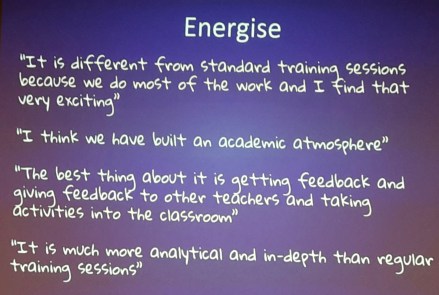
Give teachers a level of autonomy not only in how they deveop but what they develop as well. A level of choice in where they are going to go with it. This gives them ownership over it, making it more likely that they will invest in it and make an effort. Collaboration – try to foster it as much as possible.

Empower

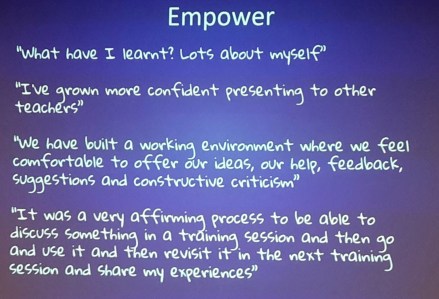
It’s a grand word but purposefully so. Often the part that is missed. It starts with follow up – meaningful action following whatever CPD so that development doesn’t stop at the end of the workshop. Feedforward – looking to the future and looking to help the teacher to develop, coaching them to be better.  Impact – reflect on the impact not just of the training session or peer obs but on the implementation and how it affects learning etc.

Transfer of learning into practice – if you add feedback and coaching into a session with theory and demonstration and practice, transfer increases dramatically.

Three examples of activities

  • Flash training
  • Personalised peer obs
  • Academic flair development programme

Focus not on what but how, this is how to put EEE into practice.

Flash training

Inspired by flash mob – short period of time, full of energy, memorable. Good for busy times. A simple way to do a CPD exercise that doesn’t need a lot of time. You only need 20 minutes.

  • Look at a current practice. (How do you…? How often do you…?) Input some fresh ideas – a few practical ideas or resources
  • Action (What will you do this week with what came up in the session)

The following week for 10 minutes you have reflection – they can reflect on how it went, they can invite a peer in to observe for the specific period where they are doing something and focus on that particular point.

Personalised peer observations

Trying to move away from the lottery element where you go in not knowing what you are going to see, maybe see some good ideas maybe not, maybe put them into practice maybe not.

Decide on a personal focus (what is it that you want to develop in your teaching); construct an observation tool that targets this element; go and observe a lesson using that tool; reflect with peer and design an action plan. (E.g. swap and be observed using the tool you made)

Academic flair development programme

The opportunity to explore beyond a single session:

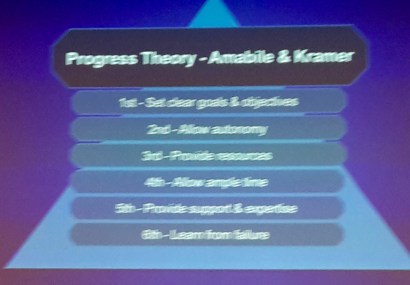
Progress theory – not just driving for the end goal but when workers (teachers in this case) can see progress, small steps of progress:

Exploring psychology in language learning and teaching – Marion Williams, Sarah Mercer, and Stephen Ryan

If you are looking to create a culture of CPD, focus on the nutrients, focus on the conditions, and amazing things will grow from there.

2. Are we really supporting new teachers?

Alistair Roy, manager of a BC teaching centre just outside Madrid.

Why this topic?

He has been teaching for 12 years, has worked for 6 dfferent schools and had 12 different posts. A lot of change, a lot of coming and going has been seen. Out of those 12 posts, only in 1 of them has there been a proper mentor and mentoring process. 26 – the number of people he has “mentored” in his career apparently. In one year he remembers having 7 mentees at one time, which is basically impossible. In Sept 2017, he started his latest role of manager. He had no mentor or induction. He got a phonecall on Friday and was told to start on Monday. He also had to deal with two brand new teachers when he was also brand new. When he asked other centres for help, he got checklists with things like “Do you have an ID card?” to use with the teachers. Not mentoring. He has since spoken to 24 different teachers about this issue, to show the teacher’s point of view of mentoring.

Do you remember your first day in your current job? Was it overwhelming? Yes. Most common doubts: How do the computers work? Do we use course books? What? Where? What is the assessment policy? Is there an acceptable behaviour policy? Where are the toilets? etc.

Do you remember your first day as a teacher? In addition to all the above the fact that you have never taught a class alone in your life.

Scraps of paper were planted in the audience. Think of them as info, questions, doubts etc teachers have on first day of work. They had to try and hit him with them. 6 hit. So imagine 6 things stuck beyond day 1. The rest: the pieces of missed information.

On one occasion he gave a checklist to a T and most of the answers were I don’t know. Information overload had occurred.

Were you assigned a mentor? What should a mentor be?

  • a carer
  • a teacher (a leader)
  • a friend
  • not a soldier but a colleague
  • same level as you

A person who guides and supports by building trust and modelling behaviour

In one role, in a regular school, his induction programme lasted for the whole first year. He had an actual real mentor. Was one of the best things that happened to him ever. The mentor was in the same department, had a weekly 45 minute meeting built into the schedule. He was observed 9 times in the one academic year. Had the chance to observe 4 peers. He had a structured training programme provided and a training record that he could take with. He was given a bi-annual appraisal.

In the next role, a private language school. There was…none of the above. He was given in-house training from unskilled owners (never done a CELTA). He was given a contract and “the talk”. Then told to go teach FCE and Advanced. He didn’t know what they were.

91,7% of the people he spoke to have never been given a mentor.

What makes a good mentor?

  • good communicator
  • well organised
  • approachable
  • available
  • honest but fair
  • diplomatic
  • understanding
  • objective

What should a good mentor do?

  • make time
  • share experience
  • set a journey
  • be curious
  • be inquisitive
  • help the mentee self-assess
  • share
  • reflect

What can managers do?

  • invest – not just economically
  • dedicate time and resources (give teacher and mentor time to talk together)
  • support
  • understand (don’t forget what it’s like to be there)
  • a good teacher is your best resource (if you don’t keep them, you’ve got nothing)

After 5 years, 91% of teachers who have a good mentor stay in the profession. That falls to 71% if they don’t have a mentor. Quite a distinctive difference. Highlights the importance of a good, structured mentoring programme.

3. Personalised Development Groups: A framework for collaborative, teacher-led CPD

Josh Round and Andy Gaskins

Personalised Development Groups is shortened to PDGs.

  • Research underpinning approach
  • What are PDGs and how to do they work?
  • Evaluation – how personalised and effective are they?

Traditional approaches are one size fits all, the focus is decided by the manager or trainer (top down), easy for participants to consume passively, probably not much follow up, minimal impact on practice.

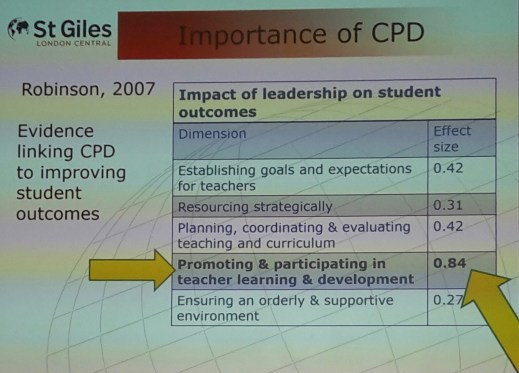
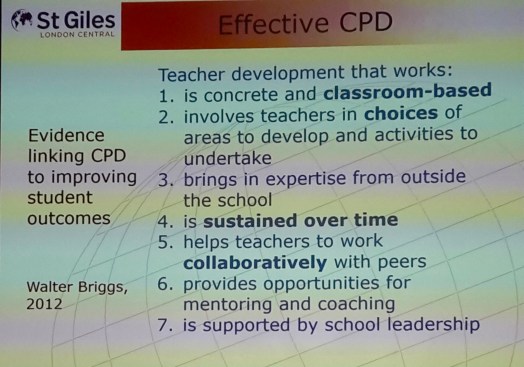
There is a lot of research available now on the importance of CPD and its impact on improving student outcomes. Need to make this clear to the teaching team, is not just a tick box thing.

E.g. of research

(Josh highlighted the highlighted words.)

Need to move away from transmission of knowledge and skills to something more collaborative. reflective development, creating learning communities.

A fresh approach to CPD

They wanted something less top-down. They would always have a person at the front talking, who gets more out of it as they had to prepare it. They wanted everyone to get more out of it. It was always Friday lunchtime and then it was the weekend all was forgotten.

Instead: less topdown and fragmentary and more personalised.

PDGs

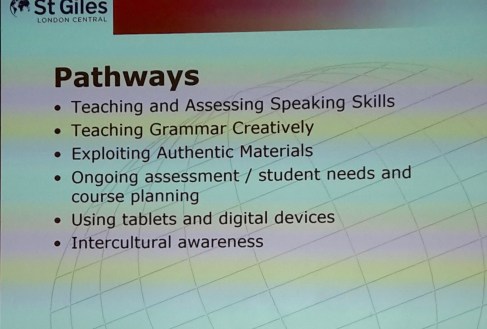
Pathways – broad areas of interest for groups to work on (some their ideas, some from the teachers – areas that would benefit the school or teachers were looking for more support or to refresh their practice) e.g.

Running the sessions: a balance between freedom to take ownership and support/structure to make it more beneficial.

6-8 teachers pr group, given a framework (the action research cycle) but left to the group to decide how to do this. Everyone gets involved.

Action research – qualitative and descriptive, observing what’s going on in the class, reflecting on that, implementing some kind of change.

  1. question (not easy, some groups took a few weeks to get going – useful to give prompts to help them get started, possible ideas to explore for each of the pathways.)
  2. Small change (take ideas into the classroom, doesn’t have to be huge, very narrow, very focused – decide what to do)
  3. implement (do what you have decided to do, be transparent about it, tell your learners what you are doing)
  4. observe (questionnaires, observations, interviews, teacher diary – simple things)
  5. reflect (talk about what you’ve done in your group, think about what to do next)
  6. repeat

How did it work? How was it received? (Evaluation)

They started doing this in Sept 2015, now in the 6th cycle, it’s been established, got going, has become a norm. They have done some staff surveys after the first cycle and at the end of last year.

  • 83% of t’s and 96% agreed it was effective
  • space and time to explore something they are interested in
  • take away practice ideas and experiment in teaching practice
  • In the first round a lower number thought it helped them discover new resources but in the last round 100% agreed.
  • High rates also for agreeing about it making a more reflective teacher and improve confidence/skills

Why do they sometimes not work so well?

  • absence or sickness
  • lack of structure
  • some members do not contribute much

Enthusiasm of early adopters can have a positive effect, that is what you hope for  to sway more reluctant ones.

At the end of the cycle, they do feedback presentations. So you (manager) finds out what has happened. Each group really wanted to tell/elaborate/share – each group gets 30 mins. Everybody gets to participate. Also promotes new, stronger work relationships and ongoing conversation about teaching.

Every second Friday at lunchtime, groups meet. But also in lessons, in the classroom, in your planning. It isn’t tidy, it’s a bit messy, needs getting used to. Teachers make two choices from range of pathways and you try and get people in first and second choice. Takes some time to get going and take off.

jround@stgiles.co.uk


IATEFL 2018: Effective peer assessment as a step towards independent learning – Agnieszka Łuczak

Agnieszka is going to tell us how peer assessment helps develop learning independence and give us some ideas of how to incorporate it in our classrooms.

Why use it?

  • It increases independence and autonomy but also their responsibility.
  • It develops students’ knowledge of assessment criteria.
  • Students can learn from each others’ successes and mistakes.
  • If our students know what they are doing and are engaged in peer assessment, it reduces our workload. It’s a great thing to see students doing something useful for them and have a breather at the same time.

Students are often skeptical of peer assessment.

  • It’s my teacher’s job
  • I don’t want anyone to see my work
  • I don’t know what to say/write
  • I don’t want to hurt anyone’s feelings
  • There are so many mistakes, I don’t know where to start

Students might be too generous, too critical, lack confidence etc.

How to fight the skepticism:

  • Explain to your students why they are doing it (A usually tells them if you know how to do peer assessment, and help your classmate, you learn more about the assessment criteria and what I am expecting from you and you will be able to self-evaluate more effectively. Highlight that mistakes are very welcome in the class. Don’t be ashamed of them. Let’s use them, discuss them.
  • Provide the necessary tools: checklists, language to assess
  • Monitor: we need to be there and listening, as a safety net. Encourage learning independence but need to be there
  • Make it regular: practice makes perfect, if it is regular they will see the benefits. First they have to be trained it and then they need to practice it in order to become good at it.

How to include it in class?

Peer correction

Nominate an expert: Give them a bell. They nominate a student to give an answer. If the student agrees, they press the bell and if they don’t, they have to say why. Teacher is an observer and only helps out as a last resort.

Homework checking: Put students in groups. One student is the leader. They have the answer key in an envelope. This can only be consulted if students disagree. They need to discuss first “I think you were wrong here, I think this is right because…” This simple homework check takes 10-15 minutes. They become confident about the answers.

Proof-reading: Students proof read each other’s work produced in class and correct it. Give them three areas to focus on and check for e.g. words we learnt last week, irregular past forms and articles.

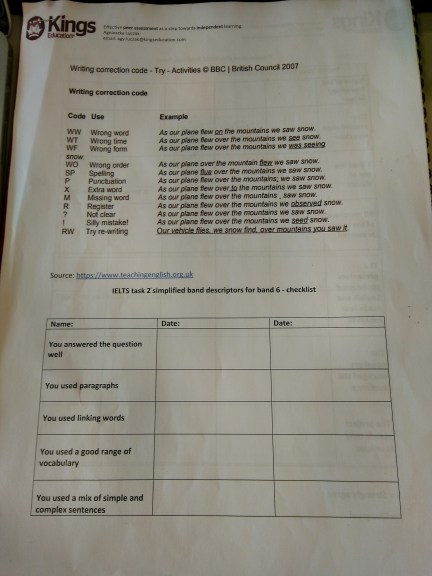
Correction codes (see handout below): Students need symbols and example sentences with errors highlighted. Then students create sentences containing different kinds of mistakes and then swap with a partner who needs to find the mistakes. This is something they don’t usually expect but are good at and they gain a better understanding of the code. Once they have understood the code, they can use it to look at their classmates’ writing.

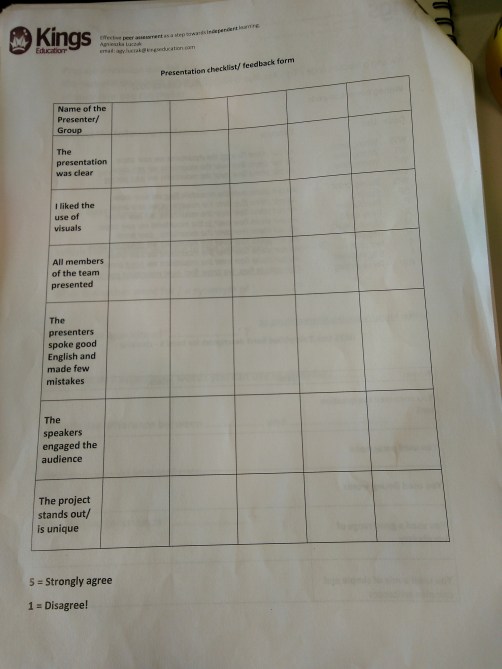
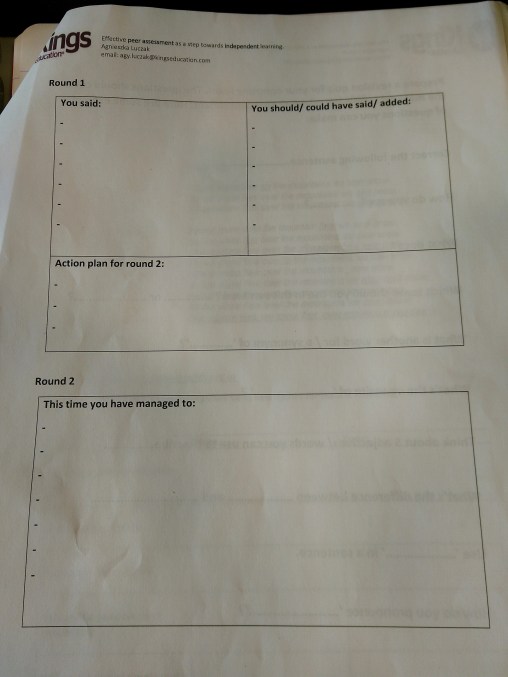
Checklists and feedback forms (see handout below): For presentations, for IELTS, for any kind of assignment where you have criteria. Simplify the criteria. Have one sheet with dated columns so that they can monitor progress. Use a likert scale and students have to justify the scores they give in discussion. “You said:…. You should/could have said/added… Action plan for round 2: ….. This time you managed to….” (She exemplified it using IELTS speaking exam practice – students in pairs, one is the student and one is the examiner. They make the action plan together. This can also be adapted for writing.

Monitoring the quality of peer assessment

Important to ensure that the feedback is useful. We need constructive feedback and it is not easy to give it. When students start giving feedback they don’t know how to do it. It’s a life skill so it is worth practising. So we need to give feedback on feedback. When students give feedback, A goes round and listens and writes down any good examples she hears. She writes them on the board for all to see. You could also draw attention to examples that don’t work. You can brainstorm useful comments and non-useful comments on a padlet and save them. Tutorials with study buddies could also be useful. Once a month A takes them to the computer room and sets a task for them. Then two peer assessment buddies come and work w


ith her. They give each other feedback on for example a piece of homework. She is there to help them and guide them. It’s very effective but timeconsuming and not easy to organise. Worth it, however, if you can, as students become more confident.

Testing


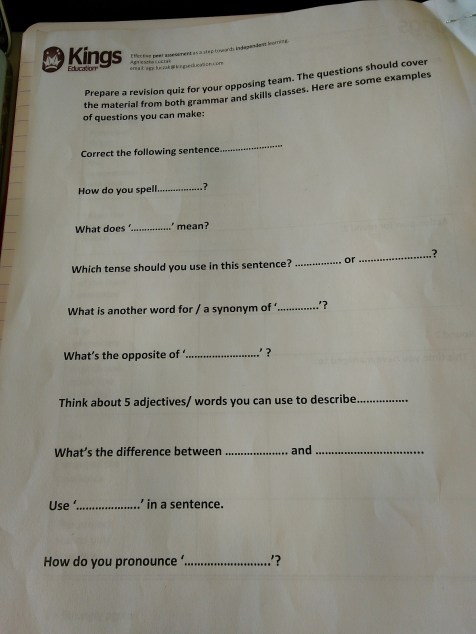
Get students to prepare questions.

  • Daily revision: students put questions in a hat. Play pass the parcel, whoever has the hat when the music stops has to answer the question. Hot potato: ask a question, throw it (a safe projectile) someone if they can answer they do or they say hot potato and throw it to someone else.
  • Revision quiz – 30 minutes to prepare questions, teams take it turns to answer the questions. It has the added benefit of making them practice making questions. Teacher is an observer/the last resort. 
  • Students, in groups, make a test for another group to answer.

agy.luczak@kingseducation.com

Question 1: how to deal with lower levels? Simplify the language used and build on it.

Question 2: what if quiz questions are repetitive? The first few times it might happen but as they get more competitive, there will be fewer. You could also get them to create 15 but only go through 10 so there are back up questions.

Question 3: What about teenagers? Make it more competitive, use a points system. With the correction code, let them create one.

I have done the putting students in groups to make up quiz questions for a review quiz thing before but I hadn’t thought of giving them question frames to help! 🙂 I like the checklists and feedback forms too. More food for thought! 

IATEFL 2018 “No-one told me that!” Top tips for new trainers – Beth Davies and Nicholas Northall

Last session for the day was with my CELTA tutors from days of yore and it really was like a trip down memory lane as well as giving me plenty food for thought. 

This session is for people who have been trainers for one or two years.

Five main areas:

  • Transitioning from treacher to trainer
  • input sessions
  • spprt with lesson planning
  • obs and feedback
  • dealing wtih trainees

We started with a gap-fill to make us think about what new trainers need to do. (See handout for details.)

Next we ranked possible features of an input session from 1-10

A sample of the possible features given

Depends on the context and who the trainees are – whether CELTA or Delta. All have some importance.

Support with lesson planning

We discussed a list of reflective questions.

A sample of the questions

These questions are things to think about. E.g. look at the plan before the lesson rather than doing both at the same time. `

Board game

Then we played a board game with dice and counters, in which we had to say whether we agreed or disagreed with the statement in the square we landed on and why.

A sample of the statements on the game board

Role plays emphasising people skills

The role plays, our final activity, were very detailed, setting up a situation and giving us instructions. I’ve not got any pictorial evidence, but basically in pairs A was the trainer and B was the trainee (taking it in turns) and we role played discussions in which we had to deal with issues that might crop up during a course (in fact they have been harvested from various courses over the years!)

The goal was to think about what we would do in that situation, basically like looking at case studies. You need to be able to cope with various situations that come up.

It was a great session, very action-packed and thought-provoking.

Here is the handout we were given:

IATEFL 2018 Opportunity and the unexpected in the classroom – Richard McNeff

Richard McNeff is a teacher and writer. He has worked a lot in Spain and the UK. Since 2000, for the London School of English in Holland Park. They have legal English groups and ESP groups with fixed timetables, they do Business and G.E. courses. Also do 1-1s.

His talk is about opportunities and the unexpected in the classroom.

Opportunity – working in a week cycle, no syllabus as such for longer than a week.

The unexpected – e.g. A year ago, he was teaching an south american girl and he asked if she was planning to stay here and make a life or go back to her country. She burst into tears. Her father had had a heart attack the day before and she wasn’t sure what to do.

It made him think and talk to colleagues about other unexpected things that happen in the classroom. Situations where the wires get crossed. He gives us some examples of these. E.g. giving a lecture about life in Britain and being asked to prepare a quiz for the teachers to use after the lecture? He used all his questions prompts. E.g. How many hours tv does the average Brit watch every week. The students all answered in the lecture. They had done the quiz before the lecture, which took away the element of surprise. To add to the joy of the occasion, the OHP started going off and on. So he had 100 people who knew the answer to everything he was going to ask and unreliable equipment. He somehow got through it.

He thought it would be interesting to ask colleagues about the unexpected. There was a lot about technology. One colleague was invigilating in an exam and a clock dropped on their head. Another, the whiteboard fell on them. This colleague turned it into a teaching moment, language for things going wrong. There was also talk about hostile situations. A colleague was teaching 4 students, Chinese, Japanese, Russian and Czech. She had to do a business English course. She had to abandon the course and focus on helping them overcome historical hostility.

Back to the South American girl, his question was completely inadvertent. Teachers do things and sometimes a reaction is unwittingly provoked. E.g. a colleague played a clip from Fawlty Towers. Mrs Richards said “The bath isn’t big enough to drown a mouse in” and a student burst into tears as a friend had had a fatal accident in a bath.

We watched a clip with a teacher consoling a student whose family has died in a crash, focusing only on the language (a comedy). That’s called the insensitive language teacher and isn’t what you do obviously.

When he is talking about opportunity, he is talking about something different. Often things come alive when students go off on a tangent. When they move off piste/plan. You get a much more living, real world situation. Trainee teachers tend to be terrified of something unexpected cropping up because the lesson plan becomes the puppet master. But when students bring things up themselves, everything becomes more alive and interesting. When students ask questions, particularly if they think you won’t know the answer, they all sit up and get interested. He used to feel guilty and think this was digression, going off subject. It can become counter-productive but when it’s valuable or enriching, it can enrich the teaching experience. A teacher in his staffroom said no no no it’s not digression, it’s affordance. “To provide or supply an opportunity. A class can afford you opportunities. This doesn’t mean that you don’t go in prepared. But if something comes up and you think it’s valid, go with them on that journey.

E.g. vocabulary for talking about tax became a springboard for discussion about the topics. The internet comes to your aid with this as you can get the information you need as back up. In the last couple of years, Brexit has been a subject they all want to leap on. Questions about vocabulary or grammar. Queries about life in Britain (in his case). Can you give any shape to these incidences?

Routines – every so often when something comes up, you can impose some order on it by:

  • tenses
  • explaining differences in meaning
  • reference other classes you’ve taught
  • talk about origins of words, etymology (using the story of words)
  • give lots of language feedback

Getting them to use street view to show you their home can provide lots of affordance. The internet is an affordance engine.

“The objective is not to tame the chaos of language but to encourage learners to appreciate the dynamic qualities inherent in its use” (Maurice Claypole, Guardian Education)

Very time-defined ESP courses or exam courses, need to be more careful but there are still affordances there.

You don’t follow everything that comes up, you need to develop an instinct for knowing if it is worth going with/will afford something positive.

IATEFL 2018 Dealing with diversity in the classroom – Geoff Tranter

Geoff is from Techische Universitat Dortmund.

His talk today will focus on the following:

  1. Details of courses
  2. Aspects of diversity
  3. Examples
  4. A macrostrategy approach

He has a B2 – C1 for Engineers and for Business  and a C1-C2 for all faculties. 15 weeks 2hrs per week face to face, 1 hour home assignments, lecture theatres, no coursebook. Generally around 20 students. Differing levels of interest and language learning backgrounds, different school backgrounds, different nationalities and backgrounds, different levels of language awareness, both intrinsic and extrinsic motivation, high work load in main studies. They have little idea of difference between spoken and written language, how to give a presentation, different reading/listening strategies, little idea of how to learn, wide range of language accuracy, more and more English is L3/4, wide differences in world knowledge.

Lots of diversity, in terms of students/participants, expectations, motivations, lang learning strategies, awareness, level and skills, strengths/weaknesses, specialist and general knowledge. We also looked at the many teaching objectives that Geoff has to meet.

How to individualise within a large group so that each student has an equal chance of improving? Need an overall strategy to ensure that all aspects are covered and exploit full potential of in class and out of class learning.

He has four examples for ESP Business English and we looked at one for…

Bitcoins – We went through a lesson plan for Bitcoin which was very learner centred, using learner generated questions, learner generated language etc and another for Nationality and Fast Food. Really interesting plans and assignments that bring together all the content and language that the lessons generate.

If you are interested in having a look at these plans, email Geoff at geoff.tranter@tu-dortmund.de  and he will be happy to share his slides as a pdf.

Macrostrategy

  • Kindle interest
  • Offer opportunity to demonstrate/acquire content/knowledge (In Bitcoin, 14 had little idea and 1 knew nearly everything, so they were able to learn from the 1.)
  • Offer sub-topics to choose from (headlines, aspects)
  • Allow learners to choose and form groups
  • Offer variety of texts (reading/listening/watching)
  • Incorporate all relevant skills and sub-skills
  • Let the learners find answers to their questions
  • Provide appropriate contextualised tasks for individual subskills
  • Use the learners’ assignment texts as the basis for language work
  • Give feedback
  • Establish transparency (tell them why they are doing something, helps them learn how to learn) otherwise it’s like the dentist, fill your mouth with metal and you can’t ask and when it’s finished you are so happy and just want to run away not ask!


IATEFL 2018: Versioning coursebooks for different contexts: What, how and why? – Heather Buchanan and Julie Norton

Heather and Julie, some of the authors of Navigate, while at OUP came across a room that was full of different versions of Headway and this was quite a revelation to them. They wanted to find out more about it as there is not a lot written about it in the academic literature. Later in the session we will be doing some versioning but first we will hear about data collected based on three questions that were asked.

Versioning is making changes to a course book for particular conditions in a country or region. Can be categorised in three ways – market versioning (make it suitable for different countries/regions), customer versioning (for particular institutions who may request it) and cosmetic versioning (very small changes). Often retains branding and name but in some cases a completely different name. As the world and coursebooks become more globalised, versioning becomes less of an issue.

Task 1 – A double page spread from Headway elementary, to be adapted for the Middle East

  • can’t have women showing any flesh
  • no wine in the pictures
  • family is a safe area? not culturally offensive

…were ideas put forward.

Actual changes:

  • The vocabulary for boyfriend and girlfriend has gone, also the pictures
  • No asking the teacher questions
  • Names and images are different
  • People are all covered up
  • Fewer photographs, page looks simpler, more white space

This is not prescriptive, just an example.

Three research questions:

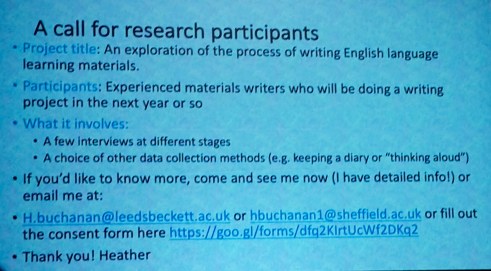
(H and J would like to add to the data if anyone in the audience/beyond has experience of versioning, via Skype interview.)

What is involved in versioning a coursebook?

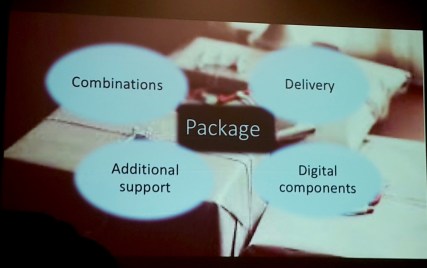
It depends! Course content, language content, might be making it more suitable for SEN, the package might change (e.g. combing student book and workbook or adding an extra digital component), design and image might change (fewer photographs, clearer font), rubrics in L1 might be added. Publishing cycle might influence versioning, affecting the extent of the changes that can be made.

What roles do different stakeholders play in the process?

Same stakeholders are involved. It’s like making a mini-product. Local focus groups will have a lot of input. Authors will have different roles – the original authors might decide and implement changes or they might not be involved at all or it might be outsourced to local experts.

How is the original text changed in terms of cultural content, language, methodology and design, and why?

Package

Digital components may be customised, additional support may be added. For secondary versions, additional support is popular e.g. including dyslexia friendly fonts in reading texts. This may be required by the customers. Student book and workbook for Italian secondary schools is common.

Cultural content

Doesn’t only involve taking things out but also involves putting things in. This may be the case with national identity for example. Local festivals, traditions and places might be integrated. There was also a concern to make sure that world cultures are represented in a balanced way, as well as including the familiar. Sensitive topics had to be removed e.g. references to religion or alcohol. Gender representation may have to be looked at. Language content might need to be geared towards particular exams that students have to pass. Content for discussion topics would need to be carefully considered and appropriate.

In Headway Plus there are more photographs of males than of females in the book.

Language

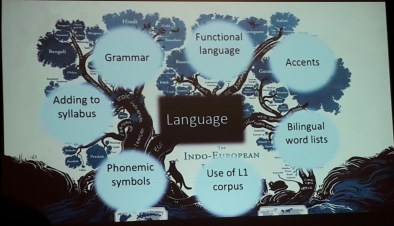
Might include more exam practice. Language doesn’t change that much but the grammar syllabus might change e.g. in American courses book, the present perfect. Levels of formality might be different too – more direct in American versions. Accents needed to change and the audios to represent the right kind of cultures. Bilingual word lists could/should be added for certain markets. Phonemes/sound charts might be different too e.g. American vs British. Minor changes.

Methodology

An area you don’t tamper with so much. You start with the best fit so fewer changes are necessary but an example of a change could be including L1 rubrics, as in a German coursebook they looked at.

Design

Images change e.g. in terms of clothing. If there was foresight of a version becoming available, the photoshoot might be done with two shots for any given image. The covers tend to be recognisable for the brand similar but a little bit different. Where there is a script different, having more white space makes a big difference. In America there is a single column to a page usually while in the UK there are two. Changing accordingly may or may not happen. If multiple images aren’t comissioned at once, stock photos may be used instead. E.g. the example of the kitchen where in Headway + no people rather than with a bottle wine. Seamus McSporran with 13 jobs became the man with 12 jobs to eliminate the one where he delivers beer in a barrel!

Political Concerns

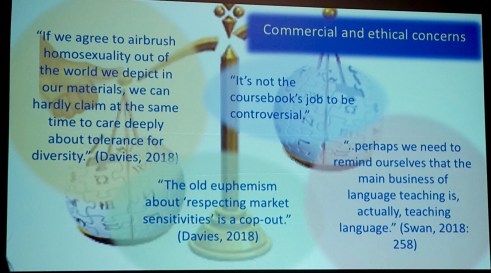
Versioning aims to make materials relatable but it involves representing the world in a particular way which raises political, ethical and commercial concerns. Coursebooks determine the nature of what is presented in the classroom. What about diversity and incidental representation – the question raised is “Could we have a little bit of diversity in the background perhaps? E.g. a wheelchair user in the background of a photo” – Would that be useful?

Comments on this was left for later on…

So where do we go from here?

Hugh told us that in the Belgian market has welcomed lots of traditionally “taboo” topics.  Versioning can enable this.

Another member suggested there is more scope for considering how to include diversity for a conservative market. Also Muslims need language to express I don’t eat/drink pork/alcohol because… However, another said that the Ministry of Education in Dubai would remove it and heads would roll.

I managed to squeeze in my question as the last of the day: Do publishers ever version course books for the UK? The response from the speakers and the audience was not to their knowledge…

And a final request:

IATEFL 2018: Labels – not the way forward! – Adrian Tennant

Adrian Tennant is a free lance teacher trainer, writer and consultant who works in a lot of different contexts world-wide. He plans to talk for 15 mins and then have time afterwards to discuss things. His talk is on labels.

Last August, he watched a programme on BBC called Without Limits. BBC had put together 6 disabled people to travel round Vietnam sightseeing and trying out things. One with autism, one who had lost an arm, one who had lost her legs. While he was watching that, he was a bit queasy by the whole idea and then one of the participants said they weren’t sure whether to take part as originally the title had the word disability in it while they prefer difability – different ability. Likewise “non-native” means lacking, not being something.

He saw a quote on Fair List, written by Allport – The human mind must think with the aid of categories….Once formed, categories are the basis for normal prejudgment. We cannot possibly avoid this process. Orderly living depends upon it.

Adrian asks if we should have disorderly living then. He doesn’t think orderly living depends on categories and labels. They are divisive. They are social constructs to create categories of us and them. He also thinks positive discrimination is an oxymoron. The only examples he has come across, particularly in education, have failed. E.g. universities in South Africa have dropped from being ranked in the top 2 or 3 to much much lower. So we need to be careful about how we go about trying to removing bias. It’s not that he doesn’t believe in equity, he does, but castigating people because they are a certain thing and it worries him.

We had to discuss gender. It can be a spectrum or you can say there as many genders as people who say they identify as x gender say they are. Adrian went on to say a mixed ability class is stating the obvious. There’s a couple of groups advocating things like gender equality and native-non native equality. In this case you are still categorising and labelling using the same kinds of labels being used all along.

He wants to propose a new framework. Which is “Do you have the competency to do the job?” = subject knowledge, communication skills, patience, compassion… what they don’t need is to be a particular gender or nationality. As a profession, we are still wedded to labels. By using labels, you are setting people up in those constructs, which perpetuates the issues. What competencies do you need to be a good conference presenter? Something new to offer, able to tailor to the audience, confidence, self-assurance, charismatic.

For the rest of the talk, there was discussion about blind selection (an example was how the number of female players in an orchestra doubled when the selection was done blind) and about labels with negative connotations (reluctant reader). One lady said she had been approached to do a plenary because the conference in question didn’t have enough female speakers. The question being “do you only want me because I am a woman then?” . I couldn’t get a word in edge-ways but my feeling was that it’s all very well having a competency approach but the characteristics we came up with in terms of what you need to be a good presenter are things that you need experience of presenting in order to develop them. And if traditionally a certain segment of the population has been favoured, they will have developed those competencies more so than people who haven’t had the opportunity. However, this all seemed to be more about selection than labels as such. I think labels are useful, personally. It’s how we use them, the connotations we attach, the prejudice we attach that is the issue. Otherwise, it’s all vocabulary and we need vocabulary to discuss issues. 

IATEFL 2018: English teaching in the post-truth era – James Taylor

My first session for Wednesday is James’s talk about English teaching in the post-truth era, conveniently located in the same room as my own talk which was in the first slot of the day. 

This isn’t about teaching students to think, or teaching them politics or make them think like us. It’s is, however, useful, to provide them with tools to enable them to interact with this media in a way that they can make informed decisions.

In 2016 a survey showed that 44% of American adults get their news from Facebook. So adults are mainly sharing these stories around without questioning them. They are just as much in need of these tools as young people. People make assumptions, put 2 and 2 together and make 10. (Or, daisies + mutations = Fukashima) In a study using the mutated daisies image was so powerful that the source was ignored. 40% students argued that the post provided strong evidence because it was taken near the power plant.

Distinguishing what is true from what is not true is an important skill. Exposing fake news, being aware that there is fake news, is key. In the future, we may see videos created of people saying things that they have never said – technologically becoming possible. So the issue that we find with images and text will be seen with videos too.

Key skills for identifying fake news

  • ability to discriminate between a trusted and an unreliable source. Need to be able to step back and make judgements, questioning the reliability.
  • need to be able to recognise when verification is necessary (not enough time to do it All The Time)
  • internet literacy (URLS, links, About section, date of publication) If there are no links, it’s a red flag, why isn’t it linking to another source of information. If there is no information about who is behind the site, historical background, author background/qualification to talk about the subject. Something true 10 years ago may not still be true now.
  • recognising bias – essential for reacting critically rather than taking something at face value
  • Finding a source – finding original source material to find out what was actually said (e.g. in reporting of scientific studies)
  • Cross-checking against other sources
  • Using fact-checkers (lots of good ones online e.g. Snopes)
  • Identifying satire e.g. The Onion, fake, meant to be fake, meant to be funny, not meant to be read as truth. Need to be able to identify jokes!
  • Preventing confirmation bias – i.e. ignoring all the things that go against what you believe. We tend to look for reassurance/to have our opinions backed up. But that creates the echo chamber and you lose access to the truth.

[This is exactly the kind of thing we try to teach our students to help them find good sources for their academic writing! We call it source evaluation. Though not the last three in this list.]

There are lots of resources to help with this. I suggest you look through James’s blog post for these

As English teachers how do we see ourselves? Are we grammar and vocab delivery systems or can we do more than that? We don’t have a subject (e.g. history), we can talk about anything we like. So we can work on these kind of skills in the classroom while teaching language.


IATEFL 2018: Social Intelligence for Teachers – Margit Szezty

What is Social Intelligence (SI)?

It is the ability to get on with others, to interact with others, successfully. Based on a deep connection, with yourself (aware of own feelings and emotions) and narrowing the gap between how you think you come across to others an how you relly come across to others. Also based on a connection with others, being aware of how they are feeling, being able to connect with them and tune in to them. In some ways it’s about switching off the autopilot. It is also about impulse control – the gap between impulse and reaction. E.g. in a social situation when you want to respond to something that someone has said, that is your impulse, what you actually say is your reaction. There needs to be a pause between the two.

Surface and deep level features

3 surface-level features (visible – have to do with behaviour and speech):

  • starting a conversation with someone (in itself not so easy sometimes)
  • directing the conversation (many conversations are ritualistic at the beginning, in order to move beyond the superficial you need to direct it rather than letting it happen to you)
  • speaking with clarity and turn-taking (don’t monologue)

Deeper level features

  • Mindsight (able to read other peoples’ emotions – perhaps by facial expression, tone of voice, pace; not just  hearing their words)
  • The ability to hold ideas loosely (being able to cope with ambiguity in conversations and not being disturbed by it. You say something with precision but then you let go of it)
  • Awareness of other people around you, aware that you are sharing time and space with others.

SI has an individual and a group dimension. It’s a property of the individual but it is also the emerging property of a group. You can activate it, then if the group is acting intelligently, they are harmonised and together and a group mind is activated. Margit asked us to estimate how many people were in the room and how many countries are represented, to make us more aware of the rest of the people in the room. In order to estimate the number of countries, you have to have a closer look. In a classroom, asking who is absent can have the same effect (makes them look more carefully at the group as a whole).

<Word association game in groups.> To have a discussion in a group, you need to move into group mode first. That was the purpose of the game.

Why do teachers need social intelligence? Three circles – in the middle classroom. Lots of relationships. It’s important for teachers to know what is going on in the classroom and be able to pick up signs of anxiety, excitement etc and work with it. The second circle is society. Students and teachers move in and out of the classroom into society, where collaboration with others is often required. E.g. workplace, family etc. Learning to work together and collaborate is important. The third circle stands for the living planet. The very carefully balanced ecosystem around that we are part of. One of the most important things are social intelligence is about connection, with self, with others, with the planet (which humans seem to have lost). If we go on endangering it, we are endangering ourselves. It is not our individual activities, it is the cumulative effect, the total sum, which have unintended and ‘invisible’ consequences as we live in a comfortable, convenient micro-world. We need to move into the third level to be more aware of our effect. Social intelligence is intrapersonal, interpersonal and ecological.

Tools for raising awareness of SI

  • 3 positions and NLP – not physical positions but perceptual positions. Our three main positions are 1) the Me position (as a teacher, this is my lesson plan, this is what I want to do/achieve) 2) the You position, the empathy position (looking around and picking up on others’ feelings. It can be a bit overwhelming.) 3) The helicopter view (The ability to stand back and see the situation – yourself and your students – from the outside. Useful when things get overwhelming)
  • 6 thinking hats – Edward deBono identified six different ways of thinking, each given a different coloured hat. Red is impulsive, gut reaction thinking, White stands for information, collecting facts and figures. Yellow is positive thinking. Green is creativity. Blue is the overview hat (like the helicopter view, the awareness hat)
  • Stories – Margit told us a story abut a deep dark forest with two protagonists. 2 men are lost. One is blind, the other is lame. They have been wondering around for ages trying to find their way out. They meet and start talking. The man with the vision has a thought – sees a powerful, young man, and suggests that he get on his shoulders as he has good eyesight but cannot walk, and together they could find their way out of the forest. This is what happens, and out they go.

Enemies of Social Intelligence

What makes it difficult to be socially intelligent?

  • Fear (of failure)
  • Being programmed
  • Upbringing
  • Cultural influence

Individualism and collectivism can both affect social intelligence/not favour it. One of the biggest obstacles is authority. Being able to think critically is important.

IATEFL 2018 Queering your pedagogy: teachers’ queries out of the closet – Giovanni Licata

Giovanni is head of TT at IH Rome Manzoni.

Task 1: We had to a look at a picture of his hand and discuss what we could tell about him from the photo. (He plays a guitar, is left-handed, is married, likes rings… maybe… we will see…) Task 2: Complete the statement “I have nothing against LGBT people but..” The reason for this slide is that sometimes we talk about queering pedagogy but are teachers really ready for this? The question is “Can I come out?” The answer appears to be “You can! But don’t be ostentatious!” He had a conversation with someone who had nothing against… but doesn’t see why we always have to talk about our partner etc etc. Yet she was doing the same thing… Enter…

Heteronormativity

“Heteronormativity consists of those structures, institutions, relations and actions that promote heterosexuality as natural, self-evident, desirable, privileged and necessary” Cameron and Kulick, 2003. E.g. There are lots of interviews asking straight actors what it’s like to play gay characters but not vice versa i.e. gay actors playing straight roles.

Two main things involved in teaching and LGBTQA+ teaching materials.

  1. Inclusive materials
  2. Teacher attitude

1999 – Thornbury stated that LGBT people are still in the coursebook closet. In 2013 not much had changed. Ten famous coursebooks: no reference to any sexual orientation other than heterosexual. Some books use the problem approach – lists gay families under issues alongside gun control, prostitution, child abuse…can we see the issue with this? There is also the “mentioning approach” e.g. mentioning uses of the word ‘partner’ and the “Inquiry approach” – let’s adopt a multisexual approach and problematise ALL sexualities.

Unpacking heteronormativity

We looked at a coursebook spread about “Getting married” from Headway. Giovanni had to teach this lesson last minute a couple of years ago. He started with “What’s missing? Talk to your partner” – Older people, same sex people etc.

Giovanni isn’t suggesting we ignore the approaches discussed so far, but wants to add “The GPS Approach” – help teachers get started.

He did a study on teachers’ attitudes towards LGBTQ themes in their classes. The findings were as follows:

Respondents welcomed both an inclusion and inquiry approach as long as they receive training and operate in safe environments.

A teacher with a CPE certificate felt they didn’t have the words to talk to a gay flat mate about it in a respectful way.

The cons they came up with:


could be dealt with:

  • in CPD training, by having a seminar on it (rather than the 1000th one on teaching vocab)
  • getting schools actively involved
  • getting publishers involved (!)

A simple task

  1. The others: a simple task – learners to go through their coursebooks and have a look at what’s missing. Then they design a course book page to include these “others”.

Here is a list of “the others” that a young class in Giovanni’s school came up with:

They made some excellent materials including people from their list of others. And no juniors or teens were harmed in the making of this lesson…even when queer themes came up. :-p

Why is all this important?

Morgan (2004) “there is no neutral space in schooling, no ways to insulate oneself from the social consequences of one’s activities” (p176)