
This double-act webinar was done by Mark Heffernan and David Byrne. You may have come across this duo at IATEFL if you attended. They also have a column in Modern English Teacher, who hosted this webinar. I haven’t encountered them before, but it was a really good webinar – if I were to attend an IATEFL in the future, I would totally look out for a session of theirs in the programme!
If you are they, or you attended the webinar, and see any mistakes in my notes-based summary, please comment and let me know!
The outline was as follows:

David particularly highlighted the idea of “Help your learners to find/make decisions”, saying that the role of teachers has changed over the years. We used to be arbiters of right and wrong, but now, we are facilitators of learning and discussion, our role isn’t to say what is right or wrong but to show possibilities and allow learners to make choices.
Writing
- Has AI changed how we write?
- Has AI changed how students write?
Yes.
Everyone (well, many people) uses it, to varying degrees of success, appropriateness and responsibility. If you don’t use it responsibly and effectively, it does wash out your personality/voice. In order to maintain your voice, you need to know what your voice is.
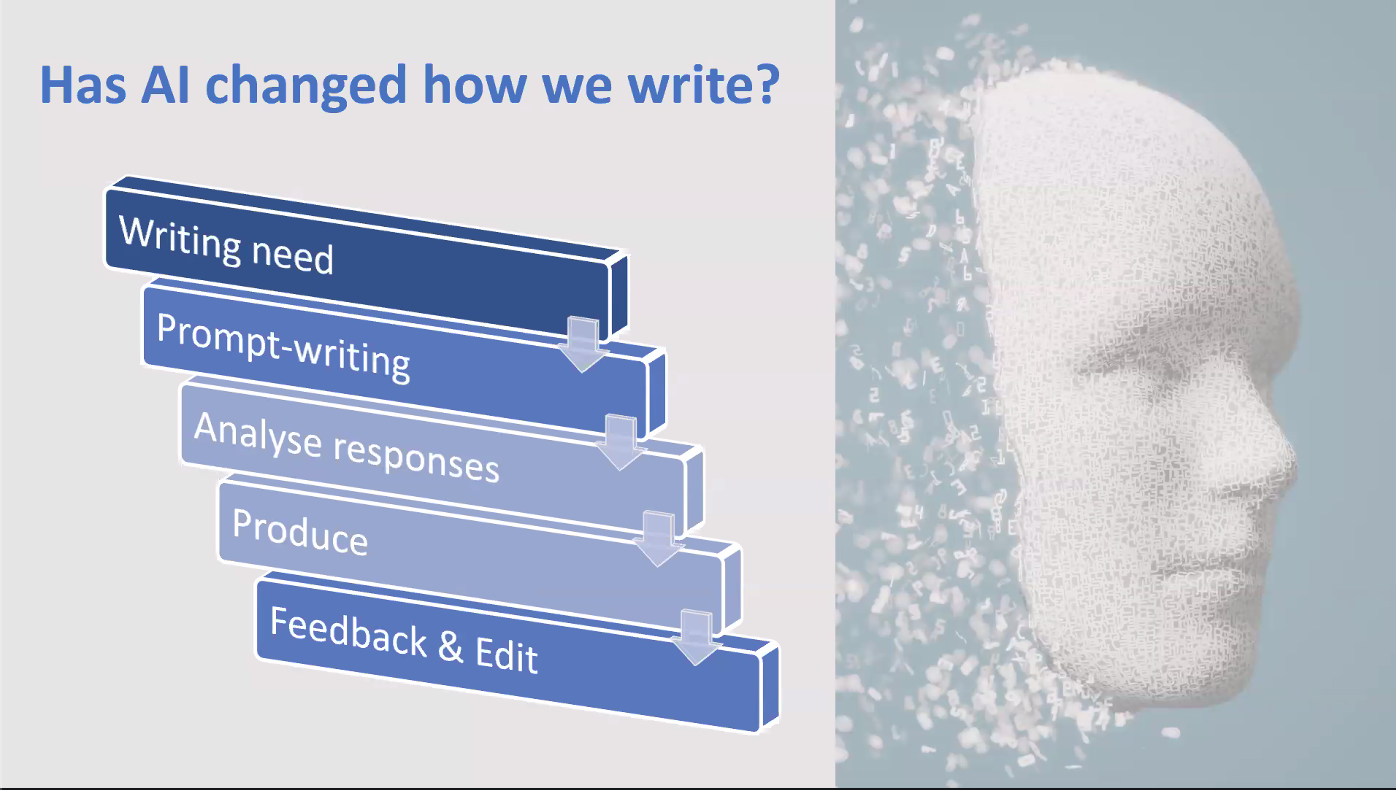
We have to train our learners on responsible, appropriate, effective use.
Questions we need to ask are: Who is the audience? What is the need (Why are you writing this?)? What role do you play in it? What role should/could AI play in this process?
E.g. a letter of complaint – if you will be all hedging/not cantankerous enough, you could use AI to write it and prompt it to add in some extra cantankerousness. If you are, you probably want your voice in there and will write it yourself. You have choices.
If we’re doing a test, AI is not appropriate unless it is built into the test. However, you could use it for brainstorming, ideation, feedback, suggested language chunks. It can be a learning tool. Most universities acknowledge and accept students using it in that way. What is generally prohibited is using it to produce text and submitting that. This is a change from two years ago and shows how things have evolved.
How do writers come across? How do you want to come across? It’s all about tone and voice.

The question becomes not did you get the grammar/vocabulary correct but is the text produced undeniably written by AI? If it is, it is not successful. If you have just pulled little language chunks from AI, then it could be.
You can teach a whole lesson on voice/tone but David/Mark suggest that is better to embed it throughout the course. Syllabuses tend to be spiral-shaped. Give students chances at multiple stages during the course to reflect and make choices. If we give them chances to do that, they have choices. It’s not a one and done lesson, appropriateness and AI can’t be a one off. It needs to be woven through. It needs to be scaffolded. The rise of AI has made it even more important than before to do this (teach about voice) but it was always important.
Speaking
When you speak, you portray a version of yourself, you make choices.

English learning and using depends on context: I need to be able to… so that I can… .
There is more than one correct way to structure an essay but we teach maybe the most foolproof way, the easiest way.
Hedging – it’s partly using modals, so it’s grammar but it’s also functional (you signal how sure or unsure, how strongly or otherwise you feel towards what you are saying).
David and Mark shared some possible activities for working with voice/persona by weaving it into existent activities:

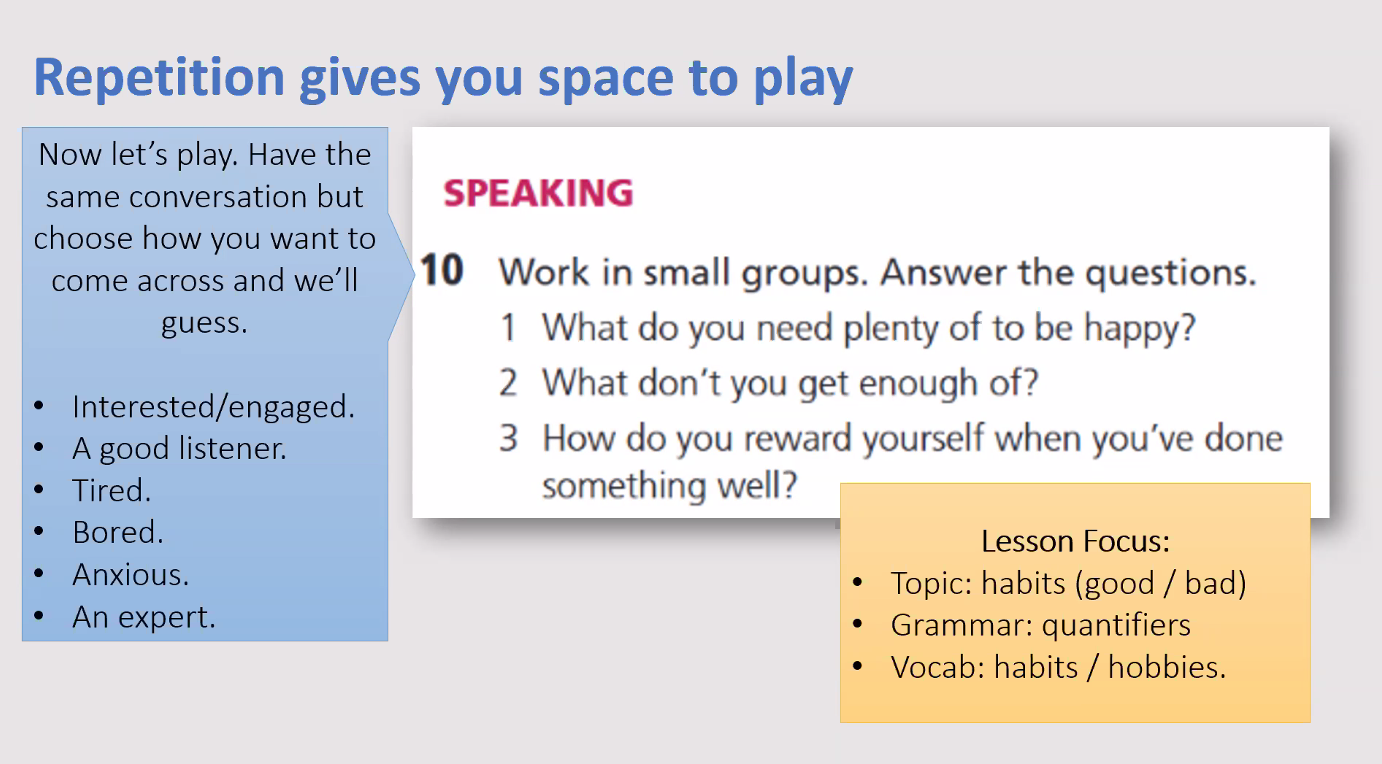
If you don’t show interest in what someone is saying, so you just listen and don’t say anything/interject etc, the speaker may feel lack of interest and lose confidence. If you see this happen in a discussion between students of yours, facilitate discussion of these kind of moments – e.g. this happened (X didn’t say or do anything while you were talking), why is that, X? How did you feel about it Y?)
My take-away:
We have seminar discussion exam preparation and then the exams coming up, and I want to try taking this approach to evaluating the example discussion recording (e.g. how did x respond, or not, how do you think y felt?), and to feedback on students’ discussions, and link it back to the language we teach them in order to enable participation. Get them thinking about what kind of persona they want to portray in a seminar discussion exam (e.g. engaged, knowledgable etc) and how to achieve that, as well as get them thinking about how to participate effectively in a real seminar. I might get them to repeat a practise discussion while playing different personas, to give them a chance to experiment.
In terms of writing (we are about to embark on extended essay writing on Monday!), I want to include more discussion of voice and, again, showing them that they have choices over how to express themselves in their essays and how those choices affect the outcome.
I feel I’ve come away with a load of ideas for how to slightly tweak what I already do, and hopefully thereby increase the value of it to my students: I call that a win! 🙂 Thank you Mark and David!
 Lizzie Pinard
Great summary of the webinar. Really glad you found it useful.
Mark of Mark and David